If you were to ask a Canadian to name the best hockey film, they’d have a fairly short list to work with. Where baseball has generated a fairly long list of films, some sentimental, some colourful, portraying various aspects of that sport, hockey hasn’t been fully captured on film.
The best hockey films?
Slap Shot, possibly Paul Newman’s best film, even if the way hockey gets represented isn’t terribly accurate. Yes I love the Hanson brothers, yes I delight in the profanity that’s woven throughout, but that’s not really what hockey looks like, fun as the film is.
The Mighty Ducks franchise made lots of money for Disney. And if you believe that’s what hockey is, perhaps I should introduce you to their talking animals, Mickey & Goofy, who can teach you a great deal about zoology.
Face-Off uses hockey as a backdrop, a romance rather than a hockey movie.
Miracle On Ice is a TV movie telling the story of the American victory in the 1960 Olympics. I had to look it up (wikipedia), which tells you how memorable it was.
But now there’s a new champ in town. Move over Slap Shot. I saw Goon today, never doubting for a moment I’d love this movie. Like Slap Shot there’s so much profanity in this film that it almost needs a special category all its own. When I said there’s a new champ in town I meant to allude to its subject because Goon is really a movie about one aspect of hockey, namely the fighter: the goon.
Written by Jay Baruchel & Evan Goldberg (adapted from the book Goon: The True Story of an Unlikely Journey into Minor League Hockey by Adam Frattasio & Doug Smith), directed by Michael Dowse (who also directed Fubar II) it’s a film as blunt as its title, yet full of surprises.
Goon uses music of surprising sophistication. While most of the score is rock music, at times we’re treated to different passages from Puccini’s opera Turandot, and not just the famous tune that ends with a hero defiantly shouting “vincero” (or “I shall win”).
The title character is one of the sweetest characters you’ll ever meet, even though he has the ability to knock you silly: when he isn’t doing the honourable thing.
Goon tells a series of interconnected stories against a backdrop of a very cynical industry, namely hockey. Our goon is Doug Glatt, portrayed by Seann William Scott, a man with no illusions about his abilities (he can barely skate), particularly in comparison to his brother (a doctor). Doug, who is an up and coming young fighter at the beginning of his career, is juxtaposed against a veteran at the end of his career, namely Ross Rhea, in a wonderful portrayal from Liev Schreiber, including something like a Newfoundland accent.
This is not a film for children, unless you’re okay with exposing them to sex, drugs and more blood than a butcher shop on a busy day. It’s grotesque, which is precisely why it’s so gloriously good.
To begin the voyage through Stewart Goodyear’s set on Marquis of the complete Piano Sonatas of Beethoven, I took two CDs, and listened to each one multiple times. While I seem to be jumping in at either end (CD #1 and CD #9) they represent a kind of logical place to start:
CD #9 includes the epic Hammerklavier sonata, Op 106 (sonata #29), that gave me my first introduction to Goodyear on youtube.
CD #1 contains the three sonatas Op 2, or in other words Beethoven’s first three
In each case there’s an opportunity to compare, both to the internet recordings and to live performances I heard in the “Beethoven Marathon”.
Performance can be understood as a kind of research. When you do something on a stage, on your toes, with your fingers at a keyboard, you are making propositions, and testing hypotheses. While the hypothetical element isn’t a scientific theory, one puts a particular reading—such as an interpretation of a piano sonata—to a test every time one sits down to play. One is especially aware of the hypothetical aspect when one encounters a performer going in a new direction with a well-known piece. The ears and eyes of an audience who think they know a particular composition may resist and may simply not understand.
Listening to Goodyear I feel certain that his mind embraces Beethoven with a calm clarity that lays the music bare before him, taking in not only the shapes of musical phrases, but an understanding of how to sound notes. He is different from what I have encountered before. Playing passages quickly may at first seem to be a virtuosic device, when one has always heard a piece slower. But I have discovered that by playing passages quickly one may discern the sense of the whole. This was my surprised discovery listening to the final movement of sonata #29.
I grew up listening to Schnabel. Then came Ashkenazy’s performance on Decca. I found Schnabel at times percussive, prone to occasional wrong notes, yet coming from a place that seemed inspired and driven by vision: which justifies the wrong notes and the occasional harsh attack. That sense of an inspire romantic is a 20th century tradition, whereby we smile and indulge wrong notes. Ashkenazy seemed so much warmer & more precise, but not as fast & furious as Schnabel. The newer recording of Ashkenazy (in the 1970s?) far surpasses the mono sound for Schnabel
Goodyear gives us the speed & ferocity of Schnabel, with note-perfect precision, and still better sonics. It should be more newsworthy. Why don’t people talk about this? But I guess Beethoven isn’t on MTV and Goodyear doesn’t have a reality TV show.
Coupled with sonata #29 is one of my favourites, namely #28. The Marathon had me looking for compositional parallels, thinking about how Beethoven takes up recurring ideas in subsequent compositions. When one listens to #s 28 & 29 together over and over as I have, one starts to see patterns. The choices of keys –so unorthodox for both sonatas—are particularly intriguing when one looks at the two works as part of one larger compositional journey, as one sees in the Marathon. Consider:
One sonata is in A, one is in B-flat.
The 2nd movement of #28 in A is in F: normally a key one would encounter in a sonata in B-flat.
The third movement of #29 is in F-sharp minor, the relative minor to A.
The introduction of the last movement of #29, beginning on F as one might expect segues boldly into loud crashing chords in A that strongly resemble the end of sonata #28.
And everywhere, phrases that answer one another. While it isn’t all contra-puntal, the writing is very dense.
Need I add that Goodyear plays both 28 & 29 with great clarity, at times with a muscular attack reminding me of Schnabel, but crisp and clean.
And then there are the first sonatas on CD #1. But Goodyear brings the same muscular clarity to bear on the early works.
The drama of the F minor sonata Op 2 #1 is infused with Sturm und Drang, a melodrama of great contrasts, very disciplined in its attire. There’s sentiment without sentimentality. Sonata #2 in A opens and closes with fast moving passages leaping up and down the keyboard, with understated drama in the inner movements.
And then comes Op 2 #3 in C, one of the highlights of the live performances of the Marathon. I remembered my sense that Goodyear could see deeply into the heart of the music, in the balance (or is it an emotional symmetry?) one feels in his reading. All four movements are marvellous, but the inner two are particularly fine. The slow movement is one of those delicate explorations of passion that we see in the early sonatas. The scherzo reminds me of the vaudeville show I saw yesterday, the voices dancing up and down the keys resembling –or inciting—a strong sense of hilarity, as if one were listening to laughter. And the closing movement is a liberating exercise in speed and delicacy.
I won’t stop listening to those two CDs (particularly when some passages continue to echo inside my head: a good thing). Now it’s time to hear more of the set.
It’s July in Toronto, which means it’s time for the Fringe Festival, the grand-daddy of them all.
Whether we’re talking about Summmerworks, Rhubarb, The Fringe, or one of the others (forgotten by my heat-addled brain) the premise is largely the same (with a few variations that matter more to participants than to the audience in my opinion). Sharing is the key, as several productions share the venues & the revenues generated by such a festival. They’re constrained by the rules to employ limited lighting & design, moving in and out quickly so that several shows can share the space each day.
The dream is alive. Producers & performers alike come to The Fringe in hopes that their short play might use this wonderful showcase as a springboard to various scenarios of bigger and better. How else to explain the incongruities one sometimes encounters, of tiny companies, the usual short plays (as stipulated by The Fringe’s rules), and amazing talent? The reason The Fringe is a can’t-miss proposition for an audience is the opportunity to see these shows in tiny venues, so close to the performers that you can hear them think.
Every year there are a few shows that get extra attention for reasons I don’t pretend to know. It’s word of mouth, whatever that really means. That’s how I heard about The Wakowski Bros: A Canadian Vaudeville, which was my first show of the 2012 Fringe. I was intrigued. Vaudeville? It’s a subject that fascinates me (Canadian or otherwise) and the venue is ridiculously convenient for me.
I was also drawn to Wakowski Bros because it’s directed by Alex Fallis, a Toronto theatre artist I’ve known for a very long time.
…the man who wrote book, music & lyrics for The Wakowski Bros: A Canadian Vaudeville
The funny thing about Wakowski Bros is how it’s simultaneously several things all at the same time, conflating its subject and style into one elegant package. It uses a vaudevillian delivery to explore something of the history of the form, even as it also tells a story about brothers (an irresistible topic for anyone like me who has a brother). The writing is a dazzling bit of meta-theatre, situating us in a performance that explores performance. We’re watching a vaudeville show about vaudeville, complete with bad jokes, sentimental songs, physical gags and a paper thin artifice. Although the tunes are original, written & composed by Wesley J Colford (who wrote book, music & lyrics), they have the disarming ability to make you think you’re hearing an old tune from bygone years.
Lorretta Bailey stole the show (as she said she would)
Sometimes Fringe shows become big hits, and are given extended runs, often in extended versions. It may be that Colford’s play can work in a longer version, but I am especially impressed at how powerfully it works in the short time-slot of a Fringe show. The ending surprised me –something like a discordant cadence—until I recognize that the last moments are likely Colford’s (or Fallis’s) way of showing us which of this play’s several threads is truly paramount (between comedy & music for their own sake, the history of vaudeville and the story of the brothers). Derek Scott and Duff MacDonald are wonderful brothers, although the show is stolen by Loretta Bailey as Caitlyn Rose McLean.
The Wakowski Bros continues at the St Vladimir’s Theatre (thankfully an air-conditioned venue), 620 Spadina Ave until July 15th.
Canada became a country July 1st 1867: one hundred forty-five years ago. July 1st is a day to count one’s blessings, to celebrate a compassionate and gentle country, a haven for so many wonderful people, among them great artists.
I’m thinking of such things as I ponder two extraordinary Canadians: one from the last century, the other from our own.
I grew up hearing about the brilliance of Glenn Gould. In fact I found that while some of his performances were excellent, others were quirky and even disturbing. What I admired was his refusal to sound like anyone else, to behave like anyone else, or to really care very much about everyone else. He is truly an iconoclast, unfettered by the usual procedures or conventions of his instrument. And as a result he went far outside the usual limits & boundaries of the piano, becoming a kind of larger-than-life spokesperson for music and for the arts in Canada. Because he’s so well known –and well documented—I leave it to you to confirm this for yourself rather than waste space on someone so firmly established in the Canadian musical imagination.
The other Canadian is Stewart Goodyear. To be honest I’ve been obsessing about him. He’s been coming into conversations that have little to do with Beethoven or pianism, because again, Goodyear is not following the usual rulebook.
Last month I heard a portion of Goodyear’s Beethoven Marathon, a performance of all 32 sonatas in a day, an undertaking denigrated as an attempt to attract attention. While the concerts did deserve attention –especially considering the pianist’s remarkable approach—they fit nicely into the tradition of piano virtuosity. But the Marathon was a happening, going far beyond what I’d expected. Accompanying the performances were a series of poetic commentaries every bit as unique & witty as the writing we came to expect from Gould. You can see Goodyear’s liner notes here.
I believe Goodyear deserves the kind of worldwide attention that Gould received half a century before, as much of an original thinker, as daring in his interpretations, and yes, at least as fine a pianist. Gould attracted the spotlight with his daring reading of Bach’s Goldberg Variations more than half a century ago, in 1955. I don’t know whether Goodyear can have the same impact when part of Gould’s impact was upon a public who by and large didn’t know those variations that put Gould on the map, and came to be smitten with the composition as much as with the playing. At least some of Beethoven’s sonatas are among the best known compositions for the piano.
Yet from what I’ve heard so far, the young pianist is every bit as original as the one who came before.
I’ve obtained Goodyear’s new release of all 32 piano sonatas on the Marquis label, available online as well as in record stores. I will be writing about them in more detail in coming weeks. Based on what I heard in the live concert, where the young pianist had every note in his head, and a clear interpretive vision unlike anyone out there, and what I’ve heard of the CDs, Goodyear could change the way we hear Beethoven.
Is it early to be talking about the 2013 bicentennial of Giuseppe Verdi & Richard Wagner? Not when papers to be presented at conferences next year are already being proposed.
Both composers were born in 1813.
Let’s get to the most provocative –and superficial—question right away. Between Richard Wagner & Giuseppe Verdi, who is more important?
Each composer was involved with politics. Verdi? his influence is remembered mostly with nostalgia, part of the mythology of Italian unification.
Wagner’s politics were riskier, considering his lengthy period of exile.
If it’s simply a popularity contest –answering the question of which composer is performed more often—I think it’s a slam-dunk for Italian Giuseppe Verdi. According to the most recent list of operas ranked by popularity Verdi was among the most popular, whereas Wagner was not. An older version from about a decade ago cited four operas in the top 20 from each of Verdi (La Traviata, Il Trovatore—to be presented by the Canadian Opera Company next season—Rigoletto and Aida), Puccini (La boheme, Madama Butterfly, Tosca, and Turandot) and Mozart (The Magic Flute, Marriage of Figaro, Don Giovanni and Cosi Fan Tutte).
Why would popularity matter? In the cinematic world critics have heaped contempt upon films whose only claim to importance is their box office success. Avatar was ignored at Oscar time. Why would popularity matter? Perhaps because it’s an objective yardstick in a realm otherwise dominated by subjective speculation. Critics have largely persuaded us that commercial success is a kind of liability, perhaps because that would mean the task of identifying quality does not require a PhD or esoteric knowledge. If popularity matters, then critics would have a difficult time justifying their roles as arbiters of taste.
Perhaps that’s one reason why most academics would be more likely to observe the bicentennial of Wagner rather than Verdi. Why? I suppose I could take a poll (ha: speaking of popularity).
Wagner’s impact isn’t limited to opera. But even if we were only speaking of opera, I wonder if it would change your perspective if we consider that the two most popular composers of the first half of the 20th century were profoundly influenced by Wagner.
The first is likely someone you’d anticipate, namely Richard Strauss. The Wagnerian influence is most obvious in early operas such as Elektra and Salome (to be presented next season by the Canadian Opera Company), each ending with something resembling a Liebestod.
The second? Giacomo Puccini. While Boheme employs recurring tunes that don’t really change much throughout the opera, Butterfly, Tosca and Turandot are more Wagnerian.
And that’s just the beginning:
Richard Wagner
If you’re a drama scholar you’re reading Wagner’s theories, particularly if you care about opera.
If you’re a film music scholar Wagner is one of the important influences, while Verdi is almost irrelevant.
The Symbolist movement in poetry & theatre saw Wagner—alongside Poe & Baudelaire—as key influences.
I was watching the daughter of a friend playing a computer game today, noticing that the dramaturgy of the game was completely Wagnerian. The music aimed for a kind of Gesamtkunstwerk, or unified effect (the music being almost as eloquent to tell you when to be afraid or to breathe a sigh of relief as the visuals).
at one time i heard that Richard Wagner was the third most cited topic of anyone in history, after Napoleon & Jesus Christ. True or false? i don’t know, but this kind of reputation makes Wagner important as a cultural phenomenon
So I will be interested to watch developments in the coming year. I will post from time to time about one or the other, or sometimes both, and invite others to comment, whether in agreement or not, about how Wagner & Verdi matter.
When did music begin to imitate its subject, begin to be ambitious about signifying? Is Mozart’s gentle rococo tuba mirum (so understated compared to Verdi’s dies irae or Mahler’s resurrection in his 2nd Symphony) an attempt to show us what it would sound like on that day, or rather a humbler idea of what the music accompanying the singer should do? When Handel’s trumpet sounds, and the bass tells us the trumpet shall sound, are we to think that the D major trumpet in some sense imitates what one would hear on that day? After hearing Hollywood movie music portend both God and Godzilla, my ear is jaded, struggling to get back to a purer sort of hearing beyond mere imitation.
At one time music had not yet become the Wagnerian monstrosity to which we’re now accustomed.
Music was not explaining. Music simply played.
Musicians weren’t expected to underscore the scene to explain the story.(affecting music for the heroine, scary music for the monster). Music simply played.
Music wasn’t burdened with meanings, telling us who was the good or bad guys. In Shakespeare for example, whether you’re a Stuart or a Plantagenet, you get a small fanfare to announce your entry (look for words such as “tucket”: a kind of ta ta ta ta to denote a major personage). Hm, so in the sense that music meant personage, its ability to signify goes back quite a way.
It may be simplistic to want to think of music having only recently acquired its baggage: its ability to signify beyond the moment. Maybe music always did this to some extent. Even so, listening to something like Vivaldi’s Four Seasons I can’t help thinking that the process of signification is so much more innocent. Vivaldi did not worry when presenting the composition to the first audience about the possibility of anyone disrupting that first performance with a phonecall or a text message.
It’s summertime and for some of us the living is easy.
Driving through the modern countryside seems the perfect counterpart to listening to Vivaldi’s The Four Seasons on the car’s sound system.
It’s so hot outside that it’s scary, global warming being the unspoken horror.
Tafelmusik’s innocent sound takes us back to a time when the seasons were natural and disciplined, surely less concerned with a perfect imitation of the weather in the music, than simply an occasion to raise our spirits.
As we zip along with the air conditioning blasting away any sensation of the inferno outside, Tafelmusik bring us a soundtrack of balance and harmony as green as an unspoiled forest filled with birds and animals, not yet poisoned or slaughtered.
Tafelmusik Music Director Jeanne Lamon (Photographer: Sian Richards)
The performances are a corrective on other versions I’ve heard. Jeanne Lamon’s solo violin has such calm tranquil beauty, without the neurotic tendency to rush, to over-emphasize phrases, as I’ve heard in so many versions. Is this the sound of nature? Perhaps that’s one way to understand it. But more fundamentally, Lamon and the ensemble she leads are playful, relaxed, and above all organic. As we drove along I could almost believe that the risks to the natural world were all in my head. Vivaldi in Tafelmusik’s recording puts me at ease with nature.
Of course the world will go on, with or without homo sapiens.
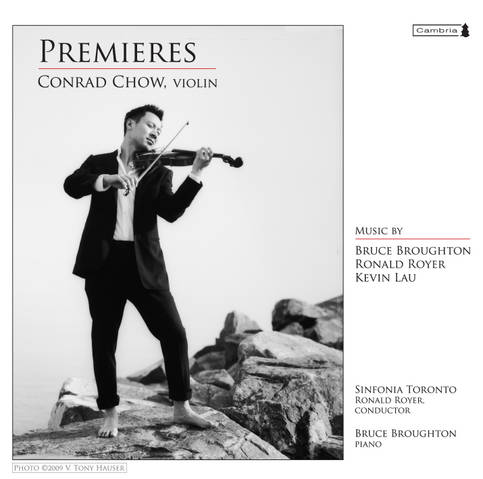
Whatever you think of the music on PREMIERES – violinist Conrad Chow’s CD of original musical compositions for violin with different groupings of accompanying instruments— the concept seems to be original.
My eyebrows went up when I heard that a young violinist was recording a series of new compositions. Honestly, I don’t know if this is really an original idea or simply something new to me; but it seems like a very fresh idea, to team up an unknown player with unknown music.
One of the saddest realities is the fate of the so-called “new music” commissioned for concerts. Few compositions survive their first presentation. That’s makes the title of Chow’s CD portentous if not ironic, when you consider how few compositions survive the premiere, to be revived, let alone entering the performing repertoire for that instrument.
Having a soloist commission composers is an ideal gig, because the goal is symbiotic, a win-win relationship. Soloists need the music going forward, and so inevitably will give the composition subsequent performances, thereby avoiding that dreaded fate of the premiere/farewell performance.
I don’t know whether Conrad Chow simply sought out a series of composers, or whether there was something more complex. (recording label facilitating the matchup? composers sharing the gig?)
I’ve been listening to PREMIERES for days now, the CD that’s in my car, in my laptop at home, or in my office downtown. It’s a kind of acid test, pressing a recording into this kind of extreme service, one that exposes the good and the bad. Having been through it completely at least seven times, plus a few extra visits to specific tracks, I’m very pleased with Chow’s project, with the compositions, and the resulting CD.
Different pieces have grabbed me at different times over the past few days. Each one has to be considered a success, given that I surrendered to each one, and have decided I adore some.
(left to right) Conrad Chow with composers Kevin Lau, Ron Royer and Bruce Broughton.
Bruce Broughton’s contribution was for me the most significant, representing the pieces that are holding on to me with a series of friendly ear-worms that refuse to let go.
Broughton opens the CD with Triptych, a piece that puzzled me for the longest time: until I noticed the subtitle “Three Incongruities for Violin and Chamber Orchestra”. Earlier this week, my back was up in response to the way these three pieces bump into one another like flavours that shouldn’t be on the same plate: that is, if one expects them to be unified. Once I noticed the sub-title (forgive me, I was listening to the music in my car over and over, not in a concert hall), the composition clicked into place for me.
The first movement sounded like a modernist take-off of the prelude from Bach’s Partita in E.
Take-off? Parody? I want to include all possibilities, such as tribute, playful imitation, stretching the boundaries a bit even while reinforcing the trope. I want to invoke a sense of fun even as the piece reminds us of something antique. We are again in the presence of many of the same disciplinary concerns as one finds in Bach’s writing, both for the composer (who at times feels as though he is paraphrasing or commenting, while at other times, inventing out of nothing) and then for Chow as the fiddler. Broughton mentions Prokofiev in the program notes, which isn’t surprising considering the neo-classical touches (e.g. using woodwinds in a concertante manner), the transparent textures & the unapologetic pacing. The second movement soars with the violin, including sections where Chow seems especially comfortable with the agile turns of melody.
By the third part of the triptych we’re in an entirely different place, a folky fiddle sound that took me by surprise. Yet –after being a bit perturbed initially –I see now that they work off of each other beautifully, like the apple following the cheese.
Broughton’s other contribution is a series of short pieces called Gold Rush Songs, that I’ve been humming –badly—all week. The glimpses of Broughton’s playfulness in the Triptych are consummated in these happy pieces, containing snatches of tunes that tempt you to sing along even as they refuse to do the obvious thing (and making them deceptively hard to emulate).
Speaking of happy, I find myself more and more impressed by the work of the most junior contributor, namely Kevin Lau’s Joy. I found myself perhaps a bit like that insomniac Princess of that fairy tale with the pea causing her to toss and turn in her bed. Joy opens with several strong gestures from the orchestra, phrases reminding me of some compositions I’ve heard before –that I love—before moving through a series of moods. After listening a few times, I’ve grown more and more impressed that Lau took the stage boldly, a self-assured voice with something to say. Joy is a troubling piece precisely because it questions happiness and joy, teasing us with lovely moments that refuse to promise us an easy happily-ever-after. Lau is to be commended for bravely undertaking the old romantic project of exploring philosophical truths in his creation. I love his ambition, and even more, I believe he did a fair job in his exploration of the idea.
Ronald Royer contributed two wonderful pieces, each in two movements. His Rhapsody begins with an eclectic sound reminding me at times of jazzy bits of Ravel, at other times of Hindemith. His In Memoriam, JS Bach is another neo-classical piece (recalling that the first piece on the CD from Broughton also incorporates older music in a new frame-work), although far more adventurous than Broughton’s piece. Where Broughton’s writing reminded me of a commission where the soloist might have said “please don’t let it be too dissonant”, Royer manages to wander away from the old, without the need to be dissonant or overly complex. His writing has wonderful clarity, several gestures coming directly from the violinist that connect it solidly to the tradition of a performer demonstrating their virtuosity.
Conrad Chow with his 1933 Gaetano Pollastri violin
Indeed, the entire album is a stunning showcase for Conrad Chow, who bursts onto the scene –or at least into the soundtrack in my car—authoritatively and decisively. Chow shows us a broad array of styles (ably accompanied by Sinfonia Toronto), so many ways of playing and being musical in diverse styles, that the recording will surely raise his profile.
Jean Cox, heldentenor (click picture for details of Cox’s extensive work at the Bayreuth Festival)
Cox was a great American heldentenor, who died on Sunday. By coincidence it’s the same day that Franz Crass passed, and not many weeks after the death of Dietrich Fischer-Dieskau.
I am pondering the workings of the culture machine, a bit mystified that whereas DFD is universally known and loved, and FC also well-known, Cox never made the same deep impression, at least in North America (but then again Cox is likely remembered far more in Europe than in America)
Of course nobody –certainly not me–can know objective truth. Maybe the way these male artists are remembered is the proper reflection of their ability.
Maybe. Yet I suspect that in fact other factors are involved.
Timing seems to be a big factor in fame. Singers have a window of opportunity to make an impression. For some that window is very brief indeed. If you listen to this sampling of tenors –all singing the same brief passage in the last act of Götterdämmerung –you get a sense of the brevity of careers. New cohorts of singers replace the older ones, and the changing recording technology may distort the singers’ actual voices.
If you come along at the right time for a key project you will be remembered.
Wolfgang Windgassen came along at the right time to be the Siegfried on that first seminal Ring cycle conducted by Georg Solti.
Manfred Jung was the Siegfried on Chereau’s Ring conducted by Pierre Boulez
Helge Brilioth and Jess Thomas share the Siegfried duties on the von Karajan Ring
That’s where timing comes in.
I saw Jean Cox sing the Siegfried from Götterdämmerung at least a couple of times in 1973 (with the Canadian Opera Company, in the unfriendly confines of the O’Keefe Centre). His portrayal was riveting, a confident physical presence at ease moving, acting and singing. His voice combined power, lovely tone & nuanced expression in this difficult role.
I also heard him on CBC radio broadcasts from Bayreuth conducted by Horst Stein (another talent who somehow fell through the cracks). To my ear Cox sounded much better than Windgassen or Jung. While I adore the quirky interpretations of the von Karajan Ring (Brilioth for example), Cox never had a recording whereby he could stake his claim as one of the great heldentenors of the century.
Recently I saw a discussion online about tenors where some put forward the notion that Jay Hunter Morris –admittedly a reasonable performer in the Met’s Ring—was one of the great tenors of the century. Why? Again, it’s a matter of timing, being in the right place at the right time.
Here’s a little sample of Cox’s death scene from Götterdämmerung, beginning at 3:20 in a clip that also includes the unique voice of Franz Mazura.
(left to right) Conrad Chow with composers Kevin Lau, Ron Royer and Bruce Broughton.
Whether performing at the Mozarteum in Salzburg, Disney Hall in Los Angeles, Carnegie Hall in New York, or Qingdao Grand Auditorium in China, Canadian violinist Conrad Chow has won over audiences with his interpretations of music from different centuries, continents, and styles. A laureate at the International Stepping Stone Competition in Quebec, Conrad Chow leads a rich performing career as a soloist and chamber musician. He is also a devoted teacher. Despite his young age (Dr. Chow is 30), he is currently on the faculty of the Royal Conservatory’s Young Artists Performance Academy in Toronto, Canada, and Visiting Professor of Violin at the University of Jinan College of Music in Shandong, China. He performs on a 1933 Gaetano Pollastri violin.
Canadian violinist Conrad Chow launches his debut CD, PREMIERES with a special performance at Toronto’s Gallery 345 on Thursday, June 28. The recording, on Cambria Master Recordings (Cambria CD-1204; distributed by Naxos) features premiere recordings of music by Bruce Broughton (an award- winning film composer from the USA), Ronald Royer and Kevin Lau, teaming Conrad Chow with SINFONIA TORONTO conducted by Ronald Royer. PREMIERES also includes a bonus track, featuring Conrad Chow and Bruce Broughton in a transcription of Chopin’s Nocturne in C# Minor for violin & piano. Chow’s June 28th appearance is with Canadian pianist Angela Park.
Chow added the following personal note addressed to me at the end which I thought it would be appropriate to share:
“Premieres represents two years of work, and also two years of enjoyment to me. I hope you get to experience and hear it for yourself!”
I haven’t yet heard the CD but in the meantime, I ask Conrad Chow ten questions: five about himself and five about his new CD PREMIERES.
1) Which of your parents do you resemble (what’s your nationality / ethnic background)?
Conrad Chow with his 1933 Gaetano Pollastri violin.
I’d say I’m a pretty balanced mix between both my mother and father. Recently, I’ve noticed people saying how much I sound like my father though! My parents were both born in Hong Kong, and came to Vancouver in their teenage years. My ancestral home is in Shandong China (the province that contains the city of Qingdao, of Tsingtao beer fame, and is also known as the city of the violin).
2) what is the BEST thing / worst thing about being a violinist?
The best thing about being a violinist is not having to buy an extra plane ticket for a cello or wheel around a bass while shouldering a stool. The worst thing is feeling envious of the piccolo player as she stuffs her instrument into her shirt pocket.
Seriously though, the best thing about being a violinist is getting to bare your soul on an instrument that is at once almost as human as the voice, but can also produce timbres and colours that are unique to the instrument. From the deep and emotionally sensitive, we can do a 180 and immediately burst into insane licks and agile fireworks. When it all flows, you feel like you can slow down time, and I imagine acrobats, dancers, and racecar drivers must all feel something similar.
3) who do you like to listen to?
I’ve always loved Gil Shaham’s sound. I met him once when I was a teenager at the Aspen Music Festival, and I remember that his personality was as engaging and welcoming as his sound.
For non-classical music, I like MC Jin – a freestyle rapper who is as quick and clever with his improvised lyrics as his rhythm and delivery are biting and dynamic when he engages in rap battles. Performance is all about feeling the audience and working with them to create a specific atmosphere – Jin is a master at this art.
4) what ability or skill do you wish you had, that you don’t have?
I wish I could play volleyball, basketball, and chop vegetables without worrying about my “precious fingers”. One day…one day!!
5) when you’re just relaxing (and not working) what is your favourite thing to do?
I like to meet with friends.
~~~~~
Five more concerning Conrad Chow’s new CD PREMIERES.
1) How did the compositions on the CD PREMIERES challenge you?
Since all the pieces on the CD are actually premieres, I really had to trust my instincts and communicate with the composers to see how I could best interpret their ideas. There was no ‘act to follow’, so to speak, so that was a challenge and blessing at the same time.
Also, with the depth and breadth that Broughton, Royer and Lau brought to the project in their compositions, I worked very hard to convincingly convey that variety in an interesting way. Even just stylistically, there were elements evoking the Baroque, Classical, Romantic, Gypsy, and 20th Century idioms throughout the CD. The second movement of the Broughton Triptych was actually inspired by Prokofiev, and I found myself going back to the 2nd movement of the G minor Violin Concerto to compare and contrast.
Likewise with the Royer Rhapsody and Ravel’s Tzigane, and Lau’s Joy with Barber’s Violin Concerto, or even the slow movement of Bruch’s Concerto.
2) What do you love about compositions such as those by Bruce Broughton and Ronald Royer (such as those featured on the CD)?
They are instantly accessible, but also multifaceted. Chess is all about being easy to play, but difficult to master. Similarly with their music, I find that audiences always enjoy their first experience, but repeat listening is where a lot of the deeper enjoyment and understanding can be found. Things like polyrythmic meters, octatonic scales, hidden themes, kind of rush by on a first sit-through, but after hearing the pieces a few times, these are the interesting aspects of the works that keep them fresh. Meanwhile, I like to know that when I’m performing these pieces, people don’t feel that they are too esoteric or opaque, and yet, there’s plenty of “steak” for me to bring out, along with the sizzle.
3) was there a favourite among these pieces?
The Broughton Triptych is the real centre-point of the CD – I think that it is a considerable achievement in composition and deserves to be played and heard throughout the world. For me, it was the most technically challenging, but it was so satisfying to put it all together. With Ron Royer conducting the live world premiere of the piece with the Scarborough Philharmonic in April of 2011, we knew that this would be an amazing focal point for the project.
The Royer Capriccio and Sarabande are also special for me, because I actually performed them almost 10 years ago, but never had the opportunity to record them properly until now. They are always fun to play, and I especially enjoy the interplay between the ensemble, solo violin, and harpsichord.
The Lau Joy, is…a joy to play. It’s so filled with verve and passion, and only brings out good memories for me. I actually met Kevin just a month before premiering that work in 2008, and we’ve become close friends and colleagues since then. It seems to be a favourite amongst hopeless romantics and dreamers of the world (and I often count myself in that category!)
4) how do you relate to these virtuoso violin pieces as a modern man?
Violin and virtuosity represent timeless concepts, whether they come from the 17th century, or the 21st. People like to see humanity, emotion, drama, and connection. They’re also tantalized by bravado, energy, seductiveness, and mastery of difficult challenges. The violin is a particularly potent tool to evoke all of these fundamental, primal concepts, and it’s our challenge to bring those to light in a way that is fresh, and will keep audiences engaged. I love being a (virtuoso) violinist!!
5) is there a violinist out there whose approach you particularly admire, or who has influenced you?
My two heroes whom I’ve never met are Itzhak Perlman and Yo Yo Ma. They have a populist approach to making music – everybody should be included – and their message is always positive and inspiring. That’s what we should all be here for…
My personal heroes are the teachers who have formed my skills and opinions about music-making. From my first teacher, Janet Wilchfort, to my teacher at the Canadian Royal Conservatory, who taught me during my formative teenage years, Alec Hou, to my university professors Miriam Fried, Pamela Frank, Ani Kavafian, and Philip Setzer, and finally to my post-collegiate mentors Philippe Djokic and Eduard Schmieder; all are consummate artists, and continue to be immense inspirations to me.
PREMIERES will be available in record stores June 26th. You can see more of Conrad Chow here on youtube, or visit Conrad Chow’s website .
Sunday June 17th was the day I watched Extremely Loud and Incredibly Close (let’s call it ELIC) for a second time. I’d seen it Friday night, and reviewed it. I remarked that for me its chief subject was not 9/11, but the issue of manhood as viewed through the lens of fathers and sons traumatized by loss.
By a curious coincidence Sunday was Father’s Day. Second time through –knowing the arc of the plot and its eventual destination—I was more fully ready for the mythic dimensions of this film. Friday’s review reflected my ambivalence. I loved parts, disliked some aspects, and wasn’t sure about it overall. Today I am much more certain, particularly the way this film fits into a recent pattern of dogmatic critics. I don’t care if I come across as Polyanna, in my dislike for negativity.
And pardon me if I am repeating myself, in mentioning these recent instances of daring or original productions rejected by some, yet embraced by others:
Lepage’s Ring Cycle at the Metropolitan Opera over the past couple of years: dissed thoroughly in the press & social media.
The Canadian Opera Company’s Semele, a production that could be accused of disrespecting the original work
Stewart Goodyear’s Beethoven Marathon. No critical response I saw denied that his playing was wonderful. Yet this achievement was little more than a blip on the radar when it could have been a paradigm-shifting moment comparable to Glenn Gould’s recording of the Goldberg Variations.
Oh well. My enjoyment and/or confidence in the excellence of those projects wasn’t dampened by sourpuss critics.
9. “Despite its overweening literary pretensions, Extremely Loud and Incredibly Close is about as artistically profound as those framed 3-D photos of the Twin Towers emblazoned with ‘Never Forget’ that are still for sale in Times Square a decade after 9/11. […] It’s Oscar-mongering of the most blunt and reprehensible sort.” Lou Lumenick, NY Post
I understand how New Yorkers may need to own these events for a long time (how could they not?), resenting any attempt to tell this story in terms that don’t correspond to their version. As a foreigner my perspective will seem skewed. I also understand how film critics think they understand a film because they’re in this tunnel of celluloid, in a groove of watching a few movies every week and writing pithy reviews, deconstructing each pathetic attempt to scale the heights of excellence. But seeing too many movies can inure one to excellence, or blunt one’s ability to appreciate what’s actually there, due to a kind of cynicism that sets in, forgetting that artists are people and that many in the audience don’t have the same cynicism. That Lumenick compares this to “framed 3-D photos of the Twin Towers emblazoned with ‘Never Forget’” says more about Lumenick than about the film. Actually, ELICworks very hard at coming at the topic indirectly, perhaps the most oblique treatment one could imagine.
8. “Poor little Oskar! Such an adorable, pint-sized heap of neuroses. What better mouthpiece for an author, or a filmmaker, to use as a way of exploring the personal cost of a great communal tragedy. Do you get the idea that Oskar must emerge from his own teeny-tiny personal prison and, yes, embrace the world? Never has the tragedy of 9/11 been made so shrinky-dinked.” — Stephanie Zacharek, Movieline
But who said ELIC ever purported to be the last word about 9/11? As I said earlier, I think this film is about manhood (speaking of shrinky dinks), about fatherhood, about war. The characters suggest a sad series of parallels, an ongoing chain of bad karma:
[SPOILER ALERT]
Boy who has lost his father (played by Tom Hanks)
Father (Hanks) who himself had no father (grandfather was traumatized victim in the previous war)
Grandfather (Max von Sydow) who is mute after the horrors of living through the Dresden bombing (both parents killed right in front of him)
But the characters are universal, rather than individualized in that karma. They’re not saying anything about the USA or New York; rather it’s about war, period.
7. “Extremely Loud & Incredibly Close isn’t about Sept. 11. It’s about the impulse to drain that day of its specificity and turn it into yet another wellspring of generic emotions: sadness, loneliness, happiness. This is how kitsch works. It exploits familiar images, be they puppies or babies — or, as in the case of this movie, the twin towers — and tries to make us feel good, even virtuous, simply about feeling. And, yes, you may cry, but when tears are milked as they are here, the truer response should be rage.” — Manohla Dargis, NY Times
They’re right about one thing: that it’s not about Sept 11. This movie does not try to make anyone feel virtuous (and to suggest this after seeing this movie suggests a heart as cold as ice). The film is full of thorny and painful images. I came away from it the first time troubled and conflicted.
Notice that #7 is almost a perfect contradiction of #6
6. “Oskar is a nasty piece of work. On that dreadful day, Oskar comes home early from school. He hears his father’s voice messages. He hides them from his mother, Linda (Sandra Bullock). He denies her listening to Tom tell her he loves her. Oskar is selfish. He sneaks out and buys an identical answering machine, records the identical outgoing message, and keeps the old one for himself. He counts his lies. Oskar has ‘head-up-his-ass’ platitudes and has read too much Jean-Paul Sartre.” — Victoria Alexander, Film Festival Today
Yes indeed, this largely corresponds to what I felt first time through on Friday. Oskar is very creepy. That’s exactly the opposite of what you read in #7 (about kitsch). But again, they show that clearly the film is not really about Sept 11: not about that brooding need America still has to articulate its nameless rage and sorrow. When Oskar starts smashing things –and it happens more than once—he’s such an unattractive image, he can’t possibly be the epitome of American angst. Oh no. Instead make it be a buff ex-marine who’s able to shoot people or kill them with his karate reflexes.
Note to America: not everyone is good enough to be a Marine. There are some real geeks out there. Oskar speaks to the geek in me, I promise you, and I am not even American.
5. “Almost half a century after Dallas, I still have trouble watching film of President Kennedy’s assassination. Yet Stephen Daldry’s screen version of the Jonathan Safran Foer novel, adapted by Eric Roth, proves hard to handle for other reasons. The production’s penchant for contrivance is insufferable —- not a single spontaneous moment from start to finish -— and the boy is so precocious you want to strangle him.” — Joe Morgenstern, Wall Street Journal
Very true. This isn’t a realistic film. It’s at least partly a symbolist film, with its multi-generational tale of fatherless boys. It’s challenging because one often doesn’t know which year one is watching.
Damn but isn’t that exactly how trauma works: that we always feel it in the here and now.
4. “Mixing the horror of 9/11 with a cutesy story about a boy’s unlikely quest just comes off as crass. Throwing a tragic old man on top — to no apparent purpose, really — cheapens things further. Extremely Loud and Incredibly Close is the kind of movie you want to punch in the nose.” — Tom Long, The Detroit News
Tom, I congratulate you for being honest enough to admit you didn’t understand the symbolism of the old man. I suppose it never occurs to you that 9/11 is not the first time anyone was ever bombed or victimized. Believe it or not it’s happened before, often with Americans dropping the bombs. In Dresden btw there weren’t 3, or 4,000 dead, but 100,000.
3. “[I]t will always be ‘too soon’ for Extremely Loud And Incredibly Close, which processes the immense grief of a city and a family through a conceit so nauseatingly precious that it’s somehow both too literary and too sentimental, cloying yet aestheticized within an inch of its life. It’s 9/11 through the eyes of a caffeinated 9-year-old Harper’s contributor. […] GRADE: F” — Scott Tobias, AV Club
This critique came closest to my feelings on Friday, and is partly the reason for my headline. I believe the subject is still too raw for Americans: that it’s still too soon. But at the same time, I find the process of criticism almost evil in its tendency to project motives onto the process of artistic creation (ie when he says that the film “processes the immense grief of a city and a family through a conceit so nauseatingly precious…”etc). Actually the critic is projecting when he says that. There were thousands of different experiences, and no one person has any claim on being the epitome of grief.
2. “Thomas Horn is a terrible actor; I don’t want to call him annoying because that might be the way Oskar is written, but dammit, I wanted to throttle the twerp pretty much for the whole movie. […] This film is so spectacularly bad that the bar for pretentious, deep-thoughts movies has been lowered roughly the length of my middle finger.” — Capone, Ain’t it Cool News
This one? Suggests very strongly that the film hit a nerve. Cheese whiz crisis, Capone, have you never seen a character in a film you wanted to throttle? I saw Untouchables last week btw, and yes, in that case his name is Capone (played by a certain Robert de Niro…?). You watch him and probably don’t like him nor his henchmen. That Horn made you hate him suggests he did a great job.
“Thus endeth the lesson,” …to coin a phrase.
1. “This is a film so thoroughly rotten to its smarmy and diseased little core that tearing into it here hardly seems an adequate method of dealing with it — going after the negative with battery acid and a sledgehammer might be closer to what it deserves. […] This is a film that takes one of the most terrible tragedies in our history and reduces it to a level of kitsch that makes a painting of the burning World Trade Center done on black velvet with a sad clown on the side bearing witness seem dignified by comparison.” — Peter Sobczynski, eFilmCritic
Going anywhere near the subject seems to touch some very raw nerves. I suppose for some people, the topic requires a moratorium, perhaps for another decade or so. As we saw with Viet Nam, there are many ways to approach aspects of the subject. But no single film is really capable of telling the story of Viet Nam. And to go anywhere near the subject in the wrong way (or how someone still suffering might call the wrong way) seems like exploitation of the worst sort.
[And here I am responding to all nine]
The horror of this film, (backdrop for a tale of a family in pain) is the horror of the event, if not of all war. Oskar is the primal embodiment of America on 9/11. On the morning of that day, you were a spoiled, self-absorbed child, unaware that some envious bastards were about to give you a sucker punch. How could anyone be heroic in the face of such evil? The soft and deranged vulnerability of this child, disturbing as it is to see, is one possible mirror, but doesn’t purport to be the best or the most accurate reflection of that insane event.

 But now there’s a new champ in town. Move over Slap Shot. I saw Goon today, never doubting for a moment I’d love this movie. Like Slap Shot there’s so much profanity in this film that it almost needs a special category all its own. When I said there’s a new champ in town I meant to allude to its subject because Goon is really a movie about one aspect of hockey, namely the fighter: the goon.




 barczablog