
There are so many things going on in Move(me)ant. The Marat/Sade Occupied that it helps to be a good multi-tasker. Its first public preview Tuesday February 28th gave us much more than a play. This student production at York University in Toronto claims to be “the world’s first interactive play,” combining live performance that we see before us in the flesh, while also glimpsing the same actors captured on camera through one of the social media channels (either on one of the huge screens within the theatre space or on your own personal device). And some occasionally contributed their own content to one of the interactive pathways such as ustream, twitter or facebook.
And that one paragraph isn’t even enough for a descriptive preamble. Adapted from Weiss’s play Marat/Sade (the full title is immense) by student Dan Pelletier, the interactive Marat/Sade Occupied is modernized on two broad fronts:
- Pelletier re-frames Weiss’ play around the Occupy Wall Street scenario, complete with tents, cops, and media coverage
- The interactive element of social media already mentioned
With such a rich smorgasbord everyone’s show will be substantially different. Some people were clearly immersed in their virtual world, heads down, while others (me for instance) concentrated more on the live experience. And the nature of the online response –including messages from remote viewers– changed the nature of our experience in the theatre. Even so, the big screens at either end often gave an instant replay two to three seconds after the fact of anything happening live on the stage. One didn’t know where to look, in this flood of fascinating images, sounds, songs, dancing figures, and yes, echoes of what we’ve seen so recently in the news.
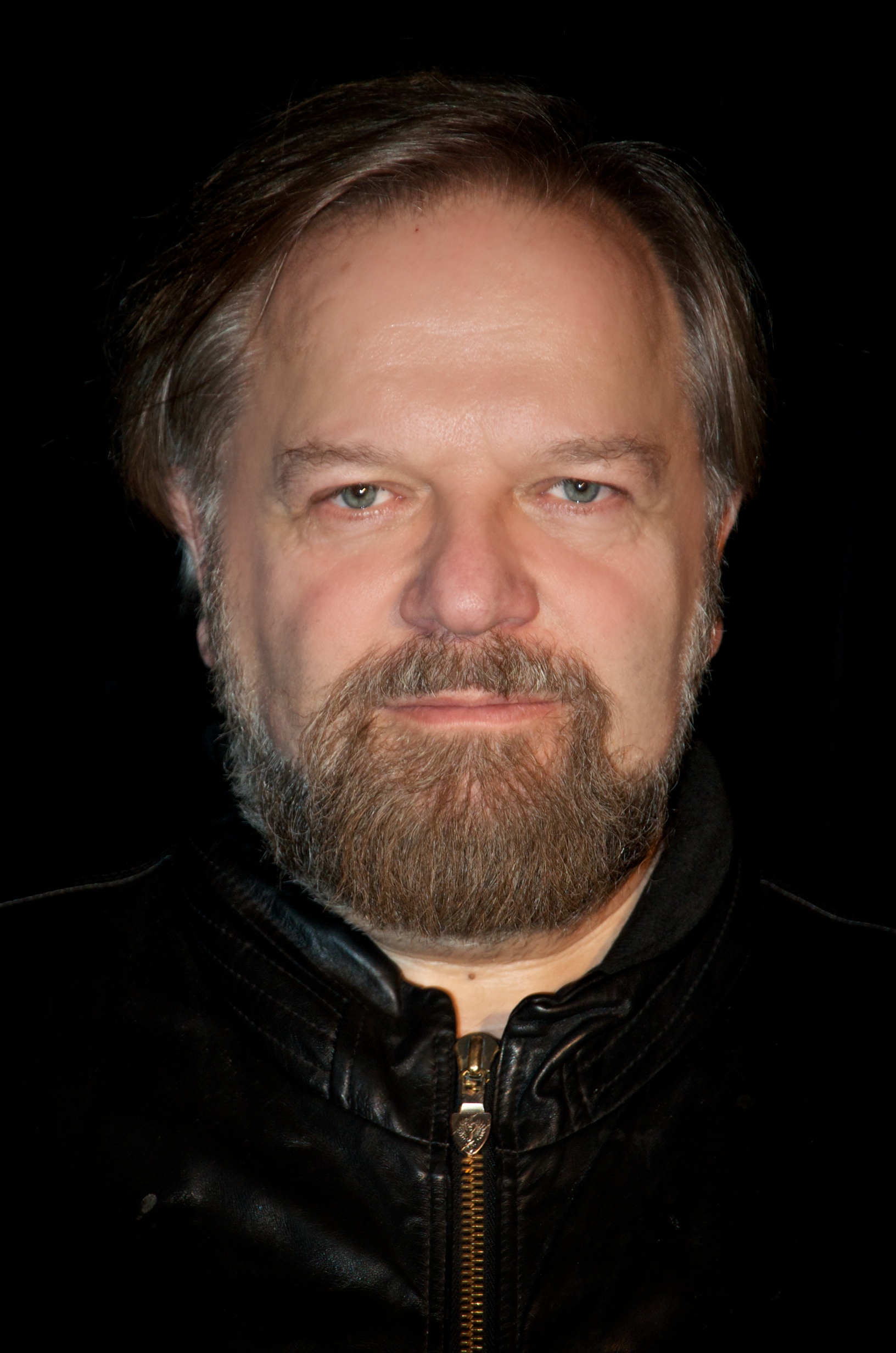
Aleksandar Lukac
Instructor and director Aleksandar Lukac must be proud. As a teacher of political theatre, what better way to show the students than to turn the stage into a kind of cultural laboratory?
If this is the future of live theatre –not just allowing you to keep your phone on, but allowing you to photograph the show and submit comments or pictures throughout—there’s likely to be a learning curve. For instance I should have realized that a photo of Charlotte Corday as she walked by in front of me would be blurry (fool that I am). With a rowdier crowd the line between performers and audience might have become blurred, whereas this friendly first-night group was very polite, indulging the performers. It’s too early to have any real sense of how this kind of theatre works, except to observe how exciting and new it all felt. And while the behaviours of the audience on this occasion were very much up for grabs –because there are no real rules, at least not yet—conventions develop with usage.
Some of the choices left me wondering why. The Marquis de Sade is a woman, Marat is a strong healthy man, played by Pelletier himself. Was that because Pelletier himself wanted to utter Marat’s lines himself? It was certainly Brechtian to make Marat so strong, even as he complains of his wasting disease. I found myself playing devil’s advocate, wondering how the play might read –modernized or not—with different approaches to the genders of the two leads:
- Staying with the usual pair of men in the leads invites comparison with every other production, and so I could see why one might want to change this up
- A pair of females? which would be what one might expect in a theatre school setting, normally a place where the talented women outnumber the talented males two or three to one. By changing both genders one at least partially takes gender out of the equation
- A female Marat with a male de Sade? To me this might have been optimum, and perplexing, but of course not this time…
There’s so much in this adaptation –both the occupy component and the social media circus—that I think one could present it several times before one exhausted the possibilities. For me the most interesting aspect of the adaptation by far was the ballad opera re-settings of several popular tunes, sung by members of the cast. In particular, a group of four females working as a kind of chorus were the best thing in the show. Maybe it’s just me, but I find shouted slogans –especially those slogans that we’ve heard over and over again—less persuasive than an ironic twist of a familiar song. That the songs were sung well made it that much better. As Lukac mentioned in his recent interview, “Lea Pehar has orchestrated all the original and new tunes with the help of singers Julia Heximer, Katarina Kovacevic, Catherine Garisto and Christina Helvadjian. ” In all versions of Marat/Sade one usually sees a struggle between the rational discourse of the political dialogue vs the irrational elements of the madhouse and the music; but in this adaptation there is such an urgency to the struggle (possibly because it’s contemporary, possibly because it’s so densely layered & complex) that I found solace in the musical interludes, those four women offering the one solid bit of sanity & order we can cling to as everything else goes to hell.
On this occasion –in a preview largely among family and friends—I felt Marat/Sade Occupied had not yet found its real audience. The music was powerful, yet the audience was sitting impassively, rather than clapping along. Partly that may be due to the power of the singing, which was so good that it silenced a crowd who could just as easily have been clapping in time. Perhaps that’s part of the learning curve, getting comfortable, although I suspect that with the right audience, a very different dynamic will likely emerge, where the audience unites with the performance and joins the actors in occupying the space.
Move(me)ant. The Marat/Sade Occupied continues at Theatre Glendon, every night at 7:00 pm until March 3rd or online via the following social media channels:
Ustream: http://199.66.238.56/user/occupytg
Facebook: http://www.facebook.com/OccupyTheatreGlendon
Twitter: https://twitter.com/#!/OccupyTG
Youtube: http://www.youtube.com/user/OccupyTG




 barczablog