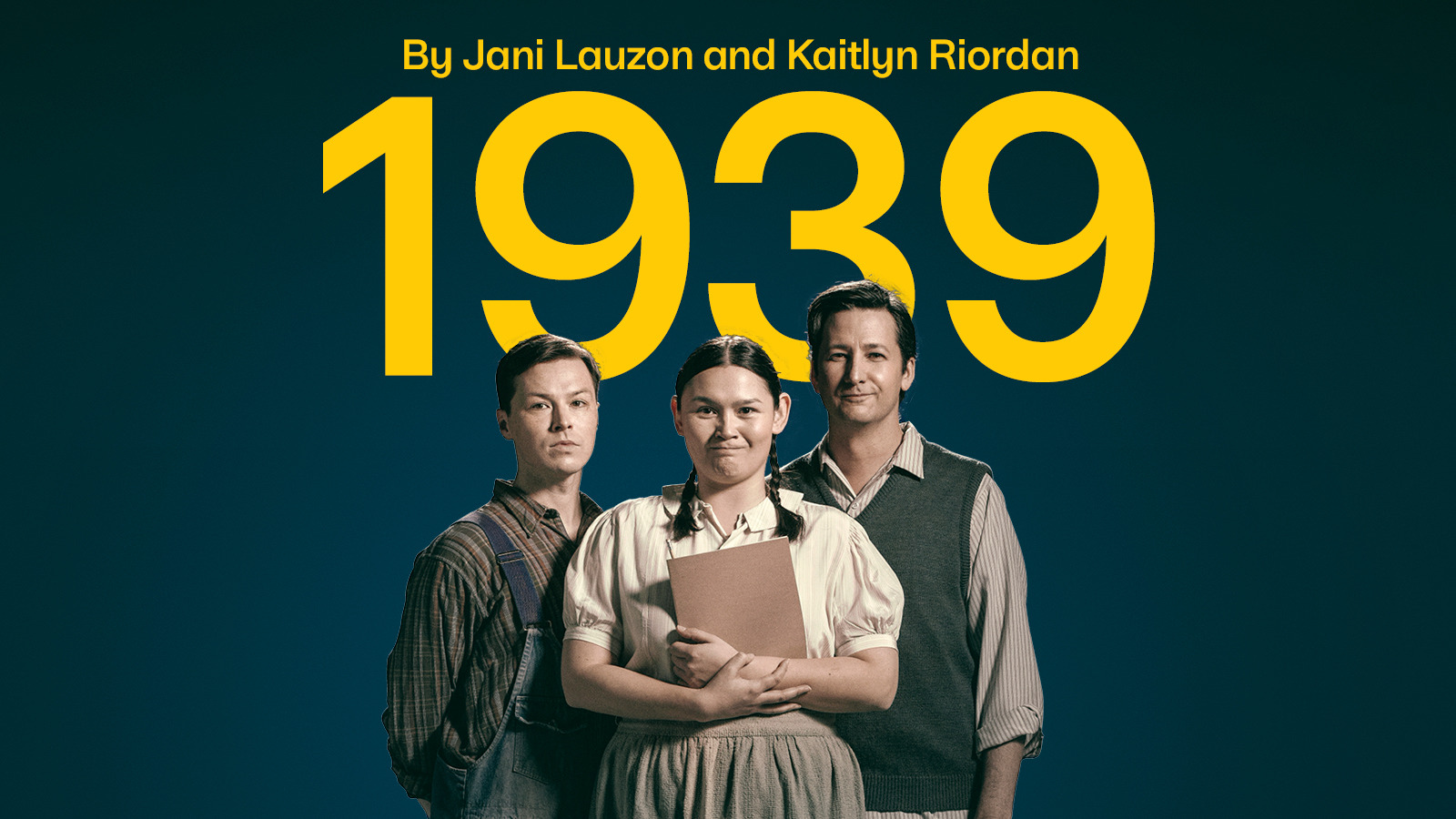
Last night I watched 1939, a recent play by Jani Lauzon and Kaitlyn Riordan at Berkeley St Theatre, a brilliant snapshot of the madness of residential schools and resilience in response. It’s a Canadian Stage and Belfry theatre joint production in association with the Stratford Festival, where 1939 had its 2022 premiere.
Imagine the presentation of a Shakespeare play by residential school students for a royal visit by the King & Queen of England in 1939. Their normal lives in school were already a performance, the lies they are forced to tell while suppressing the truths inside them. The bizarre Shakespeare project underlines the absurdity of students separated from families & culture while being imprinted with new unfamiliar Christian ideas by their teachers.
As in any first encounter with a text I’m balancing the creation of words and the performers’ creation, this time directed by Jani Lauzon, who is one of the authors. I missed seeing the piece in 2022 at Stratford, but wonder if in this incarnation it has become something new or different, deeper or perhaps lighter. I don’t know. At times we’re watching a frenetic stage full of fast moving bodies. At other times we observe a person alone in quiet reflection. At times they may struggle with language, although at times words are used playfully even if we don’t understand the words that are in an Indigenous dialect. There is so much going on, layers of meaning and action. Frequently we see words written on a blackboard, that will then be erased by Father Callum, a reminder that truthful expression is not always permitted. There is a persuasive self-assurance to this production and its cast that is irresistible, perhaps also because so many in the show are themselves Indigenous.
It was much funnier than I expected. For some such a topic may trigger overpowering emotions, and in response Canadian Stage included a gentle talk-back session for sensitive reflection afterwards, facilitated by Angel Brant, Shak Gobert and Manuel Chaves. I found that the deeper we penetrated into the story, the less I was able to laugh, although Lauzon/ Riordan did offer cheap laughs via silly costumes and fart jokes, perhaps hoping to dissipate powerful emotions. It’s barely conceivable that this be comedy, when we recall Kent Monkman’s paintings or the Truth & Reconciliation Commission, the cultural genocide to eliminate Indigenous languages & cultural practices through schools forcing children to become something they weren’t. The idea of finding comedy in residential schools is not only unexpected but a beautiful objective, perhaps a step on the pathway of reconciliation. I’m grateful for the encounter, amazed at the generosity of the performers.
It’s fascinating to watch the poignant variety of responses to Shakespeare, who at first is as completely alien as he must be to anyone reading gibberish, words they can’t understand.
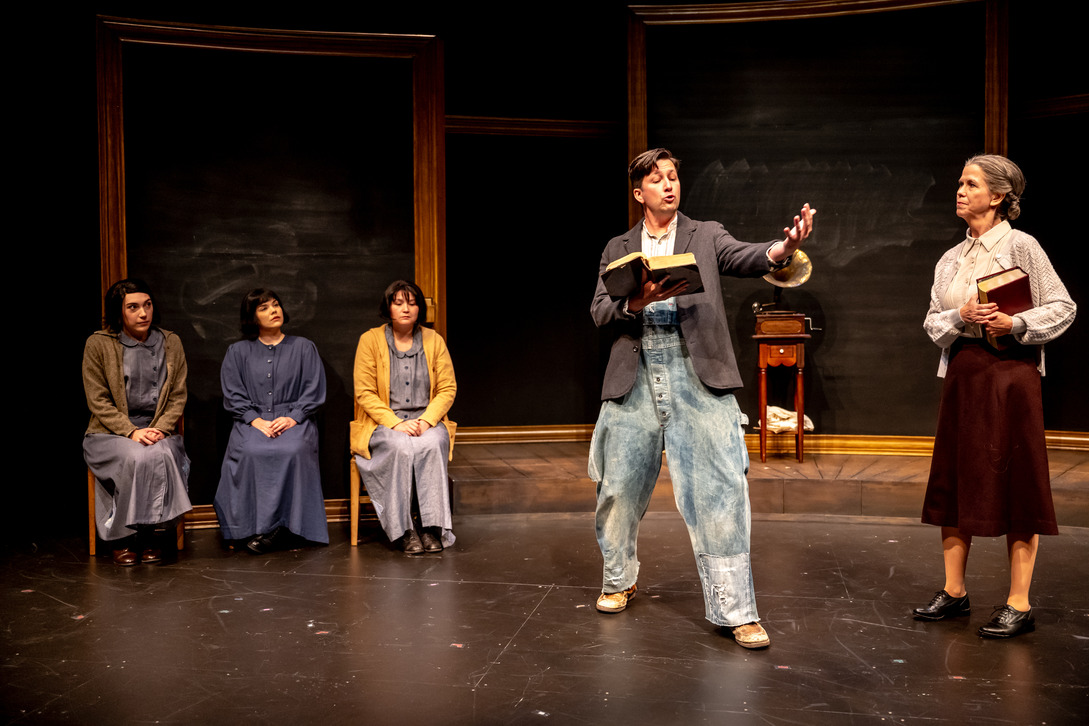
Beth (Grace Lamarche), Evelyne (Merewyn Comeau), Susan (Brefny Caribou), Joseph (Richard Comeau), Sian (Catherine Fitch) (photo: Dahlia Katz)
While Shakespeare’s language, especially as understood through their teacher, is at first foreign and rigid, the attempts to perform Alls Well that Ends Well become a redemptive escape into something more authentic than the Christian platitudes they’ve been force-fed.
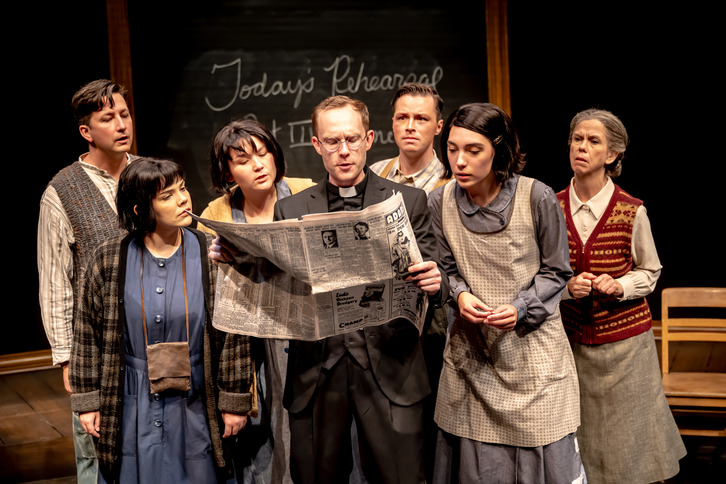
Father Callum (Nathan Howe) hopes that donors seeing the student play performance will help pay for needed repairs to the roof of their building. When a newspaper reporter (Amanda Lisman) comes to see their preparations for the royal visit, leading to a feature article publicizing their production, the project is pushed in a new direction.
Joseph (Richard Comeau), Evelyne (Merewyn Comeau), Susan (Brefny Caribou), Father Callum (Nathan Howe), Jean (John Wamsley), Beth (Grace Lamarche), Sian (Catherine Fitch) (photo: Dahlia Katz)
Suddenly instead of the usual effort to deny their culture and to assimilate the students as Christians, Sian the teacher and director of the student production (Catherine Fitch) seeks to emphasize Indian culture, getting costumes and sets for the production. Of course these are inauthentic and cliche. At one point in rehearsal, perplexed when she discovers that no they are not all the same culture, as one is partly Cree, another Ojibwe, another Mohawk, Sian asks if there is a generic Indian that they can play. The ineffectual teachers are more sympathetic than expected.
Evelyn (Merewyn Comeau) surprises her teachers by the strength of her acting, because she channels the wisdom of her elders. Susan (Brefny Caribou) follows suit, letting the memory of a quirky uncle inspire her as the clown. In contrast, Beth (Grace Lamarche) has loyally subscribed to the instructions of her teachers, believing in the residential school promise of a better life if she learns her lessons and rejects her native heritage. When Sian encourages them to play as Indian rather than as an assimilated English Canadian, Beth is perplexed, caught in the contradictions of the school and its lies, but also aware that in her acceptance of the school’s implicit bargain, she has cut herself off from a native past to which she no longer connects.
Joseph (Richard Comeau) is Beth’s brother, a fact the teachers didn’t realize until it’s disclosed during rehearsal. Jean (John Wamsley) and Joseph, who also have parts in the play will also tell us about a hockey game with a local private school that figures prominently in the unfolding of the plot. In due course we will see the presentation of their play within a play unfold, and their decisions as to how to enact their Indian portrayals, reconciling themselves.
1939 continues at the Berkeley St Theatre until at least October 12th. I recommend that you attend, and if possible stay for the experience of the reflection space after the play.
No opera today, although the headline may seem to promise as much.
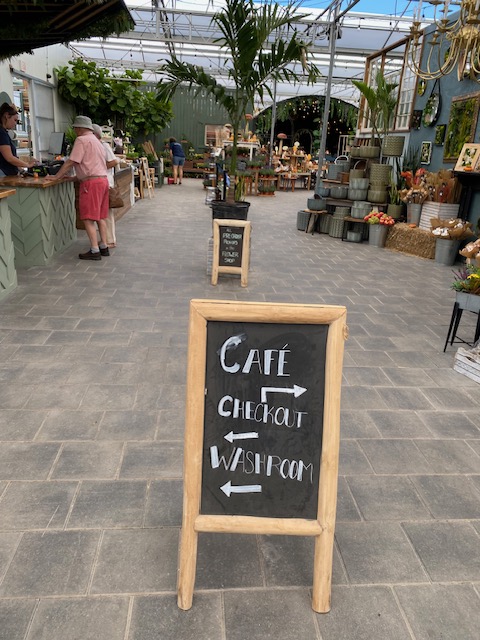
Before we got to Eryna’s house in Thorold we stopped in Vineland. This was our third or fourth visit to The Watering Can Flower Market, a place to find plants and also to have lunch.
Speaking as a resident of Scarborough who loves outside yard-work and indoor cultivation, it’s thrilling to see such an enormous inventory of plants and gardening products, often at prices far below what we pay at the garden centres in Toronto.
It was worth the drive.
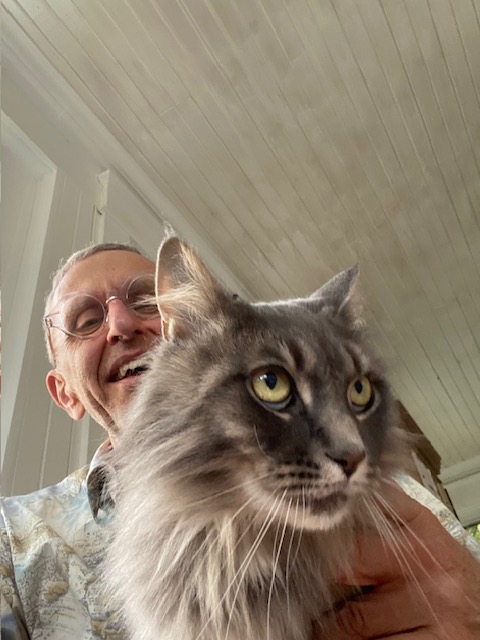
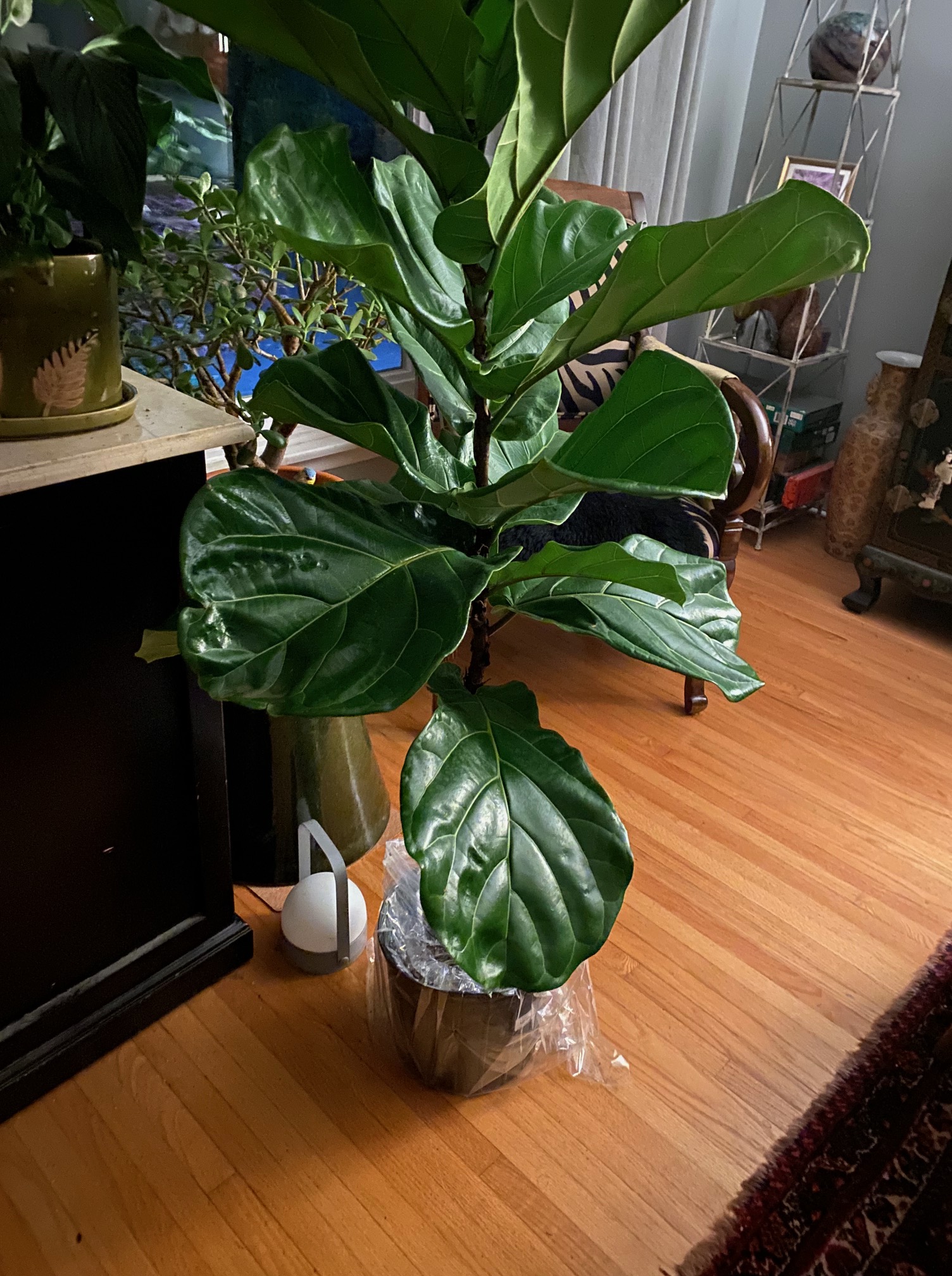
We picked it, or maybe I should say “him” up on the way home Thursday after spending Wednesday night in Thorold with Eryna (picture below).
On the way to her place Wednesday we caught a glimpse of the handsome fellow (Erika is thinking of the plant as a male, although she hadn’t yet given him a name) …while enjoying lunch.
I had a savory scone with a bowl of squash soup, Erika had tomato-red pepper soup, then we split a breakfast sandwich (egg over easy, bacon & cheese on toasted sourdough bread), and I finished with the best pumpkin pie I’ve ever tasted with ice cream on top.
It was a hot day yet the fans above us in the spacious cafe area cooled us.
Walking around in this big gorgeous space leaves me feeling I’m in an altered reality as if I’m wandering in a museum or art gallery, overwhelmed by so many varieties of beauty. And it smells amazing.
On our last visit to Eryna, you may recall pictures of Meeshko, the beautiful older cat I wrote about last year. I will spare you the reminder of his beautiful face, as he had been ill, wasting away and finally dying a few months ago.
Heartbreak.
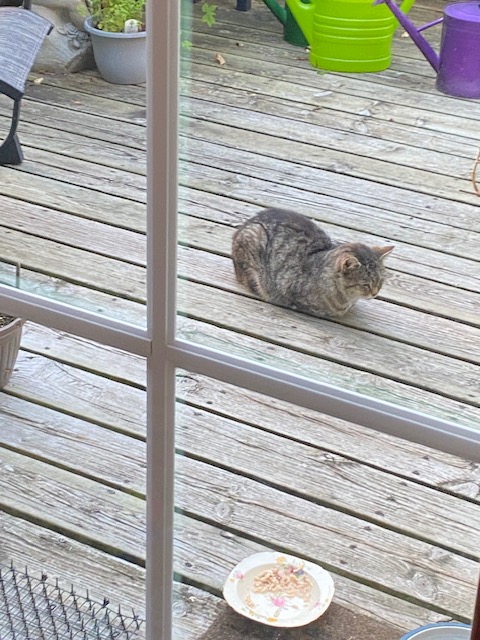
Sambuca aka Sam the feral is still alive, although he’s much smaller. Eryna does her best to get him to eat.
Sam and his breakfast
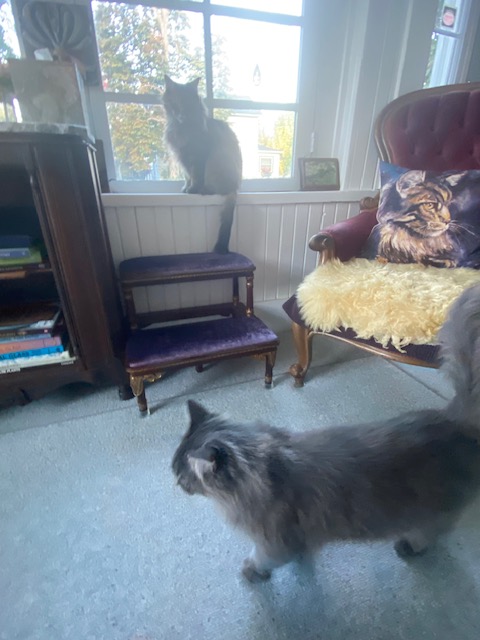
After a few weeks a friend encouraged Eryna to check out a couple of cats who were in need of a new home. Eryna couldn’t resist. The newcomers are both female, Zeerka (which means “star”) and Zenia (which means “flower”).
Live cats plus cat images on the cushions
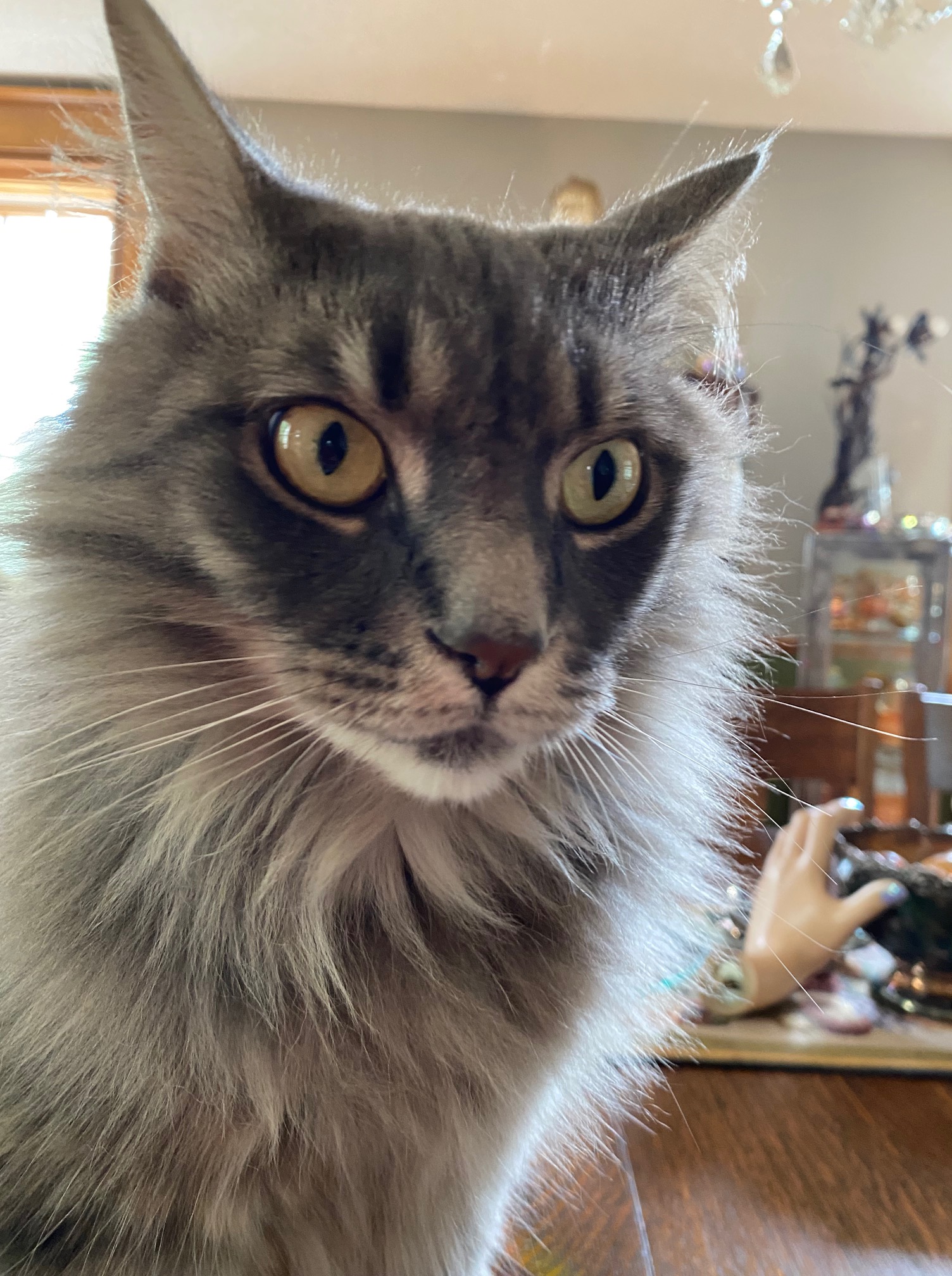
Zeerka is much friendlier.
Zeerka is much the friendlier of the two
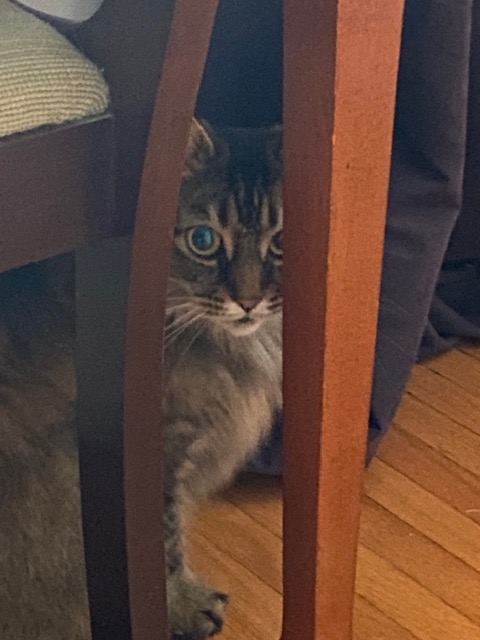
Zenia is kind of shy, apparently because of a troubled history, bullied by an earlier feline housemate.
Furtive Zenia, not yet sure she could trust us
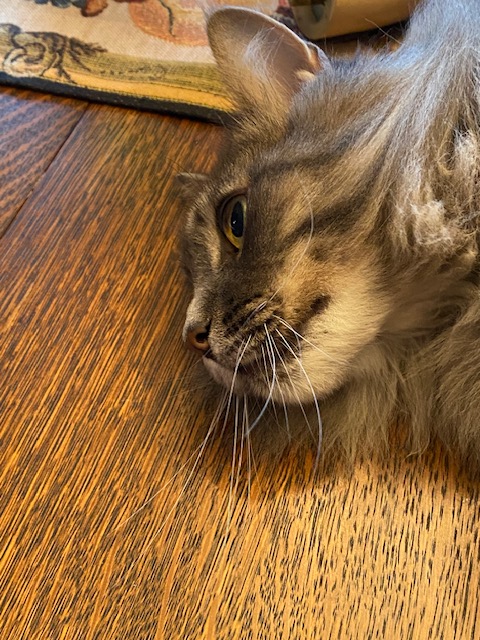
You see more pictures of Zeerka because she’s such a social butterfly, a bit of a whore for someone willing to stroke her: aka me.
I’ve only included a few of the many kitty pictures I took, several while juggling iPhone and feline in my lap.
We went to dinner just a few blocks aways from Eryna’s house down Clairmont Street in Thorold. It’s amazing to be able to walk anywhere you want in this charming little town. We’re grateful to Eryna for showing us the sights.
The menu of Pho18 reflects the creativity of Andy and Jenny Tang. Erika had pad thai, Eryna and I both enjoyed Tom Yum noodle soup, a delicious combination of coconut, broth & noodles. I finished with a mango cheesecake and a brilliant Vietnamese iced coffee, with the added magic of condensed milk. We were welcomed by our server, a charming & helpful fellow named Will. You can see their website including their menu here, or call them at 905-680-8889.
I understand their cuisine to be Vietnamese fusion, assembling the synthesis of different cultures with a confident panache.
Next morning it was time to visit some Thorold businesses.
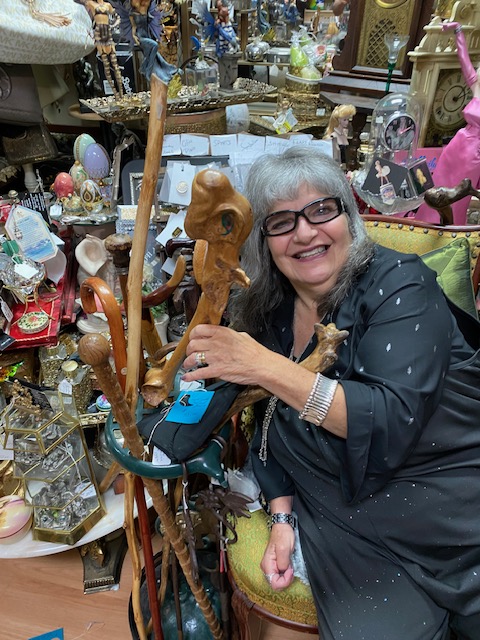
First came Angie O’H Antiques, where I tried out several walking sticks, including the shillelagh Angie herself is brandishing in the photo.
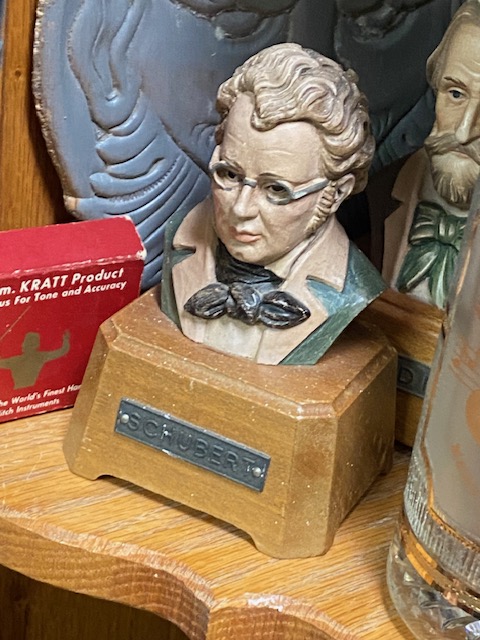
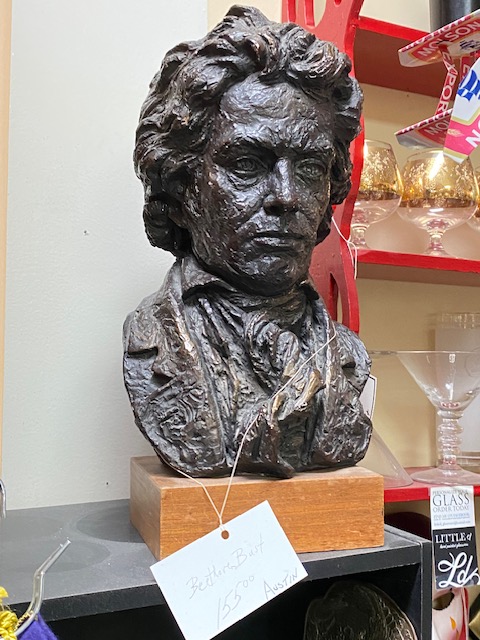
I fell down a black hole for awhile, bemused by model boats, figures of dragons and composers.
There’s so much to see. And Angie is endlessly fascinating.
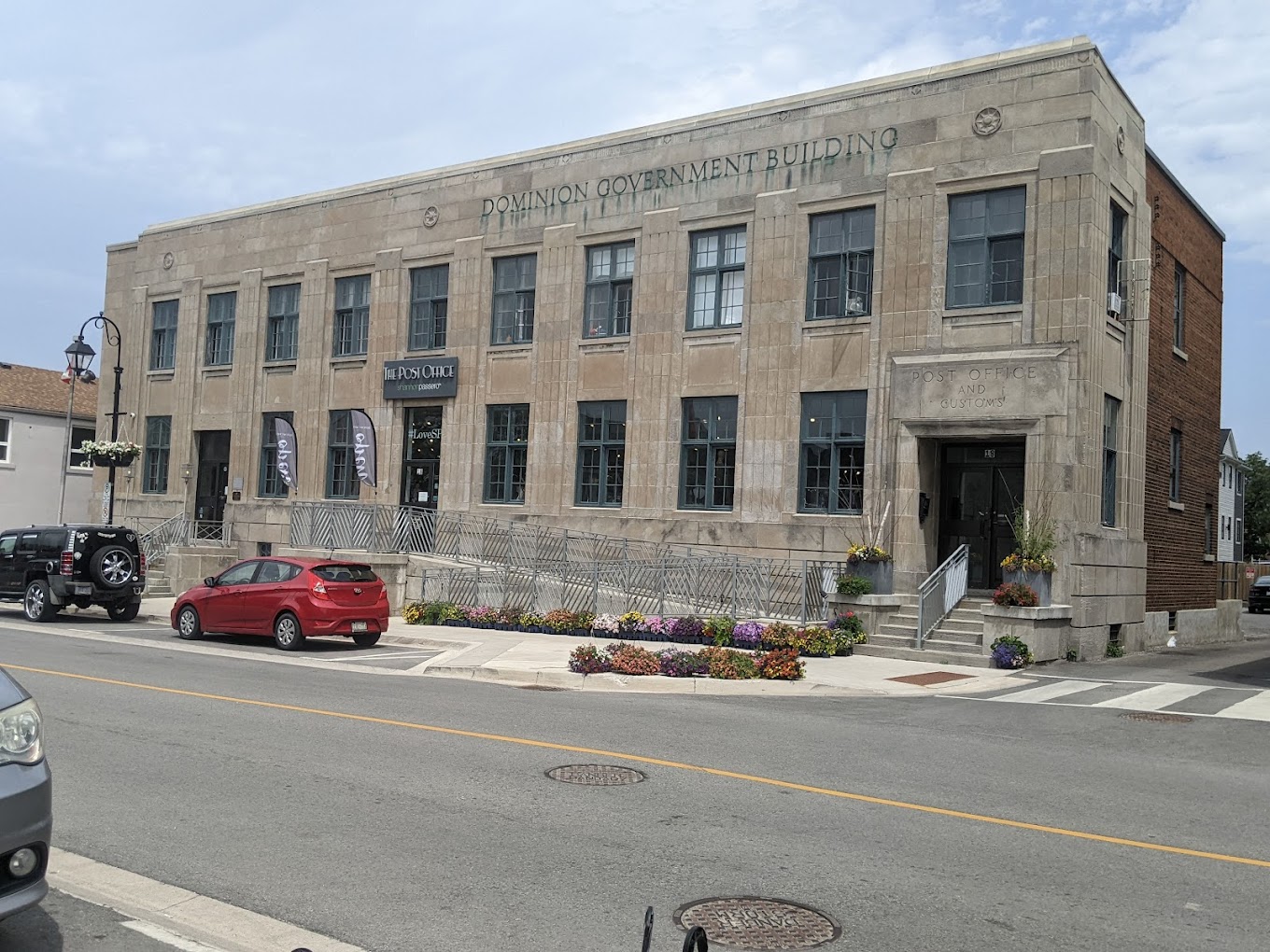
Next came The Post Office, featuring the original creations of Shannon Passero.
The name is logical given that the building seems to be a repurposed post office / government building. But Canada Post never accomplished anything as brilliant as what Shannon is offering. Inside the unpretentious exterior you find a big showroom to dazzle the eye. Eryna bought four items, Erika five, and OMG prices were reasonable, although yes, Erika has always had an eye for a bargain. She found me right? (only one previous owner).
Later as we drove back towards Hamilton (where Erika had an appointment) we were again in Vineland returning to The Watering Can.
My few pictures can’t really capture the richness, a space that feels so healthy with oxygen, plants surrounding you not as a jungle but a friendly and well-curated museum.
Our errand was more purposeful this time, going directly to the plant Erika had decided upon the previous day, without stopping to eat this time.
Erika holding a much smaller plant than the one we bought.
Our new plant only cost us $49.00, even though a GTA store (not naming names) would have charged us four times as much or more. It’s about the same height as Erika which is to say 64 inches.
Figaro can grow. Up to 60 feet tall in their native climate? OMG
The Watering Can isn’t just a plant warehouse but much more. Erika showed me the write-up they share on this plant, known as a Fiddle Leaf Fig (ficus lyrata). Helpful staff showed us information on a page in a big book, that’s also available online.
Erika’s expecting her fig to grow. No wonder she called him Figaro.
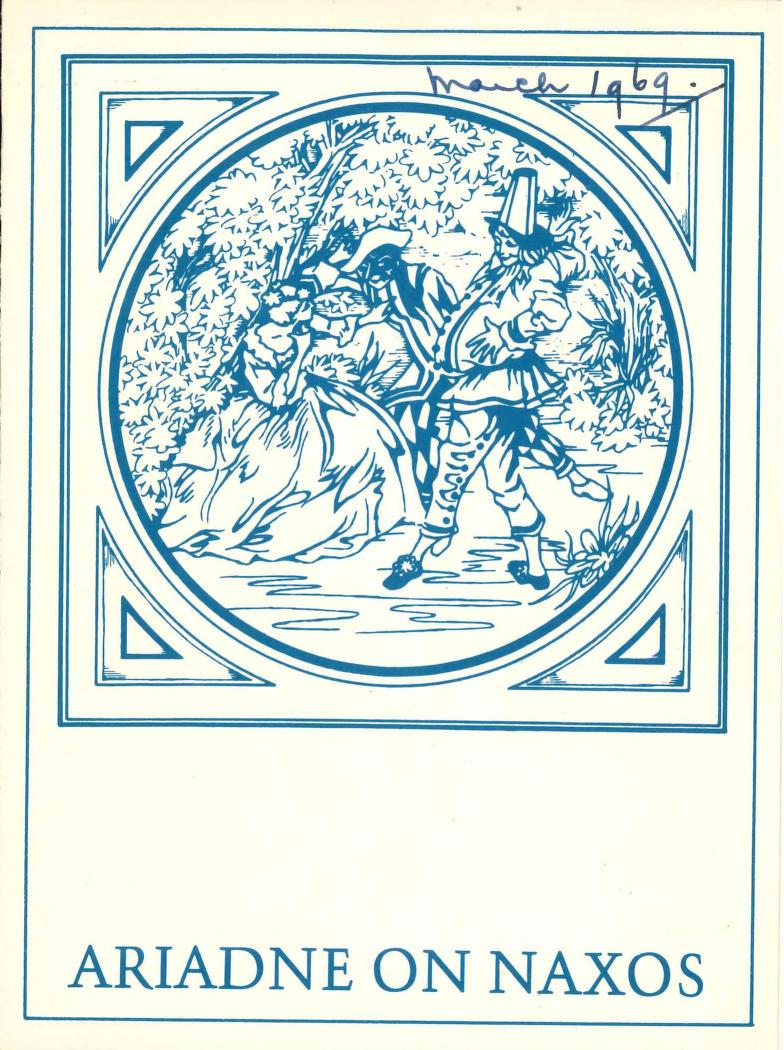
The title of the opera is Ariadne auf Naxos, done as Ariadne on Naxos because it was being sung in English.
That’s how Richard Strauss’s opera was presented back in March 1969 at the Opera School of the University of Toronto.
Through the magic of my library card to the University of Toronto Library I have been able to revisit an experience that dazzled me at 14 years of age, thanks to the kind assistance of Music Archivist Becky Shaw at the Edward Johnson Building. And my brother Peter Barcza helped me identify the people in the pictures. He was just 19 years old, and was the reason I came to see this show.
I am also able to time-travel through a few helpful Facebook friends whose names appear in the program.
I asked Riki Turofsky (Naiad), Steve Henrickson (Music Master & Arlecchino) and Mary Lou Fallis (Zerbinetta) what they remembered.
First Riki Turofsky..
Barczablog: what do you remember? any memories / anecdotes to share of Hermann Geiger-Torel, Ernesto Barbini, and your fellow cast members.?
RT:I loved that production. Torel [meaning Hermann Geiger-Torel] of course was yelling all sorts of orders from the theatre while we rehearsed. Nancy Gottchalk’s voice was too light for the role but she performed it brilliantly. I was a pretty high coloratura but was really impressed with Mary Lou’s facility with the score. I think I learned to love Strauss after being in that opera.
BB: I was curious about the way your name appears in the program, spelled as “Ricki” not “Riki” as it now appears.
RT: My name spelling changed after a concert in Victoria when a numerologist in the audience suggested the simplification to Riki from Ricki.
Next Steven Henrikson who was both Music Master and Arlecchino.
BB: Any memories / anecdotes to share of Hermann Geiger-Torel, cast members?
SH:Leslie, Wow, a long time ago, indeed. We were such a young, aspiring, talented bunch!
The larger parts were double cast. However, as a Bass-Baritone I was given two roles: Music Master and Arlecchino. The problem of having both characters in Act I was solved by having Gerard Boyd ‘act’ Arlecchino in Act I on my behalf. This was possible as Arlecchino does not sing in Act I!
SH: Further, having to rehearse as two characters and with other parts double cast, I rehearsed most days for 8 hours, sometimes 10, and once for 12 hours! I was indestructible……
Mary Lou was exceptional as Zerbinetta. Our “duet” was well-received and fun.
During the VERY difficult Act Il quintet, featuring all 4 male Commedia characters, Geiger- Torel had us leap-frogging over each other AS WE SANG! All very disciplined- we could not be anything but 100% accurate in acting and singing.
SH: Yes, Daland in Wagner’s Flying Dutchman with Bill Shookoff on College St. November 9. I have been singing, full time, for 67 years!
Finally, my interview with Mary Lou Fallis.
Mary Lou Fallis: I was in my third year university, and it was kind of …amazing(!) to me that they were going to do this production because you know it’s a big opera.
Barczablog: It’s ambitious isn’t it. I don’t think they ever did anything like this, right?
MLF: Well they did L’enfant et les Sortileges.
Soprano Mary Lou Fallis
BB: but that’s a short little thing in comparison.
MLF: it’s short but it still involves a lot of people, cast and a lot of costumes, sets that were absolutely magnificent.
Yes this was ambitious.
BB: You were singing a part that is one of the hardest in all the repertoire: Zerbinetta.
MLF: Yes I had heard it. I was twenty-one when I sang it. I had heard it two years previously. Reri Grist a wonderful coloratura, I heard her do it when she was a guest with the Toronto Symphony. She did a concert performance of it, and I heard it and thought this is so brilliant, this is my dream role.
BB: So you had the high note, right? The high E? I mean not everybody can sing this thing.
MLF: Well that’s just the way my range was. I was just built that way. I had high Fs since I was about 14. My grandmother was my singing teacher, and she never told me how high I was going.
(laughter)
BB: Good plan!
MLF: Anyway I wanted to do it, so I got the score, and I memorized the role. It took me ages and ages to learn it.
BB: You were singing it in English! Does that mean you had to learn it again?
MLF: Yes!
(and i hear a gasp)
Yes I did: but it wasn’t hard to do that. When you’re there at coachings and rehearsals it doesn’t take long. It might have taken longer to do it in German. I had no trouble with that. It was my dream role and I always felt, the roles you usually did in opera school were all the soubrette parts. I was too smart to sing all those sappy roles, or at least that’s what I felt at the time. I was arrogant much more arrogant than I am now.
BB: Isn’t it useful, don’t you have to be arrogant to be a diva? It comes with the territory doesn’t it?
MLF: On some level. I’ve mellowed. I’m very very happy with where I am now. Very happy that I don’t have to cough out a high “C“.
BB: Do you remember Hermann Geiger-Torel?
MLF: Of course! My relationship with Hermann Geiger-Torel goes back to when I was in the precursor of the Canadian Children’s Opera Chorus. I was in two performances, one was Hansel and Gretel, I was one of the gingerbread people, and then I was one of the orphans in Rosenkavalier.
“Papa! Papa!“
And then I was one of the kids in la Boheme. And I remember my very first time onstage, I guess I must have been about twelve, and I was in the chorus, Parpignol and that whole Act II start with you know Cafe Momus?
BB (singing the intro to the act) “Ta-ta-ta-…(etc)”
MLF: (singing the chorus part) “Ah...!”
Anyway that was me and I had a part in the chorus and what I remember, I knew my part. But I’d never been onstage in a big theatre like that. So when it started I was absolutely boondoggled and amazed. So I remember standing in the middle of the stage and not moving. There were things I was supposed to do: but I just stood in the middle of the stage, with my mouth open, because I was just so overwhelmed by the whole thing.
And so Geiger-Torel stopped the rehearsal, and said “Little girl! Do you know what you’re doing“.
And I was soooooo embarrassed.
But he kind of took an interest in me, when I was a little kid. And when I was 18 he had me understudy the doll in Tales of Hoffmann, early on in the COC. So I was very young. He was always very interested in me. I liked him a lot, I respected him. I thought he knew a lot about theatre. I think he felt a little badly, being in what he would consider kind of a backwater, at that point. It really was. He was starting an opera company in Toronto, when the Metropolitan Opera in New York had twenty-five times the budget.
BB: And a different audience.
MLF: Absolutely. I can remember going to operas with my grandmother when I was fifteen at the Royal Alex. But that’s beside the point.
What I remember about this production is that it was double-cast, which I didn’t enjoy very much.
BB I saw your cast by the way.
MLF: Did you? I think it was one of the most fun things that I ever did. And I think my voice did develop much more after that. It was a high point for me. And I went on to do the role in Stratford. And I went on to do it in Buffalo. And they did performances at the Shaw Festival believe it or not.
BB You’re the only person in that production–I’m willing to bet– who got to do their role again.
MLF: Do you have the program in front of you?
BB I do, I can share a list of the names.
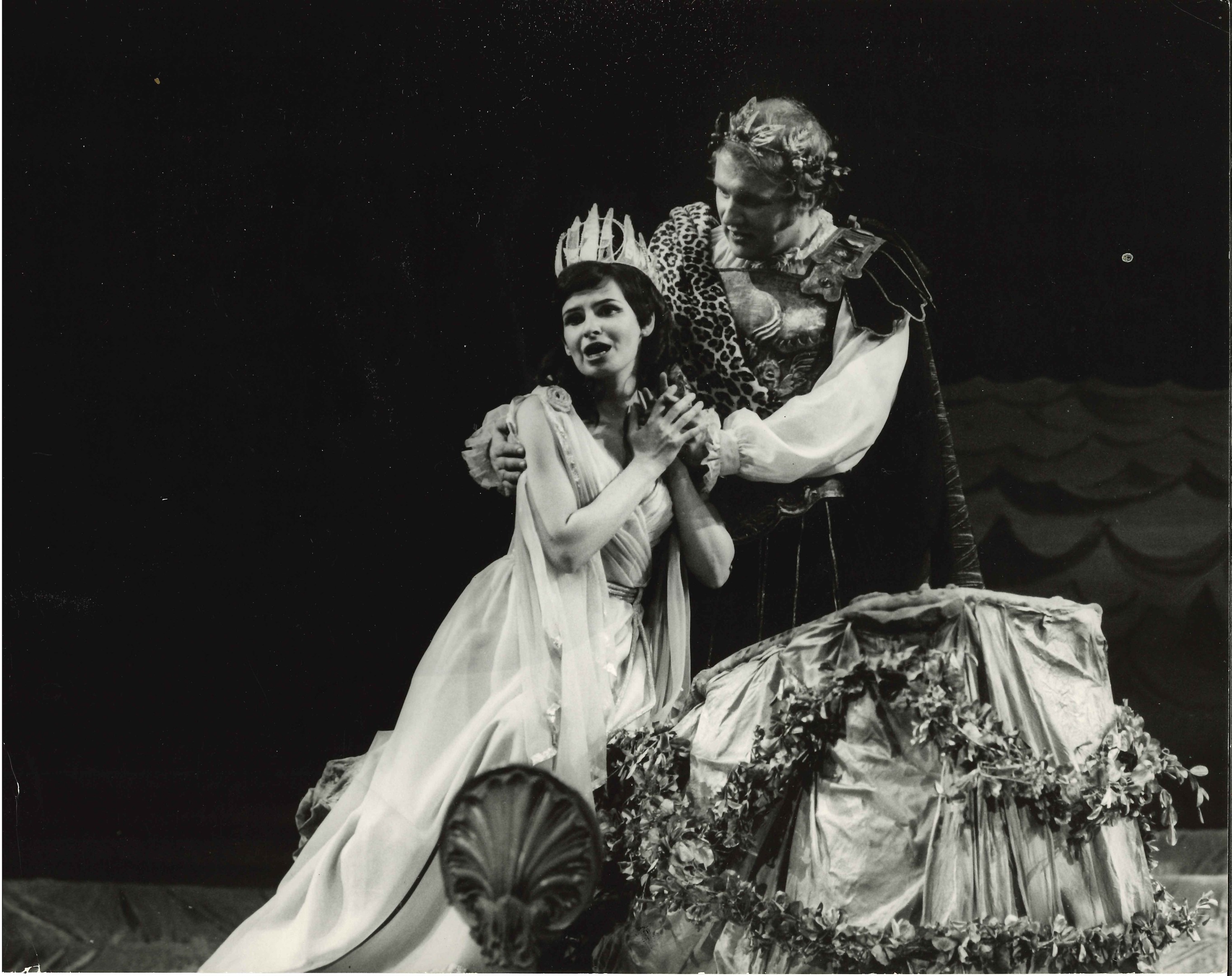
Margaret Zeidman (Ariadne) and Wilmer Neufeld (Bacchus) (photo: Copyright Ludvik Dittrich)
BB: Wilmer Neufeld (Bacchus)…
MLF: He went on to have a big career, singing in Glyndebourne, quite a career in Europe.
BB Margaret Zeidman was in your cast, while Nancy Gottschalk was the other Prima Donna / Ariadne.
MLF: Was she really!? I remember Nancy.
I was just thinking of the four guys. My cast was Roelof Oostwoud, who was a professor, he had done a mathematics degree and he had kind of a rough tenor, but he loved singing and went on to have a career in Europe. He was Dutch so I think he went over to The Netherlands, sang for quite a long time in Europe. Was Gerard Boyd in that?
BB Yes, he was the spoken Arlecchino in the prologue, while Steve was the Arlecchino in the opera, because his part had to be split apart.
MLF: Gerrard did a lot of character roles, he went on to have a career with that sort of part.
BB So the four guys (as listed in the program) were Ralph Oostwoud, Igor Saika-Voivod, Frederick Donaldson and Steven Henrikson.
MLF: I was going to say I didn’t know what happened to Fred Donaldson. Did he go to Europe too?
BB I don’t know.
MLF: And Igor did some stuff with the Canadian Opera Company. He had a very deep voice. And then he moved to London Ontario where he taught voice for many many years. When I taught at Western he sent me many students.
BB Did you stay in touch with Margaret Zeidman? She was your Ariadne.
MLF: Yes. I thought Margaret was pretty good. Who was the other Ariadne?
BB Nancy Gottschalk. I never saw her sing it.
MLF: Margaret had that sort of sadness, coolness.
BB The composer was Lorna Hearst or Elizabeth Douglas.
MLF: Elizabeth Douglas was my composer. She was from Kitchener I think. She went on to teach singing in Kitchener locally. I seem to remember that she was older than a lot of us.
BB: I guess there were others who were older. Wasn’t Wilmer Neufeld older? like a mature singer.
MLF: Oh yes quite a lot older. He was like 35 or something.
BB OMG I remember when 35 seemed old. I was 14 at the time, of course.
MLF: So there was Miss Turofsky, one of the three naiads. There was a woman from Australia named Helen (?).
BB: [reading from the program] Helen Grant.
MLF: Yes she had a lovely voice. And Clare Bewley was Echo.
BB: Michele Dowsett was the other Echo. So there was one cast with two performances (March 26th and 29th) and your cast had the single performance on the 28th.
MLF: I only had the one performance because they were worried, as I was so young. And the other woman: have we heard anything of her?
BB: I don’t know.
MLF:She married a dentist and I remember her having a party after her production.
BB Maybe she lived happily ever after.
Do you have any memories of Ernesto Barbini, who conducted..?
MLF: I have wonderful memories of Barbini. I don’t think Strauss was really his thing. He was very Italian. I was there when Teresa Stratas did Mimi, when she was the understudy. What I mean is, I think he did okay but the Germanic style wasn’t his thing. I mean when you’re conducting a student orchestra, it’s difficult. You have to take what you’ve got. But they had some very good people there, including my darling husband. Peter was in the Toronto Symphony for 35 years. He was Principal Bass, for Ariadne.
BB: Small world!
MLF: We were married at the end of fourth year. We had started courting, let’s put it that way.
BB: So Zerbinetta wasn’t really interested in Bacchus or Arlecchino, she had her eyes on somebody in the orchestra pit… (or a dentist)
MLF: Yes I was more interested in the bass player. But I guess Barbini did very well. We all benefited from his professionalism, his professional standards. I think Torel, looking back on it, he was very good. Both of them were what we would now call “old school”. Torel wasn’t into modern acting.
BB: I wanted to ask you about something Steve Henrikson said. He said Torel had the four men leap-frogging over each other, very physical. I wonder if you were tangled up in all those bodies.
MLF: I don’t think I had to do that.
BB Were they all around you while they were doing that
MLF: Yes, i remember one of them had a bit of a crush on me. I had a pink sweater and he said I was just so cute!
BB I guess the show wasn’t supposed to be an invitation to sexual harassment.
MLF: In those days nobody talked about it. You were just supposed to laugh it off, rather than “Don’t touch me!” But I loved doing that part. You have to have the chops and you have to be a musician to be able to do it.
And then I actually sang it on the stage of the Met, because I was in the semifinals of the Met Auditions. I used that as an audition piece. It was so good to be able to sing it at U of T, and Shaw and Buffalo and at Stratford and all those years later at the Met.
*******
1969 Ariadne on Naxos Images: courtesy University of Toronto Music Library. University of Toronto Opera Division fonds, OTUFM 84-B-1, with thanks to Becky Shaw the archivist at the EJB Library.
The Canadian Institute for Czech Music (CICM) and Opera by Request (OBR) collaborated to present Antonín Dvořák’s opera Jacobin in a concert performance with orchestra at Jeanne Lamon Hall Friday September 13th.
Produced by Professor John Holland of CICM, conducted by Bill Shookhoff of OBR, it was a labour of love as part of the Year of Czech Music (an international event celebrated in every year that ends in a “4”). CICM and OBR have offered a festival of three operas culminating with Jacobin.
I know Bill must have been working hard to get the orchestra to play so well in a score that’s new to everyone. Bill walked with a painful limp, worrying me because he’s irreplaceable. I hope he’s okay although he seemed to conduct with energy and verve. I suspect that Bill seemed tired having worked around the clock to ensure that Jacobin was properly prepared for the singers chorus and orchestra.
Opera By Request artistic director William Shookhoff
Let me repeat, the orchestra sounded wonderful. I want to mention them by name.
Natalie Wong ———-Violin I Amma Protasova——Vioin II Fanny Tang————-Viola Hyemee Yang———-Cello Jamie Zhang————Flute 1 Katie Kirkpatrick——Flute II Le Lu——————–Clarinet Hazel Boyle————Oboe Paolo Rosselli———-French Horn Todd Holland———-Trumpet Aaron James———–Organ Narmina Afandiyeva–Piano
There are several solos for the winds, who played boldly and with an idiomatic sound. Shookhoff also kept the chorus tightly together, as well as a children’s chorus directed by Erin Armstrong.
I don’t know Czech but observed that the singers sounded right to my ear, their accents well coached by whoever was responsible for coaching their delivery of the libretto, perhaps John Holland.
Count Vilem of Harasov — Dylan Wright Bohul, his son ————– Michael Robert-Broder Julie, Bohul’s wife ——— Cristina Pisani Benda schoolmaster ——- Alexander Cappellazzo Terinka, his daughter——- Grace Quinsey Jiri, a young gamekeeper– David Walsh Filip, Burgrave ————- John Holland Adolf the Count’s nephew- Alasdair Campbell Lotinka, keeper of keys—- Erin Armstrong
I was reminded of Fidelio, another opera containing a rescue and political themes plus a romantic story. Unlike Beethoven’s opera, this work seems much more firmly in the comic realm, while the political content is minimal even though the title might lead you to expect more. I wonder if that genre question might be one reason why this tuneful piece hasn’t yet caught on around the world. We watched the opera presented in concert, singers in formal attire portraying their part from a music stand. Perhaps next time CICM will give us something staged with costumes and sets.
Dvořák’s score is full of melody but more difficult than one might expect due to his tendency to modulate. I came out of Jeanne Lamon Hall humming the tunes that were humming in my head. The audience gave the cast and participants a strong ovation in appreciation for their hard work and their committed performances.
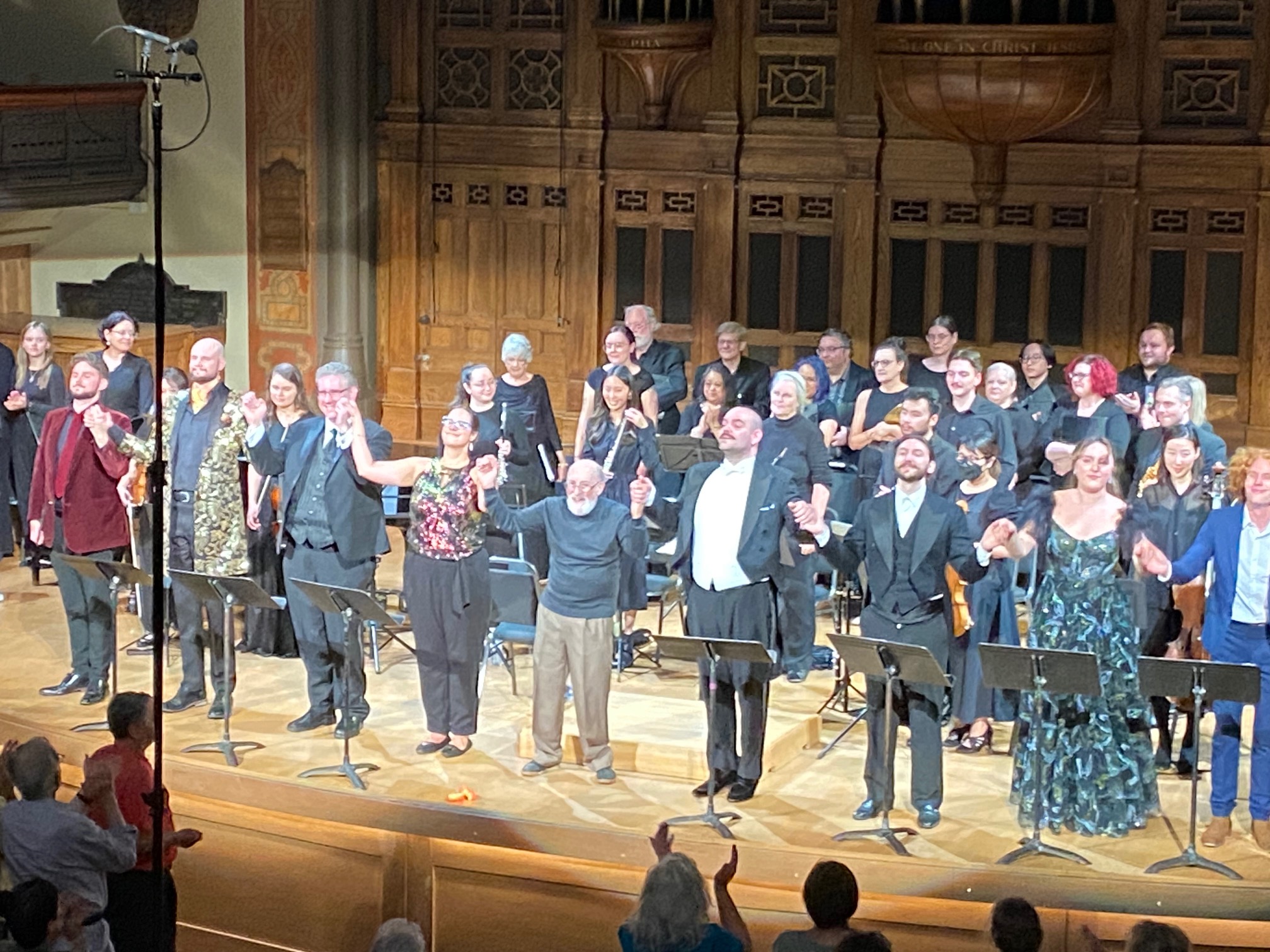
L to R: Alasdair Campbell, Dylan Wright, John Holland, Cristina Pisani, Bill Shookhoff, Michael Robert-Broder, Alexander Cappellazzo, Grace Quinsey, David Walsh
My headline is not just a nod to “Sticks Nix Hick Pix”.
There truly was no ham to see in the gala World Premiere of William Tell, unless we include the man who wrote and directed, namely Nick Hamm speaking to us in the talkback afterwards.
Writer and Director Nick Hamm
I didn’t know what to expect, even if I had Rossini’s over-played overture to his rarely performed opera in the back of my mind. I came in thinking William Tell was a known freedom fighter, a famous archer, and oh yes, he was Swiss.
Hamm crafted something remarkable, steering his script and his cast clear of the excesses one might expect in a dark violent story. While we might demand passionate responses to such a story the acting was amazingly restrained.
No ham in other words.
My headline is not just for fun. Hamm prevents his actors from overdoing it two ways. He wrote a script requiring restraint, and then he actually followed through, enforcing that upon his actors. One regularly sees actors improvise which might make for better performances, improving a script, until they veer into a language that’s from a 21st century idiom rather than the 14th. The director has to be firm given that nowadays actors normally improvise.
Of course the film is in English, not one of the languages from the actual story, so it’s a matter of simulation, a way of foregrounding historicity. You create a kind of illusion that you’re in the 14th century through art direction, costuming, set, and a choice of words to suggest the story in its time. One desperately wants to avoid being reminded that we’re watching a young person from our own time improvise in front of a camera.
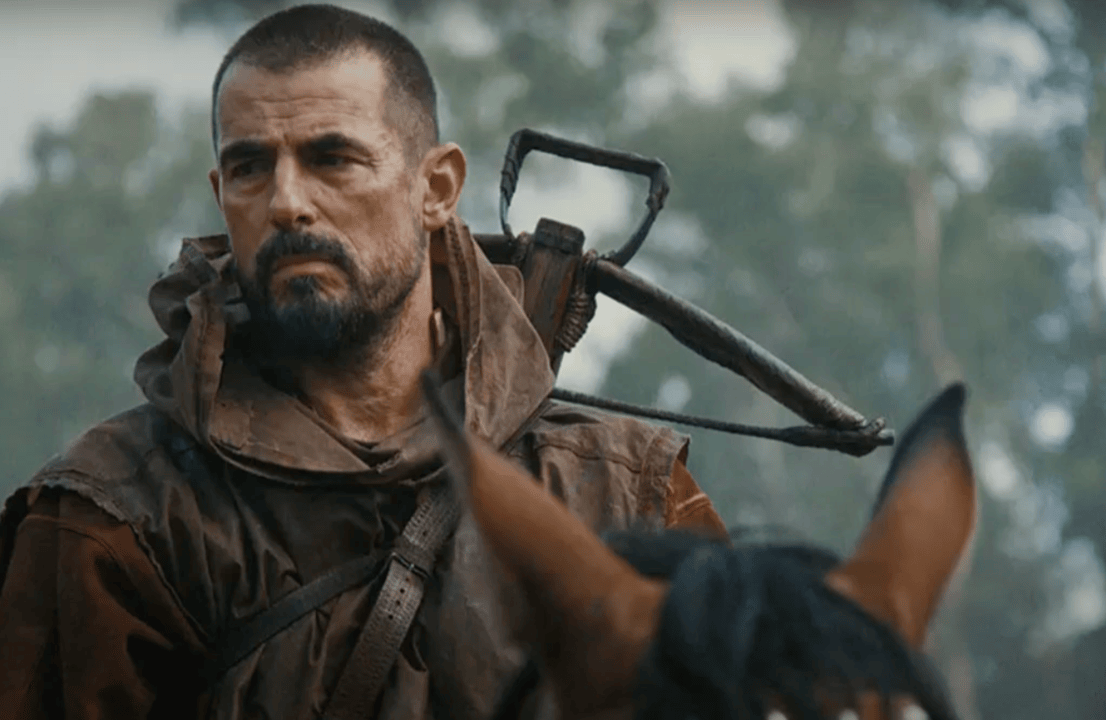
William Tell (Claes Bang) famous marksman and reluctant freedom fighter
Ben Kingsley and Jonathan Pryce restrain themselves. Claes Bang as William Tell is especially restrained. I am especially mindful of this restraint having seen Rosmersholm at Crow’s Theatre, where Chris Abraham seemed to create the world of the play through the repressed behaviour of most of the cast. Or maybe I was sensitive to it having seen William Tell the night before, thinking that the careful control of Hamm over his cast is a kind of magic trick to keep modernisms at bay.
The original sources including Friedrich Schiller’s 1804 play and earlier legends from the 15th century that I’ve looked up since seeing the film allow Hamm space to insert his own spin on a story that is for all intents and purposes unknown.
We see stunning scenery that as Hamm joked in the talk-back, might remind you of The Sound of Music.
We see more women taking up arms than I have seen in any film, something I enjoyed whether or not it’s in any way accurate. I suspect it’s a genuine possibility when a small community is under attack.
We see that Tell brought back a wife from his crusade in the Holy Land, fathering a son who appears a bit different from the others in his Swiss town. I can’t help seeing a bit of resonance to modern events in that famous moment we all know. It’s set up by details we won’t know of course, as the Austrian bailiff who posted his hat in the town square, demanding a bow of loyal obeisance from everyone. When Tell and his son refuse to bow, soldiers grab Tell’s son. Having heard of the father’s marksmanship the bailiff has the idea of demanding that the father shoot an apple off his son’s head at 20 paces, perhaps 100 feet away. There’s a visible racial marker in Hamm’s film complete with an insulting slur against the boy. I think I heard someone call him a mongrel. The actors portraying the Swiss characters show astonishing restraint in this scene, their emotions building very slowly, inexorably. So while Hamm said in the talkback he was trying to dodge anachronism, that indeed he hates anachronism in film, it was troubling to see something that felt so modern, namely the fascistic overtones to the scene, including soldiers seeming to mock someone as though for their race. But then again maybe that was accurate? Who knows. It made the scene that much more powerful.
As I watched I was mindful of what I knew about the Middle Ages. Agency in a society like this is relatively new, individualism would not be articulated for a long time, as people obeyed their church and their kings. We think of films set in the future especially science fiction as having to perform futurism, assembling mores and fashions and manners to help actors flesh out the future world they inhabit. But the same thing should be just as true for a film with historicity, foregrounding another time remote from our own. I think it’s rarely done this well, as we may think of actors slipping modern phrases and accents into their dialogue, for instance “yonder is de castle of my fodder,” from an American actor. Hamm has done a great job of keeping his actors firmly on track with the script and the world they inhabit.
The orchestral score is from Oscar winner Steven Price, composer of the music to Gravity (2013) for which he won the Oscar, Suicide Squad (2016) and Fury (2014). I don’t know his work. For this project Price seems to have been asked to subtly underline the action, so that when something momentous happens such as a storm or an attack, the music gets louder to underline that excitement. I suppose we’d call that a traditional approach to scoring even though I heard nothing especially artistic: but maybe that’s because Price was working from the same template as the actors, aiming for understatement rather than overdoing it.
I want to see this film again. I found it sometimes very violent in its depiction of combat, but then again that’s only reasonable. If you’re easily triggered you’ll avoid a film featuring battles and hand-to-hand struggles with swords and crossbows. Yet the film is handsome and a worthwhile treatment of its materials.
You sometimes hear people tell you that a play from another century seems to speak directly to our own time.
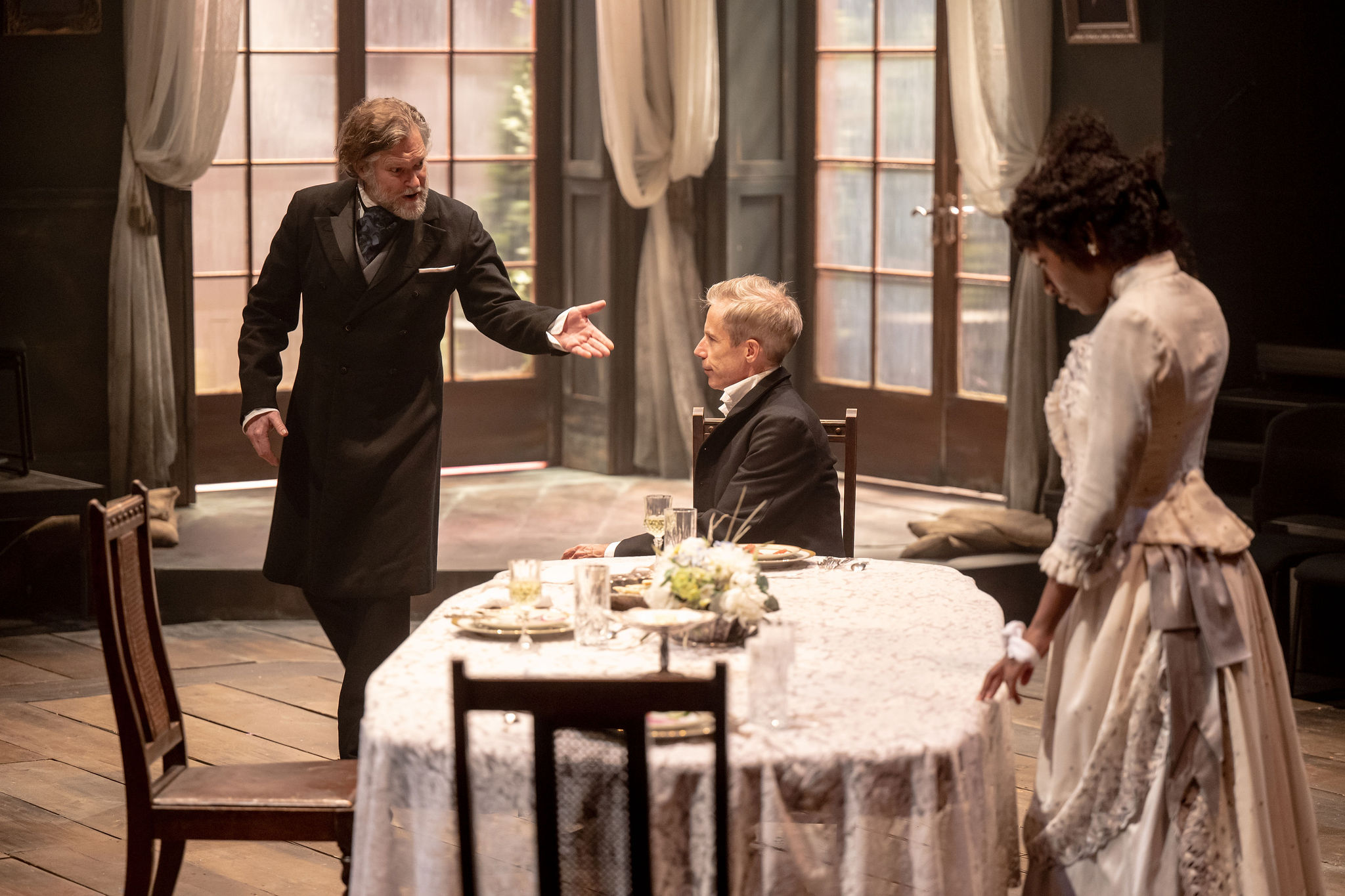
(l-r): Ben Carlson (Governor Andreas Kroll), Jonathon Young (Pastor John Rosmer), Virgilia Griffith (Miss Rebecca West) (photo: Dahlia Katz)
Last night watching Duncan Macmillan’s new adaptation of Henrik Ibsen’s Rosmersholm at Crow’s Theatre directed by Chris Abraham was the perfect segue from the Trump-Harris debate the previous night.
The progression from idealism to cynicism, the transparent use of media to mislead or lie, class struggle and the rights of women in society are all front and centre.
Abraham has assembled a dream cast who will only get stronger as the run goes on.
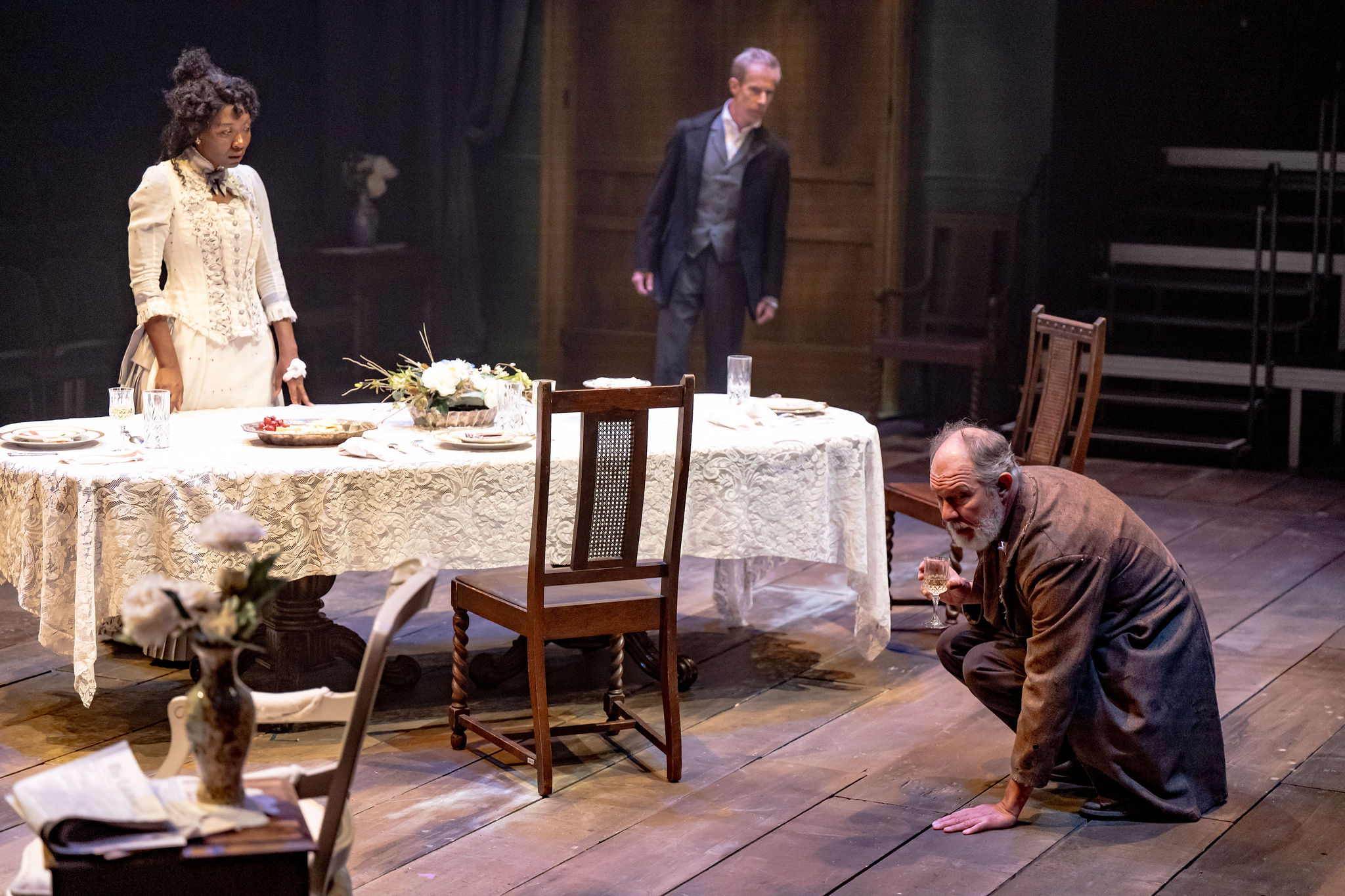
(l-r) Virgilia Griffith (Miss Rebecca West), Jonathon Young (Pastor John Rosmer), Diego Matamoros (Mr. Ulrik Brendel) (photo: Dahlia Katz)
For most of the play we watch Ibsen probing the past, not so much a CSI as an enquiry into the meaning of life, as we observe the different responses of each character to a conservative society’s demands and norms. The stage picture of our immersive set in Guloien Theatre presents the action in the round, allowing the audience the pleasures of watching responses from across the space, while every actor is fully exposed. Rosmersholm is a place, a concept of society itself, and practically a character in the play. The very first moments of Abraham’s reading that may seem like a throwaway bit of action (characters crossing innocently) sets us up for the organic flow on the stage pulling us towards the exit off to one side and the inevitability of the conclusion, further aided by a powerful sound design sometimes at the edge of audibility sometimes emerging into the foreground by Thomas Ryder Payne.
Ben Carlson as the conservative Governor Andreas Kroll is the catalyst for the first part of the play, his rage and grief tightly repressed as befits his standing in society. Diego Matamoros as Ulrik Brendel seems to conjure magic every time he appears, shifting the tone and the pace like a trickster, a complete contrast to the Governor’s oppressive language & politics in his refusal to be fettered by social mores.
Beau Dixon as Peter Mortensgaard is another catalyst, his brief appearance volcanic but tightly controlled by Chris Abraham as far as what he was permitted to do onstage given that his real actions are in print rather than through anything he would permit himself to do onstage. Kate Hennig as Mrs. Helseth is the servant who has seen everything unfold in the household, seen through a close-minded Christian lens, so well-trained in her subservience as to be a true fixture in the house.
That resounding space full of repressed emotions is where we meet two people that seem much more modern in their outlook, even as we see them unpack layers and discover deeper aspects of themselves over the course of the play. Virgilia Griffith as Miss Rebecca West is one of Ibsen’s breath-takingly modernist creations, someone you may think is almost too good to be true: except as we get to know her she’s not exactly as she seemed at first. The process of tearing away the surface is one of the delights and horrors of the play, a brave display as she enacts her own fearless implosion before our eyes.
Jonathon Young is Pastor John Rosmer. You see a remarkable blank effect in both of these photos, uncanny in its stillness even though it must be the result of discipline and skill. For the first half hour Young is like a becalmed boat on a lake, waiting for wind to give it some movement. His tranquil calmness is frankly breath-taking, indeed behaving the way I wish pastors would behave, as he listens and reacts with empathy rather than performing and preaching. His responses tend towards a naive idealism but even so he’s listening to those around him. As he starts to respond and tell us of what he really believes it is as though the wind has found him and he begins to move and respond, a startling and organic transformation.
As the run continues I think it will be enjoyable to watch Young & Griffith, as well as Matamoros, Dixon, Hennig and Carlson particularly given that the theatre affords one the opportunity to see them again from the opposite side.
Rosmersholm has just opened, running to at least October 6th. See it if you can.
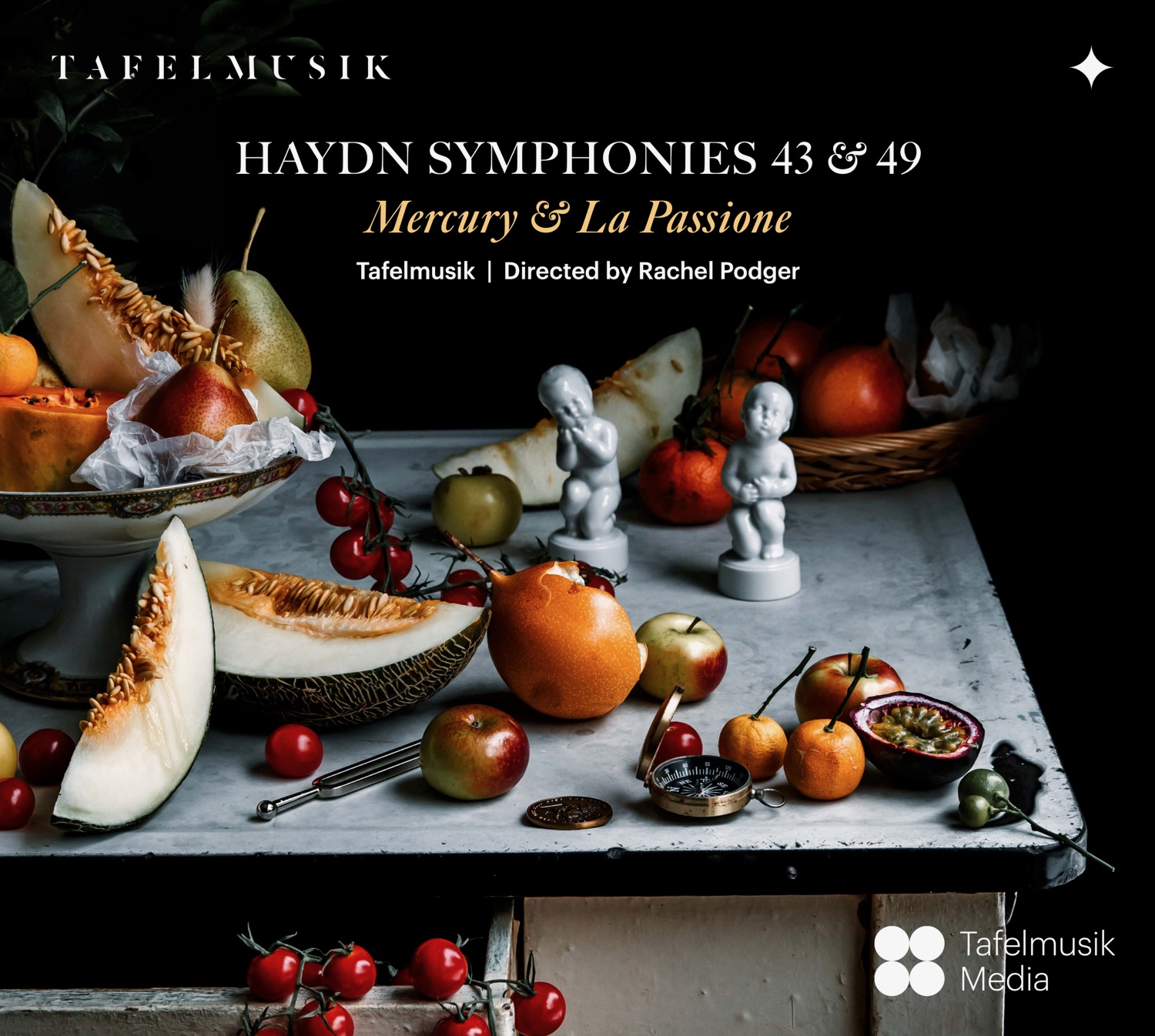
There’s a new recording of two Symphonies by Joseph Haydn scheduled to come out in October from Tafelmusik.
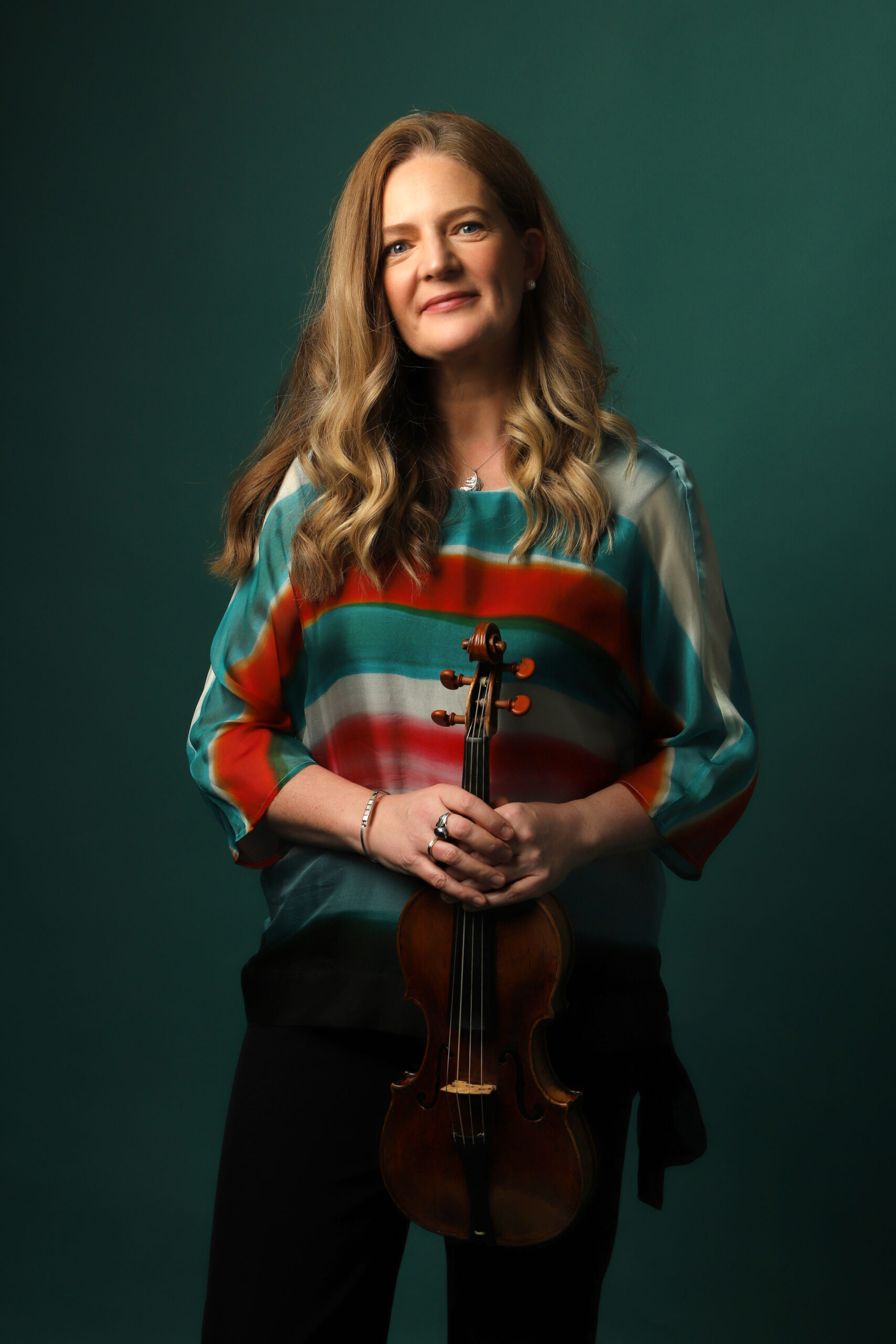
The performances feature violinist Rachel Podger, who debuts in her new role as Principal Guest Director later this month when Tafelmusik begin their fall season with an all-Mozart program at Koerner Hall September 27, 28 and 29.
Violinist and Tafelmusik Principal Guest Director Rachel Podger (photo: Broadway Studios)
The new recording offers Haydn’s symphonies #43 and #49, a contrasting pair of works. Haydn was a prolific composer who lived from 1732 to 1809, composing 104 symphonies, over 20 operas as well as many works for smaller ensembles or soloists.
We’re told in Charlotte Nediger’s excellent and enjoyable program notes that Symphony #43 dates from 1771, and that the nickname “Mercury” for #43 likely comes from the quick Finale, applied years later. The first movement after a sedate beginning suddenly doubles its effective speed (same tempo but feels twice as fast), building in intensity until a gentle second subject comes in, truly Mercurial in its alternation between vibrant and gentler moods, experienced once more as we repeat the opening exposition. The development similarly vacillates back and forth, the horns adding to the drama yet still grounded and astonishingly economical in its swift handling of the materials. If brevity is the soul of wit Haydn makes a persuasive case here and in the subsequent movements of this symphony.
Don’t get me wrong. The next movement Adagio is much longer, and more deliberate in its treatment of a theme and its elaboration. Where the first movement sounded like a big powerful statement mostly from the whole orchestra, much of the slower movement features gentler textures from parts of the ensemble dialoguing back and forth in a gentler sort of back and forth, a bit like a call & response.
The boisterous Menuetto & Trio is just over two and a half minutes long.
And the aforementioned Finale is just over six minutes of Allegro, beginning softly then erupting into something employing the whole crew. We are again alternating between softer passages and bigger stronger statements, the contrasts delightfully sudden. Is this why someone invoked Mercury? Nobody knows, but there’s certainly mercurial quality to the outer movements.
Let’s pretend there’s an intermission between the contrasting symphonies, an intermission of sorts when I will interrupt commentary on Haydn to remark on the superb performances of Tafelmusik on period instruments and violinist Rachel Podger as a team. I feel that we’re in a different place in 2024.
There’s been a transition, perhaps best understood as a sort of culture change, an evolution. I recall the first times I heard historically informed performances. There was a Handel disc on vinyl while I was working at the classical record shop in Yorkville around 1980. I wanted to like it..? There was also the Posthorn Serenade performance from the CJRT Orchestra around this time, the unfortunate soloist unable to handle the painful posthorn solo.The period instruments had a special sound but were occasionally so challenging to play that we would hear mistakes during performances or on records. In the next decades I sought and collected new recordings, although I regularly encountered people who refused to even listen to this sort of thing. Over time the skills of the players gradually caught up to those challenges.
And Tafelmusik themselves were gradually upgrading their skills over the years. They’re now at a place where their live or recorded performances have the colour, heft and weight of the older instruments but delivered without any of the fluffs one used to encounter in the previous generation. The rapport between Tafelmusik and Podger, herself not just a conductor but a performer leading from the violin, is palpable, infectious.
Symphony #49 in F Minor is a very different sort of piece from the work that opens the recording. Don’t let the higher number on the work fool you, as it actually dates from from the 1760s, three years before. Not only does it begin with a darker colour, but its emotional depths are starkly different from the upbeat work sharing the recording. The minor key is a relative rarity, one of eleven in the 104 Symphonies Haydn composed. All four movements begin in the same minor key. The nickname of “Le Passione” (again a later addition rather than one created at the time of composition) connects the work to Holy Week and possible performance on Good Friday, likely when secular music was prohibited. Elaine Sisman’s article “Haydn’s Theater symphonies” suggests a theatrical origin as she hypothesizes that Haydn’s symphonies served as theater music. Given the question-marks I welcome the chance to hear the music, given that performances are opportunities to explore such questions, if not answering them.
Reading about Haydn one sees the descriptive epithet “Sturm und Drang“, or storm and stress, a phrase that sometimes functions as more of a tease than a description. Yes composers and writers of the time were seeking to arouse emotion in the listener, to scare you, stir you up or upset you, long before we reached the romantics or gothic novels, although Walpole’s Castle of Otranto (1764) is in fact from before this symphony. Such things are relative of course. What scares or upsets someone in 2024, a time when we’re accustomed to school shootings, lying politicians and pictures of deaths caused by bombings of civilians, is surely far removed from what was undertaken by a writer or composer in the 1760s, when Haydn’s first known opera was composed (and there’s at least one more from before that’s been lost). While these are still far removed from what Haydn or Mozart would accomplish in subsequent decades, they’re still exciting and dramatic.
There are again four movements, reversing our usual expectation in placing a slow movement at the beginning and faster ones as the second and fourth.
While the complete CD is exactly 52 minutes long, it feels enormous in some ways for the density of the materials, the concentration of ideas. Yes Haydn’s movements are sometimes short but they are fleet-footed and intense. I’m listening to the recordings over and over, stunned by their economy and clarity.
Now that Podger and Tafelmusik have taken us on such a delightful tour of Sturm und Drang Haydn, I’m ready for their “Mozart Jupiter” program at the end of September.
On September 8, 1949 composer and conductor Richard Strauss died after a long productive life. I think of him as a romantic composer carrying on the stylistic traditions of Richard Wagner. In Salome and Elektra he was the modernist pushing expression and tonality to the limits of propriety taste and dissonance, before turning back from the precipice where he and the art were teetering, returning as a neo-classicist & late romantic to the warm melodic possibilities one could create in a tonal sound-world. Somehow one wouldn’t expect a man born in 1864 to have been alive so recently.
As regular readers may have noticed, I am sometimes a bit compulsive about dates and anniversaries. I’m thinking about the anniversary of Strauss’s death on September 8 2024, the 75th anniversary of his passing. I haven’t heard anyone mention this, possibly because there are usually other commemorations (for instance the Year of Czech Music or the centennial of Cunning Little Vixen) that get more attention. I guess this one is meaningful to me because Strauss has made an impression on me over and over throughout my life.
When I’m asked who I’d call my favourite composer I’ve never said Richard Strauss, even though maybe he’s always been there inside my head. That’s what I’m thinking about in this little summary.
In 1968 I didn’t wait long to see 2001: A Space Odyssey. I saw it twice in its first year, and bought the soundtrack album, featuring pieces by Ligeti and Johann Strauss Jr alongside the brief signature piece that opens the film. People refer to it as “The 2001 Theme”, that opening fragment from Also Sprach Zarathustra.
While that music has become ubiquitous, quoted in films and tv commercials, and the film itself has entered the conversation as the greatest film ever made, at least partially thanks to that revolutionary soundtrack, in 1968 its impact was still in the future. At this point in my life I was also listening to the Beatles while sometimes playing the piano accompaniment for my brother’s songs or arias. It would be years before I would get a recording of the complete tone poem Also Sprach Zarathustra, or read the poetic Nietzsche work underlying Strauss’s composition.
In 1969 one of the first really exciting operas I saw was presented at the University of Toronto Opera School (as it was then known) at the MacMillan Theatre, a production of Ariadne auf Naxos directed by Hermann Geiger-Torel and conducted by Ernesto Barbini. They called it “Ariadne on Naxos” because they presented it in English translation.
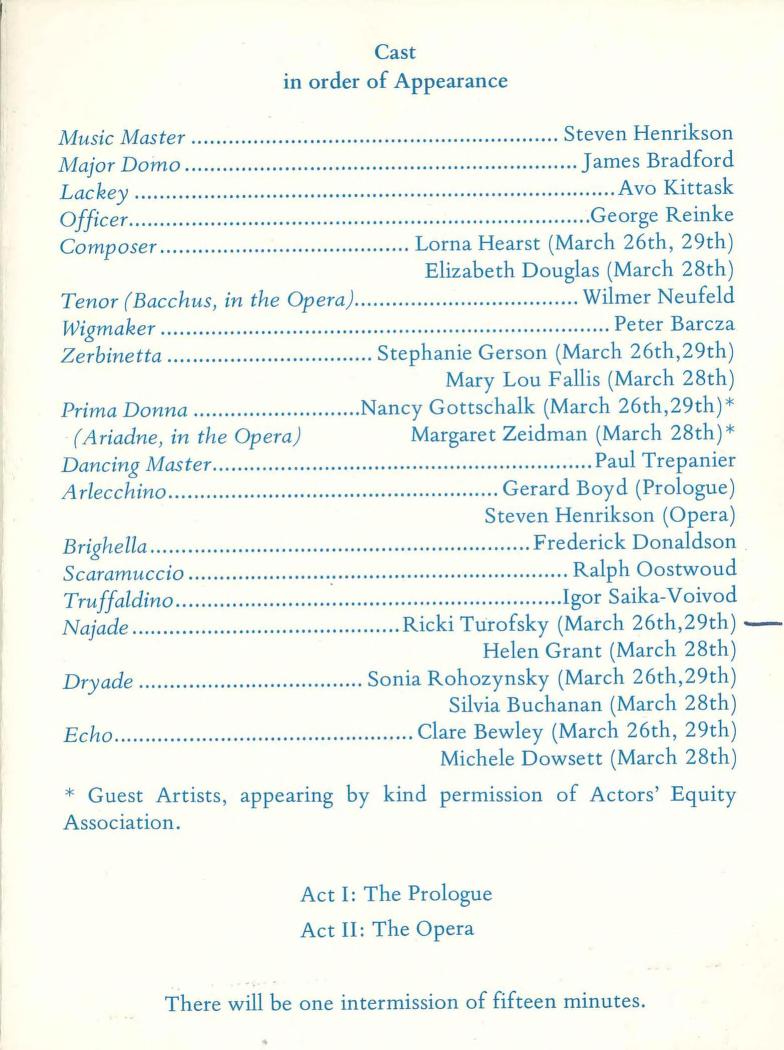
University of Toronto Music Library. Music Library collection of faculty events, Ariadne on Naxos : [program], OTUFM 51-CS68/69-OD-PR 1969 09.
Was it staged to commemorate the 30th anniversary of Strauss’s passing? If they did there’s no mention of it in the program.
Even so it was the most exciting thing I had ever seen live on a stage. I didn’t expect to love it so much.
It’s been a bit breath-taking to peruse the program, to see familiar names on the cast list. I will have more to share as I look more closely at the files in the EJB Library archives. I went to see it mostly because my brother Peter Barcza was just 19 years old in the Opera School, singing the small role of the Wigmaker.
But this opera with its strange mixture of mythological characters (Ariadne, Bacchus, three nymphs) and Commedia dell’arte figures (Arlequino, Zerbinetta, Truffaldino, Brighella, and Scaramuccio) blew me away. To this day it’s one of my favourite operas. I realize this is also where I first encountered Commedia dell’arte, another life-long preoccupation.
In my teens I started an addiction that persists to this day, collecting and listening to recordings of music. At first it was on vinyl, later on CDs and DVDs. In addition to the operas I became intrigued by the tone poems of Richard Strauss, including that aforementioned Zarathustra. I was particularly impressed by the recordings of the Dresden State Orchestra conducted by Rudolf Kempe, who seemed to have a special instinct for this music. Their Ariadne auf Naxos recording is still my favourite version of the opera, featuring James King, Gundula Janowitz, Sylvia Geszty, Theo Adam, Teresa Zylis-Gara, Peter Schreier, Hermann Prey and a transparent clarity in the recording of this radiant score.
It’s such a thrill to pull it up on YouTube to have a brief listen.
I remember when one had to struggle to find and obtain such recordings: costly for a kid, welcome gifts from a generous & supportive family. And now they’re available online for free. Is it a golden age? Or the ground-rules of our economy have changed, offering us so many free treasures, while devastating the livelihoods of the artists.
But I digress, I was speaking of a childhood getting acquainted with music through recordings and occasional live encounters in performance.
A few years later, when I was at University of Toronto doing my undergrad, I met a few remarkable people who participated in the shows I would get to do with the Trinity College Drama Society, a magical period that infected me like a disease with the theatre bug. We had a woodwind quartet with me on David Neelands’ harpsichord for a production of Beggar’s Opera, when David was the College Registrar, an extraordinarily generous individual fostering our creativity. The horn player (whose name I’ve forgotten! a divinity student) showed me his score for the Strauss horn concertos. The first one was much easier for both of us: although he seemed able to play both almost effortlessly. I didn’t appreciate how spectacular and rare he was until later. The last movement of each concerto is a bit of a thrill-ride for the pianist.
And there it was, another bit of Strauss embedded in my head. Of course I bought Peter Damm’s recording of the two concerti conducted by Rudolf Kempe with the Dresden State Orchestra.
Around the same time I would start writing at the Varsity. My first interview was with Bill Shookhoff, whom I met through my brother. I remember that he told me Salome was the toughest opera score. So of course I had to start playing that, always astounded at how it sounds on the piano while maybe also a bit intimidated by the thought that people like Bill could play this daunting piano score.
It may be a bit of madness on my part that I don’t approach one of these piano scores (Strauss Wagner or Verdi as well) as piano music, but rather always hear them as orchestral music, wanting to sound orchestral. Delusional? Perhaps.
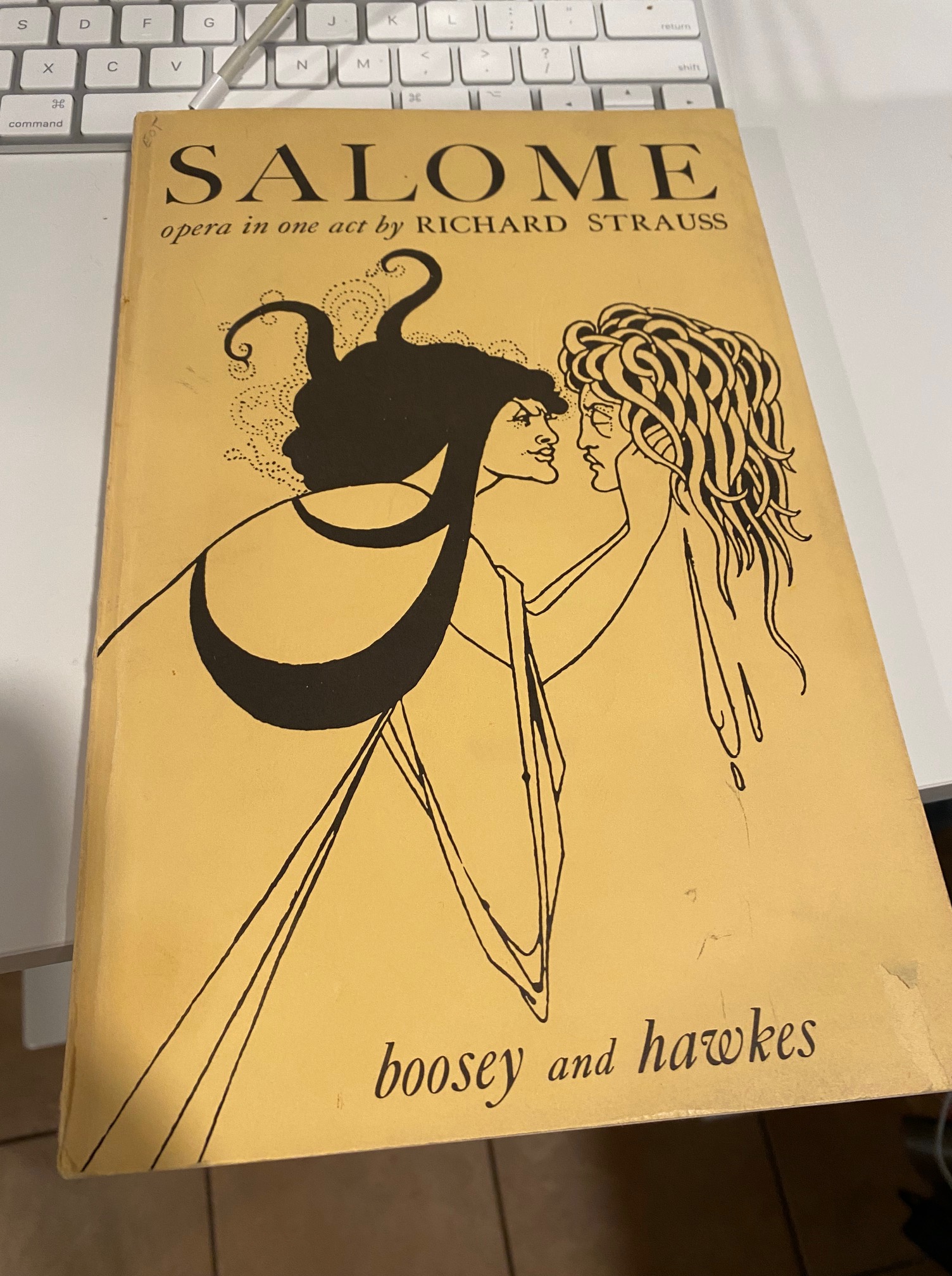
I don’t just collect CDs. Piano vocal opera scores are an amazing resource. I bought this beautiful score of Salome for $12 at a used book store. Yes I have a weakness for used books, particularly when they sell musical scores.
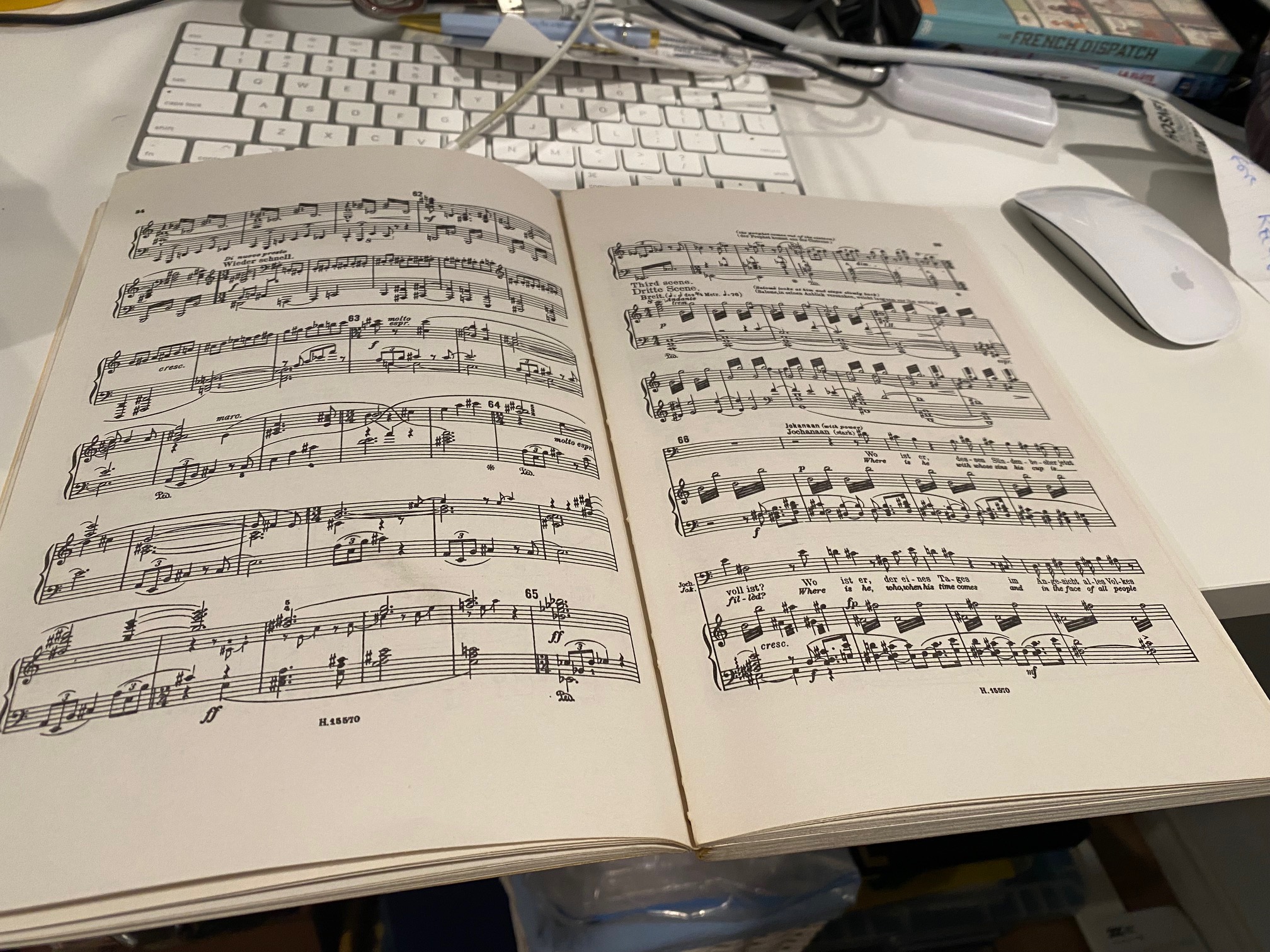
The sequence where Jochanaan emerges out of his captivity under the stage is intoxicating, music that is so much fun to play even if the piano is a pale imitation of the orchestra. It’s fun to imitate an orchestra at the piano, especially in the transitional passages or the Dance of Seven Veils when there’s no singing anyway, written in the overpowering tradition of Wagner.
Notice (if you look closely) where the score naturally falls open. Yes this is the sequence I mention above. On the previous page Narraboth commands the guards to bring Jochanaan up, Salome says “ah”, and the orchestra (or piano) takes over for a few pages. The next vocal line is Jochanaan singing “wo ist er” on the page at right.
When I went to graduate school I was living an even more divided life, sometimes studying in class, sometimes enacting practical theatre on stage, and meanwhile also holding down a full-time job.
In 1999 during my PhD I realized it was 50 years since Strauss had died. I don’t know if anyone anywhere commemorated this date, but I did, via a mid-day mosaic concert at Hart House Music Room. I had recently composed an operatic adaptation of Venus in Furs that was presented at the Drama Centre during their festival of original theatre in the spring of 1999. I called upon Counter-tenor Mathieu Marcil who had sung in the opera in May to reprise some of what he’d done in the autumn.
My own music was an afterthought in my own mind. The program I conceived was meant to bridge Strauss’s life, asking Mathieu to sing songs from Strauss’s childhood before the age of 12 in a counter-tenor voice to begin the concert, imagining a young boy’s voice such as the composer might have had at the time when he composed the songs. And the other end of the composer’s life was represented by me concluding the concert with the Four Last Songs. In between Mathieu and I sang from my opera and Mathieu sang the prayer from Akhnaten by Philip Glass.
There are layers to this act of self-indulgence, from the self-promotional aspect of any artist promoting their own music, plus the petulant desire to push back against strictures prohibiting certain sorts of performance, thinking of how the Four Last Songs are usually sung by a woman. For me it’s not a gender thing so much as a musical thing. In 2024 I no longer have the high B natural needed for the first song, and as I’m not singing much lately, it’s an academic question.
But please note, in my research into Debussy and the fin de siecle Wagnerians in Paris of that time it was very different from now, as no one had ever heard Wagner, and so a pianist might sit down and perform all the parts of an opera for a group of eager listeners. Before that period the piano was even more central to creative life, as for instance in the efforts of Franz Liszt earlier in the 19th century to popularize works that were otherwise unknown through the magic of transcription. Later 20th century virtuosi such as Rachmaninoff or Percy Grainger thrilled audiences with fanciful rewrites of music. You can still recognize the original.
The pendulum of taste seems to have swung to the other extreme, in an insistence on authenticity rather than imaginative paraphrasing. But it doesn’t have to stop us from enjoying some of the wonderment found in a piano reduction. Currently on the 75th anniversary –again thanks to the University of Toronto’s Music Library– I feel fortunate to have found piano transcriptions of some of the tone poems, bringing me full circle. While they don’t always work that well at the piano, and sometimes are very difficult to play, they still serve to stimulate the imagination, especially if we hear the orchestral version in our heads.
In 1967 Joseph Budai was working on a renovation of a Chinese restaurant in Peterborough.
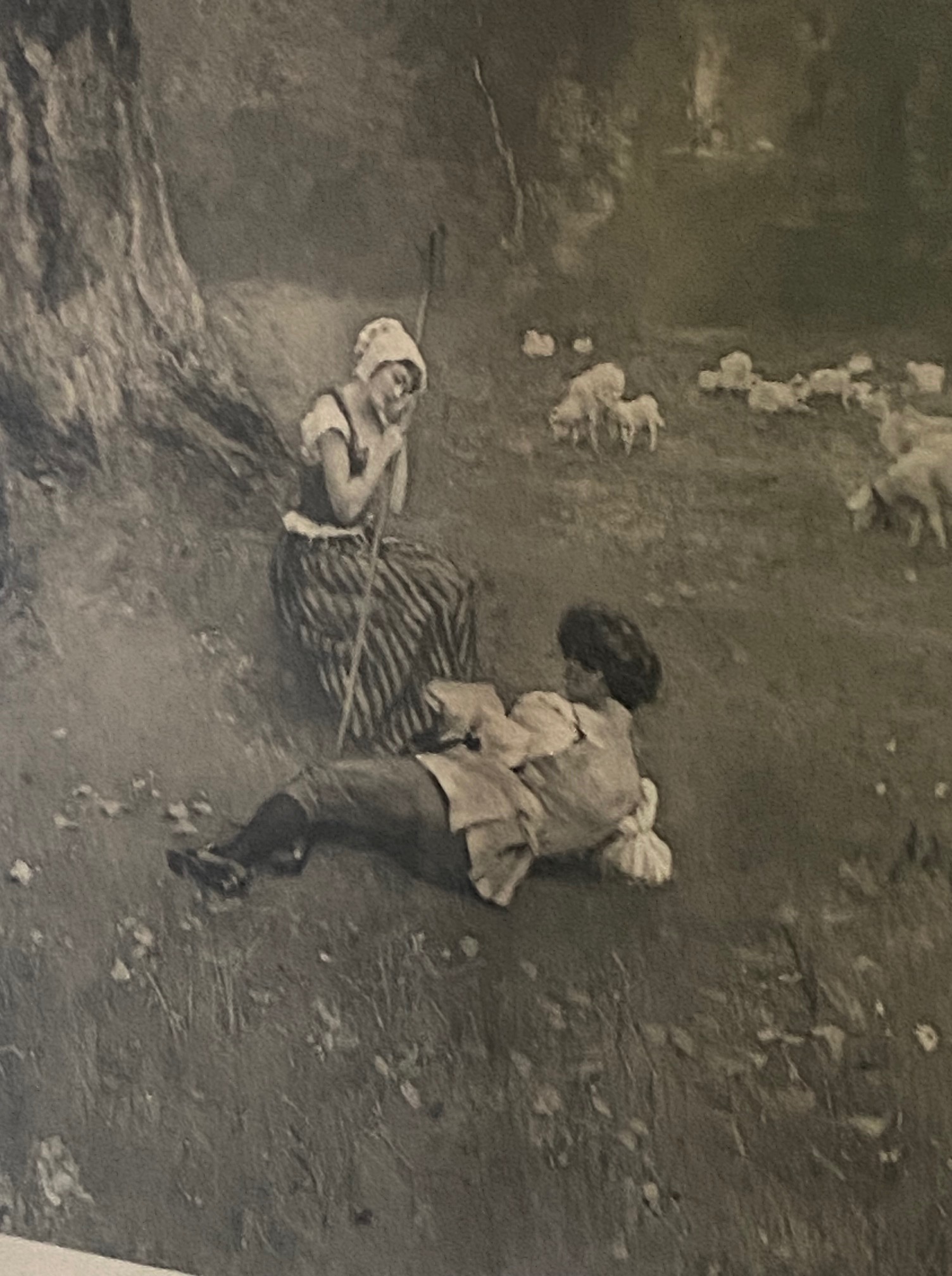
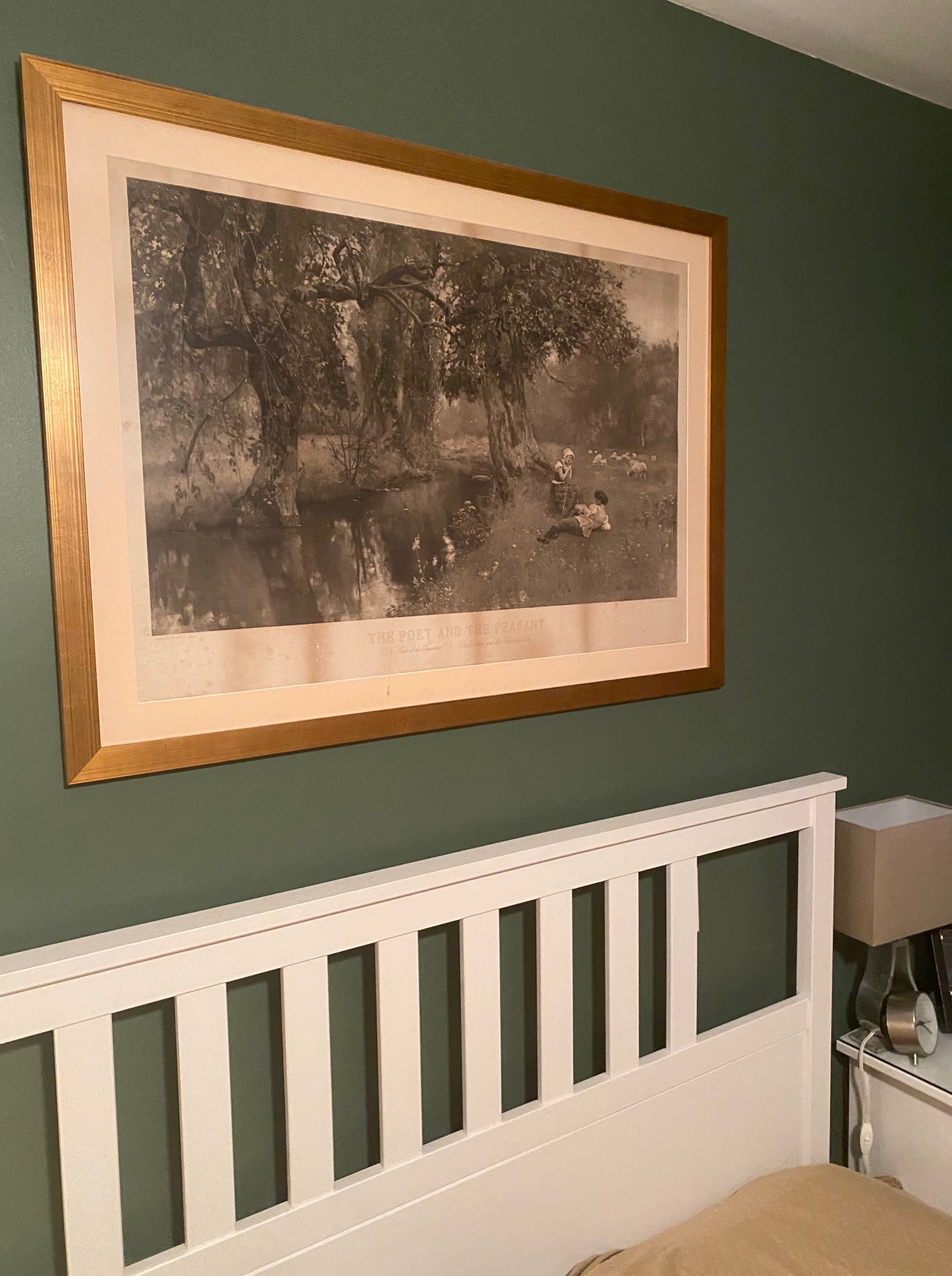
An old lithograph picture was left inside the walls that he was renovating. At the time it was still inside an old ornate frame that was broken and very dirty. Of course it was, they’d stuffed it inside the walls, where it lay forgotten for many years.
Joe retrieved it, took it home, and held onto it for a long time….
Close-up view of Joe’s picture
1967 was also the year I became a student at University of Toronto Schools, aka UTS. I know I must have been a huge pain in the butt to our music teacher Mr Fitzgerald. Perhaps my whole class was a challenge. I recall that Mr Fitzgerald had a whistle that he would sometimes blow in attempts to get us to be quiet. We were sometimes a rowdy group in grade seven and the years that followed.
I don’t deny that I was a smart-ass, proud younger brother of a great singer, trying to reconcile myself to a UTS music program oriented towards the cadet corps and marching band music rather than orchestral music or opera. While I’d played the cello in grade six I would play euphonium in grade seven.
Mr Fitzgerald, to his credit, had a few great ideas. Decades later and after having worked from the other side of the music, as a music director and teacher, I am abashed recalling how hard we made the poor guy work, trying to impress an impossible group of little boys.
One day Mr Fitzgerald brought us a new piece. The pages of music we placed onto our music stands were pristine, untouched until we opened them: the Poet and Peasant Overture by Franz von Suppé (1819 –1895).
And our leader was new too, as Mr Fitzgerald gave the conducting assignment that first day to an older student. It’s amazing how much better we behaved, no longer acting out against an authority figure, now that we were being led by the cool kid from grade 12, who came in politely, holding his baton with a kind of reverent care. He addressed us with respect, full of a high-minded seriousness before we had even begun to play the piece. Everything that day felt brand new, at least because we had a new leader and new music before us. His attitude was contagious.
I remember that we approached the Poet and Peasant Overture as though we were playing Beethoven’s Ninth Symphony.
I remember classmate Ron Walker playing the melody of the first section on trumpet, sitting in a row in front of me, and clearly having a great time with the piece. I haven’t seen Ron in half a century. I hope he’s still alive. I was on euphonium in the back row beside George Stock on trombone.
The opening phrases are big and bold. Then the softer answering phrase I think was coming from another grouping, perhaps clarinets and other woodwinds, to create a contrast. I don’t know if we ever made it through the whole piece, as it took us awhile to get past the first page. But it was exciting all the same.
Mr Fitzgerald seemed to know what he was doing, putting me on the euphonium. While I wanted to play french horn Mr Fitzgerald claimed my lips were wrong for the instrument. Perhaps he was right? My older sister had played principal french horn at Cedarbrae and later Lawrence Park Collegiate, seemingly coping with the same full lips we inherited from our parents, that didn’t prevent her from skillfully playing the horn solo in the Tchaikovsky 5th symphony.
Or maybe Mr Fitzgerald had his eye on the future of the UTS Band, so that my ambitions were irrelevant. In time I was encouraged to switch from euphonium to tuba, which is very similar in fingerings but hitting lower notes. In fact I loved it even if I didn’t enjoy being called “Tubby the Tuba,” (a reflection of my physique). Clearly Mr Fitzgerald was planning the succession, as older students’ graduation changed the needs of the UTS band. In short order I was the tuba player and offered a bargain-priced trip to Ottawa, at $40 including bus fare and two nights at the Lord Elgin in 1970 or so. I recall an inspection in uniform as member of the cadet corps, where the inspecting officer arrived beside me, commenting something along the lines of “that instrument is bigger than you!”
And I politely replied “yes sir!”
You will recall that Joe Budai found that lithograph back in 1967, when I was 12 years old and his daughter Erika was 15.
Erika and I would meet roughly twenty years later, and were married in 1989.
Joe told Erika that the lithograph in its gold frame, still stashed away in storage somewhere, reminded him of me and Erika. I found the idea not just romantic but flattering, an endearing image. The title at the bottom of the picture says “The Poet and The Peasant”.
This detail of the picture shows the title (seen more clearly by human eyes than via my smartphone)
Erika was as much or perhaps more of an artist than I. She went to Ontario College of Art (or OCA, as it was then known) now Ontario College of Art and Design University (or OCADU). I remember wondering whether I should think of her as poet (artist) and myself as the peasant in her father’s mind.
I have written about Joe Budai before. Joe was married to Irene. In April 2009 Irene passed away. Joe was still alive but afflicted with Alzheimers. In February 2010 Joe would finally pass away.
A couple of years ago we took the remnant of the lithograph in its old golden frame to be restored, cleaned up and given a new frame. It hung for awhile above our bed.
Currently the picture hangs in the front hallway of our home.
The lithograph is actually a copy of a painting by a British painter Henry John Yeend King (1855–1924). The original can be seen online, a full-colour oil on canvas 109 cm by 160 cm. I wonder whether the painter knew the operetta, or merely used the title as his inspiration.
But I was wondering about that image in the lithograph. When I looked around online it led me back to the piece I had heard at UTS decades before. When I googled I saw the connection of the name –between the picture and the overture–even if I can’t find the story original. It seems that the work titled Dichter und Bauer(Poet and Peasant) was composed in 1900 after Franz von Suppé had died. He had composed incidental music plus the overture for a play back in 1846, while the operetta was assembled in 1900 using his music.
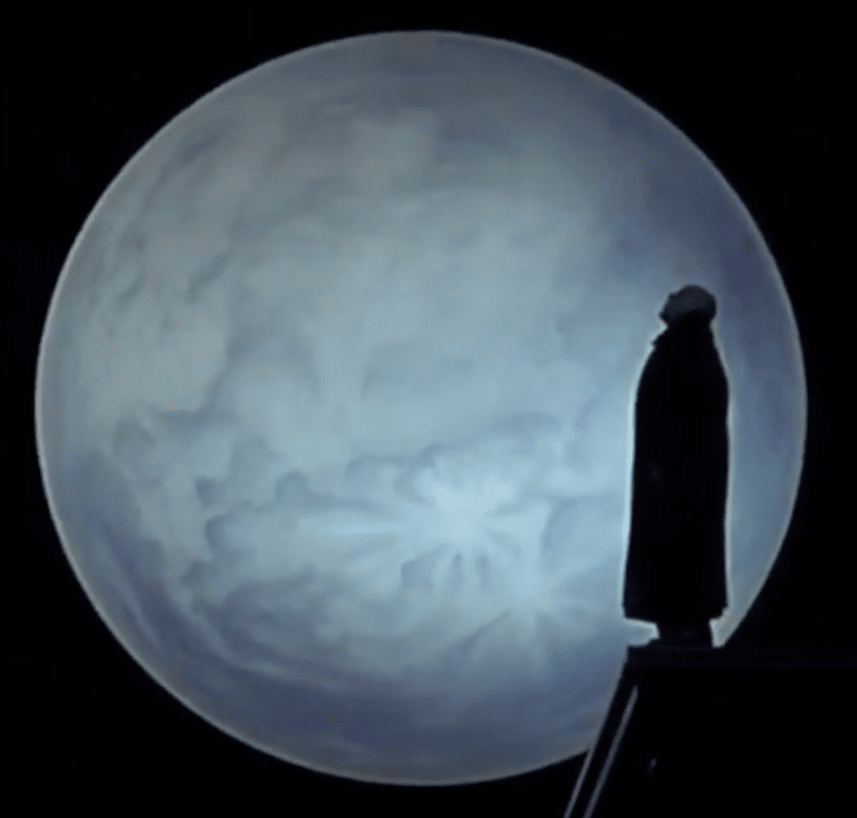
I’ve recently been exploring the riches of the Edward Johnson Building’s music library, especially piano reductions of orchestral pieces. When I looked in the library catalogue I was delighted to see that the EJB Library had a copy of the Poet and Peasant overture in a piano arrangement, one of several items donated by Professor Carl Morey. While it is not permitted to circulate, one can have a look and copy.
I requested the score of the piano transcription, took pictures and then printed a copy at home that I have played through.
As with most piano transcriptions the music has to be reduced from a large ensemble to be played at the piano by a soloist.
Here’s the cover page.
Playing it on the piano was a bit of a nostalgia trip… It opens with a solemn melody that we took very seriously back in the day even if it’s kind of silly in a Bugs Bunny cutting Elmer Fudd’s hair sort of way. Sometimes the piece is sweetly lyrical, sometimes desperately melodramatic, jumping from one mood to the other. Music for the theatre of the time was created in hopes of capturing and inspiring powerful emotions. The transitions in the music were unsubtle, even abrupt, but that just made them more exciting.
There’s a passage where the melody sounds a lot like “I’ve been working on the railroad”. The intense drama in the middle when it gets all passionate reminds me of Rossini’s overture to William Tell, alternating between pastoral lyricism and the powerless desperation of a silent film.
The heroine is tied to the railway tracks. And a train is coming!
Von Suppé’s command of a melody is as sure as any bel canto composer: even if it might be a mistake to use such a label for his music. I wish I knew the original context better, as the piece has been divorced from the original text that inspired the work. All I have so far is a title.
I hope to find out more, but in the meantime I can enjoy hearing and playing the overture.
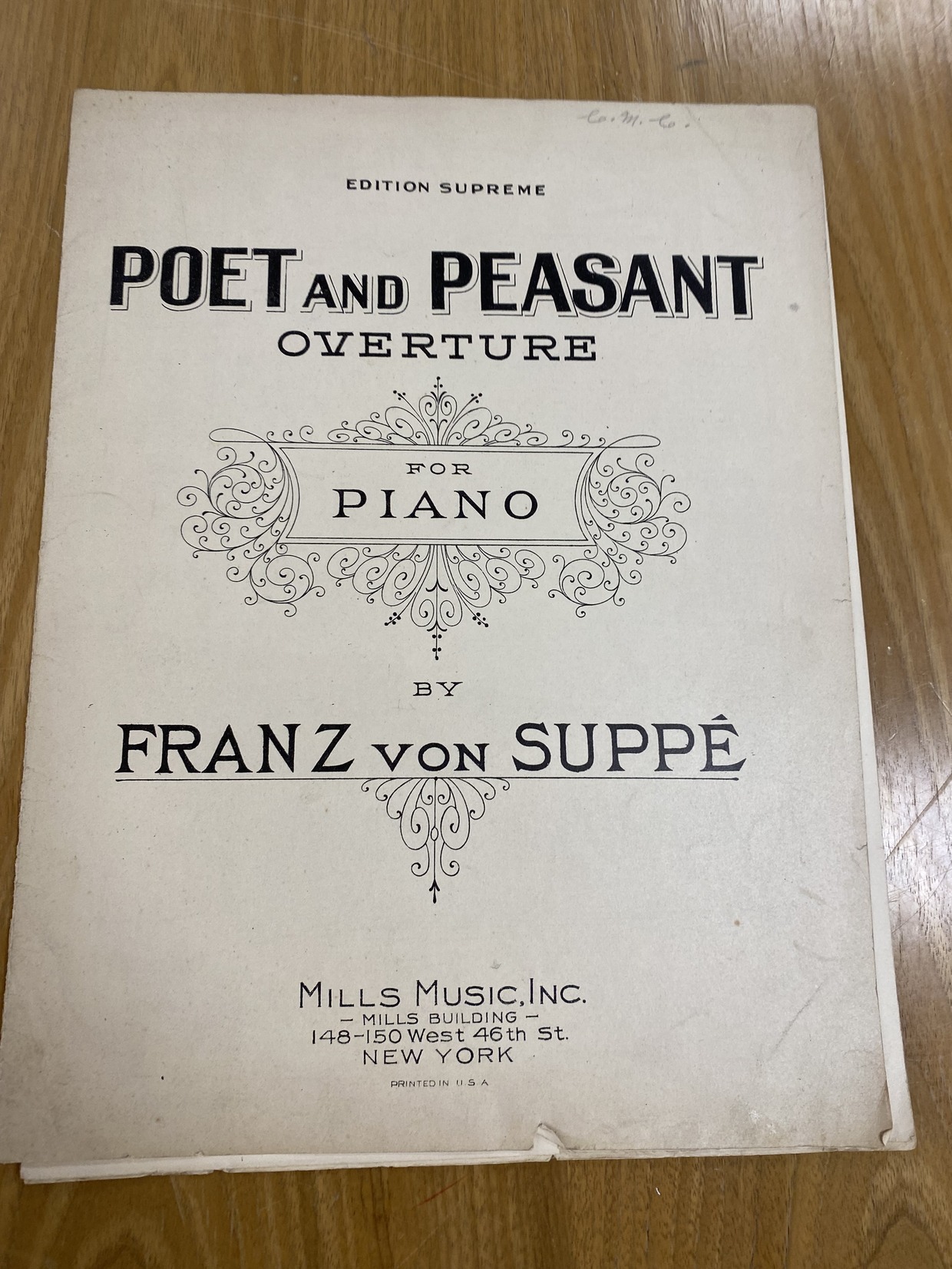
Today it’s the full moon, when people seem to go mad.
Fester howls at the moon
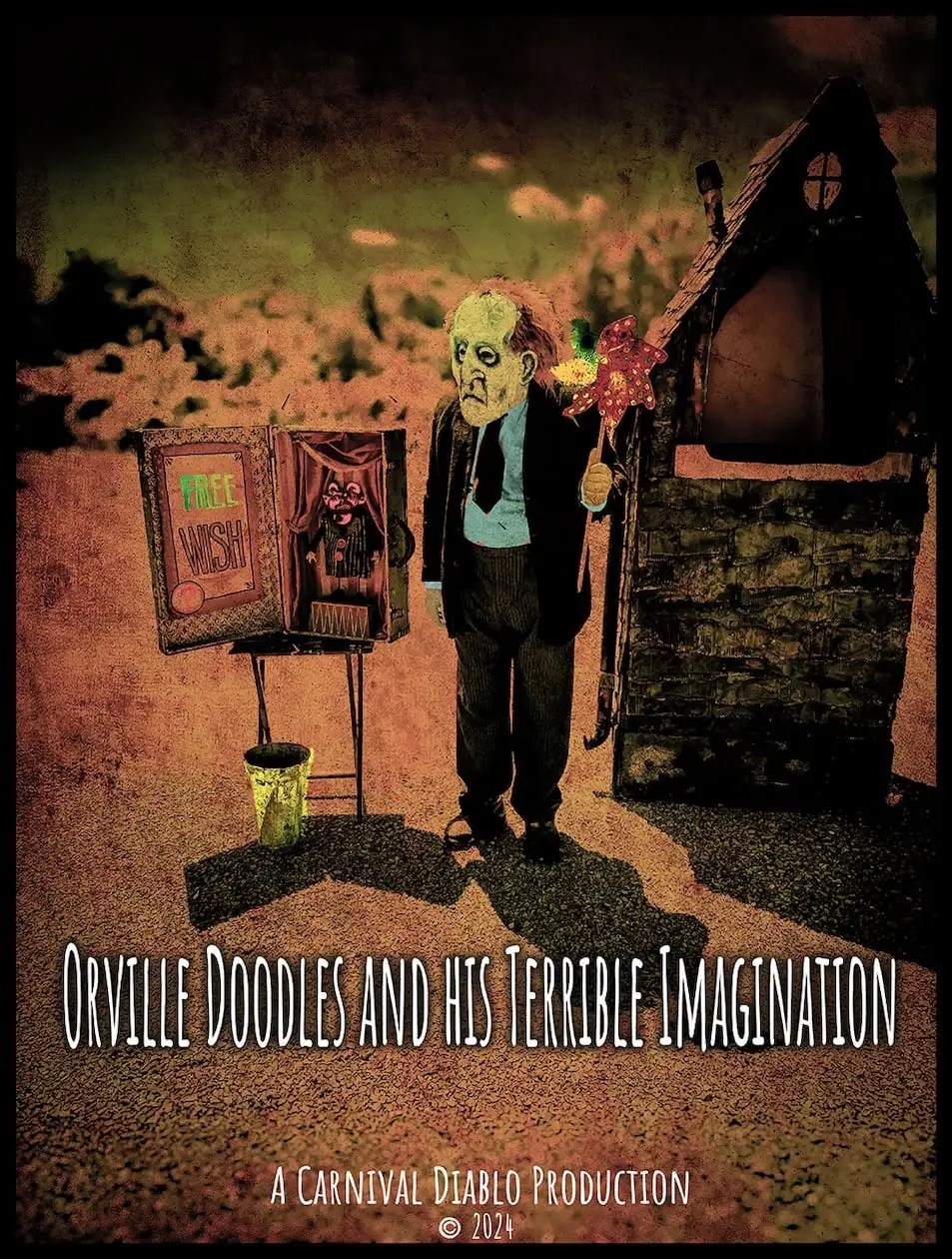
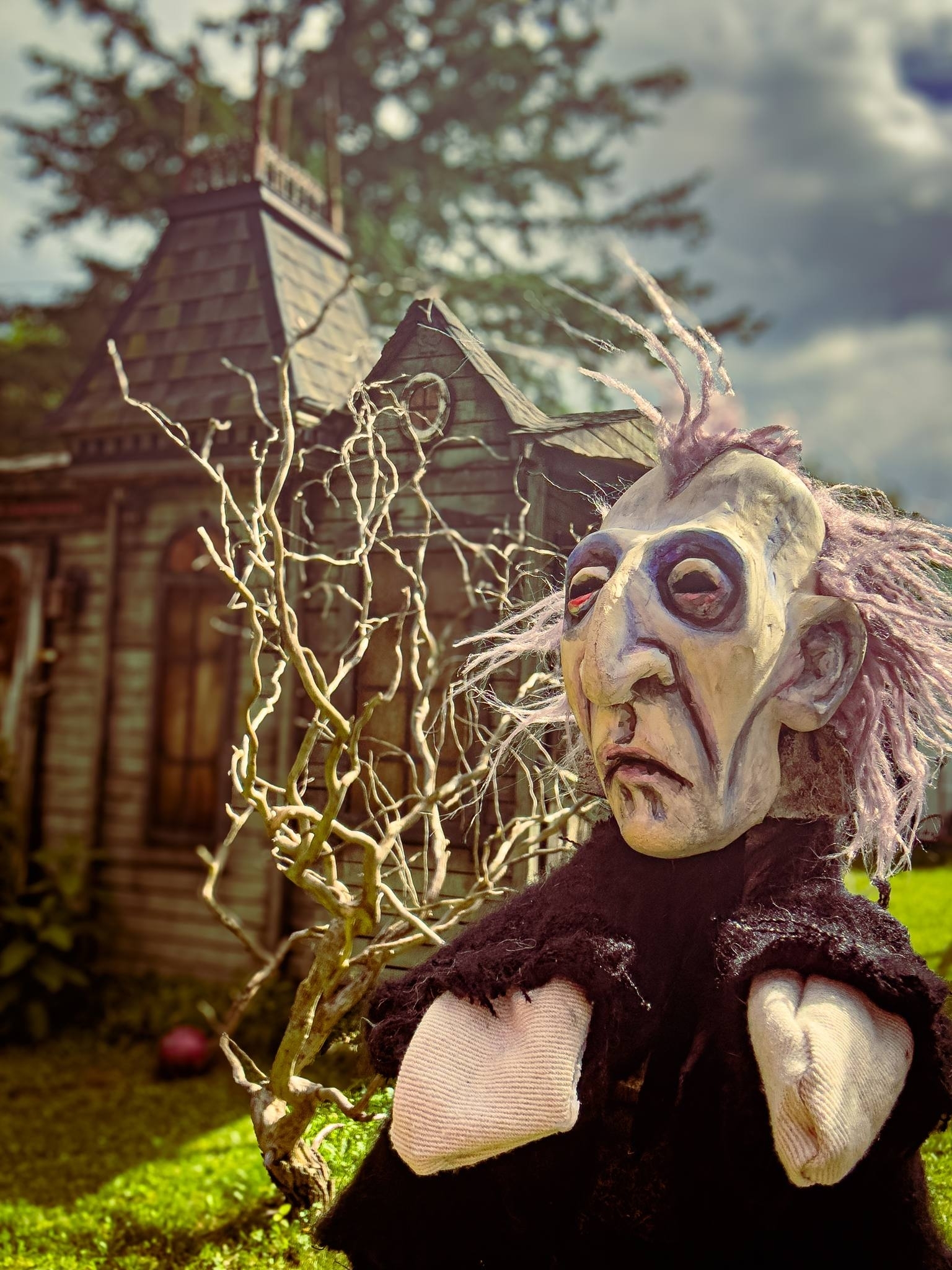
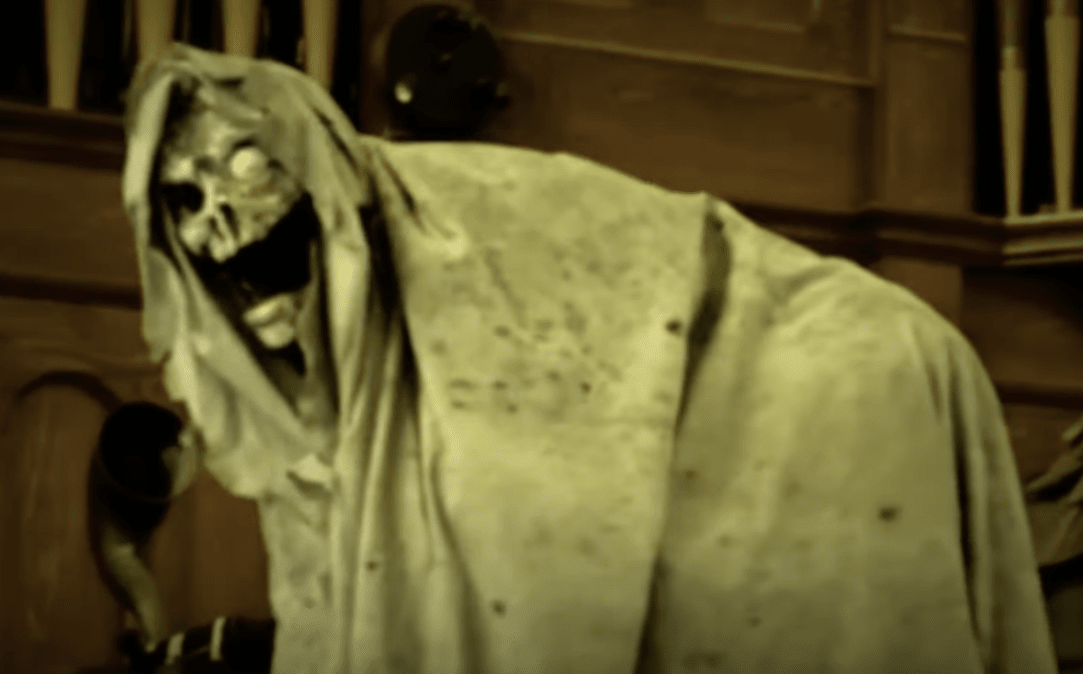
I have just watched Scott McClelland’s Orville Doodles and his Terrible Imagination: a retelling of the Faust legend at the Red Sandcastle Theatre.
No, there was no transformation into a werewolf.
But we did witness an encounter between a normal person and the powers of darkness threatening damnation, a devil & demons, a dog and even a few things that don’t begin with the letter “D”.
The original Faust may as well be Fester screaming at the moon, wishing for a better life. In various versions of the tale the hero sells his soul to the devil in exchange for something he lacks such as youth, love or excitement.
Orville does not look happy.
After seeing the show I understand that the cryptic title has multiple meanings.
Orville lives a life that seems unbearably boring, a daily routine that is stupefying. No wonder, because Orville has no imagination.
When the devil offers him an imagination in exchange for his soul, I wonder: would someone with an imagination foresee what this might mean, what consequences he might trigger? We might ask: 1-is his imagination terrible when it encounters the horror? or 2- is his imagination terrible when it fails to anticipate the consequences of his choices?
Orville takes us along on his voyage of discovery, as though we too will learn about the world, learn how to imagine.
We see a fairy get devoured by a devil-dog.
We see ghosts & demons.
We see Orville’s body change.
As Scott manipulates puppets and works magic, creating an illusion, we are invited to use our own imaginations. We may ask about the hazards, the danger for Orville and our own danger. Is the ability to imagine a blessing or a curse? If the performer succeeds in creating imaginative engagement with the audience it means we are moved, sucked into the story, rather than indifferent.
The story hints at the hazards of an imaginative sensibility.
The transformation of Orville’s life from boring routine into something magical parallels what we watch. Scott the magical practitioner strips layers off of the surface of reality, as Orville takes risks.
Is this the path to redemption or damnation? You’d have to see the show to find out, as I’d rather not spoil it. But it’s entirely kid-friendly, suitable for children ten years of age and up.
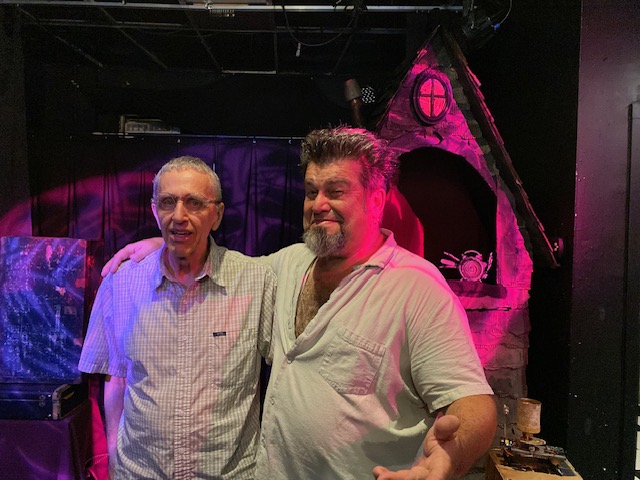
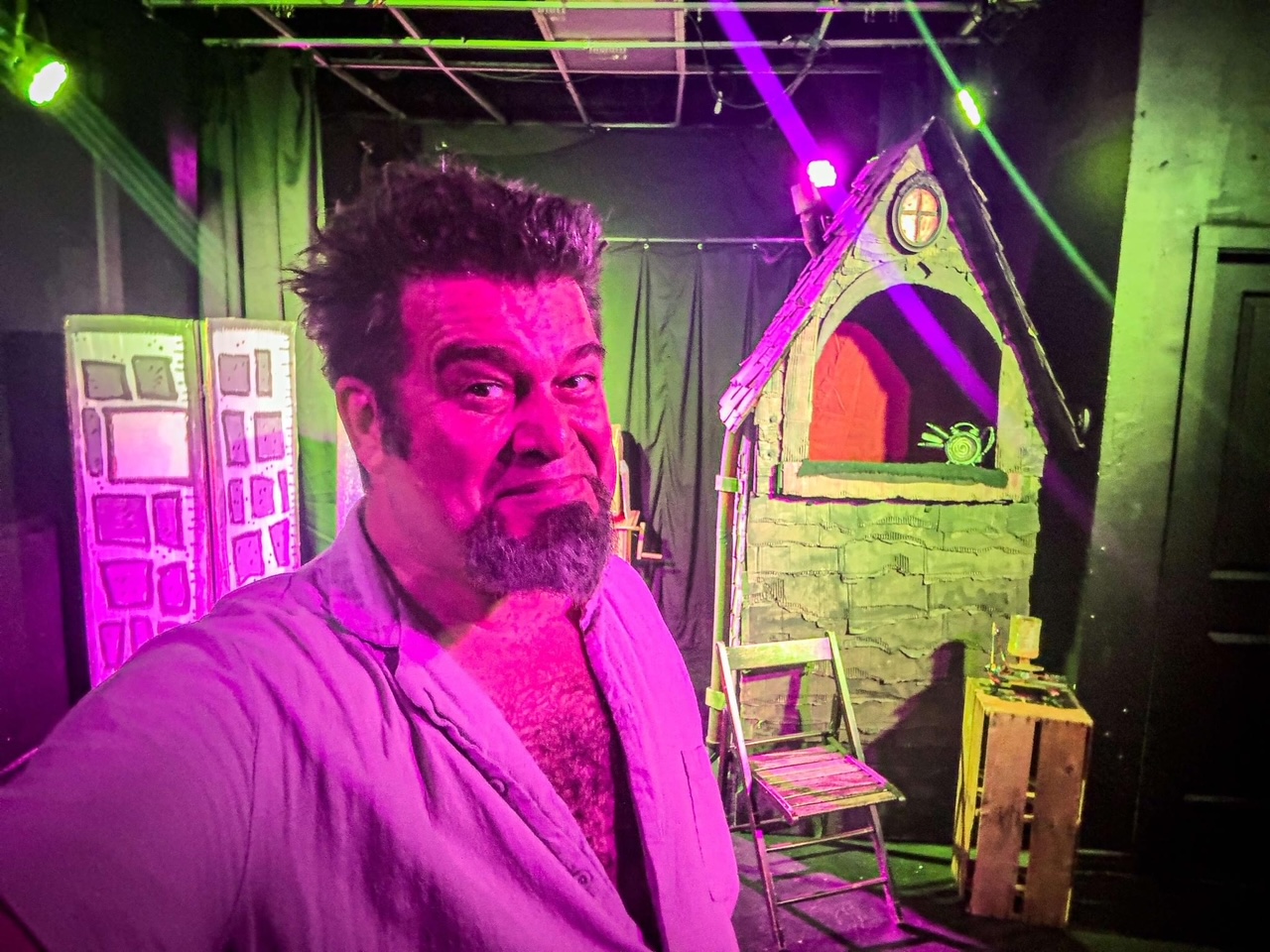
I had a chance to meet Scott.
You’ll notice how flamboyant and friendly he seems while I was stunned from the heat before the matinee.
Thank goodness for the air conditioning at Red Sandcastle Theatre.