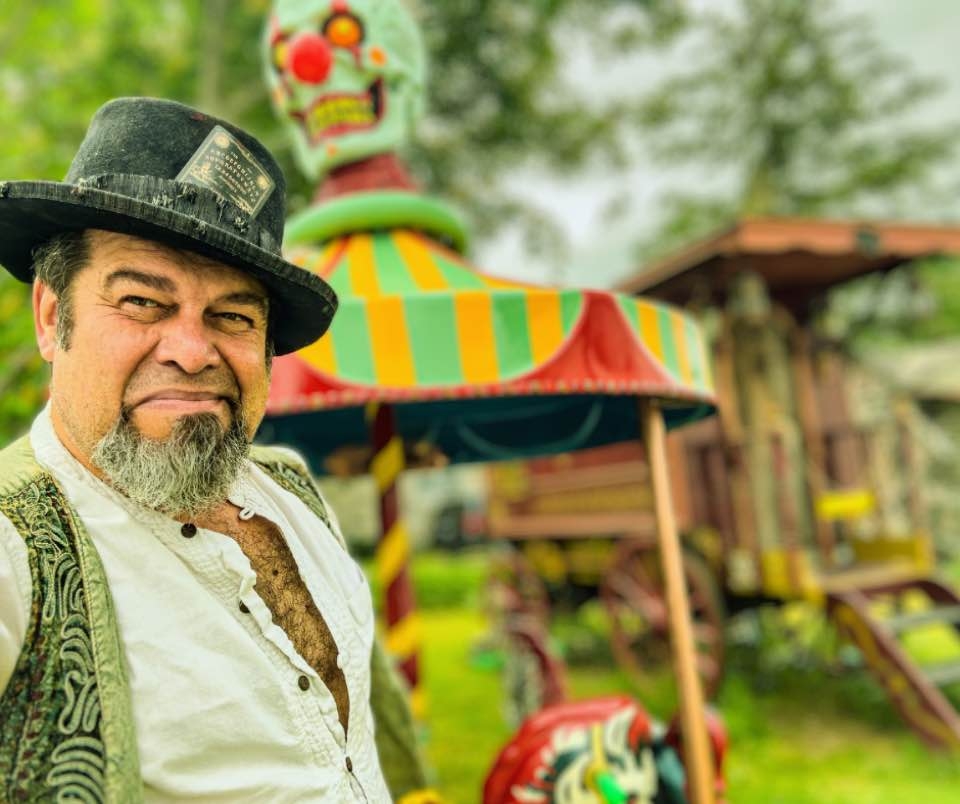
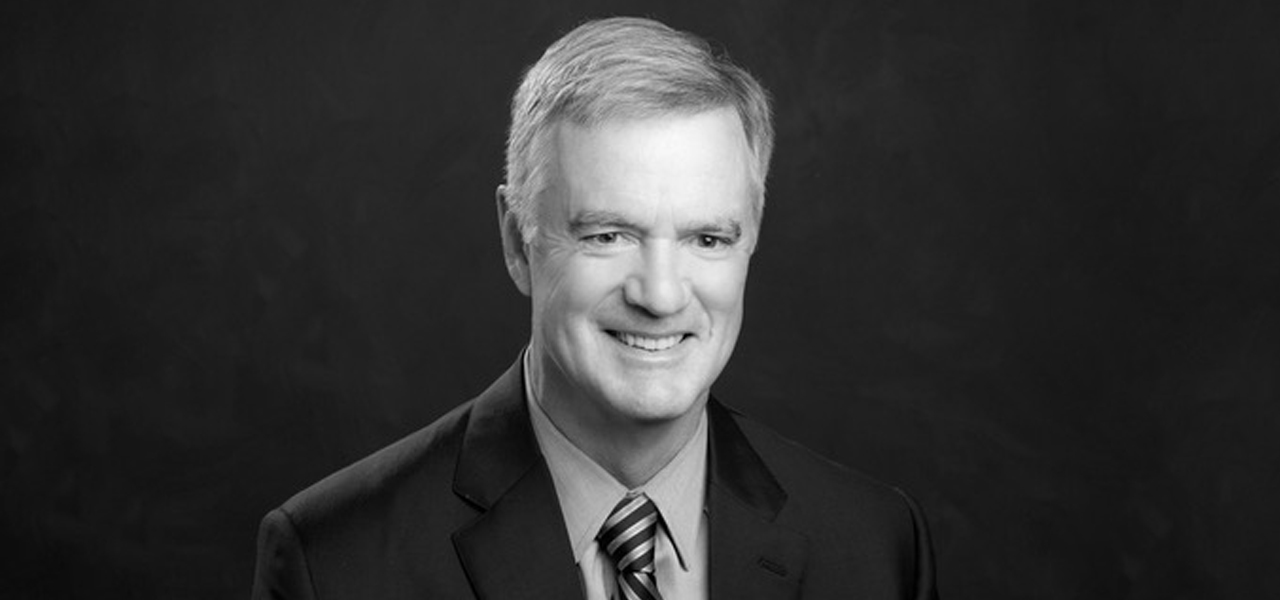
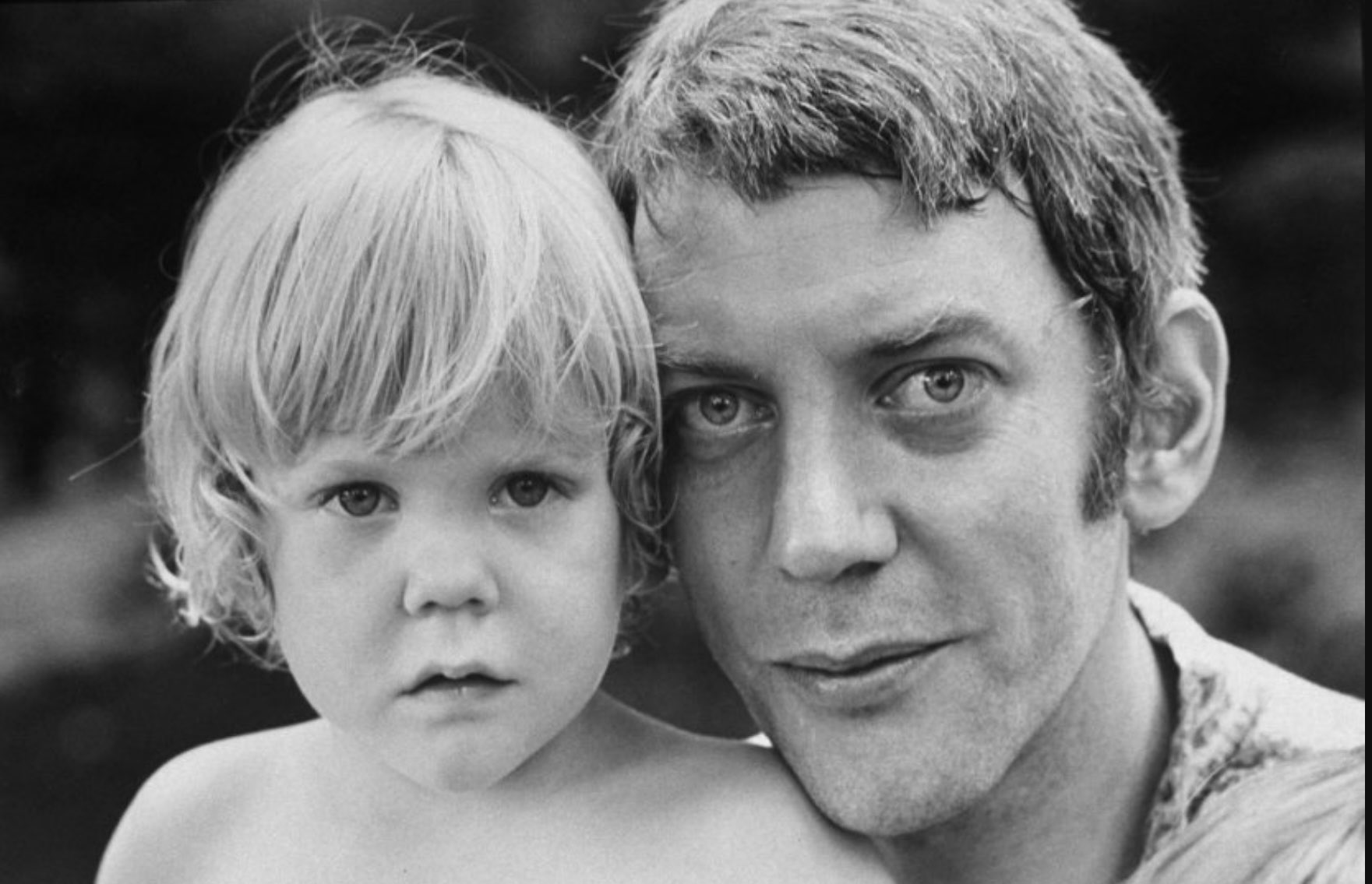
Forgive me. The name of the show may be Orville Doodles and his Terrible Imagination but I couldn’t help thinking (as I ponder questions that I will pose to Orville’s creator), that Orville comes from the brain of Scott McClelland.
So of course here are my questions for Scott to probe that terrible imagination of his.
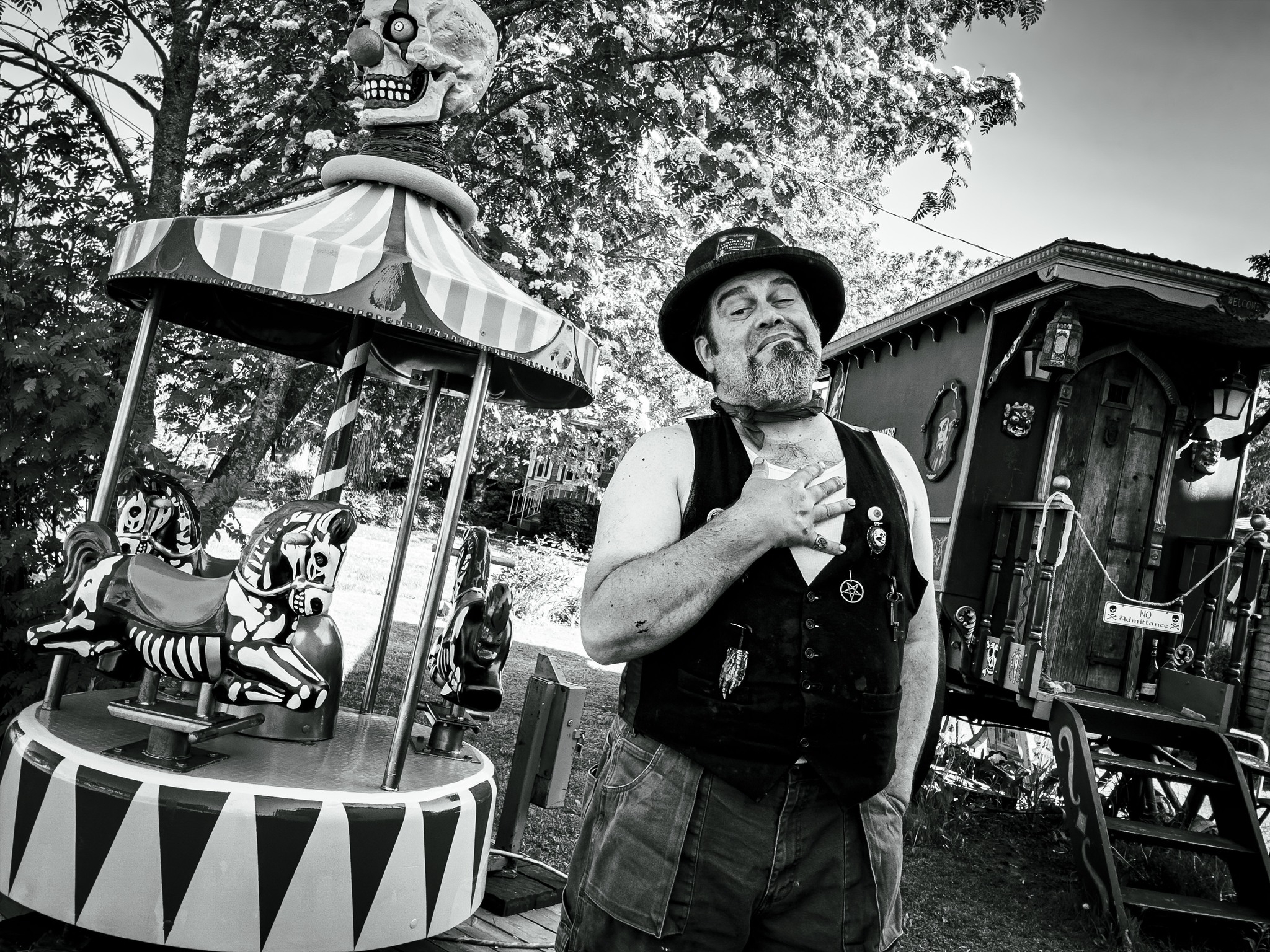
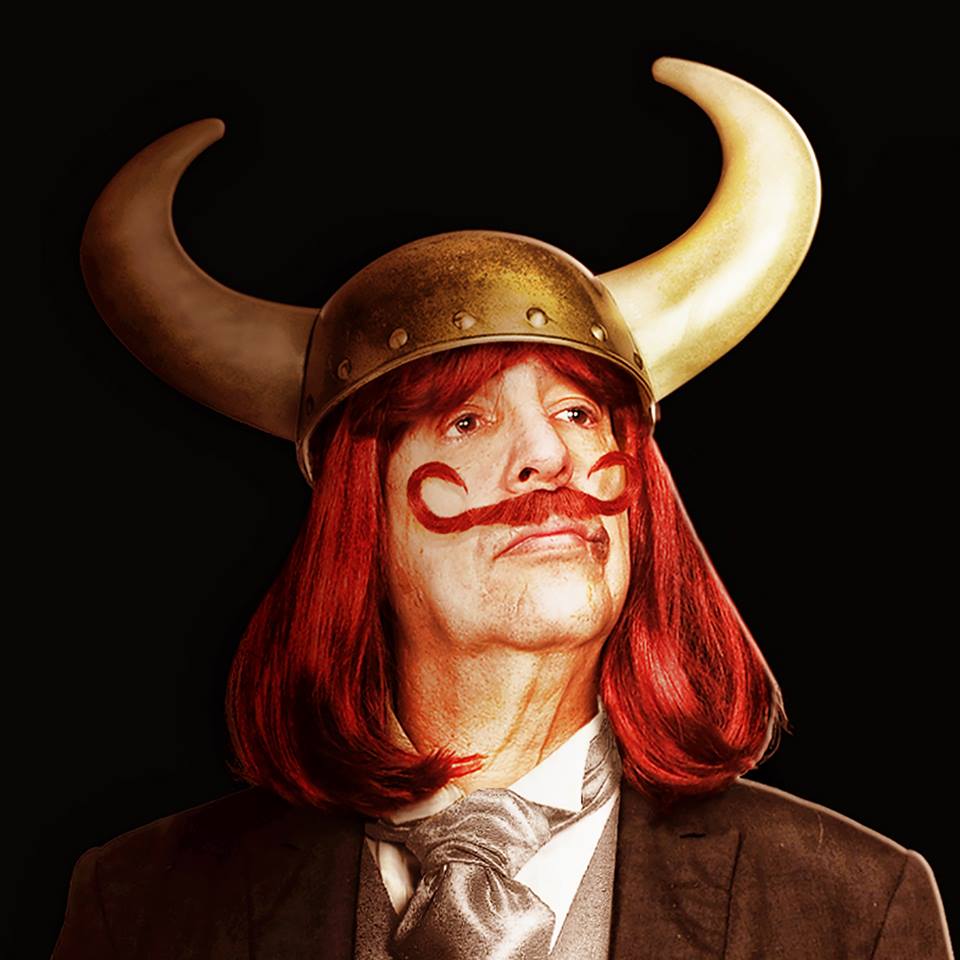
Scott McClelland, photobombed by a grotesque merry -go-round, which seems appropriate.
*******
Barczablog: Are you more like your father or your mother?
Scott McClelland: An interesting question.
Strangely, I am an anomaly. I am more like my Mother’s Father (my Grandfather) than anyone else.
When it comes to temperament, I am more like my Father. Wound up a bit too tightly at times. But, my Dad also enjoys a good story… and THAT is something that is very important to me. In many ways I look more like my Mother, skin wise, thick dark hair and even build. My Father is 5’6 and thin, my Mother is built a bit more sturdy (in a good way) I have my Mother’s olive skin from the Slavic side of my family. I wish I had my Mother’s calm temperament, but alas, I am a bit more anxious and suffer from depression, like my Father.
Needless to say, the Anxiety and Depression do play an important part in how I create and strangely, that is a good thing. Having an understanding of the darker side of the human psyche is important to much of my work… and I do not think I would be as successful if I did not live with the Black Dog in my life.
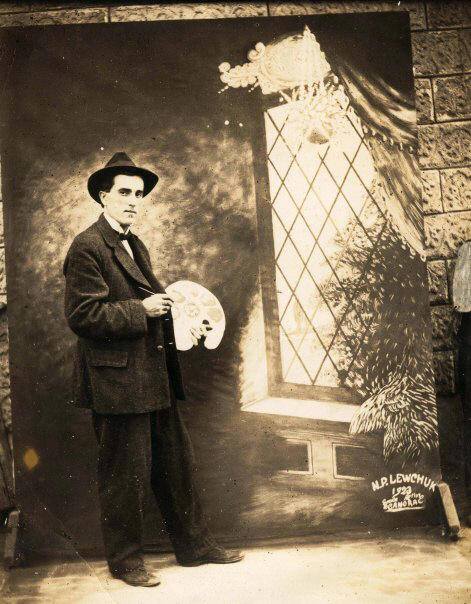
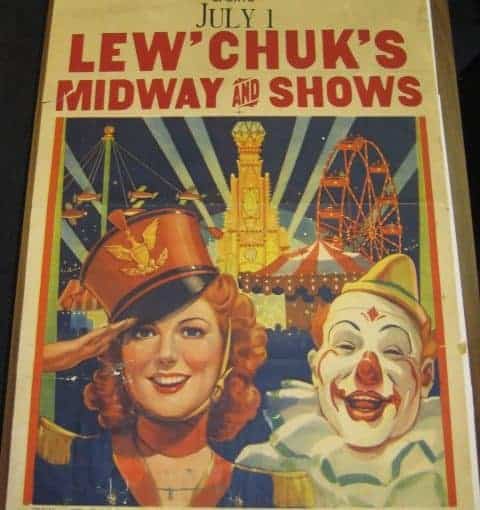
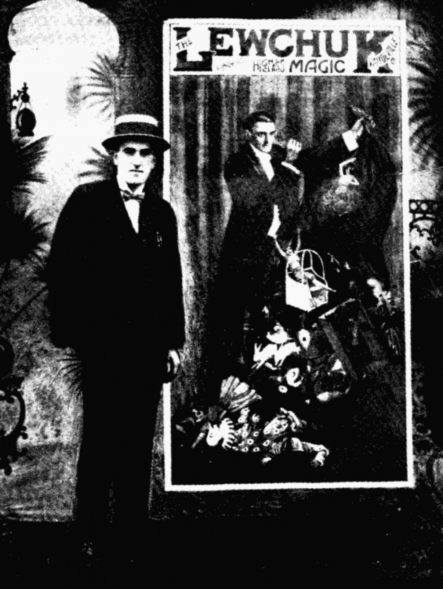
But my talent and inspiration comes from my Grandfather, Prof. N.P. Lewchuk, Inventor, Artist, Carnival owner, Performer and Mage. I am like him on so many levels, but I do not feel that I could ever accomplish as much as he had in a lifetime.
Old Nick, my Grandfather, was a man driven by passion and a need to create dreams.
I love this picture.
Scott McClelland: He invented some of the most important things on the carnival… as a young man he saw a Merry Go Round in 1917 and noted that horses would just travel in a circle with no motion, but being that he was an equestrian rider, he wondered if children would not prefer that could feel the horse gallop beneath them… and so he invented the step mechanism that makes the horses go up and down, which is the advent of the Bobbing Horse Merry-Go-Round. He also created the prototype for the Teacup Ride at Disneyland. And created the very first collapsible Ferris Wheel that was moved on a trailer base, bringing on the advent of trailer based carnival rides.
Over and above all of this, he wrote books, was a botanist, chemist, had his own record company and publishing company. They called him “The Brain from the Ukraine”. And for good reason.
My Grandfather performed Magic on stage, but performed it in a mystical and sometimes sinister fashion.
My Mom has said, when she was little, she hated watching Grampa’s Show because every performance, he would kill my Grandmother on stage, sometimes with a Guillotine or a Sword Cabinet, and it was done in the style of Grande Guignol. (Grande Guignol is a world-famous style of theatre that blends Horror and Comedy, often in shocking ways) My Grandfather would also perform Seances on stage with apparitions appearing and things going bump in the night. THIS is why I am who I am today. So much of what my Grandfather did, whether it was Vaudeville, Magic, and Sideshow… I have been doing the same. Keeping the candle burning and producing shows that are based in the strange and macabre.
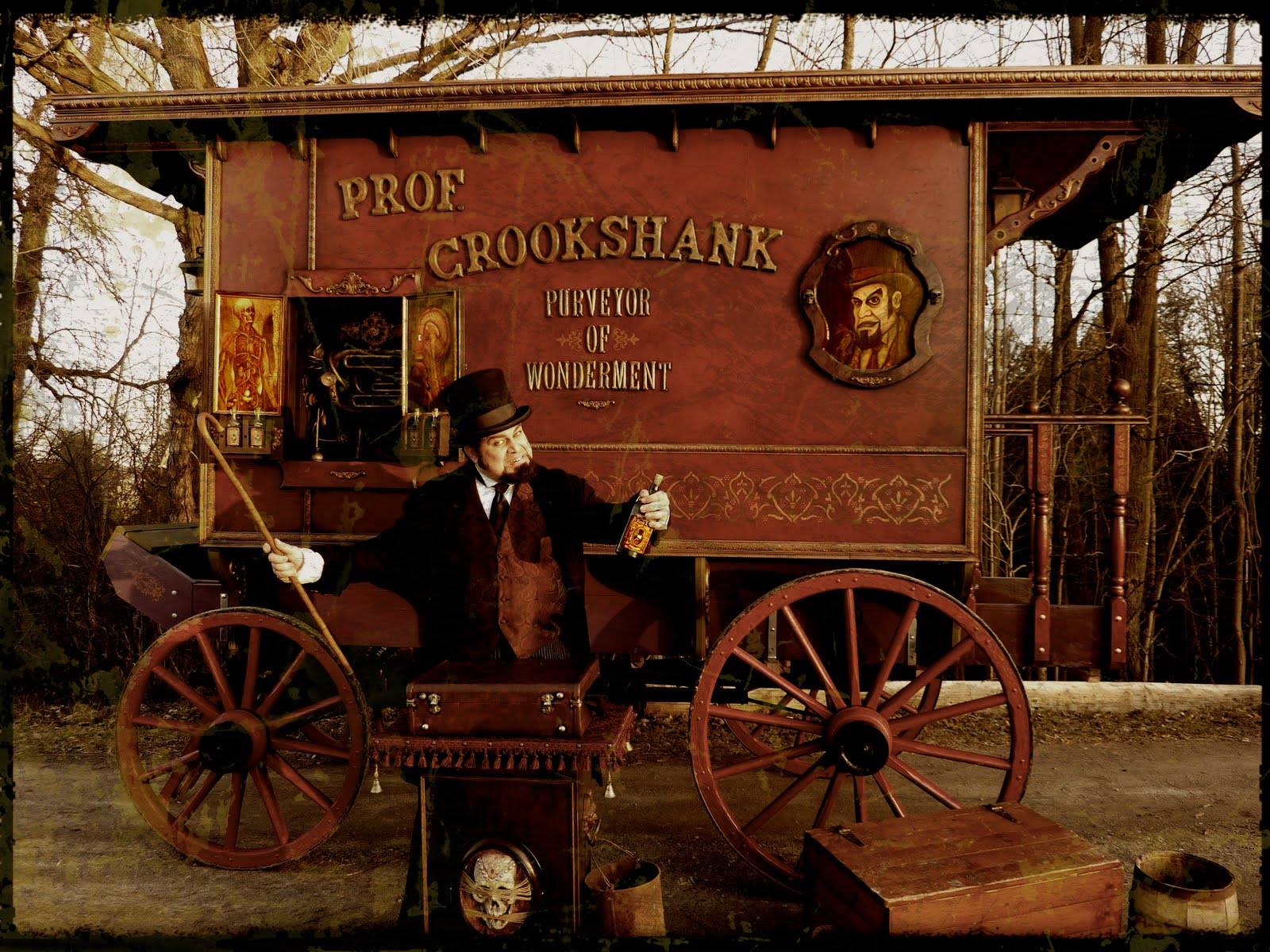
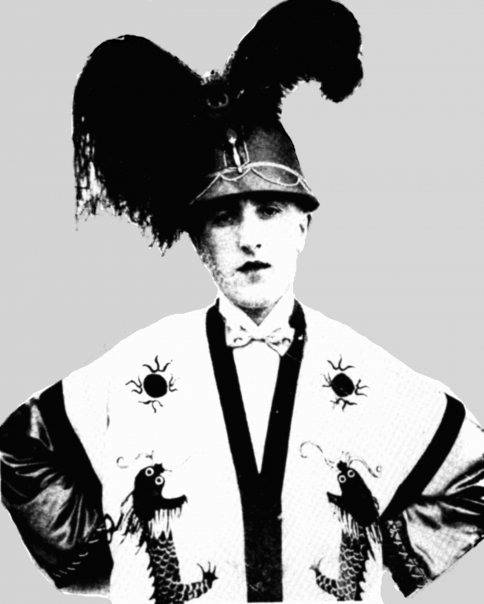
BB: I’m inserting this self-portrait I found on your Facebook profile. It seems to be the perfect follow-up to what you just said.
Scott McClelland: self-portrait
Scott McClelland: I started my career performing as a Vaudeville and Medicine Show practitioner. My first production was called Prof. Crookshank’s Travelling Medicine Show, which ran from 1977 to 1991.
Then I created Carnival Diablo, Canada’s largest Circus Sideshow in 1992 to 2019. And now I run a mysterious Dinner Theatre called The Diablo Manor, a venue that encapsulates all of my talents from Attraction Building, Sideshow and Magic, with a healthy side of Horror.
BB: What is the best or worst thing about what you do?
Scott McClelland: I cannot say that there is anything that I hate about my work. Ultimately, I have become famous for my large production and attractions and so for many I guess setting up these large extravaganzas would be hard… but I love the process. So building a world, where one did not exist, and then tearing it down when I am through is actually exciting. I live my life much like Walt Disney did, he said “Every detail is important”. And I am meticulous about creating opulent sets and props that are otherworldly and phantasmagorical.
I enjoy creating worlds that audiences can fall into and forget the mundane for a few moments.
BB: Who do you like to listen to or watch?
Scott McClelland: When it comes to musical inspiration, I am tickled by people like Tom Waits and the Tiger Lillies. But I am also a hopeless romantic and enjoy Kate Bush, David Bowie, Classical music and then the whimsical like, David Byrne, The Crash Test Dummies and yes, The Monster Mash.
When it comes to what I watch for inspiration, anything by Terry Gilliam, Wes Anderson, John Carpenter… and then it veers off into things like The Brothers Quay and Godzilla movies, with a dash of The Munsters, The Addams Family and The Hilarious House of Frightenstein. Oh! And anything by Sid and Marty Krofft.
And it was Sid and Marty Krofft and early Jim Henson productions that really got me interested in puppeteering at an early age.
I also loved, Chitty Chitty Bang Bang, A Christmas Carol and How the Grinch stole Christmas (the original)
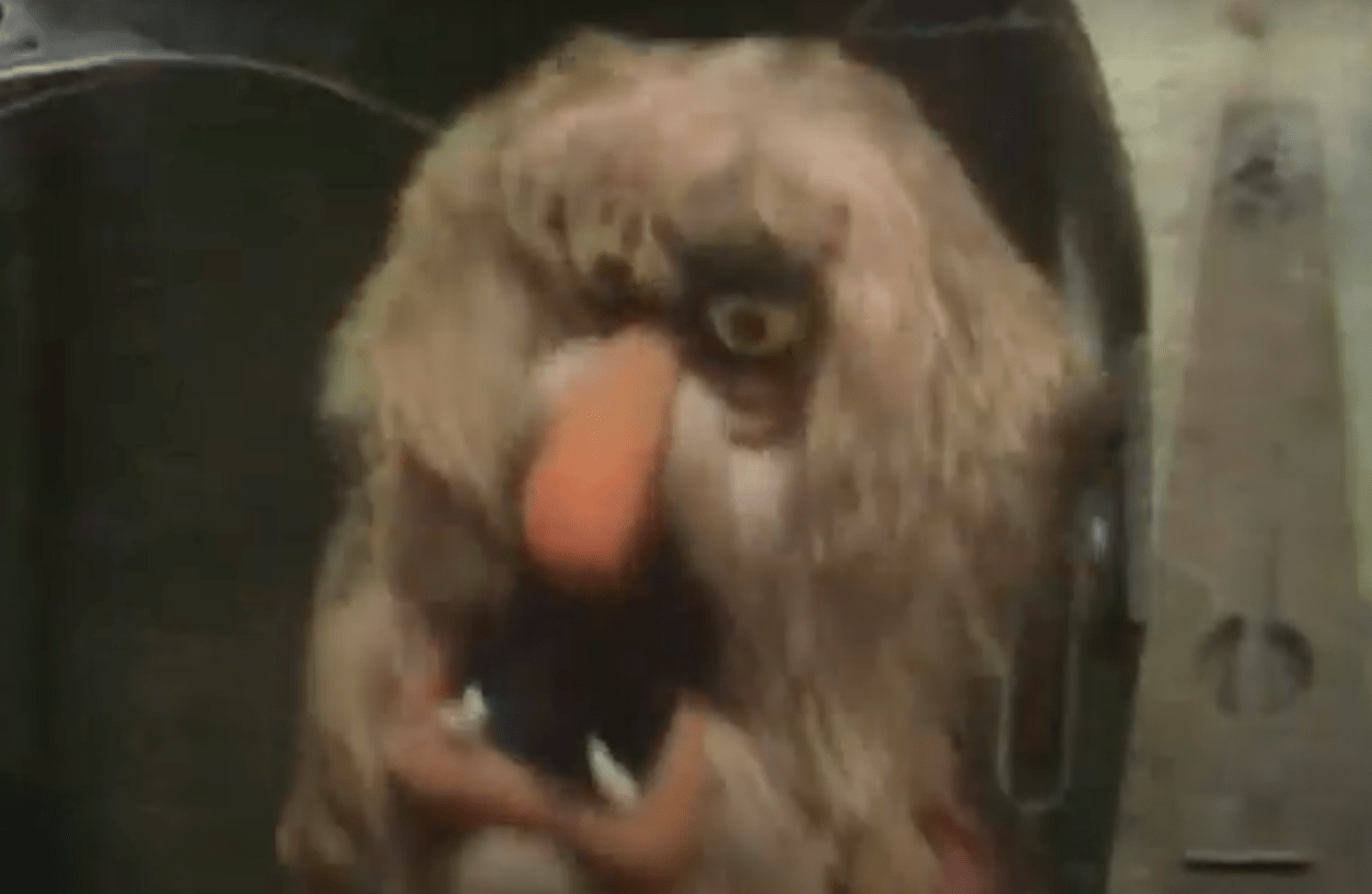
I began making puppets at 10 years of age, and by the time I was 13, I was building large full-bodied puppets much like Sweetums in Jim Henson’s Frog Prince. I loved the ugliness of Sid and Marty Krofft’s puppets because they were never cute, but more grotesque, like something out of a Grimms Faerytale.
BB: What makes you cry? What makes you laugh?
Scott McClelland: I am a softy. I cry at dramatic films and sometimes cry from utter joy of knowing that this life is a gift.
On the other hand, I have a rather macabre sense of humour, so I laugh at some of the most sinister things. Which I think helps me write and create absurd and sometimes horrifying tales.
BB Do you have a guilty pleasure?
Scott McClelland: Yes, FOOD.
I love exotic foods from different countries, East Indian, Thai, Sushi, Mexican, African, Vietnamese barbecue and anything else that is spicy and not North American.
I seriously see gourmet cooking as an art form for my tummy. And when my tummy is happy… so am I.
BB: What ability or skill do you wish you had, that you don’t have?
Scott McClelland: I cannot play a musical instrument, and there are so many reasons for me to want to have that talent! I wish I could play the accordion and the violin… because I would actually play those instruments during my Show.
I have never had the ability to play an instrument at all. My parents put me through 7 years of guitar and I could only play ONE rudimentary song. And even then I sucked. But what I cannot do musically, I make up in all the other Arts. (Thank the Gods)
BB: When you’re just relaxing and not working, what is your favourite thing to do
Scott McClelland: Smoking my pipe and sketching ideas for new things to make and do. (I actually don’t see that as work, because I have a burning desire daily to put my thoughts on paper)
And then I eat. YUM
BB: What was your first experience of puppets ?
Scott McClelland: I think at around 4 years of age, I started making imaginary friends out of cloth and played with them in a puppet style… but, I think I was really turned on to puppetry by Sid and Marty Krofft in the late 1960’s and early 70’s. I was fascinated with H.R. Puffin’Stuff.
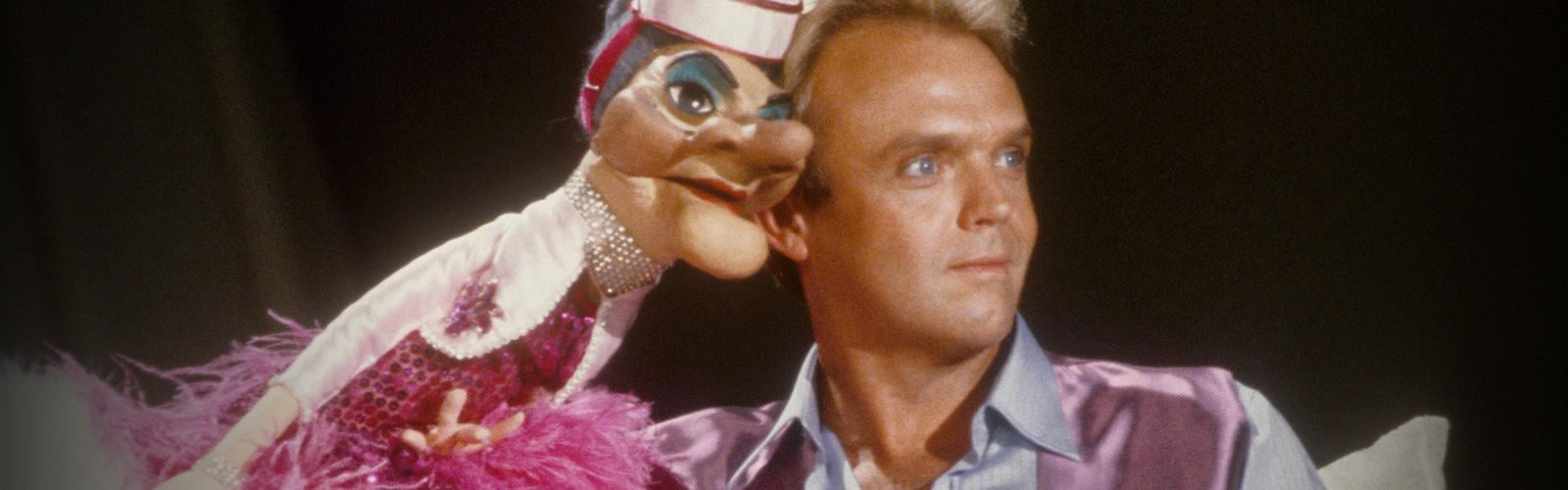
Wayland Flowers and Madame
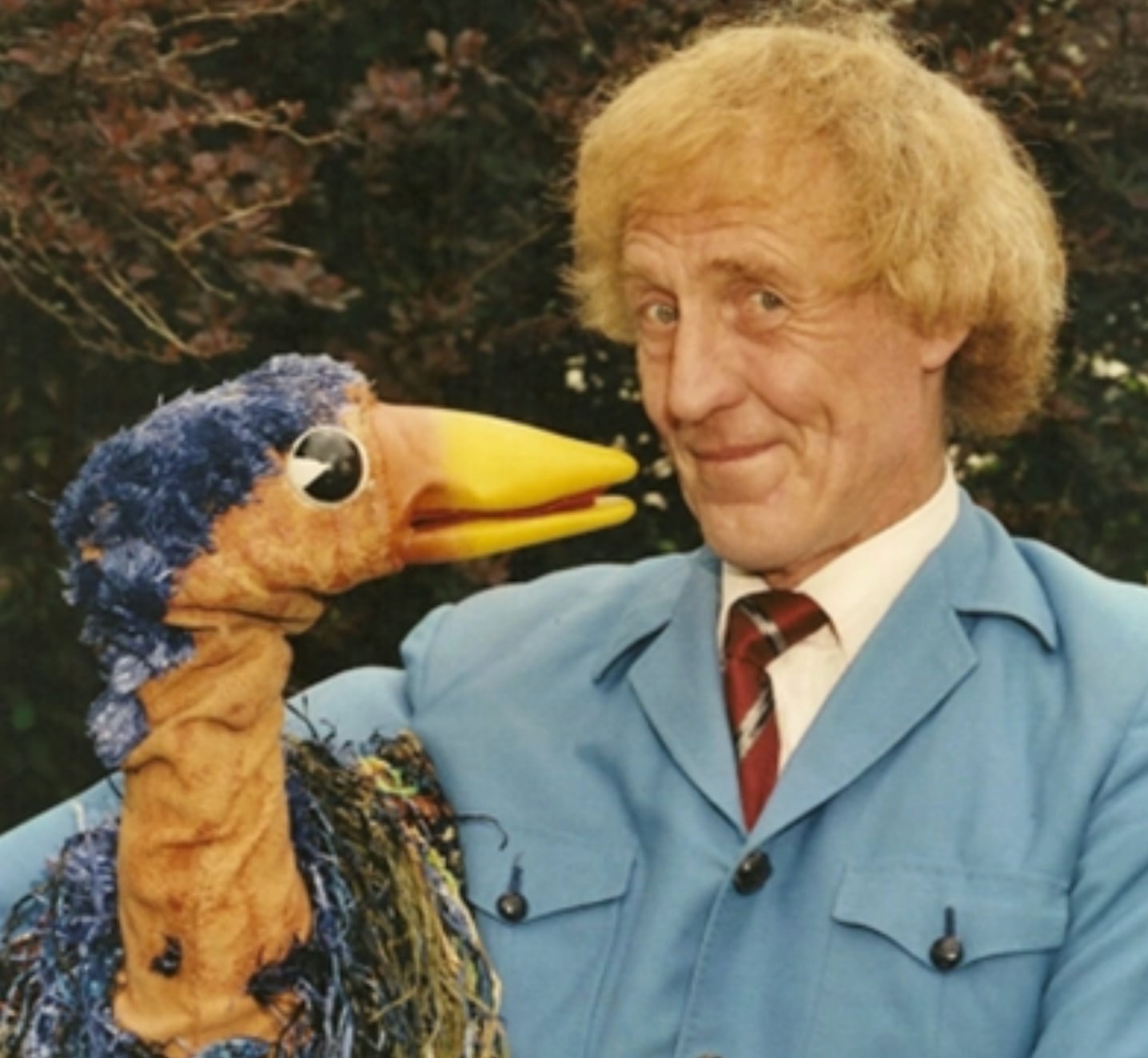
But I also liked watching Laugh In and seeing Rod Hull and his Fabulous Emu or Wayland and Madame on Carol Burnett.
Rod Hull and Emu
I consider myself very lucky, because in the late 1960’s and early 70’s there seemed to be a surge of campy Horror based entertainment on TV. I gobbled it up and created as much as I could with my little hands at the time.
I remember back in 1977 creating a Castle Puppet Theatre that was 6 feet high out of cardboard, that I would do shows out of for my friends. Creating little Monster hand puppets and even playing with paper mache to make masks that would turn me into Merlin the Wizard.
BB: What is your favourite popular puppet character?
Scott McClelland: I have a few.
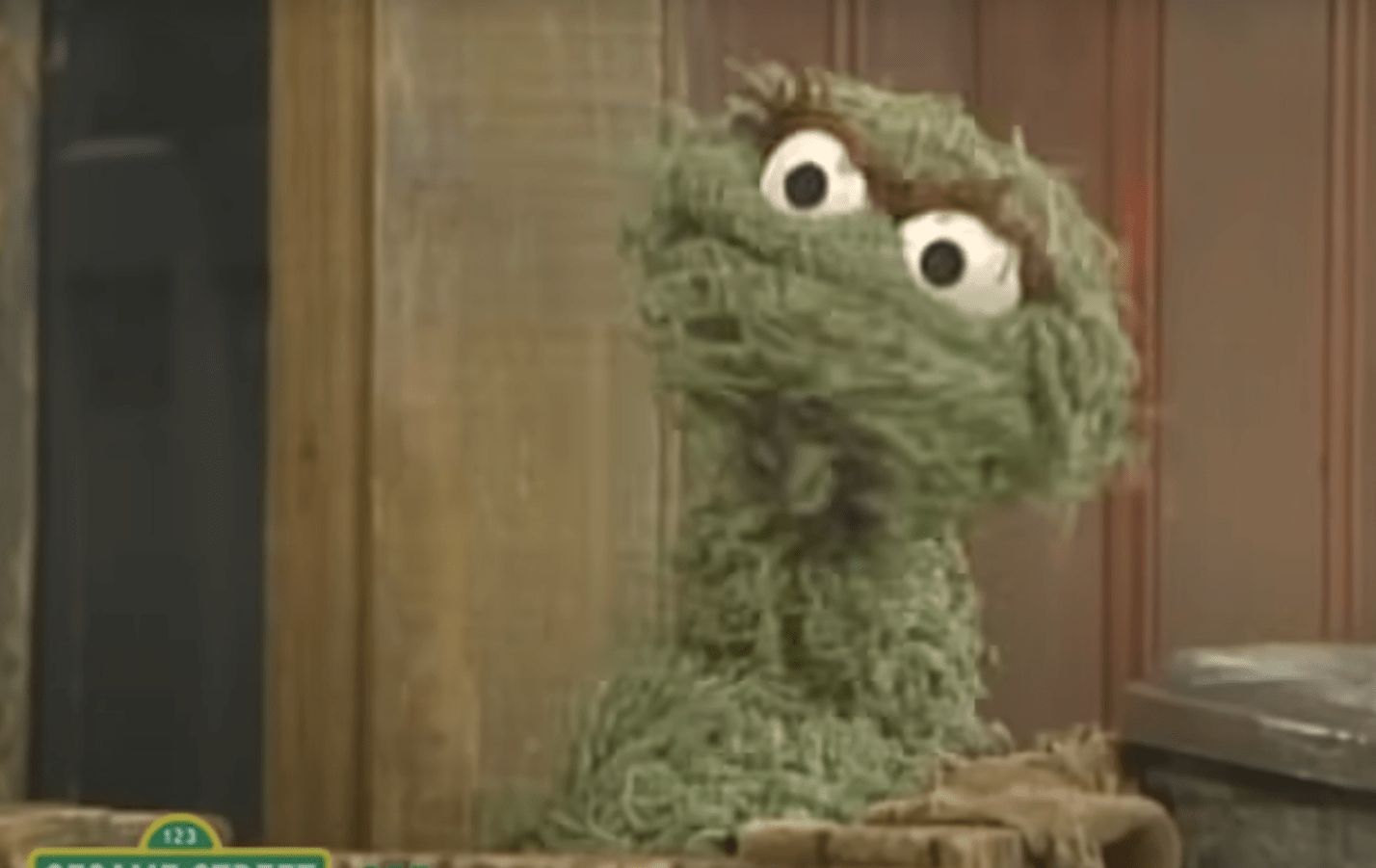
Oscar the Grouch, because he lived in a trashcan, and I could imagine a whole subterranean world inside the depths of his tin home.
Oscar peering out of his trashcan. Scott speaks of the subterranean world inside the depths of Oscar’s tin home, a concept which blows my mind.
Sweetums, because he was over 7 feet tall and AMAZING.
Grammar Slammer Bammer from Hilarious House of Frightenstein, because he was Huge also and I have a strong affinity to Trolls.
And Madame of Wayland and Madame… because she was so flamboyant and outrageous!
BB: Describe your pathway into being a puppetry practitioner.
Scott McClelland: After the age of 18, when I moved away from home, I moved away from puppets, because I wanted to make a career as an entertainer, performing Vaudeville and Magic. And it was not until 10 years ago that I started to reform a strong interest in puppetry. In 2015 I started working on a TV Pilot idea I had been toying with for 30 odd years called The Doctor Rigormorto Show, a throwback to the Munsters and Addam’s Family and of course The Hilarious House of Frightenstein. This was a dream show, an amalgamation of live actors, puppetry and animation. I built a couple of puppet creatures for the show and got the bug to create more puppets over time. My fascination with every form of puppetry plays out in the new production I am now doing. Shadow Puppetry. Marionettes, Hand and Rod Puppets, Kinetic Sculpture Puppets and Mechanical Puppets… my need to create otherworldly characters is huge and this show, Orville Doodles and his Terrible Imagination is my Magnus Opus.
BB: Toronto is insanely expensive. Do actors, singers and performing artists need a day-job nowadays?
Scott McClelland: Funny you should ask.
I lived in Toronto for 28 years because I thought that the Big T-Dot was the place to be for professional Arts and Entertainment… BUT, after white knuckling it on the Gardiner and putting up with the smug attitude of the city, I remembered something. I TOUR for a living. Why the HELL do I have to live in this HUGE Arkham styled city, when I could live out in the country in a 156-year-old Victorian Manor?
Welllll….. Look at me go!
I left Toronto and never looked back. I now tour without the high anxiety and blood pressure issues that came with high rents, traffic jams, and that need to feel like you have to always be busy, busy, busy.
I was once a part of the Toronto Arts and Entertainment Scene and flourished doing it… but I was not happy. I think I was more of an old curmudgeon and cranky pants in Toronto than anywhere else I had ever lived. But now… I am living the good life in the country, in a home that Edward Gorey would LOVE.
BB : Is there a work you’d like to adapt, that you someday might dream of adapting and staging?
Scott McClelland: Yes, there are two works…
20,000 Leagues Under the Sea and Alice in Wonderland.
BB: Are your puppets meant for children? Or perhaps for adults with older kids?
Scott McClelland: They are meant for people 9 to 99, I created them to be grotesque and intriguing… not cute and cuddly.
They are Dangerous and creepy.
Orville Doodles and his Terrible Imagination has been created for young adults still trying to find their way in the world and older adults that may have lost that Spark that was so prevalent when they were young. More than anything I want to inspire people to become creative with their lives again. Not follow ALL of the rules and enjoy playing, like a child. Because we truly are remarkably imaginative animals.
BB: What do you have coming up?
Scott McClelland: Orville Doodles and his Terrible Imagination is on Tour this Summer and Fall.
My past year has been spent building and creating the puppets for this Extravaganza.
And now, I proudly present it at The Red Sandcastle Theatre and many other venues across Ontario.
BB: that link is for performances on Sat Aug 17 — two shows in Merrickville Sun Aug 18 — three shows in Toronto– Red Sandcastle Theatre Sat Aug 24 — two shows in Smiths Falls Sun Aug 25 — two shows in Spencerville
I also run a Victorian Dinner Theatre called The Diablo Manor in Spencerville Ontario, which houses my family’s estate of FREAKS and ANOMOLIES and is the perfect date nite with great food and a 75 minute performance of 19th Century Magick ending in a Seance.
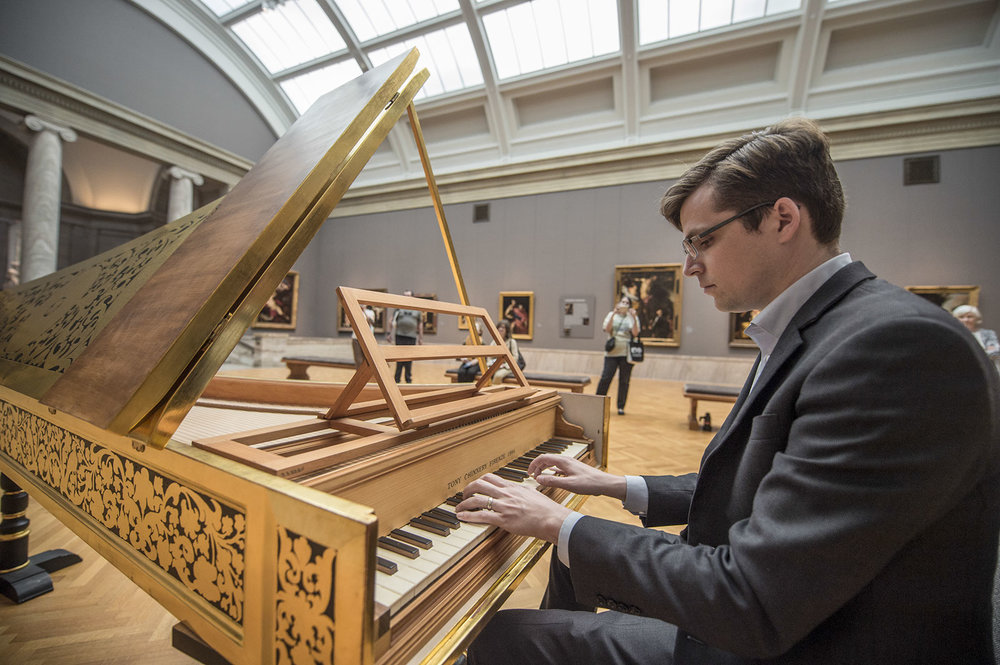
Edwin Huizinga is one of those people doing many things in different places. I first encountered him as part of Tafelmusik.
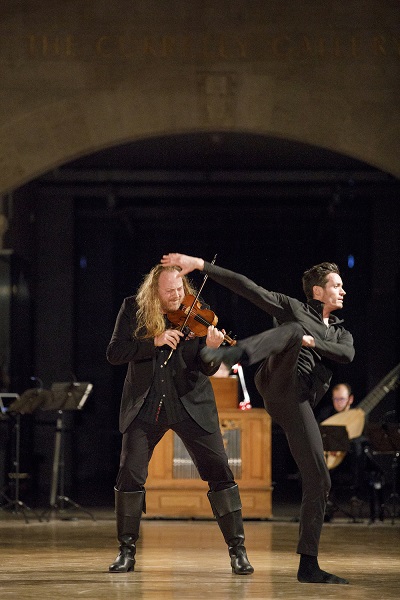
Violinist & composer Edwin Huizinga beside dancer and choreographer Tyler Gledhill (photo: Bruce Zinger)
I heard Edwin’s original composition in Opera Atelier’s The Angel Speaks in 2019, when he played his baroque violin.
Tyler Gledhill (dancing) with Edwin Huizinga (violin) in Inception (photo: Bruce Zinger)
Edwin is a composer, a violinist, a professor of violin, and also the artistic director of the Sweetwater Music Festival that runs September 10th to 15th, a unique annual event in Grey Bruce Ontario.
I was delighted to ask him a few questions.
*******
Barczablog: Are you more like your father or mother?
Edwin Huizinga: It is because of my loving mother Mieke, that I play the violin today. I am so grateful. There is not a day that goes by since October 21st, 2007 when she passed away that I do not think of her, and send the love I have for her out into the world. My mother’s love for her family and music was so infectious, that I feel like I connected the music with that love. To this day, playing the violin is such a joy for me. Playing with others, sharing music with audiences around the world. It brings me so much joy. I also remember, as a child, getting up in front of an audience for a local Kiwanis music festival in Guelph, Ontario, Canada, putting the violin under my chin, and then running back into the audience into my mother’s arms. Playing in public was going to take many years for me to really understand how to enjoy. However, now, having been performing professionally for over half of my life, when I take the stage I feel like it is a chance to share a bit of who I am, who I want to be, my dreams, my fears, all of it. It gives me a chance to tell a story. Communication through music is such a magical thing – because you don’t even have to find the right words for what you want to say.
My father, Jan, is also a big influence on me. He has been a professor at McMaster University for the last 30 plus years, and loves his work so much. My fathers work ethic, and passion has often been a driving force for me. As a professor now myself, at my alma mater, Oberlin Conservatory of Music, I feel that same work ethic as I begin this next chapter of my life in academia. I often think about the unknowns of studying the violin as a first year undergraduate student in 2024. However, many things in life are unknown, and one thing that I always like to tell my students is to enjoy every minute of it. You can always change your mind, or pivot to other fields, but being involved and learning about something you love and working hard in it, is the best thing you can do as a young student.
I also love nature, and being outdoors. Growing up on a farm I was lost in the woods for countless hours a day with my dog Robin, and my sister Linden. We had an amazing magical kingdom behind the house. I made forts, and bike paths, and fortresses, and witch cauldrons with blackberries, and stick houses, and you name it. A young boy with many acres to explore and a pretty big imagination. I often spend time in nature, when I compose, or for downtime from touring or teaching. Nature is one of the ultimate ways for me to feel the presence of peace. Hiking is also a passion of mine, and I always look for new trails wherever I go. In another life, perhaps I would spend it as a park warden working in Big Sur, California. One of my favourite little corners of the world.
BB: What is the best or worst thing about what you do?
Edwin Huizinga: One of the best things about my life as an artist is dreaming up ideas, and finding ways to bring musicians and friends together. Those things just make my heart leap for joy. Now, as a teacher as well, I have to add getting students excited about music they have never heard of and getting them over a hurdle or hump in their learning. Dreaming up ideas is just the most amazing thing. I mean, there are times now, in my life, that I get paid to think of interesting things to program, compose, and make happen. WHAT!?!? I mean, that is just mind blowing. One thing comes to mind of being part of a CBC Gem’s series with my dear friend Measha and putting together a hip hop symphony with the NAC Orchestra, Measha, Jay Vernon, and Aaron Davis. How did that happen? I said YES to an amazing idea. Or putting together my folk and barolk duo called Fire & Grace. My friend William and I just decided we were having so much fun on a gig we should start a duo. Now ten years later, we have three albums out and have toured and performed all over together.
Measha Bruegergosman-Lee and Edwin Huizinga
Another question that you asked is what is the worst thing about what I do? Hmmmm. I guess I would say, every now and then the administration aspect of being a director and conductor and doer gets to be overwhelming. Also being in Academia now has its juggling act with understanding the bureaucratic world around the Conservatory and College. However, I know it needs to get done, and I always find some joy in it. Even if the joy is simply in getting it done. Once in a while I also miss something, and having someone think I forgot about them, or didn’t want to reply to something that they asked about, that feels awful. However, as I grow and learn how to manage my time more efficiently that does not often happen!
BB: Who do you like to listen to or watch?
Edwin Huizinga: I love to listen to my friends make music. I love listening to them play, perform or just share what they are passionate about. And, I love to listen to my colleagues that I am working with, or other musicians I admire and just have bigtime musical crushes on. Let me give you some examples. The last year has been a year of Brian Finnegan tunes for me. Just last month, in July 2024, my duo Fire & Grace invited him to the Carmel Bach Festival to perform on the main stage together and put on an amazing show of folk and barolk music. Yes, I am spelling baroque like that on purpose. I think it’s fun 🙂 If you’re interested, look up Brian Finnegan and his tune Joy on any streaming platform and have a listen. It is so beautiful. Also, this summer I finally got to work with Maeve Gilchrist, and went down a rabbit hole of her incredible music. Another group of friends are in a band called Hawktail, and I think my dear friend Trent and I have almost punched holes in the roof of both of our cars, sending our fists into the air during their amazing tunes. I am also super fortunate to be planning a lot of programs in my life, whether it be for an orchestra that I’m conducting and directing, or providing advice for a friend, or future festivals. This means I just end up listening to a ton of music that I may or may not play and program for those reasons. And, I always try to look for recordings with friends on them, because that just warms my heart. As for watching things, I do love movies, especially ones with a true story element. It’s nice to turn off my brain sometimes at the end of the day, because otherwise I often just end up working and practicing late into the night.
BB: What ability or skill do you wish you had, that you don’t have?
Edwin Huizinga: A skill I wish I had… A skill I wish I had is perhaps learning to invest? Work fluently with spreadsheets? Figure out legal jargon? I mean, these are all things I know I could learn. But the older I get, the more I realize that time is finite, so there is simply not enough time to learn everything, or do everything. I mean, I would love to be better at the piano, and be a wizard at Sibelius, instead of pretty slow going… but also, I do get it done!!! And being a music engineer… I would love to get in front of a mixing board and really know what I am doing. I mean thank goodness for all my years playing the indie folk band the Wooden Sky. I learned a ton about recording, but still, so much of it is a mystery to me. I do also love working with people that are masters in their craft and soaking in the knowledge that they have dedicated their lives to. I mean what an awesome feeling, walking into a room with so many different people with different skills and being on the same team. That is always a fun moment when it comes to board meetings, artistic planning meetings, and conferences!
BB: When you’re just relaxing and not working, what is your favourite thing to do?
Edwin Huizinga: I love going out for the best possible cortado I can find, with friends, or even on my own. I love hiking and getting lost among the trees, or sitting by the ocean. This past summer in Carmel, I often went down to the ocean late in the evening, after the concerts, and after the receptions, and just marvelled at the beauty of the ocean. I also find it so interesting that it is so beautiful at night under a new moon, or a full moon, and yet there is almost never a soul on the beach at that hour. Probably because most of the other people in the town are getting a reasonable night’s sleep and preparing for their next early morning of work or rehearsal. (Not a bad idea) However, for me it always takes me a while to come down from concerts, and being next to the ocean, or in the trees has an incredible calming effect and feels very nurturing to me. I also love cycling and having a musical jam session with friends. It has also been said I make a mean veggie lasagna, and I really enjoy spending time in the kitchen.
BB: Are you more of a dog person or cat person?
Edwin Huizinga: Well, I started the interview off by talking about my dog Robin, who was a golden retriever we had when I was a child. So I am definitely a dog person. I love snuggling, and cats are great snugglers too. We had a few cats growing up too. Indoor and outdoor cats. I also lived with a cute cat chicha for several years with my ex Jennifer. I have often thought about how I would need to shift my career to have a dog at this point in my life. We shall see where that idea goes. If anyone needs a dog sitter, please let me know.
BB: What was your first experience of music ?
Edwin Huizinga: What was my first experience with music? I am not sure if I have any idea. I bet it was my sister, Linden playing piano and also the classical music we listened to in the house. My sister is five years older than me and would have been playing piano before I even knew how to walk. And for a few years, we had the same piano teacher, Sylvia Hunter, who would tell us stories about her studio mate Glenn Gould way before I really understood the magnitude of how cool those stories really were. We also listened to Tchaikovsky, Bach, and all the great oldies of classical music on CBC radio. I think my initial experiences of music all come from at home and around my family, until I started heading to Guelph every week to study Suzuki violin.
BB: What is your favorite melody / piece of music?
Edwin Huizinga: My favorite melody, that question makes me smile, because to any of my friends that spend a lot of time around me, they would probably just sing one of the many noodles I play on the violin constantly, and daily, and have been for years and years. I just love to noodle or fiddle around with notes and tunes. And so many people ask what it is that I am playing, and I just have no idea, I just love putting notes in fun places and trying intervals that I love, and making people smile. A favorite tune of mine for a while has been Unless, by Hawktail which I recorded on a trio album a few years ago.
BB: When did you start studying violin?
Edwin Huizinga: I started playing the tiniest of violins when I was five. I say tiny, because many people when they see me for the first time, they are surprised. I’m tall, and I don’t slouch, and stand at 6 feet and five inches, and I have a big presence. Sometimes it is difficult for people to understand that I started when I was small, short, and skinny. I was a late bloomer as they sometimes say. Just on the street, I sometimes get a, “Oh wow, are you a linebacker?” In all honesty, I’m not entirely sure what position that is, but no, I have never played football. Only the European kind growing up, as both of my parents are Dutch, and I do love soccer. Anyways, I mention my size now vs my size then because it is funny to recall how many people have asked why I don’t play bass. I will say, this never really comes up once I start playing the violin. I think this is because the violin is an extension of me, and a very treasured compliment from others is always when someone mentions that the violin sounds and looks and feels like an extension of who I am when I play. Thank you to all of you that have told me something of the sort over the years. I appreciate you all so much. One funny story that comes to mind is when I was in Malaysia with the Tafelmusik Baroque Orchestra on tour, one of my favorite bands in the world. I was backstage warming up under those huge Patronus towers, and several people came up to me very excitedly, squealing, excited, and asked for my autograph. I was super surprised, especially with all of my other amazing colleagues around me, and then after further discovery, I realized that they thought I was the “undertaker”. Now at the time, I had no idea who that was, but after some research I realized this person was part of the wrestling world, the WWF I believe. However the only WWF I ever knew growing up, was the one with the logo of a panda on it, so I was just very confused. Anyways, to their dismay, I was only a baroque violinist, traveling all the way from Toronto, Ontario, Canada, to play Galileo, a memorized program that Jeanne personally invited me to be part of. A huge moment in my life, performing that project with Tafelmusik.
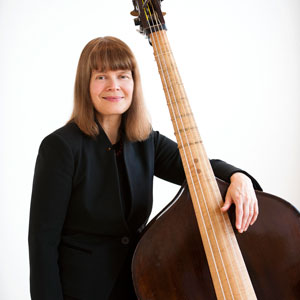
Alison Mackay, bassist & visionary programmer
Also big kudos to Alison Mackay for dreaming it up! All this to say, I started when I was small, on a little farm in Puslinch, Ontario, with a 30-minute lesson per week with Linda Drennan, one of the most wonderful violin teachers. AND, if I may, a big shout out to Bruce Skelton, and Daphne Hughes. Two other extremely influential teachers in my very young musical life. Then, I started learning my dance moves from Mark Fewer, a teacher and friend who is still a big influence and someone I really enjoy playing with whenever I get a chance. Thank you Mark!
BB: Do you ever feel conflicted, reconciling the business side and the art?
Edwin Huizinga: Wow, I would like to take another moment to thank you Leslie for these questions. They are very well thought out, personal, and deep. Thank you.
BB: I am asking perhaps because it’s something I struggle with myself, and seems to be pertinent to a country where so many artists are struggling. I think it’s especially important to hear from someone like you: who seems to be coping so well, reconciling the different aspects masterfully.
Edwin Huizinga: Do I ever feel conflicted, reconciling the business side and the art? That is a profound question. And one that I will likely have a very different answer to every decade of my life. In my early career, I basically just said yes to everything. I wasn’t thinking of the business side at all. I sometimes printed business cards, but would always forget to give them out, and the times someone would ask me for one, I would never have them with me. In fact, I have thought about where my life would be if I would have networked more as a younger person. Who knows. My early career involved baroque, classical, contemporary, rock, improvisation, folk, you name it. I was all in for learning about and experiencing all the genres. Now, I’m in my fourth decade on the planet, and I have a position at the Oberlin Conservatory. This, and some positions in the Artistic Director role keeps me very busy. However, I’m not yet entirely answering the question of feeling conflicted. And I do not think I do feel that way. Ever since I started performing, I always enjoyed inviting people to my shows. Music is magic to me, and I want everyone to come to the magic show. So, whether it was me giving tickets away to all the baristas while on tour with The Wooden Sky, or whether it was me starting a small series in Toronto called Stereo Live at the Campbell House Museum with Keith Hamm, and recalling that every show we ever did was SOLD OUT, that was important to me. I wanted to share what my colleagues and I worked so hard on. Performing is a drug. It’s a wonderful drug, and it’s also addictive, and you need to learn to navigate it like any other drug. For example, you should probably not drink a million coffees a day, for example. The business end of it always feels and has felt for me important, and part of the conversation.
As the Artistic Director of Sweetwater Music Festival many of my conversations with Natasha Bood (our GM) are about business, and I love those conversations. Setting ticket prices, free concerts, engaging.
Natasha Bood, Sweetwater Music Festival General Manager (photo: Joseph Fuda)
These things are all crucial. Now, it’s true that as an individual artist, you really can’t do it all. Especially if the projects start taking off. I’m very grateful for my management now. They do incredible work, on multiple fronts. That helps a lot. At some point in your life, the emails and work will overwhelm you. If this is happening to any of you reading this, you are not alone. Oh my goodness, you are not alone, and it’s okay. No one can do everything. And, you can always ask for help – from me included!!!
BB: Tell us about the highlights of the upcoming summer festival
Edwin Huizinga: Oh wow. The juicy bit. I get to talk about the upcoming Sweetwater Music Festival! I’ve been dreaming about festivals and programs and music since I started playing violin, so this wonderful world of Artistic Direction is pretty fun. One of the most beautiful sandboxes to play in. This year is no exception. We are coming off of a serious high from last year, our 20th anniversary where I invited the inimitable Mark Fewer back to perform with a stellar group of artists from around the world – heavily Canadian of course. This year one of my goals was also to bring back Canadians from their international careers to come back to their homeland, or one of their homelands. One of the formidable players that exemplifies this is Karen Ouzounian. A terrific artist that plays cello, composes, sings, and shares from her heart. I had the great fortune of growing up with her at YAPA, the old version of the Taylor Academy at the Royal Conservatory of Music in Toronto.
This year is also about Serenades and Songs. That’s our theme. I am so excited to be bringing the Canadian Chamber Choir. This choir represents so many wonderful things about Canada, and the arts, and I get to share it with the Owen Sound community. That just feels AWESOME. Measha Brueggergosman Lee is also headlining the festival. She has over the years become a dear friend, and also just a force of nature that I greatly admire. We are both dreamers, and we also both get things done, and her coming to this festival feels incredible. It will be her second time since my tenure as AD, so the audience is prepped. I’m also inviting some new faces, and some of my dearest Sweetwater regulars. This is also important to me. Our audiences are fiercely loyal, and relationships are the be all and end all for, well, just about anything I do. Having the audience build friendships with these musicians is a big part of the festival, and then also surprising them with some new faces. That feels like a wonderful potion to keep the magic flowing in Owen Sound.
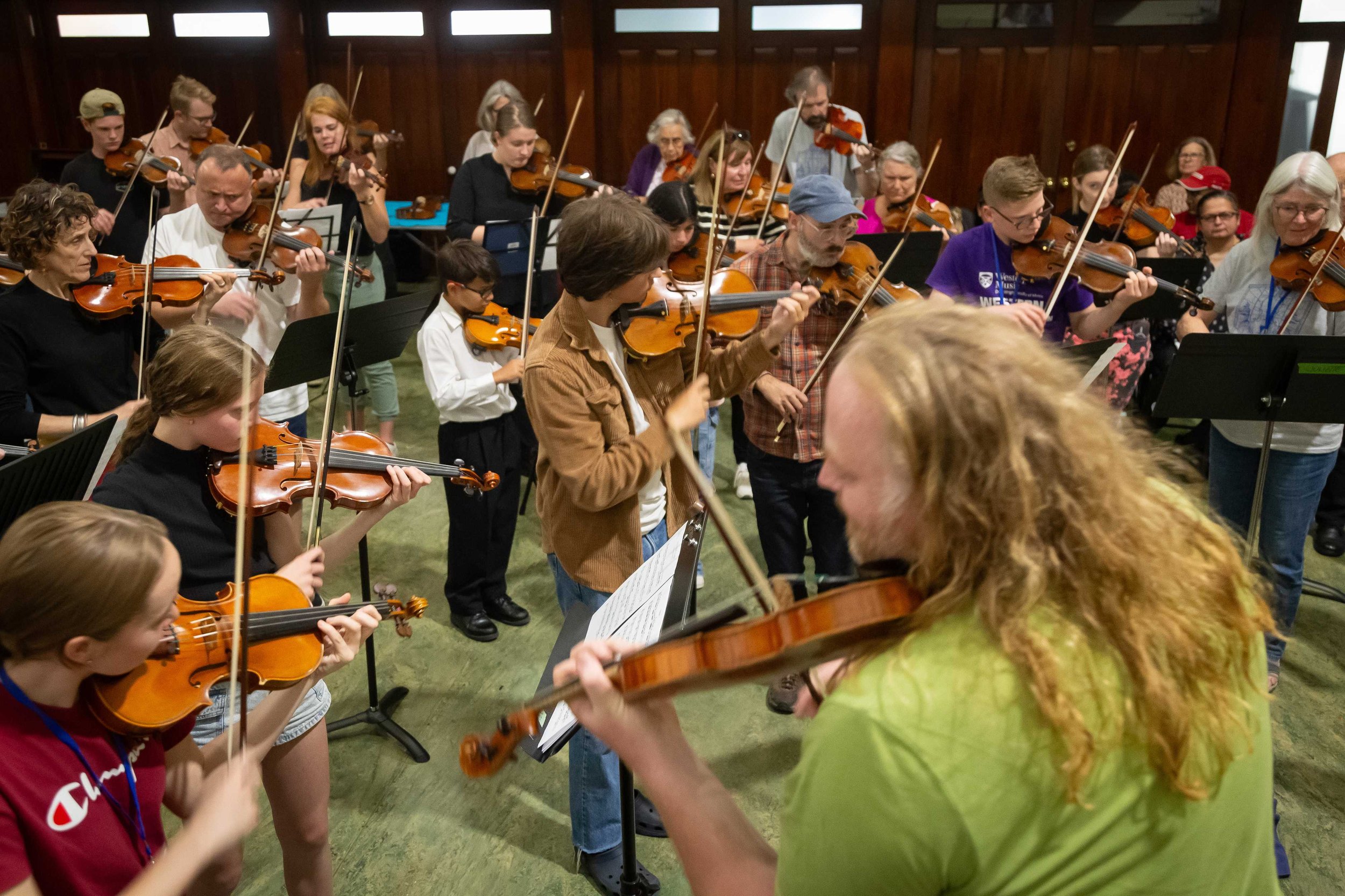
Local musicians are invited to play along with featured SweetWater musicians led by Artistic Director Edwin Huizinga Saturday, September 14, 2:30pm. Anyone who plays a string instrument, no matter your level of expertise, is welcome to be a part of this fun, community-building experience in a comfortable, welcoming environment!
One of my favorite pieces on earth is the Tchaikovsky Serenade, so we will be performing that on the closing day of our festival. On the same program, we will be featuring a world premiere from our composer in residence Matthias McIntire. We are going to be weaving in and out of old and new throughout the festival. Sherryl Sewepagaham is coming as a headliner, thanks to the CCC and Julia Davids. This incredible singer is going to share some powerful pieces and stories with our audiences, and I simply cannot wait to welcome her with huge open arms to Owen Sound.
BB: An artistic director is a curator, a leader & manager. What is the part you enjoy the most, what part is hardest ?
Edwin Huizinga: One of the most difficult things for me about being an AD is managing everyone’s time properly leading up to, and during the festival. Knowing exactly how much rehearsal time is needed for each piece and each person, and each ensemble is difficult. I don’t program easy repertoire, so things take time. One thing I have noticed in the world of juggling artists is that everyone has a different sense of timing, and of course if you are working on a piece that is important to you, you want to have all the time in the world. Navigating those moments is never that difficult however, because the artists involved are so intuitive, and the vibe, and atmosphere is fantastic. Everyone understands the need for time management, and most are just glad not to be the ones worrying about that part. I also love hospitality… I mean I can’t do it alone, and thank goodness I have a wonderful volunteer force at Sweetwater with incredibly thoughtful members of the board and beyond. We have great breaks and lunches, and after parties. That part matters! Sitting down to a wonderful meal after rehearsing all day with your friends is absolutely a necessary part of the festival. I love being part of that, and helping make it happen. I hope to see some of you this September at Sweetwater!
BB: You are a composer and a performer, a busy artist. Talk about how you approach promoting your different disciplines. How do you do it?
Edwin Huizinga: For the first time in my life, I am working with a professional person on a new website. I have always made them in house, and by in house, I mean, first my dad, then me, and then my sister also helped me a lot. Then all of us, it seems, just got too busy. My priorities keep shifting, as they do, and a website, as important as it is, has been low on the list for a little while. I’m still working with a friend of a friend of course, because connections are important to me. I also really enjoy knowing the person who is helping me personally, and having interactions with them. Anything to do with art is personal I think, and so even a website that is being developed by someone else, I think they need to get your vibe. I am currently having trouble figuring out what to promote in my life. I mean, I LOVE to teach, and Oberlin definitely wants me recruiting, although thankfully they have a wonderful name, and a big beautiful recruiting machine to help. I also love playing violin, composing, and conducting!!! I mean how do you gracefully promote all of these things on one website? Sometimes I think it might make me look like an artistic chameleon. That doesn’t even sound like a bad thing to me, but it is difficult for presenters and bookers to understand what they are getting. My two biggest touring acts right now are ACRONYM, my baroque band, and Fire & Grace, my folk and barolk duo. Luckily, they have their own websites, and people helping with the promotion machine. My philosophy in my life, and being an artist, is definitely old school. And I mean way old school. Back in the baroque era an artist was busy doing all kinds of things. There was no distinction between a composer and a performer, because that didn’t exist, to the best of my knowledge. Everyone wrote a bit, played a bit, directed a bit. I mean, I recently conducted Beethoven’s sixth symphony with the Guelph Symphony and did a ton of reading about it. Beethoven had to hustle pretty hard to get people to come to that premiere. So he was not only a performer, and a composer, but a conductor, and a promoter. I love exploring the folk world more and more, and its similarities to the baroque world, and beyond that. This is part of who I have become as an artist, and also how I teach. I have been developing a new class at Oberlin Conservatory with my colleague Mark Edwards called Historical Improvisation. Improvisation to me is part of being an artist. This course takes old historical techniques to bridge the gap for young musicians to begin the exploration of improvisation. I have also started a fiddle ensemble at Oberlin to give conservatory students a chance to play tunes with each other, and just JAM!!! The feeling of jamming on a sixteen-bar tune with your friends with all your heart and soul, I believe, needs to be part of your musical education on every level.
BB: electronic or paper? as a composer and as a performer, do you prefer to work with a pencil and scores, or electronic notation?
Edwin Huizinga: I always start writing with my violin and bow, I noodle around, then I grab a piece of paper and write some ideas down, and then I get to the computer and open Sibelius. I will take this moment to give huge props to Chris Bagan, who to this point in my career has been a magnificent help and source of inspiration and mentorship with all things related to composing, arranging, and orchestrating.
Christopher Bagan
Chris, if you ever read this, you are the man.
Another question is my method. My method is so irregular. It has everything to do with my mood, and the project, and the people involved. Then I just try and let go. Let the ego go, let the worries go, and just be me.
BB: do you have any ideas about reforming / modernizing classical music culture to better align with modern audiences
Edwin Huizinga: I’m on a story kick these days as far as speaking about the concept of modernizing classical music culture goes. Modern audiences, to the best of my knowledge and experience, just want connection. And connection comes through relationship and story. I love what Bill Barclay is doing with Concert Theatre, and I also always try to speak to my audiences, and think about the emotional journey, and all the things you want to consider if you’re really trying to grab someone’s attention and interest! I also feel like people really want to know who you are as a person. I know that is vulnerable, and of course you have to have boundaries for yourself and your colleagues, but a little taste of who you are goes a long way. I see it every day when I’m producing things, or bringing ideas forward at a meeting, or anything. Connection, relationships, and story. That’s the answer in my opinion.
BB: Reflect on the difference when you take music out of the city to a Summer Festival
Edwin Huizinga: I love the idea of bringing music to various places, and getting into the festival spirit. I think it gives you a lot of freedom. I think you can often dream bigger, and take more risks, and also, chances are, your audience is curious, trusts you, and is all in for different experiences. I have brought some very different things to Owen Sound already. Not to say I haven’t heard about it (!!), with some raised eyebrows but I have also heard many positive things. This year we will have premieres, as well as lots of group singing, and amateur jam sessions, and a lot of community events. I’m also excited to bring some multimedia production to the festival this year, as well as events like lectures, artist chats, and times to socialize with each other. For me the key is thinking about what makes a wonderful community event, and what kind of music will inspire and excite the soul.
BB: If you could tell the institutions how to train future artists, what would you change?
Edwin Huizinga: If I could tell the institutions how to train future artists, I would say, don’t forget, at any cost, to mentor the individual human being that you have the opportunity to help along their own path. That is the biggest thing for me. My path starting with the Suzuki String School of Guelph, and then coming to the Royal Conservatory of Music in Toronto, and then to Oberlin Conservatory, and then the San Francisco Conservatory, and then the University of California Santa Cruz, and then the school of life, those opportunities helped me so so so much. AND, there is nothing like the school of just doing it. Just saying yes to things, and taking a gig, and working with new people, and making things happen, especially making your own dreams happen. That’s HUGE. Sitting next to Elizabeth Wallfisch at the Carmel Bach Festival was a life lesson.
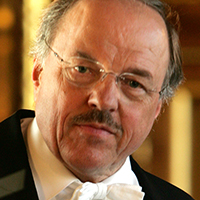
Conductor Bruno Weil
Having the opportunity to have a conducting lesson from Tito Muñoz, working with Simon Rattle, asking Bruno Weil about Beethoven, being invited to play with Tafelmusik by Jeanne Lamon, these things were just the most special. Almost every single thing I have ever done in my career is because of an incredibly wonderful, personal connection with someone I admire and respect. That is the magic of the world of music. Playing with A Far Cry, The Knights, Apollo’s Fire, Brandywine Baroque, and sharing time with Anner Byslma, there are so many moments. Guy Braunstein telling me I better get my act together as I spent a week listening to the Berlin Philharmonic rehearse and taking lessons. So many life lessons. Take it in, process them, learn from them, and then be you! What would I change? I mean hindsight is 20/20. I would be a little more disciplined maybe? Although the stories you make with your friends and family is so much of who you are. So I don’t think I would change much of anything. So far, it’s been a really beautiful journey. I do have a million more people I would thank though, but instead maybe I would just say, I hope I have given all of you a huge hug for all the help I have received along the way. I am literally the artist I am today because of all the love that has been offered and shared with me. Thank you.
BB:What’s coming up next? Sweetwater Music Festival of course…
Edwin Huizinga: Oh wow, and things that are coming up? There are so many wonderful things. I cannot wait for the Sweetwater Music Festival! I cannot wait to welcome a new undergraduate class to my studio at Oberlin. I cannot wait to perform with my band ACRONYM and Fire & Grace. I cannot wait to find time to write more tunes and pieces, and dream up my next big projects with the Carmel Bach Festival. I also cannot wait to plan my next hike in the mountains, my next swim in the ocean, and my next moment with friends around an outdoor firepit.
Thank you for this opportunity Leslie, and thank you all for reading.
*******
And thank you Edwin, as you continue this busy exciting life, likely returning to teaching in the fall, but first: Sweetwater Music Festival September 10-15. For further information click here.
Whether or not we’re drinkers, we have all seen Alcoholics Anonymous in films and tv, that organization that gives addicts a place to find support on their journey back from rock bottom. AA is now part of our mythology. In theory one goes because one seeks to recover, to stop being ruled by the addiction even if that’s easier said than done.
No wonder AA is such a perfect template for exploring relationships, via the idea that we’re recovering from our addiction to romance. I think we all have had the romantic dream, even if it sometimes seems more like a nightmare. Whether we have found a happy relationship or given up, the dream is completely relatable.
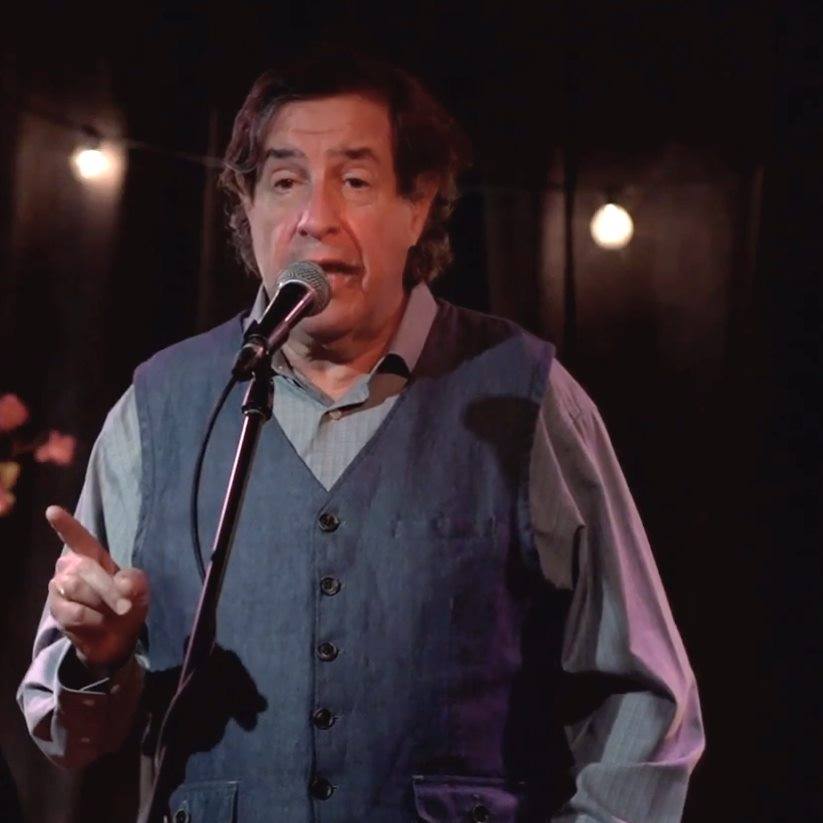
Recovering Romantic is Briane Nasimok’s creation, shown in Toronto as a preview tonight before it opens at the Halifax Fringe Festival next month.
We were welcomed into Red Sandcastle Theatre by Lesley Ballantyne, who gave us name tags as though we too had all come there as fellow recovering romantics, and she were the facilitator of our meeting. Lesley ran the show from behind us in the booth, which makes sense because she also directed the play. She spoke in a kind unconditionally supportive voice as though she were a psychotherapist, leading us all over a microphone as though it were an AA meeting meant for recovering romantics. But that’s not wrong. Romantic dreams seem to be the norm in our world.
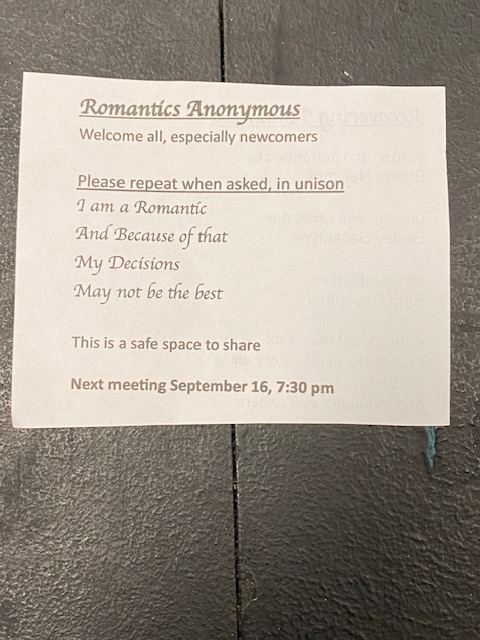
And she handed us a page with our affirmations that we were to say as prompted. The organization’s name as we see on the sheet is “Romantics Anonymous”.
I know Briane Nasimok from a few places, including opera, stand up comedy, and Confessions of an Operatic Mute: his Fringe show from roughly a decade ago.
Briane Nasimok, aka the Operatic Mute
Briane is a natural story-teller who reminds me of a cross between Woody Allen and Groucho. He’s Jewish of course. I found myself recalling Portnoy’s Complaint in Briane’s storytelling, possibly because Portnoy was also Jewish, or maybe because Portnoy is such an adolescent. Men in our culture often begin by looking at women this way, and struggle to break out of that. Hm, I suppose it’s a lot like the addiction that Briane is exploring. So there’s some deep truth underlying the story.
Recovering Romantic is a confessional monologue. True love isn’t funny. Ah but what about romantic disaster? that’s pure gold.
Briane’s delivery is as smooth as ever. And amazingly he looks younger now than he did in the operatic mute show a decade ago. Standing before audiences telling stories seems to agree with him.
Briane Shelly Nasimok
For now it’s a Fringe show, but I suspect the idea is bigger than what we saw, that there could be more to this concept, going as far as Briane is willing to go. As the show is repeated Briane will flesh it out further. Maybe he could actually invite a couple of us to come up onto the stage to tell our horror stories, our confessions? We’ve all had them. Or Briane could plant a couple of actors in the audience as fake audience members with scripted dating disaster stories. I could even see this as a tv show, or perhaps a reality TV show. I think Briane has hit on something universal. It’s as big as he wants to make it.
With a theatre full of fellow Recovering Romantics Briane is speaking to all of us. I have no doubt that he will have a sympathetic audience of fellow sufferers & recovering addicts in Halifax.
Last night’s final 2024 Toronto Summer Music Festival concert at Koerner Hall, titled Beethoven Unleashed, featured the violin concerto and the Eroica Symphony, a perfect snapshot of TSM at its best.
TSM combines the educational objectives of an academy and a showcase in a festival of concerts. Don’t let the “academy” part scare you off, the performances last night were as good as anything I’ve heard this year.
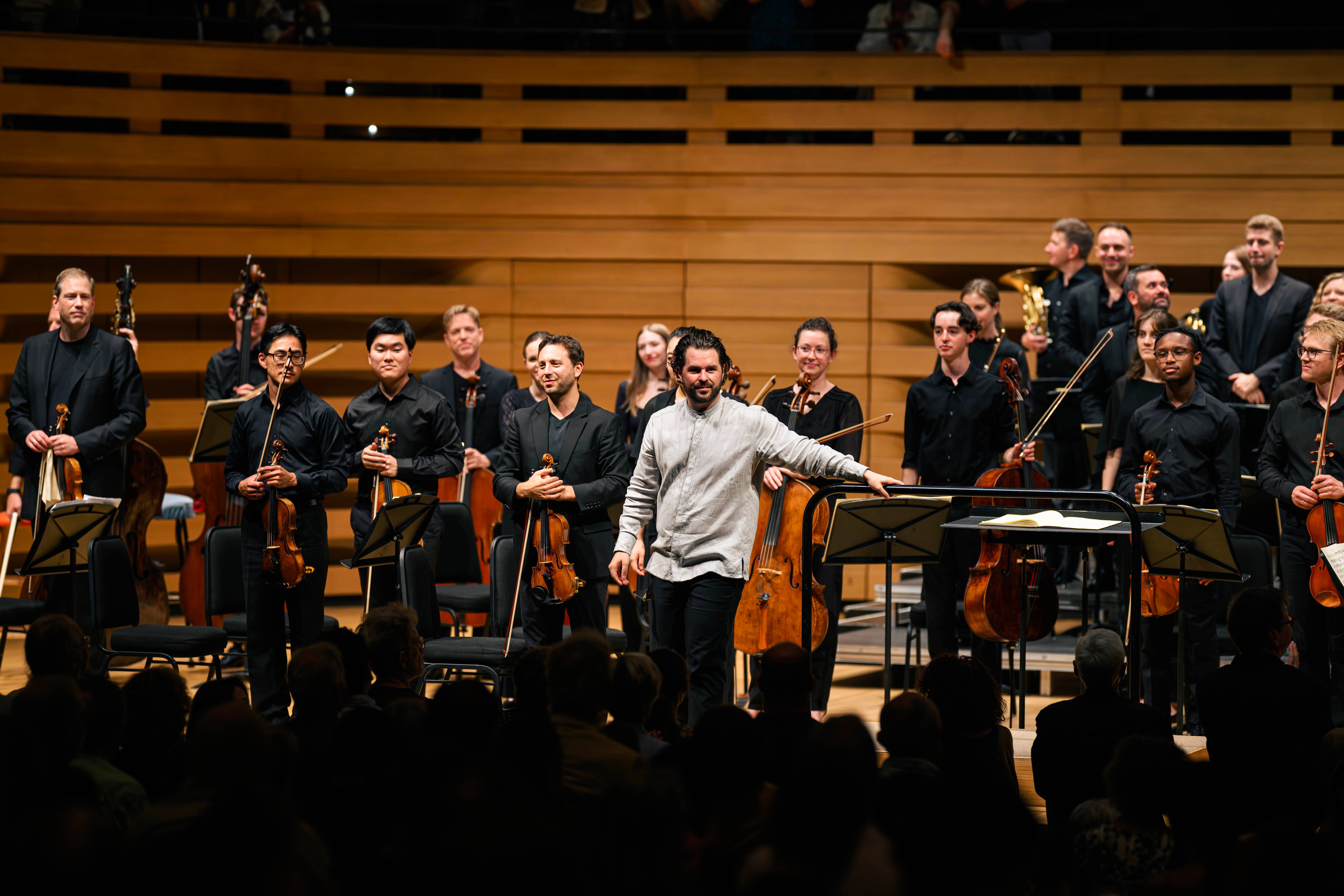
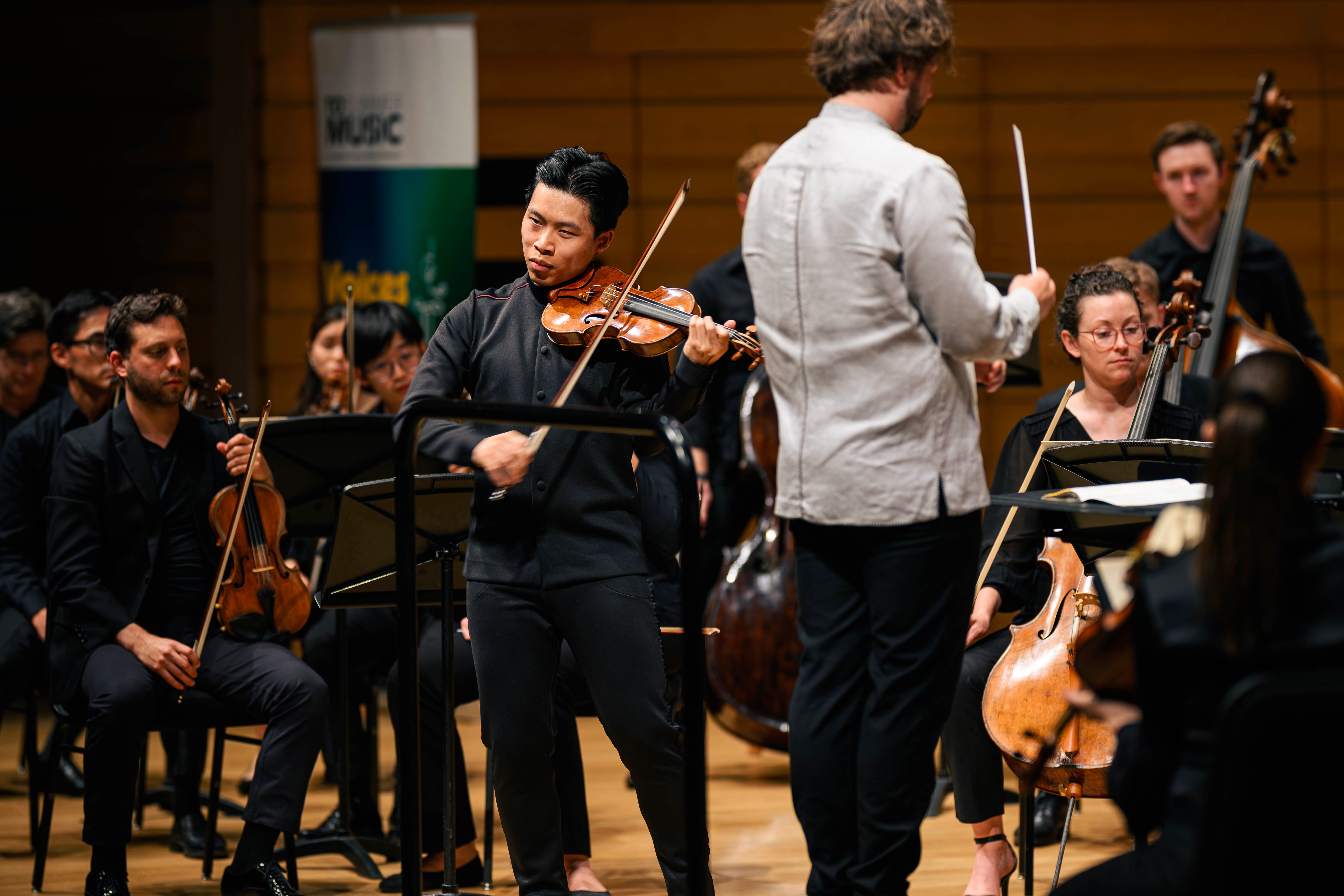
Conductor Simon Rivard accepting rapturous applause with the Toronto Summer Music Orchestra including Jonathan Crow & cellist Joseph Johnson (photo: Lucky Tang)
I was struck by a photo of so much youth, conductor Simon Rivard and the professionals from the Toronto Symphony such as cellist Joseph Johnson or violinist Jonathan Crow among them as equals. The warm informality we see throughout the festival is beautiful to see and to hear.
To begin it was the Violin Concerto, Op 61.
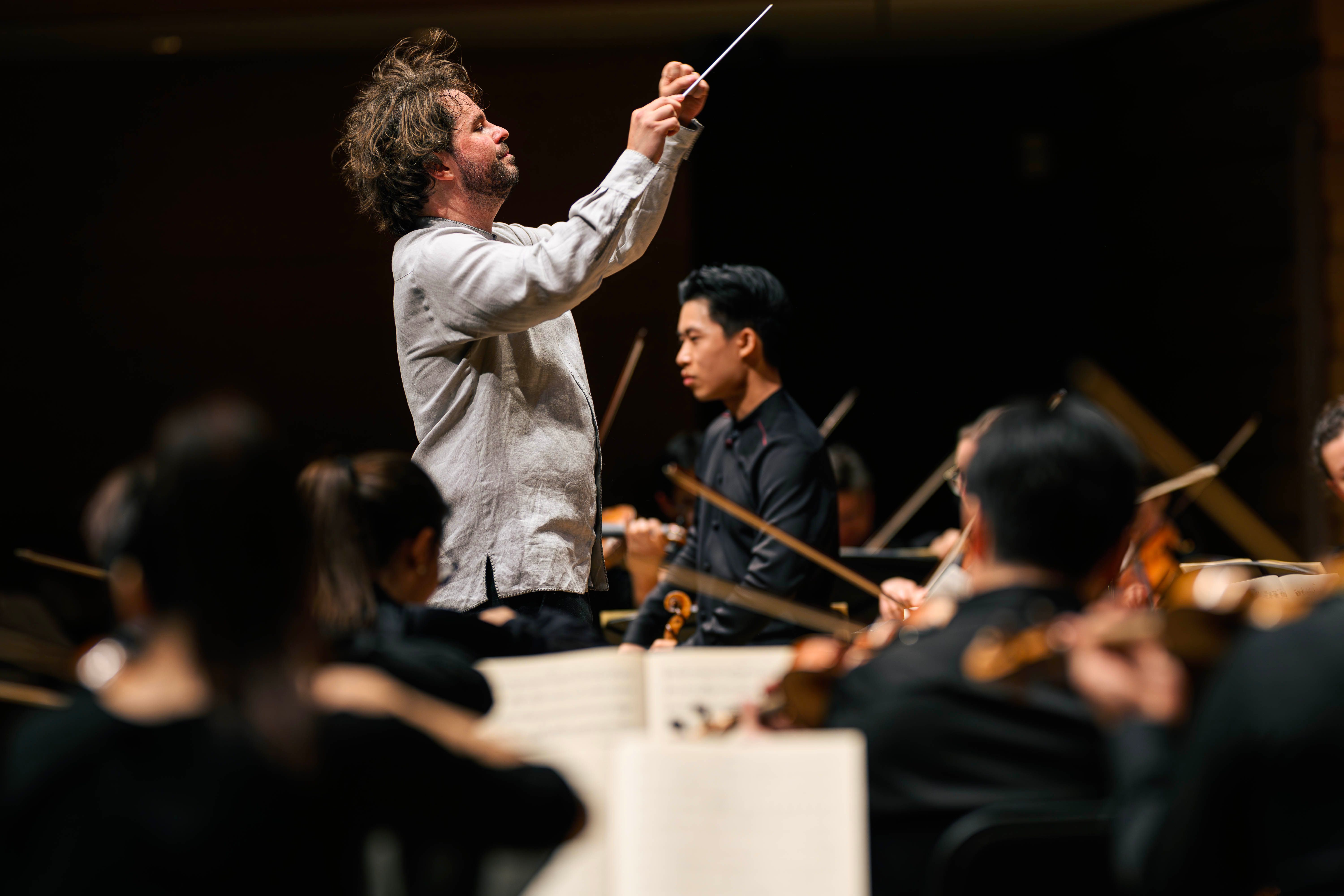
Conductor Simon Rivard, TSM Festival Orchestra, soloist Kerson Leong awaiting his next entry (photo: Lucky Tang)
Kerson Leong was soloist, with Simon Rivard leading the TSM Festival Orchestra. When I first heard this work decades ago I found the first movement to be a kind of agony, its passionate struggle almost unbearable. Or maybe it is simply that without the flair and flamboyance of a soloist like Kerson Long the piece can become boring. At times there was a kind of rhetorical gesture as though to set up his entry, an effortless showmanship. Not only was his tone larger than life but he has a kind of presence on the stage. The cadenza for the first movement felt titanic, at times giving us multiple voices on different strings. Difficult as it looks and sounds, there was never a moment when I doubted his ability to surmount all challenges in the piece. It was a piece of theatre to watch them making magic together.
Violinist Kerson Leong, conductor Simon Rivard, TSM Festival Orchestra (photo: Lucky Tang)
As an encore we were treated to a deliciously delicate reading of a slow movement from a Bach sonata.
After intermission we encountered another well-known work from the same middle-period of the composer, Beethoven’s symphony #3, known as the Eroica. I’m writing this next day after having tossed and turned through the night with music from the concerto and the symphony in my head, musing about the advantages of hearing music from the same decade and similar style of a composer’s output. I was reminded of Stewart Goodyear’s Beethoven marathons, when we would hear the sonatas played in order, as the experience invited us to notice similarities between adjacent creations, his new innovations jumping out for us seeming almost as revolutionary as they must have been in his time.
I pulled up the list of opus numbers to see the works coming up before and after the 3rd Symphony and the Violin Concerto. Notwithstanding the limits to the use of opus numbers given that music is being conceived before it is written down and possibly published later than it was really composed: the list is full of tantalizing hints. This little list that’s just a small part of Beethoven’s output takes my breath away just looking at it.
Op 53 –Waldstein piano sonata Op 54 — piano sonata Op 55 — Eroica symphony Op 56 — Triple concerto Op 57 — Appassionata sonata Op 58 — Piano concerto #4 Op 59 — three Razumovsky string quartets Op 60 — Symphony #4 Op 61 — Violin Concerto
The thing rattling in my head overnight was the way Beethoven seems to be thinking about sound and hearing, and in the process reinventing music almost by accident. Of course, he was gradually becoming deaf. The Waldstein’s opening notes may be music on the page but in some respects they’re like noise, repeated notes that can be percussive, although they’re soft at first, almost on the edge of our hearing. We get something like that to begin the violin concerto, a drum playing the same note to start. And we have something like that at the start of the scherzo of the symphony, a soft rustling in the orchestra that will get louder but to begin is almost imperceptible. Ditto to begin the last movement of the Eroica, as though the composer is playing a game of “can you hear the music?” The playfulness of these pieces is evident but also their refusal to play by the old rules. Indeed they’re daring precisely because they challenge all the old assumptions. Excuse me for going on like this (and there is so much more one could observe about similar sounding passages in those other works, for instance the soft opening notes of the 4th piano concerto), but it’s especially valuable that TSM were willing to program a concert this way, offering this opportunity to hear the music differently. I’m very grateful.
And conductor Simon Rivard extracted superb performances from his ensemble. Part of the joy is hearing a big work in the intimate acoustic of Koerner Hall, every player clearly heard, although that clarity is ideal when they play at this level. The horns in the trio of the scherzo were especially gorgeous, not just clear but with every phrase shaped to perfection, in a passage where players sometimes come to grief (I’ve heard a few fluffs in my time). I’ve never heard this segment played so well in my life. In fairness every section, every player was good, in a concert that was close to flawless in its execution and a fitting climax to a wonderful festival: the last concert at Koerner although there’s still more to come elsewhere.
For further information (about making a donation, to see names of Academy members or to read more about the festival that concludes on August 3rd) visit their website. The matching campaign ends this weekend.
A good pre-concert introduction from the artist can make a big impact.
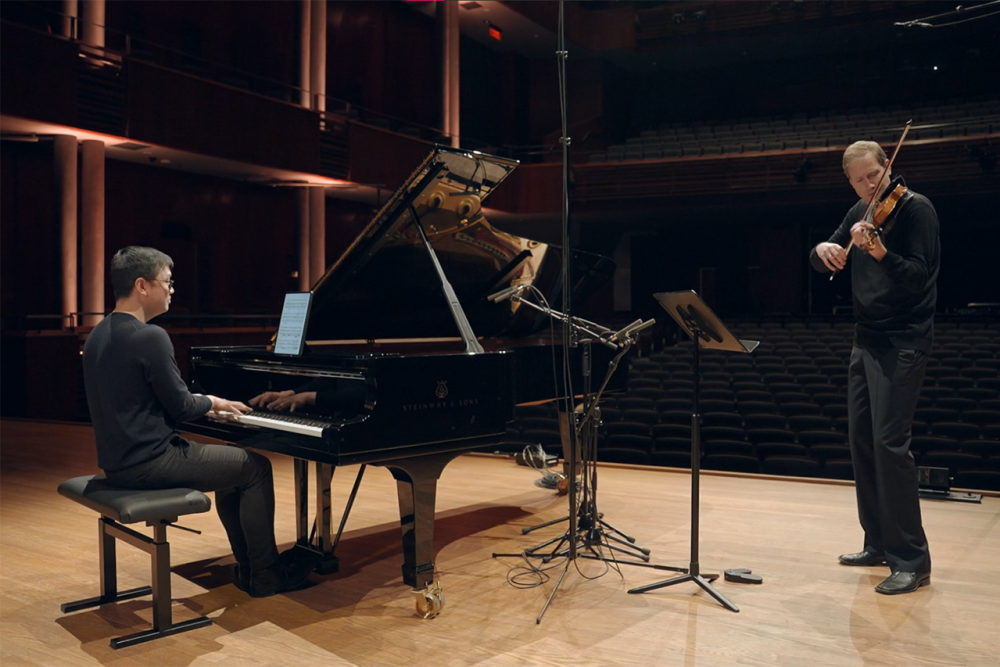
Last night’s Toronto Summer Music Concert by pianist Philip Chiu with violinist & TSM artistic director Jonathan Crow at Walter Hall was sold out.
Titled “Dreams and Shadows” here’s the program (timings in brackets from performances on YouTube):
Elizabeth Raum — Les Ombres (9 minutes) Kaija Saariaho — Tocar (7 minutes) Johannes Brahms — Sonata No 3 in D minor Op 108 (29 mninutes) –intermission– Jules Massenet — Meditation from Thais (6 minutes) Sergei Prokofiev — Sonata No. 1 in F minor, Op. 80 (26 minutes)
Philip gave a light talk at the beginning to introduce the pieces by Brahms, Saariaho and Raum, reminding us that he is now a TSM festival regular. Yes indeed and thank goodness. It’s a reason why I found & then reviewed his wonderful CD that won a Juno last year. His collaborations with Jonathan have been a highlight of recent summers at TSM, thinking especially of 2021 and a belated celebration of Beethoven (that should have happened in 2020, when no concerts were permitted), as we tentatively came back from the pandemic in distanced venues. Their music-making banished all our cares.
Philip Chiu and Jonathan Crow at the 2021 Toronto Summer Music Festival
Philip’s joking told us a great deal about the security of their relationship: as artists and as friends. He finished by drilling down on Tegan Niziol’s program note to the Raum piece, reading it as the audience giggled:
“Raum describes the work as a “true duo”, with each part afforded an equal level of prominence. In her notes to the score, Raum indicates that the interaction of two main structural elements –repeating short musical figures known as ostinati, and melodic lines shared between the violin and piano– define the work’s overall form. She ascribes a sensual quality to the interactions between the two instrument as they form a flirtatious relationship.” According to Raum shadows (the English translation of Les Ombres) are evoked by imitative voices within the composition“. (Tegan Niziol)
The two halves of the concert couldn’t be more different, one from the other, especially as introduced by the artists.
I was put in mind of the design on the page, something we think of when looking at the scores of Debussy (for example) who spoke of arabesques both in his own work and in the baroque, patterns on the page. A shadow is if nothing else, the trace or effect of light being blocked by another. I’m looking at the shadow of the top of my laptop as I type this. A shadow is a kind of image of something else, not unlike what we encounter in counterpoint, but also not as rigorous as counterpoint. Shadows are capricious, sometimes they aren’t visible. MAYBE I am overthinking the name and the implications of the title, certainly less fun than what Philip made from the program note.
Les Ombres dates from the 1980s, and contrasts in interesting ways with Tocar, Saariaho’s piece that dates from 2010. Raum makes each instrument work rather than making the piano subservient or somehow an accompanist. The patterns that we hear articulated across the imagined stafflines, like musical gestures drawn in the air, are emulated, rather than echoed. It’s as though we’re observing a kind of encounter between the violin and piano, who do not speak the same language either in their sound or their physical – gestural vocabulary. We’re sometimes seeing them synthesize into something harmonious, sometimes watching one trigger something in reply. At times it’s a dialectic, a response in a new direction. When we’re getting towards the end –and you can tell when the ending is coming– there is something like a stretto, a concentration of the materials into a unified expression of the closing ideas.
Saariaho is doing something different in Tocar (a word meaning “touch”). It’s intriguing that both pieces employ a word in another language that in some respects characterizes the music via a kind of metaphor. I think it’s very helpful that Philip’s language encouraged a playful engagement with these pieces. My understanding of the word “tocar” doesn’t focus on what I saw in the program note, which spoke chiefly of the interaction between the two instruments. When I hear this piece the first thing that catches my ear is the curious way each instrument is sounded, which brings us back to the physical process of playing each instrument. Philip touches the piano, Jonathan touches the violin, and the notes diverge. The obvious contrast is made a few times, when Saariaho gets the violin to venture between tones, something you can’t do on a piano. There is a wonderful variety to this short piece, including segments of tremendous rhythmic vitality: that Philip & Jonathan exploited with effortless acceleration. The dynamic variety they displayed reminded us of their rapport, playing as if the two of them operate with one mind. The tentative exploratory quality of the beginning –when we watch each one make music on their instrument as if from first principles–returns at the end. Everyone in the audience leans forward, fascinated by this piece…
I’ll insert a tiny anecdote. One time I was picking up a family member at the Toronto airport I saw Saariaho. I approached her, introduced myself as a fan and spoke briefly of her opera Love from Afar. She was very patient with my starstruck tongue-tied manner, smiled and then I let her go on her way. Unfortunately she died last year, a composer who I thought still had lots to offer us.
We then listened to the Brahms sonata for violin & piano op 80. Of the three Brahms sonatas it’s the hardest, a quantum leap in difficulty both for each player and in how they articulate and make something from what’s going on in the relationship between the two instruments, who often work together for a joint effect. To make that come off one has to be pristine in one’s command, absolutely solid and clean, otherwise it just sounds busy or cluttered and won’t really work. I say this having experienced such a failure, but now having a better idea listening to the stunning playing by Philip and Jonathan. Especially in the second movement I was struck by how Jonathan Crow is seemingly at the peak of his game, a big full sound full of expression pouring out of him without any struggle, anytime he wants to call it forth.
And it seems to get harder, the further we go. While the piano was more of a conventional accompanist earlier (the melodies & phrases & rhythms perhaps reminding you of what we hear from Brahms in his piano concerti) for the last two movement Brahms takes us into something suggestive of a Hungarian or Roma influence, dance rhythms and a huge amount of energy. In the last movement it’s intensely demanding of the piano and violin, quick passages of many notes, cleanly articulated yet often understated to illustrate the maxim “less is more”. Then when we get to the big climactic passages we get genuine drama in the dynamic contrasts. Their subtlety in holding back at first pays off, so much of the sonata played more quietly than one might expect yet at such a high energy level and quick flow of notes.
It was magnificent, and the audience exploded with applause in appreciation.
After the intermission it was time to hear from Jonathan, the artistic director of the festival and likely the one who selected this program of music for violin and piano. He spoke briefly of the Massenet which was played to honour someone’s passing (sorry I didn’t catch the name), and much more passionately about the Prokofiev. This was more of a cautionary exercise to warn us of the loud edgy piece that we were about to hear, almost an apology: but in defence of its quirks. I’m hugely grateful that what Jonathan was pointing to was the context for the work’s creation in the crazy times of the composer. Where Philip was drawing our attention to the light that we should hear in the works to begin the concert, Jonathan encouraged us to embrace and even celebrate the dark.
I repeat, Jonathan seemed to be apologizing, admitting that when the work was new the first interpreters were told to make the piano part even heavier regardless of whether it drowned out the violin. We were reminded of how the composer described a passage where the violin ascends rapidly up and down, as “wind passing through a graveyard.” The place where we hear that in the first movement, the piano’s chords reminded me of church-bells, an eerily beautiful evocation, something we hear again (but differently) towards the end of the piece. In between we get extremes of dynamics that remind me more of Shostakovich or Mahler than Prokofiev, the heartbreak of the human comedy.
I hope Philip and Jonathan record this piece, indeed everything we heard deserves to be captured for all time, as this pair are at the peak of their powers.
Toronto Summer Music continues until next weekend. I should also mention that among Philip’s light-hearted commentary at the beginning were reminders about fund-raising for the Festival, which offers a matching program for a few more days (sorry I’m not sure when it ends).
For further information (about making a donation or to see/hear one of the concerts in the final few days of the festival that concludes on August 3rd) visit their website.
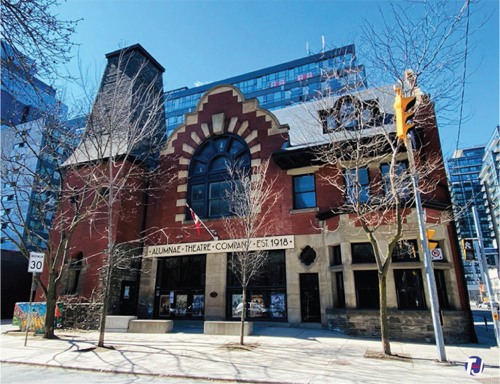
I attended the La Boheme to open Summer Opera Lyric Theatre’s summer season tonight at the Alumnae Theatre.
Alumnae Theatre
Guillermo Silva-Marin called it a festival in his pre-show introductory talk.
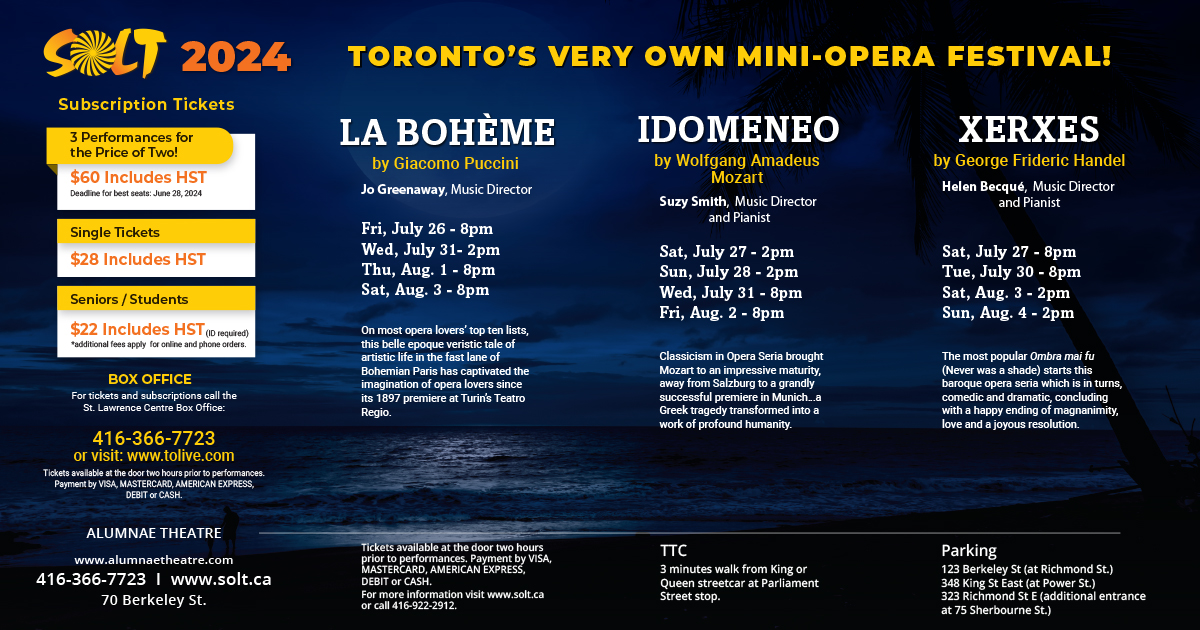
As you can see in the graphic, between now and next weekend SOLT will present three operas (not just Puccini’s bohemians but also Handel’s Xerxes and Mozart’s Idomeneo), two performances by each of the double casts to offer four of each opera, twelve shows in total in their schedule. Xerxes and boheme are offered in English translation while Idomeneo is sung in Italian, a different pianist / music director for each opera.
SOLT is a school for young singers, a summer program that climaxes with the showcase of this festival, when we see what they have learned.
Among the countless productions of boheme that I’ve seen & heard, a few were done in an English translation like this one. The singer’s task becomes quite a bit different especially when we’re working without surtitles. The comedy is foregrounded as we suddenly have funny lines, so long as the singer can make the lines funny. Some of the singers rose to the challenge better than others, balancing their need to sing beautifully while enunciating with clarity. Chances are they will improve in their second time next week. Marcel van Helden as Rodolfo and Cassandra Amorim as Mimi were very successful romantic leads, communicating & acting clearly and eloquently. I love it when I see a familiar opera in a new way. Baritone Joseph Ernst was a standout as Schaunard, both as an instigator of comedy in the first act, and the one who discovers Mimi’s death in the last moments.
Boheme without a chorus is a different animal, the challenge landing squarely on pianist Jo Greenaway. I was impressed by her choices, giving the singers room to be lyrical in their solos, fully honouring the lyrical lines rather than the compulsive quickness one finds in some interpretations (thinking especially of Toscanini, the one I first heard as a child). I think Jo’s approach helped the singers communicate, especially in the pathos of the last scene.
One of the changes in this version is the removal of the children’s chorus chasing after the toy-seller Parpignol, who is reinvented as a waiter in the Cafe Momus singing an aria. Everly Conrad-Baldwin took the stage boldly giving us a different way than the usual to set up the scene in the Cafe.
Everly Conrad-Baldwin
I will never stop admiring Puccini’s achievement. It’s a piano score I play (once we’ve done Christmas carols) at the annual Italian Department Christmas party (a regular gig at U of T I’ve been doing for over 10 years), apt because the first two acts take place at Christmas time. Puccini gives us joy and despair, romance and comedy in what is one of the most economical scores ever written. It never stops moving me, an effect that carries over into repeated viewings of the romantic comedy Moonstruck, a film relying heavily on Puccini for its charm.
But the other two operas aren’t chopped liver. Xerxes opens with what might be the most performed tune in opera, even though it’s often separated from the original context. “Ombra mai fu” has been paraphrased in such weird ways as “Handel’s Celebrated Largo” or the church anthem “Holy Art Thou”. Alas the irony of the original is usually missing even if it’s an amazing tune.
I used to enjoy playing and contrasting different versions of the melody for opera classes, for instance Gigli and David Daniels. I wouldn’t dream of suggesting one version of the piece is better, so much as that it’s a kind of litmus test of the era and a demonstration of the changing assumptions about the art form and their use of the virtuoso.
And here’s a sample from a rehearsal of Idomeneo by Mike Fan who sings the title role this week for SOLT.
We were grateful for an air conditioned space. Unlike the old Robert Gill Theatre, SOLT’s former home, they shut off the a/c for the start of the opera, resuming for intermission then silencing the blowers again for the last portion. Much as I loved the Gill it was plagued by ventilation noise. And the sightlines are better at the Alumnae Theatre.
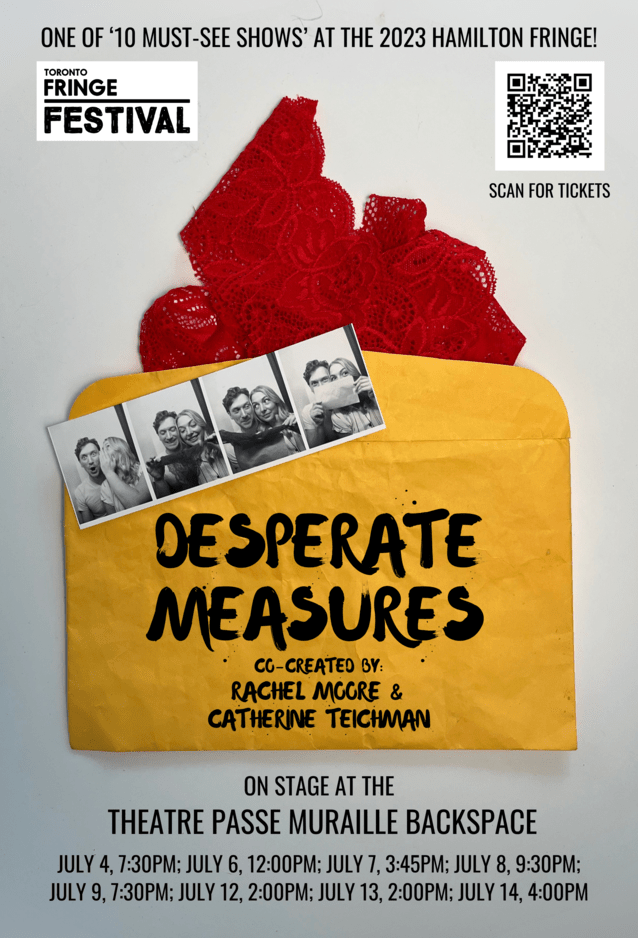
Sometimes a theatre piece captures essential conflicts of modern life. If you read this excerpt from the press release for Desperate Measures you’ll see why I wanted to ask them some questions
“What would you do for an extra stream of income? Funny, sexy, and cathartic, Desperate Measures explores the question on so many people’s minds: how to make extra money “in this economy?!”. In the face of rising rent, shrinking income, and a baby on the way, Amy and Pete begin selling Amy’s used underwear online. However, when things spiral out of control, they end up buried in the panty business.”
Desperate Measures by Rachel Moore and Catherine Teichman, opened at The Toronto Fringe Festival running until July 14th . I asked Hilary Wirachowsky of the Desperate Measures Collective (DMC) about their show.
Hilary Wirachowsky
Barczablog: The press release begins “What would you do for an extra stream of income?” What are some of the desperate measures / side hustles / dayjobs members of the Desperate Measures Collective have done?
Hilary Wirachowsky & DMC: Hahaha oh man, what a way to start! I obviously polled the cast & crew for this one. We have all the usuals: Serving, Catering, Nanny, Child-minding at the COC. Some of the more unique ones I heard were: Property Management, Monologue Curation Service, Landscape art Door to Door Selling, and someone sold Bread by Bike (I love this name) but had to stop because the cost of ingredients/labour outweighed the reasonable price they wanted to sell for.
Barczablog: I’m sympathetic, I used to work in construction, landscaping, deliver mail, do websites..,. I have known desperation. Is Desperate Measures funnier or maybe more serious than the authors expected? Are the laughs in the expected places?
Hilary & DMC At its inception, Desperate Measures was definitely intended to be a comedy, but we always knew we were exploring sensitive and politically charged themes: the cost-of-living crisis (and the way it impacts different generations), sex work, gender roles, etc. As the show developed, we worked very mindfully to give these economic and political ideas the weight they deserve while still keeping it firmly as a comedy. There will be lots of laughs, but also moments of seriousness and honesty, and sometimes we even manage to do both at the same time.
BB: Your play flirts with sex work. How far can you push the envelope, embracing a risqué presentation?
Hilary & DMC The show does centre around a form of sex work, which we know might push the envelope for some audience members, but Desperate Measures really looks much more at the logistics of sex work, rather than the ethics. We get to watch Pete and Amy work out the nuts and bolts of running a panty-selling business. This gives the audience a chance to learn along with them, which we think will make it more accessible to those who might feel out of their depth. That said, there are plenty of moments in the show that some people may find risqué, but they’re all for the sake of comedy or storytelling, not just to be purposefully shocking.
BB: In 2024 can we laugh about the subtexts of Desperate Measures or is it a serious question?
Cameron Kneteman (Pete), Hilary Wirachowsky (Amy), and Lisa Randall (Linda) in rehearsal (what are they laughing about?)
Hilary & DMC It’s a bit of both! The best comedy is always based in truth—that’s what lets us connect with it, even in moments of heightened ridiculousness. The cost-of-living crisis is serious, and we know that nearly everybody is feeling the effects of it, ourselves in the show included. Our hope is that the show will give audience members feelings of both catharsis and levity—a chance to see their own frustrations reflected, but the opportunity to laugh and enjoy themselves.
BB: It’s a blunt dilemma as old as the theatre, reconciling the desire to make art and the need to make a living. Is Desperate Measures a work of art, or a way to make money?
Hilary & DMC: Well… I don’t think anyone does The Fringe to get rich.
BB: Good point..!
Hilary & DMC To me, The Fringe often is scrappy-indie-makeithappen-fun. Desperate Measures is a labour of love that started from the playwrights: Rachel Moore and Catherine Teichman and branched out to all of us involved. They set out because they wanted to tell this story, so it’s entertainment, and art. And I think all of those things can intersect and look differently depending on the project!
BB: Do you expect the regular theatre goers that populate your fringe audience to be like the choir to whom you’ll be preaching, people who face the same challenges as your team?
Hilary & DMC: What I like about Fringe is the diverse audience you can reach. The cost-of-living crisis affects us all, and this play is full of universal themes (it’s a comedy, but has some really tender moments I think) and so in my opinion it’s easy to relate or feel empathy to what’s playing out in front of you here.
BB: The desperation of the title could just as easily refer to the consumers as the sellers in these transactions. Do we ever hear from them, or are they irrelevant to your piece?
Hilary & DMC: Without giving too much away, the consumers have a presence in the show for sure. My character Amy does have some interaction.
BB Is the desperation understood as selling out, of compromising one’s values? Or should we be sympathetic to that desperation?
Hilary & DMC: The desperation (as referred to in the title) doesn’t represent much, beyond the catalyst of the plot and what causes the play to start!
BB: Recalling Barbie last summer, a light-hearted comedy with an unexpected feminist core, where does Desperate Measures situate itself, between comedy & satire, in addressing the implicit feminist questions.
Hilary & DMC First of all, thank you for bringing up Barbie! My favourite colour is pink, and I loved the film. Desperate Measures is absolutely a comedy, we laughed a lot in rehearsal, and the couple shows we’ve done so far have also had lots of laughter. But to me, the best comedy is grounded in real, and often big feelings, and there is no shortage of those in our show either: lots of tender, very human moments. Someone mentioned to me “these characters feel so real” which is so important to me as an actor, that the characters are whole people.
It’s feminist for sure, but what lives in this play is what I would call household feminism instead of a revolutionary feminism. It’s the tiny subtleties in day to day conversation addressing gender politics and societal expectations based on gender. I think the play is inherently feminist because it has to be given what goes on in the play, and who is involved, but it’s not the show’s only brand. There was a great effort made to make it not “preachy”.
BB: Whose desperation is being portrayed in Desperate Measures? Tell me about the authors and the players.
Hilary & DMC The story revolves around Amy (played by me! Hilary Wirachowsky) and Pete (Cameron Kneteman), a couple overworked and struggling to get by (let alone ahead) in this economy who find themselves buried in the panty business. You also meet Pete’s mom Linda (Lisa Randall) who makes things harder for Pete and Amy in spite of good intentions. The show is created by Rachel Moore and Catherine Teichman, Staged Managed by Paulina Tapia, and Directed by Rachel Moore. It’s a great team!
BB: Is the balance between farce and satire today the same as when the play was begun? Did the authors find the topic becoming sillier, funnier as they proceeded, or did they begin to see depths and profundities?
Hilary & DMC I asked the playwrights this (want to give them credit) and this is what they said: Certainly, some of the themes of Desperate Measures have only become more relevant since we started writing it in 2022, prompting us to explore them with more depth as time has gone on. That being said, the longer development time has also given us the opportunity to hone the comedy too, which we’re so grateful for.
BB How have live audiences changed the way the play is received?
Cameron Kneteman (Pete) and Hilary Wirachowsky (Amy) in rehearsal
Hilary & DMC: I love hearing new laughs in new places. And each audience shows their personality in different moments standing out to them. So we’ve had lots of laughing/funnier than expected moments or in places we didn’t necessarily expect. On opening one moment near the end got an audible “Aww” and surprised sounds, it’s always nice to know the audience is on the ride with you in moments like that. We’re in the Theatre Passe Muraille Backspace, so the audience is close, and at times I’ve felt the audience be more on my side, or they switch to Pete, or they’re conflicted about something – like Amy and Pete often are- and I’ve caught myself in defence of my character thinking “no you don’t understand!, etc.” It’s really fun, and each audience is so unique. It seems like they’re having fun too.
BB: There seems to be a lot of possible irony & comic depth to the story. Do you anticipate that the fringe show will be expanded, maybe even as a full-length feature film?
Hilary & DMC: I’m so glad you feel that way, I agree! Last year at The Hamilton Fringe the creators produced readings of various casts, so getting to be Amy in the first full production of Desperate Measures is a real treat, and I’m glad they took the plunge in Toronto. I definitely hope it continues to have a life after Fringe, and I think Catherine and Rachel do too. They lovingly nickname it as “The Panty Play That Could” sometimes in conversation, and I think that sums it up a lot. It’s silly and funny, but also so heartfelt, and hopefully makes people think and feel as much as it makes you laugh!
BB: Are there credits / acknowledgments that you might want to make?
Hilary & DMC: Additional Credits: Dramaturgical Support by Kat Sandler and Matt Pilipiak
We are so grateful to have a sold out run! A very limited amount of tickets may be available shortly before each show. There is also often a waitlist available.
I just visited The Drey Gallery on Woodbine in East York, just north of Danforth.
I was drawn by seeing Patrick DeCoste’s mention of the show on Facebook, plus the convenience of the location. I have friends and family living a couple of blocks away. I’ve told them and now am blogging about my first look. I’ll be back to get a closer look and to chat a bit more with the Gallery curator / owner Drew. The shows by the two artists open today, and will be up until August 5th.
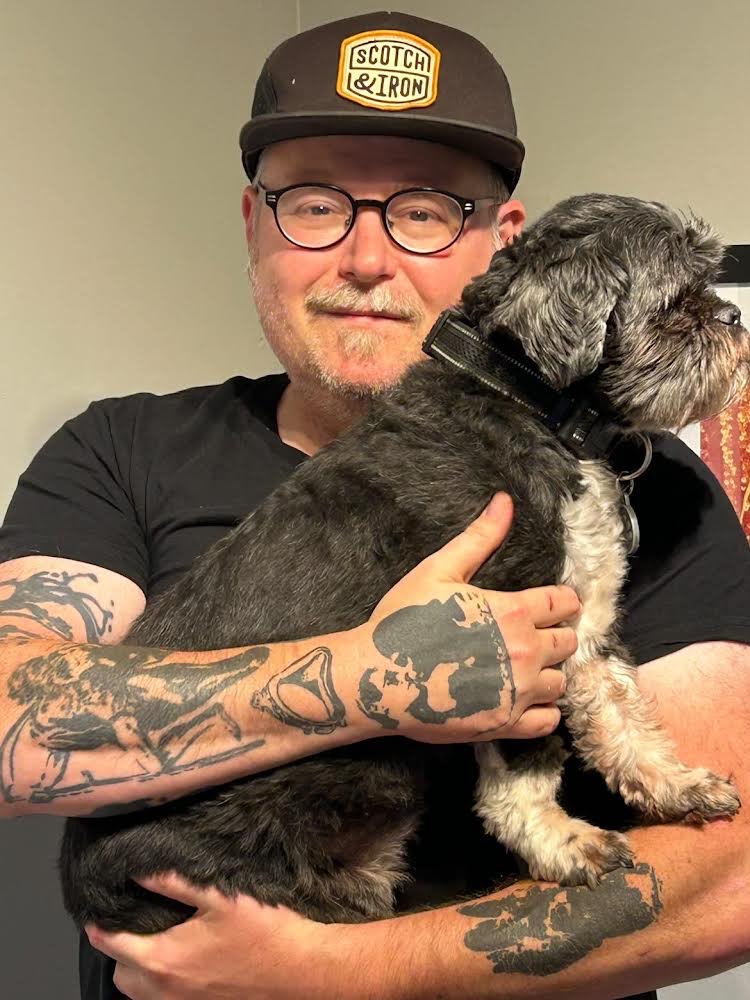
Drew Simpson and Louie
At first I wondered if that was his real name. An artist who drew? Perfect considering that Drew really drew, at least once upon a time, It’s funny Drew is the second person I met today who was telling me about their past at OCAD, now OCADU, formerly OCA (when Erika went there back in the 1970s). We met the first (who lives across the street from us) earlier today as we went for a walk.
Here’s a bit about the Gallery from their website:
After a long illness and extensive rehabilitation, The Drey was founded by artist Drew Simpson in 2019. The first gallery was a small ground floor space in an historic 200 year old mill tucked away in Canada’s last registered hamlet, Glen Williams. From the outset, the Gallery was committed to reimagining the traditional art business model while celebrating and exhibiting the work of under-represented, often marginalized mid-career artists.
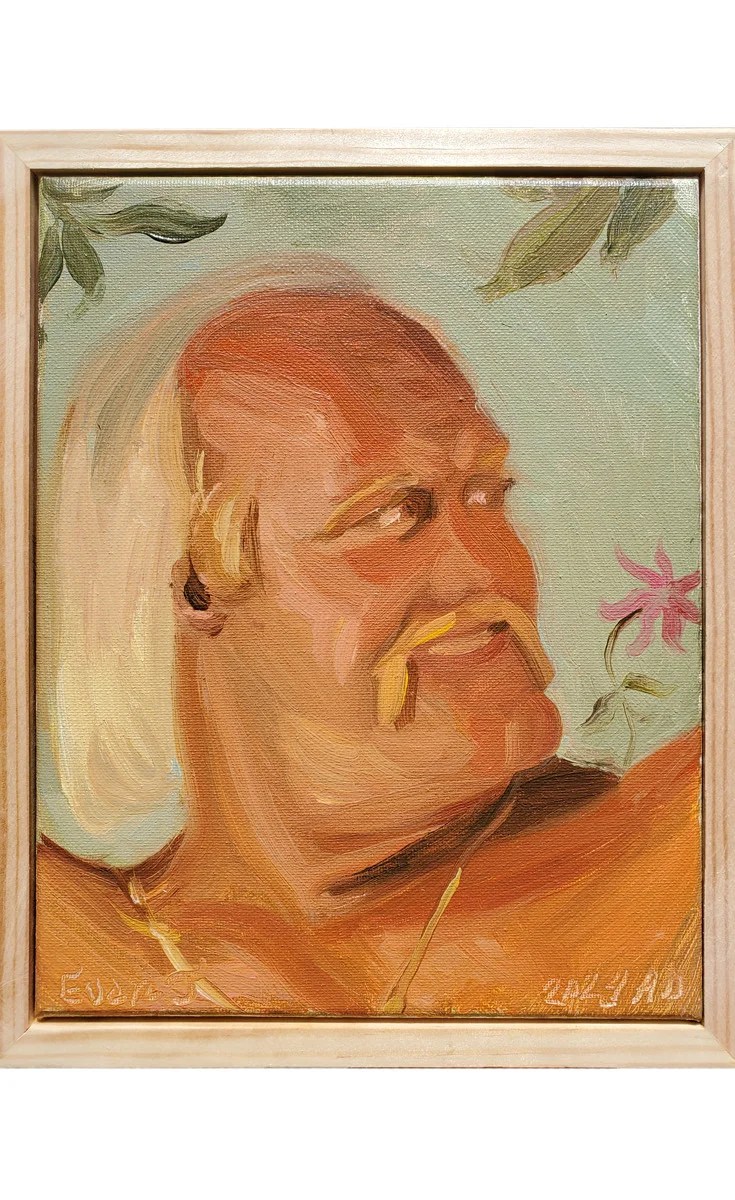
Evan Jones: Hulk Hogan, acrylic on canvas
There are two artists in the show, and other works on display at the gallery on Woodbine. It’s a really charming space that felt especially welcoming on a hot day, nice and cool inside even before I talked to Drew, who was preparing food & drink for the expected visitors.
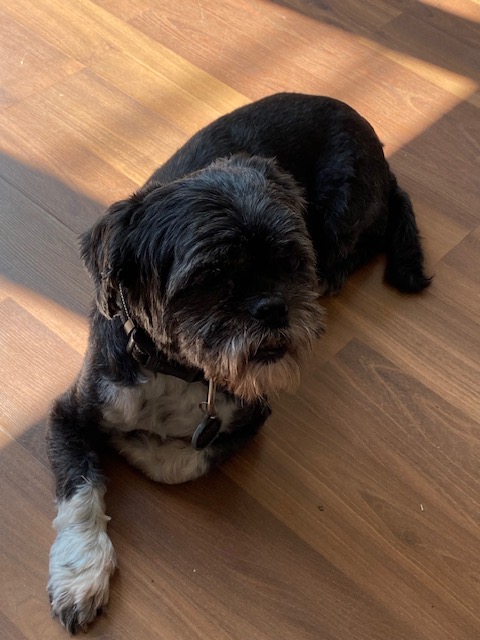
And his dog welcomed me. The photo doesn’t show how sociable Louie was, a very friendly doggie.
Louie
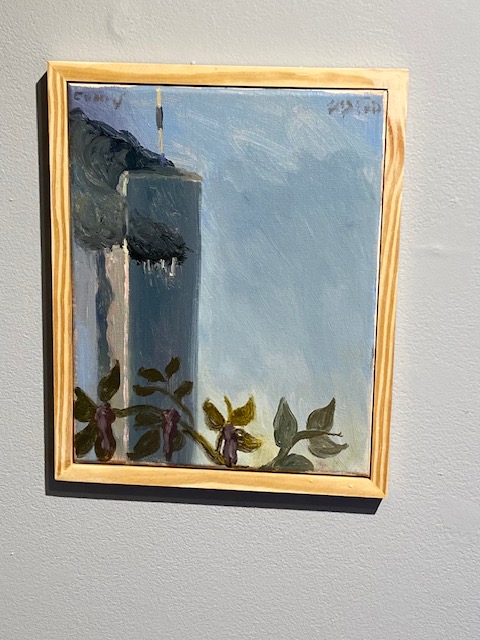
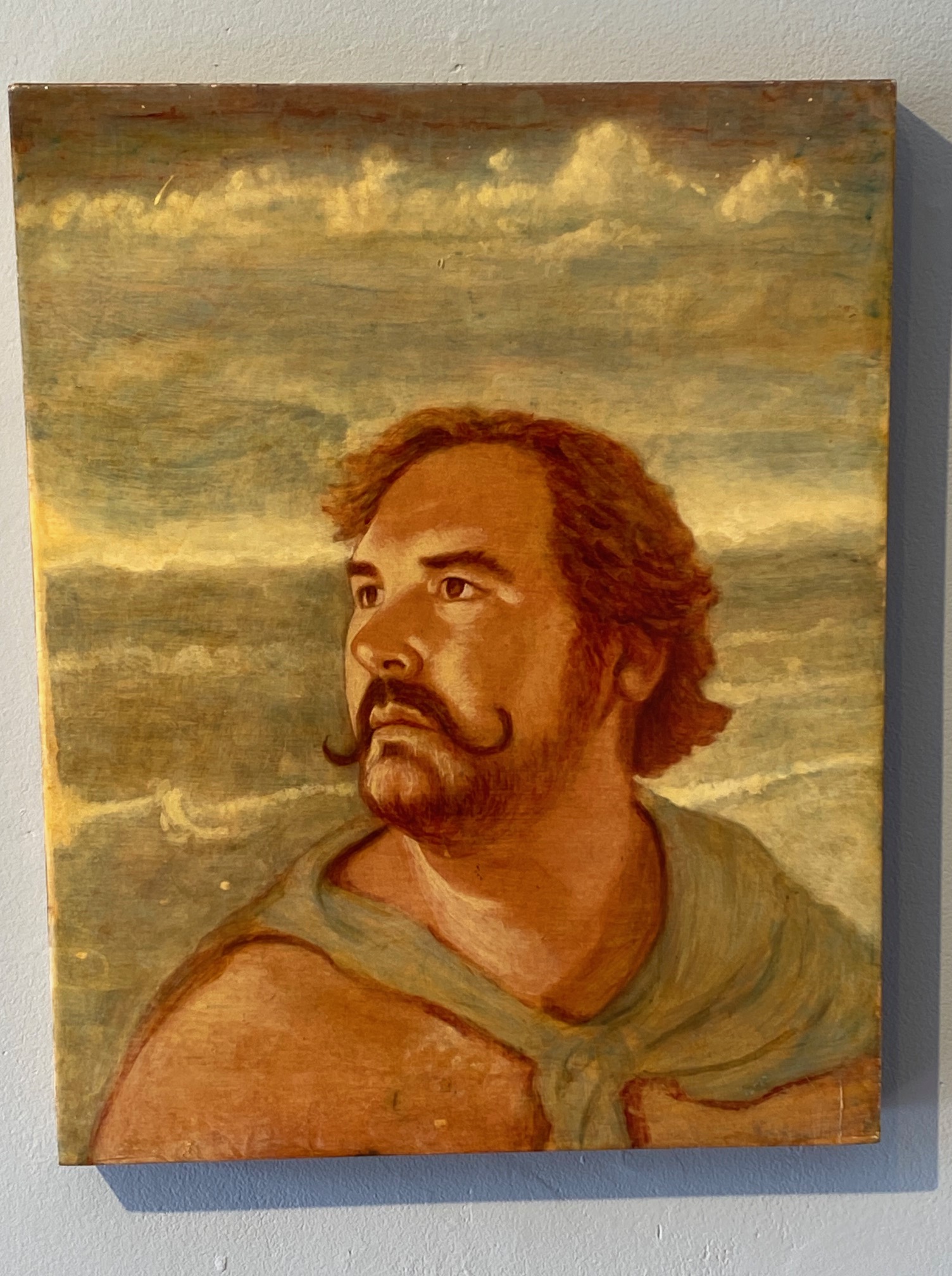
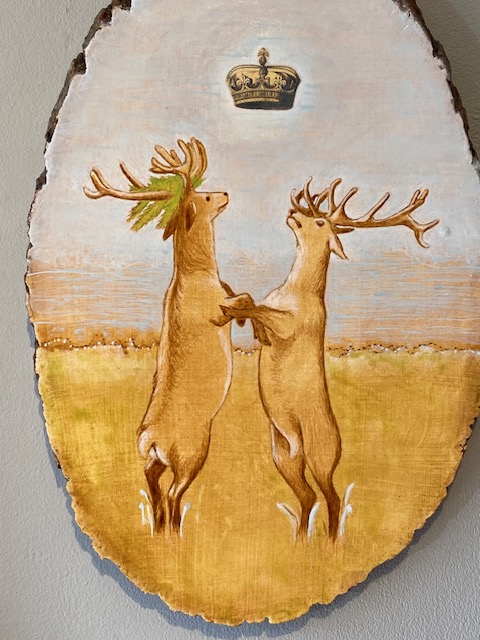
Evan Jones & Patrick DeCoste are two artists whose styles are complementary even though contrasting.
Evan paints portraits of persons famous (like Hulk Hogan) and not so famous, or perhaps infamous when we mention his pictures of 9-1-1. There are two, and looking at his titles I’m not sure what title goes with the one I took (shown immediately below)
Evan Jones: (not sure of the title), acrylic on canvas
Patrick DeCoste is a Metis artist who (excuse the pun) drew me to the show. I wrote a bit about his work a decade ago, and I’ve followed his work through Facebook ever since. And you can see more of his work here. Patrick’s last pictures are in a fascinating post-modern style, alongside works that are very polished and seemingly from another century.
His new ones are also polished but contain a few ironic anachronisms tipping us off that no we can’t be looking at something old.
Patrick DeCoste: Dancing Deer
The show had just opened when I got there, deliberately early to avoid any sort of crowd, as I continue to be a caregiver who must avoid communicating any virus to family members. I made a quick visit, had a brief chat with Drew and stroked the lovely doggie who is apparently 14 years old. While he’s old I’m the one who had the senior moment, forgetting his name, which I’ll find out asap and insert into this writeup sometime soon. (==> Louie!)
It’s Canada Day. I live in Toronto and am a subscriber to the Canadian Opera Company.
I was remembering examples I’ve seen south of the border at the Metropolitan Opera. Yes they import talent, bringing in Italians to sing Verdi or Russians to sing Tchaikovsky. As I look back at the different people who have been entrusted with the leadership roles at the COC, I think they absorbed this philosophy perfectly, because the COC have been very good at imitating this part of the Met’s approach to bringing in talented foreigners instead of using the talent developed at home.
I wanted to celebrate the times when the Met set a good example for the new management of the COC who recently announced the departure of their General Director Perryn Leech and the interim appointment of David Ferguson. I want to call it a lesson because this has not been the way the COC has been directed.
Perryn Leech
David Ferguson
Decades of casting choices can’t be reduced to the few glib sentences I’m writing here, so please excuse me for oversimplifying.
The current conversation about the COC has given me a new appreciation for the choices made by Met management. I’m a big fan of Wagner’s Ring Cycle operas since my teens when I was fortunate to get to NY to see singers I idolized such as Jon Vickers or Thomas Stewart. The Met was understood to be the best opera house, if not in the world certainly anywhere in North America, regularly importing the best singers in the world. The song is right when it says “if you could make it there you could make it anywhere”, at least as far as the Met and opera were concerned.
Yet I remember being frustrated by the Met, who chose to cast James Morris as their Wotan from 1987 until 2009. I had heard and admired the Wotan of the English singer John Tomlinson, who was Wotan at Bayreuth from 1988-1992 for the Kupfer Ring, and again in 1994-1998 in the Kirschner Ring. The on-line journal MusicalCriticism.com called Tomlinson ‘the leading Wotan of his generation’ (September 2006).
Here’s a tiny peek at Tomlinson, a great singing actor, performing Wotan.
Yet Tomlinson only showed his face at the Met in 1999 for a difficult role in Moses und Aron, and would share the stage in the 21st century a few times with Morris: but playing smaller parts such as Fafner alongside Morris’s Wotan. The Met chose never to cast Tomlinson as Wotan.
What am I getting at? In 2024 I now see it differently.
The Met actually did something I have long wanted to see the COC do. James Morris is an American, a competent Wotan. John Tomlinson is British, “the leading Wotan of his generation” but never sang the role at the Met.
Why?
Perhaps that was because the Met were loyal to their American talent, casting Morris for over 20 years as their Wotan. The vote of confidence from management helped the singer perform with even greater self-assurance while also building the relationship with the audience in NY.
While I did not like Morris as much as Tomlinson he’s still quite good in the role as you can see.
Yes, I once thought of James Morris as a letdown compared to Tomlinson, wishing to see him in NY.
But now I’m thinking differently. I realize now that in fact the Met did something admirable in casting Morris. I have no idea whether there was a conscious effort to ignore Tomlinson, but by showing such loyalty to an American singer they also showed a commitment to their American audience, building their community of opera fans in the process. When you look at their history you see lots of American singers. I mentioned Thomas Stewart, another American. We assume that because they sang at the Met they must be the best in the world, and that opportunity helped their careers.
Let that be context for the job of the management of the COC, their approach to finding singers when they cast productions. The Met’s example can illustrate another approach than the one practiced since the time of Lotfi Mansouri. No we don’t need to always hire from abroad. We can promote Canadian talent, even if there might be someone with a better reputation in Europe.
I know of older singers whose careers are ending, winding down. It doesn’t help that they were not getting cast here in Toronto, singing for a supportive audience. And I know of younger ones who could use the work, who are forced to take day-jobs or to abandon their career.
Whoever is selected to be General Director can understand their position and its goals in many different ways:
Emulate Lotfi by hiring from abroad?
Or his predecessor Herman Geiger-Torel, whose COC was cast mostly by Canadians and only rarely sought talent outside the country.
I’ve heard rumblings that the COC is in debt. I wonder if the finances of the company would improve if their casts featured more Canadian singers: who surely are less expensive than imported singers.
I think in the 1970s it was exciting to see big stars come to Toronto, and this has often been understood as the best way to run the company in the decades since, even if the imports weren’t necessarily great singers or well-known to the Toronto audience. There may be a mistaken assumption that we must cast from outside Canada, as the management seem to be oblivious to the talented Canadians who can fill roles without the requirement to go outside the country. I could list dozens. Imports should only be cast when we can’t find a Canadian.
A Canadian General Director might have a greater sensitivity to Canadian talent. Perhaps it’s time to hire a Canadian in the role, and not just as their interim General Director. But whoever gets the job, Canadian or not, should be instructed by the Board of directors to make it their priority to search for Canadian singers, to build a complement of mature Canadians and not merely to hire the young singers of the Ensemble Studio to sing small parts, who are shown the door when their term is up. The COC could signal their commitment in a public mission statement. I would be happier as a subscriber if I knew my dollars were not automatically going to imported talent.
We shall find out eventually.
In the meantime let me wish you a Happy Canada Day.
I am another Canadian mourning the passing of Donald Sutherland.
When celebrities pass we may sometimes feel the loss more keenly than would seem reasonable for a stranger. I never met him even though I saw many of his films. I think the passing of a star sometimes hurts so much because their work is so much a part of our lives.
I am again muttering darkly to myself, because of course Donald Sutherland was never even nominated for an Academy Award. Yes yes he got an honorary statuette but for me that doesn’t count, not for recognition by peers. Sutherland was a gifted performer but perhaps because he didn’t look like he was “acting” (in quotes because I want you to hear me speaking the word with an implicit sneer on my face), he wasn’t recognized.
If you don’t look like you’re “acting” (sneered again) surely you’re doing it right.
I’ve eagerly read what others have said, noticing the roles that people name as favourites.
One reads through his IMDB listing, recalling roles, visualizing scenes.
Here’s the scene that came to mind as I recalled Donald Sutherland, likely the one I will always have in mind.
I mention this one because of how extraordinary this short scene is in one of my favourite movies, Oliver Stone’s JFK (1991), a film featuring several scenes that I think of as career best performances: Gary Oldman as Lee Harvey Oswald, John Candy as Dean Andrews, Joe Pesci as David Ferrie, Tommy Lee Jones as Clay Shaw, and especially Donald Sutherland as X.
The thing about this scene is that we’re hearing an eyewitness observer who must have integrity, must be believable. More than anyone else in this film, Stone leans on Donald Sutherland to create X in this scene. X is like Deep Throat except of course this is fictionalized.
I find I trust this speech as though it were true, an amazing delivery of a remarkable speech. In a real sense Stone has decided to make X the conscience of America, a witness to what went wrong and a reliable commentator on a conspiracy. Maybe upon closer observation one doesn’t believe it? But I listen to Donald Sutherland and I am completely persuaded.
And Stone also gets a big assist from John Williams underscoring this speech.
I will circle back to review Klute, Ordinary People, 1900, Start the Revolution Without Me, Kelly’s Heroes. We watched M*A*S*H just last week, Casanova is on the DVR already. Animal House? Six Degrees of Separation..?
As I glance through the listing on IMDB it’s a bit awe-inspiring how many roles in different genres, things I’d forgotten.
Oh yes he’s the father in Pride & Prejudice (2005), I think I recall at least one scene shot with him sitting down so that his imposing height wouldn’t disrupt the family dynamic, as sweetly smiling a Mr Bennet as one could want. And I see he had a small part in The Bedford Incident (1965), making me want to see that one again.
He’s gone of course, indecent that we are able to stare at his friendly face in so many roles, when his family has lost their patriarch.
It’s heart-rending to read Kiefer Sutherland’s tweet “With a heavy heart, I tell you that my father, Donald Sutherland, has passed away. I personally think one of the most important actors in the history of film. Never daunted by a role, good, bad or ugly. He loved what he did and did what he loved, and one can never ask for more than that. A life well lived.“