Robert Carsen has once again held up a mirror to an opera by Gluck with the help of the Canadian Opera Company. Last season it was an award winning production of Orfeo ed Euridice. Tonight I saw Iphigenie en Tauride, which the COC are calling “Iphigenia in Tauris” perhaps to emphasize the connection to Athenian tragedy.
The result is even more intense than last year.
I don’t think I realized how dark this opera is. Or maybe it’s just that when everyone is singing, the drama is concealed or mitigated somehow; how could I miss it? When everything is sung one can sidestep the gore and dysfunction that are the lifeblood of Athenian tragedy. Iphigenia is in a most ironic position. Rescued by the gods just as her father Agamemnon was sacrificing her, her new life as a priestess requires her to sacrifice others to the Gods.
We’re accustomed to portrayals of Orestes as a haunted man, pursued by the furies for having killed his mother Klytemnestra (avenging his father). Carsen gives Iphigenia her own furies, dancers who sometimes seem to be the helpers in the temple. In a world of bloody rituals divorced from anything spiritual or holy, the faithful attendants are every bit as scary as furies.
Carsen’s emphasis is decidedly psychological, with larger than life gestures taking us inside the protagonists’ painful conflicts. Iphigenia is tormented by her role in the temple, while Orestes is haunted by memories of what he’s done.
Diana rescues Iphigenia, taking her to faraway Tauris where she presides over ritual executions. While this might have seemed like a fair exchange in the ancient world, Carsen makes it clear just how cruel this fate is. From the first moment Iphigenia is haunted, pursued by reminders of what she is living with at every moment. This insight from Carsen is especially useful to counterbalance Orestes, the other haunted figure of this story.
Two wonderful portrayals come to life on the bare dark stage of the Four Seasons Centre. Susan Graham takes us deeper into Iphigenia than I thought possible, a portrayal of strength and nobility. I have never really liked this character so much as I did tonight, but Graham took me so deeply into her anguish that I see the character differently. By surrounding Graham with stark reminders of Iphigenia’s actions (via the dancers), her solos were given more transparency than usual.
I had expected to like Russell Braun’s Orestes, and he did not disappoint. I had been a bit nervous because other productions I’d seen sometimes play up the homoerotic subtext between Orestes and his friend Pylades. Yet although they are willing to die for one another, this was a dignified and serious presentation that did not go off on that particular tangent, nor any other.
It’s not just a metaphor to say this is a dark production. With all the dancers enacting and re-enacting ritual killing, I’d say this is the largest number of deaths I have ever seen on a stage in a single performance. Even at the end, when I thought we’d see something more celebratory, Carsen chooses to keep the focus on the internal state of his protagonists rather than show us a happy world: because come to think of it that would mock all the death we’ve seen so far. The ending is somewhat open (and i will have to think about what it might mean) as we contemplate where these figures shall wander next. They do not seem fully reconciled to one another, although at least their tormenters — the furies who have been hounding them– are all dead. I find myself wanting to go back to the beginning, to explore the cycle anew: in other words, to go see it again.
Iphigenia in Tauris plays at the Four Seasons Centre until October 15th.
I heard “The Film Music of Philip Glass,“ a concert last night by the Manitoba Chamber Orchestra at the intimate Glenn Gould Studio conducted by Anne Manson with Michael Riesman, piano soloist. The concert was recorded for a CD that I am looking forward to obtaining, in order to allow me the pleasure of hearing this music again.
Although Glass has an enormous number of projects listed on IMDB he has yet to win an Academy Award, and is not known for film music, or at least is not synonymous with film music, the way we might observe of such big names as John Williams or Danny Elfman. But then again Glass came to Hollywood via artistic rather than commercial pathways; he reminds me of another serious artist who achieved mainstream success, namely Bernard Herrmann, who dreamed of the kind of legitimacy as an opera composer that is Glass’ calling card. This season for example, the Metropolitan Opera will include Satyagraha, a revival of an earlier production of one of his ‘portrait operas’ in its high definition broadcasts.
The concert opened and closed with a work for piano and orchestra based on a film. The “Suite from Dracula” goes with the 1931 film, while the “Suite from The Hours” is based on cues in Glass’ 2002 score for the film, assembled at least partly by Michael Riesman, the soloist on this occasion. In between was Glass’ Symphony #3, a composition whose connection to film is unclear to me ; but then again, perhaps that will be explained in the CD’s liner notes.
Riesman apologized that he forgot to give his introduction to the Dracula music, perhaps mesmerized by the warm applause with which he was greeted. I wish I had seen Dracula with Glass’ music, so that I might have a better idea how it’s meant to work. As a stand-alone composition I was unconvinced, finding the music insubstantial, but pleasant: which is probably all one can ask of film music.
Conductor Anne Manson with composer Philip Glass
For me the highlight of the evening was Glass’ Symphony 3, a work that demonstrated the strengths of the orchestra and its relationship with conductor Manson. Over the years I have been a bit in awe of Glass’ compositions in performance, which are daunting in their requirement of a strict meter that neither accelerates nor drags, played meticulously. When I think back on all the Glass I’ve heard (and it’s a lot, going back to a concert in 1977, the North American premiere of Satyagraha in 1981, his score for La Belle et la Bête, films such as Koyaanisqatsi, Mishima as well as many more recordings I obtained) the requirement of precision represents a particular kind of virtuosity that may dazzle yet also puts a kind of strait jacket over the performance. Glass himself remarked –at the time of his Metropolitan Opera production of Satyagraha– that he welcomed new approaches and interpretations of his work; if so I believe Glass would be thrilled with the original approach Manson brings to these works. In a nutshell, she relaxes the strait-jacket. The solos have the wonderful give and take one usually finds in a concerto of Mozart or Beethoven, where one allows the piece to have an organic shape rather than observing the crystalline tyranny that one finds in the performances by Glass’ own ensemble. One doesn’t argue with the composer, but then again, sometimes a new interpreter can bring something fresh to the table.
The third movement of the Third Symphony is an especially wonderful creation, whose origins are explained somewhat by the composer. The key movement is the third one, whose construction reminds me a bit of Pachelbel’s canon, building from a simple core in the first passage to more and more elaborate construction of solo lines over top, as you can hear in this performance. Manson and the Manitoba Chamber Orchestra achieve a wonderfully delicate balance in the intimate confines of the Glenn Gould Studio.
Here’s an example of that wonderful third movement from youtube:
Finally, Riesman returned for a piano concerto based on the music in The Hours. Some time over a hundred years ago composers were taken captive by the collective notion that the audience prefers a display of skill from the pianist. For the longest time, no one was willing to write any other sort of concerto, perhaps afraid to fail in a kind of test of their manhood. While no one measures such things, as far as virtuosity is concerned Glass has written a concerto that is mostly under the hand, rarely very fast and wonderfully lyrical without being taxing. Of course that ship –classical compositions with any kind of audience—has all but sailed, so that by now, there are no rules, no requirements really. Glass gave us something beautiful, tuneful, and Riesman gave the authoritative reading.
I saw The Turin Horse directed byBélaTarr at the Toronto International Film Festival.
Tarr says it’s his last film. This is no warm farewell like Fanny & Alexander(Ingmar Bergman’s last film) or The Tempest (Shakespeare’s last play). It’s dark, so dark that it makes The Seventh Seal look like a Simpsons’ episode.
Like Seventh Seal it’s allegorical, and perhaps a bit heavy-handed. I think we forgive a film-maker for being obvious when he has something important to say.
The world we see in The Turin Horse is a world of people who are all takers. A man beats his horse: purportedly the same horse Nietzsche saw beaten before he went mad.
Mankind is not shown in a very sympathetic light in Tarr’s valedictory. Nature has been abused to the point that the land is a barren wasteland, such as we’d find in King Lear. There is no kindness or gentle feeling, only exploitation, cruelty, ethnic hatreds (just in case what we’d already seen weren’t enough!) and a kind of desperation underlying everything. While it sounds somewhat pointless to read in this synopsis, the 146 minute experience is stunning in its cumulative effect on a big screen. Although one can see where it’s going, that’s also true of a good book or symphony. The inevitability only adds weight to the effect.
The score by Milhály Víg is like obnoxious Philip Glass: which is to say it has repetition without variety, only suggesting futility and defeat, and none of the meditative calm one feels from Glass: which is surely a deliberate effect.
In the talk-back session afterwards Tarr told us what’s missing from that mythological world of his film, as he spoke of his desire to work with young film-makers, possibly founding a school for young film makers. He wants to be the “umbrella” under which they shelter. He spoke of the need for tenderness.
Tenderness, of course, is precisely what’s missing in this world he showed us, a world that beats its horses, while sucking an entire world dry.
The Turin Horse repeats at TIFF on Sept 16 and 18th.
I am following up yesterday’s post on Aphrodite and Mary Garden because of something I found via Google books. I made an assertion yesterday off the top of my head; upon further reflection i realized i had no idea, but was functioning entirely on instinct. Having said Aphrodite was no longer being produced (and that assertion appears to be correct), I looked for someone to back me up OR to perhaps contradict me.
God Bless Richard Langham Smith and Caroline Potter, for more or less confirming my blind assertion in their book French Music Since Berlioz. But when I looked at what they’d said, I was somewhat surprised. Here I was, worrying about my accuracy, and BOOM, one of the authors of that book(Smith or Potter) confused two different works by Louÿs. Does anyone care? perhaps not. Okay I am a nerd, guilty as charged. But I thought it’s a great departure point to speak about musical adaptations of the works of Pierre Louÿs.
Yesterday we looked at Aphrodite, admittedly giving it short shrift(but also a link to the score if you want to read through it). Here’s the quote from Smith/Potter, which serves both to address Erlanger’s operatic adaptation of the novel, as well as a segue to another work.
Camille Erlanger’s Le juif polonais had enjoyed some success at its premiere in 1900 but his Aphrodite, based on a series of gently pornographic prose poems by Debussy’s friend Pierre Louÿs became a lavish and celebrated spectacle as had his teacher Delibes’s Lakme with which it shares at least exoticism. (Smith/Potter)
Of course the error is especially ironic considering the reference to Debussy, the friend to Louÿs. The poems by Louÿs were the Chansons de Bilitis, a remarkable piece of literary fraud. Louÿs claimed that he had found antique writings that he purportedly translated; but of course he’d written it all himself, using the framing story to lend his poetry an additional aura. Debussy would set three of the Chansons de Bilitis, and later write chamber music for the songs. Potter/Smith accidentally conflated the poems with Aphrodite, which is a novel, rather than a series of poems.
While we’re at it, let’s hear one. Here’s the text followed by a translation:
La Flûte de Pan
Pour le jour des Hyacinthies,
il m’a donné une syrinx faite
de roseaux bien taillés,
unis avec la blanche cire
qui est douce à mes lèvres comme le miel.
Il m’apprend à jouer, assise sur ses genoux ;
mais je suis un peu tremblante.
il en joue après moi,
si doucement que je l’entends à peine.
Nous n’avons rien à nous dire,
tant nous sommes près l’un de l’autre;
mais nos chansons veulent se répondre,
et tour à tour nos bouches
s’unissent sur la flûte.
Il est tard,
voici le chant des grenouilles vertes
qui commence avec la nuit.
Ma mère ne croira jamais
que je suis restée si longtemps
à chercher ma ceinture perdue.
The flute of Pan
For Hyacinth Day
he gave me a syrinx, pipes made
from well-cut reeds joined
with the white wax
as sweet to my lips as honey.
He is teaching me to play, as I sit on his knee;
but I am shaking.
He plays it after me, so softly
that it’s an effort to hear.
We have nothing to say to one another
being so close to each other.
but our songs want to answer,
and turn after turn our mouths
meet on the flute.
It is late:
here’s the song of the green frogs,
that begins at twilight.
My mother will never believe
I spent so long
searching for my lost waistband.
And so we’ve distinguished between the Chansons de Bilitis, which are poems –set by Debussy, not Erlanger– and the novel Aphrodite, set notoriously by Erlanger, and largely forgotten in our own time. Here’s a bit of an epitaph for the opera from Smith/Potter:
Despite its success, Aphrodite seems to have been written out of operatic history relatively early on: Henry Malherbe, in his important survey of the repertoire of the Opera-Comique, gives it scant attention alongside works which enjoyed considerably less success, although he does give us one picture of an empty set. He attributes its popularity largely to the basis of its libretto, which fantasises upon female goings-on around the temple of Aphrodite. (Smith/Potter)
I held a piece of history in my hands. And then after keeping it a few days overdue, I returned it to the library.
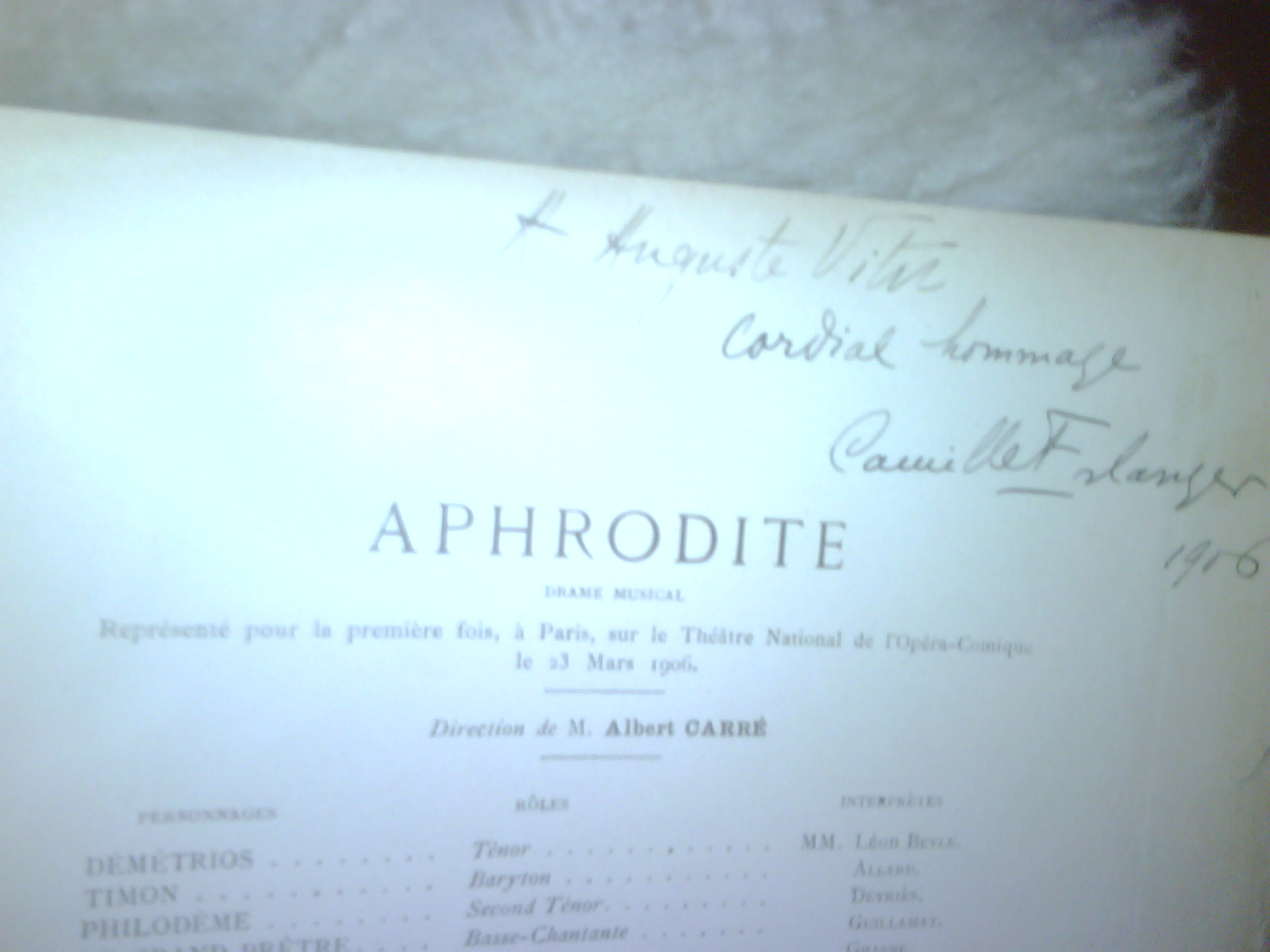
I am speaking of a score for an opera signed by its composer. The opera? Aphrodite, adapted from the novel by Pierre Louÿs. The composer? Camille Erlanger.
photo of autographed score
Nobody had taken this score out of the library since they began barcoding some time ago (perhaps in the 1990s?). I know that because when I took it out, they needed to put the barcode on the book. I wondered how long it had been since the previous withdrawal.
To my knowledge nobody has staged this opera in a very long time. But it did very well at one time. According to Stéphane Wolff’s Un Demi-Siècle d’Opéra Comique, chronicling the works staged in the first half of the 20th century at one of Paris’ opera houses, the opera was staged 182 times, which is more than Gluck’s Alceste (37), Ravel’s L’Enfant et les Sortilèges (30), Faure’s Pénélope (63), and the single performance of Debussy’s La Demoiselle Élue,(it’s not actually an opera, although it served as a vehicle for Mary Garden): but still short of the 343 performances afforded to Pelléas et Mélisande.
I played through much of the score and was not impressed (see for yourself). Perhaps it would make more sense to me –and appeal to my ear– if I were reading through it in 1911 rather than 2011. I confess that the idiom of this work leaves me cold. It may sound cynical to say that the subject matter and its star had more to say about its success than the quality of its score. Like Pelléas et Mélisande, it starred Mary Garden, a soprano with exraordinary stage presence. I get the impression from reading between the lines of Garden’s memoir Mary Garden’s story (a self-serving document) that Debussy was smitten with her, for example. Without her special magic to bring the opera to life, the score seems particularly lifeless.
Can anyone hum this man’s music nowadays? His name: Camille Erlanger
I chanced upon Aphrodite, looking at scores by Erkel, the Hungarian opera composer of Bánk Bán and Hunyadi László. “M1503” is the call number for piano vocal scores. The scores are then organized alphabetically by the last name of the composer. “Erkel” was filed just before “Erlanger.” When my eye fell on the title –Aphrodite –I almost fell over. I had to have a look to confirm that this was what I hoped it might be: the Louÿs story. And so I took it out.
I suppose I should explain the reasons for my excitement.
I’ve been researching Pelléas et Mélisande, Debussy’s opera that premiered in 1902. Erlanger’s Aphrodite dates from 1906 in the same opera house.
Both operas starred Mary Garden.
Pierre Louÿs, who wrote the novel from which the opera was adapted, was at one time Debussy’s best friend.
Long before I ever began researching Debussy a friend handed me a novel saying that it would make a great opera. The novel was Aphrodite by Pierre Louÿs. Now in fact while it’s an unforgettable novel, I was somewhat daunted, unable to imagine how to bring this flamboyant tale to the stage, particularly as far as imagining Chrysis or Demetrios (the protagonists) singing. It certainly helps when you have a seductive leading lady such as Mary Garden, as they had for the 1906 Paris production. I did finally find a way to stage it –without any singing—in the 1990s, very different from what Erlanger did, especially in the number of performances my version got (cue the laugh-track).
But you see why I had to look at the score, seeing how the novel had been adapted.
The one interesting thing about the score was Erlanger’s signature on the frontispiece. It’s downhill from there. Perhaps if i heard a performance i might feel differently. But i wonder if anyone will hear this opera again.
Even so, it felt remarkable to hold the score for an opera performed so many times, signed by the composer. I finally relinquished my little piece of history, returning it to the library where it will likely again sit untouched and forgotten on the shelves for years. Sic transit gloria mundi.
Géricault 's painting The Raft of the Medusa has a documentary realism, showing hope and despair, man at the mercy of nature.
This is a continuation of my previous post, inspired by Hurricane Irene and Beethoven’s Pastoral Symphony. I’d lamented the loss of innocence that’s implied by the notion of global warming: that we can’t very well think of Nature as our “Mother” when we’re systematically killing her in so many ways. Or to put it another way, we can’t be surprised when the planet gives back some of our bad karma.
I have this gut feeling that the sustainability movement begins with a romantic thrill upon viewing the sea, paddling a canoe, smelling the air. Perhaps i am thinking of the first movement of the Pastoral Symphony which is titled “Awakening of cheerful feelings upon arrival in the country”. I find that’s the most vivid part of that Symphony for me, a sense of feeling more alive (cheerful feelings?) in one’s connection to what’s around you. Before we had David Suzuki and Walt Disney creating documentaries(if you’re old enough you’ll remember), we had books, and we had compositions like the ones I have been writing about (last time and today). I think it had to be different fundamentally, because of course, those folks weren’t sequestered in offices with laptops or riding public transit glued to their electronic devices. Nature was real to people who were not (yet) surrounded by concrete and steel structures.
And so, I was trying to think of some romantic music that speaks to our relationship with nature, and probing for the sentiments behind eco-friendly ideologues. Does that sound crazy? I don’t mean what’s David Suzuki’s favourite song, or what’s in Jane Goodall’s ipod. I am thinking of a kind of meta-text, a background consensus about the world in the time before Darwin changed our world-view. I had a vague feeling there had to be something, given that nature has inspired so much music over the centuries, and that nature is in one of the abiding concerns of European Romanticism.
Johann Wolfgang von Goethe, who wrote the poems Meeres Stille and Gluckliche Fahrt
And then a title popped into my head. In English it’s “Calm Sea and Prosperous Voyage”, the title of a pair of poems by Goethe (originally Meeres Stille, and Glückliche Fahrt) that inspired at least three adaptations:
two discreet songs by Schubert
a single choral work by Beethoven
a youthful overture by Mendelssohn
Let’s start with Goethe’s poems . They bespeak a world far less cocky than our own, far from sure of their command of nature. Ha… WHAT command? Those words suggest a healthy aand fearful respect for nature, based upon a reliance upon the wind & water, and not so different from the despair one sees in the faces of Gericault’s painting (shown above). Travel by sailing ship is not an imposition upon nature, and surely unlikely to leave any sort of carbon footprint.
Today we fly between cities even when hurricanes threaten and rain drenches runways. When a volcano spews ash, disrupting air travel, people have no wonder or awe, just annoyance.
But Goethe’s ecology is unpredictable and worthy of respect. In the first poem, while the stillness of the waters is portrayed with a pastoral beauty, there’s also an implicit threat. A ship becalmed without wind is in danger, needing wind to find its way to shore, escaping the virtual desert of a calm sea. The second poem is like a catharsis, a release after the containment felt in the first poem, boisterous and exuberant. Together the pair of poems celebrate and revere the powers of wind & water.
Let’s look at the three adaptations I mentioned above. I don’t know the chronology of their composition in history, but that’s not important, except to observe that the overture was written a dozen years after the Beethoven setting. So perhaps, knowing that, let’s begin with Schubert’s songs. It makes perfect sense to create two discreet compositions as Schubert did, honouring this pair of antithetical poems, as opposite in tone as in matter.
First, here’s a stunning performance of Meeres Stille from bass-baritone Bryn Terfel. This tranquil setting is as calm as the water it would portray for us.
Now let’s listen to Glückliche Fahrt, sung by Elisabeth Scholl. Notice that this song is not even a minute long, with a powerful rhythmic pulse in the accompaniment [note to self: i must get this and play it!] contrasting the tranquil song about the calm sea.
Now let’s turn to Beethoven, who once again gives us a choral piece in D: like the Ode to Joy. It’s opus 112, which falls right after the last magnificent trio of piano sonatas, but still a few years before the final towering choral achievements in the 1820s (Missa Solemnis and the Ninth Symphony).
Notice that Beethoven’s approach is hyper-sensitive to the text, making the chorus react to the words with genuine emotion, singing this phrase:
Todesstille fürchterlich! / Deathly, terrible stillness!
In der ungeheuern Weite / In the immense distances
And when they describe the physical phenomenon (Reget keine Welle sich./ not a single wave stirs. ), the lack of any pulse in the music is quietly scary. Hitchcock would be impressed.
The ocean finally stirs five minutes into the 7:40 composition. The celebratory second poem seems to have been what drew Beethoven to Goethe in the first place. As with Schiller in the 1820s, Beethoven might well be saying, “oh friends, not in those sombre tones, but these exuberant ones.”
Why isn’t this piece better known? Oh my God it’s so beautiful.
I might say the same for Mendelssohn’s adaptation. The overture was written when the composer was still a teenager. While I like the Hebrides Overture surely there’s room for this other youthful masterpiece.
Once again Mendelssohn ventures into genuinely romantic territory. Just as he wrapped Oberon & Titania in musical fairy-dust for his A Midsummernight’s Dream overture, here we get a vivid seascape to conjure powerful images. There is a kind of introduction as the sea is quiet, deep, massively brooding, and unmistakeably powerful. Our calm sea episode is relatively brief, compared to the adaptations of Beethoven & Schubert where we’re made to suffer the suspense of the becalmed awaiting the rescuing breezes.
Mendelssohn then takes classical sonata structure and puts it to ideal use. Normally one gets an exposition leading one away from the tonic, into a development, and then a recapitulation solidly in the tonic key. Mendelssohn brilliantly affirms a kind of musical geography, as we feel ourselves sailing away (from the tonic) in the exposition, wandering –as one usually does—in the development, before heading for home and the tonic key at the end.
Here’s Gabriel Chmura conducting “Meeresstille und glückliche Fahrt” composed when Mendelssohn was only nineteen years old.
In case it’s not crystal clear I desperately love these last two compositions (Beethoven’s choral setting and Mendelssohn’s overture), and psst any of you conductors reading this should consider programming them. The public hasn’t yet become tired of them because they’re programmed so rarely.
Perhaps you too sense the connection to sustainability. I wonder, is the reason these pieces are comparatively obscure because we are so far removed from that place, standing in terror and awe of nature? A calm sea has no terror for us, because we don’t need the wind to move. And there’s lots more music, often with a far more domesticated version of Nature that knows its place, like a housebroken pet. Think for instance of the nature music in Wagner’s Ring operas, where the orchestra paints marvellous images of colour that are among my most favourite moments; but neither the story nor the dramaturgy ever imply that the backdrop is anything but a safe place for story-telling. For me, the compositions based on Goethe’s poems are like a time capsule, a glimpse of an entirely different world and assumptions no longer held. They’d be precious if they were only nice tunes, but they’re so much more than that.
Every now and then I notice that a beloved piece of music has fallen out of my personal top ten. It may be because I’ve listened too often, or because some other piece has grabbed my affections. But something very different is at work with Beethoven’s 6th Symphony, and it’s especially clear to me tonight, as I ponder the much-advertised arrival of Hurricane Irene in New York.
Ludwig van Beethoven
Known as the “Pastoral Symphony“ Beethoven constructed this work as if to tell a story over the course of its five movements, one of the first examples of what’s now known as “program music”. Here’s Beethoven’s synopsis.
Awakening of cheerful feelings upon arrival in the country
Scene at the brook
Happy gathering of country folk
Thunderstorm
Shepherds’ song; cheerful and thankful feelings after the storm (from Wikipedia)
Movements three, four and five form a continuous unit. A happy gathering is disrupted by a storm which clears up, followed by a kind of song of thanksgiving.
Here’s an example of a performance of these three movements in two segments from youtube, beginning with three and four
….and concluding with number five.
I find myself unable to enter into this piece as fully as I once did. It’s as if I were a former believer in the flat Earth, confronting a celebration of some flat Earth ritual after having seen pictures of the round Earth from outer space.
Beethoven’s symphony used to move me greatly as a celebration of our world renewing itself through the cathartic conflict and tumult of the storm. I used to rejoice in the calm tranquility of the last movement as if it were a religious piece, a paean to Mother Nature: which it is come to think of it.
But there’s a big problem now, as Irene reminds me today. Where I once felt part of a natural cycle that renews itself, I now fear that humankind and Nature are no longer in harmony. Speaking of beliefs, I am a believer in the hypothesis of anthropogenic climate change. I believe that phenomena such as the melting polar icecaps, the rising levels of oceans, the bizarre weather seen all over the world, and especially, the increasing power and virulence of storms such as Irene, have their origins not in the bad moods of some cranky deity, but rather in such factors as the collective human carbon footprint.
If we are doing this to ourselves, where does that leave the old idea of Nature’s power to renew itself? I am no longer sure that humankind and the surrounding natural world can be reconciled, when so many human activities—from burning forests to slaughtering apes to dragging nets along the bottom of the ocean—seem hostile to our Mother.
At this hour, late on the Saturday before Irene comes to NYC, I am reminded of Lewis Thomas’s Late Night Thoughts On Listening To Mahlers Ninth Symphony contemplating the end of our species. Perhaps I was naïve to believe that Nature takes care of us like a Mother. But now? Humankind never had a real cradle, but in the process of becoming responsible for our own emissions, we can no longer presuppose a benign caregiver or a warm fuzzy world.
It’s dark and scary out there, and I no longer feel quite so safe, particularly as I wonder how wild the storms might get in the years to come.
I am so lucky that I made it to Lincoln Center in New York City this week for the big summer music festival, when Mostly Mozart Festival is admittedly mostly over.
This is a festival probing interesting connections and juxtapositions of repertoire. For example, this weekend, the Schubert Unfinished Symphony will be coupled with Mozart’s ultimate unfinished piece, his Requiem. On this occasion mid-week, I was fortunate to witness the first New York appearances of a pair of Frenchmen, namely conductor Jeremie Rhorer and pianist Bertrand Chamayou.
I sat almost as far back as it’s possible to sit in the Avery Fisher Hall, a charming little hall whose acoustics still allowed me to hear lots of detail. But I couldn’t see the instruments. Why would that matter? Okay I admit I am a bit compulsive about these things. I couldn’t see whether the horns had valves or not.
Young French pianist Bertrand Chamayou
The strings sounded like modern strings. Is the Mostly Mozart orchestra– who proclaim themselves to be the only NY orchestra specializing in the classical period–an ensemble playing on period instruments? Wonderful as the concert was –and accurate–I believe I was hearing modern instruments. I found the text on their websites ambiguous, with sentences such as the following:
“Mostly Mozart includes concerts by the Mostly Mozart Festival Orchestra, period-instrument ensembles, chamber orchestras and ensembles, and acclaimed soloists, as well as staged music presentations, opera, dance, film and visual art.”
That suggests that Mostly Mozart Festival Orchestra might be a period instrument ensemble. But although the Mostly Mozart crew play accurately, they’re too good, reflecting the usual advantage of modern instruments over the instruments of Mozart’s time. The strings lack the luscious sound of the strings in Tafelmusik Baroque orchestra or Aradia Ensemble, two Toronto ensembles who have spoiled me with their sound. In fact I have at least a couple of friends who reject anything played on authentic instruments because of their occasional tendency to fluff notes. Modern instruments are more reliably fluff-proof; but in that trade-off you have something as anachronistic as the big gleaming Steinway used to play the Mozart concerto.
Oh my, I am such a hypocrite. After all, we cherry pick which aspect of the performance will be historically informed –such as the instruments–while ignoring so many other facets, such as the lighting, theatre architecture, dramaturgy, or singing. In the end chauvinism is indefensible, given these inconsistencies. So when we set aside the nit-picking about instrumentation (and when we come to terms with our own quirky preferences), let’s consider the performances.
Opening the concert we heard one of the most unlikely pieces, namely Haydn’s Symphony #22. Here’s a composition to confound your expectations, particularly in its moody opening movement. This stirring movement reminds me of two of the more dramatic compositions of the Romantic period, namely the pilgrims march from Berlioz’s Harold en Italie , as well as the powerful chorale 4th movement of Schumann’s 3rd Symphony. In each case the religious subtexts charge the music with a sense of spiritual drama. I can’t help but wonder whether Berlioz & Schumann had been influenced by Haydn, writing more than half a century earlier.
Revelatory as the Haydn had been, for me the most exciting part of the program came next, in the concerto played by Chamayou. Who is he?
On Youtube Chamayou plays Mendelssohn (a familiar name but hardly well worn repertoire when we go to the songs without words), and genuine terra incognita in music of Thomas Adès and John Cage. How wonderful is that? Let me explain. Pianists are often known for cutting their teeth on warhorses, pieces whose chief value resides in their function as yardsticks of virtuosity. Play a Rachmaninoff Third Concerto or a Liszt B-minor sonata, well trodden as those pathways are, and one is thereby able to claim credentials as a virtuoso. Playing these other guys–Cage, Adès or Mendelssohn’s Lieder ohne Wort–on the other hand is a far riskier proposition for an artist. Unless you make a stunning impression, such repertoire is a huge risk. Aha, so this young fellow Chamayou was clearly not afraid of getting lost in the crowd. Or perhaps he recognized that the only way NOT to get lost in the crowd of virtuosi was to do something extraordinary and brave.
Now of course I would be a liar if I were to say I knew any of that when this young chap stepped out onto the stage to play Mozart’s Concerto # 12 in A major. Conductor Jeremie Rhorer looked young enough, but where Rhorer was stylish, Chamayou came out with a distinctively edgy appearance. During the opening orchestral exposition, Chamayou twitched like an adrenaline addict, desperate to find release. And when it was his turn to play, he poured the energy into astonishing note-perfect playing, as fluid as if he were pouring liquid Mozart out of his fingers.
“Aha, a virtuoso“, one might be tempted to say: and I think we’d be right in that assessment. I read something note-worthy (excuse the pun) on that score (uh oh, another pun). In a recent article Anthony Tommasini of the NY Times suggested that virtuosi are a dime a dozen. How unfortunate that what was once so rare as to seem magical awhile ago, has become commonplace, and therefore no longer valued. In each generation there are benchmarks of the unplayable, gradually rehabilitated into concert repertoire by the talent of a piano player such as Chamayou.
Mozart might seem like the most unlikely repertoire for such an adventurer. But Chamayou brought something very original to the concerto, especially in the cadenzas. In each case he might have been playing Mozartean jazz, given the coquetry with which he teased his way around the beat during these impromptu solos. In every case (there’s a candenza in each movement) he sounded fresh and a bit unpredictable, which is quite an achievement in Mozart.
To close the concert Rhorer gave us a brisk clean reading of Mozart’s Symphony #29. While this was no paradigm shifter, we were still hearing clean idiomatic playing. This orchestra obviously know their Mozart.
Simone Osborne will be taking the lead role of Gilda in the Canadian Opera Company’s new production of Giuseppe Verdi’sRigoletto in September 2011. I ask her ten questions: five about her and five about her upcoming role.
Soprano Simone Osborne
1) Which of your parents do you resemble (what’s your nationality / ethnic background)?
I think I look like my father but with my mother’s colouring. My mother is Persian and my father has an Icelandic background. I have dark hair and eyes like my mother but a big Viking head (helpful for singing!) which comes from my dads.
2) what is the BEST thing / worst thing about being an opera singer?
There are a lot of incredible things about being a professional musician. Travelling to exotic places, attending lavish parties, meeting interesting people, the list goes on. But the best thing by far is that I get to do what I love everyday. The music I sing means so much to me and I thank my lucky stars that I get to immerse myself in it day and night.
It is hard to speak negatively about a career that I feel so fortunate to have, but there are some challenges. I don’t mind all of the traveling yet (check back with me in 30 years) but sometimes I miss family and friends when I am on the road. I have also missed an awful lot of weddings, Christmases, Thanksgivings, birthdays, and special events because I’ve been off somewhere singing and unable to celebrate with the people I love.
3) who do you like to listen to? (a favourite singer or performer…can be anyone or anything)
Mentor and Mezzo-soprano, Marilyn Horne
I’ll keep this mostly classical as it is left up to my 21 year old brother to update my ipod with non classical music whenever we see eachother (usually about twice annually). Left to my own devices, I just download more opera and classical song…I love Freni, Caballe, Scotto and Callas, to name a few, but I have to say that my favourite singer is Marilyn Horne. Her recordings exhibit some of the most incredible singing I’ve ever heard. From Handel and Rossini arias filled with rapid fire pyrotechnics to Copland songs delivered from the heart with so much immediacy and attention to the words that they’ll make you cry. I may be biased since she has been such an incredible mentor to me, but Marilyn is also one of the most down to earth, honest and genuine people you will ever have the pleasure to meet. I can only dream of being equally accomplished and level headed myself one day.
4) what ability or skill do you wish you had, that you don’t have?
The ability to refuse a bar of chocolate. I’d also love to be able to dance without making myself laugh.
5) when you’re just relaxing (and not working) what is your favourite thing to do?
This may seem too simple but here goes: Sitting in the sun, surrounded by a group of good friends, catching up on lost time. If a beach is involved all the better. If chilled sauvignon blanc is present, hallelujah!
Five more concerning Gilda, in Rigoletto
1) how does the role challenge you?
I think the more appropriate question in this case would be: “How does the role NOT challenge you?” The music for Gilda is extremely challenging in itself but trying to create a believable, multi dimentional, significant character is an equally difficult task. I refuse to believe that Gilda is simply a love stricken ingénue. Luckily for me (and the COC audiences), the incredible stage director, Christopher Alden, will be leading the way for us and I am very much looking forward to creating my first Gilda with him. In terms of the vocal writing, the role sits relatively high and in certain sections the orchestration is very thick. As a young singer, there is a tendency to want to prove yourself and put your best foot forward. This role will be an exercise is singing smart and not allowing the energy and excitement from the pit overwhelm my good judgement! Again, lucky for me, the COC’s own, fabulous Johannes Debus will be at the helm. One couldn’t ask for a more inspired and supportive maestro. I’m sure he’ll have a dozen solutions for every challenge that comes my way.
2) what do you love about the part?
What’s not to love? I get four costumes! Just joking (for the most part!). I love the fact that this character goes on a journey. The girl you meet in Act One is not the girl you encounter at the end of the evening. That is one of the things that is so wonderful about taking on this part as a young person. I completely identify with having one event change the course of one’s life. I understand how a person can discover so much in such a short time and change substantially as a result. And, of course, the music is SUBLIME. I hardly feel worthy of some of the incredible melodies bestowed upon me. Everything about this piece of music works. The sum is even better than it’s unbelievably great parts. The same goes for the piece as a dramatic work. There is really nothing NOT to love…
3) is there a favourite passage: something you’re looking forward to staging/singing?
The section of duets with Rigoletto and then the Duke is one of the achingly beautiful parts I was talking about. It is 50 pages of gorgeous music, each page more stunning than the last. I am very much looking forward to singing the aria “Caro nome”. I can hardly believe I get to stand up on that beautiful Four Seasons Centre stage and sing a piece of music that seemed so out of reach in the practice room during my student days. In terms of staging, I am excited to stage the storm trio and the (spoiler alert!) death scene. The trio is just so darn exciting dramatically and who doesn’t love a good death scene? If the audience isn’t crying by the end of that, we’ve failed in some way.
4) how do you relate to the character as a modern woman?
I think Gilda is exceedingly strong. I would like to think of myself as a strong person. She disobeys her father and follows her heart. If I had listened to my father, I would be a lawyer today, not an opera singer (not that he doesn’t love that this singing thing has worked out!). She certainly has a mind of her own, knows what she wants and seeks it out. She knows right from wrong and may not always do the right thing, but always does what she thinks is right. Gilda also has common flaws that make her very relatable. She’s jealous and trusts too easily when she falls in love. But can you blame the girl? She’s hardly had a reservoir of past experiences to draw on! I have found a lot of things to relate to with this character, although I’m not sure you will find me throwing myself into harms way for a cheating boyfriend anytime soon…
5) is there a recorded Gilda you particularly admire?
There’s a special place in my heart for the Scotto, Bastianini, Kraus recording for a few reasons. First of all, it was given to me by the beautiful Italian soprano Serena Farnocchia, (you probably remember her incredible performances of “Maria Stuarda” at the COC in 09/10) when I spent time with her and her family in Tuscany last summer. I must have listened to that recording 100 times as I travelled all over Italy by train learning Italian and taking in the culture, all in preparation for this Rigoletto. I just love the way Renata Scotto sings the role of Gilda here and enjoyed reading about her preparation for it in her autobiography. She was almost exactly my age when she recorded this particular version and set the bar pretty darn high! I also enjoy recordings of Anna Moffo with Solti conducting, Maria Callas with Serafin, and the live recording of Bidu Sayao (thanks to the ever insightful Alexander Neef for that one). The few clips of Anna Netrebko I have seen are pretty thrilling ….
and I had the recording of Act Three with Milanov and Toscanini on repeat in my apartment for a week straight. However, it is now time to put all of the recordings away and make this Gilda my own. That may involve locking the CD cabinet….
Simone Osborne appears in Rigoletto September 30th, October 13, 17 and 20, at the Four Seasons Centre in Toronto.
In the middle of a driving rainstorm, my doorbell rang this morning. The mailman, bless his heart, was dropping off a bundle just as the heavens opened to drench the guy, and my mail.
Among the wet items was –oh no—my new COC tickets, apparently soaked. But no, it appears the minds behind choosing and casting operas have also figured out how to keep our precious tickets safe from buckets of rain. Hallelujah! Inside the wet envelope, the contents were surprisingly dry.
And so I discovered that this year the Thursday nighters – possibly the loudest gang of operaphiles if I do say so myself—are being rewarded with the season’s opening night on September 22nd. I also attend other nights, noticing how sleepy those other audiences sound compared to the boisterousness Thursday throng.
Thanks Alex, Johannes, Sandra, Gunta…! (…and the rest of you.) We will surely be just as vocal on September 22nd. And how could we fail to applaud, when the COC begins our season with their version of the Fantastic Four…? No, they’re not superheroes, per se. Even so, I’m very confident we will Marvel (excuse the pun) at their work… Who are these four? Count down with me.
#4 is Conductor Pablo Heras-Casado, who led the COC orchestra in their sterling readings of Adams’ Nixon in China last winter. I wish I had watched his mini-analysis last year before seeing the opera, as his observations would have helped me… Oh well, better late than never.
Director Robert Carsen
#3 is perhaps the one to whom Toronto opera-goers are most attuned, namely Canadian Robert Carsen. Toronto is a funny opera town, because this is a crazy theatre city, highly competitive in a way that might make sense on Broadway, but with one tenth the population seeing a ton of shows. Opera does probably capture music fans, but it seems to me that we go to opera more for the theatre than the music. Why? First because we suffered a theatre with abominable acoustics —the O’Keefe Centre— for decades, and now have our reward in the Four Seasons Centre, an intimate space that elevates any performance. Carsen’s production of Orfeo ed Euridice took the city by storm last year. For my money, the Ariadne was more extraordinary because of the voices & the musicianship, but it was Carsen’s minimalist show that won the awards. This is a city that’s regularly fascinated by challenging interpretations, a home-away-from-home for Robert Lepage, an opera company regularly pushing the dramatic envelope. And so in this bookish town, Carsen is a major drawing card.
#2 is a newcomer, ostensibly the star of the opera playing the title role, namely Susan Graham as “Iphigenia.” No that’s not a misspelling. Remember what I said about Toronto as a theatre town, even for opera? As a result Toronto promotes this opera as Iphigenia in Tauris, not Iphigenie en Tauride. Graham is synonymous with French opera the past few years. She was Lepage’s Marguérite in his Damnation de Faust, her features literally catching fire in the CGI as she sang D’amour l’ardente flame. And then there’s “nuit d’ivresse” from Les Troyens
Yes I know Berlioz is a century removed from Gluck…(i’ve been listening to Berlioz a lot lately, and am in love with this DVD). Perhaps a better and more relevant example is this one promoting the opera we’re seeing in September. Notice that the Met used Graham’s voice to go with visuals of Domingo as their drawing cards.
#1 for me is the man playing what I believe to be the most interesting character in this opera. The character is Oreste (or Orestes, as he’s usually known), and the singer is Russell Braun, the same Russell Braun who starred in the Met’s Nixon in China last season, after being the rock-solid anchor in such COC productions as Billy Budd about a decade ago, Andrei in War & Peace, Count Almaviva in Marriage of Figaro, and a probing interpretation of Pelléas. You get some idea of the combination of voice & acting in this little clip from Roméo et Juliette (subtitles in German, but if you know your Shakespeare it’s not a problem, right?).
September means TIFF, it means cooler weather, and right after TIFF, it means Iphigenie en Tauride at the COC. August can’t end soon enough.




 barczablog