Conservatives won election after election, with a tory trifecta lurking in the autumn when McGuinty faces Hudak.
TV is no relief, with debt ceilings and popular uprisings (after a promising beginning in Egypt) gone sour in Libya, Syria, Bahrain.
If you’re as shell-shocked as I am, satire is the best medicine. I feel much better after an hour of laughter brought on by this Actor’s Repertory Company production.
Come to think of it, I don’t believe I have seen the word “satire” associated with Mrożek, whereas he is often associated with the theatre of the absurd. And it’s true, the bizarre story I witnessed today could technically come from Ionesco, except for its political flavour.
As I don’t want to give the play away (which would spoil the humour), I can only attempt to give some idea of its flavour by analogy. For example, Mary Trapani Hynes made a deposition to the Executive Committee at Toronto City Hall on July 28, 2011, a deadpan assault on logic reminiscent of Mrożek. When your world stops making sense, it’s time for another kind of sense:
Notice Hynes’ nod to Jonathan Swift, in calling these “modest proposals”.
Andre Sills
Director Aleksandar Lukac sharply delineated the conflicts between the principals. Andre Sills played the alpha to perfection, dominating the stage with his voice and physical presence. Once you get that this strange world will be his, it all devolves into the struggle of the others for their own small place.
John Fitzgerald Jay, Gordon Bolan, and Sam Malkin are all delightfully different from one another in pacing, voice, and physical style. Their ensemble work is very musical, in the sense of supportively balancing one another for the overall effect.
Although the ARC production of Out at Sea is under the auspices of Summerworks—a festival limiting each show to about an hour in length—that length is just long enough for the show to build to its logical climax, enabling it to pack a wallop. Yes, it’s a silly wallop, but a wallop nonetheless.
Out at Sea continues at the Factory Theatre mainspace until August 14th. If I make the mistake of turning on the TV –and getting bummed out by the news—I might just need another dose of Mrożek to set me right.
Amy Winehouse reminds me of Judy Garland. They both had big powerful voices, larger than life really. They were both known for excessive use of make-up and drugs. Given that Garland and her daughter Liza Minelli have a huge following in the gay community, I have to wonder whether Winehouse does as well.
You may well be wondering what any of this has to do with the title. What’s so funny about competence, and where’s the connection to drag? Let’s see.
There are several definitions of “drag,” a word people toss around carelessly. Here’s one for starters, in To Wong Foo Thanks for Everything, Julie Newmar
Noxeema Jackson [Wesley Snipes]: When a straight man puts on a dress and gets his sexual kicks, he is a transvestite. When a man is a woman trapped in a man’s body and has a little operation he is a Transsexual. Miss Chi-Chi Rodriguez[John Leguizamo]: I know that.
Noxeema Jackson: When a gay man has way too much fashion sense for one gender he is a drag queen.
A drag queen does not want to be a woman (transsexual).
A drag queen is not trying to pass as a woman.
A drag queen does not dress in drag for sexual pleasure (transvestite).”
So far so good. And then Fayye tells us that drag is “an expression of the artist’s view, emotions, creativity, etc., all things that art encompasses.“
But gender travesty is not the only drag realm, even if it might be the most familiar one.
I was inspired to think outside the box by Romy Shiller’s book You Never Know: A Memoir (2009) . Here’s a quick snapshot from Rebecca Donnelly’s book review:
“Disability drag” is Shiller’s phrase for the way courageous people with disabilities can make society rethink its ideas about body image, identity, and personal growth. “Cyborg drag” is her term for living with a permanent shunt to drain excess fluid from her brain. She is part human, part machine, she says, and this gives her another rare insight into conventional ideas about what it means to be human.”
There’s much more to it than this little summary can really capture, but that’s at least a start. The popular TV show Glee is an instance of ”disability drag” in its use of an able-bodied actor playing a boy confined to a wheelchair. At one time
long ago white actors played aboriginals in the movies
long ago white actors put bootblack on their faces to simulate African features
attractive actors /actresses would sometimes lip-synch to a beautiful singing voice; one could also flip that around if we say that the singer employed a human-sized puppet (Ubermarionette) as a stand-in for their voice, as we saw with Milli Vanilli
There are other instances of performed travesty.
Women playing children (thanks for the reminder Professor Hanson): as for example, when they can’t find a child to play Yniold in Pelléas et Mélisande
Age issues can play both ways. In student theatre you’ll see young adults portraying old men and women; and especially in opera, you see stars trying to persuade us that they’re still believable as young romantic leads long after that ship has sailed.
the voices in animated cartoons and puppetry take the lip-synch situation to a kind of absurd extreme
And why be restricted by the life-forms on the planet Earth? In the film District 9 a human is infected with genetic material that begins to transform him into one of the alien invaders, a change that is most definitely a mixed blessing. On the one hand (and those who have seen the film will be excused for making a nervous laugh at this accidentally literal choice of words) he is now able to use the alien technology and fire their weaponry; but his status as a hybrid, or half-breed carries some stigma, as we discover.
Shiller (the author I mentioned above) can probably sympathize with the man transformed in District 9; she writes about her own extraordinary experiences, having lost consciousness for months in a medical procedure gone wrong that left her near death, and even now has seen her radically changed. Now, with her reliance upon technology –not so very different from those of us joined to our various devices—she speaks of “cyborg drag”. But we are all becoming hybrids of human and machine to varying degrees.
We have seen cyborg drag enacted before, however. In Terminator 2 and earlier in Robocop, we watched the struggles of various hybrids between human and machine. In other films, the imitation of humanity by machines –robots or some equivalent—create parodies with varying degrees of authenticity. AI gives us robots strongly resembling humans, while figures from the Star Wars sagas such as R2D2 or C3PO are cartoons never coming very close to human. In the last hour of the third episode –when we watch the emergence of Darth Vader from the wreckage of his defeat at the hands of Obiwan –we see another sort of cyborg drag, a pathetic remnant. The science fiction world also gave us the painful hybrids we get in such films as Blade Runner, where the agonizing death scene for Pris (played by Daryl Hannah) sits on the boundary between cyborg and disability, heart-breaking in any event.
And so I’ve touched on so many different kinds of drag, is there anything one can say that they have in common?
In each case there is a kind of imitation going on, at times verging on parody
One can identify a series of individual signifiers that add up to a convincing portrayal of, respectively, humanity, feminity, disability, etc
Competence is the key: as we observe how well the person enacting the portrayal speaks, walks in high heels, wears makeup, hair , shoots their weapon, or some other skill.
In each case, we’re speaking of a kind of cultural competence: that is, a set of criteria that are context specific
if there is “comedy” it’s perhaps in the sense of Dante’s Divine Comedy: the human condition, with its ups and downs. For every situation that might evince laughter, there may be two others to bring us to tears.
Drunks perform something like a drag show. Foster Brooks made a career out of playing a drunk. The film Arthur concerns a good-natured drunk whose charm largely can be seen in his incompetence, the various ways in which he falls short.
Does this bring us back to Judy Garland and Amy Winehouse? I always used to wonder why gay men love Judy, speaking as a straight guy who never really understood why she’s such a big deal. Is it that Judy, like Liza, like Maria Callas, was in some respects almost like a drag queen, because the performance of their larger-than-life persona wasn’t really feminine, but more of a parody of femininity? Or because she’s known to have suffered, but that she gamely went on with the show no matter how badly she was feeling? On top of the strange imitation of femininity that resembled a dragqueen, Judy also was at times so druggy as to resemble that other sort of drag, as in Arthur.
Addictions get a great deal of attention, fingers wagging but rarely with any compassion. When the person is in trouble the media are heartless. When the celebrity has passed away, suddenly everyone seems to discover that they always loved the person that they used to ridicule or abuse.
Gabor Maté is a Hungarian Canadian doctor who has made the study of stress and pain his specialty.
“Opiates: we use them as painkillers. They not only kill physical pain, they also kill emotional pain. It turns out that if you look at the brain-scans of human beings when they’re feeling emotional pain, the same part of the brain lights up as when they’re feeling physical pain. So whether I call you a really terrible name that hurts you or whether I cut you with a knife, the same part of the brain registers it. … So the first question when dealing with addiction is always not “Why the addiction?” but “Why the pain?” “
Addiction is problematic because of our bizarre social responses, the two-faced apparatus that sometimes shows compassion, sometimes blame. When faced with the lack of compassion, it’s understandable that the sufferer would choose to conceal their pain. This is one of the points of contact between the drag of the substance user and those with some sort of disability, which make sense considering that Maté would have us understand drug addiction as disability.
Amy Winehouse
Disability drag is a slippery phenomenon. Not only is it the attempt by the able-bodied actor to give an authentic portrayal of someone less able than themselves. It also encompasses the disabled person attempting to simulate various sorts of competence, trying to avoid the secondary afflictiong of being called “disabled”. Sometimes a person wants to fit in, to be accepted as competent and able; and sometimes one wants to signify disability, to be understood as disabled even when the performance of the disability is a kind of travesty. Tobin Siebers explains the convolutions very economically in the abstract of his paper “Disability as Masquerade“:
I have been keeping secrets and telling lies. In December 1999, I had an altercation at the San Francisco airport with a gatekeeper for Northwest Airlines, who demanded that I use a wheelchair if I wanted to claim the early-boarding option. He did not want to accept that I was disabled unless my status was validated by a highly visible prop like a wheelchair. In the years since I have begun to feel the effects of postpolio, my practice has been to board airplanes immediately after the first-class passengers so that I do not have to navigate crowded aisles on wobbly legs. I answered the gatekeeper that I would be in a wheelchair soon enough, but that it was my decision, not his, when I began to use one. He eventually let me board and then chased after me on an afterthought to apologize. The incident was trivial in many ways, but I have now adopted the habit of exaggerating my limp whenever I board planes. My exaggeration is not always sufficient to render my disability visible—gatekeepers still question me on occasion—but I continue to use the strategy, despite the fact that it fills me with a sense of anxiety and bad faith…”
I don’t pretend to understand what motivated Amy Winehouse, nor what she felt or thought. I am certain she was a great performer. The performances were not only musical, but the performances of someone trying to live up to our image of her as an able and competent person.
Last night I watched the opening of Soup Can Theatre’s new production of Peter Weiss’ Marat/Sade, or to use its full title The Persecution and Assassination of Jean-Paul Marat as Performed by the Inmates of the Asylum of Charenton Under the Direction of the Marquis de Sade.
It’s been almost a half a century since Peter Weiss created Marat/Sade. I’ve been watching deconstruction on the stage for such a long time – in texts, in mise-en-scène, in everything one can deconstruct—that I feel some sadness seeing the play now. Its Brechtian edginess has no real targets, at least not like the early 1960s, when its messages hit ready ears. The play reads differently now, preaching to a largely converted audience who would agree with its premises about war, revolution, religion or sexual repression. Even so the idea is compelling, as we watch asylum inmates perform famous persons, while we may wonder whether the supposedly sane ones running the place are really any different.
Soup Can Theatre used the Peaslee score that is vaguely familiar (including at least one famous song), employing a small onstage band dressed as asylum inmates. This is not Sondheim, even if the edgy politics and in-your-face delivery may at times remind one of Assassins. The wonderful thing about this score, especially as the Soup Can cast observed, is the way it allows for songs that break into the action, without inflicting voices on you that are obviously the trained voices of a stage musical. No I don’t mean that they’re bad; quite the opposite. The singing is very under-stated, and so unobtrusive even in the loud numbers that one’s connection with the onstage reality – of a presentation from asylum inmates—is not lost. It’s very sad when a musical makes the mistake of making the music sound so good as to disconnect you from the story. Soup Can tread the line wonderfully well of never letting the music subvert the mad asylum world.
The program explained that we were witnessing an adaptation of the play in a quasi-modern setting, namely the Montreal of the 1950s, when electro-shock therapy was employed. I am not one to object to modernization, and indeed, felt that this production worked well in its new guise. But it should be noted that while we see an asylum from the 1950s, we are still listening to a text pre-supposing the original setting of 1808 (eg in the big song near the end “Fifteen Glorious Years”); but perhaps that’s a leap that director Sarah Thorpe did not want to make.
Liam Morris, foreground, Allan Michael Brunet and Heather Marie Annis, in the Soup Can Theatre production of, ‘Marat/Sade’. Photo/SCARLET O’NEILL
I thoroughly enjoyed myself, even if I was watching a cast that were in my opinion a little on the young side for this work. Maybe my age is showing? I felt that the play’s ongoing debate between De Sade and Marat was somewhat one-sided. While Liam Morris has a charming delivery(and yes he’s a dead ringer for the Marat we see in David’s famous painting), was overmatched alongside the powerful Allan Michael Brunet in his portrayal of the Marquis, admittedly a role where one wants to see some star power. Brunet’s performance was especially ironic, in his ability to position himself –the most subversive character on view–as the moral centre of the work, due to the gravitas he displayed, particularly in the last part of the play.
I found Heather Marie Annis was a successful Charlotte, both in her wonderful singing and in a very believable madness, the most under-stated performance on the stage. The other rock-solid performance came from Scott Moore as Coulmier, the headman in white coat. Moore’s demeanour as the officious shrink offering this performance for us, the ostensible visitors to the asylum, was creepy in a Ned Flanders kind of way, a bureaucrat whose niceness points to the banality at the end of the world.
Soup Can Theatre’s Marat/Sade continues at the Alumnae Theatre Mainspace evenings until July 23rd, with a matinee on the 24th.
Verisimilitude may be a tad over-rated. Tonight I witnessed a concert performance of Verdi’s Il Trovatore by Toronto’s Opera By Request. It’s habitual to apologize for what’s missing in these virtual renditions, that have music stands instead of sets, and evening attire instead of period costume.
But some operas founder upon encountering realism, like ships aground on a beach. When modern stagecraft shines a spotlight upon a story, we may not like what we see; Trovatore is one of the most blatant examples of this.
At one time Trovatore was Verdi’s most successful opera, if not the most popular opera of all. That the opera has fallen from that exalted status is likely as much an indication of growing sophistication as of changes in audience preferences. It’s an opera assembled out of a series of picturesque moments, packed with melodies and stirring feeling.
Carrie Gray, a genuine Verdi soprano
I found it very welcome to be sitting in close contact with William Shookhoff’s pianism & the powerful singing of the soloists assembled for the occasion, filling the College St United Church space with passionate music.
Carrie Gray as Leonora sang what was for me the most impressive performance of any soloist performing this season for Opera by Request. Hers is a genuine Verdi soprano, a generous instrument easily filling the space with sound, holding nothing back in the ensembles, powering up to the many high notes in this role, and always rock solid in her intonation.
Karen Bojti met the many challenges of Azucena. She has a gorgeous colour, with smokey low notes, while brazenly taking the stage in the moments of high drama required by the role.
Steven Sherwood gave us a sensitive Manrico, Italianate and lyrical throughout. Yevgeny Yablonovsky’s Count Di Luna was consistent with the usual casting that prevails today, namely for a big dark voice.
Finally, I was again grateful for Shookhoff’s efforts at the piano, impersonating an orchestra, always helping the singers, while using a big sound that matched the big voices we heard today. Well done!
Opera By Request will be back after a brief summer holiday with Donizetti’s L’Elisir d’Amore September 17th at College St United Church.
Tonight I saw the opening of Guild Festival Theatre, an ambitious company taking the stage in The Greek Theatre in Guildwood Park.
This is the former site of the Guild Inn, in Guildwood Village. There really was a “guild” at one time, a colony of artists working at the edge of the Scarborough Bluffs. Alongside this earnest group, there used to be a hotel and a terrific restaurant. The site boasts wonderful scenery, with an aura of history.
For me it was surreal to watch a play on this stage. I was married there in 1989. We had planned to actually use the theatre stage for our ceremony but we were rained out (instead we used a covered space on the steps of the hotel), so this performance was like a long-postponed consummation. My wife and I used to come back regularly for dinner, then brunch, and finally, just to walk the grounds when they closed the hotel & restaurant. I felt a bit like Pu Yi the Last Emperor, walking in the Forbidden City among the tourists, in a place of great personal significance; and like Pu Yi, I’ve become just like everyone else, this time in my admiration for what the Guild Festival Theatre have accomplished. What’s more, I believe there are lots of people just like me, who were either married there or had their pictures taken on the grounds, who feel that space is part of their personal mythology. It’s truly magical to come back and see the theatre finally come to life!
I wasn’t joking when I put that headline, a misquote from Field of Dreams. A disembodied voice says “if you build it they will come,” speaking of a baseball field in Iowa. This magical field of dreams–a replica of a Greek amphitheatre –was built in the 1960s, utilizing some wonderful neo-classical remnants from old downtown banks in Toronto that had been demolished except for their delicious facades. I remember reading somewhere that Herb Whitaker had been consulted on the design, that the acoustics were remarkable; or maybe that was just what we surmised from playing around on the stage.
Back when the theatre was built, perhaps Toronto wasn’t ready for outdoor theatre, but in the meantime we’ve had over a quarter century of the Dream in High Park. Originally Shakespeare’s A Midsummernight’s Dream, we’ve been getting lots of other plays since. They were a summer incarnation of an existing company. In the downtown there are other companies performing outdoors, such as the Canopy Theatre who have been at it for a decade plus.
And now Scarborough is ready for its own company. And why not? The venue is spectacular. But unlike The Dream, they are not an offshoot from an existing company, but a new undertaking, which makes this an even bigger mountain to climb.
We were not just outside, but situated very close to the lake. While there was still light in the sky, the play was accompanied by a chorus of birdsong, especially welcome in the second act when we have the most lyrical moments of the play, including reference to birds. Behind the stage is a tall stand of trees. We’re not far from the edge of the bluffs, with a steep edge going down to the lake perhaps a hundred feet below. When you dress for this venue, remember the lake, which creates a microclimate a few degrees chillier than what you get downtown; bring a sweater.
And how about Chekhov? I’d say TheCherry Orchard comes off very well. Director Sten Eirik chose to treat the work as a comedy, with a terrific pace, lots of energy, yet a keen ear for the ebb and flow of the dialogue. This is not one of those attempts to mine the profundities people sometimes see in Chekhov: thank God. And yet all the key moments got their due. Dawna Wightman was a sweet mess as Lyubov Andreyevna, grieving over what she was losing while seeming to throw it away before our eyes. Alongside her, John Jarvis was lovably inept as her brother Gaev, verbose and unsure.
Eirik’s casting struck me as cinematic, reminding me less of the histrionic warhorse I have sometimes seen (where “Chekhov” is said in hushed tones of awe), and more of a good comedy of manners. I enjoyed Paul Amato’s take on Lopakhin, a more likeable version of the self-made man who’s at the centre of the story than one sometimes gets in other interpretations, where the political subtexts hijack the gentle comedy. And perhaps the most memorable portrayal came from Bryan Stanish as Firs, the ancient servant who extracted every wonderful laugh in his part and then some.
The Cherry Orchard presented by Guild Festival Theatre continues at The Greek Theater in Guildwood Park until July 30th.
I suspect this is going to be a long review, so for those of you who need the executive summary up front, yes I liked it. Go see Codex Nocturno!! I will make an effort to see it again before it closes next week.
Of course if you’re the sort of person who has a short attention span, someone who needs things spelled out, someone with a low tolerance for ambiguity, haha then it would be a sadistic punishment to send you—that superficial person with no patience that is—to this show: because it’s brilliant and complex and difficult.
Let me add that I suspect the reason Kadozuke Kollectif –the artists responsible for Codex Nocturno—fly under the radar so far is because new work tends to be difficult. PT Barnum, that prototype of the successful impresario, never proposed that artists should challenge their audiences, did he? But some of us thrive on newness. Too bad critics rarely have time for the difficult. How else to explain why I haven’t heard of Kadozuke Kollectif before now?
I had a sip from the fountain of youth tonight, a reminder of Lindsay Kemp in Flowers. Oh my God I know that makes me sound so old. Kemp is an unexpected kind of eclectic, mixing butoh movement, drag, music-hall and theatre into something richer than the sum of its parts. I remember being alternately terrified, aroused, disoriented and amused. I was often on the edge of my seat simply because I did not understand what I was seeing and wanted to resolve some of the ambiguities.
I hope nobody in the show is offended that they’ve reminded me of a drag performer, when they probably don’t think there was any drag in the show. They might also be wondering what drags I have been taking (or what drags I am high on).
Sigh, I hate talking in too much detail about a show that has a colossal power to surprise. If I spill the beans I make the show more intelligible but likely far less powerful. Its ability to stir you begins with the ambiguities, moments that aren’t quite this or that, putting you on the edge of your seat, as you strive to make sense of what’s happening.
Speaking of mysteries, let’s begin with the offbeat title, “Codex Nocturno.” The night that we traverse in Codex Nocturno is a place of dreams & shadows, metaphors and suggestions, rather than explicit declarations and clear statements. A Kadozuke Kollectif book of the night avoids being reductive or explicit, and celebrates the anti-rational, the bizarreness of dreams and the surreal. If you’re a person who might say “ugh that’s weird” and shiver in fear, don’t see Codex Nocturno.
Let’s address drag. No, there are no people doing cross-gendered drag. I am speaking of something more esoteric, and indeed, something that probably surprises the cast. I am thinking of “Disability drag,” an idea that has been with us for awhile, but only recently has a name. Here’s a quick example:
In December 1999, I had an altercation at the San Francisco airport with a gatekeeper for Northwest Airlines, who demanded that I use a wheelchair if I wanted to claim the early-boarding option. He did not want to accept that I was disabled unless my status was validated by a highly visible prop like a wheelchair. In the years since I have begun to feel the effects of postpolio, my practice has been to board airplanes immediately after the first-class passengers so that I do not have to navigate crowded aisles on wobbly legs. I answered the gatekeeper that I would be in a wheelchair soon enough, but that it was my decision, not his, when I began to use one. He eventually let me board and then chased after me on an afterthought to apologize. The incident was trivial in many ways, but I have now adopted the habit of exaggerating my limp whenever I board planes. (SOURCE)
People who have been disabled do not, as is so commonly assumed, simply ask for help. Typically a person tries to blend in as well as possible, faking competence, while limping or otherwise failing at some crucial part of the large task of pretending to be human. Humanity is a performance, comprised of several different bits and pieces. The drag of gender is only one of many sorts of drag. People attempt to be competent in their job, in their courtship, in their walk to the bathroom. Sometimes the imitation of competence—for instance in a dragqueen—becomes a parody that invokes our laughter, because of the visible discrepancy between the performance and the ideal.
Lacey Creighton, unforgettable as a disabled machine
In Codex Nocturno we’re confronted by several physical spectacles of human action, and often we find that the imitation of humanity falls short in some way:
A girl hauls a tiny plastic toy baby out of herself, and then proceeds to nurture and “mother” that little baby; it’s gross, silly and poignant all at once
A beautiful automaton breaks down, becoming progressively less and less human, yet ever more heart-breaking in its blunt pursuit of competence, even vomiting metal parts at one point; is she a she or an it?
Transactions in a hotel resemble hospitality superficially, but without any real understanding of what’s involved; the lack of compassion does, however, resemble some nightmarish transactions I’ve been through (ha I wish I were kidding)
Wetness & blood and other mysterious liquids from inside the body figure prominently; what is it to be human, and are we a “who” or are we more of an “it”? there’s a great deal of objectification in this show
on a number of occasions people are restrained or confined, a condition resembling disability even though artificially created
It’s often much funnier than this sounds, but then again, having written about this, I know how twisted some of those images must sound. The humour is extreme, undoubtedly. So is the poignancy. I cried in a couple of places, and also guffawed like an animal.
The space is used brilliantly. I won’t say how –can’t spoil the surprise, remember—but promise you something uncommon, verging on brilliant.
Tatiana Jennings, Artistic Director of Kadozuke Kollectif
Kadozuke Kollectif have apparently been doing Codex Nocturno for awhile. The 2011 staging is a remount after a previous incarnation. Tatiana Jennings is the artistic director. There’s a great deal of dream-like imagery, as we’re confronted by several videos on the stage, displays that seem to take us inside different personages whomwe also encounter physically as well as virtually. I suspect that what I’ve chosen to focus on –that disability drag thing—is not what the Kollectif would identify as the primary expressive element of this show. I think the reason it grabbed me so hard is because I am seeking a handle on the original idiom I see in the Kollectif. I see a combination of humour and poignancy, slivers of humanity, little bits and pieces of performed emotion that sometimes coheres into a person, sometimes seems like a fragment. Their style is wonderfully physical, brimming with talent, and still too modest to swagger. But they’re masterful, without a moment of falseness.
The newness of this flavour is as intoxicating as the discovery of a new cuisine. Remember the first time you tasted something really intense and exotic? …like (don’t laugh too hard… maybe you eat these every day, but to me they were once brand new) mango or gorgonzola. I picked two of my favourite flavours that I know are sometimes liked sometimes loathed. Kadozuke Kollectif are not likely to win any popularity contest, certainly not when they’re unknown. They deserve your attention, and might win your love.
Codex Nocturno continues at the Image Foundry, 1581 Dupont St until July 3rd.
I experienced one of the great joys tonight at a new opera. For awhile I was lost. In a world of GPS precision and universal surveillance, it’s very hard to be so engrossed as to not know where you are.
I was whisked away from my usual realm on the wings of song, or more particularly, the songs of Ana Sokolovic, in Svadba – Wedding, a new opera commissioned and premiered by Queen of Puddings Music Theatre.
Let’s not quibble about the usual things one might expect in opera, such as a storyline or characters. If this were the usual sort of thing you’d know exactly where you are, and where’s the fun in that? The usual procedure is also the usual ticket to something predictable, where this was anything but.
Composer Ana Sokolovic
I previously encountered Sokolovic in another work premiered by Queen of Puddings, namely The Midnight Court. At the time I remember feeling very optimistic about the future of opera, as Sokolovic opened several compositional pathways that I had never encountered, playing exquisite games with the human voice and with sound. I felt freed of many of the unfortunate compositional pigeon-holes used to identify new music. Then as now, I was sufficiently disoriented to be freed of categories, which is another way of saying, I was freed of the usual sorts of expectations.
And so, while Svadba too felt new, in the end it did feel quite familiar. Perhaps I was projecting, following a line of association through the Serbian text, Sokolovic’s Eastern-European ethnicity, and repeated patterns of notes in the music; but I was reminded of other composers of the last century, particularly Stravinsky and Bartok, who would take an angular phrase, and by repeating it, normalize some of that angularity for us.
Milica the Bride, sung by Jacqueline Woodley in Queen of Pudding’s production of Ana Sokolovic’s Svadba-Wedding. Photo by John Lauener
Svadba may only be an hour long, but it’s quite powerful, particularly in a tiny space. Six women effortlessly fill the stage with voice, with stage presence, with all the quirks each brings to the stage. Only one of them is really differentiated as a character, namely Jacqueline Woodley as Milica, the young Bride.
That the others –a powerful ensemble of some of the best voices in this country—do not create personages as in a usual opera is but one of the wonderfully disorienting aspects of this work. Yes, each one has a named character, but i found it very difficult to identify much that was unique in their work. I took in their portrayals en masse, partly because the work is new to me, partly because i was experiencing the work sensuously –through pure sound and sensation– rather than in a logical fashion. I think, too, that the surtitles malfunctioned for part of the evening, making the story a bit harder to follow. Essentially an a capella tour de force, Sokolovic works her cast very hard in the hour they are onstage. Although a few places seem to call for higher singing, the biggest challenge appears to be in the co-ordination of passages calling for fast ensemble singing. Conductor & co-artistic director Dairine Ni Mheadhra led the ensemble in a precision reading to make the composer proud. I don’t think it was an empty gesture when Sokolovic crossed the stage, passionately hugging every single cast member in turn, namely Shannon Mercer, Andrea Ludwig, Carla Huhtanen, Laura Albino, Jacqueline Woodley and Krisztina Szabo.
Upon their first entrance my mind drifted to the last act of Die Walküre re-broadcast last week by the Metropolitan Opera high definition series, when the Valkyries sing as one powerful ensemble. I hope the comparison doesn’t seem lame –it was just last week after all—but it struck me just how rare it is for an opera to be handed over to an entirely female cast. Puccini’s Suor Angelica (another short opera) and Poulenc’s Dialogues des Carmelites are the only two comparable works I can think of. Whereas the other two both take us to the rarefied world of the convent, in this case we’re among young women who seem decidedly normal in their outlook and deportment. While the circumstances are traditional, the very fact of so many women taking the stage in a work composed by a woman feels very political to me, and worthy of applause. In a world where women composers & conductors are the exception rather than the norm the look and feel of this opera was a breath of fresh air before the first note was even sung.
For all the newness Svadba managed simultaneously to be as old and traditional as the pre-nuptual rituals portrayed onstage. I am perhaps cheating in my inference, but The Midnight Court seemed newer and more disorienting in its construction. Svadba is both new and old, easily invoking a realm of Slavic folklore for me.
Following the uprising in 1956, we were blessed for a time with a neighbourhood of Hungarian restaurants. Magyar refugees poured into the downtown Toronto area, leaving their mark in Kensington Market, as well as the stretch of Bloor St West between Spadina and Bathurst. It felt like an offshoot of the university’s neighbourhood, full of inexpensive places to eat.
And now, so many years later? The inevitable gentrification has transformed the area, so that only one remains, the venerable “Country Style.” I was there a couple of weeks ago, impressed that their ambience was essentially unchanged, and that they had somehow survived; they had never been my favourite.
Tonight, however, I didn’t feel like going downtown, even though Erika –who’s having a birthday—and I both wanted to eat Hungarian food. What to do?
We had noticed a place right in our Scarborough neighbourhood for years. Feeling lazy, but still wanting to eat Hungarian, we made our first belated foray into the Cosy Hungarian Dining Room, just 2 blocks from home. I am embarrassed to report that a project that began in a spirit of laziness should have led to a splendid discovery. Did we deserve to find such a great place so close to home?
Don’t answer that.
I looked at the menu, aware that the prices were very reasonable, and decided to try to
Cosy Hungarian Dining Room
make the evening feel like an event. The priciest item on the menu is the Flaming Wooden Platter for Two at $42.00. Aside to my Vegan friends: cover your eyes!
Does that sound expensive? Not when you consider that each person gets a cabbage roll (brought as an appetizer), a wiener schnitzel, a sausage, a pork chop, vegetables, potatoes & salad. The wooden platter makes a theatrical presentation, complete with big knives skewered through all that meat. Carnivores smile indulgently at such things.
The schnitzels were really big, and really clean tasting, without the residual grease I was accustomed to from –for example – the Hungarian joints of my youth down on Bloor St. The potatoes were exquisitely roasted. The main reason I wanted the wooden platter is that it’s a bit of a smorgasbord, giving you a sampling of the restaurant and its capabilities. We encountered breaded meat (schnitzels), roasted meat (pork chops), seared meat (the sausages), an irresistible tower of delight.
Dessert on this occasion was palacsinta. That reminds me of another bothersome Bloor St memory. The Blue Cellar Room offered something called “palacinka” which always seemed odd until google told me (a moment ago) that palacinka is a Czech crêpe. Aha! now i get it.
The palacsinta (Hungarian crêpe) I encountered tonight vanished like magic. I surprised myself, considering:
• we’d come here on a quick impulse
• I ate a big lunch shortly before
• I was already inexplicably stuffed from the wooden platter (i had expected to take some home in a doggie bag, NOT to be consuming all of it…)
Hm, I guess I was hungrier than I realized…?
Chef Gabor (i should find out his surname)
Yet I devoured that dessert. I hope my mom doesn’t read this, but the palacsinta’s better than hers. Same with the cabbage rolls come to think of it.
I discussed it with Gabor, the chef, who explained that his mom –haha like mine—had made cabbage rolls at home using beef mixed with pork, making something firm as a meatball, whereas his were from beef & rice. They were soft inside yet held together brilliantly.
So now, my Hungarian restaurant experiences will be in my Scarborough neighbourhood. Cosy Hungarian Dining Room is very close to the corner of Midland & Kingston Rd. While it’s a bit off the beaten track, it’s very good and very cheap, just like the best places I remember downtown. I know I’ll be back.
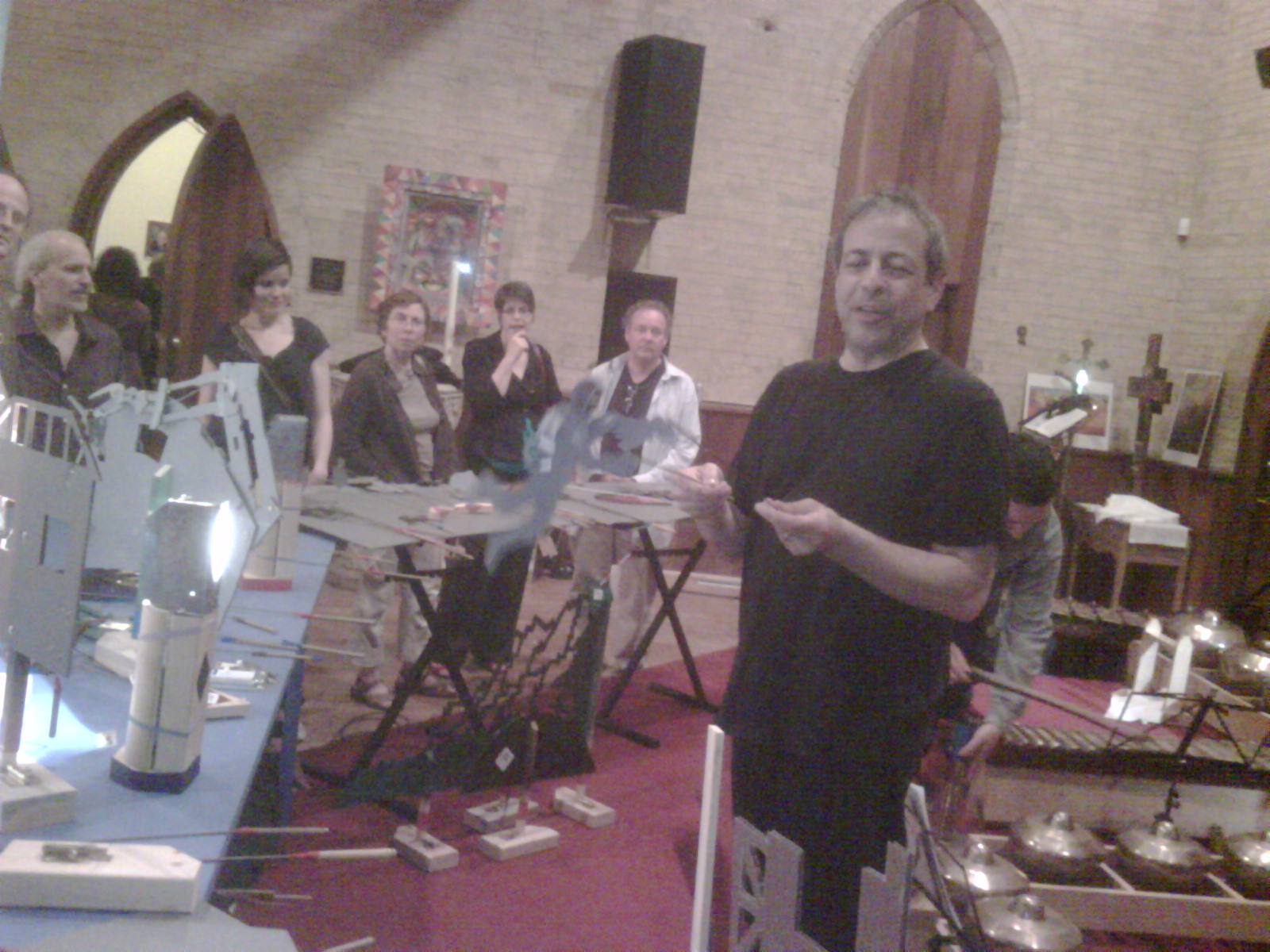
Playwright, puppeteer & percussionist Rick Sacks, showing us the magic behind his Smoid. David Powell, the puppet master, is immediately beside him.
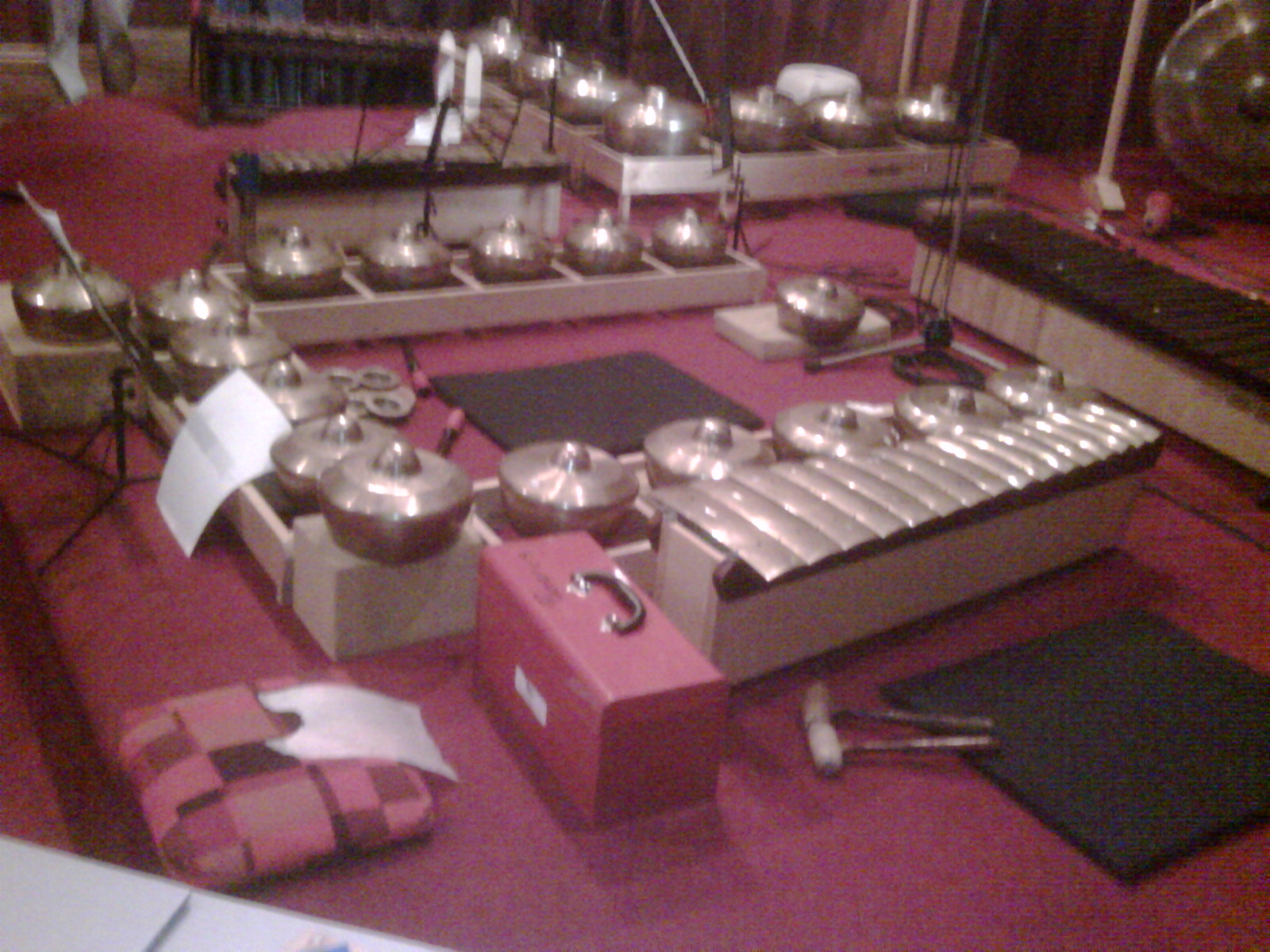
There are nine musicians in Evergreen Club Contemporary Gamelan(aka “ECCG”), and judging by the works presented tonight, this is an ambitious group eagerly embracing new disciplines & styles, while welcoming a diverse assortment of collaborators.
I was drawn to this week’s program by the concluding item on the bill, namely The Adventures of the Smoid, a new dramatic work by Rick Sacks. I’d heard that David Powell of Puppetmongers had assisted Sacks, not only in designing shadow puppets to tell his story, but in training some of the ECCG musicians in shadow puppetry.
It reminded me of what I’d seen from the Canadian Opera Company in 2009. Just as Robert Lepage’s production of Stravinsky works had led the COC to employ opera singers as puppet manipulators, so too with Sacks’ work for ECCG.
A glimpse of some of the Evergreen Club Contemporary Gamelan instruments.
Without giving too much away, let’s just say that The Adventures of the Smoidis an unpretentious tale suitable for children but sophisticated enough for adults. This shadow puppetry will wow any audience, particularly with the gamelan accompaniment. While it’s a simple story, there are picturesque moments throughout that keep you riveted. I was as excited as a small child.
After the performance Sacks and company invited us behind the projection screen for a question –answer session whereby we could see how it was all done. In some respects the illusions seemed more rather than less impressive when we saw the simplicity of the design & execution.
The remainder of the evening was completely different. Titled “Tribute to Nano S.” the first half of the programme consisted of a series of songs honouring the master Nano Suratno. The five songs married the acoustic subtleties of ECCG, including some microphones, with the electronic wizardry of turntable duo INSiDEaMiND.
INSiDEaMiND aT WoRK
Four of the five songs began with something electronic –a drone, or an ostinato—supplying a rhythmic hook for the song that followed. The nine members of ECCG joined in with the electronic rhythms of INSiDEaMiND, a pulsing hybrid that wouldn’t be out of place in a dance-club yet one still sufficiently artsy for a Music Gallery crowd. After having experienced La Bohemelast week in the Tranzac Club, I couldn’t help but wonder how a site-specific performance might galvanize ECCG with INSiDEaMiND. The last item in the first half—a traditional Palestinian song with an infectious rhythmic hook—had me wondering how people could keep their seats, given my own impulse to get up and dance.
The vocals by Jennifer Moore and Maryem Tollar were almost subliminal. When I consciously attempted to decipher the lyrics I was somewhat frustrated, but when I relaxed and surrendered to the dense texture I found myself presented with gifts of a clear phrase here and there, in several languages. As with so much on this occasion, I let it all wash over me, not too worried about making sense out of the proceedings, so much as to revel in the sensations. Our ears were in safe hands, as there wasn’t a moment that wasn’t beautiful.
The ECCG program –the five song Tribute to Nano S, and The Adventures of the Smoid—is to be repeated 8:00 pm Tuesday June 14th at the Music Gallery.
Tenor, baritone, conductor, and impressario, Placido Domingo
Tonight’s Toronto concert by Placido Domingo with Sondra Radvanosvky was the proverbial “happening”. Held in a converted tennis stadium enjoying its christening as a musical venue, we were watching their faces on a jumbotron, hearing a wall of amplified sound, in a mix of opera & popular songs. I was reminded a few times of the first Three Tenors concert, on the eve of the World Cup in 1994, whether via the repertoire of songs, or the genial tone.
While the concert was not without its glitches the crowd (I’d estimate it at somewhere around ten thousand) was in a forgiving mood. Jet planes coming to and from the nearby airport regularly piped up, as if auditioning for parts, occasionally in the right key. A cold breeze that might have helped carry homerun balls to the outfield did nothing to dampen the enthusiasm of the crowd.
Placido Domingo is a seventy year old man with at least four operatic incarnations:
• Tenor
• Conductor
• Impresario (artistic director first in Washington, then Los Angeles)
• Baritone…(!?)
On this occasion we mostly saw and heard the baritone, as the tenor isn’t available very often. The opening aria (from Le Cid) was the one genuine tenor aria. In addition Domingo sang the duet at the conclusion of Act I of Otello, although partway through they modulated down a semitone, so that the high note was now less of a challenge.
But that’s all quibbling. The man is 70, and is already defying the calendar & the odds, and he has been living in this borderland for awhile now. Heldentenor roles like Siegmund require more of a baritone’s colour with the occasional high note thrown in.
While the audience was thrilled, to me the baritone rep sounds a bit odd. In the duet from Simon Boccanegra, where father sings to his daughter, although the visual impression was right, the sound is different than what we’re accustomed to hearing from a baritone. In ”Nemico della patria” the notes come out almost too easily, but they’re not aligned in the usual ways. Those at the bottom are hard to hear, while those at the top of a baritone’s natural range sound relatively easy. While I dislike stereotyping, I’d have to say that Domingo is still a tenor, but unable to hit the high notes any longer.
Even so the audience ate it up, and I have to admit i thoroughly enjoyed myself.
Soprano Sondra Radvanovsky
I had already had a day of Radvanovsky, hearing her Aida on CBC this afternoon (recorded months ago); she gave us the vocal highlight of the evening during the encores. After saying how good it felt to sing in front of the hometown audience, to a warm ovation, she sang a very impressive ”vissi d’arte,” from Tosca.
Radvanovsky & Domingo were so generous with their encores that I lost count (somewhere around six i believe!), watching them happily return to the stage over and over again. The other big moment was clearly understood to be the finale of the evening, when Domingo unexpectedly took up the baton to conduct the Black Creek Festival Orchestra and Chorus in a brisk “Hallelujah” from Messiah, climaxing with fireworks.



 Tonight I saw the opening of Guild Festival Theatre, an ambitious company taking the stage in The Greek Theatre in Guildwood Park.


 Following the uprising in 1956, we were blessed for a time with a neighbourhood of Hungarian restaurants. Magyar refugees poured into the downtown Toronto area, leaving their mark in Kensington Market, as well as the stretch of Bloor St West between Spadina and Bathurst. It felt like an offshoot of the university’s neighbourhood, full of inexpensive places to eat.