Ariadne in Toronto

Sir Andrew Davis

Sir Andrew Davis, who made his first appearance conducting with the COC

The premiere of the new Canadian Opera Company production of Ariadne auf Naxos was  a dramatic occasion indeed.  Neil Armfield’s new production, handsomely designed by Dale Ferguson, was upstaged by some genuine drama.

First, there was the return of Sir Andrew Davis, former Music Director of the Toronto Symphony, who made his long-delayed debut conducting with the COC.  Davis gave us brave tempi indeed, taking a brisk and business-like approach throughout that i believe served Strauss very well.  The COC Orchestra seemed happy enough, sounding lustrous.

Then, we heard that local soprano Adrianne Pieczonka, scheduled to sing the title role, was forced to cancel due to illness.  As a result we experienced the debut of an understudy in the title role.

Soprano Amber Wagner

Soprano Amber Wagner, who made her COC debut in a surprise appearance as Ariadne in place of Adrianne Pieczonka

Young American soprano Amber Wagner made her COC debut singing the Ariadne.  There were no telltale signs that Wagner was unprepared for the part that i could see.  At one point –during a scene with Zerbinetta where a scarf gets trapped under a body– I was thinking “ah this is because she’s the understudy,  an unfortunate mistake”.  But that was a purposeful and clever part of the direction, not a mistake, as we soon discovered.

Wagner wasted no time in showing us she was for real.  In the Prologue she was a deliciously bitchy Prima Donna backstage before she came onstage in the “opera” as Ariadne.  The voice is rich, reminding me of Jessye Norman or Helen Traubel, but without the tendency those two great stars had to sometimes sing below pitch.   At the very least, Wagner showed us that she belongs comfortably at this level, and never resembled a replacement.

Richard Margison

Tenor Richard Margison

Another Canadian raised eyebrows as well. Richard Margison has spent his career singing the starring roles in French & Italian opera, known for his rendition of “Nessun dorma.”  I saw something new a couple of years ago, when Margison took on Florestan in Fidelio, a part usually entrusted to a heldentenor.  Bacchus in Ariadne is another role requiring a genuinely heroic sound.  Like Florestan, it’s not a long role, and therefore is a good choice for a singer exploring a new type of role.   I would say on the basis of what i heard that Margison has made a clever move, as there is a world-wide demand for this kind of singer, a demand that as far as i can tell, Margison can and will fulfill easily.  The voice sounded huge no matter how loudly the orchestra played, and the top is still as effortless as ever.

I keep talking about star performances.  I am not about to stop anytime soon.

Jane Archibald as Zerbinetta

Jane Archibald pleasing the crowd as Zerbinetta

The audience favourite was hard to discern, given Davis’ popular return, Margison’s heroics, and especially the drama surrounding Amber Wagner’s substitution and fearless performance.  With all those candidates, i think the loudest applause likely went to our Zerbinetta –admittedly the role that normally steals our hearts– portrayed by Jane Archibald.  The singing wasn’t just accurate, but infused with all the flirtatiousness that we could wish for in a Zerbinetta.  Director Armfield gave the character a gradual crescendo of adoration, climaxing in her aria, a swaggering showpiece to bring Strauss back from the dead.  The adoring males included not just the entire onstage Commedia dell’Arte troupe but even conductor Davis, to whom Archibald playfully blew kisses, and thereby expanding the show outside the proscenium in the process.

The other star in the production was Alice Coote as the Composer.  Armfield pushed this Composer in a more serious direction than I have seen, by making the Prologue a very modern backstage environment, complete with cigarettes and pizza.  At first i thought this might backfire, especially watching Coote, in her earnestness facing the irreverent cacophony of the callous theatre professionals.

But Armfield showed me something i either never saw before or perhaps was too cynical to notice.  As he points out in the director’s notes, with reference to Zerbinetta, “underneath the smiles of the clown there is a human heart breaking.”  While it’s true that Zerbinetta says words to that effect, every Zerbinetta I’ve ever seen plays from the outside in, making us admire her skills while keeping us at a distance.  We don’t see the soft heart beating under the surface: except in this production.   And as a result the opera, when it began, seemed especially artificial, after the realism we’d seen in the Prologue.

The strength of the COC’s company was clearly in evidence on several fronts, whether in the clear voices of Naiad, Dryad and Echo (Simone Osborne, Lauren Segal and Teiya Kasahara), or in the plethora of delightful performances, such as Peter Barrett’s Arlecchino, Christopher Enns’ Scaramuccio, and Adrian Kramer, making more comedic capital out of the tiny role of the Wig-Maker than usual.

Ariadne auf Naxos (likely with Adrianne Pieczonka re-assuming the title role) continues until May 29th at the Four Seasons Centre.

Posted in Opera, Reviews | 6 Comments

La Cenerentola

Elizabeth DeShong(Angelina) and her rodent friends in the Canadian Opera Company production of Cinderella (La Cenerentola). Photo Credit: © 2011 Michael Cooper

The current Canadian Opera Company production of La Cenerentola brings me face to face with one of the great themes, and sorry if I am about to sound like your junior high English teacher.  While the opera probably can be explored in several ways, this production concentrates on the great question of how we reconcile illusion and reality.

This co-production of Houston Grand Opera Association, Welsh National Opera, Gran Teatre del Liceu and Grand Théâtre de Genève, employing Els Comediants from Spain in the production team (Joan Font as director, Joan Guillén as set & costume designer) now has come to Toronto.

I will quickly say it’s a huge success musically, and then set that aside while I talk about the production, one of the most remarkable I have ever seen.

While Rossini’s take on Cinderella differs in a few key ways from the fairy tale as  Canadian children know it, the chief plotline is the same:

  • Girl is mis-treated by step-sisters and step-parent (this time it’s a step-father rather than a step-mother)
  • Prince seeks bride
  • While the step-sisters present themselves to t he Prince, it is the unknown beauty –Cinderalla after a makeover—who turns the Prince’s head
  • But Cinderella leaves, forcing the Prince to come find her
  • …and once he finds her, love conquers all

Els Comediants bring a unique flavour to this production.  They’re known for a carnivalesque approach that they employed in the time of Franco as a kind of protest.  It shouldn’t therefore be surprising that they manage to preserve the fun of this fairytale, while infusing it with an activist sensibility, taking Cinderella to unexpected depths.

At first glance the eye is almost overwhelmed by the colourful excess of the design.  While Angelina (Cinderella) is in the appropriate muted browns, while cleaning the floor, her two step-sisters’ outfits are clownishly flamboyant.

As we meet the family, we notice something else: a series of rodents –mice or rats?—who are silent observers of the action throughout.  Their outfits are highly artificial, reminding me of

  1. The Nutcracker
  2. Characters in Art Spiegelman’s illustrated novel Maus
  3. a 2010 production of Wagner’s Lohengrin directed by Hans Neuenfels.  If originality counts for anything, it needs to be said that the Comediants’ rodents predate Neuenfels by at least three year (and thank you Opera Chic for the images from Bayreuth).

2010 Bayreuth Festival production of Wagner’s Lohengrin

Unpacking the metaphor could push me to thousands of words.  But imagine that this light tale suddenly acquires unexpected weight.  Cinderella shares her oppression with silent witnesses.  As I set aside my concern and confusion during the first part of the opera I was untroubled, because I was busy laughing at Donato DiStefano’s astonishing portrayal of Don Magnifico, alternatively funny, disgusting, terrifying, and always framed within a traditional buffo approach to the singing and acting.

Partway through the first act I overcame my confusion, when everything clicked into focus as something very deliberate and self-consistent.  Don Magnifico & his daughters (Cinderella’s step-sisters) have a very different value system than Cinderella, mistaking the trappings and the wealth for real value, claiming to be better than a mere servant.  In a world of playful and flamboyant dress-up, transformation and magic are possible.  Ramiro (the Prince) and his servant exchange roles, fooling Don Magnifico’s family, but not Cinderella, who knows who she is and what she wants.  The rodents are more real than any other part of the opera, taking on the role of puppeteers in the enacted shadow-puppetry illustration of Ramiro’s carriage accident: the providential turning point of the plot whereby Cinderella and the Prince are brought together.  It’s spooky how powerful some of this can be, when you’re laughing so hard, yet seeing something so dream-like.  At no time were we led away from the text, as the production respects Rossini, even as it shows us unexpected depths.

Donato DiStefano as Don Magnifico

Donato DiStefano as Don Magnifico, photographed by Michal Daniel

Although all the principals had wonderful moments DiStefano was the most interesting portrayal to watch, whether sleepy, pompous, threatening, drunk, afraid or sneering with disbelief at his step-daughter’s surprising elevation.

I could go on about DiStefano’s vocal delivery, a catalogue of the possible comical sounds a buffo singer can make.  Yes he’s funny. He’s also completely in character while singing, so persuasive that you get lost in the opera.

While prettier of voice than DiStefano, Brett Polegato’s Dandini gave DiStefano a run for the money. Polegato had a voice that’s  apt for bel canto while being one of the comic stars of the performance.

Elizabeth DeShong as Cinderella was thoroughly musical, not just coloratura & high notes, but a beautiful tone in her lower register as well.  Kyle Ketelsen brought a majestic sound to the role of Alidoro, the philosopher who—at least in this production—helps Cinderella through a magical transformation.

I said the singing was good?  But that doesn’t really do it justice.  Lawrence Brownlee as Ramiro (the Prince) has an amazingvoice, one of the best voices I have ever heard in person.  I experienced Leontyne Price, Luciano Pavarotti, Birgit Nilsson, and Jon Vickers, each a visceral experience for different reasons.  I feel I have to put Brownlee in a similar category.  Given the ability to edit recordings, or to choose from the best take, it’s important to recognize the drama of a live performance.  Brownlee nailed a whole series of high Cs (one for at least 5 seconds), never going off pitch, never sounding uncomfortable, always musical, and a complete thrill. No, it’s not the biggest voice I’ve ever heard (nor was Pavarotti come to think of it); but it’s perfect for this material.  See for yourself (either in this clip OR in person).

La Cenerentola will continue to bewitch us at the Four Seasons Theatre until May 25th.

Posted in Opera, Reviews | 7 Comments

La Clemenza di Tito

Marshall Pynkoski, co-artistic director of Opera Atelier

Marshall Pynkoski, co-artistic director of Opera Atelier

Let’s say you’re a devoted fan of a particular art form, such as Shakespeare’s plays, Fellini’s films or Gaugin’s paintings.  Then imagine that suddenly someone discovers a masterpiece by your favourite.  Can you imagine the joy to suddenly encounter a new work from your hero (Shakespeare, Fellini, Gaugin), in their prime?

That’s how i feel.  I had heard La Clemenza di Tito before.  The production I’ve experienced this week in Toronto from Opera Atelier is like a revelation.  A combination of a long rehearsal period, a scholarly approach to staging & music, the use of historically informed performance & instruments, have all stripped away the dust, revealing the masterpiece within.

The cast of six are strong both musically and dramatically.   The complex triangle between Sesto, Tito & Vitellia have a special chemistry.

Measha Brueggergosman’s Vitellia has the crazy seductiveness to start with.  Can you say “high maintenance?”  She demands that her admirer Sesto–who’s not yet her lover–should avenge her for being rejected by Tito, who is Caesar after all.  Vitellia can’t seem to make up her mind however:

  • when rejected she wants Sesto to kill Tito
  • but when Tito is single again, suddenly Vitellia wants Tito again, and demands that Sesto hold back his avenging rage: while observing her interest in the Emperor

Brueggergosman has the seductive chutzpah of a Carmen (including several remarkably improvisatory moments, in her a piacere reading of passages in “Deh se piacer mi vuoi,” her Act I aria) , blatantly demanding of her man and without any shame: at least until Sesto is tried and convicted of attempting to kill Tito. Even then her primary concern is that Sesto will spill the beans on her part in the plot, while her concern for Sesto’s life is an afterthought.

Michael Maniaci, Sesto in Opera Atelier's La Clemenza di Tito

Michael Maniaci, Sesto in Opera Atelier’s La Clemenza di Tito

Michael Maniaci? he understands the chemistry.  He is practically begging, totally dominated by this woman.  The part was written for castrato, which means that it’s often performed by a woman, whereas Maniaci –a male soprano– gives us both the authentic sounding vocal type AND the right gender.  Seeing the way Maniaci is pushed (and occasionally slapped) around by Brueggergosman’s Vitellia, it makes exquisite sense that their voices blend so perfectly.  While Maniaci is not a castrato, the subtext is there with Brueggergosman pushing the envelope as if Vitellia could be a dominatrix.  Musically and dramatically these two have an amazing rapport.

Kresimir Spicer plays the third member of the trio, namely Tito, Emperor of Rome.  I was very impressed by his accuracy marking (singing with only half voice) his big aria at the dress rehearsal two nights ago.  Tonight the same accuracy was there, plus ample heft when he wanted it.  When I think about why this opera is not more popular, i wonder if it’s limited by the availability of tenors who can actually sing Tito, a role calling for agility as well as more high notes than one usually encounters in a Mozart opera.  Spicer sang with wonderful pitch, lovely clarity in his coloratura, and a remarkable dynamic range.  At the same time that he faces the toughest singing of any cast member (in my opinion), Spicer was the rock holding the opera together with his passionate acting.

Mireille Lebel

Mireille Lebel, Annio in Opera Atelier’s La Clemenza di Tito

The other female character –Servilia– was played by Mireille Asselin, the virtuous foil to nasty Vitellia. Where the main trio are caught up in conspiracy, Servilia radiates goodness, particularly in Asselin’s reading.

Her virtuous partner is Annio, a man played by a woman.  Not only did Mireille Lebel bring flawless intonation & phrasing to her portrayal, but she helped decode some of the gender ambiguity in the simplest way: by being so tall.  Where some trouser parts are feebly enacted, Lebel’s stature and playfully aggressive body language gave a curious balance to Maniaci’s Sesto, in their jocular horseplay, or the way she towered over Asselin in their love duet, “Ah, perdona al primo affetto.”

My facebook friends already know I’m crazed for this tune, having posted two different versions today (when a melody is this good, i don’t mind if i can’t get it out of my head):

Popp with von Stade

Ivanova with Garanca

And finally, there’s Curtis Sullivan, a stalwart with Opera Atelier, as Publio. This role is a bit of a  challenge, because Publio is a complete abstraction without much clear subtext.  Sullivan played him with strength, barking at Tito a couple of times, otherwise a confidant or witness.

I observed –in my review of the dress-rehearsal— that Fallis & Pynkoski have a revolutionary approach to the recitatives.  It shouldn’t be such a radical idea, but it is: that there’s not a second of this reading that lets down in intensity.  It’s thoroughly  well-thought out, so that the relationships cohere perfectly, the love triangle balancing the virtuous duo, and all the singing-actors bringing their whole person to every note & word.

The sets & costumes by Gerard Gauci reinforce a period feel, by conjuring a curious mix of old & new; this is the Roman Empire dressed in the fashions of the Enlightment.

It all adds up to a spectacular new look at an opera that deserves to be in the standard repertoire.  Perhaps if more companies emulated the care lavished by director Marshall Pynkoski and conductor David Fallis, they might have similar breakthroughs of their own.

How fortunate for Torontonians that we get to see/hear them.

Opera Atelier’s production of La Clemenza di Tito continues at the Elgin Theatre until May 1st.

Posted in Opera, Reviews | Tagged , , , , , , | 4 Comments

Mozart knew what he was doing

Mozart

Wolfgang Amadeus Mozart

Yes I made a joke on my facebook status about the relevance of Mozart’s opera La Clemenza di Tito to anyone in a country uneasy about their government’s authoritarian tendencies, an ironic reference to Kubrick’s Dr Strangelove; Mozart’s opera might be subtitled “How I stopped worrying about tyranny and learned to love my Emperor”.  But it was more than a facetious attempt to make this opera topical.

Tito has had an image problem for a long time, an oddball in Mozart’s output.  Most great opera composers learn their craft gradually, finally hitting their stride with their final works; and so it is too with Mozart, except for the conspicuous exception of Tito The other operas produced in Mozart’s final years –The Magic Flute, and the three daPonte operas, Cosi fan Tutte, Don Giovanni and The Marriage of Figaro—are among the most popular operas of all.

Is Tito a lesser work; or have we simply misunderstood the opera all this time?  If ever an opera cried out for a rethinking via a historically informed approach it’s Tito.

Why hasn’t Tito achieved a comparable level of popularity to those other masterpieces?  Of course maybe it simply isn’t a masterpiece, just a hurried job by Mozart. but I don’t agree with this view.  More likely we didn’t understand how to approach the genre of opera seria (literally serious opera) in the right way; notice, though that I said “didn’t” because I have reason to be hopeful after what I saw tonight.

After Opera Atelier’s dress rehearsal, I am eager to get back for the opening Friday, when I will be thrilled to see it again.  There are several things about this production that contribute to its success.

First, there’s the problem of vocal types one chooses to employ.  The main characters can be done several ways:

  • TITO : tenor
  • SESTO: male soprano or counter-tenor or female soprano or mezzo-soprano
  • VITELLIA: soprano
  • ANNIO: soprano or mezzo–soprano
  • SERVILIA: soprano or mezzo-soprano
  • PUBLIO: bass

The same issue comes up in other well-known operas; the first one that pops into my head is Orfeo ed Euridice, where Orfeo is sometimes played by a woman to make the voice sound right, sometimes by a man to make the gender look right.  Opera Atelier’s choice to use Michael Maniaci (a male soprano) removes the convolutions imposed by attempts to modernize.

Second, there’s the simple matter of scale.  In a big opera house with a big modern orchestra, Tito quickly devolves into a scream-fest without subtlety.  Tonight we had

  • the charming sound of Tafelmusik Baroque Orchestra
  • the Elgin Theatre, seating about 1500
  • Conductor David Fallis who believes in holding an orchestra properly in check so that you can easily hear the singers, even when they’re marking (as we heard at times tonight)
David Fallis

Conductor David Fallis

Third, there’s the rather difficult matter of drama.  Director Marshall Pynkoski and Fallis share credit for this (as well as the cast of course).  I had a bit of a revelation watching the recitatives tonight.  In most productions –especially opera seria—the recit is understood as connective tissue.  The singers tend to look past them to the aria or ensemble that follows, and the conductor doesn’t usually respect the rudimentary music contained in recit.  But Pynkoski and Fallis seem to get that the drama doesn’t stop just because the aria is over.  In fact some of the recitatives were so exciting –as moments of high drama between the principals—that they generated applause: the first time I have ever seen that kind of electricity sustained between numbers.

Above & beyond Opera Atelier’s usual beautiful bodies and Tafelmusik’s lovely sound, there’s the matter of the singers and their chemistry.

As with Mozart’s earlier opera seria Idomeneo, we meet most of the principals before encountering the title role, sung by a tenor.

Measha Brueggergosman

Soprano Measha Brueggergosman

There’s Vitellia, a classic scenery-chewing diva mad with jealousy, fearlessly played by Measha Brueggergosman.  We had the emotional blackmail, the bullying, the physicality (whether slapping or seducing), and the melodramatic facial expressions.  I loved her singing, especially her tendency to turn coloratura into something resembling a seductive jazz, toying with an entire theatre full of people hanging on her every note.  There’s no denying the star power, and also the ample voice she offered in a dress rehearsal complete with lots of high notes.  Whenever Measha was on stage she commanded our attention, whether her presence matters to that scene or not.  Her flamboyance is a necessary starting point.

Sesto is the pivotal player in the opera, the man so eager to please Vitellia that he’d kill his best friend, and in the process depose a king who is almost too good to be true.  If you can’t believe this dynamic – of a man pushed around by the irresistible female, driven to betrayal of all that he believes in—you may as well pack it in.  Michael Maniaci may have been holding some voice in reserve for opening night, but sounded at least alright, and sometimes quite wonderful.  The main thing was the passion of his portrayal, both in his relationship to Vitellia as well as with Tito.  I found that I genuinely cared about Sesto & Tito.  The tone between Maniaci & Brueggergosman sometimes edged towards comedy, in recognition that the key relationship of the opera is really the one between the two men.  There’s  a hint of a homo-erotic subtext in the ideal love between these two men; but i felt that the scenes between the two were quite beautiful, and showed restraint.

We also meet Mireille Lebel as Annio and Mireille Asselin as Servilia, counter-balancing all the anguish and melodrama of the chief love-triangle of the opera, showing us something genuinely sweet & worthwhile.

Spicer

Tenor Kresimir Spicer

Finally, the City of Rome welcomed Tito: and Kresimir Spicer stepped onto the stage.  While that scene seemed to play on the level of civic duty and right behaviour (Tito rejecting the generous gifts of his citizens, suggesting they use them instead to help the homeless victims of the Vesuvius eruption rather than himself), Spicer played the scene with his recent heartbreak as subtext.  Spicer brought a genuine sense of seriousness to the proceedings, the rock at the centre of this production; he was tightly wound, explosive but contained.

I found myself thinking afterwards that maybe we need to rediscover or reinvent opera seria, to find its truth for ourselves.  Opera Atelier’s La Clemenza di Tito looked and sounded wonderful, a taut piece of music theatre, and a display of many different sorts of beauty.  There was no concept overlaid onto the production, just a tight-knit group of performers trusting the excellence of the score, relying upon one another in a textbook example of ensemble musicianship.

In case anyone was in doubt, I feel they’ve confirmed that Mozart knew what he was doing.

Opera Atelier’s production of La Clemenza di Tito at the Elgin Theatre in Toronto opens Friday April 22nd, running until May 1st.

Posted in Opera, Reviews | Tagged , , , , , , , | Leave a comment

Woody & Frankie’s Bullet for Adolf

There came a moment when I discovered just how sincere and authentic Woody Harrelson & Frankie Hyman are about their new play Bullet for Adolf.

bullet for adoft

Tonight was the first preview in Toronto at Hart House Theatre, and afterwards they held a talkback session with the actors and audience.  I asked a question, and in the process may have offended Frankie, although I didn’t see Woody’s response.

Woody & Frankie

Woody Harrelson & Frankie Hyman

I guess it sounds weird to call them by their first names.  Woody? You probably know him from his film & TV work.  I think I had one of my biggest life lessons, courtesy Woody Harrelson.  When I used to watch Cheers, I didn’t really differentiate between “Woody” the actor and “Woody” the role portrayed on Cheers.  In my defense I point to the names being the same, and the uncanny goofiness Woody brought to Woody.

Let’s just say I underestimated the man: profoundly.  Watching Natural Born Killers was the real eye opener, a role for which I think he should have won the oscar.

But excuse me, I digress.  I was saying that my question may have offended Frankie.

My question was meant in all innocence.  I first observed how authentic the writing seemed to my ear.  I was nervous so I didn’t really say what I meant to say, about how the black people sounded authentically black, and vice versa.  The question may have seemed racist, as I more or less asked who wrote what, and whether they achieved that authenticity by ensuring that the white guy wrote the white guy lines, and vice versa.

I saw Frankie wince, possibly embarrassed, before he more or less confirmed what I’d asserted, possibly feeling my question was a faux pas.  I felt bad that I had called attention to the divisions that exist in society when, in the course of the play, the writers had done such a marvellous job of erasing those divisions.

In the pre-show publicity, Harrelson made a big deal about choosing Toronto as the site for this premiere.  I wondered about that.  Is it because we’re multi-cultural, and likely to be very comfortable with the sensitivities in the script? Possibly.

But then again the talk back was like a love-in.  It had been a very successful preview, two and a quarter hours of steady laughs from an audience delighted by what they’d seen and heard.  Torontonians love to be flattered, love to be told how cosmopolitan we are; so perhaps it was a done deal that the show would go over well.  But by the same token, we may be easy but we’re not cheap (or the theatre-going equivalent).  The laughs were genuine.

I don’t want to give anything away –as a devout believer in the spoiler-free review—but let me just say that the title contains a kernel of poetic truth that elevates the material beyond mere laughs.  The comedy is at times very edgy, challenging the audience’s willingness to laugh.  I found that aspect the most exciting, that this genuinely felt like a work of art rather than a commercial vehicle, even if there’s the possibility of a big-time payoff at the box office.

Bullet for Adolf is set in the early 1980s.  The production magically teleports into that time through a regular use of video, by Christian Peterson & Jeremy Hutton.  Between scenes we’d watch combinations of images & music taking us back to the big hair, the moves & music of the time.  Occasionally, just to see if we were paying attention, some of the characters from the play would turn up in those little vignettes. But this is a very self-conscious bit of time-travel from Woody & Frankie, in a play that at times resembles a flashback.

When I put this in context with the last two plays I saw –by a pair of Brits named Martin Crimp & David Greig—I can’t miss the difference.  Crimp & Greig are doing what modern theatre does well: express alienation and pain for the usual theatre-goer.  I was ready for a play that leaves you feeling good afterwards, and Harrelson/Hyman delivered.   Whereas I can’t imagine addressing either of the famous playwrights by their first names, it goes without saying that Bullet for Adolf is unpretentious, a play bordering on guileless in its eagerness to have fun.

But by the same token, the play does have an edge.  There’s a great deal of abrasion in some of the exchanges, a fair amount of conflict, and suspense too.  I quibble with the play’s subtitle (“almost a comedy”), because to my eye/ear it’s very much a comedy.

The preview went very smoothly with no muffed lines that I could recognize and some tightly choregraphed fights & dance, the physicality coming as a very welcome release.

There were no weak links among the performers.  Brandon Coffey’s Zach & Ronnie Rowe’s Frankie were always persuasive, particularly in their first bristling encounters in their workplace;  their mastery of physical labour—shovelling and climbing scaffolds—made the early scenes at work very believable.  Meghan Swaby as Shareeta was a force to be reckoned with, and never less than fascinating.

Bullet for Adolf runs until May 7th at Hart House Theatre in Toronto.

Posted in Dance, theatre & musicals, Reviews | 5 Comments

Fortresses and tears

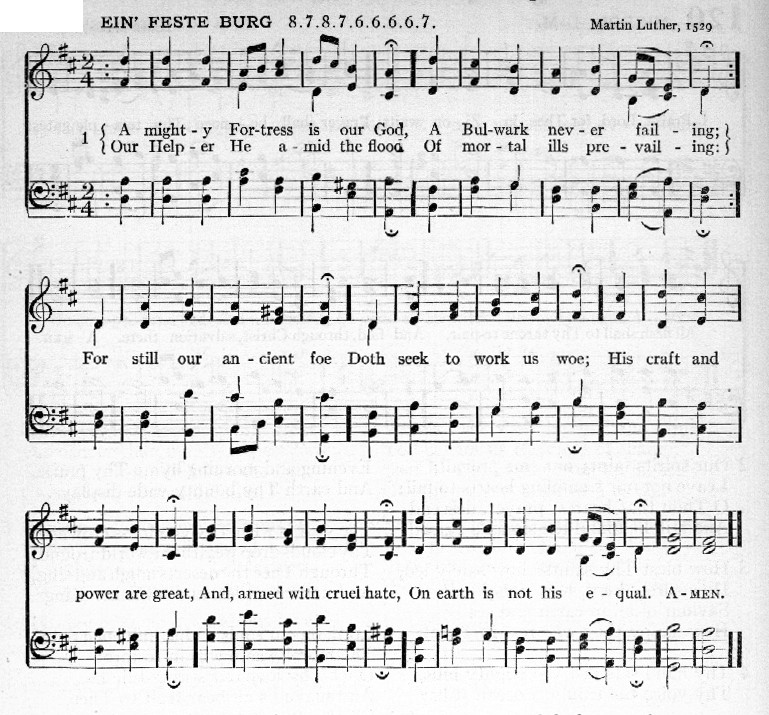
A hymn

Luthers hymn

Today in church we sang “A Mighty Fortress is our God,” a hymn that has powerful associations for me. I am going to speak of three incarnations of that tune.

FIRST?  The original version is Luther’s great hymn of the Reformation.  The hymn has a curious effect on me. I find i can never finish it because my voice breaks partway through.  I am especially devastated trying to sing the words to the last verse, which not only renders me tearful but yes, my voice totally gives way:

Let goods and kindred go,
this mortal life also;
the body they may kill;
God’s truth abideth still;
his kingdom is forever.

Don’t ask me why, but i haven’t successfully sung these words, the last half of the last verse in more than a decade.  Here’s a version entirely on organ + words. Why that way?  It’s the most understated version i could find. Other versions are so strong that you might think i am trying to PREACH.  This is just an attempt to share some music: music that has admittedly been a powerful text in my life.

SECOND?  Felix Mendelssohn, a man known as one of the great Christian composers in one century –the 19th– was rebranded as a Jewish composer by the Nazis, who attempted to remove him from history.  Please note: while in the 20th century the fanatics attempted to persuade the world that Mendelssohn was a Jew, he thought of himself as a Christian, and would not have understood the Nazis.  His perspective is a valuable one for anyone who wonders why so many Jews stayed in Germany rather than fleeing: because they did not even understand the madness about to descend upon them.

Mendelssohn composed a lot of music that moves me, including a wonderful Violin Concerto, his music for A Midsummernight’s Dream, his symphonies & piano music.  Mendelssohn wrote a symphony to commemorate the anniversary of the reformation, using Luther’s tune as the basis for a movement of that symphony.

Listen to how meekly the tune appears, as if it were an idea in someone’s head, an idea that grows as if it were a little bulb pushing forth leaves.  It’s a sweet gentle idea on a spring morning, not a hammering oppressive powerful dogma.  The tune becomes part of something quite dramatic and passionate, even while being complete abstract.

THIRD, i come to what is for me an adaptation of Luther’s tune.  Viktor Ullmann wrote Der Kaiser von Atlantis (in other words The Emperor of Atlantis) while living in the supposedly model work-camp at Theresienstadt.

There are two pre-existing melodies picked up by Ullmann in his opera.  The first is the Austrian hymn, which was the Nazi anthem.  In Ullmann’s version, it becomes a dirge sung in minor.

Ullmann’s tale was a very ironic story, aimed by a concentration camp inmate at his captors.  Death takes a holiday, because Death is overwhelmed by the demands made upon him by Emperor Uberall (“Uberall” = over all, and a satire on Hitler, given that the Austrian anthem was sung to the words “Deutschland, Deutschland uber alles”: Germany over all).  By the end of the opera, Death ends his strike, after striking a deal with Emperor Uberall, resuming his job if the Emperor will agree to be the first to die.  He agrees. The opera ends with his farewell, followed by a madrigal version of Luther’s hymn, sung in 6/8 time rather than its usual quadruple time, and reharmonized.  Would the men holding their machine guns have been moved by this melody?  It was never tested, because the Nazis stopped Ullmann before he finished, shipping him to Auschwitz.

Here is the scene that ends Ullmann’s opera, complete with subtitles, and starring Canadian baritone Gerald Finley as the Emperor.  This video was shot on location in Theresienstadt, as if in homage to those who were dragged away to be killed, including Ullmann himself.  The madrigal passage adapting “A mighty fortress is our God” begins 5:30 into this clip, but it’s worth waiting for it in context.  If the singers seems a bit spooky and haunted, maybe that’s because the space seems haunted by the spirits of those who inhabited that camp.

Did Ullmann know the geneology of this tune: that it was the Reformation anthem, picked up by Mendelssohn (by now a forbidden composer, due to his Jewish blood), and possibly recognizable to the soldiers? One could wish that they would have been humanized by the tune had they heard it, the ultimate utopian reading of this place of death.

And speaking of tears, I find i always have tears watching this video.

Posted in Essays, Personal ruminations & essays, Spirituality & Religion | 2 Comments

David Greig’s Cosmonaut

Chances are that when a play has a fifteen word title, neither the work nor its review will be short.  David Greig’s The Cosmonaut’s Last Message to the Woman He Once Loved in the Former Soviet Union has been given its first Canadian production by Canadian Stage in Toronto.

David Greig, Scottish playwright

David Greig, Scottish playwright (Photograph: Murdo Macleod)

As I come to this, my second of three consecutive plays representing my first encounter with that playwright (after Martin Crimp, and before a collaboration between Woody
Harrelson & Frankie Hyman), I am wondering how one writes a spoiler-free review of a work unfamiliar to the reader.  Whatever Greig’s other works may be like, I can’t merely speak of the production and Jennifer Tarver’s direction, but need to somehow speak of Cosmonaut without giving it away.

Earlier this week I posted a link about Yuri Gagarin on Facebook… …. in commemoration of the fiftieth anniversary of the first manned flight into space, perhaps mindful that I’d be seeing this play.

There are a number of urban legends associated with the Soviet space program.  I remember hearing as a child that there was probably a dead cosmonaut in orbit, that Gagarin was the first one we heard about, after previous failures hushed up by the secretive USSR.

It’s interesting to compare the American & Soviet programs.

  • The Soviets started first, both with their sputnik and the first manned launch of Gagarin fifty years ago this past Tuesday
  • The Americans did everything in full view of the public, including their failures, while the Soviets were tight-lipped and only reported after-the-fact
  • Americans landed at sea, while Soviets landed on the land
  • Americans supposedly had better computing & science, while the Soviets had bigger and more powerful rockets.
Director Jennifer Tarver

Director Jennifer Tarver

I believe it’s a mistake to say that Greig’s play is based in reality, given that the plot only bears a passing resemblance to historical facts.  And does it matter?  I am not interested in assessing whether Tarver’s production for Canadian Stage does or does not properly replicate the conditions in orbit or for that matter on the earth.  It’s a work of art, and the cosmonaut characters are walking metaphors, the same as the earthbound personages populating the stage.

We encounter two cosmonauts who are marooned in space and apparently forgotten by their space program more than a decade later.  How they subsisted or even managed to breath is not explained, given that provisions or oxygen wouldn’t last; but as I said, let’s not quibble with a work of art.  At times we watch a spaceman hanging artificially above our heads, a stage convention that we willingly accept because we want the truth of the situation, and make a willing suspension(excuse the pun) of disbelief.  I was reminded at times of another legend that eventually proved true: of the lonely Japanese soldiers hiding in bunkers on various Pacific islands long after the end of the Second World War.  Impossible situations sometimes illuminate the human condition.

The Canstage presentation of Greig’s play is divided by an intermission.  I found the first half very different from the second.  In the first part, we watch a series of encounters that demonstrate the futility of attempting communication.

  • Cosmonauts attempt unsuccessfully to contact ground control
  • A man and his wife watch a television with bad reception; when the TV signal goes out, opening the possibility for some kind of conversation, they don’t seem able to connect, highlighting the uses of technologies such as the TV for evading human contact
  • Two men supposedly in similar types of bureaucracy struggle to converse in a bar; the one thing the absolutely can agree on is that anything secret they shared must be kept secret
  • A person with some sort of dementia struggles to grasp reality in the presence of a therapist; this touching little encounter, had it begun the act might have seemed like the logical beginning, yet it comes in the heart of other failed attempts at communication

The audience was often laughing even though the situations were extremely poignant with complex ironies that rarely led the entire audience to laugh at the same time.

In the second portion, we experience some redemptive moments in the quest for meaning, even as things unravel even further:

  • A wife struggles to decode the mysterious messages her husband left behind
  • A man obsesses about a woman
  • Another man obsesses about a recording of a woman
  • During these investigations, people draw their own conclusions, even if they don’t really “understand”.

It’s a substantial evening in the theatre, a remarkably theatrical presentation calling for each actor to undertake multiple characters.  Tarver’s direction never gets in the way of this complex work, so that the interpretation is transparent without obscuring Greig’s complexities.  I was especially impressed by Thomas Ryder Payne’s sound design, whereby six actors are given a kind of sensuous life due to the wealth of atmospheric sonic detailing that fills the stage.

This play with the long name, that I’ll simply call The Cosmonaut’s Last Message is currently previewing, opening this week, and running until May 14th at the Bluma Appel Theatre.  I would strongly recommend that you see it if you can.

Posted in Dance, theatre & musicals, Reviews | Leave a comment

opera-singer singing

The title must seem like a joke, strangely redundant.  How could that even be a question for study, you may wonder.

But singing is not just a vehicle, but also sometimes a primary concern of the opera.  Some operas take us backstage (as some plays do), while others simply insist that we notice that the characters onstage in the opera are singing.  And some, particularly the various incarnations of Orpheus, the immortal singer, are brilliant experiments with the form.

"Libiamo" says Alfredo (Jose Cura)

I’ve been conflicted about that from the first time I saw such a thing.  There we are in Act I of  La Traviata, when we have a drinking song.  But what precisely were they all doing before the drinking song?  Is it more realistic for an operatic personage such as Alfredo Germont to break into song, or less?  I can’t decide, but it’s a little bit like reminding you of your breathing; you may suddenly become self-conscious about a process that you didn’t notice before that.

When the transition isn’t quite so obvious, as in the Te Deum that concludes Act I of Tosca, the effect can be quite powerful; indeed, Puccini seems to anticipate the cinema in the power of this moment.

In film, scholars sometimes sub-divide the ways music is employed into two mutually-exclusive groups.  Observe the following example (click on it below, but FIRST read this synopsis):

  • Diegetic music originates  in the world of the action shown on the screen, as for instance when Dooley Wilson sings “As Time Goes By” in Rick’s Club American, in Casablanca.
  • Two minutes into this sample –when Rick comes storming in, to discover why the forbidden song is being played, and makes eye-contact with Ilsa—the first non-diegetic music since the beginning of the film suddenly begins.  Notice how the music from an invisible source completely changes the meaning of the scene, as if we’re now feeling what’s inside Rick’s head.

It’s not quite the same in live theatre, but even there we have a similar sort of dichotomy at work. When the singing is part of the artifice—as in almost all operas—we are more inclined to critique the skill of that portrayal, noticing the singer as a virtuoso.  Diegetic music has a different kind of reality.  Whether the singer performs skilfully or not, we must accept the legitimacy of the performance, as it is part of the world being portrayed.

Diegetic music occurs in opera as well.  Two of Wagner’s operas  — Tannhaüser  and Die Meistersinger –include  singing competitions, whereby performance onstage is deconstructed as a display of virtuosity.  We don’t listen with the same judgmental ear, because the singers are playing singers.

Perhaps the reason Orpheus has been portrayed in so many operas is because of this dynamic.  Two of the very first operas –Peri’s Euridice and Monteverdi’s Orfeo—bring us the story of the great mythological singer.

Gluck’s Orfeo ed Euridice is considered a “reform opera,” which is another way of saying that Gluck broke away from the usual style of his time in search of something simpler and more eloquent.   Rightly or wrongly, I understood that Gluck and his librettist Calzabigi sought to go back to the very wellspring of opera, in reviving one of the original operatic figures, namely Orpheus.  By returning to this immortal theme, they signalled a new beginning, and a neoclassical purity.

You may know some of the famous music from this opera.  The Dance of the Blessed Spirits is the most well known orchestral passage, while Orfeo’s big aria “che faro senza Euridice” is probably the vocal highlight.

But for me the most powerful moment in the opera is the confrontation between Orfeo and the Furies, a moment that is breath-takingly new.  In the economical exchange between the pleading Orfeo and the implacable Furies, we hear a gradual softening, as music stills the savage breasts. 

Never had music been shown to be so powerful.  The furies become less furious and more musical, in spite of themselves (here’s a second slightly different take on the same scene).

I am looking forward to seeing what Robert Carsen does with Gluck’s opera at the upcoming production from the Canadian Opera Company, May 8 – 28 at the Four Seasons Centre.

Posted in Essays | Leave a comment

La Traviata in concert

There’s no better affirmation of the power of a particular opera score than to see it performed in concert: or maybe that should be “hear” rather than “see”.  The only impact a designer has on such a performance is the cut of a tuxedo or the style of an evening gown. The evening depends on the singing, the musicianship and the music itself.

Callas as Violetta

Tonight I attended the second of three presentations of La Traviata being undertaken by Bill Shookhoff’s company Opera by Request, a testimony not just to its popularity (given the good sized turnout) but its dramatic power as well.

Traviata has always felt modern to me in its bourgeois concerns, unlike Rigoletto and Il Trovatore, the other masterpieces Verdi composed  in the 1850s, with their royal personages and unlikely romantic plots.  Traviata is one of the earliest operas with such a contemporary focus, believable scenario (a courtesan dying of consumption) and has remained among the most popular.

A concert presentation is a mixed blessing.  Yes the voices are front and centre, especially in an intimate setting, but the singers must conjure the illusion without sets or costumes, without champagne or an actual deathbed.   In Opera by Request’s presentation we notice the biggest discrepancy in the two party scenes, whereas the more intimate scenes between two principals were far more successful.

Traviata sinks or swims with the soprano portraying Violetta, a role requiring the consummate singing actor, while—at least for me—the others only matter in their impact upon Violetta and her short life.

Soprano Jennifer Carter

Jennifer Carter achieved the most important of the requirements of any Violetta.  It has been said that over the course of the work, we require several different singers to encompass the drama and corresponding vocal writing Verdi entrusts to her.  From the moment she appeared, we believed Carter as a courtesan and bon vivant living under the shadow of her illness.  I was especially persuaded by Carter’s confrontation with the elder Germont in Act II and her final act duet with Alfredo & eventual death.

Paul Williamson as Alfredo was for me the vocal star of the evening, with a lovely voice, masterful top and exquisite musicianship, never straying off pitch.  Wayne Line’s Giorgio Germont transcended the usual stiff conservative; as a result, we saw a confrontation between two loving individuals in disagreement (Line’s Germont and Carter’s Violetta), giving their scene the weight of real tragedy.

Shookhoff was the usual note-perfect accompanist.

Opera By Request will offer their third and  final performance Wednesday April 13th at the New St James Presbyterian Church, London Ontario.

Posted in Opera, Reviews | 2 Comments

On a desert island…in Toronto.

painting shipwreck Shakespeare's The Tempest

Romney’s painting for the shipwreck in The Tempest

There you are on a desert island, the place where what-if questions are always posited.  One is asked impossible hypotheticals, such as “If you were on a desert island, and you could only take one book, one DVD, one beverage, one appliance… which one would you take.”

Okay, here’s another impossible question, one I am sure you’ve never heard.  If you were cast ashore on that desert island, what opera would you decide to set on your island, and then enact on the island?

It’s an odd question, yes.  But curiously enough, lots of operas are set on the proverbial desert island.

Two operas immediately popped into my head, because of current events, namely the two comparatively recent adaptations of Shakespeare’s The Tempest.  One premiered in 2004, with music composed by Thomas Adès, and a libretto by Meredith Oakes adapted from Shakespeare; this Tempest will premiere at the Metropolitan Opera in the 2012-13 season in a production to be directed by Robert Lepage.  The other, with a libretto adapted from Shakespeare by Mark Shulgassser, was composed by Lee Hoiby, the American compsoer who passed away this week; Schirmer say it was composed in 1985.  I wonder if Hoiby is reading this from some paradisal setting, possibly at peace, possibly disgruntled that the wrong setting is coming to the Met.

One of the earliest operas we know of, is Monteverdi’s setting of the Ariadne story, L’Arianna.  Curiously the opera about the mythological castaway is itself as lost as if it were a ship wrecked at sea.  I find this very poignant, particularly because one tiny little bit of it survives, like a little chunk of wreckage found floating in the vast ocean.  We have not lost Ariadne’s lament “Lasciatemi morire” (or “let me die”), one of the earliest pieces I learned to play on the piano.  I learned it because it’s in that Schirmer anthology of Italian arias that everyone gets, but also because it’s easy to play.  This tiny little composition –on a single page in the Schirmer book– is a powerful little drama.  Hear it for yourself:

….how odd, you may think that a man sings this.  But the circumstances are not so different than a popular Broadway song, or a tune from a Hollywood film.  Youtube has versions of this song by Jewel (yes that one: the pop singer), Paul Robeson, as well as several wonderful recordings sung by women.  I chose to use Corelli because it corresponds to my own early experience of the work.  I first played the accompaniment while my brother sang it.

Of course this is just a roundabout way of introducing my favourite desert island opera, namely Ariadne auf Naxos. With libretto by Hugo von Hoffmannsthal, and music by Richard Strauss –after Giacomo Puccini, possibly the most successful opera composer of the last century, — this is a very sophisticated take on the story.

Dale Ferguson's design

Dale Ferguson’s design for Zerbinetta on the beach

The Canadian Opera Company are opening a new production of the Strauss opera in the next few weeks, and I can’t wait.  The designs, posted on the COC’s blog, elicited these ruminations.  I shared them to Facebook, where friends and I had a bit of an exchange that led me here.

Upon seeing that Zerbinetta has three costumes, including one outfit she puts on when she realizes that she’ll be on an exotic island, James Fretz said “It is so important to have the perfect island wear. It can’t be stressed too much.”

I replied “Seriously, if you could pick one opera character to travel with, wouldn’t Zerbinetta be close to the top of the list?”  …Because of course her happy demeanor is the opposite of sad Ariadne.

And so for awhile we wondered about operatic travel-companions.  Some of them are pretty dreary:

  • don’t get in a boat with Peter Grimes
  • ditto for The Flying Dutchman
  • Aschenbach (Death in Venice) will talk your ear off
  • don’t open the door to Jack the Ripper (Lulu)
  • and it’s hard to imagine enjoying a glass of zinfandel sitting in an outdoor café with either Alberich or Mime
  • you’d enjoy tagging along after Don Giovanni however

Yes, the questions are nerdy to the extreme.  I guess i need a vacation and it doesn’t have to involve a desert island.  In the meantime, we don’t have to travel any further than the opera house, where we’ll encounter a strange juxtaposition of characters, some fun, some serious.  The premise for Ariadne auf Naxos reminds me of the crazy mashups of ideas you’d see in a sketch from Second City.

If you missed the Battle of the PBS Stars, Julia Child boxes with Mr Rogers (the clip above).  Odd as this may seem, the combination of one template (battle of the stars)  with another (recognizable PBS celebrities) creates something new and completely absurd.

Ariadne auf Naxos is much the same.  A rich man’s entertainment is to include two contrasting entertainments:

  • a comic scene of commedia dell’arte
  • a serious operatic scene

Imagine if suddenly, due to time constraints, they were forced to play simultaneously.  That’s the bizarre premise for Strauss’s opera, as comedy and tragedy share the stage together.

For instance, in this little excerpt Harlequin sings a simple song in an attempt to lift Ariadne’s spirits, accompanied not only by his commedia cohort but also by Echo, one of the mythological nymphs on the island.  It’s a strange mix, which is why i invoked SCTV.  While I’m not sure it always works (some operas, in comparison, seem indestructible), when it does work the blend of sublime and ridiculous is pure theatre magic.

Ariadne auf Naxos, at the Four Seasons Centre, April 30-May 29

The designs, posted on the COC’s blog, elicited these ruminations.  I shared them to Facebook, where friends Joseph Fretz, Donald Arthur and I had a bit of an exchange that led me here.
Posted in Essays, Opera, Personal ruminations & essays | Leave a comment