After a friend described Spaceman as Adam Sandler’s best film I had to have a look, especially given that nobody I know takes Sandler seriously, and quite a few grimace at the mention of his name.
I recently quoted CS Lewis on the topic of criticism. He said “Let bad tragedies be censured by those who love tragedy, and bad detective stories by those who love the detective story. “
If someone who hates Adam Sandler says they’ve seen his best film, what does that mean? In Spaceman Sandler is almost silent, meaning no mugging no shenanigans no songs. Perhaps they like it because 99% of the things offensive in most of Sandler’s movies have been purged.
Sandler is Jakub Prochazka, a solitary voyager sadly taking us on a psychological journey to remind you of the isolation of the Jupiter mission in Kubrick’s 2001, a combination of the psychological sci-fi of Contact (recalling Jodie Foster’s performance as Ellie Arroway, in an encounter that may be all in her head) and the existential questions of Kafka’s Metamorphosis (because there’s a creepy crawly creature in the spaceship).
That opinion that Spaceman is Sandler’s best reminds me of (if you’ll excuse a strange segue) Pelleas et Melisande, the opera that was the focus of my dissertation. It’s the least operatic opera as the singers avoid the usual sorts of operatic singing. If you hate opera for the loud extroverted performances, maybe Pelleas will please you, in much the same way that a hater of Adam Sandler might like his work in Spaceman.
Meanwhile just as I’m an opera fan I came to Spaceman as a fan of Sandler.
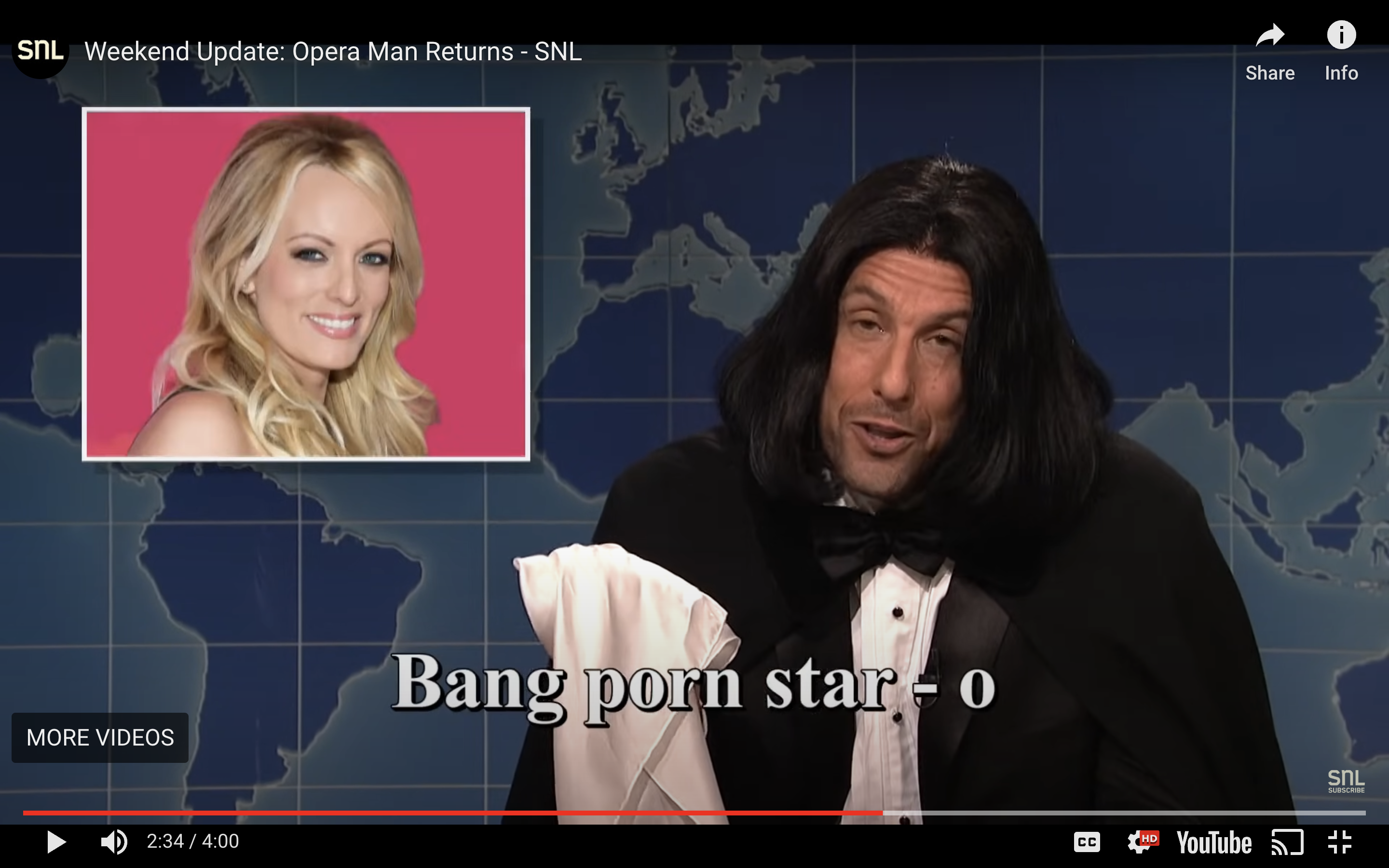
Let me come clean. I have loved Sandler’s work since he and Chris Farley were regulars on Saturday Night Live. In the 1990s as the designated ticket buyer at the University of Toronto’s Drama Centre who would make arrangements for tickets to the Canadian Opera Company’s dress rehearsals for classmates & colleagues, I used the alias “Operaman”, aping Sandler’s character from SNL. My emails made reference to the guy in this video from SNL.
While Sandler’s Operaman was created during his tenure on SNL between 1990 and 1995, he recently came back to advise Joe Biden how to win the presidency. In his usual rhyming couplets, Operaman said
“Joe for this you won’t go far-o To win white house You need to bang porn star-o.”
Sandler’s career reminds me a bit of Eddie Murphy, another comedian whose huge output includes both great work and outings of lesser quality. It’s hard to reconcile the brilliance of Murphy’s Oscar nominated work in Dream Girls or his voiceovers in the Shrek series, with his silliness as The Nutty Professor.
Adam Sandler is just the latest in a long series of comic actors migrating into more serious roles. I offered an opinion about this recently on Facebook, in reply to a post about Hollywood hiring English actors. I said (in response to disrespectful comments about Kenan Thompson): “Kenan was especially brilliant this past week (the Ryan Gosling episode). Perhaps instead of saying that what he does isn’t acting it might be more accurate to observe how influential improv has been upon cinematic acting over the past half century: 1- changes to how films are written since the time of Robert Altman incorporating improvisation into the performance 2-comedians standing tall as actors (Robin Williams , Tom Hanks & many more I could name) 3-de-emphasis of stage acting chops except in period films where it lends a lustre to the project Scripts ain’t what they used to be, meaning that the writing process has been transformed and as a result, the way actors work is now different. Critics and pedagogy (acting teachers, film teachers & writing teachers) tend to take ages to catch up to the reality in the field.“
The last half-century of film-making includes so much improvisational performance that comedians had a natural advantage. The shift has been so profound that when I name performers from comic TV & film who seemed adept at improv work, we may question whether they’re really comedians.
I first saw Jonah Hill and Emma Stone in the comedy Superbad (2007), along with Bill Hader and Seth Rogen. Does anyone think of Stone as a comedian? Probably not.
Comedy continues to be disrespected as a lower form, echoing a centuries old class distinction elevating tragedy above comedy. Academy Awards are merely the most recent instance. Was Oppenheimer really a better film than Barbie, or is it simply this ongoing assumption that serious topics are somehow better, that comedy is less important..?
Sometimes the actors came from standup (Tom Hanks, Robin Williams, Whoopi Goldberg) sometimes situation comedy (Jackie Gleason, Lucille Ball, Mary Tyler Moore, Steve Carell, Woody Harrelson) sometimes sketch comedy (Peter Sellars, Catherine O’Hara, Bill Murray, Michael Keaton, Lily Tomlin, Eddie Murphy, Mike Myers). I’m only scratching the surface.
Speaking as a critic I’m aware that in taking Adam Sandler seriously as an actor I may be out of step with other critics, but it wouldn’t be the first time. In 2020 when I was in NY, Zoe and I went to see Uncut Gems, I remember there was a bit of surprise at how well Sandler did in a film also starring Judd Hirsch (speaking of actors coming from comedy).
Film, opera, theatre and concerts entail two parallel interlocking tracks, each hugely important in the outcome. On the one side there’s the purely artistic conversation, the directors and writers and designers working with actors and cinematographers. But before any of that happens there’s another stream, the curatorial stream where producers and programmers decide what pieces to put into the concert program, what operas to put into a season, what artists to hire for roles in the opera or play or film. First someone has to decide the shape of the project, by hiring writers, seeking out directors and actors. It’s hard to know which is the chicken and which is the egg, given that a Judd Hirsch or a Carrie Mulligan or an Adam Sandler may be brought into a project before or after the concept takes shape. The flexibility of performers who can improvise surely makes them attractive for producers.
I don’t hate Spaceman but (surprise surprise) I don’t think Spaceman is Adam Operaman’s best film. You can decode / evaluate this opinion via my Sandler touchstones, the films I’d consider his best. While I mentioned Uncut Gems (2019) back in 2020, it’s a bit like Spaceman in its departure from the usual Sandler toolkit, although yes Sandler is very good. But –sentimental beast that I am– I was far happier with Deeds (2002), an update of the Frank Capra classic, or 50 First Dates (2004). The question is messed up by the fact that Sandler is not just an actor but sometimes a writer as well, as in Waterboy (1998), and You Don’t Mess with the Zohan (2008). Also fun (acting without writing) are the remake of The Longest Yard (2005) and Spanglish (2004).
Yes I often like Sandler’s work although there are several films I can’t stand such as Little Nicky or Big Daddy.
If I have to pick a favorite it must be Anger Management (2003) featuring superb work from Marisa Tomei and Jack Nicholson, including some of the best versions of Leonard Bernstein’s music that I have ever heard.
I got some bad news today, when Peter at Seraphia informed me that he will have his last day Saturday April 27th.
I can’t properly capture what his Scarborough gourmet shop has meant to me and my family. I’ve been a caregiver to a family member who ate some amazing meals thanks to Peter’s good taste. Do I suddenly have to learn how to cook? Maybe.
I understand that the reason he’s leaving is because the new lease would mean a big rent increase. Perhaps he’ll find a new location somewhere else, although I fear he’ll simply pack it in. The kids from RH King, the brave guys from the nearby firehall, and those of us who live in the neighbourhood will all have to get by without his lasagna, his muffins, his spanakopita, his quiches, his sister’s baklava, his poutine, his burgers, his breakfasts…. And so many other things like salads and cole slaw and Greek salad and Caesar salad. Sigh.
And we’ll miss his personality and the Q107 accompaniment.
Ave atque vale or as the Romans used to say: hail and farewell.
It’s the morning after seeing My Little Brony: The Musical. The music was great, and we laughed a lot. It’s a delightfully enjoyable play.
Cecil (Graham Conway) and Maxim (Nathaniel Bacon)
I went into it thinking about reviews and critics, wondering how I would approach a new musical, with music (songs, piano & music direction) by Stewart Borden at the electronic keyboard.
Composer, music-director and keyboardist Stewart Borden
While I feel confident writing about music I wanted to be careful approaching the play’s subject. My Little Brony: The Musical celebrates a relatively new but obscure subculture about which I know next to nothing.
The book, lyrics & direction are by Sky Gilbert.
Professor Emeritus Schuyler Gilbert
I see in his bio that Sky is now a Professor Emeritus. As someone who used a senior ticket to get in yes, time is flying by. And the prolific Dr Gilbert has another book about Shakespeare coming in the fall so I will have to chase that down, subject matter for a future review.
Critic #1 is George Bernard Shaw who said that although he could not lay an egg yet he was a good judge of omelette. As I’ve never read a review or a play by a chicken maybe GBS can be forgiven for thinking he was a better writer than any chicken.
Critic #2 is CS Lewis, bemoaning reviewers who are not lovers of a genre. I’m going to quote this big chunk of text from a piece titled “On Science Fiction“.
Of the articles I have read on the subject (and I expect I have missed many) I do not find that I can make any use. For one thing, most were not very well informed. For another, many were by people who clearly hated the kind they wrote about. It is very dangerous to write about a kind you hate. Hatred obscures all distinctions. I don’t like detective stories and therefore all detective stories look much alike to me: if I wrote about them I should therefore infallibly write drivel. Criticism of kinds, as distinct from criticism of works, cannot of course be avoided: I shall be driven to criticize one sub-species of science fiction myself. But it is, I think, the most subjective and least reliable type of criticism. Above all, it should not masquerade as criticism of individual works. Many reviews are useless because, while purporting to condemn the book, they only reveal the reviewer’s dislike of the kind to which it belongs. Let bad tragedies be censured by those who love tragedy, and bad detective stories by those who love the detective story. Then we shall learn their real faults. Otherwise we shall find epics blamed for not being novels, farces for not being high comedies, novels by James for lacking the swift action of Smollett. Who wants to hear a particular claret abused by a fanatical teetotaller, or a particular woman by a confirmed misogynist? (and he says more: On Science Fiction)
I quote Shaw and Lewis because I see them as two poles in the critical conversation. I’m a swooning admirer of Lewis, having heard JRR Tolkien’s claim ( quoted from Town and Country) that “but for his interest and unceasing eagerness for more, I should never have brought The L. of the R. to a conclusion”. In addition to Lewis’s splendid writing this is what a critic needs to do, namely help another artist on their creative path.
I am more of a skeptic about Shaw and his criticism, fearing he might sometimes mistake composers & artists for barnyard creatures, talking down to us from his lofty height.
You will notice I say “us” as a practitioner (singer, keyboardist, composer), but feel I should also include Pierre Poilievre’s words in the discussion. On This Hour Has 22 Minutes last week he was quoted as saying “Those who can’t become critics”, which might be conventional wisdom. Whichever pigeonhole seems right for me, I’m enjoying this process of writing about operas, musicals, plays and concerts.
If PP might also say “those who can’t act become drama teachers…” we know who he would have in mind.
The most famous drama teacher in Canada
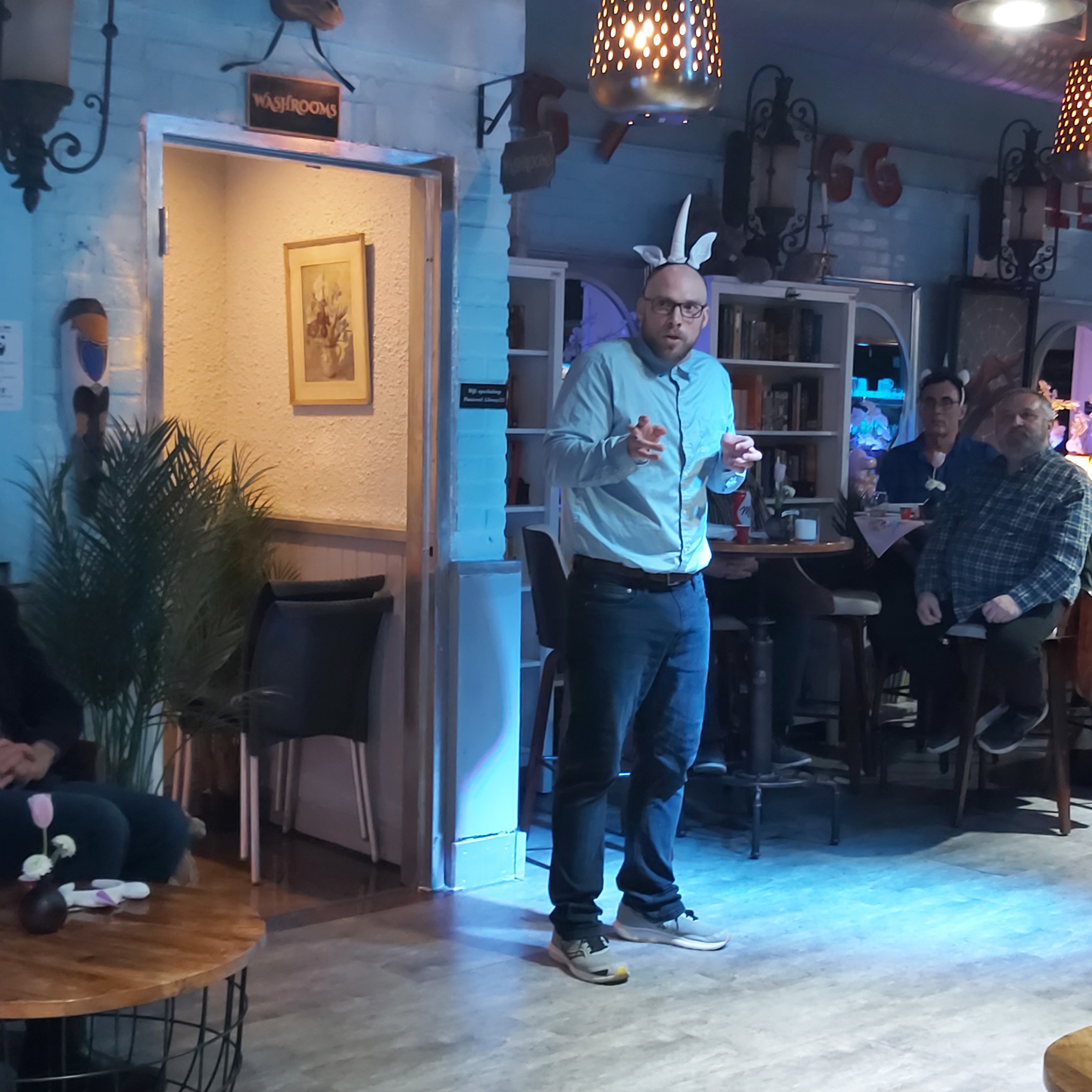
The show was presented in an intimate performance venue at the Epochal Imp.
Maxim’s (Nathaniel Bacon) first entrance gives you some idea of the space. photo: Lissa Bobrow
My hesitancy about being a critic includes fear of using the wrong label for Epochal Imp, a newly opened space on Danforth close to Broadview, a safe and welcoming space. They offer coffee, beer or cocktails, standup comedy, live music, Tarot readings as well as currently hosting the new musical. There are three performances remaining, Tuesday, Wednesday & Sunday next week, April 16, 17 & 21 and note that it starts at 7:00 pm each night.
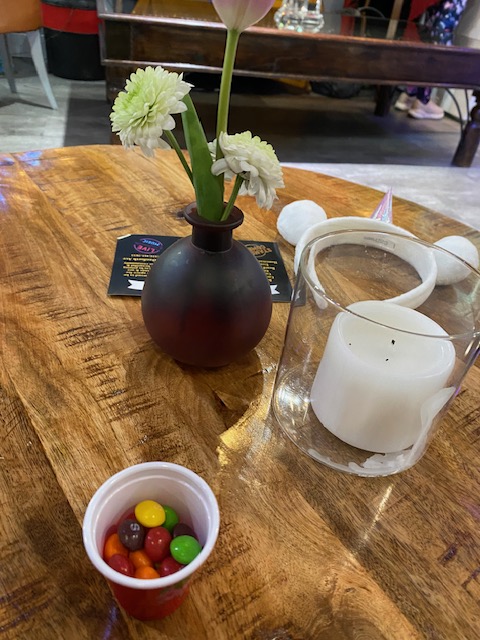
There’s a stage plus the entire space down the middle. We were offered comfortable seating, including a cup of skittles and a cute unicorn headband that many in the audience chose to wear.
Lots of seating was sacrificed to give us an immersive experience of songs right in front of us. That can’t be easy. My big mouth was tempted to speak when my eyes locked with a performer 5 feet away from me, but I stifled my subversive impulses.
I invited my friend Greg along, worried that I might not understand the implications of Bronies (the male followers of the My Little Pony cartoons / films: bro + pony = brony), but Sky and his team made this a welcoming experience for anyone regardless of their background. Sky has a gift for writing dialogue. While the exposition of the story is slow enough for a newby (moi) it’s still sufficiently absorbing to keep everyone intrigued. Greg was guffawing as much as I was. And the tiny venue helps, as there’s a great deal to take in when the whole show is physically close to you.
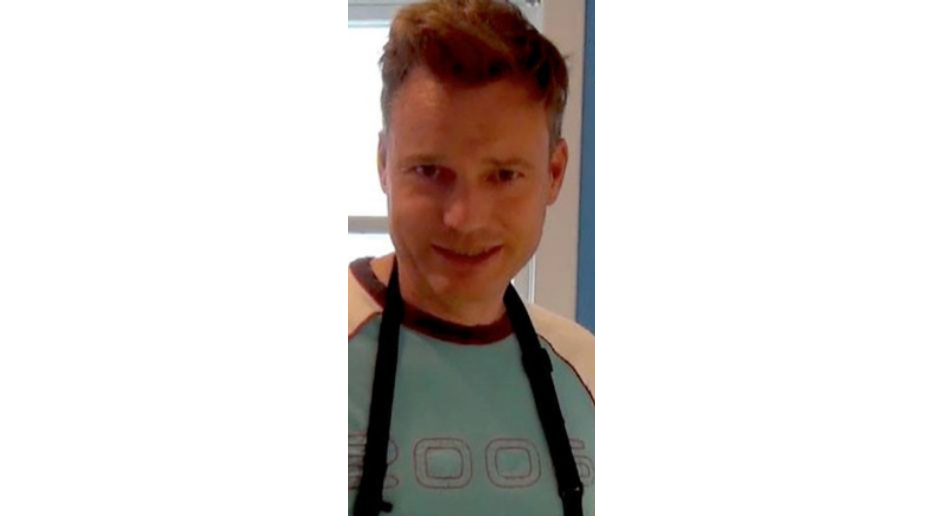
Greg and I agreed that the music was the best thing in the show, which is why I wanted to lead with a picture of Stewart rather than Sky. Full disclosure, I altered a picture I found on Stewart’s facebook page, that shows another aspect of his busy life including a book he published several years ago.
The songs do the thing we want them to do in a musical, namely to go where words cannot go. Maxim (Nathaniel Bacon) is especially aided by his music, as there is a great deal that is deep under the surface, gradually emerging musically. When we first meet Maxim he’s a shy quiet computer nerd, at least until he starts to sing, warning us of the inevitability of A.I. I believe Cecil (Graham Conway) has a bigger part as far as lines and stage-time are concerned, although I don’t believe his music is as challenging. Cecil is a very believable 19 year-old, a student animator planning to study at a community college.
Stewart’s song-writing and keyboard work are impressive, at times dazzling. Yet if anything the musical element is understated and could stand to be drawn out further in the next version of this show.
The program says “My Little Brony: The Musical is the first draft of a musical we are hoping to develop into a full length piece (this musical has, at its centre, a “road adventure“).
When we see Cecil get into Maxim’s car, it’s the first part of what’s likely to be a much longer trip in the next iteration.
Cecil (Graham Conway) and Maxim (Nathaniel Bacon) photo: Lissa Bobrow
The roughly 70 minutes flew by, leaving us all cheering at the end.
Last night’s brilliant concert at Roy Thomson Hall from the Toronto Symphony was improved by the introductory remarks from Music Director Gustavo Gimeno, explaining his unorthodox choices.
TSO Music Director Gustavo Gimeno (Photo: Allan Cabral)
The concert may have been titled “R Strauss’s Don Quixote” but Gimeno explained that the program was built around the North American premiere of Samy Moussa’s Trombone Concerto. The composer felt his new piece would work with Wagner or Strauss so we got both composers last night.
The program consisted of four pieces: 1) Lontano by György Ligeti 2) Prelude to Act I of Parsifal by Richard Wagner 3) Concerto for Trombone and Orchestra “Yericho” by Samy Moussa –intermission– 4) Don Quixote by Richard Strauss
Composer Samy Moussa
Moussa’s concerto is a tonal piece full of big sweeping phrases for a huge orchestra, romantic in its implications. I even wonder whether Moussa understood this seven movement work titled “Yericho” to be at some level a kind of “program music”, perhaps telling a story. I say that even though we were not really given a program, at least not in the sense of what Strauss did telling a version of Cervantes’ Don Quixote through orchestral means. I wonder if it matters, given that one can enjoy a piece even without knowing the composer’s subtext(s). The TSO’s notes tell us that Yericho is a work touching upon symbols such as the use of seven movements, seven horns (if we include the trombone soloist plus the four horns and two trumpets), as in the Biblical Book of Joshua.
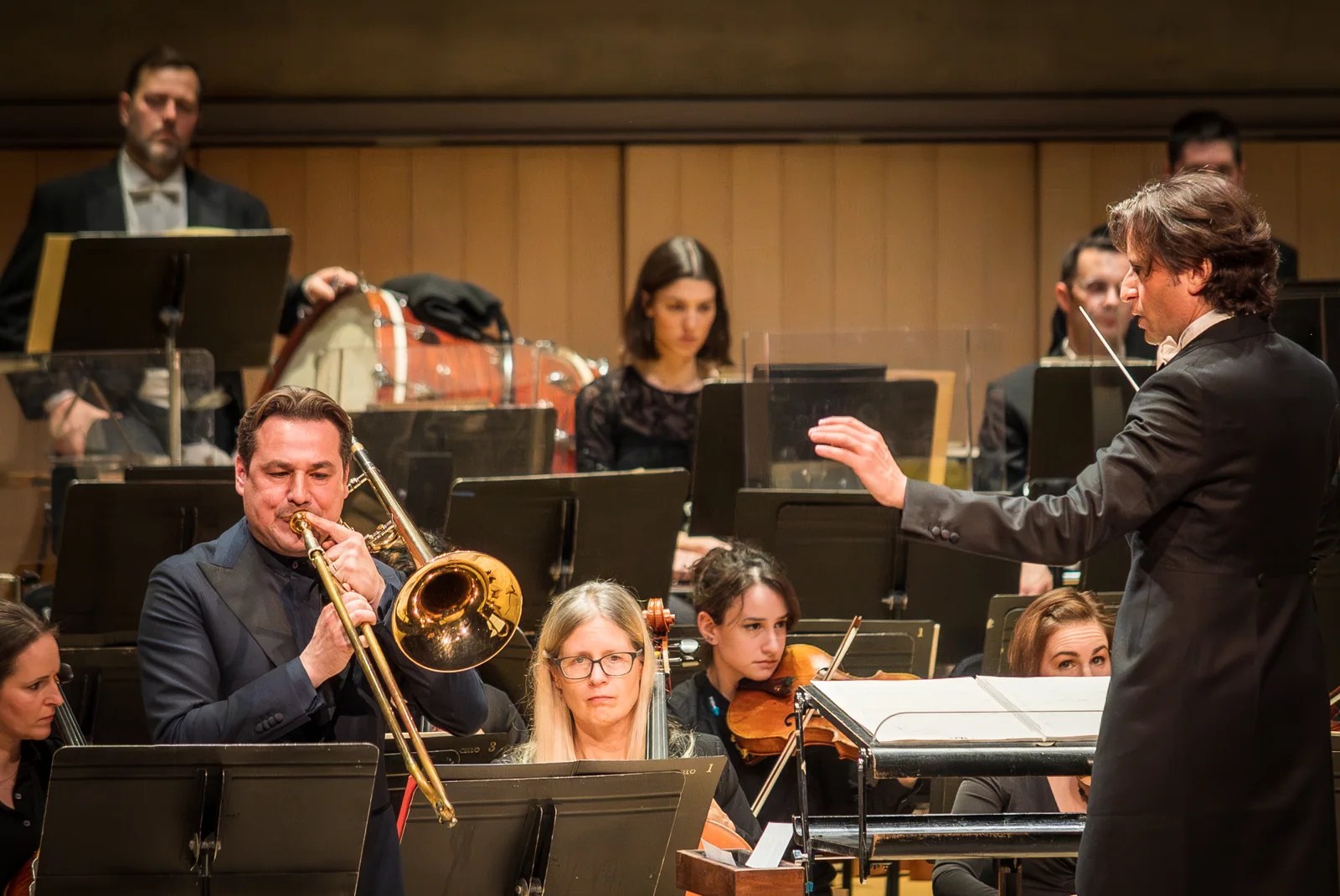
For what it’s worth, whatever the intended meanings that Moussa may or may not have meant to convey, his concerto is gripping, its first and last movements pulsing with urgent repeated figures shared through parts of the orchestra, slower sections of great beauty, and a phenomenal display of virtuosity from the trombone soloist Jörgen van Rijen. The audience responded to the dramatic power of Moussa’s vision and the brilliance of van Rijen. I hope to hear the piece again.
Trombone soloist Jörgen van Rijen and TSO Music Director Gustavo Gimeno (Photo: Allan Cabral) & members of the orchestra
And so I’d say “mission accomplished” as far as Gimeno’s desire to frame Moussa’s trombone concerto in a sympathetic context, all while employing a comparable contingent of players in the other pieces given the large orchestra required for the concerto.
The TSO again chose to showcase talented soloists from the orchestra. Don Quixote is a set of variations that features Joseph Johnson principal cellist of the TSO almost as though portraying the Don. Rémi Pelletier viola, with assistance from bass clarinet and tenor tuba give us Sancho Panza, often debating with the Don.
TSO Principal Cellist Joseph Johnson (photo: Allan Cabral) and members of the orchestra
Before he turned to opera in the 20th century Richard Strauss had a successful career composing orchestral music in his youth. With each subsequent creation, from Aus Italien to Macbeth, to Death & Transfiguration, then Till Eulenspiegel and Also Sprach Zarathustra displayed Strauss’s unique ability to tell stories and paint detailed pictures with orchestra. For me Don Quixote was the peak, given that some of the others such as Ein Heldenleben, Sinfonia Domestica and the Alpine Symphony suggest a colossal ego. But long before Strauss gave us that sublime final trio in Der Rosenkavalier, he was already capturing deep emotions in his tone poems. I find the concluding minutes of Don Quixote every bit as stunning as anything in his operas, especially when played with the subtlety of Gimeno and Johnson. The version I long admired on vinyl from Pierre Fournier’s cello with George Szell leading the Cleveland Orchestra has a more heavy-handed approach to the comedy, the gags in the orchestra sometimes landing like vaudeville schtick. Gimeno and Johnson gave us something more sophisticated, subtler. When we came to the gentle final solo when the Don dies, fading away with a gentle barely audible glissando downwards, I cried. At the conclusion of the piece the audience sat silently for a very long time before anyone applauded.
The TSO are playing at a high level right now, especially in a work like the Strauss where every section gets their moments to shine, responding to Gimeno.
I feel lucky that we again get to hear music of Ligeti. Just last week Esprit Orchestra’s Violinissimo II featured the violin concerto that we had heard from Jonathan Crow and the TSO back in October. Maybe I shouldn’t jump to any conclusions as to whether Gimeno loves Ligeti, but I’ll never complain when his challenging scores are offered to us.
Gimeno again paired Ligeti with a grail-themed Wagner prelude, played without a pause between them. Last season we had the magic of Atmospheres plus the Lohengrin prelude, done without a break. Audiences were silent, hypnotized. This time it was Lontano and Parsifal casting a spell on listeners. Lontano might be meant to literally show us something that seems to be far away (as in the title), the softer passages seeming to be distant.
I recall (a morning after addition) how Gimeno spoke of the Parsifal prelude as the “Vorspiel”, in his charming accented English employing the German word that appears on the page. How many languages does Gimeno have to speak, as he conducts in Toronto and elsewhere, an intercultural ambassador bringing together the Hungarian expat (Ligeti) and the German (Wagner), here for a Toronto audience..? I pulled out my Parsifal piano-vocal score to photograph that first page, as Erika remarked at the stunning patterns of arpeggiated notes that you see rising upwards like the music and indeed like the associated spirit Wagner chased. Roy Howat sensitized me to the design element on the page, the beauty of the patterns. Our ears were especially sensitive to this after the remote far-off sounds of the Ligeti, everyone leaning forward.
I recall professor Godfrey Ridout telling a story in an opera class, how Mad King Ludwig of Bavaria demanded a performance of first the Lohengrin and then the Parsifal prelude, infuriating Wagner by declaring Lohengrin’s prelude to be better. How extraordinary that we have had a pair of parallel performances from Gimeno and the TSO. Lohengrin’s prelude is shorter, a miniature version of the opera’s plot represented in music, while Parsifal’s prelude is more complex. Coming a few days after Easter it’s timely, a piece many of us listen to as a nod to the season. As we await the long-promised Parsifal production from COC I wonder if Gimeno wants to conduct this opera. Of course COC resident Music Director Johannes Debus has led their Wagner operas in the past.
The concert is repeated Saturday night at 8:00 pm. I recommend you go if you can make it.
TSO Concertmaster Jonathan Crow, Principal Cellist Joseph Johnson & Music Director Gustavo Gimeno (photo: Allan Cabral), and members of the orchestra
Thursday March 28th Esprit Orchestra led by their artistic director and conductor Alex Pauk presented Violinissimo II at Koerner Hall.
The program leant heavily on soloist Mark Fewer in a pair of big works, playing solos for over an hour in total.
The Four Seasons Recomposed (2012) is still a violin concerto in Max Richter’s intriguing hybrid, employing Esprit Orchestra, a harpsichord and subtle electronics to revisit Vivaldi’s classic. It should not be thought of as an adaptation so much as something closer to a new work re-framing elements from the original, sometimes playfully sometimes irreverently. Given Esprit’s identity as an ensemble commissioning and playing newer music, it was a gently tonal accompaniment to the more dissonant pieces from György Ligeti that followed after intermission.
Violinist Mark Fewer, Conductor Alex Pauk, harpsichordist Wesley Shen and members of Esprit Orchestra (photo: Karen E Reeves Dragonfly Imagery)
We hear passages played with a different time signature, a quaver missing to throw off the accent ever so slightly. We hear familiar violin passages from Vivaldi but with the orchestra doing something unlike what Vivaldi would do, whose orchestra usually matched the soloist. In places it resembles pop music, something I say without meaning any disrespect to Richter. Considering how ubiquitous the original has been, I suspect it’s a deliberate choice from the composer to make something new even while suggesting a seminal connection to other musics. As a result it feels very much like a new piece employing known elements. Yet we don’t go quite as far as anything we’d call post-modern or deconstructive, because the reassuring squareness of the baroque elements are mostly preserved, the harmonies rarely venturing far from what Vivaldi did. It might be understood as a sort of neo-baroque, the orchestra sometimes in repetitive patterns underpinning the solos in ways that I think Vivaldi could have understood and even approved. Overall it’s music that is entertaining, fun, a delight that I’d like to think is still true to Vivaldi.
Before we came to the second big violin concerto on the program we were offered a delicious contrast in the person of soloist Wesley Shen, playing Ligeti’s Continuum (1968) for solo harpsichord. I’m happy to be able to share a performance by Shen on YouTube to give you some idea of what we heard, four intense minutes of keyboard virtuosity between two huge violin concerti.
The concluding piece, Ligeti’s Violin Concerto (1990-2) is where I had the notion of calibrating. October 26th I posted a review of Jonathan Crow playing the same concerto with the Toronto Symphony at Roy Thomson Hall, almost exactly five months ago. It’s rare that we get an opportunity to hear a piece that isn’t programmed very often so soon that it’s still in my mind, to be able to make a comparison.
It may seem obvious to say some of this, but a violin or an orchestra sound very different in the intimacy of Koerner Hall, after hearing the same piece in the generous space of Roy Thomson Hall. All the relationships are different. Fewer’s violin sounded immense and heroic among the orchestral players of Esprit, whose sound is sensual and immediate. It doesn’t matter that for example Crow and Gustavo Gimeno managed hyper-precise synchronization of the challenging moments when the violin and percussionist hit abrupt and seemingly unpredictable loud notes at the same moment, while Pauk and his percussionist didn’t always hit exactly with Fewer. So what. If the TSO experience was sharp as a diamond, this one was warm and sensual. The effect is so totally different, I’m glad I was able to have both experiences. I felt more drama in Roy Thomson Hall, while Fewer’s trip through Ligeti’s concerto was more laid back, as if it managed to carry over some of the fun from the Vivaldi & Shen’s harpsichord solo. Maybe it’s all in my head, but where I felt the TSO was being outrageous & blunt, the Esprit take on Ligeti felt more conventional, as though this were just another concerto.
Then again it might be the mood I was in, loving the ambience at Koerner and the enthusiasm of the music-making. In four weeks time Esprit will be back Thursday April 25th with John Adams’ Harmonielehre (1985) and R Murray Schafer’s Adieu Robert Schumann (1976) to be sung by Krisztina Szabo.
Violinist Mark Fewer, Conductor Alex Pauk, harpsichordist Wesley Shen and members of Esprit Orchestra (photo: Karen E Reeves Dragonfly Imagery)
On April 7th the ARC Ensemble present a concert “The Viennese in Los Angeles”, a happier title than what they might choose to call it, from composers in exile.
In the promotion for the event we’re told that for the concert the ARC Ensemble “performs Erich Wolfgang Korngold’s extravagantly lush Piano Quintet, and works for string quartet and clarinet by his Viennese contemporary Ernest Kanitz. Both settled in Los Angeles during the 1930s, where Korngold became the most celebrated film composer of the day and Kanitz became a legendary teacher at the University of Southern California.”
By a funny coincidence, Kanitz’s birthday is April 9th (right after the concert), and the date of his death is April 7th (the date of the concert). This little factoid is all I know about Kanitz, having googled him. I admire the work done by the ARC Ensemble, helping to advance the lost or under-valued music of exiled composers that might otherwise be forgotten. I raved about their recent CD of the chamber works of Robert Müller-Hartmann, especially the Three Intermezzi and Scherzo Op 22 played by pianist Kevin Ahfat, who sent me a pdf file of the pieces. It’s a tiny glimpse of the complex task faced by the ARC team and their artistic director Simon Wynberg finding composers whose music has been suppressed or lost. The hand-written score is not always easy to read on the page. The poignancy of this struggle to bring lost music to the public is underlined by the hand-written manuscript, brilliantly played by Kevin. No wonder music such as this from composers running for their lives might vanish.
I notice that the night of April 7th they plan to show Robin Hood, although I have to say I’m sad because I believe it’s the wrong film to show. In placing Korngold in the context of the exiled artist, what could be better than music from a film that shows refugees and oppression? Yes Robin Hood is a good film, so are Sea Hawk and a number of other films. But there’s one film that actually addresses refugees and exile explicitly. I think it’s largely under the radar because most people don’t think of it as Korngold’s composition, nor do they notice any refugees in the film.
In 1934 Max Reinhardt directed a production of A Midsummernight’s Dream at the Hollywood Bowl, including extensive use of the music of Felix Mendelssohn. Reinhardt’s student William Dieterle acted as translator for Reinhardt when Warner Brothers filmed it, a prestige project for a studio known for gangster pictures. Korngold arrived in Hollywood in time to work on this his first film in America.
I grew up thinking of this as the funny film with Mickey Rooney, Joe E Brown and James Cagney, without taking it seriously. Only later did I change my viewpoint.
There are two large ballet sequences in the film that employ Mendelssohn’s incidental music for the play, but not precisely as originally written. The first is when we first meet Titania and her faeries, including a mysterious introduction that’s Korngold’s music, followed by arrangements of Mendelssohn. The second and much darker sequence comes after Oberon has successfully snatched the changeling boy as Titania sleeps beside Bottom as he wears an ass’s head.
Reinhardt, Korngold and Mendelssohn were all Jews. So that’s the official reason that this film would be banned in Germany during the war. Perhaps another reason the Nazis banned the film was because of the scene I’m about to describe.
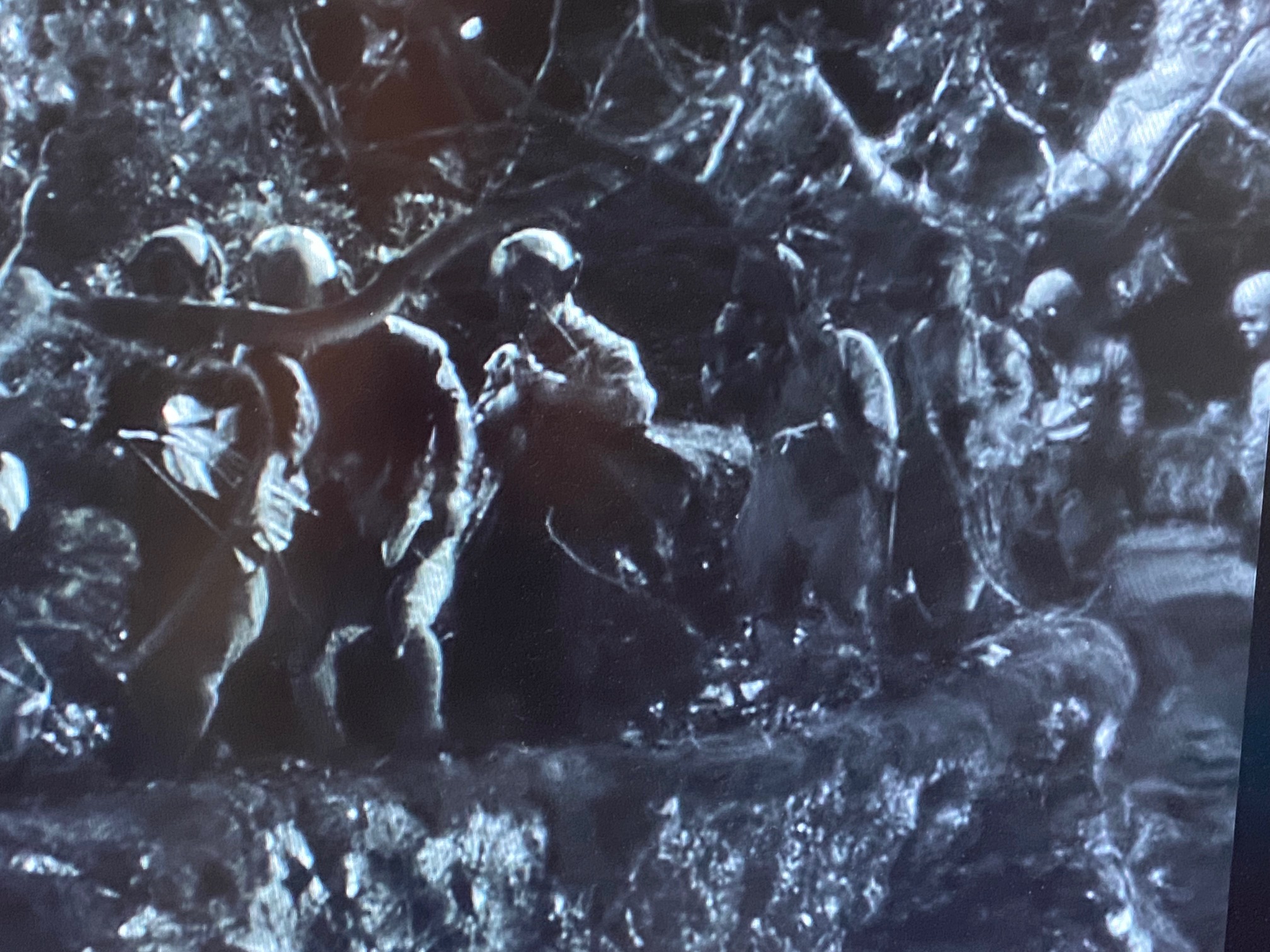
This ballet sequence begins with the dark shades of Oberon’s retinue flocking over the hill. They enter to music that sounds a lot like Wagner. Korngold composed the opening fifty seconds of the segment that segues into the Nocturne. I’ve captured this segment on my iPhone from the DVD because it’s no longer on YouTube. The absence of this extraordinary piece of film from YouTube shouldn’t surprise anyone (even though it surprised me), given that it’s been largely forgotten.
The opening 50 seconds, before the Mendelssohn Nocturne begins
I didn’t get it at first. My brother Peter pointed out that we were watching refugees. The shades are oppressive bullies, forcing the light-coloured faeries who surround Titania to flee. They don’t have any weapons but they’re overpowering all the same.
In addition to the faeries, we see the elven musicians, who are also being forced to leave by the dark shades.
In short order we’re watching everyone onstage being pushed to leave, becoming a stream of refugees, fleeing slowly before the oppressive dark-clothed shades.
We also see Oberon in a charismatic attitude, the camera looking up at him. The changeling boy stares up in adoration.
And the shades surround Oberon as though he were their Fuhrer, their worshipful adulation impossible to miss.
Whether or not Reinhardt actually saw Triumph of the Will, Leni Riefenstahl’s 1935 film, he would surely have known of events such as the 1934 Nuremberg rally by the Nazis. The echo is unmistakable.
I don’t believe anyone was making cinematic references to the Nazis as early as 1935. Most of the film is simply Shakespeare via Hollywood.
For more information about the ARC Ensemble concert click here.
Every year in the aftermath of the Academy Awards I’m left wondering how they do it. Yes I should be in awe of the creations: but I was speaking of the awards process. Why this film and not that one? and why suddenly a stampede towards one film?
Why has Danny Elfman (whose work I love for films such as Good Will Hunting, that we re-watched on the weekend) never won an Oscar, while Ludwig Göransson has now won two Oscars before the age of 40 (he’ll reach that milestone in September). I loved his work on Black Panther but did not agree with his win for Oppenheimer. I can’t lose sleep about it given that every year there are awards that drive me a bit nuts.
I again muse on the process as I speak of an even younger composer. I’m especially fascinated by the work of Jerskin Fendrix, who isn’t even 30 years old yet.
Composer Jerskin Fendrix
Fendrix scored Poor Things, scoring an Oscar nomination for the film. “Score” is the perfect word, don’t you think?
And I see that Fendrix has also scored Kinds of Kindness, a new film to be released soon, reuniting his Poor Things collaborators Yorgos Lanthimos, actors Emma Stone and Willem Dafoe. Don’t be surprised if some in that group are again nominated, although I don’t understand how Dafoe was ignored this time, anymore than how Martin Scorsese could again be snubbed, having seen online that his last four films received 26 nominations but zero wins. And alongside Dafoe, why wasn’t Leonardo DiCaprio nominated? Or perhaps what I should be seeking is the pattern explaining the politics of wins & losses. If I could figure that out perhaps there’d be no surprise, less pain. Every year I’m not so much baffled as disappointed, hurt, upset.
In fairness some wins make total sense in hindsight. The pair of songs from Barbie can be seen as yin & yang, male and female principles captured in song. Billie Eilish’s delicate barely audible song “What Was I Made For” so sad in its existential doubt as a thing, a plastic toy suddenly realizing its true nature, in contrast to the garish and simple-minded construction of “I’m Just Ken.” Of course, in a year when the director of Barbie was being snubbed, they would have to throw the film a bone, and that would be via Billie Eilish. But wait, that’s suggesting that the Academy is some sort of monolith that deliberately snubs or rewards, when it’s actually an electorate of members making choices, some really good and more than a few really frustrating.
While Terry Gilliam’s Adventures of Baron Munchausen received four nominations in visual categories (art direction, costumes, visual effects and makeup) nobody seemed to notice its extraordinary score by Michael Kamen, possibly the most impressive score I’ve ever encountered. At its core it is essentially a set of variations on a theme taken from a song from the depression-era about cheering up in spite of our poverty, in keeping with the madness of Maggie Thatcher’s Britain that frames the film.
The original song is from Irving Berlin. Notice the italicized words of the refrain: “let’s have another cup of coffee and let’s have another piece of pie“.
Now here’s The Baron’s main theme, which comes from that song, beefed up with Handelian pomp and brass. It’s heard at the beginning of the film and at the conclusion.
It’s a lot like Richard Strauss’s tone poem Till Eulenspiegel. In both the Strauss and Gilliam’s film we’re watching the adventures of a character in a series of variations, and brilliant orchestrations. When the Baron is in danger, the theme is suspenseful and in a minor key. When he dies there’s a miniature Requiem Mass for him (complete with chorus).
It ends with the voiceover of the Baron telling us how much he recommends death as something we should experience, and the immortal story-teller fabulist is back, miraculously.
I’m also reminded of Kamen’s score for The Baron because, while somehow in 2024 young Fendrix broke through to get a nomination (and a win in BAFTA), Poor Things won three of the same oscars as the Baron (costumes, makeup & production design).
Maybe the key to having your music recognized & appreciated is eye candy.
And speaking of eye candy, as in Kamen’s score for the Baron, there’s a show-stopper of a dance sequence.
Here’s the one from Kamen, featuring John Neville and Uma Thurman. Please note: the youtube example I’m sharing takes Kamen’s music, likely from the soundtrack album, matching it with the actors in the right sequence of the film but without the dialogue that we should be hearing (their lips move without hearing their words). Sorry it’s the best I could find.
I have to think that director Gilliam must have liked this idea of a dance, given that he imitates his moment in his next film The Fisher King, with a different composer. But it’s nowhere near as interesting.
And wow here’s the one from Fendrix, featuring Mark Ruffalo and Emma Stone. Notice that among the steampunk magic of this film there’s even a new musical instrument with an attempt to create its original sound.
What would that instrument (seen roughly 27-28 seconds into the clip) be called? I wonder. I love that the music-making is integrated into the production design, representing so much more than just underscoring, as we saw with the surreal team of Kamen and Gilliam previously for Brazil & The Baron. This kind of dance is an integral piece of the film, telling us more about the characters.
If you’ll forgive me, I want to zero in on the music. In the film music classes I taught I used to enjoy playing the Psycho shower music without the visual so that students would actually hear what Bernard Herrmann had created. Let’s listen to the dance music without the distraction of the visual.
I found Fendrix’s Winterreise (2020) on YouTube, a fascinating mixture of sounds & musical moments. Has he come a long way? yes, although this album is already full of bold and original moments. While it may sound like a do-it-yourself project, he’s so young, right? And that sense of being clever and original is precisely what’s so appealing in his film-score.
No it’s not Schubert (who wrote a song cycle of the same name and come to think of it at the same age), but the title is still a fascinating choice.
Fendrix is still as direct & clean as this in the film-score, amplified by the astonishing visuals from Lanthimos and his team.
While I continue to be puzzled by the mysterious Oscar process, pleased yet often frustrated, I’m mollified somewhat after watching Poor Things, seeing that there’s lots to celebrate in this film. And now I’m eager to see and hear what Lanthimos & the young Mr Fendrix (as well as Stone & Dafoe) can do in Kinds of Kindness, scheduled to be released on June 21st. I can’t wait.
Sometimes interviews are just a series of obvious questions designed to publicize an artist and their work. I’m happy to play that game. But there are times when I’ve been fascinated by what I’ve seen from an artist, my curiosity aimed at finding their secret, encouraging me to interview them.
Maghan McPhee is one such person, a singer, teacher and entrepreneur whom I’ve observed since she was a very young voice student. I may be much older but from the first she seemed very mature beyond her years, very clear in her goals & objectives. She recorded a very impressive CD a decade ago.
I have heard that she started BIIMA, a summer program in Italy for artists. And soon Maghan will be singing and recording in my part of the world with our Scarborough Philharmonic next month and returning again next year.
I needed to find out what makes her tick, how she does it.
BB: Are you more like your father or your mother?
Maghan McPhee Oh this is such a good question. I think I look and act like my mom and her side of the family. My mom and her family should all be opera singers. They are expressive, hilarious people. The volume with which they speak is at a very high decibel level, even when they’re happy! My mom comes from a family of 11 children, hence the need for all of them to speak up. I grew up having a lot of influence from my mom, her sisters and my grandmother and I took on their way of expression. They wear their hearts on their sleeves and I think it’s the most honest way to live. It takes so much ENERGY to try to be something other than ourselves and put on a mask to fit in. I tried that for a long time without realizing it and it was exhausting. I’ve been described as “intense” on several occasions. I realize that it’s not a compliment, but I’ve come to see it as one of my superpowers.
My dad is such an industrious person. He built a really successful business from nothing and is now enjoying retirement. I’m so proud of what he’s done and what he dreamed for himself and for his family. We (myself, my 2 kids and husband) are actually visiting them at their home in Florida currently over the March break. I’ve always felt like the black sheep in my family, because I didn’t pursue a career in the family business like my brothers and their partners, in Timmins, Ontario.
About a decade ago, I started to see that my path wasn’t going to be like others in my world, as I wanted to begin my family and change what I was doing. I began to think more like a business person, conferring with my dad quite a bit, while understanding that I can also build something from nothing, in a very different way than he did: BIIMA. I didn’t need to follow the typical path of an opera singer and I could find a way to create a business out of my passion.
Maghan McPhee, soprano & teacher
BB: And in a moment I will ask you to tell us more about BIIMA. But first, what is the best or worst thing about what you do?
MM: The best thing about what I do is that I am helping my students listen to their inner voice, discovering their unique gifts to unleash their true sounds. I love being a detective to help the students find their sound. It’s incredibly rewarding and it’s what gets me excited to start my day every day. I went through quite a vocal struggle in my twenties and worked so hard and spent a lot of time (and money!) on working with the best in my field to figure out what was going on. I truly went from having a very easy, natural ability…
BB I remember. You had an amazing sound.
MM: I went from having an incredible range when I was a teen, to losing my high notes (and confidence) when I left U of T. I found amazing teachers in New York who helped me tremendously.
It was a long road, but I’m on the other side of it, and I’m so happy to be able to work with students to help them find their sound, no matter their level, because I’ve BEEN THERE. I know what it’s like to KNOW that there is more sound, more ease, more range, more agility, but unable to access it. So, I feel like I can authentically work with a student who is struggling and give them tools to find one clue at a time to figure out their own vocal puzzle. I love holding their hand through the process and helping them uncover the mental and physical blocks standing in their way. I work with students of all levels. I have students who are doing professional auditions, some university level students, teenagers that are preparing (and winning!) provincial competitions, and some retired singers who want to feel better about their voices when singing in their respective choirs.
BB:Who do you like to listen to or watch?
MM I started listening to Mel Robbins. I love her motivational approach and I relate to her struggles. She’s so honest about who she was and how she had to make big changes to become her best self. She’s a working mom and cares deeply about so many things in her life. Her message isn’t: SIMPLIFY! I CAN’T simplify. Wouldn’t life be easier if I JUST sang, or I JUST taught, or I JUST ran BIIMA? People are always saying to me that I need to choose. I feel the calling to do all three and I want to make it all work. I have an incredibly supportive husband and like Mel Robbins I am able to find a way to do all of the things that keep me feeling alive and serving those that choose to work with me through all of the struggles I’ve overcome and continue to work on.
BB: What ability or skill do you wish you had, that you don’t have?
MM: I think it would’ve been amazing to have a business degree, since I’m now an entrepreneur. I also now realize that it would’ve been really helpful to take a minor in psychology, to be able to help my students understand their struggles. However, a good friend of mine once said that singing teachers are not cheap therapists, which is so true! When I feel that the student wants to unleash some heavy things that I’m simply not qualified to take on, I always refer them to a therapist that I’ve worked with in the past. This way, we can focus on the act of singing and that the work needing to be done outside of this framework can be done with a qualified professional.
BB:When you’re just relaxing and not working, what is your favourite thing to do?
MM: I love to walk. Walking allows me to feel like I’m accomplishing something and I know it’s really good for me. I often seem to figure out answers to my problems while I’m walking and away from the laptop.
I also love to watch Netflix/Apple TV series to take me right out of my world. Shows that are on the lighter side, like Working Moms, The Let Down, Offspring, The Morning Show and Beef have been fun to watch and get me out of my stress and to do list.
BB: What was your first experience of music ?
MM: My first memories of music was at our local music competition in Timmins, Ontario. There aren’t a lot of performance opportunities in Timmins. All of the music students work all year for the competition and it was truly one of the most amazing influences on me from the time I was seven years old. It’s what kept me focused on getting my music ready for performance. I played in the piano categories- I rarely placed in them, yet I spent over a decade competing, and I sang many pieces in every festival and won a lot. It kept me very motivated.
BB: What is your favorite song or aria?
MM: A piece I love to sing: Morgen by Strauss or anything by Mozart. It’s too hard to choose!
BB: Do you ever feel conflicted, reconciling the business side and the art?
MM 100% It took me many years in this field to see myself as an entrepreneur, because essentially, I truly want to help people sing. With BIIMA, I wanted to create this amazing oasis that I wish I would’ve had as a young singer, and I know that every artist deserves the chance to attend. I understand that it’s an investment to afford a program like this, based in Italy. I spend countless hours trying to find people to sponsor the talented students who audition for us, as I know that many can’t find a way to take this opportunity.
It is a life-changing opportunity, but how can one quantify this, unless they’ve been before? I was able to secure two full scholarships (including travel!) for two students who are from my home-town of Timmins and are both studying at Western University in classical music. The music festival in Timmins helped us with covering their tuition and an incredible supporter of the arts in Timmins worked to get their travel covered. She worked incredibly hard to receive a grant from Canada Nickel to cover their travel costs, which was incredible. I believe that this opportunity for these two young artists opened their minds to what’s possible and I couldn’t be happier to have been able to offer the opportunity to both of them. We were able to offer our thanks to the community of Timmins by putting on a free recital this past November and donating all of the proceeds to the Timmins Food Bank. We raised $1800. It was a win. Anything is possible, we just have to be the ones to make it happen and not wait for someone to hand us the opportunity.
More generally, it’s common for artists to undervalue their skills and experience. This is an important culture change that needs to happen and I’m learning that we have to switch our mindsets to truly understand our value. This means charging a proper fee for all of the different projects that we do to live well and to offer the best of ourselves. I’m surrounding myself with people who have the same mindset and staying away from negative, old school thinking, that one isn’t a real artist if they are making a living outside of performance, or not living in Toronto or Montreal (if they are living in Canada) and having a family.
I didn’t realize for so long that there were so many mindsets that I had to overcome, not only from the people in my life who aren’t artists themselves and their expectations of me, but also purists in the arts who think there is only one way to live artistically. Redefining success was a huge milestone for me and it changed everything. I realize that I am a success, even if I didn’t follow the path that many of my colleagues did and even if others don’t agree. I love my life and my path so far and I wouldn’t change any of it. The struggles made me who I am today and I now know that every part of it created the singer, teacher, entrepreneur and mother I am in this moment. I’ve come a long way, but I know that there is still so much out there that I want to create and develop. I have NO plans on retiring, even in old age. I believe I will continue to work and develop ways to create and educate as long as I’m capable.
BB: Of everything you sing (whether we’re talking about opera, lieder, pop tunes or anything else) what feels the best in your voice and what do you think sounds best?
MM: What’s interesting, is that we (singing students) are taught at a young age that we should be able to do it all- opera, lieder, contemporary, oratorio, but then as we age, we’re often asked- what’s your niche? I would think to myself- I haven’t the faintest idea! I love all of it and what I’m not good at yet, I want to be better! I never wanted to be pigeon-holed in one area, because there was so much to learn from all of the classical singing areas. The music that has by far pushed me the furthest has been contemporary art song. I truly love all of it- Mozart is what feeds me the most, but I do have to say that I love working on music that has never been performed before. How to bring this incredible new music to life and sing it well with proper technique, the way you would have to with any music by Mozart, but express it in a way that’s simple and natural so that it is received by the listener, even if it’s very complex.
An older recording I have where I do feel proud of my performance is during the 2009 Montreal International Voice Competition where I was a semi-finalist, performing with my good friend and incredible pianist Lucas Wong, 3 German pieces by living composer Elmar Lampson.
This was not long after I graduated from Dawn Upshaw’s program at Bard College in upstate New York, where I worked on a lot of contemporary music with living composers and had placed second at the Eckhardt Gramatte competition in Brandon, Manitoba. I also adore singing chamber music. Der Hirt auf dem Felsen by Schubert is something I still enjoy listening to on my CD ‘Portrait’. I’m proud of this performance, because of the vocal gymnastics and the depth of expression that came together while working with my pianist Parvaneh Eshghi and clarinetist Shauna (MacDonald) Barker.
More recently here’s a video of a contemporary work by Travis Reynolds as part of a workshop where Daniel Mehdizadeh (composer), Valerie Dueck (pianist) and I worked intensively with young composers on creating pieces for soprano and piano, where we recorded the piece at the end of the online workshop. I truly love this piece and felt that he knew how to allow for my voice to soar through the beautiful melody he created. Valerie and I have been collaborating for over 20 years! It was a true pleasure to work with her on this project.
BB: Singers come out of training programs, including the ensemble studio of the COC. And then what? Some people can make a living, some can’t. Stratford Festival and National Ballet function as places to employ almost 100% Canadian talent. Yet the fiction is out there that we need to bring in singers from abroad. Can you imagine Canadian opera with Canadian personnel?
MM: I think you raise a valid point here. Why can’t the Canadian Opera Company hire on the whole Canadian talent? I think that’s sadly something that’s reflected in our Canadian culture. We can’t get behind Canadian talent, unless they’ve made it elsewhere. We can’t hire actual Canadians to run our opera companies, because what do they know? I know countless singers who deserve to be on stage, but can’t get hired, because they lack experience. They lack experience, because no one will take a chance on them, because they don’t have experience. And around and around we go.
I began to understand, after my time in New York and I returned to Canada (I completed my second Masters degree at Bard College and traveled to Manhattan every week to coach with our teachers) that the auditioning I was doing was kind of a waste of time (and so much money). The people listening, even at the regional opera level, wanted singers who were already being hired all of the time by the bigger companies, and out of the country. It didn’t matter how well one sang, it was what was on my resume that seemed to matter and the fact that I was based in Ottawa seemed to really upset everyone I sang for. It was baffling to me. An artistic director of a very small summer opera festival told me as much, and I was happy to have had the guts to say that I was sad that he was worried about my resume, more than the performance I JUST gave. He needed to hire based on what everyone else was doing, instead of his own gut instincts. The more I auditioned, the more I realized that they weren’t the only Canadian company working in this way.
Americans seem to know how to back up their talent, as do Quebecers. Why is it that the rest of Canada can’t back up their own? It must be something that’s deep within our psychology and something we don’t even realize on a conscious level. I’m from Timmins and so is Shania Twain. I remember when she made it really big, so many people in the town didn’t like her music and didn’t support her success. You would hear time and time again that she wasn’t any better than anyone else, and who did she think she was? She was Shania Twain, and she made it all the way to the top! She beat all of the odds. We should have all been celebrating this amazing person who came out of poverty and from our small, isolated community. My point with this, is that it’s no surprise to me that the Canadian Opera Company and many others are constantly overlooking and under supporting the Canadian artists who have decided to stay in their own country to live and work. I do think it’s important to bring awareness to this problem, and I’m incredibly grateful to you, Leslie, for being our champion and for calling out these companies.
BB Thanks and yes it has been an obsession of mine. So nowadays it’s very expensive to live in a Canadian city, whether it’s Toronto, Vancouver, Ottawa, you name it. Can a performer survive without a day job?
What’s cool is that we are now discussing portfolio careers in many universities, which is how an artist can survive. When I was a student, it was the do or die mentality, which is crazy, because we all know most of the graduates in music will not have a performance career, based on the fact that there are too many graduates and not enough work. We need to equip our students with the knowledge and the drive that you CAN have a performance career in Canada, but it may take some creativity to make it work for you.
Maghan McPhee
BB: Aha, “portfolio career”. That expression is new to me.
MM: I certainly have a portfolio career, singing, as well as teaching and running a summer program. I think it’s important to have skills in many areas, to be able to continue your craft.
BB: Does one have to be an extrovert or even an egotist, to be a good singer?
MM: I personally believe that the singers and musicians we are excited to listen to or watch are the artists that are making music from a very personal place. It’s less about them, but about the music and the text they are performing. These performers who are truly genuine are often introverted and not that excited about being the centre of attention. But, give them the space and they will touch you with their genuine expression, which I believe is at the core of what artists should be thinking about. How do we touch the people who come to listen to us, instead of, how do I look, sound, act? Is it enough? It will always be enough if it is authentic. Everyone has something to say, even if it isn’t through perfect technique.
Yes, to answer your question, I do speak on a video about being shy and how this affected not only my posture, but my vocal position on the whole. I didn’t realize that my speaking voice was in a lower pitch to where it should actually be anchored to have a healthy tone nor did I realize that my shoulders naturally rolled inward due to my shyness and insecurity, which can inhibit breath.
MM: These are things that I continue to work on to this day, but knowing one’s tendencies is the first step to being able to change for the better!
BB: I hear you will be singing with the Scarborough Philharmonic on April 26 and 27, new premieres by Canadian composers as part of a double album recording project. Please tell me more.
Conductor Ron Royer
MM: This project means a lot to me. I will be performing and premiering new Canadian works in Toronto with Ron Royer and the Scarborough Philharmonic Orchestra on April 26 and 27 with mezzo soprano Danielle MacMillan. We will be performing contemporary music solos and duets as well as some famous opera hits. It’s part of a double CD release project where Danielle will be featured this season and I will be featured next season with newly commissioned Canadian works. I’m thrilled to be able to finally record songs that were written for me over 20 years ago from one of my mentors in Timmins. Geoffery James Lee was the conductor for many years of the Timmins Symphony and began a strings school in our community which is still thriving to this day. He gave me the opportunity to sing my first Pamina at the age of 19 and wrote songs for me when I was doing a fundraising recital to travel to Italy for my first ever summer program. He sadly passed away very soon after the premiere of these songs and I’m very honoured to have the opportunity to bring them to life and record them with the Odin String Quartet. These songs “Moonlight Solitude” and “Last Flight “ were the inspiration for the theme of my album with the SPO, entitled Luna I’m excited to expand and commission moon themed pieces by Canadian composers and members of the SPO.
Our Voice Intensive is a personalized program, catered to each individual singer. We accept approximately 8-12 singers and nurture them and help them achieve their goals. They receive DAILY one-on-one attention (which is unheard of at most of these summer programs), daily masterclasses, Italian language class, body awareness classes, ensembles classes, performance opportunities, discussions on performance anxiety, the business of music and the list goes on.
Participants can sign up for day trips to Verona to watch an opera at the Roman amphitheatre and Milan to tour La Scala opera house.
Faculty: Maghan McPhee, Dr. Christina Haldane, Dr. Carl Philippe Gionet and pianist Jason Handy Dates: July 16-30 Toronto auditions: March 29 or via video auditions Registration deadline: Apr 15, 2024
Dr Christina Raphaëlle Haldane, Voice Teacher & Soprano
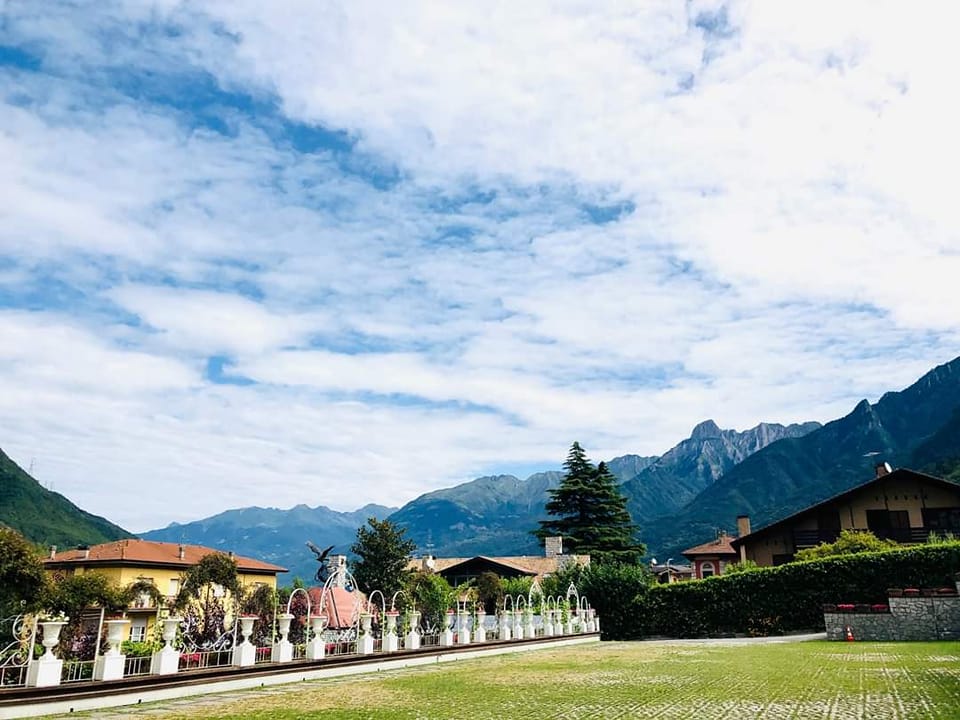
BIIMA Choral Retreat will provide an authentic and unforgettable cultural immersion in Breno, Italy for the active amateur choral musician. Choristers will spend two weeks living in the Italian Alps learning the language, developing musicianship and vocal technique, rehearsing repertoire, performing in the historic city of Brescia, taking in performances, and making life-long connections and memories with fellow travellers and singers. Participants can sign up for day trips to Verona to watch an opera at the Roman amphitheatre and to take in a breathtaking winery.
Faculty: Lee Carter conductor, Maghan McPhee voice teacher Dates: July 1-14, 2024 No auditions necessary Registration deadline: Apr 15, 2024
BIIMA Composition, Creativity and Improv retreat:
Through daily non-judgemental, guided creative activities and free form spontaneous improv sessions, this individualized, highly tailored program will free your mind and unleash your full artistic and creative potential.
Faculty: Margaret Maria composer, Alice Kanack author/composer Dates: July 16-30, 2024 No auditions necessary Registration deadline: Apr 15, 2024
BB: How did you get involved in something as original as BIIMA. How did it start?
MM I don’t know if you or your readers would believe this, but the origin of this story is weird. I was driving my husband to work, as I did every morning and I was telling him about a past student who was now at McGill, working with Ana Maria Popescu, who ran a small voice summer program in Italy. I then said that it would be a dream to run a program and I know exactly what I would offer, as I had done many summer opera programs in Europe, and although I gained a lot of experience, what it came down to was that the student was supposed to be impressing the faculty, similar to how it was during my undergrad, instead of actually learning and improving, I felt that the obvious need for most young artists was to find a place away from the pressure of being perfect every time they opened their mouths was paramount. Great faculty with actual current performance careers that could help them achieve their personal goals would be the goal. Having discussions about portfolio career strategies, classes on mental health and performance anxiety, body awareness group classes, masterclasses, performances and of course daily one-on-one guidance was a must.
I returned home, opened my email, as was my routine to begin my day, and there was an email from an Italian contact who was asking me to run my own voice summer program in Italy.
This was in 2014. I began the program with 5 of my own students and an incredible pianist voice coach, Carl Philippe Gionet who happened to be in Europe during the period we needed him for.
Carl Philippe Gionet, pianist
It was a match made in heaven as the two of us seem to say the same things in different ways when working with a singer. We didn’t have a name for the program yet as I worked in conjunction with the cultural Italian organization Cieli Vibranti. The name finally came to me a few years later, as I wanted the name to encompass the possibility of expanding into different areas of music education.
Lara Deutsch flute (Brent Calis Photography)
My Italian partners Andrea Faini and Fabio Larovere have been wonderful about allowing me to see this dream through and we have now expanded from a small opera intensive program, to a flute masterclass with Lara Deutsch, and a Choral Retreat for the amateur singer this year with Lee Carter.
Lee Carter, choral conductor
And there’s a really exciting groundbreaking program with composer Margaret Maria, called Composition, Creativity and Improv for any kind of musician and genre.
Margaret Maria, composer
BB: Why should singers go to Europe?
MM: The setting we’re in at BIIMA is literally out of a dream. Think Sound of Music. We are in the Italian Alps, in a small medieval town in the north of Italy, where no one speaks English. Our music academy is part of a convent, with incredible facilities including Steinway pianos, amazing acoustics and the presence of art everywhere you look. We have these wonderful nuns looking after us, cooking for us and hosting us. Everything from the time we arrive is managed for us and all we have to do is create and work on our craft.
Why Italy? I’m asked this a lot. After my first year of university, I had the opportunity to join a summer program in Italy and it changed my world. I had never been to Europe before and I was stunned by the beauty, the people, the language, the food, the heat…everything. I feel that having the opportunity to sing in a place where no one knew me was truly an important part of my development. I could try things out and knew no one would really remember me once I left and it was so liberating! It was wonderful to sing an aria at the final concert in the piazza and have the public literally singing along with me! I think experiencing Italy, where opera was conceived, is an important part of music education, especially with respect to classical voice. Understanding the culture around our artform is paramount in being able to share it authentically. Speaking technically, as Canadians or Americans, we don’t (on the whole) speak in a very resonant position. Spending two weeks surrounded by Italians, the students can begin to hear the natural legato in the Italians’ speaking voice, with incredible resonance. Working on the speaking voices of my Canadian students is a huge part of the work that I do, because most of us speak with much tension in our vocal tract. “Parla come canti e canta come parli” Speak the way you sing and sing the way you speak. I find that so many Italians speak so beautifully and it’s no surprise that opera stemmed from these people and their natural way of speaking on the vowels in their resonance, on the breath.
We offer an intro to Italian language class as well every morning, which is an added bonus. It’s wonderful for the students to see that it’s possible to learn another language, one that’s essential to the classical music world and my hopes are that the students then take this experience of the language and expand it when they return to their homes and their institutions.
BB: If you could tell the institutions how to train future artists for a career in opera, what would you change?
MM: All of the institutions that offer classical voice should offer a business of music class on how to find auditions, network, market oneself, file taxes and learn how to manage time efficiently. Most will have to find a way to work in a different career while performing. Another surprise is that not all institutions that offer a classical voice degree offer obvious things, like a mandatory diction class. How can institutions claim to offer young singers a chance at a career if they aren’t even receiving the basics in their education? I was happy to have been able to offer a diction class in 2019 at Carleton University, but sadly the class was too expensive to continue.
As great as many of these music programs are, the unwritten rule is that the students should be continuing their studies at summer programs throughout their degree and beyond to fill in the holes of their education. Those who do attend summer programs have the advantage of hearing other singers, have access to new faculty, new ideas and new feedback. They also continue to learn and grow throughout the summer months, which otherwise would be a four month hiatus from their lessons and performance practices. This is an essential part of the music student’s development, because it’s not enough to be the best at your school. You need to know that there are thousands of other young artists just like you around the world. What makes you different? What are your strengths and how can you stand out? Our program is about building up the artist based on their strengths while tackling their weaknesses.
BB: Talk about your own educational pathway and how it prepared you for your current career.
MM: My undergrad and my two masters degrees at the University of Ottawa and Bard College didn’t prepare me for my current career, full stop. I never expected the institutions to magically make things happen for me on a career level. I was on a quest to better myself and my voice and to some extent, I learned some of that at each institution. The interesting thing about my journey was that my undergrad took away a lot of what I was doing naturally and I lost so much of my range and had throat tension that I didn’t know what to do with throughout most of my degree. No one seemed to know what I was talking about (my teacher, coaches, professors and fellow singers), so I kept it to myself and tried to figure it out on my own. It was terrible that I felt shame about something that was happening to me and likely many others in the program. I still sounded good and won auditions and competitions, so no one really understood what I was going through. I felt like an imposter for so many years and it absolutely took my confidence away from me. I had to work very hard to continue on as a performer throughout this period that went on for years. I came very close to quitting and moving on, but my stubbornness and my need to find the answers to my voice kept me going. That and my husband’s belief in me and my dream.
I realize now that what I put out in the universe has come back to me. My singer friends’ goals were a career in performance and many of them have achieved it. My drive was that I wanted to understand my voice. I wanted to know how these amazing teachers in New York with whom I worked seemed to waive a magic wand and help singers sound instantly better in a masterclass. I wanted to understand technique and how it worked for me. I wanted to find the natural way I seemed to sing before I went to school for singing and I knew that I wanted to help others find their gifts as well.
BB: Do you have any teachers or influences you would care to mention?
MM: Teachers who made a big difference in my singing: Benita Valente, Lorraine Nubar, Jennifer Ringo Conlon and my current teacher Heidi Melton.
BB:What do you have coming up?
MM: I’m excited about a few things that are coming up:
We are holding Toronto auditions for BIIMA on March 29th in TORONTO for our voice intensive! Each audition is a mini-coaching, so that the singer will have the chance to work through their piece(s) should they so choose.
I have a new voice program that I run from September-June online, Release Your Inner Voice, where I work with singers individually through a personalized program, but also as part of a community through online group discussions, masterclasses, guest speakers and all sorts of new ways to work. It’s been a huge success this year, and I’m excited to be offering it once again next season. I’m excited to be able to work with singers all around the world.
I’m performing and premiering new Canadian works in Toronto with the Scarborough Philharmonic Orchestra on April 26 and 27 with mezzo soprano Danielle MacMillan. We will be performing contemporary music solos and duets as well as some famous opera hits. It’s part of a double CD release project where Danielle will be featured this season and I will be featured next season with newly commissioned Canadian works.
I will also be performing in Breno Italy, as well as in Lake Moniga where I will feature Italian repertoire and Canadian works with pianist Carl Philippe Gionet.
When I started reading John Holland’s new book, I didn’t expect it to be more than a study of a composer and his operas.
That modest goal would already be significant, considering the cognitive dissonance I feel whenever the plural phrase “Dvořák’s operas” reaches my ear or eye. I glibly think I know Antonín Dvořák, one of the most important composers of his time, composer of wonderful symphonies and amazing piano music. I admit that I know his life only superficially, his travels in America resulting in remarkable music, his connection to Brahms, which I only know in the most superficial terms. Dvořák’s Slavonic Dances are among my favorite pieces of music, as they got me through the worst of the pandemic, meaning a two-handed arrangement of his Op 46 and 72. I’m smitten with the first set of eight, still figuring out the second set. I am sometimes puzzled that he isn’t better known, but that’s just one of the mysteries that begins to be answered by John’s study.
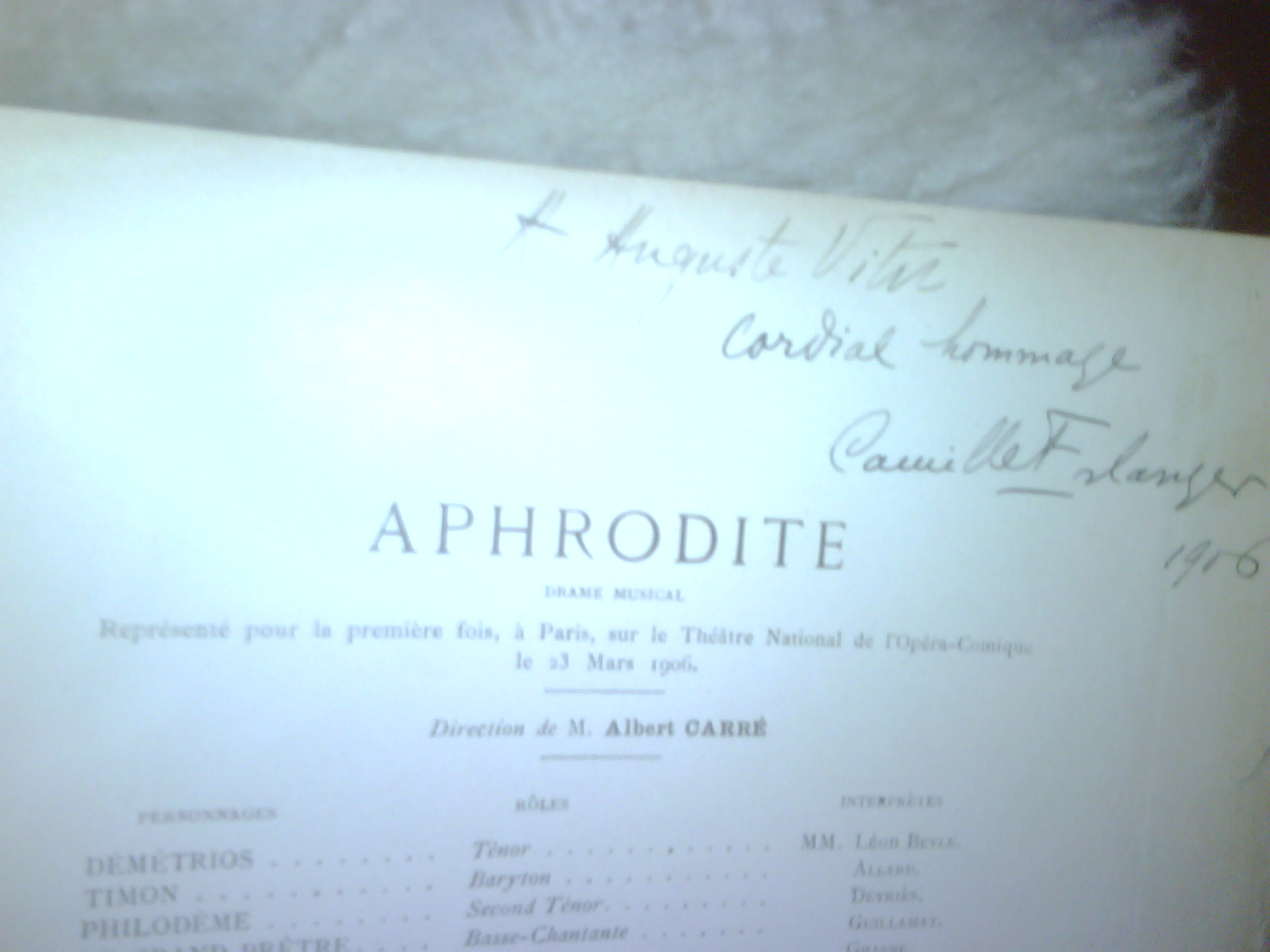
I was frankly gob-smacked reading John’s book, not just with the discovery that Dvořák composed ten operas, but that except for Rusalka all of them are out of print. How could that be? When I go to the Edward Johnson Building Music Library at the University of Toronto, admittedly one of the greatest collections anywhere in North America, I am repeatedly spoiled by the excellence of their comprehensive collection, whether among popular composers (Philip Glass’s Akhnaten or Songs of Liquid Days) or more obscure treasures such as the piano vocal score of Camille Erlanger’s Aphrodite, autographed by the composer himself.
my photo of autographed score
So while I can find all of Mozart’s or Verdi’s scores, multiple copies of Puccini or Wagner operatic scores, can find a piano version of Mahler’s 5th Symphony or Liszt’s transcriptions of Beethoven and Wagner, my mind boggles to think that John Holland himself has a better collection than my beloved music library. I don’t mean to single out the EJB, as John’s research has enabled him to assemble a considerable library of the scores that, if not the most comprehensive in the world, is certainly the biggest in North America. You want proof that Holland is an expert? Let’s start there! Sigh, I was looking forward to grabbing the score of Jacobin to play through it at my piano and maybe sing some parts, in preparation for the upcoming production: but it’s out of print. Or to explore his other scores, the way I’ve been able to do with the early operas of Mozart or Wagner or Verdi.
But I can’t do that obviously.
It’s not just puzzling that the works of a great composer can’t be found. I find this quite upsetting, especially with the help of Holland’s book. I don’t know if he meant to light a fire under me, but the book is quite disturbing in the best way, exploring the context in order to raise questions and inspire curiosity.
How could this be, and how did this happen? That’s what Holland’s book addresses.
I was trying to put Holland’s work into context. I’ve barely begun that, really. Let’s talk about history for a moment. When I started reading The Lost Tradition of Dvořák’s operas I was surprised at how much history is included, how much background we’re given before Dvořák even appears in Chapter Four. Chapter One is really about John Holland and his experience of the phenomenon that I’ve been obsessing over, his encounter with that bizarre absence of Dvořák’s operas from the world. Please note we’re not talking about a composer who tried and failed at opera. Liszt and Mahler for instance avoided opera except as producers and conductors. Dvořák composed ten operas. And considering that opera would be the composer’s preoccupation for much of the last decade of his life (as Holland explains), it’s especially perplexing that but for Rusalka, none of them can be found in print. Maddening.
That’s why I’ve put the headline on this book review. Holland is taking a position as a scholar that is pointed and energetic. The fact I couldn’t put the book down but read its 180 or so pages in a little over 24 hours is a tip-off. I’ve been re-reading the first chapter, which reads differently after you’ve finished the book. I suggest you do the same thing, as it reads differently, retrospectively.
As a Hungarian I want to pose parallel questions, having spotted a word that grabbed me. To “Germanize” is something that may sound odd to your ear. Yet I’ve noticed this among other Europeans. It’s Georg Solti, not György Solti, nor Solti György, given that the Magyar way is to put the surname first. Franz Liszt, not Liszt Ferenc. See a pattern here? Whether we’re speaking of the great 19th century virtuoso or one of the greatest 20th century conductors, Hungarians have often used a Germanic form of their name. Indeed it prickles me a bit to think that the word “Hungarian” is itself of foreign derivation, as we call ourselves Magyar not Hungarian. The misnomer via a Latin root reminds me of other comparable names applied from abroad such as Eskimo (rather than Inuit) or Gypsy (rather than Roma), although the experience of the Magyars was far more successful, via this Germanizing tactic, than what we see from Dvořák. No wonder then that Holland embarks upon a project of cultural rebirth, seeking to breathe life into a moribund tradition. But it wasn’t just a matter of popularity.
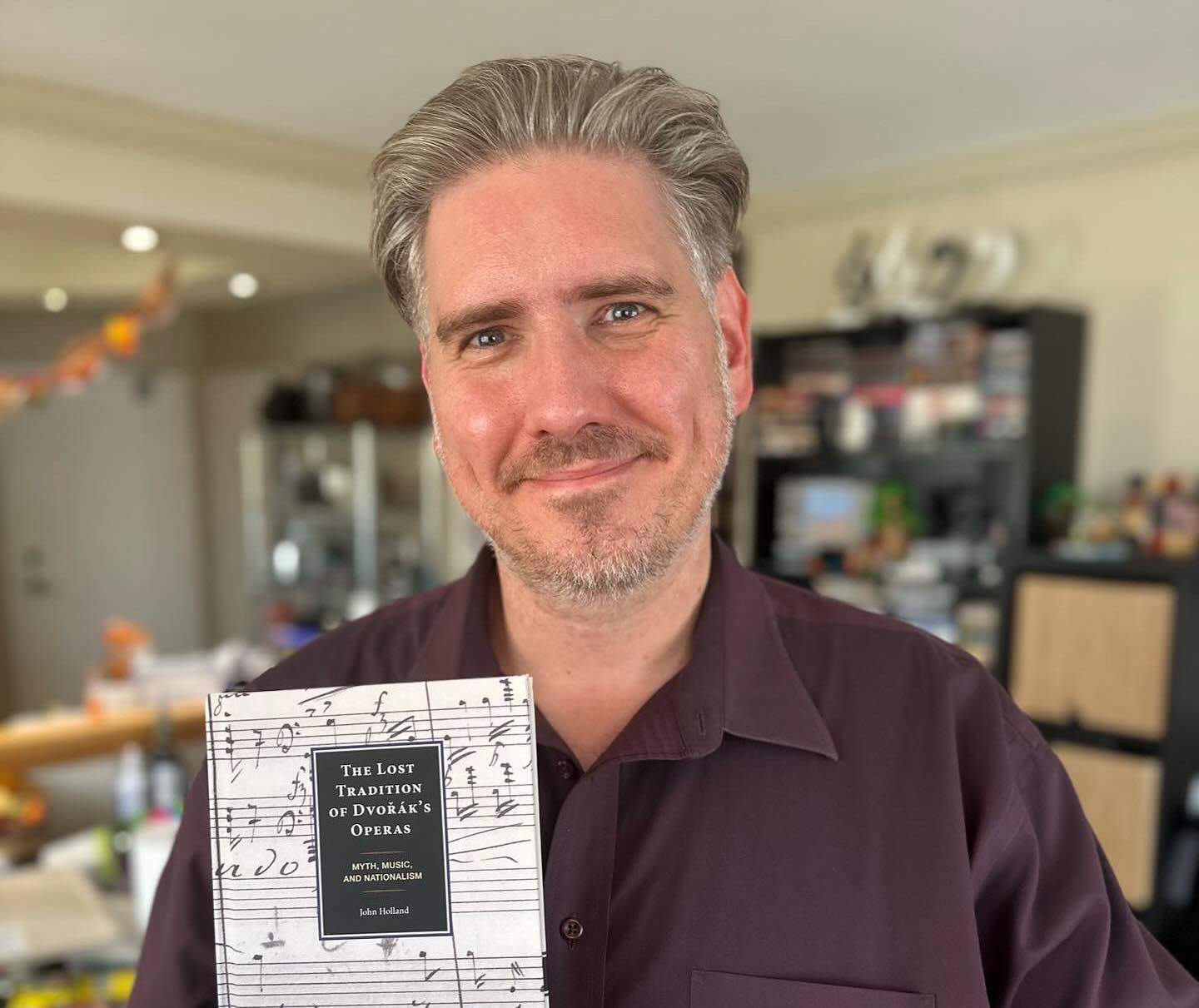
John Holland looking like a proud papa with his new book.
I almost feel like I’ve seen a political thriller or a documentary history, rather than a book of musicology, disliking “spoilers” that give away plot-twists. But this is history and indeed the fiction part might be the version of the truth that we were given before. At times Holland’s book reads like activism, in its efforts to rescue Dvořák’s operas from their undeserved purgatory, where they sit waiting to be remembered and revived. Perhaps an organization such as the Canadian Institute for Czech Music can help, as CICM could promote interest in Dvořák’s operas, by helping find & publish the scores.
It can’t be a surprise to think that political questions rear their problematic heads, both from Dvořák’s time and since. I wouldn’t presume to paraphrase complex questions in this space. Operas become popular for a multitude of reasons, as most go in and out of the standard repertoire. We hear of politics in the opera world (competing visions of what opera should be) and the cultures presenting opera. In the case of Dvořák’s operas it’s not enough to speak of a loss of interest, when the operas are literally gone, out of print. Holland doesn’t go as far as to suggest a conspiracy but does show mechanisms whereby Dvořák’s operas have been discouraged, in effect suppressed when one looks at the outcome as of 2024, when only one opera can be found in print. I completely accept the validity of Holland’s historical essay, describing the contending factions and their motivations.
Along the way we get musicological analyses with splendid illustrations from the missing scores. There’s a chapter looking at Jacobin and Rusalka as a pair of operas that show how Dvořák reconciled himself to the two poles of operatic dramaturgy, namely the Wagnerian model and the number opera associated with Verdi. Holland even gives us a leitmotif list for Rusalka! How cool is that? As far as John knows nobody has done this before.
When I was first getting to know the Ring Cycle, it was a special thrill that the Solti recording of Das Rheingold that I got in my teens directed us to notice the leitmotifs as they appeared. And then I encountered books with different ways of understanding the themes, eventually coming to Robert Donington’s Ring and its symbols. I invoke Donington to suggest that there are higher levels of engagement with a score, that can only begin with the kind of work John is doing with Rusalka, let alone the invisible scores. At the very least John is laying groundwork for future studies, including those he may do in the years to come.
One of the issues John brings up can sometimes be a lightning rod for discussions about operatic production, namely Regietheater aka “Director’s theatre”. Our different academic pathways may be showing in the way I react to what John is saying (my graduate work was in drama, not music), although I am sympathetic. John is absolutely right to observe that in opera productions the 21st century is so far a century that belongs to the director. Indeed I must mention that in many respects John writes a history of opera, inserting Dvořák into that study, a broadly based analysis, at least until he gets to the part where he observes the challenge of Regietheater. I was amused hearing what John has to say, and confess I’ve had similar conversations including a big argument I had with a member of my committee who was outraged by the COC’s production of Semele.
In the best of these, one can still see the original through the layers. I’m again invoking Linda Hutcheon’s metaphor of the palimpsest to describe adaptation, where we see through the new surface to the older text seen beneath: or at least one would hope so. When Patrice Chereau set his opening scene of Das Rheingold in a modern river where we see a power dam rather than a pristine riverbed, we were still within shouting distance of the original, that was distorted but not harmed by the imposition of new contexts onto the old.
But it’s problematic when the text being presented is unknown. We won’t see through layers if we don’t know the original opera. John complains about a London production of Rusalka that for many was their first experience with the work, and therefore (in his view) destructive as far as the popularization of the works of Dvořák. I’m a bit more of a Darwinian, believing that popularity is a de facto phenomenon, not so very different from the phases of the moon or the weather, being largely beyond our control.
Difficult, too, is the question of opera that presents folklore and ethnic culture, in a theatre environment that seeks to be edgy or controversial. John rightly observes that maybe this is bad timing for Dvořák. I have more faith. I have seen how a Regietheater approach can sit on the fence, working with something traditional, as in Dmitri Tcherniakov’s Prince Igor at the Met, or his Bolshoi Ruslan und Ludmila. In both cases the traditional surface of the first part of the production sets up electrifying drama in the latter part of the production. I wish I knew Dvořák’s works better, to be able to speak more authoritatively but haha, nope. I am confident, though, that publishing scores and getting the chance to hear the music will work its usual magic, especially as an admirer of Dvořák and his gift for melody. Once they’ve heard it, film-makers will start inserting the music into their movies, singers will program arias or scenes into concerts, and as curiosity will grow about the operas, there will be a need to produce the works.
No it won’t happen overnight. But my goodness, John Holland is performing important work to make this possible. I was moved to the brink of tears reading the dedication of the book.
I watched the last hour of Killers of the Flower Moon today.
I had heard terrible things about the violence in this film, although the same was true of Taxi Driver, another Martin Scorsese film with a brilliant orchestral score from a composer (Bernard Herrmann) making his last film. The title is a dead giveaway (if you’ll excuse the choice of words). So I downloaded the film and have been watching it on the small screen at home rather than submitting to the relentless dominance of a movie theatre.
I stopped partway through, earlier this week.
Yes it’s violent, but that’s not what I’m posting about. Let me simply say parenthetically that I now see a whole new market for streaming and downloading, where a movie might be overpowering in a theatre. I saw Oppenheimer in an IMAX theatre, and to be honest, was disappointed.
It’s almost time for the Academy Awards, an annual ritual that tends to drive me nuts. While I like the notion of celebrating excellence I don’t believe in awards that would say, for example, that Christopher Nolan’s direction of Oppenheimer is somehow better than Martin Scorsese’s direction of Killers of the Flower Moon, whether or not they even admit Barbie into that conversation.
I wanted to see Killers of the Flower Moon for a number of reasons, and I’m glad I bought it, as I will watch it again. It seems to capture our exploitive and genocidal relationship to the Indigenous populations rather well, horrific as it is. I always like Scorsese’s work, painful as it may be to watch.
But I was especially interested in hearing what Robbie Robertson contributes to this epic exploration of genocidal violence and exploitation in an American Indigenous community. After a lifetime of collaborations between Robertson and Scorsese this would be the climax.
I was not disappointed.
Robbie Robertson and Martin Scorsese in 1978 (Photo: Richard E. Aaron/Redferns)
I believe Robbie Robertson deserves the Oscar for best Original Score. That may sound kind of stupid when I’ve only seen one other nominated film, namely Oppenheimer.
The nominees are:
AMERICAN FICTION -Laura Karpman INDIANA JONES AND THE DIAL OF DESTINY -John Williams KILLERS OF THE FLOWER MOON -Robbie Robertson OPPENHEIMER -Ludwig Göransson POOR THINGS -Jerskin Fendrix
If Karpman or Fendrix win, that would be a fascinating and unexpected turn of events. Perhaps they deserve an award. As mentioned, I haven’t seen those two films.
If the 92 year old John Williams wins I won’t be upset. But Williams has won the Oscar before. Williams is old, while Robbie Robertson died this past summer. Please note, I am not proposing Robbie Robertson as winner because he’s dead.
I saw Göransson’s film, which many are touting for best picture and best director and best actor nods.
What gets a little crazy is when the voters decide they need to reward a film in adjacent categories, that they love a film so much that it needs to win multiple Oscars. It made me crazy that Blade Runner, the most cleverly art directed film I’ve ever seen, with its brilliant imagery of a future dystopia, should lose the Art Direction Oscar to Gandhi, in that film’s sweep of the awards. Something similar may happen with Oppenheimer, even though Göransson, like Williams, has won an Oscar before.
Let me offer my criteria. The touchstone for me of music to accompany a play or film has always been Felix Mendelssohn’s music for Shakespeare’s A Midsummernight’s Dream. The 1935 Max Reinhardt film of the play, in the debut of Erich Korngold, makes a most impressive use of Mendelssohn to underscore the film.
Why is it impressive? Mendelssohn created a musical style for each of the three social milieux represented in Shakespeare’s play, namely 1) faeries 2) lovers and 3) mechanicals. Each of them has a distinct kind of music that aids the story-telling. For me that’s the ideal.
Robbie Robertson’s score isn’t playing music for three different groups, but it does underscore the social divide in Scorsese’s film, between the Osage Nation and the settlers of the American west. There are times when the music functions as a greek chorus, telling us what’s really happening beneath the surface. I want to watch it again and listen more closely, as I thought I detected times when Robertson underlines the cultural divide with music that illustrates a comparable spiritual divide.
Robertson’s roots from a Cayuga and Mohawk mother lends the musical score a special authenticity and authority.
Scorsese has a habit of showing up in his films to play a small part. I loved his appearance in Hugo as a cameraman filming at Georges Méliès’ studio. I wonder if the 81 year old Scorsese suspects he is coming to the end of his life, given that this time (spoiler alert) he delivers the stirring final speech of the film.
At the end we see that the film has been dedicated to Robbie Robertson. An additional heartbreaking thought that Erika gave me just now, is that the composer who died in August likely never saw the finished product, released in October.
I’m looking forward to seeing and hearing it all again.