TSM J’Nai Bridges

The drama of tonight’s Toronto Summer Music Recital at Koerner Hall was as much about the one who didn’t sing (Sondra Radvanovsky) as the one who did (J’Nai Bridges).

I’m sympathetic to Sondra however much I may have wished to hear her. A mature artist’s name and reputation become a valuable commodity to be protected even if that makes twice this year, when we recall her cancellation in the Canadian Opera Company’s Macbeth. I hope she’ll be feeling better soon.

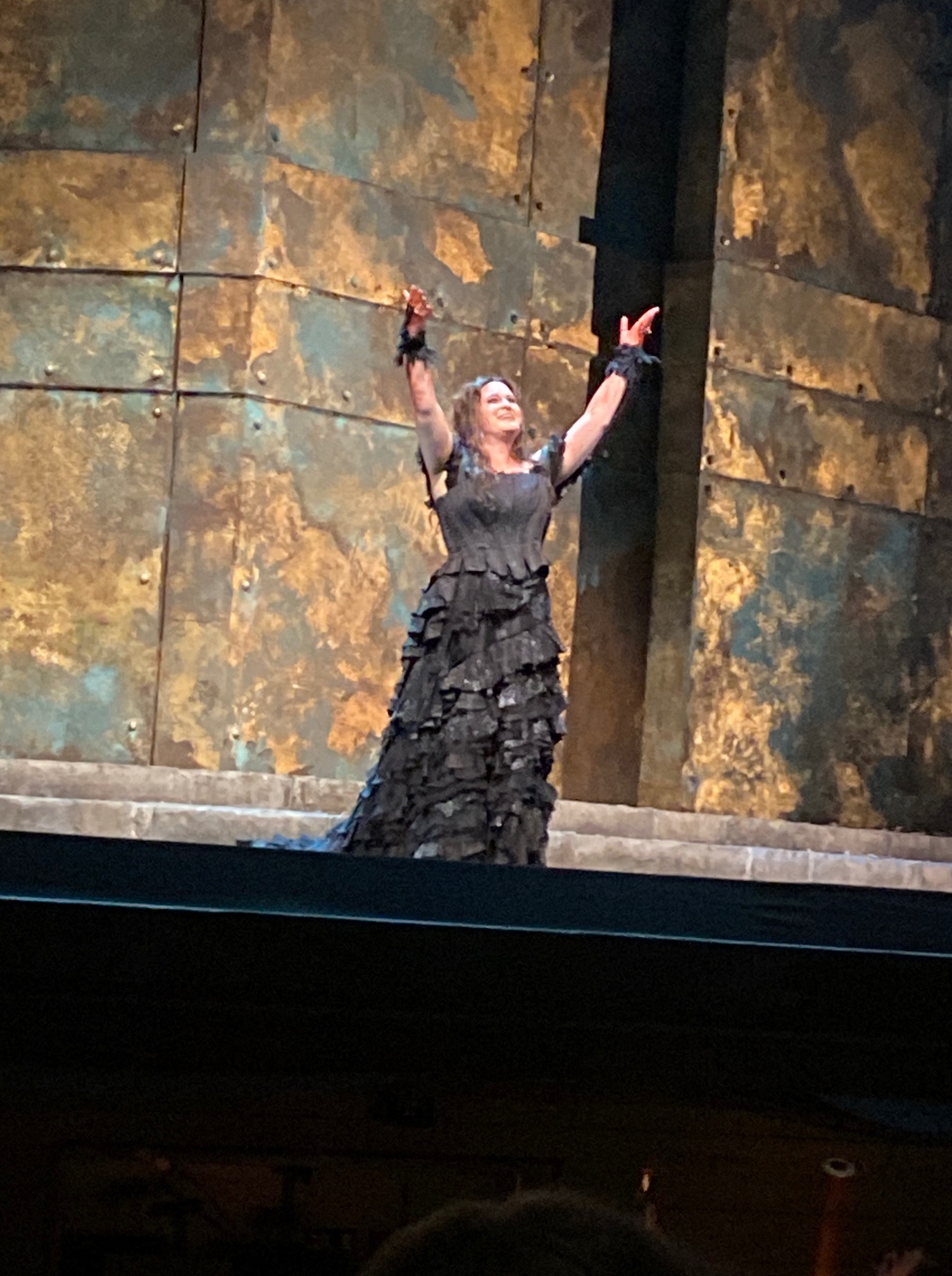
How wonderful then to see the delightful concert TSM conjured up on short notice featuring J’Nai Bridges, last season’s COC Carmen.

Marcelo Puente as Don José and J’Nai Bridges as Carmen (photo: Michael Cooper)

She told us this was her first Canadian recital, wearing a glorious gown in shimmering gold. Erika my wife might be able to tell you what it was made of, I only know that she looked very beautiful from the first moment to the last encore. She is a singer of the younger generation, as I was shown on social media by my friend Jane who accompanied me. Here’s a screen capture from a video on Instagram that gives you a look at her easy smile and her powerful physique. She has a natural charisma, as we saw soon enough.

jnaibmezzo from Instagram

It’s funny that the substitute program they conjured up at the last minute should feel so comfortable, between a well-known cycle by Ravel, and music from J’Nai’s roots in church, aided by two of the talented artists in town for the festival, namely Rachael Kerr piano and Sheila Jaffé. I was reminded of Leontyne Price who also started out singing gospel in church, and would often bring some of that music into her recitals. That kind of music is where her authenticity comes from, where she was originally grounded.

Pianist Rachael Kerr

And so we began with an item not listed on the program, Malotte’s Lord’s Prayer, ably supported by Rachael Kerr at the piano with a bluesy feel to end the first section (“as it is in heaven”). When we do The Lord’s Prayer in my church this Sunday we will sing a softer and more prayerful one, where this older piece is virtuosic featuring brilliant high notes, perfect for J’Nai to start off the program.

The first half featured songs by Brahms: from Op. 59, Op. 43 and, Op. 91, joined for the last two songs by violist Sheila Jaffé.

After intermission we heard the three Ravel Shéhérazade songs, featuring a delicate and idiomatic sound at the piano from Rachael. J’Nai seemed to be telling us stories, as she looked up into the concert hall. I love this cycle, and think it sounds ideal for her voice.

We finished with John Carter’s Cantata, a collection of gospel melodies from church, including Peter Go Ring Dem Bells, Sometimes I Feel Like a Motherless Child, Let Us Break Bread Together and Ride On King Jesus. The piano part is fierce, including lots of challenging passages taking us in unexpected directions.

When our applause persuaded J’Nai to offer an encore, it shouldn’t have surprised me that she sang the Habanera from Carmen. Of course! But this time, instead of seeking to seduce Don José it was as though she were seducing everyone in the concert hall. The second encore was a moving reading of “You’ll never walk alone” to conclude.

Mezzo-soprano J’Nai Bridges
Posted in Dance, theatre & musicals, Music and musicology, Reviews | Tagged , , , , , , , | Leave a comment

TSM: Tradition

Some words have such broad definitions that we miss some of the possibilities. That’s what I experienced last night at the Toronto Summer Music Concert titled “Tradition”. We don’t always get the opportunity to reflect upon this process nor to see it enacted before our eyes.

Part of it shows up in the Festival’s commitment to its Academy, passing the torch from the experienced virtuoso to the younger musical talents coming to Toronto every summer to listen and learn. I wish it were possible to see every minute of this remarkable festival, even if I’d miss the nuances experienced by the artists taking part in such an apprenticeship. Yes a lot of this goes over my head.

And then there was the program:
Gabriela Lena Frank: Four Folk Songs
Iman Habibi: Relics
Jerry Bock: “If I Were a Rich Man” from Fiddler on the Roof (arr. Kelly Hall-Tompkins)
Jerry Bock: “Fiddler Rhapsody and Scherzo” from Fiddler on the Roof (arr. Oran Eldor)
–intermission–
Dvořák: Piano Quartet No. 2 in E-flat Major, Op. 87, B. 162

For me it was a concert that problematized the idea of newness, reminding one of the complexity of influence, as though I glimpsed oral cultures where children were taught stories and songs, to pass on to successive generations. And of course there’s the magic when one culture encounters another, ideally in friendship rather than in enmity (where the word “tradition” may sometimes have negative connotations and impacts), let alone in the music of the oppressed or refugees who have left their homes behind, their art a precious reminder of what they’ve lost.

When I look at a festival schedule it’s guesswork as to what will work, what will be fun, what will be comprehensible. I feel I hit the jackpot with this one even if Walter Hall wasn’t full, possibly because of access issues announced through the courtesy of email telling us that the elevator might not be working, and the kind offer of last-minute refunds to those prevented from getting downstairs to the performance space. That reminder hits home for me, a lifetime arthritis sufferer who is currently in remission but at one time might have been daunted by an elevator on the fritz. And this also reminded me of the inter-generational aspect of traditions even as it suggested a barrier rather than free access.

We began in a modernist place with Four Folk Songs, the compositions bringing us elements of Latin music via a boldly dissonant sound world employing violin (Kelly Hall-Tompkins, who introduced the pieces), cello (Matthew Zalkind) and piano (Philip Chiu).

Composer Gabriela Lena Frank

Kelly spoke of the influence of composers such as Bartok or Shostakovich, perhaps suggesting that for the listener one of our inevitable tendencies is to seek connections, to in effect place a new work into a recognizable musical tradition. We can’t fully understand something we’ve never heard without in some respect understanding where it fits into what came before. I suppose we do that every time we hear something new, whether we realize it or not. Traditions function as markers or even as pigeon holes. At one time this might have been for the purpose of classification, yet tonight we were in the sort of place that seems to break down barriers and invite crossover and dialogue.

Our next exploration seemed much more of a demonstration of oral culture, in the back and forth exchanges in Iman Habibi’s Relics, a duo between Matthew’s cello and Barry Schiffman’s viola.

Composer Iman Habibi

The five brief pieces sometimes would elicit giggles around me for its wit and clever imitative rhetoric, a kind of call and response that seemed primal and pre-verbal, leading us to an explosion of applause at the end for Habibi, who was in attendance. I want to hear more from this eloquent young composer.

The following section included some of the most touching moments of the evening, watching members of the audience embrace the unexpected. No this wasn’t the usual white male Jewish fiddler. For thirteen months on Broadway Kelly Hall-Tompkins was the “Fiddler,” as violin soloist for the Bartlett Sher production of “Fiddler on the Roof,” with numerous solos written especially for her, for over 500 performances. This time Kelly was in the centre of the stage rather than supporting a show.

Violinist Kelly Hall-Tompkins

Kelly played the first part with Philip in support, including one passage where I was tempted to loudly sing the word “tradition” (as in the song) in response to a passage in the piano. I wondered if this was one of the meanings the concert programmers had in mind when they assembled the concert. I saw heads swaying, heard some humming along. The melodies from this Broadway show have permeated our culture. Norman Jewison’s film of the musical is one of my mom’s favorites, preserved in her PVR. For the second part we heard a brilliant solo virtuoso display, Kelly at times seeming to play two parts, as she’d hit brilliant melodic passages, plus lower notes resembling bass on the lower strings.

After intermission we were in a different place again, listening to Jennifer Frautschi introducing and then playing the Dvorak Piano Quartet, alongside cellist Matthew, violist Barry and pianist Philip. While Jennifer spoke of a possible competition between players (at a children’s concert earlier in the festival), it speaks to the way ensembles work, that while section leaders may be trained to make a big sound, yet in chamber music such displays of ego become a liability. We heard wonderfully cohesive playing from the quartet, Philip emerging for the last movement for some bravura playing but always in support of the other three. As Jennifer rightly observed, Dvorak had a spectacular gift for melody, displayed perfectly on this occasion at the boundary between folk and art music. I think Dvorak is under-rated.

Accepting applause, (L-r) Jennifer Frautschi, Barry Schiffman, Matthew Zalkind, and Philip Chiu

The festival continues for another week until July 29th. For further information: https://torontosummermusic.com/

Posted in Dance, theatre & musicals, Music and musicology, Reviews | Tagged , , , , , , , , , , , | 1 Comment

The Butterfly Project

Teiya Kasahara gave the first iteration of a self-exploratory monologue from Amplified Opera tonight at the Toronto Summer Music Festival in Walter Hall. It’s called The Butterfly Project because it’s to be an ongoing investigation, inviting us to explore the origins of the Japanese music appropriated by the European Puccini for his teenaged heroine in the popular opera. Kasahara draws on their experience as a Nikkei (of Japanese descent) Canadian settler to consider (as they say in the program note) what ChoCho-san “might have been thinking , doing, dreaming of during those three years of her life from geisha to bride, wife to woman to mother”.

While Kasahara previously brought a happy and exuberant disruptive energy to their deconstructive exploration of the Queen of the Night, in The Queen in Me, another project with multiple iterations, on this occasion the subject matter calls for a more solemn and reflective approach.

It’s personal.

Interdisciplinary performer-creator Teiya Kasahara

There’s surely some ambivalence underlying Kasahara’s brilliant new work performed with Andrea Wong, consisting of electronics, live sound design, voice, piano and violin. They’ve sung the Puccini and likely loved the music employed in this problematic opera even as we were invited to understand the work anew.

Tonight it was as though Butterfly escaped her usual fate, the role she’s been trapped in by the opera and previous versions of the story by David Belasco or John Luther Long. We heard a new libretto from Eiki Isomura and Josh Shaw, the role sung in Japanese where we’ve previously usually heard Italian. We heard some of the great aria, some familiar melodies, interrupting the usual expectations and pushing us to feel something different. At times Kasahara was seemingly singing with a full orchestra, a remarkable effect.

The Walter Hall stage, afterwards

This was apt for a concert hall, where the emphasis was on music rather than the drama. We were offered tangents, possible pathways left open rather than closed by the death that usually ends Puccini’s opera.

There’s a bit of an irony to mention. The TSM logo shows a Butterfly perched on a violin, mentioning the Festival theme of “metamorphosis”.

Yet the butterfly image of the original opera is much darker, not a metaphor of transformation, but one of conquest given that Butterfly sings fearfully (in the Act I duet of Puccini’s opera) that westerners usually mount butterflies on pins (a fact Pinkerton seems to embrace as romantic, ignoring her fears), a horrible foreshadowing of her eventual fate. In Kasahara’s project Butterfly escapes that horror for one night, as indeed there is the prospect of metamorphosis in their reinvention of the work.

In the first half we listened to music of Japanese composers that was completely new to me, piano, violin & vocal music, by Rentaro Taki, Kunihiko Hashimoto, Kosaku Yamada, and Koichi Kishi, performed by Kasahara, Dabin Zoey Yang, Xi Huang and Gregory Smith.

Andrea Wong

It was appropriately disorienting, considering that in Puccini’s opera we encounter the appropriated melodies without any attribution, subsumed into his orchestral score as a western composition. Kasahara was in a sense refreshing our perspective by reorienting us towards Japan and its culture.

I have a lot to learn.

Posted in Dance, theatre & musicals, Music and musicology, Opera, Reviews | Tagged , , , , , , , | Leave a comment

Toronto Summer Music Metamorphosis

Tonight was the opening concert of Toronto Summer Music, a festival running until July 29th in several performance spaces around Toronto.

For a festival such as this one with the dual objectives of showcasing performance and training artists in its academy its theme of “metamorphosis” can be a powerful metaphor, whether we’re considering the music or the musicians.

I had to do a double take when I read on the TSM website that “2023 is the seventh season with Canadian violinist Jonathan Crow at the helm in the role of TSM’s Artistic Director.”

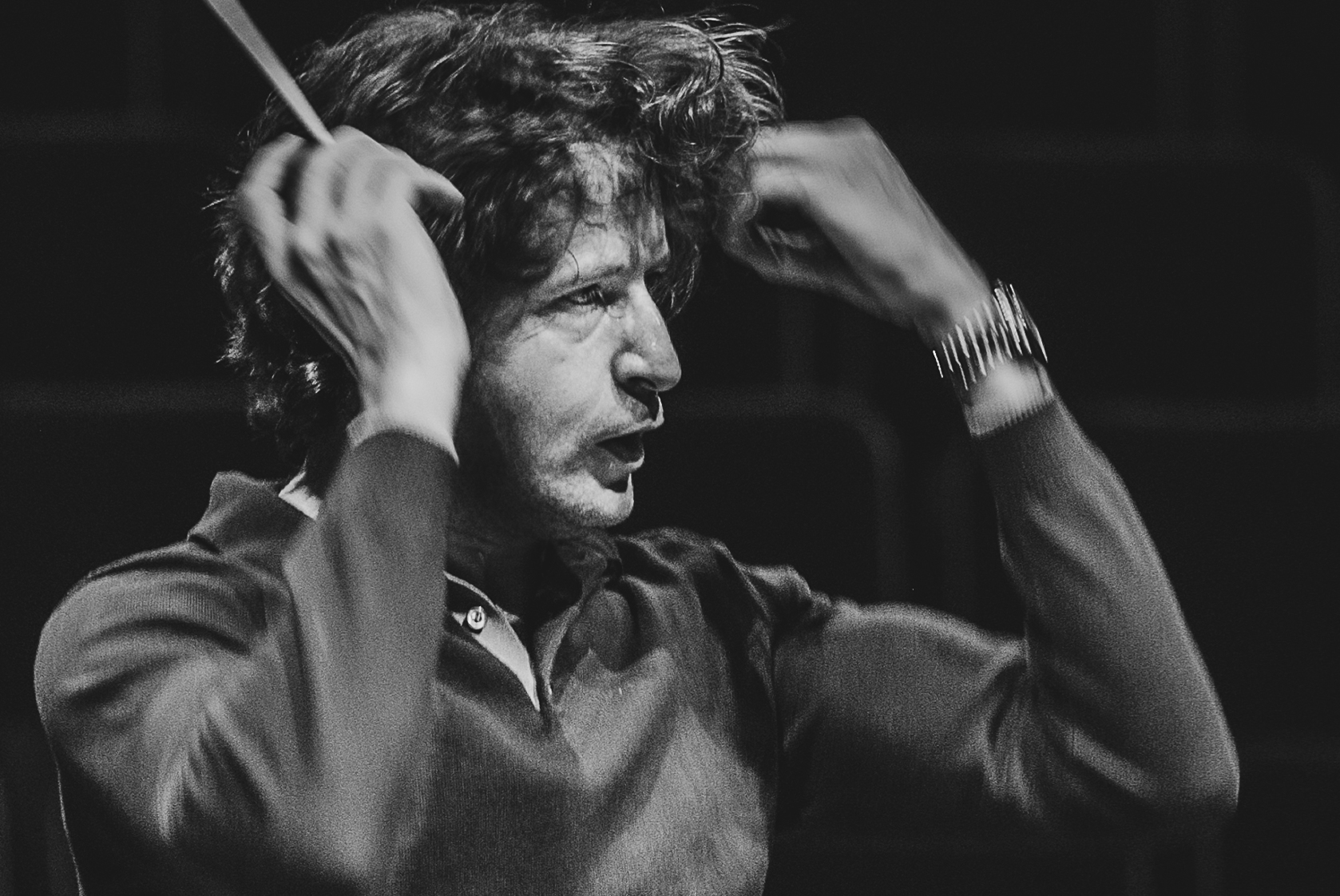
TSM Artistic Director Jonathan Crow

Time flies, especially when cultural events are disrupted by a pandemic. The butterfly in the TSM logo could be me or any of us, emerging from our masked cocoon.

Festivals offer special opportunities that aren’t usually available, as when five excellent soloists can give us a taut reading of the Mozart concerto.

Two pianists were the stars of the evening:
Beethoven: Sonata No 14
Mozart: Piano Concerto No 12 (arr. For chamber ensemble)
(intermission)
Milhaud: Scaramouche
Levko Revutsky: Preludes Op 7, Nos 1 & 2
Liszt: Etude No 3 “La Campanella”
Rachmaninoff: Suite no. 2 for Two Pianos

Jon Kimura Parker made a welcome return to the festival, seeming ageless in his stunning reading of the Moonlight Sonata, before introducing 21 year old Illia Ovcharenko to us, the winner of the Honens International Piano Competition.

Jon Kimura Parker

Parker, Artistic Director of that competition, spoke of glowingly of the young Ukrainian virtuoso, with whom he partnered on two works in the second half of the program.

Illia Ovcharenko

I had to wonder, how much time have they had to play together, how well do they know one another? Piano duos work together for years, seemingly anticipating one another as though reading minds. How when they met relatively recently, could they get the kind of cohesion we heard in the Milhaud and especially in the powerful Rachmaninoff suite? It was a joy watching them, seeing the eye contact and the body language.

I hope we will have the chance to welcome Ovcharenko back to Toronto again. He demonstrated sensitivity to Mozart, at times bringing out the comical playful side especially in his cadenzas. After the joyful exuberance of the Milhaud duet, the two Revutsky preludes took us in an entirely different direction, something soulfully Slavic in the manner of a Rachmaninoff or a Scriabin, someone I hope to explore further, and someone we need to hear more often. The Liszt afforded Ovcharenko the chance to show us more delicate playing, a subtle approach to Liszt that’s very welcome.

The Toronto Summer Music schedule can be found at https://torontosummermusic.com/events/.

Posted in Music and musicology | Tagged , , , , , , , , , | 1 Comment

Asteroid City, America

Wes Anderson is at it again with Asteroid City.

Wes Anderson

Once more, an elaborate structure plays games with the viewer. Asteroid City is the name of a play within the movie, a fictitious place in America. We go back and forth between fictions, sometimes in black and white sometimes in colour. It never seems real. The film conceals a vast amount of detail under the surface, inviting you to watch the film over and over. Sure you can get through it the first time, indeed this one felt easier than the last one, Paris Dispatch. But as usual there’s much more to be found with every additional viewing. I know that’s what I’ve done in the past with Grand Budapest Hotel, Moonrise Kingdom, French Dispatch, Isle of Dogs. And while I’ve only watched this one once, I know there’s lots there to discover.

Every few minutes someone says something preposterous. For instance in the trailer we hear this announcement:
Each year we celebrate Asteroid Day, commemorating Sept 23, 3007 BC, when the Arid Plains Meteorite made Earth impact.

The cast is a stunning array of talent, including the usual suspects coming back again and again (Tilda Swinton, Jason Schwartzman, Liev Screiber, Bob Balaban, Jeffrey Wright, Ed Norton, Scarlett Johansson, Willem Dafoe, Bryan Cranston, Jeff Goldblum and Adrien Brody) as well as newcomers Tom Hanks, Matt Dillon & Steve Carell. It feels at times as though they’re having so much fun that they’re paying Anderson to be in the film rather than the other way around.

The musical score includes a couple of set pieces from Anderson’s regular collaborator Alexandre Desplat although the film is full of popular songs evoking a period.

This is again full of moments of beautiful symmetry, an artificial work of art that never seems real. It feels less challenging than previous Wes Anderson films, perhaps because it’s so American, often very silly.

While we may be in a surreal version of the 1950s, we’re exploring contemporary issues. In a summer when the film Oppenheimer will remind us of the Manhattan Project, it seems perfectly natural when we see atomic bomb tests nearby in the desert. Or maybe it’s because of the war in Ukraine.

We will see an alien land a space-ship. As in ET and Close Encounters, the military gets involved, censoring everyone and shutting down the town, although they’re so inept as to be comical.

As in his previous films the children are the smart ones, although their special gifts may be a liability. This time they’re even more nerdy and brilliant than before, performing astonishing feats among the goofy adults.

I must watch it again of course. I came out of the film smiling.

Posted in Cinema, video & DVDs, Reviews | Tagged , , , , , , , , , , , , , | Leave a comment

Black Panther in concert with the Toronto Symphony

This was a Toronto Symphony performance like no other.

The idea of presenting a film with live accompaniment isn’t new, indeed that’s how they used to do it in the old days. At one time –thinking of the silent era– films were accompanied by live music, whether on a piano, organ or even a whole orchestra playing the music to underscore the action.

Lately the idea has had a resurgence, with the help of technology. Conductor Steven Reineke is able to synchronize the TSO with the help of instructions on the small screen in front of him ensuring they start in the right place. The rest of us watched the action on an enormous screen above the orchestra. TSO have offered us everything from Psycho to Star Wars, Nightmare Before Christmas, or Home Alone coming at Christmas. You may think you know the film, but it’s not the same with the live accompaniment. It’s a brand-new experience.

I cannot deny while I may claim to be a scholar, a student of film music: I’m a total fan. And when film music is performed live that changes the equation. At times the dialogue was covered by the big sound coming from the orchestra, although we had subtitles to rely upon, so no harm done. Indeed it was a glorious experience, the music suddenly massive and foregrounded as never before.

This was a savvy audience, applauding when Stan Lee appeared briefly. They know their super-heroes.

The star of the evening (and no I don’t mean Chadwick Boseman, Michael B Jordan, or Angela Bassett) was Massamba Diop on his talking drum, an extraordinary performance including a brief encore after the film.

Massamba Diop accepting our applause afterwards, Conductor Steven Reineke just to the left

I was aware that Ludwig Göransson won the Academy Award for best original score, but had not seen the film until tonight. What a treat and no wonder he won the Oscar.

Göransson’s score employs a big percussion contingent (at least four percussionists at the back of the stage) as well as Diop in the spotlight beside conductor Reineke. And the big brass section crushed us with an enormous sound, especially at the climactic moments of action.

It was a younger crowd than usual. We had a great time.

Friday June 30th there is another chance to see and hear Black Panther in Concert at Roy Thomson Hall. I’d go again if I could. It was a tremendous experience.

Posted in Cinema, video & DVDs, Music and musicology, Reviews | Tagged , , , , , , , , | Leave a comment

Rossini’s Otello from Opera By Request

Last night I watched a concert presentation of Rossini’s Otello from Opera By Request, a company who demonstrate their importance with every outing.  

Bill Shookhoff leads from the piano working without a conductor, seated upstage of performers who face the audience from their music stands dressed in formal attire. Their usual venue of College St. United Church is an intimate space with a live acoustic ideal for this sort of exploration.  The singers are in character, although sometimes when they’re looking at one another it is as much for musical reasons as dramatic ones.  

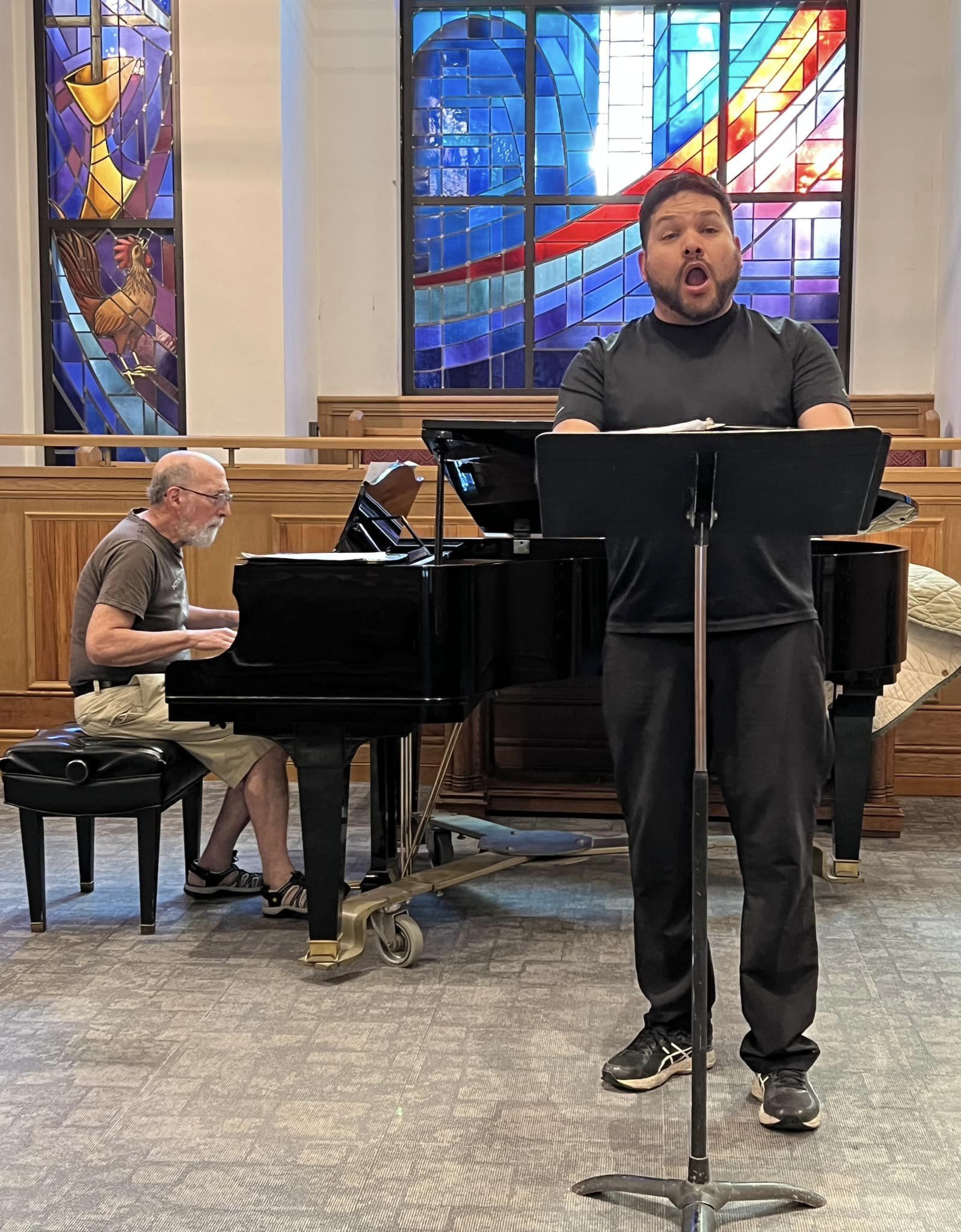
Bill Shookhoff and Ernesto Ramirez rehearsing at College St United Church

OBR explain their rationale in their program note:

“Opera By Request was launched in 2007 to provide opportunities for singers to learn and perform roles in their entirety, and for audiences to experience opera, both rare and familiar, at affordable prices. All Opera By Request productions are initiated by singers not by the director. Since its inception, more than 300 singers have presented over 200 performances of more than 100 different operas.”

And so on this occasion we encountered Rossini’s alternative to Verdi’s better known version of Shakespeare’s play, its libretto by Francesco Berio di Salsa that premiered in 1816 (in contrast to the better known adaptation by Arrigo Boito that premiered in 1887).  The prolific Rossini, one of the quickest composers in history, who premiered three operas in 1816, and four the next year likely didn’t agonize over his work the way Boito and Verdi did. Does it matter that the story has been changed? Does it matter that some of the music in the scene where Otello murders Desdemona resembles music we hear in Barber of Seville, composed earlier the same year?  Not when the goal is a virtuoso display of vocal fireworks. In fairness there’s nothing wrong with what he’s written, it’s just that this segment reminds me of the comedy. I don’t know whether it’s another reason why Verdi’s opera pushed Rossini’s out of the standard repertoire, although the fact that Rossini requires two amazing tenors is likely a bigger reason.  

Shakespeare’s Iago is a major character who has more lines in the play than the title role, a disparity honoured in Boito’s adaptation even if he changes the motivations substantially.   Rossini’s Iago (Dillon Parmer) is a much smaller part even if his machinations are still central to the plot, fueling mistrust by Otello (Paul Williamson) of his wife Desdemona (Meagan Reimer). The arc of her character is much darker in Rossini’s opera, distrusted and castigated by her father (Dylan Wright), concealing the marriage to Otello without any of the joyful lyrical moments such as the ones Verdi offers at the conclusion of his first act.  Rodrigo (Ernesto Ramirez) is a much bigger character in this older version that requires a spectacular tenor voice.  Rossini’s audience welcomed a bel canto showpiece for three tenor voices and a big soprano role rather than the more psychological writing Verdi created  71 years later. Tastes change. 

Recalling the main reason for OBR—singers trying out roles—it was a privilege to see and hear this rarity. It’s a pleasure to see the opera sung with a black Otello, even as I wondered whether vocal type had any part in the casting.  Paul has a dramatic sound that might be big enough for Verdi’s Otello. While Rossini’s Otello goes much higher than Verdi’s (who never reaches a high C), Paul’s colour was still of a more heroic timbre than that of Ernesto, whose role seems more conventionally bel canto in its requirement of an enormous amount of coloratura, often sung softly. I’m not sure which role lies higher in its overall tessitura (range) especially when singers may sometimes interpolate higher notes.  The aesthetic is meant to impress us and in this respect they succeeded admirably.  Paul sang a couple of very high notes, one that I think was a high D, even while defying expectations in also giving us a big heroic sound.  If Verdi was familiar with Rossini’s take on the character he likely had a dramatic voice in mind, following up on the heavier writing in Don Carlos and for Rhadames in Aida.  Ernesto’s singing was beautifully idiomatic, breath-taking at times, using the small venue to advantage, singing very softly with the piano accompaniment, an approach that likely would not have been heard opposite a full orchestra.

Meagan Reimer and Paul Williamson rehearsing the climactic moments

Meagan Reimer was very good in the last act of the role of Desdemona, especially the Willow Song, reminding me of Joan Sutherland in her secure pitch and focus, and precisely accurate coloratura.   

Dillon Parmer was a subtle Iago, winning Otello’s trust without seeming too evil, which is helpful. Otherwise we lose all respect for Otello because he seems gullible to trust Iago. Dylan Wright was a powerful voiced Elmiro (Desdemona’s father), Abigail Veenstra was a sympathetic Emilia.

I am always amazed at what Bill accomplishes, as prolific and busy as Rossini himself. The piano part was full of quick passages, often exploding into loud octaves meant to simulate a big orchestra in the piano reduction.

OBR tell us that next season will include Rigoletto, Marriage of Figaro, Bartered Bride, Idomeneo, the Canadian premiere of Thomas Pasatieri’s The Segull, and more. You can find out more by calling (416) 455-2365, or follow them on Facebook.

Posted in Books & Literature, Music and musicology, Opera, Reviews | Tagged , , , , , , , , , , , , | Leave a comment

Yuja Wang’s Rachmaninoff

What’s in a name.

“Yuja Wang’s Rachmaninoff” was the title of the final program to bring the Toronto Symphony 100th Anniversary Season to a powerful close. All three concerts were sold out. We knew why we wanted to be there, it’s right in the name.

Cartoon by Jessica Mariko @caffeinatedkeyboardist

She comes into the concert hall in couture, atop impossibly tall shoes. The entrance alone is a feat of elegance bordering on athleticism.

She bows so deeply and quickly it’s an acrobatic move. I’m afraid watching her head go flying down so far (but then again I’m older and stiffer).

It’s especially amazing to watch Yuja play this piece, the Rachmaninoff Third piano concerto, one of the most difficult of all piano concertos. As of today it’s now hers. Nobody can really touch what she’s doing out there. It meant that the concert’s title had a literal meaning for me. Rach III is hers as far as I’m concerned. “Yuja Wang’s Rachmaninoff” is truer than expected.

At times there’s a kind of swagger to her interpretation, sometimes sketching a phrase like a brushstroke in the air, so soft it’s almost a dare to your ear. “Can you imagine this played with such clarity, such delicacy?”

That the artist making those subtle gestures can come back with so much power a few moments later boggles the mind. I’ve heard this concerto a few times live and many times on record. I’ve staggered through it on my own piano (no I am not so delusional as to inflict it on an audience), and it’s never going to bore me or wear out its welcome, like a song played once too often. The interpretation emerges like a thought, created by the pianist as though she had just composed it a moment ago. It seems brand new.

I’m always a bit amazed watching Yuja, whose technique seems so fluid that she makes it seem easy anf effortless. No I can’t say she makes it sound easy, because she’ll be playing something bordering on the impossible. Yet there’s no sense of effort or struggle. I’d point to a pair of contrasting operatic styles. Jon Vickers or Maria Callas gave us the drama of a singer whose voice showed the signs of struggle, the voice full of pain and anguish. I wasn’t always confident they could reach their high notes and at times they would fail to do so. There were pianists like that, for instance Artur Schnabel, who played wrong notes. Then there’s an artist such as Luciano Pavarotti or Joan Sutherland, who never in my experience sang flat, an ease of production that allowed one to get lost in the music. I find Yuja is more like the latter, as she may play pieces of demonic intensity but her expression is always angelic, totally on top of the experience. If she doesn’t seem stressed or worried we won’t worry either.

I’m sorry for those people who beat a hasty retreat from the crowded confines of Roy Thomson Hall (I’ve never seen it so full), missing the two brilliant encores Yuja offered to her adoring screaming fans, myself included. The first was a lyrical piece I didn’t recognize (perhaps Schumann? Chopin?) that might be in G-minor. The second was one of the Carmen fantasies, taking melodies from Bizet’s opera as the opportunity for some brilliant pyrotechnics at the keyboard. Seriously, the people who left early missed something glorious.

I was envious of Joseph Johnson, the TSO’s principal cellist sitting in the best seat in the house just upstage of the end of Yuja’s piano bench.

Joseph Johnson: best seat in the house

He posted a lovely photo earlier this week, a shot of him and Yuja possibly taken by Jonathan Crow with whom they were making chamber music.

Envious? Of course.

I was one of the pushy people bravoing endlessly, but coming to a point where I felt guilty, that maybe Yuja had suffered enough, between two encores, the Rach III and applause fit for a rock concert. We needed to let her go.

Principal 2nd violin Wendy Rose was warmly celebrated by Gustavo Gimeno on the occasion of her last TSO. performance.

At intermission I was delighted to run into Janice Oliver, Project Manager for the COC opera house and the Citadel at Regent Park, my former boss at University of Toronto. She spoke of the integrity shown by the TSO’s programming in the first half of the concert.

Before intermission the TSO and Music Director Gustavo Gimeno demonstrated their support for the development of early career composers through the TSO’s NextGen Composer program, established in 2020, as the TSO website tells us.

Three promising Canadian composers are selected each year and given opportunity to write five-minute orchestral works for the TSO. Throughout the process, the NextGens are mentored by TSO Composer Advisor Gary Kulesha and RBC Affiliate Composer Alison Yun-Fei Jiang with workshops in score preparation by TSO Principal Librarian Chris Reiche Boucher.

Gustavo Gimeno explains:/
A defining element of the program is the placement of new works by our NextGen Composers adjacent to Shostakovich’s First Symphony,” he says. “One of the reasons I love the NextGen program is because it allows us to investigate the area between very fresh and fully established in each creator’s artistry, which is where their distinct personality begins to present itself. Similarly, what you hear in Shostakovich’s First is an artist who is young, creative, searching.

And it made a beautiful complement to Yuja’s Rach III, a three-movement work that’s roughly 45 minutes long. Before intermission we heard the three five minute world premiere pieces plus the half-hour of Shostakovich’s First Symphony.

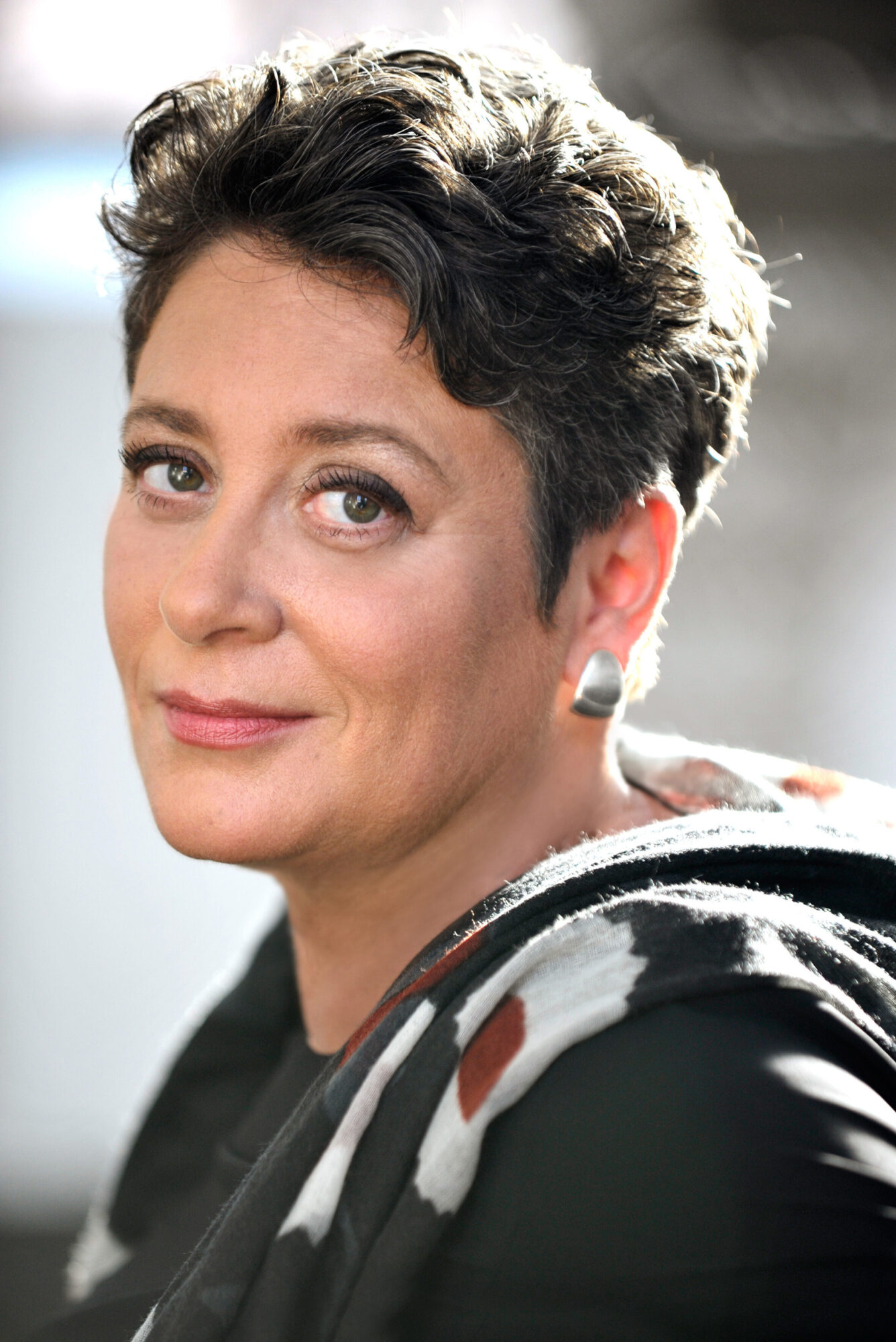
Luis Ramirez, Fjóla Evans, and Matthew-John (MJ) Knights

I’m again moved to ask “what’s in a name” as we ponder the three new works from the three young composers. While Shostakovich’s piece is called a symphony (which was perhaps the fashion in his time), each of the new works has a title that is itself a fascinating commentary.

We began with Hraunflæði (Icelandic for ‘lava flow’) from Canadian/Icelandic composer Fjóla Evans.

Her program note says “In the first half of Hraunflæði, I attempt to evoke the impression of molten lava roiling beneath the surface and then emanating forth in an unstoppable yet slow-moving torrent. In the second half of the piece, the drier textures of the orchestra explore the sounds of lava solidifying. Towards the end of the piece, I imagine the hissing and sputtering of drops of rain falling on the still warm lava.

While Hraunflæði is not to be confused with impressionist music that paints a precise tone-picture, there’s clearly something recognizable from her description, the opening soundscape of bent tones gnarly with a ferocious energy, while towards the end we get something that truly seems to cool off, music that’s less of an implicit threat, gentler, safer, more approachable.

Lines Layers Ligaments, the piece from Matthew-John (MJ) Knights seems to focus on the music on the page, his program note reminding me of Debussy (whose arabesques could be understood in a tradition of design upon the music staff) and Richard Strauss (whose Metamorphosen presents itself as an orchestral work for a large ensemble of solo instruments): a pair of allusions that likely will have some shaking their heads at what I’ve just said: because of course we didn’t get anything sounding like Debussy or Strauss in these five minutes, but something far edgier, rougher. While I loved the way he wrote about his music, the result was more like an etude or study, the orchestra making a great deal of music, then leaving us with a delightful concluding gesture.

Picante by Mexican-Canadian composer Luis Ramirez seemed to be the one that inspired Gimeno, himself another Latino after all. If the key to composition and marketing yourself as a composer is to create a good concept & title for your piece? then Ramirez will go far.

Picante follows the masochistic experience of eating spicy food as it takes us on an imaginative journey inside the human body. The entire piece is built around a fiery gesture that builds over time into an explosive climax, before being close-up in a calm state of flavourful enjoyment. This burning sensation is quintessential in Mexican culture. The music captures the fascinating process that occurs when eating spicy food: Our hearts quicken; we sweat, sniffle, cry, and cough; we shiver; we groan; we scream; and we suffer. Nevertheless, the most crucial reaction is that the brain releases endorphins and dopamine to lessen and alleviate the pain. The result is an intriguing exploration of the fine line between pain and pleasure. After all, what is life, if not the search for pleasure amidst the pain?”

But in fact his piece is more than just a concept. The music is mostly pleasurable, including sensuous passages of great beauty. It’s not just a name or an idea. If he chose he could expand this to something far bigger than five minutes in length.

Alongside these three, the TSO then gave us Shostakovich’s flamboyant 1st Symphony, a badass display of wit and irony to bely the composer’s supposed inexperience. It makes a terrific companion to the three Nextgen premieres.

The TSO will continue this week with the music of Alan Menken led by Steve Reineke, and Marvel’s Black Panther in concert next week.

Posted in Music and musicology, Reviews | Tagged , , , , , , , , , , | Leave a comment

VICE and the Doctrine of Presidential Infallibility

The headline is designed to catch your attention. When I googled “presidential infallibility” most hits refer to the Pope, whose infallibility is a doctrine we’ve heard about for a long time. The idea of infallibility associated with the POTUS is another matter entirely.

I call it VICE rather than Vice (the way you see it in IMDB for instance) because that’s how it appears in the film’s credits, or the trailer.

Perhaps that’s wrong, but I like the look of it, a screaming four letter word.

Never have I felt that a historical film was so apt for explaining the current mess in USA as VICE (2018). Primary credit for this incisiveness surely belongs to Adam McKay, who directed and wrote the screenplay.

Yes its cast is also remarkable, Christian Bale transformed into Dick Cheney. This is an official photo of Cheney, to show you how close Bale’s portrayal comes to the original.

Vice President Dick Cheney is seen Jan. 28, 2008 during the State of the Union Address at the U.S. Capitol. With a distinguished career in public service spanning four decades, the Vice President has served four presidents and his home state of Wyoming as a six-term member of the U.S. House of Representatives. White House photo by David Bohrer

Amy Adams was his wife Lynne, Steve Carell was Donald Rumsfeld, Sam Rockwell was George W Bush.

But there are brilliant touches we don’t see in Hollywood films.

There’s a wonderful scene in a restaurant featuring Alfred Molina in an uncredited appearance as a waiter, offering Rumsfeld, Cheney and others in the inner circle (that didn’t include George W Bush btw) a series of options. Are they there for food? The guest are rather blood-thirsty in the way the huge slabs of meat are cut up on the plates. They’re hearing ways to violate international law. It’s creepy.

Another example comes in a scene between Cheney (Bale) and his wife (Adams), that segues from the constructed reality we’ve had into a more theatrical exchange. The narrator tells us that there’s no way to know what they were really discussing, and suddenly we’re listening to a Shakespearean discussion between the wife encouraging her husband’s pursuit of power, not unlike the Scottish play. It’s a breathtaking bit of film precisely because it’s so unreal, so unlikely, and yes, a reminder that Shakespeare or cinema are fictional creations.

McKay has in this segment taken us back to earlier moments of his film. We see the moment earlier in the Cheney’s marriage when Lynne confronted Dick about his drinking, urging him to do better, or she’d dump him.

She wasn’t disappointed.

It’s not all politics though. Dick Cheney is a loyal husband and father, standing by his gay daughter. He’s at times a mystery, but often sympathetic.

McKay shows Cheney making connections. Rumsfeld explains a lot to his loyal pupil Cheney, observing how Nixon comes to Kissinger’s office, where the conversations won’t be recorded, to discuss bombing Cambodia without consulting or even telling Congress (as required by law). During a war especially, the POTUS has the powers of a king, above the law and virtually infallible.

McKay is explaining how we got to where we are in 2023. A recent president is following the same template as Nixon (Cambodia is not the only example) or George W Bush (lying about weapons of mass destruction before USA and its coalition invaded Iraq, supposedly in response to the terrorist attacks of Sept 11 2001). While the Insurrection may be illegal for the participants (thinking of the ones who are in jail already), but what about for the President, who is arguably infallible? It’s a bit of a legal conundrum, a logical puzzle at the very least. But these stepping stones make the present day predicament far easier to understand.

Let me point you to a couple of things I found when I googled.

The doctrine of infallibility version 1, pertaining to George W Bush in a piece from 2002.
A Doctrine of Presidential Infallibility – The Washington Post

The doctrine of infallibility version 2: a more recent essay pertaining to Donald Trump
Trump’s Defenders Have Adopted a Doctrine of Infallibility | National Review

Underlying this idea of infallibility is something we heard in the film, namely the Unitary executive theory. The wikipedia article gives a summary, including mention of VICE, a film that explores the implications, as Bush (with the help of Dick Cheney, Bush rubber-stamping Cheney’s actions) can do anything during a war. Unitary executive theory – Wikipedia

Finally, there’s a comical afterthought, in a “focus group” scene that comes up in the moments of the film after the credits. As I type this CNN has a town hall underway, which hopefully will be more authentic than the CNN townhall with Trump. I just heard Chris Christie say “complete baloney”, thinking that hmm a town hall where you only admit supporters of the person on the stage isn’t a town hall. It’s a rally. Hopefully this time there will be people in the audience asking tough questions, not lobbing softballs into the guest’s strike-zone. Canada isn’t much better.

Democracy has seen better days.

Posted in Cinema, video & DVDs, Politics, Reviews | Tagged , , , , , , , , , , , , | Leave a comment

PERCEPTUAL ARCHAEOLOGY (or How To Travel Blind)

Don’t let the big words in the title fool you. “Perceptual Archaeology”? I’m closer to knowing what that might mean after seeing Alex Bulmer’s new show at Crow’s Theatre, a co-production with Fire and Rescue Team that helps you to imagine How To Travel Blind, and perhaps rethink how you live if you were to “decentre visuality”. It’s a question that’s a luxury to contemplate if your eyes work. A blind person must ask such things of necessity.

I can’t deny that the title stopped me short, pausing to ask myself how that works, what does it mean. As a sighted person I’m amazed at how people manage to get around in their home or their city when they can’t see.

Now picture doing that in another country where they don’t even speak your language.

Notice that the verb I used (picture) is visual. I think I’m an average person, which is to say, I rely on what I see and tend to speak via metaphors and images that invoke eyesight.

Coming into this show I was ready to have my eyes opened (whoops there I go again with that visual-orientation). I know that lots of people have more courage than I do. What was so intriguing about this piece was the vulnerability of the presentation, a kind of story-telling that took us along on the journey around the world, the blind performer before us showing us a great deal about how it works without ever leaving the theatre.

Alex Bulmer and Enzo Massara (photo: Dahlia Katz)

The piece (forgive me if I skip the big title) was “several years in the making“, they tell us. That’s no surprise when we read about the author’s history from the program:

In 2014, the Winston Churchill Trust funded Alex Bulmer to pursue a Blind travel writing project inspired by the nineteenth century British Blind travel writer James Holman. She was later commissioned to turn her travel writing into five essays for BBC radio. These essays are the foundation of this play and led to the creation of a new Canadian theatre collective with Leah Cherniak and Laura Philipps called Fire and Rescue Team.

It’s very romantic the way Alex speaks of James Holman, a real adventurer from another century. But I fear it all sounds too dry, the way I’m speaking of this.

The cool stories Alex tells of James Holman (which I won’t tell as I believe in a spoiler free writeup) remind me that disability and ability are at least partly performative. Just as he was acting out a brave bold persona, so too Alex in her presentation. I am raising the issue of disability very carefully for fear of sending the wrong message.

Alex has reminded me of how much I miss travel. I was in NYC in January 2020 and since then haven’t been out of Ontario. We are socialized by encounters with others, whether we speak their language or not. This little travelogue is a genuine tour de force, sometimes warm and fuzzy, sometimes a nudge to remind us how fortunate we are.

Alex Bulmer (foreground) and Enzo Massara (photo: Dahlia Katz)

The relatively bare stage is apt for a show inviting us to identify and perhaps wonder: “what might it be like?” We don’t need an actual bed or airplane to be taken on a trip with Alex and Enzo and James. Leah Cherniak directs this minimalist show. There’s not much there and that’s a good thing. I closed my eyes a few times, listening rather than staring, swept up in sensory images.

It was a trip.

PERCEPTUAL ARCHAEOLOGY (or How To Travel Blind) continues at Crow’s Studio Theatre until June 25th.

Posted in Dance, theatre & musicals, Psychology and perception, Reviews | Tagged , , , , , , , , , | Leave a comment