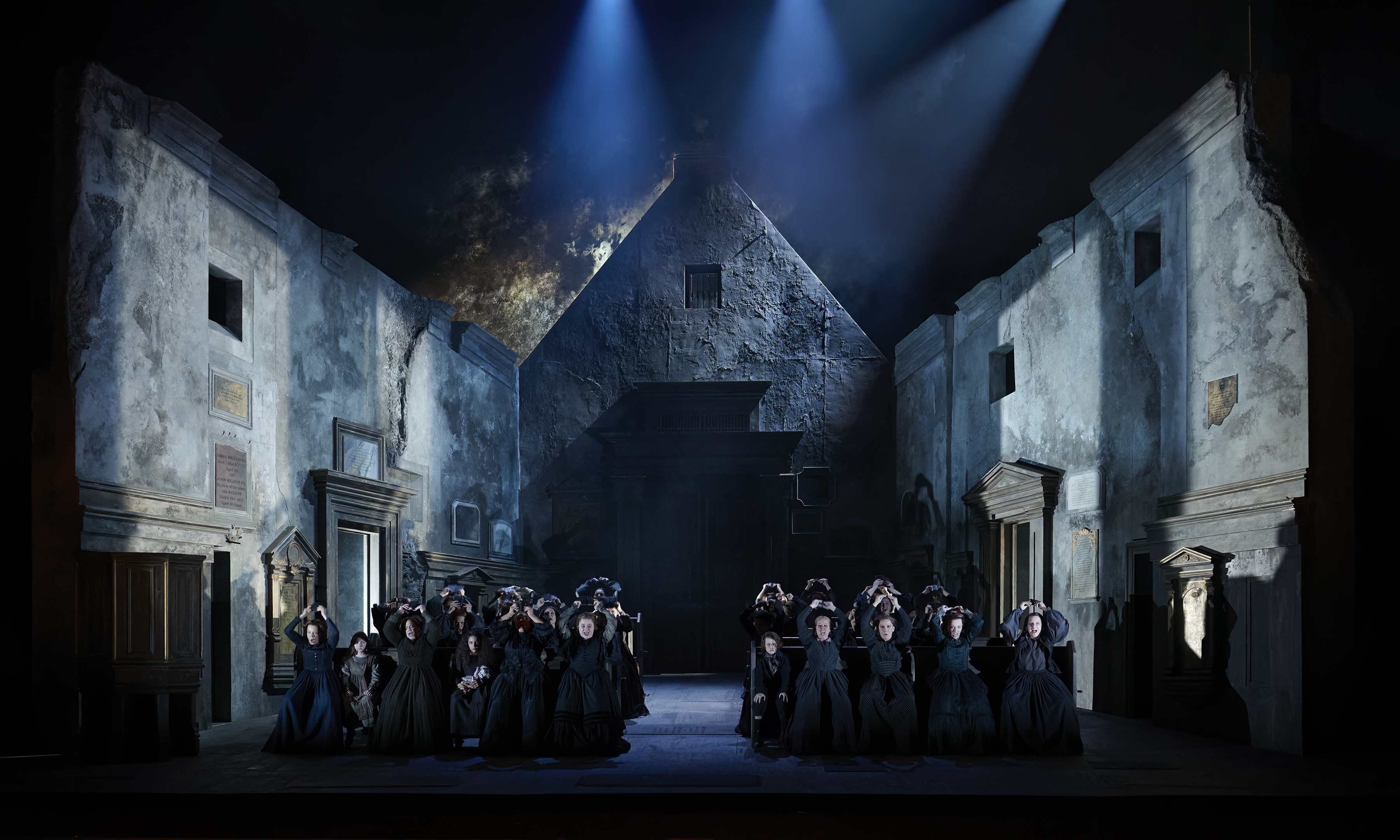
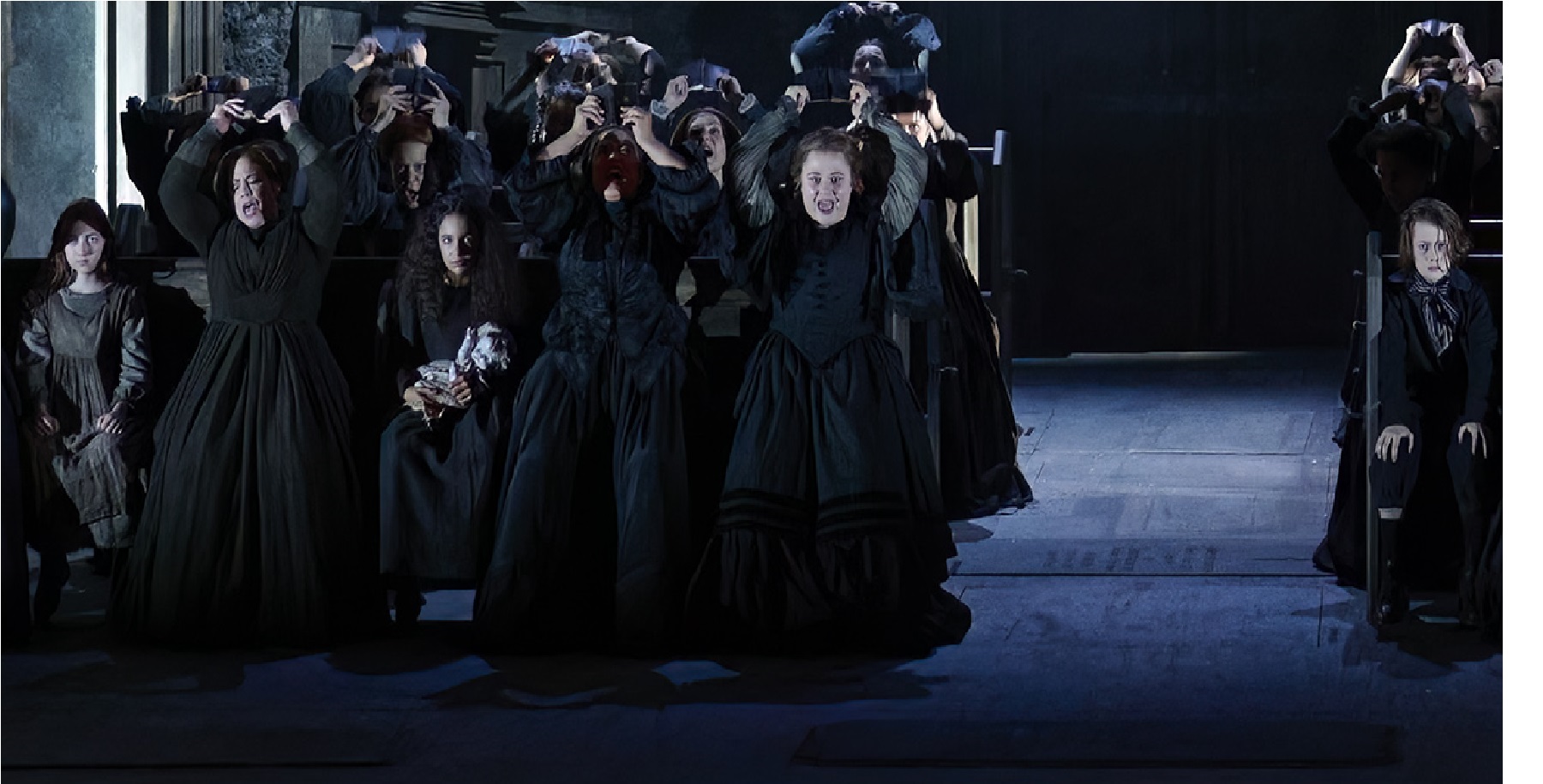
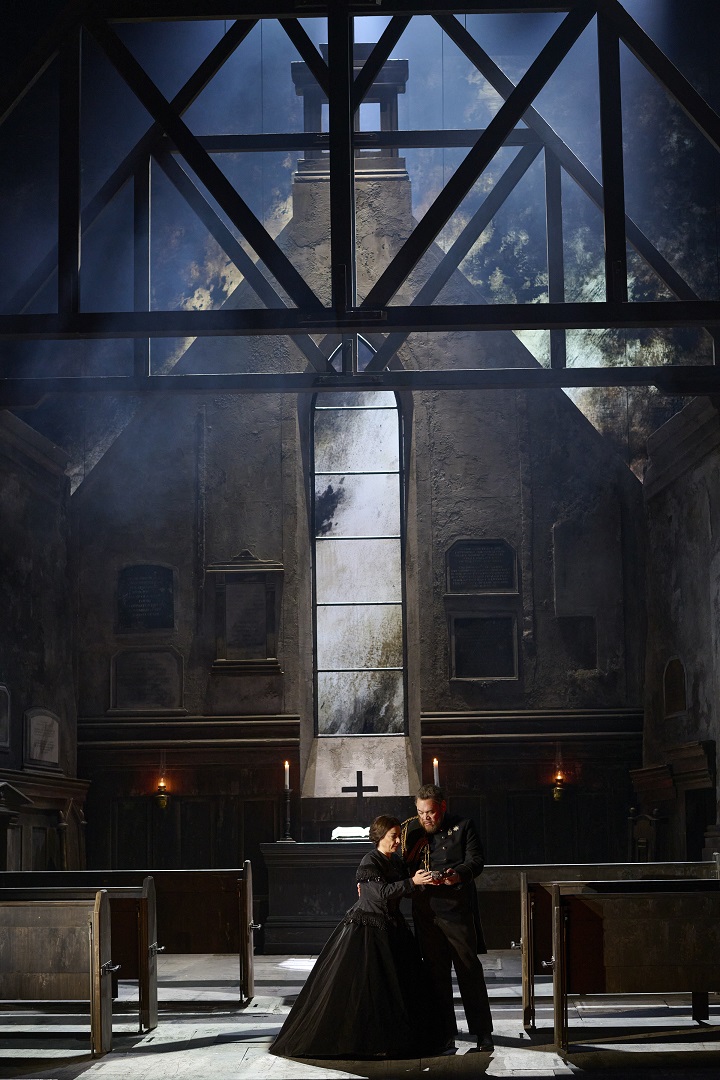
Rhino is an adaptation of Ionesco’s 1959 absurdist play Rhinoceros, by Aleksandar (Sasha) Lukac and Emilie Varga. Last night I watched its premiere at Theatre Glendon with students in Lukac’s drama class.
Sasha Lukac
It’s much shorter than the original. As I was commenting (oh dear or perhaps pontificating) afterwards, the world is almost unrecognizable 64 years after Ionesco’s play first poked its pointy snout into the world’s consciousness. Absurdism was a thing for awhile, and it took Ionesco much longer to make his point than is necessary now in a world of memes and fake news.
We get that point pretty quickly now, and curiously it’s as pointy and relevant as ever.
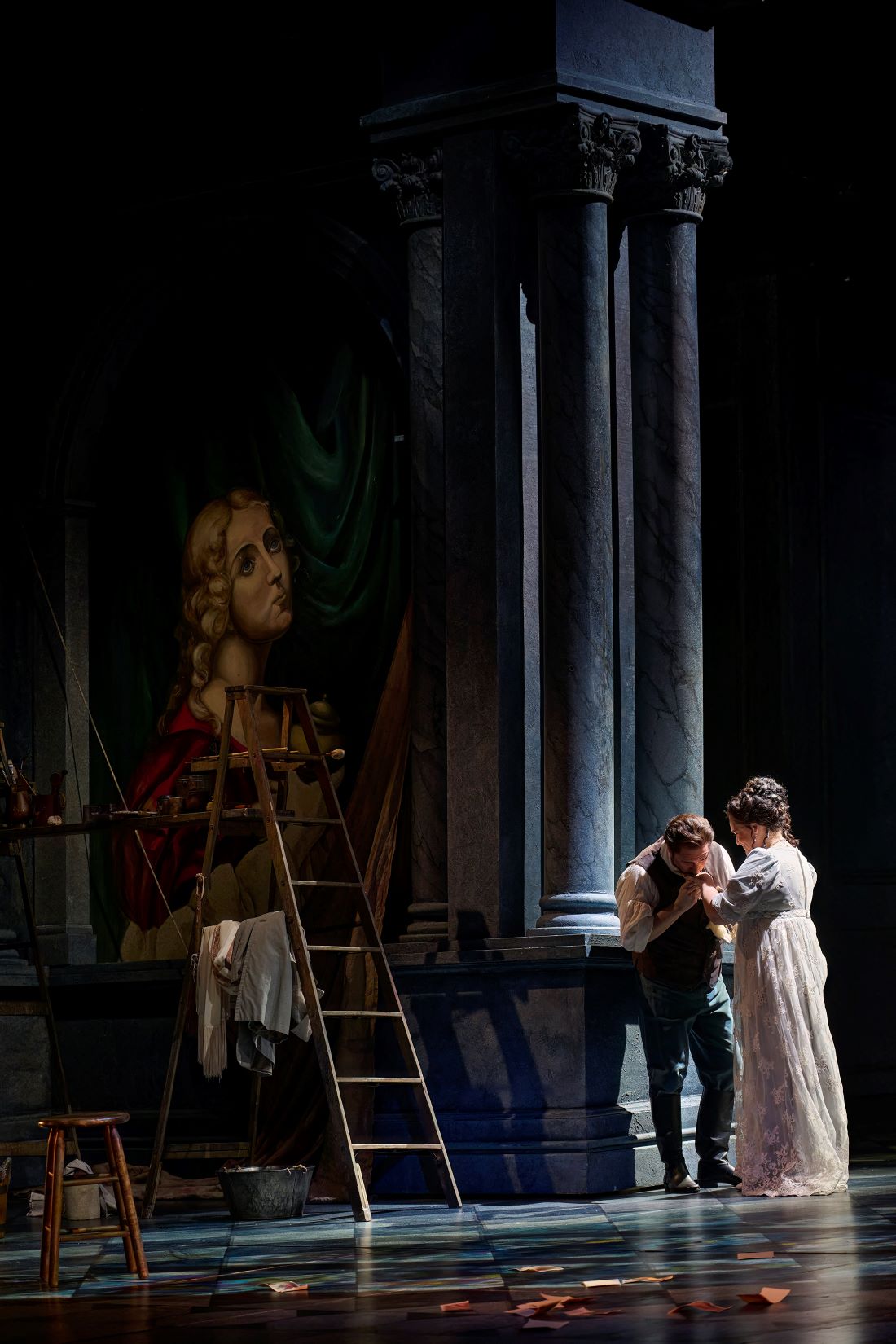
We open on a stage that jolted me for a moment, reminding me of the stage picture that confronted the Bayreuth Festival audience for their centennial production of Wagner’s Ring Cycle directed by Patrice Chereau in 1976. No I wasn’t there but I’ve seen that video many times. At the end of Twilight of the Gods, as the world ends, that audience see all the people onstage looking right back into the auditorium, reflecting ourselves back to us.
Similarly as this Rhino begins we’re looking into a theatre with a series of seats populated with people looking back into our own space, exactly like the audience.
They are us, which is perhaps the point.
It doesn’t stop there. We discover they’re in that seated auditorium to watch a new film by Sasha Lukac.
The absurd self-reflective action is especially strong when I look over to see Sasha sitting beside me in the front row. As the action unfolds one of the characters is accused of being Sasha, although it’s delightfully sycophantic, so it’s done in the fake language of flattery. Throughout we’re tasked with decoding the layers. Is it real or fake, authentic or artificial? It’s a lot like life in 2023, when the world has become so bizarre we don’t know what to believe anymore.
And from time to time the “reality” of the rhinoceros transformation of the storyline bursts into the space, both as projections onto the scrim separating us from our mirror images (and yes there is even a doppelganger for me, the loudmouthed reviewer pontificating endlessly) and eventually….
But I don’t want to spoil it.
Sasha explained to me that Emilie Varga –who co-wrote the adaptation – is responsible for the self-reflexive parts about “Sasha Lukac, the brilliant film director”, a worthwhile addition.
Rony Ojha is editor of the video content jarring us from time to time, created by a team of contributors. For these moments we’ve truly left Ionesco and the 1950s behind and are firmly in the 2020s.
From time to time I laughed very loudly, although sometimes it’s a bit pained, especially in the recognition of the familiarity of what we’re seeing, so close to home.
Student theatre can be a revelation, unhindered by the pressure to be commercial or popular, as the participants passionately pour all their energy into the performance. I’d rather not name names except to say that they’re very good, an absurd slice of theatre life.
There are two more performances Friday & Saturday March 10 & 11. The shows start at 7 p.m. Click link to get tickets. Suggested donation $10.00.
The description of Claren Grosz’s new show caught my eye.
I love the smell of gasoline dives into Western alienation, the Canadian oil and gas machine and what it all means in the face of an environmental apocalypse.
Her title suggests the visceral relationship to the topic of an Albertan. If you’ve been reading Twitter or just following the news, it’s concerning, indeed a bit terrifying. Does Alberta want to separate? or do they just hate Ontario? Yes I’m intrigued. It’s an existential question for a Canadian.
But what kind of a sadist interviews the playwright just before her show opens? Me I suppose (here goes).
Claren Grosz (photo: Fran Chudnoff)
Are you more like your father or your mother?
I think at first glance, I’m more like my mother. We have the same smile and the same laugh. We’re both easy to make laugh. We’re both “bossy” and have strong feelings about how a dishwasher should be loaded. My mother nursed my love of art and fashion and reading fiction and picnics. I’d like to think I’m charming, fiery and fearless like her.
My father nursed my love of music with good lyrics, good design, hot dogs, and a general romanticism about day-to-day life. I would like to believe I inherited his ability to apply humour to anything, and his willingness to be the butt of a joke. I learned from him how to easily admit when I’m wrong, when I don’t know, when my mind has been changed.
From both of them I learned to work hard and offer hugs to the people who hurt me.
What is the best or worst thing about what you do?
The best thing about what I do— both as a theatre artist and a math tutor— is that it’s challenging and involves building real relationships with people. I feel so lucky that in my work I get to genuinely connect with people while solving problems creatively.
The worst thing about theatre work is that so much of it is waiting for someone to give you permission to make your art. Something I don’t contend with in my visual arts practice where if I want to make something… I just do! But theatre involves so many people, and space, and resources. You need to be chosen— by granting bodies, by collaborators, by companies. One of the reasons I switched from being an actor to a director/producer upon graduating theatre school is because I could minimize the amount of waiting-for-permission, but there’s still a decent amount of it.
Who do you like to listen to or watch?
King Princess. MUNA. The sound track/effects of Stardew Valley. Everything, Everywhere, All At Once. The podcasts How to Save a Planet; The Big Story; and The Gray Area. Dogs in the Trinity Bellwoods off-leash bowl. The Calgary Flames, but only if my Dad takes me.
What ability or skill do you wish you had, that you don’t have?
I’d really like to be able to salsa and two-step better. I know the basics. I wish I was fluent in French. I’m still working on that. And I wish I played an instrument. Not badly enough to learn, though.
When you’re just relaxing and not working, what is your favourite thing to do?
The good answer: draw, go for walks, spend time in the sun with friends. The bad answer: binge entire seasons of tv shows in one sitting.
What was your first experience of theatre?
My earliest memory is playing the “stage manager” in a Christmas play about a Christmas play in grade five. I got to wear a sparkly holiday outfit and march around the stage with a clipboard and headset. This must have been quite formative because I still like to march around in sparkly outfits and lead rooms.
Do you believe in art as a vehicle for social change?
I think artists can definitely help incite social action. I do, however, have a bone to pick with a lot of activist art: it can be grim and oversimplified.
Keshia Palm and Claren Grosz working on Shadow Girls (Photo: Colin Murray)
To incite action, art must take aim for our hearts. A lot of art utilizes rage, shock and despair in hopes that the audience then metabolizes this emotion into action. But despair and rage are notoriously difficult to metabolize! And I think, specifically around climate change, people are already aware ’n’ in despair. Art has this opportunity to also help us emotionally regulate. I leave some activist art and I feel helpless! I feel misunderstood! I feel guilty! Or I’m directing the feelings away from myself and feeling angry with those other complacent, evil humans! So one of the goals with my own play was to provide a space for us all to wade into how hard and complicated it is, to face both our fault and our helplessness together, and still come out the other end ready for action. I hope.
As a former westerner who got out do you think you have the pulse of Alberta as it is now and over the past decade of turmoil & struggle?
I barely feel like I have a sense of the Toronto pulse, let alone the Alberta pulse. Even when I was living in Alberta, I only had a sense of my own city, Calgary, and only a sense of my own socio-economic bubble. I’ve done my best to write this play in a way that honours the province without being an expert on it. I don’t assume I know what’s going on there and I think that actually allows me to be more sensitive and in tune. I’m going to be bold and say this approach works for people too. When I assume I do not and cannot fully understand my loved ones and the people around me, it allows me to be more curious and compassionate, especially when I disagree with them. When people make choices that initially make me recoil (for example, the Wexit movement), my first impulse is to think wait, there must be a piece to this puzzle I’m missing. In some ways I think this really serves me, and in others I think it makes me a little naive.
Pierre Trudeau and the federal government that set the rules for energy, have often been perceived as unfriendly, exploitive, of Alberta. How did you understand this relationship (to central Canada and the PM) when you were a child growing up out west?
As far as I absorbed as a child and teen (again, keeping in mind that I perhaps did not have my finger on the pulse), Albertans hated the Liberals and yes, I think this stems from Pierre Trudeau. Out West there is a strong distrust of the federal government, the same I see reflected in my own peers, but whereas in my circles the consensus seems to be ok, more, better funded government with more accountability, the general Albertan consensus seems to be ok, less government because there is no way to achieve accountability. There’s also a perception in Alberta that Ontario is biting the hand that feeds it— that is, accepting cashflow from Alberta through equalization payments while shaming it for the industry that provides that cashflow. There’s also small things that I imagine every province that isn’t Ontario feels. “Canadian” media is often actually Ontarian media. It’s run by Ontarians and focuses on Ontario. My Dad used to joke that the TV people would sooner play a rerun of the Maple Leafs game instead of show the live Flames game. Even when national media covers issues outside of Ontario, it’s from an outsider lens. I remember watching CBC’s national election coverage and it so obviously was taking place in Ottawa because they talked about other provinces in a tone of oh hmm… what’s going on over there.
When did you come to Ontario, and what ties (if any) do you currently maintain with Alberta?
I moved here in 2011 for university when I was 17. My parents and sister still live in Calgary, and I visit home twice a year. I think when I talk about Alberta, I mostly picture my immediate family. To me, they are home, wherever they are. And they are in Alberta!
Were you surprised to discover we –the denizens of Ontario—weren’t the way popular mythology portrays us back out west..? OR Were we precisely as you expected?
I’m thinking of the Rick Mercer Report: Special Report on Toronto Snow, in which he makes a heavy Toronto snowfall out to be a national crisis.
This bit of satire does feel apt. My parents and I have a running joke that Toronto is the self-appointed centre of the universe. There’s some laughable truth to it, and I say this with great affection as someone who now identifies as a Torontonian and also fits the stereotype— a little self-righteous and a little out of touch with the rest of the country. But hey, you kind of get to be that way when you make up a third of the nation’s population, as Southern Ontario does!
You describe your show I Love the Smell of Gasoline this way:
Overhead projection meets performative research essay meets personal narrative as Claren attempts to reconcile her Alberta oil-industry roots with the current environmental emergency. The project was born of a frustration with divisive Canadian politics, rampant hypocrisy, and a lack of team spirit when facing impending doom. It unpacks some of the forces that drive global warming and Western alienation in a personal account of what it is to live in a modern, capitalist environment, be a self-serving organism, and also care about the earth and fellow creature kind. What does it really mean to sacrifice and to survive? How can we harness our agency and responsibility in a global crisis?
Should we expect you to challenge us in the theatre?
Yes, I think so. I hope it pokes holes in people’s worldviews, opens them to the idea that maybe there’s a lot more going on than they can possibly understand.
Claren Grosz (photo: Raf Antonio)
That’s how I felt building the play, anyways. The more I researched, the less I knew. The show might challenge some people to grieve. I hope it challenges people to switch from an us vs. them mentality to an us vs. the problem mentality. I hope it challenges us to ditch the guilt and lean into problem solving. Perhaps that’s too grandiose for a little 75 minute solo show. Definitely the audience will join me on my own journey as I roll out research, arguments and statistics, as I tell quippy first date stories, as I recall important familial memories, as I explore poetic and existential questions I have about our place in the universe.
How did you handle the pandemic, both professionally & personally?
Claren Grosz (photo: Keshia Palm)
Kurt Vonnegut has said that “we are here on Earth to fart around,” and I really embraced this in the pandemic. I committed to filling my days with the most mundane things. Walks. Taking note of how the sun reached different parts of my room as the months went on. Quite literally sitting with my chin on the porch railing and watching the garden grow. I’d sit there for an hour, gazing at the plants, thinking about possibilities and watching bees. Once a man walked by twice within 30 minutes and on his return trip he commented “has anything grown since you’ve been watching?” and we shared a neighbourly laugh.
Puttering is a privilege. I was blessed with financial stability, an amazing roommate, and deep friendships that still felt fulfilling through three hour phone calls. I didn’t have any projects that were slashed because of the pandemic. Part of my personal sense of activism is to prioritize joy and also to prioritize puttering. For everyone!
Do you have any influences you’d like to acknowledge?
An artist and poet and tremendous friend who regularly inspires me is Jessica Hiemstra (who also made us some beautiful plastic bag installations to compliment Echo Zhou’s set for I love the smell of gasoline). I like the way her work makes room for multiplicity and complication. I like the way she looks at the world. She wrote to me in an email that with this play I “hold our hope and despair in one hand,” and perhaps I actually learned to do this from— or at least alongside— her.
You can discover more about Claren’s collective — Pencil Kit Productions—and their commitment to exciting theatre through their website.
Their next show is I love the smell of gasoline at Aki Studio Theatre 585 Dundas Street East running from Thursday March 9th to Sunday March 19th. For tickets click here.
Co-directors William Dao and Claren Grosz (photo: Raf Antonio)
It was worth the drive to Richmond Hill yesterday to see Opera York’s production of The Magic Flute, their first in-person return to the stage since the pandemic. While Friday night’s snow-storm likely reduced attendance, Sunday’s matinee was sold out.
Opera York deliver popular favorites without turning the directors and designers loose to revise the original. If you’re one of those who has been turned off by such updates (you know who you are, some of you discuss this with me regularly): this was the Flute for you.
Stage Director Penny Cookson did not impose upon Schikaneder’s libretto, but instead gave us the work as written, complete with costumes from Amanda Eason and sets from Frank Pasian that match our expectations of this tale of princes & princesses in a faraway land.
Yes there’s magic in these musical instruments, especially in the work of Conductor- Music Director Geoffrey Butler. Mozart would have been pleased with the tempi especially in the finales, and the perfect support given to the singers.
While Opera York is a small organization relying largely on volunteers, without the resources & support given to the big arts companies, they showcased some terrific soloists who raised the standard higher than ever.
Holly Chaplin’s Queen of the Night was sung as well as I’ve ever heard the role sung, and with the aid of Richmond Hill Centre’s superb acoustics, her pinging coloratura was especially dazzling.
I came to the show knowing I’ve get to enjoy Holly Chaplin and tenor Ryan Downey as Tamino, that if all else failed, I’d have the chance to hear their lovely voices. Ryan is one of those rare singers whose pitch is impeccable, with a sweet tone and a personality to match.
No it’s not a competition, but I take exception when the Canadian Opera Company bring in singers from abroad when there are so many excellent Canadians available and needing employment. I found Holly and Ryan better than the people singing their roles with the COC downtown in their 2022 revival of Magic Flute in Toronto, even if we don’t also mention that with the intimate acoustic in RH you could hear these stunning voices (and everyone else) with ease.
Thank goodness for companies such as Opera York or OperOttawa (to mention just two), that are not just offering enjoyable performances but also employing our artists, and staying true to their mission statement: “Opera York’s mission is to provide passionate, professional opera for everyone, and to entertain, enrich, educate, and inspire through full productions, education and community programming. It is to offer professional career opportunities for emerging and established Canadian artists, and to support volunteerism and involvement in the arts within our diverse community.”
There were several other good performances to mention.
Stephanie Kim was a wonderfully sympathetic Pamina, Dylan Wright a truly ceremonial figure as Sarastro as though he had stepped out of a Biblical epic, John Holland a loveable everyman as Papageno. Alvaro Vazquez was a weirdly wacky bad guy as Monastotos, Douglas Tranquada a properly fervent Speaker, Grace Quinsey as Papagena stealing the show whenever she peeked out of her disguise, or finally showed up in person. Liv Morton, Veronika Annissimova, and Adriana Albu helped get the show off to a good start as the three ladies, between their singing and silliness. The three spirits in this version were Lori Mak, Ella Farlinger and Katelyn Bird, ably handling some of the prettiest music in the entire opera. Corey Arnold and Austin Larusson as priests were sometimes comical and as the two Armed Men offering us luxury vocals, particularly when Corey & Ryan soar effortlessly in the trial scene.
Foreground Stephanie Kim and Ryan Downey, with Austin Larusson and Corey Arnold in the moments before the trial.
To stay in touch with Opera York’s upcoming work or to read about their past productions follow them on their website.
Rhino is Aleksandar (Sasha) Lukac’s adaptation of Rhinoceros, opening March 9th at Glendon College.
Sasha directed over sixty professional theatre productions in his native Yugoslavia (now Serbia and Bosnia), which garnered seven Grand Prix awards for Best Director as well as eight Grand Prix awards for Best Production. His notable Canadian work includes: • Christmas at the Ivanovs (Vvedenski), nominated for a Dora in the independent theatre category; • Unicorn Horns (M.Major), which represented Canada at the Festival of Ideas in Hong Kong; • Moliere, (Bulgakov), performed at the Bulgakov Festival in Kiev; • Ivan Vs Ivan (Gogol/Lukac), which toured London, England, Moscow and Belgrade, Serbia; and • Family Stories and Bea, produced in collaboration with Toronto based Actors Rep Company (ARC).
Sasha has been teaching at York University and Glendon College since 1992. At Glendon, he had directed 23 student shows, including three that fully explored interactive digital theatre (Marat/Sade Occupy, WWI Revisions of the Aftermath, and Life is a Dream). These productions encouraged the students to explore the implications of live interactivity between performers and audiences across the world. Rhino is his second production of a Ionesco play at Glendon College – he has previously staged a “mash-up” of Bald Soprano, The Lesson and Artaud’s Jet of Blood.
Aleksandar Sasha Lukac
I wanted to find out more about Rhino.
There’s a quote from Soren Kierkegaard. “A fire broke out backstage in a theatre. The clown came out to warn the public, but they thought it was a joke and applauded. He repeated it, and the applause was even greater. I think that’s exactly how the world will come to an end: to general applause from people who think it’s all a joke.” Are you or your actors anything like that clown, and do you expect us to listen to warnings, or to applaud your wit?
I think we are way beyond that – I have completely lost faith that theatre or, for that matter, any art, has the power to affect the audience’s comprehension or contemplation of the world in which we live. It took awhile, but capitalism has succeeded in making art and, theater particularly, a toothless commodity.
How does “Absurdism” work in 2023? Is it possible anymore after Trump & Putin? Is anything absurd anymore? Was absurdism funny: or is it comic or tragic or satire?
That “Absurdism” took over our lives long before the culprits you mention. Don’t you think that it is absurd that humans did not learn a single thing in the aftermath of WWI and WWII? That we keep repeating the same mistakes in cycles to the point that it has convinced me that we are predestined to self-destruct? What I find bitterly funny is the endless capacity of humans to distract themselves from this reality.
You have a history of making political theatre, at least partly because the politics of your origins in Serbia shaped your sensibility and your creative voice. But you’ve been in Canada for a long time. How have you changed with the passage of time?
The previous answer showed how pessimistic my worldview has become. When I came to Canada it was a promised land of sorts. Recent discoveries of past crimes against the indigenous population as well as a general rapid move to the Right has me extremely disappointed and worried. Of course, the old me would take both these realisations as a challenge to create more compelling stage work. The “new” me asks who would I address this work to? No one cares – and I mean politically, not aesthetically. So, when I work, I put on my Fool’s hat and have a blast. It most of the time connects with the actors and my collaborators – which is an immense pleasure. The audiences can be more challenging, and I, of course, blame them entirely if they do not connect. Thankfully my most recent production in Serbia has been sold out for the past year so, as I said, it can work.
The need and the hunger for satire ebbs and flows, according to the state of a society. Please talk about why we need satire and why our current time might be a good time for satire, either in Europe, Canada or anywhere else.
I never had any confidence that satire has any impact on the outcomes in society. It always served as a pressure valve to relieve societal tensions – yet it somehow always relied on some weird notion that those tensions are temporary and that a healthy society awaits if we can only hold on long enough. Well, guess what? Satire is too thin of a sugar-coat to swallow this mess of a world. We need a bigger boat!
Talk about your adaptation of Rhino.
Of course I read the original and even watched the Zero Mostel film version. Our Glendon version is less of an adaptation as it is a new play heavily inspired by the original.
When we were discussing the Canadian Opera Company’s production of Marriage of Figaro the other day you said “it was very Commedia”. And you mention that you did a commedia warmup with your class. Please help me orient your work around styles & idioms. Commedia was once a part of your individual voice back around 2000 for Christmas at the Ivanov’s. You’ve done other shows such as the Flea in her ear at the Fringe in 2017 that was more of a pure French farce, than commedia. Where does commedia fit into your vocabulary, either as a teacher or as a practitioner? What are you teaching, please explain the style(s) you explore.
There are some Commedia based warmups and exercises that help unleash the actors’ energy and “size”. Rhino has definitely incorporated those in the creative process. However, in terms of comedy, this play functions best when the actors are dead serious in performing idiotic character tasks.
For Life is a Dream you played some elaborate games with technology, incorporating them into the playtext and the mise-en-scène. Will you do something similar for Rhino?
Indeed, those were very interesting experiments. In the case of Rhino we are not going interactive with the audience.
Tik Tok videos serve the purpose of creating the external backdrop to the action that is confined to a special event cinema during the rhinoceros’ attack.
Talk about theatre in the age of social media . What’s the relationship between stage and mass media nowadays?
You know that I have been experimenting with interactivity in the live performances – through YouTube and other platforms. It yielded some amazing results.
Unfortunately, as the whole world had to perform on Zoom in the last three years, I feel that there is a certain Zoom fatigue which affects other similar experiments. We have all longed for the live theatre feeling so we will give that a chance for a bit, I think.
Please put this adaptation in context with Glendon and your teaching. What does one learn doing this sort of show? And how does it differ from a more classical approach?
Well – I wrote the play in four days and then had a student, Emilie Varga, read it over, edit, add some even more absurd elements including adding me as a character in the play. And we all keep adding Gen Z language to keep it light – so the process essentially reflects my general teaching philosophy – include the students in the process and respect their discoveries/contributions as if they are your own. The most rewarding moment for me is when I see that students take pride in their work. I owe that to my teachers who made me discover myself in theater.
Where and when is show to be presented?
Glendon College/Glendon Theatre, March 9,10 and 11. The shows start at 7:00pm
Is there anyone you’d like to thank, acknowledge for their input / influence / assistance?
Other than the whole Glendon Theatre community for inviting me back to do a show, I have to thank my kids for making it easier to make fun of myself.
Aleksandar Sasha Lukac
*******
Rhino runs Thursday March 9 to Saturday March 11th, performances at 7:00 pm. Click link to get tickets. Suggested donation $10.00.
When I saw the email on Thursday from the Canadian Opera Company announcing their 2023-2024 season it moved me to say this on Facebook:
That’s more like it! COC’s 2023-24 season: Fidelio, La Boheme, Cunning Little Vixen, Don Pasquale, Don Giovanni (Gordon Bintner!) & Medea plus the world premiere of Aportia Chryptych.
I have to wonder when will it be reasonable to say that this is Perryn Leech’s COC?
COC General Director Perryn Leech
I say that looking at the season we’re enjoying now, revivals of Flying Dutchman & Carmen in the fall, revivals of Salome & Marriage of Figaro just finished this month, a new Macbeth and a revival of Tosca still to come in April-May, in other words five revivals plus one new show. In a real sense it’s still 5/6ths Alexander Neef, with just the one new production. Indeed maybe Neef had some involvement in the new production as well, given the long lead time required to plan operatic productions.
For 2023-24, though, we get the opposite namely five new productions (new to us in Toronto at least), plus one revival. That’s why I said “That’s more like it!” Speaking as a subscriber I’m thrilled. I felt we should give the new guy time to show us what he can do, and so far so good.
I listed Fidelio, La Boheme, Cunning Little Vixen, Don Pasquale, Don Giovanni & Medea, as well as the world premiere of Aportia Chryptych.
It’s kind of funny to speak about the boheme revival, when so many I know groan at any boheme, an opera they may say is programmed too often. Not me. I don’t agree speaking as someone who regularly pulls out my boheme score to play through. It never gets old for me, a perfect piece of music that I’ve loved since I was a little kid. I suppose I become a kid again listening to parts of this opera.
You’ll hear people call it the ideal first opera, as a few people reminded me recently when I suggested that Salome could be a good first opera for some people. Of course I was thinking of the sort who love heavy metal and claim to hate opera. Let’s see if they still hate opera after seeing Ambur Braid in Atom Egoyan’s production. But I digress.
Let me direct you to the COC website, where in addition to the usual video, for once they’re also offering us pictures to give us some idea of what to expect visually. This is a huge improvement over past practice. For each opera, click on “Learn more” then click on “photos”. This is a small sampler of what you can see there, some very cool designs coming to the COC next season.
Sondra Radvanovsky as Medea in Medea, The Metropolitan Opera, 2022 (photo: Marty Sohl)A scene from The Cunning Little Vixen, English National Opera, 2022 (photo: Clive Barda)
Russell Thomas as Florestan in Fidelio, San Francisco Opera, 2021. (Photo: Cory Weaver)
Luca Micheletti as Don Giovanni in Don Giovanni, The Royal Opera, 2022 (photo: Marc Brenner)
Scottish Opera’s production of Don Pasquale, 2014 (photo: KK Dundas)
I love the eye candy, don’t you?
I’m sold!
In addition to what’s included in my subscription the COC will also present a world premiere opera, namely Aportia Chryptych. You can meet the creators near the end of the video describing the season, featuring General Director Perryn Leech. I’m very impressed.
No there was no cake or champagne but I’m watching my weight and can’t drive home to Scarborough if I’ve been drinking.
Yet it was truly like a party, a celebration of our host Colin Eatock on the occasion of his 65th birthday, an occasion full of joy. And our ears were blessed by the generosity of what we were offered.
Colin Eatock
Colin was not only premiering “Two pieces for Tenor Recorder and Harpsichord (2021), but handing over the programming for the remainder of the concert to his soloists, Alison Melville recorder and Christopher Bagan harpsichord, which I can elaborate upon after addressing the main event, namely Colin’s new works, a pair of contrasting pieces.
In the first one, the recorder began with something rhapsodic, a lovely meditative melody that instigated everything to follow. The harpsichord functioned as a kind of accompaniment sketching in the harmonic landscape surrounding the plaintive wind-melody, as though explaining what was implicit in what Melville had played, a bit like a shrink or a priest explaining the mysteries of the recorder’s sounds. The recorder started with something that may have been notated as a mordent (the note going up and down, back to where it started) or written out (I am only guessing). Ornaments, meaning mordents, trills and more were a big part of the baroque, and may have been something Colin wanted to emulate in the piece, perhaps to invoke something of the period, even if the harmonies from the harpsichord (the timbre of the harpsichord offering another automatic pathway of association to the baroque) put me more in mind of someone like Debussy, Ravel or Poulenc.
The second piece is a contrasting composition, beginning with the harpsichord as provocateur, regular minor thirds in a pattern establishing a rhythm and urgency, while the recorder this time was responding or even debating rather than provoking. Where the first was subtly thoughtful, the second was more from the realm of a movie score, something dramatic and troubled. Where the first was to my mind sunny the second was stormy and with anguish underneath. They’re a nicely matched set, like yin and yang.
Of course music is a bit like a Rorschach test, so what I’ve written here may sound more like my pathology than a proper assessment of what Colin created. Yet it was absorbing to hear these two works from unexpected instruments, and employed cogently and economically without a surplus note.
Between Alison Melville, recorder and Christopher Bagan, harpsichord, we heard music from three different centuries. It all felt very new whether it was the 1700s, 1900s or from our own time, complete with some fascinating introductions explaining something about the way the instruments were being employed by the music, a wonderfully diverse assortment of sound from two instruments that you wouldn’t think of as the vehicles for anything modernist or edgy.
Framing Colin’s pieces, Bagan and Melville had their solo moments.
To start Bagan gave us Louis Andriessen’s Overture to Orpheus, speaking first of the idea of “following”, one hand quickly echoing the other on different manuals to create some remarkable acoustic effects. Euridice may have walked behind Orpheus in like manner, or so it seemed in this meditative work from the 1960s. I never knew a harpsichord could sound so modern.
Following Colin’s pieces, Melville offered Telemann’s Fantasia No. 9 seguing directly into Staeps’ “Allegro deciso”, suggesting that perhaps Telemann’s ideas weren’t so old considering how fresh he sounded, particularly alongside Staeps.
The remainder of the program featured two impressive works. Hans Poser’s Seven Bagatelles showed signs of Hindemith’s influence, works I wish I could hear again to enjoy their wacky humour and stunning brevity. JS Bach’s trio sonata #1 BWV 525, transcribed for recorder & harpsichord contained perhaps as many notes as everything else in the concert combined, a stunning display from Melville and Bagan to close the concert.
I was also thrilled to be able to get my hands on a copy of Colin’s Glenn Gould book, which I’d looked for in vain online. Thank you Colin and Happy Birthday!
I wanted to shine a spotlight on OperOttawa, a relatively new company, by talking to their founder and Artistic Director, Canadian baritone Norman E. Brown.
OperOttawa present Handel’s Alcina on March 5th in Ottawa, so I wanted to ask Norman some questions.
Who and what is OperOttawa?
Norman E Brown, Artistic Director of OperOttawa
OperOttawa is a relatively young opera company (10th season) producing opera and concerts amidst the larger well-established companies across Canada. In Ottawa OperOttawa has specialized in filling a gap by producing operas and oratorios of the Baroque early periods, producing staged versions of lesser performed works, and supporting and encouraging young Canadian, Ottawa based composers. OperOttawa also endeavours to produce operas in their entirety with no cuts, giving singers an opportunity to fully learn major roles. We also offer younger and less experienced singers an opportunity to understudy main roles, with a chance to perform at rehearsals.
During the Covid pandemic OperOttawa successfully produced on-line the world premiere of Jack Hui Litster’s opera “The Day You Were Born” and led the return to live performances last November with a successful “Acis & Galatea” (costumed and semi-staged), our “alternative Messiah”, and a successful performance of Jack Hui Litster’s world premiere “What is Love“.
In November of 2022. The 10th season kicked off in October with a successful Opera Gala. OperOttawa was incorporated as a not-for-profit entity in November 2022, and formed its first Board of Directors.
Are you more like your father or your mother?
I get my musical talent from mother’s side of family. And probably my strong determination from father’s side.
What is the best or worst thing about what you do?
After studying the sciences and business administration and after a career in government it is great to be able to spend my time devoted to music both performing and producing. And yet I truly believe I couldn’t achieve what I do if it hadn’t been for those aspects of my life. So for me the best thing I hope I am doing is making it possible through mentorship or through providing opportunities for others to equally enjoy music.
The worst thing about what I do is seeing empty seats in our shows. OperOttawa engages some incredible singers and musicians, many of whom have performed on major stages internationally, and it is my goal and hope that their talent can be heard and appreciated by more.
Who do you like to listen to or watch?
While I do watch a lot of opera videos (at least half are the operas of Handel) I also have a penchant for horror films.
I think I would love to stage an opera one day with zombies of the apocalypse!
I also enjoy watching sports such as squash (before Covid I played in many tournaments) as well as bobsledding World Cup competitions. Something about the adrenaline rush the teams must experience as they fly down the track is akin to the rush I feel just before going on stage to sing a major role.
What ability or skill do you wish you had, that you don’t have?
I wish I had continued my piano studies beyond the conservatory and the university. While I play quite well I would have liked to have the talent to play major works.
When you’re just relaxing and not working, what is your favourite thing to do?
One of my favourite pastimes is painting in oils. I have always had artistic talent and for the past 15 years I have done over 300 oil paintings, in various styles and themes. I sell my paintings in the hope to find them a loving home, and I donate the funds to charity. I also will admit to enjoy baking. My forte seems to be muffins of every kind possible. It’s where my creativity comes into action. I watch many films especially horror, science-fiction and historical documentaries. These tend to transport me to another place where I don’t have to worry about scores, schedules, rehearsals, or performances.
What was your first experience of classical music?
When I was 5 I joined the boys’ choir at my home church (St Anne’s Anglican in Toronto) where we received excellent training and were exposed to the most amazing music including Handel’s Messiah. We were accompanied by members of the Toronto Symphony which is where I fell in love with viola – an instrument I still play when time permits.
I was most fortunate as a child in primary school. I was always in the school choir and starting at age 8 I was chosen to sing in the May Concerts at Massey Hall. We would rehearse one afternoon a week for three months leading up to the concert. I sang in these concerts for 5 years.
What’s your favorite opera?
While I should be “politically correct“ and say my favourite opera is which ever one I am currently singing…but… Quick answer – Mozart’s “Magic Flute” (which I will be conducting next November). Also one of my first opera roles was as Papageno.
Photos of Norman’s early opera roles
Long answer – perhaps “Don Giovanni” because it is one of my favourite roles to sing – I made my official debut as Don G with the Stara Zagora State Opera in Bulgaria and subsequently sang the role on tour with Opera by Request and later sang the role in a creative production of “Don Giovanni Triumphant “.
Don Giovanni in Bulgaria
I also love the opera “Aida” by Verdi. It was the first opera I sang at age 18 with the Canadian Opera Company in chorus. I think that was where I realized my future was in music.
I saw on Facebook that you said “Now is the time to get your tickets and support Ottawa’s longest running currently producing Opera Company—OperOttawa.” What is your history?
This is an amazing statement I am so proud to make. For the past ten years we continued (even during Covid on-line) to produce opera.
In addition to the history bio posted above for OperOttawa, my own history that got me to where I am started after I graduated from the Royal Conservatory of Music – Toronto, the Trinity College of Music – London UK, and the University of Toronto faculty of music, and I had concerns about what would happen if I could no longer perform. So, with the assistance of a Canada Council Arts B grant I completed my MBA in art’s administration. Eventually this led to my engagement as General Manager of Opera Lyra Ottawa in the early 1990s. Later with the demise of Opera Lyra I started producing opera performances under the banner of OperOttawa.
Our first show was Handel’s “Acis & Galatea” in 2012 featuring Erinne-Colleen Laurin as Alcina, myself as Polyphemus and Frederic Lacroix as our collaborative pianist. The three of us along with others just performed the opera as part of our 9th season and the return to live performances after Covid.
Erinne-Colleen Laurin (Alcina)
Since that first year we have performed over 25 performances including a fully staged “The Medium” by Menotti, a multi-city tour of Bizet’s “The Pearlfishers”, a semi-staged “Giulio Cesare” by Handel, and two World Premiere Operas by our composer-in-residence Jack Hui Litster – both for which we received City of Ottawa Arts Project Grants. OperOttawa has also produced concerts featuring local singers devoted to the music of Mozart, Schubert, or Bach & Handel.
OperOttawa has produced two performances of Handel’s “Messiah” the last one in 2022 featured many alternative versions of arias and a chorus that is rarely if not ever performed.
Currently OperOttawa produces three full opera productions per year.
What’s the hardest part you face wearing multiple hats, as Artistic Director.
Fortunately I am a very organized person who enjoys what I do. And so I wear many hats – Artistic Director (selecting the operas, casting, hiring orchestra and singers), General Manager (booking the venue, scheduling, contracting, budgeting, paying the bills), Conductor (conducting rehearsals and performances), Fund Raiser (filling out grants and creating fund raising strategies), Marketing Director (publicity, posters, programs, etc), Stage Director (stage direction for some shows), and Stage Crew (setting up and tear down for shows).
It sounds like a lot but I enjoy it and I think for the most part I am good at it.
In November 2022 OperOttawa became officially incorporated as a not-for-profit organization and we formed our first aboard of Directors who serve in an advisory capacity.
Tell us about your cast for Alcina
We have an incredible cast for “ALCINA” made up of long time audience favourites and regulars such as: Erinne-Colleen Laurin as Alcina, Morgan Strickland as Morgana, Carole Portelance as Bradamante and Kathleen Radke as Oberto. We also have, as always, Frederic Lacroix on keyboard continuo with the OperOttawa Orchestra and our wonderful chorus.
Morgan Strickland (Morgana)
And you’re singing too? Tell us more.
In addition to conducting “Alcina” I will be singing the role of Melisso.
As a singer I keep very busy (see bio) with concert recitals, and operas in Canada, in Italy, in Bulgaria and in Japan.
I also perform as soloist in oratorio – recently sang in two different productions in 2022 as bass soloist in “Messiah”, and will be soloist in June 2023 in Bach’s “B minor Mass” in Toronto.
For many years I sang as professional lead with the Ottawa Choral Society as soloist and on tour, and with the Men & Boys’ Choir of Christ Church Cathedral that included Europe tours singing at St Paul’s London, Notre Dame Paris, Ely Cathedral, Salisbury Cathedral, and Chartres Cathedral to name a few.
What’s next for OperOttawa?
Next in the 2022-23 season we are producing “Il Matrimonio Segreto” (the secret marriage) by Cimarosa on Sunday May 7 2023 at 2:30 pm at First Baptist Church Ottawa.
OperOttawa’s 2023-24 season will include “Suor Angelica” by Puccini, “Magic Flute” by Mozart and a world premiere Requiem by Hui Litster. I will be conducting all three. And we will perform using only female upper voices!
Do you have any teachers or influences you’d care to mention?
I would be remiss not to mention my grade 1 teacher who handed me a recorder and a learning guide. I went through that first book in a week (I still have it!) and was given the second book.
In High School I played viola and received huge support and encouragement for my musicality from my music teacher Stanley Clarke.
My early singing studies were with John McKnight, Bernard Diamant and Patricia Kern. Later I worked with Saverio Bambi in Italy, Darina Tokova in Bulgaria and Tom Studebaker out of New York. I’m a big fan of Lucas Meacham and I follow his masterclasses on-line which are very useful.
My two favourite singers are Joan Sutherland and Janet Baker. When I listen to their recordings I always take away some new sense of what singing should be about.
OperOttawa present Alcina March 5th at First Baptist Church 140 Laurier Avenue West, Ottawa Ontario. (Click for tickets).
Every year at this time, the Toronto Symphony and National Arts Centre Orchestras visit one another as part of a tour. NACO and Joshua Hopkins brought the cycle Songs for Murdered Sisters by Jake Heggie and Margaret Atwood to Roy Thomson Hall in Toronto last night, a special program that has been in the works for years, but delayed by the pandemic.
It was a concert of considerable emotional impact. If the NACO sought to impress their Toronto neighbours, they succeeded.
Baritone Joshua Hopkins (photo: Dario Acosta)
In the Dedication in the program, Hopkins explained a bit about the creation of the work.
One week after my sister Nathalie’s murder in September 2015, my wife and I met with Daphne Burt and Stefani Truant at the NACT Orchestra to discuss the development of a new musical work that would both commemorate Nathalie and address the worldwide epidemic of gender-based violence.
Margaret Atwood wrote the words, a series of poems that Jake Heggie set to music as a cycle sung with piano and then orchestrated. The orchestrated version of the work received its world premiere earlier this week at Southam Hall in Ottawa.
Hopkins told us that he created the cycle to “both commemorate Nathalie and address the worldwide epidemic of gender-based violence,” again raising a question that has dogged me all my life. If art moves people, can it change their hearts and their behaviour? I grew up listening to the protest songs and rock music of the 1960s and 70s. I’d like to think that the culture of that period changed how we understand racism, war, inequality. Music, film and theatre have been powerful to awaken awareness of injustices even though the problems don’t vanish. This cycle similarly opens up questions for us. We’ve seen how Kent Monkman’s paintings have been powerful tools to help us understand the experience of residential schools. Atwood’s poems and Heggie’s music aim to be part of the bigger conversation that follows.
I wonder how this process changed Hopkins, the idea for the cycle growing with the NACO, Shelley, Atwood and Heggie. We listen to the songs, able to read and re-read the texts in the program, and see Hopkins enact a response. I have to think this was a healing act for the singer, reconciling him in some ways to the loss of his sister, a cathartic exercise at the very least, that becomes almost like a sacrament, a ritual bringing her back every time he sings the songs. I think we bring our loved ones back when we celebrate them.
Poet, novelist and lyricist Margaret Atwood
Awood’s song texts offer a variety of opportunities to Heggie the composer. His sound world reminds me at times of Mahler, possibly because of the darkness of the texts but also because he’s tonal, going back and forth between major and minor, sometimes dissonant in his response to pain, sometimes sweetly lyrical. In the songs where the text takes us away from the brutality of murder, Heggie seemed best able to get Hopkins to sing, as in “Bird Soul” (exploiting bird sounds from the orchestra) or as in the second song, “Enchantment” seguing directly out of the first song into a magical exploration of how his sister might be brought back. The text of “Dream” was one of Atwood’s deepest explorations, suggesting an image where the singer sees his sister when they’re younger, and then when they’re older she’s further away; Heggie made this a very simple but powerful song. I wished for something stronger from Heggie in the song “Lost”, the song that seems to step outside the cycle to comment upon the many sisters lost, although Heggie makes it a very simple and direct statement from Hopkins: which might have been what they wanted to do (excuse me for second-guessing). The closing Coda: Song addressed the catharsis idea as a healing act for Hopkins, and that this performed ritual serves to revive Nathalie. It’s a wonderfully positive way to finish the cycle.
Composer Jake Heggie
It’s hard to comment upon Hopkins’ performance when the entire event was so personal, so far beyond the usual parameters of performance. To say the baritone showed commitment would be absurd. At times I thought Hopkins was looking out into the auditorium and perhaps seeing his sister. It was very moving, a stunning experience. I don’t really want to call it a performance, as it seemed so genuine and authentic, rather than the outcome of vocal skill and acting, which we’ve seen from Hopkins in happier roles such as Papageno. At the end when Shelley and Hopkins embraced before the rapturous audience, it seemed like the culmination of their journey rather than something performed.
Songs for Murdered Sisters deserves to be studied and performed. A couple of the songs are strong enough to stand alone outside the cycle.
There were two other works on the program. We began with Emilie Mayer’s Faust-Overture, a work that was a decent warm-up although not really a peer to the other sizzling works on the program. In addition to the song cycle, which was very well-received we heard Brahms’s Fourth Symphony after the intermission. As we watch the TSO gradually become accustomed to Gustavo Gimeno, their new music director, it’s a fascinating experience to watch a conductor like Alexander Shelley leading the NACO in a work he conducted from memory: and seeing how well an ensemble can follow.
NACO music director Alexander Shelley
For the first movement I was surprised at an opening phrase that was so slow and gentle as to almost sound like a loving caress. It was so different from any version I’ve ever heard, that I wondered if this was even intentional and how it could work for the rest of the movement. But gradually, inexorably they got faster and faster, one long gradual accelerando, a phenomenal display of interpretative control, as the players took Shelley’s direction, perfectly coordinated at any tempo. When we came to the recap, wow there it was again, that slow approach, as gentle as a remembered dream, before we start to get serious, more intense, again accelerating, building.
For the second movement Shelley and the NACO did the opposite to how they began the opening movement as the horns powerfully put out the motto we would hear throughout, quickly and boldly stating it: and then the orchestra joins in oh so gently. Throughout the movement we experienced several tempo changes and a broad range of dynamics. The third movement was a delicious roller-coaster ride, quick yet controlled. The final movement again showed us extremes, Shelley taking some passages as fast as I’ve ever heard them, the orchestra precise and accurate. It was the most exciting live experience of the work that I’ve ever had.
“I’m organizing a concert in Toronto on February 20 (my 65th birthday). The programme will include a new piece by me. Admission is by donation — I hope you can make it!”
We’ve seen the name Colin Eatock in a few contexts. I’ve heard some of his music. We saw his byline at the Globe & Mail and elsewhere as a writer.
His website says he did his PhD in Musicology, writing about Felix Mendelssohn, and he has also written a book about Glenn Gould.
Colin Eatock beside Ruth Abernethy’s Glenn Gould sculpture
This interview is a chance to find out more about him and the upcoming concert.
*******
Are you more like your father or your mother?
I’d say I’m more like my dad, who was a high-school history teacher in Hamilton for most of his professional life. He was very much drawn to scholarship. And I should also mention that I had an uncle who was a violin teacher. But he was the only professional musician in my immediate family.
What is the best or worst thing about what you do?
Composing music is a real “workout” for the brain – and I’m hoping it will forestall senility! And although I find composing a challenge, it’s not nearly as hard as finding opportunities to have my music performed.
Who do you like to listen to or watch?
If I find a show I like on Netflix, I will shamelessly binge-watch!
What ability or skill do you wish you had, that you don’t have?
It would probably be really useful to be a conductor. But it’s nothing I’d ever want to do! And I’ve avoided it like the plague.
When you’re just relaxing and not working, what is your favourite thing to do?
During the Covid lockdown, I took up cooking, with mixed results. At least, I haven’t poisoned anyone (yet)! I retired from music criticism a few years ago, and I find that I’m very well suited to a leisurely lifestyle.
What was your first experience of classical music?
Listening to classical music was a part of my home life from birth, so I have no memory of being formally introduced to it. I do recall attending Handel’s Messiah as a child, performed by the Hamilton Philharmonic. And my first opera was Don Giovanni, in Chautauqua NY – but I slept through most of it.
The concert is offered by “St. Wulfric’s Concert Society. Works by Bach, Louis Andriessen, Hans Poser and Colin Eatock.” I notice with the aid of Google that your February 20th concert falls not just on your birthday but also the day that Wulfric of Haselbury passed away in 1154. Please elaborate on the connection, whatever it might be.
Casting around for a “presenter” for this concert, I did a search to find out if any saints’ feast-day fell on February 20, which is my birthday. That’s how I discovered St. Wulfric. It seems that he was a bit of a recluse, so maybe we have that in common.
Please describe the works on the program by Bach, Louis Andriessen, Hans Poser and your own new piece.
When I asked recorderist Alison Melville and harpsichordist Christopher Bagan to perform on my birthday concert, I asked them to play a new piece I composed just a few months ago.
RecorderistAlison Melville (Photo by Colin Savage)
They kindly agreed. My Two Pieces for Harpsichord and Tenor Recorder contains a lot of obvious “baroque-isms,” but the harmonic language is all my own.
Harpsichordist Christopher Bagan (Photo courtesy of the Cleveland Museum of Art)
For the rest of the program, I suggested Alison and Chis play whatever they wanted.
The Bach is his Sonata BWV 525. It was originally composed for the organ, but it works really well with recorder and harpsichord.
Hans Poser
The Andriessen is his Overture to Orpheus – which is not really an operatic overture at all, but a concert piece for harpsichord. It makes clever use of the difference in timbre between the two keyboards on the instrument. And you can really hear the descent of Orpheus into Hell!
Alison chose Poser’s Seven Bagatelles – and I must confess that I don’t yet know the piece. All I’ve been able to find out about Hans Poser is that he was a German composer who was born in 1917 and who died in 1970. During the Second World War, he was pilot in the Luftwaffe, and he was shot down over London in 1940. He spent the rest of the war in a POW camp near Gravenhurst, Ontario.
On your website you ask yourself “What kind of music do you write”, telling us that you began composing at the age of 16 long before the advent of digital notation software.
You include a picture showing two hands manually composing using a pencil and staff paper.
Photo from Colin’s website
Do you still compose with a pencil, or have you at least partially gone digital?
I still do most of my composing with a pencil, staff paper and a large eraser. That’s how I was taught, and it has served me well. I don’t want composing to be too easy, and directly typing the notes into a computer – or playing them into a computer with a keyboard interface – feels a little too facile, and could lead to hasty decision-making. Once I’ve worked out the music on paper, I then “engrave” the music with my computer for a professional-looking score. I find that musicians respect a score that looks just like “real” music.
Do you remember your first teacher and the first things you composed in your teens. And did you keep any of the pieces?
At first, I was self-taught as a composer, reading books about orchestration at the library. Then, I wrote an ambitious orchestral piece that was performed by the Hamilton Philharmonic Youth Orchestra. From that point, I decided that being a composer was the most splendid thing a person could be, and I was hooked on writing music. So I went to Western, to study formally.
A couple of years ago, when I was moving apartments, I found an old cardboard box containing my student compositions. I looked through them and was horrified by how bad they were. I chucked them in the garbage – and the world is a better place for it!
You say “my music is tonal”. In the 1970s when you started, classical music was often modernist and dissonant. When you began were you encouraged to find your own voice even if that voice was tonal, or were you in any way pressured to emulate famous composers of the time?
In my student days, I tried my best to be a good little modernist. Certainly, this is what most of my composition teachers strongly encouraged. And I struggled for a long time, before I found my own voice, in a more tonal idiom. Yet I’m glad I had the experience of being immersed in modernism. It freed up my thinking about music. Although my music is now based on a tonal harmonic language – you’d have a hard time finding a chord in my music that Brahms never wrote – I try not to be one of those composers whose music is essentially an exercise in nostalgia for some glorious past. I like to think that the present is present in my scores.
You say “Mostly, I write choral music and songs“ which leads me to wonder about your relationship to the church: one of the places in my experience where tonality is welcome.
I’m very much drawn to the traditions of church music, and some of my choral music is based on sacred texts, in either English or Latin. But my choral music is intended for concert performance, not for liturgical use. And most of my choral music is simply too difficult for the average church choir, so you’re not likely to hear it anywhere on a Sunday morning. Also, I’m not affiliated with any religious denomination, and I haven’t been for many years.
Speaking of churches and church music, your dissertation concerned Felix Mendelssohn, a composer whose spiritual compositions I admire. What drew you to him as a subject?
It was a kind of pragmatism, I guess. I wanted to study a composer who was connected to Great Britain – so I could get a research grant to go and live in London for a year. I recall having dinner with a friend, and talking about various continental composers who lived or worked in Britain. He said, “What about Mendelssohn – didn’t he spend some time there?” I replied, “Yes, he did. But I’m sure that subject has already been researched to death. For a PhD dissertation, you’re expected to do something original.” Then I looked into it – and discovered, much to my surprise, that there wasn’t much scholarly research done on Mendelssohn’s time in the UK.
Eight months later, I landed at Heathrow. Of course, it helped that I liked his music.
Did the Mendelssohn you studied during your dissertation influence either the way you compose, write criticism or the sound you aim for in your compositions? Do you in any sense think of yourself as a romantic?
I was struck with how Mendelssohn was a “Janus-faced” composer, looking back to historical models, while also very much engaged with his own era. Maybe there’s something of that in my music, as well.
Describing your music you said “My music is rarely virtuosic, although it demands a high level o precision from performers. (So they tell me.)” Could you unpack that?
I suppose that’s a bit of a boast. But I guess I was thinking about how delicate and thin-textured my music often is. It doesn’t give performers anything to “hide behind”: a wrong note really stands out!
Who is your favorite composer? Is there a music you enjoy merely for pleasure / fun, distinct from your appreciation of the art of that composition?
Music for pleasure? What a strange question! Pretty much everything I listen to is intended for (my) pleasure. The only time I put the “pleasure principle” on hold is when I attend a contemporary music program even though I suspect I probably won’t like it. I think it’s a good idea for composers to keep up-to-date on what other composers are doing — even if what they’re doing sounds like a train-wreck.
And to answer your first question last, my tastes are pretty broad, and I don’t really have a favourite composer.
Some composers were just hitting their peak in their 60s, doing their best work. Do you have any big projects ahead?
At present, I’m producing a new CD of my music: of compositions for choir, and also music for chamber orchestra. In the fall of 2021, Sinfonia Toronto recorded some of my orchestral music. And in the fall of 2022, Choir 21 recorded some choral pieces. So I now have over an hour of repertoire in the can. It’s all currently being edited to perfection. The disc should be released this spring on the Centrediscs label.
Front cover design for the upcoming CD
After the CD has been released, I’ll be able to look to future projects. It will be interesting to see what direction my inspiration takes me in.
You’ve combined different professions, at a time when it’s very challenging to afford living in Toronto. Do you have any advice on day jobs or side hustles for young composers wondering how best to survive?
Hmmm … I may not be the best person to answer that question. Music journalism worked for me, for a while. But these days, there’s very little money to be made, writing about music.
Of course, teaching has always been an option for composers. Everyone knows that.
If I may address your question more broadly, I’d like to see the list of “proper” occupations for composers expanded to include everything. To say that a composer who works as a music teacher is a “professional” composer, and another who works as a tax accountant is “just an amateur” is really just snobbery.
Is there a teacher or influence you would name who was important to your development?
The best composition teacher I ever had was John Beckwith, at U of T. Sadly, he passed away recently.
I can also call myself a student of R. Murray Schafer. He taught for one semester at Western while I was there, and I attended his classes. But his approach to teaching composition was nothing like the traditional nuts-and-bolts method; it was more abstract and philosophical. To this day, I ask myself how his instruction influenced me. I’m sure he did, somehow, but it’s hard to put my finger on it.
*******
Colin Eatock February 20th 7:30 St Wulfric’s Concert Society In Recital Works by Bach, Louis Andriessen, Hans Poser and Colin Eatock. Alison Melville recorder, Christopher Bagan, Harpsichord. Heliconian Hall, 35 Hazelton Ave. By donation ($20 suggested)
There’s lots more wonderful content to read at Colin’s website (click here). Colin has also shared the following track from his upcoming recording.
The Canadian Opera Company’s co-production of Richard Strauss’s Salome returned last night in the first of seven performances to huge applause. It’s a star vehicle for Ambur Braid in the title role, a wonderful first outing for Michael Schade as Herod, surrounded by a brilliant cast and another brilliant reading from Music Director Johannes Debus at the helm of the COC orchestra.
Sometimes opera forces one to compromise, settling for someone who looks the part but can’t sing it, or sings it but doesn’t look right. Braid seems to be on the verge of a Maria Callas career, in a voracious portrayal of nuance and vulnerability. As with Callas I’m wondering if there’s anything she can’t sing, if she has Isoldes in her future, having so far not shown us any limits to her vocal development, a genuine stage animal who seems to love performing. I want to see her in the roles requiring dramatics such as Lulu or Kundry.
Michael Schade was her perfect foil, finding all the grotesque comedy as Herod. I couldn’t take my eyes off him, the lovechild of Dr Evil and Elton John. Someday I’d like to see his Mime (in Siegfried) or the Captain (in Wozzeck). His piercing tenor and frenetic energy seemed unstoppable.
Herod (Michael Schade), Herodias (Karita Mattila) and Salome (Ambur Braid). Photo: Michael Cooper
At the end I identified with the disgust displayed by Herod, who could well be the walking presence of the composer himself, the Gesamtkunstwerk that must murder its heroine that it made. Herod is like Frankenstein and the “monster” Salome (as he calls her) is largely his creation (even if he blames Herodias). All that beautiful music leads to the brutal explosion of noise that ends the work, a most satisfying resolution: all passion spent.
In the latest version of director Atom Egoyan’s ongoing relationship with Salome, the mise-en-scène is the other big draw, Salome’s dance a highlight of the evening whether or not you buy into the director’s explanations (I don’t): but it didn’t stop me from enjoying the opera.
A scene from the Canadian Opera Company’s production of Salome, 2023, photo: Michael Cooper
Michael Kupfer-Radecky as Jokanaan and Karita Mattila as Herodias were excellent imports alongside a mostly Canadian cast. Robert Pomakov, Michael Colvin and Jacques Arsenault manage to reconcile their comic roles in Marriage of Figaro to an entirely different style in Salome. Frédéric Antoun as Narraboth, alongside Carolyn Sproule as Herodias’s page, were heroic in the extraneous drama they’re called upon to enact upstage of the main action (perhaps the most egregious yet ultimately harmless transgression against the text inflicted by the director). Vartan Gabrielian was an impressive soldier, his deep voice resounding beautifully. I wish at a time when so many Canadian artists are struggling to make ends meet that the COC would always try to employ them, singers who were all terrific: rather than casting foreigners in the small parts.
The other main attraction for me is the COC orchestra, Debus leading a tight quick reading that accords with what I understand about the composer’s own preferences. The opera sounds amazing and looks beautiful. I’m looking forward to seeing and hearing it again.