A good performance can change how you understand a piece. I stumbled upon a YouTube recording that I keep listening to over and over, a piece I thought I knew.
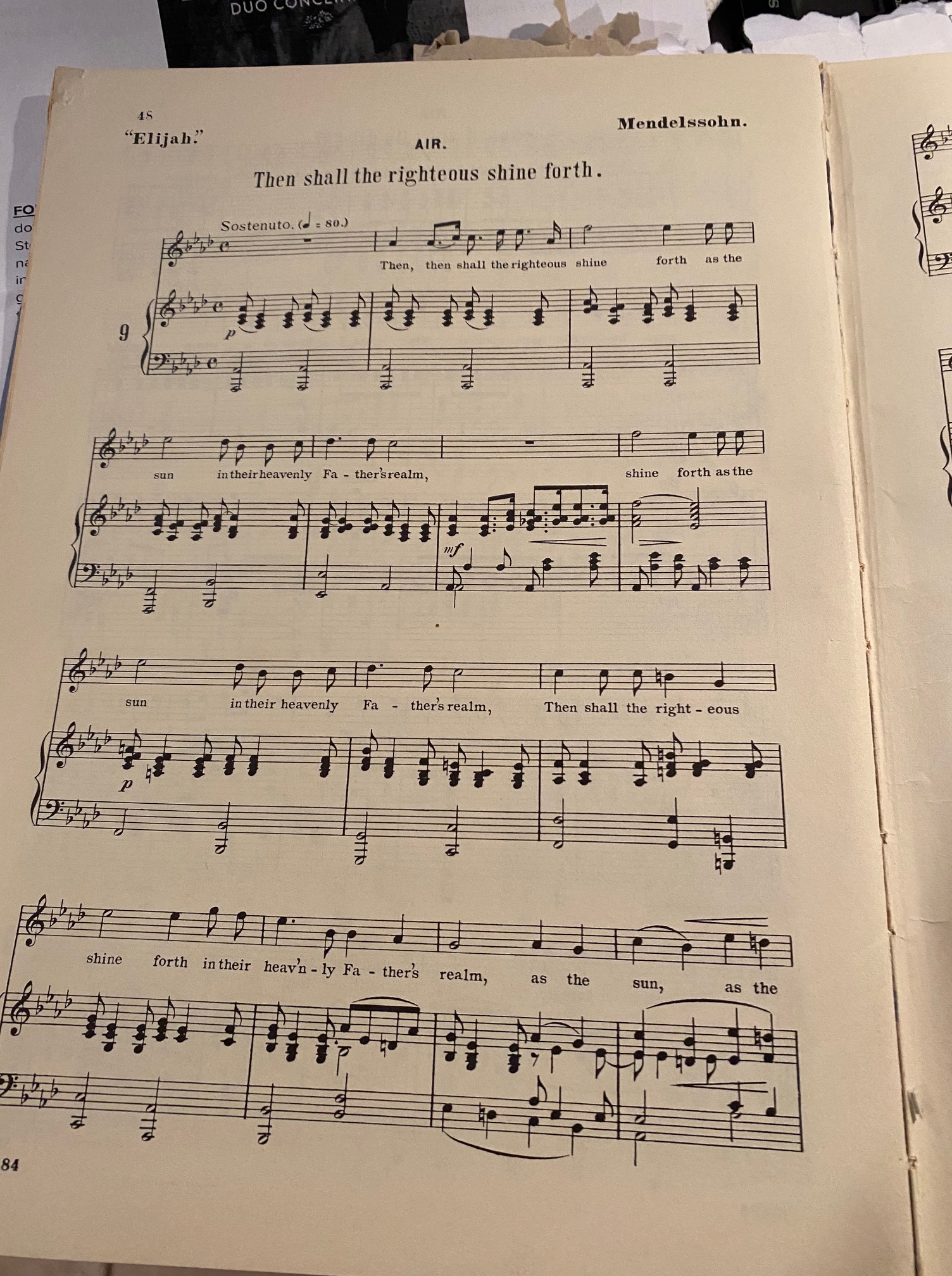
There are two contrasting tenor arias in Mendelssohn’s oratorio Elijah. I’ve sung them both in church a number of times, so of course I’ve memorized them inside out. Even so I didn’t really understand them.
The one near the beginning is a probing exploration of faith, including an admission of doubt. “Oh if I knew where I might find him, that I may even come before his presence.”
The one near the end is the opposite, its confident prophecy like an answer to the doubts in the first, an affirmation using text from Matthew 13:43 and Isaiah 51:11
Then shall the righteous shine forth as the sun in their heavenly Father’s realm. Joy on their head shall be for everlasting, and all sorrow and mourning shall flee away forever.
Sure, I understood this in terms of how to sing it, and where it comes in the narrative of the oratorio.
My new perspective might be better aligned with what the composer was trying for.
A few weeks ago I wrote about how I am sometimes troubled about singing some religious texts, that I am at least a bit conflicted about reconciling performance, especially foregrounded virtuosity, and the notion of prayer and worship. They seem like a contradiction.
Meanwhile, I’ve been singing this piece over and over, feeling no contradiction in this confident prophecy. For whatever reason it’s been a comfort to me, the only piece that seems to work as something touching upon our physical manifestation in a way that doesn’t contradict science. In the weeks before and after our dog Sam was put down, I’ve enjoyed the spiritual overtones of this text. It’s almost pagan in the simplicity of its suggestion that when we die we become pure energy: “the righteous shining forth as the sun in their heavenly Father’s realm.” Never mind doctrines or complexities, this is simple.
We have eternal life as the radiant sun.
Mortality is my troubled subtext. We may try to live as though we will live forever but truth stares back at us. My mom is coming up on her 101st birthday. My dog is now gone. I cannot help thinking about what follows life.
I’ve wondered sometimes whether one should sing this Mendelssohn piece gently and softly or passionately with energy. Good music usually offers alternatives, more than one way to make a score work.
But when I stumbled on this version, my doubts were gone.
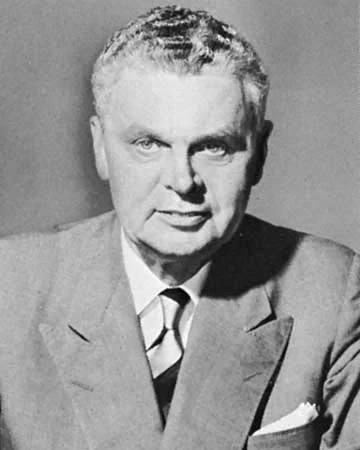
For the 1979 funeral of John Diefenbaker (a former Conservative Prime Minister of Canada, strongly associated with the province of Saskatchewan) they brought in a tenor born in Saskatchewan, namely Jon Vickers, who sings this with heroic intensity.
I believe this is how the piece should be sung. Vickers’ high notes are explosive, brightly shining like what they would sing of.
I recall when I mentioned I was a big fan of Vickers back in my days at UTS, my friend Richard Outerbridge happily said “he’s my uncle”.
Richard passed away earlier this year. Vickers died July 10th 2015.
This aria proclaims that they live on, that we all live on.
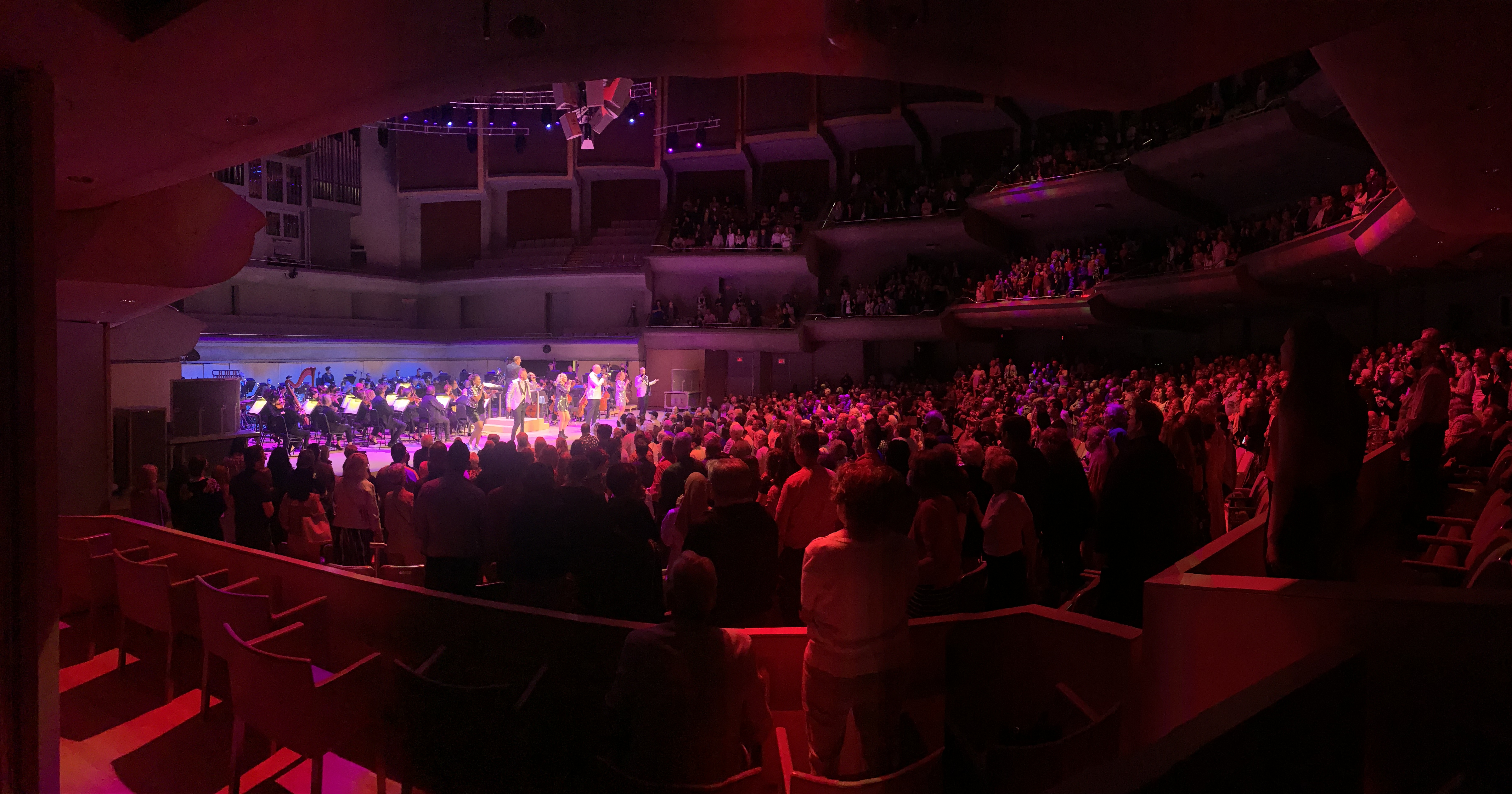
This week the Toronto Symphony under their pops conductor Steven Reineke presented three concerts of the music of ABBA featuring Rajaton, the Finnish vocal ensemble. While they describe themselves as an a cappella ensemble –singing their vocals accompanied—it was electrifying to see them team up with the TSO today. Most of their songs were accompanied by orchestra.
As you can see the audience were ecstatic in response, coming to their feet to sing and dance along for the final encores.
Everyone was on their feet at the end
ABBA have four members in their band (Agnetha Fältskog, Björn Ulvaeus, Benny Andersson, & Anni-Frid Lyngstad, where the initials of their first names give the band its name).
Rajaton have six members (Essi Wuorela, Aili Ikonen, Soila Sariola, Hannu Lepola, Ahti Paunu & Jussi Chydenius).
While I love the TSO, the best performances today were Rajaton’s a capella songs, brilliant arrangements getting maximum impact from the members of Rajaton. Bass Jussi Chydenius anchors these songs while the others offer clever percussion effects into their microphones. Baritone Ahti Paunu has the most lovely tone, reminiscent of Johnny Mathis, soaring above, as do all three women.
The TSO are sometimes subtle in their support, sometimes over the top in the exuberance of “Waterloo” or “Dancing Queen (performed a second time as one of the encores).”
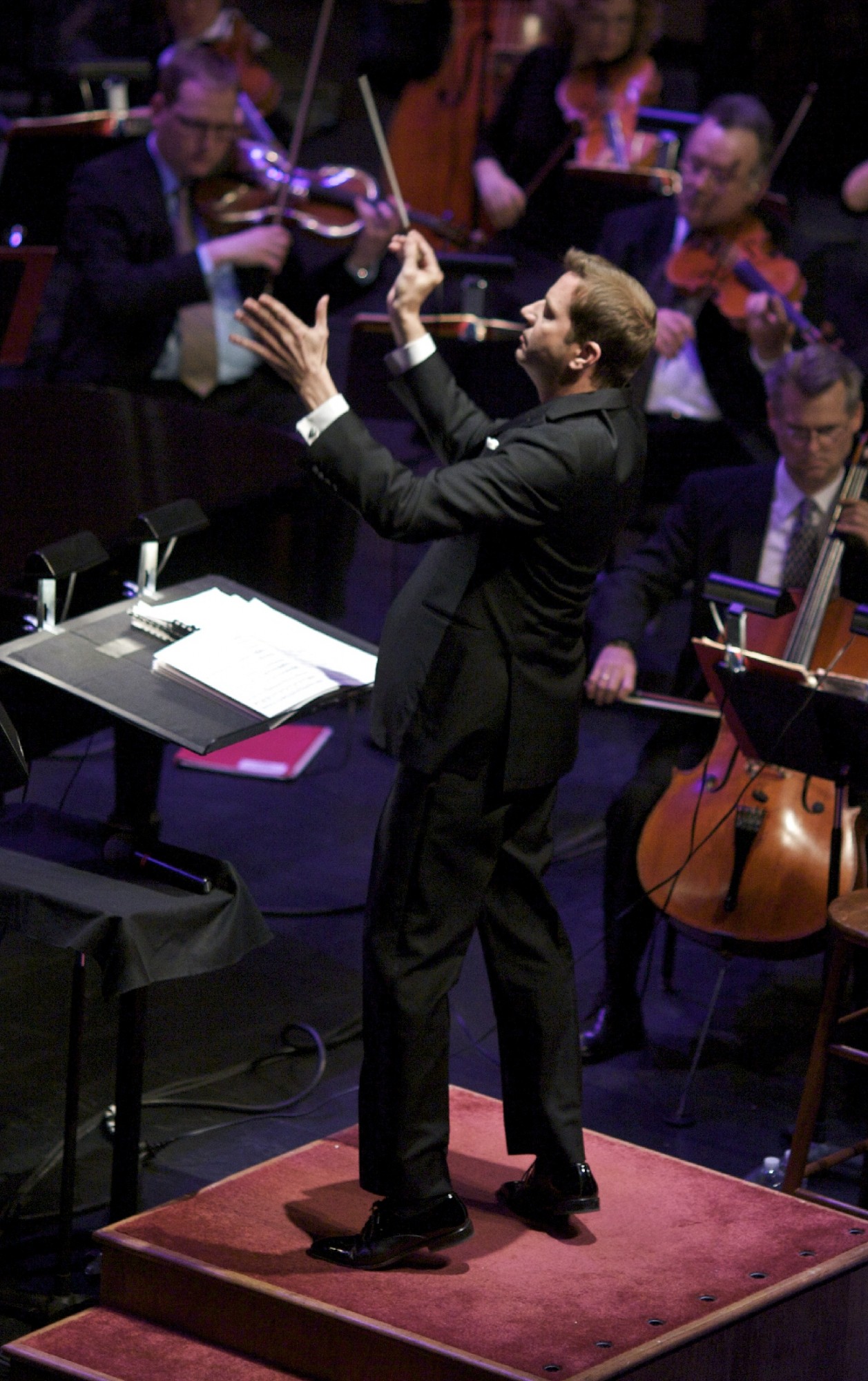
It’s fun to watch Reineke with his physical conducting style, at times like another dancer, inspiring the orchestra.
Conductor Steven Reineke (photo: Michael Tammaro)
Rajaton singing ABBA songs with the TSO make a good fit. ABBA are soft rock, very tuneful and musical in their compositions, which suit TSO pops audiences. The singers of ABBA make music that’s almost like music-theatre, between the melodrama of “The Winner Takes it all” or the silliness of “Mamma Mia”.
Of course my perspective may be distorted. Hindsight is 20-20, right? You must know they’ve made a musical titled Mamma Mia out of ABBA songs. The point is, I suppose, I’m obviously not the first person to notice how well-suited these “rock tunes” are for a music-theatre treatment.
The ABBA concerts are presented by the TSO as a Pride- related event, the third & final concert tonight. I took Erika as part of her birthday celebration this week, but couldn’t help remembering dancing to them when these songs first appeared: many birthdays ago.
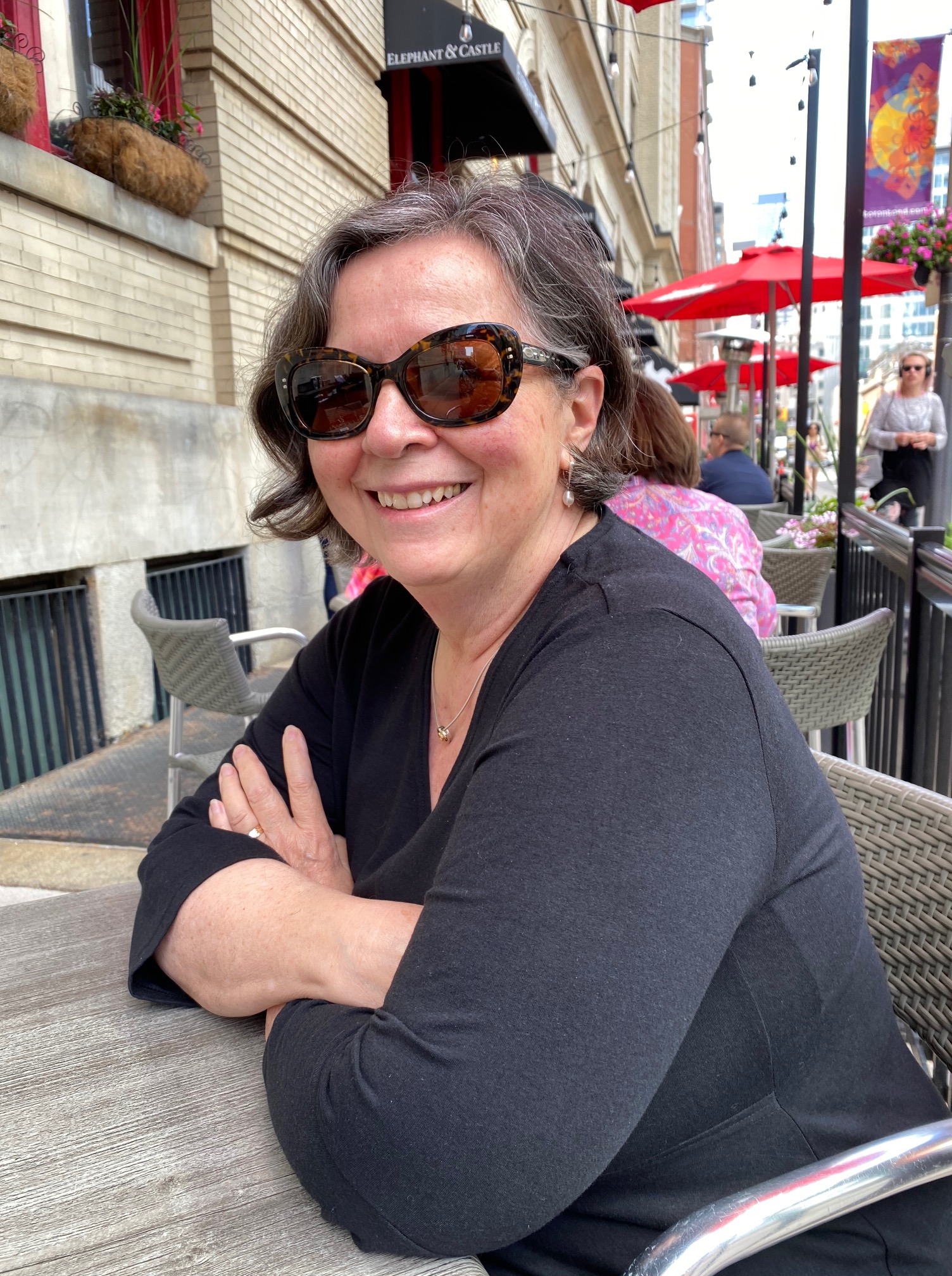
It was like a celebration including dinner afterwards, our first time back at Elephant & Castle across the street from Roy Thomson Hall in over two years. Yes I ate too much. Dessert was outrageous.
Is she smiling because I have lettuce stuck in my teeth?
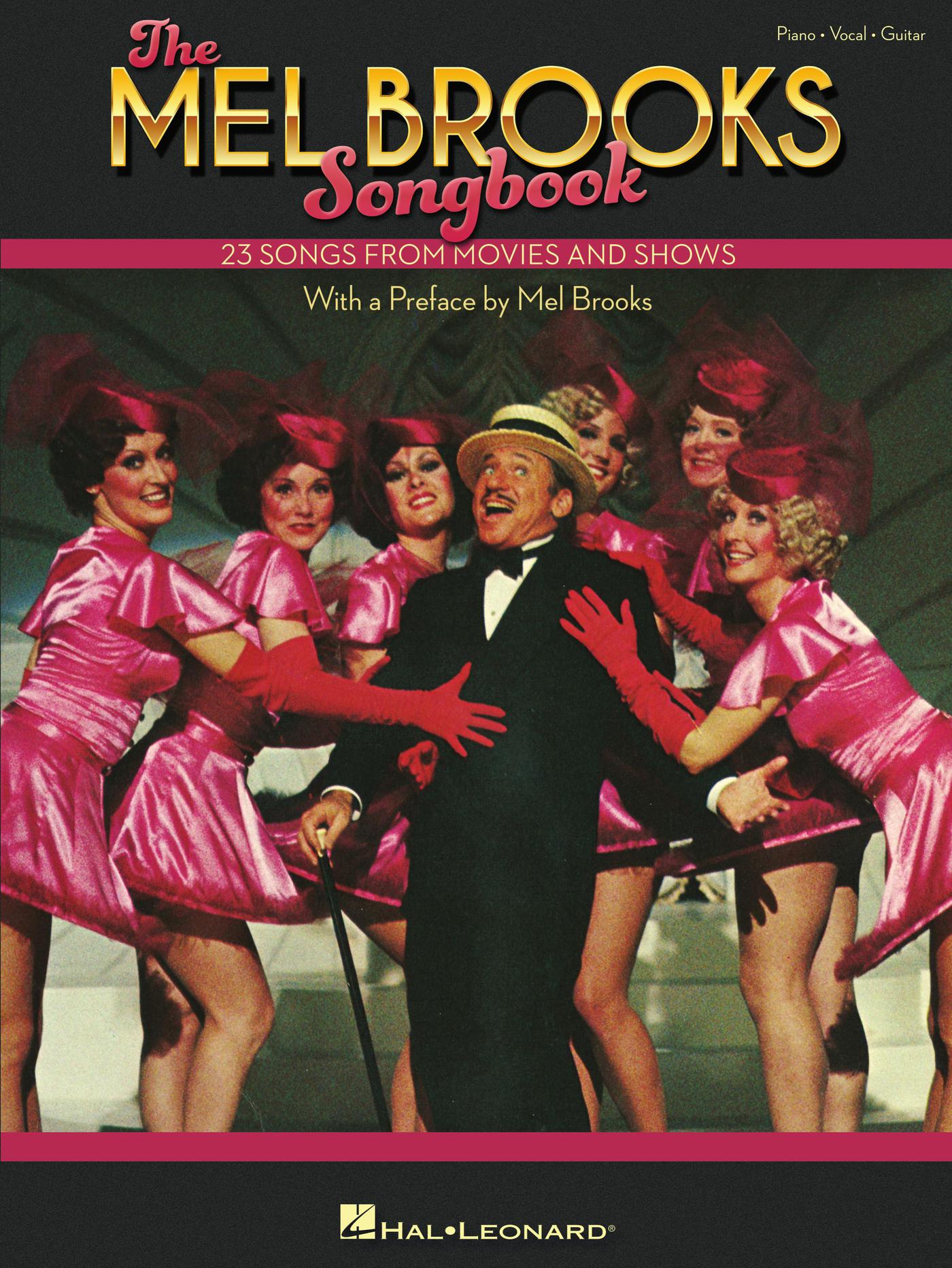
And no joke, there really is a Mel Brooks Songbook. When I picked it up from the shelf in the Indigo bookstore I was a bit disbelieving myself.
Mel Brooks, songwriter? The subtitle is “23 Songs from Movies and Shows”.
Even before Brooks wrote the songs for The Producers, his huge Broadway hit musical, we already had ample evidence of something verging on a gift.
In the film of The Producers there were two remarkable songs. I’m sure you’re already hearing one in your head at the mention of the film. “Springtime for Hitler” wasn’t just a song, it was Brooks’ original title for the piece, back when it wasn’t clear whether it would be a play or a film. The other great tune is “Prisoners of Love”.
In his next film, The Twelve Chairs, there’s another brilliant song. Brooks’ preface is very entertaining when he talks about stealing “Hope for the Best, Expect the Worst” from Johannes Brahms: a tune that Brahms himself appropriated for his Hungarian Dance #4.
“If it was good enough for Brahms to steal, it was good enough for me”.
According to a post from Cinema Shorthand Society—the source where I was alerted to Brooks’ birthday today– he doesn’t read music. Apparently Brooks hums into a tape recorder and then gets someone to transcribe it. That was the method for those first two songs, and everything else thereafter.
Lest you think I might believe this makes him incompetent: far from it. I am also an admirer of Luciano Pavarotti, one of the greatest voices I ever heard: another talent who couldn’t read music.
There are three great songs from Blazing Saddles namely the main theme, the song from the uproar near the end of the film “The French Mistake” and “I’m Tired.” With those two words I am instantly reminded of the great Madeleine Kahn, who made so much of the piece.
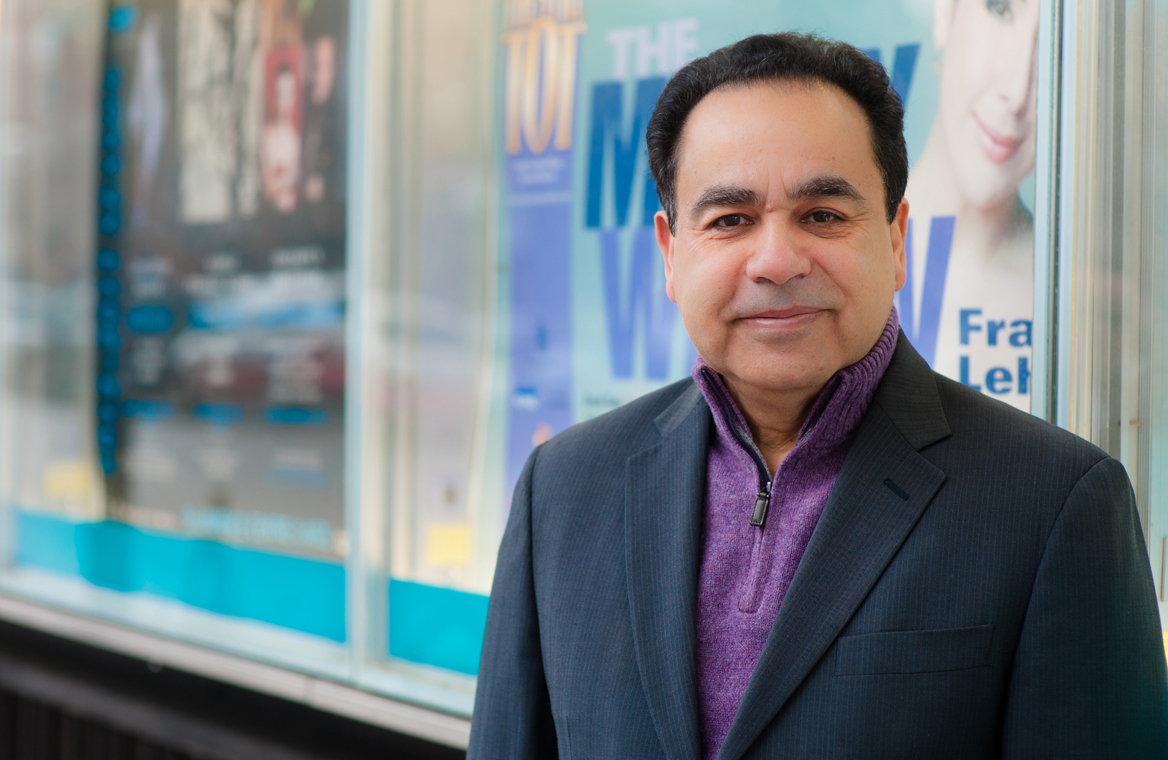
Arkady Spivak of TIFT
There are also four songs from a musical I’m dying to see, namely Young Frankenstein, adapted from the film. While it was produced in the USA, revised and then produced in the UK it hasn’t yet made it to Canada.
(Are you listening, Arkady Spivak?)
Let me encourage you to check out the book, especially if you’re a fan of musicals. In addition to what I’ve mentioned there are also songs from High Anxiety, History of the World Part 1, To Be or Not to Be, Robin Hood: Men in Tights, and Spaceballs.
Brooks is one of the funniest people I have ever encountered, a gifted writer who not only gives us brilliant stories & lyrics but also seems to know how to compose the music for songs too.
Insights sometimes sneak up on you. I was blind-sided by one today watching the Toronto Operetta Theatre Canadian premiere production of Oscar Straus’ A Waltz Dream at St Lawrence Centre. TOT play an important role offering local artists a place to hone their craft, giving work to singers & musicians especially now after the horrors of the last two years, aka the pandemic.
Yet they’re also giving us opportunities to sample rarities we might never hear otherwise.
I didn’t expect to connect to this obscure work from a composer who is almost completely unknown, but I had déjà vu, listening to the way some of the characters talk down to one another: a big part of films such as The Shop Around the Corner, where much of the humour and the tensions of the plot, derive from the awareness of class.
One of the perpetual questions with TOT casts is to observe the balance between their skill-sets. Some sing but aren’t fabulous actors, some act but don’t sing so well, and some can do both. I wonder sometimes how Director Guillermo Silva-Marin sleeps at night, given the responsibilities he shoulders juggling three different artistic endeavors. Opera in Concert is over for the year, and with today’s show, so too with TOT, while the workshops of students at Summer Opera Lyric Theatre are just beginning to exhaust Guillermo.
Guillermo Silva-Marin, General Director of SOLT
Shows such as today’s display an assortment between younger talents emerging at the beginning of their career, alongside more seasoned performers.
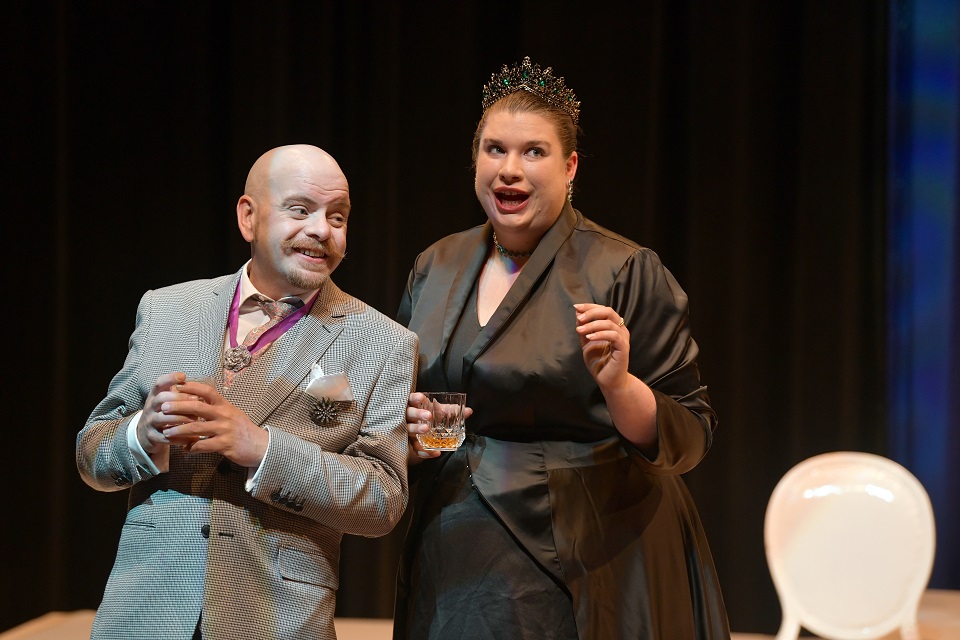
The biggest laughs as well as some of the best singing was created by Gregory Finney as Count Lothar, reminding us of the adage “there are no small parts, only small actors.”
Greg Finney as Count Lothar and Karina Bray as Princess Adelaide (photo: Gary Beechey, BDS Studios)
Greg makes everyone better, funnier, giving us the additional pleasure of watching his chemistry with the cast. Alexandra Weintraub as Fifi probably had the most opportunities to share the limelight & laughter, while Brittany Stewart as Isobel also had a few hilarious moments with Greg.
Like Greg, Elizabeth Beeler as Theodora gave us professional delivery of her comedy and terrific singing, even if her role requires her to be more of a set-up for others to get the laugh, somewhat like a comic straight-man.
As so often happens with TOT, Derek Bate had me wondering how he gets so much musical value out of such a small ensemble, playing idiomatically, sensitively and supportively. Straus was well-served by singers, chorus and this tiny but energetic orchestra.
Guillermo and Derek must balance the dramatic and the musical, as not everyone has the multiple talents of Greg or Elizabeth. Andrea Nunez as the Princess Helene and Scott Rumble as Niki, gave us a convincing romance with lots of lovely singing. In this rather big cast I found the women more convincing in reconciling the music and the comedy. Amy Moodie as Franki was central to the romantic plot, while Karina Bray as Princess Adelaide was often right in the middle as the funniest moments of the comedy unfolded.
The title of tonight’s performance by Toronto Symphony was “Gimeno + Beethoven’s “Ode to Joy”, a celebratory concert. It’s the TSO’s centennial season and a perfect way to bring Gustavo Gimeno’s first in-person season as music director to a conclusion.
The orchestra seems to respond to their new maestro. At times they seem to read his mind, everyone in accord. I listened to the quickest tempi I’ve ever heard in this well-known work, one we’ve all heard many times. The TSO have become an assembly of virtuoso talent, sounding fearless and bold. Faster is the way the historically informed players do it, so this is arguably authentic even if we’re hearing modern instruments rather than the sort that you’d hear from a band such as Tafelmusik.
At this tempo, the “Ode to Joy” is very enjoyable. And I think it’s easier for singers, who don’t require as much air, and don’t have to sit so long on the high notes.
The audience went crazy at the end with their applause.
I was a little bit surprised to see the placement of the soloists, in the centre of the choir loft with the Toronto Mendelssohn Choir.
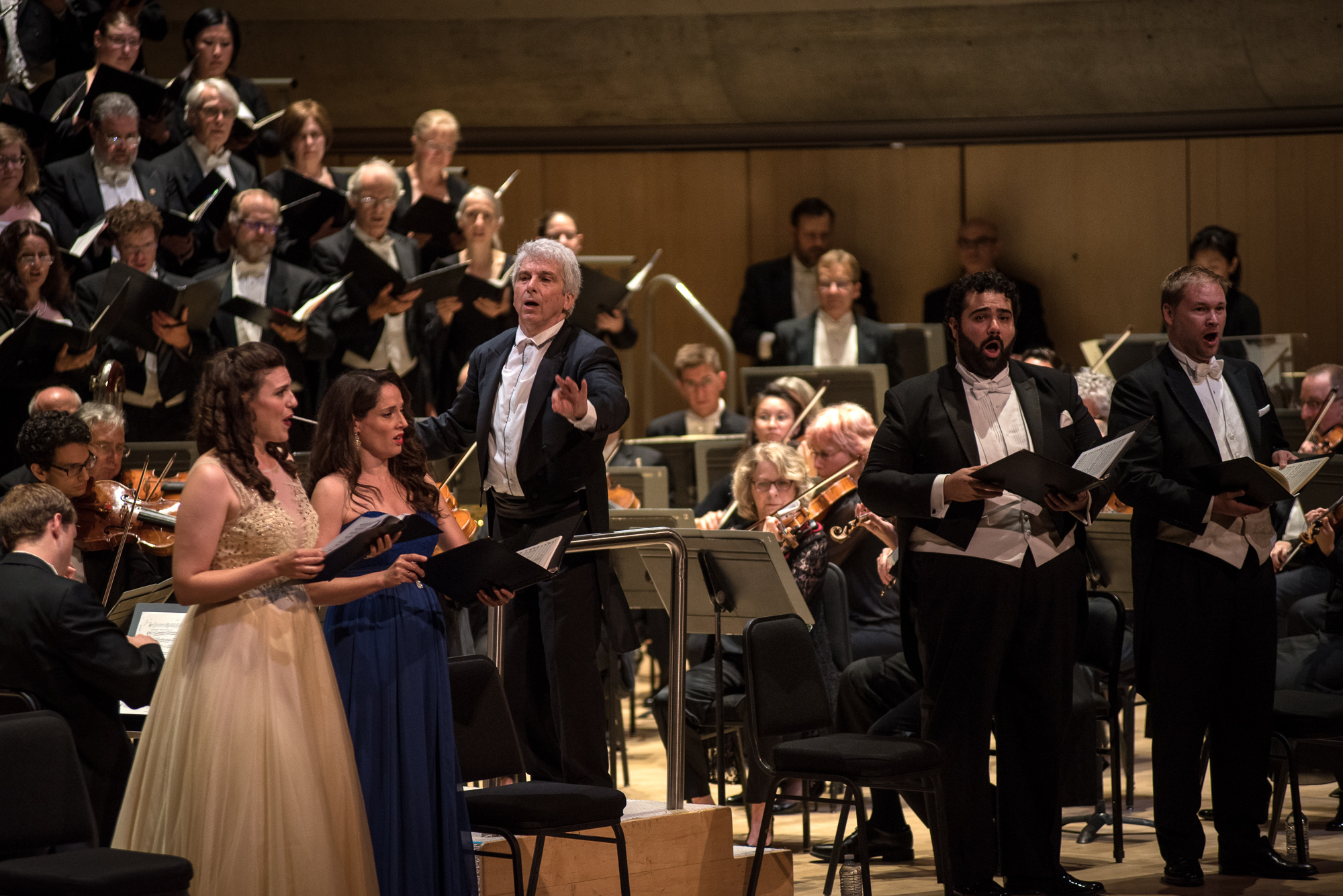
Soloists MacKinnon, Segal, Haji, Duncan, led by Peter Oundjian (photo: Nick Wons)
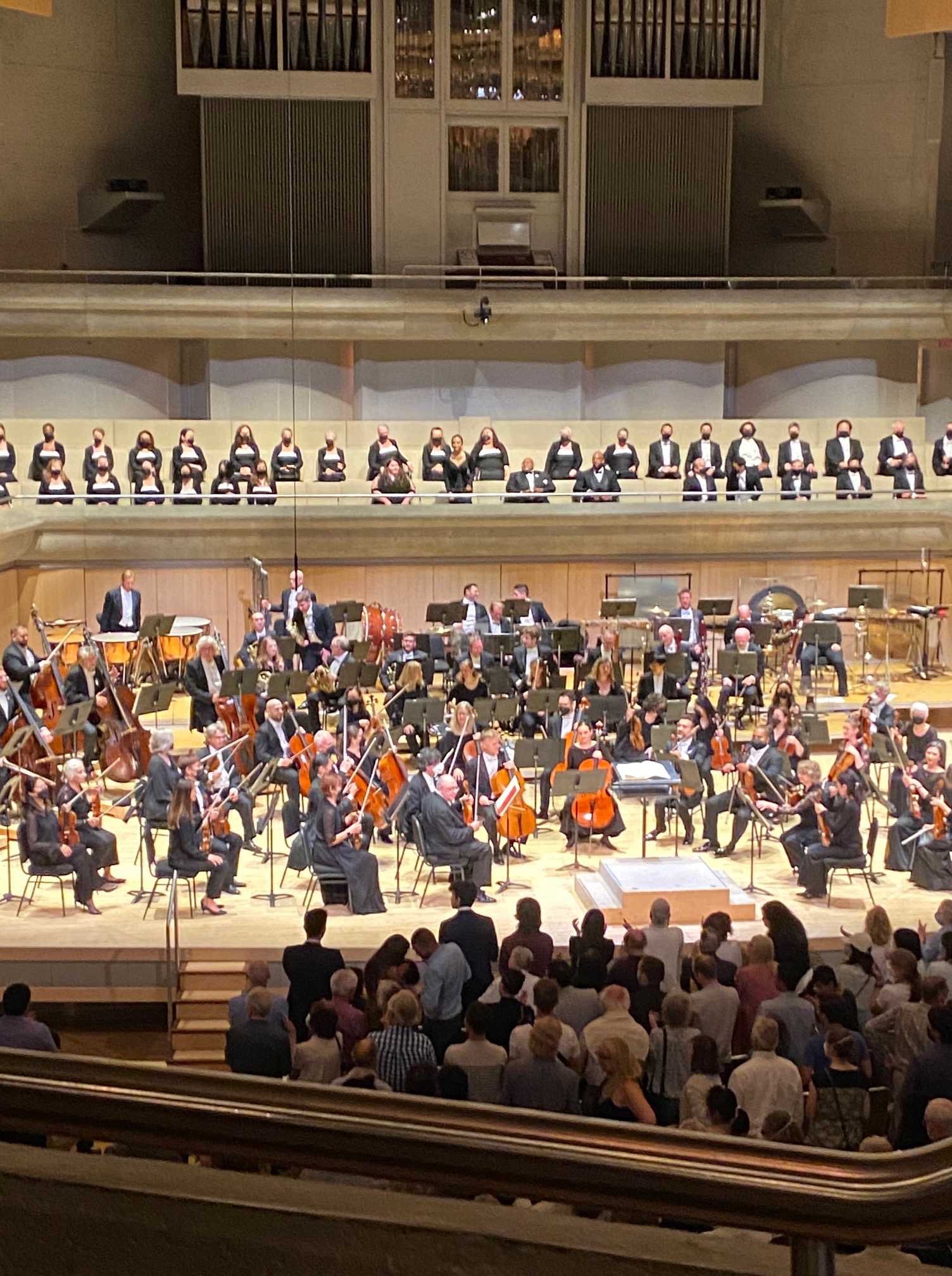
When we heard the TSO and TMC commemorating the departure of Peter Oundjian in June 2018 (already four years ago) the soloists were at the front of the stage which is as far as I know it closer to the acoustical sweet spot than where this group of soloists (Angela Meade, Rihab Chaieb, Issachah Savage and Ryan Speedo Green) were placed last night. Excuse me for the amateurish photo I’m supplying, from the curtain call. Gimeno is not visible, but the soloists are there far from the audience. They sang very well.
While it is true that tenor Issachah Savage likely has a bigger voice than Andrew Haji, I wonder: did they seek out a heldentenor (that is, a tenor with a sufficiently heroic sound suitable to carry over a Wagnerian orchestra) knowing that he and his soloist colleagues would be placed so far away? They all had big strong voices.
The opening of the concert was especially intriguing as the TSO offered three consecutive pieces receiving their world premieres with this concert series, each one a TSO NextGen Commission: 1-A Dream of Refuge by Adam Scime 2-Bite by Bekah Simms 3-Unrelenting Sorrow by Roydon Tse
It was tempting to frame them in context with the Beethoven that was to follow intermission. While each five minute work has a different rationale and style, composed by a different young Canadian composer, I saw them as a kind of triptych. Remember that before the soloists and chorus enter for the fourth movement of Beethoven’s 9th we get three contrasting instrumental movements.
Beethoven’s allegro seems to emerge out of a misty nothingness, the ambiguous void of its open fifths. That was in the back of my mind listening to Scime’s piece, that also employed some ambiguously open tonalities in service of his exploration of alienation and the anxieties of the pandemic. The big existential questions of life underlie both the first movement of the Beethoven and Scime’s work.
Beethoven’s second movement scherzo is a burst of energy, less about asking the meaning of life and more likely to make us ask “how did they make that sound?” It’s a fabulous exploration of orchestral timbres that still sounds fresh two centuries later (the premiere was almost exactly 200 years ago by the way). Simms’ piece is the one of the three new works most concerned with timbre, indeed likely to make you say “how did they make that sound:” which is pretty cool to achieve for 2022. As with Beethoven’s scherzo we’re in ambiguous territory emotionally, neither comical or tragic, but listening to big and small sounds, very much in the moment even with the teasing silences near the end. As with the Beethoven, the tempo is faster –Gimeno’s arms moving faster in this piece (I almost said “movement”… but pardon me, it’s not really triptych no matter how hard I try to make it into one) – than in either of the other two works.
When we began Tse’s work I was reminded of the third movement of the Beethoven. I may be wrong to say this but I’ve always seen the opening two movements (the allegro and the scherzo) as hugely revolutionary, the existential ambiguities of that first movement leading us to such things as the opening D minor chase of Die Walküre and the ambiguities of tonality we get in Nuages by Debussy at the close of the 19th century. The second movement scherzo changes the rules for such movements (even if he already hinted at this in some of his earlier works such as the piano sonata Op 101), opening the template wide for what’s to come in the early 20th century with Mahler and Shostakovich.
The third movement though? The adagio might be Beethoven almost saying “nicht diese tone”. I’m being ironic of course, as I don’t mean in the spirit of the “Ode to Joy” which opens with that phrase, asking us to be joyful, but rather speaking to our sense of musical style: literally not these tones. If Beethoven has so far freaked us out with the newness of his first two movements –and it’s reported that’s how some people responded—the gentle opening notes and the melody coming as consolation and reassurance, take us to something less radical, less threatening, with more than a hint of nostalgia.
That’s how I see Tse’s piece. Of the three new works, in “Unrelenting Sorrow”, where he would explore loss from war and pandemic, Tse is undertaking the most conventional sort of piece in seeking to be melodic and appealing to our emotions, taking us in a late-romantic direction. As such it’s a brave choice, one that not all composers can handle. I think the work succeeds admirably.
And so, let me just ponder the triptych for a moment (given that I’ll never encounter them again this way), this trio of existential angst (Scime), provocative and experimental sounds in the moment (Simms), and a melodic exploration of sadness (Tse). They made a terrific appetizer for the evening, ably executed by the TSO and Gimeno, who so far seems to be championing new composition. I don’t know who’s really deciding the programming and commissioning, but when they’re up there on the stage, Gimeno is truly leading the players, and they’re giving us a full commitment.
The concert repeats Saturday night and Sunday afternoon at Roy Thomson Hall. For further information or tickets click here.
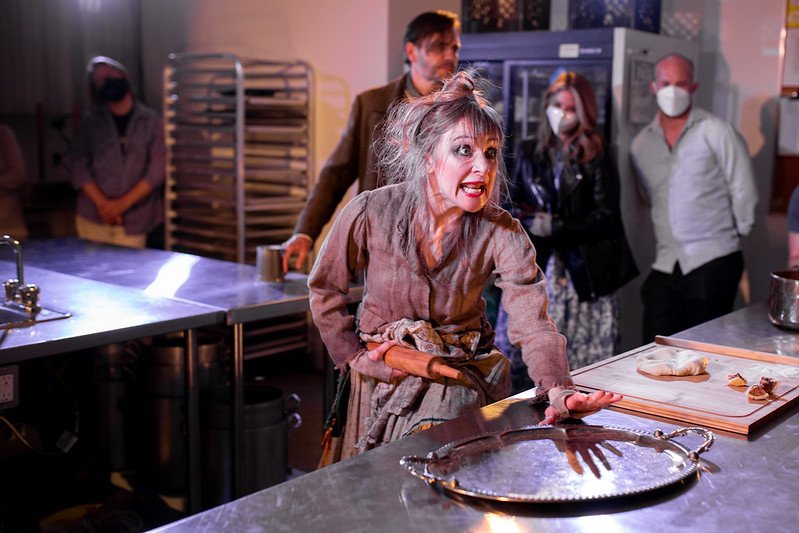
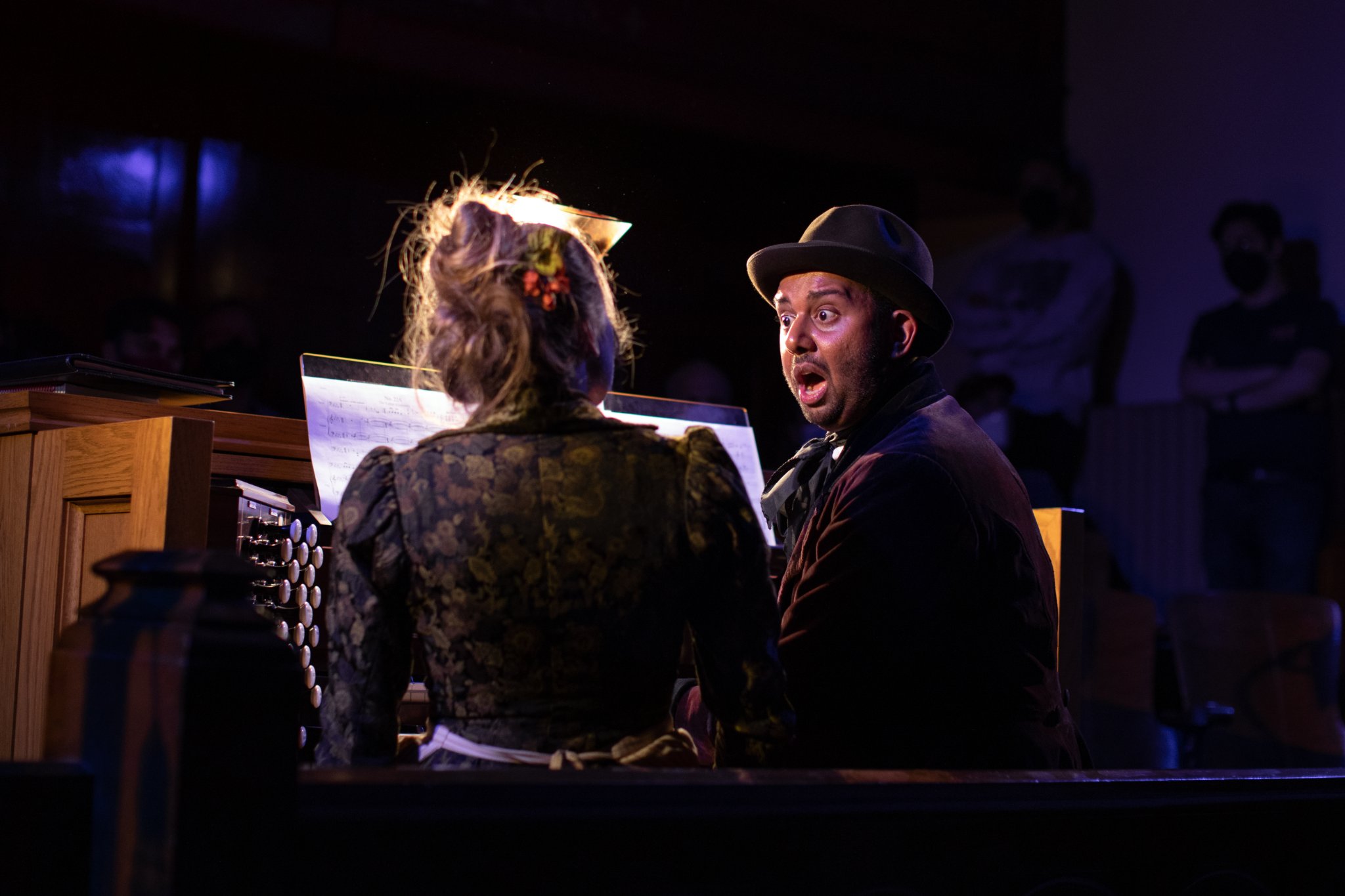
I’m never going to see a better Sweeney Todd than the one I saw tonight from Talk is Free Theatre at the Neighbourhood Food Hub, Glen Rhodes Campus. Wow.
Each night there are just 44 seats available, a cohort providing vaccination documents and masked. It’s a carefully planned show, bringing you into intimate contact with the players and their world, inside a church. I am asking myself how to explain why it’s so good, as it can be described from several different angles, not unlike how you watch the show come to think of it. Yes it’s music and words, great acting, design concept and a brilliant choice of venue. It’s execution of a challenging score led by music director Dan Rutzen, propelled by passionate performances directed by Mitchell Cushman.
44 audience members are sometimes spread around inside the church sanctuary, sometimes we are moved to tight corridor spaces or rooms within the church building. Sometimes we’re downstairs, the players employing the kitchen areas pertinent to the food bank housed on the premises. If you know the plot at all, you’ll recall how apt that makes the space, both for the poverty and the food preparation underlying it. The foodprep factory, with the conveyer from barber’s chair to oven with the overtones of the deadly industrial revolution (as has sometimes been seen in this work particularly in the early productions) was not invoked, in pursuit of something subtler.
You need to be prepared to move, sometimes in the dark, but always carefully led by staff and even cast members. Mrs Lovett spoke to us at one point gently encouraging us to stand out of the way of the traffic flow in one scene change. The blarney coming out of her (!) would do a talk-show host proud, effortless filler not unlike what one finds in a meat pie, come to think of it.
As we did our scene changes (meaning, our moves from one performance space to another) the musicians had to cope with an unending series of segues. We’d begin one place, where perhaps a couple of musicians would discreetly exit, while the other members of the ensemble kept playing. We’d have a kind of vamp until ready happen in our space, as we gradually were shepherded out into corridors and/or down stairs, noticing some of the matching music now coming from the instruments in the new space, vamping away until the scene properly commenced. We might exit from the sounds of piano & cello to arrive in a new location, hearing violin and perhaps keys as well, sometimes percussion generated by the actors. It’s only because I’m a student of this stuff that I noticed at all. It’s very smooth, so self-effacing as to be unheard. Brilliant.
I don’t want to scare you off but there’s something post-modern about this. The church and its performance straddles the boundaries between our modern time and that of the play. Coming in we were asked for money by a pan-handler on the street, in a story that includes a character begging for money on the stage. The church building may not actually be Victorian (likely built in the early 20th century, if I recall the date inscribed on the outside correctly) but when we’re hearing Sondheim’s 20th century score played in this old space, we are amazingly in both places at once. It’s uncanny. They dress in the period costume, they speak with authentic accents, singing a musical style that occasionally offers us something reminiscent of the 19th Century, but sometimes in the soft rock of that American composer on Broadway, Stephen Sondheim. Oh sure it’s his most ambitious score, often dissonant and so difficult that sometimes it gets labeled as “opera”. Opera companies sometimes perform it, although they’d never get the kind of fluidity you get in this intimate show, never seduce you with performances practically in your lap for such a long detailed show.
No you will never be closer to a performance. You have choices in the scene changes, a bit like the choices in a proper smorgasbord. If you are shy? You can more or less hide among the crowd, even though the actors may come striding right up to your location and sing a couple of feet away from your masked face. If you’re bold? Choose to sit closer to the action and you may even be invited to participate a few times. In the smaller spaces there aren’t many options, not when 44 people are being accommodated in a tight hallway, some seated some standing. If we have to stand it’s never for long.
That word “immersive” gets tossed around so much lately, it’s a bit like we’re immersed in immersive. Lepage has his thing, and there are various art things (van Gogh, Klimt, Kahlo) promising yup an “immersive experience”. But this is different. No I don’t really see those artists that way, not wanting those works coming at me from all sides. But first and foremost, there’s a rationale for our space, for the curious reconciliation between centuries, styles. And this play works better done this way. The relentless obsessiveness of the crazed hero bursts out of the heart of this presentation.
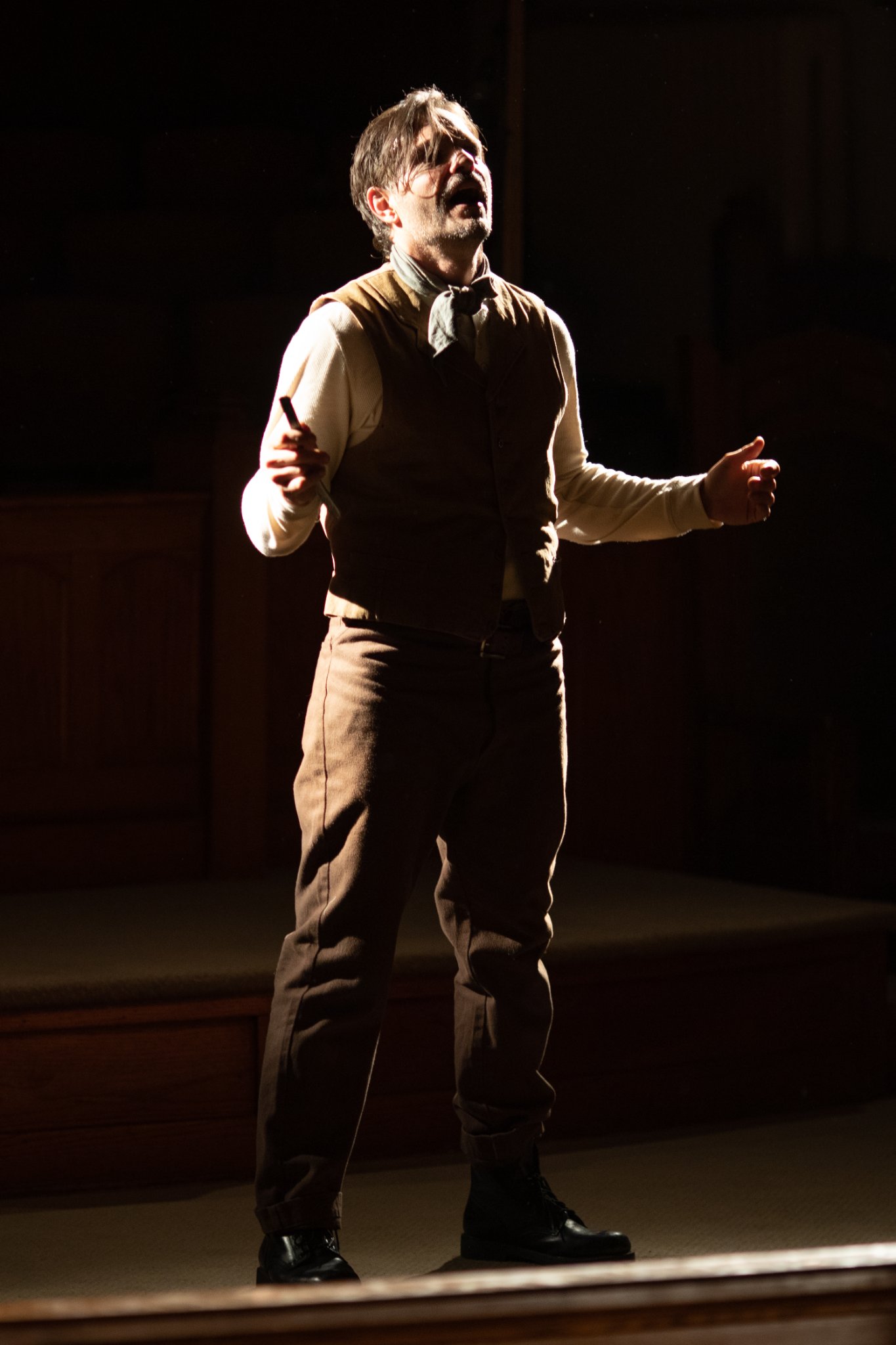
While this is a uniformly strong cast, wonderful when the bigger ensembles are sung, there are a couple of outstanding performers. I’m intrigued to discover that Michael Torontow, our Sweeney Todd, who has directed several shows for TIFT, has now been named their Artistic Director.
Michael Torontow as Sweeney Todd (photo: Roman Boldyrev)
The play doesn’t fly if you don’t care about the character. Torontow’s Sweeney Todd was a tormented suffering individual, desperately wronged and beyond redemption. One of the immediate benefits of this style is how vulnerable Torontow is, which simply can’t happen when the role is bellowed by a big voice in a big theatre (which I’ve seen a couple of times). This is so much more musical, so much more believable, because it’s on a human scale, clearly audible and intelligible in every sense.
Glynis Ranney was a very entertaining Mrs Lovett, reminding me at times of Carol Kane’s zaney take on the Ghost of Christmas Present in Scrooged, never entirely nice nor nasty but always a deadly brutal mix of both. I couldn’t decide whether I should be afraid or attracted to her. She was arguably the most important ingredient in keeping the tone light, when it was in danger of drowning in blood and gore.
Glynis Ranney, Michael Torontow and audience members in the Food hub kitchen (photo: Roman Boldyrev)
The ensemble was full of talented players. Andrew Prashad was a delightfully slippery Beadle, fun to watch when he was in the Judge Turpin’s shadow, but lovely to listen to when he emerged to take his turn singing solo. Cyrus Lane’s Judge was underplayed, deadpan yet ferocious; his subtlety dodged the risk of melodrama in pursuit of something subtler. Jeff Lillico’s Pirelli gave us an assortment of ethnicities and accents, while Tess Benger was a strong Johanna.
After tonight’s opening, there are only 14 shows left, running until July 3rd. When word gets out the seats will be gone. Even if they extend the run I strongly recommend getting a seat to TIFT’s Sweeney Todd as soon as possible.
Andrew Prashad –Beadle sings to Glynis Ranney (photo: Roman Boldyrev)
If you have any difficulties moving about the show may seem a bit challenging for you. Although I have a permanently stiff neck (arthritis) that didn’t stop me, indeed twisting about to watch the show as the actors moved around us was a big part of the fun. It’s hair-raising.
The title of the lecture was “Art Canada Institute presents: The Making of a Masterpiece– Kent Monkman.”
Monkman is an enormous star, famous far beyond the immediate milieu of art dealers and galleries.
But I have no real idea who he is. Before tonight I had never seen him in person, never heard him speak, had no sense of who he is.
No wonder Koerner Hall was packed.
Let me repeat, he’s a star. When he came onto the stage tonight to be interviewed, there was a huge ovation.
“The Scream” is surely the most cited image by a Canadian artist of the current generation.
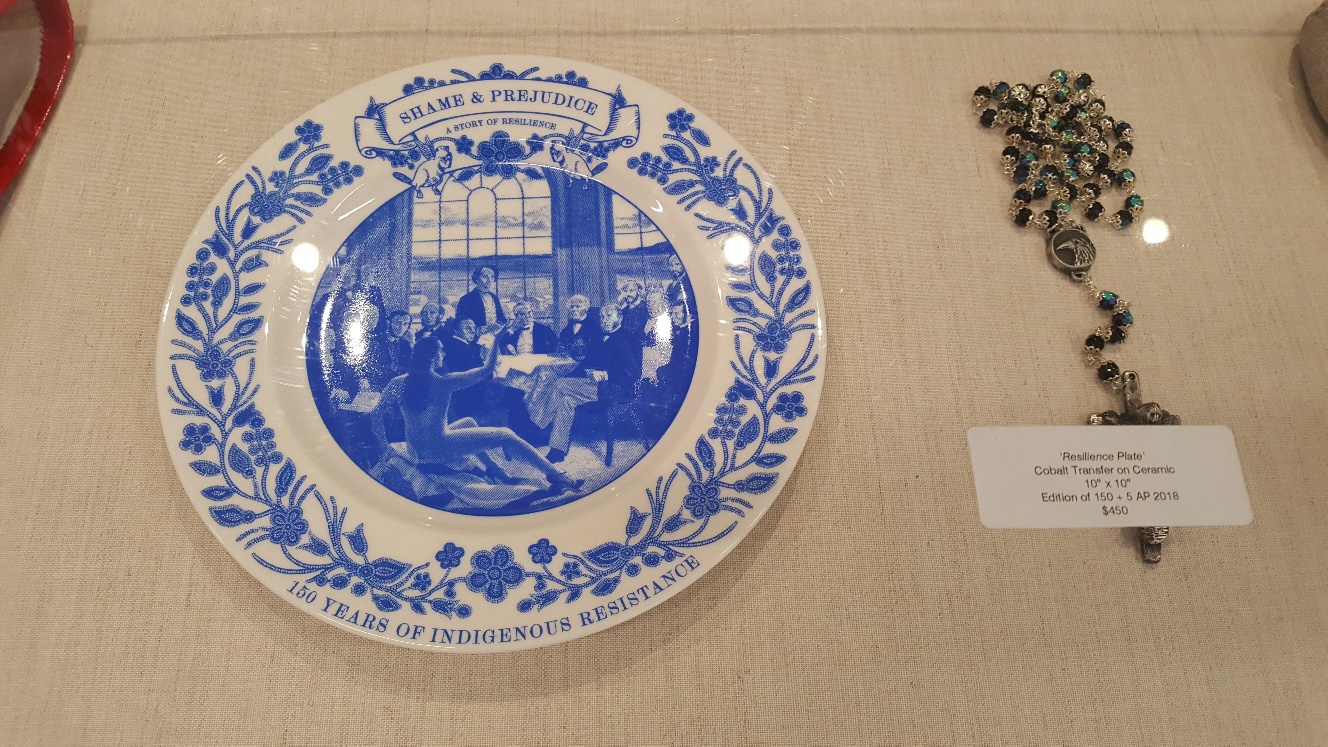
I remember feeling dizzy at the Shame and Prejudice show in 2017 at University College, as though the ground had opened up under my feet. I hadn’t really understood the urgency of the Indigenous use of the word “genocide”: until then.
His art is a curious mix, suggesting a complex personality. Monkman is ambiguous in his persona, his tone, and so much more, when you encounter his alter-ego Miss Chief Eagle Testickle.
Underlying the serious and ironic statements is an ongoing project, that can be nicely captured in a quote from the program to his 2017 show “Shame and Prejudice: A Story of Resilience”:
“I could not think of any history paintings that conveyed or authorized Indigenous experience into the canon of art history. Where were the paintings from the nineteenth century that recounted, with passion and empathy, the dispossession, starvation, incarceration and genocide of Indigenous people here on Turtle Island?”
The works for the big 2017 Toronto show, and especially in his commission at the Metropolitan Museum of Art in NY, can be understood as an attempt to redress that balance, to fix that great injustice of lies and omissions among the canon of art and by implication, in what we know and understand.
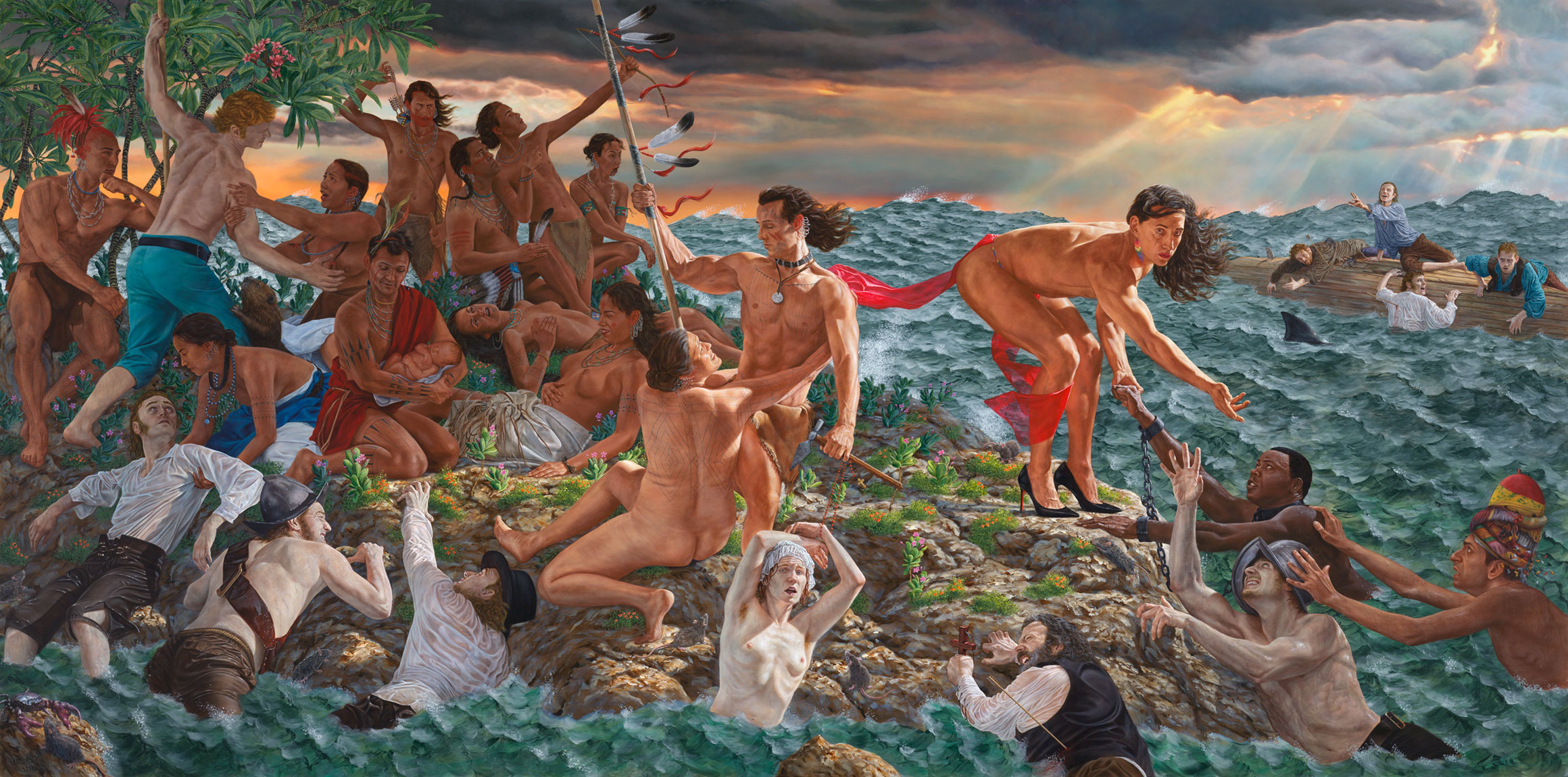
The two great pieces (mistikôkosiwak (Wooden Boat People), or Welcoming the Newcomers and Resurgence of the People) take the canon of art as exemplified by works housed in the Met, and then reframe them, in his own work.
Kent Monkman (Cree, b. 1965). Welcoming the Newcomers, 2019. Acrylic on canvas, 132 x 264 in. (335.28 x 670.6 cm). Courtesy of the artist
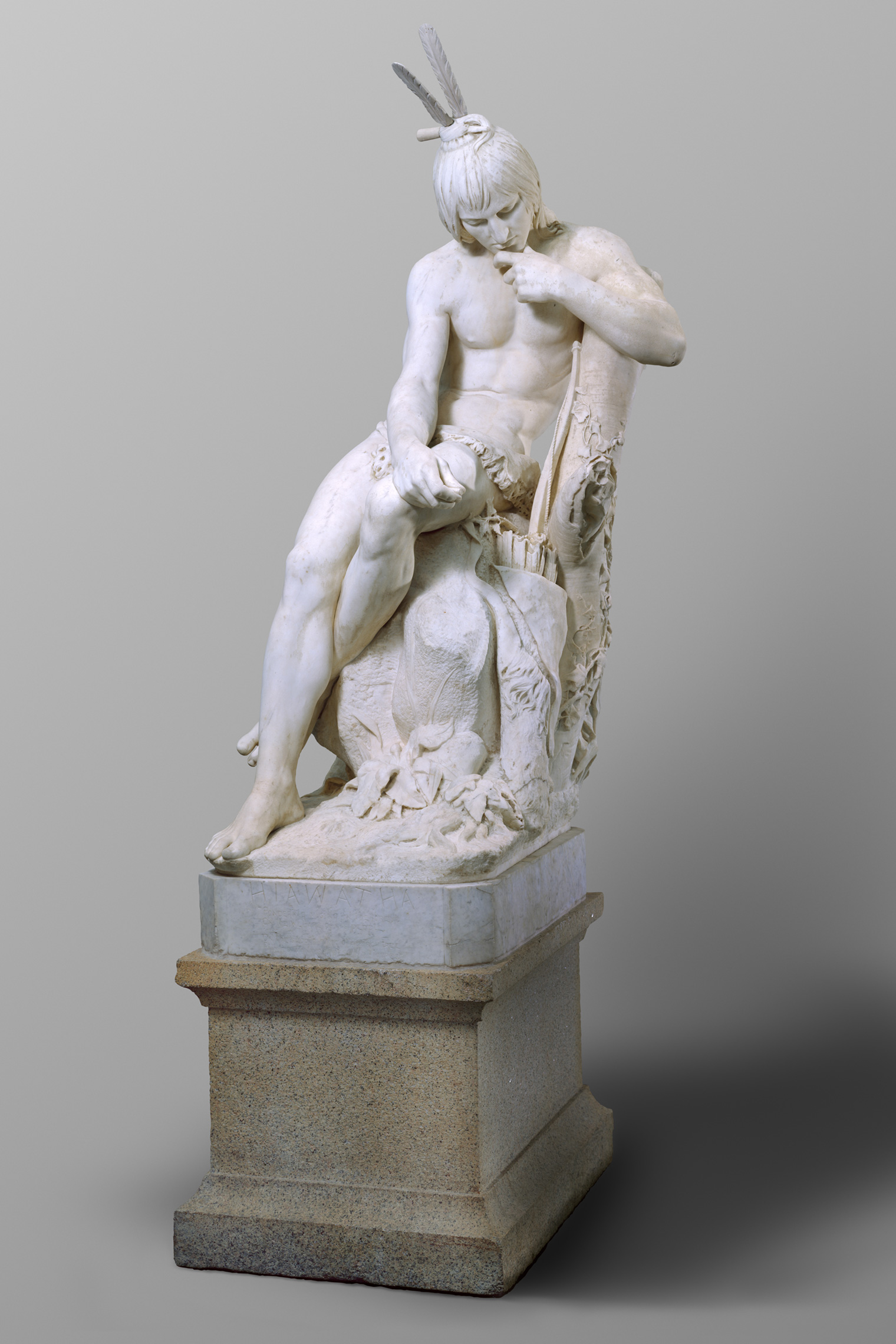
Augustus Saint-Gaudens (American, 1848–1907). Hiawatha, 1871–72, carved 1874. Marble, 60 x 34 1/2 x 37 1/4 in. (152.4 x 87.6 x 94.6 cm). The Metropolitan Museum of Art, New York, Gift of Diane, Daniel, and Mathew Wolf, in memory of Catherine Hoover Voorsanger, 2001 (2001.641)Kent Monkman (Cree, b. 1965). Resurgence of the People, 2019. Acrylic on canvas, 132 x 264 in. (335.28 x 670.6 cm). Courtesy of the artist
I’m not sure how we’re to see these works, but it’s a wonderfully bold approach. As a genre it’s something very original, not unlike parody if we consider the way something pre-existing is reframed in the new form. The brooding sculpture Hiawatha you see (above) for instance recurs in a corner of “Welcoming the newcomers”, while Miss Chief boldly leads the vessel in Resurgence of the People”, in a heroic echo of Washington crossing the Delaware. Miss Chief is at least a trickster figure in being a disruptor, forcing us to revisit our shared assumptions about culture.
I can’t miss the prescience of his images in the background of that painting, those macho yahoos with guns who turn up on the news with heart-breaking regularity over the last couple of years.
Emanuel Leutze (American, 1816–1868). Washington Crossing the Delaware, 1851. Oil on canvas, 149 x 255 in. (378.5 x 647.7 cm). The Metropolitan Museum of Art, New York, Gift of John Stewart Kennedy, 1897 (97.34).
The big commission for the Met can be read as a species of adaptation in the same way that a film such as Clueless is an adaptation of Pride and Prejudice. I’m mindful too of the Jane Austen, given that Monkman was himself playing with the title in his show “Shame and Prejudice: A Story of Resilience”.
Monkman is very humble, very generous in sharing credit, with a wonderful sense of humour that you can see in his work. I think there’s a lot more he may show us, considering what we saw in his 2018 show “Miss Chief’s Praying Hands”.
Lest you be too cocky that we Canadians are so much more sensitive or aware of Indigenous issues than Americans? We got smacked down brilliantly. Yes Monkman did say that Americans are more conscious of blacks and Latinos than Indigenous issues. And then he told us of a Canadian woman who, when his name was mentioned said “Honey it’s the gay Indian!”
Ouch. Yes there are racists in this country too. So perhaps we should tread carefully, not be too quick to act “holier than thou”.
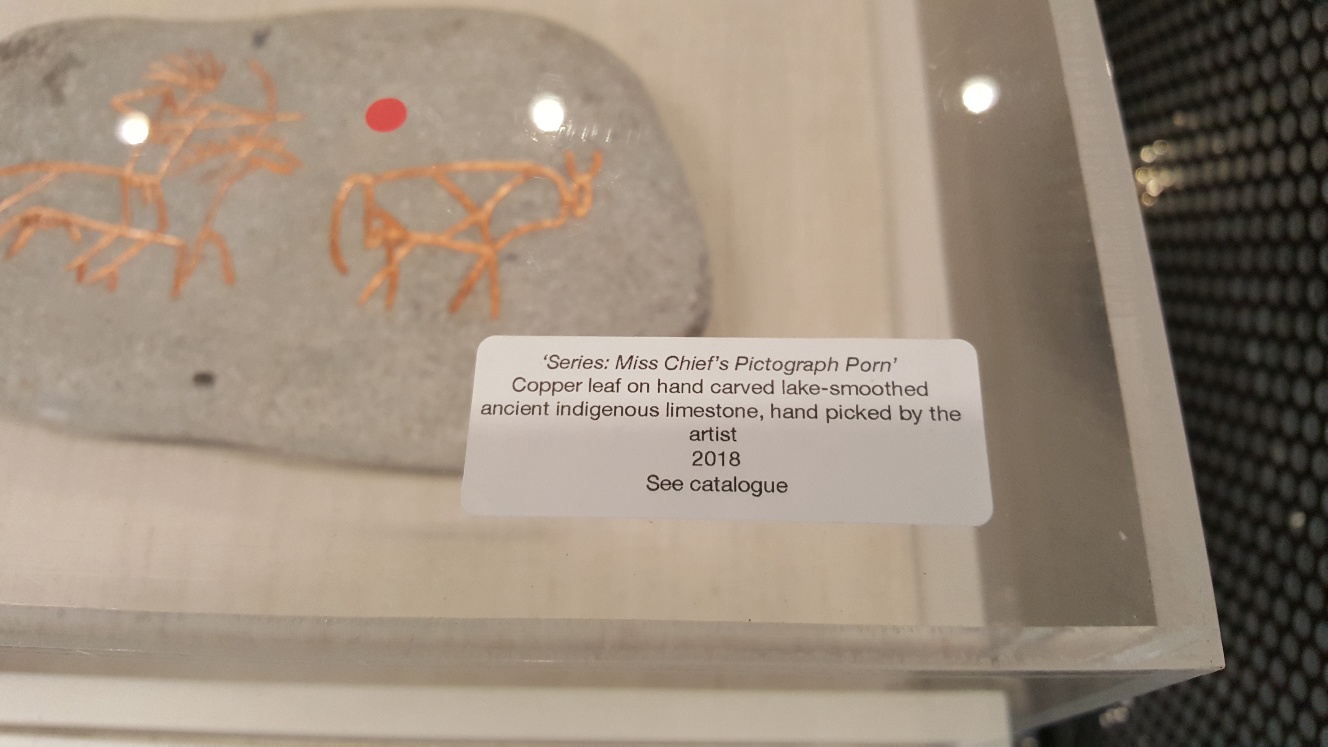
Pictograph porn. The gallery staff were super-serious but I was laughing.Canadians will recognize Robert Harris’s painting “The Fathers of Confederation”, parodied here.
Tonight I picked up a copy of a new book about his two works at the Metropolitan Museum, titled Revision and Resistance. I can’t tell you more than that because I haven’t even removed the plastic covering the book. But I want to see more of Monkman, hoping he is again interviewed, perhaps drawn into new projects.
I wish Miss Chief would consider writing an opera or musical. Perhaps there’s a film in their future.
I wish CBC would get them to host This Is My Music: because I’d like to get a better sense of their personality. What kind of music does Kent / Miss Chief listen to? I’m sure I’m not the only one asking.
Someday I hope we get to find out more about Kent Monkman. In the meantime I am very grateful to the Art Canada Institute, whose offerings I’ve just stumbled upon today, via their lecture.
Today I watched an outdoor performance of Alice in Wonderland presented by the Canadian Children’s Opera Company.
Over the past few weeks it’s been a joy to see productions that signal a return by many companies forced to the brink by the pandemic, often with a celebratory tone regardless of what was being presented.
That was especially so for today’s Alice, with libretto by Michael Patrick Albano and composed by Errol Gay, premiered in 2015 and offered this year in honour of its composer, who passed away in 2019. In addition to Alice, Errol had also composed A Dickens of a Christmas and Laura’s Cow: the legend of Laura Secord.
I was impressed watching the complexities of the music in Alice. The cast had memorized their parts, the music sometimes made challenging modulations, with nary a missed cue or note. I have no idea how much rehearsal it took for them to achieve this level of perfection, only that it’s tremendous fun to watch, observing the supportive parents gobbling it up.
Founded by singer, broadcaster and impresario Ruby Mercer and Music Director Lloyd Bradshaw, the company was designed to offer young people top quality instruction in operatic and choral singing, stagecraft and drama. This training, paired with numerous and varied annual performance opportunities, places the CCOC in a central position in the Canadian opera scene.
I was thinking how useful this would be as part of an education. You may well ask me “what do they mean by “children”? What are the ages? To be honest I didn’t know. They seemed pretty sophisticated. So I consulted their websitehttps://www.canadianchildrensopera.com/.
Wow, there’s a great deal of detail there for a parent considering sending their child.
This is no idle recreation. CCOC have carefully studied the subject given that they’re coming up on their 55th anniversary. They break down their activities by age cohort. As they tell you in a couple of places on the site (especially if you’re a parent hoping to find a placement for your child), they “have 6 choirs for children and youth grades from JK and up.”
Today’s performance was accomplished by members of that “Youth Chorus”.
If you follow the links for each age group’s choir, you’ll see that this is a fully developed curriculum, well-planned to train the prospective performer in musical theatre, let alone opera. If you’re considering it for your child, have a look at their page titled “Auditions – what to expect“.
I can’t imagine a better pathway for someone who hopes to end up in a post-secondary theatre programs such as the ones at universities or colleges in this country. But never mind career. This is a brilliant way to socialize children in an environment encouraging discipline, goals, and the exploration of personal limits. If they learn something, so much the better, but at the very least their activities are creative and likely to foster confidence. At a time when some schools are reducing their arts education the CCOC’s offerings could be vital.
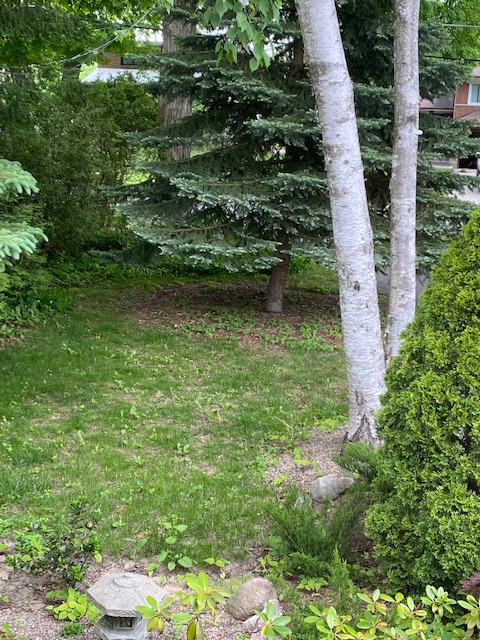
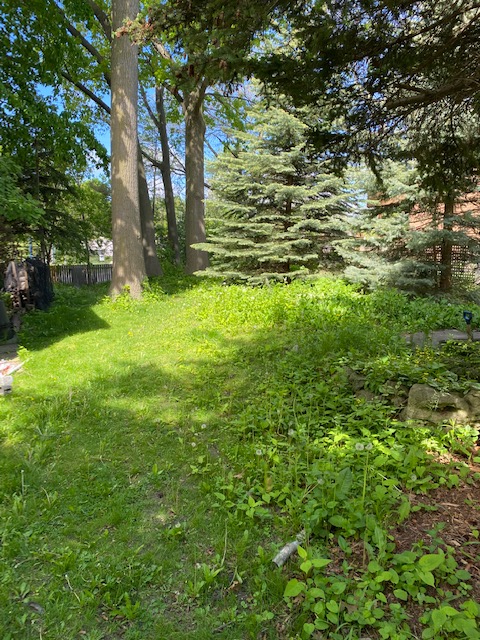
It’s June which means the back-lawn has had its first complete trim.
In front I’ve been able to dodge this question – between protecting pollinators by letting dandelions & weeds grow vs trimming and cutting—by allowing other sorts of growth, led by a big spruce and a birch.
In the back it’s designed as more of a progression. The further away from the house you get, the more unruly it becomes (i almost said “beecomes”, perhaps a Freudian slip?).
Against the house things are carefully manicured, although even here nature has her say.
There’s a big remnant from Sam’s winter pathway. When we were dealing with big snows, she had to rely on the pathway a shovel’s width that I created into the snow in the back.
Sam back in January
I loved how tiny it made her seem against the yard. The snow made me feel small too. And of course this conditioned precisely (i almost said “peecisely”) where she would pee.
It’s no surprise that for the spring, while she may be gone (a story I’ve shared) we still have an indirect reminder of her. I don’t want to sod over this bald patch (at least not yet): which serves as her calling card.
It seems to say “Sam was here”.
Sam was here
Lindsay Anne Black was the first person I ever heard use the word “rewild” aloud, when I interviewed her a few days ago. I have neighbours whose entire lawns are given over to wild growth although I’m not including any photos.
We rely more on bushes and trees. It’s not just that I’m mindful of bees and pollinators. In the back there’s also the noise factor, vehicles going up and down Brimley Rd. Mother Nature is my pal when she helps the bushes and trees grow, acting as noise absorbers.
Adapting a play into an opera can be fascinating work, especially when it’s as well-known a play as Hamlet. I’ve seen several attempts to turn this play into something else including a couple of musicals, an opera long ago, and today’s production on the Met high-definition series in a movie theatre.
While it may be early to pronounce the adaptation by Brett Dean and Matthew Jocelyn a success, I’d like to stay away from anything like an appraisal. First and foremost, it’s no stretch to say that the work is satisfying to audiences, not when I watched the audience scream their approval, or when I teared up in so many scenes, including the last one. I liked it a great deal but of course that’s just one opinion.
You may remember Jocelyn as the former Artistic Director of Canadian Stage, a champion of inter-disciplinary performance for many years, and a successful opera director. Dean too was here as curator of the Toronto Symphony New Creations festival in 2016.
Matthew Jocelyn (photo: V Tony Hauser)
Yes there are parts of Shakespeare’s original that are missing. But just as I doubt we’d pronounce Verdi’s Otello a failure because of the omission of the first act, making note of divergences doesn’t mean dismissal. I admire the ways Meredith Oakes altered the ending of The Tempest, the one composed by Thomas Adès, changes that resemble some of what Matthew Jocelyn does in his libretto of Hamlet.
There’s no sign of Fortinbras, so the usual last line to bid the soldiers to shoot can’t happen. The ghost isn’t seen on the battlements to begin. And –minor change—it’s Rosenkrantz and Guildenstern rather than Osric explaining the wager and then judging the fencing contest in the last scene of the show. Those distinctions aren’t significant.
Far more important are the ways in which Jocelyn and Dean approach the text. You might recall the Tempest adaptation of Adès/Oakes, where librettist Oakes dared to write shorter lines, disregarding Shakespeare’s iambic pentameter. Just as Mallarmé, when confronted with Debussy’s musical setting of Après-midi d’un faune, said something along the lines of “I thought I already set it to music”, so too perhaps Shakespeare (if he could be reached for comment).
If you’re to sing intelligibly for an audience over an orchestra you can’t also be dealing with humongous lines of imagistic poetry. Oakes wrote shorter lines. Jocelyn did something different but comparable, namely giving short chunks of text to a character and then often having the lines repeated many times, sometimes by another character. Hamlet says “or not to be” over and over near the beginning. And we hear “the rest is…” without that last word several times before finally finishing the well-known sentence. I would have wished for Jocelyn to have made the truly brave choice, leaving out the “is silence” because if he’s dead after having said “the rest is” without saying “silence”, we know enough Shakespeare to fill in the blank ourselves. Oh well.
And sometimes the repetition was handed back and forth among several characters. I liked the effect although at such moments I’m reminded of something I saw in a review, when Zachary Woolfe of the NY Times calls it “”an adaptation about ‘Hamlet’ as much as it is an adaptation of ‘Hamlet’”. Yes. When the actor who will be the player king is the one saying “to be or not to be”, we’re in curiously meta- dramatical territory. But this is possibly the best known play in the English language. I only wish Jocelyn had done more rather than less of this, as for example Hamlet’s last line.
Missing too are most of Hamlet’s famous soliloquys, among the treasures of the play. But the role is already huge, so something had to go. I think the choice is valid, even if there will be those coming to the text feeling cheated of their favorite parts.
Allan Clayton’s Hamlet is tremendous vocally and dramatically. There are places where I might quibble with the choices Jocelyn and Dean made, for instance in emphasizing the conspiracy brewing between Claudius and Laertes against Hamlet, leaving Hamlet to have a bigger share of the scene in the graveyard (where usually Laertes and Hamlet aren’t just debating who loved her more but coming to blows). But in this moment as in almost every one, the results were powerful, compelling, dramatic. And the bottom line that can’t be forgotten is that in a play that’s already so long, trying to include everything would make the opera impossibly lengthy. I think when you watch this opera you will be seeing a Hamlet to move you a great deal, a portrayal that wins you over.
Rod Gilfry is a very believable Claudius, but darker than any I’ve ever seen to be honest. If there’s a problem in this, it’s in the dynamics with the others. I’m reminded of some of the Iagos and Hagens I’ve seen, whose transparent evil makes the characters around them look gullible for believing them. Just as an obviously evil Iago or Hagen undermines your Otello or your Siegfried and make them seem less hero than patsy, similarly with Gertrude, especially when she seems clueless about her son’s feelings. Gilfry’s singing is excellent but the role as written doesn’t have the ambiguities I recall from stage productions, where we may question whether the ghost might just be a figment of Hamlet’s mind. In this operatic treatment Claudius is unambiguous. I welcome productions where I believe that some of Claudius’s motivation is his attraction for Gertrude, that his prayer has some semblance of feeling. Yes Sarah Connolly sings a beautiful Gertrude, convincing in the big scene with Hamlet where Polonius is murdered.
William Burden is quite wonderful as Polonius, a voice heard in Toronto with the COC in Death in Venice and Semele. Jocelyn and Dean giving us some absurdly wonderful text to flesh him out. His final lines as he dies recapitulate his bizarre list of genres with the players. He repeatedly addresses his daughter as “green girl”: a line Shakespeare’s Polonius utters but once, that not only becomes his mantra towards her, but –once she is mad—becomes something she utters too.
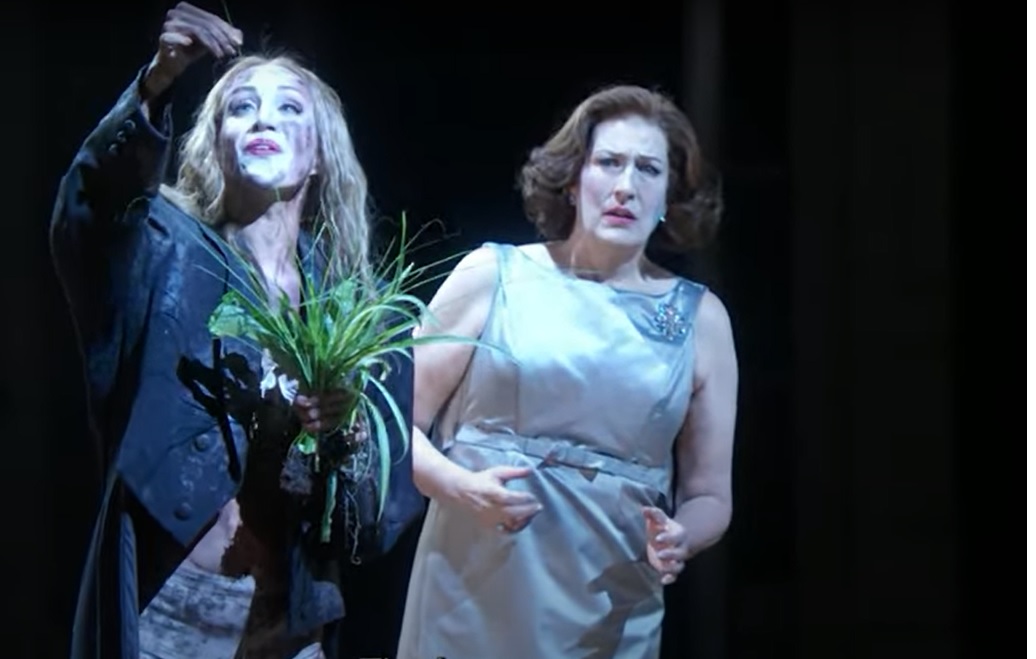
Ophelia’s mad scene (Brenda Rae) observed by a concerned Gertrude (Sarah Connolly)
Oh my, I cried a lot for Ophelia, a character who has never touched me nearly so much as in this version. I’m tearing up just thinking about her. It may be the combination of Brenda Rae’s performance, as well as the costuming in her final scene that leaves her looking like a ravaged survivor of a ship-wreck without the serenity of the famous Millais painting. I’m accustomed to crying for Laertes too as I usually see him and his sister as innocent victims of circumstance, but he’s made into more of an active conspirator than victim in the Jocelyn / Dean version. I thought we hear Ophelia singing along with Gertrude in the scene when her death is reported, an inspired touch, even if this too seems a bit like a gloss on the play, an adaptation in some respect that’s about Hamlet rather than merely adapting it. And it’s no coincidence that this relatively small role gets one of the last curtain calls, and the audience goes crazy for her.
The other key player is perhaps to be expected, John Relyea in multiple roles, as Hamlet’s father, as the grave-digger and a player. Relyea is electrifying every time we see him regardless of the size of his part, not just vocally but even in his silent moments.
This is a production that premiered in Glyndebourne in 2017. The first Ophelia was Barbara Hannigan who sang “And once I played Ophelia” for String Orchestra and Soprano, another piece by Dean given its Canadian premiere in Toronto in 2019; I can’t recall it well enough to know whether it’s at all like the role in the opera, but the composer’s notes to this piece tell us a great deal about his perception of Ophelia:
Though traditionally portrayed as a meek, even weak character, often dressed in flowing white robes and unable to defend herself before the pressures of Elsinore cause her to snap, I’ve often felt that much of what she says betrays a feistier personality than the one we often are presented. (“And I that sucked from his musicked vows…”) And perhaps, just perhaps, Ophelia drowns not from a romantically-fed whim or madness, but simply because of the pure weight of the words others say about her caught irrevocably in her pockets.” (from the website of the publisher of the composer Boosey & Hawkes)
Just as Adès & Oake alter the ending to The Tempest, letting Ariel and Caliban inherit the island at the end of his opera, so too Jocelyn and Dean, in their approach to Ophelia. It’s the most conventionally operatic part of Hamlet and very powerful, very successful.
Produced by Neil Armfield, conducted by Nicholas Carter I recommend this without reservation. I hope there’s eventually a video. I will watch for the encore presentation July 23rd. Dean’s score is full of thrilling effects, a small chorus in the orchestra pit, some instruments playing from behind the audience. There are moments of brilliant wit, for instance the roles of Rosenkrantz and Guildenstern as countertenors, the players accompanied by a frenetic accordion, the moans of the chorus observing the carnage of the last scene. I kept wanting to look over my shoulder for the subtle sounds around me (in the stereo of the broadcast), leads me to wonder how much better it would be if heard in person.
To close, here’s a small sample of Brenda Rae’s version of Ophelia’s mad scene in a video from the dress rehearsal of the Metropolitan Opera production.