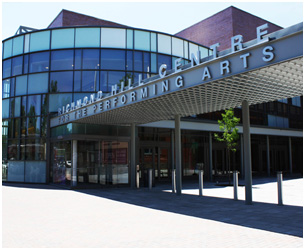
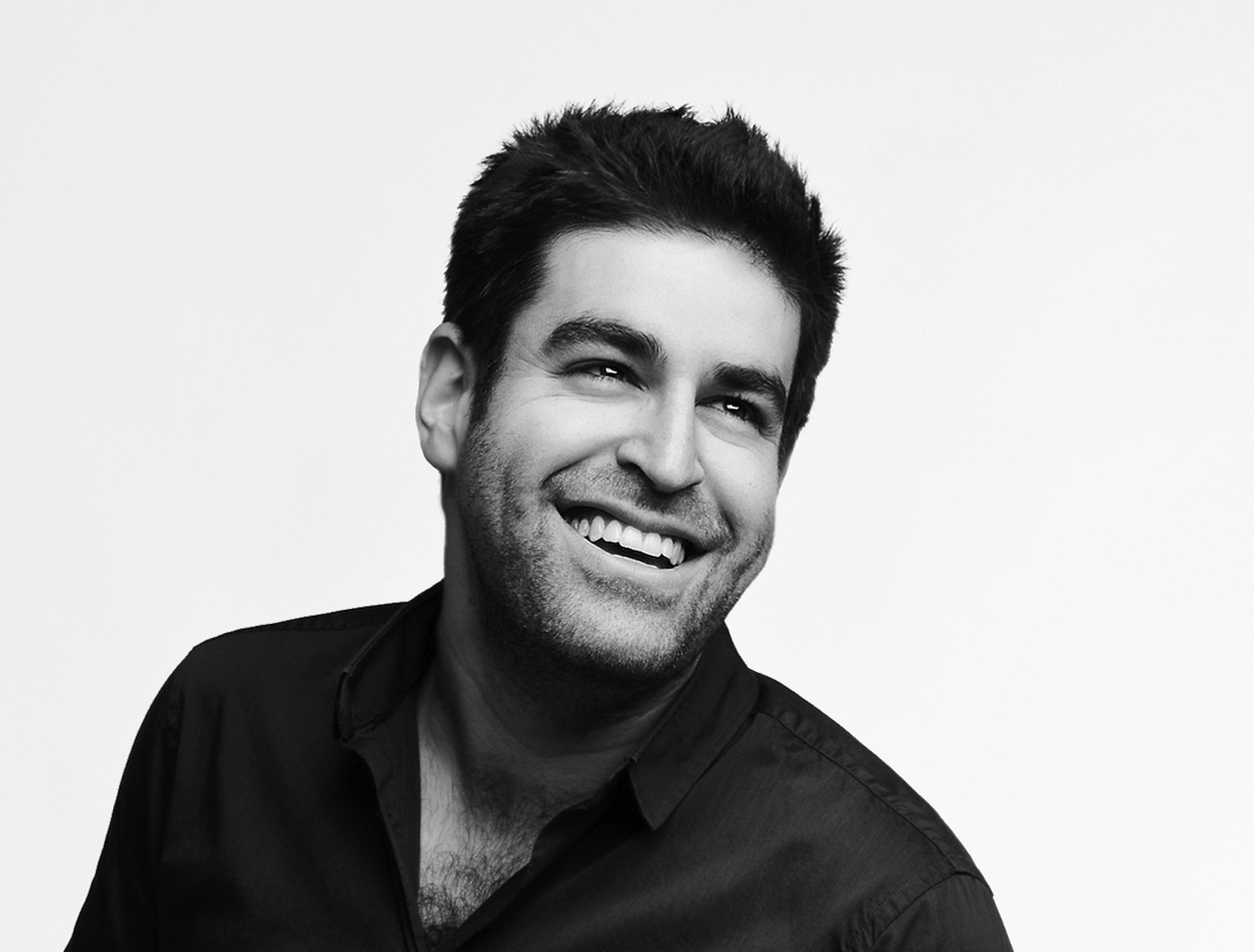
Last night I heard Kindred Spirits Orchestra playing at the Richmond Hill Centre, led by their conductor Kristian Alexander with piano soloist Naomi Wong.
From outside it looks nice enough..
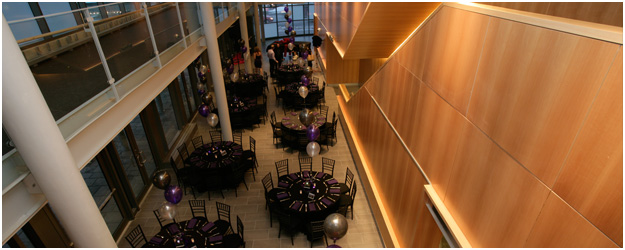
I forget the beauty of this space, until I enter.
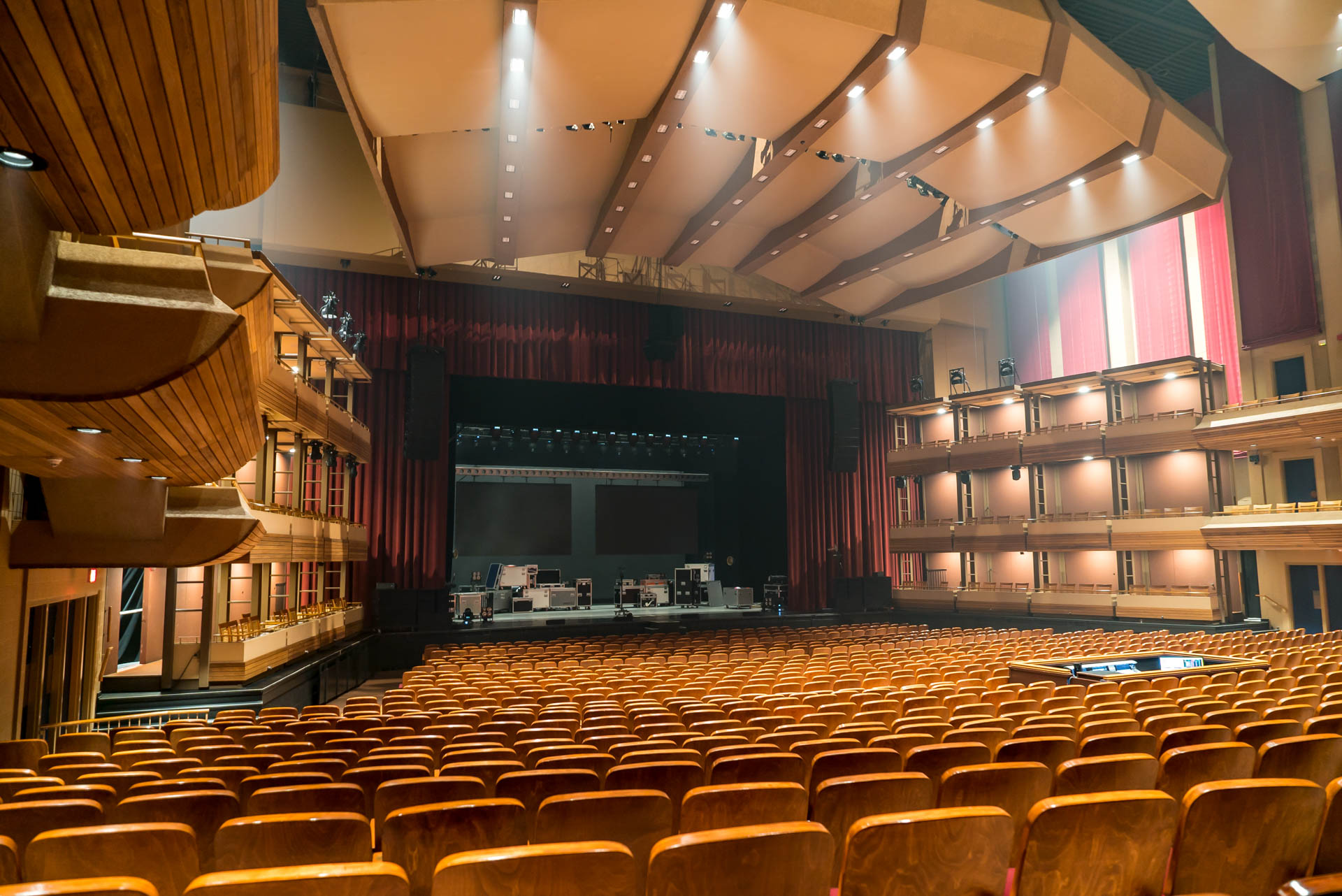
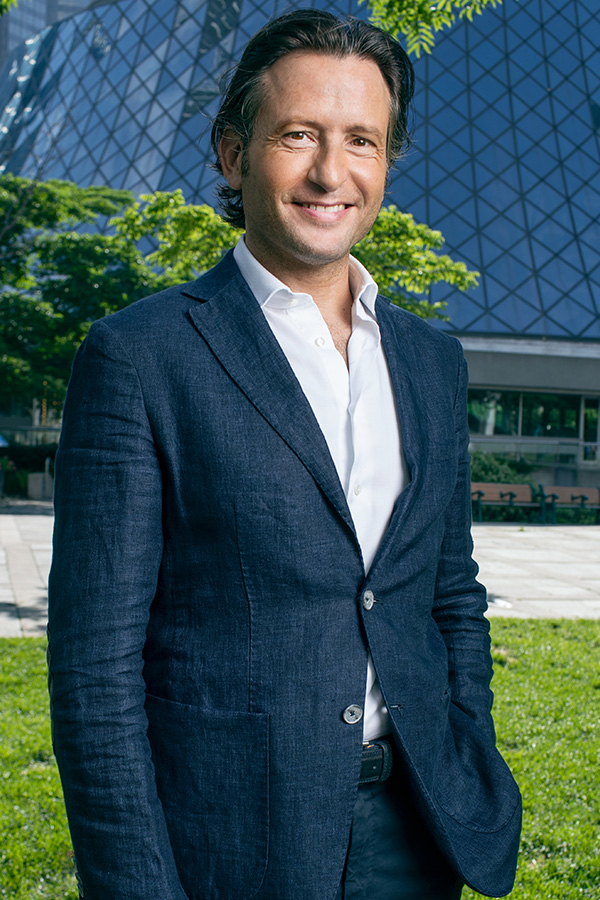
The lobby of the Richmond Hill Centre for the Performing Arts, designed by Jack Diamond
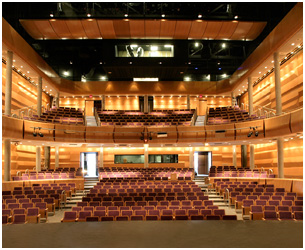
My friend Brian and I were sitting 30-40 feet away, roughly eye level with the Steinway piano, with most of the audience in front of us. The RH Centre website says their capacity is 631, with 360 at the orchestra level.
The acoustic in this little jewel of a hall enabled us to easily hear Wong playing the Chopin piano concerto #2, her notes soaring over the sonorities of the orchestra arrayed behind her on the stage.
Even if we were to sit this close to a soloist downstairs in a big space such as Roy Thomson Hall, we’d be hearing the sound dispersed into a space that can hold 2600, over four times the size of RH Centre. When a soloist undertakes a concerto in the big space, they have to ostentatiously take the stage with their playing (like an actor on a big stage) even in the softer passages. Wong had the luxury of this intimate space, every note clear on the instrument. And it was really lovely to be able to see her fingers as though she were performing across the living room from us. Wong doesn’t have the preening ego that some pianists develop, very humble about her playing as conductor Alexander gently encouraged her to take her solo bows.
The KSO opened the program with Prokofiev’s “Lieutenant Kijé Suite”. I recall we played the “troika” theme in my high-school band many years ago in an arrangement (as I quietly remarked to Brian, wondering if he remembered it from when we went to that school long ago). One of the chief joys of the piece is the way the themes gets handed among different sections, creating a genuine sense of community as each of us got a turn at the melody. It’s a tuneful composition calling for lots of solos from the wind players and intriguing orchestral colours, at times overwhelming in its enthusiasm.
Alexander led the KSO at a bold pace. Again, how wonderful to hear every note so clearly in this tiny hall. The trade-off one makes when choosing between a concert from a community orchestra like KSO and the premiere ensembles such as the Toronto Symphony is evident at such moments. TSO might be better, but in this space we’re hearing and seeing everything with perfect clarity, the players lovingly surrounded by family, friends plus the supporters in Richmond Hill and the surrounding area.
After the interval we heard Elgar’s Enigma Variations, the big piece that was the orchestra’s focus. While the concerto is also substantial, for that piece the soloist is the obvious star, with the orchestra in a supporting role. After the interval that shifted.
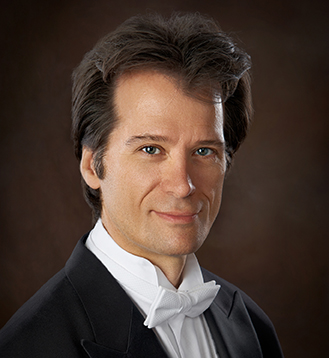
KSO Conductor Kristian Alexander
For a young group such as the KSO –comprised of a mix of young players and professionals—the question of repertoire looms large. One can imagine that Alexander and his team carefully aim for works that will entertain the audience, while not over-reaching by selecting music beyond the capabilities of the ensemble. Alexander functions as both an interpreter and a teacher, leading the musicians while helping in their development.
But what is the enigma, you may ask. I believe it’s a mistake to think of Elgar’s piece as a puzzle to be solved, however many musicologists may dig into the score in search of the answer. I saw a quote from Elgar saying that a “dark saying must be left unguessed.” Where have we heard such things? Indeed, given the timing of the composition, in 1898, I’m reminded of Elgar’s contemporary Claude Debussy, whose Nocturnes were composed at this time, and whose symbolist opera Pelléas et Mélisande was composed in that decade.
Elgar said “So the principal Theme never appears, even as in some late dramas – eg Maeterlinck’s L’Intruse and Les sept Princesses – the chief character is never on the stage.” There it is. Maeterlinck’s The Intruder premiered in 1891, while Maeterlinck’s Pelléas had its premiere with Debussy in attendance in 1893. The mistake I’ve often seen is to think of “symbolist” meaning that the symbol is to be decoded and explained, when the essence of the symbolist aesthetic is a reticence, a refusal to be explicit, a tendency to be obscure, vague, shadowy. The symbolist movement can be understood as a response to the growing influence of science in modern life, the reductive tendencies of thinkers seeking to be explicit. The symbolist enjoys mystery as Elgar likely enjoyed the ambiguities created for the listener in his Enigma Variations. Whether or not Elgar should be thought of as a symbolist, he’s only explicit when he tells us that we should not seek clarity in our understanding of his enigma. I’m inclined to listen to that suggestion.
Perhaps the over-riding idea or theme behind the piece is Elgar himself, as this work is in some respect a self-portrait. If we understand it as a series of portraits of his friends, the last variation is Elgar himself, containing within it the music of his chief influences.
Alexander led a stirring performance, building slowly but inexorably in the “Nimrod” variation: the one that’s so well known, that we sometimes hear at funerals or on Remembrance Day. At the conclusion (concerts still a relative novelty for most of us in March 2022) our ovation attempted to return the favour, in an eruption of joyful gratitude.
Lent in 2022 is becoming darker, war casting a horrific shadow over our fortunate prosperity on this side of the world. I treat gratitude as a kind of sacrament, the foundation of everything; we begin with recognition that we are so lucky here in North America.
I’m praying every night. Is it for me? perhaps. I hope that when I ask for mercy for my loved ones, for the safety of those who might be in danger or harm’s way, that perhaps my prayer is heard. At the very least I am meditating, making myself feel better.
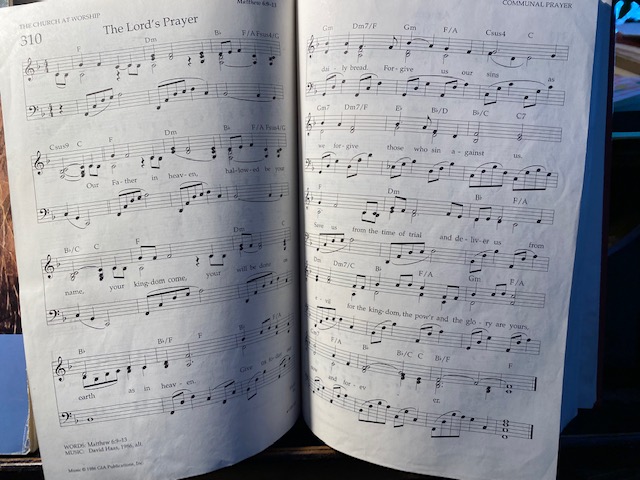
I’ve been thinking about The Lord’s Prayer not just because I run it through my head several times every day, but because it exists in multiple versions for me. If we read it in the Sermon on the Mount as it appears in Matthew Chapter 6, we already encounter multiple versions: depending on The Bible we read. The King James Version was drilled into me early, and so it’s still my go-to if I am reciting, a prayer I learned long ago. Although Luke 11 has a version of a prayer that’s startlingly similar (considering the divergences we get in parts of the Gospel accounts), Mathew’s is the one I’ve been reciting, especially since COVID disrupted church services, forcing me back on my own devices.
It’s ironic that in being chased out of church, we might in some respects be closer to honouring what Jesus told us to do: as I shall explain.
I think that chapter six of Matthew, which includes that prayer, is mostly about performing. No it’s not Stanislavsky or the Method, we’re not being taught the mechanics of performance. But Jesus is talking to us about sincerity and purity of purpose in our actions. Actors going through the motions, simulating piety are the problem, and we shouldn’t be troubled if we’re not simulating faith as boldly. That’s not what He wants.
The opening of chapter 6 may seem to be talking about charity, when it says “Be careful not to practice your righteousness in front of others to be seen by them. If you do, you will have no reward from your Father in heaven.” The chapter will also speak to us about prayer and fasting. But it’s less about charity or prayer or fasting, and much more about our sincerity of purpose: how we perform the actions.
When I speak about performance I mean Jesus’s underlying question. Are you really praying, really giving sincerely: or is it all an act, all for show?
We’re told “And when you pray, do not be like the hypocrites, for they love to pray standing in the synagogues and on the street corners to be seen by others. Truly I tell you, they have received their reward in full. 6 But when you pray, go into your room, close the door and pray to your Father, who is unseen. ”
I have always found this hard to reconcile with performances of sacred text, and perhaps I’ve even talked your ear off about this? (sorry!).
I used to be a soloist in churches. While I am still comfortable in the role of organist or in a choir, I’m troubled, conflicted about singing text to a congregation who listen. Indeed, the last time I sang –when I was especially tormented—someone came up to me afterwards to comment on how sincere I seemed to them. It was a lovely gesture, yet I felt horrible, because I was being torn in two, and haven’t been able to sing a text in church since that time.
Yes I can play the organ, or sing in the choir because that’s a more purely spiritual thing, free to each person to interpret.
Indeed, this commentary could just as easily apply to sung versions of “Ave Maria”: featured so prominently in the current Batman movie, sung by the Riddler, please note.
Sometimes when I pray I employ the sung version of The Lord’s Prayer in my head, silently. It’s an oxymoron. To perform this aloud, especially if it were admired for its sincerity, would be in direct contradiction to what we’re told to do, how to pray in the very chapter of Matthew where he gives us the prayer. How weird to perform this prayer–meaning to model faith before others—when the prayer was given as an example of something to be done silently in private, not before others.
Perhaps I sound like a prude or a stickler. But I find the contradictions illuminating. Perhaps in church we’re not really praying, given that we’re all hearing one another, hearing the organ and the choir that might resonate inside ourselves later when we pray alone.
Maybe the way it should be done in church is in its context: with Jesus’s admonition (via Matthew): to do this alone in the dark, not on a street corner where we’re showing off our piety. To sing it without the preamble is to miss the most important part of the lesson.
I stumbled upon a sermon from Justin Schwartz today that made me very happy, thrilled when my own wandering in the dark corresponds to something another person is thinking or saying. Justin served an internship at Hillcrest Church in Toronto during his graduate school days, before taking up a post in the USA. His recent sermon comes about two minutes into the video after a crisp clear reading of the relevant text of Matthew’s Gospel, from First Christian Church, Disciples of Christ in Louisburg Kansas, USA. I feel lucky that I can follow him and hear his sermons through the magic of social media.
His words are applicable every day of the year, especially now.
When we sing the Lord’s Prayer in church –in a sense contradicting what Jesus said in Matthew 6—I wonder: what are we doing? Are we praying, or is church like a school where we practice what we’ll do at home on our own..?
As I ponder this question (one I’ve been mulling over for over 50 years), I’m going to briefly look at the four versions of The Lord’s Prayer in the Chalice Hymnal. Each one has its merits.
#307 is the one that employs the nice old King James Version text. As such it takes us to a place that in some respects is even more of a contradiction to Matthew’s words. If the text says “for Thine is The Kingdom and the power and the glory”, surely it’s wrong-headed to be glorifying ourselves on those words. The glory and the power and The Kingdom are His. Not ours. The big musical climax on that phrase (going up to a big high note in the music) is very much like the behaviour being castigated at the beginning of Matthew Chapter 6.
So how can one sing this without puffing out one’s chest like one of those people Jesus spoke of? “And when you pray, do not be like the hypocrites, for they love to pray standing in the synagogues and on the street corners to be seen by others. ”
Each of the next three versions in the Chalice Hymnal offer something as a sort of answer to the conundrum.
#308 gives you a West Indian song that has a meditative quality reminding me of Taizé singing, where we seem to be hypnotized away from pure logic into something more genuinely spiritual. I love this tune and hear it in my head long after. That the melody functions as a sort of “ear-worm” is to me a true blessing, allowing me to use it in the night when I pray silently alone.
#309 is more of a spoken litany, another pathway that may help make the prayer meaningful. This doesn’t work for me when I try it alone but I can see the value in this, especially if the opening invocation helps to focus one on a prayerful mindset.
#310 is the one I find myself using most often, possibly because it was our usual sung version at Hillcrest. This one is in a soft folk-rock style, with a direct address to God in the second person. I find this very helpful when I pray at night, whether sung or not. And in contrast to #307, it’s crystal clear when we sing that “the pow’r and the glory are yours”, we humble ourselves.
I’m still spellbound by the contradiction, the performance of a text meant to be heard in solitude.
But that same 19th century play is the basis for a new film named Cyrano, actually a film musical based on a recent stage musical adaptation of Rostand’s original. After briefly opening in December 2021 –something they do in order to qualify for the Oscars– the film went into wide release February 25th, not even two weeks ago. It has made roughly $3.8 million of its $30 million budget. I went to see it this week at my local Scarborough CINEPLEX, knowing that it couldn’t last much longer, and suspecting that its poor box office performance was not a proper reflection of its merits.
I was the only person in the theatre, for the one showing that day at this location.
There are several reasons why it might be doing poorly, up against blockbusters, at the end of the pandemic, with a war breaking our hearts.
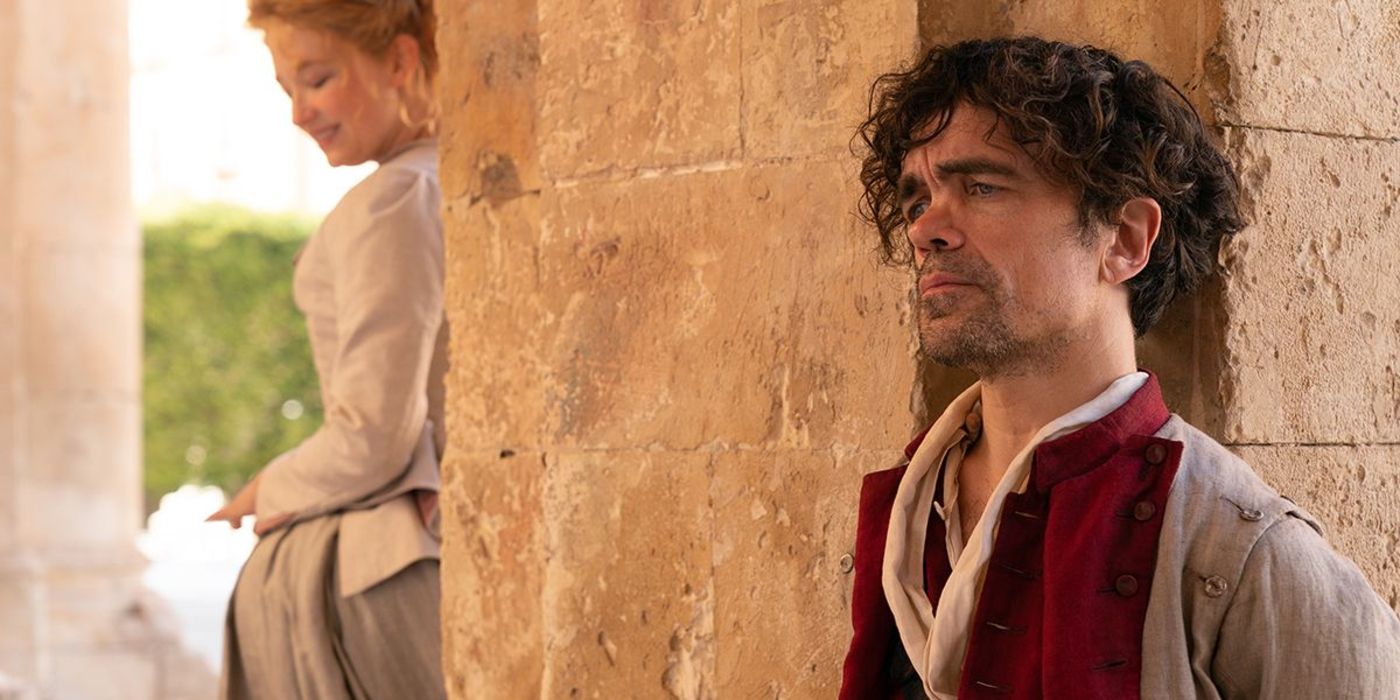
The most obvious difference? Instead of a cantankerous hero with a big nose, we get Peter Dinklage, a 4’4” tall hero.
Roxanne (Haley Bennett) and Cyrano (Peter Dinklage)
Don’t misunderstand me, I love the guy. He has a wonderful speaking voice and a good singing voice. You may recall him from Elf (2003) as Miles Finch, the famous author of children’s books.
Dinklage’s portrayal of a hero unable to believe that the beautiful girl could possibly return his affections is totally relatable. And he’s brilliant in the part. I can even believe his swordplay.
While audiences haven’t shown up in theatres to prove that they can make the willing suspension of disbelief, it’s a beautiful idea (Peter Dinklage’s height, in place of the usual big nosed Cyrano), at least in theory
That is not the only change. We meet Roxanne (Haley Bennett) first, only encountering Cyrano later. Roxanne’s part seems enlarged to my eye. Is it relevant that Haley Bennett is having a relationship with director Joe Wright? possibly.
And the hero is different in other ways too. Both the 1950 film of the Rostand play with Jose Ferrer and the 1990 Gerard Depardieu film en français are mostly Rostand and a hero with a big nose, meaning a cranky SOB who has so many enemies that he is ambushed and fatally injured at the end of the play, to set up his death scene. Purists who are fond of either of the aforementioned films or who love the play as Rostand wrote it will be bothered by the ending as given to us by the team of playwright Erica Schmidt and director Joe Wright.
The love-duet we get between the hero & his beloved bugged me so much I left the theatre right away without staying for the credits. While I mentioned that the director is in love with Roxanne (that Joe Wright and Haley Bennett are having a relationship, possibly married by now) in fact the adaptation by Erica Schmidt is really the issue, as she puts a love-duet in place of the usual ending of the play, totally emasculating Cyrano in the process.
Instead he’s been made nicer.
(shudder)
Their duet is titled “No Cyrano” although perhaps more properly it should be titled “No Joe!” or “No Erica”, my cries at their changes, marring Rostand’s hero.
Cyrano has had a nose job. And it’s not pretty.
Until that moment though, I was mostly enraptured, hypnotized, won over. If you do get to see it on the big screen you’ll see $30 million worth of choreography, art direction, beautiful design and cinematography up there on the screen. The score for the musical by Bryce and Aaron Dessner, two rock musicians reminding me of the gentler numbers in Les Miserables. It’s easily intelligible, sometimes excellent.
There is one musical number that moved me to tears, namely “Wherever I fall”. We hear soldiers speak of war, then watch them actually go into battle. Christian (Kelvin Harrison Jr) falls before us, Cyrano wounded not in an ambush by his enemies, but in the same battle, three years before his death scene. The link I’m giving you is really like a demo version, and audio only. The visuals accompanying this in the film are stunning.
Now if they would just re-write the finale, not as a duet but as a soliloquy with that last line back in place, we might have something truly brilliant.
I can’t decide if the last line is wit or a punch-line to a joke, possibly because I am not sure I get all the nuances and allusions/echoes in the line. In a musical I imagine it ending with a brilliant flourish somewhat like the very end of Debussy’s piano prelude number 12, or Ravel’s Tombeau de Couperin: but just the end, mind you, as it must be set up by something respectful and serious in tone.
But please, not a love duet.
So for what it’s worth, read it & weep. And thank you Project Gutenberg.
CYRANO: I tell you, it is there, There, that they send me for my Paradise, There I shall find at last the souls I love, In exile,–Galileo–Socrates! LE BRET (rebelliously): No, no! It is too clumsy, too unjust! So great a heart! So great a poet! Die Like this? what, die. . .? CYRANO: Hark to Le Bret, who scolds! LE BRET (weeping): Dear friend. . . CYRANO (starting up, his eyes wild): What ho! Cadets of Gascony! The elemental mass–ah yes! The hic. . . LE BRET: His science still–he raves! CYRANO: Copernicus Said. . . ROXANE: Oh! CYRANO: Mais que diable allait-il faire, Mais que diable allait-il faire dans cette galere?. . . Philosopher, metaphysician, Rhymer, brawler, and musician, Famed for his lunar expedition, And the unnumbered duels he fought,– And lover also,–by interposition!– Here lies Hercule Savinien De Cyrano de Bergerac, Who was everything, yet was naught. I cry you pardon, but I may not stay; See, the moon-ray that comes to call me hence!
(He has fallen back in his chair; the sobs of Roxane recall him to reality; he looks long at her, and, touching her veil):
I would not bid you mourn less faithfully That good, brave Christian: I would only ask That when my body shall be cold in clay You wear those sable mourning weeds for two, And mourn awhile for me, in mourning him. ROXANE: I swear it you!. . . CYRANO (shivering violently, then suddenly rising): Not there! what, seated?–no! (They spring toward him): Let no one hold me up– (He props himself against the tree): Only the tree! (Silence): It comes. E’en now my feet have turned to stone, My hands are gloved with lead! (He stands erect): But since Death comes, I meet him still afoot, (He draws his sword): And sword in hand! LE BRET: Cyrano! ROXANE (half fainting): Cyrano! (All shrink back in terror.) CYRANO: Why, I well believe He dares to mock my nose? Ho! insolent! (He raises his sword): What say you? It is useless? Ay, I know But who fights ever hoping for success? I fought for lost cause, and for fruitless quest! You there, who are you!–You are thousands! Ah! I know you now, old enemies of mine! Falsehood! (He strikes in air with his sword): Have at you! Ha! and Compromise! Prejudice, Treachery!. . . (He strikes): Surrender, I? Parley? No, never! You too, Folly,–you? I know that you will lay me low at last; Let be! Yet I fall fighting, fighting still! (He makes passes in the air, and stops, breathless): You strip from me the laurel and the rose! Take all! Despite you there is yet one thing I hold against you all, and when, to-night, I enter Christ’s fair courts, and, lowly bowed, Sweep with doffed casque the heavens’ threshold blue, One thing is left, that, void of stain or smutch, I bear away despite you. (He springs forward, his sword raised; it falls from his hand; he staggers, falls back into the arms of Le Bret and Ragueneau.) ROXANE (bending and kissing his forehead): ‘Tis?. . . CYRANO (opening his eyes, recognizing her, and smiling): MY PANACHE.
As usual I’ve been watching tv with my mom when I visit her to bring her lunch and dinner.
During the Winter Olympics she would sometimes get up in the night to watch opening or closing ceremonies, given the time difference.
Yesterday I helped her find the CBC broadcasts of the Paralympics. The French channel broadcasts from 1:00 to 3:00, then at 3:00 one can then switch to the English channel. My mom doesn’t care what language they’re speaking, as it’s hard for her to understand in either of our official languages.
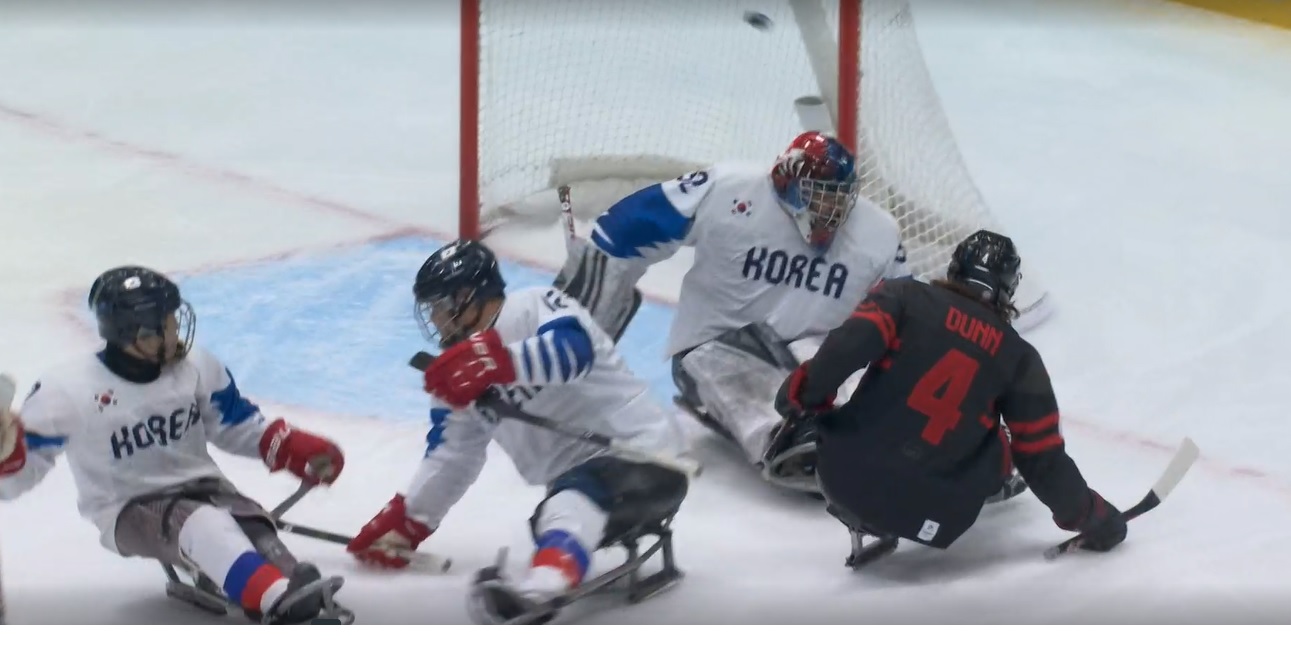
We watched Canada beating Republic of Korea in hockey.
One of James Dunn’s three goals, a blur entering the net above the Korean goalie’s shoulder.
My mom is capable of slowly walking with her walker for awhile each day, doing her physiotherapy exercises. But mostly she was sitting beside me in her wheelchair.
As we watched James Dunn get his hat-trick in a 6-0 triumph, I giggled. Finally! After all these years, we were watching hockey together, something that never interested her before.
My mom looked at the way they were playing, the limits of their movements. It was great to hear her recognition that those guys are amazing in what they can do, as she said “I shouldn’t complain about what I can’t do.”
We watched cross-country skiing, marveling at their speed and agility.
We discussed the weight of the curling rock, how difficult it must be for anyone to throw it, let alone someone with the challenges of the competitors we watched on the broadcast.
I explained how the sport of curling works. It’s not just hockey, we’ve never watched curling together either.
It was a day of insights. We talked about how difficult it is for the physio-therapist who encourages her or any patient to go past their limits, enduring pain.
She remarked that it is hard for us, when her children try to get her to endure discomfort.
You don’t win popularity contests making people go “ouch”, even if that’s what helps keep you going.
The Princess Bride is showing at Roy Thomson Hall, accompanied by the Toronto Symphony Orchestra who play the accompaniment live.
It’s the perfect film for 2022. How?
It features a tyrannical villain who lies shamelessly, just like certain people we see on the news.
At one point we’re told by Fezzik that “People in masks cannot be trusted” which got a big laugh, in a theatre full of masked patrons. There was an even bigger laugh when Fezzik asked the Man in Black why he’s in a mask, to be told “they’re terribly comfortable. I think everyone will be wearing them in the future.” Not bad for a film released in 1987.
Not only were we masked, not only is the capacity at Roy Thomson Hall still reduced for safety, but they even asked us for our vaccination passports even though the law doesn’t require it anymore. For those of us who are still hesitant about venturing out, it’s a relief.
If you’ve seen other films in the TSO series – such as the Star Wars films, Vertigo, or Back to the Future—in each case you were listening and watching the orchestra re-creating the musical score played by an orchestra that was heard in the original.
But for The Princess Bride? it’s slightly different, as you can hear in this CP24 interview of conductor Lucas Waldin from earlier this week. https://www.cp24.com/video?clipId=2394478
I was there to see it tonight and agree with Waldin’s description. They’ve taken the original score by Mark Knopfler, that featured guitar and subtle electronics mimicking orchestral sounds.
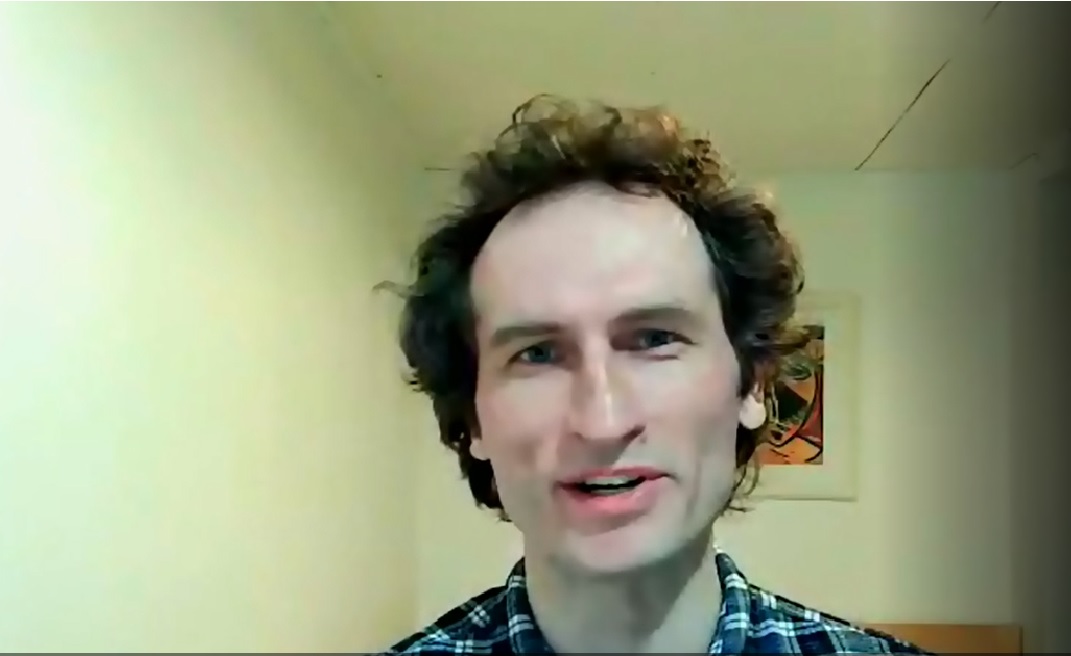
Lucas Waldin, conductor
What’s remarkable in this case is we get something that Waldin calls “reverse-engineered”. That’s another way of saying that it’s a transcription, something like what we get taking Mussorgsky’s piano piece “Pictures at an Exhibition” in Ravel’s flamboyant orchestral version. As with Ravel’s piece, there’s an expansion of the original. It’s subtle because the music mustn’t interfere with the film.
The score serves an important dramaturgical purpose in the film. You will recall that the grandfather (Peter Falk) tells a story to his grandson (Fred Savage), although from time to time the boy resists the romance of the story. At those moments the music abruptly cuts out, because the illusion is ripped apart by his questions or complaints. Whenever we’re immersed in the tale, we’re bathing in the music.
Listening to Waldin’s comments, I wonder if they might try to assemble other films that employed electronics for us to watch at the TSO. You may recall Blade Runner or Chariots of Fire, both employing wonderful electronic scores from Vangelis. OR there’s the pre-recorded music that Stanley Kubrick used in 2001: A Space Odyssey.
Judging from the rhapsodic response of the audience, I know there’s an appetite for this kind of concert performance of cinema.
After a short stay in Mt Sinai after collapsing in early September, my mother went to Bridgepoint Hospital for rehab, gradually seeking to re-cover her mobility with the help of physical therapy. The beautiful view through the window lifts patients’ spirits.
My mom’s room-mate at Bridgepoint was Geraldine McGillivray, which is how I met Geraldine’s son Bruce McGillivray, on one of my visits to my mom.
Bruce has been playing double bass with the Kitchener Waterloo Symphony since 1976.
And he speaks Hungarian rather well, for a non-native speaker. Having noticed my mom’s surname he ventured to speak Hungarian on one of his visits.
I’m very grateful for the conversations Bruce had with my mom, at a time when she was in rehab, amusing her with his friendly banter. Bruce’s kindness is quintessentially Canadian, a neighbourliness we may take for granted. It’s a beautiful thing.
In November everyone parted company. My mom went home from Bridgepoint in late November, Geraldine having been released about ten days earlier. This interview with Bruce was my chance to follow up. Questions of music and rehabilitation run through this interview, as you’ll see.
Bass player Bruce McGillivray
BARCZABLOG: Would you say you’re more like your father or your mother?
BRUCE: I think I’m more like my mother and her family, because her parents listened to classical music. My mother is named after an opera singer: Geraldine Farrar. Her sister was given the task of naming the new baby
BARCZABLOG: So would it be fair to say your mother encouraged your musical studies? Or both your parents did?
Bruce McGillivray They were both non-musical. I just did it. Let me clarify. When I was 12 I bought my first piano.
BARCZABLOG: You bought a piano at the age of 12?
Bruce McGillivrayMy mother signed the cheque. I worked on the morning paper-route to pay for it. And I saved up from zero. It was quite an ancient piano. I’ve often seen them in old movies. It had like a carved fret-work with velvet behind it. It was a Nordheimer. It could have been from the early 1900s.
BARCZABLOG: Cool. So tell me do you still play the piano?
Bruce McGillivray: I have a piano… (giggling) I’m not really playing piano music for pleasure. Just kind of doodling on it.
BARCZABLOG: So Bruce I saw your bio on the KW Symphony website. Bruce has been playing with the KWS since 1976. He has played with the St. Catherine’s Symphony, and Symphony Canada. Bruce developed a children’s solo show for Double Bass, which he has performed in schools across Canada. When not busy performing, Bruce enjoys photography, gardening, and listening to music.
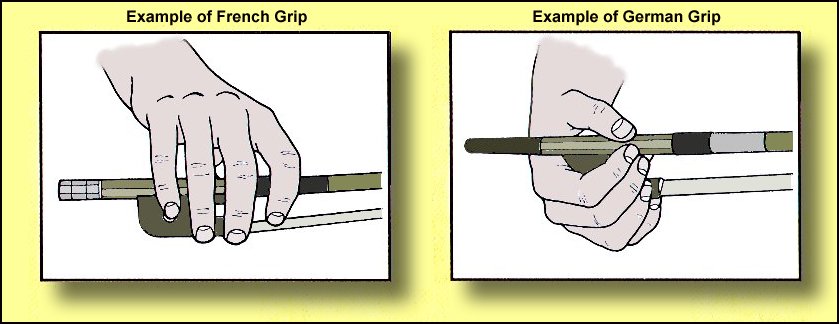
Bruce McGillivrayI have a new biography. It talks about how I went to Berlin. I had a coaching with one of their bass players at the Berlin Philharmonic on the German bow grip. I want to send him a letter, thanking him, because 20 years later, I’m still playing and I have no pain.
BARCZABLOG: Did you used to have pain?
Bruce McGillivray: I did, oh yes I did in the 1980s, I had the same pain. It’s regarding volume production. The way you get it with a French bow is that you press, and with the German bow, you pull. You’re not pressing down on a wooden stick.
So where did it hurt, when you were using the French bowing? the wrist? maybe the shoulder or back?
Bruce McGillivray The wrist, and i recall having tendinitis at times. Possibly the forearm. I’ve been without pain for so long, I can’t remember.
BARCZABLOG: is it easier on the shoulder?
Bruce McGillivrayOh yes it’s easier on everything. And actually you get more sound with less effort.
BARCZABLOG: A teacher taught you?
Bruce McGillivrayMartin Heinze, of the Berlin Philharmonic. It’s an interesting thing. In certain countries –Germany, Austria and countries east—they only teach the German bow. They don’t teach the French bow: because they think it’s inferior.
BARCZABLOG: Would you agree?
Bruce McGillivrayWell: yes! Certain other countries – France, England—they’re more French bow. There are some excellent players. But for me, it caused pain. And the German bow cleared it up.
BARCZABLOG: Your bass. You play it mostly for the pieces you’re playing for KW Symphony?
Bruce McGillivrayWell, my friend Sean Bennesch and I…We also busk. We’ve been busking for some years. At the Kitchener Farmers’ Market. We’re called the Wilhelm Duo. For example we play “Eleanor Rigby”.
Bruce McGillivrayI live on Wilhelm Street so….”The Wilhelm Duo.” (giggling) Very original.
BARCZABLOG: What is the best thing about what you do?
Bruce McGillivrayThe best thing is we perform in the Centre in the Square in Kitchener, which is an acoustical gem. And we love it.
Raffi Armenian Theatre, Centre in the Square
Everyone who comes there , orchestras from Europe, and they finish in Toronto. And word always came back that they liked it better in Kitchener.
BARCZABLOG: Yes. The fact it can be configured…. It’s truly a multi-purpose hall. In the old days multipurpose was a euphemism for “generic”, a design that wouldn’t work too well for anything, as in the old O’Keefe Centre.
Bruce McGillivrayYou know, when they make a recording, they take those towers away. And it’s a huge cathedral-like structure in front of us and behind us. That is one of the favorite things.
BARCZABLOG: So tell me… I want to talk about the Bridgepoint experience, when you met my mom. How did you learn Hungarian? It’s one of the most difficult languages to learn.
Bruce McGillivray: In 1989 I went to Hungary as part of a European trip on my own. Germany, Austria, Czechoslovakia (as it was then known). And ending in Hungary. And I didn’t know how long I was going to stay.
BARCZABLOG: But you didn’t just pick up a language in a couple of days. You’ve got a good accent and vocabulary in one of the toughest languages of all. I guess your German is pretty good too.
Bruce McGillivray The German got me through it. I lived with a Hungarian family for a week. I was actually going to an event there. It’s quite a miraculous thing that happened. Here I was, a Canadian coming, and there was a co-ordinator there, sending them to their billets. There was this Billy Graham event. I didn’t know what I was doing, I couldn’t read anything, and I looked kind of lost and he asked me “are you here for Billy Graham”? And I said “yes!”
But I didn’t know what that all entailed. Before I knew it, I was incorporated with a group of three Bulgarian people who couldn’t speak Hungarian. And we ended up in the dark at the billet’s house near Budapest.
BARCZABLOG It’s so nice to hear you pronounce that correctly. So now, so many years later, you still speak the language. Did you have a chance to practice decades later?
Bruce McGillivrayI have to tell you, this is really interesting. I was at that special event. And then I get a letter back from these people, and I can’t read Hungarian so I searched around at church for someone who could translate it for me. My friends Ferenc and Irenke… Irenke talked to me a week later, after she read it. And she said “we know these people!” I was just at a funeral for their eldest son. I’m considered as a member of the family. I don’t know when I was incorporated. But I’ve been at every Christmas…
BARCZABLOG: natural segue.. so there you were in Bridgepoint with your mom, and you start talking to my mother. You’re a friendly kind of person I guess. I don’t know how to say that, without it sounding unorthodox. But most Canadians are polite but shy and distant.
Bruce McGillivray That’s my specialty, language. Ferenc and Irenke Molnar in the early 90s: they were teaching me. We were working from this really hard book.
BARCZABLOG: yes, your Hungarian accent is as good as mine or better. I talk to my mom, I did a bit to my children. But mostly my mom speaks English. Like most of the Hungarians I’ve known, when they came to this country they want to fit in, so they learn English.
Bruce McGillivrayFrank had an awful time with English. Not everyone is linguistically inclined.
BARCZABLOG Hungarian is a hard language. Could you describe for me…? I’m trying to picture what seems like a magical moment. When did you start speaking to my mom? How did that happen? Did you just say hello to her and listen to her accent?
Bruce McGillivrayProbably the first day I came in, I was coming in pretty regularly for my mother. And I saw the name on the name –plate at the front. And I said to my mom “I think that’s Hungarian”.
And your sister Kaci was there, and I said “jo nappot kivanok”. [like “hello” but literally it’s “have a nice day” in Hungarian] ,
“hogy vagy?” [OR how are you?]
And then she looked at me with large eyes.
BARCZABLOG did she answer in Hungarian?
Bruce McGillivrayI think so. And then I think she told your mother that I speak Hungarian. I have to keep it up. I have another specialty language, Armenian. I can’t even read the letters.
BARCZABLOG: But it’s use it or lose it, right?
Bruce McGillivraythat’s right, I have to keep using it.
BARCZABLOG we joke about this with my mother. There’s a song for instance that my brother found, that’s a popular song from my mother’s youth, from the old days when she lived in Hungary. We did it for her. I played the piano, my brother Peter sang it: for her 100th birthday.
It’s a flirtatious song, perhaps risqué for the 1930s? But she isn’t speaking Hungarian as often as she used to. Who would she talk to ? All of her siblings and friends are either deceased or assimilated Canadians like my siblings and I, speaking English most of the time.
Bruce McGillivraycould i add one point that helps me practice? I call the Kitchener’s farmer’s market my language school. So when I go to buy my kenyér (that’s Bread in Hungarian), it’s the Hungarian baker, And one of the people who works with her, he speaks German too, fluently. So I could be talking Hungarian, and when we come to a dead-end we flip over to German. That’s how I can practice all of these languages. I used to help out at the Kitchener Farmer’s Market. And I remember there was one instance, a lady came to me who spoke no English. She was Hungarian. I figured out the whole transaction. And I was exhausted after that. But I figured it out with no English. I made the sale, the person was happy…
BARCZABLOG So… where do you live?
Bruce McGillivrayI’m in downtown Kitchener. It’s an interesting street because in 1910 or so, it was the last street radiating from the city centre in the direction of Waterloo. And then there would be the forest.And when the forest ended: it would be Waterloo. So gradually the forest disappeared … and you can’t tell where you are.
BARCZABLOG You have been coming to look after your mother. You’re part of a team, right?
Bruce McGillivrayYes, there are PSW who come in the morning and evening. And my sister comes when she can. Generally once a month.
BARCZABLOG anyone else besides you, your sister and the caregivers?
Bruce McGillivrayYes we have our neighbour , on salary and she fills in the holes when neither of us are available. She’s like the glue . When someone has to come open the door for the PSW, she can do so.
BARCZABLOG right. Interesting. We have a lockbox on the front of the house, the kind real estate agents use. You can buy then at a hardware store, and it’s a box that holds the front door key, but you have to know the combination to get into the box to get the key. That’s what we do, although some mornings it’s hard to do, when it’s cold, hard on the fingers.
So –changing the subject– how many hours do you practice?
Bruce McGillivrayIt depends on the program. There are two types of practice. There’s practicing away from the instrument, and then you practice it on the instrument.
BARCZABLOG So you can actually practice without the instrument?!
Bruce McGillivrayWhen I’m in Toronto, i can’t really bring it, because i have a whole car full of clothing food, ….
BARCZABLOG aha ,i was going to ask you if you bring your bass to Toronto, and i think you’ve just indirectly answered my question.
Bruce McGillivrayNo i can’t.
BARCZABLOG Wow you can practice without your instrument? (jaw dropped)
Bruce McGillivrayI can practice, I can work out fingerings. I can try to work out difficult passages. If the piece is not known to me, I can at least work out a fingering. And when i come to the bass, finally, see how that thought works.
BARCZABLOG so right now, you’re preparing for your concert?
Bruce McGillivrayI haven’t got the music yet. My next one should probably be in March. I’ll get the music maybe on the weekend. The big piece is going to be the Elgar Enigma Variations. And there’s a concerto.
I’ll tell you this, I’d probably practice one hour in the morning, one hour in the afternoon, one hour in the evening, because it’s not the quantity, it’s the quality.
BARCZABLOG We were talking about Haydn. Are you curating a concert at some point?
Bruce McGillivrayIt’s delayed, it will be in 2023. It’s part two of the History of the Symphony I curated in 2018. I was thinking “that could be part one”. And this all-Haydn concert would be part two. And this has me thinking, the concluding one will be part three, it will be a trilogy.
BARCZABLOG There’s a lot of Haydn that’s for sure. When you eventually have that concert, please let me know.
Bruce McGillivray That will not be presented at the Centre in the Square but First United Church in Waterloo. That’s the one I would get you to come to.
BARCZABLOG do you play any other types of music?
Bruce McGillivrayYes in our programming we do film scores. We do pop concerts which could be any type from Latin to ballet…There’s even like a Cirque du Soleil, where the people are hanging and we can’t look, because it’s making me nervous, way up there swinging…!
BARCZABLOG so long as you’re not doing that.
Bruce McGillivray no….! I’m a bass player, i want to be on the ground!
When I was busking we switched it up. We’d be doing Mozart one minute, and then Sean would say “let’s do Paranoid”.Or “Black Dog“.
Bruce McGillivray …and the younger listeners would say “we didn’t know you could play that”.
BARCZABLOG Do you have anyone you admire as an influence, or anyone you want to thank?
Bruce McGillivrayI want to thank my original conductor and music director Raffi Armenian. He molded me for 18 years.
Raffi Armenian former Artistic Director of the Kitchener-Waterloo Symphony Orchestra
And in that time he was so instrumental in getting Centre in the Square built.
BARCZABLOG did you ever speak to him in Armenian?
Bruce McGillivraymaybe a couple of little things. Not really. My Hungarian is way better.
BARCZABLOG is there any teacher you want to acknowledge?
Bruce McGillivrayI started off with my wonderful Toronto Symphony teacher Jane McAdam and then I left for Kitchener. Janet Auger was the Principal of the Kitchener-Waterloo Symphony; I ended up studying with her at university.
Then I’d have to say the next teacher is the one in Germany, Martin Heinze, Berlin Philharmonic, who coached me on the German bow. That changed my life. And no pain.
Bassist Martin Heinze of the Berlin Philharmonic
*******
Last time I chatted with Bruce he was telling me how his mother Geraldine walked a short distance that day without a walker, which is a positive development. Rehabilitation and relief of pain continues to be a recurring theme for us. I didn’t mention my own arthritis pain to Bruce. But all four of us (Bruce, his mom Geraldine, myself and my own mother) have worked to get past pain.
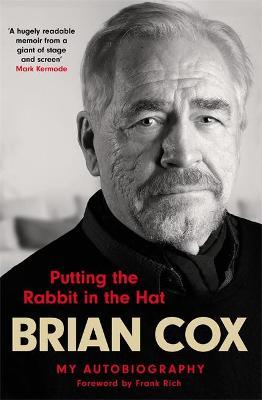
I’ve just finished reading Brian Cox’s delightful memoir, subtitled Putting the Rabbit in the Hat.
Cox is an actor currently famous for his role as the powerful father Logan Roy, in the tv series Succession, although you might know him for films such as Troy, Adaptation, the Jason Bourne films, or Rushmore, to name but a few.
Cox has now twice had the dubious honor of appearing in the other versions of a famous character, whose portrayal won someone else an Academy Award. In 2017 it was Cox’s Churchill that was largely ignored in the same year as Gary Oldman’s award-winning take. Before that he was Dr. Lecktor in Manhunter (1986), before Silence of the Lambs (1991) gave Anthony Hopkins his Oscar.
Partway through Cox’s book, I came across a bit of pure gold. At one point he’s telling us about an experience from more than ten years ago, captured on film that has supposedly gone viral via YouTube.
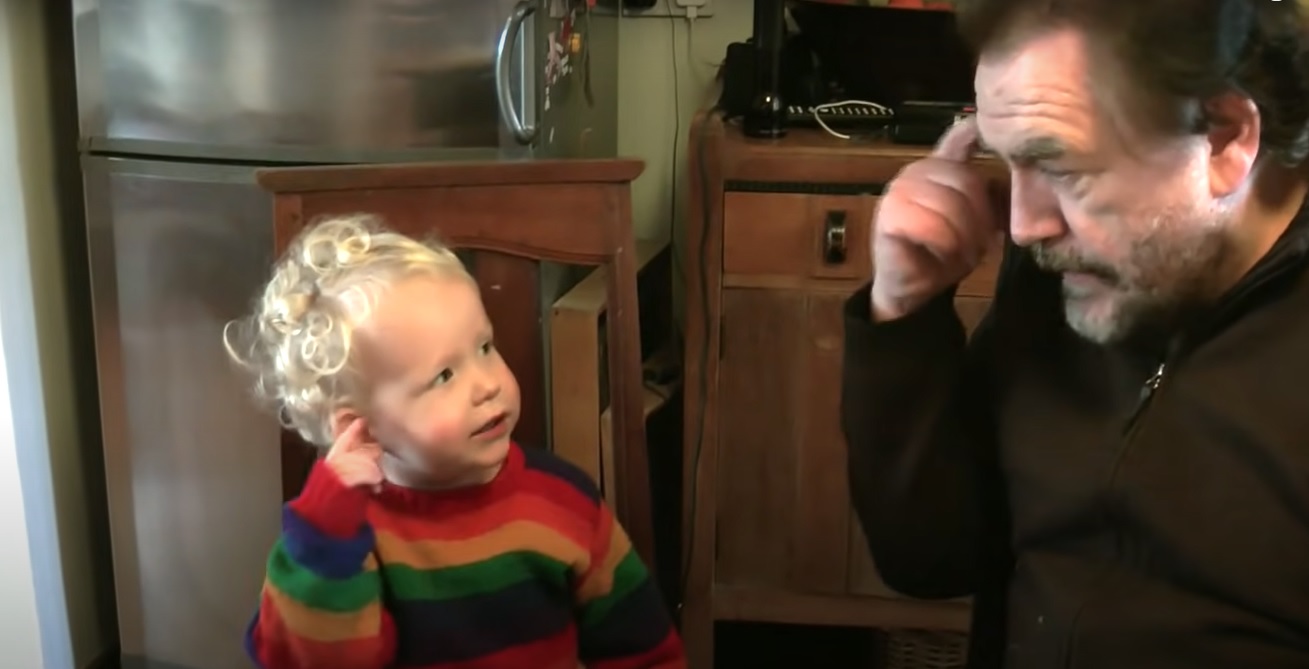
He’s teaching a 30-month old toddler named Theo to deliver a Shakespeare soliloquy. Line by line, we hear “to be or not to be”, first from Cox, then from the charming little fellow beside him. Perhaps you saw it long ago, but it’s new to me.
Cox is having a great time with the little fellow. Of course, it’s wonderful fun.
But it’s also a fascinating study of the whole process of theatre, of learning a part and of how we perceive a performance.
I don’t think the little fellow understands what he’s saying, not in the sense of the full import of the speech. How could he possibly? It’s amazing how well he delivers lines, but I doubt he understands much of what he’s saying. The video is charming, lots of fun.
In a sense it functions as a kind of parody of Shakespeare. Instead of a tormented Hamlet we watch the little boy.
For me it deconstructs the experience of theatre. As an opera fan I regularly watch singers perform. Most operas I see are in languages other than English, which means that I’m not usually able to understand unless they offer subtitles, or if it’s one of those operas that I’ve seen and studied so many times that I know every word.
Ideally the singer makes their words sound as smooth as conversation, fluent and convincing. But in practice we sometimes hear singing that isn’t quite believable because it’s been learned syllable by syllable, sung with a phonetic accuracy that might still be lacking genuine fluency. I can sing “che ge li da ma ni na”, one syllable at a time, or “che gelida manina”, making the syllables flow as words. If a singer is learning the words and sings with conviction, the phrases come across as genuine.
Alas that’s the image that comes back to me, thanks to the performance by this charming toddler. The virtuoso magic of someone delivering complex lines of iambic pentameter isn’t something one encounters very often. It’s a bit like a magic trick or a feat we’d see at the Olympics like ski jump or luge. “How do they manage to go so quickly without falling off the sled” you might ask, just as I also question “how do they manage to get through those lines without forgetting”? The delivery of this young lad reminds me of so many bad performances. I wish those moments were somehow redeemed by the cuteness of the person onstage, the way we excuse singers going off key, when they’re adorable kids in a church or school performance. The framework for performance is fascinating in the way context changes the way we listen. I’m sure, yes this is adorable, yes this is cute. Yes Brian Cox knows that his young charge is more or less going through the motions, not really understanding the complexities of what it is saying.
But it reminds me of so many things I have heard spoken and/or sung, especially when we consider the world of opera. When the audience sits, staring up at the titles that explain the foreign words, translating for us “che gelida manina” or “non piu andrai“ or “un bel di”, I listen to the way the words are delivered. I sometimes am enraptured at delivery that sounds like a native speaker. The chorus singing on one of my LesTroyens recordings is a Montreal ensemble, all French speakers. I noticed how different they sound from the Metropolitan Opera chorus, whose sound is bigger but whose phonetics sometimes seem to lurch from syllable to syllable, at least compared to the Montreal chorus, singing Berlioz’s lines as genuine sentences and full thoughts rather than a series of single notes.
There are several passages in his book where Brian Cox undertakes theoretical explanations of what an actor does, how acting works, as a teacher and as a critic. I think he’s a natural teacher, largely because his style is so straight-forward, so unaffected and direct.
This “masterclass” puts me in mind of Maurice Maeterlinck, who famously said this:
“The day we see Hamlet die in the theatre, something of him dies for us. He is dethroned by the spectre of an actor, and we shall never be able to keep the usurper out of our dreams.”
While I have felt uneasy with Maeterlinck’s preference for the page over the stage, this video does remind me of the way the Shakespeare of our inner ear lurks in the background, especially when we’re hearing a performance that fails to persuade. This video is the most extreme case of this I have ever seen, as it calls to mind the entire process of actors learning words that they would never normally utter, drilled into them by rote. It’s not making a compelling case for live theatre.
I need to see a “real” show sometime soon. Isn’t that weird? What is real, after all, in this context, but superior artifice.
Theo and Brian Cox
I believe that in a classroom the one we call “the teacher” is also learning, sometimes as much or more than the one we’d call “the student”. Who is the teacher and who is the student in this masterclass?
Pat and Skee opens February 25 at Theatre Aquarius in Hamilton, a darkly comic memoir of a challenging childhood.
Sky Gilbert is a ‘child of divorce.’ Pat and Skee is an homage to Sky’s parents—who did their best to raise him despite all the unpleasantness. Sky plays himself in Pat and Skee, which gives him a chance to chat with his mother (Patricia) about her divorce from his father (Skee). Pat and Skee goes beyond meta-theatre—searching for the wistful, often comic essence of the struggle that lies at the very heart of any broken family.
I asked Sky about his new show.
How long have you been thinking of writing a play like this one, about your parents?
I haven’t thought about it as much as written a couple of plays about it. This is the second.I wrote a play called The Terrible Parents about 6 years ago, that starred Gavin Crawford and Edward Roy, and I produced it at Buddies. It was mainly about my mother’s affair with Jerry — her lover after my father (and during their marriage). There were some kind of cartoony scenes with my own father depicting the ‘happy family’ before that — but mostly it was about my mother’s love for Jerry.
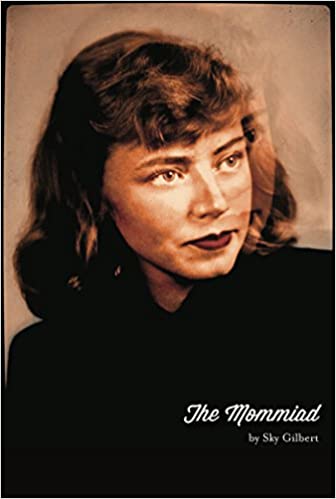
I also wrote a book about my mother — a book of poems — called The Mommiad.
During lockdown I began thinking about my mother again, she died in 2011 and she is the main inspiration for the play.
Back in 2019 I recall that when I interviewed you before the premiere of Shakespeare’s Criminal, you spoke of your mother.
“She was an amazing person; she ran for political office in Buffalo in the 60s, started her own business and raised two children. But more than that she nourished my creativity — I remember that as a teen I was torn between music and theatre as professions and she had an upright piano installed in our tiny flat in East York just so I could practice. It’s a long story, but let’s just say that her beauty and her wit were what inspired me; her dark sense of humour about the world is probably also mine today.”
…so now I read that this new play is “a chance to chat with [your] mother (Patricia) about her divorce from [your] father (Skee).”
Are you in some sense seeking to discover more about your father, perhaps to reconcile yourself to him in some sense??
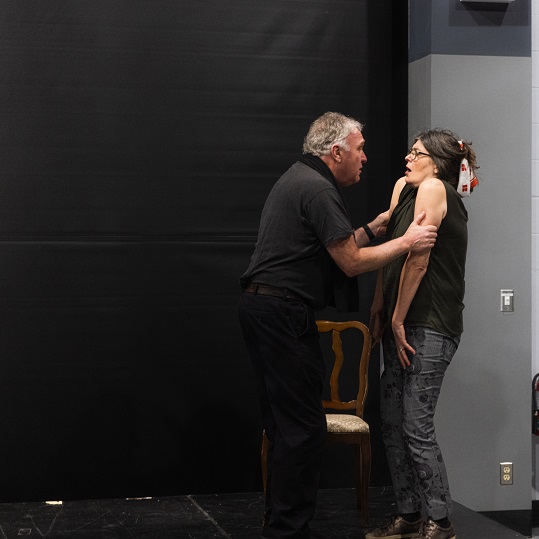
I would say that this is a memory play, pure and simple, It’s me missing my mother and father, since they are both dead, and wanted to bring them back in some way. I get a chance to confront my mother, it’s very odd being in rehearsal with Suzanne Bennett who is so uncanny as her — and having the ‘Pat’ character tell me that I’ll never escape the memory of her — which essentially happens at the end. The play is really about different kinds of love — my love for my mother, and my father’s love for my mother, and my mother’s love for Jerry and of course my mother’s obsession with me.
Pat and Skee: Suzanne Bennett and Ralph Small (photo: Felix Vlasak)
Could you tell me the age of yourself and your parents in Pat and Skee?
There are some scenes when my mother is 35 and my father 39— these are the divorce scenes, when she tells my father she is divorcing him.
Then there are scenes when my mother was 45 — these are the scenes in the 70s, where I am a waiter in a cafe and I am serving my mother and we are talking about her relationship with Jerry after the marriage to my father is over.
I’m a child of divorce myself, and also a divorced adult, on my second marriage. At the risk of asking you a colossal question that’s impossible to answer, I’d be interested to hear your take on the institution of marriage, both from the point of view of the child and as the adult considering marriage or partnership. Please also comment on the changes you’ve seen from the time of our childhoods in the mid-20th century, to now decades later.
I’m against marriage. At the very least I think it’s not for everyone, or for a very select few. I think it is unnatural as monogamy is unnatural for most people. I would say less then 40% of the population is truly happy being monogamous — most people will tire of one sexual partner or need variety. Also people are different. Some people can handle a co-dependent relationship, they think they need it. I hate co-dependence. My partner and I have had an open relationship for 25 years and we lead very independent lives, we would never get married. For me marriage means the oppression of women, as well as conformity, as well as hypocrisy, and trying to fit all of us who are square pegs really into round holes.
Has the process of writing a work that purports to be self-exploratory been in any sense an act of reconciliation for you, either with your parents or yourself?
Yes I’m going through something being in this. I think it might be at the very least odd, or at least an interesting emotional experiment. Ralph is as like my father in his performance as Suzanne is like my mother and it is unnerving.
Ralph Small and Suzanne Bennett (photo: Felix Vlasak)
But it’s nice to have my parents back in my life! Suzanne is putting me through the ringer in interesting ways: “How do we separate the fantasy of your mother from your actual mother?” She asked me this the other day — very interesting question.
The pandemic underlines our need for art, given how dependent some of us were upon the arts to stay sane. How have you been coping?
Are you kidding? I’m furious, angry. I’m actually with the truckers to a certain extent. That is I HATE LOCKDOWNS — and they seem the only ones capable of saying it. I am a social person and I live in my social interactions and in theatre. This has ruined my life and put it to a stop essentially, to all the things I love. They are gone. I need to perform, to be in front of people, to meet strangers, to have promiscuous sex, to go to bars and party. I need that to survive it is essential.
Also lockdowns are homophobic. Many of us don’t have families and we find our families in our community. If we can’t go out into the community we don’t have family. I hate everything online— social media is ruining our lives and ruining our children. Online education is useless and bad for young people. I have nothing good to say about COVID-19 measures— there were too many restrictions, for too long for no reason, with no sense of people’s mental health. Period. They may have been necessary at one point, but certainly no more.
As a professor you have likely been using Zoom and other virtual teaching tools, even though you are a practitioner as playwright and performer in live theatre. Apart from missing live performance (don’t we all): how have the two years of virtual teaching changed your process for live performance?
I have come to realize the incredibly inadequacy of zoom teaching and online learning. The essential of learning is no longer there — the question and answers, the easy improvisational conversations, the expressions on people’s faces — social interaction. Zoom rooms are scary places (did you know they were developed first years ago and very popular for druggie sex parties?) — some students are blacked out, I never see them, some never speak. I don’t know how they are reacting to what I’m saying. It’s awful, and creepy. We need live classes in order to teach and doing living teaching a week after having to zoom makes this appallingly apparent.
The phrase you use of the “broken family” might seem to be a bit of an oxymoron. What’s left, when a family is broken, and do you think it’s still recognizably a family?
Well, there is still habit, there is still shared experience. I know that I love my sister, and that even though the divorce stressed us both out, and certainly left me with abandonment issues, we share all the movies we watched, the culture of the 60s, all the gossip about our crazy mother, etc. There’s always that bond which never disappears.
Does being gay, and coming into relationships from a place that was until recently forbidden in our culture (first, being gay itself, and later, the notion of gay marriage), make partnership or marriage better or more meaningful? And as a gay person do you have special insights about straight relationships?
I wish gay men could bring their honest insights about alternative relationships into the world of gay marriage. We were supposed to CHANGE marriage, we were supposed to make it our own, instead gay marriages are just as dysfunctional and dishonest as straight ones. I have HUGE insights about straight relationships, I mean I used to be in one with a woman, and I’m very aware of the lies that hold straight relationships together, and I understand men, and how awful/wonderful they are, and I understand a major thing — sex between a long term couple never last more than ten years. But you can still love the person you love, totally, and if your relationship is open, there are so many possibilities. If straight couples could open up their relationships when the sex stops (because it almost always eventually does) they would be a lot happier.
That’s my advice….
Sky Gilbert’s Pat and Skee opens February 25 at Theatre Aquarius in Hamilton, running until March 12. For tickets click here.
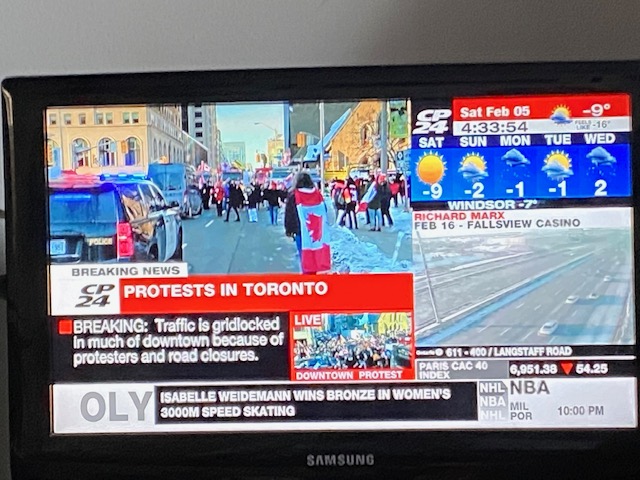
It’s 11:20 pm as I begin to write this, recalling the headline on CP24 (a picture I snapped at 4:33 pm) about Toronto’s downtown, that says “BREAKING: Traffic is gridlocked in much of downtown because of protesters and road closures.”
As of 11:24 CP 24 said the protesters were dispersed, thank goodness. Not only is Roy Thomson Hall’s capacity limited to 500 by current COVID restrictions even though there are over 2600 seats but I suspect some were also daunted by the traffic. I took the GO train.
It’s too bad that there were so few in attendance. In a night of Beethoven, Schumann and a recent work from Jordan Pal, it was the new piece that felt most relevant for a city in turmoil.
Composer Jordan Pal
Pal’s composition is called Scylla, drawing upon the mythology of the Odyssey, as he tells us in his program note:
“In Homer’s Odyssey, Odysseus was forced to choose between Scylla and Charybdis – between two equally dangerous situations. ‘Scylla for Trombone and Orchestra’ is my climate odyssey, embodying the choice we as a species face: climate catastrophe or a sustainable future; inaction or proaction; disbelief or faith. ‘Scylla’ journeys from the future – an inhospitable world, the result of centuries of human neglect – to present-day crossroads where mankind must make climate change its priority.”
The young composer’s three movement concerto was the centre-piece of a night when we were already jarred by the activism of protesters elsewhere in the city, Pal’s ambition wonderful to behold. I’ve been inspired especially by the composers who dare to propose that music can change the world by changing the hearts of humanity, a John Lennon or a Bob Dylan.
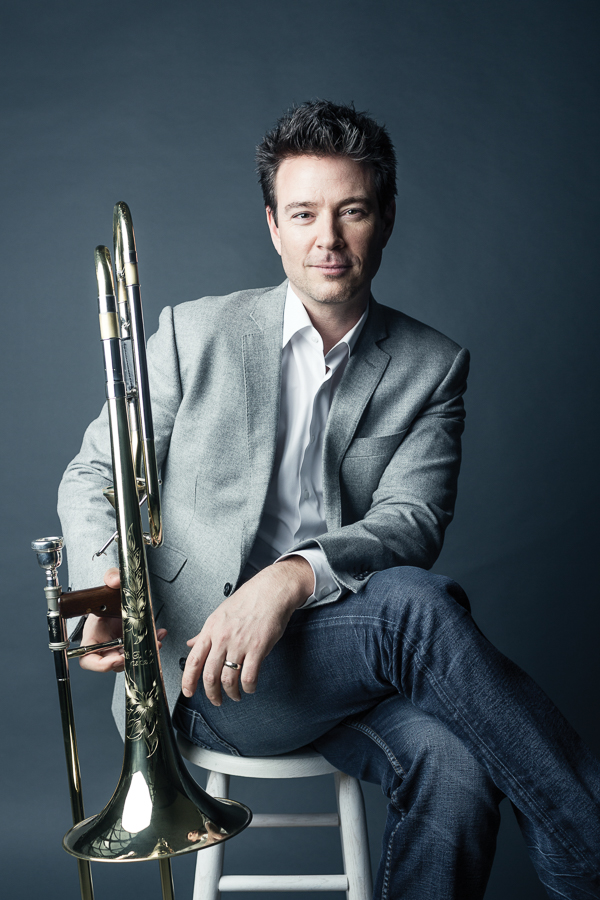
TSO Principal trombone Gordon Wolfe
Pal’s concerto, played by TSO Principal Trombone Gordon Wolfe, puts me in mind of other romantic works that resemble concerti. Like Berlioz’s Harold in Italy, Pal’s trombonist could be a character in a drama, a personage walking onstage partway through the first movement, exiting, then situating himself in a balcony at the rear above the orchestra for a lyrical second movement. At times the trombone seems to be fighting against the forces arrayed against it. In the third movement, I was inspired by the shift in tone, as though the soloist could actually have agency and be heroic, offering cause for hope.
Pal’s music reminded me a bit of John Williams (who’s on my mind admittedly because I’ve been listening to a lot of his music & watching his films lately), especially the bold music when the humans fight the shark in Jaws, and the battle sequences from Star Wars. While I’m sure I don’t always get what Pal is signifying, or what his music is doing, that’s only reasonable with such a complex and ambitious work. I didn’t get Berlioz or Strauss’s tone poems right away either, as I must listen to the piece again.
I don’t know enough about the trombone to have a sense of how difficult the piece is as far as its challenges to trombonist Wolfe, except that he seems undaunted, confident and committed throughout. There are places where he is soft and serene sounding, other places where he is as agile as an Olympic slalom skier, negotiating ferocious hazards without a slip-up.
On either end of the program, music director Gustavo Gimeno led the TSO in something more conventional. We began with Beethoven’s Creatures of Prometheus overture, and ended with Schumann’s 1st Symphony also known as the “Spring Symphony”. The Beethoven is a congenial piece in C major with sparkling sections for the woodwinds and energetic passages running up and down for the strings. Notwithstanding its romantic title this bit of Beethoven doesn’t seem so eager to turn his world upside down (as Prometheus or the protesters might) but simply gives us something with the joyful delicacy of Haydn.
The Schumann symphony was an opportunity to see what our future might be like, as we get a better look at Gimeno. There’s no question that he has been embraced by the orchestra, who follow him doggedly. As I’ve mentioned before, Gimeno was a percussionist, and it shows in his solid metre and bold tempi.
The first movement began with a long moody introduction, apt for Spring when we recall that it’s a transitional season, out of the darkness of winter towards the brilliance of summer. When we get to the main allegro Gimeno holds nothing back, indeed the fastest version of this movement that I’ve ever heard. It’s coherent even if it’s right on the edge a couple of times. When it comes to the climactic phrases, they’re especially clear and powerful. For the second movement we’re into something subtler, a beautiful melody unfolding in the strings, then coming back gloriously in the cellos, decorated by delicate woodwind accompaniments. For the third movement we’re going quickly but without the ponderous or unsubtle tendencies one sometimes finds in interpretations of this movement, the melodic impulse always clear, always musical.
And for the finale oh my we’re again moving very quickly. Gimeno sometimes teases us with the transition passages between sections, where the tempo slows for a thoughtful moment. In such phrases we can see just how exquisite Gimeno’s control is. And then quick as we’re going, we still go faster to finish, the brass all in for the final statement.
It’s going to be fun watching the TSO and Gimeno in the years ahead.
It can be awe-inspiring to look at a composer’s lifetime of work. We know that JS Bach composed over 1,000 pieces in his 65 years, while Mozart, who lived only 35 years, composed perhaps 600 pieces. Yet we only care about them because of their best work, the melodies that pop into your head as soon as the name is mentioned.
It’s in that spirit that I want to think about John Williams as he approaches his 90th birthday on Tuesday February 8th. He’s still alive, still working, still being paid big fees for his music, because he is often memorable.
Williams has won five Academy Awards: 1-in 1972 for Fiddler on the Roof (“Best Music, Scoring Adaptation and Original Song Score”) 2-in 1976 for Jaws (“Best Music, Original Dramatic Score”) 3-in 1978 for Star Wars (“Best Music, Original Score”) beating his other nominee Close Encounters of the Third Kind 4-in 1983 for ET The Extra-terrestrial (“Best Music, Original Score”) 5-in 1994 for Schindler’s List (“Best Music, Original Score”)
This is his most recent win, almost thirty years ago.
John Williams’ 161st composer entry on IMDB is set to be released in 2023, namely Indiana Jones V.
Let’s stop there, to contemplate what it means to have composed music for 160 films, and the 161st is to be released after your 90th birthday. I can imagine the objection to speaking of this in context with Bach or Mozart. It’s impossible to compare and I’m not for a moment suggesting that we somehow determine who’s better or more important. But it is worth observing that few of us will dent Bach’s 1000 work library significantly, that none of us will hear all of Mozart’s 22 operas performed onstage in a lifetime: yet one could conceivably see all of Williams’ 160 (and counting) films. While Williams may be accused of being derivative (although one might just as easily point accusatory fingers at some of Bach’s pieces), his output is so popular as to be impossible to ignore.
In each of the past five decades there is at least one film that begat a franchise, the brand largely associated with the themes created by Williams.
In the 1970s we saw the first of the Star Wars, Jaws, and Superman films
How well-known are these pieces? Here’s a great demonstration.
We heard similar nervous laughter when the Toronto Symphony played the Jaws theme at a Williams-centric concert.
Oh, and yes that’s another incarnation for Williams, conducting the Boston Pops Orchestra, beginning in 1980 for over a decade.
In the 1980s the Indiana Jones series began. In the 1990s Home Alone & Jurassic Park each started a franchise. Since 2000 we had the Harry Potter films.
In addition there are many more scores every bit as ubiquitous, so popular that if you think about it you might even remember the main theme. Close Encounters of the Third Kind. ET the Extra-terrestrial. Hook. Schindler’s List.
And I’m not mentioning the subtler scores to films that didn’t achieve pop culture status. JFK, Munich, Lincoln, Minority Report, Catch Me if you can, War of the Worlds, Saving Private Ryan, Empire of the Sun.
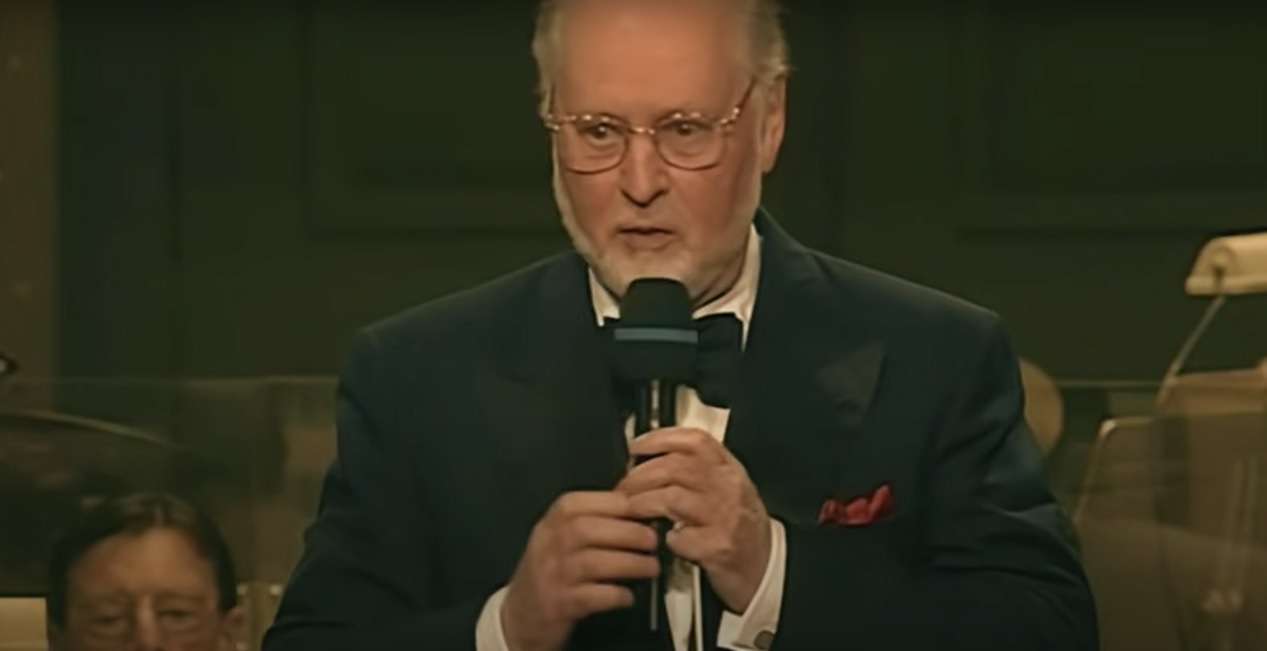
Composer and conductor John Williams
Yes Williams has been around a long time. Among his credits on IMDB you can see credits for TV as well, such as episodes of Wagon Train, 44 episodes of Bachelor Father in 1960 (over 60 years ago, when he was a young composer identifying himself as “Johnny Williams”).
But in addition, IMDB includes another 281 credits for “Music Department”, as for example the 1960s TV show “The Time Tunnel” (29 episodes), Lost In Space (126 episodes), Wide Country (28 episodes), Checkmate (70 episodes), or Amazing Stories (45 episodes), all instances where Williams wrote a show’s theme music. And that 281 also includes instances where another composer uses Williams’ music, as in a Star Wars or Jurassic Park spinoff.
I may be alone in this sentiment, but if it weren’t for Williams, I wouldn’t be able to stand the Star Wars films. He’s the reason I bother, and he manages to elevate the material, more heroic than Luke or Leia.
Over time one sees a change in the role of music. Mozart may have been a success yet he was still a glorified servant, buried in a pauper’s grave. Rossini with his brilliant taste got rich giving audiences what they wanted, one of the smartest of all composers. Liszt and Rachmaninoff too managed to use their virtuosity to make money. In the 20th century we see music begin to specialize more and more, between popular and artistic, music created pragmatically to please and yes, to make money.
While you may quibble when I call it “the music of our time” Williams’ music is a success. He’s been making a living as a composer and conductor for more than half a century. No it’s not the only music we have, not by a long shot. But the big star of 1965 (Beatles?) or 1975 (Supertramp?) or 1985 (Madonna or Bruce Springsteen?) or 1995 (Mariah Carey?) rarely stayed prominent for very long. Taylor Swift or Kanye may be rich and influential now, and there will be others who come along in future. But Williams has been a huge success in each of those decades. You might say “not the 60s” but no, he was huge in television rather than film and perhaps most importantly, has been growing in influence with each passing decade.
And the 90 year old John Williams is still working, and deserving his big fee: because his film scores are always good.
As a closing thought –as much for context as for the pure fun of it—here’s a five minute clip of John Williams conducting a medley of Oscar winners. No this isn’t Bach or Mozart. But it’s fun to see Williams conduct his own themes without any cinematic distractions.