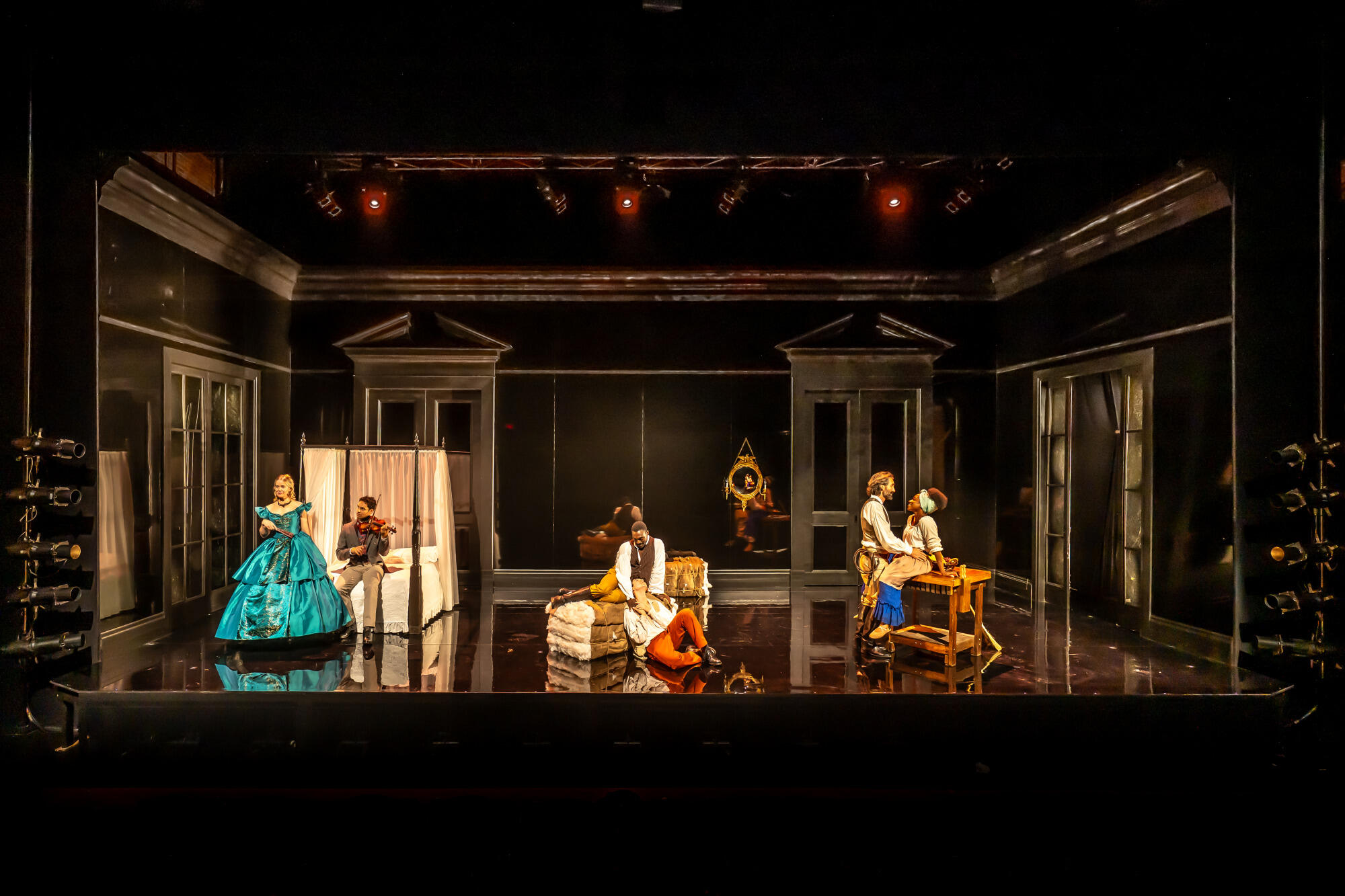
Falling for Sky Gilbert’s Shakespeare Lied and other bardish books

I want to explain where I’m coming from, as I review the second of three books from Sky Gilbert about William Shakespeare.

Oh gosh I see the newer book is getting dog-eared on its third reading.

Shakespeare Lied appeared in 2024, while Shakespeare Beyond Science came out in 2020. My response this time (over the past year) is an even more extreme form of what happened last time. Here’s what I said in 2020 (click here to see the full 2020 review):
I’ve been dancing around this one for quite awhile, hesitant about the review because I am in awe of the book. Nobody expects me to be brilliant even if the book has put me in touch with a desire to be immortal, to make an impact. Gilbert’s book deserves to be read, deserves to be influential. While Gilbert hasn’t been a professor for very long (he was still in grad school when I was there not so long ago), he’s doing great things.

As it has almost been a year since I began reading & re-reading Shakespeare Lied that effect applies even more. This has been a very introspective year for me, a caregiver and a son mourning the passing of his aged mom, pondering the meaning of life, pondering meaning itself.

Sometimes a book you read can totally colour your experience, changing the way you see and hear everything. That’s one of the reasons we read. A book may teach you how to unravel your puzzles, even if reading may also lead you into a deeper labyrinth than before. When the world goes to shit, whether you’re looking for a solution or you want to find a really good umbrella, a place to shelter, books do that better than almost any drug or altered reality I know. Music usually is my go – to, but first, I need to look at the single book that had the biggest impact on my 2024, that I continue to re-read as I try to do it justice.

And yes this may be a cautionary tale for those who want me to help promote their work, as I take it very seriously. I will read and re-read a book because I don’t want to just do a book report. I want to understand.

I normally don’t like spoilers, as the experience of the story or the unfolding of the argument are a kind of magic. I feel it’s sacrilege when a reviewer fills their review with the best lines of a comedy or tells you the outcome of a plot and so for example my recent review of Heratio tells you next to nothing because I aim to be spoiler free. But I don’t think I will be ruining anything if I give you the central conceit of Sky Gilbert’s latest book: Shakespeare Lied. Lately this book and its unique lens has become a kind of subtext for everything I see and by implication, everything I’m writing lately.

Sky’s book is a filter through which I’m seeing everything right now. He asks a question that I keep coming back to: “What, after all, is one to believe?

I hear that in my head not so much as a mantra, but as a reminder. We’re lost in the forest with Hansel & Gretel, not knowing which way to turn.

In 2024 I watched JD Vance and Tim Walz debate through the lens of Sky’s question, impressed by the fluidity of Vance’s delivery even though he lies like a rug, if you take my meaning. But I am not going to go off on the tangent of asking “what is truth” as though I were Pontius Pilate interrogating Jesus. I’m less interested in what fact-checker Daniel Dale had to say than I am in performances, rhetoric, portrayals and (especially apt for politics) reception. What are we to believe, and what is the consensus? We’re as mistaken as Chuck Schumer and the Democrats in how we approach discourse, if we get hung up on questions of truth & procedure, missing the point. And indeed I think it’s worth noting that Daniel Dale was ultimately flummoxed by JD Vance’s running mate, a man who has taken questions of truth and hair to a whole new level. When we zero in too closely on the factoids we miss the forest for the hair.

Or the trees.

Sky’s book was very helpful when I wrote about Canadian Stage’s 1939, foregrounding the play’s colliding performance styles, layers of meaning on top of other meanings. I have a new appreciation for the meta-theatre I see all around us in media. I alluded to General Leslie (Dick) Rhodes, key player in the development of the American nuclear arsenal, a devout Presbyterian from the family of a Chaplain that I mentioned in my review of John Elford’s Our Hearts Were Strangely Lukewarm. Mere questions of truth miss the performative b.s. of genocidal Christians who have no trouble sleeping at night: because they’ve been blessed and absolved.

I could go on with more examples, such as Tafelmusik led by Rachel Podger and the Pictures concert of TSO all through the rose-coloured glasses of Gilbert’s ideas. The point is, Sky isn’t just talking about Shakespeare. Or maybe I should put it in context with his previous book on the subject, Shakespeare Beyond Science: When Poetry was the World (2020).

The first book is gentler and more even-handed, while the new book reads like a polemic. There’s an intensity to it beginning with the cover, showing us Acteon, attacked by his hounds, as he bursts through Shakespeare’s head.

I can’t help noticing that Sky used a big long title last time and this time a tiny one. Speaking of filters and influences, I can’t help thinking that — like Daniel Dale’s orange nemesis–Sky is trying to simplify things for those who didn’t get it the first time. But don’t get me wrong, the new book doesn’t dumb it down. Far from it. The first book was more Shakespearean in its flowery approach to scholarship. In fact I think he was very gentle and careful in his diction last time as though he were giving us the undergraduate version, while this one moves more quickly and passionately, like a grad school version.

We’re in the discursive realm of sequels, where the author presupposes a lot more, daring us to follow him as any good lecturer does. Graduate school assumes you saw the first film and so will know about the relationships, the politics, the objectives of each character. We get to the point faster which makes some sentences more electric and even acerbic.

The first book is great preparation for this new book. And they make a fascinating study as a pair. I can’t help looking at 2024’s foray as a continuation of the 2020 study.

But maybe the real difference is that this time it’s personal. I don’t know enough about the background to comment, except to frame this for you, using the words in Sky’s prologue.

During Buddies’ 40th anniversary season, I was delighted when Artistic Director Evalyn Parry announced a reading of my 1986 hit play Drag Queens in Outer Space. A week before the reading I wrote a controversial poem for my blog. I received an email from Evalyn Parry saying the ‘community’ was up in arms about my poem. I politely suggested Evalyn ignore the hysteria. In a return email she stated that due to the offensive nature of my poem, the reading of my play would be cancelled. I was thus forced to remove myself from any association with the company that I founded many years ago. (Shakespeare Lied p11)

We don’t get to read the poem in question so the controversy is a black box, something mysterious and unknown to the reader. I did some searching, looking for something from that time, a clue about the poem, but came up empty… Perhaps we can set that question aside for the moment.

The next thing Sky talks about in his book didn’t seem terribly important, namely his viewpoint about the way he was being read: a discussion of form & rhetoric, not unlike what we saw in the first Shakespeare book, but now pointed squarely at writing of the present century. I’m mentioning this in the interest of being comprehensive & complete, not because I think it’s important. I don’t think we usually need to know what was going on in an artist’s life when they made their creation. Yes Sky sounds a bit angrier in this book than he did last time, even if Shakespeare Beyond Science came out in 2020, long after the controversies I’m alluding to.

As I ponder the two books in August 2025, I’m struck by a contrast, that may be a reflection of where I am at rather than an accurate picture of the two books. But one book filled me with inspiration, one throws me back, hesitant and questioning what lies beneath. The first book suggests I can get closer, get to know something about Shakespeare. The second says not so fast, maybe he’s not knowable, maybe we don’t want to proceed because: our hearts are bruised and even broken. We’re told just a bit of that mystery I spoke of, about poetry & art, from a mysterious community of secrets, concealed identity, performative virtues, backstabbing, conspiracy, false loyalty. It may be dark but it has the ring of truth & authenticity because of its passionate delivery, something less than full out Shakespearean histrionics. Having just seen the latest meta-Shakespearean show (Heratio) I hesitate to try to distinguish between what’s imaginary and what is genuine. And yes I know, the way that second book seems to parallel a zeitgeist full of lies & fakery makes me wonder: is it the book or is it me? Am I watching CP24 or CNN too much? The books are both mirrors, and maybe I need to be careful not to write a book review that sounds like I am talking about myself and my own self-doubt, my own awareness of mortality.

As I pondered the two books and the many sources Sky acknowledges, I knew what lay ahead, because at the end of the second book Sky’s bio says that he’s working on another Shakespeare book tentatively titled “Shakespeare’s Effeminacy”, the concluding volume of a trilogy about the identity of Edward de Vere.

In my reflections, knowing another book was coming I wandered off into the sources, the alternative readings of Shakespeare and his life, competing theories about authorship. It’s a huge industry of course. Let me suggest further reading if you would like to discover more, as I confess my own conflicts & quandaries on the topic(s).

In his first book Sky pointed us towards the research from Canadian scholar Leslie Hotson, a writer from a previous generation, writing about the Hilliard miniature in his 1977 book Shakespeare by Hilliard.

When I consider the way Hotson writes, it’s a trip back in time, less to the era of Shakespeare as to a time of arcane & obscure criticism allegedly in the service of truth and clarity. The book is a labyrinth. While I may have complained at the density of the discourse Sky offers up in his second book, compared to the accessible language of the first, they are both worlds away from Hotson, whose prose suggests something secret & obscure as hieroglyphics or runes inside a musty tomb, as Hotson gives us a musty tome, and I have to give an example to justify such extreme language. In his first book on page 57 Sky says the following:

<<As Hotson tells us (quoting Littleton) , Apollo was associated with oracles and messages that were riddling or “oblique”. This means he was prone to “speaking ambiguously, so that he can be taken divers ways”>> (Shakespeare Beyond Science 57)

That’s Sky. Here’s a sample of Hotson, and it won’t matter where I start, because it’s all a miles-long thread running through that forest I spoke of:

Randolph’s wry-legged god is his translation of Ariostophanes’ term Loxias, which Henry Fielding’s version of the Plutus gives us that oblique deity. For the explanation we turn to Littleton: ‘Apollo was called Loxias; who in his replies was loxos, that is, oblique, and speaking ambiguously, so that we may be taken divers ways.’ (Shakespeare by Hilliard 96 )

So of course, in his book about oblique or riddling messages, Hotson is poking oh so slowly oh so carefully at the tiny relic Sky put on the cover of his first book, spending 200+ pages ultimately telling us a tiny bit about a tiny thing. Don’t get me wrong, I’m not complaining. But I feel a bit like an explorer in that forest, now peering into a deep dark well, afraid I will fall in.

Notice that the book title to the right makes no mention of the subtitle in the spine of the book as mentioned below.

The book’s title as it appears on the spine:
“Shakespeare by Hilliard A PORTRAIT DECIPHERED”

While that sub-title is on the spine of the book I couldn’t find anywhere inside the book nor anywhere in the bibliographic record when I look on the UTL website. Hilliard and perhaps Apollo himself would approve of this oblique approach, presumably true to what Hotson wanted.

So as I wander about inside that well (yes I fell in), there are other books and theories that I am simultaneously pondering. Hotson also wrote about Mr WH, a person of some interest in the conversations about Shakespeare and the sonnets.

A more recent book complicates the conversation, namely Richard Paul Roe’s 2011 Shakespeare Guide to Italy: Retracing the Bard’s Unknown Travels. I was stunned reading so many explanations that correspond to lines in plays that previously made little or no sense. The book offers connections in many of Shakespeare’s plays, set in places with Italian or Mediterranean place names, drilling down on tiny details over and over again.

Roe’s book on top of the others

I will look in Sky’s third book for some mention of Roe’s analyses. Whatever version of Shakespeare’s life you want to write must reckon with Roe’s conclusions.

Feeling lost I searched and found even more confusion. Paul Streitz wrote Oxford: Son of Queen Elizabeth I, a book that I have to chase down, seemingly arguing many of the same things Sky’s books argue, again speaking of Edward de Vere, Earl of Oxford as the alias or perhaps the true identity of William Shakespeare. Perhaps this is old news? I had not heard this version before, with Elizabeth the Queen in a starring role.

Sky makes no mention of Streitz. I feel a bit perplexed to see that neither Streitz nor Hotson are cited in the back of Roe’s book, which is amazing in a bibliography that’s over 10 pages long. In the tiny Epilogue of his study, Roe calls attention to a disconnect between accepted scholarship & his observations, suggesting that his goal was to “revisit these orthodox beliefs and contrast them for their accuracy with the actual words of the English playwright” (Roe 297).

Maybe in the next generation someone will pull it all together, make sense of the different theories.

I’m reminded of Sky’s title and a year spent observing the lies all around us. Yes there are so many books about Shakespeare that I suppose you dear reader and I could miss a few books. But a scholar studying Shakespeare’s life? That seems hard to believe, even if he meant to ignore or dismiss their work.

Let me quote Sky again even as I admit I am lost. “What, after all, is one to believe?

So I am waiting for Sky’s concluding book, as I plan to delve deeper into Hotson, Streitz, Roe and yes, Shakespeare.

Posted in Books & Literature, Dance, theatre & musicals, Reviews | Tagged , , , , , , , , , , , , , , , | Leave a comment

Heratio premieres at the Guild Festival Theatre

I’ve just seen Genevieve Adam’s Heratio, a new play that picks up from where Hamlet ended.

It’s another of the scripts that build on Shakespeare, with much of the fun coming if you know the original, as in Stoppard’s Rosenkrantz & Guildenstern are Dead. It’s fertile material, as I recall earlier this summer when I interviewed Kenzia Dalie (creator of a show called Clowns Reading Shakespeare) or last year’s 1939 (a work by Jani Lauzon and Kaitlyn Riordan using children in a residential school playing Shakespeare as a powerful microcosm for exploration). The currency of Shakespeare in our culture makes him a perfect departure point, and clearly he’s not close to being exhausted, with lots still to show us in 2025 and beyond.

I just want to quickly mention the venue, in passing. I was married there in 1989, a place that is surely one of the most beautiful places to stroll or to watch a play in the Toronto area. Today we were outside near the lake, breezes cooling us on what had been a stifling hot day, as birds swirled overhead, passersby sometimes making noise that never really distracted us from this astounding space and the work being presented.

Looking back as I was leaving after the show
View from my seat in the front row

It’s actually even more beautiful than what you see in my pictures. The actors were right in front of us, delightfully intimate in this tiny space.

Adams’ Heratio is a curious mix that gets to the point quite quickly, combining moments of gravitas & physical comedy, juxtaposing noble personages with the servants who are usually under the radar. It may be an advantage not to know the original, if that means one can arrive without stipulations or requirements of the plot or language. Best to just go with it.

Director Helen Juvonen

Director Helen Juvonen’s program note calls it a comedy which is a useful guidepost for those who worry about such things. I found myself wondering –given that this is a new work–whether they knew how they wanted to finish the play when they started, perhaps working back from the ending. I do like how it ends, and sorry I won’t tell you more.

Every one of the six members of the cast had powerful moments.

Siobhan Richardson (Violet)
Phoenix Fyre (Rue)

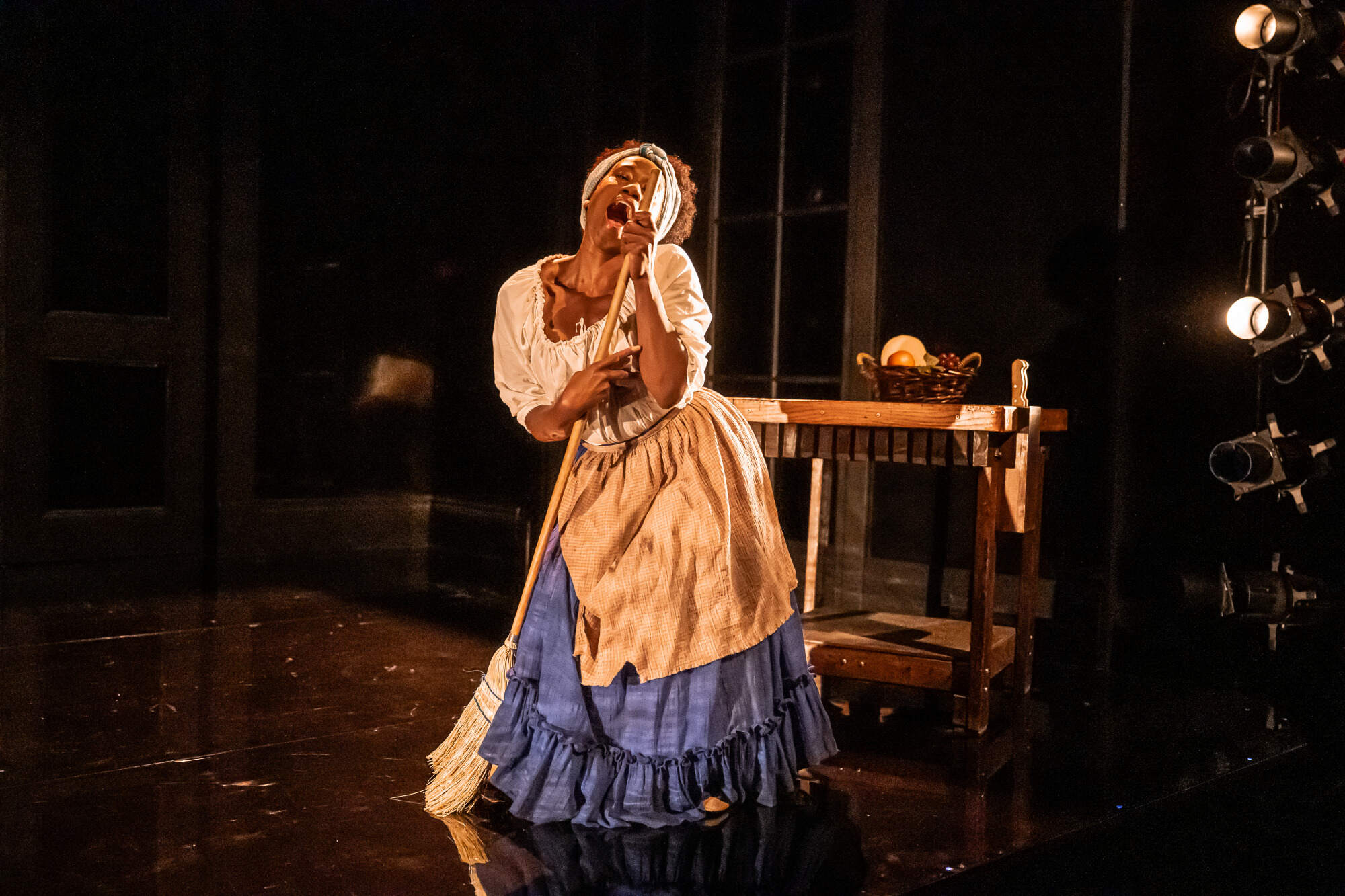
We begin with Violet (Siobhan Richardson) and Rue (Phoenix Fyre), a pair of servants charged with exposition & clean up orienting us into the world of Elsinore immediately after the bloody end of Hamlet, as they scrub all the blood off the floor. They’re not to be under-estimated.

Janelle Hanna (Horatio)

Horatio (Janelle Hanna) has a huge challenge in his/her role, somewhat perplexing at first until we find out why, but the title of the play was a big clue.

Jack Davidson (Fortinbras)

Fortinbras (Jack Davidson), a character who appeared briefly at the end of Hamlet, now has a whole new life thanks to Adams’ new comedy, a figure sometimes cut right out of the play, and often forgotten except as a footnote.

Columbine (Rashaana Cumberbatch) is a delightfully difficult creation from Adams, a family member of one of the dead in the play. I couldn’t take my eyes off her, fascinating every time she appeared onstage.

Queen (Philippa Domville)

Last to appear is Philippa Domville, whose presence seems to work magic the way she raises the energy of the ensemble, everyone coming to life. I don’t know if she was meant to be a spark-plug but I can only compare it to the arrival of Jimmy Durante in Man Who Came to Dinner, a strategic moment built into the script that inevitably turns everything & everyone upside down. Awesome.

The comedy is sometimes very dark, but maybe our use of the word nowadays loses something given how freely Shakespeare worked between joyful & sad in tragedies, histories or comedies. I found myself rethinking aspects of a play I thought I knew inside out, re-examining relationships in new ways.

And yes there are lots of laughs in Adams’ meta-Shakespearean comedy.

Genevieve Adam

Heratio continues until August 24th at the beautiful Guild Festival Theatre. Click for info & tickets

Posted in Books & Literature, Dance, theatre & musicals, Reviews | Tagged , , , , , , , , , , , , , , , , , , , , , | 1 Comment

Feral butterflies: Cale Crowe talks about his new play Rez Gas

Rez Gas is a world premiere musical by Cale Crowe and Genevieve Adam running August 22nd to September 7th at the Capitol Theatre in Port Hope.

Rez Gas playwrights Genevieve Adam & Cale Crowe (photo: Sam Moffatt)

After moving away from his home reservation to pursue a music career, Destin stumbles back into town with unexpected car trouble and lands at the Wide Wigwam diner. There he finds many of those who he left behind and who want to remind him of his history and his place in the community. 

Rez Gas features Vinnie AlbertoDillan Meighan-Chiblow and John Wamsley as a trio of old friends at the centre of the action.

Vinnie Alberto, Dillan Meighan Chiblow and John Wamsley (photo: Sam Moffatt)

The ensemble also features Michelle BardachJonathan FisherNicole Joy-Fraser, and Emma Rudy.

Dillan Meighan Chiblow, Emma Rudy & Nicole Joy-Fraser (photo: Sam Moffatt)
Jonathan Fisher (photo: Sam Moffatt)

The piece is directed by Herbie Barnes. Orchestrations and Music Supervision by Jeff Newberry, with a band led by Music Director Sarah Richardson, and featuring Kia RoseEmry Tupper, and David Schotzko. Click here for tickets & further information.

I had the chance to ask Cale Crowe a few questions.

*******

Barczablog: Are you more like your father or mother?

Cale Crowe: I used to think all I got from my Dad was his looks, but I’m older now than he was when he and my Mom had me and my sister and people in our family tell me I’m more like him than I realize.

Cale Crowe (photo: Sara Tanner)

BB: What is the best or worst thing about what you do?

Cale Crowe:The best thing about what I do is that I get to connect with people using expressions that touch on the unspoken parts of the human experience, be it through the songs I write or through a show like Rez Gas or possible future works. The worst part? That would be a toss-up between missing time with my son and having people at shows request songs I hate or have never heard.

BB: Who do you like to listen to or watch?

Cale Crowe:I appreciate any music project with a singer that lays themselves bare in their work – whether they’re expressing love, lust, loss, or loathing. Things that leave you feeling like you had a moment within yourself when the song ends. That can come from lyrics or from the physical elements of their voice and the care an artist takes in crafting their work.

In terms of watching, as I’ve gotten older, I’ve come to appreciate anything that can swing the full spectrum of emotion out of me – falling in love alongside the hero, hating the villain, mourning the losses along the way, or even just getting me laughing so hard I have to massage my cheeks from smiling too hard. This summer I made Shoresy my comfort watch – there’s a combination of character development and just how obnoxiously Ontarian that show is that tickles me. It’s full of surprise emotional moments; I never thought I’d tear up watching a losing team come back with five goals in the 3rd period or seeing a bunch of guys just hanging out and shooting the breeze until the early hours of the morning (all the while none of whom are wearing pants – if you know, you know).

BB: What ability or skill do you wish you had, that you don’t have?

Cale Crowe:Being present during the rehearsals for Rez Gas always makes me wish I had kept acting in the 10+ years since my last community theatre gig. Our cast is small, but every member is incredible and deserving of all the flowers, and above all, they make it look so fun. I know a lot of the skills needed to do what I do translate to acting, but I’m more than happy to watch the pros bring this story to life.

BB: When you’re just relaxing and not working, what is your favourite thing to do?

Cale Crowe:I’m big on solo time. After my son goes to bed, I’m often found rewatching shows and movies or playing single-player video games, or scrolling through TikTok or Instagram for longer than I care to admit.

BB: Who do you think of first, when I ask you to name the best singer?

Cale Crowe:It’s a frustrating answer, but I think the question has different answers for different reasons. I grew up at a time where people sang against their governments and didn’t think ahead far enough to consider the health of their vocal cords. Lately I’ve been in love with the (sometimes) metal band Sleep Token and their singer (known only as Vessel). I wish I could sing like that.

BB: What was your first experience of music?

Cale Crowe:Generally speaking, my parents played music all the time when my sister and I were kids – in the car, during house-cleaning blitzes, in the garage on a Sunday afternoon, anytime and anywhere. Music accompanies nearly every formative memory I have. My first-ever live concert was in 2003; Nickelback at the Peterborough Memorial Centre with Three Days Grace and The Trews.

BB: Who are your favourite artists, what are your influences ?

Cale Crowe:I spent my teen years on Billy Talent, Alexisonfire, The Used, My Chemical Romance, Fall Out Boy, that sort of thing. In college, I got into a wider range of music that included (but wasn’t limited to) The Halluci Nation, G-Eazy, Ed Sheeran, and The Weeknd. Today, I’m influenced by anything that intersects between the risk of vulnerability and the risk of trying new things sonically.

BB: Is there a song that you identify with or admire that you’d suggest we listen to, as a way to understand you better?

Cale Crowe:I’m the type of person that will find a song and tack it to a feeling or emotion permanently. A more recent example is the song “Euclid” by Sleep Token; it’s not a happy song by any stretch of the imagination, but it makes me so happy to listen to. It’s full of swells and elements of chorus that make it anthemic and equally, simultaneously heart-breaking.

BB What’s your favourite song that you’ve ever created?

Cale Crowe:My personal favourite from my own collection is called “If You Let Me” – a pretty standard love song, maybe, but depending on my energy level at any given show it somehow ends up being played a little differently every time.

Here’s me performing it live back in 2022.

BB: Could you talk a bit about your development and how to see Rez Gas in context with your work?

Cale Crowe:Honestly, to this point, I view Rez Gas as being a pretty stark departure from my other works. It’s the first/only musical I’ve ever written, and in terms of deeper meaning it falls onto the more literal end of the spectrum; much like my work as a musical artist, the setting, characters, and plot are all loosely based on reality, but in my other works the veils of symbolism and metaphor are thicker. That being said, in terms of actually writing each piece of music for this show, much of that process was similar to how I’ve written my records in the past – using looping elements to give more focus to the words and story being told.

BB: Do land acknowledgments feel like a meaningful ritual to you? Do you have any ideas of what settler populations could do or should think about that might be helpful towards genuine reconciliation?

Rob Kempson, Artistic Director

Cale Crowe:I think that proper land acknowledgements (like the one Rob Kempson has written for the Capitol Theatre) can carry significance, but there are many, many variables that can sway that meaning – on both the acknowledger’s and the audience’s parts. I don’t pretend I can even come close to having all the answers, but in the time I’ve had on Turtle Island to think about it, I have come to understand reconciliation as a practice rather than an outcome.

BB:  How do you feel about the way new works like Rez Gas are received and presented in Canada, especially in Ontario?

Cale Crowe:With Rez Gas specifically not yet being presented to the world (at the time of this interview), I can’t say for sure how it will ultimately be received. That said, I believe with my whole chest that the world of artistic expression needs all the Indigenous-made projects that can be made. Any culture on the planet is doomed if it isn’t given the space to grow, to evolve, to move forward. The Capitol Theatre has set a standard by facilitating this growth in even this small way.

BB: In August Capitol Theatre presents the world premiere of Rez Gas. The press release says “After moving away from his home reservation to pursue a music career, Destin stumbles back into town with unexpected car trouble and lands at the Wide Wigwam diner. There he finds many of those who he left behind and who want to remind him of his history and his place in the community. ” Please tell us more.

Cale Crowe:Rez Gas is a two-act story that provides a chance for audiences of various walks of life to see a bit of themselves on stage and, hopefully, it gives them pause to reflect on their choices, their relationships, and their communities.

Dillan Meighan Chiblow (photo: Sam Moffatt)

Our entire show has lived its life (thus far) within the walls of the Capitol Theatre Port Hope. It was written by myself and Genevieve Adam during the 2023 Capitol Theatre Creator’s Unit and its world premiere will happen on the Capitol’s main stage. It’s truly been an incredible privilege to come in every day and watch the cast and crew breathe a third dimension into the words and sounds we’ve made.

BB I saw that the music of Rez Gas is described as “ a beautiful expression of Indigenous joy with a hip-hop-infused, unforgettable score. ” Please tell me more about what we should expect to hear.

Cale Crowe:During the making of our show, we made many a comparison to shows like Rent and Hamilton when looking at the music. Audiences can expect a blend of genres, from hip-hop to 90’s country and even ‘00’s rock. Influences ranged from Brooks & Dunn to Linkin Park to Cardi B.

BB: Can you share anything about the writing process or stories from backstage?

Cale Crowe:One thing I can say is that our show did quite literally spawn from the tiniest kernel of an idea – that being that an artist with next to no prior experience in the medium of theatre could conceive something that now has so many people behind it, both on stage and off. I had no idea that any of this would happen when I reluctantly agreed to humor Rob’s (then) impossible ask of including me in that Creator’s Unit, and yet here we all are.

BB: There’s a great quote I saw, where you sayRez Gas is a labour of love that takes loose inspiration from my own upbringing on the Alderville First Nation territory; some audience members that come from back home may see some semblance of themselves and their home brought to life through our show through its setting, characters, and even costume choices.”

Please excuse me for again asking the obvious question: Is Rez Gas auto-biographical?

Cale Crowe: This is perhaps the most common question I’ve gotten – and mostly from prospective audiences! The long answer is that I wrote Rez Gas during a pretty big transitional period; I was a new parent, I had moved back to Alderville First Nation, I had entered my 30s in the late stages of a global pandemic, and being invited to write this project felt like just another example of how much of my life was in flux at the time. The setting for the show is loosely based on the local hangout of my youth, and the characters are inspired by my own personal relationships – sometimes individuals, sometimes amalgamations of people.

Cale Crowe (photo: Sara Tanner)

The short answer: Eh, maybe?

BB: I’d love to hear more about the creative process at the Capitol Theatre, the team & what you experienced.

Cale Crowe:A rule about success that I’ve come to understand intimately: in any room, always seek to be the least of any skill you have, and then get learning. Yes, I helped conceive the show at a skeletal level, but before I set foot in a rehearsal space and watched our director and actors’ creativity flow, I could never have imagined the colours and shapes that the show has been molded into so far. Even when I’m playing the role of wallflower, the team we’ve made has felt very much like a form of home these past weeks. The laughs are real, there are no bad ideas, and every single person in the room feels in their whole body that we’re making something that The Capitol Theatre’s audience will talk about long after this run is over. I’ve heard the words “This is only the beginning” several times since we started rehearsing.

BB: I interviewed Genevieve Adam recently about Heratio, her other new show that opens really close to where I live in Scarborough, not realizing wow she had a second one the same month, coming up in collaboration with you. Talk about what it was like working with her and the team to create this work.

Cale Crowe:Genevieve often describes her part of this process as “midwifing” the story. In truth, she was also often playing the role of soundboard, editor, therapist, and all the while wearing dozens of other hats that were required to get the ideas we had onto paper.

Genevieve Adam (photo: John Gundy)

I hadn’t heard her name prior to Rob match-making us for this project, and in the time we’ve known each other she’s become someone I’ve relied on for support in so many ways.

Rob Kempson, Artistic Producer at the Capitol Theatre since the summer of 2021.

Rez Gas came from my head, but the ideas came in the form of a swarm of feral butterflies that she did the work of catching in order to make into something more tangible.

Like everyone else thus far in making our show, Genevieve never once made me feel like I didn’t have good ideas or something important to say.

BB: I recently saw an opera called “Missing” about the girls & women who disappeared in BC on the highway of tears. That very serious subject had to be done as an opera.  Could you share something about the conversations between you & Genevieve about the genre, the tone & approach you were choosing for this show, and how the choice of a style would help you approach the topics in the play?

Cale Crowe:One of the first things I told Genevieve and Rob when we discussed making this project: no “trauma porn”. There is a time and a place for Indigenous voices to express the horrors that we as a people have experienced, and both are/should be plentiful, but my priority was to be a relief from that – specifically for Indigenous audiences. I didn’t want our show to be another example of reliving these atrocities; rather, I wanted it to demonstrate how many other sides of our people there can be. We’ve faced so much adversity, but we also laugh. We cry. We rage. We lust. And every now and then, we need a good smack (metaphorically) to remind us of what’s important, just like everyone else. And yes, our show does still touch on elements of adversity that Indigenous people face in modern times, but the goal for me was always that personal perspective rather than one that turns our stories into statistics.

BB:  In 2025 Canadian culture seems precarious. We hear “elbows up”.  I want to thank you and Capitol Theatre in Port Hope for doing your part, although we may sometimes forget the importance of local culture, employing local talent.

Cale Crowe:I can’t say for certain what the future holds when it comes to the arts and our cultural expressions, but if it takes turbulent times for us to remember how important these domestic works are, then now is certainly an example of that. Canadians – especially those of us who live closer to the border – often experience life second-hand from Americans, and nowhere is that more evident than in our media. The whole “elbows up” movement, complicated as it may be, is a great opportunity for the average Canadian to reflect on what gives us our identity – and what sets us apart from our neighbours. Rez Gas doesn’t serve to play a role in that, but all domestic artistic expression made now and in the years to come will be bricks in this house we make for ourselves as Canadians.

BB: Could you offer any advice to creatives wanting to make something for the stage?

Cale Crowe: There is no limit to the number of necessary drafts.

BB: do you have any upcoming gigs you want to mention after this?

Cale Crowe: I have a few that I can’t talk about just yet. I’ll say this: The day after our curtains fall for the last time is the day I pick up my music career again, and I plan to hit the ground running.

BB Do you have any influences / teachers you want to acknowledge

Cale Crowe:I want to give a special shout-out to Christine Stone, my high school Drama teacher. She’s the one who made me fall in love with the theatre way back in 2006 (almost 20 years ago!) and she was among the first people I was truly excited to tell when we confirmed we were mounting this show. Christine, if you’re reading this: I love you, I hope I make you proud, and I’m still sorry I never completed a single ISU assignment you gave in all my time as your student. When you see this show, I hope it makes up for that.

BB: I’m sure she will be proud of you!

Rez Gas is a world premiere musical by Cale Crowe and Genevieve Adam, directed by Herbie Barnes, music supervision by Jeff Newberry, running August 22nd – September 7th at the Capitol Theatre in Port Hope. Click here for tickets & further information.

Posted in Dance, theatre & musicals, Interviews | Tagged , , , , , , , , , , , , , , , , , , , , | Leave a comment

Dramatic New Orford String Quartet Concert

The New Orford String Quartet appearance July 30th at Walter Hall was not as expected.

Yes our Toronto Summer Music program was already a departure from normal expectations, putting Brahms’ F minor piano quintet before rather than after Beethoven’s Op 131 String Quartet.

When Jonathan Crow came out to explain a few things after intermission, such as the unexpected sequence, he added to the drama with an announcement.

A larger than life-size photo of Jonathan Crow wearing all possible TSM swag

After close to a decade as Artistic Director, I came knowing that tonight was Jonathan’s last concert performing as AD at a TSM concert. I wanted to experience that.

The drama came in the introduction after intermission, when we heard that cellist Brian Manker was leaving, and this performance was to be his last concert with the NOSQ after more than a decade in the ensemble.

After Jonathan’s announcement, Brian said a few words.

(L-r) Jonathan Crow & Andrew Wan, violin, Sharon Wei, viola and Brian Manker, cello

It made the reading of this passionate quartet extra special, every note more poignant than usual.

Nothing was held back, the frequent moments of dialog between instruments taking on comical overtones at times, the players smiling and exchanging intimate glances. They played with one mind, unified and their ego vanishing into the Beethoven, presented as an organic whole.

I don’t think I am the only one who didn’t want it to end.

Earlier they played Brahms, a work in four big parts that seemed to improve, becoming more cohesive and expressive with each successive movement.

Ian Parker Piano, Community Program Mentor

Pianist Ian Parker seemed to play without looking at his music or the instrument, thoughtfully watching the quartet most of the way. Their ensemble play was very tight.

Toronto Summer Music has taken things to a higher level under Jonathan, both in the excellence of the programming he has curated, the remarkable talent coming to our city, and the explosion of attendance lately. He’s going out on a high note.

Cake was served afterwards in the lobby.

Cellist Brian Manker, Chamber Music Institute Mentor
Posted in Music and musicology, Reviews | Tagged , , , , , , , , , | Leave a comment

Affairs of the Heart at TSM

Friday night’s Toronto Summer Music concert at Walter Hall titled “Affairs of the Heart” lived up to its name.

Three chamber works in a diverse assortment of styles brought the sold out audience to its feet each time.

We started with Mozart’s Duo for Violin and Viola in B-flat Major, K. 424, representing something of a masquerade. I saw in the program note that Mozart composed the piece in a style of Michael Haydn to fulfill a commission for his gravely ill friend.

Min-Jeong Koh, violin, Chamber Music Institute Mentor
Rémi Pelletier, viola, Chamber Music Institute Mentor and Community Program Mentor

I don’t know the specifics well enough to understand if this represented a departure from what Mozart might have usually written, but the performance from Min-Jeong Koh, violin and Rémi Pelletier, viola, was played with theatrical flair. In the final passages the back and forth between the two instruments was offered complete with an over the top vaudevillian challenge played out between the two, as their charming comedy underlined what was already clear on the pages of the composition.

The revelation of the night came next, namely Shostakovich’s Cello Sonata in D minor, Op. 40. I heard others afterwards marvelling at a work that was as new to them as it was to me.

Efe Baltacıgil, Cello, Chamber Music Institute Mentor

Efe Baltacıgil, cello and TSM regular Philip Chiu, piano, took us for a wild journey in four movements.

Philip Chiu, Piano, Chamber Music Institute Mentor

While the work was identified for us in the program as a sonata for cello, the work gives a great deal of work to both soloists. I will have to go get the score to see what the composer was doing. The first movement is sometimes tranquil, very lyrical, a kind of friendly conversation between two moody souls, collaborators who are mostly friends and definitely on the same page. While Baltacıgil’s cello was often a powerful sound filling Walter Hall with a rich tone, I was awed by the way Chiu held back so often, very quick yet soft. I was put in mind of a word we’re not supposed to use anymore, namely “accompaniment”, given that Chiu’s role is fully collaborative, the title of the sonata notwithstanding.

The second movement infected me with a need to tap my toes, making me worry i was bothering my neighbours in the hall, infectious rhythms in triple meter and mercurial, quicksilver emotions prompted out of nothing and then gone with the ending of the phrase. The repeated little phrases suggest dance although, hmm, whose tune are they dancing to? I have to wonder, as we ponder authoritarians lurking in the wings for our possible future, whether the one tiny consolation is to be found in the way oppression triggers brilliance in the artists responding to tyranny. Yes I may be reading too much into the surreal shifts of tone Shostakovich throws at his artists and the listeners. As I wonder whether the composer wants to tease us or scare us, at the very least this is challenging for the artists, who pull us all back to safety with something orderly in the simple solid cadence, like the ground under our feet (and hopefully we didn’t face-plant). The solemn & troubled largo that follows allowed Baltacıgil to show off his superb tone as though it were Shostakovich’s protagonist, Chiu’s underscoring like a softly menacing reminder that the world isn’t always as you think it to be.

After the internalized Largo, Shostakovich concludes with something more extroverted, dancing us out the door with a brief & energetic Allegro. The tune that begins on the piano & then taken up by the cello is a bit wacky, even morbid. It would work as a theme for the Addams Family franchise or a horror film, complete with the requisite humour that the genre often includes nowadays. We erupted in appreciation after a flamboyant but flawless reading from Baltacıgil & Chiu. I wish they would record this, as their chemistry together is quite beautiful.

It was intermission, as I was asking myself what I could properly remember, what I could record here. Memory and its absence haunts me, now a little over two weeks past the celebration of life for my mom, and the performance of Missing Thursday that I couldn’t help experiencing as a celebration of life for the missing girls & women. I remember how I spoke at a festival at the U of T in 2005, observing the bias our institutions lend towards print & books & buildings, while festivals celebrate people and happenings in the present. Jonathan Crow in his last year as Artistic Director of this festival is still a tall presence, a young – looking violinist we’ve been lucky to see with the Toronto Symphony and at the TSM Festival. He would perform in the last work tonight, and is back next week to play on Monday & Wednesday, as well as whatever other appearances he makes as a host & presenter speaking into the microphone. He has curated a superb & unforgettable festival, even as I write this, aware of how memory fades.

Jonathan Crow, Violin, Chamber Music Institute Mentor

After intermission we went on another sort of journey with Brahms’ piano quartet #1 in G minor, four movements sometimes very gently musical, sometimes elaborately virtuosic in the demands made upon all four players, namely Crow, Pelletier, Baltacıgil, and Chiu. I was grateful for the programming, as the combination of pieces was suggestive, Shostakovich’s Slavic grotesquerie making a perfect preparation for Brahms’ flirtation with musics suggestive of ethnicities to the east such as the Roma or the Magyar, although Brahms makes art music with allusions.

Festivals may make for strange bed-fellows (speaking of “Affairs of the heart”). Baltacıgil is principal cellist in Seattle, Crow is concertmaster alongside Pelletier in the Toronto Symphony, and Crow has played a great deal alongside Chiu in recent TSM festivals. The cohesion between these players suggests a longer term connection, a lovely chemistry. Chiu regularly allowed the piece to breath, while all three string players stepped up for key solos but otherwise blended rather than sticking out. I wonder if they will ever get the chance to play together? There is a special magic in the encounter between musicians from different cities, coming together as teachers & mentors, sharing their gifts.

Speaking of gifts Toronto Summer Music Festival is a growing feature of our city and could use your support. I will quote from their website which asks “Why TSM?”
Support access to classical music for first-time concertgoers, young people, and students.
Support musical excellence through some of the world’s top classical musicians.
Support opportunities for emerging artists as they launch their careers.
Support new music and ensure the exciting future of the art form.
Support a thriving community of music-lovers brought together by shared enthusiasm.

Click here if you’re thinking of making a donation.

Posted in Music and musicology, Reviews | Tagged , , , , , , , , , , , , , , | Leave a comment

Missing comes east to Toronto

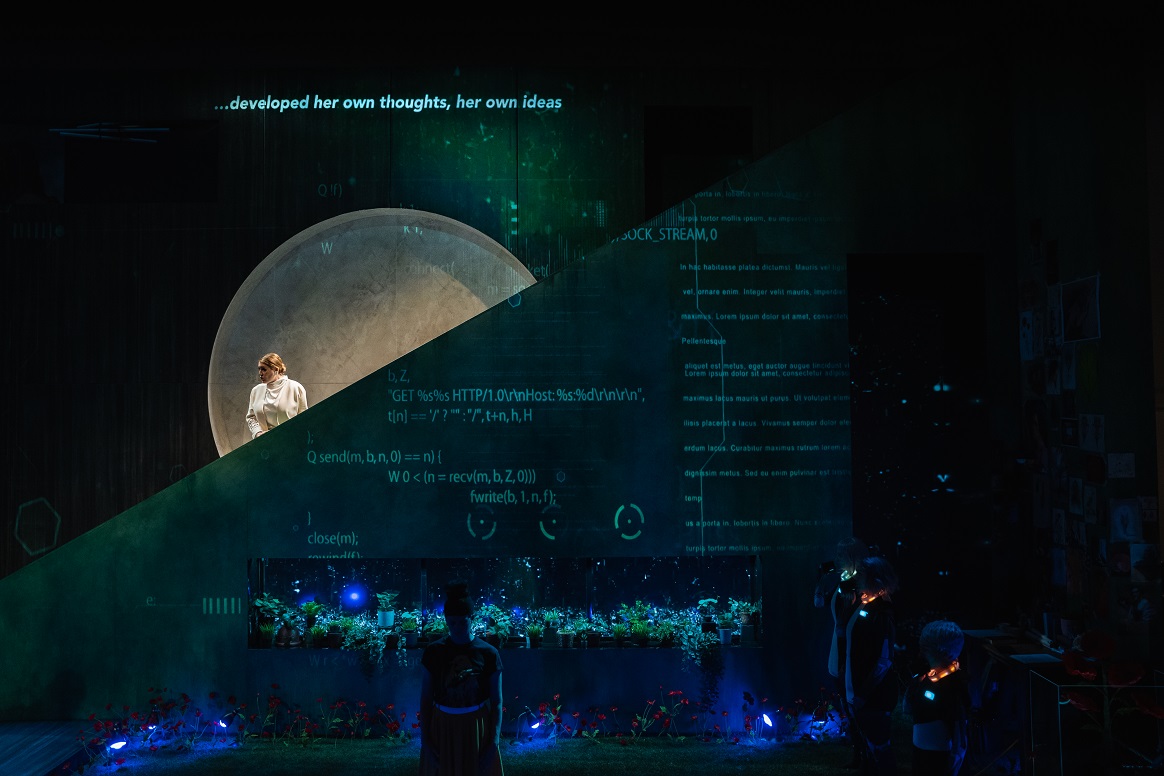
Toronto Summer Music presented a single concert performance of the opera Missing, from a libretto by Marie Clements and a score by Brian Current, to a full Koerner Hall. This was its first appearance in Eastern Canada after having been co-commissioned and co-produced by Pacific Opera Victoria and City Opera Vancouver in 2017, and it was rapturously received by the audience.

The original production website says
“Set in Vancouver’s Downtown Eastside and along the Highway of Tears, Missing is a poetic expression of loss and hope, its creation led by aboriginal theatre and opera artists.”

The title of the opera is wonderfully ambiguous, suggesting both the thousands of women and girls who have vanished and their extended community of family members upset, bereft, heart-broken, hurt by the disappearances.

Librettist Marie Clements
Composer Brian Current

Although presented in concert the presentation included elaborate projections designed by Andy Moro, the TSM Technical Director, perhaps from the original production. I was sad that Andy didn’t come out to accept applause; the person running the sound board at the back told me he was upstairs in the booth, working anonymously in the background. What he created is like a beautiful film to accompany the opera’s performance.

Andy Moro, TSM technical director

The screen displayed animations of animals (real & totem images), nature, and sometimes live video in stunning combinations complementing and enlarging the text being sung, as well as displaying the words in English & Gitxsan. Yes Andy was a busy man so I shouldn’t be surprised he didn’t (or couldn’t) easily come down.

A glimpse of the Koerner Hall stage with one of the simplest of Andy Moro’s projected images (photo: Lucky Tang). I’m guessing the complex layered images were hard to capture in a photograph.

What we saw tonight was an opera that worked really well in this static concert presentation, given its resemblance to an oratorio, as full of ideas and the contemplation of spirit as anything by Bach or Handel. I did not expect such a positive life affirming work, reminding us again and again of motherhood, birth and especially rebirth.

The singers and the Continuum Ensemble were conducted by Timothy Long, who led the 2017 world premiere in Vancouver and the American premiere in Alaska in 2023.

Conductor Timothy Long

I kept wondering: when the work was conceived and created, who did they have in mind as an audience, who did they expect to watch & listen? Opera is expensive and challenging both to the artists creating it and the audience seeing & hearing it. Next month Capitol Theatre in Port Hope premiere the new musical Rez Gas with a hip-hop-infused score from Indigenous musician Cale Crowe, likely aimed at a younger audience to tell a happier tale. When I heard of Missing, concerning the missing and murdered indigenous girls & women, I wondered: how could something so darkly powerful be brought to the stage? But maybe that’s why it’s an opera, rather than a musical, because it’s such a big challenging topic. Opera can be solemn, and choosing that idiom proclaims a seriousness of purpose.

And maybe the audience is meant to include those whose hearts needed changing.

The opera begins as follows (from the synopsis):
Ava, a young white woman, is thrown from her car and badly injured in a crash on Highway 16. She sees another body – a young native girl – lying on the ground. Their eyes meet.”

We see Ava (Caitlin Wood) living her life after the accident, haunted by memories of what she saw and felt. There’s a sentence in the synopsis that describes a number of moments in the opera, namely “each sees the other in herself and herself in the other.” There’s a delightful sort of ambiguity to many scenes, where we are watching two people singing at one another, whether it’s Ava & the native girl (Melody Courage), her mother (Michelle Lafferty) with her son (Evan Korbut), Ava with her boyfriend and eventual husband Devon (Asitha Tennekoon), Ava in class with her professor (Marion Newman), a back and forth as though at times they’re talking to another version of them self. The approach to duets / dialogue is beautifully original, and captured brilliantly in Brian Current’s setting. The singing is never of the sort we had in much romantic opera, designed to show off the singer’s high notes, but rather coming from a place articulating pain or love or connection. There are a few bold painful moments articulated yet on the whole I was (against my expectations) comforted and inspired.

At times we’re in a realm beyond life & death, where spirits communicate with the living and vice versa. For me those were the most vivid and powerful scenes. I experienced the opera as a ritual celebration of her life (allowing that she is also a kind of every-woman, embodying all the different missing women & girls), to permit the release of the spirit(s) of the native girl(s). Perhaps this is what Marie Clements sought to achieve, a kind of community release for the missing ones, a beautiful and even therapeutic objective.

The part of Jess (Andrea Ludwig) was perhaps the most challenging role of the entire opera, written to be the one person in opposition to the direction of the story and therefore tasked with the least sympathetic lines of the work. I can’t imagine how difficult it would be to be rehearsing and then presenting her part. I have to think librettist Marie Clements believed some in the audience shared such views. I don’t know if Toronto is different from BC (where the piece originated), but I do know some people who are blatantly racist, and wonder whether they’d avoid coming to hear such an opera. It’s a horrible additional layer, but a necessary & troubling part of the story. If they sought to change minds & hearts this kind of language, however disturbing, was a necessary component.

I’m sorry there was only the single performance in Toronto, as I’m sure there’s an interests in the work and its challenging subject, and I agree (quoting from the TSM website) that Missing is “something every Canadian should see.” To learn more about the missing and murdered Indigenous Women and Girls, visit the National Inquiry page found at: https://www.mmiwg-ffada.ca/

There’s a CD of the opera that I obtained at the concert performance, that will allow me to have a closer listen / look at the text of this fascinating work, from “ATOM” (Artists of The Opera Missing: the same people we heard at Koerner Hall).

If I can’t attend another performance anytime soon at least I can listen to it again. And again…. If you are interested in obtaining it, here’s the link (click here) to find out more.

Posted in Music and musicology, Opera, Reviews, Spirituality & Religion | Tagged , , , , , , , , , , , , , , , , , , , , , | 1 Comment

Asking Genevieve Adam about her newest play Heratio

On August 8th Guild Festival Theatre will be giving the world premiere performance of Heratio, a re-imagining of Hamlet that picks up the story where Shakespeare left off, giving voice to the women and servants who are left to clean up the mess created by the intrigues of princes and kings.

Heratio is the latest play from acclaimed playwright Genevieve Adam, who has made an impact with several new works over the past decade, since returning from UK where she made a name for herself as an actor. Genevieve is part of the Creator’s Units at the Capitol Theatre in Port Hope (where her new musical Rez Gas opens August 22nd) and the Guild Festival Theatre in Toronto.

Heratio was developed through In Conversation With Classics, Guild Festival Theatre’s program for new plays.

I asked Genevieve a few questions.

Playwright and actor Genevieve Adam

*******

Barczablog: Are you more like your father or mother?

Genevieve Adam: My father is British and likes to leave the butter out on the counter to get nice and rancid – I’ve noticed I’m guilty of this more and more. He also used to force us to go on long walks with him, which we hated and complained loudly about at the time….and which, sure enough, I now force my own children to go on.

My mother has watched every Agatha Christie adaptation ever made and can crack a suspicious death in 60 minutes or less. She worked in a male dominated field and took absolutely no shit from anyone. She comes from a long line of women with spines of steel who took their knocks and kept on going, and I hope I continue their legacy.

BB: What is the best or worst thing about what you do?

The best part is being in control of my own writing output, and the worst part is being in control of my own writing output. There is no surer way to guarantee that my bathroom will be sparkling clean than to give me a writing deadline.

BB: Who do you like to listen to or watch?

Genevieve Adam: My kids are really into manga, and they’ve gotten me into it. I also love bardcore i.e. contemporary songs remixed with ancient instruments. You haven’t lived until you’ve heard the harp n’ bagpipes version of “Pink Pony Club”.

BB: What ability or skill do you wish you had, that you don’t have?

Genevieve Adam: Reading music.

BB: When you’re just relaxing and not working, what is your favourite thing to do?

Genevieve Adam: Drink coffee (I am very committed to good coffee!), go on long walks with friends, get lost in a new city.

BB: Who do you think of first, when I ask you to name the best actor ?

Genevieve Adam: I’m loving evil Hugh Grant. Alicia Vikander. The whole ensemble of We Are Lady Parts and What We Do In The Shadows. So many wonderful actors out there.

BB: What was your first experience of drama?

Genevieve Adam: Seeing a community theatre production of The Lion, the Witch and the Wardrobe at 6 years old and deciding, that’s for me baby!

BB: What’s your favourite play?

Genevieve Adam: Right now I’m really interested in exploring whether a theatre play experience can actually scare an audience, so I’m obsessed with “2.22 – A Ghost Story” by Danny Robins. But I also want to shout out some Canadian playwrights I love and respect who are creating amazing work: Michael Ross Albert, Pamela Sinha, Frances Koncan, Steven Elliott Jackson, Makram Ayache, Marcia Johnson, Lili Robinson and Philip Dwight Morgan. 

BB: You have been prolific, as your bio shows several new works over the past decade. Could you talk a bit about your development and how to see Heratio in context with your writing?

Genevieve Adam: Heratio is a bit of a departure from my previous works in that there are no eff-bombs and no one having sex on a table! People do still die though, so any fans out there can take comfort that at least some things never change!

Genevieve Adam (photo: Dahlia Katz)

My previous works deal a lot with reframing traditionally white, male narratives from a female and First Nations perspective. Heratio is a continuation of my interest in reframing well-known classics, only this time from the point of view of women and servants. So we’re playing more with a class and gender lens: not so much obsessed with what the rich dudes are up to, but more with what the people cleaning up all the blood and making the sandwiches are scheming and dreaming about.

I also love writing period pieces, because I have a lot of fun being anachronistic and undercutting the sometimes stuffy nature of Ye Olde Shakespeare Summer Play. 

BB: You’re an award-winning playwright who received accolades for your writing. How do you feel about the way writing is received and presented in Canada, especially in Ontario?

Genevieve Adam: I had a weird experience of this early on in my writing career. I’d been to theatre school in Ontario, did the rounds on the circuit for a few years, and then went on to do my master’s in the UK. I ended up working there pretty consistently as an artist for many years, with some big internationally known companies, and when I did decide to come back to Toronto, I naively thought this experience would be respected and would open some doors for me. Instead I got a lot of feedback like: “Oh, who are you? We don’t know you. Who do you know that we know?” and “Wow, you missed out on some really formative years. You didn’t make those contacts.” And meanwhile I was also being told my work was great, exciting….but to come back in 10 years when I “knew more people.” There’s always an element of this in any hiring process, of course – but it felt cliquey and exclusionary in a very Toronto way. This scarcity mindset. In the UK – and obviously it’s a very different market, with a different history and much more government funding – artistic directors would want to meet with you if they didn’t know your work, would actively seek you out to see if you could pool resources and make a bigger pie. In Toronto it was more like: “get away, this is MY pie, I’m not sharing.”

BB: In August Guild Festival Theatre present the world premiere of Heratio, described in the press release as  “a bold re-imagining of Hamlet that picks up the story after Shakespeare’s ending.”   Please tell us more

Genevieve Adam: Heratio is what happens if you took Game of Thrones but made it Downton Abbey. We pick up right where Hamlet left off, only this time, the action doesn’t concern the princes and kings. We focus on two servants, mopping blood off the floor, worried about their job security now that there’s been a regime change, jockeying to manoeuvre themselves to better advantage in a changing world. Throw in some political scheming, a murder mystery, a broken heart, and a ghost or two, and you get a funny, whimsical, but hopefully moving story about navigating grief, loss and identity. 

Our log line is “What if nothing you thought you knew about Shakespeare’s “Hamlet” was true?”, but we’ve crafted the show so that you don’t need to be a Hamlet scholar to understand the action (although there are some juicy easter eggs in there for the real Hamlet aficionados!)

BB: As I recall Hamlet ends with a lots of bodies on the stage. Is Heratio as bloody as Shakespeare?

Genevieve Adam: There may be some mirroring of that original high body count, yes……

BB: What characters will we see in Heratio? 

Genevieve Adam: You’ll get to meet a lot of behind the scenes folks at Elsinore: the servants, the kitchen staff, the “below stairs” who lived through Hamlet and had to clean up its aftermath. In terms of OG Hamlet characters, I can definitely confirm the presence of Horatio and Fortinbras, and some other fan favourites may make an appearance as well!

BB: I see in the press release that Heratio was developed through In Conversation With Classics, Guild Festival Theatre’s program for new plays. Please talk about that experience. 

Genevieve Adam: I knew the ADs of the Guild Helen and Tyler through having worked with them before. They approached me about joining the inaugural playwrights unit and of course I said yes! I really love working with both of them, and they’re doing incredibly fun, high-quality work at the Guild, so it was really a no-brainer. And then when I found out who the other members of the unit were – Keith Barker, Thomas Morgan Jones, and Azeem Nathoo – I doubled down every harder. These are all folks with impressive playwriting and theatre experiences under their collective belts, and I jumped at the chance to work with them. We would meet at regularly scheduled times via zoom, read each other’s works in progress, offer our thoughts and encouragement. Writing is such a solitary business, so it was incredible to feel that there were other pilgrims along on my writing journey, walking the same road, cheering each other on to keep going. 
BB: Tell us about the GFT production of Heratio.

Janelle Hanna

Genevieve Adam: It is literally a dream cast: Janelle Hanna, Phoenix Fire, Rashaana Cumberbatch, Philippa Domville, Jack Davidson, and Siobhan Richardson.

Phoenix Fire
Rashaana Cumberbatch
Philippa Domville
Jack Davidson
Siobhan Richardson

Nancy Anne Perrin is making everyone look gorgeous on beautiful sets, while Sean Meldrum is creating an original soundtrack and Adam Walters is lighting the team. Helen Juvonen is directing, and Hamlet is one of her subjects of special expertise, so I am doubly blessed!

Director Helen Juvonen

And it all takes place in the beautiful Greek Theatre in the Guild Park and Gardens.

BB:  In 2025 Canadian culture seems precarious. We hear “elbows up”.  I want to thank you and GFT for doing your part, although we may forget the importance of local culture, employing local talent. 

Genevieve Adam: I really see an appetite for this – people want to see local talents creating stories made here on these lands, telling our stories, in all the diversity and scope that this implies. Audiences are no longer content to let other countries and cultures dictate what “good” theatre is and what they should be watching (although I enjoyed Hamilton as much as anybody!) We may not always be sure who we are as a nation and as a culture, but we’re exploring and discovering and redefining this identity constantly through our arts, and that’s something to celebrate.

BB: Could you offer any advice to Canadians writing for the stage?

Genevieve Adam: Be persistent! Submit to every festival and competition and writing retreat you can. Go to openings and meet people. You need people to get to know your work and want to work with you. Until they do, apply for all the grants and self-produce. Repeat for 10 to 15 years (kidding not kidding!)

Genevieve Adam (photo: John Gundy)

BB Do you have any influences / teachers you want to acknowledge

Genevieve Adam: All the amazing people who have encouraged me and cheered me on throughout the years. Special shout out to my dear friend Patrick Conner, whose tireless friendship and faith in me led me to become a playwright in the first place.

Thank you!

*******

Discover more about the playwright at her website.

Guild Festival Theatre present the world premiere of Heratio, preview August 7th, running August 8- 24 at the Guild Festival Theatre. For tickets & info click here.

Posted in Dance, theatre & musicals, Interviews, Personal ruminations & essays | Tagged , , , , , , , , , , , , , , , , | 1 Comment

George Li: virtuosity in the service of good taste

Tonight I had the pleasure of making my first acquaintance with pianist George Li, courtesy the Toronto Summer Music Festival, in an excellent concert at Koerner Hall.

Pianist George Li

The four big works on the program plus the pair of encores all showed us the stunning technique of a young pianist (coming up on his 30th birthday next month), but always employed towards a display of excellent taste.

Perhaps the programmer (possibly the pianist himself) aimed at suggesting something pictorial, given the pair of Beethoven sonatas with epithet names before intermission, followed by Debussy’s first set of Images and Mussorgsky’s Pictures at an Exhibition. Yes we saw pictures, the imagination stirred by the way the pieces were played.

We began with the Op 31 #2 that’s associated with Shakespeare’s play The Tempest thanks to comments the composer made to his friend Anton Schindler. The only connection I see to the play is that both the first and last movements remind me of stormy weather and waves: but it’s great for the piece to have the suggestive name. In Li’s reading the first movement offers something melodramatic, his use of the pedal boldly modern underlining some of the unexpected dissonances. In the slow second movement Li is understated, the deep passion in the melody clearly articulated but soft & gentle. For the third he is exquisite, so delicate in his touch and lighter than what I’m accustomed to, a reading smooth & subtle.

That delicate touch was featured in everything we heard tonight. Li’s next offering was the Op 27 #2 aka the Moonlight Sonata. The second movement was another example of understatement, setting up a last movement that was super quick without the percussive moments one sometimes gets. I think it helped the piece build to the explosive cadenzas at the end which felt more climactic because of Li’s restraint earlier in the sonata.

While I loved the first movement I was stunned by one of the longest examples of phone noise I’ve ever encountered and at surely the most inappropriate moment possible. That Li didn’t seem to respond to the provocation was to his credit (I half expected him to stop and start over), while my jaw was practically dislocated in shock, as the sound went on and on.

After intermission we went in a different direction, first with the Debussy Images series 1. I was in heaven for the Reflets dans l’eau, mostly soft and appropriately fluid, the music dripping from Li’s fingers. We then had a suitably solemn Hommage a Rameau, and a madcap playful Mouvement to bring this part of the concert to its conclusion. I may be wrong but I believe this 3rd of the Images is the most technically demanding part of the concert: that Li tossed off as though it were a lark or a race around the park. If my jaw was down, this time it was in awe of the pianist’s technical prowess.

Then came Pictures at an Exhibition, a piece we usually hear with orchestration (usually by Ravel), even if in my opinion it’s far more interesting in the original for piano. When I spoke in the headline of technique in the service of good taste I was thinking about the whole concert, but it was particularly true for the Mussorgsky, technical wizardry at its most cinematic. The cute unhatched chicks have never been so balletic, the marketplace at Limoges wildly frenetic, the Hut on Fowl’s Legs demonic. In the slower passages, we heard melodies that sang soulfully, as in the old castle. The climactic Great Gate of Kyiv (is this the first time I call it that? educated alas by ongoing news reports of the invasion & endless bombardments) had the most wonderful sense of scale, between the suggestion of pious choruses and bells.

After lots of applause Li honoured us with a pair of encores. First it was a peaceful shift away from the wild energies of Mussorgsky with Chopin’s raindrop prelude in D-flat Op. 28, #15, offered in a sweet meditation. Li then gave us fireworks with Liszt’s la Campanella etude, this time holding nothing back.

As I left I took a picture of the statue of Franz Liszt, who surely would have been pleased at how his music was being interpreted.

A statue of Franz Liszt, that avatar of virtuosity

It was another great TSM concert. I hope to hear Li again sometime.

Posted in Music and musicology, Reviews | Tagged , , , , , , , , , , , , | Leave a comment

Calidore String Quartet offering American culture

I love ambitious concerts, and that’s certainly what we heard tonight at Walter Hall from Calidore String Quartet, comprised of violinists Jeffrey Myers & Ryan Meehan, violist Jeremy Berry and cellist Estelle Choi.

Calidore String Quartet: (l-r) Ryan Meehan, Jeremy Berry, Estelle Choi and Jeffrey Myers

In one of his brief introductory talks violinist Ryan Meehan told us that the concert aimed to show us varieties of American culture. And my goodness they truly did so, in this program:

Samuel Barber: String Quartet op 11
Wynton Marsalis: excerpts from String Quartet No. 1
— intermission —
John Williams “With Malice Toward None” from Lincoln
Erich Wolfgang Korngold String Quartet No. 3

I am sometimes the luckiest guy in the world. This year I picked a few concerts from the Toronto Summer Music Festival’s many offerings.

A larger than life-size picture of TSM Artistic Director Jonathan Crow, displaying TSM swag. Yes I bought the T-shirt

No I was unable to attend the opening night due to a conflict with the celebration of my mom’s life last week (July 10th).

Tonight’s concert was my first, and is right up my alley. Three of the four items have a connection to film. You may recall my obsession with film music. I used to teach a couple of courses on the topic at the Conservatory & at University of Toronto’s School of Continuing Studies.

The 2nd movement molto adagio of the Barber Quartet is well-known in its string orchestra arrangement “Adagio for Strings” heard in Platoon, and as Ryan reminded us, also regularly employed as solemn music for funerals (I’ve seen it arranged for keyboard). We heard too about the Quartet’s meeting with composer John Williams, who agreed to arrange music from the film Lincoln for them to play (wow what a cool story). Korngold’s 3rd Quartet includes themes the composer repurposed / recycled from films.

The extraordinary thing about the Calidore Quartet is something I hadn’t thought about in a very long time. I recall a violinist I knew from the TSO explaining to me the difference between the way an orchestral section leader plays, a sound necessary for the others who hear that person & follow the leader’s sound, as opposed to the ideal of a quartet. While I heard the theory explained tonight I heard it properly enacted, when the quartet plays as though they are a single instrument, rather than four soloists. I am reminded of something my brother told me awhile ago about choral singing, that is similar, that you don’t want to hear voices popping out of the texture of the ensemble, unless they are singing solos. Just as a chorus needs to have a blended sound, so too even more so with a quartet, although I swear I rarely hear it done as well as tonight.

For example in our encore –the second movement of Beethoven’s Op 74 — there are places where the melody seems to be handed between parts, from the cello to the viola (or maybe it’s the other way around..?).

I found a performance of this piece that they put onto YouTube, that you can hear. My my what a generous piece to play as an encore!

The point is, they made it sound like a single voice, a continuous thought rather than call & response, which is something we encountered quite deliberately in the Marsalis, where it’s a normal thing to find in gospel or blues or even jazz. The quartet found the right way to play each piece, apt for the idiom of that composer.

There’s so much I would like to say, stimulated by this wonderful concert.

Let’s start by thinking a bit about the broad topic we call “film music”. The Barber Adagio is in the category of music that is a pre-existing piece that has been pressed into service in a film. Think of the music Kubrick used in 2001 or Clockwork Orange (although there he transforms it via Wendy Carlos’ Moog-magic), or the way Coppola grabs the Ride of the Valkyries for Apocalypse Now. In each case it’s a piece many of us already knew, even if the film retrospectively alters how we experience the music, so long as we saw that film. For those of you who never saw those films, naturally, that music isn’t really film music.

And then there’s a piece such as John Williams’s lovely little quartet we heard tonight, featuring a stunning cello melody redolent of a church, suggestive of Gospel or Americana: yet the melody is original. I must confess that while I like what the Calidore quartet did with the piece, it’s a classic example of film music, meaning music that I believe is probably stronger in its original context, where we see the images onscreen. Williams has so many of these pieces that one may encounter on the radio or in a pops concert (the Toronto Symphony regularly programs music from Williams’s films). Yet the best music Williams ever wrote is always missing. In Hook the piece that makes me cry is when Tinkerbell is saying goodbye accompanied by a stunning little passage for orchestra, that can’t really be excerpted because it’s less than a minute long and absolute perfection in context. The music Williams made to accompany Donald Sutherland’s powerful speech in JFK always gets me. There’s that amazing moment from Williams in The Empire Strikes Back when Yoda shows Luke that he can raise the ship out of the water, fabulous music that isn’t quite as good if it’s played without the magical visuals. That doesn’t mean the music is no good. I also dislike it when an orchestra plays the Liebestod without the soprano: as that’s a similar case of an orchestra playing something out of context. Concert programming is the attempt to capture magic that we felt in the movie theatre, and for that reason your mileage may vary.

The final piece on the program, is a funny piece in the way Korngold has it both ways. He is both a film music composer and a classical composer, with credibility in both realms. While some look down upon film music as inferior I don’t subscribe to such a philosophy. But while some composers expressed their own misgivings (Bernard Herrmann or Ennio Morricone), seeing film music as a lesser form, even seeming to under value their own creations, Korngold managed to dodge such concerns, seemingly effortless in his compositions for film. We get four very different movements, modernity in the outer movements, lyricism in the middle movements (although the scherzo gives us a huge contrast when we get to a lovely trio).

And then, there was something completely different, the excerpts from Marsalis’s Quartet. OMG I loved it and wished to have heard the whole thing, although when I chatted with a couple of friends in the lobby they thought it was more than enough. Yes it’s dissonant and edgy.

To each their own of course.

I was blown away by the astonishing variety of timbres Marsalis –a classical & jazz trumpeter please note!– was able to get out of the four string players we watched tonight. If it weren’t so much fun I might have called it torture because it was seriously hard work. I didn’t want it to end. This movement –and thank goodness I found an example on YouTube again to show you what I’m talking about– makes the strings emulate a train, in the rhythms and screeching sounds. This is like nothing I’ve ever heard, although maybe its willingness to imitate the noises of a train remind me of the traffic sounds in American in Paris. Yes it’s a true variant of the theme of American culture. Wow it’s beautiful.

I guess it should be clear that I really liked this concert. I admire the ambitions of the programmer, whoever it was, finishing all the modernity with Beethoven in the encore.

I hope someone will invite the Calidore String Quartet to Toronto again sometime soon. They’re remarkable and they are very good. As far as Toronto Summer Music Festival in their 20th season and Jonathan Crow’s final year as their artistic director: so far so good.

Posted in Music and musicology, Reviews | Tagged , , , , , , , , , , , , , , , , , , , , | Leave a comment

Celebration of life for my mother

July 10th would have been my mother’s 104th birthday, so it seemed like the perfect day to do a Celebration of Life. I want to share the moment here on the blog, largely because this event was my focus, if not my actual obsession over the past few weeks. We had a small gathering of family as a moment to share our memories.

I just wanted to share some simple concrete images. In my eulogy I did a kind of “show and tell” about my mother. I will mention a few things from that day as I seek to preserve this moment, already a few days ago. I have been obsessed, as I have anxiety about remembrance, fearing that so much of her life is long ago, that I shall forget, even as I recognize there are huge parts of her life that I never knew.

******* 

At one time (when the family used to go to a cottage) my mom used to collect heart-shaped stones she found on the beach.

A rock I found recently that reminds me of the rocks my mother used to collect


Sometimes the resemblance to a heart was not very strong. As a kid I thought it was funny. But I see now that SHE could see the heart. It suggests the strength of her moral imagination: that she saw the resemblance to a heart, on the beach. She could see the heart in others.

My mom crocheted finger-less gloves in multiple colours.


I put the blue ones on because blue was her favourite colour.

I showed a photocopy of a school assignment that my daughter Zoe wrote long ago. The title is “A Person That Has Influenced Me” and you see she’s talking about my mother’s resilience. You can’t read it easily, but that’s not the point. It matters to me because it mattered to my mom, who kept this copy by her desk as a keepsake, among her own most precious items.

It reminds me that my mother used to babysit Zoe half days during kindergarten (with my brother Peter’s help making the pickups). My mom who was an artist would do art with Zoe from an early age.


And of course now Zoe is an adult artist influenced by my mom. At the far end of the room from the grand piano where I stood delivering my eulogy I have the huge painting by Zoe that I use as my Facebook profile pic.


Impressive as it appears here, in person it is even more breath-taking.

Another keepsake of my mother was a precious book in Hungarian, that reminds me of a chat I had with my mother back in 2020. (follow the link for the details)

In my 2025 eulogy I only said this book was a prize possession of my mom, a book rescued from a bombed out Budapest bookstore back in 1944, that she had given to me. I mused on the way memory works, how romantic that she would re-read poems that long ago my father Jozsef had read to her. This book serves as a pathway to remember both of them, even if my grasp of the subtleties is weak.

I realize now that I’ve photographed the book and also my mother’s hands, holding this book in 2020.

I finished my talk, as other family members took their turns speaking: Zoe via smartphone from USA, my sisters Katherine & Margaret, my brother Peter and my cousin Larry.

Peter spoke while I held my phone, playing music from YouTube that my mother loved, Jussi Björling singing Ack Värmeland du sköna, a song associated with a place and a time in her life.

Peter was the one born in Sweden, and the one who was to become the opera singer.

Peter held up a cartoon for us to see, a little piece of comic art my mother created upon her graduation in 1967 from the Ontario College of Education (as it was then known). She showed this (or handed it out? I am guessing) to prospective employers, school principals who might want to employ her, saying the following in her cartoon self-portrait:

Sewing Teacher
Young, Talented, Enthusiastic
Dependable, Versatile
Shy Modest
Requires employment
goes anywhere in Town

Have Needle Will Travel”

The drawing is signed “KayBee” which would be her Canadian nom de plume, in cartoons & rhyme. And it worked. She met her future boss from Humbergrove Vocational School (as it was then called) in the northern part of Etobicoke, teaching until her retirement.

My sister Margaret brought a cake including a picture of my mom, and decorated with tiny candy ladybugs in the icing. My mother often included the ladybug one way or another as a kind of alias in her signature or in drawings she made, a lifetime association coming from the Hungarian name for ladybug (“katicabogár“, where “bogár” is the Magyar word for bug) and of course her name was Katalin or Kati for short.

It occurs to me now that she switched from the ladybug to “KayBee” in recognition that Canadians wouldn’t understand the significance of the ladybug the way we did.

Once again it raises a question that I wish I could discuss with her: but it’s just one more topic that will have to end with speculation rather than a conclusive answer.

My mother’s picture decorating the top of the cake

We drank a toast to my mother on her 104th birthday.

Posted in My mother, Personal ruminations & essays | Tagged , , , , , , , | 7 Comments