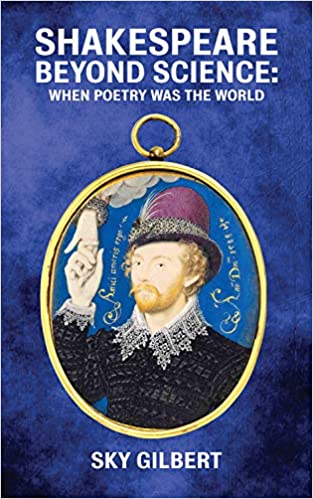
Sky Gilbert’s remarkable new book Shakespeare Beyond Science: When Poetry Was the World

I am on my third read-through of Sky Gilbert’s Shakespeare Beyond Science: When Poetry Was the World.

It is the best book I’ve read this year, one of the most interesting books I’ve ever encountered.

I’ve been dancing around this one for quite awhile, hesitant about the review because I am in awe of the book. Nobody expects me to be brilliant even if the book has put me in touch with a desire to be immortal, to make an impact. Gilbert’s book deserves to be read, deserves to be influential. While Gilbert hasn’t been a professor for very long (he was still in grad school when I was there not so long ago), he’s doing great things.

I have read a lot of entertaining books this year, but I’m certain this is the best, a great idea for a Christmas gift in a year when all the best-sellers seem to be about American politics. (click here for more information on how to get it)
Sky brings up Marshall McLuhan’s dissertation. Did you know that McLuhan was a professor at the University of Toronto? And that his scholarly work has little or nothing to do with media even if that’s where his fame lies. Sky’s choice of a departure point is apt given that the book stirs a comparable nationalistic pride.

So as you can probably tell by now, I admire the author & the book a great deal. If I were telling a joke, the worst thing I could do is to say “I have a wonderful joke to tell you” which would kill any possibility of a laugh. But that’s the thing, I’m not looking to be dramatic or to surprise you with an unexpected punchline. I am falling all over myself, after having nervously avoided writing this review for ages because I can’t be nearly so clever. So I have resolved to just put this out there as simply as possible. At one point –perhaps in the midst of my second read through—I was hoping to unpack more of the book, to discuss it and engage with its content: which I realize now is absurd, especially considering the economy of Sky’s prose. The book deserves to be part of a curriculum.

Sky Gilbert

I recall hearing that there were more books about Jesus, Napoleon Bonaparte & Richard Wagner than anyone else: a factoid likely composed by a musicologist. But when I googled the question I see that it’s now 1-Jesus, 2-Napoleon and, 3- (you guessed it): William Shakespeare.

With each trip through Shakespeare Beyond Science: When Poetry Was the World, my appreciation for Sky’s remarkable achievement grows, a book that flows with a conversational ease while opening up dense analytical pathways. I want to retain its ideas so that I can talk about it.

While the title is poetic it also captures the book rather well, the battle that seems to recur every century between those seeking to privilege science & what can be known, vs those of a more platonic or idealistic bent. The miracle is how Shakespeare can be both old yet also new. Old not just because he’s from centuries ago but as an examplar of even older rhetorical tendencies that were being discarded & pushed aside in Shakespeare’s time. New in his apparent deconstruction of words, through his resistance to denotative language, against interpretation via the slipperiness of his poetry.

If I seem to be teasing you, in comparison Gilbert’s book is a provocation, throwing down a gauntlet. I would refer you to Gilbert’s previous book small things (2018) that I see promoted online (AND that I now must read, as a possible gloss on the Shakespeare book) as follows:

Small things is a book of mini-anti-essays, part of Sky Gilbert’s project to dismantle and challenge the rigid classifications of genre, thus challenging 21st century notions of truth. Inspired by Oscar Wilde, Foucault, and the post-structuralist project, the small writings in small things are story, essay, and memoir combined. They question the notion that an essay is necessarily fact, or fair opinion, or even informed opinion, while at the same time challenging the dictum that fiction might necessarily be free of didacticism, or at least, ideas.

Amazingly I see Gilbert doing many of the same things in his newest book, this time in the deadpan manner of a scholarly study. Whether it’s teasing us with didacticism, poetry, the fluidity of post-structuralist discourse, all while undressing The Bard and challenging previous Shakespeare criticism, and even musing on Shakespeare’s actual identity in passing, I am reminded of Sky’s explorations & incarnations of drag-queens. Shakespeare Beyond Science manages to dress itself up in the clothing of a serious book while offering welcome challenges to the usual assumptions underlying the discipline.
Gilbert’s introduction closes with this nugget (and I quote perhaps more than necessary for the fun of it):

From the start stage director and editors modified Shakespeare’s text in order to render the language less ambiguous. Today, critics like Harold Bloom are suspicious of anyone who asserts that Shakespeare was primarily a poet. And scholars still waste a lot of time trying to figure out exactly what Shakespeare means. Shakespeare was obsessed with the truth that lies in language itself. But truth means something very different to Shakespeare than it does to us.
As it should have. Truth was his motto, and his last name
.

As I re-read this I noticed what he meant, a subtle but pointed reference to Edward de Vere 17th Earl of Oxford, a candidate to answer the questions surrounding William Shakespeare’s identity. In Latin that would be “veritas”, “vero” in Italian, or vérité in French.

I’m no expert so I can only mention the objections to de Vere raised via google, such as the problem of his death many years before that of Shakespeare. But that doesn’t derail the conversation. As we first engage with the meta-questions, the mysteries about Shakespeare’s identity, changes in his reputation over the centuries & the growing reverence he has acquired, we are teased with parts of the question. Let that encourage you to engage with Sky Gilbert rather than with me.

But I’m failing to properly capture the subtlety of Sky’s work. I feel I’d be a spoiler, like one of those critics who tells you the plot-twists in place of a review, were I to attempt to summarize the book.

On its cover, it’s presented this way:

Shakespeare wrote at a unique historical turning point: the world was understood through poetry—rather than through the science of observing it. In Shakespeare Beyond Science: When Poetry Was the World, Sky Gilbert’s radical new research locates Shakespeare as a disciple of the Greek rhetorician Hermogenes, and a student of the Neo-Platonist Johannes Sturm. No, not just another “interpretation” of the meaning of Shakespeare’s work. Instead a radical approach to Shakespeare as magician and rhetorician, as a post-structuralist more concerned with form than content, and confident of the dangerous magical power of words not only to persuade but to construct our consciousness.

Gilbert is painstaking in unpacking the basis for Shakespeare’s style, the clearest such explanation I’ve ever seen. If the Bard were just an actor from a small town in England, could he possibly have had the opportunity to learn all that would have been required? Additional subtext for the Bard as de Vere is in Gilbert’s discussion of de Vere’s education, and Johannes Sturm. Before Gilbert gets to Sturm & Hermogenes (who each get a chapter, illustrated by examples from Shakespeare) we revisit Marshall McLuhan & the Classical Trivium: the subject of McLuhan’s doctoral dissertation, and the backdrop for a subtle discursive shift that was taking place at the time. In a nutshell, it concerns the gradual acceptance of the biases exemplified by the Royal Society & Francis Bacon, towards trusting observations, inductive reasoning & clarity, and resisting or even decrying ambiguity in expression & poetry. In effect Sky invokes Shakespeare in defense of poetry: an ongoing struggle to this day.

But there’s so much more to it. There’s a chapter on sexuality where Ernest Hemingway rears his masculine head, and sodomy puts in its obligatory appearance.

I keep reading and re-reading, both because I keep noticing additional depths. And yes, Sky offers the best sort of escape from the horrors of CNN & CP24.

Posted in Books & Literature, Dance, theatre & musicals, Reviews, University life | Tagged , , , , , , , , | 4 Comments

Beethoven 250: which incarnation?

I hope it isn’t a radical idea to suggest that each of us is really several people, depending on context. The people around me, the places I visit, even the time of day might influence how I act. I’m more jocular around other men, aiming to be nicer at church where I am more mindful about my language. Hopefully I don’t speak loudly at night or honk the car’s horn when I might wake my neighbours. Some of this is common courtesy.

Every artist can be understood in several ways, so much so that we can almost think of them as having multiple personalities that can resemble incarnations. Consider the Eddie Murphy of Dreamgirls alongside the comedian Eddie Murphy of Norbit (and speaking of multiple personalities Murphy plays 3 characters in that one film), and then recall he also has a lucrative voiceover career in films such as the Shrek series. All these versions of Eddie Murphy are the same person, whether we’re speaking of the talking donkey, the three characters of Norbit or his work in Dreamgirls. The variety is driven at least partly by commercial considerations as much as artistic ones.

I was thinking about this after having seen The Pianist late Monday night (after watching and blogging about The Exterminating Angel). Yesterday & today as I played the piano Chopin was the natural choice. In case you haven’t seen The Pianist, it shows us the life of pianist Wladyslaw Szpilman between 1939 and 1945, including a scene at the very end where he’s playing with an orchestra. We hear him play Chopin a couple of times. At one point when he’s hiding, he sits at a piano, not daring to make any sound lest he be discovered, as he mimes playing without touching a key: and we hear the “music” in his head.

Even in what we’re seeing on screen one can imagine at least a couple of different sides to Szpilman, the public pianist with orchestra distinct from the quiet poet alone with his thoughts. I was very moved by the film, even as I was at times struggling with questions, wondering what Polanski might have been thinking as I ponder this, the most brutal depiction of this material that I have ever seen. I wanted to ask him “why this piece”? The choice of repertoire curates our experience in the music that we hear. Artist biographies may resemble a compendium of greatest hits for at least a couple of reasons. If they were too accurate we’d get lost in obscure moments with works we don’t know. They need us to recognize and connect to great works, so of course when we’re watching Mr Turner (Mike Leigh’s film about the painter) naturally we see the moments when he conceived of “Rain Steam and Speed” or “The Fighting Temeraire”. Polanski and his team may have pondered comparable choices, opting for instance to include the well-known G-minor Ballade, especially if the well-loved piece helps sell a sound-track recording.

But to come back to what I was hinting at in my preamble, there are at least a couple of different Chopins, just as there are several Beethovens or Gershwins.

The guy on the right

Brian Wyers, a painter I know & admire, has at least two different types of painting. Some of his paintings sell themselves, others seem to sit a bit longer in the gallery.

“Adoration” by Brian Wyers
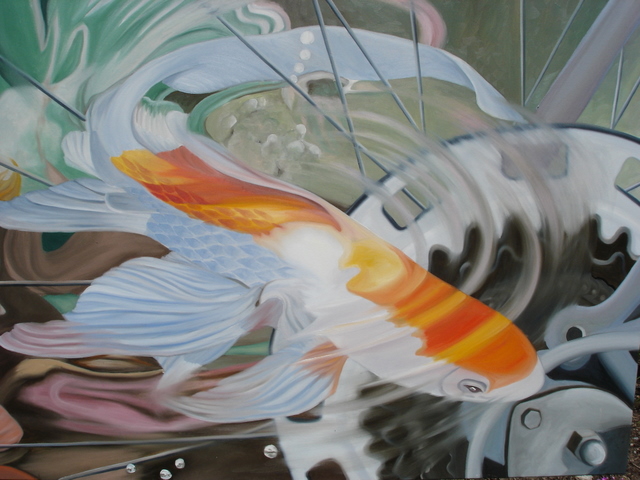
“A woman without a man is like a fish without a bicycle” by Brian Wyers

The ones that sell easily appeal to customers who like beautiful images (especially his paintings of flowers), while the quirky ones that take longer to sell usually emerge from Brian’s deeper creative impulses. When he explained this to me, I thought of how composers hit a comparable fork in the road, especially if they know what work will best serve to help pay the rent. A friend joked about Puccini yesterday, observing Puccini’s irresistible style is always commercially successful and never difficult, even if this is Puccini’s curse, that he is lambasted by critics for daring to write music that is unabashedly beautiful. Some people prefer something difficult or obscure and are uncomfortable admitting that they like something that everyone else likes as well.

Ludwig van Beethoven is a funny case, because he’s recognized by scholars for great works, but also a composer of a great deal of music that is popular. Do you ever wonder about the relationship between popularity & greatness? Notice that the plays of Shakespeare, the music of Mozart, the paintings of Van Gogh, are not just beloved by the average person but also by the experts. But maybe there are different types of popularity. I mentioned Taylor Swift, John Legend & Ennio Morricone earlier this week, artists who are popular in 2020. I wonder if anyone will bother with their music in 2220, two hundred years from now.

That’s the thing. Antonio Salieri was famous for awhile, now known more for the disgruntled character in the fictional play Amadeus than as a composer who might deserve to be remembered for more than this misrepresentation of his character.
Let’s think about the way Beethoven continues to be popular long after his passing.
There are 1,613 soundtrack credits listed on the Internet Movie Database (IMDB) for Beethoven.

Let me break it down a bit further. That includes 251 Moonlight sonata references, 219 for Symphony #5, 192 for Symphony #9, 178 for the piano bagatelle “für Elise”, 83 for the Allegretto from Symphony #7 that we heard so tellingly in The King’s Speech, 58 of the Pathetique Adagio, plus many more besides.

Among those many Ninth Symphony credits is Stanley Kubrick’s A Clockwork Orange (1971). While the synthesizer timbres from Wendy Carlos create a sound appropriately displaced from the composer’s time it’s still unmistakably Beethoven.

Later that same decade came another modernized Beethoven from another Walter, this time Walter Murphy, namely “A Fifth of Beethoven.”

There is also the Beethoven we hear in “Joyful joyful we adore thee”, a hymn repurposing one of his most famous melodies.

There are other versions of Beethoven that I’m not even broaching yet. He wrote music for solo piano, chamber music, music for the stage (including an opera), encompassing some of his political beliefs, and religious music too.

I wonder what he would think if he encountered his modern selves.

Posted in Art, Architecture & Design, Cinema, video & DVDs, Music and musicology, Popular music & culture | Tagged , , , , , , , , , , , , , , , | 1 Comment

Sounds like hell Mr Adès: Looking in the mirror of The Exterminating Angel

I wasn’t sure I’d have the nerve to go through with it, watching an opera that seems to show us exactly the predicament we face. Based on the surreal film from Luis Bunuel, The Exterminating Angel was today’s free Metropolitan online offering. Composer Thomas Adès collaborated with Tom Cairns on the libretto.

Here we are, facing winter & being told again and again by our public health professionals: you must stay inside. This is in large measure the nightmare of The Exterminating Angel, as a group of guests find themselves unable to leave. We see the upper class at their ugliest, what could be understood as a kind of manners comedy: except they have no manners.

No wait that’s not true. The servants are all polite.

We’re in a world not unlike what you find in Lord of the Flies, except the descent into unmannerliness happens in formal attire at a rich man’s home, not a desert island.

Here’s the intermezzo between the first two acts, conducted by the composer including a close-up of the ondes Martenot towards the end of the clip just in case you were wondering what that odd sci-fi sound was in the orchestral texture. Not only are we not in Kansas anymore we seem to have left the planet Earth altogether: because we’re in the orchestra pit for an opera needing an appropriately otherworldly sound. Have a listen.

It wasn’t as difficult as expected. Not only did I watch and survive, but I also felt some relief, awareness that this story was largely a critique of a particular class of people, even if I might feel that its satirical finger might point at me and my brethren. Yes I’m also a privileged spectator right now, fortunate in terms of where I live & what I’m able to avoid. There are people in this city who are more vulnerable, especially the health-care workers: let alone those in other countries. So it’s cathartic to endure a nightmare that does indeed end from which one can wake up (unlike 2020, which goes on…).

The opera seems like a perfect fit for Adès. I had already decided I would set aside the misgivings I acquired reading Adès’ Conversations with Tom Service, a book that attacks some of my favorite operas, for the simple reason that I admire his music.

Composer Thomas Adès

The Tempest is one of the most impressive operatic adaptations I have ever seen & heard. Those two things (misgivings + admiration) combine perfectly in The Exterminating Angel. My misgivings arose over Adès’s admission that he admires positivist thinking, and my assumption that his rejection of the kind of religious ceremony at the heart of Parsifal might be a kind of doctrinal prejudice (which is another way of saying, perhaps he’s an atheist). The ideal piece for an agnostic / positivist to adapt as opera would have to be a kind of rejection of transcendence, and that’s precisely what Adès finds in Bunuel’s film.

There are at least two moments that might underline this philosophical drift.

When the three sheep appear in the last act, there’s a musical parody of Bach’s “Sheep May Safely Graze” that hits you over the head. I am reminded of the outrage of Pete Venkman (Bill Murray’s character in Ghostbusters) when the Staypuft Marshmallow Man steps on a church.


Should I be saying “Nobody mocks a Bach cantata in my town”?

Except Adès does such a good job..! And come to think of it, this makes a lot of sense in this nasty world of caprice and disorder. Indeed if we recall what the Bach Cantata would tell us, that “sheep may safely graze”..?

Ah but in this kaka world no they may not safely graze oh no.

They get devoured by the bourgeois barbarians. So perhaps Jesus would approve of what Adès does at this moment.

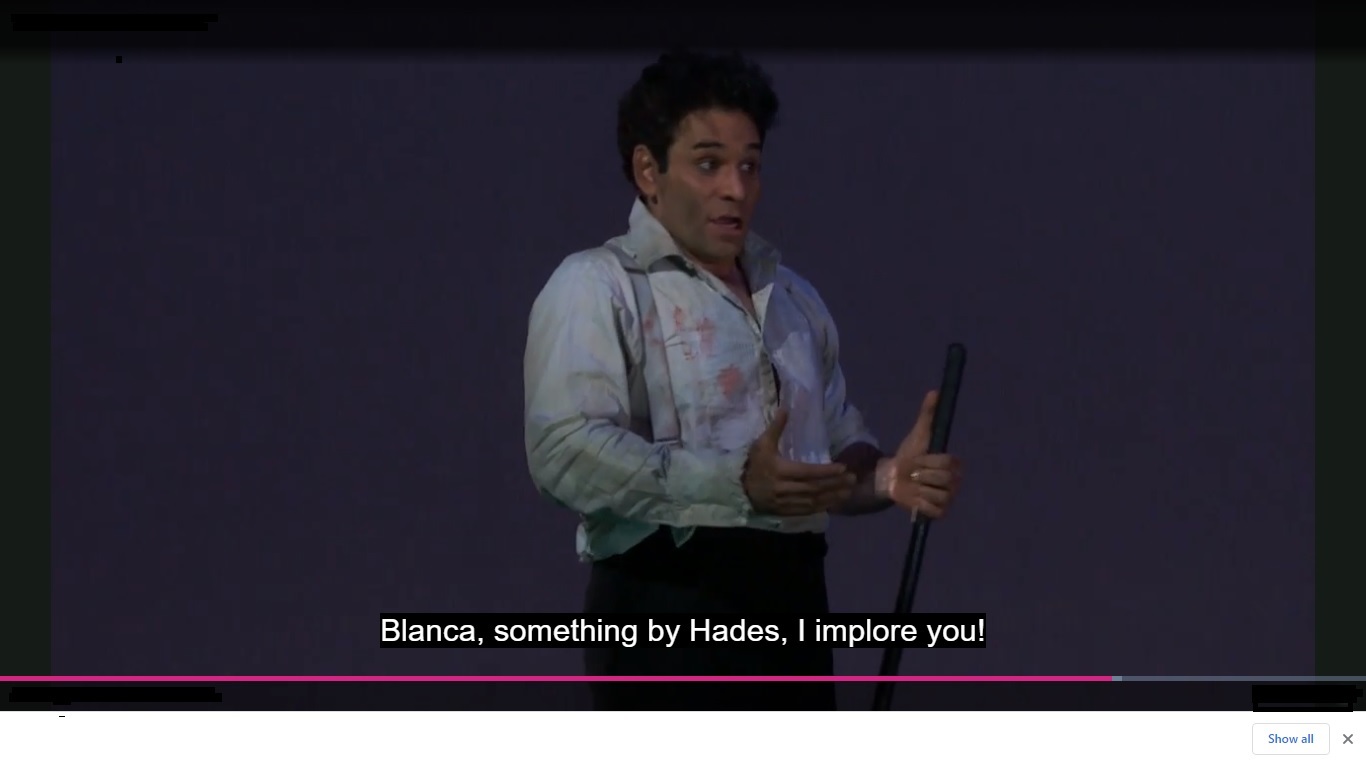
And then there’s the double meaning in the libretto, once in the first act and again in the last…. The pianist Blanca is given a request to play something.

“Blanca something by Hades I implore you” is the line in the libretto. At first glance you’d think the “by Hades” is an epithet comparable to “by gum” or “by golly”: except that when it’s sung by the tenor, he pronounces the word Hades “Adès”, making the line very interesting in a self-referential way.

Because of course she (and everyone else) sings or plays something by Adès.

No not Hades, not hell. Just Adès. Is that also a metaphysical reference perhaps? I leave that up to you

Adès is writing some very difficult music for his singers especially the sopranos. Audrey Luna, who had already conquered the world with her astonishing high notes as Ariel in Adès’s Tempest, is back singing even higher this time. John Tomlinson balances her stratospherics with his solidly grounded portrayal at the other end of the staff. The Met production includes several great portrayals including some we’ve heard in Toronto, namely Alice Coote, Joseph Kaiser, Frédéric Antoun, and Christian van Horn.

You’d think the subject intolerable in our pandemic, over a dozen people locked in arbitrarily, unable to escape, and while entrapped, confronted with their own lives. But it’s surprisingly cathartic not just because we know that actually we can go outside. Perhaps we notice how much we have to be grateful for..?

So in other words, while the idea of this story might scare you, in the midst of our pandemic it hits the spot. I’m very impressed with this creation of Adès & Cairns plus the cast & creative team at the Metropolitan Opera. This is not an easy opera to stage, indeed the casting requirements (including a soprano who can hit a high A above the usual high C) make it all but impossible.

We can’t accuse him of having taken the easy route

Move over Glass & Adams. As far as I can see & hear when I recall his Tempest Adès must be placed at the forefront with the most accomplished & successful composers of new opera. His website mentions ballets employing Dante’s Divine Comedy. If he’s an agnostic what would that sound like? Or perhaps I’m all wrong about his beliefs.

But I’ll be very interested to hear his new works either way.

Posted in Animals, domestic & wild, Books & Literature, Cinema, video & DVDs, Dance, theatre & musicals, Music and musicology, Opera, Personal ruminations & essays, Reviews, Spirituality & Religion | Tagged , , , , , | Leave a comment

Beethoven 250: interpreting Sonata #9

There are at least two ways to understand music.

We listen. Perhaps you hear a performance on some device such as your smartphone, your TV or a computer, or even in a live setting such as a concert or a church. It may be something from the past, for instance when we’re talking about someone like Ludwig van Beethoven in anticipation of his 250th birthday. It could be a popular composer such as Taylor Swift, John Legend or a film-music legend such as Ennio Morricone. But in each case the encounter with the music itself is through your ears. I don’t deny that other senses come into play, that there’s a visual component too, particularly if you’re watching Swift or looking at how Morricone’s music works in a film.

But there’s another way many of us encounter music, and it’s usually how one learns music, when we’re taught how to sing or play an instrument, perhaps how to read music or charts.

And so in addition to listening to music we may sometimes make music: or at least that is the goal.

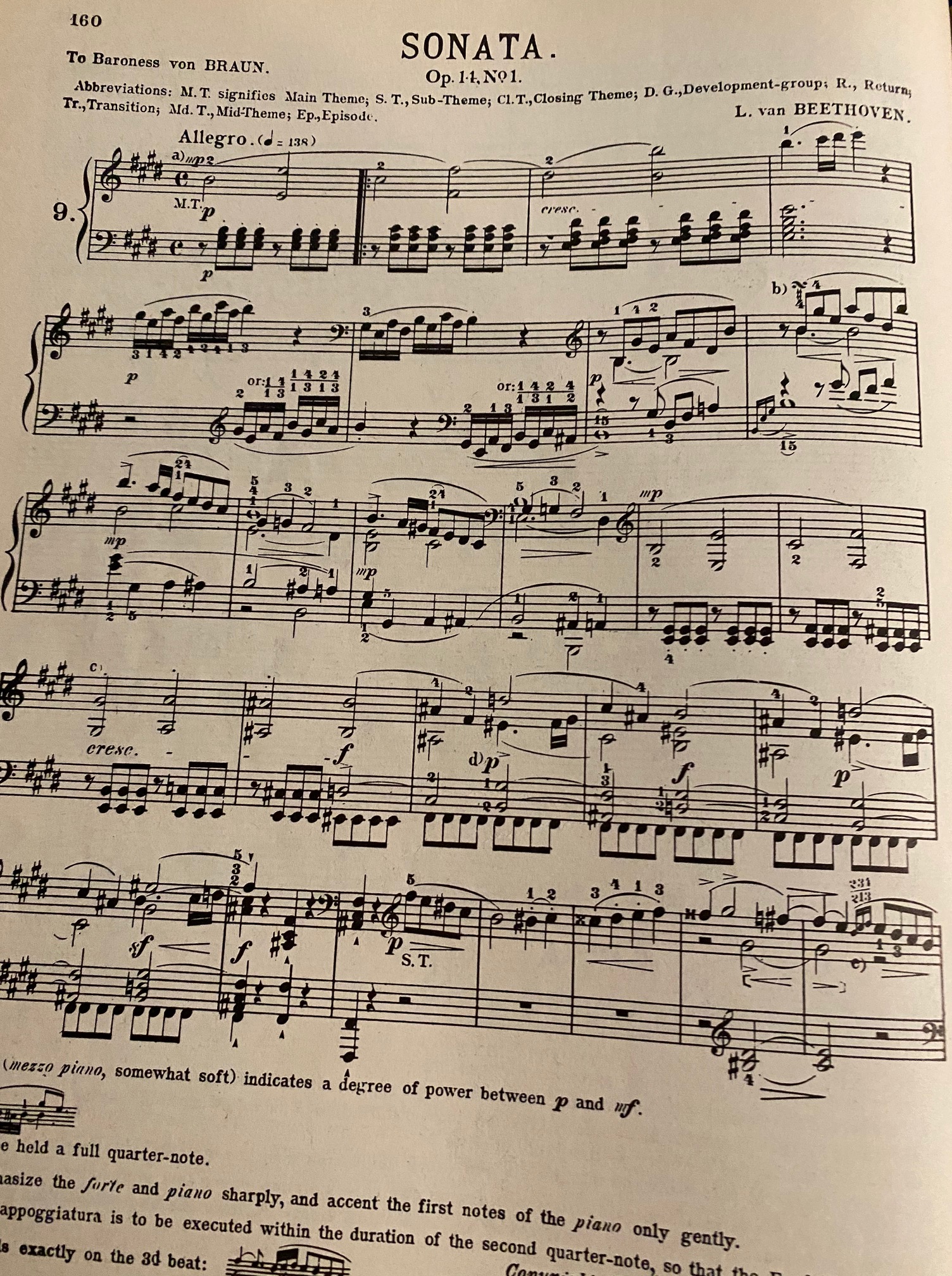
This is the first Beethoven Sonata I studied. I was much younger, under the guidance of my second teacher, Harold Patterson (I hope I spelled that right…) at the Royal Conservatory of Music, North Toronto Branch, on Yonge St, roughly 15 minutes walking distance from my childhood home.

I wasn’t afraid of it or intimidated, although Mr Patterson always said “Beethoven” with a curious emphasis, not unlike the way some people will say the names of Biblical figures such as “Pontius Pilate” or “John the Baptist”. I was to understand that this was an undertaking, that I was privileged to play this music and must treat this as a significant challenge.

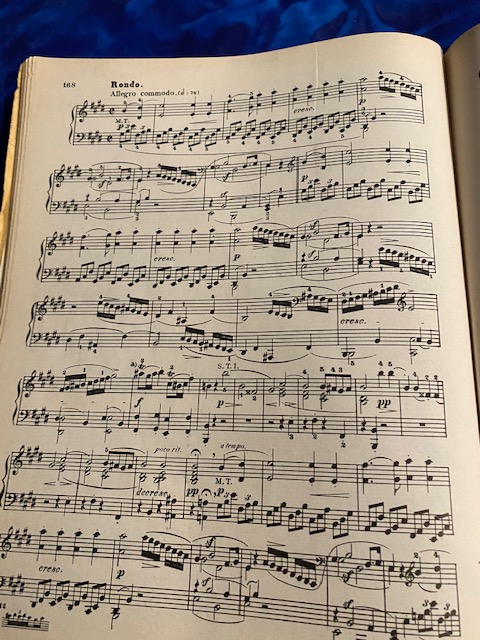
The first time I looked I noticed something in this piece that has best been captured by something I read decades later, from Claude Debussy, who spoke of baroque composers such as JS Bach. Debussy observed that the notes on the page were like the patterns of arabesque, a word with mysterious connotations that I’m sure the French composer likely encouraged. Whatever else is going on, the music is beautiful to look at on the printed page.

That page of music is the site for an encounter between the player & the composition, as though it were a football player meeting the football. Does that sound crude? It’s easy to make noise, harder to make something beautiful. But we can imagine a vast continuum of ability between those (at any age) who are just beginning to play, and those who have acquired expertise, mastery, even virtuosity. The music may require care from the player, perhaps playing it slowly, perhaps only undertaking a few notes from one hand or the other rather than taking on the whole piece. If one has heard the piece before, if one is a good sight-reader, one might dare to play the whole thing up to speed. Sometimes we have no choice, as that’s what’s required in a church or music-theatre or opera when someone puts a score in front of you and you have to make it happen with little or no opportunity to practice.

Beethoven himself was recognized in his youth as a great player, a virtuoso artist: even as he concealed the secret of his growing deafness. In the modern era we may look back upon people who were known as composers or pianists, applying a label that may not be how they thought of themselves, persons without any awareness of being only one or the other, not both. Mozart played the fortepiano, (which isn’t the same as a modern pianoforte) and also played the violin, writing music for both, also operas & masses and many other types of music. Besides the many things he would accomplish, Beethoven was a great pianist who wrote great music for the piano. In the next century music was often designed to challenge the player, displaying their virtuosity. Think of Beethoven in the lineage that leads us on to Chopin & Liszt, Mendelssohn & Schumann, later Ravel, Rachmaninoff, Busoni, Bartok, Ligeti…

For me it’s the inevitable subtext when I’m listening to Stewart Goodyear or Yuja Wang playing a piece. The virtuoso might be understood to be on a spiritual quest, where the great compositions are like the mountains to be climbed or oceans to be crossed: with nothing more than their fingers to take them and us on that journey of exploration. It can be one of the great joys to encounter a new approach, although for some listeners this is heresy: that one might dare play something in a new way. There is a discourse around performance of a particular work, where we understand the conversation between the way it has been done and the possibilities to do it in a new way. I listen, intrigued, because I’m a fellow traveler on that quest, admittedly never likely to venture as high or as far. But the Olympic motto “ Citius – Altius – Fortius” (or in other words “Faster – Higher – Stronger”) is not irrelevant. Singing or playing an instrument does entail the expenditure of energy, making the athletic analogy at least something to consider. If you consider the athleticism of dance –the necessity to train and strengthen while retaining flexibility & agility—remember that the fingers are doing something like a dance on the keyboard. Some pieces are very quick, sometimes calling for a big sound, sometimes for something gentle. A player’s strength & agility are indispensable to the fullest expression of what’s on the page. Some pieces are exhausting. Some pieces require great delicacy.

Although Beethoven died in 1827 we are far from having exhausted the possibilities in his works. As with the plays of Shakespeare or the operas of Wagner, there are still interpretive pathways available to make something new of something old. I recall my excitement in 2012 when I heard that Canadian pianist Stewart Goodyear was undertaking something called the “Beethoven Marathon”, playing all 32 sonatas in one grueling day, concerts in the morning afternoon & evening. As a mental achievement alone it’s remarkable, a bigger feat for instance than the roles of Hamlet or King Lear, each a few hours shared with a cast, where Goodyear played alone through all 32 sonatas.

I was inspired by the film Julie and Julia, following the parallel stories of Julia Child virtuoso chef and Julie Powell, emulating her and writing about it on a blog.

So I tried approaching Beethoven in a new way. Never mind the challenges of playing this sonata or that sonata. What if one played them all, one after another? I couldn’t help noticing resemblances, when one is hearing the sonatas in one’s head, played one after another. The concluding chords to Op 101 almost sound like a taunt inviting the opening of Op 106. (try playing one after the other). One sees patterns. And so as I thought about Beethoven & Goodyear back in 2012, I wrote a few times about it, not unlike Julie contemplating French cuisine & Julia.

Let’s come back to piano sonata #9, a piece I started to learn as a child. Was I 13? I’m not sure but when I look at what a mature artist does with the music I’m humbled to think that I was unafraid to play this music. With maturity comes fear I suppose.

I really like Daniel Barenboim’s reading of Sonata #9. He had a program that I saw on TVO long ago called Barenboim on Beethoven, a wonderful combination of remarks & performances.

Barenboim’s version is not as quick as Glenn Gould’s performance, one that might remind you of that Olympic motto Citius – Altius – Fortius.

To each their own. I prefer the way Barenboim lets the music breathe, giving space for reflection. The two readings are so different from one another, bringing out different aspects of the same music.

Isn’t it amazing.

Posted in Books & Literature, Dance, theatre & musicals, Music and musicology, Opera, Personal ruminations & essays, Popular music & culture, Sports | Tagged , , , , , , , , | 5 Comments

Food porn

That’s what it felt like, watching a film about food, before eating something irresistibly scrumptious.

The film is Chef with its wonderful premise and strong script.

The cast includes Sofia Vergara, Dustin Hoffman, John Leguizamo, Bobby Cannavale, Robert Downey Jr & Scarlett Johansson. Jon Favreau is at the heart of a project that he wrote produced & directed, showing another side to his flamboyant self. It was surely a labour of love. Have you seen it?

I wonder if you know Favreau. He’s directed superhero movies, comedies, and lent his physical presence to several films.

I first saw him in The Replacements(2000) where he plays a raging linebacker. If you watch this clip, you might never suspect that under that wild surface lurks a sensitive artist.

A sensitive artist with anger-management issues, that is….

The story might be a cautionary tale for anyone not aware of the power of social media, as Favreau’s raging chef Carl Casper has a career ending meltdown caught on video, that goes viral. It’s full of life lessons, centred in the kitchen, reminding us of the redemptive power of work & family values.

When one is humbled? You start over.

On top of everything it has amazing close-up shots of food, to make your mouth water, and lots of lovely music too.

But there is hazard I want to warn you of, namely don’t watch this film if you’re trying to control your eating.

I knew I liked the menu from The Kingston Social as I am having a second consecutive week of the epic Jambalaya (shrimp, smoked chicken & pork sausage, rice & beans and humongous).

It’s big…!

Erika went for the Lamb Shank, and we both enjoyed the accompaniment of Konzelmann Shiraz.

The film is food porn, enticing you to let go of any self-control you thought you might have. I’ve seen the film 3 or 4 times now and can’t resist it.

Posted in Cinema, video & DVDs, Food, Health and Nutrition, Reviews | Tagged , , , , , , | Leave a comment

Le tombeau de Couperin: Ravel’s Six Remembrance Monuments

In the first days of November we remember.

November 1st is All Saints’ Day, the celebration that gave rise to Halloween, even if modern culture pays more attention to the edgy rebellion implicit in October 31st than the day that follows. In many churches it’s a day to honour those who have passed away, remembering parents, grandparents and those who came before, presumed to have ascended to heaven.

And a few days later, another important day. Known as “Armistice Day” throughout the British Empire it was renamed “Remembrance Day” in Canada, to commemorate November 11th 1918, the last day of the First World War. Hostilities ceased at the 11th hour of the 11th day of the 11th month. The ending of the war coincided with the season of gratitude implicit in All Saints Day. Outdoor services at 11:00 am on the 11th may include the Last Post and 2 minutes of silence, followed by Reveille and the recitation of the poem “In Flanders Fields.”

Artists help us remember, painting portraits of famous people. Composers too. Imagine that you were in the midst of the greatest war anyone had ever seen, your friends were dying, and you wanted them to be remembered.

Maurice Ravel’s “Le tombeau de Couperin” is in a tradition of honouring someone, as the intro in the Dover edition explains:

Formal compositions by his pupils honoring a departed master grew out of an ancient historical tradition. In Europe of the 14th to 17th centuries such works were labeled apothéose (glorification), plainte or déploration (lamentation), or tombeau (literally, a tomb—a monument to the dead). Ockeghem wrote one for Binchois… Josquin for Ockeghem… Gombert for Josquin. Influenced by the music of Corelli, Couperin acknowledged his musical debt in his “Grande Sonate en trio“ entitled Le Parnasse ou l’apothéose de Corelli.

Ravel composed a suite of six movements for piano between 1914 and 1917, and then orchestrated four of them in 1919, omitting two and changing the order.

Each of the six is dedicated to the memory of close friends who died in World War I. Who were they? While their identity might be a mystery, we do have the monuments themselves, like beautiful statues, that might at least give us some idea of what Ravel thought of them. Maybe he simply attached their names, and there’s no connection to the person. Ravel built them with elegant restraint, as balanced and stylish as anything you’d find in a graveyard.

1 Prélude dedicated to Lietenant Jacques Charlot, a composer whose chief claim to fame might be for his solo piano transcription of Ravel’s Mother Goose suite. He died in 1915.

2 Fugue dedicated to Second Lieutenant Jean Cruppi, son of a prominent politician.

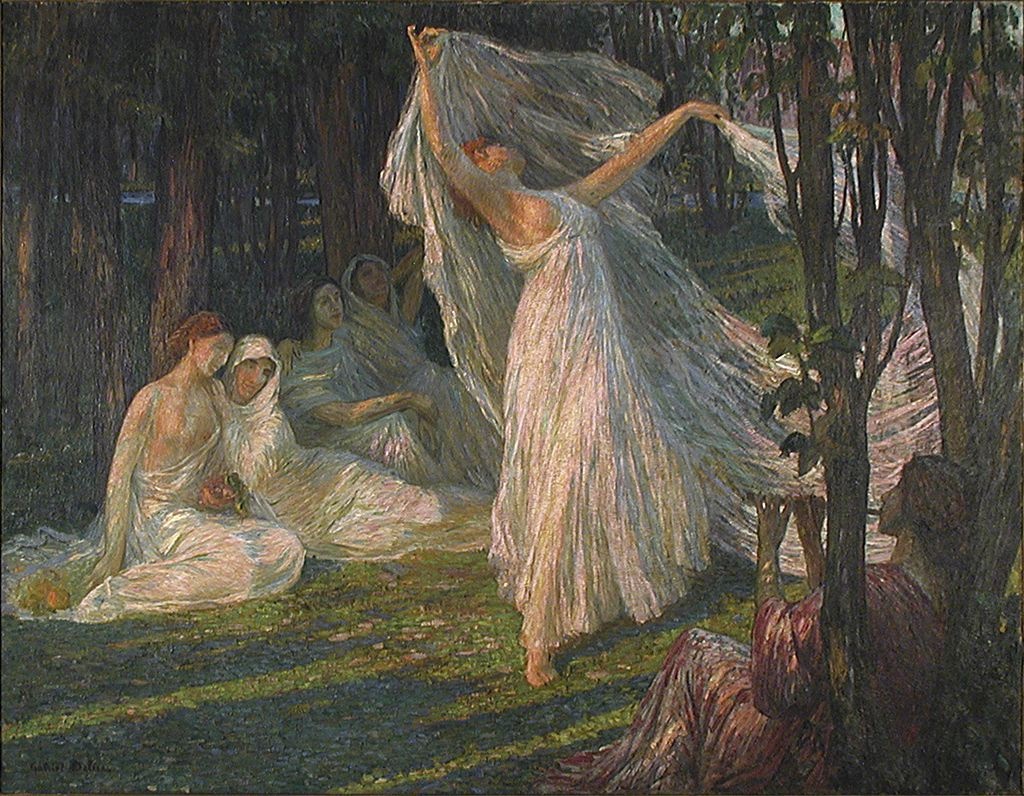
3 Forlane dedicated to Lietenant Gabriel Deluc, a painter killed in 1916. I find this is the most interesting piece, suggesting a quirky intellectual, someone capable of irony. I wonder what kind of conversation one could have had with Gabriel Deluc.

La Danse dans le Bois sacré, Gabriel Deluc (1910)

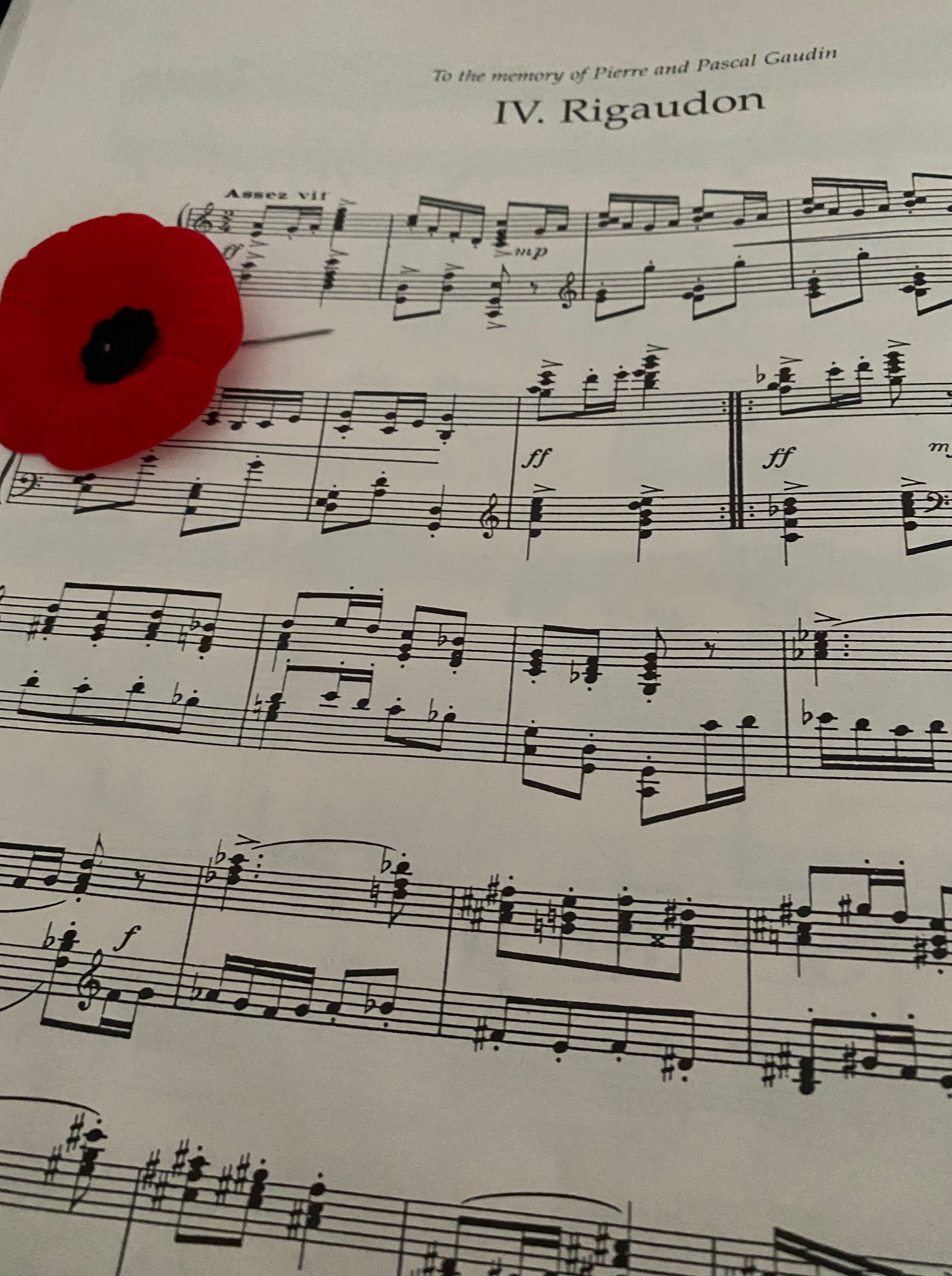
4 Rigaudon dedicated to Pierre and Pascal Gaudin, who were childhood friends. For this movement at least the suite seems to shake off its seriousness.

5 Menuet dedicated to Jean Dreyfus

6 Toccata dedicated to Captain Joseph de Marliave a famous musicologist who died close to the beginning of the war in August 2014. No wonder Ravel gave him this intricate memorial.

For the orchestral suite of four, the Toccata & Fugue are dropped, leaving the Prélude to begin the suite, then the Forlane, followed by the Menuet and concluding with the boisterous Rigaudon. These men who died were all so young. The painter Deluc was 33 when he died. Musicologist Joseph de Marliave was 41 when he died. No wonder Ravel’s last word should be with this reminder of boys at play.

And perhaps that’s how they should be remembered forever.

Posted in Books & Literature, Music and musicology, Personal ruminations & essays | Tagged , , , , , , | Leave a comment

Beethoven 250: his double life

Composer Ludwig van Beethoven was born in 1770, almost 250 years ago.

The Heiligenstadt Testament was addressed to the composer’s two brothers, Carl & Johann, as a last will and testament. Written in October 1802 as the composer approached his 32nd birthday, this autumnal piece of work about the great secret of his life was never seen by anyone other than the composer until months after he died in 1827. A small part of the document is about what he leaves behind, while the greatest part concerns his identity, the pretense of his youth.

Let’s look at excerpts from an English translation quoted in George Marek’s Beethoven: biography of a genius (1961).

O my fellow men, who consider me, or describe me as, unfriendly, peevish or even misanthropic, how greatly do you wrong me. For you do not know the secret reason why I appear to you to be so. Ever since my childhood my heart and soul have been imbued with the tender feeling of goodwill, and I have always been ready to perform even great actions. But just think, for the last six years I have been afflicted with an incurable complaint which has been made worse by incompetent doctors. From year to year my hopes of being cured have gradually been shattered and finally I have been forced to accept the prospect of permanent infirmity (the curing of which may perhaps take years or may even prove to be impossible). Though endowed with a passionate and lively temperament and even fond of the distractions offered by society I was soon obliged to seclude myself and live in solitude. If at times I decided just to ignore my infirmity, alas! How cruelly was I then driven back by the intensified sad experience of my poor hearing. Yet I could not bring myself to say to people: “Speak up, shout, for I am deaf.” Alas! How could I possibly refer to the impairing of a sense which in me should be more perfectly developed than in other people, a sense which at one time I possessed in the greatest perfection, even to a degree of perfection such as assuredly few in my profession possess or have ever possessed—Oh, I cannot do it; so forgive me, if you ever see me withdrawing from your company which I used to enjoy. Moreover my misfortune pains me doubly, inasmuch as it leads to my being misjudged. For me there can be no relaxation in human society, no refined conversations, no mutual confidences. I must live quite alone and may creep into society only as often as sheer necessity demands; I must live like an outcast. If I appear in company I am overcome by a burning anxiety, a fear that I am running the risk of letting people notice my condition—And that has been my experience during the last six months which I have spent in the country. My sensible doctor by suggesting that I should spare my hearing as much as possible has more or less encouraged my present natural inclination, though indeed when carried away now and then by my instinctive desire for human society I have let myself be tempted to seek it. But how humiliated I have felt if somebody standing beside me heard the sound of a flute in the distance and I heard nothing, or if somebody heard a shepherd sing and again I heard nothing—Such experiences almost made me despair and I was on the point of putting an end to my life—The only thing that held me back was my art.

This, the first part of the document, shows Beethoven’s despondency, describing not just the drama of his growing deafness but also the additional layer of his masquerade, his need to conceal his condition as he continued to perform at the piano. Eventually his secret was revealed to the world, but at this time and for a few years he was able to compose and perform. His last concert would be in December 1808, more than six years later!

Beethoven’s condition changed, becoming more deaf with the passage of time. Robin Wallace produces an enormous amount of indirect evidence in his recent book Hearing Beethoven, to suggest that Beethoven’s hearing loss was partial & gradual rather than complete.

The complex drama included the struggle to simulate a competent musician rather than a deaf one, not just the performances in concert but in society & in his daily life, and the various means employed to compensate. There is a performative aspect to competence. You put on your clothes and go out into the world, and perhaps think nothing of the eyes upon you, noticing whether you tied your shoelaces or have your pants on backwards. We may not experience any pressure to fit in as a normal person, but what if your behaviour signifies some sort of weakness or disability? When one is different, when one might be noticed there is the possibility of being judged. That is exacerbated by the onstage drama when one takes on the persona of virtuoso, who must at the very least signify competence if not expertise and even a superhuman brilliance.

Do you ever get stage-fright? Now imagine that your secret identity could be revealed at any moment by a slip-up.

We are only able to speculate so long after the fact, but there is also the evidence of Beethoven’s own music. Think about the challenges of playing your own piano concerto when you can’t hear. In several places Beethoven boldly begins a movement with a piano solo. That applies to the finale to concertos & 1, 2, 3 and 5, and the first movement of #4. That may seem unorthodox until you realize this is a clever solution for a deaf musician.

Opening to the Finale to Concerto #2

When the orchestra joins in –which could be both a visual event as well as an aural one –the soloist can see them all begin to play. And the orchestra would normally match the tempo of the pianist, and therefore no one should notice if the soloist were deaf.

And the deception could continue.

But finally the secret was revealed. The 1994 film Immortal Beloved gives us a fictionalized dramatization of that moment of discovery.

Let’s re-read the beginning of the Testament again.

O my fellow men, who consider me, or describe me as, unfriendly, peevish or even misanthropic, how greatly do you wrong me. For you do not know the secret reason why I appear to you to be so.

No wonder that he seemed crabby or distant.

Posted in Books & Literature, Cinema, video & DVDs, Dance, theatre & musicals, Music and musicology, Personal ruminations & essays, Psychology and perception | Tagged , , , , , , , , , | Leave a comment

Beethoven’s 250th

Ludwig van Beethoven was born in December of 1770.

I suppose the only people who might care about the precise date would be those of us who want to throw Ludwig a party.

In my day one was taught that his birthday was December 16th although it’s now understood that his actual date of birth isn’t known. There’s a registration of baptism for December 17th, so some people think it was the day immediately before. But that’s a guess.

A vague beginning? It reminds me of the ambiguities in the opening of his 9th Symphony. Listen….to the beginning at least. If you’re not paying close attention you may not discern the moment when it began: just like Ludwig himself.

It’s very theatrical. He creates a stage, where we can watch something happen, the blank space for an event or the background in a painting with something that will be added into the foreground, something natural & organic. The quiet anticipatory buzz in the orchestra that might suggest something about to happen is like a misty view of a lake or ocean before sunrise. It reminds me of the birthday mystery, that gradual opening. From the foggy mist, the theme will emerge, mythic. I take it as a self-portrait of the man, even of the species. Surely Wagner had it in his head as an influence if not an actual prototype when he wrote the opening to his Ring cycle, another long gradual beginning that reminds one of nature & the origins of life.

The Ludwig who landed into a world without Victrolas or vaccines, a place where people on average didn’t live much past the age of 40, and child mortality rates that would claim one in four children, might be more astonished by our plans for celebrations than for pandemics. In that time composers were neither published nor remembered the way they are now. It was decades after his death that Mendelssohn brought Bach back from near extinction, just as Wagner would help popularize Beethoven.

I recall the reverence of the Beethoven bicentennial in 1970, unlike any other commemoration before or since. The place to worship was in the record store, interpreters like a priesthood. How ironic that these recordings that seemed so perfect would in time be relics of a failed religion: for of course they were vinyl.

As Americans brace for the outcome of their election,…As Canadians bundle up for winter & indoor life safe from the coronavirus…As we look around at what’s missing from our lives (Halloween or hockey, theatres & recreation), while seeking to remember those who have passed away,…? chances are that the commemoration of that life lived so long ago is the furthest thing from anyone’s mind, especially given that concerts & operas are all but impossible right now.

I suspect Ludwig would just shrug.

But I’m going to do my own little Beethoven 250 commemoration, posting here over the next few weeks leading up to the day that might be his 250th birthday, December 16th.

The man and his music interest me.

Posted in Music and musicology, Personal ruminations & essays | Tagged , , , | 1 Comment

Brand new sound: a moving experience

I stumbled upon something quite by accident and want to share the good news.

No I can’t take credit. We’re fixing some old windows, and needed to work with the contractor, who was blocked off by the way the furniture was arranged.

I was at my mom’s, when Erika took the initiative. She asked me if it would be okay to experiment a bit, and I said “sure”: because her taste is really good. It made sense for her to do this when I wasn’t around to get in the way or object.

I’m still impressed by how much she moved all by herself: especially the piano.

So as I report on our experience, let me propose this to you as a possibility, something to consider for your own living space.

Have you ever wanted to make a change, but lamented that changes are usually expensive & difficult? A new paint-job? New furniture or decor?

A new piano?!!

That’s the thing. Whatever you have, high-tech or acoustic, can seem brand-new if you do as Erika did. She simply re-arranged the furniture. Please note, she didn’t have the acoustical properties of the space in mind. It was primarily to do with the guy fixing the windows, and the need to clear space for him to work.

He’s coming this week!

Have you ever analyzed the acoustics of your living space, the way your instrument(s) make(s) sound when they’re played in your home? Even if you only have one room, there’s likely a place in the room, the proverbial sweet spot, where the music sounds best. If there are multiple rooms, there are surely places where the sound is dead, and others where it’s alive. Maybe you seek out the softest place to play, to inflict the least sound on your neighbours, maybe you seek out the most lively response. Maybe you play as softly as possible. Maybe you don’t hold back.

No I’m not suggesting you be a scientist, an acoustical engineer. I merely mean, listen, and pay attention to what you hear. It might change the way you play, indeed it should change the way you are playing, because after all when we make music we’re also listening: and not just to ourselves. The title of Gerald Moore’s memoir sums up the old-school understanding of the accompanist (a word that is out of favour in the 21st century), namely “Am I too loud?” To answer such questions, one doesn’t merely play, but one listens as one plays.

But I digress.

Do you listen to the room before you start? And this can be the funniest part, although haha the joke may be on you.

What does it sound like when you’re not playing, when you’re listening to the ambient sound?? Is there sound from other apartment dwellers? Perhaps music drifting in (and I am suddenly recalling the experience waiting in the corridors of the Royal Conservatory, hearing singers & instrumentalists all working away…. Creating a fearsome din).

And suddenly I remember the first time I did music for a show in the Robert Gill Theatre back in the 1990s, while I was doing my MA at the Drama Centre, University of Toronto. It was a thrill to get to work on the show, written by Daniel David Moses, directed by Colin Taylor. As I sat in the empty theatre talking to Colin he pointed out something about the theatre: that I had never really noticed.

The Robert Gill Theatre is on the 3rd floor of the Koffler Student Services Centre, a wonderful multi-purpose building in what used to be the Central Library at the corner of St George & College Streets: repurposed as a student centre and bookstore with multiple office spaces. The old theatre on the third floor was refurbished for the Drama Centre’s use, but had some weaknesses, both as far as sightlines and acoustics.

Colin was alerting me to the sounds in the space. And I now recall Anton Kuerti long ago talking about the bane of musicians everywhere in Canada, especially those who have to tour, an issue also present in the Gill, namely ventilation noise. Music is ideally presented into silence: but that’s not what we’re usually working with.

Before Colin & I even started to discuss cues for the show, he asked me to create something he called “a bed-track”, that would conceal the ventilation sounds behind a curtain of something quasi-musical, gentle sounds that would be meta-music, given that we’d play this track at the threshold of hearing, just loud enough to meld with the noises but not be so obtrusive as to be noticed.

We’d start playing it during the pre-show as the audience came in. It was one among many lessons.

I’m still learning: as we flash forward to 2020 and Erika’s experimentation. When the piano moved it had at least three impacts:

1) The place looked different: and Erika liked it. This might have been her primary consideration..? I suspect this is what one often faces in real life, that visual concerns trump everything else.

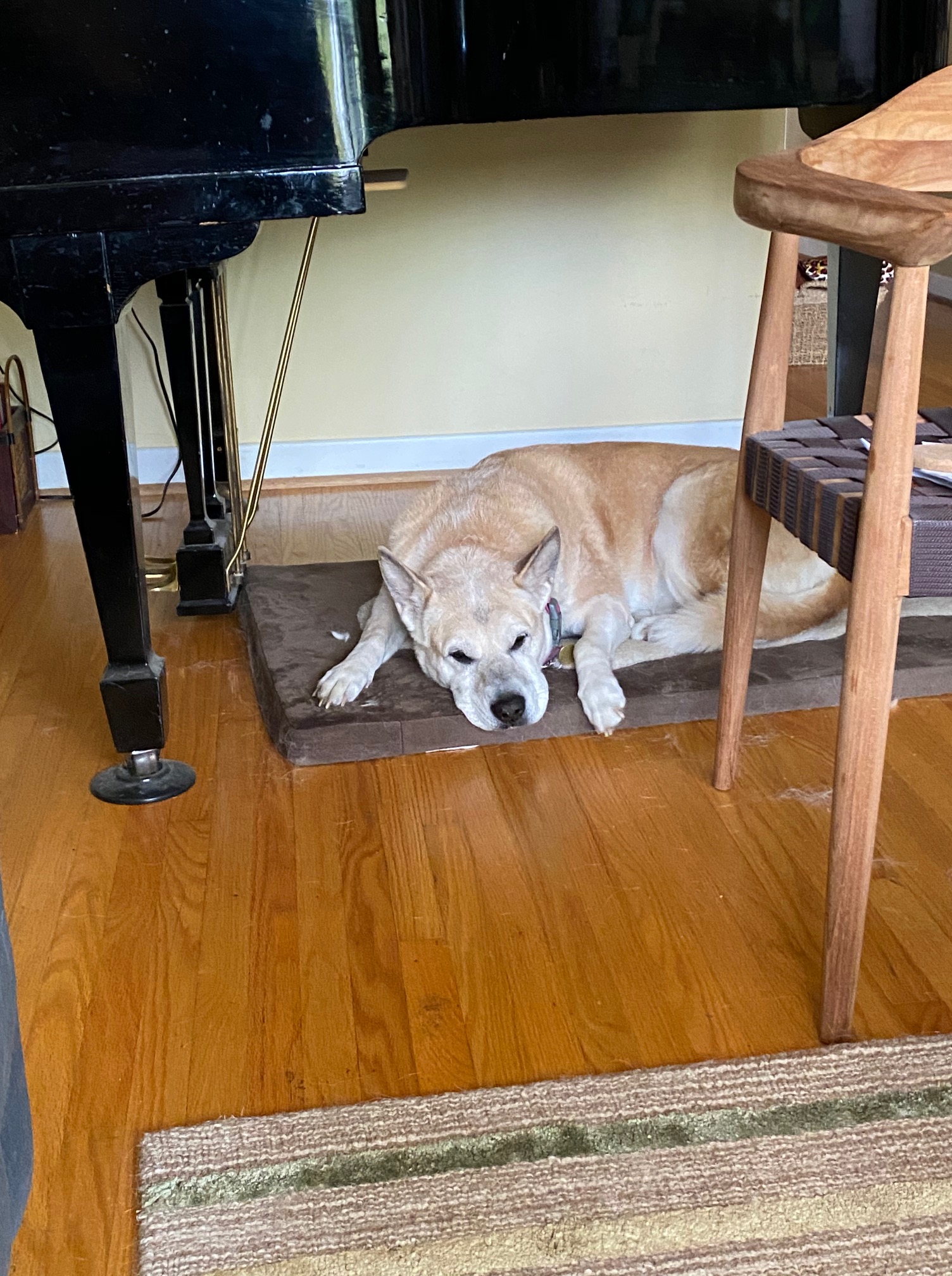
2) The dog had a new place to sleep, given that the piano is a den where she sleeps. Believe it or not she’s under there while I am playing, sometimes happiest (it seems) with the biggest loudest pieces. I say this because when she’s elsewhere and I begin playing one of these she gets up and finds her way over to her bed under the piano.

Who’d a thunk it?

3) The piano sounded different.

I am still figuring this out. One of the first things I played through was the last few pages of Tristan und Isolde minus the voices of course, something I’ve been playing a lot over the past few weeks.

It sounded brand new: because the lower notes had a new depth and sonority with the walls bouncing the sound to me in new ways. The upper notes sounded sweeter, as though they were free to fly, where previously I hadn’t heard them as clearly.

This has been true for everything I’ve played since the move. Chopin and Schumann and Dvorak and Wagner and Ravel and Debussy are all sounding different. I was hesitant about joining in (weird to say that… I said that impulsively, not remembering that it’s ME who is playing) with my voice. Singing along with myself in this new location feels different. Because of course the singing voice is also different with the new acoustic, the different set of surfaces bouncing the music (both instrumental & vocal).

I find I want to play differently now. Indeed I think this is always the case with any new instrument, that I hear the music in new ways and understand the contours and shapes of the music in new ways.

Let’s set aside the question of whether it’s any good. As a critic, a person expected to judge, to tell you this is good and/or bad”, you may want to frame this around judgment & questions of making something better, perfecting the music. But anyone can change their musical experience by examining their acoustic. The options may not be huge, indeed you may already have found the sweet spot and are sounding as good as you can in your space.

Even so, I want to put this out there.

If the pandemic means you’re not able to get out to the usual places where you practice and /or perform (and I am certainly missing the church where I was accustomed to sing & play, especially the loving community)? If you’re not feeling inspired because you don’t have the usual opportunities?

Altering the configuration of your space is a way to rejuvenate your experience of music.

Posted in Animals, domestic & wild, Art, Architecture & Design, Dance, theatre & musicals, Music and musicology, Opera, Personal ruminations & essays, University life | Tagged , , , , | 3 Comments

Woodward and Cohen: odd couple

They’re an odd pair, Bob Woodward & Michael Cohen. Or more properly, their books make an odd couple.

One man uses four letter words for his titles, the other book has a title with a sub-title followed by a sub-subtitle (although come to think of it he features four letter words throughout his book). Maybe the length of the titles tells us something about the writer & their confidence in their project.

One man might be identified as a crusader who already has a place in the history books (including the ones he’s authored). There’s the film we’ve all seen, All the President’s Men, where he’s portrayed by Robert Redford.

The other man went to jail, and might even be identified as a crook. More on that in a moment.

Michael Cohen’s book about his time working for Donald Trump is called Disloyal in huge letters, then A Memoir in smaller letters, and finally The True Story of the Former Personal Attorney to President Donald J. Trump. As far as I can tell it is his first and only book, and now a best-seller.

Rage is the latest Bob Woodward book about Donald Trump. Not only has Woodward written over a dozen books, he’s even written another one about Trump, Fear.

After a taste of Disloyal and a sniff of Rage (that is, sampling each book), I dove into Cohen’s book without hesitation as I found it much easier reading. The book by the beginner is full of wit & reads like a conversation. The book by the professional is a slower slog, much more careful in its construction and as a result much harder to read.

I wonder, does this perhaps parallel the larger world & the discourses surrounding POTUS #45? The beginner politician might be expected to flounder although to some (himself especially) he is the greatest ever.

Conventional wisdom doesn’t apply to Trump. Indeed he seems to deliberately push against the mainstream, and that guarantees him publicity & his ongoing ownership of the headlines & our attention. Cohen writes the way Trump tweets, which is to say without expertise and without any evident hesitation. It seems impulsive & organic, where Woodward’s writing is accurate but careful & deliberate. If this were a morality play, Woodward would be the personification of the rule-book & convention. We see the path to Trump’s White House of maskless self-indulgence in Cohen’s book, a thrill-ride with no fear of consequences or the bill to pay. And it’s natural to encounter Woodward as the nagging voice asking about the morning after, about where it leads & how much it will cost.

Needless to say one is more fun than the other, a guilty pleasure.

If you think Satan was the hero of Paradise Lost you will love Cohen’s book & the villainy it captures. It’s a matter of aesthetics & politics, taste & morality. The Godfather books & films are much clearer in telling us who is a good guy or a bad guy than Disloyal. But come to think of it, everything seems blurry lately, as far as which way is up, who’s good or bad.

There is a strange pair of voices heard in each book.

For Woodward it’s what we might have demanded of the press in 2016: that for every known falsehood, that it be balanced with truth. And so Woodward interviews Trump for hours, capturing all sorts of falsehoods and half-truths inside the quotation marks, followed by a kind of rebuttal in the next sentence from his authorial voice, as though to set the record straight.

For Cohen it’s more a matter of his conscience. He’ll be doing something awful and telling us that he knows it’s wrong, perhaps mentioning the disapproval of his wife and children, and shifting his tone to comment upon himself, asking why he was so mesmerized by his leader. We hear about Jim Jones & the Koolade, the question of Trump’s cult-like following. Clearly cognitive dissonance was mild for Cohen, possibly because he was riding the coat-tails of his boss Trump.

I read the books one after the other, startled at how nicely they go together.

I offer a cautionary note to anyone considering these books. If by the time you are going to read, it turns out that the election is over and Trump has been re-elected, I wouldn’t recommend the books. They will depress you if you’re a Democrat. If you’re a Republican, they might promote cognitive dissonance, although maybe you can ignore the sensation if you are sufficiently enamored of the joys of “winning”.

Woodward’s book is more timely for me, given that the elephant in the room—COVID19—steps forward in 2020. The pandemic wasn’t relevant for Cohen’s book. There’s a natural sequence to the books, that I hit by accident. Cohen tells us how the idea for a Trump presidency was born, and takes us through the campaign, ending in 2019. Woodward’s book is much more current, taking us into 2020 & right up to the present day pandemic horror show.

And of course I will have a different perspective when I wake up next week, depending on the outcome of the election.

Posted in Books & Literature, Politics, Reviews | Tagged , , , , , , | Leave a comment