Questions for Beste Kalender

Beste Kalender could tell you about the different pathways to success.

One can be discovered in competitions, especially if one wins. You can be mentored by great singers. There’s even the Hollywood legend, the understudy going on as last minute replacement for the star in a production of Carmen. Beste has done them all.

Every time I’ve seen her I’ve been impressed by her intelligence. At Verbotenlieder roughly a year ago I wrote this about her performance:

I laughed loudest at Beste Kalender’s brilliant re-imagining of “Erlkönig” (a drinking game! Divide the audience in three, based on the three characters in the song, and take a sip whenever you hear yours –Vater, Kind oder Erlkönig—mentioned).

She made a familiar song brand-new with her reinvention, and we had a great deal of fun along the way.

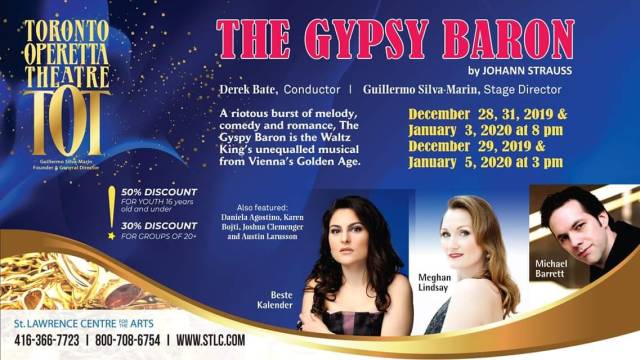
In a few days Beste will be back with Toronto Operetta Theatre in Johann Strauss Jr’s Gypsy Baron. I had to ask her a few questions.

Barczablog: Are you more like your father or your mother?

Beste Kalender: I am very close to both my parents, but I would say that in many ways I am more like my father. He is a self-taught musician and a guitar player. Growing up, I remember him working at the bank during the day and playing gigs with his band in the evening. In celebration of my birth, my father composed a song about me, and somehow foreshadowed my future by naming me Beste – which translates to ‘musical tune’ in Turkish. In fact, both my parents have an artistic side to them – my mother has a literary talent for writing stories and poems – but neither of them had the right circumstances to pursue art or literature professionally.

I can trace my love for opera back to when I was five years old. It was a cold winter in a small apartment in Ankara, and my parents were watching a concert on TV. When I looked up at the TV, I saw a beautiful lady in a fabulous red dress making the most magical sounds one can imagine. As my mom recalls that day, I pointed at the lady and said “I want to be like her!” As I look back to that day, I never doubted what I wanted to do in life.
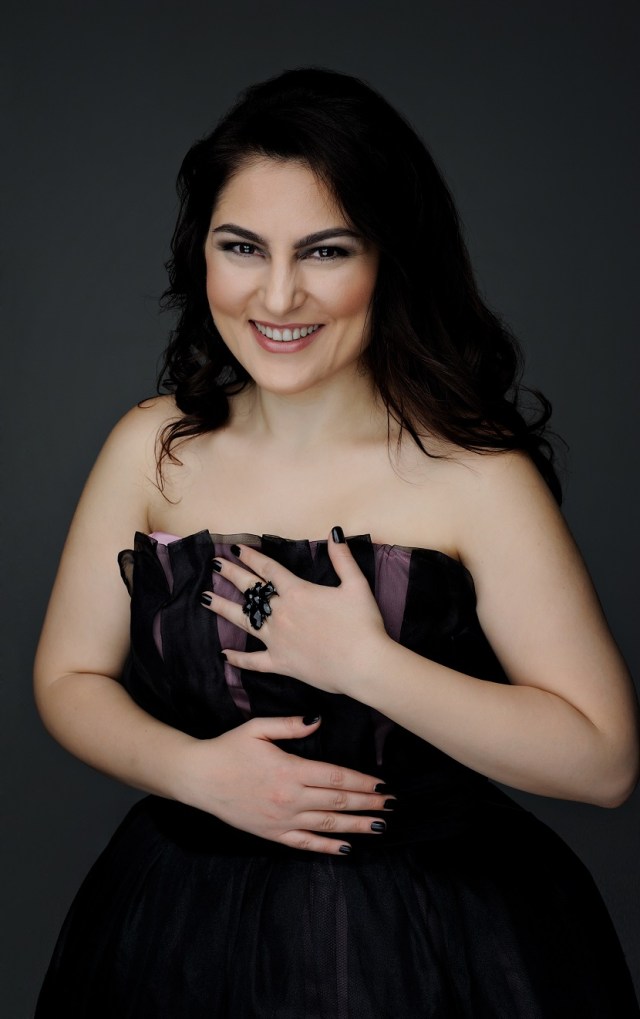
Beste_Kalender_2020_2

Beste Kalender

My parents did not have the financial means to support my training as a musician abroad. However, they never let that stand in the way of my imagination and dreams. It is because they were such good parents who appreciated my passion and encouraged me, that I believed in myself, searched for scholarships, received grants, and completed a graduate training in Voice, as well as in Psychology.

Even though I am more like my father, I also think my parents make a great team and they both have inspired me in so many different ways. If I ever become a parent, I hope I can be as perceptive, kind, and loving as they have been to me.

Barczablog: What is the best thing about what you do?

Beste Kalender: The performing arts go well beyond entertainment to help us communicate with the whole world. That’s one of the main reasons why I’d like to keep singing, to share beautiful works of music from all over the world and to give voice to people’s joy and sorrow, to change lives or at least try to make a difference through my voice and music.

Today’s world is filled with so much conflict, hostility, discrimination and fear. One of the greatest and most creative performers of our times, Joyce DiDonato, often repeats: The opposite of war is not peace, it is creation! (J.Larson). I aspire to ‘create’ through my artistry and want that to be my antidote to all the negativity out there. I also love the fact that my profession gives me the opportunity to travel, meet with new cultures, people and colleagues from different parts of the world, which I find gives me perspective about my own understanding of art and people.
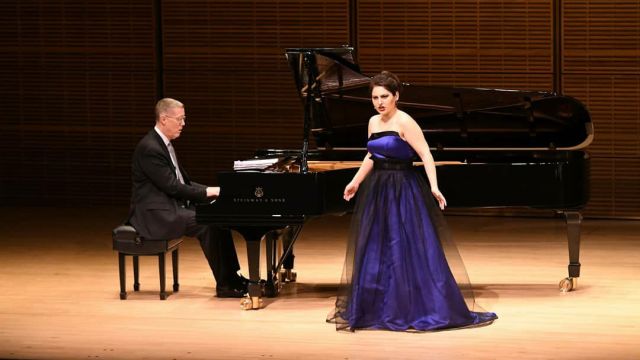
carnegie_18_songcelebration

Beste Kalender at Carnegie Hall, in Marilyn Horne’s Song Celebration with Warren Jones.

So far I have performed with companies and festivals in a number of countries. Jeonju Sori Festival (Korea), Helikon Opera (Russia), Bolshoi Theatre (Belarus), Bologna Opera (Italy), Choregies D’Orange (France) to name a few. Each engagement taught me something novel about people and their perception of the art. The only down side of all the travelling is that most of the time I am not able to share those experiences with my family. Feelings of homesickness and loneliness can creep in from time to time, but I try to make the best of the situation!

Barczablog Who do you like to listen to or watch?

Beste Kalender: I generally really enjoy classical jazz. Nowadays, I find myself listening more and more to my favorite Turkish composers from when I was growing up, as well as 60’s and 70’s world music. As for classical music, when in need of inspiration, my go to performers are Marilyn Horne, Joan Sutherland and Jessye Norman.

I also love listening to Anne Sofie von Otter and Leyla Gencer. For those who don’t know the latter, Leyla Gencer was actually the first Turkish singer who built an international career, and Italians called her “La Diva Turca”. She has become an idol and inspiration for many Turkish singers who would dream about an international career in opera, like myself. Unfortunately, she was not very interested in making recordings. Almost all the recordings you can find of Gencer are pirate recordings of live performances. Therefore she is also known as “The Pirate Queen”.

Barczablog: What ability or skill do you wish you had, that you don’t have?

Beste Kalender: Definitely sports! I love learning languages, dancing, singing, acting, painting etc.… However, when it comes to playing any kind of sports, I am generally hopeless. It would have been fun to play some volleyball or basketball growing up, but I didn’t have the aptitude for it. The only reason I got passing grades in the gym class was that I was representing my high school in music competitions. Bless their soul, my teachers must have felt sorry for me!

Barczablog: When you’re just relaxing and not working, what is your favourite thing to do?

Beste Kalender: When I am exhausted or want to relax, I usually end up in the kitchen baking and cooking, with some delicious jazz music, most probably by Ella Fitzgerald or Oscar Peterson, in the background.

More questions about projects & professional life.

Barczablog Can you talk about what you’ll be doing in the coming year ?

Beste Kalender: 2020 will be busy with some exciting projects. After The Gypsy Baron I will be on my way to San Miguel for the 6th annual Mexico-Canada CO-OPERA-TIVE Concert, which will be my performance debut in Mexico. Then, I will be back in Toronto as a guest soloist at Sinfonia Toronto’s concert: Musical Bridges & KOMITAS 150. This project has a very special place in my heart, as this will be the first concert in Canada where Armenian and Turkish artists will join each other on the same stage to celebrate this great musician and the founder of Armenian School of Music: Komitas. The concert will also feature the world premiere of some beautiful music by internationally celebrated Turkish composer Tahsin Incirci. After that, I will be with Edmonton Opera, giving life to another “older lady” character, The Old Lady in Candide. I have previously performed this role two years ago at Banff Centre and I am really looking forward to reviving it! After Edmonton, I will be back in Toronto in April with a busy schedule of some other opera and oratorio projects. Fall 2020 performances will mostly be in Europe. More details about my upcoming engagements for the year are available online at www.bestekalender.com

Barczablog A few days ago I heard that you’ve won the 26th Théâtre Lyrichorégra 20 Jeunes Ambassadeurs Lyriques in Montréal. There’s a cash prize plus performance opportunities, too. Please tell us all about it.

Beste Kalender: Jeunes Ambassadeurs Lyriques is a competition in concert format. Singers are selected via preliminary auditions in various cities in Canada or international competitions in Europe. There are four concerts in total. Participants perform arias and ensembles, in different styles and languages, in front of opera directors from Eastern and Western Europe, Asia and Canada. After the fourth concert selected singers are offered money prizes and/or role/concert engagements as well as other audition opportunities in Europe.
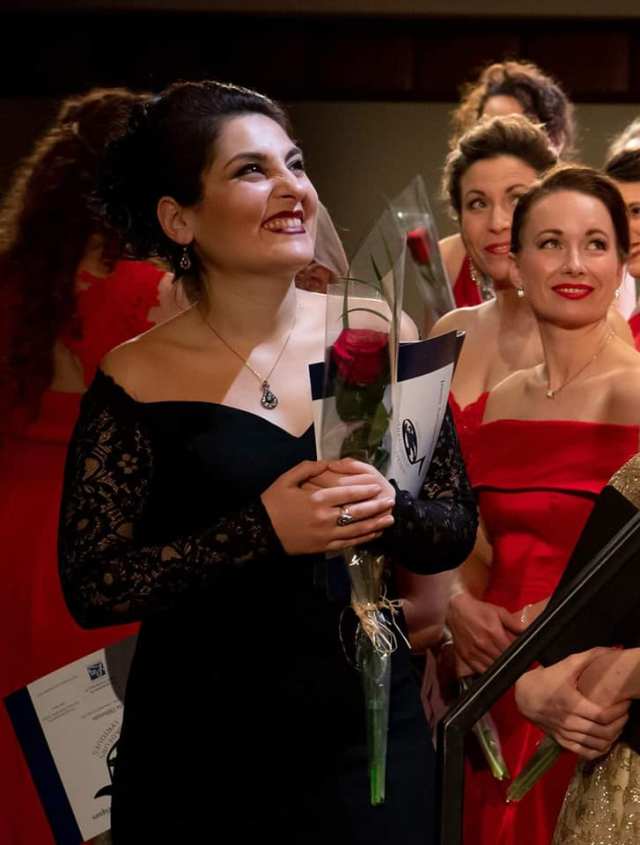
BesteKalender_JAL_FINALS

At the Jeunes Ambassadeurs Lyriques finals

As for this year’s competition, I have been awarded the grand prize by the jury, was chosen as “Jeune Espoir Lyrique Canadien 2019”, and granted $5000 by Azrieli Foundation to support my future engagements and auditions in Europe. I have been also offered the title role in Carmen by Bizet in Sofia National Opera and Ballet(Bulgaria) for Fall 2020, a concert engagement in January 2020 with Opera de San Miguel, concert engagements with Opéra Angers Nantes (France) for next season as well as concert engagements with Shenzhen Poly Theatre (China)

Barczablog Later this month you’ll be singing in Toronto Operetta Theatre’s The Gypsy Baron by Johann Strauss Jr. Tell us about your role in the production.

Beste Kalender: The Gypsy Baron is a very fun piece with a number of colorful characters. Czipra is definitely one of those. She is an old gypsy woman full of life, also the leader of the gypsy troops in her area. She is very deeply involved in anything related to the spiritual world, fortune telling and such. She is also a very strong woman who fears nothing and no one. She raised Saffi (performed by Soprano Meghan Lindsay) who is later revealed as the daughter of a Turkish Pasha (I know…the irony), as her own daughter, and protected her against the Pasha’s enemies.

The story is about the marriage of Saffi and the landowner Barinkay (played by Tenor Michael Barrett), who just returned from exile. Czipra has a very central role in all the events bringing these young lovers together and it is very exciting to experience her “larger-than-life” spirit, laughter (she does laugh big…and A LOT)) and determination in taking care of her beloved Saffi throughout the story.

It all takes place in Hungary and Vienna in late 18th century but get ready for some modern touch with the English text as our fearless leader Guillermo Silva-Marin has a great skill to always bring these works up-to-date with some ingenious word play.

Barczablog You have a new hat you’re wearing with Tongue in Cheek Productions. Please explain.

Beste Kalender: As the position of “PR Sorceress” goes, I take care of the Public Relations, Press and Media Services for the company but, in reality, we really try to share the work as much as possible including casting and other organization related subjects. Mike Nyby and Aaron Durand are two of my favorite colleagues with whom I have performed in a number of different productions. They founded Tongue in Cheek Productions and asked me to sing for them in their second show “Verbotenlieder: Forbidden songs”, where female performers sang pieces they always longed to sing but were never allowed to, because their teachers or the actual “fach” forbade them. I got to perform Erlkonig by Schubert, which was SO MUCH FUN!!! I officially joined the team shortly after “Verbotenlieder”.

I really liked Mike and Aaron’s way of thinking about classical music, and how they wanted to stretch the boundaries of the average person’s understanding of the opera world and I am a big believer in the power of strong social presence and promotion for a successful career in the arts. I also really enjoy talking to and connecting with people, hearing what they have to say, which – I suppose – has something to do with my Psychology training. At the time, I was also curious about the administrative and promotion side of the shows in which I was involved. Since then our journey together has been nothing but real hard work and lots of fun. We all share the same vision, and I look forward to see what the future holds for our innovative, “classical music and people friendly” company!

Barczablog You’re playing in an operetta with TOT, you’re singing the Old Lady in Candide in Edmonton, you’ll be singing Carmen again (having sung the role before). You’re a singer who is very comfortable with spoken dialogue. Have you done a lot of this before?

Beste Kalender I was never trained particularly for spoken theatre but I have had the opportunity to work with so many wonderful stage directors who have significantly contributed to my talent as a performing artist. Leon Major, Paul Curran, Guillermo Silva-Marin, Tom Diamond, just to name a few. As for my acting and spoken scenes in general, I guess I am just comfortable with the stage.

I love the process, the dynamics, and the action in live theatre. It doesn’t really matter what role I perform…I am the happiest performer when I feel the presence of my audience.

Barczablog How many languages do you speak?

Beste Kalender My native language is Turkish and I am fluent in English.
My life-long passion for opera meant that I always had a great interest in Italian songs and the language itself. When I was in high school more and more Italian tourists started visiting our city of Antalya (on the Mediterranean coast of Turkey). A family friend was fluent in Italian and had his own carpet and silver shop at the bazaar. He loved to hear about my passion for opera and I loved the fact that he was a real gentleman and fluent in 6 languages including Italian. So we made a deal: I started working for him at the carpet shop, and he taught me Italian for one hour every day… and then let me practice with the tourists. It was the best summer of my life and the lessons came in handy when I had my first contract with Teatro Comunale di Bologna in Italy, years later.

I have studied some French in Turkey, and later continued my studies here in Canada. If you are patient enough I can even discuss some politics in French. I just adore the language! I am also a beginner in German but hope to have a better grasp of the language in the near future.

Barczablog At one time you were doing research in psychology. Could you talk for a moment about your interest in music and how it leads to your present life as a performer?

Beste Kalender: In Turkey, I finished a bachelor’s degree in Psychology (at Bogazici University in Istanbul) as well as a Voice Diploma Program (at Istanbul University State Conservatory with Ayse Sezerman Unel). I was really looking for an opportunity to study music abroad and, being exuberantly inspired by “La Diva Turca” Leyla Gencer’s biographical novel, to pursue an international career in performance.

At the same time, I was curious about how music can enhance our lives. During my studies at Bogazici University, I was working in three different labs with internationally respected scholars and professors. Oliver Sack’s Musicophilia being my favorite book, I was fascinated by neuroscience and studies supporting the idea of how music can promote so many cognitive functions, including memory and language skills via the overlapping faculties in the brain. I was the valedictorian of my class, also the recipient of the presidency award upon graduation from Bogazici University and I started applying for PhD programs in North America where I could conduct music-related Developmental Psychology research. In my applications, I was always honest about my interest in opera performance. I knew I wanted to be an opera singer but I did not want to feel disappointed with myself if I simply didn’t have the talent I thought I had. My goal was to be happy, to nurture my interests and dreams to the fullest. I was immediately accepted at University of Toronto by renowned developmental researcher Sandra Trehub. Upon my arrival I also convinced mezzo soprano Jean MacPhail to meet and hear me-I may have begged a little. Within six months, I was conducting my own studies as well as working on my first role, Tancredi in Rossini’s Tancredi for Guillermo Silva-Marin’s Summer Opera Lyric Theatre. Guillermo was the first director who ever gave me a chance to perform in Canada and develop as an artist!
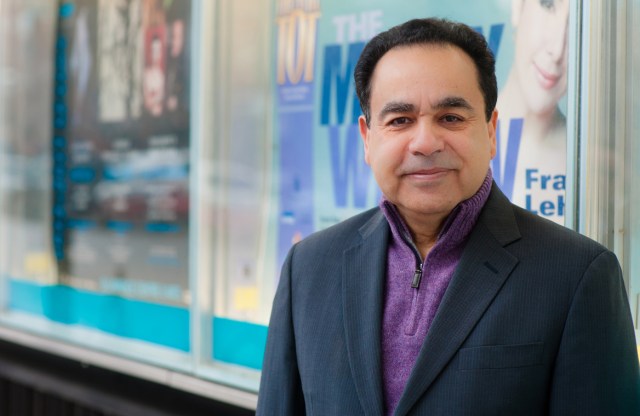
gsm2

Guillermo Silva-Marin, General Director of SOLT.

During my time at the PhD program, I continued performing regularly and also completed an Artist Diploma in Voice at The Glenn Gould School of The Royal Conservatory of Music.

When I took a leave from research and joined Calgary Opera’s Emerging Artists Program, I was “all but dissertation”. Then, originally cast as Mercedes, I had the unexpected opportunity to fill in for the title role in Carmen at Calgary Opera, singing all four performances. My performance was well received and I knew I was ready to embrace what the future brings as a performer. The next day, I phoned my supervisor in Toronto and informed her that I am leaving academia. That Carmen role was just the first of many others… I can easily say that I owe my professional career to Carmen and to my mentors in Calgary Opera who believed in my talent to bring “her” to life!

Barczablog I saw in your bio the “Marilyn Horne Song Celebration Concert”. What is your connection to Marilyn Horne?

Beste Kalender: I feel very lucky to call Marilyn Horne my muse and mentor. I will never forget my first time meeting her…
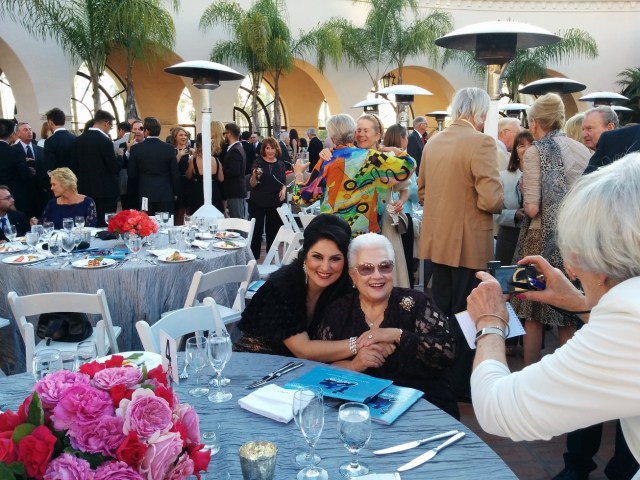
HORNE_Beste

Beste with Marilyn Horne

When I talked to my former teacher about how I admire Marilyn Horne and aspire to meet her someday, she advised me to apply to Music Academy of The West’s Summer Music Festival.

In 2014, Music Academy announced their season production of Carmen – obviously my favorite opera ever – so I decided to give it a try and actually received a call-back. I entered the room and there was Marilyn Horne looking at me with the most radiant smile I have ever seen. I don’t remember how I sang. I just remember that all of a sudden it was hard to breathe. I turned back to exit the room then I heard Warren Jones, who is also one of the greatest coaches of the program, say “Please stop!” The rest of my audition turned into a short working session. After my audition, I was full of all sorts of feelings (singers joke!).

Then I heard the door open. It was Ms. Horne. She said “…so Beste Kalender from Turkey. You have worked with some wonderful voice teachers and you have the right voice for Carmen. Now tell me why you were so nervous…”

I told her: “Ms. Horne I grew up with this dream of meeting you some day. I was so overwhelmed by your presence.”

She answered back with that same wonderful smile of hers and said “Whatever happens…Don’t forget to breathe.” 

Shortly before the results were announced, I was offered a lead role at a main opera house in Moscow. But I forgot all about Moscow when I heard that Ms. Horne invited me to her festival, this time just as a cover… for Mercedes. The following year she offered me the title role in Rossini’s Cinderella and we developed a great “”teacher-student” bond during the preparation process. Thanks to her, my story turned into a real life Cinderella story. She was very pleased with my performances and invited me to sing for The Song Continues Masterclasses at Carnegie Hall, which was followed by my recital debut at Carnegie Hall with another favorite mentor of mine: world renowned Maestro Warren Jones. After that I was featured by Musical America as “The Artist of the Month”. The following year I had the opportunity to perform at Carnegie Hall once again, this time at the Marilyn Horne Song Celebration Concert with many other internationally celebrated artists such as Isabel Leonard, Russell Thomas, Nicole Cabell, Susanna Philips et al.

Barczablog Do you have any teachers or influences you’d like to acknowledge?

Beste Kalender A career in this business is only possible when you are surrounded by the right team of people. I would like to thank TOT’S Guillermo Silva-Marin and Jean MacPhail for taking a chance in me 10 years ago when they first met me as a researcher and my former academic supervisor at U of T, Professor Emerita Sandra Trehub for her support throughout this adventure.

I would like to also thank my current teachers and mentors: Marilyn Horne, Warren Jones, Laura Brooks Rice, Rachel Andrist and Hans Nieuwenhuis for always being there for me.

With Beste Wishes…

*******

Beste Kalender is featured in Toronto Operetta Theatre’s holiday production of Johann Strauss Jr’s The Gypsy Baron, presented with full orchestra conducted by Derek Bate and directed by Guillermo Silva-Marin, December 28th until January 5th at the St Lawrence Centre. Click here for tickets.
The GypsyBaron

Posted in Dance, theatre & musicals, Interviews, Opera, Personal ruminations & essays, Press Releases and Announcements | Tagged , , , , , , , , , , , | Leave a comment

Toronto Consort: Schütz’s Christmas Story

Looking for an alternative to the Messiah & Handel?

Look no further than Toronto Consort’s current program, Schütz’s Christmas Story, curated by David Fallis.

You will hear stunningly beautiful music that you’ve probably never encountered before. Schütz is new to me. Speaking of Handel, Schütz’s baroque aesthetic is in some ways more primitive & simple than what we encounter in Messiah in the next century, at least as far as his creative procedures that we see growing from Monteverdi, a composer you might hear echoed by Schütz: except the words are sung in German rather than Italian.

My Toronto Consort attendance is irregular, so I can’t be sure when I say that this is the most impressive thing they’ve ever done. But wow, there are a great many wonderful things happening among the players, colours & timbres that would be our focus if we didn’t have so much text & drama before us.  Schütz deserves to be better known, and perhaps programs like this one will remedy that injustice.

The approaches to story-telling is something I wish I could have studied more closely, but then again I’d have to know the music & the words much better, to have a sense of the dramaturgy, the strategies in the piece as written vs what I think I see in the interpretations.

And you will hear remarkable performances.

Charles Daniels is again showing us his versatility. Where with another artist I might question the authenticity, asking “is this the right way to do this”, with Daniels I assume it’s right. He works hard to sing the words clearly, has impeccable pitch & phrasing, and usually underplays even at the most dramatic moments in a text.

Charles-Daniels-Credit-Annelies-van-der-Vegt (002)

Tenor Charles Daniels (photo: Annelies van der Vegt)

Katherine Hill sounded wonderful & clear. Dare I say it “angelic”? But how does one sing music meant for an angel, and how much drama does one include? Like Daniels, Hill underplayed.

And Joel Allison showed us a lovely rich tone, while at times giving us a bit more theatricality in his Herod. That feels right to me as a former PLS actor (“PLS” are a University of Toronto troupe exploring pre-Shakespearean theatre), familiar with mystery plays & the tradition of histrionics in a role such as Herod: possibly the most over-acted role of them all.

I admire the ambitions of this program, the way Fallis dared to assemble pieces in the first half around a lamentation after the massacre of the innocents. It lends a weight & depth to the Christmas story, making the eventual joy & celebration feel three-dimensional and grounded.

In the second half we get Schütz’s Historia von der Geburt Jesu Christi, a complete Christmas story. Daniels is the Evangelist telling the story through a very simple recitative. Schütz’s style & delicate attention to the text reminds me of his near-contemporary Lully, a direct, unencumbered approach to setting words to music.  The priority is telling the story.

The music goes back and forth between evangelist recitative & “intermedium” perhaps to be thought of as “intermezzo”, a concerted composition that is a little bit more like an aria or song, although sometimes the intermedium sounds somewhat like recitative. There are eight of these episodes, corresponding to parts of the story such as the visit of the Magi or the Angel singing to the shepherds in the field.  This is a baroque that is transparent rather than showy, not yet seeking to give us a display of skill or virtuosity, as we’ll get later with Handel or Bach.

David Fallis curating a program usually takes us deeper, in programs of integrity & ambition.  He’s likely a big reason we’re so fortunate to have another visit from an extraordinary artist such as Charles Daniels.

The program repeats Saturday night & Sunday afternoon at Jeanne Lamon Hall, Trinity-St. Paul’s Centre.

Posted in Music and musicology, Reviews | 4 Comments

News from Alexander Neef about Parsifal

“September 25 is going to be a big night for the Canadian Opera Company.”

That’s how Alexander Neef’s email to subscribers began. It was in my inbox early this afternoon.

neefLR_SamGaetz

Alexander Neef (Photo: Gaetz Photography)

It will be an expensive project, so of course he –meaning Neef on behalf of the COC—are asking for donations. And I’m thinking about whether I’ll make a contribution.  The email offers some incentives, as I shall explain below.

The COC have come a long way from their Ring Cycle that opened the Four Seasons Centre, remounting 3 of the 4 operas in the past 5 years but with a huge upgrade in the level of talent, thanks for Neef’s connections in the international opera world.
Let me jump to the linked page he appended to his email, perhaps a test of one’s true nerdy devotion. If you’re a Wagner fanatic you click on such things, because of the gold that lurking underneath as though this were the Rhine.

They give us a cast, at least as of today, with a cautionary note at the end that “ All casting and production information is subject to change”

Parsifal: Christopher Ventris/Viktor Antipenko
Amfortas: Johan Reuter
Kundry: Tanja Baumgartner/Daniela Sindram
Klingsor: Robert Pomakov
Gurnemanz: Mika Kares/David Leigh
Titurel: David Leigh/Mika Kares

Conductor: Johannes Debus
Director: François Girard
Set Designer: Michael Levine
Costume Designer: Thibault Vancraenenbroeck
Lighting Designer: David Finn
Video Designer: Peter Flaherty
Price Family Chorus Master: Sandra Horst

Ventris and Antipenko are both talented singers. We saw Reuter not so long ago. Canadian Robert Pomakov can comfortably stand alongside the imported talent, as he did in Götterdämmerung not so long ago.

The dates?

Friday, September 25, 6 p.m.
Sunday, September 27, 2 p.m.
Saturday, October 3, 6 p.m.
Sunday, October 4, 2 p.m.
Friday, October 9, 6 p.m.
Saturday, October 17, 4:30 p.m.
Sunday, October 18, 4:30 p.m.

Subscriptions will go on sale February 10.
Single tickets for the general public will go on sale July 20.
Monumental Campaign donors who give $1,000 and above will receive early access to single tickets (date forthcoming)

Are you tempted?

Posted in Personal ruminations & essays | 1 Comment

How to Singalong

I don’t presume to know how one does the Singalong Messiah thing.  I am no expert.

[morning after emendation… There are different sorts of experts. Singers? organists, conductors, musicians? or the textual scholars, people who really know Handel?  I avoid the mantle of expertise because I don’t like class distinctions. In Roy Thomson Hall we’re all admirers of Handel, amateurs in the best sense of the word, loving the music & the art: except of course for those who are professionals.]

But I’m taking a family member along on the afternoon of December 21st, to Roy Thomson Hall. And I realized as we chatted back and forth about this, that this is a really good topic for the blog.

One might wonder how one approaches Handel’s Messiah. Does one prepare? Does one study the score, listen to the music, prepare one’s voice, warm-up the day of the event?  Yes yes yes…

And it’s not every day that one gets the opportunity to perform with accomplished professionals in the same piece. One of the great thrills –and there are several to be had—is to look up and to notice that you’re singing with all these people, including the Tafelmusik Baroque Orchestra & the Tafelmusik Choir. It’s heady stuff, especially in the more complex pieces.

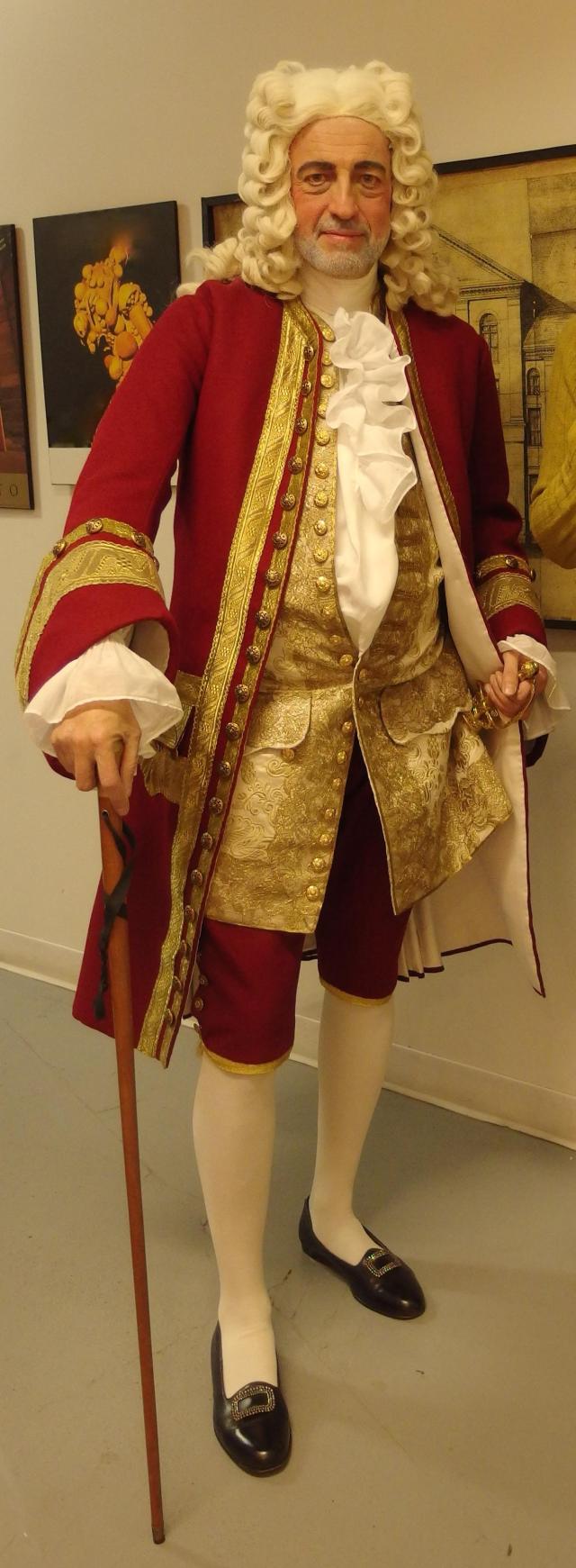
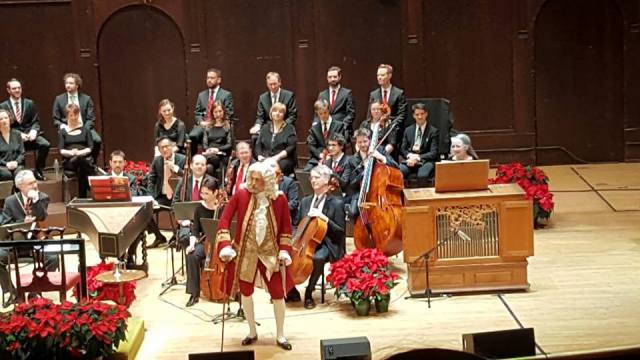
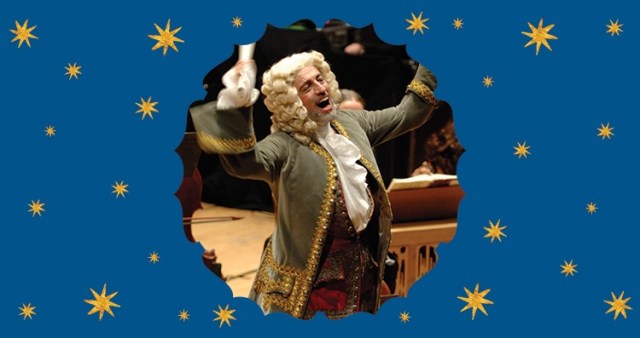
Two years ago I had the singular honour of interviewing Herr Handel himself, although admittedly with some help from Ivars Taurins, the conductor of Tafelmusik Baroque Choir. Does Taurins have a special gift that he is able to channel the spirit of the departed composer? Or maybe it’s just the music that gets into him, bringing Handel to life.

portrait

I invoke that interview to suggest that above all this is fun. When you look at the pictures you can see it. When you come into the hall you feel the unique vibe: as though we were at a rock concert from the 18th century.

guess_how

I don’t think anyone is stoned or drugged except perhaps with antihistamines stifling their coughs or cold symptoms.

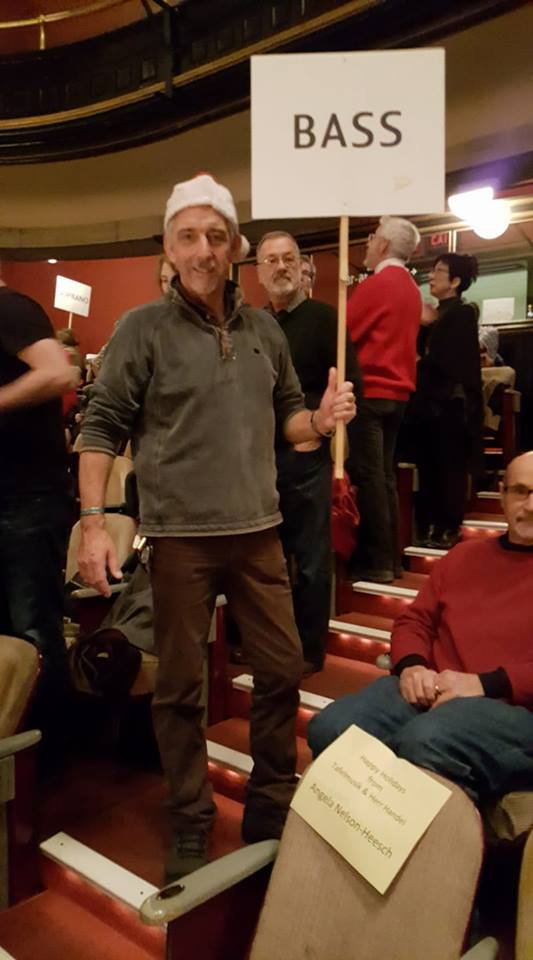
I am reminded that seating is assigned by voice part. If you’re a soprano, sit among the sopranos. Altos sit with altos, tenor with tenors, basses with other basses.

signage

For those who wanted to be among the same vocal type, they help us find our sections.

And there is also a general mixed section for groups that want to sing together.

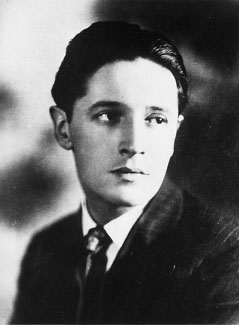
ivor-novello-4-sized

Ivor Novello

While we do not sing the whole Messiah, we sing enough that one would do well to be accustomed to singing, the way one is as a regular church chorister.

Don’t underestimate the effort required. If you’re not in shape –that is, using the analogy of an athlete because in fact singing is an athletic discipline requiring wind & a kind of fitness—then you would do well to pace yourself. Don’t give it your all in the first part or you’ll be all sung out by the end.

We use the Novello score.

Not Ivor Novello, the composer & film-star, who shows up as a character in the film Gosford Park.

That would be the wrong Novello!

No, the score comes from a publishing house founded long ago by Vincent Novello. If you look around you’ll see that it’s the score everyone seems to use, as it appears that there’s a consensus around these versions of Handel’s music.  If you don’t own one of these, they will be on sale at Roy Thomson Hall.

cover-large_file

Here is a list of the choruses sung in the Tafelmusik singalong last year, including page numbers from the Novello score (and please note, there are solos in between, which I’m leaving out of this summary).

In the first part of the concert before the intermission there are five big choral pieces:

Chorus: And the glory of the Lord 11

Here’s a version where you can see the score as you listen.

This version is from the Monteverdi Choir, English Baroque Soloists, led by John Eliot Gardiner in a reading that might resemble what Tafelmusik under Ivars Taurins would do: except that there are an additional 2000 or more in Roy Thomson Hall, singing along.  But it’s somewhat useful practice to follow along with the score.

That text (like all of them) is fascinating, from the book of Isaiah.

And the glory of the Lord shall be revealed, and all flesh shall see it together: for the mouth of the Lord hath spoken it. (Isaiah 40: 5)

It’s a prophecy.  I find it comes true when I come to Handel & his treatment of the text, and remarkably it seems to happen to me every time.

Alto Air and Chorus: O thou that tellest good tidings to Zion 41

Here’s a wonderful performance (I love the alto’s pronunciation). Notice that the chorus gets little warning before their entrance. If you get too carried away with the alto’s performance you’ll miss your entrance!

The process of communication in this chorus never sees to amaze & overwhelm me. Is this number not a bit like a snapshot of the entirety of Christianity in miniature? Someone has heard good news, and they report it, and they’re spreading it and it does spread, from a soloist to a multitude.

Wow.

Chorus: For unto us a child is born 55
OKAY the last two chorus examples were ideal performances by small ensembles.  That’s not what it sounds like when you add 2000 people in a singalong, no matter how perfectly you sing your part.

Will we sound as good as the Mormon Tabernacle Choir? Let’s see.

The next chorus comes in response to recitative lines from the Soprano.  When she gets to the lines “And suddenly there was with the angel a multitude of the heavnly host praising God and saying” it’s time for the chorus to sing
Glory to God 68

One of the most exciting parts of Messiah is the dramatization of Christmas Eve.  We in the chorus get to play a chorus of angels. The strings almost sound like wings, don’t they?

And to close the first part of Messiah,…
Chorus: His yoke is easy, and his burthen is light 86

No we won’t go this fast. Our burthen (or Herr Handel’s burthen) will not be so light, not with so many singers.

But isn’t it cool, to be able to follow the score, to see your part, to sing a part of this amazing piece? What a rush!

And that brings us to the Intermission. Don’t mistake this for a halfway point, though. The usual full Messiah has three parts, with an intermission normally after the 1st part, with two big parts still to come.

Rest.

Go to the washroom,

Perhaps have a coffee.

Because after intermission there’s lots more.
The first Chorus is  Behold the Lamb of God 91

And yes that’s Tafelmusik you hear.

There are several more choruses.

• Chorus: Surely he hath borne our griefs 98
• Chorus: And with his stripes we are healed 102
• Chorus: All we like sheep have gone astray 106
…a bit of comic relief: at least to begin.

The photos of the sheep are cute, and Handel’s vocal lines meander, truly tempting us to go astray.

“Every one to his own way?!”

Hopefully not in the performance of the music.

Then the Chorus: He trusted in God 115

And we come to Chorus: Hallelujah 171

Do we sing this loudly? Perhaps not if we want it to be musical, to be meaningful. Best to start softly, and to save something for later, rather than exhaust yourself on your first Hallelujah, right? And that means that it builds to something over the course of the piece.  To become louder, it’s safest to start softly.

•Then there’s the Chorus: Since by man came death 186

And finally we come to a pair of choruses to conclude, one after the other.

Worthy is the Lamb that was slain 217

…again allowing you to see the score as you listen.  It’s even harder if you allow the music to move you, which it inevitably does. But can one sing like a machine without emotion?  I wonder.

And then it’s immediately followed by the Amen

One of the wonders of the season is getting to hear these pieces anew, even if we know every note.  I never tire of them.   And when you’re in Roy Thomson Hall surrounded by so many others, the chemistry adds something.  I know I’ll make mistakes, and I won’t be the only one. That’s okay.  It’s a happening.

I’m looking forward to it. Perhaps I’ll see you there, 2:00 pm on Saturday December 21st at Roy Thomson Hall.

12-Sing-Along-Messiah

Posted in Music and musicology, Personal ruminations & essays, Press Releases and Announcements | Tagged , , , , , , , , , | 2 Comments

Melancholiac at Music Gallery

The best works of theatre or music function as advocacy for the creator. A good production of a play, a great performance of a song, should persuade you of the importance of the work & its author.

Adam singing melancoliac

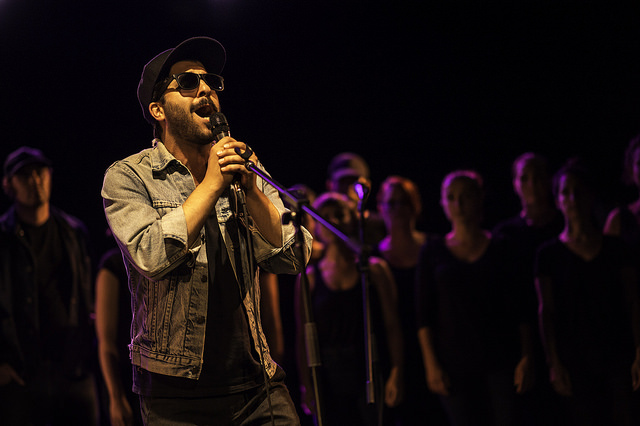
Adam singing Melancholiac

Melancholiac: The Music of Scott Walker is a strong argument that Scott Walker is a genius who deserves our attention. For about two hours, we watched the collaborative efforts of Adam Paolozza & Greg Oh, plus a great many other singers, actors & musicians, offering us a multi-disciplinary exploration of Walker’s art.

Notwithstanding the title that might suggest sadness or ennui, the two hours flew by, one of those wild tumultuous shows I wish I had been somehow part of.

I glimpsed giggling performers who were clearly having the time of their lives with something brand new. Imagine the excitement if you were invited to premiere an undiscovered Shakespeare play or someone found a new Beethoven Sonata. This was a special project whether you were conducting (Greg Oh), part of the chorus, the small orchestra, or working in support, let alone getting to sing one of the exquisite solos, thinking not just of Adam, but also Patricia O’Callaghan, Alex Samaras, Matt Smith, John Millard, and probably a couple of other people too.  There were so many different voices, all so fascinating, so much to hear & see.  You can read more about this wonderful group on their website. 

greg

Can you discern the big smile on Gregory Oh’s face? a not-so-melancholy Melancholiac

Yes it was fun.

There was the tiniest bit of Puccini, some Jacques Brel but mostly Walker.

The Music Gallery & Bad New Days teamed up for a project that will have concluded its third & final performance tonight (I saw the matinee aka the 2nd performance), by the time you read this.

RESIZED_swau11-photobydahliakatz-web-1559_20319583198_o

Patricia O’Callaghan (photo: Dahlia Katz)

Music Gallery could have been the intersection of Bloor & Yonge for the crossover. And yet I wonder if that joke is dated, as I don’t think anyone even talks about “crossover” anymore. We may recall “fusion” from another century, but ‘interdisciplinary’ is no longer unorthodox. The boundary between media and/or forms is a wonderfully fertile place to find treasures. At times it was a concert vibe, the musicians & singers mostly static on a stage. Adam sang too but he also spoke as though he were Scott Walker. We had musical moments that were ostentatious theatre (cracking a belt as a whip in time to the music? A procession of percussionists?), messing with our expectations.

And yes, there were moments that were straddling discursive boundaries, lines that were painfully funny.  I wish more people had dared to laugh.  It’s liberating.

Perhaps the unsung hero or heroine was the one controlling the levels & mixing it all, making sure that we could hear the vocalist given a dynamic range that went from silence to maxed out.

I can’t be the only one thinking that we will see / hear more of Scott Walker, given the fertility of what we saw & heard.  Perhaps Adam & Greg will attempt another version of Melancholiac;  this is already its second incarnation.

The word I am thinking of is “beauty”, something we don’t always encounter in the realm of “new music.” The later modernists (thinking of Berg, Boulez, Ligeti, Kurtág and beyond) seem especially eloquent when signifying pain or conflict (and yes I know that’s arguably a projection). And they’ve been less interested in beauty, which can sometimes be dismissed in the same waste bin with kitsch. Yes I know this is entirely a subjective category. But I’m thrilled when someone can show me a new way to express beauty, particularly if it’s as fraught as modern life. Walker’s world is sophisticated & problematic, sometimes troubled & never simplistic.

Of course Greg Oh & company took us far deeper into the realm of modern, and it was a fascinating journey;  I have a new lens thanks to Greg, who likens Walker to Franz Liszt. That’s very resonant for me right now, as I begin to think of Liszt (and even Dvorak) in the same way as Walker.

I want more Scott Walker. He was under the radar for awhile. I’m sure we’ll hear and/or see more someday.

How about it Adam? Greg?

Posted in Dance, theatre & musicals, Music and musicology, Reviews | Tagged , , , , , | 1 Comment

Figaro’s Wedding 2019

In 2013 Against the Grain offered the first of their “transladaptations” of one of the trilogy of da Ponte-Mozart operas, Figaro’s Wedding.

Tonight AtG premiered something we might call a revival of the work, with a number of intriguing differences, the first of twelve performances at the Enoch Turner Schoolhouse.
Sequels and revivals can be especially challenging, because the stakes are higher. We were excited by a new concept in 2013. This time, knowing the premise, could it work as well?

It could and it did.

In 2013 it was lighter & cuter. Tonight we encountered something darker. Where the first take was delightful & energetic, this time there was a bit more weight.

Rosina is pregnant. Last time we wondered if they would reconcile at the end but it had the colours of a romantic comedy. This time felt more like Shakespeare, pondering deeper meanings & consequences.

We were in a different sort of space this time, which may have impacted acoustics. Last time Topher Mokrzewski achieved miracles of precision, where this time we danced on the edge of chaos. But the result had weight, the voices placed at the service of storytelling.

There’s a special magic we get from the scenes in the round, watching an audience seduced & spellbound on the other side of the action staring in wonderment. Director Joel Ivany gets spectacular performances from every member of his cast in this wonderfully intimate performance, where we’re at times inches away from the singers.

We do indeed see a wonderful wedding between Figaro & Susanna. Bruno Roy is a vulnerable & likable Figaro, Alexandra Smither a passionate volatile Susanna, every second meaningful & never letting the illusion fade.

1_L-R_Alexandra Smither and Bruno Roy, Photo by Taylor Long

Alexandra Smither and Bruno Roy (Photo: Taylor Long)

Miriam Khalil, our Susanna in 2013, is now Rosina opposite Phillip Addis as Alberto Almaviva.  I believe Ivany’s darker reading begins with the fact of his wife’s pregnancy, lending true gravitas to the story. Where we wondered about the playful ending last time, this time? they’re playing for keeps. Khalil continues to be Ivany’s muse and the centre of gravity for the production. Addis is a fascinating contrast, a very dark presence for much of the show, but turning the last act into something wildly comical with his pelvic dance moves.

The modernized reading works quite well, or perhaps it’s just easier to accept the second time around. The final act shenanigans on the dancefloor –and everyone gets into the act—serve to set up the action quite nicely. I didn’t expect it to be so believable.

And speaking of shenanigans, the rest of the cast might be testimony confirming Stanislavski’s truism that there are no small parts, just small actors.  Lauren Eberwein continues to be just about the most watchable singing actor in Toronto, hysterically funny in her scenes in Rusalka and again demonstrating a gift for comedy in her over the top approach to Cherubino. Greg Finney is delightful as Bartolo, underplaying while getting the best laugh of the night with a line that more or less brings the house down to end Act III. Amazing.  But I won’t be a beast and steal the joke.

Maria Soulis as Marcellina and Jacques Arsenault as Basilio both have great moments, especially in that wild & woolly last act.

Everybody and I mean everybody had a great time. If you want a fun night at the theatre go see Figaro’s Wedding. Don’t be surprised if you’re not just laughing but profoundly moved.

Figaro’s Wedding continues at Enoch Turner Schoolhouse until December 20th.

Posted in Music and musicology, Opera, Reviews | Tagged , , , , , , , , , , , , , , | Leave a comment

TSO All Tchaikovsky

I came to hear Tchaikovsky at the Toronto Symphony and was rewarded with one of the most brilliant performances of his violin concerto that I’ve ever heard. The program at Roy Thomson Hall featured three works by the popular Russian composer, but perhaps should have been promoted for the prodigy we heard as soloist.

Daniel Lozakovich was born 2001. And yet we heard an interpretation of great maturity & wisdom.

resize_TchaikoJAG_0827

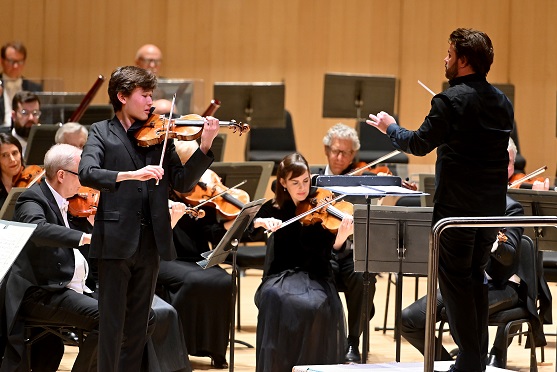
Simon Rivard leading the TSO and soloist Daniel Lozakovich (photo: Jag Gundu)

It’s not so much a matter of perfection, as indeed there were wrong notes, but come to think of it Horowitz sometimes did that too.

What we heard was a genuine virtuoso, not just in his skill but perhaps more importantly in his sense of drama. Phrases were begun with the kind of rhetorical flourish making everything seem especially new. I had the impression in the first movement of a kind of method actor coming at the solo from the inside, making it seem spontaneous and fresh, a series of responses to the orchestra pursuing a musical logic, and making the composition tight & organic.

resize_TchaikoJAG_0661

Lozakovich, Rivard & the TSO (photo: Jag Gundu)

In the second movement, when he’s in a kind of duet with the woodwinds, he actually turned to face them, a stunning moment of genuine theatricality, to suggest that they were listening to one another. Yes I think they really were doing so.

Lozakovich has several different sounds he gets from his violin. Sometimes he got a big sound, sometimes something extremely soft & subdued, as in the opening to the second movement. In his cadenzas he made them seem like complete thoughts, soliloquys leading to profound statements. For minutes at a time, he seemed to be shaping phrases as though to suggest a series of sentences or thoughts, building one upon the next.
Lozakovich was aided by conductor Simon Rivard, who stayed with the soloist in spite of some quirky shifts in tempo, all working well to illuminate Tchaikovsky.

I was surprised that there wasn’t a bigger reception, meaning enough to get an encore. The violin playing was superb, but there weren’t enough of us screaming our approval.

Bracketing the concerto were a pair of Tchaikovky works, his 1st Symphony and his well-known 1812 Overture in a reading from Rivard that was passionate in its restraint, refusing to rush anything, building inexorably to its big finish.  The TSO respond wonderfully to Rivard’s leadership.

While I liked Rivard’s reading of the Symphony there are other works one could wish for, such as the Manfred Symphony that I don’t think we’ve heard in Toronto in a long time.

Rivard did well with this early work that features some lovely melodies without the subtleties of orchestration or structure we might be accustomed to in the mature composer. At times we hear the gears shifting and the wheels turning, building gradually.

The program repeats Saturday night & Sunday afternoon. I recommend you go hear the young violinist if at all possible.  You won’t hear anything better.

Posted in Music and musicology, Reviews | Tagged , , , | Leave a comment

Questions about Melancholiac: the Music of Scott Walker

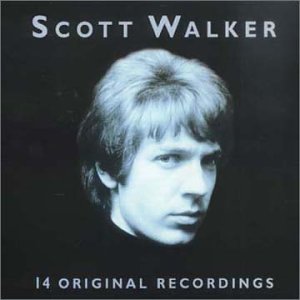
Long ago I stumbled upon Scott Walker, via a cassette with the hand-written inscription The Godlike Genius of Scott Walker.

I remember wondering: is this for real? What may have been at least part ironic self-mockery was upon closer inspection perhaps a statement with some truth. In fact the person who wrote the title on the cassette had truncated the name of the recording: which was twice as long…

amazon_record

Who is Scott Walker and how does he fare in Melancholiac? Interview questions are partly for the subjects, partly for me.  I seek to unpack the work of the artists, lobbing easy questions into their strike-zone in hopes that someone hits a self-promotional home-run. But I’m also asking questions out of genuine curiosity. Greg & Adam are remounting a work incubated at Summerworks four years ago that’s described on the Music Gallery website as “part concert, part spectacle, part existential talk-show”.

I’m looking forward to seeing it.

Walker is unusual, a unique sound, a voice, a persona. Melancholiac: the Music of Scott Walker is the brainchild of two admirers: Adam Paolozza & Gregory Oh and a large company of collaborators we’ll see and hear in three performances at the Music Gallery Dec 6th at 7:30, and Dec 7th at 4:00 and at 7:30.

And as we go through the interview I’ve interspersed a Scott Walker playlist curated by Adam.

Song #1 It’s Raining Today

barczablog: Whose idea / passion was this originally: did Gregory go find you, or did you find Gregory, OR did someone else originally conceive of this? What was the process that brought you two together?

ADAM: I tend to get obsessed with artists and after I watched the documentary about Scott in 2009 I became obsessed with him. I loved the music and I loved how he talks about his process. It reminded me of Samuel Beckett, one of my earliest art crushes. So, I had it in the back of my mind since then that I wanted to sing Scott’s songs in some performative setting eventually.

Then a few years later I met Greg at Soulpepper, I think, and we worked on a few cabaret shows there. Greg and I really got along and I pitched the idea of doing something about Walker to him. He listened to the music, really dug it, and that’s how it all began.
The current show, is very much a collaboration between Gregory and I. Greg really helped choose the songs, structure the evening, hired the arrangers and the band and he makes it all come together sonically. I brought in the singer/dancers and choreographer and staged it.

Adam singing melancoliac

Adam singing Melancholiac

barczablog : But it’s much more than the two of you. Please mention the names of the singers & players and anyone else involved… (besides the two of you)

RESIZED_swau11-photobydahliakatz-web-1610_20481456666_o

Some of the chorus members (photo: Dahlia Katz)

Chorus Members (they sing and move):
Kari Pederson
Eduardo DiMartino
Richard Mojica
Julianne Dransfield
Mandy Maclean
Joshua McFaul
Michael Keene
Neil Silcox
Nick DiGaetano
Saba Akhtar
Susanna Mackay
Marina Gwynne

Lighting Design: Andre Du Toit
Stage Manager: Dylan Tate-Howarth

Musicians:
Electric Bass: Matt Fong
Upright Bass: Adam Scime
Drums: Spencer Cole
Percussion: Dan Morphy
Guitar: Paul Kolinski
Leslie Ting: violin
Arlan Vriens: violin
Samuel Edwards: viola
Amahl Arulandandam: Cello
Lina Allemano: trumpet
David Quackenbush: horns
Shaun Mallinen: saxophones

RESIZED_swau11-photobydahliakatz-web-1559_20319583198_o

Patricia O’Callaghan (photo: Dahlia Katz)

Solo Singers:
Patricia O’Callaghan
John Millard
Alex Samaras
Matt Smith (aka Prince Nifty)

Song #2 Duchess from Scott 4

barczablog: Scott Walker sits on the fertile interface between popular music & serious music previously visited by people like Kurt Weill, David Bowie, David Byrne, Philip Glass, Tom Waits, and lots more. Who if anyone does he remind you of?

ADAM: His music doesn’t remind me too much of any of these musicians. His early stuff reminds me of a certain lush, orchestral 60’s sound that I loved as a child. But again, with an eerie atonal ambience. So, maybe he reminds me of some dissonant 20th century composers, like Ligeti. But his newer compositions are really sui generis. I guess if I had to compare him to anyone, I would use Samuel Beckett again. In the sense that they both pare things down to the essential and do their best to avoid cliché.

GREG: I would think of someone like John Oswald or Franz Liszt. Oswald because of his ability to knit together pop and post-classical forms, always with an awareness of person/place/context, and maintaining a genuine sense of self amidst creative kleptomania. Walker and Liszt were both “rock stars” and significant performers, and both had compositional careers that started with the hyper-popular and ended in under-appreciated innovation and eclecticism.

Song #3:Clara from The Drift

barczablog: How would you describe the style you’re using in the presentation? Concert? Or Cabaret?

ADAM: It’s an expressionistic style, inspired by cabaret for sure, that Greg Oh and I have developed over the years through projects like this and another recent collaboration, The Cave (which premiered at Luminato last year). It’s a hybrid musical-theatre form, without a plot per se, more like a concert punctuated with expressive dramatic sequences. The look and feel is also influenced by watching music videos from the 90’s and musical tv specials from the 60’s, like the BBC one Scott Walker had very briefly. Shows that had variety, dancing, singing, etc. We shamelessly reference that.

barczablog: Is the persona of Scott Walker the artist presented in your show, either as a character or a presence? I had the impression that the earlier version of the show divided the Walker persona among multiple performers a bit like the film about Bob Dylan I’m Not There.

ADAM The idea is to send a tribute to Scott beyond the grave, as he recently passed away. To evoke his presence. Sometimes we do this by physically playing him (a little like I’m Not There for sure, but it’s mostly me that plays him) and speaking words he spoke, but more often by evoking the sonic, emotional experience of Scott’s music, making it present in the space.

barczablog: Can you talk for a minute about the word “Melancholiac” and what it tells us about SW, what it tells us about the show, and maybe what it tells us about you (two), and your relationship to SW

ADAM: I’ve always been drawn to darker, more contemplative, uncompromising artists who explore the extremities of human experience. Again, that’s why I often think of Beckett when I think of Scott Walker.

In my own work I’ve been exploring the idea of melancholy through various shows over the last few years, like Italian Mime Suicide, Empire of Night and Paolozzapedia. It’s less about the sadness associated with melancholia. It’s more about approaching the art experience as a means to reflect on existential thoughts and feelings. More about finding and contemplating beauty in darker, denser things. And I think Scott’s music is definitely dark and dense. That’s why we named the show the way we did.

GREG Chronicle of a public executions? Check. Inevitable ephemerality and insignificance of love? Check. Life and times of a CIA torturer? Bing. Sadomasochism? Yup and yup. Dark funereal humour? It’s in there. Blood money of arms dealing? Selbstverständlich.

Song #4: The Electrician from Nite Flights

barczablog : Can we talk about influences, as in who you see influencing SW, perhaps what influences you’re allowing in how you approach Melancholiac. I am especially intrigued by some of the musical adaptations, which are a kind of modernist pop music, far more dissonant and daring in places than the original (and please let me know if you’re okay with me saying that… perhaps you don’t agree). But I think this treatment is ideal for the Music Gallery. I understand some of Walker’s late music was much more adventurous, edgy sounding: but I don’t know those songs. If you can point me to any examples (youtube or elsewhere) that might be useful too.

GREG: Not to pass the buck, but this Pitchfork article is quite good at achieving an understanding on just how wide the borders of Scott Walker’s music are.

ADAM Also, I would recommend the 2006 documentary 30 Century Man, that’s what introduced me to Scott Walker and it’s a fabulous documentary.

In most cases we’ve just tried to recreate the sound of Scott’s original arrangements, which are quite daring and dissonant, especially in the later stuff. That’s our biggest influence. What we’re doing isn’t so far removed from the recordings. The 60’s stuff we tried to just reproduce as best we can with what we’ve got.

But in some cases, I supposed we’ve transposed an idea, taking some license. Instead of having 10 guitars we have 10 shakers, for example, or we chant something chorally Scott originally sang. Or, when Walker has done something really unusual, like having a percussionist pound a side of raw beef, we’ve attempted a more vegetarian approach to the same effect. Still food based, of course!

barczablog: Walker died back in March of this year. How does that change how you understand him and this project?

ADAM It’s made me think more of the show being a message that we’re sending him. A send off, a love letter, an evocation.

GREG: In this culture, I see parallels between Scott Walker and Claude Vivier. Many of their compositions were so obviously obsessed with death, darkness and the afterlife. They told stories about murder, stabbings, executions, wars and the fatalities of social injustice. If I had to contrast their post-mortem narratives, Vivier was obsessed with predicting his own death, and perhaps Walker gave more thought to the cyclical nature of life, and wondering “what happens next”?

vivier_small

Claude Vivier

Perhaps because of this, my reading of the show didn’t really change, but I understand the show in a more nuanced way. Walker did have a very dark but subtle sense of humour, and I think his tune “30th Century Man” was both a witticism and a credo. Most classical composers strive to be of this century, but Walker, whether or not he succeeded, had his eyes on the next millennium. In my imagination, Walker endured the melancholy of life, having sampled and rejected the fruits of popular success, and in doing so freed himself to creatively explore anything and everything.

Song #5: Mathilde

barczablog What’s your favorite song of SW (if you can pick one)? One for each of you?

GREG: My favourite of Scott Walker’s is probably The Electrician. My favourite in the show is the cover of Mathilde, sung by Patricia O’Callaghan and arranged incredibly well by Bram Gielen.

ADAM: Ah! Impossible to pick but maybe I’d say The Electrician. That always gives me chills when I hear it.

barczablog: Do you have anyone you’d like to thank?

ADAM: Thank the Canada Council for the Arts, The Music Gallery, SummerWorks and In The Soil Festival for supporting early stages of the project. As well as the artists from earlier versions who can’t be with us this time around.

GREG: Thanks to Adam, without whom I never would have discovered the music of Scott Walker. Also, thanks to David Dacks and the Music Gallery.

*******

Melancholiac: the Music of Scott Walker is coming up Dec 6th at 7:30, Dec 7th at 4:00 and Dec 7th at 7:30: at the Music Gallery 918 Bathurst St., telephone 416.204.1080 (click for tickets).

Posted in Dance, theatre & musicals, Interviews, Music and musicology | Tagged , , , , , , | 2 Comments

Met HD Akhnaten

Yesterday I watched Philip Glass’s opera Akhnaten as presented in the Metropolitan Opera’s High Definition broadcast on a big screen in Scarborough, at the same time people were watching it in many places around the world.

I wish the Canadian Opera Company would undertake one of Glass’s operas, thinking especially of Akhnaten or Satyagraha. The works are written in many ways as a big blank slate inviting a director to interpret, to make something to fill broad swaths of music where the action is described in the most abstract terms.

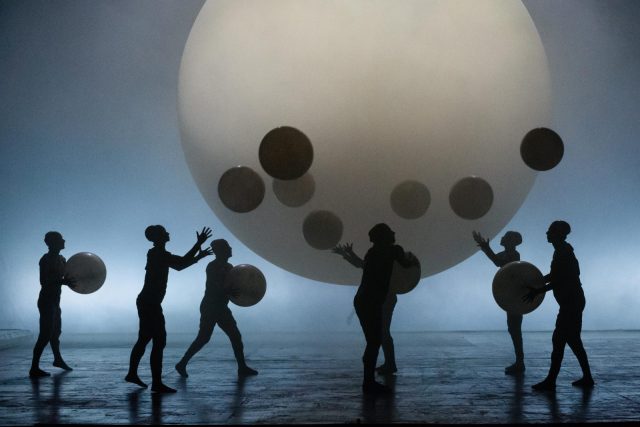
So for example in Phelim McDermott’s conception of Akhnaten the ball shape of the sun that is worshipped by Akhnaten (who is for a time leading a monotheistic culture that goes against the previous religion & culture) gets replicated onstage by jugglers tossing balls or later carrying larger balls. His design concept working with set designer Tom Pye is blessedly simple, often a powerful stage picture.

AKHNATENsc6-5-1600x1068

Set by Tom Pye, costume design by Kevin Pollard (Photo: Jane Hobson)

The action could just as easily be shown through dance or puppetry or projections, and one is free to employ as few or as many persons, moving as quickly as the sometimes frenetic music or more slowly.

The curious thing about Akhnaten and Satyagraha is that one can easily mistake the themes of one for those of the other.

  • Akhnaten shows us religion as a subject of political struggle and war
  • Satyagraha shows us political struggle against the backdrop of belief
  • Akhnaten seems to concern religion
  • Satyagraha seems to concern politics
  • But Akhnaten is very much about de facto existence, a series of historically existing texts including a prayer & a series of rituals of burial, coronation & marriage
  • But Satyagraha is very much about spirituality, a series of passages from the Bhagavad Gita, as though to illustrate the activities of Gandhi’s life through his religious subtext

I have found Satyagraha very powerful in every version I’ve seen as a spiritual document. I’ve found the two versions of Akhnaten that I’ve seen to be less about spirituality and much more about the predicament of a soul incarnated in a sometimes challenging world.

These two operas would make wonderful opportunities for the COC for the following reasons:

  • They showcase the orchestra & chorus (two strengths of the COC)
  • They don’t require star power to be sold, indeed the composer alone would help sell them. It might be possible to cast either show entirely from the members of the Ensemble Studio, although Akhnaten is played by that rare bird, the counter-tenor. But there are Canadian counter-tenors.
  •  They are visual treats, depending on what director were hired, but it’s a natural for someone like Robert Lepage, François Girard, la Fura dels Baus or indeed any director the COC has employed in the past.

There is interpretive room on the musical side too. Conductor Karen Kamensek made a number of fascinating departures from what we hear on the original CBS recording conducted by Dennis Russell Davies from 1990. Where the original often snarls, maximizing the brass & percussion, Kamensek’s reading goes for something far softer. Her choices likely make things easier for the singers & especially the players expected to still have lips at the end of the 2 + hours of playing. The chorus too have a totally different sound that I’d credit to both Kamensek & Donald Palumbo, the Met chorus master. It’s most divergent in a section that I’d happily identify as my favorite passage not only in Akhnaten but in all of Philip Glass, the funeral music of Amenhotep III.

Where the 1990 version is sung and maximized in volume, Kamensek & Palumbo make the chorus sound almost like rappers, as they pump out their consonants with little sustained sound on the vowels: making for a remarkably percussive effect matching the aggressive percussion in the orchestra. It’s wonderful to see the artists take advantage of the opportunity to interpret something original & new.

It was especially enjoyable after the recent Robert Wilson Turandot to see the Met chorus sometimes juggling or carrying balls alongside the troupe of jugglers.

It’s interesting after the Euridice story that I saw Friday with its preoccupation with the afterlife and with frustrations, that this too is a story concerned with the afterlife & with frustrations, both in the abrupt ending to Akhnaten’s monotheistic experiment in revolution & warfare (Act III scene ii) and in the final scene when the protagonists’ souls discover to their dismay (in the 20th century!) that OMG they’re dead.  I wish I could chat someday with Glass (who identifies himself as a Buddhist) about how he reconciles a work such as this one or Satyagraha with his own beliefs.

There are encore presentations scheduled for Saturday February 15, Monday Feb 17 & Sunday Feb 23rd . The live performances continue until Dec 7th at Lincoln Center in N.Y.

Posted in Music and musicology, Opera, Personal ruminations & essays, Politics, Reviews, Spirituality & Religion | Tagged , , , , , , , , , | Comments Off on Met HD Akhnaten

Oxymoronic Augmented Opera

I don’t use that word lightly, and it’s not an insult.

Some operas are oxymoronic, rife with contradiction, asymptotic in their fascination with impossibilities. Maeterlinck’s play Pelléas et Mélisande is the creation of a playwright who cringed in the presence of live performance, who said “something of Hamlet dies” in the theatre. Maeterlinck’s ideal was plays that you read rather than see enacted live; he also wrote marionette plays. And so it’s no wonder that Debussy’s setting is reticent to the point of self-effacement, without arias or any ostentation, the players standing like puppets in a series of short scenes. And in that contradiction –an anti-theatricality –we discover its beauty & Debussy’s achievement.

Or perhaps we can consider the various operas about Orpheus as he seeks to get back to his deceased love Euridice.  Does anyone ever tell the tale from her perspective? Aha, that’s what this one does.

Because tonight I saw the penultimate performance of Tapestry Opera’s latest version of their Tap EX series, flirting with the notion of virtual reality, an evening brimming with great ideas. As is so often the case with new work, I couldn’t help thinking that the idea on paper was better than what we experienced, perhaps because it’s not ready for prime-time, a series of parts needing a bit more work before it will be finished. There’s lots to admire, but it’s not quite there, yet.

What better way to experience something new than in a new place?

venue

Sidewalk Labs in Toronto

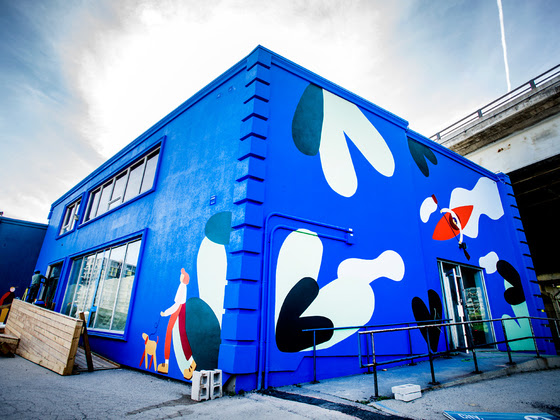
We came into Sidewalk Labs, located at the corner of Parliament & Lakeshore Blvd. The piece we were to see has a science fiction aspect to it, and so what could be better than to come to the edge of the world.

Did you know that’s a genre, stories about ”the edge of the world”? The corner of Parliament & Lakeshore definitely FEELS like the edge of the world, and is a brilliantly conceived location for the projects happening at Sidewalk Labs: a space investigating the socially conscious change & transformation of our city. Dare I say it, they knew that they were building this brilliant showcase of reinvention on the brink of all that’s wrong with Toronto. We’re under the Gardiner Expressway, a crumbling monstrosity that consumes many of the dollars we could use to redevelop our city.

Speaking of oxymorons, isn’t it remarkably funny that Sidewalk Labs sits in a place where one is almost afraid to walk on the sidewalk: with the cars whizzing by on  Lakeshore Blvd?  The Gardiner Expressway provides the lovely canopy overhead, in some ways the epitome of how we’ve messed up this city.

neighbourhood

To get to that beautiful blue building one must first dare to cross this expressway (Lakeshore Blvd) masquerading as a mere street. And there’s a real expressway overhead.

And isn’t it bizarre to note in passing that Toronto is becoming too expensive for artists at the beginning of their career. If you drive or take a cab, Sidewalk Labs is a great place to go to. I parked by the Distillery District, to see just how hard it is to walk there. It wasn’t bad other than my near-death experience with a cyclist. His idea of a horn was to twice say “whoops whoops” in that soft nerdy voice that signals a millennial; someone of my generation would scream a four letter word. But we didn’t die so perhaps I shouldn’t complain.

Someone had a brilliant idea. The opera begins and ends a bit like a dog and pony show, like a TED talk or one of those 30 minute ads you see on TV.  Before the opera we had a presentation from Sidewalk Labs to tell us about the venue. But more subtly, it served to frame the show as a dog n pony show within a dog n pony show.

Clever.

The music by Benton Roark was quite lovely in that noodly minimalist way we’ve heard since the time of Philip Glass (who’s on my mind because I’m seeing the broadcast of Akhnaten tomorrow).

Early on in the show we were advised that we might want to put on a mask to simulate the virtual reality of the opera: which was a clever idea. Would you call it a coup de theatre, or just a gimmick? I found it sensational in the way it made me listen to Roark’s creation and the words in the libretto (whereas a friend of mine thought it’s more of a radio play than an opera, because it was too static in his opinion). Forgive me I’m not sure whose words they sang, although perhaps it’s Tapestry Opera’s artistic director Michael Hidetoshi Mori and co-director Debi Wong, who are credited with the idea.

mask

Partway through we were encouraged to remove our masks. I liked it much better before I took off the mask. Yes the piece is static, not just because of the minimalist noodling (and please note Roark was setting the text pretty well as written, reflecting the lyricism in the words). It’s very poetic, more of a long lyrical song than an opera without much in the way of conflict or action. I wonder if that’s intentional? If you leave your mask on for the entire show chances are you won’t be as troubled by that. The text talks a lot about what is happening, rather than directly making something happen; so in other words, there’s little or no action, just words about things. Given that we’re in the realm of subjective experience that might be justifiable, but this didn’t work for me, as a depiction of what we were promised, which was a big luscious idea.

Imagine that we’re talking about the afterlife as a business proposition, where you create a virtual reality for eternity. Atheists could suddenly have a heaven. I’m reminded of Walt Disney’s version of immortality, where he was cryogenically preserved, hoping to be revived later (and there’s even an opera about it: whoops there’s that Glass fellow again). Such a reality is a plum of an idea for a composer & a librettist.

Except I didn’t think the libretto (at this point in its creation) lives up to this fabulous idea, as Roark did his best with what he was given.  Perhaps it will be better in its next revision, as it’s a work in progress.  Just as I’m inclined to credit Roark with the loveliness of his creation, so too the performances by Lauren Segal, mezzo-soprano, Vanessa Oude-Reimerink, soprano, and Lyndsay Promane, mezzo-soprano.  The voices blended beautifully at times hauntingly lyrical.  Whether or not you want to call it opera it’s a splendid hour of music.

But the story is in some ways about impossibilities & frustration, as Euridice (the main character) longs for something that she can’t have. I couldn’t decide if her frustration was with what she was shown in the virtual reality, or simply the normal dissatisfaction that seems to be fundamental to her character. She is after all the one who refuses to trust Orpheus and gets him to turn around and look, which kills her in those other versions of the story. So she’s never a happy camper in those operas either.

The show concludes Saturday at Sidewalk Labs.

Posted in Dance, theatre & musicals, Opera, Personal ruminations & essays, Politics, Reviews | Tagged , , , , , , , , , , , , , , , , | 1 Comment