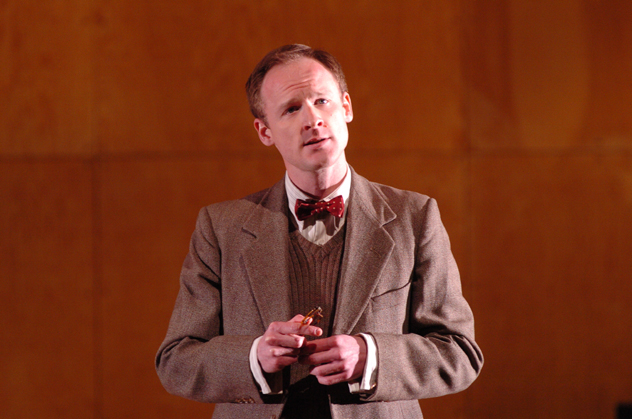
Elektra again

Today I had a second chance to see & hear the Canadian Opera Company’s Elektra at the Four Seasons Centre. It was so much better for me the second time, possibly because I was sitting closer. That first time (from a distance) I was quibbling with the stage picture & the directorial concept (which seemed to be at odds with the work), the way voices carried over the orchestra (sometimes not so well) and especially the one performer I singled out last time. In hindsight maybe what I thought I heard before was someone being careful? or fighting a cold? This time I saw and heard complete abandon & commitment putting any worries I had to rest.

18-19-03-MC-D-1074

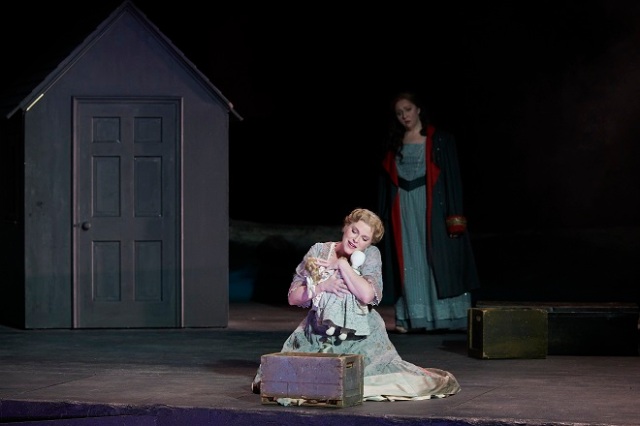
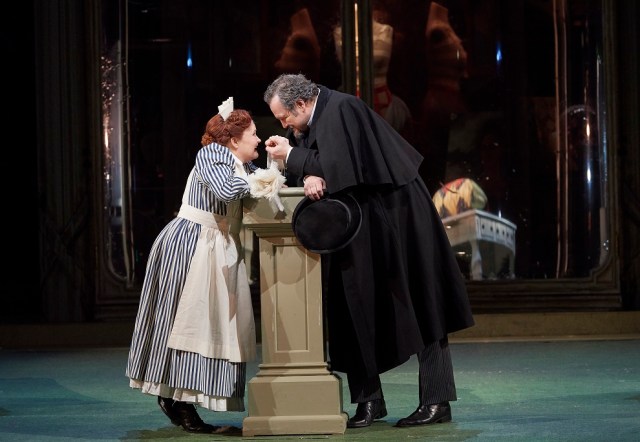
Elektra (Christine Goerke) welcomes Aegisth (Michael Schade) home. (photo: Michael Cooper)

Up close, the intensity of the performances swallowed us whole, as we were carried away both by the sounds of the orchestra—and the pleasures of watching Maestro Debus at work—as well as the high calibre of the singing. I still dislike the concept, but up close it doesn’t matter so much, not when the stars are in your face. Objections vanish when the music overpowers dramatic logic.

Last time I felt that Erin Wall’s Chrysothemis more or less made me forget everyone else sharing the stage. I was very moved by her personal drama (if you’ve not heard click here), thrilled to see her back with so much voice & presence. There was an authenticity to what she was doing that dwarfed everyone else. Today Christine Goerke was not just her peer, but the star of the show: as we would expect. I heard the kind of mastery from her today that we had experienced previously in the three seasons of Wagner. I recall the difference across the run of Götterdämmerung, from a fascinating but careful performance early in the run to something so confident as to have a kind of swagger to it. Similarly, her opening show seemed somewhat tentative, whereas today the portrayal was so much more fun, so much more complete. She was Elektra in other words.

18-19-03-MC-D-0279

Erin Wall as Chrysothemis (foreground) and Christine Goerke as Elektra in the Canadian Opera Company’s production of Elektra, 2019 (photo: Michael Cooper)

The stage was packed full of great singers, many of them Canadian. While Susan Bullock can sometimes sound wonderful I think she was miscast as Klytemnestra, upending the show for me. The role that needs to be the monster of ceremonies, the designated target of our hatred, was sometimes inaudible, sometimes seeming like a mom displeased with her child rather than an unrepentant killer. I am again speaking of the scale and intensity of the performance, which was fairly good by most standards. But as I said in my previous review I need to hate this character to go with the story’s flow: the ecstasy that can be felt in the score upon her murder. I don’t want to be pondering whether Orest & Elektra are bad people for killing her. It needs to be clear beyond question (or do you think this is a legitimate interpretive arc the director could take for the opera? in which case we’re not likely to agree).  She reminded me of Placido Domingo, the tenor without high-notes singing baritone roles, taking work away from capable baritones; please follow the analogy. Jill Grove was a tower of strength as the First Maid: but really could have been our Klytemnestra. No she’s not Canadian, she’s a Texan (in case you think I’m beating that drum again) and she was a fabulous Amneris a few years ago. But please excuse me, you may think I should just shut up and enjoy what’s in front of me. Michael Schade as Klytemnestra’s consort Aegisth was even funnier up close (drunkenly picking his nose and wiping his finger on his waistcoat!). And while Wilhelm Schwinghammer was a moving Orest, mostly because of the way Goerke made me care about him this time and not because of anything he did: yes I do wonder if a Canadian could have sung the part as well or better. Owen McCausland was wonderful in his brief role as a servant. The aforementioned Grove, Simona Genga, Lauren Segal, Tracy Cantin, Lauren Eberwein and Alexandra Loutsion gave the opera a strong start in the opening scene.

There’s one more performance on the 22nd that I expect to be even better. Misgivings or not, I’d suggest you see it if you can.  The orchestra and most of the singing are truly fabulous.

Posted in Opera, Reviews | Tagged , , , , , , , , , , , , , , | 1 Comment

Glimpses of The Eternal Feminine with Barbara Hannigan

When I posted that photo at lunch earlier today from last night’s Toronto Symphony concert, I joked that Barbara Hannigan is a precedent setter. Even so I understated what we saw & heard tonight.

reszied_Barbara Hannigan Sings & Conducts (@Jag Gundu)_1

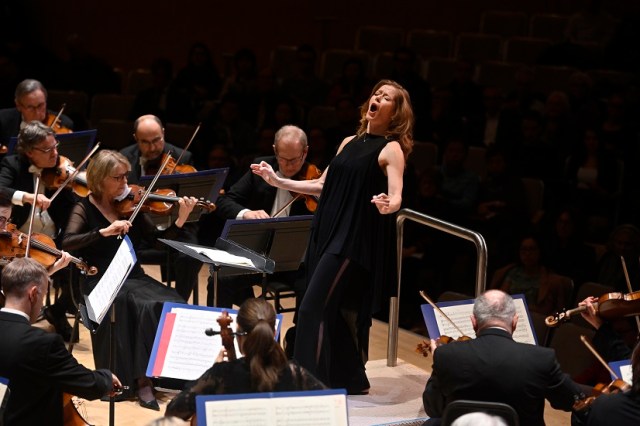
Soprano Barbara Hannigan, singing & conducting the Toronto Symphony. (photo: Jag Gundu)

With one exception, the five works we heard hang together as a carefully curated study touching in various ways upon the Ewig-weibliche, (or the “eternal feminine”), via Debussy, Sibelius, Berg, and Gershwin. In the middle the TSO presented a Haydn symphony that might have been that proverbial piece of bread to cleanse the palate, although my gosh it might have been the clearest cleanest Haydn I’d ever heard.

I hope the question of Barbara Hannigan’s ability as a conductor has by now been laid to rest. We ran the gamut of styles tonight, including several places where she didn’t just conduct ferociously difficult scores, but at times sang while conducting. Does anyone else do this? I can’t recall unless we’re talking about someone from a popular realm such as Cab Calloway (the first one who comes to mind). Alas classical criticism often is nothing more than a measurement of competence, how fast or how high they went as though singers & instrumentalists were in the Olympics. She must surely pass in that kind of mechanical critique, but please don’t expect me to make that kind of assessment.

I was too busy having fun, and that’s likely true of the orchestra as well.

And so there we were out on our Valentine’s Day date, watching and hearing works that in various ways seem relevant to the day. Debussy’s brief Syrinx began our evening, played by TSO principal flautist Kelly Zimba from a darkened auditorium seated among us in the mezzanine. The program note is longer than the piece, which is perhaps an indication that there was something more ambitious in mind than just a curtain raiser, pointing to the deeper meanings for the work. While Zimba played Debussy’s sinuous line Hannigan quietly entered in the dark through the orchestra. As the piece finished there was a brief pause before the downbeat to begin Sibelius’ Luonnotar, a work for soprano & orchestra.

As with the Debussy, we’re in the realm of a romantic music. This one tells a creation myth in a song that’s a kind of ur-folk music. This was the second of five pieces tonight that were 100% in Hannigan’s head, memorized not only for her role as conductor but also singing.  At times her voice soared, sometimes sighing softly through the gentle accompaniments. She seemed to emerge organically out of the middle of the orchestra, a wonderful symbiosis. You’d never persuade me that the orchestra didn’t love playing with her, from the way they responded to her at the podium throughout the evening.

After the interval came two pieces from roughly the same historical period, that took our study of the female in new directions. Again, I’m mindful of Hannigan the curator, bringing two unexpected voices together. Berg & Gershwin? It’s nowhere near as odd as that might sound when you think about it.   Hannigan’s is the prettiest sounding Berg (Suite from Lulu) I think I’ve ever heard. No really. The internal voices came through with great delicacy, the powerful brass statements dramatic for their contrast, emerging out of soft textures.  While the ensemble is enormous, she resisted the temptation to be loud by default. And this Gershwin is of course an arrangement that plays up similarities, while pushing the most modern of his impulses. After hearing Hannigan singing Lulu & a little bit of Geschwitz, she sang three songs from Girl Crazy in a recent arrangement by Bill Elliott, designed to be heard alongside the Lulu Suite. For the Gershwin the voice was amplified, but the conducting was still very challenging, as Elliott sometimes threw in some odd time-signatures and dissonances. That’s the edgiest Gershwin I’ve ever heard: and it was thrilling.  Hannigan’s conclusion brought the audience to a stirring ovation at the end.

resized_Barbara Hannigan_4 (@Jag Gundu)

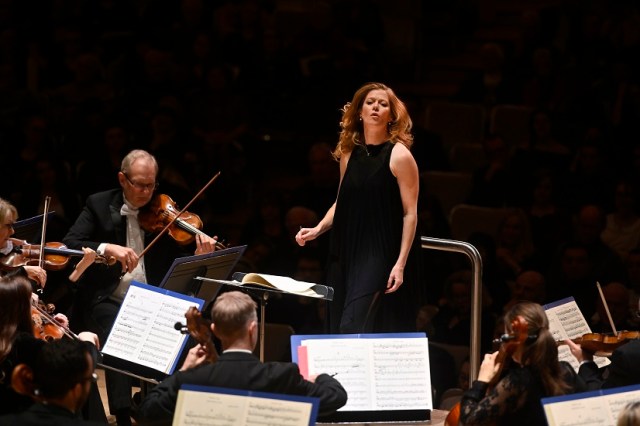
Barbara Hannigan leading the TSO (photo: Jag Gundu)

And now I hope she makes a recording of this repertoire. I need to hear it again.

Tomorrow the TSO switch gears, as Casablanca moves into Roy Thomson Hall. The ongoing film with live orchestra series appears to be a huge success.

Posted in Music and musicology, Opera, Reviews | Tagged , , , , , , , , | 3 Comments

Barbara Hannigan on Valentine’s Day

Happy Valentine’s Day.

Tonight I’ll be listening to the Toronto Symphony celebrate the day under the leadership of Barbara Hannigan, who will also be singing.

reszied_Barbara Hannigan Sings & Conducts (@Jag Gundu)_1

Soprano Barbara Hannigan, singing & conducting the Toronto Symphony. (photo: Jag Gundu)

Here’s the program:

Debussy: Syrinx for solo flute [3′]
Sibelius: Luonnotar for Soprano and Orchestra [10′]
Haydn: Symphony No. 86 [26′]

Intermission

Berg: Suite from Lulu [32′]
Gershwin/arr. Bill Elliot: Suite from Girl Crazy [13′]

Has anyone ever conducted the Berg suite from Lulu, who has also SUNG the title role in the opera?? That’s quite a unique feat, when you recall how few women conductors there are.
I wonder, has anyone before Hannigan ever sung Luonnotar and conducted it as well? It’s all in the service of art, not to just be the first. But in passing one can’t help noticing that she is indeed a setter of precedents.
We’re on two sides of Valentine’s Day with the Berg & the Gershwin.  Berg in some ways is very true to the real St Valentine, if we think of the martyrdom and violence in his life story.
And if that’s too crazy for you, Gershwin lets us off easy to end the evening.
Posted in Music and musicology, Personal ruminations & essays, Popular music & culture | Tagged , , , , , | 1 Comment

COC fan tutte

Is it really five years ago? Time flies. In January 2014 Atom Egoyan’s production of Mozart’s Cosi fan tutte had its premiere with the Canadian Opera Company.  I looked back at what I wrote and –after having seen the revival of the production tonight – I wonder. Did I get it wrong? I wrote a lot of very serious language, about the Frida Kahlo painting that at times dominates the stage picture, and about the politics of the production. If the 2019 version of myself could talk to the guy from five years ago I’d tell my younger self to lighten up.

works_2fridas[1]

Frida Kahlo’s painting Two Fridas.

Watching it tonight I laughed a lot. Now let me be clear, Mozart’s comedy is among his darkest works even without Egoyan’s reading, which simply lays the subtext bare. There’s no distortion of what’s in the score.

What I can’t decide is whether tonight’s cast has made this more fun, or if I was simply a pretentious bore in 2014, who missed all the fun that was there 5 years ago.

But never mind.

There’s a great deal of beautiful music in this opera. The COC orchestra sound splendid under conductor Bernard Labadie, tight & clean throughout. A couple of times he left singers in his wake, something I recall when he conducted a COC Magic Flute.  Things did move along swiftly.

There are six soloists in this jewel of an opera, and there’s nowhere to hide. Everyone has their moment, although there’s also a great deal of ensemble singing, while a story must be told in Egoyan’s modern take on da Ponte’s cautionary tale of love & romance. Subtitled “The school for lovers” by the librettist, the romance is a lesson on love. It’s not precisely Hook Up.

18-19-04-MC-D-1520

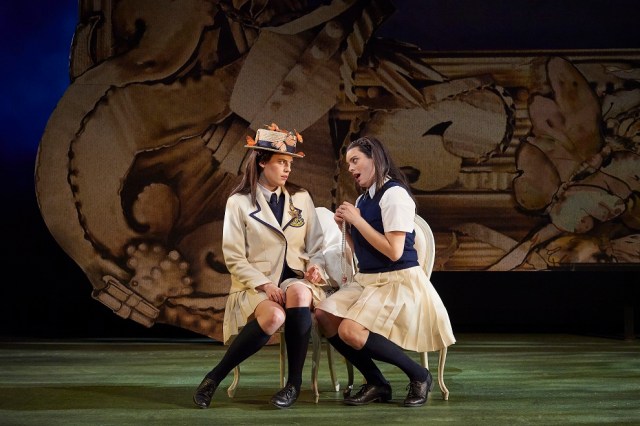
(l-r) Kirsten MacKinnon as Fiordiligi & Emily D’Angelo as Dorabella (photo: Michael Cooper)

In spite of the serious images of bleeding hearts via Frida Kahlo’s The Two Fridas (1939) Egoyan and Associate Director Marilyn Gronsdal have turned the performers loose to be really funny, especially the women: Emily D’Angelo (Dorabella), Kirsten MacKinnon (Fiordiligi) and Tracy Dahl (Despina). Or maybe it’s just that last time they seemed to be the focus of meaning, and appear to be free this time to be much more playful.

The chorus too seemed to be involved in a much more enjoyable exercise (they’re much busier than you would expect from looking at the score!), alongside Russell Braun, their teacher in the “School.” Ah yes I wonder if he’s the key this time? Last time Sir Thomas Allen may have lent the whole thing a gravitas that took it to another place entirely from what Egoyan or da Ponte may have wanted. Braun seemed a whole lot more fun. Does that sound crazy, to be knocking Sir Thomas Allen? But I only know that it felt way more pompous last time, more light-hearted this time.

18-19-04-MC-D-0536

Tracy Dahl as Despina & Russell Braun as Don Alfonso (photo: Michael Cooper)

Which isn’t to say that the ending is happy. No, I think we’re very much in tune with the text, but this time it felt genuine and connected to what went before. In 2014 I saw it twice and it just felt long and ponderous. This time –perhaps with credit to Labadie’s pace—it moves more like a comedy, dark though the ending might be.

Where last time Tracy Dahl (the sole hold-over from 2014) was the occasion for the first smile to cross my face when she appeared, and the star of that show, this time it was different, as Braun and the two sisters gave us some laughs too. MacKinnon sang beautifully. D’Angelo is an exciting performer with genuine star quality, that she’ll bring to Rosina next season. Ben Bliss (Ferrando) and Johannes Kammler (Guglielmo) were also quite lovely to listen to, although their roles in the comedy are less pointed in Egoyan’s interpretation.

Cosi fan tutte continues until Feb 23rd at the Four Seasons Centre.

Posted in Personal ruminations & essays | Tagged , , , , , , , , , | 1 Comment

The Adaptation of Prince Hamlet

Do you ever need a tragedy? Sometimes I think we can be so burdened by the troubles of our own lives and the stories we hear from others, that we hunger for catharsis. I can’t be objective about the show I saw tonight, because I was starving for something, overwhelmed by the firestorm I started this week, by so many emotional people coming to me and sharing their stories. All I know is that tonight I cried in several places, laughed in several others, and came out feeling as refreshed as if I’d had a workout and a long hot shower, cleansed and refreshed and energized.

players

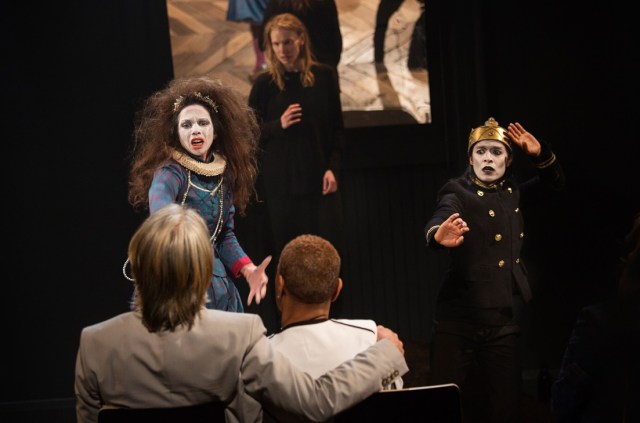
Player Queen-Hannah Miller, Player King- Miriam Fernandes, Christine Horne as Hamlet upstage, Rick Roberts & Karen Robinson watch the show (photo: Bronwen Sharp)

Prince Hamlet is an adaptation of Shakespeare’s tragedy from Why Not Theatre, at the Berkeley St space of Canadian Stage. It’s been seen before, but I missed it last time, and now I see why it was so celebrated.  My admiration is combined with a need to understand, perhaps a bit like the drinker trying to replicate the deliciousness that permeates the taste buds and haunts the memory.

Opera lovers know this feeling, when you’ve come to a familiar work and see something that’s close enough to the original to allow you to see through it, seeing what’s overlaid decorating and embellishing the framework we need to recognize the story. I can’t decide what’s more enticing, between the moments when we get the parts we know, such as “to be or not to be” or the places where we’re denied the expected line and get something just a bit different, as in the final speech.

It’s a team effort, and so I want to be certain I give credit, as there’s much credit to be shared. Ravi Jain is the adapter & director. Dawn Jani Birley is credited as ASL & Visual translation, as well as playing the role of Horatio. Now you must imagine if you will, that you’re getting Hamlet in two languages: English but also American Sign Language. When I first heard of this my head cocked at a funny angle, like one of those dogs who doesn’t understand his master’s directions. I wondered what this could be like.

The reason I put the preamble on there about how much I needed this and how perfectly it filled me up and made me laugh and cry is necessary, because I want to calibrate my response. Is this really the best thing I’ve seen this year? Maybe.  Or am I just raw and emotional from this week? I think, though that yes, it really is that good, that I was just lucky, like a hungry guy stumbling upon a really great restaurant in his moment of hunger.

And so at times we are in a realm that seems genuinely operatic. There’s a tiny bit of music from Thomas Ryder Payne, that is often subliminal or barely noticeable –except of course to musicians or nerds like myself—adding a wonderful depth to the proceedings. But when I speak of this as operatic I mean in the sense of the broadening of emotions that we get with opera. We’re in the presence of big ideas and big emotions, on a stage where nothing is really held back, where several performers grab the stage and make the most of their moment. I’ve seen quite a few Hamlets in the past few years, and this one is by far the most successful precisely because it’s an adaptation, a departure from the original into something else: allowing every character to have their perfect moment.

hamlet

Christine Horne (photo: Bronwen Sharp)

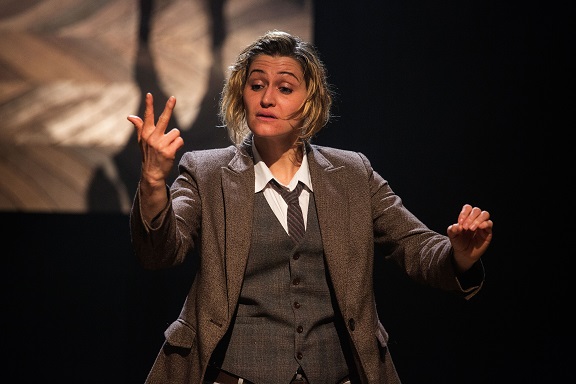
I can’t decide who I like better between Christine Horne’s Hamlet and Birley’s ASL Horatio. I think I am blown away with admiration for Horne’s work, while I love what Birley did –and I say that with a quaver in my voice like someone who is heart-broken that I can’t stay in that place where she took me tonight, beautiful beyond words.

horatio

Dawn Jani Birley (photo: Bronwen Sharp)

This is a very energetic passionate Hamlet. Because of the ASL we’re in a very meta-theatrical place, automatically in a show within a show, due to the omnipresent mediation efforts of Birley: although I think everyone in the show does some ASL as part of their performance. It really is bilingual. Yet we’re not in a rhetorically Shakespearean place, no sense of set-pieces, of structure and fights and artifice. For one reason or another –that I’ll attempt to figure out as I ponder the show—everything moves with fluidity. I guess that’s Jain’s adaptation, brilliantly seguing from scene to scene without much ado, with little effort.

Several moments in the show represent original treatments of parts of Hamlet, that I need to approach gingerly so as to avoid being a spoiler (although many of you must have seen it when it was done last time). I don’t like it when a critic ruins something by doing the lazy thing and describing what they saw, and in the process sucking the energy out of it by helping the audience know what to expect.

“To be or not to be” is unlike any I’ve encountered. When it erupts out of its scene it is the most natural and organic version, not least because Horne propels it right into our faces. I started to cry as I wondered about a young woman pondering suicide.  I perceived her as a woman playing Prince Hamlet, so at this point relatively early in the show, I still perceived her as female… later? The gender seems to vanish.  It’s not like any reading of the speech I’ve ever found. Compelling, urgent, and not at all like a soliloquy but rather like a seamless part of the play. Wow. And yes Horne is so good, delivering zillions of lines (it’s a huge part) without any sign of effort and then on top of that she’s also signing much of her part as well.

But just when you thought I was going to tell you how huge her part is, well I must talk about Birley, who is signing throughout, sometimes in response, sometimes? Venturing into something else like interpretative dance. Or so it seemed. There are places where the English lines are missing but because we know so much of the play, it doesn’t matter.
It’s so beautiful, pardon me I’m stunned, a Hamlet like no other. Forgive me, I’m trying desperately to find words for something so sublime and so beautiful.

claudius_solil

From left: Dawn Jani Birley, Rick Roberts and Christine Horne (photo: Bronwen Sharp)

But there were laughs too. At times the ASL allows members of the cast to suddenly retreat into something that’s not English, a game that Hamlet plays a couple of times as part of his madness. We are in a realm where comprehension might be a struggle. Is that really a ghost? What does that mean for the life one is leading? Language fails in the presence of such questions. We watch Hamlet investigate the meaning of life and later, watch Claudius soliloquizing about prayer before a mirror (whereby we see his struggle): the most poignant and powerful version of that speech I’ve ever seen; thank you Rick Roberts for making me cry. We see the most playful & enjoyable gravedigger of Miriam Fernandes , setting up some wonderful & poignant moments. We don’t need a skull to be confronted with the mortality of Yorick, nor by implication, that of Hamlet, Laertes or Ophelia. I am a sucker for Laertes’s passion, especially vulnerable in the portrayal of Khadijah Roberts—Abdullah, another moment when I was blind-sided by tears.

And Birley totally destroyed me at the end.

Prince Hamlet continues until February 24th at Berkeley St Theatre.

Posted in Dance, theatre & musicals, Reviews | Tagged , , , , , , , , , , , | 3 Comments

The case for a Canadian Opera Company

Monday night the Canadian Opera Company held their “Season Reveal,” a dramatic presentation whereby subscribers & guests were treated to a combination of announcements, musical performances & CGI to tell us the six operas coming in the 2019-2020 season. In the lobby of the Four Seasons Centre afterwards, on social media, in conversation, I heard comments pro & con in response to the announcement.  This long diatribe responds to some of those comments.

The COC announced plans to stage six operas. There are three new productions:

  • Puccini’s Turandot, directed by Robert Wilson
  • Dvořák’s Rusalka directed by David McVicar
  • Humperdinck’s Hansel & Gretel directed by Joel Ivany

In addition the COC offers 3 revivals:

  • Rossini’s The Barber of Seville directed by Joan Font
  • Verdi’s Aida directed by Tim Albery
  • Wagner’s The Flying Dutchman directed by Christopher Alden

I am especially excited about the three new productions (especially Robert Wilson), not so excited by the other three. While I really love the Font Barber we saw it quite recently. I am conflicted about the Aida and Dutchman, a pair of productions where the director / designer seem to be fighting the score, whereas Font’s exuberant Barber enhances and enlarges the work. I admire the theatricality of Font & his team.

Let me get to the reason for the headline, and excuse me if I seem to be repeating myself as I ask a series of questions. I think of myself as being out of step with the mainstream and with my fellow critics & bloggers, who likely don’t have the same perspective as mine.  Is the main objective of a company to present the best work possible, or are there other concerns? In addition to solvency I propose a nationalistic objective for the COC, one that I’ve heard muttered in passing but never articulated as a guiding principle.

First let me talk about the season, then we’ll get to the argument.

First in Turandot:
The part of Turandot is played by Tamara Wilson (wonderful singer) double with Marjorie Owens. Calaf is sung by Sergey Skorokhodov and Kamen Chanev. Liù is sung by Joyce El-Khoury (a Canadian) and Vanessa Vasquez. Timur is sung by Stefan Kocan. Ping is sung by Adrian Timpau, Pang by Julius Ahn, Pong by Joseph Hu. The Mandarin is sung by Joel Allison (a Canadian). The Prince of Persia is sung by Matthew Cairns (a Canadian).
Why are imports singing Ping, Pang & Pong? Why is Timur an import? I can think of Canadians who can sing these parts.

Next, in Rusalka:
Rusalka is Sondra Radvanovsky (Canadian resident and amazing singer). Vodnik is Matthew Rose and Stefan Kocan. I saw Canadian Robert Pomakov sing an excellent Vodnik in Montreal a few years ago. Ježibaba is Elena Manistina, Prince is Pavel Černoch, Foreign Princess is Keri Alkema (a singer I admire). First Wood Nymph is Anna-Sophie Neher (Canadian), Second Wood Nymph is Jamie Groote (Canadian), Third Wood Nymph is Lauren Segal (Canadian), Gamekeeper is Matthew Cairns (Canadian), and the Hunter is Vartan Gabrielian (Canadian).

Seeing a pattern yet? There’s a word for this. Insulting? Colonial? I recall from my childhood the way Canada was spoken of as a wasteland, indeed I recall New Yorkers arrogantly dismissing the COC in the 1990s when we were at times doing far more adventurous things than they: except they didn’t know it.

Let me continue.

For Barber of Seville:
Figaro is Vito Priante, Rosina is Emily D’Angelo (a Canadian), Almaviva, Santiago Ballerini, Bartolo Renato Girolami, Basilio, Brandon Cedel, Berta, Simona Genga (a Canadian), Fiorello Joel Allison (Canadian), Officer, Vartan Gabrielian (Canadian).

For Hansel and Gretel the pattern changes:
Hansel is Emily Fons, the lone foreigner, Gretel is Simone Osborne (Canadian), Peter is Russell Braun (Canadian), Gertrude is Krisztina Szabó (Canadian) and The Witch is Michael Colvin (Canadian).

And then we’re back to that funny pattern again for Aida:
Aida is Tamara Wilson (wonderful) Radames is Russell Thomas (wonderful), Amneris is Clémentine Margaine (especially wonderful), Amonasro is Roland Wood, Ramfis, Goderdzi Janelidze, King of Egypt, Richard Wiegold, The Messenger is Matthew Cairns (Canadian), the Priestess Simona Genga (Canadian).

And for Flying Dutchman, again:
The Dutchman Vitalij Kowaljow, Senta Marjorie Owens, Daland Dmitry Ulyanov, The Steersman Miles Mykkanen, Mary Ewa Płonka, Erik Michael Schade (Canadian)

If the only Canadian singers were graduates from the Ensemble Studio –and in case you’re wondering, there are lots and lots of good singers who either failed to get into the Studio or didn’t even try—even then, there are loads and loads of talented singers to choose from who can sing those roles sung by foreigners.

Are the Canadians more expensive than the foreigners being hired? OR in other words, is the COC saving money by bringing in non-Canadians to sing the King of Egypt, Amonasro or Mary or the Steuermann (we heard the hardest part of the role sung by Owen McCausland–a Canadian– Monday night  by the way) or Don Basilio (sung by Canadian Robert Gleadow last time)? No, I’d think that in fact the Canadians are likely cheaper.

Are the Canadians as good as the foreigners? That depends on who you hire. For some roles you must go with the import. But there are good Canadians, without question. They’re singing all across the country with other opera companies, and even in Europe.
I bring this up because after a few excellent and encouraging seasons when I thought the COC was becoming more Canadian in its casting protocol, this season appears to be a big step backwards. For some roles the imports are great. I love Russell Thomas & Tamara Wilson. But while I am sure Roland Wood will be capable, I also like Canadians James Westman or Neil Craighead (who are merely the first two I thought of, as I am sure there are others who can sing the role). I don’t know the man singing Figaro this time but we did well with Joshua Hopkins last time (as well as Gordon Bintner & Andrew Haji in the ensemble cast). If you’re bringing in exceptional stars, all well and good that they be foreign imports. For other secondary roles such as Ping, Pang & Pong, Mary in Dutchman, Daland, the Steurmann…? Why hire foreigners for the small parts?

Now in fact there are Americans I really like that haven’t been back after impressive appearances. First and foremost was Kelly Kaduce, an amazing Butterfly, who sang Rusalka in Montreal, possibly the finest actor I’ve seen in an opera in the past decade. And in NY I saw Adam Klein sing Loge in Lepage’s Das Rheingold, adept at the wall-walking required of the role, and a spectacular actor. And then there’s Keri Alkema and Tamara Wilson and Russell Thomas, three amazing talents we will see next year. If they must bring in an American please let it be someone like these three, or the other two I mention.

But pardon me, there are literally tons of good Canadian singers. We make great hockey players and comedians and curlers in this country, and also opera singers. Per capita we’re an amazing place for opera & music. Some of these singers are making a huge impact abroad. I will come back to this in a moment.

But there are two related things to observe.
1) America is not as open as it once was. Was it ever open? Canadians have reported being shut out from the US organizations / companies whereas the doors were open before: at least for chorus and comprimario roles. Whether it’s Mr Trump’s impact, or perhaps he’s just a pretense, this is not a level playing field, not nearly, when –as far as we can tell—the COC appears to prefer imports.
2) I heard long ago that the COC actually has a charter. Maybe it doesn’t mean much? But it allegedly says that the COC is to hire Canadians whenever possible, to provide work & training for them. While the COC’s Ensemble Studio does serve a huge role in this: they’re essentially cheap labour who are cut loose after their brief term is over. It’s great training, to be sure: but there’s little sign of a commitment to casting Canadians: especially in this coming season’s offerings. I remember Berta from the last Barber, sung by Aviva Fortunata (a voice I miss).

So Canadians are allowed to sing the Prince of Persia—who sings one loud pathetic bleat of “Turandot” —before he gets his head chopped off.

neefLR_SamGaetz

Alexander Neef (Photo: Gaetz Photography)

Ha after writing this maybe COC Artistic Director Alexander Neef will offer me the role! Chop BARCZA’s head off! But also, what about David Pomeroy as Calaf? Or James Westman as Ping? Or any number of Canadian tenors as Pang or Pong? I saw Ryan Harper sing a splendid Ferrando in a Cosi fan tutte several years ago, why must they bring in an American yet again..?

As I was saying there are really a lot of talented singers out there, young and old. If you simply think back you can remember lots of people as I did without really searching, just remembering recent conversations on Facebook. I miss Virginia Hatfield, formerly of the ensemble studio (I saw her on social media yesterday). Rebecca Caine is a wonderful performer & singer (I’m a fan). This is me brain-storming now, btw. There are so many performers I could name, famous and not so famous. I have to return my Onegin score to the library which has English text (so I sing not “kuda kuda” but “oh where oh where”….), that reminds me of Natalya Gennadi who not only sings beautifully but could coach me on my Russian. Someday perhaps we’ll hear Vasilisa Atanackovic, a wonderful young talent. There’s Lance Ryan, the helden-tenor seen in a DVD of Les Troyens, making a big splash in Europe. But Ryan Harper (haha see the word-association?) is also a very good tenor, who appeared in Peter Brook’s La Tragédie de Carmen directed by Alaina Viau, opposite Cassandra Warner. I haven’t seen Warner lately, and it breaks my heart that Harper isn’t singing so much, as there’s not enough work. It’s not because of a lack of talent. There really isn’t enough work for everyone but it’s exacerbated if the small parts are given to foreign performers. And yes there are many brilliant Canadian directors. I’m still impressed by the prescience Alexander Neef showed in hiring Peter Hinton for Louis Riel. And there are many other Canadian directors. Alaina Viau, Ken Gass, Aria Umezawa..? Pardon me, there are so so many. If that COC charter means anything the company should begin with the aim to cast and run its shows 100% with Canadians onstage & backstage at least as a goal. Yes we do need stars to come in especially if no one from Canada can sing the role. By all means bring in a Christine Goerke, a Russell Thomas, a Tamara Wilson. They’re wonderful. I loved Tamara’s work in Die Fledermaus a few years ago opposite Ambur Braid, who alas is missing this year after being the best thing about Hadrian. I think of that Falstaff with Gerald Finley (a great Canadian artist), alongside so many other talents, including Russell Braun, Simone Osborne, Marie-Nicole Lemieux, Colin Ainsworth and Robert Gleadow: all Canadians. Yes we’re seeing Braun & Osborne this year, but not Lemieux, Ainsworth nor Gleadow. I miss Geoffrey Sirett , not just the star of The Overcoat, but a most intriguing presence onstage in a tiny role during Arabella last year. Sirett is a curious demonstration of what a mature performer can bring to the COC stage. The Ensemble Studio performers are usually too young to have much gravitas on stage, which is fixed when you have a complete performer such as Sirrett or for that matter Ryan Harper, who is a gifted actor.

And later this year things will change if Andrew Scheer replaces Justin Trudeau as Prime Minister. No I don’t mean that Scheer will come see an opera and sneer at Regietheater or talk about artistic elites and their wine the way Mr Harper did (I’ve blacked it out… feel free to correct me on the precise quote… but I prefer to forget him altogether). As with Stephen Harper the support for the arts will dwindle. The CBC will be cut and the Canada Council will be cut. I am surprised that the arts organizations haven’t asked these tough question of the COC, to insist that the money be spent in ways relevant to Canadian tax-payers.

Meanwhile there are other opera companies. Marshall Pynkoski and David Fallis at Opera Atelier put on a first class show that is above all Canadian. Ditto for Joel Ivany and Topher Mokrzewski at Against the Grain. You donors who might be reading could consider whether the company you’re supporting is helping your country & its artists. This season is all very well, but is the company building for the future? And the granting agencies could make things a little tougher for companies such as the COC by asking them to be true to their charter, loyal to the taxpayer.

Later this week I’m looking forward to seeing Canadians onstage in Cosi fan tutte at the Four Seasons Centre: Tracy Dahl, Kirsten MacKinnon, Russell Braun & Emily D’angelo (the latter two so spectacular Monday in a duet from the Barber of Seville, I can’t wait to see them in Mozart this time).

Meanwhile in the background is the conversation at home about our COC subscription renewal. She loves Turandot and she’s a big fan of Joel Ivany & Against the Grain, so she’ll certainly want to see Hansel & Gretel. For her there’s no big interest in Wagner, while Aida without elephants or ancient Egypt is an oddity. And yet the COC is still a great night out.  Of course we’ll renew.

But wouldn’t it be interesting if there were more Canadians up there onstage..? One can only hope.

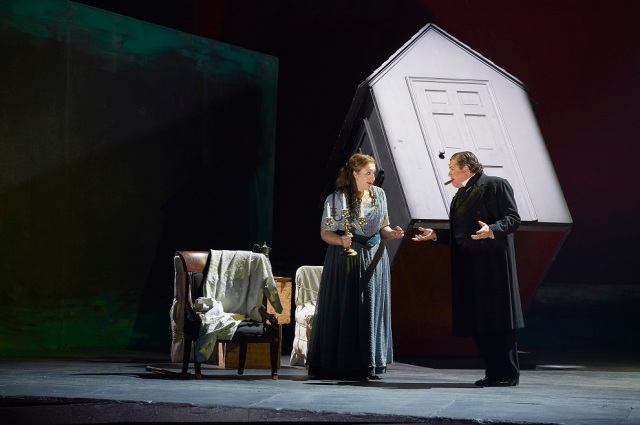
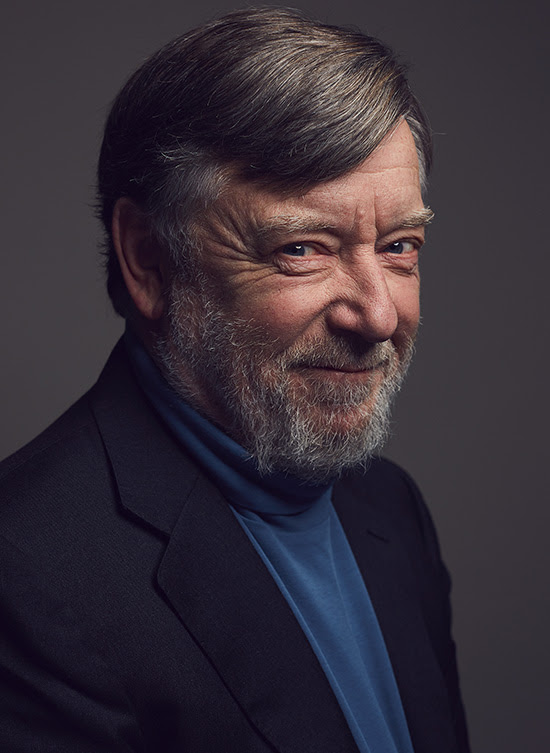
Posted in Opera, Personal ruminations & essays | 19 Comments

Fierabras in concert

Voicebox /Opera in Concert offered a highlight in a splendid week of music theatre in Toronto, reminding us of why they are such a crucial part of the mix in this city with their concert performance of Schubert’s Fierabras today.  Hook Up from Tapestry at Passe Muraille  was a brand-new musical, and then the Wagner done by the Toronto Symphony  gave us some amazing voices with the playing from the TSO. But this was a chance to hear a genuine rarity, done with wonderful care & some tremendous singing.

Like Beethoven, Franz Schubert was a transitional composer from the classical to the romantic, known for several different types of music. While Schubert wrote many more operas (the number could be as high as 20) than Beethoven (who composed but one), none of Schubert’s are ever staged, unlike Fidelio, Beethoven’s single operatic masterpiece. I’m very grateful to Guillermo Silva-Marin, OiC’s Artistic Director for programming this gem, full of beautiful music that we’ll probably never hear again.

KevinMallon-224x300

Conductor Kevin Mallon

Kevin Mallon conducted the ten players of Aradia in his arrangement of the work, adding a movement from the Schubert Octet as overture. I’m clear as to why Schubert’s operas aren’t performed: at least if they’re like this one, thanks to what we heard today. I don’t think I can possibly calibrate the importance of Mallon’s input except to say that he made the entire thing possible.

It’s very challenging music, especially for the men. If we hadn’t been in the welcoming acoustic of the Jane Mallett Theatre (which seats fewer than 500), and if Mallon hadn’t orchestrated for such a small ensemble, it would have been brutal in a bigger theatre with a big orchestra. And it gets worse…(!) Even as it was, I had the distinct impression that Schubert’s idea of opera if very different from that of any other composer. The men are often above the passagio (the transition zone of the vocal registers), or in other words at times it’s very tough. There is a huge amount of choral writing in this opera, so in addition to a number of extraordinarily difficult roles for the men –already the likely deal-breaker for a company considering the work—the men’s choral writing is relentlessly difficult. The women’s chorus have a fair bit to do as well, but not as murderous. Robert Cooper, the OiC Chorus’s Director did a masterful job preparing them. Did I mention that the plot is very complex? I heard more than a few in attendance joking about the challenges of following the story. So in other words, there are several good reasons why one never hears this Schubert opera even though the music is stunningly beautiful.

I’m not sure who had the toughest role, only that I was staring in disbelief more than once. Lance Wiliford –the co-artistic director of Canadian-Art Song Project and therefore a singer we’d expect to be comfortable with Schubert’s song rep—gave a textbook demonstration of perfect technique, handling a considerable number of high notes with apparent ease. Matthew Dalen with a heavier sound than Wiliford’s also soared impressively in the title role.

Wiliford

Tenor Lawrence (Lance) Wiliford (photo: Aldeburgh Music, UK)

In this story conflating tales of romantic love and wars of conquest, the testosterone on the stage was unmistakeable.  Much of the baritone writing resembled what Beethoven created for the tyrant Pizarro, which is to say quick macho declamation that wasn’t terribly pretty to hear nor very believable dramatically. Evan Korbut, Alex Dobson & Justin Welsh all had their masculine moments, although by the end some lines were so melodramatic as to give the audience the giggles. The two contrasting female leads were both wonderfully well-sung. Where Amy Moodie’s sound had the lightness and deft accuracy of a coloratura role –but without the coloratura—Jocelyn Fralick had a more dramatic sound, as well as one of the few staged moments in the opera, when she’s required to pass out on the stage (done quite believably).

The funny thing that occurred to me watching all these people in formal attire was how much more believable that made it than had it been costumed. Silly and tangled as the plot was, imagining it sung with knights in armour made me wonder how it would have looked in the time (although the opera never made it to the stage during the composer’s short life). The tuxedoes served to reconcile the extremes of plot –warfare & romance—in a curiously believable middle ground. At times I thought we were watching a director’s theatre approach to the opera, presented with the musical numbers sung in German but with English dialogue.
(a thought I’ve added the next morning: in other words, imagine that instead of clothing that distinguishes between the two warring sides, as separate colour schemes or even costuming to suggest different cultures, you have everyone dressed identically:  arguably reflecting the theme of the story. that we’re all the same after all).
I’m very grateful for their spectacular efforts today.

Voicebox / Opera in Concert are back for Kurt Weill’s The Rise and Fall of the City of Mahagonny March 30th & 31st.

Posted in Music and musicology, Opera, Reviews | Tagged , , , , , , , , , , , | Leave a comment

TSO: Sir Andrew Davis Conducts Wagner

If you’re a fan of the music of Richard Wagner chances are you’re fully aware that the Toronto Symphony are showcasing some of his best known music this week, in a concert tonight that repeats Saturday Feb 2nd. After three consecutive years of Ring Cycle thrills 2015-16-17 from the Canadian Opera Company we hit a two year drought since Götterdämmerung.

So you must get a ticket to the Saturday concert for your fix of  big powerful voices, passionate tunes & hair-raising climaxes. You won’t hear better singing anytime soon (sorry COC). There are several reasons to go, as I shall elaborate.

Yes the three nights of the Ring operas are over four hours each plus the one-act prologue that’s two and a half hours. Our 90 minute concert tonight was a delicious hors d’oeuvre, an appetizer. But then again, considering how exhausting some of those operas can be, this felt complete:

  • a concert performance of the first act of Die Walküre perhaps Wagner’s most popular opera
  • his best known melody, that five minute bon bon from later in the same opera aka “The Ride of the Valkyries.”
  • In between the Wagner performances came Berg’s Three Pieces for Orchestra.

And yet there were lots of empty seats. Perhaps they didn’t know about the concert? I only spotted it a few days ago but of course I go to things compulsively and scour schedules to make sure I don’t miss things. When I saw this my heart skipped a beat.

In the spirit of Wagner, who denies you cadences and harmonic resolutions to keep you tied up in knots & hanging on, and all hot & bothered: let me first address the first half of the concert, and keep you waiting concerning the main event.

We began with the tune everyone knows. No this is not what we heard in Apocalypse Now. That sequence with the helicopters was the proper beginning to Act III with the soprano voices. In case you’ve ever wondered why Coppola put that music in the film, (preposterous and unlikely as it is), this is music that celebrates war. The first time I saw that film –as someone who grew up listening to Die Walküre –I felt like I was being ripped apart, torn in two by the contrary emotions of this orgiastic celebration of war (helicopters dropping napalm to those ecstatic soprano voices) while watching innocent villagers get shot and incinerated. Now if you take out the voices, you’re listening to a really cool melody in the trombones plus lots of swirling strings, all meant to accompany a vocal line: that’s missing. After about two minutes it gets very repetitive, but come to think of it, so are most of these orchestral gems (The Sabre Dance? Flight of the Bumblebee?), pieces of music for a different sort of audience.  Oh well, the audience ate it up.

This is not the same Andrew Davis I knew when he first led the Toronto Symphony decades ago. He’s gone away and matured. When he conducted Ariadne auf Naxos a few years ago with the COC we already saw a new larger than life persona, who’s been back for such adventures as his brassy Messiah that the TSO recorded. He is a magisterial presence, a steady hand on the tiller with a mischievous smile.

davis

Sir Andrew Davis (Photo: Jaime Hogge)

Davis seemed very comfortable with Wagner & the riderless horses that this piece implies (given that the sopranos / Valkyries riding the horses are missing from this version). And then he came out to do the Peter Oundjian thing at the microphone, introducing the second item on the program. After a pregnant pause he took the stage, going much deeper than any talk I can recall from Peter, bless his heart. I’m guessing that Peter was mindful of his audience & his mission, aimed to educate and to be inclusive, and so was studious in the KISS principle: keep it simple, Scarberian, (or whatever else S might stand for). Berg is like the bastard child of the Ring; no I don’t mean in the way Siegfried is the outcome of a wild night on the forest floor for the fleeing Wälsung twins, so much as the musical outcome of what Wagner started, namely modernism. I loved Davis’s off the cuff style, explaining how we got to Berg and in the process making sense out of this curious program. While it was a wild & woolly Ride, complete with a trombone coming in a whole bar early (well the piece does seem to vamp until ready… except trombones are supposed to count, not make the whole orchestra adjust & make the conductor blush): all was forgiven. The Berg was a remarkably delicate affair for the first part, gradually building to big climaxes. The great thing about this piece is that I wouldn’t have a clue if someone played a wrong note or an entire wrong page. It sounded great.

And then after intermission we came to the reason most of us were there.

Let me begin by saying a heart-felt “it’s about time”. Every rinky dink opera outfit in the GTA gives us projected titles with a translation. Thank you Roy Thomson Hall for catching up to something the COC first did in 1983. So that was a mighty step forward. We shouldn’t have to juggle programs when something is being sung in a foreign language, opera or oratorio or whatever else it might be.  Hopefully this will be the new normal.

This concert performance of the Act I showcased many talents:

  • Soprano Lise Davidsen as Sieglinde
  • Tenor Simon O’Neill as Siegmund
  • Bass Brindley Sherratt as Hunding
  • The conducting of Davis: not at all who he used to be
  • And assorted solos in the TSO…. Joseph Johnson was particularly affecting in two brilliant solos, especially the first one, as Siegmund begins to fall for Sieglinde. O’Neill stared at JJ as though dumbstruck by the beauty coming out of that cello. No wonder he falls in love.

It’s not fair to compare this to a fully staged performance. O’Neill doesn’t have to struggle with a real sword, Davidsen doesn’t have to actually get a drink for Siegmund or drug her hubby. No costumes or sets might be an advantage, though, in the era of Regietheater, productions that sometimes overwrite the opera with new meanings. And it’s a whole different animal to sing Sieglinde for three acts, or Siegmund for two (he doesn’t live to see Act III), as opposed to what we got tonight: which is still lots to sing.

While I won’t deny that I’ve got some Dalwhinnie in a glass as I gather my thoughts before sleeping, I’m sober in my assessments. I’ve heard a great many Sieglindes in my time, both on record and some live. This performance from Davidsen is the most accurately sung sensuous singing I’ve yet heard in the role. The lower part of the range is like butterscotch ice cream, so rich as to seem decadent and so good I kept wanting more (and she will be the reason I come back Saturday if I can manage it: as should you). It might be the most beautiful voice I’ve ever heard. I want to say it can’t last, because she’s young and singing rep that 30 year olds don’t normally undertake (and btw I don’t know her age, but she looks even younger). The approach seems natural, unaffected.  The sound emerges without struggle possibly because of her size, as she stands 1.88 meters tall, towering over the others onstage with her. With each successively higher note (it’s written so that she hits a G, then a G-sharp and finally an A) she showed more power, perhaps a tiny bit sharp on the A, which was preferable to flat. I mention that only because except for that she was perfect, the voice powerful, emerging without apparent  effort.  I think it’s fair to say that she has a brilliant future ahead of her.

O’Neill is in some respects the exact opposite even as he portrays her twin. You can hear recordings of his intelligent singing from years ago, and that’s basically what we got tonight. He has excellent technique, a committed portrayal dramatically with crystal clear diction & impeccable pitch on every single note. Maybe that’s what people expect in a concert performance: but Siegmund is challenging. The colour is lighter than what some singers give us, more of a McCracken than a Vickers or a Kaufmann, which is another way of saying that he is a tenor without darkening into a baritonal sound. This man is reliable, and will give you the high notes that make the climactic moments work so well.

Here’s an example of him singing part of what we heard tonight. Notice the commitment, the perfect technique & accurate pitch

I don’t know Brindley Sherratt, but maybe I should..? He reminded me instantly of Gottlob Frick, a bass with a wonderfully dark direct delivery. Again, he was note-perfect. This was a classic reading without anything quirky or unexpected, very musical.

Davis gave us some magic. In the earlier part of Hunding’s role, when so many orchestras think their job is to make the brass loud as if they were all MAGA hat wearers playing their music ALL IN UPPER CASE (in other words, without subtlety or guile), this was a revelation. Aha, what if Hunding is observing Wehwalt (as they initially call Siegmund), seeing the resemblance between his wife & the newcomer, singing sotto voce while the brass were crisp but shooting brief little bursts..?  As a result we could hear everything perfectly, without necessitating exhaustion for Sherratt: or any other singer come to think of it. Davis let it all build gradually. The big climaxes were never overly loud, under control, and musical. The emphasis on beauty rather than pure volume was noticeable.

And I need to mention something from today on Facebook. As I walked to visit a customer today in the extreme cold of Toronto’s morning, and I recalled a piece of music that makes me shiver, I asked friends what music makes them shiver: given that we’re already shivering, right? The culmination of that thought was in the moment during the concert when the (virtual) sword comes out of the (virtual) tree, a sound very much like an orchestral orgasm: and no Wagner was not blind to the implications of all this talk about a sword. The moment in question Davis and the TSO gave me colossal shivers as the whole orchestra simulated the convulsions in the viscera of the twins, glimpsing the sword pulled out of its sheath.

The three singers were entirely believable in their portrayals, delightful to hear. You won’t hear Wagner again in Toronto for a long time, and certainly won’t hear singing like this, perhaps ever. This is what Roy Thomson Hall is really good for, namely big loud performances from a big large orchestra.  The program repeats Saturday Feb 2nd at 8:00 pm.

Posted in Dance, theatre & musicals, Music and musicology, Opera, Reviews | Tagged , , , , , , | 16 Comments

Opera Atelier Announces 2019/20 Season

Opera Atelier Announces 2019/20 Season of Sinners and Saints

oa_logoCompany Unveils 34th Season Featuring Daring Juxtaposition of Mozart’s Don Giovanni and Handel’s The Resurrection

Toronto, ON — Opera Atelier is thrilled to announce a dramatic 2019/20 season with two wildly varying masterworks in two distinctly different venues: Wolfgang Amadeus Mozart’s Don Giovanni from October 31–November 9, 2019, in the Ed Mirvish Theatre, and George Frideric Handel’s The Resurrection from April 11–19, 2020, at Koerner Hall. Both productions include the full corps of Artists of Atelier Ballet with choreography by Founding Co-Artistic Director Jeannette Lajeunesse Zingg, and the renowned Tafelmusik Baroque Orchestra led by Elisa Citterio under the baton of Opera Atelier Music Director David Fallis.

Opera Atelier’s award-winning production of Mozart’s Don Giovanni features American bass-baritone Douglas Williams who will make his role debut as the Don, alongside a stellar cast of Opera Atelier’s favourite singers — who act much like a repertory theatre company. The production includes Meghan Lindsay as Donna Anna, Stephen Hegedus as Leporello, Carla Huhtanen in her role debut as Donna Elvira, Mireille Asselin as Zerlina, Olivier Laquerre as Masetto, and Gustav Andreassen as Commendatore. The production also features Martha Mann’s award-winning costume designs, Gerard Gauci’s extravagant sets, and lighting design by Michelle Ramsay. The season continues the company’s important relationship with Mirvish Productions by taking place in the beautiful Ed Mirvish Theatre.

“Our audience has made it clear they are longing for us to return to the Mozart production, which had its premiere in 2011,” says Opera Atelier Founding Co-Artistic Director Marshall Pynkoski. “Mozart himself referred to Don Giovanni as an opera buffa and it is in this spirit that we present our commedia dell’arte inspired production.”

Lajeunesse Zingg adds: “Douglas displayed such an astonishing facility both for comedy in Opera Atelier’s The Marriage of Figaro in 2017 and sexually charged danger in Monteverdi’s The Return of Ulysses in 2018 — we knew we had to revisit this production for him.”

Mozart’s outrageous comedy tells the tale of an incorrigible young playboy who blazes a path to his own destruction in a single day. Based on the story of Don Juan, Don Giovanni follows a skirt-chasing youth who is loved by women almost as universally as he loves them. His luck begins to turn at the start of the story, and the audiences soon see that even he cannot escape the consequences of his actions. Featuring an astonishingly inventive score, bloody duels, and mistaken identities, Don Giovanni stands as one of Mozart’s greatest comic masterpieces.

The season continues with Handel’s first operatic masterpiece, The Resurrection, which opens in the superb acoustics of Koerner Hall just in time for the Easter season. Opera Atelier first staged this work for the Handel Festival in Halle, Germany, in 1995; the 2020 remount will fulfill the company’s dream to create a fully staged production in Toronto. The all-Canadian cast features Huhtanen as Gabriel, Lindsay as Mary Magdalene, Isaiah Bell as Saint John, Hegedus as Satan, and Allyson McHardy as Cleophas. The production includes sets by Gauci and lighting design by Ramsay.

The action begins with the angel Gabriel appearing at the gates of hell following Christ’s death. Handel and his librettist manage to turn this classic Easter story into an operatic pot boiler, including the classic baroque messenger scene in which Mary Magdalene races onto the stage to describe in thrilling detail her encounter with the risen Christ in the garden.

Handel’s The Resurrection premiered in Rome in 1708. Due to the Lenten season, all theatres were closed but Handel brilliantly circumvented these restrictions by producing the work in the Palazzo Ruspoli. His original production was an opera in everything but name, and included a lavish setting of clouds, painted baroque backdrops, and palm trees. Given that the work was never meant to be played in a proscenium theatre, Opera Atelier has selected Koerner Hall as the closest facsimile to the grandeur of a Roman baroque ballroom.

Subscriptions for Opera Atelier’s 2019/20 season are on sale now at OperaAtelier.com or by calling: 416-703-3767 ext. 222.

Season Presenting Sponsor: BMO Financial Group

Season Underwriter: El Mocambo Productions


Opera Atelier gratefully acknowledges the ongoing support of The Canada Council for the Arts, the Ontario Arts Council, and the City of Toronto through the Toronto Arts Council.

About Opera Atelier (OperaAtelier.com)

Established in 1985, Opera Atelier is Canada’s premier period opera/ballet company, specializing in producing opera, ballet, and drama from the 17th and 18th centuries. While drawing upon the aesthetics and ideals of the period, Opera Atelier goes beyond “reconstruction” and infuses each production with an inventive theatricality that resonates with modern audiences. These productions feature soloists of international acclaim, period ballet, original instruments, elaborate stage decor, intricate costumes, and an imaginative energy that sets Opera Atelier apart. Founding Artistic Directors Marshall Pynkoski and Jeannette Lajeunesse Zingg were both recently awarded the Order of Canada for their contributions to opera and ballet.

Opera Atelier has been acclaimed throughout Canada, and tours on a regular basis to the Royal Opera House in Versailles. The company has also performed at the Glimmerglass Festival in New York, Salzburg Festival, the Rossini Opera Festival in Pesaro, and La Scala in Milan. Opera Atelier has collaborated with some of early music’s most distinguished artists including Andrew Parrott, Trevor Pinnock, Hervé Niquet, Marc Minkowski and many others.

Through historically informed performance practice, Opera Atelier allows audiences to experience the continuum of musical form; hearing and seeing great works in the ways these works might have first resonated. In inspired programming, Opera Atelier creates art that speaks to the here and now; finding fresh relevance for society in evergreen creations. Through impassioned outreach and audience development, Opera Atelier aims to secure a future by ensuring opera has a place in the hearts and lives of the upcoming generation.

LISTING INFORMATION Opera Atelier’s 2019/20 Season
Programs: Don Giovanni and The Resurrection
Dates: October 31–November 9, 2019 and April 11–19, 2020
Venue: Ed Mirvish Theatre
244 Victoria Street
Toronto, ON M5B 1V8
– and –
Koerner Hall
TELUS Centre for Performance and Learning
The Royal Conservatory
273 Bloor Street W
Toronto, ON M5S 1V6
Ticket Prices: Subscriptions from $99.
Individual tickets from $39 (some fees may apply).
Tickets and Info: OperaAtelier.com
 

*****

“Press releases and announcements” are presented verbatim without comment

Posted in Press Releases and Announcements | Leave a comment

Hook Up

Tonight I saw and heard the world premiere of Hook Up, a partnership of Tapestry Opera with Theatre Passe Muraille.

It’s a very accomplished musical, a story about relationships, sex and self-discovery. For the occasion of the premiere maybe we weren’t the right audience for the piece, an older average age than the younger crowd to whom this piece might seem to be directed. At times there were a few people laughing uproariously while others were quiet: but perhaps that’s because humour & language are sometimes  coded in ways that can leave the outsider puzzled, not always picking up allusions.

I expected a louder ovation (and was surprised that there was no bow at the end by Julie Tepperman—librettist or Chris Thornborrow—composer nor by director-dramaturg Richard Greenblatt; you can read an interview about their work here)  But then again, perhaps the darkness of the ending  (with a glimmer of hope on the horizon) conditioned our sombre response.

Thornborrow does an admirable job scoring for piano & percussion, staying out of Tepperman’s way so that the words he asks the young cast to sing are phenomenally clear. The complexities of the story develop gradually, at times grabbing the audience more completely than anything I’ve seen in a long time. It’s powerful.

julie_tepperman medium

Librettist Julie Tepperman

This is a through-composed musical that rarely has something one would call a song in the usual sense, even though the style is very self-consistent in the segments, often sounding like popular music, and never remotely like something you’d find on Broadway.  It feels very new & original.  Some of them are haunting: for instance there’s one sequence of question & answer where the accompaniment had a beautiful repeated pattern of notes against which the perplexing questions floated like thought balloons. At times the music was a perfect match.  There were a couple of places later in the show when things become more reflective, and we’re given space to feel and to observe. That’s a very welcome choice.

Overall, though, I think it’s a trial for something to come, a very understated style that hasn’t yet found its ideal material. There were moments when I thought Thornborrow was going to step forward and take over. The ending? But no that wasn’t to be, as the music backed off completely. Or in the party, a sequence of about ten seconds when things were building up wonderfully…? After all Bernstein gives us that erotic dance music in West Side Story for example. But no, Thornborrow behaves like a film music composer, wonderfully self-effacing, allowing the details of the conversation to be heard distinctly.  I wanted him to step forward, to make his mark, but again, given the sexual politics of this story, perhaps what I ask is problematic.

Even so there’s much to admire in the work, that ranges across multiple styles. For such a detailed complex show, with so much going on played on multiple levels around the theatre space, and with music that doesn’t sound easy, this was a very polished performance. Emily Lukasik, Jeff Lillico, Alexis Gordon, Nathan Carroll & Alicia Ault were proper champions for Thornborrow & Tepperman. Director Richard Greenblatt created something at times very physical, yet often leaving space for reflection and quiet. That’s a necessary balance in music-theatre, that Greenblatt honoured very sensitively, helped by Kelly Wolf’s intriguing set design.  Jennifer Tung at the piano kept the performance together, aided by percussionist Greg Harrison.

I think the ending of Hook Up is itself a subject worthy of discussion, but I hate to be a spoiler so I’ll have to be oblique in what I say. I think the last ten minutes are fascinating theatre, ending in thematic discussion that’s a bit Shavian, drifting away from the realm of art into something didactic & political.  And so be it, as I believe that’s what the creators wanted, what they aimed at all night.

chris_thornborrow_bw

Composer Chris Thornborrow

Dare I say it, this might have been an occasion when Tepperman might have turned the material over to Thornborrow, to let the unspeakable be expressed in music. If in the old days we understood music to be necessary to go where words cannot go, to me that’s what the ending required, rather than debate: although in a piece so invested with questions of consent & control, and male vs female, my suggestion might be troubling. In my defense I submit that Thornborrow’s contribution at that moment is arguably a feminine rather than a male principle (recalling Caryl Flinn’s book Strains of Utopia about film music & Freud).

But perhaps I should see it again before presuming to say this definitively. New works challenge our ability to understand them.  See Hook Up for yourself, and please let me know what you think.

Hook Up continues at Theatre Passe Muraille until Feb 9th .

Posted in Dance, theatre & musicals, Reviews, University life | 2 Comments