Opera 5 –Open Chambers

Walter Pater famously said “all art constantly aspires to the condition of music”.  But did anyone bother to ask “what then does music aspire to”?  Does music seek to be something more, or should it perhaps be content to be itself, the sine qua non, the most ideal of the arts, at least according to Pater.

Such questions were rattling around in my empty skull as I watched and listened to Opera 5’s “Open Chambers: Hindemith & Shostakovich”. Tonight was the second of three presentations that are more than just concerts, as the music was given additional opportunities to signify with the creative use of the principals:

  • Vadim Serebryany—piano
  • Melissa Scott—oboe
  • Wolfram Koessel—cello
  • Yosuke Kawasaki – violin
  • Jacqueline Woodley – soprano 1
  • Rachel Krehm—soprano 2

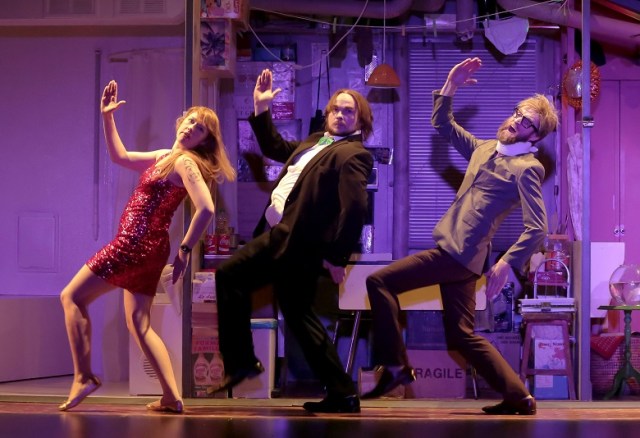
Sometimes the musicians were resembling actors, taking positions, posing and moving about on an interesting looking stage.

From a musical standpoint the evening was overpowering, wonderfully successful, especially with those two big soprano voices that easily filled the space at Factory Theatre’s studio space. The Shostakovich Romances were especially effective, although I wonder if dramatizing added anything. The musicianship, the commitment, the passion in these songs was tremendous.

In the earlier Hindemith pieces, overflowing with wit & ironic gestures, the results were if anything, more ambiguous, more playful, raising more questions.

cello_girl

(Left to Right): Wolfram Koessel, Cello, Jacqueline Woodley, Soprano 1 (photo: Dahlia Katz)

What if the cellist brings his bow up to lovingly address a woman between his knees as though she were a cello? Or is the idea too fraught, sexist, problematic, and must be ended immediately?  Jacqueline Woodley pushed Wolfram Koessel aside after his momentary approach to her with his bow, intriguing as the moment was.

What if the suggestion of chase music in a duet between two instruments inspires the sopranos to begin chasing one another around the stage? For a good ten seconds they went with it: then stopped.  I wonder, couldn’t the idea have been sustained longer?

There were a few such moments, playing with the strict & polite conventions of the concert. Yet I wondered whether Stage Director & Designer Patrick Hansen at times was fighting against the conventions and habits of his musicians? or did he simply lose his nerve, afraid of upstaging the musicians. He gave his silent onstage personnel so many moments of stillness rather than action. While there were several moments when images were overlaid on the music, I don’t believe anything was gained by the exercise. The music was fabulous, wonderfully well played. The dramatic shenanigans were at times stealing focus without adding much of anything: sitting on the fence between respectful and deconstructive. I would have welcomed it if they had gone much further, and tried something genuinely subversive, as this barely scraped the surface.  Why do it at all if in the end, you’re just going to surrender to the polite rules of the concert, and have your onstage personnel sit there as though they were Toronto concert-goers?

And I repeat, the playing and singing were fabulous. Rachel Krehm’s voice does me in, it’s so beautiful especially when she’s singing in a tight space like this one. She was joined by Jacqueline Woodley, who was sometimes singing forte, sometimes much more softly, but we were immersed in wonderful musicianship.

But the stage action struck me as pretentious, weighing the music down with additional incomprehensible layers.

We’re told that this is the first of a series. I applaud the effort, always delighted with ambitious efforts. I look forward to what may come in future Open Chambers creations.

Posted in Music and musicology, Opera, Reviews | Tagged , , , , , , , , | Leave a comment

No stranger

Two photographs by Bruce Zinger from the “Opera Atelier Takes Canada to the World” campaign show Artists of Atelier Ballet and OA dancer Tyler Gledhill as their “Canadian Icon in Red”.

Between the glimpses of Chicago or Versailles which is the more incongruous?

Opera Atelier Chicago Tour 2018 (Photo by Bruce Zinger)

Female Artists of Atelier Ballet and OA dancer Tyler Gledhill (photo: Bruce Zinger)

Exhibit A (above) is from Opera Atelier’s recent visit to Chicago.

Exhibit B (below) is from Opera Atelier’s current visit to Versailles, where they are about to open.

The Atelier Ballet seem quite at home in either setting. It’s more that fellow in red that I’m wondering about.

resized Versailles Tour 2018 (Photo by Bruce Zinger)

The female Artists of Atelier Ballet and OA dancer Tyler Gledhill in the Hall of Mirrors, Versailles (photo: Bruce Zinger)

As you’re no doubt surmised, Tyler Gledhill doesn’t dance in this outfit when he’s onstage as part of an Opera Atelier production. More typically he looks like this (exhibit C below). Of course the Mountie outfit is meant as symbolism (proud Canadians etc), to which he is no stranger. Symbolism? look no further than exhibit C.

Tyler_Gledhill_Edwin_Huizinga_Inception_Bruce_Zinger

Tyler Gledhill (dancing) with Edwin Huizinga (violin) in Inception (photo: Bruce Zinger)

I can’t decide. Which is more incongruous: the Mountie in Chicago or Versailles?  I wonder too whether one can move easily in those boots.  I don’t picture Tyler dancing in that outfit: although never say never.

But by now seeing the winged figure onstage seems like the most perfectly natural thing in the world.

Posted in Opera, Personal ruminations & essays, Press Releases and Announcements | Tagged , , , , , | 2 Comments

Questions for Thomas Gough: Ebenezer Scrooge

If you go to the theatre in Toronto it’s quite possible you’ve seen Thomas Gough. He has an avuncular presence, perhaps a result of years as a teacher, and so he’s perfect for roles such as Brabantio in Othello or Montague or Polonius. The voice is confident, the diction crystal-clear, and so it’s no wonder he does voice-over work. While he doesn’t look young I can’t quite tell how old he really is, because there’s a strength to his body language. So Gough is especially well-suited to playing a plum role such as Ebenezer Scrooge in The Three Ships Collective’s (with the support of Soup Can Theatre) upcoming immersive presentation of Dickens’s A Christmas Carol at Campbell House.

1545280

Actor Thomas Gough

I had to ask him some questions.

1 – Are you more like your father or your mother?

That’s not easy to say. I definitely have my father’s sense of humour, but I have large parts of my mother’s too. I am physically like the men of my mother’s family, except that I had my father’s reddish hair and lost it early, as he did. I have my father’s tendency to avoid things I don’t want to do, and my mother’s tendency to insist on getting them right when I finally start. My obsession with the English Language comes from both sides. My father was an excellent public speaker, and my mother did not like to be the centre of attention, and those things influenced me; there’s nothing I like better than making a speech to an audience of strangers, but I hate being the centre of attention when I’m off stage. (This latter characteristic is one I share with a lot of performers, which may surprise people outside the field.)

My father’s only sibling was a teacher, and my mother’s family is full of teachers and professors. I was a teacher for twenty-two years, and I found working with teenagers incredibly rewarding; that’s at least partly because I grew up in a family with a genius for loving its young. I can be happy alone for long stretches; in fact solitude is necessary to me, and that comes from both sides. I have four siblings, and my parents made sure that we all learnt to be content spending time alone, and they very deliberately hooked us all on the printed word; they both read to us when we were tiny, and they taught us all to read long before we ever went near a school. My mother refused to have a television in her house until her youngest child was an addicted reader, and to this day none of us ever stops talking except to read. I couldn’t begin to explain how important that addiction to the printed word has been in my life, or how profoundly grateful I am for it.

2 – What is the best thing or worst thing about being an actor?

The best thing about being THIS actor is being in performance. Memorizing lines can be an awful task; and rehearsing, if you do it right, is bloody hard work; but being on stage in front of an audience is pure terrifying joy. I grumble and curse and make a fool of myself in rehearsal and go home hot with shame about how obtuse and un-coöperative I must seem to the people who are trying to help me and I wish I could have some nice cozy job like defusing un-exploded bombs (which is at least not likely to trouble you very long); but then the moment comes when I actually get to tell the story to a living audience and everything is worth while and I wouldn’t give back a split second of the frustration or the repetitive pub meals (Do you have any idea how many actors die of scurvy? It’s a scandal, or it ought to be.) or the endless wandering around in circles trying to figure out which end is up or the never getting home for dinner or the friends who stop talking to you because you always seem to be in another world – if those things are the price of that wonderful evening when I get to tell the story.

The worst thing about being THIS actor is those bloody god-damned warm-up games many directors insist on. I hate them with a white-hot screaming passion.

3 – Who do you like to listen to or watch?

I couldn’t live a happy day without music. There are certain things that never fail to move me: Horowitz playing Scarlatti, Rubinstein playing Chopin, Heifetz playing Bach, Dinu Lipatti’s breath-taking “Alborada Del Gracioso”, Benny Goodman’s solo on “One O’Clock Jump” at the famous Carnegie Hall concert.

One of the things I love most about the Arts And Letters Club, which I’ve belonged to for nearly twenty years, is the fabulous lunch-time music programme, which has exposed me to so much music I’d never otherwise have heard. The club’s been essential in the development of my love for vocal music (speaking of the costs of being an actor: a few days ago I discovered that my next-day performance was a matinée, and not the evening show I’d thought it was, which meant I had to miss a lunch-time recital I’d been looking forward to for months, by a newly-launched young tenor named Jacob Abrahamse – if you love classical singers watch for him) and some music I’d never have expected to like. I remember a fantastic young pianist named Annie Zhou (watch for her too) who came a couple of years ago when she was fifteen and performed a wickedly difficult piece of Scriabin, and I just sat there thinking “Never mind the finger-work, how does a fifteen-year-old have the emotional maturity to do that?”

(Quick Canadian Fact: according to fellow-member Iain Scott, who knows these things, Canada produces more top-class operatic tenors than any other country. Somehow this surprises me.)

Actors? Among the famous, I think my favourite at the moment is Dame Judi Dench; I saw Rupert Everett in his show about Oscar Wilde a couple of years ago and he was wonderful. And I find it heartening that in Daniel Radcliffe a child star has for once made the transition to an adult career and has real talent and doesn’t seem to have been emotionally destroyed in the process.

But never mind the famous: there’s huge talent in the independent theatre in Toronto right now. Toronto is one of the very great theatre towns in the world and, with the greatest respect to the well-known established companies, it’s not entirely because of them. There’s fantastic stuff happening in holes in walls all over Toronto, performed by indie companies no one’s ever heard of because they can’t afford to advertise. It’s nice to be part of a close-knit community, but I get a bit sad whenever I go to an indie production and most of the people in the audience are actors, because they’re the only ones who know what amazing stuff their colleagues are doing. I really wish more people, instead of spending $120.00 to see The Sound Of Music again, would use the money to see five or six indie shows and have their brains scrubbed.

Indie theatre is ridiculously cheap and there are gems all over the city. Go and see Soup Can shows, or Safeword, or Single Thread, or Thought For Food, or Storefront, or Teatron Toronto Jewish Theatre – there are dozens I don’t even know; spend a few days seeing an indescribable variety of stories at the Toronto Fringe Festival every July. Of course you’ll see the occasional stinker, but you’ll do that in Shaftesbury Avenue or on Broadway, and for $10 or $12 per ticket what are you losing?

So, without wanting to be invidious, here are a few people I love to watch working, or to work with: Leah Holder, Kyle McDonald (worth it for that magnificent voice alone), Jakob Ehman (who’s going to Stratford next season), Kwaku Okyere, Conor Ling, Chloë Payne, the insanely talented Brandon Crone, Marie Gleason, Rob Candy, Jesse Nerenberg, Tyler Séguin, Helen Juvonen, Scott Garland, Alex Dault, Khadijah Roberts-Abdullah, John Fray, Kat Letwin, Benjamin Blais, Robert Notman, Tom Beattie, Joshua Browne – never mind, there are far too many and I could go on all night. If you’re seriously interested in Canadian theatre you need to know about these people and what they’re doing.

4 – What ability or skill do you wish you had, that you don’t have?

I’m helplessly addicted to music, but I have absolutely no musical talent, which annoys me. I also think it would have been fun to be a top-class song-and-dance man. But I try not to worry too much about the talents I don’t have, because that’s a great way to started neglecting the talents you do have.

And on this question of talent, kids: it’s not immodest to admit that you have it. If you never get to the point of looking your own talent in the face and saying “Yes, that’s mine, and it’s worth working and suffering for”, then how do you make any conscious and deliberate attempt to nurture it? Yes, of course, some people perceive in themselves talent which they don’t actually have, but I think a far larger problem is the numbers of people who unconsciously cripple themselves because they think that “Actually I’m pretty good at this” is something they must never say even to themselves. One of the reasons John Fray (if he will forgive me for singling him out) is so bloody good on stage is that he knows perfectly well that he has a lot of talent.

But instead of going around saying to random strangers “I am a very good actor; you may kiss my ring”, he says to himself “All right then, if I work like hell, this talent will allow me to turn in a clean tight performance that will actually mean something to those who see it.” I’m pretty sure that’s what all the good ones do. I know dozens of good actors, and I don’t know any who seem to be stuck on themselves. Their ego power goes into their work.

20160402_1_August_osage

A pensive Thomas Gough portrayal. Did he see a ghost?

5 – When you’re just relaxing and not working what is your favourite thing to do?

I’m often working on more than one show. As I write this, I have a show closing tomorrow evening and a rehearsal for a second one on Sunday morning. And I’ve been cast in another big scary project which will start work as soon as the producers have raised the money they need to do it right. And of course my ball-of-fire agent Michael Rubinstein and I are always looking for auditions.

When I close a show and haven’t another to work on, I get depressed for a couple of days because I’m never going to see all those wonderful people in the same room again, and then I think “Yay, I can spend entire days reading!” And after a few days I’m starting to get restless because I want to be back at work.

Otherwise I read whatever looks interesting: I read a lot of history and biography, a lot of classic novels – I love Dickens, Eliot, Austen, Orwell, Forster, and I’ve read a few Russian novels in the past few years. Tyrone Savage lent me The Master And Margarita when we were working on a Canopy Theatre show together, and I loved it.

And War And Peace is not nearly as daunting as you might expect. I’ve never read a better or funnier book than Tom Jones. I have little or no use for Puritanism, but The Pilgrim’s Progress is a magical book. I love Patrick O’Brian’s twenty Aubrey-Maturin novels. I love the great humourists, both English and American: P.G. Wodehouse, Noël Coward, Saki, S.J. Perelman, Mark Twain. I wish I could read the great Jewish humourists who wrote in Yiddish. The only serious American novelist I know at all well is Sinclair Lewis, who is of course a satirist above everything else. For some reason I rarely seem to read anything by anyone who’s still alive, except history. I’m very sad to know that there will be no more books from John Julius Norwich, who died a few months ago. It’s actually scary and depressing how much I haven’t read.

But I console myself with the reflection that, as with music, knowing you’ll never have time to learn it all is preferable to being afraid that you’ll run out.

I listen to a great deal of music, especially piano music. I was exposed to the classics early and my father introduced me to jazz when I was at a very absorbent age. For some reason I’ve never been able to develop the smallest interest in the popular music of my own or any subsequent generation, which has always been a bit of a social handicap. I suppose my synaptic pathways were all constructed before I heard any popular music or something (says the award-winning neuro-scientist; I actually have no clue why it should be so.)

I love to eat lunch or dinner for hours at a time with one or two friends, but I can’t handle big groups. I love good restaurants and I am very nice to servers, partly because I have some understanding of how very difficult it is to do their work well; I love watching people do pretty much anything well. I hate loud noises and I can no longer pick one voice out of a noisy background. I find crowds exhausting and frightening. I love being alone, especially in a room full of books or in deep woods where there’s no one else but white-tailed deer.

More Questions concerning preparation to be Scrooge in the upcoming The Three Ships Collective’s (with the support of Soup Can Theatre) production of A Christmas Carol.

1 – What was your first experience of A Christmas Carol and how did it make you feel?

I was well into adulthood before I read A Christmas Carol. I had already read much of the rest of Dickens, and I think my first reaction to A Christmas Carol was that it wasn’t a patch on any of the great novels; obviously it wasn’t intended to be, but my first reaction was disappointment. (In passing, if anyone tells you that Bleak House is a boring book, spit in his eye; it’s a wonderful book.)

2 – One can imagine Ebenezer Scrooge done in a very theatrical style, larger than life and artificial, or much more realistic, and even intimate in his sentiments. Do you have thoughts on how you want to approach him?

Sarah Thorpe, our director, and I were talking about this a few days ago. It’s easy to see Scrooge as a one-dimensional character who suddenly becomes a completely different one-dimensional character. But that’s melodrama.

justin

Justin Haigh, writer and producer

In Justin Haigh’s script there are several opportunities to show that though humanity and compassion are dormant in Scrooge, they’ve never been absent altogether.

Scrooge doesn’t become a different person; he wakes, slowly and painfully, from a long hard sleep. The Ghosts don’t put a spell on Scrooge; they help him find his way out of a swamp of loneliness and defensive ill temper he’s been so mired in that he’s forgotten there’s any other place to live. I hope we’ll be able to make audiences see him that way.

3 – How might an immersive version of Dickens change your interpretation?

I’m not sure how much it changes interpretation, but it definitely changes presentation.

House with Snow Edited

Campbell House

I’ve worked in Campbell House before, and in Spadina House, and there’s an extraordinary feeling that one is hardly acting at all. It’s like being in your own house, talking at a normal volume, and there just happen to be a few guests there listening to the conversation. I find myself freed from any temptation to declaim, and I can achieve degrees of vocal subtlety that just aren’t possible when I have to project to the back of a 500-seat auditorium. In Campbell House the largest audience will be 28 people, and they’ll be close enough to touch the actors, though it’s generally appreciated if they don’t. I think that if we do it right, the illusion will seem less illusory than it would on a proscenium stage, which is, after all, a definitely artificial setting. In somebody’s drawing-room the audience is literally inside the fourth wall, hearing sounds and seeing gestures that seem to be presented exactly as they would in daily interaction with friends and colleagues.

I played Leonato in two productions of Much Ado About Nothing at Spadina House with Single Thread Theatre, and I remember going into the place for the first time and thinking “My God! What an ugly house!” mainly because it really is over-full of dreadful knick-knacks and much of the furniture was made in a period when everything was over-wrought. But by the time we got to performance I felt, every day as I entered the building, that I was coming home from the office and settling in for a cozy evening in my own house. I hope the audience felt the same way.

4 – In undertaking a part like Ebenezer Scrooge you’re stepping into a role like Hamlet or Romeo: where you and the audience will have seen many other versions. Do you have a favorite?

sarah

Director & Producer Sarah Thorpe

I’ve actually never seen any acted version of this story. I read the book about thirty years ago and I’ve heard people yack about it and I’ve seen the Scrooge character (and Tiny Tim, of course) exploited in advertising and so on. But really all I have to work with in this production is Justin Haigh’s script and Sarah Thorpe’s direction.

And that’s the way I like it. I did a production a few years ago with a director who was terrific in many ways, but he kept showing us clips of famous actors doing scenes from the play we were preparing. And I thought “Pops, you’ve never been an actor, have you? (He hadn’t.) You need to stop doing this. The LAST thing I want when I’m preparing a role is to have other actors’ interpretations getting in the way.” If I’m preparing Hamlet (unlikely at this point, and a role I have never had the smallest wish to play anyway), I don’t want to keep thinking about how Olivier did it, or that I’ll never match Gielgud’s performance, or wondering why some other actor made such a mess of some particular speech. And this is neither arrogance nor self-satisfaction.

Sorting out how to present a believable character on stage is quite complicated enough without have some unrealizable ideal (or some total hatchet-job, of course) haunting you the whole time.

That is the only thing that makes me glad to be so nearly illiterate. Of course I’ve seen, or read analyses of, a few famous performances (Kenneth Branagh’s Hamlet, Olivier’s Richard III, Mary Pickford’s King Lear, and so on), but not many. And I do my best to keep them out of my mind when I’m working. I want every text to be Urtext. I don’t mind seeing other performers’ interpretations after I’ve done something, so I can spend a pleasant afternoon thinking to myself “Granddad, why did you even bother pretending to play Cleopatra after Charles Bronson’s epoch-making production?” and then spend the next few weeks with my head in a paper bag so people won’t throw things at me in the public by-ways. But that’s after, not before.

You ask whose Scrooge moved me. Maybe mine; I don’t know yet. You ask whose Scrooge is to be avoided. Maybe mine; I don’t know yet.

5 – How do you relate to the arc of Ebenezer’s story, especially having to travel this pathway night after night?

Playing the same story night after night isn’t a problem; actors expect to do that. And no two performances are really the same, because every audience is different, and has its own effect on what happens. I think a lot of people who go to the theatre are unaware that the audience is an essential part of the performance; you can rehearse a show until you can’t possibly get it any better, and then the first time you get in front of an audience, everything changes.

You ask if the character of Scrooge at the beginning is a stretch. It is to some extent; it doesn’t come naturally to me to be deliberately unpleasant to someone who has done me no injury. On the other hand, I tend to be somewhat terse with fools and interlopers, so all I need to do is behave as if Cratchit is a fool (which Scrooge vaguely supposes him to be), and the collectors for charity are unwarrantably invading Scrooge’s space and wasting his time.

And Scrooge at the end of the play? He’s obviously a much more attractive person, much more the person one would choose to be. What will make him real and playable for me is the affection he conceives for Tim. There’s nothing more heart-melting than an unselfconsciously charming child, and it won’t be difficult to make Scrooge surrender to Tim. That affection is a redemption in itself.

1

How do I prepare? I’m afraid my approach is very dull: I sit in the quietest place I can find and think about what I’m doing. Physical warm-ups are a distracting waste of time and energy, and I have what my friend Jeremy Hutton calls an iron voice: it never gets tired and I never have trouble with it, so vocal warm-ups are superfluous. (I used to get bronchitis from time to time, sometimes quite badly. Once I actually had laryngitis, and it had no effect at all on my voice; I understand that this is a bit unusual.)

6 – Have you ever played a part like this?

No, not really. I don’t think I’ve ever played any character who did such a complete about-face. I really do like to have a new challenge with each role, and I think making that complete reversal of character believable is going to be the challenge here. There are a few sharp contrasts when I consider the show I’m just closing. In The Story Of Ethel And Julius Rosenberg (Teatron Toronto Jewish Theatre, Ari Weisberg) I played four characters, and because there was no time for elaborate costume-changes, I had to use four different voices (Neutral American or Middle Canadian newscaster, Louisiana, Manhattan, and vaguely German-Middle European) and variations of posture and movement to distinguish them. At one point I had to be three characters within about five minutes. In A Christmas Carol I’m one of few actors not playing more than one role, so all my changes of character must be internal, and I’m also going be muttering to myself “Ah, this is a scene with Mrs. Dilber…no, hang on, Alex is Mrs. Fezziwig this time. Damn, which scene is this anyway?” quite a lot until I’ve got much farther on with learning the text. And I have to learn the so-called “r.p.” accent, the standard more-or-less-upper-class English voice which for some reason, though my family background is about as fairly-well-educated- Anglo-Saxon as you can get, I have never been able to do properly.

So yes, there’s definitely some new stuff to do.

7 – What do you love about this story?

Well, call me simple-minded, but I love its happy ending. Scrooge is redeemed, Tim lives, and Bob Cratchit gets a huge promotion. I think we make a serious error in cramming the high-school curriculum with tragedy and despair. There are human stories – true stories – that end happily, and I think we ought to be teaching kids that they can have happy endings too. I think it was the grade ten English course we used to refer to as “the suicide course”; mercifully I never had to teach it. And while I flogged my older kids through King Lear and 1984 – books not only great and terrible but entirely human and believable – I also made them read Terence Rattigan’s The Winslow Boy, because not only is it a brilliantly constructed play, it’s a true story about a family that fights City Hall and wins. I don’t believe that terror and squalour and deceit and betrayal are all we have to look forward to, and I don’t think we should be teaching that they are.

I also love Dickens’s truculent liberalism. He draws the vulgarly opulent bank-towers looming over the streets teeming with half-starved labourers and crippled children, and he leaves no doubt at all about who he’s rooting for. He also shows us again and again something that remains shamefully true: that poor people are much more likely to be helped by poor people than by rich people. I’d like to think the occasional corporate bigwig who “can’t afford” to pay his employées a living wage might read this story – or much of the rest of Dickens – and be bloody well ashamed of himself.

And, as always, the extraordinary names, so utterly identifying characters in Dickens and nowhere else unless intended to evoke Dickens: Scrooge, Fezziwig, Crachit, Cheeryble, Pirrip, Twist, Rudge, Merdle, Gamp, Wittiterly, Squeers, Steerforth, Magwitch….

8 – Does the ubiquity of this story –constantly broadcast at Christmastime—make it harder or easier for you and the company?

I can’t speak reliably for the company. I don’t think it does either, though, for me. The people who come to see our show will presumably be those who are not sick of the story, to whom its familiarity is not a problem. By and large people come to see a play because they want to, and then of course we have them on our side before we start. And pretty much everyone wants to feel good about this story. They’ll want to enjoy what we’re doing and, on the assumption that we’re not simply atrocious, they’ll be happy to watch and listen.

And if we get a few people who are not sure they wouldn’t rather have stayed home to play cribbage, well, our job is to make them glad they came to see us instead. But that’s always our job. No matter how sure we are that the audience wants to be there, we still have to perform as if they needed to be persuaded. Half-hearted performance turns devotées into skeptics, and tells the skeptics that they were right all along. The other face of that is that we want them to like what we’re doing, so putting in our best work every time is very much in our own interest.

9 – Who other than Scrooge is your favourite character?

In this version of the story I can already tell I’m going to love Mrs. Dilber and the Ghost of Christmas Present, because the two actors (respectively Alex Dallas and Christopher Lucas) are already turning them into wonderful performance-pieces. And I suppose I love Tim, because I think Dickens, in the original, makes him a plucky kid we want to pull for but who is not repellently noble about his illness. Dickens’s sentimentality can be a bit trying, but I think he manages to avoid it with Tim, and we get a true picture of a kid playing a tough hand without moaning on about how unfair it all is. I suppose I find Tim’s sweetness convincing because in my mercifully limited experience of seriouslly ill children that’s how they really tend to be.

10 – If you could play any Dickens character, who would you want to portray?

That’s like asking “What’s you favourite book?”! How could you possibly choose? Dickens draws characters better than anyone, and every imaginable human being appears somewhere in Dickens. So I’d love to play Mr. Micawber, or Sairey Gamp, or Wackford Squeers, or the Cheeryble Brothers, or Fagin, or the deliciously appalling Harold Skimpole. There are dozens an actor could feast on.

11 – Is there a teacher, actor, director or an influence that you especially admire?

Dozens, but three to whom I am especially grateful, and without whom I wouldn’t be doing what I’m doing:

a) My favourite Shakespeare director, Jeremy Hutton. It was through acting in several shows directed by Jeremy at the Hart House Theatre that I began to believe I might have talent, which I had never understood before,

MARTIN_HUNTER

Martin Hunter

b) My late friend Martin Hunter, who talked me into believing that I was good enough to be taken seriously as a professional, and

c) My very dear friend, the producer, director, and miraculous photographer John Gundy, who made me understand that since I had talent, I really needed to use it.

And, if you will allow me, I’m going to answer a question you haven’t asked:

12. Do you think people will really enjoy the Thomas Gough production of A Christmas Carol ?

No, because there is no such thing. This is a collaborative effort. Theatre is always a collaborative effort (not collective, which is quite different. Collectivity is possible, if you like that sort of thing, but collaboration is essential.) We have fifteen actors and a production team, so far, of seven. I’ve worked with some of them before and I know what spectacular talent we have on board; and I’m seeing more of it every day in cast-mates and crew members I’ve never worked with before but am very glad to be working with now. The smallest roles, the briefest scenes, are all going to be as important to the total impact as Scrooge.

And I strongly suspect that people outside the theatre tend not to be aware of how much support actors need to do what we do. You never see the designers when you go to a play, but you are inescapably affected by their work. Adapting another writer’s work and shifting it to a different medium; finding appropriate costumes, after you’ve done days or weeks of research so you know what to look for; listening to a library of music to choose exactly the right things, which you then have to transpose and arrange; teaching the cast to speak in an accent that is unnatural to them; imagining how you can achieve romantic or menacing lighting effects with very little flexibility in your equipment; thinking through every possible nuance of a complex story so you can direct a group of people who all learn in different ways, answering unexpected questions on the fly and conducting agonizingly detailed conversations about aspects of the play that some demented actor just started worrying about five minutes ago; welcoming all these strange people into your space, which is not usually used this way, and making accommodation for their endless special requirements: these things are all complex, difficult, and absolutely essential, and the people you see on stage didn’t do any of them. Is somebody going to be barefoot on stage? Then we need an absolutely reliable stage-hand to sweep the playing surface so actors don’t wind up with random bits of metal in their feet. Who’s going to do the actors’ laundry? We can’t let them take it home because they won’t all remember to bring it back. You need a thoroughly competent and conscientious producer to make sure all these things happen. And finally you need a stage manager, who must be a diplomat, a conciliator, a disciplinarian, an articulate communicator, an instantaneous problem-solver (I complained about being cold at rehearsal yesterday and bang! Kathleen Hemsworth draped a blanket over my shoulders; I have no idea where she got it – produced it from thin air for all I know), a den-mother, and a miraculously talented organizer.

Nothing good ever happens on stage without a good stage manager. Yes, all those people are working with the ultimate goal of getting actors in front of an audience looking and sounding as good as possible, but actors are the tip of the iceberg. Without all these others, actors would be absolutely helpless; there would be no theatre. So I hope the people who enjoy our production of A Christmas Carol will spare an appreciative thought or two for the technical wizards who have made it happen.

*******

The Three Ships Collective’s (with the support of Soup Can Theatre) present their immersive production of Dickens’s A Christmas Carol at Campbell House Museum December 12-22. For further information see Christmascarolto.com

Christmas Carol - Subway Poster - For Web

Posted in Books & Literature, Dance, theatre & musicals, Interviews, Personal ruminations & essays | Tagged , , , , , , , | Leave a comment

BOUND v. 2: power struggles

Against the Grain Theatre premiered version two of BOUND at The Great Hall on Queen St W or as Joel Ivany called it “an ongoing process”.  I didn’t see version 1, and perhaps this summer or next year there will be a version 3: further workshops and/or explorations.

Version 2 is many things. We were told in some of the PR that this is “opera in the age of Trump.” And so this is opera framed within a heavily political context. Posters were up in the washroom, and the program was done a bit like a passport from an authoritarian society.

guidebook

Our program was this “State Guidebook to border security and anti-terrorism strategy”: Written by Amanda Hadi, Design by Eitan Zohar, Illustration by Dmitry Bondarenko

The AtG website calls it A Handel Mashup. In the preshow intro by Ivany & composer Kevin Lau we were told that Canadian Opera Company general director Alexander Neef suggested a Handel mashup. Ivany didn’t go on at great length about it, only to tell us that there is this intriguing question that Lau presented to us. Is it Handel or is it perhaps Lau?

20181119_195239_resized

Composer Kevin Lau

After hearing it I’m okay saying that it’s both. We’re in a kind of post-modern creative space, familiar when we see an old building re-purposed with additional shapes & structures, so that the old is re-framed and reinvented in the new. Lau was very humble about his role, but it seems simply to be the pragmatic work of a musician, someone who re-purposes the old while adding new wrinkles. I did something similar in church Sunday (a postlude incorporating REM’s “It’s the End of the World as we know it” and the hymn “When all is Ended.”). Post-modernism is pragmatic, re-working what you have, and not necessarily original: although in places we were 100% Lau with little that sounded like Handel.  The variety he offered is helpful sometimes deliciously different, occasionally dissonant.  The ear was toyed with but mostly caressed.

Version 2 has four characters singing Handel, using a modern libretto crafted by Ivany. The four are to be imagined as though they’ve been detained by this repressive state. I’m not sure I understand where the work came from, especially when there’s a version 1 with additional singers. But as Ivany described it, in the creation process, the singers were asked to bring arias that they liked to sing. That suggests that there’s an earlier layer of pragmatic authorship from Ivany, setting new words to those tunes, followed by another layer when Lau adapted this into something else with a small orchestra; and there’s another layer with the electronics, sound design by Acote.

It might be the edgiest thing AtG have ever done.

Did anyone mean for the style to be symbolic? perhaps it’s not meant to be but it seems profound, Handel being this old voice for expressions of individual passion.  But the abuse of power, authoritarianism, this is nothing new. The various ways a person expresses their griefs is one of the universals in opera. So much of what we see in our social systems are antiques, vestiges that are still with us like tailbones, long after the function is gone. The struggling of old against new makes perfect sense in this style.

The four characters are introduced within that repressive political context, on a card inserted into our passbooks, showing the character with the singer identified as an alias.

  • Noor Haddad alias Miriam Khalil
  • Kelly Davidson alias David Trudgen
  • Naveen Dewan alias Andrew Haji
  • Ahmed Habib alias Justin Welsh
20181119_225440_resized

This is one side of the card inserted into our Guidebooks.

There’s a great deal of exposition, details that add depths and nuances. While I didn’t follow everything going on (not just because there were so many poetic lines from Ivany, fascinating things being said by the singers, that I couldn’t always discern, but because of the complexities of the premise), there wasn’t a moment that let down the intensity, nothing wasted. Version 2 gives us a glimpse of a much more complex world, one we accept on faith because it’s totally believable. The singing of the four soloists was nothing short of spectacular, whether alone or in the occasional ensemble.

But it wasn’t what I’d expected. There were two arias from Andrew Haji –one near the beginning, another near the end—that gave us sparkling coloratura. David Trudgen’s arias were perhaps the most atypical, as in places Lau had the orchestra doing tango rhythms and in another, syncopated drumming at times with military overtones. In places the voice or its accompaniment had been sampled and was coming back, transformed, as though inside the singer’s head.

While I suppose the form is technically some sort of pastiche, I don’t know that it matters. It was more on the concert side than on the theatrical side, of opera. Music director Topher Mokrzewski led a sensitive reading of this music that was at once old and yet new, deliciously crisp & clear.

The four are detained & supposedly being oppressed. But we don’t see any oppression. The voice of the state is occasionally represented for us in the voice of Martha Burns speaking. From the soloists, we hear of suffering, we hear brave sentiments of resistance. It’s a curiously powerless state, their threat theoretical rather than actual. Handel is also the composer of such triumphant tunes as “See the Conquering Hero Come”,  a composer of pomp & power, never more so than in the coronation anthems such as “Zadok the Priest.” Opera was for centuries a tool of oppressive states, authorizing and celebrating tyrants: even if this is not likely anything either Ivany or Neef want to promote. We get a much more politically correct Handel.  More villainy might have given the work more balance, but even so BOUND is bound to please.  We don’t disbelieve the suffering or the reality of the singers in their mysterious places of confinement.

All in all it was a lovely evening of music, splendid performances framed within the ironic signage & programs. BOUND v.2 will be repeated Tuesday & Wednesday at 8 pm at The Great Hall.

Posted in Art, Architecture & Design, Opera, Personal ruminations & essays, Politics, Reviews | Tagged , , , , , , , , , , , | 3 Comments

Space Opera Zero

When I write about the shows I see I’m sometimes overwhelmed by envy, wishing it were me who’s up there singing or playing. We’re never more alive than when we’re dying onstage.

And so I’ll often toss off these spontaneous ejaculations late at night, seeking to prolong the magic of a show that is alas: no more. It’s over. Done. Finito.

The blog is a futile oxymoron, impossibly reaching back in time, from the contented afterglow seeking to touch the radiance of the show itself.

I know I can’t possibly connect, and sometimes the awareness of futility is so heavy that I’ll overload the beginning of the review with factoids, telling you where and when and what and who: even as I struggle with the real issue, the time travel and the attempt to walk my soul into those bodies from the recent past, to reincarnate myself somehow in their show.

melanie_mcneill_original_art

Original art by Melanie McNeill

Eldritch Theatre might be the most purely artistic thing I know of in Toronto. The adventures of Eric Woolfe & company in the realms of puppetry, magic, music & theatre would never be mistaken for high art (yet it probably helps to be high when you see his shows), and I invariably come out of his shows feeling light-hearted.

Talk about contrast. The previous night I watched a one-woman show about real life. Tonight was pure theatricality, silliness, puppets, toys, magic and mayhem, an escape from the stresses of reality.

Space Opera Zero is many things. It’s a combination of live action, a bit of film, some singing, some dancing, puppets and models.  Curiously, we’re getting glimpses of The Changeling, by Thomas Middleton, that very powerful story about love & betrayal.  Setting it somewhere off planet doesn’t hurt Middleton nor the audience.  We are mixing high art tropes with all sorts of silly pop culture references. So long as you check your pretentiousness at the door, you’ll be fine.

Lisa Norton and  Mairi Babb star, opposite Eric Woolfe in a myriad incarnations, directed by Dylan Trowbridge, designed by Melanie McNeill, lights by Michael Brunet, and sounds by Christopher Stanton.  It’s a small team creating a whole universe.

four_heads

Princess Jenora, Hjalmar Pomeranki + Emily Trueheart (Mairi Babb, Eric Woolfe + Lisa Norton), photo: Adrianna Prosser

The audience at last night’s opening performance seemed to be a mix of regulars and newcomers: that is, people ready to laugh (familiarity with hilarity?) and those swept up in the screaming & laughing that eventually fills the tight little space of the theatre. We are in a realm of irony and strangeness, not realism. If you resist you may think it’s merely silly. “Resistance” as another space opera once said “is futile”.

One thing I knew beyond a shadow of a doubt. As I sat in the front portion of the theatre on Queen St East, awaiting the beginning of Eldritch Theatre’s premiere performance of Space Opera Zero, I knew I would never encounter my colleagues. I might run into Justin Trudeau –a theatre teacher after all—or Donald Trump –a reality TV star—before I’d ever encounter an opera reviewer. That’s right you’ve guessed it. Space Opera Zero is not actually an opera (hm or is it?). You know it, and perhaps too John Terauds of the Toronto Star, John Gilks of Opera Ramblings, Jenna Simeonov of Schmopera, Arthur Kaptainis of the National Post.., also know it. That’s why I knew I’d never run into them there on Queen St E. While there is music, singing, histrionics, lots of hand-wringing about who screws whom, even a coitus song: yet Space Opera Zero isn’t really an opera (although it’s every bit as silly, every bit as nonsensical, and maybe a whole lot more believable).

If I want to see it again it’s because of that envy factor. This is one of those shows where you can see how much fun it is to perform. Ah to be young. Ah to be wearing a costume with tentacles discussing sensuality and planetary annihilation: in the same sentence. Only opera –space opera or the regular kind of opera—manages to combine these elements together, the big questions of life.  Space Opera Zero is shorter & more fun than anything Wagner wrote, although at times I was thinking of Götterdämmerung, Wagner’s long end of the world saga. Woolfe improved on Wagner, actually, using more species, more tentacles a little sleight of hand and more songs about coitus.

Be advised, it’s not really for children. They might learn something about coitus and inter-planetary copulation. I don’t think there’s any such advisory issued because it’s also rather obvious that it’s not real, it’s operatic, over-the-top. Indeed, I wonder if “over-the-top” is Eric Woolfe’s middle name.  If you take a young child be prepared to have to answer questions about coitus and human anatomy. And you could learn something about our friends on other planets.

But it’s a good thing, like the candy sprinkles and chocolate icing on top of the three layer cake. You don’t hold back with the decorations when you want someone to have a happy birthday or inter-species wedding.

Posted in Art, Architecture & Design, Dance, theatre & musicals, Opera, Popular music & culture, Reviews | Tagged , , , , , , | 2 Comments

Vitals

Whenever I see a new theatre piece, whether spoken or musical, I’m juggling a few balls, responding to

  • the work that was composed / written
  • the interpretation / direction of that piece
  • the performances / acting in the piece

Whatever the play or opera might be about I feel I must try to sort through the achievements on those three fronts.

Vitals is new to me, a one-person show by Rosamund Small exploring the life of a Toronto EMS technician. We’re plunged into the world of near-death and death, attempted suicides and wacky people on the street demanding health-care, with plenty of recognizable local references.

vitals_image

Anna is as darkly deadpan as Bob Newhart while the crazy world goes by, whether it’s hysterically funny or heart-breaking. For seventy minutes she’s the whole show, sometimes tranquil, sometimes frenetic but an intense one-person show.

Yes I chose to say “one-person” rather than “one-woman” after a moment of reflection. Lauren Wolanski portrays Anna clearly as a woman yet I can’t help wondering if the script could work with a man as the lead. Ever notice how men and women work together in the EMS service? how egalitarian it is? No I didn’t notice much that was gendered about the role, and that makes it seem especially accurate, because when I think of it, EMS technicians are meant to be inter-changeable, rather than conspicuously different if they’re male or female. While I think that’s in the play, full marks to Wolanski and director Bryn Kennedy for the authenticity of the representation.

It’s quite dark at times. Kennedy—who is director and spokesperson too—gave us a bit of a cautionary note before the show, with the caveat that while we may wish to step out if it gets too intense, we can’t return if we leave. After seeing the show I see why.

For someone with PTSD Vitals might be rough-sledding.

In theory one has boundaries between one’s work and one’s life. But what if your job is so intense that it haunts your imagination, blurring the lines? Their creation of that ambiguity that’s in the text is what’s so powerful, the sense that the job can be traumatic. It’s not through CGI or hyper-accurate sound design.  It’s mostly done by attention to the text and good acting.

What I saw tonight was a preview on a snowy night: yet the theatre was quite full. Vitals is the first full-scale production from Theatre Born Between who describe themselves this way in the program:

Theatre Born Between is a Toronto-based theatre company interested in creating work that focuses on bringing the inner emotional realities of the play and its characters to the surface – the seen andunseen. Our mission is to create a platform for diverse emerging artists from all communities to explore the boundaries of theatrical practice through a blending of styles, such as movement, verbatim text and fantastical realism.”

Vitals continues at The Commons Theatre until November 25th .

Posted in Dance, theatre & musicals, Psychology and perception, Reviews | Tagged , , , | 1 Comment

Attila Keszei in 2018

I’ve written about Attila Keszei a few times including an interview back in 2015.

I met him at the University of Toronto, a kindred spirit because

  • We’re both Hungarian
  • We both worked for Facilities & Services at the University of Toronto (he’s retired, I am still there).
  • In addition to our daytime jobs, we both engaged in extensive artistic activities

Attila’s creations take at least a few different pathways.

  • Religion and Biblical images
  • Sustainability and images of our dynamic Earth
  • Erotic and sensuous art
Flower-3-D-W

“Homage to Georgia O’Keeffe Flower #3” (Raku fired ceramic – 2015 )

Currently his work can be found in three places in Toronto:

  1. Two paintings at the Hungarian Consulate
  2. Three paintings at the Hungarian Catholic church (432 Sheppard Ave. East.)
  3. And although he just finished a show at Art Square Gallery (opposite AGO on Dundas St W), he now has a dozen pieces at the University of Toronto’s Faculty Club. And every Wednesday afternoon for the rest of November, 4 -7 pm, he’ll be there in person

Here are a few examples of his work.

ATTILA_dock

“Morning Mist, Steaming Coffee and M1911”, oil on canvas by Attila Keszei, 2018

Sometimes he paints, sometimes he does raku ceramic, and he’s still exploring new options of other media.

susannah

“The Wicked Elders and Susanna”: raku-fired ceramic, Attila Keszei, 2011

In case it’s not obvious I’m an admirer.

jonah

“Jonah in the Whale” (from a series of 4), Raku-fired ceramic, Attila Keszei, 2018.

Posted in Art, Architecture & Design, Press Releases and Announcements, Spirituality & Religion | Tagged , | Leave a comment

Questions for Rose Plotek: Like Mother, Like Daughter

Questions about process and form can be among the most profound even if they seem to be never-ending.  I’m happily immersed in such considerations this week, having seen Humans by Circa (what is their idiom after all?) and Ken Gass’s intriguing adaptation of Helen’s Necklace.

Now I will inflict the questions on someone else, namely Rose Plotek, in my hope to learn something. Let me begin by sharing Rose’s bio from National Theatre School.

Rose Plotek (Directing 2007) is a director and theatre maker. The inquiry of Rose’s work investigates form and aesthetic, with experiment being a driving force of both development and presentation. Her work is often developed through inter-disciplinary collaboration and workshop, most frequently with Philip McKee (Directing 2009). Recent credits: Like Mother, Like Daughter, created with Ravi Jain (Why Not Theatre, Toronto) and Complicite (London, UK); Bloody Family (Theatre Centre); LEAR (World Stage/Magnetic North); Performance About A Woman (Summerworks Performance Festival). She was Intern Director at the Shaw Festival (Neil Munro Intern Director Project, 2013).

Rose’s co-creation Like Mother, Like Daughter is back, and was the occasion for this interview.

Rose Plotek_headshot

Rose Plotek, director & maker of theatre

Are you more like your father or your mother?

My mother. My mother is a force of nature. She is a community organizer, activist, educator, writer, filmmaker and farmer. She cares deeply for the land and for her community. I try in all I do to carry the work she does forward.

I am emotional, at times volatile, but deeply caring, all of which I share with my mother.

I’m grateful if I’m even just a little bit like her.

What is the best or worst thing about what you do?

I travel a lot for work, which is the best, except it means I’m away from my kid, which is the worst.

Who do you like to listen to or watch?

I listen to CBC radio all the time. I work from home when I’m not in rehearsal and I often have it on in the background. This is something I have inherited from my parents, they both do this as well.

What ability or skill do you wish you had, that you don’t have?

I wish I could speak more languages. I am fluent in French, but I would love to also speak Italian, Spanish, German and Arabic.

When you’re just relaxing and not working, what is your favourite thing to do?

Hang out with my kid. Cook. Read. Spend time at my mother’s farm. Go to the movies.

*****

More questions about Like Mother, Like Daughter

Speaking of questions, Like Mother, Like Daughter consists of a framework of questions being posed on a stage to the real-life women, taking the questions. What are some of the best questions you’ve heard?

What things should mothers teach their children and what things are better for children to discover for themselves?

What makes a house a home?

Do you think you would survive alone in the wilderness?

What’s one question you would ask a psychic about your future?

Do you rehearse or somehow get them ready for real questions before a real audience? What is the nature of your preparation, and are some people too shy or nervous to do this, and back out?

We do a series of workshops with the participants in the weeks leading up to the performances. The primary focus of those workshops is for the group to spend time together, and get to know each other a little bit. Essentially, we spend that time in conversation. We also lead the mothers and daughters through a series of writing exercises that help generate the questions that are then used in the performances themselves. They generate the questions, which are then curated by me for the performances.

We’ve never had people back out of the process. We’ve certainly had participants who are shyer than others. We try to create an environment that is warm and convivial, that makes people feel comfortable and allows them to be themselves. If they are shy or feel discomfort in front of a group of people, then they’re welcome to be just that in front of an audience. Because participants are coming to this with their mother or daughter, I think that there’s a familiar element, there’s a little bit of your life and your self there that’s always present. That creates an environment where I believe people feel quite comfortable. We do have a microphone for people who are little more soft-spoken, so they don’t have to try and amplify their voices or be performative in any way. We allow them to be themselves.

There’s a great quote from The Guardian that I saw in the press release: “It works on the premise that other people’s lives are completely fascinating.” Do people need any help to be “completely fascinating”, or is that Guardian quote completely accurate?

I think it’s completely accurate. I think everyone has a story to tell that has value, and everyone’s experience matters. The way that we understand each other as human beings is by coming together and having a conversation. What we’re trying to do in creating the circumstances of the piece is to allow people to come together and share their stories and experiences; something that can feel perhaps small or insignificant can be very telling and can connect people on a pretty profound level.

40_40LMLD_Baking_Session_2016-23(1)_medres

Talk about the communal meal that’s such a big part of this, how & why that’s included in the piece.

The meal was an element that was part of it right from the initial impulse of the piece. I think its value is that that regardless of your background or the culture that you come from, people get together over food. They come together around the dinner table – it’s the thing that brings us together. Breaking bread together crosses all borders, so for us it was an integral part of a way to open up the possibility for a group of strangers to come together and have a conversation.

For me, the performance event witnessed by the audience in the first half of the evening is a warm up to the meal in the second half. The meal is shared between the mothers and daughters and the audience. For me, that meal is really the main event of Like Mother, Like Daughter. What we’re doing in the first half of the evening is getting the conversation started. That conversation then continues with the audience over some extremely delicious food made by Newcomer Kitchen. It really is a special experience and something that I think is unique. A lot of people who go to the theatre are used to sitting in the dark amongst a group of strangers and sharing a kind of communal experience in that way. But sitting down at a dinner table with strangers is not something that we get the opportunity to do very often, if ever.

This work seems very intimate. What’s the range, from the biggest and smallest audiences you’ve had for this work, and what do you think is the ideal size of audience?

The audience capacity is 70. It’s been between 50 and 70 each time we’ve done the show. The piece hinges on the fact that it is quite intimate and that you’re sitting down at a table with the mothers and daughters, so if you had an audience that was too large it would be very difficult to have any kind of further conversation at the dinner table.

60 to 70 people is really the perfect size for the piece – it is very intimate the way the audience surrounds a big dinner table. In the first part of the evening the audience gets a bird’s eye view of a dinner table where the mothers and daughters have a conversation, and then the audience moves to a series of tables that mimics that shape in the other half of the space. The piece hinges on the fact that it is an intimate experience, but it also has to have a large enough audience to fuel a good conversation.

Do you have any influences / teachers you would want to mention, especially as they are relevant to what we see in Like Mother, Like Daughter.

There are people whose work has influenced the shape of this piece. Lois Weaver’s Long Table is one of those. Forced Entertainment’s Quizoola! is another one. The show that Ravi Jain (Why Not Theatre) created with his mother, Brimful of Asha, is obviously a piece that influenced the beginnings of this one. Also the previous work of Complicité, which is the company in the UK that co-created Like Mother, Like Daughter. The stream of their company called “Creative Learning” had made other works that incorporated non-performers and audiences coming together over food. There’s one piece that they made called Tea, and there are some structural elements that are shared between the two pieces. I’d say that those four things had some influence on the shape that the piece eventually took.

*******

Like Mother, Like Daughter returns for Eight Shows Nov 15 – 24, 2018
918 Bathurst Centre for Culture, Arts, Media & Education, Toronto
PAY WHAT YOU CAN AFFORD: $50 | $35 | $20
Tickets available through kofflerarts.org | theatrewhynot.org
Original Concept and Direction by Ravi Jain, Rose Plotek, and Poppy Keeling
Co-Created by Why Not Theatre and Complicité Creative Learning
Directed by Rose Plotek
Associate Directed by Lisa Karen Cox
Directing Assistance by Darwin Lyons
Produced by Why Not Theatre and Koffler Centre of the Arts
Producing for Why Not Theatre by Kevin Matthew Wong
Producing for Koffler Centre by Jessica Dargo Caplan

PERFORMANCE SCHEDULE
Thursday, November 15, 8 PM – OPENING NIGHT
Friday, November 16, 8 PM
Saturday, November 17, 11 AM – BRUNCH PERFORMANCE
Sunday, November 18, 6 PM
Thursday November 22, 8 PM
Friday November 23, 8 PM
Saturday, November 24, 11 AM – BRUNCH PERFORMANCE
Saturday, November 24, 8 PM

Posted in Personal ruminations & essays | Tagged | Leave a comment

Helen’s Necklace via Canadian Rep Theatre

I knew what I was going to see when I got to the upstairs space on Berkeley St. Oh sure, it was Canadian Rep Theatre’s staging of Carole Fréchette’s play Helen’s Necklace in John Murrell’s translation, directed by Ken Gass.

But I mean, I knew. The second paragraph director’s note Ken has put into the program makes it clear what we’re about to experience:

“This often-produced play is normally done with one female performer playing the role of Helen and one male actor playing Nabil, the taxi driver, and the four other inhabitants of the foreign (to her) city. Here, each of three performers share the role of Helen, while also collectively presenting the remaining characters. In the Canadian context, the role of Helen could obviously belong to actresses of any racial or ethnic identity, and by bringing together a diverse ensemble of performers, we came closer, hopefully, to recognizing the universality of Helen’s journey.”   (Ken Gass)

This technique of dividing a dramatic personage among multiple persons is not a common one, but also, not so rare that it’s never been seen. We saw it in I’m Not There¸ the 2007 film about Bob Dylan. We saw it also in Terry Gilliam’s The Imaginarium of Dr Parnassus¸ likely due to the untimely passing of Heath Ledger in 2009, as other actors undertook parts of his role that were unfinished. I’ve experimented with it a bit myself.

Ken Gass’s approach to Fréchette’s text via Murrell’s translation offers another wrinkle. Excuse me if I wax mechanical for a moment. Any playtext can be understood as a bit of a puzzle, decoded or solved in the various choices made by the cast, director and designers; one can imagine several axes along which creators make choices, such as “loudness-softness” or “explicit – poetic”, or “internal- external”. Getting poetic or symbolic problematizes the signification, normally making it a bit harder to figure out who is who.  We’re distanced and possibly alienated by such a process. But in a story that is, if you’ll excuse me for saying so, blunt & obvious, sometimes that’s a welcome thing, to lessen the pure onslaught of reality. I am recalling for example the film and also the production of Scorched by Wajdi Mouawad that I saw last year: each struggling with the question of how to represent or signify unwatchable horrors that are in the texts.

My background in music & opera may be showing, if I choose to see this adaptation (and I hope Ken will be okay with me calling it that) as something like chamber opera. We’re listening to the beauty of the voices, the stunning ensemble work of three extraordinary actors. Where the original might seem to punch you in the guts, the presentation of the same story becomes gentler in this adaptation, as though handed to a Greek chorus to sing as though from afar: even as they sometimes give it to us directly in our faces. The performances sweep you away even if the questions being asked have obvious answers.

But these are not questions one asks expecting any sort of answer.

From the first we’re watching emotions & impressions seeming to reverberate through the three actors –Akosua Amo-Adem, Zorana Sadiq and Helen Taylor—as though they were all the same person. Throughout there is a reflexive hand to the throat, feeling for a missing necklace.

resized_HELENS-NECKLACE-PHOTO 2

Left to right: Akosua Amo-Adem; Zorana Sadiq; Helen Taylor (Photo: Michael Cooper)

As the story proceeds we discover what might be missing for each. It’s a bit like an elegy or a requiem in its universality, a search for what’s missing, mourning for what may never be restored.  While it may go without saying that this is a tour de force, an impressive piece of theatre, it is above all a beautiful experience that swallows you up.

This exquisite 70 minute production will continue this weekend (meaning November 11th at 2:30 PM) at Canadian Stage’s Berkeley St upstairs space, before continuing on to Burlington Performing Arts Centre November 16 – 18.

resized HELENS-NECKLACE-Photo 4

Left to right: Akosua Amo-Adem; Helen Taylor; Zorana Sadiq (photo: Michael Cooper)

Posted in Dance, theatre & musicals, Politics, Reviews | Tagged , , , , , , , , , , | 2 Comments

Circa Humans

Tonight I saw Humans by the Circa Ensemble a visiting troupe from Australia. I read the following brief preamble from Yaron Lifschitz, the Artistic Director of Circa.  While it was poignant before the show, it was positively illuminating to re-read it afterwards, and to reproduce it now.

“We humans are a fairly weak, unimpressive species. Anything we can achieve physically can be easily surpassed by a well-trained monkey. An injured pigeon can fly higher and longer than the best acrobat in the world. A snake can bend infinitely more than the most flexible of contortionists. But it is precisely because we are human that our physical achievements acquire dignity, meaning and poetry. It is in connection to our vulnerability that our strength find its true articulation. In our limitations are out possibilities.

In humans I have asked our ensemble of artists “what does it mean to be human”? How do you express the very essence of this experience with your body, with the group and with the audience? Where are your limits, what extraordinary things can you achieve and how can you find grace in your inevitable defeat?

The creation is the result of this investigation—a report on what it means to be human.”  (Yaron Lifschitz)

YARON

Yaron Lifschitz, artistic director of Circa

I was impressed by what I saw of Circa in their last appearance in Toronto 18 months ago. I’m hungry for a synthesis of media, a new language that’s a blend of procedures from disciplines we might identify with labels such as “circus” and “dance” or “theatre”.   Humans, the piece we saw tonight, takes us further in offering a fulfillment of that heady whiff of something new & original that I caught last year.

It was a delight to be surrounded by people much younger than myself at the Sony Centre tonight.

I’d like to take a stab at expanding on Yaron’s “report on what it means to be human,” at least from what I could see.

Displays of virtuosity have often been geared towards showing us superman or superwoman, the gap between what they can do and what we can do. Whether we mean singing or dancing or circus performance, humanity can get lost when one is too busy showing off.

And that is the key difference with Yaron’s report.

We watch remarkable specimens move and tumble, displaying their skills but often falling, often showing vulnerabilities as well as strengths. We see frailty and pain alongside the more typical displays of procedures with bodies & floors & aerial apparatus. We see reminders of the arbitrariness of our society and what it deems competence or incompetence, through a series of social actions among the bodies onstage, imitating one another absurdly. At times the pace is frenetic, while in other places we are given something softer & more reflective, the music taking us inward, or at times to something blatantly comical. There is some pathos in watching a body that is as passive as a puppet, controlled and moved by the actions of another person. It’s a largely abstract exploration, as the performers make few sounds, tell us little except what we assume from watching them move and their expressions as they interact. Sometimes they’re alone, sometimes in pairs, sometimes a big crowd sculpted into fascinating aggregations of limbs and bodies.

Tonight thrilled as an inter-disciplinary work that isn’t quite dance or circus or theatre: or any single discipline, something really new and a fertile ground for exploration and development.  I’m certain there’s much more to be seen & heard from Yaron & Circa in the years to come. While there were moments when we were clearly watching something recognizably circus, procedures we’d seen before, yet there were many more moments where the movement vocabulary had combined elements or even given us new & unrecognizable ones, taking us into unfamiliar territory.  The disorientation was electrifying. Time flew by, the 75 minutes of the show feeling like perhaps 15 or 20 jam-packed minutes.

I am reminded of a paper I gave years ago concerning improvisation, that used aerial work as a departure point. I heard a story of firemen coming into a space where aerials were being done, and their perception of the risks.  It was hugely ironic that these professionals who themselves take risks that we might find daunting, perceived a risk in others. But perceived risk is not the same as a real risk, whether one is watching someone doing a floor exercise, listening to a jazz solo, or an aria with a cadenza.  I’ll set aside the work of a fireman, which is genuinely risky. A performer may seek to create drama from the illusion of risk, when they’re actually confident of their ability to sing coloratura, hit a high note on the instrument, or execute a flip with their body. It was especially shocking to watch skillful falls executed. It sometimes looked painful.

I’m grateful for the serendipity of seeing this the very day after the Tafelmusik concert, when I speculated about applause. Tonight I watched an enthusiastic group bursting into cheers –clapping and sometimes hooting & hollering—in the midst of routines as well as respectfully applauding at the end of segments. Applause seems to be socialized, although I’m not sure exactly how it works. Tonight I was in the land of the ‘woot’ rather than the ‘bravo’. A woot doesn’t seem designed to be especially loud so much as to signal a kind of peer thing, something that sounds like “I appreciate you and want you to know you’re cool”, and not to be confused with a wilder howl or cry as one makes in pure appreciation, cries that wouldn’t be out of place at a hockey game. The applause could erupt at any time, reminding me of the newness we were discovering in the concert last night. When something is really new the applause is different than when we’re giving applause that is in some sense contracted or promised due to an existing relationship (for instance when we come to the end of a jazz solo or when we see an aerialist descend at the end of a routine: and we’re expected to offer applause).

I’ll be watching for future creations from Circa, to see where they take their new procedures & vocabulary.  And I’ll be reflecting on what I saw tonight, the most stimulating show I’ve seen in awhile.

Here’s a tiny sample.

Posted in Dance, theatre & musicals, Personal ruminations & essays, Psychology and perception, Reviews | Tagged , , , | 1 Comment