I Remember: UTS

I’m going through a series of retrospective experiences.

Yesterday was Jeremy Dutcher’s concert exploring and re-visiting music from his culture.  Today I heard a Holocaust memorial performance (review still to come).

And the whole time as a kind of background there’s the CD in my car that I’ve been playing incessantly.

I REMEMBER

Unlike the two aforementioned experiences, this bit of remembering is a joyful project from University of Toronto Schools.

I’ve spoken of this institution a few times in passing, particularly when interviewing or reviewing an artist alumnus, such as

University of Toronto Schools = UTS.  It was projected in the plural when founded in 1910, but is still a single institution.  And it’s singular, one of a kind.

The headline means at least two things.  There is a CD titled “I remember” that has been produced by UTS.  But when I say “I remember: UTS” I’m unavoidably thinking back on a place that has been indelibly etched into me, because of course I’m an alumnus.  When I think for example of the phrase uttered by that unforgettable teacher in “The Prime of Miss Jean Brodie,” (a film that appeared when I was in grade 8 at UTS by the way), saying loosely paraphrased, “give me a girr-rull at an impressionable age, and she will be MINE for LIFE”..?

Of course I can’t find it on youtube.

Even so it has a great deal of truth to it.  I remember looking about me at the time, taking in the godlike masters (as they called the teachers in those days), and thinking I would have no ability to resist their imprint.

When I was at UTS it was boys rather than girls (and they called us “old boys” not “alumni”), although the school has been co-ed since the year after I left.

As far as the CD is concerned, it’s unique, a remarkable recording unlike any I’ve ever encountered.

If you come to the recording without any connection to UTS you might simply enjoy the diverse assortment of performances:

  • Scriabin: Valse in A flat major, Annie Zhou (‘16) piano
  • Brahms: Scherzo, Amir Safavi (’10) violin & Aaron Dou (’18) piano
  • Dukas: Villanelle, James Sommerville (‘80) horn & Annie Zhou (’16) piano
  • Dvorak: Romance, Aaron Schwebel (‘06)  violin & Derek Bate (‘71) piano
  • Chopin: Trois Écossaises, Annie Zhou (‘16) piano
  • Vieuxtemps: Souvenir d’Amérique, Emma Meinrenken (‘17) violin & Su Jeon Higuera piano
  • * Rapoport: Waldberauscht, James Sommerville (‘80) horn & Annie Zhou (’16) piano
  • * Royer: Danzon, Conrad Chow (‘99) violin, Aaron Schwebel (‘06), violin, Ronald Royer cello, & Aaron Dou(’18) piano
  • * Shugarman: Carousel, Conrad Chow (‘99) violin, Aaron Schwebel (‘06), violin, Emma Meinrenken (‘17) violin, Donna Oh (‘18) cello,  Ronald Royer cello, Mark Laidman bass
  • *Eddington(‘98): Bubblegum Delicious based on poetry of Dennis Lee (‘57), Cynthia Smithers (‘06) soprano, Rebecca Moranis (’16) flute,  Conrad Chow (‘99) violin, Donna Oh (‘18) cello,  Aaron Dou (’18) piano, David Fallis (’73) narrator, Alex Eddington (‘98) conductor
  • * Bao (‘14): Dance, Billy Bao (’14) violin & Ronald Royer cello
  • Mendelssohn: Auf Flügeln des Gesanges, Alastair Thorburn-Vitols (‘22) boy soprano & Derek Bate (‘71) piano

* Signifies premiere recording

Notice that plethora of asterisks, meaning that roughly half of the recordings are premieres, original compositions getting their first hearing. That’s new music.

But alongside the new, are the memories that I remember.  I remember that when I was there, the music program was not as it is now.  The school produced an amazing assortment of talented grads, and –no offense, UTS! –it was not due to the excellent music program.  I was a cellist when I arrived at UTS at the end of grade 6, going into grade 7, but: they didn’t have a string music program.  Nope. Of course that was in another century.  The music program in those days was co-ordinated with the cadet corps, and so we played wind instruments.  And so the cello was set aside (my family couldn’t afford private lessons, at least, not for that plus the piano I was already studying). I started playing the euphonium and later took up the tuba, marching around as the smallest guy in the UTS band, with the biggest instrument.

Don’t get me wrong, it was fun.  My single most enjoyable moment in my whole time at UTS is a memory of being in the band at an assembly playing “La Cumparsita”, alongside George Stock on trombone.

But my point is, Derek Bate, David Fallis, James McLean et al (the ones who went in that pre-co-education era, 1910-1973) don’t come from a brilliant music program.  It was a school full of nerds, which meant we showed up already primed and ready, usually taking private lessons.  And the current generation of nerd? They get the additional push of a really good school music program, to kick it up a notch.  That’s why you have a generation of wonderful musicians coming out of the school.

The recording is an anthology of recordings to celebrate the school by anthologizing that  talent.  Some, like Bate & Fallis, who are from that Precambrian era before there was much of a music program, got their education via private study (Derek Bate) or great church mentors (David Fallis).  But the majority on this CD  come from that later era when the school took the gifted kids and saw to it that their nerdy sensibilities had good music instruction to kick it up a notch.  And some on the CD are from that eager team of teachers.  Everyone on the CD is affiliated to UTS in some way either as graduates or instructors.  Ronald Royer was the driving force behind this labour of love although you’ll notice a number of participants who don’t have their graduating year bracketed after their name, indicating that they did not actually go to UTS.  It’s a fascinating CD, and as I listen, I really do remember.

And it’s a nice feeling.

Remember was released through the Cambria Music label and is distributed through NAXOS Direct. The recording is available on more than 65 streaming services worldwide and through vendors such as Amazon, iTunes and University of Toronto Schools. OR go to this page
Posted in Music and musicology, Personal ruminations & essays, University life | 3 Comments

Jeremy Dutcher at the RBA

I’ve heard Jeremy Dutcher before in collaboration with other artists:

This time we heard him alone. Having just released his first solo CD a few days ago, Dutcher brought his unique sound to the Richard Bradshaw Amphitheatre for another of the Canadian Opera Company noon-hour concerts, in a space that felt more like a magical sanctuary than ever.

album_cover

If you’ve never been to this space, it’s a curious combination of informality (everyone sitting on the steps upstairs inside the Four Seasons Centre) and glamor (everyone floating in the sky above University Avenue).  It’s a block away from city hall, down the street from the provincial parliament and hanging above one of the city’s main streets.  As Dutcher sang and played we saw and heard three different emergency vehicles, sometimes seguing nicely into his music, and always reminding us that music is part of rather than an escape from life.

Dorian Cox, program manager of the Free Concert Series, quoted Louis Riel’s words in his introduction to the concert:

My people will sleep for one hundred years, but when they awake, it will be the artists who give them their spirit back.   

And then Dutcher seemed to enact them.

At several points in the concert Dutcher consciously and ostentatiously invoked spirit. To begin he took a drum and walked through the space as though addressing those unseen in the space around us.  And he reminded us shortly thereafter, that while there may seem to be empty seats, they are filled by spirits.

We heard him sing along with an old recording of an indigenous song, that he elaborated into something simultaneously honoring the tradition yet something new and liberated, in its use of modern sounds.  Dutcher is working to keep his culture & language alive.

Dutcher’s is a fascinating voice, classically trained but not at all like the usual opera singer, given his flexibility, a tone that can mix raw power and soft delicacy.

At another point in the concert he depressed the pedal, and sang into the piano, as the strings picked up his sound and vibrated sympathetically.  I’m sure everyone has tried this. But it was magical in a new way, poignantly fading in the air like a suggestion of a spiritual presence in the air with us.

And of course he was accompanying himself the whole time.  Dutcher has an interesting approach at the piano. At times his playing reminded me of Keith Jarrett although it’s not fair to call it jazz.  While there’s an improvisational quality to his playing he always seems to know exactly what he’s doing, where he’s going.  This was the first time I’ve seen the RBA piano swung around to face directly into the audience. While I would have liked to see his hands working the keys, we also got a wonderfully direct performance of remarkable intensity.

In the hour of his solo concert we heard a broad range of music, sometimes gentle, sometimes more powerful and celebratory.

For more about Dutcher and his new album, go to jdutchermusic.com 

Posted in Music and musicology, Spirituality & Religion | 5 Comments

Mixie and the Halfbreeds

My visit to the eye doctor today reminds me that when all’s said and done I must look at the world through my own lens.

I was at the theatre tonight to see Mixie and the Halfbreeds by Julie Tamiko Manning and Adrienne Wong, directed by Jenna Rodgers.  For better or worse, my review must be through that lens.  I feel especially aware of my subjectivity, the limits of my own perspective.

I’m reminded of my time studying drama, doing shows with students.  The energy of a young cast is such a vital beautiful thing.  I’m older now, and so it’s especially poignant to take in the youth of this cast, in such a small space at Scotiabank Studio Theatre at the Pia Bouman School.

Mixie-DahliaKatzZoé Doyle

Zoé Doyle as Mixie (photo by DahliaKatz)

I’m reminded of the proposal process, the ambitions of play-creation, as I work on a proposal of my own (another lens).  I can’t help wondering about Mixie’s creators and what they expected coming into the project. What were their ambitions and expectations?  I see some wonderful things, some beautiful moments, some satire & comedy. And as I sat there –a person of mixed heritage from Eastern Europe rather than China or Japan or the Philippines (among the places mentioned in tonight’s show)—I didn’t always understand, even as  I noticed others in the theatre, of a different ethnicity, laughing at times when I was staring blankly. “My lens” means I got only some jokes, only understood some of  the moments pointing a critical eye, that didn’t fully read from where I sat.  Some of that may be due to coding, language that is understood differently if you’re of a particular ethnic group, or indeed gender, in a show played entirely by females.

Mixie is ambitious, and I like that.  We’re in the presence of a discourse mixing media, with words, music, dance, and lots of blonde wigs.  I think I understand what the wigs signify, although they read differently depending on who you are, in other words, what lens you look through.  I think the energy of this show could fill a huge stage, reaching the deepest recesses among thousands of spectators, but there we were in a tiny space.

I read what Julie Tamiko Manning said in an interview.

 “In Canadian theatre, shows are written, produced and then they’re done. To be able to revisit and rewrite as an artist who has grown in the last 10 years was a really wonderful opportunity.”

I understand it was shorter last time, and I suspect at that time it was tight, where this time, by enlarging it, they may have weakened it in the process.  This past week I saw The Overcoat: a musical tailoring, also a piece from years ago that has been revised and revisited, one of the best things I’ve seen all year. As I look to revisit an old piece of my own, to make it better next time, I see the risks in re-creating something.

I went to the library last week to get John Ralson Saul’s A Fair Country, a book Peter Hinton cited when I interviewed him last year for Lous Riel. I wanted to unpack Saul’s observation that we are a Métis nation.  We are rarely that British country of good government that is sometimes spoken of in school, except for the occasional misstep, such as 1885.  More often we are a country who are surprisingly ready to inter-marry, a Métis country.  And so I wondered, as a Hungarian-Canadian, recalling from my reading the way Canada welcomed Hungarians into this country via Jack Pickersgill (ensuring my mom’s lifelong loyalty to the Liberals), and more recently have welcomed refugees from Syria.  We are not a melting pot –admit it, you knew I was going to invoke this cultural cliché—but more of a mosaic, and indeed neither metaphor is really adequate to account for Saul’s idea. But maybe Canada is a place we are still figuring out, discovering through books like the one by Saul, or by plays such as Mixie.

When Zoé Doyle as Mixie and Vanessa Trenton as Trixie –the two leads—were trading lines back and forth, the dialogue was always interesting, sometimes quite brilliant.  In the last five minutes it was especially good, when they lowered the energy level to speak with great sincerity & commitment, giving us something less like a satirical sketch on SNL.  I would like to hear the whole thing again, but delivered more softly, as I think the dialogue is full of poetry and wit, occasionally very powerful.  There’s a fair bit of dance throughout that’s quite impressive, and at times stunningly beautiful, although other than the pointed satire of these dark-haired women of different ethnicities in blonde wigs, the dance was an explosion of energy that did not often seem to connect for me with the rest of the play.  It was as though there were two separate shows going on, which can be wonderful, but they only intersected occasionally.

Mixie and the Halfbreeds continues until April 15th.

Posted in Dance, theatre & musicals, Politics, Reviews | Leave a comment

Tafelmusik Bach Mass in B Minor

Tonight I heard the first of five performances to be given of JS Bach’s Mass in B Minor by Tafelmusik (four at Jeanne Lamon Hall in Trinity St Paul’s Centre, April 5-8 inclusive, and one more at the George Weston Recital Hall on the 10th).

It’s not the fastest nor the slowest you’d ever hear. But it’s remarkably meaningful, intelligible, music and words connected.

1617-ivars-taurins-portrait-bysianrichards_50

Ivars Taurins (photo: Sian Richards)

Ivars Taurins offers his usual thorough scholarly exploration of the score, leading the orchestra & their chamber choir. I’d like to think we were hearing something that JS Bach might have enjoyed had he been there in the church space to hear and see. A generation or two ago, one would encounter something bigger and fatter, both in the choral forces and especially in the orchestration, and usually at a glacial pace.  Sometimes the leaner meaner approach of a historically accurate performance style –like the one often favored by Tafelmusik–can get so quick as to lose touch with the text being expressed.  While I love those big climaxes as much as the next person, they can be achieved with a moderate sized ensemble raising the roof in a lovely little space, such as what we heard on this occasion.

Tonight’s was just right.

The five soloists gave us excellent work. I was especially moved by the simplicity of tenor Charles Daniels, who showed me how this should be sung, Bach being one of the most difficult composers to sing right. He made it look easy, but I don’t want to underestimate what he accomplished, a deceptive ease that is the product of great artistry. Daniels floated up to the high notes, sometimes very delicate, sometimes forthright, but never pushing, and always perfectly in tune & matching the text being expressed. He is a genuine student of the work, immersed in the score all night except when he had to come forward to sing.  Less is more.

Laura Pudwell’s colour shone brightly without ever going beyond a mezzo-forte , the picture of restraint and elegance in her fluid delivery.

Laura Pudwell PHOTO

Mezzo-soprano Laura Pudwell

Soprano Dorothee Mields is new to me, but I enjoyed watching her both in her solo work or when she gazed about her enthusiastically at the chorus and orchestra at work.

Baritone Tyler Duncan brought his burnished sound, especially effective in the “Quoniam tu solus sanctus”, a solo aria where his low voice, accompanied by the lower orchestral sounds (string bass, bassoon, horn) remarks that Jesus only is the most high, a moment of wonderful humanity.

But the Tafelmusik Chamber Choir were the real stars, especially in the second part of the program, when the fireworks really happen. In the “Symbolum Nicenum”, we get the parts of the Nicene Creed. It’s one thing to speak this solemnly in church, but Bach dramatizes this profession of faith, so that we’re given a miniature Biblical epic, complete with Jesus’s birth, crucifixion, death, and glorious resurrection.

At the apt moments the chorus and orchestra erupt in celebratory glory. Coming at the climax of the Christian Year, Bach’s Mass is an overwhelming experience, with a proper focus on the text and its meaning, rather than virtuosity and display for its own sake.

And I think JS would have approved.

Posted in Music and musicology, Reviews | 6 Comments

From the Diary of Virginia Woolf: Muse 9

Muse 9 Productions is a Multi-disciplinary Music Theatre production company based in Toronto, Canada.

muse9Founded by Operatic Stage Director Anna Theodosakis (COC, UofT Opera, MYOpera) and Collaborative Pianist Hyejin Kwon (COC, UofT Opera, Lyric Opera Baltimore), Muse 9 strives to showcase unheard voices in the Indie opera scene in Toronto, and seek out talented individuals across artistic mediums who inspire the company to collaborate and tell feminist stories in unique ways.
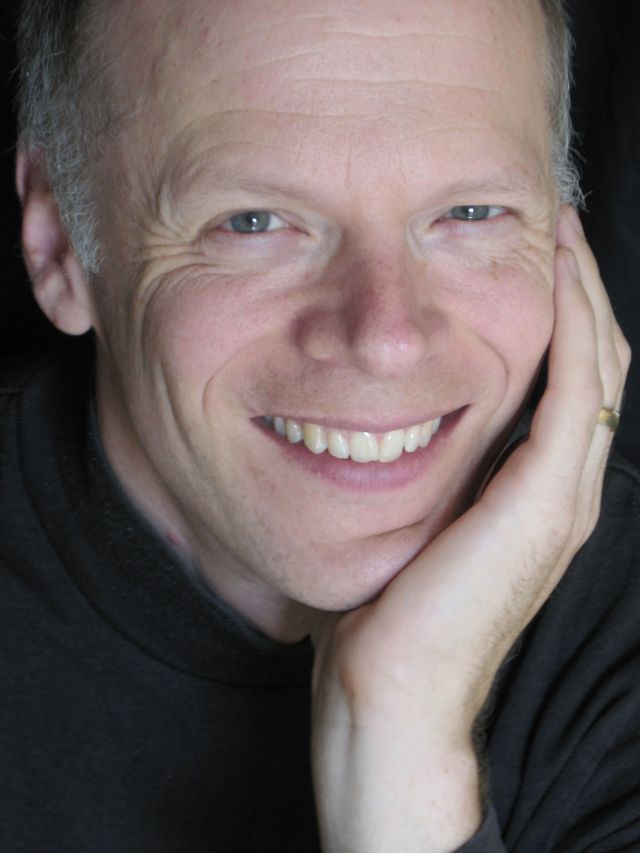
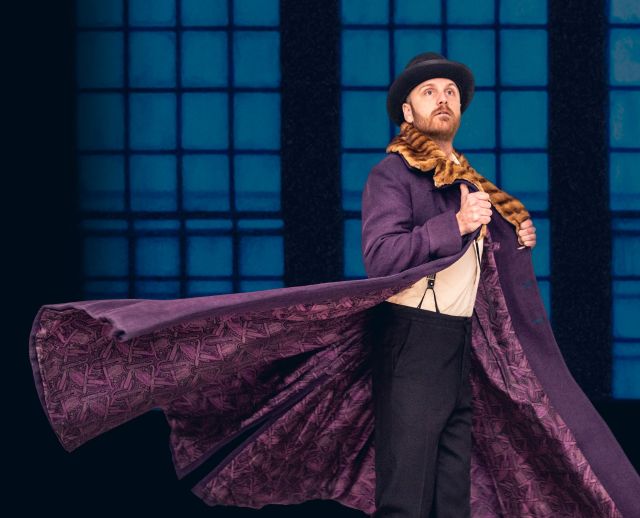

Muse 9’s first production, “From the Diary of Virginia Woolf“, is a theatrical art song performance featuring the music of Dominick Argento and Amy Beach paired with excerpts from Woolf’s novels, letters, and diaries. It is an artistic exploration into the life and mind of the brilliant writer and feminist icon Virginia Woolf through the performances of Mezzo Soprano Victoria Marshall, Actor Keshia Palm, and Dancer Renee Killough.

“Each of the three performers represent a facet of Woolf ranging from her public persona to her inner most thoughts.” Explains co-founder and Stage Director Anna Theodosakis, “Different parts of her personality and experience are portrayed through a combination of song, dance, and Woolf’s own writing. It’s been exciting to see the diverse ideas these three women bring to the rehearsal and creation process based on their unique disciplines.”

Staged at the Ernest Balmer Studio in Toronto’s Historic Distillery District on April 13th at 8pm, it will feature music direction and piano by Hyejin Kwon, stage direction by Anna Theodosakis, and lighting design by Wesley McKenzie. Proceeds from the event will go to CAMH. Tickets are available at brownpapertickets.com under From the Diary of Virginia Woolf. https://www.brownpapertickets.com/event/3351476

Anna Theodosakis is a Toronto based stage director and choreographer originally from Vancouver. This fall Anna was the Assistant Director for the Canadian Opera Company’s Arabella, choreographed UofT Opera’s Don Giovanni, assistant directed Tapestry Opera’s Briefs, directed Tafelmusik’s Haus Musik, and directed the premiere of Shot for the Hamilton Philharmonic Orchestra. Select 2017 directing credits include: L’italiana in Algeri (MYOpera), Les contes d’Hoffmann (Opera Laurier), dawn always begins in the bones (Canadian Art Song Project/COC Ensemble Studio), La boheme (Muskoka Opera Festival) and L’elisir d’amore (COSI). Upcoming projects include directing The Tender Land (Opera Laurier), choreographing Of Thee I Sing (UofT Opera), assistant directing The Nightingale and Other Short Fables (COC), and coaching the COC Ensemble Showcase. She is a dramatic coach for the COC Ensemble Studio and teaches dance for UofT Opera. Anna is the recipient of the Vancouver Opera Guild’s 2017 Career Development Grant.

Pianist and co-founder of Muse 9 Productions, Korean pianist Hyejin Kwon is currently based in Toronto, actively working as a vocal coach. She has received her Bachelor of Music and Masters of Music degrees from Peabody Conservatory and Artistic Diploma from University of Toronto opera. She is also a graduate of Canadian Opera Company Ensemble Studio. Hyejin has worked as a music staff at Canadian Opera Company, University of Toronto Opera, St. Andrews Opera Workshop by the Sea, Repertory Opera Theatre in Washington, Lyric Opera Baltimore, and Shoestring Opera, and was a vocal accompanying fellow at Aspen Music festival. This upcoming summer she will be one of the fellows at the Music Academy of the West.

*********

“Press releases and announcements” are presented verbatim without comment.

Posted in Press Releases and Announcements | Leave a comment

The Overcoat: a musical tailoring

I’ve just seen the premiere of a new opera from James Rolfe & Morris Panych adapting Gogol’s story “The Overcoat”.

JamesRolfe_Headshot_PhotoCredit_JulietPalmer_preview

Composer James Rolfe (Photo: Juliet Palmer)

There’s much to admire, and frankly I feel like saying “it’s about time.” Opera is often bogged down in virtuoso exercises that obscure the simple core elements of the story. The Overcoat: a musical tailoring is an astonishing creation, a transparent bit of nothingness hinting at profundities. No the singers aren’t showing off (the basis of the genre for centuries), and even more importantly, neither is the composer (the unfortunate tendency in the last century or so, that usually buries the story beyond reach of all but the most erudite audiences). The story is simple but amazingly, so is the musical treatment.

The creation reminds me a bit of one of my favourite operas. Richard Strauss and Hugo von Hoffmansthal’s Ariadne auf Naxos went through a series of stages in its conception, an idea that grew over time. Similarly, there was an earlier Overcoat 20 years ago that Panych returns to in 2018 with Rolfe, bigger and bolder even as it is in some respects like a whole lot of nothing. Sometimes a creator can come back to an idea to make it work even better, but what’s especially impressive is how simple their dramaturgy, and without convolution or undue complexity.

As they say dying is easy, comedy is hard. The Overcoat: a musical tailoring is an admirable piece of work that had the audience roaring with laughter, that deserves to be exported abroad, a wonderful creation to be produced and interpreted again.

We’re in the presence of something reminiscent of that master composer, Rossini, who regularly wrote numbers and situations reducing people to comical automatons. Panych and Rolfe give us a 21st century version, the robotic behaviour much more disturbing than anything you’d find in Rossini. Much of the way, the text is in something like couplets, reminding me at times of the nonsense verse of Ogden Nash. This stylization is an interesting choice, setting up the absurdist tone for the work but also making the words fully intelligible; as the opera unfolds this nonsensical texture takes on darker overtones. We’re hearing something at times sounding minimalist like Glass or Adams, although at times I thought I was listening to a musical rather than an opera.

Please don’t take that as disparagement, as I am often unsatisfied with new operas and opera composers. I was thrilled when hearing The Ecstasy of Rita Joe last week, to encounter a score employing an accessible idiom such as country music, less worried about showing off compositional chops and winning conservatory brownie points, than simply telling the story and moving our hearts. There’s nothing extra in what Panych and Rolfe give us, a very lean structure. As in the recent adaptation of The Tempest, where Meredith Oakes opted for shorter lines than what Shakespeare wrote, tampering with iambic pentameter to make the opera understandable and allow the story to move much faster, I think they opted for something very different from the original.  We get a viable, intelligible and completely absurd discourse to explore the world of the story.  While there are changes from the story in their adaptation I don’t think that’s an issue when most people won’t know the story.

Lean and minimal as the work is, there was an enormous amount of energy poured into the Tapestry –Vancouver Opera co-production, presented at the Bluma Appel Theatre, as part of Canadian Stage’s 30th Anniversary Season seen tonight. Sometimes there was only one person onstage, at other times a huge big crowd. For such a slim story, Panych & Rolfe have created something big. While much of the story involves solitary actions and absurd descriptions, they choose to display an absurd world not just inside one person’s head but filling the stage, dashing back and forth. The simple little story doesn’t move all that fast, but the personages on stage certainly do.  Wendy Gorling’s movement vocabulary (a gloss upon her original creation decades ago with Panych) is for me the most exciting part of the presentation, a fabulous visual commentary upon the story & Rolfe’s score.

Geoffrey Sirett as Akakiy in The Overcoat A Musical Tailoring_Photo Credit Dahlia Katz_preview

Geoffrey Sirett as Akakiy in The Overcoat: A Musical Tailoring (Photo: Dahlia Katz)

The opera feels fully realized because of the high quality performance presented tonight. Geoffrey Sirett created the role of Akakiy Akakievitch, a poignant mix of comedy and occasional pathos, wonderfully well sung. Sirett has a gift, possibly because he is free of affections or mannerisms and able to show real vulnerability, always interesting to watch. It was great to see Peter McGillivray in two very different roles—Petrovich the tailor and Akakiy’s department head—both showing off his lovely voice and quirky comic sensibility. Andrea Ludwig was an interesting anchor in the production, as Akakiy’s landlady, giving us some of the few moments of lucid commentary in a work that is otherwise mostly absurd rather than explicit. And as a narrative device, Rolfe & Panych created a “mad chorus” of three fascinating women, who first appear, crawling out of the orchestra pit, commenting at various points in Akakiy’s journey and giving us beautiful music as well, the trio of Caitlin Wood, Magali Simard-Galdes and Erica Iris Huang.

Leslie Dala conducted a small ensemble (a dozen names listed, but it’s hard to know exactly what that entails, when one is simply “percussion” and another “keyboard”), holding everything together beautifully, and the text fully intelligible throughout.

If there’s any way you can get to see The overcoat: a musical tailoring I strongly recommend that you go see it. If nothing else you’ll laugh. The production is on until April 14th, and then will be seen in May out in British Columbia with the Vancouver Opera.

Posted in Music and musicology, Opera, Reviews | 2 Comments

Davies’ Ecstasy of Rita Joe

I’ve just seen Victor Davies’ adaptation of George Ryga’s 1967 play The Ecstasy of Rita Joe, a very faithful treatment of Ryga’s work, the world premiere production in Toronto.

As a result we’re in a funny place culturally with this opera, using the word “Indian” rather than “indigenous” or “aboriginal”. The world has changed a great deal since then, particularly in Canada, where there’s a national dialogue about reconciliation going on, including an ongoing conversation about violence to Indigenous women.

not-forgotten-861x1024

Not Forgotten, by Maxine Noel

There was, in my opinion, no cultural appropriation at work in this opera. I say that in context with the recent production of Louis Riel that contained a song whose use raised some interesting questions about cultural property & the law.

But Ryga’s story really concerns an aboriginal woman in an urban milieu and so the musical idiom must use European & North American musical forms. She is immersed in a world that overwhelms her, and so this musical treatment doesn’t raise the question of appropriation. And it makes a lot of sense.  She is in a world full of something at times European & conservative, at other times, sounding like country & western, because that’s what they listened to and danced to in the bars back then.  It’s eclectic but a recognizable and intelligible mix of styles.

Davies has written something that is especially powerful in its last hour: when it matters. Less than half an hour from the end we get a wonderful trio of three excellent voices singing together, namely Rita, her boyfriend Jaimie, and her father David. For several minutes we heard three voices singing powerfully, pulling at our heart-strings, and with the passionate words fully intelligible.

We also get a thrilling fight-scene that leads to a killing. I was surprised at how gripping this was, considering how badly operas sometimes handle fights onstage. The music is thrilling, dissonant but most important, fluid, which means that the performers can give us the action without being overwhelmed by the challenges in the score.

And we had a kind of tragic epilog to conclude. This sort of thing ideally sums up the story and leaves you with something to think about. You think of the endings of Hamlet or Romeo & Juliet as plays that have a kind of ritual at the ending to mark the deaths and to help us to understand all that has happened. Davies gives us something that is certainly as good or better than any new opera I’ve seen recently, and as I recall it, better than what we have in Ryga’s play at this point (which I clearly recall puzzled me when I read it).

The question we always must ask –that I rarely include in reviews because the answer is so humiliating and futile—is “why set this to music?” Or to put it another way, what does music add, that you can’t do without music? After seeing an opera, I’m often asking myself –and not putting it into my review—why did they bother? For once Davies makes me grateful, made me think “Yes the adaptation improves the original”, takes us somewhere we can’t go otherwise.

Many new operas start well and finish badly, their concept not fully sustaining them to the end. In contrast, Davies is strongest at the end, which is not just remarkable but makes me want to see it again. I also found it a bit long, but maybe that’s contributing to the effect at the end.  I put that in context with my earlier observation that Davies was faithful to Ryga. I have a preference for simplicity, and that includes making things shorter when possible, making cuts / edits, because I know that when an opera is too long, you’ll find some people simply will refuse to come. In being faithful to Ryga, we get a show that’s almost three hours long. In the opera world? 3 hours is no big deal, especially alongside behemoths by Wagner & Strauss, and even Mozart. But in the spoken theatre world that length is exceptional.  I mention this because I think this piece deserves to be heard, and more importantly needs to be produced, to be known, and not just in the opera world.  I’m not sure if it can be done by music-theatre performers (eg Shaw or Stratford), who may not have the voices for the toughest passages; but they usually trade off voice for acting ability.  I think the piece deserves to be seen /heard.

Davies was true to his word (in his recent interview). He said he wanted to write vocal lines that are intelligible: and he succeeded admirably. And he said he would aim for singable melodic lines, a goal that he seemed to achieve.

bio-5

Victor Davies in 2007 (photo: Lori Davies)

The production from Voicebox – Opera in Concert includes some wonderful work in the upstage orchestra pit, conducted by Robert Cooper, with outstanding work from pianist Narmina Afadiyeva, who played almost the entire show, with the other four members of the quintet (woodwind, violin, cello, percussion) playing only sporadically throughout.

While it’s true there are indigenous performers in the show, I simply want to call attention to great singing & acting. Marion Newman as Rita Joe was authoritative, very comfortable, very strong throughout, in a challenging role, totally believable and worthy of applause. Evan Korbut as her lover Jaimie had genuine star quality, a lovely voice and great presence. Everett Morrison as David Joe, Rita’s father, had some very difficult singing that he handled beautifully, while bringing a special presence to the stage. Michael Robert-Broder was a very lyrical magistrate.

Voicebox Artistic Director Guillermo Silva-Marin showed his uncanny instincts today, not just in his direction, getting great work from the Opera in Concert Chorus and from a large cast on the crowded stage of the Jane Mallet Theatre, but more fundamentally in having the foresight to develop and program this work, latest in a series of pieces commissioned from Davies.

I can’t wait to see what they come up with next.

Posted in Opera, Politics, Reviews | 3 Comments

Jaws live with the TSO: not the same

Every time I’ve seen one of these live Toronto Symphony showings of a classic film + film-score, I’ve had some remarkable experiences complete with insights, and tonight’s showing of Jaws was no different.

The phrase that keeps running through my head is “it’s not the same”.

Oh sure, I know this movie really well, having seen it so many times I know every line. But never this way.

Each film has a slightly different impact on the audience. Tonight there was something decidedly carnivalesque at work. There was an electric charge in the air before we began, but then again, it’s not usual to sit at a Toronto Symphony concert eating popcorn or drinking.  The audience had come for certain thrills even if they might elicit screams of terror rather than delight. I heard jokes about people wearing shark costumes and the old SNL “land shark”, perhaps the high-point in Chevy Chase’s career.

The guy beside me said “here we go” as it began: as though we were on a roller-coaster. And in a sense we were.

RESIZEDJaws_Still_9

Roy Scheider, wishing for a bigger boat.

When the familiar theme started its oscillation between two notes, the theme that’s John Williams’ most (in) famous creation, there were giggles and laughs throughout the audience. It became something of a communal experience resembling a public execution, except that the deaths were not real, and of course I say this never having seen an actual public execution. But there was the most outrageous sense of titillation in the air, in direct proportion to the degree of violence and the amount of blood.

When Quint finally dies there was a surprising response from part of the theatre, namely applause, as though the villain had just died.  Hm he’s not the bad guy is he? I should have expected this, as we were in the middle of a big public melodrama, without the booing and hissing. We and the protagonists were powerless. The music heightened and amplified the emotional moments in the story.

It’s really like two films, especially when they insert an intermission right in the middle: just as the trio set off in the boat to catch the great white shark. The first part of the film has a very different tone, reminding me at times of Close Encounters of the Third Kind, another movie with a lengthy exposition setting us up for the great ecstatic struggle that is the last part of the film.

It’s not the same in another couple of ways, having to do with this presentation. It’s likely to seem as though I am splitting hairs. The intermission is of course standard by now, as every one of these TSO screenings inserts an intermission into the film, and this one was no different.

But the ending caught me off guard. One of the things I love about Williams’ score is the end, where –after hours of tension—we get a fabulous release. The music when the shark’s head has been blown off, and is bleeding into the water is like a take on Saint-Saëns “Aquarium” from his Carnival of the Animals, with the flowing ostinato in the piano. After all the death and adrenaline, it’s so redemptive as the survivors swim home, so uplifting, and yes, such a sense of relief after all the suspense. But: at the end someone thought it might be fun to insert more of the scary music, to whip up the audience again. And of course yes they were screaming in admiration, so I suppose I’m out of step with them: these people who started talking loudly while I was trying to listen to Williams’ music at the end, while they started leaving. I can’t decide whether I should shut up about this, as an admirer of Williams’ achievement, when that chattering audience who were so ecstatic at the end surely lost themselves in the film, just as Williams and Spielberg would have wanted.  Perhaps they are the ideal audience and I’m just a nerd who should try to be more understanding.

RESIZED Constantine Kitsopoulos - credit Lisa Kohler

Conductor Constantine Kitsopoulos (photo: Lisa Kohler)

It is amazing that at times I forgot all about the orchestra and their conductor Constantine Kitsopoulos. There’s so much going on in this score, not just that oscillating theme, but moments of wonderful work in the percussion (xylophone or marimba perhaps?), brass, and the woodwinds. It’s a huge score, but they are merely accessories to the emotional torture we’re put through in this film, one of the most accomplished scores I know of.

Played this way you hear all sorts of details that are lost usually when you watch the film on DVD.

I found it quite overwhelming, and –for the umpteenth time—must recommend the experience of film with a live accompaniment, whenever possible.

It’s not the same.

And that’s why it’s so extraordinary.

Posted in Cinema, video & DVDs, Music and musicology, Reviews | Leave a comment

Paint Me a Song: three cycles for three painters. 

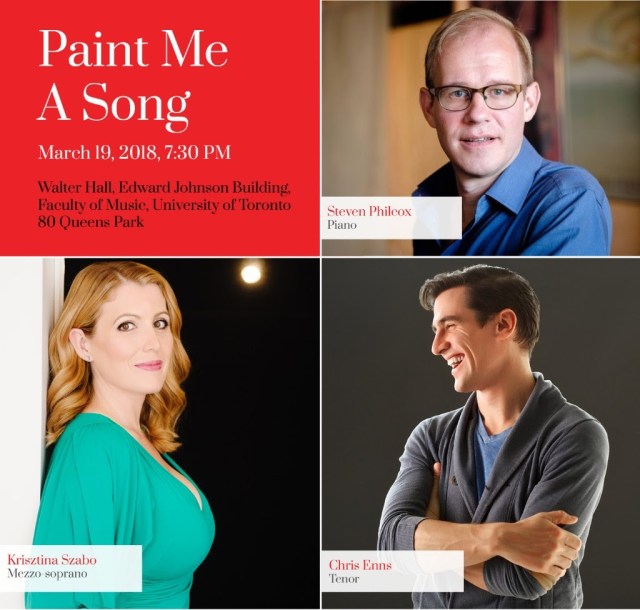
CASP, the Canadian Art Song Project, regularly undertake ambitious programs to push the possibilities of their medium.  To begin tonight’s concert, “Paint Me a Song”, Co-artistic Director Steven Philcox gave some insight into the creation of our program.

paint_song

Curating and commissioning seems to be a challenging prospect, when you not only have to plant seeds, hoping they’ll germinate, but also find the right artists and then bring the growing sproutlings before an audience.  It’s as scary as anything a painter or a composer might do.

And so Stephen and his co-AD Lawrence Wiliford gradually built this program from several disparate threads:

  • Canadian composer Jeffrey Ryan set some of Emily Carr’s journal Hundreds and Thousands, which he’d stumbled upon in a bookstore; this cycle was a CASP commission for Philcox & mezzo-soprano Krisztina Szabó
  • American composer Ben Moore had earlier set some of Vincent van Gogh’s letters to his brother, Dear Theo, a cycle for tenor & piano
  • Canadian composer John Beckwith recently wrote Four Short Songs, setting poems of the young Kandinsky

The Walter Hall audience was very receptive taking in the work of Philcox at the piano, tenor Chris Enns and Szabó.

The three composers each came at their subjects in divergent ways.

Ryan gave Philcox a run for his money at the keyboard, sometimes very understated, sometimes very frenetic.  In places the page of music likely resemble something of Carr, patterns of notes in arabesques to make a Debussy proud of their design.  I can’t help thinking that Ryan wanted us to hear and even see something like the repeated brush-strokes Carr would apply to her canvas.   At other times we were encountering a canny monologue, the artist brilliantly brought to life by Szabó.  It could be tuneful, sometimes powerful, sometimes more like a stand-up comedy routine.  The shifts of tone were wonderfully woven together.  As this is my first encounter I can’t really comment on whether it’s a unified work or not, as there seemed to be some abrupt tonal shifts, but the contrasts were electrifying.  At one point I was put in mind of the symbolist Debussy of the Proses Lyriques¸ the solemn chords in this case taking us to an ambiguous tonality suggesting something metaphysical & unearthly for awhile until Ryan settled us into something more recognizably diatonic.

I’m hoping to hear this wonderful cycle again.

In the middle of the program were four short songs from John Beckwith sung alternately by each singer, and an unexpected delight.  This short cycle from the oldest composer on the program was in some ways the most experimental, a playful series of provocations and teases in song.  I’m not sure if it’s because I was hungry that I was mindful of the sumptuous dessert my mom offered me yesterday, as each of these songs was as elusive as whipped cream on the palate, melting in the singers’ mouths and ours as well.

whipped_cream

It’s a metaphor, but this is how I experienced Beckwith’s delicious little songs

I should explain that I chose a strategy tonight that might seem ill-advised, which is to read the program notes but to listen without reference to the texts.  I wanted to see what I could discern just from hearing and without reference to my notes.  On that basis Beckwith was especially astonishing, each of his songs like an abstract mathematical model, aided and abetted by the playful delivery from Enns & Szabó.

Philcox & Wiliford cleverly anticipated the way the three pieces would work together when they began, giving us a wonderful range of sounds & styles even though the theme might at first glance have seemed narrow. Moore’s writing is probably the most accessible, as the least likely to represent a significant innovation, sounding closer to pop song than art song. But this most tuneful writing that sounds like music-theatre, and a good match for Chris’s lyrical sound was a great place to begin, to ease us in and get us warmed up.  While Moore’s tunes are pretty, indeed at times very beautiful, I don’t feel that they approach the profundities hinted at in the van Gogh texts let alone his paintings.  Even so Philcox and Enns gave us something quite intriguing to see & hear, urgent and powerful

It was a very impressive outing from CASP.

all_five_resized

Philcox claps as did we all; Ryan and Beckwith meet centre stage, while Szabó & Enns had earned their rest after lots of singing.

Posted in Art, Architecture & Design, Music and musicology, Reviews | Leave a comment

Sirett, Koniuk & Oriana: romance on the road

This weekend I went out of town to see a concert while processing this weekend’s great tempo rubato. Daylight Savings Time appropriates an hour from our lives that will only be given back half a year from now. I figured it might be fun to wake up in a new place, not terribly worried whether it’s 7 or 8 or 9: so long as I didn’t miss breakfast. More on that in a moment.

Speaking of travel, artists sometimes have to leave home. The greatest satisfaction isn’t necessarily in the big city, but may be found guest-starring in a small town.

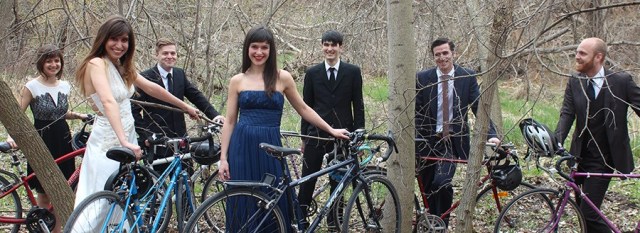
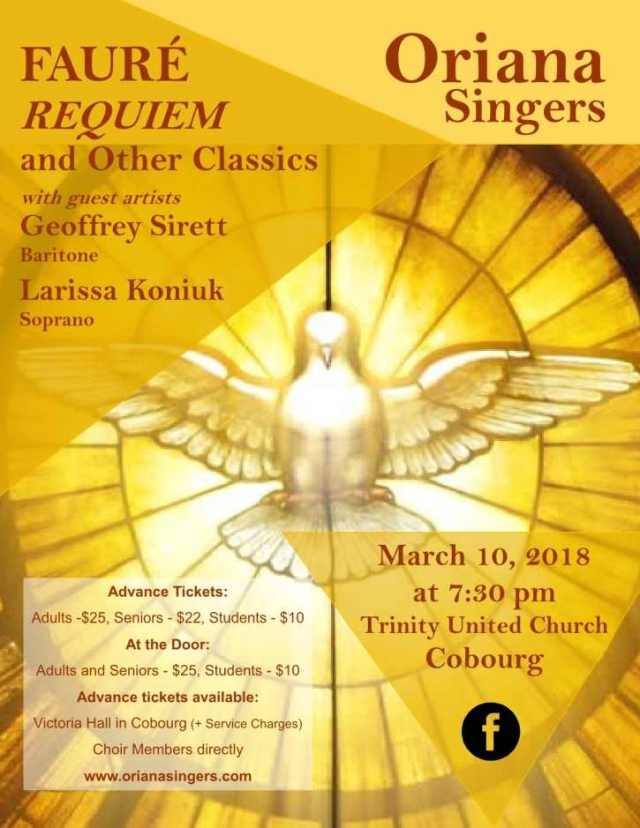
Oriana Singers, conducted by their Artistic Director Markus Howard and accompanied by accompanist Robert Grandy presented a concert in Cobourg last night including Fauré’s Requiem featuring baritone Geoffrey Sirett and soprano Larissa Koniuk. You may remember them from Bicycle Opera Project programs over the past few years.

groupwoods

The 2014 Bicycle Opera Project team, including Artistic Director Larissa Koniuk in the blue, centre, and Geoff Sirett, at the extreme right,

They pull their opera productions around the province behind their bikes, including last summer in Sweat when he was music director, while she was a featured performer, and Artistic Director. Geoff’s face is all over town in the promotional images for The Overcoat: a Musical Tailoring, coming later this month.

Geoffrey Sirett as Akakiy in The Overcoat A Musical Tailoring_Photo Credit Dahlia Katz_preview

Geoffrey Sirett as Akakiy in The Overcoat A Musical Tailoring (Photo: Dahlia Katz)

In the Fauré, played with organ plus Tak Kwan’s eloquent violin solo in the Sanctus, Sirett had the bigger role. In the Hostias his rich baritone warmly filled the sanctuary space, while in the Libera Me, his solo seemed as insistent and powerful as the entire 60+ voices of the choir (admittedly carefully restrained in this section by Howard). Koniuk’s Pie Jesu displayed the beauty of her vocal colour to great advantage.

There were other choral pieces on the program. We began with Fauré’s Cantique de Jean Racine, a flowing & lyrical warm-up for the Requiem that followed. Later in the program we heard Acclamation / Hallelujah by Robert Ray, Winter’s Agnus Dei, and Ola Gjeilo’s Evening Prayer, aided by David Tanner’s mellifluous saxophone.

oriana

The second half included a series of operatic excerpts. Koniuk began with “Je veux vivre” from Roméo et Juliette, easily popping her high notes, all smiles throughout. Sirett followed with a contrasting aria from Die tote Stadt, his sound floating in the space. We would also hear Musetta’s Waltz from Koniuk and a charming “La ci darem la mano” with a delightful bit of flirting between the couple. Thankfully Donna Elvira had the night off, allowing nature to take its course for once; but then again Zerlina is married to Don Giovanni.

In the meantime it was a great pleasure watching the chemistry between them and their guests, the drama written on the faces of choristers watching Sirett or Koniuk, let alone the intensity of their performances in the choral works. I was thrilled by the Fauré, one of my favourite works.

Oriana Singers will have their 50th anniversary next season. Their next concert this season is Shakespeare: Words & Music coming Saturday May 26th.

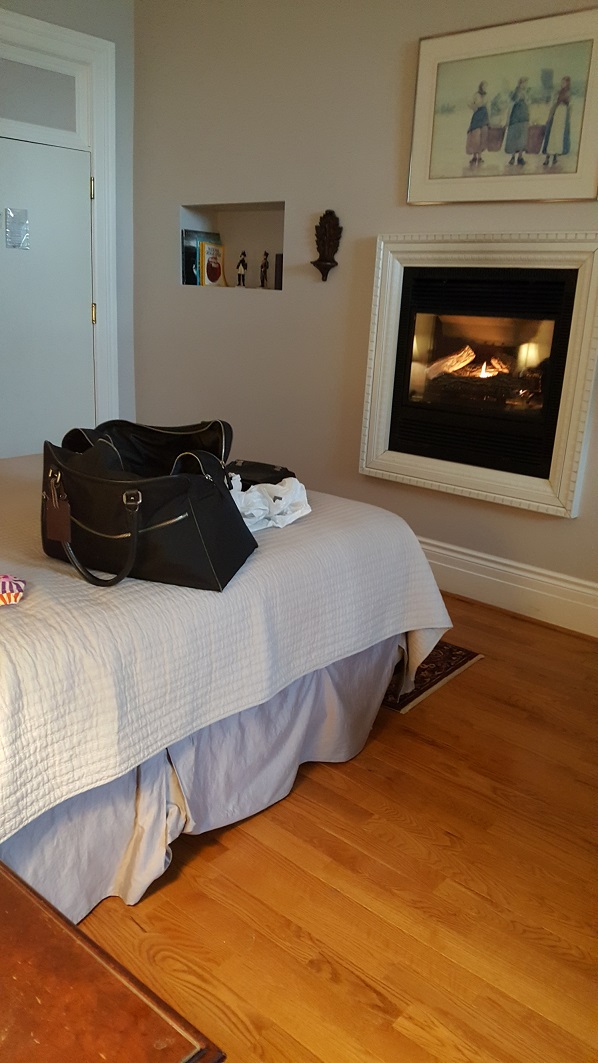
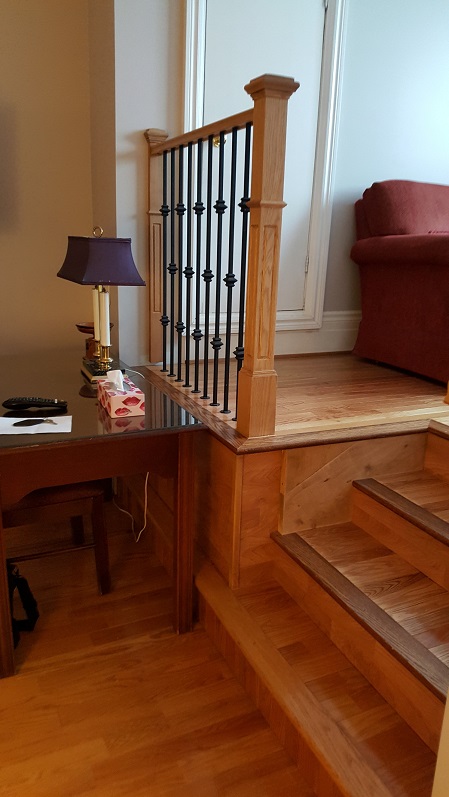
Let me add that we had a great time, staying at the Woodlawn Inn, a bed and breakfast a few blocks away from the church where we enjoyed the concert: close enough to walk on a brisk March evening.  I’m adding a couple of photos to show the room, which I understand is one of the smaller ones, actually.  Yes we had an upstairs including a couch & a second TV, a working fire-place (gas I suppose: which was really awesome when i woke up to it in the night) and for those who care for such things, a jacuzzi.

fire2

up

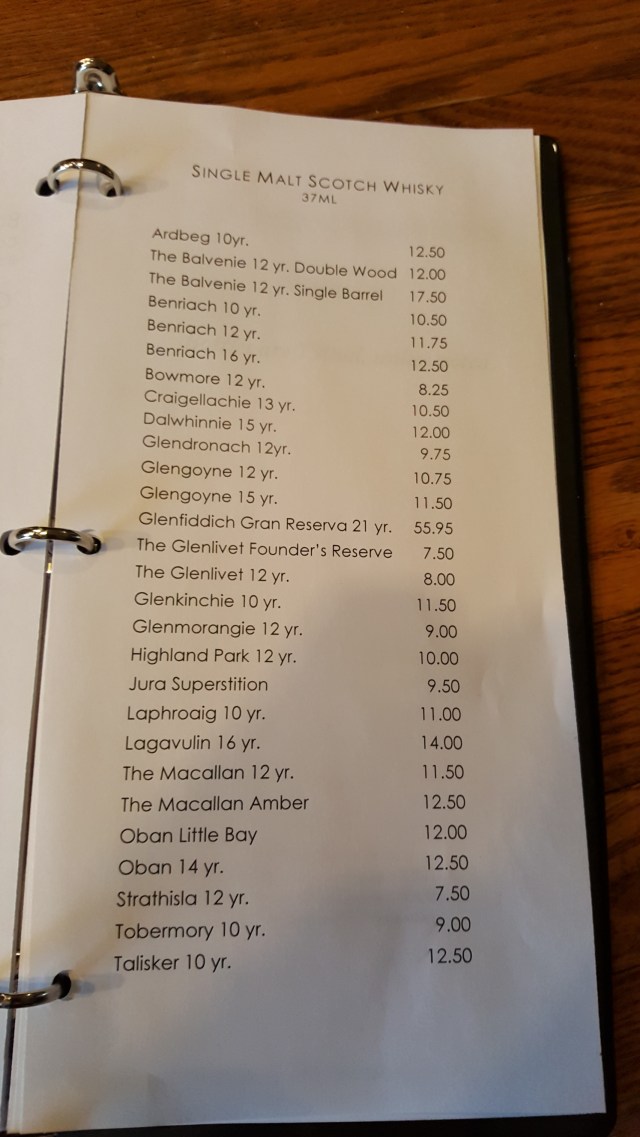
It wasn’t a long drive away from Toronto, but with the help of a bit of Ardbeg, Oriana Fauré, Sirett, Koniuk, Howard and Cobourg herself, I lost all sense of time.

You can’t steal something when it’s given away freely.

ardbeg

And in the bar(!)

Posted in Music and musicology, Opera, Personal ruminations & essays, Reviews | Leave a comment