The Wizard of Oz live with the TSO

For the past few years the Toronto Symphony have given us opportunities to see well-known movies with live orchestral accompaniment:

I don’t pretend to understand how all the necessary technical challenges are surmounted to make these possible.  The dialogue appears to be on a different track from the music, with the result that we still get Anthony Perkins or Kim Novak or Jimmy Stewart speaking their lines, whether we have the old Bernard Herrmann soundtrack that was recorded and imprinted onto those films, or a live performance by the Toronto Symphony in the 21st century.  Vertigo and Psycho have scores that are 100% extra-diegetic: meaning that the music is created outside the world of the story.  While there’s a moment in Vertigo when Scottie is cracking up after the apparent death of his beloved when he’s listening to Mozart to calm his soul, and so some music is from the same world as the dialogue, namely, within the film’s diegesis, but it’s on a phonograph record, and so doesn’t shatter our reality. We can watch those stories unfold whether the music is the same sound we’ve always heard or a live performance.

Wiz 2

In Back to the Future it gets a bit harder because we’re watching Michael J Fox sing & play “Johnny B Goode” live at the “Enchantment Under the Sea” dance.  But this would only pose a technical challenge if the scene contained Fox’s guitar & vocals as well as live orchestra. But because there’s no other music at that moment we’re content to listen to music from the same place as the dialogue, in much the same way as that vinyl recording of Mozart in Vertigo.   In the performance of Howard Shore’s The Fellowship of the Ring there was a much higher level of complexity, as we heard a soloist singing a song, and a chorus as well, adding to what the orchestra did.  Even so, these too were extra-diegetic, and not in any way penetrating the world of the film.

That colossal preamble is meant to explain the different challenges posed by the film I saw tonight, namely The Wizard of Oz.  First and foremost, is the fact that it’s a classic film musical, which means that the songs had to be left more or less un-touched, because you can’t replace Judy Garland or Ray Bolger or Bert Lahr.  As a result we were in the presence of something reminding me a bit of Natalie Cole’s Unforgettable, an album of songs where she sang duets with her deceased father Nat King Cole.

Emil de Cou conducted the Toronto Symphony in the virtual ensemble across two different centuries, including their concertmaster Jonathan Crow, playing along with Garland and Bolger and Lahr et al.  What I saw tonight was surely one of the most difficult and thankless jobs I can imagine, speaking as an accompanist.  There are times when singers are hard to follow.  But usually when one is attempting to stay with a singer or an ensemble, they are making adjustments, trying to stay with you and adjusting as much as possible.  In this case, we were watching the TSO led by de Cou, seeking to synchronize with a performance that was fixed long ago and could not in any way respond or adjust.  When it was a vocal solo it was amazing stuff.  For these solos, such as “Over the Rainbow” or “If I were the King of the Forest”, I believe the track was at least put through an equalizer if not actually edited so that we heard mostly voice coming from the film, while the orchestra gave us the accompaniment, and de Cou did his best to synchronize the big orchestra.

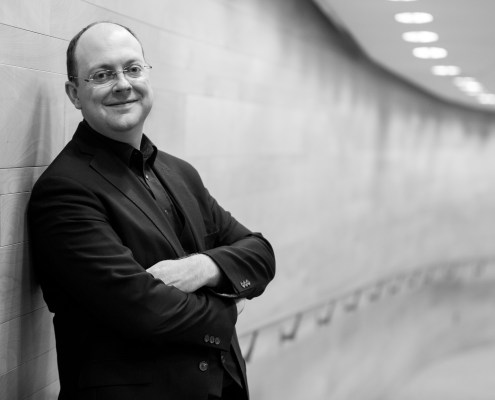
Emil de Cou - head shot

Conductor Emil de Cou

This became an almost impossible task with the big choral numbers, thinking especially of the songs with the Munchkins such as “Follow the Yellow Brick Road” that pose a huge challenge for the synchronization. And so of course in places the accompaniment and the vocals were out of synch. But I’m hugely sympathetic because I can see what a difficult task this is.   I don’t think anyone minded, indeed it calls attention to something that’s easy to forget: that the orchestral music is being created live.  The virtual aspect was overshadowed by the live-ness of the creation, rather than undermined.

When you know every line of the film –and I know I’m not the only one in this category—options open up.  For the last half-hour of the film, it seemed as though the orchestra was often on the edge of completely drowning out the dialogue. But who cares, if we know every word?  We experienced something like being deeply immersed in the film.  We had the  film projected on a big screen, which is a novelty for those of us who grew up watching it at home on TV. But the big thing was simply hearing all the details in the score.  I never realized how often a theme or melody from earlier in the film comes back as a leit-motiv.  That’s all much clearer when the score is played so powerfully.

Another challenge was the occasional wordless chorus (a trope you can find in Debussy’s 3rd Nocturne for orchestra or in Neptune in Holst’s The Planets suite although it appeared as early as in Rigoletto, which is currently on stage in Toronto; and we still hear such choruses in the film-scores of Danny Elfman). They solved the problem by the choice to use a synth player on his laptop.   Did anyone notice? It wasn’t a problem for me that’s for sure.

It was a very full night for the orchestra. While the playing is rarely virtuosic in nature –although there are a slew of borrowings from the classical repertoire, for instance the chunk of Night on Bald Mountain in the big confrontation scene with the Witch—it seems to be a full night’s work.  Crow sounded wonderful in his solos.

The TSO perform it again Sunday afternoon.  See/hear it if you can.

Posted in Cinema, video & DVDs, Music and musicology, Reviews | Leave a comment

Aeris Chordas

“Aeris Chordas” is the name for the concert I saw tonight, chamber music from four artists:

  • Christina Raphaëlle Haldane, soprano
  • Carl Philippe Gionet, piano
  • Michelle Jacot, clarinet
  • Marc Labranche, cello
ChristinaHeadshot8

Soprano Christina Raphaelle Haldane

The four composers I saw on the program:

  • Johannes Brahms
  • Gionet: (the same person playing the piano)
  • André Previn
  • Franz Schubert

Aha, Schubert + a clarinet? First things first. Scanning the program, I looked for “Der Hirt auf dem Felsen” (aka “the Shepherd on the rock”) and voila! there it was to close the program. It’s a challenging work, not programmed often enough, a lovely composition.  And so there we were at Jeanne Lamon Hall at Trinity St Paul’s Centre, hearing these “Chords of the Air,” (my feeble attempt to translate the title, not knowing what language we’re working from).

In a program of unfamiliar music composed in the last quarter century (Previn in 1994 and Gionet’s work from the past year), book-ended by the more familiar composers (Brahms & Schubert), I would never have predicted the high points of the concert.  Let me begin by saying that Carl Philippe Gionet was especially impressive, a bit of a musical chameleon.  It’s funny that with the concluding piece, Schubert’s “The Shepherd on the Rock” that Gionet was totally self-effacing while allowed clarinetist Jacot and soprano Haldane to soar.  Yet over the evening he really was their collaborative rock, the one who held it all together.   The Brahms is easy to under-estimate, a work that demands ensemble fluidity as though the players are one mind and one body rather than a trio.  It was in his three songs that I was especially impressed.

To hear the introduction from Haldane & Gionet, one would understand these as his adaptations, although I am hesitant because of course some artists have used this sort of framework to disguise original  compositions –for instance Pierre Louÿs’ “Chansons de Bilitis” that were originally presented as historic specimens, and only later seen to be the poet’s own writing.  According to their explanation, the “Trois folklores acadiens” are the beginning of a larger compilation, reminiscent perhaps of the anthropological record of folk music that Bartók assembled, rather than original compositions.  Do I care whether these are adaptations or 100% original? Nope. Either way Gionet has made something very special.   The three songs were introduced to us in Haldane’s wonderful incarnation of each, along with Gionet’s remarkable pianism, supposedly older a cappella songs adapted by Gionet.

  • If I understood “Wing tra la” there’s flirtation here, Haldane giving us some remarkable sounds from her rich lower register (from a singer who is a lot more than just a soprano) while impersonating more than one character
  • “Tout passe” in stark contrast is a smaller part of a longer hymn sung by the Acadians as they awaited deportation, a kind of stoic song of acceptance of their sad fate, while the piano swirls and comments, without really anchoring us solidly in a single tonality. We are floating in space for much of the song.
  • “L’escaouette” is a wildly playful conclusion to this cycle, the pianist playfully hitting clusters, sounding at least bitonal in his support of an energetic song.  Gionet has a gift at the piano, making something happen in his writing that never gets in the way of the voice, sometimes ambiguous in its tonality, and always interesting to hear. His is a flamboyant compositional voice that deserves to be heard.  I look forward to the future additions to this cycle.

After the interval we encountered three strong solo voices together, namely cellist Labranche, soprano Haldane, and Gionet at the piano, in “Four songs after poems by Toni Morrison”, by André Previn.  The cycle ends in an understated song called “The Lacemaker”, after some remarkable flamboyance from the piano, particularly in the jazzy “Stones”.  Gionet & Haldane seem to be very happy on jazzy turf, her voice having several possible approaches to such repertoire.

MICHELLE

I found this picture on Michele Jacot’s website. She’s a clarinetist and conductor, but maybe just maybe she plays a few other instruments…?!

My admiration for the final song really centres on Haldane, Jacot playing accurately, Gionet playing softly while Haldane astonished me, as though in a duet between the two soloists.

Coming at the end of a busy evening and lots of notes, I couldn’t help noticing how intelligently she began this Olympian song of huge leaps that suggest the high mountains, ascending 9ths and descending 10ths, all with pristine intonation.  She began very carefully, gradually opening up as the song went on.

Will we hear more from this group, perhaps an album of this rep?

I hope so.

Posted in Music and musicology, Reviews | Leave a comment

Questions for Maxim Lando: Lang Lang’s protégé

Maxim Lando is a 15 year old American pianist. In 2017 at the age of fourteen, Maxim performed Rachmaninoff 3rd Concerto with the Mariinsky Theater Orchestra in Saint Petersburg,  receiving rave commentary on the popular Russian TV Kultura program Tzar’s Box. Maxim also had the great honor to perform at Carnegie Hall’s Opening Night Gala Concert together with Lang Lang, Chick Corea, and the Philadelphia Orchestra led by Yannick Nézet-Séguin in an unprecedented three-pianist rendition of Gershwin’s Rhapsody in Blue.

There’s lots more I could tell you, but you can find a more detailed biography on his website or check him out for yourself on youtube.

Maxim is in Toronto performing March 1st on a revised Toronto Symphony Orchestra program led by Peter Oundjian, revised because the featured performer, pianist Lang Lang, has developed tendinitis.

Lang Lang also happens to be Maxim’s mentor.

Screen-Shot-2015-12-31-at-3.28.10-AM

Of course I had to ask Maxim some questions.

Are you more like your father or your mother?

I feel like I am a combination of many traits from both of my parents. I definitely share their stubborn persistence, especially about ideas and passions. My entire family (including grandparents, uncles, aunts, and cousins) is full of determined, strong-willed people, and I would have to say that I have inherited that quality. My parents have a particularly relaxed view of life, almost always looking at the humorous side of things. My home is full of quick loud outbursts (because we are all stubborn and passionate) and then a lot of irreverent laughter. I think I am the same way – most of the time my personality could best be described as either very intense or very goofy.

What is the best thing or worst thing about being a pianist?

Music has to be one greatest pleasures in life, so spending the majority of my time immersed in music is fantastic. Being a pianist specifically, there are definitely best and worst aspects. We have an amazing repertoire, endless really. There is so much incredible music already written and constantly being written for the piano, that you could spend several lifetimes and still not even play a fraction of it. On top of all the music specifically written for piano, there is an entire genre of transcriptions for the piano. Almost any orchestral work, opera aria, great melody, or popular song, could be conceived on the piano. Composers like Liszt and Rachmaninoff did this in virtuoso ways, and composers and pianists today continue to have fun changing up the tradition.

As far as a more difficult thing about being a pianist, it can be lonely. Pianists don’t perform and practice with other musicians as much as orchestral players and singers. For me, I would love to have a career that involves both – performing all over the world as a solo pianist, but also having ample opportunities to collaborate with other artists.

Who do you like to listen to or watch?

I love listening to the musical Jekyll and Hyde. I often find myself singing at the top of my lungs in the shower and running around the house screaming the lyrics to Jekyll and Hyde. I also always enjoy watching and studying the famous ping pong player Jan Ove Waldner. The Lord of the Rings has always been my absolute favorite book and movie series, and I think that the musical score is brilliant. Lately I’ve been listening to this score as a nightly routine right before I go to bed. Among classical recordings, I can never ever get enough of Vladimir Horowitz!

What ability or skill do you wish you had, that you don’t have?

Invisibility (but only when I choose). I could hear what people are really saying, and it could be advantageous is so many fun ways.

When you’re just relaxing and not working what is your favorite thing to do?

I really enjoy playing ping pong and also spending time cooking with my friends, (especially making fresh homemade pasta from scratch). I love taking long walks that are often around 27 miles long. I always look at nature on these walks, which inspires me to come up with new ideas in music. I think that music is all about telling a story and bringing the audience on a journey. Somehow my walks help me to feel and understand that journey. They can always cheer me up when I’m in a bad mood or I don’t feel like practicing on a particular day.

Maxim_Lando_Island_Photography

Maxim Lando (Island Photography)

Please talk about some of the joys & challenges in Gershwin’s Rhapsody in Blue

Gershwin’s Rhapsody in Blue is simply a blast to play! There are endless possibilities of different types of sound, rhythmic variations, and voicing. Gershwin’s music always has this wonderful combination of both jazz and classical elements, but still distinctly has its own voice. For me, the fun in playing the Rhapsody in Blue is the absolute joy and love of life that I hear in the music. I also feel that the jazz influences give freedom to add something or improvise here and there.

What is it like sharing the stage with a major star such as Lang Lang?

LangLang_Photo_Robert_Ashcroft_Sony_Classical

Lang Lang (Photo: Robert Ashcroft – Sony Classical)

To be honest sharing the stage with Lang Lang is very easy, because he makes it easy. Lang Lang’s enthusiasm for everything is infectious, and when we are playing together there is so much joy of just making music in the moment. From the first time we ever played a duet (I had just turned 12), I have always felt his overwhelming support and encouragement. For me, Lang Lang is one of the most brilliant and committed musicians out there and I think he has done more for the classical music world than almost anyone. Of course there is always the sense of awe in Lang Lang’s crazy star power (I don’t think there is any other classical musician who can affect young musicians, a roomful of school kids, or popular culture the way Lang Lang can), but when we play together I feel like fundamentally and musically somehow we are in sync.

How do you approach the Gershwin differently, to take the pressure off Lang Lang?

For the Gershwin, essentially I am playing the notes of the left hand using two hands, and Lang Lang is playing the right hand. This gets a bit complicated however, since the Rhapsody in Blue contains numerous hand cross overs (where the left hand crosses over the right hand or vice versa). There will be places in the piece where I end up taking over both hands, Lang Lang takes over the left hand with his right hand, where we are constantly crossing over each other’s hands, and sometime we just add extra notes that aren’t even written. It’s really quite fun! I also feel like it’s something really special on a fundamentally human level. Playing any chamber music together is a very intimate experience, but to play a solo piano concerto with three hands (rather than two) is even more connected!

What is the experience of mentorship like?

I would have to say that the Lang Lang International Music Foundation has ultimately been responsible for the majority of unbelievable opportunities that I have had over the past four years. Through the foundation’s support, I have had the chance to travel all over the world! Almost every time, these first introductions have led to new opportunities or concert invitations. I have also had the chance to spend time with an amazing network of other young musicians through the foundation.

Maxim with his teachers Lang Lang, Tema Blackstone, and Hung-Kuan Chen

Maxim with his teachers Lang Lang, Tema Blackstone, and Hung-Kuan Chen

As a personal mentor, Lang Lang is simply the best! Probably the best moments are informal ones, when I play something in a dressing room and Lang Lang offers some invaluable words of wisdom. A very special form of mentorship also happens on stage during rehearsals, where I’m part of the action or just observing as Lang Lang interacts with some of today’s most important orchestras and conductors. This form of mentorship is extremely rare and it’s such an amazing opportunity to learn first-hand from someone who has performed with orchestra thousands of times. Finally, Lang Lang is a mentor in terms of his fantastic view of life and incredible strength of character.

Talk for a moment about what you’re doing to make music accessible to your generation.

I think most classical music is just as moody as the typical teenager. There are calm moments, crazy moments, insanely intense moments, depressing moments, and unbelievably beautiful moments. It’s not hard to understand or appreciate this art form, it’s simply that a lot of young people are never really exposed to this music (or when they were, it was unfortunately a negative experience) so they think they hate it. There is also sometimes a bit of a snob appeal to classical music that turns people off. I think this is such a shame! You don’t have to know anything about classical music to enjoy it. Music in general is probably one of the most powerful ways we can bridge gaps and become closer together as caring human beings. It is language that has no boundaries.

Is there a teacher or an influence you’d care to name that you especially admire?

I am always inspired by my teacher at Juilliard, Hung-Kuan Chen. He passionately shares a lifetime of profound wisdom, insight and advice on so many levels. He supports and encourages me to find my own path in this world.

*****

Maxim Lando and Lang Lang team up with Peter Oundjian and the Toronto Symphony , including members of Toronto Symphony Youth Orchestra in a March 1st concert featuring Dukas’ The Sorcerer’s Apprentice, Ravel’s Daphnis et Chloé Suite No. 2 and Gershwin’s Rhapsody in Blue.

Posted in Interviews, Music and musicology | 1 Comment

Abduction via Mouawad

It’s another new Canadian Opera Company production where my first impulse is to credit the brass running the COC. But in a week when the big news for North American opera was the second artistic directorship undertaken by Alexander Neef, this time in Santa Fe, it’s a wonderful omen that his role is again front and centre, a series of wise choices.

RESIZED_neef_Debus

COC Music Director Johannes Debus and COC General Director Alexander Neef. (Photo: bohuang.ca)

While the photo of Jane Archibald is far more striking –no offense Mr Neef or Maestro Debus—I’ll still lead with the two men, as I think that’s the real story.  The new COC Abduction from the Seraglio –a co-production with Opéra de Lyon—reminds me a lot of their production of Louis Riel last season because of a similar political framework, an enlightened director leading a kind of redemptive production, aiming to save the opera from itself.

Wajdi Mouawad_ photo jean-louis_fernandez

Wajdi Mouawad (photo: Jean-Louis Fernandez)

This time we’re in the presence of a Lebanese Canadian, namely Wajdi Mouawad, who interrogates the Mozart Singspiel as a site of what the director might call “caricature or casual racism.” By a curious coincidence, Mouawad’s method sets up a similar sort of layering to what Hinton gave us in the spring for Riel. When Jane Archibald sings her big number to close the first half of the show it’s again in the presence of silent witnesses, lending an extraordinary weight to the moment. “Marten aller Arten” is sung from a kind of cleft that has huge resonance for me in a week when I was watching François Girard’s Parsifal and its lurid suggestions of female sexuality (ha, while we’re speaking of co-productions with Opéra de Lyon). As the set begins to move and close in on the women –Archibald plus a dozen extras, half children half adult—if you know this opera, you may gasp. Mouawad seems to make this moment speak for all women. No wonder people are speaking of Archibald as though she were Gandhi or MLK, because of course the moment becomes one of activism, highly political, and I might add, totally irresistible. It doesn’t hurt that Archibald, the COC’s artist in residence sings note-perfect. I can’t recall ever hearing her sing off pitch, and tonight there was a great deal more going on than just the music.

operaenlevementauserail35_copyrightstofleth

Jane Archibald as Konstanze, in the Opéra de Lyon/COC co-production of Abduction from the Seraglio, 2016 copyright ©Stofleth

Mouawad gives us a highly original new slant to the story with a fascinating little prologue. What if we were to see the characters who escaped from the Seraglio, back in Europe? The opera becomes a kind of discussion resembling a trial –again reminding me of Hinton’s Riel—in its reframing of a flawed work with the benefit of 21st century hindsight. The dialogue is new, and the staging is peppered with moments where the illusion is pierced by flashback moments, as when Belmonte is touching Konstanze in a scene she has with Selim. Those occasional moments of ambiguity made the whole thing electric, seeming to dance on the edge of being yanked from one reality into another. We open after the intermission with a prayer and a dervish-like dance both of which add to the richness of the production.

The set design of Emmanuel Clolus is a co-conspirator in the inter-penetration of the original, at times pushing it away, at other times overwhelming us, as in the moment I described that concludes the first half. There’s a mysterious geometric shape peeking out upstage, that is finally revealed near the end –spoiler alert—when we discover that this is where the women have been held captive and where the four Europeans are held pending their torture, a spherical shape that alludes to the Earth in its totality. Am I reading too much into it? one does that when one is feeling drugged, my mind expanded in sympathy with all the love and enlightenment (in more senses of the word than just the one) on display.

There may be casualties. The comic tone one usually encounters is harder to find, possibly because the opera simply isn’t as funny in this version. No it’s not a light comedy, too much gravitas for that. Pedrillo, played by Owen McCausland is the designated funny man, sometimes in cahoots with Goran Juric’s Osmin.

While I’m saying nice things about Neef, who hopefully will read my apparently sycophantic words, I hope he reads my next sentence. There are several brilliant Canadians in this show, and some talented imports: but I feel that if a Canadian can do the role, every effort should be made to cast the domestic talent. I think we’ve improved from the days –especially under Mansouri—when we had to endure mediocre Americans coming north when there were lots of Canadians perfectly capable of offering a mediocre (or even dare I say it, good?) performance. All things being equal, the Canadian must get the job. If you’re bringing in brilliant foreigners such as our Rigoletto, fine and dandy. But I am sure there are Canadians who could have sung Belmonte or Osmin, lovely as these two artists were. As Neef’s star rises with his new foreign appointment, as the sesquicentennial sinks into the distance behind us, I hope they will keep the Canadian in Canadian Opera Company, as we must continue to see lots of Canadians onstage. Jane Archibald, Claire de Sévigné, Owen McCausland and Wajdi Mouawad are brilliant Canadians of whom I am very proud, thrilled by their excellence.

Abduction from the Seraglio continues until the closing performance February 24th.

Posted in Opera, Reviews | 2 Comments

Karam’s Humans

This co-production of The Humans, Stephen Karam’s 2016 Tony Award winner from Citadel Theatre & Canadian Stage has come to the Bluma Appel Theatre.   We are functioning in real time for about an hour and a half of a Thanksgiving Day, an average American family melting down before our eyes.  It’s just another day in the long descent that is modern American life, rather than the actual end of the world.  There are several sorts of pain & conflict featured, and they all ring  true, all painted vividly and portrayed with authenticity.

stephen_Karam_PHOTO_Jessica_Antola

Playwright Stephen Karam (photo: Jessica Antola)

There’s a big impressive set designed by Judith Bowden. a stunning piece of architecture that allows us to see six characters interact on two levels before our eyes.  Downstage right there’s a spiral staircase, while in the middle of the upstage walls are doors leading to the corridors taking one to the elevator that’s needed to get Momo –the aging dementia sufferer who uses a wheelchair –up or down.  The Humans is like absurd Rossini in the robotic frenzy of a distempered family talking and shouting and living and gradually dying. Sometimes they listen to one another but more often they’re busily racing on to their next gut response.  Between Bowden’s design and Jackie Maxwell’s direction there is no mistaking the tour de force that is Karam’s play, at least for the remarkable amount of energy in this passionate human comedy.

My musical ear craves something softer, rebelling against the size of the theatre that compels many of the most tender moments to be louder than I would wish, like Mozart played in a bigger venue or with a bigger ensemble than the piece really should require.  And yet when there is a quiet tête-a-tête the dialogue fades away, as the exchanges become too private for us to hear.  So no, Karam isn’t Mozart and doesn’t want tender rococo.  Much as I might wish that Maxwell and/or Bowden would vouchsafe us something delicate and small—because in spite of myself I’m drawn into the lives of every one of these characters, caring about every damn one of them–the play itself is built to run like a clockwork monstrosity, a Rube Goldberg nightmare of human devolution.

From time to time we hear a trash compactor running in the building, a noisy machine that might be a family member.

The production will get better, as they get more accustomed to playing the lines with a laughing audience and the curious acoustics of this big space.  My heart rebels against such intimacy played to such a big audience. I think the size necessitates a certain broadness of delivery to some parts of the play, that undermines its power, making it more generic and less incisive.  I wonder if it might be better played in a tiny space. Yet that’s just me, viscerally identifying with the older generation in the play, trying to turn back the clock to another sort of family drama from another century, wanting to MAGA at least onstage rather than face what they (and we) have become.  I can’t recall the last time I’ve seen such an accurate snapshot of the American Dream turned nightmare, a human comedy that’s often funny even if the laughs are painful ones.

I think you’ll experience the same sort of split that I did, in responding simultaneously to the brilliant writing of the play and the remarkable production, precision performances from a tight ensemble of six actors:

  • Maralyn Ryan
  • Ric Reid
  • Laurie Paton
  • Alana Hawley Purvis
  • Sara Farb
  • Richard Lee

For the first half hour, which cleverly offers exposition, it’s a bit dazzling just coping with the voices coming from up and down, seemingly so alive that their baroque counterpoint of perfectly timed lines seems natural rather than contrived.  And for the most part the intense complexity in your face pulls you in, hooking you on several different threads of conflict, plot, character.  Once the machine hits its stride – or maybe what I mean is, once you start to understand the dynamics and calibrate the different elements– it just gets better.  From time to time the reality acquires a metaphysical layer, especially towards the end: which I won’t spoil.

Whether you’re pulled in by the writing or the performances, it’s unlikely you’ll be indifferent.  In places it’s wildly funny but there’s a great deal to jolt you and disturb you.  Good thing I’m disturbed. The play speaks my language.

The Humans continues at the Bluma Appel Theatre until February 25th.

Posted in Dance, theatre & musicals, Reviews | 5 Comments

Frisch takes us Over the Rainbow

Sometimes we read a book to learn something, to discover answers to questions. And sometimes we read simply to get lost in the conversation.

overtherainbowWalter Frisch is taking me on one of those latter sorts of journeys in his 2017 book Arlen & Harburg’s Over the Rainbow, part of Oxford’s Keynote series that explores the canons of western music.  Other volumes have explored Alexander Nevsky, Beethoven’s 9th and Carousel.

I’m not aware of a time when I didn’t know this song by Harold Arlen & Yip Harburg.  The Wizard of Oz is one of the first films I saw that I have seen over and over, first of many in a lifelong pattern, I realize.  Strangely I recall that when I was young there was something about this song that didn’t work for me. It stops the action in the film. It’s emotional, and I didn’t fully understand it.  Of course as we grow up our attitudes change.

The film has always been a touchstone, a film encountered young that continues to speak to me and lots of other people.

I didn’t realize how much there was to know:

  • about the composition of the song: taken apart for us, both the music and lyrics, including alternate versions / variants. I didn’t know that Ira Gershwin even helped with part of the lyric
  • of its inclusion in the film: it almost didn’t make it. Can you imagine the film without the song?
  • its subsequent life as a calling card for Judy Garland. The later you get in her life, the slower it gets. The above version is perhaps 2:30 long. Later? No longer the wistful song of a child, hopeful and dreamy but a torch song, regretful, and shadowed by the past.

  • I read in the book that it’s the most popular song of the century and am not at all surprised.

Arlen is not a typical song-writer, we discover.  I thought I knew that, although I never properly explored it before now, as I read about his compositional methods. We hear about Harburg too although that did not interest me as much.

Frisch also traces Garland as an icon for the LGBT world in the 1950s and after, the singer and her various roles functioning as signifiers that shifted decade by decade, culminating in a discussion of Rufus Wainwright’s 2006 Carnegie Hall concert & subsequent album celebrating Garland.

And while we’re told of the many singers who gave “Over the Rainbow” a wide berth, respecting its association with Garland, the same isn’t true of jazz piano, where we read of some of the different approaches to the song minus the text.

There’s Art Tatum.

No we’re not in Kansas anymore.

Or Bud Powell.

And finally, Frisch tells us the story of IZ, aka Israel Kamakawiwo’ole, whose version of the song not only gained fame worldwide, but was a symbol of Indigenous self-determination in Hawaii.  IZ died in 1997. This video plays the song, showing the scattering of his ashes.

In the epilogue we hear from Linda Hansen and Salman Rushdie, exploring the meanings of the song.  And now I regretfully come to the end of the book. It’s not quite the same as a song, that I might simply play again.

Even so I’m thinking, I want that again.  But in the meantime, I will enjoy seeing The Wizard of Oz with the Toronto Symphony performing live. It’s presented February 17th & 18th at Roy Thomson Hall.

Posted in Books & Literature, Personal ruminations & essays, Popular music & culture, Reviews | Leave a comment

Rigoletto reboot

I like the Canadian Opera Company’s Rigoletto, directed by Christopher Alden, starring Roland Wood, Anna Christy and Stephen Costello. Everyone I’ve talked to enthuses about the singing.

17-18-03-MC-D-0377

Anna Christy as Gilda, Roland Wood as Rigoletto (photo: Michael Cooper)

Ah but I like the production, and I say this, aware (via social media) that the reviews I’ve seen uniformly trash Alden. While I get this (where some do their usual refusal to accept anything new, while others are put out that this is quirky and hard to decipher in places), it seems really unfair, when we remember that the opera they want done faithful to the original score is a wooden melodrama full of scenes that make no sense. I’ve been playing this music at the piano since I was a teenager. I watched Louis Quilico sing the role many times, rolling my eyes at his acting even while I adored his singing. The last scene never worked for me, ultimately a question of which high notes would be sung rather than a genuine believable scene. As the years went by he became more and more melodramatic, which I now see makes a lot of sense, considering that the original is truly melodrama. I used to rationalize all this by seeing Rigoletto’s character –and to a lesser extent Monterone & Sparafucile– as evolutionary hybrids, new creatures who didn’t quite fit in with the older bel canto model as exemplified by Gilda & the Duke. And so while some scenes were wooden or hokey I’d lose myself in the wonderful music written for Rigoletto, while glossing over the clunky dramaturgy, the places where Verdi would grind his gears in seeking to make the thing work.

I feel that Alden’s Rigoletto is in some ways ideal, in its striving to get back in touch with the essence of the story, refusing to gloss over what’s really happening.

No one has any real agency. Gilda makes the closest thing to a choice, in offering herself up in place of the skanky Duke she loves, a choice almost totally devoid of nobility because of the foul stench emanating from the person she saves. Her father, a jester who mocked the father of one of the seducer’s victims partly to curry favour with his boss, partly because mockery and abuse were his stock in trade, begins to be fearful contemplating the curse laid up him.  And as the disaster looms closer and closer (a father who mocked another father?), we hear him speak of the curse, but in fear. Not guilt mind you, nor remorse.

Fear.

Let me repeat, true to the form of melodrama, this is a world without any real agency, and as such maybe something we have trouble understanding. I love the way Alden’s production refuses to euphemize, takes away all the hiding places. Some of those are surprising, as for instance, when Rigoletto mocks Monterone –that aforementioned father of the girl who was seduced—not by jumping about like a jester (as the mickey—mousing in the score might seem to indicate), but instead by sitting still and abusing Monterone directly, pointedly.

It’s drier and nastier as a result.

Monterone eventually gets it, but in most other productions, that’s something offstage, something we only imagine. Alden gives it to us, complete with a body swaying on the end of a rope. And instead of the quiet Giovanna in the background Alden gets Megan Latham to portray her as an enabler and the Duke’s creepy collaborator, pulling the curtain open and closed even though neither she nor anyone else is really in control.

This production, I repeat, works for me and is one I find more successful than the traditional Rigolettos of my youth. The final scene between Gilda & her father moved me for once. But I was especially shocked by the scene where Gilda goes to the killer Sparafucile, in effect offering herself in place of her lover. Intriguingly, she’s dragged by someone who might be Monterone’s daughter or simply the spirit of all the desperate women who loved the Duke. Perhaps she’s choosing, perhaps she is possessed & haunted. It’s mysterious and poetic and original at the moment of greatest melodrama, when the action is all wild passion. I was shocked to find myself tearing up, and swept away as the music moved me more than it has ever done.

17-18-03-MC-D-1526

Roland Wood & Anna Christy (photo: Michael Cooper)

Some of that I credit to conductor Stephen Lord’s bravura emotion, erupting from the orchestra at the key moments. But he held the show together magnificently, the COC orchestra sounding strong, agile, and above all, beautiful.

I loved this production when I saw it in 2011 (and I said that I liked it too). But I think I get it more clearly now that I have been reading about melodrama.  What I see Alden doing is unwrapping the euphemisms and stripping off the genteel façade that has made this very ugly story palatable for over a century and a half. In so doing he’s marching in step with other opera directors whose updates sharpen the dramatic edge of their shows, for instance Robert Carsen’s Iphigenie en Tauride that we saw here in Toronto at the same time that this Rigoletto first appeared here, or Atom Egoyan’s Salome, which takes an ugly story and makes it even uglier in deconstruction.

Oh my so many references to ugliness: but let me explain. Rigoletto is particularly problematic because the nicest music goes to the nastiest character, the serial seducer who leads a charmed life, while the most sympathetic creature is physically grotesque and morally ambiguous. If this were a Hollywood movie that Duke would eventually get his: but not in this film noir of an opera. Alden makes it that much more exasperating. While Verdi writes happy jocular music for the courtiers when they’re abducting Rigoletto’s daughter, and more happy jocular music when they tell their boss about their clever boys club scheme, Alden doesn’t buy in. When the courtiers show up for the abduction, although the music is all fun fun fun, Alden makes them very creepy, very scary. I love that moment. And while Verdi wrote something especially bizarre to open Act III (because of the two part aria convention, the Duke has an abrupt change of heart and manner), Alden with the help of newspapers, conjures something hysterically funny, in the chorus’s response.  It’s a melodrama, like a clockwork machine that inexorably runs without remorse to its conclusion. At times it resembles the dark comedy one glimpses in Hitchcock.

17-18-03-MC-D-0498

Anna Christy and Stephen Costello (photo: Michael Cooper)

On this occasion, we had an announcement that Stephen Costello was unwell yet he finished the performance. There was one high note that had a tiny bit of a crack, confirming his condition (although the omission of a few high notes also served as de facto evidence); even so he was heroic, singing boldly and with a wonderfully Italianate flair. Christy was highly sympathetic in what can be a thankless role, while Wood was especially strong dramatically and vocally.

But there is no tragedy, just sadness here in this strange space, that I called “a man’s world” back in 2011, resembling a kind of men’s club.  All are forgiven, none can be blamed in a microcosm that’s so relentless. I can see that some found it unsympathetic as though we’re watching rats in a Skinner Box. No it’s not nice, but then again: neither is Verdi’s opera.

Finally, I offer something to help get inside the world of Alden’s Rigoletto, courtesy of Jessica Chastain & Saturday Night Live. We seem to be in a world with some resemblance to Rigoletto’s world, a world where the rules are different for people like the Duke of Mantua, or the POTUS. When you watch the news and the most outrageous behaviours seem to have no consequence, no logical outcome, and you’re asking yourself “what even matters”? Perhaps one should accept that you have no agency, that there’s nothing you can do.

Posted in Opera, Reviews | 8 Comments

Planets via Storgårds and TSO

There are many possible ways to interpret great pieces of music.  I was struck tonight, listening to the Toronto Symphony led by John Storgårds at Roy Thomson Hall, that sometimes there are more important considerations than the interpretation. I say that because, while I didn’t always agree with Storgårds’ choices, there was no mistaking the rapport between the conductor & the ensemble.

They follow him. They play for him with great passion & commitment.  They seem to like him.  And as we observe the orchestra in the twilight hours of Peter Oundjian’s tenure as music director, every new wielder of a baton becomes a possible suitor wooing the orchestra and the audience, someone who might be a candidate to take Oundjian’s place.

There were three items on the program tonight:

  • Igor Stravinsky’s Funeral Song for Orchestra, a youthful work having received its Canadian premiere performance in yesterday’s concert
  • John Estacio’s Trumpet Concerto, having received its Toronto premiere in yesterday’s concert, co-commissioned with several other Canadian orchestras
  • Gustav Holst’s familiar suite The Planets 
Andrew McCandless, John Storgårds (@Jag Gundu)

Conductor John Storgårds leads the TSO, including trumpet soloist Andrew McCandless (photo: Jag Gundu)

The Stravinsky piece that began the program is quite a story in and of itself.  In 1908 the work received its single performance before being lost.  Stravinsky composed it to honour his teacher Rimsky—Korsakov.  And it was assumed to have been lost.  In wikipedia the composer –speaking decades later of the lost piece he recalled from his youth—is quoted describing it as follows:

all the solo instruments of the orchestra filed past the tomb of the master [one of the great authorities & teachers of orchestration] in succession, each laying down its own melody as its wreath

But of course it has only just been re-assembled from parts that were found in 2015, which is why it received its Canadian premiere this week.  I heard it for the first time just yesterday, and confess that this new piece that I had been looking forward to tonight didn’t impress me as expected, a more restrained and polite reading than the one I heard online. I’m inclined to cut Storgårds some slack, as this highly chromatic piece is full of subtleties. Perhaps it will sound better in time, as its nuances are better understood? Or maybe my expectations are unreasonable, and the issue is mine alone.

In contrast, the flamboyant Trumpet Concerto by Jon Estacio was a huge success with the audience (although NB they loved the more sombre Stravinsky piece too). It’s a  work of lovely sonorities.  Everything I’ve heard by Estacio is beautiful, a composer with a very direct sensuous appeal to the ear.  The ease with which soloist Andrew McCandless negotiated the work makes it tricky to determine whether we were experiencing phenomenal virtuosity, or simply a piece making relatively modest demands on the soloist. All I know is that the instrument stayed within its normal range without straining the player with extreme high notes or challenging passages with lots of sweet cantabile passages.  I suspect that Estacio made smart & judicious choices, avoiding making his concerto overly difficult, but did make it a stunninglyy attractive piece of music to listen to, which is perhaps the most important consideration.

After the two premieres and the interval we came to the well-known piece on the program, namely Holst’s monumental seven-movement suite The Planets, that’s less about astronomy than astrology, concerning the seven planets nearest to us in the solar system:

  • Mars The Bringer of War
  • Venus, The Bringer of Peace
  • Mercury, The Winged Messenger
  • Jupiter, The Bringer of Jollity
  • Saturn, The Bring of Old Age
  • Uranus, The Magician
  • Nepture, The Mystic

While my comments about the orchestra’s rapport with their leader apply to the entire concert it especially mattered to me in a work that I know well, and where I have opinions about how I like it to be performed. But no matter, the key –as I said at the outset—is how the orchestra responds to Storgårds’ leadership.  Nevermind my preferences.  The readings were all very confidently executed, in the sense that Storgårds seemed to know what he wanted, and the orchestra followed faithfully.  This was a tight ensemble, especially in the most challenging sections, a parade of beautiful solos from Jonathan Crow, Joseph Johnson, the winds & brass, and the percussion, and many accurate entries when everyone was playing.  By the time the women of the Elmer Iseler Singers offered their wordless epilogue to Neptune, I was thoroughly hooked, the audience joining me in a long respectful silence at the end: always a good sign.

The concert repeats Saturday night at 7:30 pm.

Posted in Music and musicology, Reviews | Leave a comment

Questions for Sara Schabas: Canadian premieres of two Jake Heggie operas

Canadian soprano Sara Schabas is the founder of the Electric Bond Opera Ensemble, a group that aims to present classical and operatic works that tell untold stories, reminding audiences and performers of the “electric bond of being” (Thomas Huxley) by which we are united.

In the 2017/2018 season, Ms. Schabas debuted with Tapestry Opera as Henri in Bandits in the Valley, receiving Broadway World Toronto nominations for Best Leading Actress (Musical-Equity). She will sing Yom HaShoah: Holocaust Remembrance, a solo recital with Geoffrey Conquer, piano at noon April 11th at the Richard Bradshaw Auditorium.

But first she performs Krystyna in the Canadian premieres of Jake Heggie’s chamber operas, Another Sunrise​, and ​Farewell, Auschwitz​ to be staged by the Electric Bond Opera Ensemble at Beth Tzedec with members of the Toronto Symphony Orchestra, February 10th  & 11th.  Because I wanted to know more about her involvement in the Heggie operas I asked her some questions.

RESIZED head_shot

Founder of Electric Bond Opera Ensemble, soprano ​Sara Schabas (photo: Kirsten Miccoli:)

Are you more like your father or your mother?

I’m lucky to have inherited traits from both my parents. While I certainly look like my mum and share many of her mannerisms, personality traits, habits (including her love of reading) and artistic sensibilities, I also like to think I take many qualities from my father: his jovialness, work ethic and musicality (he was originally a french horn player). Music, art and social justice stretch throughout my family tree, and many of my aunts, uncles, grandparents and cousins are either artists or work in the arts or are engaged in human rights in some way.

What is the best or worst thing about what you do?

The best thing about what I do is I have the opportunity to make an immediate connection and impact on other people. Whether it’s five minutes of joy or a life-changing performance (though of course those are rare!), I get to share something intimate with people I’ve never met before. It’s also a huge privilege to constantly engage with an art form that awakens and inspires all aspects of the human condition. The classical music tradition is so rich and varied that every day I get to learn and discover something new.

Who do you like to listen to or watch?

In my adolescence and during University, I was completely consumed with classical music and happy to listen to classical music and opera all day long! Now that I‘m a professional singer and spend so much time thinking about my craft, I often find that I need a break at the end of the day. I really enjoy listening to podcasts while I’m commuting or at the gym, such as The Daily, Canadaland, On Being and the New York Times’ Modern Love. I also have a soft spot for folk music, such as the Toronto-based band, The Weather Station. I still love listening to classical music – particularly French music (loving Barbara Hannigan singing Satie these days) – and the Met’s Saturday Afternoon at the Opera broadcasts with which I grew up. Oh, and I’m a total CBC Radio junkie.

What ability or skill do you wish you had, that you don’t have?

I absolutely love to watch dance, and in another (more coordinated) life I would love to have been a ballet dancer! I love watching modern works, like the National Ballet’s recent triumph, Nijinsky, and following the New York City Ballet on social media and taking inspiration from the innovative, gorgeous new works they are always putting on. Luckily I can pretend to be a (very clumsy) ballerina every week in my Allegro ballet fitness class at Toronto’s Extension Room.

When you’re just relaxing and not working, what is your favourite thing to do?

I really love to bake. There’s something so meditative about listening to a podcast while measuring cups of flour and separating eggs. I also love being outdoors – I developed a great love for hiking during the two summers I spent at the Aspen Music Festival, and I’ve always loved biking and canoeing.

*******

More questions about Electric Bond Opera Ensemble​’s Canadian premiere presentations of Another Sunrise​ & ​Farewell Auschwitz, two one-act operas by Jake Heggie.

jakeheggie

Composer Jake Heggie

Why do you want to present these two operas?

I’ve been a fan of Jake Heggie’s music since I first began studying classical voice. I became even more passionate about his works after performing in his opera, Dead Man Walking, two years ago with the Dayton Opera, as well as doing a concert of his works which he both coached and narrated. Heggie has such a gift for communicating genuine human conflict and emotion, which I think is why his work is so impactful, even on fraught issues like the death penalty in the U.S. (I had a colleague remark to me after our production that the opera had changed his opinion on capital punishment.)

Another Sunrise and Farewell, Auschwitz similarly communicate complicated, deeply human stories around the Holocaust. The protagonist of Another Sunrise is a survivor of the Holocaust who not only clearly struggles with P.T.S.D., but with her identity, her past, and what it means to be a survivor. I’m hoping that our presentations of these works help people to identify more personally with victims of the Holocaust and the implications of genocide and hate worldwide.

What style of music—both in terms of harmony and vocalism—should we expect to hear in these operas?

In these operas, one can expect to hear music that is both familiar and new. Heggie looks to the classical and operatic tradition when composing, and the pieces are full of allusions to Chopin, Jewish folk melodies, moments that feel reminiscent of Puccini and moments that may remind audience members of music theatre. The five-part ensemble of piano, clarinet, violin, cello and bass is almost Klezmer-esque. One can expect impassioned, refined singing and playing, as well as moments of humour amidst the pathos. There are times when the singers vulgarly imitate instruments playing in the style of Kurt Weill cabaret and times where they sing Freedom marches based off of Soviet Nationalist Hymns. Basically, in these operas, you get the gamut!

Please tell me the stories of Another Sunrise​ & ​Farewell, Auschwitz

Another Sunrise tells the story of Krystyna Zywulska, a Jewish woman (originally named Sonia Landau) who hid her Jewish identity during World War II. She was arrested as a political prisoner and sent to Auschwitz-Birkenau, where she was given a position in the Effektenkammer, sorting peoples’ belongings while they were sent to be gassed in the room next door. Krystyna Zywulska survived partly because the Nazis enjoyed reading her poetry and the songs she wrote while in the camps. In Another Sunrise, Krystyna looks back on her experiences in Auschwitz, trying to make sense of what it means to be a survivor, as well as her guilt and sorrow, reconciling the past with the present.

Zywulska

Born Jewish with the name Sonia Landau​, she became Krystyna Zywulska.

In Farewell, Auschwitz, three singers perform settings of poetry by Krystyna Zywulska (in new poetic translations by Gene Scheer), which were originally written and performed in Auschwitz for the S.S, in cabaret-like style. The poems alternate between humour, sadness, irony, pathos and defiance in character.

Please put Another Sunrise​ & ​Farewell, Auschwitz  in context vis a vis operatic prototypes of the 21st century.  How radical or conservative are these operas? 

Heggie’s music is quite tonal and full of lush, wide-ranging melodies and harmonies. There are some moments of dissonance but overall, Heggie’s works are so entrenched in the classical and music theatre traditions of the last two hundred years, I don’t think audience members will be shocked by any of his language.

Michael

Music Director Michael Shannon

Please tell us about who’s involved with the project

First of all, this project came to life because Yacov Fruchter and the staff of Beth Tzedec Congregation believed in it so strongly. Many members of the crew are new to me, and it’s been a joy getting to know them and share in their creative energy. Michael Shannon and I knew each other from our work on Tapestry Opera’s Bandits in the Valley, so I knew his enthusiasm, musicality, leadership and talent would put our musical ensemble in the right hands.

Aaron Willis, our director, was introduced to me through his wife, Julie Tepperman – librettist for Bandits in the Valley. Aaron and Julie are the co-artistic directors of Convergence Theatre, and Aaron has directed for numerous esteemed companies around Toronto including Soulpepper and Theatre Passe Muraille. He’s also involved in the Toronto Jewish community, and he and Julie wrote and starred in a comedy called Yichud about an Orthodox Jewish couple a few years ago, which received wide-ranging praise. We also have the award-winning set, costume and lighting designer Jennifer Goodman transforming Beth Tzedec’s Herman Hall and creating brand new sets and costumes for this production. The other two singers, Georgia Burashko and Sean Watson, are extremely talented Toronto-based singers who connect to the material on multiple levels. Georgia and I have the connection of both being Canadian Children’s Opera Company, Earl Haig Secondary School and University of Toronto Faculty of Music alumni, although this will be our first time singing together (!), while Sean Watson and I have sung together in the Beth Sholom Synagogue choir. The instrumental ensemble is made up of Toronto Symphony Orchestra musicians who all connected to the material and made time to perform in this work despite their very busy schedules!

Tell us about Electric Bond Opera Ensemble

volunteering_hospital

Sara at a hospital in Chicago

The name for the Electric Bond Opera Ensemble came to me during a lecture Adrienne Clarkson gave at the Six Degrees Festival in Toronto. She quoted the 19th century biologist Thomas Huxley, who said that we are all connected by an “electric bond of being.” This quotation struck a chord with me, as it taps into the essence of why I think music is important and has the power to unite people. Music reminds us of our common humanity. Through the shared experience of listening to a performance or making music together, we are united, despite our differences in cultures and backgrounds. Over the past few years, I have become more and more aware of the opportunity musicians have to make a difference in people’s lives. While I lived in the United States, I was involved in the charities Sharing Notes and Songs by Heart, where I performed in hospitals and for people with Alzheimer’s, work I continued at Baycrest Hospital after returning to Toronto. I also helped organize and performed in three Syrian refugee fundraising recitals over the past couple of years. Another Sunrise and Farewell, Auschwitz fit well into my theme of performing untold stories that remind us of our common humanity.

Is there a teacher or an influence you’d care to name that you especially admire?

I have been lucky enough to be surrounded by role models, in both my industry and my personal life. My husband works in non-profit and constantly inspires me with his work around poverty and social justice. I’m extremely inspired by the many incredible women in Toronto who have started their own opera companies, such as Aria Umezawa (another Earl Haig alumna) and Rachel Krehm, Larissa Koniuk, Alaina Viau, Stephanie and Kate Applin, Maureen Batt and Erin Bardua and others, and by my friend Allegra Montanari, who started the non-profit Sharing Notes in Chicago that first inspired me to give back through music.

*****header-logo-203x100

Electric Bond Opera Ensemble present the Canadian premieres of two Holocaust-themed operas by Jake Heggie, Another Sunrise and Farewell, Auschwitz, February 10th  at 8:00 pm and 11th at 2:00 pm, at Beth Tzedec.  For more information or for tickets, please visit: www.anothersunrise.ca or call 416-781-3511.

Posted in Interviews, Opera | 1 Comment

Opera by Request—Salome

The concept is exactly as it sounds.  If you’re a singer wanting to do a role, Opera by Request is the place for you.  William Shookhoff is a busy man, the pianist & music director responsible for making those requests happen.

I can’t pretend that I understand the conversations that go into the choice of repertoire, but I would assume that the chief conversations surround the big roles in an opera, the difficult parts.

  • Naomi Eberhard sang Salome
  • Ryan Harper sang Herod
  • Michael Robert-Broder sang Jochanaan
  • Leah Giselle Field sang Herodias

I didn’t ask, but I wonder.  Did Shookhoff begin with a request from one or two people, and then approached likely candidates for the other parts?  I do know that Ryan Harper came to his role relatively late in place of someone else.

None of the music was cut, although the ObR concept is virtual, along the lines of opera in concert rather than fully staged.

  • No dance
  • No costumes
  • But there was a severed head!

And while there is no orchestra, just the grand piano at College St United Church, Shookhoff did admirably in emulating the Straussian sound.

shookhoff-william

William Shookhoff, Opera by Request music director and pianist

The funny thing is, I seem to have come full circle.  Back when I wrote for the University of Toronto student newspaper The Varsity in the 1970s I interviewed Bill Shookhoff, then a coach with the Canadian Opera Company in the Mansouri era.  I remember that he spoke about the challenges of playing Salome.  I had always hoped to hear him play it and now I got my wish.

To get through two hours of playing this score one has to make a few judicious choices.  It’s not as loud as Strauss with his full orchestra: and how could it be? But that’s a good thing for the singers.

The singers we hear with Opera By Request are sometimes ex-members of the COC ensemble, sometimes singers who have not been admitted.  Some of these performances are good enough to merit at least consideration by the powers that be with the big companies.

Michael Robert-Broder’s Jochanaan was a stunningly lyrical reading of this role, one that can sometimes be misread as a prudish fundamentalist, which is to distort the drama and the music. If it’s done right we should be seduced by this, the original evangelist.  And I think that’s what we got from Michael, singing a smoothly lyrical line throughout, putting out a fabulous wall of sound from time to time, always on pitch and never harsh sounding. But most important he seemed to believe everything he was saying, to sing with a fervent love for his subject rather than like a fake preacher who has secrets in his closet.

Ryan Harper? Different kind of challenge.  I’ve known this voice awhile, watching him develop as an artist, from a light tenor who sang in the Richmond Hill production of Cosi fan tutte, where he showed a gift for comedy, then as the second of the Rodolfos in Against the Grain’s La boheme, where his comic gift again took me by surprise.  A Rodolfo who isn’t just a self-centred poet, but can actually bring something to the horseplay in Acts I & IV? Excellent! And surprising.  His Don José for Loose Tea Music Theatre’s Tragédie de Carmen showed not just a growing heft in the voice, but acting chops as well.  And so I wasn’t surprised at all to see him taking on Herod in Salome, at the last minute I found out in an after-the-show conversation.  It’s a role that sometimes is done in a manner that escapes singing full out, thinking of the approach of Gerhard Stolze (on the Solti recording with Nilsson) where it’s a light sound that often verges on falsetto.  We heard Richard Margison sing the pants off this role not so long ago with the COC.  Harper gave us something between Margison’s full-out singing and Stolze’s faux production, as he sometimes put his voice into something very delicate and light –suitable for the ironic delivery we sometimes must have from Herod, and sometimes a very Wagnerian sound such as what we got from Margison, as in his hallucination sequence, or when the story turns dark in the last half hour.

Cian Horrobin had everything you want in a Narraboth. He’s young and exuberant sounding, he sang powerfully, and is attractive onstage. And Leah Giselle Field gave us the kind of sardonic delivery you want from your Herodias, the core of this dysfunctional family feud.

Opera by Request return Feb 10th at 7:30 pm with Bellini’s Norma. Further information.

Posted in Opera, Reviews | Leave a comment