As a Canadian I regularly see pleasant but undistinguished productions that are enjoyable for some aspects, while leaving me unsatisfied overall. The performance of Parsifal that I watched tonight live-streamed from the Bavarian State Opera, sung and played with such brilliance, at times left me puzzled, but waiting for the scenes that always move me. Maybe I expected too much, especially with an opera that is among my favourites, and usually an event. While I may want a religious experience, I suppose I should learn to be content with something that is merely good in places, while letting down in others. Of course I invested the hours in watching and listening, and indeed was moved to tears in places. I’d be hard-pressed to describe the interpretation of the opera, the objectives of the production beyond a bare description. Even so it’s an opera that never leaves me cold especially when we get to the last act.
The production employs visual art as a kind of subtext, not unlike what we’ve seen in co-productions at the Met and ENO using the direction of Phelim McDermott and the art of Julian Crouch. This time it’s director Pierre Audi and designer Georg Baselitz. The best scenes were the ones where –after much visual sturm und drang in the first two acts—we were permitted to encounter the main trio of actors in the last act, without all the artifice, indeed without much art. This might have been the most beautiful Good Friday Scene I ever saw & heard: because it was unadorned, just the music and the performers on a mostly bare stage. So I suppose it’s meaningful when we finally get to see the characters without all the extra layers. Those layers helped set up this beautiful scene.
The overlay works best in Act II, a Brechtian game we play, where the women are wearing some sort of bodysuit resembling a naked body, with a looser outfit over that. And so we get glimpses of fake boobs and ass, that really enhances the scene when the young Parsifal encounters a stage full of half-naked flower maidens, all trying to seduce him with their bodies and mouth and cute singing. If they had actually been naked I doubt it could have worked nearly so well. But because it was in this funny alienated discursive space as Berthold Brecht sought, where we are thinking and feeling but not fully swallowed up in the illusion, we are as a result laughing at Parsifal’s bemusement even as we see that the boobs are all fake, and often saggy and silly looking.
Parsifal (Jonas Kaufmann) among the Blumenmaedchen (photo: Ruth Walz)
The real star for me was Music director Kirill Petrenko, leading a very tender & sensitive reading. The video director regularly brought us back to the pit to watch Petrenko & the Bayerisches Staatsorchester at work. I was struck by how wonderful the production values were, the excellent sound & intimate camera work. Petrenko’s reading was a wonderful mix, at times majestic and respectful, as at the opening of the First or Third Acts, at times quick and light of foot, as in the Good Friday music.
The singing was as good as any you could find in the world today. Jonas Kaufmann sings but also acts a Parsifal who is youthful for the first 2 acts, and seems quite old to begin the last act: but inspired for the last scene. René Pape offers a different Gurnemanz than the one we see on the Met Opera video of the Girard production, much more outgoing and direct in his displays of emotion; where the Girard production calls for a more reticent display, in this one Audi gets Pape to respond, to smile, to rage, to cry, in other words to react to the drama and lead us in his displays of emotion. It’s an old trick –watching someone onstage thrilled or upset, showing us how to feel—and you bet I fell for it every time.
Kundry is sung by the variable Nina Stemme, perhaps the single most visually flamboyant element of a production that is predominantly black & white plus splashes of blood. Stemme looks different in each scene, and gives us a performance to match. She is perhaps most exciting in the last act when –as you may recall—she only has one line: but is otherwise fabulous to watch. Several times her reactions totally set me off. Her singing is of the powerful type, rather than subtle. I suppose Pape & Kaufmann are subtle in comparison
And then there’s the Amfortas of Christian Gerhaher whose acting sometimes is blatant to the point of caricature, limping & mugging yet singing with a broad range of sounds. Sometimes he’s as sweet as Dietrich Fischer-Dieskau, at other times crooning or moaning or growling. But the characterization hangs together, impossible to take your eyes off him, stumbling around with a blood belly. And in his brief appearance as Klingsor, Wolfgang Koch is magnificent, with a sound reminiscent of Gustav Neidlinger, a remarkably sympathetic portrayal of a role often turned into a monster or a travesty.
Someday there may be a DVD available of this performance. I’ll get it if I can.
It’s a testament to what might have been, this CD I’m reviewing, a relic to be sure. In 1960 the stars didn’t quite align, wouldn’t permit the recording that was intended, Sir Thomas Beecham engaged to conduct Hector Berlioz’s mammoth Les Troyens in New York, Philadelphia and Washington DC: but it was not meant to be.
The complete Les Troyens wasn’t heard in the composer’s lifetime, a larger than life work I’d dearly love to see undertaken here in Toronto by the Canadian Opera Company. It might be ideal for the COC, with lots of big moments from the orchestra & chorus, although one does have to recruit at least one spectacular tenor soloist for the role of Aenée, and such a long work would be expensive to prepare. That won’t stop me from dreaming of Berlioz’s orchestral colours.
The CD is conducted by Robert Lawrence, a noted Berlioz champion & scholar: or so say the liner notes. He’s not the reason I obtained it, as the soloists on the cover were the reason I was attracted, after seeing the recording mentioned by a friend on social media. But reading the liner notes I realize what might have been, that didn’t quite come to fruition.
The recording is actually from two different days, as Beecham’s plan was to honour Berlioz’s original division of the work into two different works, namely La prise de Troie and Les Troyens à Carthage. The recording captures two concerts roughly two weeks apart.
Oh well, no Beecham. But I bought it for three key parts:
Aenée, sung by tenor Richard Cassilly
Didon, sung by mezzo-soprano Regina Resnik
Cassandre, sung by Eleanor Steber
The detailed account in the liner notes of the event in New York at the end of 1959 and to begin 1960 makes for a tale as epic as the one in the storyline. Can the notes be believed? While it says the work was to be presented with few cuts, in fact there’s a lot missing from the 3 CD set. Three CDs? Yes, the ballet has mostly been cut. The Dutoit –OSM recording for example is more than three quarters of an hour longer, on 4 CDs not 3. I am having a great time listening to the wonderful singing on this new recording: but the opera has been distorted. If for example we’re missing the celebratory ballet in the First Act –after the dark procession, to open the 2nd scene and just before the overwhelming sadness in the pantomime of Hector’s son & widow: it’s continuously dark for most of the act as we’re then on to Cassandre’s desperate ranting just before the horse is brought into the city. Here’s an example of what we’re missing (from another recording), one of those cheerful Berlioz divertissements.
No question, ballet sequences like this one make the opera longer: but they’re an essential part of the whole.
But I bought the CD hoping for great singing. I heard Richard Cassilly sing a powerful Siegmund in the Canadian Opera Company’s Die Walküre in 1976, a singer who was a regular with the COC in the decade before. I remembered the timbre of his voice very clearly, and eagerly wondered: what could he sound like in his youth? Surely even better. This CD answers the question. The edge and ring are remarkable. He mostly sings on pitch, in one of the most difficult roles. The live performance does undermine a few moments, as for example in Cassilly’s entrance for “inutile regrets”, when his first word is almost inaudible, possibly because he is entering. Or maybe the engineer simply messed up and had the microphone level too low? But live means dramatic, and I wouldn’t trade that for studio perfection. His voice rings wonderfully even though he can’t reach the C in that final big aria.
The two female leads are also interesting to hear. Steber’s Cassandre suffers from a grasp of the language that is mediocre. Even so her vocalism is passionate, at times so dark as to sound almost painful in its intensity.
Resnik’s Didon is the most successful characterization on the recording, precisely sung and in tune. Her final half-hour is devastatingly powerful, her heart-break showing more genuine anger than any Didon I’ve heard. Once Aenée has gone –at her insistence—she shows another side, a sadder tone and a nostalgic love that must lead her to take her own life. The characterization hangs together wonderfully well. And I keep listening to her duet with Cassilly to close the fourth act, a wonderfully musical reading.
While Beecham didn’t participate his hand is still evident on the tiller. The sound of this orchestra is deliciously full, the brass totally in your face. Speaking of orchestras, it’s very vague on the notes as to what orchestra we’re hearing. There’s no orchestra mentioned in any of the usual places, although when you pore through the booklet you see one indirect mention of them, as it says “Robert Lawrence, critic, author, musicologist, and associate conductor of the American Opera Society, would step in.” Earlier we see that these concerts are being presented by the American Opera Society. Can one conclude that this is their orchestra? Perhaps: but it’s totally undignified considering they the biggest contributors to this massive piece are never actually named, never credited; and ditto for the chorus. Presumably they too are from the American Opera Society. Too bad they’re not mentioned by name.
The bits of Beecham I’ve heard on youtube suggest that the substitution weakens the performance. Lawrence is a bit too respectful, at times dragging the piece and much slower than what I hear from Beecham’s 1947 recording. In the big procession of the horse to conclude Act I –one of my favourite moments—Lawrence commits an unpardonable sin, mistaking this music for something symphonic rather than diegetic. When a huge procession marches and comes to a big climax, to broaden the tempo and slow down for a musical effect makes it clear: you’re in a concert and not in a real procession. You wouldn’t do this in a real march. But the orchestral sound is remarkable, big and powerful even if it’s mono. For the key vocal ensembles, Lawrence and the orchestra sound just fine, Berlioz being well served.
So let me be clear. Les Troyens is one of my favourite operas. As I’m eternally hungry to hear different interpretations of this music, I found it fascinating. But unless you’re a rabid Berlioz fan like me, or perhaps a fervent admirer of Resnik, I can’t in good conscience recommend this recording, not when there are other versions available that give a better account of the score, and with better sound.
I begin a bit differently on this occasion. I will speak about metaphysics & my beliefs.
While I grew up infatuated with science, Hamlet put it nicely when he said
There are more things in heaven and earth, Horatio, Than are dreamt of in your philosophy.
I believe in God, in life after death. What is the Bible? A series of inspired books, written by people who heard messages from beyond. I believe some parts more than others, although I’ve read it all. While science seems to have all the answers, and has shifted the balance in our societies, away from holy men & religion to secular forms of power, that doesn’t mean that the voices from beyond have stopped speaking.
And as always there are people who listen to the messages from other realms. For example Anastasia Agouros, who I know simply as “Stacey”.
Her business card says “Motivational Counselor, Clairvoyant Psychic Reader, Intuitive Life Coach”.
I have been to other psychics before and this isn’t my first session with Stacey. Today is different because after we have our session, I will also interview her. I have questions about what she does and hope this could be a fascinating interview.
I hope you’ll agree.
Barczablog: How does it work? Do you hear voices or feel something when you answer a question?
Stacey: Good question. So it’s all of that. I feel things very strongly. I hear them. I get messages. And I actually get images as well, while I’m talking to you (let’s use you, as an example of course).
Stacey Agouros
What I do is, I prepare about a half an hour prior to you coming. So I get a sense, not only because I know you and I have a visual on you, I also try to get a sense of what I’m feeling around you and what I’m also seeing, what I would consider an “energy DNA level”. So are there things effecting you on a cellular level?
Barczablog: So you can feel how alive I am or how dead I am right now. Physical health & psychic health..?
Stacey: And their emotional health. Whether they feel like their head is in a spin or their emotions are in a spin or compartmentalize from emotions, to the physical to the spiritual.
Barczablog Do you think you can read them when they don’t know themselves?
Stacey: Yes
Barczablog because you’re seeing through us in some ways.
Stacey: Right.…so a really good example. Someone who comes in and believes that they are a certain type of person. Do I have the ability to see through that person? Yes, but: I also have a sense of whether they can deal with that reality.
Barczablog But you can only work with what they tell you.
Stacey: Right. But I have had the sense where people aren’t being truthful not only in what they say but also energetics. The thing is, my job is not to push past that boundary. To say a few things, thank goodness I’ve been doing this long enough that I know how to articulate things that I can bring out in gentle ways, to know what they’re capable of managing. So I will find ways to tell a person in ways that they can understand.
Barczablog: So a person is presenting themselves one way, and you feel the other side as well. So when they present themselves one way but you experience the whole of it? That must be stressful, like cognitive dissonance, a kind of psychic dissonance..?
Stacey: Yeah it’s a terrible thing to say, but there have been clients that I didn’t want to meet again.
I’m going to share a story. There was a woman who came to me many years ago. She’s the only one who ever told me: “I know you don’t like me as a person”. That’s exactly what she said to me.
(she continued) “But your job is not to decide whether you like me or not, but to be objective enough to read me.”
Barczablog: Were you able to do it?
Stacey: I was. She said to me “you gotta learn how to detach”. This was more at the beginning of my career. And she was absolutely right. I learned how to disconnect so that I can be objective, to say what needs to be said.
Barczablog save your emotions for later..?
Stacey: But to be able to distinguish: this is what she can handle. This is how I’m going to say it. And what my personal opinion is? She taught me to not judge.
Barczablog: But do you ever get into confrontations with someone where they may not want to hear what you’re saying. You may not see that coming.
Stacey: Yes there have been some times when I’ve gotten angry and I’ve said things to people, saying I’m not trying to be mean and disrespectful, I’m not going to change my mind about this being my view. So people will come to me and say ‘Stacey this is how it is’ and I’ll say yes this is how it is, but this is not how it needs to be. You have a conscious ability to choose between what it is you want and what is real.
Barczablog: Aha you’re suggesting a very important question to me. Talk for a minute about free will. You read this and are you making predictions that can’t change, or does it depend on what people do?
Stacey: very interesting. There is such a thing as free will. Every step we make, there are 15 different door-ways to every decision.
Barczablog: is that a metaphor? Or literally true
Stacey: it’s literally true
Barczablog 15?
Stacey: at least..! so what it comes down to is free will. And as a reader what I choose is the most probable outcome. The energy they’re working at the moment you’re reading them? That’s the most probable outcome that you’re leading them towards. So you have the option of what’s possible, but this is what path I see you taking.
Barczablog but you’re not talking about the distant future, like 40 years in the future.
Stacey: That’s a good question. I don’t see 40 years down the road. Hmmm, [reconsidering] That’s not a true statement. I have read people this is how I see you passing and this is your thought process when I see you pass. It’s come to fruition. A couple of clients said “Stacey when you said this to my mother, I heard her recording, and that’s exactly how it went. It was exactly what she said. And you (meaning Stacey) were one of the last people she thought of. Because she remembers recalling your session.” And to me wow that’s phenomenal.
Barczablog that must be an amazing thought, that as they leave this incarnation (life), they’re actually conscious of the process, and you helped them.
Stacey: Yeah it’s amazing. There was a time I had a client, who had a son, who was hit by a vehicle at 95 miles an hour. She called me from the hospital. They’re saying he’s not going to make it. There’s a lot of fluid on the brain. I said to her “you are going to call me every day, and every day I will give you a report on how he is progressing”.
So of course she would go back to the doctors. He was at Sunnybrook, and then they transferred him to Sick Kids. They didn’t want to listen. Every day she went in and said “this is what my reader said. This is what’s going to happen”. And what they started to notice is that the things I was saying would happen, started happening to him: to the point where the doctors & the nurses were saying “have you talked to Stacey today”?
Barczablog (loud guffaw)
Stacey: So that for me was really triumphant. The only one thing I find really remarkable, is that there was a time when I said to my client “be prepared, your son is going to go into a temporary coma, and when he does he’s going to see his grandfather who has passed away. And he’s going to see another man who he’s going to perceive as God. And “God” is going to ask him if he wants to stay. And his exact words will be ‘no way Jose. I’m going back’. So this child did survive.
He’s 29 years old now. And when he was 18 he and his mom were sitting at a table, talking about his recovery. So he’s cognisant: but it just takes him a little while to get his thoughts together: because of the damage to his brain. And he says (I don’t know how they got on the topic of spirituality) “I saw papa, and there was this man that looked like God. I think he was God.” So his mom said “so describe him to me”. And he said “you know he asked me. He asked me point blank: ‘do you want to stay’”: and my exact words to him were ‘no way Jose’.”
So I predicted this 10 years prior to this experience. And when she heard this she messaged me right away, “you’re not gonna believe this. Ten years ago you said I would have a conversation with him where he would tell me what he said to this universal being: and in fact it did happen”.
Barczablog: aha, so you may not have been seeing something ten years in the future. You may have seen it close to the time it was happening, and the report was much later.
Wow…!
Stacey: it’s hard to understand how miraculous the world really is and yet it’s things like that, that give you proof that there’s something beyond our existence. And so free will has everything to do with that. We can choose something and then all of a sudden decide not to do that because of fear or what people will think or our own fears, and so we change our path. I think it’s like a fork in the road, so that our guardian angels will take us back to the path, to what it is they want us to be able to do.
Barczablog: I don’t think it’s all written in a book, meant to be, but there are certain things, we’re pushed in particular directions.
Stacey: I believe that when we’re on the other side, or heaven, imagine yourself on a beach. My concept is, it’s like we’re on a beach, taking a time out, and relaxing, taking a time out after your previous life, and we may come across a story or novel. And you’re like ‘oh my gosh I want to live this reality I want to know what it for this person to experience this.’ And they sit with the group or council, and they say “I really want to live this lifetime, I know this can serve my soul, it can give me peace, it can give me opportunity”.
Barczablog: To learn something?
Stacey: Yes that’s right. And so we put the right people in place. Sometimes those guardian angels or archangels or council may tweak a couple of those things.
Barczablog Edgar Cayce said something similar, speaking of our interlife time, when we choose.
Stacey: Right
Barczablog That works for me.
Stacey: What we do is create our experiences. No one is better or worse. It’s what we believe. So why is it that we have some people in the world who are extremely confident, multi-billionaires? Because it’s based on how emotionally they feel. If we could attract what we need through thought, we’d all work two days a week not five, it would be summertime all the time. There would be no war or any corruption or anything displaced. And we would live this miraculous world. And it is a miraculous world. It’s what we attract that shapes us. We attract by emotions not by thought process.
Barczablog: do you see war in the future?
Stacey: I do.
Barczablog it’s scary shit.
Stacey: it’s scary shit. I don’t believe it’s a nuclear war of any kind. I do believe there will be atrocities: as there always are.
Barczablog …but I’m more interested in talking about you and learning about what you do.
What is a guide? Are we talking about angels? Are they the same creatures, as might turn up in Biblical stories in olden times?
Stacey: some people perceive it as that. Guardian angels are mentors. They’re teachers. They’re the ones who are going to help us go through the good bad and the ugly, to ultimately serve our souls, and our lessons that we come into this lifetime to experience. See, Heaven is a place of solace, a place of rest, of beauty, a place of joy. We have beautiful buildings that have a hall of records, that have a hall of history, a hall of religions.
Barczablog That’s counter-intuitive. A hall of religion?
Stacey: a hall of different religions.
Barczablog. Ah! that’s cool. So is it in the sense that a museum will have a hall of different technologies?
Stacey: Absolutely. Imagine the oldest library, that has books and book and books of different histories of every lifetime.
Barczablog So I’m wondering about your own theology, your beliefs. I don’t see organized religion in there. Do you believe in God?
Stacey: I do. I believe in a higher power. I believe there is more to life than what we can tangibly see and taste.
Barczablog And any attempt to put that into a book, however inspired, is going to reduce that multiplicity, infinity…
Stacey: And there’s a hall of music.
Barczablog And a hall of football (kidding)… because I’ve been talking on social media about how, while some people play by the rules, and others take dives and fake injuries, there are those who prosper from cheating… I suppose it’s a lesson, like art. You learn from it.
Stacey: A hall of all records exists up above. Imagine something like the University of Toronto, with the beautiful old buildings, multiplied by a billion.
Barczablog So who cuts the grass?
Stacey: ha that’s a good question! Oh my goodness that would be a big task.
Barczablog speaking as a guy who works in Facilities. But maybe the grass never grows.
Stacey: funny you would say that. But when I meditate, I sometimes go to a place like heaven. And the temperature is always a steady temperature. Now someone who was a snow-bunny, who loved having some cold in their life: they would imagine a place that includes some colder weather.
Barczablog So if you were Inuit, and had lived your whole life in a place of cold, what would your heaven be? If you had never seen a lion or a pyramid, do you discover things in your heaven, or is it limited by what you’ve seen in your subjectivity?
Stacey: Good question.
Barczablog I guess you work with what you’ve seen
Stacey: I’ll tell you what I find fascinating. The knowledge I’ve gained about what we would consider heaven to be, has been confirmed by other world renowned readers, which to me is so fascinating.
Barczablog So there’s a community of…
Stacey: a community seeing heaven a certain way.
Barczablog So do you spend much time talking to your colleagues? Go to conferences and talk about the afterlife?
Stacey: I don’t have a big community of other readers that I connect with. And yet when I do, I like to find out what their perspectives are and what it is that they see.
When I started this gift one of the very first thoughts was “I feel I need to take this out into the world’. And then my second thought was ‘well we’re a dime a dozen’.
Barczablog: (loud belly laugh) really?
Stacey: swear to God.
Barczablog do you beat yourself up sometimes?
Stacey: oh yes absolutely.
Barczablog: Did your parents insist that you needed a degree, or want you to work in a restaurant (LOL) …thinking of My Big fat Greek wedding?
Stacey: Thank God no. My mom was always my main parent and she always encouraged me to do what I loved.
Barczablog were they okay with the fact that this isn’t exactly Greek orthodox church stuff…(?) Did that bother them?
Stacey: Ah my family was outraged. My extended family was outraged.
Barczablog So were you excommunicated?
Stacey: I was
Barczablog Wow you were??!!
Stacey: Yes. And yet my mother always stood by me.
Barczablog you’re in a good place with your mom, right?
Stacey: Yes
Barczablog was it a long struggle?
Stacey: I was very disappointed. I was very young at the time.
Barczablog: so you must have been having images etc before you know what you really were.
Stacey: Pretty much
Barczablog So did you have, like, dreams when you were a little girl?
Stacey: No. Actually the very first memory I have of being intuitive, yeah I didn’t know it at the time. I was living in British Columbia in a very small town up north. And we lived in a really really old building. When I’d go to bed every night I would hear people walking in the hallways. And a couple of times I asked my mom.
Barczablog (laughing)
Stacey: because I remember knowing that they were in bed.
Barczablog That’s just like Samuel! In the Bible? He thinks someone is calling him. They think “no”… finally they realize God is talking to him.
3 The boy Samuel ministered before the Lord under Eli. In those days the word of the Lord was rare; there were not many visions.
2 One night Eli, whose eyes were becoming so weak that he could barely see, was lying down in his usual place.3 The lamp of God had not yet gone out, and Samuel was lying down in the house of the Lord, where the ark of God was.4 Then the Lord called Samuel.
Samuel answered, “Here I am.”5 And he ran to Eli and said, “Here I am; you called me.”
But Eli said, “I did not call; go back and lie down.” So he went and lay down.
6 Again the Lord called, “Samuel!” And Samuel got up and went to Eli and said, “Here I am; you called me.”
“My son,” Eli said, “I did not call; go back and lie down.”
7 Now Samuel did not yet know the Lord: The word of the Lord had not yet been revealed to him.
8 A third time the Lord called, “Samuel!” And Samuel got up and went to Eli and said, “Here I am; you called me.”
Then Eli realized that the Lord was calling the boy.9 So Eli told Samuel, “Go and lie down, and if he calls you, say, ‘Speak, Lord, for your servant is listening.’” So Samuel went and lay down in his place.
10 The Lord came and stood there, calling as at the other times, “Samuel! Samuel!”
Then Samuel said, “Speak, for your servant is listening.” ]
Barczablog… it’s the same thing. A child doesn’t know what it is they’re hearing.
Stacey: Yes. I didn’t know who it was. I would ask my mom and she would say “honey it’s nobody. Your dad and I are in bed”. The lights were off.
Barczablog: It didn’t scare you did it?
Stacey: no. It kind of creeped me out, as a little kid. I was 8 or 9, and I didn’t know who it was. But at the same time it didn’t scare me either.
And the next set of memories was maybe at the age of 15, and feeling in my bedroom that there were all these people in my bedroom. That the room was filled.
Barczablog: Were you awake?
Stacey: while I was awake, during the day. So I’ll give you an example. So especially being 14 or 15, being young and impressionable, I didn’t want to change. I didn’t feel comfortable changing in my own room.
Barczablog: taking your clothes off in front of all these people.
Stacey: Yeah! I felt that there were all these people in my room.
Barczablog: Scary!
Stacey: but I wasn’t scared at all. I just said “whoever you are, could you please leave my room”.
Barczablog (giggles)
Stacey: “…let me change, and then come back.” And I swear to you, if you had been a bug on the wall, you would have seen, a bunch of people coming back.
[I wonder as I type this up afterwards…. Would the bug on the wall have seen this? Can a bug see guides or angels?]
Stacey: And at the time I didn’t realize it was guardian angels.
Barczablog: So that suggests that whole other line of questioning for me. You felt safe. But there is that whole tradition of scary demons & ghosts. Schubert’s “Erlkönig”. (I sing the famous tune)
Is that bullshit?
Stacey: Unfortunately it isn’t.
Barczablog: so there are scary ghosts? What is it? the spirit of someone who had a difficult life?
Stacey: Yes. It’s very rare to encounter true demonic energy.
Barczablog So you have stories like the Flying Dutchman, who is cursed because he made an ill-advised vow (“I’m going to make it around Cape Horn or I’ll be damned”) and failed. He’s punished for eternity.
But I wouldn’t think God works that way.
Stacey: No.
Barczablog So why on earth would someone –a spirit—stick around?
Stacey: Believe it or not Leslie, it comes down to trauma. Okay? That’s what it comes back to.
Barczablog so if someone was in a plane-crash, their soul might stick around?
Stacey: because they’re stuck. Because they’re afraid.
Barczablog Because they don’t even know what’s happening.
Stacey: right… especially if it’s very quick. Again, it’s not that there aren’t demonic presences out there. They’re just more rare. Usually if someone encounters a ghost, which I have several times on many different occasions, it’s because they’re trapped, they’re stuck.
Barczablog Do you help them? Help them finish their business?
Stacey: Yes.
Barczablog So you’re like a therapist.
Stacey: yes I used to do it before I had my daughter.
And let’s go back to this. At the end of the day my grandma was extremely religious, and raised me to be quite religious. So I got quite confused at 14- 16 year old stage. Is this real? Is this demonic? Is this bad? How am I coping with this stuff. Why me? Because I felt initially that I was cursed, having this gift. And I felt this tug of war between what I learned religiously and what is okay; what makes sense and what I was feeling. I know the first time I read a couple of people I was like
‘I know I don’t know these people regardless of what they believe, and I know what I have given them is not bad. So how can that be a bad thing?’
I was very confused between what religion taught me and what I was experiencing. I was told by family members “this is the devil’s work” or ”you’re dabbling in things that are bigger than you, stop what you are doing”.
Barczablog “You don’t understand what you’re doing”… Did they give you that?
Stacey: Absolutely. I talked to my mom about it. And she said “does this feel like something good for you”? “Yeah” I said. “do you see the impacts you’re making and are they positive”? “Yes” I said “How are people responding to you?” she asked “With love”. Then she said “so you need to continue this”.
Barczablog: that was wonderful….So she over-rode any flak you got from anywhere else.
Stacey: and I think she thought it was a bit of a phase, I gotta be honest.
For me I was so fascinated by this, it felt more real than what I was taught about religion.
At the time, there was somebody in my life who told me about a New Age bookstore in downtown Toronto on Yorkville, called The Omega Centre. It was the largest spiritual bookstore. And she told me “go check this out”. So I did. I think I spent about five hours there.
And so the things I learned about esteem, and that there’s something bigger than us, and more to life than what we can physically tangibly see: that was so real for me. And so for me at 19 that’s when things started to bloom. I wanted to understand this more. I wanted to have more of an idea of what’s really going on here.
I believe in the equality of everything, so I believe in Eastern Medicine and I believe in Western Medicine.
Barczablog: So you’re not saying one is right and one is wrong
Stacey: no I’m not saying that at all
Barczablog: Like you were talking to me about acupuncture (a suggestion for my arthritis, in a session we had). You always try to frame things in the most positive terms no matter how troubling they might be.
Stacey: yes. My job I feel is to uplift & encourage. Not to discourage.
Barczablog The word “judge”. Do you ever use it? Okay you’re aware of judgment as a human activity, but I never hear you do it.
Stacey: never. It’s not my place.
Barczablog you’re more of a mirror. Showing us not just the face but the spiritual essence, to reflect back who we are.
Stacey: right, because that’s the most important part.
Barczablog because we can’t see that part….and you can.
Stacey: right
Barczablog…. (loud… being a bit ironic) So what do you see right now? Just you and me? Or seventeen dudes hanging out? (laughter) or the couple who hang out with me who came to the wilds of Oshawa [NB our conversation was at Stacey’s home in Oshawa]. And would it matter if I got in a car or in a plane: my guides travel with me?
Stacey: Absolutely. They never leave you ever, no matter where you go, whether you’re consciously aware of them or not.
Barczablog Do you think Neil Armstrong’s guides went with him to the moon?
Stacey: I do actually. As crazy as that sounds.
Barczablog: not at all.
Stacey: We are never ever alone.
Barczablog but when you’re changing (laughing) you might like that!
Stacey: never ever alone. It doesn’t mean we don’t feel alone.
Barczablog we feel alone because we forget.
Stacey: The more emotional we are, the more distraught we are, the more trauma we experience, the less we feel supported. And a lot of times it can be an illusion, a perception.
Barczablog the illusion that we’re alone?
Stacey: that’s right
Barczablog the illusion that nobody understands us?
Stacey: And some of us have the ability to reach out. Others don’t feel the ability to reach out.
Barczablog Would you say you’re an extrovert?
Stacey: yes
Barczablog Aha. You seem to communicate this stuff really well. So let me ask you. Do you think that when we’re children, we all have these experiences? But when we hear those steps upstairs (like what you heard), some of us are afraid and say “leave me alone”, and the guides clam up, because we silence them?
Stacey: (looking dubious)
Barczablog Or we’re so scared maybe we cease to trust them?
Stacey: I think that’s better.
Barczablog Because you seemed to trust them. What’s that about? That’s so interesting.
Stacey: you know Leslie I don’t know if I can explain it to you.
Barczablog Don’t you think we all have these experiences as children?
Stacey: 100 percent. And some of us are more attuned. I mean there’s a lot of children that I’ve heard. There was a time I was working with psychic kids and I really enjoyed it, where they’ll go to parents and say “I had this experience”. Now depending on that parent’s belief system it might be like they’d say “Nah honey it was nothing”. Or “you made it up in your head”. Where in my case, well, when I was a little girl my mom did it too.
Barczablog: I think there’s a possibility to prove some of this in a clinical setting. Just as in the First World War there were what they call “natural experiments” (horrible incidents where a phenomenon like getting shot could create the framework for an experiment eg allowing to test what happens if your left & right hemispheres aren’t connected, due to a stray bullet), similarly I saw something like this. I’m talking about Alzheimers, where I’ve heard of this sort of thing. When you have dementia, your defenses go down.
Stacey: Yes it’s a loss of inhibition. We grow up with conditioning, and rules. We’re not supposed to do this, not supposed to do that. So when children have that sense of innocence they’re not afraid of those things.
So I’ll give you an example. My little one, she’s three and a half. And she was saying to her dad “oh Uncle Scott doesn’t like mommy”. And so my ex-husband messages me and says “who’s Uncle Scott?” And I have no idea. As a woman who’s intuitive, it raises the flag: that she’s being exposed to a soul, who is talking to her, and maybe feels threatened by me.
Barczablog : so this would be a guide connected to him?
Stacey: not a guide but an actual ghost, connected to his home. So I asked him to look at his closing paper. We both just moved out here. And if there’s any previous owners on the house who had the name Scott. I said that because she doesn’t do that here, so what has she been exposed to?
One, very logically and practically it could be a dream. But when children dream because they’re so innocent they usually forget. It’s not common that a child would be consistent with certain things and certain words & certain experiences unless they actually experienced it.
Barczablog by the way are you okay with me mentioning this in the interview?
Stacey: Absolutely. So he never got back to me because he’s very logical and practical and that’s okay. But I would be very curious to know if there was somebody in his home who…
Barczablog If he discovered it, that might freak him out a little, too.
Stacey: maybe
Barczablog especially with a partner if there were issues of fidelity ..? that might freak him out too.
Stacey: with my female friends over the years, with their boyfriends,, there has been lot of animosity over the years as they got to know me because they feel threatened by me. My response is, let them feel threatened. What are they doing that’s unethical, that they are afraid for me to know..?
Because I don’t judge.
Barczablog but maybe when they’re checking you out, that they think you’re assessing them.
Stacey: absolutely
Barczablog: I mean you have ethics. Like a psychotherapist or a doctor. You’re confidential. But that’s important. People need to understand that the same ethics that constrain a doctor or psychiatrist, applies to you. And you’re doubly constrained because you actually feel this. You’re not doing this (the discretion) merely from a professional prohibition. You feel the actual karma of hurting someone.
Stacey Agouros
Stacey: Absolutely. The only thing I will do, is, if in fact if an individual is suicidal, then I will tell them before they continue with me, that if they don’t have the help, I can help them get the resources: but if I feel they are a threat to their lives, I will have to let someone know. I think it’s my moral duty.
And I network with a lot of really good groups. I have a lot of really good therapists who are clients, that are fascinated by this work. There are all these resources that I can lead someone to, if they need those resources. I’m constantly networking.
Barczablog would you say that the people who come are only believers in metaphysics, not people who are more scientifically oriented?
Stacey: I’ve had people come see me who say to me after the session “it’s wonderful, I never believed in this before I came to see you, there are things that there’s no way you could have known: but what’s the science behind this?”
Barczablog Maybe we just haven’t figured it out yet! When you look at a TV or a phone, you can use the device without knowing how it works. I just push a button. I think it was Isaac Asimov [when I double-checked it was Arthur C Clarke] who said ‘Any sufficiently advanced technology is indistinguishable from magic.’.
And there’s a ton of faith behind a lot of science. I have an old school-chum who is an adamant denier of anthropogenic climate change. He’s a geologist, and thinks our data is too flimsy to be able to support such claims. But his belief or disbelief is again: an acceptance of a body of thought, not unlike what happens when you accept a religion.
Stacey: Me personally, I believe anything is possible. When someone comes to me and says ‘Stacey you’re not going to believe me’ I’m like “oh try me, I probably will..!”
[big laughs on both sides]
Barczablog: speaking of climate science: how bad is it?
Stacey: I think we’re in trouble. We’re in some serious trouble. I think human nature is that, until something is in our face, we’re not going to deal with it. Until something actually happens they don’t believe it will take place. Does a city have to be underwater before people take heed and decide “we have to change”?
To some degree the damage will have been done, but the rest of the world can be saved.
Barczablog: Everyone is a critic, and not usually gentle.
Stacey: You need to listen to what’s inside you. If I had listened to even one person when I was young, I’d be doing a 9-5 job, miserable as hell. And always wondering if I could have-should-have-would have done it. And in the end by doing that sometimes there is even financial success. Maybe not to the degree of billions but success. Thank God for me I’ve been blessed enough since the age of 23 I quit my fulltime job. And I’ve been fulfilling this dream ever since. And it has supported me with a home & a car. And all these beautiful things. Because I have chosen to believe that this is where my passions are and this is helping. So when your passion becomes greater than what somebody else’s perception is of you, that’s where you become victorious. Success doesn’t have to be in someone else’s eyes. If you change one life, one at a time, you’re making a big difference.
I remember the first time a reader told me –I was very young—and I started this gift, she said to me, at a psychic fair actually “honey you’re not going to change the world”. Well I balled my face off. And now I know why she said that to me. Because my attitude was to turn around and to say “okay, I might not be able to change the world, but I’m going to change one life at a time.”
So I had a choice. I could have believed her. Been deflated. Not allowed someone else’s opinion to take over. Even if she meant it like that, or not…
Barczablog She was also competition.
Stacey: Perhaps. I chose to take it as: “I’m going to take on this challenge.” Because I know what I’m capable of. I know what I’ve heard, feedback-wise, and I know I’m making a difference. And at the end of that day, really Leslie, that’s what I care about. Being able to make a difference in someone’s life. To show them something bigger and greater than what they believe. And to give them something greater.
I didn’t have…. My mother was too busy trying to raise three children, trying to keep the fort down, on a really small income. I didn’t have the support I needed for someone to lead me down the path that I was supposed to be on: which is obviously this one. I found the strength to persevere. I want to be that voice. I want to be that calmness for someone else.
Barczablog: Ultimately all lives matter. All lives are the same, in the life-long dialogue.
Stacey: if I could give the world a wish, I’d put mirrors in front of billions and billions of people, and I’d ask them to sit there and take a good long hard look at what they see in the mirror. And if they’re not happy, they could come to terms, really sit there. It would be an interesting concept in prisons. Or in places where people have no choice but they can’t do anything else, but look in this mirror, admit their truth.
Barczablog And maybe Congress or the House of Commons, where you have politicians, or City Hall. Who are putting out lies all day. Who are you really?
Stacey: you can run from anyone, you can hide. But you can’t hide from yourself.
Barczablog: Do you pick up on past lives?
Stacey: on occasion. It has to be effecting the individual in the present.
Barczablog So let’s say someone who is afflicted, whether it’s something from earlier in this life, or a past life. What’s the difference if they can’t remember?
Stacey: yes… very good question. Past lives, if they’re affecting someone in this lifetime, I can usually pick up on them. What is the difference? So if you’ve done something in past life are you doomed to repeat it again because you’re not consciously aware?
Barczablog: Can you do a penance or in some way make good?
Stacey: Yes. Because while you don’t consciously remember, there is a part of you –on a soul level—that does. On a soul level we recognize. We don’t understand from one lifetime to another, on a soul level. Hence someone who’s never been.. okay me perfect example, I can never stand anything being sharp being pointed at me. Not a mail opener, not a knife. Not a butter knife. I have never ever been threatened or hurt. But any sharp object…
Barczablog You think in another life…(?)
Stacey: Yes! So whether it was self-inflicted –it doesn’t feel like it is because usually it’s usually pointing at me from someone else—or if it was sitting on a table. Now I have to admit I’m not as bad as I used to be. Because I’ve chosen to work at it. There’s no doubt it’s a past life memory. Though I don’t have conscious memory of it our bodies, our senses, this is why people sometimes have phobias. Right? Because it still happened. It just didn’t happen in this time-frame. So past life definitely does have an effect. But we always have the ability to change it, that’s the beauty about the present.
Barczablog You talked about a ghost that might have been traumatized, from a not nice experience. Would it be fair to say that the guides are always good?
Stacey: Yes. Guardian angels work from a completely different energy source.
Barczablog But are they ever misunderstood?
Stacey: All the time!
Barczablog So they may be trying to do something good, but the person may react or resist because of what they perceive.
Stacey: I just did it this week. We do it all the time, because it’s our perceptions. It’s human nature. Self-inflicted.
Barczablog I was just thinking, when you said that, is it the human, or the soul’s tendency?
Stacey: definitely not the soul’s tendency. Well…. That’s a good argument. I mean it’s more human nature in the fact of habitual behaviour, rather than it being the soul. But –going back to the past life thing—there’s definitely a connection that could trigger that. So, I think it’s more habitual behaviour.
Barczablog: So: how far back can you go? I would love to know about Beethoven or about Cleopatra. Are there no remnants of energy from that far back? Because you hear people joke about this, when the talk about past lives, in movies and that.
Stacey: you know what Leslie, I’ve never picked up on either one of them. But in all fairness, have there been people I’ve read that have revealed parts of past lives, and then they’ve done the research and those things are actually factual? That they’ve discovered that they’re factual? Yes.
When I was in the Mayan ruins and I was on my first trip and that was the only day that I was on my own, and I went to the ruins and all I’m feeling is Atlanteans. And I’m thinking ‘I don’t know how this is possible’ how they would have got there but there were Atlanteans here… only to watch something on TLC, I’m doing the dishes and they’re saying for sure the Atlanteans where there. And I went “oh my god! That’s so cool.”
Barczablog …because you could feel it..?
Stacey: yes I could feel it. When you go to places that hold lots of history, lots of memory, you can definitely as a reader recall those circumstances. Everything holds energy. We also have beings of light who at those times will come and assist that process. And if we learn to believe in it and to tap into that source, the work becomes even more brilliant.
*******
Anastasia –Stacey—Agouros, who I know simply as “Stacey” is a “Motivational Counselor, Clairvoyant Psychic Reader, Intuitive Life Coach”. You can find her through her website https://www.staceyagouros.com and on Facebook.
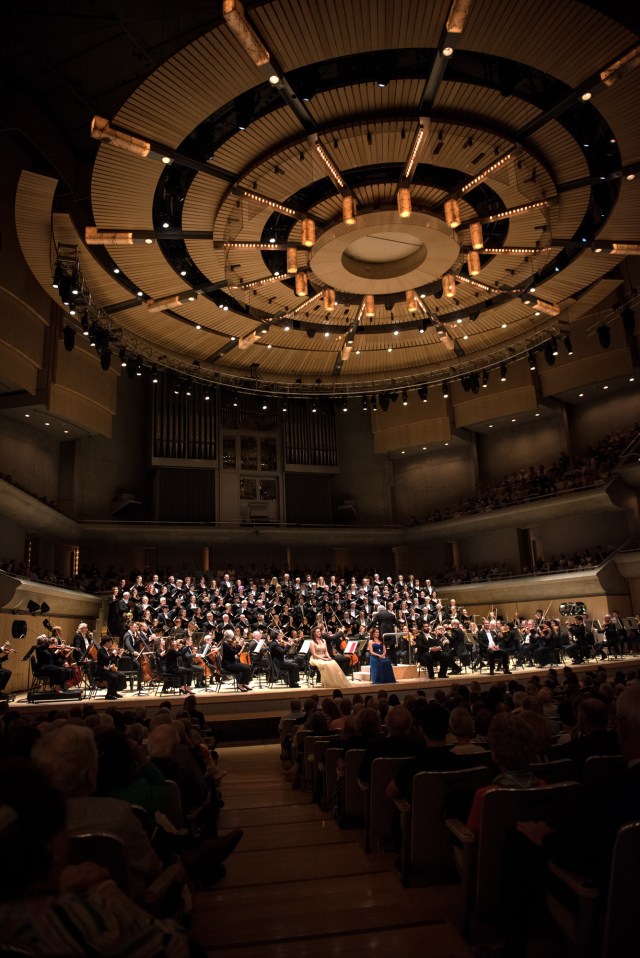
Tomorrow will be the last concert in this month-long celebration of Peter Oundjian’s tenure with the Toronto Symphony. I would have gone tomorrow but unfortunately I have to be somewhere else, and will miss that last encounter between orchestra & conductor, between Peter & his audience.
Peter Oundjian leading the massed forces of Beethoven’s 9, seen from the back of Roy Thomson Hall (photo: Nick Wons). And doesn’t that look like the mother ship is about to land?
Tonight was pretty good though even if it’s but the penultimate.
We heard Beethoven’s Ninth Symphony. The piece is ideal for this sort of occasion, an instant happening. For three movements the orchestra plays while a crowd of brooding faces watch and listen from the stage. It was almost like three different symphonies, totally unlike one another, each in the presence of the 150 formally attired singers of the Toronto Mendelssohn Choir, waiting their turn. The dissonance that opens the last movement might almost sum up the shock we feel when oh my they’re standing up, perfectly synchronized.
Something is going to happen! Of course it won’t be a surprise when they also sing in perfect synchronization.
And –to quote Anna Russell—if Beethoven doesn’t tell the whole story, all over again (admittedly in miniature).
It’s quite a drama, with the conductor at the centre.
The first movement begins with a lot of nothing, as Harvey Olnick pronounced decades ago. Olnick was a music professor describing the opening of Die Walküre by Richard Wagner, pointing out the way Wagner’s opera begins with something reminiscent of Beethoven and the drama of pure ambiguity, “nothing” in the sense that Beethoven opened a discursive window, a space for us to listen and think, gradually filled in by the first big statement of the theme and lots more. Olnick felt that every composer wanted to do what Beethoven achieved, as so many others imitated this model, including Gustav Mahler with his own 9th symphony that Oundjian led just last week, also in D but much gentler to begin.
The second movement, a scherzo that could be titled “and now for something completely different” (like so many other scherzi come to think of it), gets them playing in a whole other way; and just when you think you know where Beethoven’s leading you (the timpani & that obsessive rhythm first in a string figure than enlarged to the whole orchestra), presto, he knocks you on your can for the trio, in an entirely different rhythm from a different part of the orchestra, and an entirely different flavour. Where the main section of the scherzo is powerfully rhythmic and even a bit scary, the trio is cute and nostalgic: as trios are wont to be.
Two movements down, and so far pretty close to perfect from the TSO & Oundjian, as far as I could tell.
We go off in another meditative direction for the third movement, lyrical & sublime, even at the quick tempo Oundjian takes: which as I must have said many times, is how I always prefer it. The orchestra are playing with great enthusiasm but entirely surrendering to the boss, following him to the ends of the earth or at least the end of the movement.
And then lordy by Jordy, we come to that cacophonous opening to the fourth movement when all heck seems to be breaking loose, and on top of everything else the choir is standing up.
And as I implied in invoking Madam Russell a moment ago, the opening reminds us of where we’ve been, the ups and down of emotion. Do we want to traverse such a path? shall we try a bit of movement #1? how about a sample of #2? or how about #3?
Perhaps.
But we are going to be admonished: not these tones, but joy instead. First it’s just the strings playing that recitative, then it’s the baritone solo sung by Tyler Duncan, one of the most impressive versions of this I’ve ever heard. It’s quite a challenge when you think about it. On the one hand there’s this big orchestra, sounding like all heck is breaking loose. So you have to sing big and loud just to be heard. But hold on a second, you have to sing big and loud, while saying “oh friends, not these tones” (meaning: not this emotional stuff….).
He will tell us that instead, let’s be joyful.
So you got that? He has to sing loudly while telling us to be joyful, which (if you think of a poor struggling baritone bleating as loudly as he can) often comes off with all the kindness and joy of a U-boat commander ordering you to put your hands in the air. (if you don’t believe me go look on youtube, but don’t say I didn’t warn you). Yet Duncan managed to smile, managed to look friendly, and yes, managed to sing this audibly without bellowing or shouting, beautiful tone, coherent, perfect.
Amazing.
And so we’re into the “Ode to Joy”, Duncan’s baritone echoed by the big chorus standing behind who are now not just bearing witness in their silent formal splendor but adding weight to whatever anyone sings, and genuinely sounding joyful.
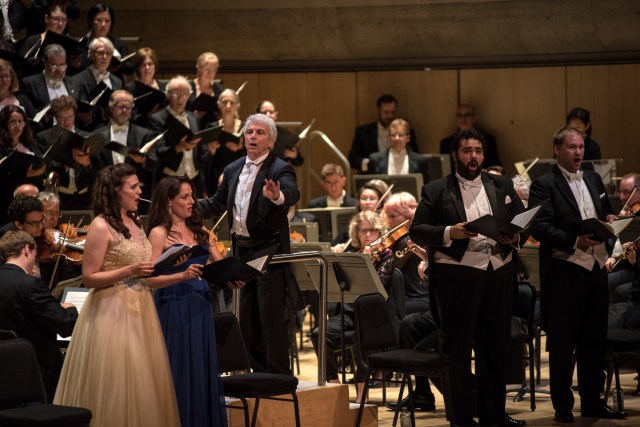
Soloists MacKinnon, Segal, Haji, Duncan, led by Peter Oundjian (photo: Nick Wons)
We’ll get some other solo burblings, echoing Duncan’s exhortations, as Andrew Haji, Lauren Segal & Kirsten MacKinnon join in or sing their own lovely solo moments.
We build then soften, then build some more, Oundjian leading them all to a wild Dionysian conclusion.
I’m sure he’ll come back to visit from time to time, especially as he remembers the passionate ovation at the end.
Joy indeed!
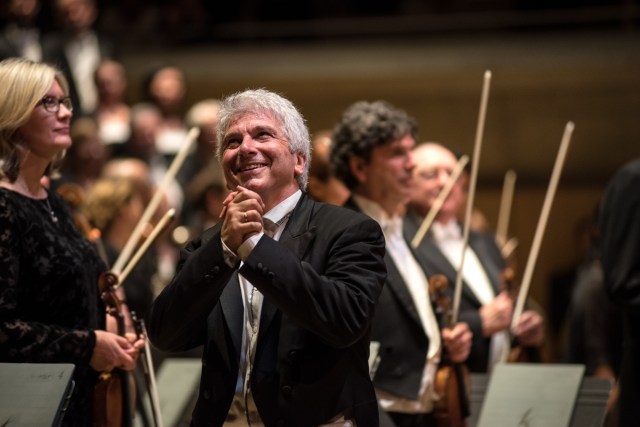
Peter Oundjian thanking the audience as they thank him (photo: Nick Wons)
Composer Stephanie Martin & playwright Paul Ciufo are collaborating on their first opera, The Llandovery Castle. They’re telling the story of the sinking of an unarmed hospital vessel of that name exactly 100 years ago. On the night of June 27th 1918 it was torpedoed by a German U-boat.
Martin and Ciufo worked with the Bicycle Opera Project team to present a workshop performance of the piece with a small ensemble of musicians using Calvin Presbyterian Church. The location works for a piece ending with these final words:
You must bear witness In the darkest of times There were those who chose To walk in the light
Do operas about war help us AVOID war or GLORIFY war?
Just in the last few days, I confess I have listened to the following compositions that valorize sacrifice & battle:
Some of William Walton’s music from Henry V at last night’s TSO concert with Christopher Plummer
A new CD of Berlioz’s Les Troyens (new to me, as it was recorded in 1960), that I listen to, over and over, in the car
And I keep watching Scorsese’s Hugo including Sacha Baron Cohen as a WW I war veteran whose disability humanizes him
Do we even KNOW what war is anymore, or have we forgotten? Our films, like our operas before, invite us to repeat the same errors over and over, sensationalizing, commemorating, celebrating the ultimate horror.
Do we EVER learn? Perhaps this opera can help.
Martin composes with a very accessible style that’s a reminder if not an admonition to composers insisting on more challenging approaches to music-making. If opera is to be a piece of theatre, especially if it’s to move the audience, it can’t turn its back upon melody & diatonic composition. The lesson is clear enough if you look at the most successful composers of the past century such as Puccini or Richard Strauss, composers employing a style of music sometimes seen as sentimental verging on kitsch, but in the process moving you to tears.
One might well ask how one could tell a story like this one without sentiment?
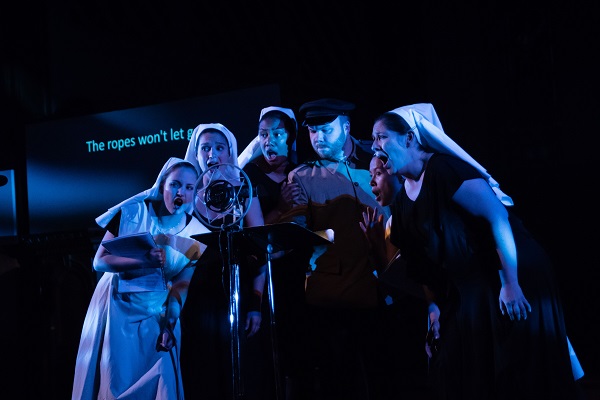
The Bicycle Opera production was completely successful in my view, given that we were watching a work in progress. Director Tom Diamond had a fascinating conceit that framed the workshop presentation, by offering the performance as though we were watching a live presentation of a radio play.
Singing into the “microphone” of the radio broadcast. (photo: Will Ford)
That sets up the possibility of anachronism, as well as giving us a context that forgives any shortcomings in the staging, because of course in a radio play it’s all hand-made and improvised before us, into the “broadcast microphone” (which is a prop of course). We were invited to use our imaginations, while we heard elements in the music to suggest the rhythms of the sea, the various anthems of countries, hymn tunes, and yes, desperate music when the torpedo hits.
Conductor Kimberley-Ann Bartczak gave a tidy account of the score, leading an ensemble of nine players, and nine singers, often all singing or playing at once, supplying plenty of sound for the church’s acoustic.
I can’t tell whether composer & librettist believe their piece is finished or not; while the current version felt complete yet they may see things in this workshop that leads them to change the work. You may wish to explore the piece further by looking at their website that includes the program including a synopsis, libretto and a link should you wish to contribute to the project. (choose “Bicycle Opera Project” in the drop-down)
Tonight’s concert, the latest in the month-long Toronto Symphony celebration of Peter Oundjian, was like a cross between a pops concert and a play reading, titled “Christopher Plummer’s Symphonic Shakespeare”. It was like “Shakespeare’s Greatest Hits”, a series of textual highlights delivered by Christopher Plummer, embellished with some of the famous music associated with each of the plays being sampled, and it was smooth as silk, effortless as if they’ve done this program a thousand times..
But it felt like an event. The fact that we watched The Great Man at work for a couple of hours felt very special. Plummer may be in his 80s, he may walk with a bit of a limp that he’s earned with years of toil onstage and onscreen, but he’s still capable of silencing a full theatre with his eloquence. We heard famous passages from several plays, as Plummer showed us the brilliance he still commands even now. Shakespearean magic was wound around the moments of appreciation for Oundjian, with whom he shared the stage & the adulation of a thrilled audience at Roy Thomson Hall. I wish I could tell you it’s to be repeated tomorrow but this is the only time, and I’ll never forget it.
We heard a relatively small sampler of the wonderful music Shakespeare has inspired (given that there’s such an enormous amount): yet it filled out the evening. Every nation’s music, every great composer has taken their turn, if not several turns either adapting Shakespeare (in opera, ballet or musicals), or writing music to accompany a presentation of a play or film adaptation. Over the course of this delightful program we heard from Wagner, Debussy, Mendelssohn, Berlioz, Korngold, Rota, Vaughan Williams, Walton, Prokofiev, Tchaikovsky, & Willan.
At times Plummer & Oundjian worked at the same time, the music underscoring a passage: for instance in the Walton “Passacaglia” from Henry V, as Plummer gave us first Falstaff and then the King answering.
But for the most part it was more of a give & take, the music and the text going back and forth, answering one another. In the end that’s the most natural thing, given that the text & music are part of a centuries-old dialogue, words inspiring the composition of music, the music inspiring the reading of the words. And again. Again.
It was magical.
At times Plummer would give us BOTH characters in a scene, offering a contrast in the voice & body language to differentiate for us, so we’d know Falstaff from King Henry, or Puck from Oberon.
At the end there was huge applause for both men and the orchestra as well.
All that remains for Oundjian of his tenure as TSO Music Director are a series of performances of Beethoven’s Ninth this Thursday, Friday & Saturday nights with soloists & the Toronto Mendelssohn Choir.
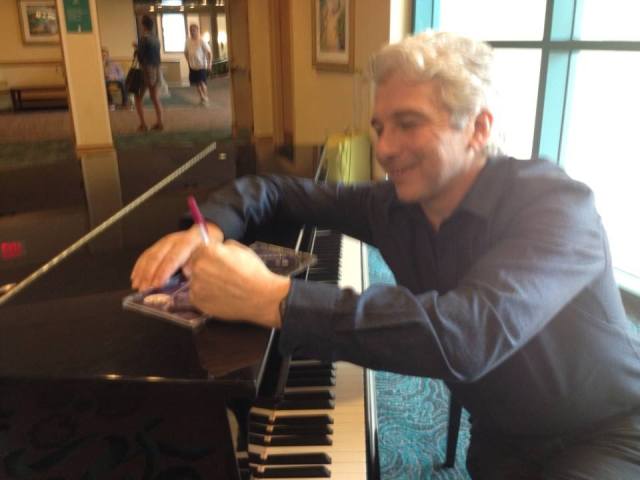
Peter Oundjian, autographing the Scheherazade CD for (lucky) me
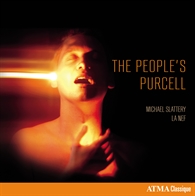
Michael Slattery & La Nef are back with another recording from ATMA.
A few years ago they collaborated on Dowland in Dublin. On that occasion their project took the music in a new direction, reminding me of folk music or even pub music. Layers of artifice were cleared away to expose an approach to the composer from a more informal world, a whole other way of hearing & performing the music.
At the time I remember wondering what they might do next, whether there were any other composers they might uncover, revisit, rethink.
And that’s what I thought of when I saw the cover of The People’s Purcell, their latest.
Was there something comparable at work? In the Dowland album they presented a theory that there was an Irish connection, and from there took the music in a wholly new direction, undertaken in a new way. The album made a compelling case for rethinking the composer, even if it began as nothing more than a fun experiment, like the ones we sometimes do when we’re playing around the piano, improvising something hypothetical. What happens if I play the Pathetique in Major instead of minor, or add a dotted rhythm to this Mozart sonata, or play this half as fast or twice as fast. What happens as in, is it funny or is it actually any good?
I am sometimes the fastest person I know: at watching & writing & publishing. I’ll see a show from 8-10 pm, drive home to Scarborough and usually have the review published within the hour, allowing me to go to bed & be up for work the next day. And sometimes? If I’m not sure, if there’s something deeper at work, I may balk, pausing to ponder. This is especially so with CDs & DVDs, where there is no public performance to be promoted by the review, and so the time-frame ceases to matter.
I first listened to The People’s Purcell months ago. It was winter and now spring is giving way to summer. I’ve driven about with this CD on my car’s stereo. I can hum most of this to myself by now because I know every note of the CD. Yet I was stopped, as I tried to understand what was really going on, to make sure I could get a handle on what they were doing, or at least to understand my response, my passionate enthusiasm.
Don’t lose sight of one thing. I really like The People’s Purcell even if I have been pondering it for weeks, unsure of what to say. Just because I can’t really explain its charm or deconstruct it into neat categories doesn’t diminish its achievement. Indeed it’s rather unpretentious, so maybe the key is to just accept it on its own terms. I don’t know what the thought process was behind the People’s Purcell nor do I know exactly what that title meant to them, only that it’s meaningful to me after having listened to this album for several weeks in the car, one of my favourite experimental laboratories.
I find the title very suggestive, very powerful, to tell me what this music has become in the hands of La Nef & Slattery, and perhaps along the way they’ve discovered something about Purcell and how he is traditionally approached. Please feel free to find the answer to the question if you would, in someone else’s review or interview.
The thing is, this really feels like a new way of approaching Purcell, a Purcell I’ve never heard before. The usual Purcell is more formal, more stuffy than this pub-flavored performance. The way La Nef make music it sounds like folk music, even when they’re playing something usually understood as serious baroque music. I found myself imagining musicians after hours, taking the music to the tavern, or playing among themselves, and making something fun out of more serious compositions.
Why you may ask, would anyone need a “people’s Purcell”? unless perhaps the composer has somehow been submerged in something else, lost, misplaced. Whose Purcell was it if not the people’s? Perhaps we’ve had a more pretentious Purcell, the virtuoso’s Purcell or the composer as treated by big institutions such as the church or conservatories. However he’s been represented, this is a kind of unpretentious re-think. Or maybe it’s simply Purcell among the people rather than up above us, a less lofty and ambitious version of a composer sometimes held up as the greatest of all English composers. And how wonderful must he be that he shows himself in a whole new light, even in this rough guise? I should add, that if you’re someone who loves the way Purcell is usually performed, you’ll think what I just wrote is nonsense, hogwash, PR- BS. But I confess, I am always ready for another look, another approach.
And this is why I keep listening to this CD. Well, there’s also the small matter of my admiration & enjoyment of Michael Slattery’s voice, its impeccable diction & pitch, the directness of communication without the overlay of too much artifice. We have ornamented music on this CD where the ornaments feel natural and organic, rather than forced or artificial. That in itself is an achievement, as though we’re seeing the compositions more clearly, hearing the thought more truly. And his collaboration with La Nef is again such a natural thing, as though the music of Purcell were always played in taverns and bars. HAS it ever been played there?
Perhaps it’s most accurate to say that I was daunted initially by this CD because it straddles boundaries, doesn’t immediately declare itself as opera or classical, neither this nor that. That’s one of its strengths arguably even as that has been the reason I didn’t review it for weeks and weeks. And now as we’re into the summer I want to put out the review, to encourage people to have this the way I have it, ideal for the car as you travel to the cottage or just enjoying a drive with the windows down.
We begin with something called ”An Evening Hymn” that is a perfect illustration of what’s different about this CD.
Let me first link to a typical recording of this piece from youtube.
The voice is lovely, the accompaniment delightful. Notice that this is a hymn that addresses the whole question of how it would be sung, how to deport itself.
Now that the sun hath veil’d his light And bid the world goodnight; To the soft bed my body I dispose, But where shall my soul repose?
Dear, dear God, even in Thy arms, And can there be any so sweet security! Then to thy rest, O my soul! And singing, praise the mercy That prolongs thy days.
Hallelujah!
This hymn is almost a prayer within a prayer, asking God: how to pray, how to approach God.
Here’s another recording, also quite wonderful!
I’ve listened to several, and they are ALL wonderful. It’s a fabulous little piece of music.
Dare I say it, the version by Slattery & La Nef (sorry I am not presenting it for you) manages to strip away the veneer of art, to get to the essence of the music without making it seem so difficult. In making it seem effortless I feel closer to spirit: the essence of prayer & spirituality. To each his own, naturally. But that’s where I was first won, in that sense of directness & sincerity, of a music with just enough art as to make something beautiful, with enough spontaneity as to allow me to feel what must be felt. Slattery’s evening hymn becomes a different hymn. We’re not in a church that’s for sure. Might we be alone with him as he prays? it’s not big and loud. Where would we imagine this being sung? It seems like a very direct address to the creator, as though in a private space, in a bed softly at bedtime or out in a field alone looking up at the night sky. I think it’s closer to the language of the actual hymn as it benefits from informality, creating intimacy missing from any other version I’ve encountered. They’re all more rhetorical, more formal. This one? is vulnerable and gentle and yes even cute. I find it adorable, heart-breaking in its simplicity.
Let’s try another example. “Let each gallant heart” is a song about love.
Let each gallant heart, Untouch’d with love’s dart, Prepare for his secret alarms; That sluggish repose Wherein now thou art, Affords far less numerous charms, For the warfare of love Yields a thousand times more Sweets and delights than your dull peace before.
Long torment ’tis sure We must calmly endure, Before the dear prize we obtain. Yet still the hard toil Is part of the cure, And such pleasures we find in our pain, That the warfare of love Yields a thousand times more Blissful delights than your dull peace before.
The text is playful, the realm of love becoming a metaphorical site of warfare. How to approach it?
Here’s one way to read the text & music
I find it somewhat formal, so caught up in being authentic to the baroque style that it’s not really playful. It’s a nice performance, but, well I’m comparing it to what Slattery & La Nef do, and that’s a problem, because I can’t unhear the fun they have.
So let’s finally hear some of Slattery & La Nef so you can have some idea what I’m raving about..!
After the People’s Purcell, I will never be quite the same about any of this music. I will always ask myself: how would they have done it? The entire CD asks me –and perhaps you too – to reconsider Purcell, hear him in a new way. Are we hearing some of the implications in the music, perhaps folk influences? or did they simply go off on a mad folk tangent? I am not sure it matters, or at least it doesn’t matter to me. I am not listening to this as a definitive Purcell but rather as an alternative, a kind of deconstructed or reconstructed Purcell, synthesized from folk music, as though he were played in pubs & taverns rather than concert halls & conservatories. I am wondering, are all those precise classical artists perhaps being too strict, not playful enough? It’s an unpretentious project, this rethink of Purcell. If you ask them to document or prove this by some kind of musicological criteria, it must fail. But it’s the Purcell you might hear in a bar over a few drinks, not the Purcell you’d ever find in the concert hall: unless of course they invite La Nef & Slattery to perform there.
The final week of Peter Oundjian’s tenure leading the Toronto Symphony is here, so tantalizing because there’s a genuine rapport between the players & their leader. The future conductors who lead the ensemble, whether as guests or residents, may never get this close to the musicians, all of whom know Oundjian at least from years working together, if not also as the man who found & recruited them to their position. It’s his band to steer for the moment even if he will soon let go of the tiller.
Tonight was in some ways a classic TSO concert, reminding me of so many nights at Roy Thomson Hall, when we’d hear sporadic applause between movements, including the looks of irritation from some who don’t want applause in their silent mid-symphony reverie (like that pensive soul sitting in front of me fidgeting at every noise). There was an early courteous pause to allow patrons to find their seats, and a dramatic eruption near the end from a child whose sobs surprised a parent who must have mistaken Mahler for the Muppets (what was he thinking? At least the child wasn’t separated from his dad, even if I was immediately reminded by the audible cries of other tearful moments on the news this week). But for me this is typical TSO –in stark contrast to the discipline one sees from the Tafelmusik audience—as we remember that Oundjian has been a teacher not just to the symphonic colleagues he’s mentored but to his audience as well, nursed along in the Decades Project and other efforts to raise the literacy of his listeners. I recall a concert a decade ago that infuriated me for the inability of the audience to be quiet: but at that time the orchestra hadn’t yet persuaded us (the listeners) to keep still.
We’ve come a long way.
The two works on the program couldn’t be more different, both for what they require of the orchestra & leader, as well as what they demand of the listener.
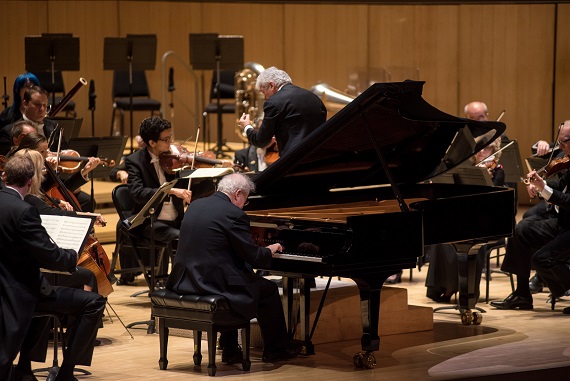
Emanuel Ax at the piano with the TSO led by Peter Oundjian (photo: Nick Wons)
We began with Mozart in the guise of K 453, a piano concerto in G Major, employing veteran soloist Emanuel Ax. As with other concerts in this festival of Oundjiania, Ax has history with Oundjian, being his very first concerto soloist, and he’s now the last as well with this weekend’s concert. I’m sounding like a broken record in once more calling attention to the excellence with which Oundjian follows visiting virtuosi. I am always impressed with how good he makes them sound, how masterfully the work comes off. Had it been Wolfgang Amadeus himself sitting at the keyboard I don’t think it would have been better (allowing that WA Mozart might have wanted to conduct his own ensemble from the piano, distracted by the big beautiful sounds coming out of his modern instrument, and dazzled to find himself alive in the 21st century surrounded by all the attractive patrons at Roy Thomson Hall). Ax? a humble servant of the music, even in its most challenging moments, never rocking the Mozartian boat.
The big work to conclude, Mahler’s 9th Symphony, was as much a treat for the conductor as for us, guaranteeing that a fun time was had by all: except perhaps the little child who was stunned by the intensity near the end, plus his embarrassed papa, carrying him to the safety of the lobby. For those of us who didn’t have to run away in terror it was quite an event. Oundjian had full commitment from his players this time out, everyone going all out. We got solos in every section, played flawlessly as far as I could tell. Teng Li was especially eloquent tonight in the last days of her tenure as principal violist, before she goes to Los Angeles as the Philharmonic’s new Principal. Oundjian’s interpretation opted for the faster tempi that I usually prefer in Mahler even if that can be fraught with risks, a greater challenge to hold it all together. The intensity never let up, particularly in a hair-raising third movement taken at a break-neck speed. With every year and new arrival, the virtuosity of this orchestra has risen ever higher, so it’s a treat to hear them tested in a showcase work such as this one.
The victory lap continues next week, with a Shakespeare program featuring Christopher Plummer and then Beethoven’s Ninth to finish next weekend.
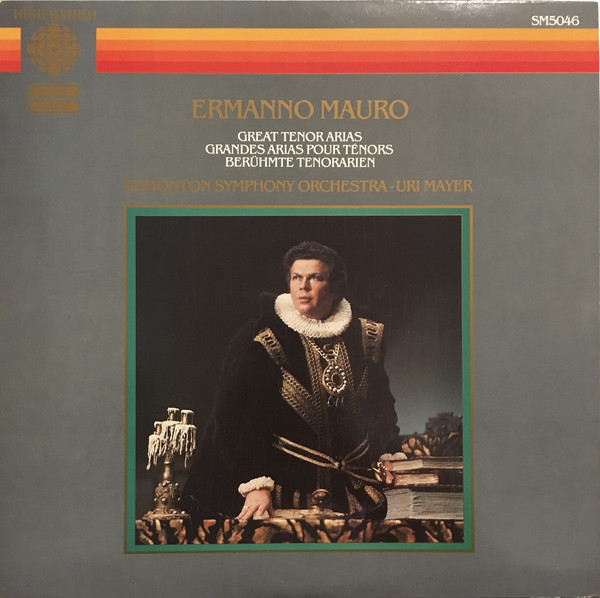
Sometimes recordings can open a window on the past. I’ve got a “new” CD, actually an old one that’s only new to me. Forgive me if I choose to write about something that’s not easily available but the CD immediately took me back decades to several powerful moments.
One of my first live opera experiences, at the U of T Opera School (later the Opera Department)
One of my most powerful moments ever playing for singers
The first night of the Canadian Opera Company under Lotfi Mansouri
What or rather who do these three moments have in common? Tenor Ermanno Mauro.
#1, up close in the MacMillan Theatre of the Edward Johnson Building, Mauro’s voice was a powerful experience, in Britten’s Rape of Lucretia. I remember very little except the visceral pressure of the voice in a space that seemed tiny when he let fly, an effortless sound, and my first real experience of a huge voice.
#2: Playing? I think it must have been the year my brother sang Schaunard with the Canadian Opera Company opposite Mauro as Rodolfo, and so Ermanno came to dinner at my mom’s house: where I still lived, a teenager. In Opera Viva (that wonderful and sometimes astonishing history of the COC by Ezra Schabas & Carl Morey), I see that it was in the autumn of 1972, when Peter was all of 23 singing on the COC’s mainstage, and Mauro? a mature singer ten years older than my brother with that huge voice. His Rodolfo could be lyrical, but from an instrument of such power. I’ve never heard anything like it before or since.
That 1972 experience (#2), one of the most powerful musical experiences of my young life, felt like I was riding a wild horse, playing the Otello vengeance duet while Peter & Ermanno sang. I played as loud as I could, barely able to hear the piano, while the two voices enveloped me, in my mom’s back-room. Afterwards I only recall the kindness of the man, so sweet to me while I had been struggling to keep up, sight-reading Verdi, turning pages, while these two amazing voices belted out music that I had recently heard and embraced from records. I was 17 and star-struck, but will never forget. Ermanno’s voice is remarkable, an ideal instrument honed for verismo, spinto singing. He can sing soft delicate phrases but has a direct sound and secure high notes. I hear a bit of Giuseppe di Stefano here (particularly in the gentle oh so Italianate pianissimo passages), a bit of James McCracken there (the vowel diphthongs, a sound we sometimes hear from American tenor Russell Thomas). But unlike di Stefano or McCracken the voice stayed together, the production impressive even in his maturity.
Listen to him sing Otello in this video, nearly 70 years old, and still an amazing voice.
#3 was a curious moment. The opening of the 1977 fall season, I was sitting in the cheap seats at the back of the O’Keefe Centre for the opening night of Don Carlos, as the COC got the jump on the Metropolitan Opera as the first company in North America to present the original five act version in French. While its acoustics are famously bad, the back rows of the orchestra under the balcony actually tended to be better for sound, as there was a bit of a concentration of the sound there, unlike the dead spots in the midst of the orchestra. I was back there because it was all I could get, but by a magical fluke, there he was.
Lotfi Mansouri.
He stood directly behind me, pacing, fidgeting about. What was he thinking, I wondered? I could feel his tension. But the production was handsome and very beautiful in places. Mauro played the title role. And the production was the beginning of a quantum leap for the COC.
Pardon me for the preamble, but that’s more or less meant to indicate that when I slipped the CD into the player in my car, I was somewhat breathless in anticipation, encountering an old friend. The CD is from the CBC SM5000 series in the 1980s, a DDD recording (meaning, fully digital), Mauro singing a dozen arias accompanied by the Edmonton Symphony Orchestra conducted by Uri Mayer. The Boheme aria you see shared via youtube above is from this recording.
In addition?
“La fleur que tu m’avais jetée” from Carmen
“O souverain” from Le Cid
“Nessun dorma” from Turandot
“Un di all’azzuro spazio” from Andrea Chenier
“Vesti la giubba” from Pagliacci
“Niun mi tema” from Otello
“Pourquoi me réveiller” from Werther
“Ah! lève-toi soleil” Romeo et Juliette
”Ma, se m’è forza perderti” from Un ballo in maschera
“Ah si ben mio” from Il trovatore
“E lucevan le stelle” from Tosca
While a purist might take issue with some of the interpretations, Mauro’s pragmatic vocalism is a good match for most of these operas. In 2018, we could use a voice like this. At times his muscular sound is as big and loud as any I’ve ever encountered, wonderfully reliable on top. I’ve now listened to his “Niun mi tema” from Otello twice, totally destroyed by it both times. While his “vesti la giubba” skips the histrionic crying, the way this Otello chooses to die is heart-breaking, and very original to my ear (and speaking of crying, I had enough sobs for the both of us). Mauro has a very vulnerable soft voice he employs in places, for instance to begin the flower aria, or in “E lucevan le stelle”: but not in the places I expected. His “oh dolce baci”, going up to the F-sharp, is soft as the kisses he would describe, so gently evocative that you can see the scene he is describing. The middle voice is huge when he wants to call up a dark and passionate power, as Werther or in Le Cid.
Ermanno Mauro? Quite a voice. I will be listening to the CD again and again.
The last month of Peter Oundjian’s tenure with the Toronto Symphony is unfolding as a celebration. We’re partway through a series of concerts, with three more programs to come in the next fortnight.
In addition Chandos have released a TSO recording that in some ways epitomizes everything Oundjian stands for. It’s English music but performed by Canadians, a young group of soloists, including some of the talented players recruited & mentored by Oundjian.
I understand that the music of Ralph Vaughan Williams is a special favourite of Oundjian:
Serenade to Music, for Four Soloists, Chorus, and Orchestra (1938)
Concerto for Oboe & Strings (1944)
Flos Campi , Suite for Solo Viola, Small Chorus and Small Orchestra (1924-25)
Concerto, for Piano and Orchestra (1926-31)
While the four works are varied, they all serve to show off the exquisite sound of a TSO that Oundjian built & trained.
The Serenade to Music is a sensual delight, and as with most of Vaughan Williams output, takes us to a more tuneful & tonal place than what most of his contemporaries were producing. The Serenade might have been written in the 19th century for its lush tonal palette, a hymn to romance and romantic music itself. The Elmer Iseler Singers are quicksilver, fluid as breezes and sunshine illuminating the score from within, seemingly effortless.
The Oboe Concerto, composed during the Second World War, came from a composer likely seeking to uplift & inspire, as that’s how this music hits me. It takes us in a more playful & whimsical direction, suggesting a more vulnerable aspect to the composer, both in the achingly beautiful solos from Sarah Jeffrey, and in the textures that surround or answer her oboe.
Flos Campi (or “Flower of the field”) is arguably one of Vaughan Williams very best works. The inspiration is the Songs of Songs, that most sensual part of the Bible. Whether you choose to read this as something devotional or just plain sexy, I think your ear will be ravished one way or another, the TSO’s principal viola Teng Li teaming with the Iseler Singers again.
Finally the most surprising piece for me is the concluding Piano Concerto. It doesn’t sound like the Vaughan Williams I thought I knew. I’ll have to take the score out of the library to get inside the piece. The liner notes suggest the influence of Busoni’s Bach transcriptions, which certainly suggests something on the very boundaries of what’s playable: yet I would never have guessed, listening to the ease with which Louis Lortie plays it. There are places that are lyrical, but also places that are more percussive, with a genuine ferocity.
Throughout, the TSO are at the service of the composer & the conductor, a joyful valedictory for Oundjian. To obtain or download the recording click here.