Adizokan

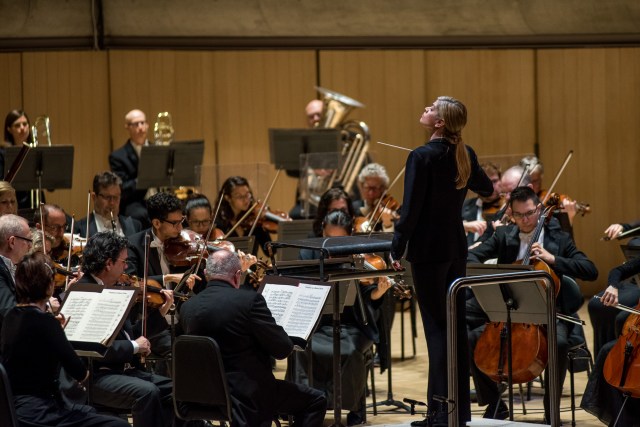
adizokanTonight I was present for the premiere of Adizokan, a collaboration between Red Sky Performance and the Toronto Symphony as part of Canada 150. It was much easier surrendering to the sounds and sights of this multi-media multi-disciplinary work than trying to talk about it.  That may sound like a cop-out. I don’t say that in any way as a criticism, for there are many experiences in our lives that may be complex, that make total sense, even though they resist an explanation in words.  So many of the best things I’ve seen in this our Sesquicentennial year have been works that challenge and even problematize our assumptions about Canada, particularly from the Indigenous perspective on settler culture.

And I’m not sure that it matters how it was conceived, and which came first between the music and words and dance.  What’s more important is how well everything was balanced, how nicely it cohered, at times blending into something total unique.  I felt a curious conversational space open up, where we could experience something about the Indigenous view of the country in the blend of native and European cultural procedures.

I often was torn, not always knowing where to look or where to focus my attention with so much going on.

The concert began with another Sesqui, a mysterious pulsing work by Carmen Braden, the perfect overture to the evening.  Then came “My Roots”, a pair of stunning performances, songs that began traditionally, at least in their use of a drum pulse, although Fara Palmer’s take on Indigeneity was on the boundary between native and something resembling the blues, a wonderfully powerful invocation to set us up for what came next.

From there we were into Adizokan, and the dramaturgy became much more complex & variegated, Eliot Britton’s composition for about an hour or more; time flew by, but I only know the duration from the time on my phone. This ambitious work seemed to be a concerto for throat boxer & orchestra. .

Throat boxer? That’s the term Nelson Tagoona has coined for his original use of throat singing, a kind of indigenous hip-hop, merging throat singing and beat boxing into something new.

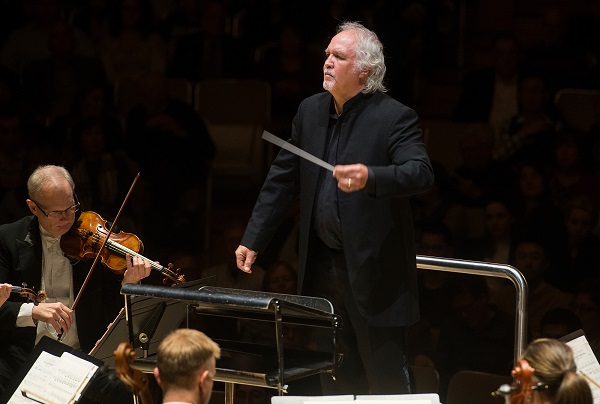
I’ve heard several of these attempts by the TSO to integrate something like hip hop into their original performance, and have to say this one felt more authentic and genuine than any of the others, possibly because the mash-up wasn’t violent or abrupt but really much simpler and humbler than that.  I don’t know whether more credit should go to Britton or Tagoona in finding this common ground.  And conductor Gary Kulesha kept everyone together.

My bias might be showing in wishing to simply hear Britton and Tagoona without the dance & video embellishments.  I don’t mean to disrespect the many layers of Adizokan, including indigenous vocals coming through the PA overlaid with what Tagoona was creating, both with his brilliant vocals as well as through something that I’d guess to be digital vocording: because it sounded as though Tagoona’s voice was being overlaid in real time with additional harmonies. I am not nearly up on the state of the vocorder art, only that this was very ambient, at times very beautiful.  When I say I want to hear the music without any visuals, I am thinking back to the excellent score created by Christos Hatzis for Going Home Star collaborating with Tanya Tagaq, wanting to hear this again and have a chance to digest it on its musical merits alone.

I think Britton & Tagoona created something very original.  I’m reminded of two very different touchstones:

  • Colin McPhee wrote several orchestral works based on the Balinese music of the gamelan, one of the earliest examples of what we might call minimalism; Britton at times gives us a minimalism with Indigenous overtones, and a very original use of the orchestra
  • George Gershwin took the language of jazz and wrote piano concertos without dishonouring either tradition. I think Tagoona & Britton too found a middle ground between their own Indigenous idioms and the world of the symphony & the concerto.  There were several moments, some gently meditative, some powerfully climactic, where we had the orchestra working with authentic sounding native voices, married beautifully in that middle ground.
sandra

Sandra Laronde, founder of Red Sky Performance

Sandra Laronde of Red Sky Performance took the role of “curator”, and I think that title tells us more than a little about what Adizokan is.  There are disparate elements, more of a quilt or a suite of different parts rather than a single unified work.  The music with the dance and the video was very powerful, very moving, even if I don’t pretend to understand what it all signified (and again, that’s why I want to hear it again).  There were titles to different sections but with the lights out I wasn’t able to follow along, nor to know which part was which, except to feel naturally when we were coming to the end, a segment titled “Epic Future Skies”, including images of stars on the video-screens.

All I know is that it worked for me.  I found it very moving, very beautiful.

I hope we get to hear this collaboration between Britton & Tagoona again. Perhaps next time the TSO can make a recording.

Posted in Dance, theatre & musicals, Music and musicology, Reviews | 3 Comments

Gala Concert — Transatlantic Opera

vasilisa_CONCERT_oct2017


www.transatlanticopera.com

Posted in Press Releases and Announcements | Leave a comment

Playing it Forward: Artists Giving Back

A collection of artists has come together to present Playing it Forward: Artists
Giving Back (PiF), a music and theatre showcase highlighting exceptional Toronto artists in support of worthwhile causes in their communities. Each of the six presentations will have a connection to a specific charity, not-for-profit or service group, and a fixed portion of the proceeds from each ticket sold will go directly to their organization. The one-off shows run October 11 – 15, 2017, in the intimate Back Space at Theatre Passe Muraille.

Tickets ($10/$20) are available at www.artsboxoffice.ca or by calling (416) 504-7529.

Playing it Forward: Artists Giving Back is the brainchild of Briane Nasimok, assembling a like-minded production team of fellow artists and patrons to realize the project, including Lesley Ballantyne (Herculean Effort), Laurie Murphy (MARRAM) and Tom Carson (Smile Theatre).

Briane is especially pleased with the community support for his PiF vision. “I am very lucky to have worked with many brilliant artists who have immediately embraced the idea,” he says, “It gives us a chance to spotlight some meaningful organizations.”

The Playing it Forward schedule begins on Wednesday, October 11, 7:30 p.m., with
Confessions of an Operatic Mute, a comedy benefiting The Forest Hill Lions Club Holiday Food Fund. Briane Nasimok will be remounting his 2015 hit Fringe show which CBC chose as one the ten shows “not to miss.” Briane boasts the show has “18% new material.”

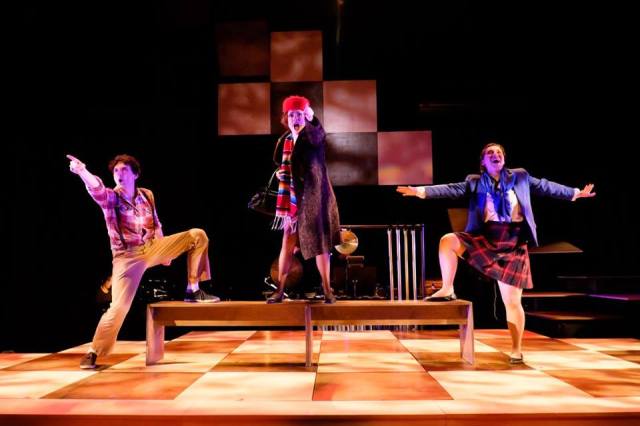
On Thursday, October 12, 7:30 p.m., Smile Theatre presents its current production, “Sunshine Sketches,” an original musical, based on Stephen Leacock’s writing, from the professional company that tours entertainment to homes for the elderly, with proceeds benefiting Smile.

The Friday October 13, 7:30 p.m., show is “The Gershwin Project.” Musical Theatre Maven Charlotte Moore and her two favourite musicians, Doug Balfour on keys and Bob Hewus on bass, explore the legacy in music and words of both Gershwin Brothers. The show is benefiting Sketch Working Arts.

A matinee on Saturday, October 14, at 1:30 p.m., is “But, That’s Another Story,” Toronto’s
leading storytellers sharing classic tales and personal anecdotes for a family audience. Tickets are $10 per person, with funds raised benefiting Story Telling Toronto.

The evening show on Saturday, October 14, at 7:30 p.m. Joanne O’Sullivan’s Fringe hit “She Grew Funny,” about how her life changed when her daughter turned six, the same age that Joanne was when her mother died. The show is benefitting the Canadian Stomach Cancer Foundation.

Playing it Forward closes with a matinee on Sunday, October 15, 1:30 p.m., an ENCORE
presentation of Briane Nasimok’s “Confessions of an Operatic Mute,” benefiting Gilda’s Club of Greater Toronto.

For more information about Playing it Forward: Artists Giving Back, please contact Briane Nasimok at thenaz3011@gmail.com.

nasimok

Briane Nasimok, aka the Operatic Mute

Posted in Press Releases and Announcements | Leave a comment

Dumb luck at the EJB

I found something marvelous and don’t deserve any credit for the discovery. That’s why I say “dumb luck.”

We’ve just had the verismo class in the opera course I teach at School of Continuing Studies here at University of Toronto. I looked in the collection of the Music Library in the Edward Johnson Building, one of my favourite places in this city, or anywhere else come to think of it.

I stumbled upon a couple of wonderful things.

The DVD that I used most is one I’ve seen before, a live performance from the Metropolitan Opera in 1978 of Cavalleria Rusticana and Pagliacci in productions by Franco Zeffirelli. A young Placido Domingo sings a sympathetic account of both of the tenor leads.

This isn’t the recording that spawned the headline although I’m grateful to again be in the presence of two voices I miss:

  • Tatiana Troyanos is over-the-top as Santuzza, holding nothing back in her emotional blackmail, her heart on her sleeve, the voice as extraordinary as ever.
  • And Teresa Stratas was a feisty Nedda, so beautiful and defiant in that final scene.

No, I’m thinking of something rarer.

The library also has a 1955 VHS of Pagliacci, slightly abridged, with a remarkable cast.  Because it’s VHS it’s less usable in a class room, where you have to rewind, but I did take the time to play one part. Canio is played by a 29 year old Jon Vickers, still at the very beginning of his career and still a student when he went into the studio. The voice would get much thicker as the years went by.  His “vesti la giubba” was completely original even at this early date.

There’s another surprise on the tape, and in an unexpected role. One might expect to find Louis Quilico in this opera, but on this occasion he sang Silvio, Nedda’s lover, rather than Tonio, the role he would assume later in his career when his voice had thickened. Quilico is a handsome figure at this point, almost exactly the same age as Vickers. I shook hands with them in the 1970s backstage after an Otello at the Met conducted by James Levine.

But at this point the voices and their bodies were decades lighter, the delivery more fluid and uninhibited. As the voices became bigger and more powerful they lost flexibility. It’s a fascinating trade-off that’s unmistakable in two well-known voices, the two finest male singers I ever heard.  While Vickers’ talent is known, I believe Quilico is under-rated as he only really conquered the world stage in the latter part of his career, when some of the bloom was off the voice.

The cast includes Eva Likova as Nedda, who used her ballet training in the final scene as Columbina, and Robert Savoie as Tonio. Otto-Werner Mueller conducts the Orchestra of Radio-Canada, Montreal.

I need to look further to get my own copy of this performance from the CBC, hopefully on a DVD. So far it hasn’t turned up in any of my searches: but I will make some enquiries. For any fan of Vickers and especially for fans of Quilico, this recording is pure gold.

Have a look at this excerpt, up to the most chilling delivery of the final line that I have ever heard.

It’s worth recalling, too what amazing things the CBC used to do.

Posted in Personal ruminations & essays | 1 Comment

TSO, Reineke and Williams

Roy Thomson Hall was jammed tonight, fans of every age including parents & their children. The programme presented by the Toronto Symphony was a small sampling of the film music of John Williams.

There’s no mistaking the interest. In 2016 the TSO presented a similar program that was wonderfully well-received conducted by the same natural showman and evangelist, namely Steve Reineke.

conducting_Michael_Tammaro

Conductor Steven Reineke (photo: Michael Tammaro)

From what I hear, the 2017 concerts are selling very well. Tonight looked to be sold out, with few empty seats, so if you’re hoping to catch one of the remaining concerts don’t wait until the last minute before getting a ticket.

Film music is a big thing. I’m obsessed, personally, and not just because I teach a course on the subject. This is another side of popular music that can get lost in the shuffle if you only think of rock or hip-hop. John Williams reputedly charges a million dollars per film, and I saw elsewhere that others such as Danny Elfman charge comparable amounts. So when someone asks you who is the most successful Canadian composer, you might consider answering “Mychael Danna”: whose new orchestral suite based on his score to Life of Pi debuted last week with the TSO.

Tonight it was music from such films as Jaws, Close Encounters of the Third Kind, Raiders of the Lost Ark, E.T.,  and Jurassic Park. Whether you’re a fan of Harry Potter, Star Wars or one of the Spielberg – Williams collaborations such as Raiders of the Lost Ark, there was something for every nerd in attendance.

We began with Toboggan, Darren Fung’s Sesquie (and in case you haven’t heard, the TSO and other Canadian orchestras commissioned several of these two minute fanfares as a celebration of Canada’s 150th anniversary, our sesquicentennial, which begat the “Sesquie”).  Reineke gave a wonderfully theatrical intro to the piece, which has a very cinematic feel, matching the rest of the program. Fung takes us on a musical ride, an impression of the adventure of going down a hill as a child, complete with the sense of triumph and the comical recognition that nobody was really paying any attention (with the wacky last note).

It was the perfect beginning to a concert where we were entertained in the same spirit, as though we were all children. Reineke gave us all an overdone backward glance during the Jaws music, as everyone started giggling uncontrollably. No the movie isn’t funny, but this is different, right? Listening to the shark music without any visible shark is hysterically funny: which is why Reineke got that out of the way to begin.

But it’s a valuable exercise. People watch films without recognizing the powerful components at work. You discover just how good Williams’ scores are when you hear these suites in a concert hall, with no visual accompaniment. All we have is our imaginations, which have no trouble filling in the rest, in the presence of this larger than life music.

I wonder if the TSO will change their programming philosophy. Last week, after all, they programmed Danna’s orchestral suite. That’s a different sort of music from the fun kid-friendly stuff Reineke gave us tonight. If orchestras can present opera excerpts such as “The Ride of the Valkyries” in a symphonic concert, there’s no reason they can’t do likewise with some film music compositions.

I’d love to see them probe connections, for instance giving us some of the Star Wars music alongside Mars Bringer of War from Holst’s The Planets Suite, which exerted such an influence on Williams. I thought tonight that the Jaws theme sounds like a cruder version of what Herrmann wrote for Psycho’s shower scene: possibly because the killer is so much bigger and nastier, but I wish I could hear them side by side in the same concert, for comparison. That sort of thing would be lots of fun.

Reineke could probe some of the connections between Williams’ scores. Harry Potter sounds a bit like the pirate theme in Hook for example. Superman and Star Wars have some resemblances. And—while I’m dreaming in colour—wouldn’t it be wonderful if the TSO could do some of the things I do in the film music class, when I play a powerful scene first WITHOUT the music (that shower scene for example), and then play the music without the visuals, and finally bring them all together.  But it would be so much better on the TSO’s big screen with the orchestra.

The program (minus the Sesquie) repeats twice On October 4th and again October 5th.

Posted in Cinema, video & DVDs, Music and musicology | Leave a comment

What Happened: deja vu

As I’ve been reading Hillary Clinton’s What Happened, her bestselling memoir, I experienced a curious and disturbing feeling.

That I’d been here before.

That I had felt these feelings not so long ago, concerning events here in Canada. hillary book

I am posting this, mostly to try to articulate this feeling. I can’t help reading the title not in a calm Hillary Clinton voice as a declaration, but with a question mark after it (as in “What happened?!!”) to be muttered or moaned in the morning-after agony. While she’s in a great position to tell her own story, I’m not sure she really gets what happened, if indeed anyone does so soon after the event.

Add this to your list of explanations for November 2016, when an election didn’t go quite as predicted.  There are already a series of factors that are invoked to explain what happened to the American election campaign, as though it weren’t actually the choice of millions of people in the electorate, but something created by some sort of conspiracy.

  • It might be the Russians.
  • It might be the voter suppression.
  • It might be the unprecedented intervention of the FBI Director in the last couple of weeks, swaying voters.

You already know all that, right?

So let me add my small something to the conversation.  In 2011 we had a federal election in Canada, one that pushed some of the same buttons of outrage and despair.

  • Michael Ignatieff led the Liberals
  • Stephen Harper led the Conservatives
  • Jack Layton led the NDP
  • Gilles Duceppe led the Bloc Quebecois
  • Elizabeth May led the Green Party

I inhaled the coverage like an addict, and –recalling the days when I used to smoke—not enjoying the sensations at all.  I’ll point to some striking similarities to the current American election, observed after the fact as I started experiencing something like déjà vu in thinking about Hillary and her defeat last fall. Our system is totally different from the American one, our discourse substantially different as well, so you may not accept the parallels I make, connections that are personal for me.

At the time of the 2011 election no one seemed to expect that

  • The Liberals would be annihilated, in their worst ever showing
  • Layton’s NDP would become the opposition in their best ever showing
  • Harper’s Conservatives would build on their minority standing to take a majority
  • Duceppe was smacked down, caught in the NDP crossfire
  • And May’s Greens took their first seat

The exciting good news — Layton & May– did not compensate for the main story,  Harper’s accession to a virtual throne, and a terrifying period of abuses of power.  How does any of this resemble what happened to the USA and Hillary Clinton? I see at least two parallels, even if one may be irrelevant.

  • While Ignatieff’s platform was activist, he was outflanked on the left by Layton & the NDP, very much the way Clinton’s thunder was stolen by Bernie Sanders: but I don’t think this matters very much.
  • The main similarity that I can’t forget is in the way the conservative discourse –whether in attack ads or through the actual media coverage—dictated the popular perception of the candidate, and framed the conversation.

And so it didn’t matter what Hillary Clinton or Michael Ignatieff proposed, not when the predominant discussion was entirely shaped by various forms of negative attack discourse:

  • Ignatieff was introduced to the electorate a couple of years before the 2011 election via Conservative attack ads that suggested Ignatieff wasn’t coming back for us, that he was really more in it for himself. The Liberals were never able to shake this off, never able to define Ignatieff successfully, never able to fully escape from the damage of ads like these, as their discourse was often caught up in replying and debating the questions as framed in the attack ads. It must have been very humiliating.

  • The conversation between Trump and Clinton in 2016? From here it seemed that Clinton was doing well according to the polls. Both candidates had attack ads.  For example, here’s one of Trump’s

The election is over.  If it were a matter of whose ads were subtler? I think Hillary deserves to win.  But does an opera reviewer get to decide elections? i don’t think so.

Here are two different ads, just for the fun of it.

And I watch this ad below, and then wonder.

My mind still boggles that any Democrat supporter who saw that could have missed voting.  Yes she won the popular vote, but not by much, and not in the states that might have swayed the outcome (meaning Wisconsin & Michigan, to name two). How could the election be so close? Why wasn’t it a landslide?

Let’s set aside the conspiracy theories, that Russian hacking might have tipped the election in Wisconsin & Michigan, or the suppression of voters via the rules such as they are.

But I wonder if you see why I’m reminded of Ignatieff, a candidate whose political career is overshadowed and indeed framed entirely by the way he was portrayed by the opposition.  The word in my head as I think of Ignatieff as a precursor of Hillary’s 2016 run, is “emails”, meaning the largely bogus question that dominated the American campaign.   It doesn’t matter what Ignatieff promised he would do, as he never had the chance to really show us.

Ditto Hillary.  While there was a huge constituency who did hear what Hillary was promising the voter turnout apparently let her down.  I tend to be a skeptic, to adhere to the notion of Occam’s Razor: that the simplest explanation is usually the right one.  I don’t believe in conspiracies usually. Maybe this is nothing more than the combination of electoral polls predicting Hillary’s victory combined with GOP legwork on election day, getting out their vote, with the help of voter suppression, a very troubling activity that is legal and therefore not to be confused with a conspiracy.

Like Ignatieff, like George McGovern before her, Hillary is a series of hypotheticals, a poignant series of possibilities that will never be realized.  My big hope for Ignatieff now is not political but artistic, the slim possibility (depending on my ability to persuade a particular collaborator) that Ignatieff ends up in an opera I hope to write, about a larger than life icon.

But I am very conflicted reading this book, What Happened.  It reminds me of what might have been, a future that can never be.  Yes it sometimes makes me laugh but the laughter is painful.

Posted in Books & Literature, Politics | Leave a comment

A Joyous Welcome for Elisa Citterio

I’ve been on vacation for the past few weeks, taking a break from blogging. I had to miss some marvelous concerts last week such as Mychael Danna’s new piece with the TSO and Elisa Citterio’s debut as the new Music Director of Tafelmusik: that is, the one at their downtown venue.  I couldn’t go so I don’t know whether the concerts I missed were at Trinity St Paul’s or Koerner Hall.

Ah but there was still another concert tonight at the George Weston Recital Hall in the Toronto Centre for the Arts, an opportunity for a different perspective.

For those of us who are spoiled by the riches in the downtown neighbourhood, it’s easy to forget. I work and park at the U of T campus which means I can walk to Koerner Hall in 15 minutes, Trinity St Paul’s in about 10 minutes, Four Seasons Centre in 20 or Roy Thomson Hall and TIFF in 25.

RESIZED_Tafelmusik_MusicDirectorDesignate_Elisa_Citterio-01-HighRes-Credit-Monica-Cordiviola

Music Director Designate Elisa Citterio (photo: Monica Cordiviola)

Yet uptown at the George Weston recital hall (where I’ve experienced Garrick Ohlsson playing the 24 Chopin Preludes Op 28, and Frans Bruggen conducting the Orchestra of the Eighteenth Century playing Beethoven’s 5th) they have better acoustics than any of these.  In other words it’s been a site for some of the best musical experiences I’ve ever had in this city.

What do you know.

Tafelmusik sound better in this hall, unquestionably. No doubt about it. The sound seems to have a greater dynamic range, to have more depth, clarity. When there was a call & response between horns and later oboes from one side of the stage to the other, I could hear the sound coming precisely from the person playing. The antiphonal effects have never been so clear for me as they were tonight.

So in other words if you ever want to get tickets to a Tafelmusik concert and they’re sold out downtown, consider going to hear them uptown at the George Weston. You’ll hear a whole different dimension to their playing, as I did tonight.

Now of course there’s the matter of tonight’s concert, a genuinely celebratory occasion launching Elisa Citterio’s tenure. Oh sure, the music was fun, but more importantly, was to see the chemistry between the Tafelmusik players and Citterio. They already seem to love her, the way they respond to her leadership.

When she took a solo role as we heard in one of the Vivaldi Four Seasons Concerti –it is certainly hot enough for the “Summer” we encountered tonight, with each season to be performed in turn—she took the stage, a very dynamic and theatrical presence. One of the great pleasures I’ve had watching her so far (including the concerts we’ve already heard her play) is in watching the way the rest of the orchestra responds to her.

In the closing Rameau suite from Les Boréades, we saw another dimension, in a series of pieces of great rhythmic flamboyance, pieces that are huge fun to play, fun to hear and really fun to watch as there’s a visual component. In some she was leading a kind of dance impulse in the playing, the players stamping their feet in time, which is likely  right when we recall the tradition Rameau culminates, that began with Lully, Louis XIV’s dance-master and composer. When she concluded she faced downstage, taking the stage with a genuine star quality.

So now I have to again wish that Opera Atelier might do a Rameau opera. These are marvelous pieces that Citterio and Tafelmusik played with great flair & a passionate energy. They gave us a Rameau encore.

I can’t help wondering on the direction of this orchestra, who seem so inspired by their new music director.

It’s an exciting time to be in Toronto.

Posted in Music and musicology, Reviews | Leave a comment

Inter-textual Strauss

Composer Richard Strauss often dropped subtle references to other works into his scores. We’re accustomed to this in poetry, drama or film, where a quote can add depths to our experience, but it’s especially powerful when we recall how abstract music is, adding meanings that would otherwise not be available in a musical score. “Intertextual” is a word Julia Kristeva employed to call attention to the powerful relationships between texts.

By now we’re familiar with this effect in film-music.  Here’s a classic example from Gone With the Wind, as Max Steiner creates a medley of several songs whose associations amplify the effect of this scene.

I recently mentioned a Wagnerian allusion in the first act of Arabella.

In one of his last compositions, Metamorphosen (1945) Strauss quotes from the mournful slow movement of Beethoven’s Eroica, as though to write the epitaph for Germany in the darkest years late in the Second World War. It’s in the last minute of the work (if the link works you’ll start there). Strauss inscribed the words “In memoriam” at the pertinent passage of the score.

It sounds very much like what Max Steiner did in that excerpt above.  And it’s a bit surprising to recognize that Strauss wrote his work years after Steiner.

But Strauss is especially likely to quote his own music.  In his 1899 autobiographical symphonic poem Ein Heldenleben –or “A Hero’s life”—the composer is the hero, his exploits illustrated in quotes from several of his own compositions—Don Quixote, Death & Transfiguration and Also Sprach Zarathustra, to name three– while doing battle with the enemy: the critics.    Or in the last decade of his life, he wrote a series of songs assembled into the “Four Last Songs”.  The one usually sung last, “Im abendrot”—or “at sunset”—which was the first of the four composed, includes not just the passage from “Death & Transfiguration” that is usually discussed in program notes, but also a passage from Don Quixote.  Heldenleben was a marvelous opportunity to make self-reflexive music, bringing back the various characters—in a series of musical themes—as though he were on a psychiatrist’s couch introspecting about different aspects of himself. Strauss seemed to valorize the humble Don Quixote’s version of heroism above all others, returning to the Quixotic ideal in “Im abendrot” even if he gives us the big show of humility in the midst of a colossal display of ego.

He’s hardly the first one to do this kind of inter-textual reference.  In Die Meistersinger, Richard Wagner quotes his previous opera Tristan und Isolde, a poignant quote pointing to the impossibility of a relationship between Hans Sachs and Eva, who are as far apart in age as Isolde and Tristan’s uncle King Marke (Isolde’s intended husband).  OR in Don Giovanni Mozart gets comic mileage in the last scene of the opera when he quotes an aria from The Marriage of Figaro.

So when I was listening to Arabella, especially recalling it as an opera that was the last collaboration with Hofmannsthal, I expected to find other music.  This game of looking for quotes is an old-style musicology that is out of fashion, with roots in the dry leit-motiv lists for Wagner operas, searches for meaning in esoteric little quotes.  I would insist that any such commentary must be supported in the story.  For example Arabella’s longing for the mysterious stranger while being besieged by suitors for whom she has little or no interest, parallels Elsa’s dream in Lohengrin (which incidentally is the very first time we encounter that tune in the Wagner opera). While Lohengrin is no comedy, it might be the single opera most associated with romantic love & marriage, especially when we recall another theme, surely the most famous tune Wagner wrote.

I thought I heard something from Der Rosenkavalier the first time through Arabella.  Let me do this in reverse.  Before I went back for a look at the actual text, I couldn’t help noticing remarkable parallels in the stories.  Of the six operas Strauss did with Hugo von Hofmannsthal, it’s Rosenkavalier surely that we might think of, not the other four:

  1. Elektra
  2. Ariadne auf Naxos
  3. Die Frau ohne Schatten
  4. Die ägyptische Helena

The first and last adapt characters from classical myth (Elektra and Helena) while the other two are even further removed from reality via a magical story (Frau ohne Schatten) and a topsy-turvy juxtaposition of two different dramatic presentations presented simultaneously at a wedding (Ariadne).  Rosenkavalier and Arabella, though, are much more similar.

When I started to tally up the parallels between Rosenkavalier and Arabella I was drawn to look for something more in the music.

  • both explore romantic love
  • both call for an ambiguous portrayal:
    • Octavian is a young man portrayed by a woman, while Zdenka is a young woman who masquerades as a young man in the diegetic story itself
    • both Octavian and Zdenka attempt to bring two lovers together
    • both Octavian and Zdenka present a rose on behalf of the one for whom they’re advocating
    • both Octavian and Zdenka end up with the one they were touting to someone else

And no wonder, then that Strauss decided to gently underline some of those parallels in the score of Arabella.  The theme of the roses that are such a magical bit of colour in the opening of Act II of Rosenkavalier and echoed at the end of the opera for the starry-eyed young couple is what I thought I heard in Act I of Arabella.  And there it is right in the libretto. When Arabella is asking about roses, a moment before she utters the question the music reminds us of that rose presentation music.  The stage directions say “sie sieht die Rosen” or “she sees the roses”, and at that precise moment a version of the theme is heard in the orchestra.

arabella_roses

Here’s the original, where Octavian meets Sophie while carrying his ceremonial silver rose.

Let me be clear. It’s not vitally important.  One can watch the opera without ever noticing this. But I think it’s worth observing that Strauss made the connection, perhaps encouraging us to think about the parallels and divergences.

Can we find any more? I wondered about something else, not in the score but in the libretti and this time it might be an allusion to Ariadne.  You’ll recall that the arrival on Ariadne’s island by Bacchus –the god of wine & intoxication—is announced by his offstage voice singing of Circe, who gave a drink to Ulysses’ men, turning them into swine.   The god is not transformed.  Similarly Arabella brings a glass of water to Mandryka, as a ritual show of love and readiness to marry; when she’s asked if she will remain the same she asks to be accepted as she is because she can’t be anything else.  But is this something Kristeva might call an inter-textual reference?  The formality of the moment suggests it might have been self-conscious but even so I tend to doubt it.  And in Act II we watch Mandryka get steamed up, drinking aggressively and somewhat transformed as a result.  Is it in any way an allusion to Bacchus or Ariadne?  No I don’t think so.  Yes it’s fun to peer into the score. But while this can be a nerdy way to get deeper into the music, if it doesn’t lead us to the theatre and something we can discern in performance, I question the value of that kind of close study.

I’m looking forward to watching the Canadian Opera Company production at least a couple of times, at which point I’ll be very susceptible to echoes from the other operas, especially Ariadne, which was one of the first operas I ever saw, a U of T student production of the opera at the Edward Johnson Building when I was 12 years old.  Come to think of it I think this was the first time I had seen an opera that really moved me, that really worked.  Strauss is a curious composer, largely under-rated or even dismissed as a creator of kitsch, a composer who self-consciously turned his back on avant-garde music with popular operas such as Rosenkavalier.  Yet just a couple of days ago TCM broadcast 2001: A Space Odyssey (1968) featuring the two most famous minutes Strauss ever composed, and premiered the same year of that student Ariadne.

No matter what the critics say, everyone knows a little bit of Richard Strauss.  We will talk about him in the opera course that begins in September and also in the film music course early next year.

Posted in Cinema, video & DVDs, Music and musicology, Opera | Leave a comment

An Arabella DVD

Every year as I prepare to teach the Most Popular Operas course at University of Toronto’s School of Continuing Studies, I have to adjust the course to include the current season’s repertoire.

Fall is in the air, as the nights get cooler.  Three different operas to be presented in Toronto will be rehearsed & then premiered:

  • Arabella and Elixir of Love from the Canadian Opera Company
  • Marriage of Figaro by Opera Atelier

After three consecutive Christine Goerke role-debuts, the Canadian Opera Company will be giving Richard Wagner a rest.  Instead of an immense long Ring opera (the five + hours of Götterdämmerung last season to finish CG’s Brunhild-trifecta), Toronto COC fans will have to be content with a single bar of music by Wagner.

Just a single bar? Yes, and here it is.

Lohengrin_snippet

It’s a backhanded reference in the first act of Arabella, the opera that opens the fall season for the COC on October 5th.

Matteo wants to know where Arabella has been.  Not only does Zdenka answer –“ war sie in der Oper”, or in other words “she was at the opera”—but the orchestra goes one better by telling us which one.  We hear the theme for Wagner’s hero Lohengrin.  It is especially apt considering that everyone is pursuing Arabella, while she waits for her dream suitor to come and sweep her off her feet: not so very different from what Elsa dreamt of in Lohengrin.

While I’m still trying to wrap my head around this story, the last in a series of collaborations between Richard Strauss and Hugo von Hofmannsthal, the music is delightful.

I’ve been watching & listening to a DVD starring Renée Fleming & Thomas Hampson from the 2014 Salzburg Festival, and conducted by Christian Thielemann.  If you’re a fan of the music of Richard Strauss you might know that one city & its orchestra in particular had a special relationship with Richard Strauss & his music, namely Dresden.  This is where Arabella premiered in 1933.  If you’ve heard the recordings of Strauss tone-poems and short works led by Rudolf Kempe from the 1970s, you will have noticed how effortless they can make these challenging scores seem.  So too with this DVD, as the Staatskapelle Dresden manage transparency and lightness, so powerful yet without burying the singers in sound.

Portrait_Florentine_Klepper_Wolf Silveri

Stage Director Florentine Klepper (photo: Wolf Silveri)

Florentine Klepper’s production is not one to obscure the story in the hijinks of director’s theatre.  Brian Large’s video brings us into intimate proximity with the lovers.

We’re watching two pairs mostly:

  • Renée Fleming & Thomas Hampson
  • Hanna-Elisabeth Müller & Daniel Behle [thanks Joseph So for the correction]

Where Fleming as Arabella & Hampson as Mandryka are quite conservative in their portrayals, Müller as Zdenka & Behle as Matteo give us the quirks and more, just as the plot requires. I was surprised at how compelling this production makes the story. Arabella, who needs to marry someone with money to save her impoverished family, is holding out for love while surrounded by suitors.  Enter Mandryka, who serendipitously has fallen in love with Arabella from afar. A story that might be out of a fairy-tale is juxtaposed against something much messier.  Zdenka is dressing as a man –“Zdenko” as (s)he’s called—because the family is too poor to marry off a pair of daughters.  While poverty might be the plot rationale, Klepper makes us question that, wondering at the psychology of this fascinating young woman.  Zdenka keeps enabling Matteo’s obsession with Arabella (writing fake love letters purportedly from Arabella), even though it’s a bad plan if Zdenka wants Matteo for herself.  Convoluted?  But it has the strength of emotional logic when we watch Müller  struggling against herself, concealing her true self for most of the opera: until of course, she finally consummates her love with Matteo.   I’m looking forward to seeing what the COC does with this opera, starring Canadians Jane Archibald as Zdenka/o, Erin Wall as Arabella and David Pomeroy as Matteo in a production directed by Tim Albery.

In the class we will explore Arabella, Marriage of Figaro, Elixir of Love, Toronto’s autumn operas, as well as the operas of winter and spring such as Rigoletto, Abduction from the Seraglio, The Return of Ulysses, and Anna Bolena, all framed in their historical context.   For further information and to register click here.

Posted in Opera | 3 Comments

Beethoven’s five minute sermon

Nothing changes your perspective on a piece of music like repurposing it. The new context may strain the original to its breaking point. A happy tune works well at a party, perhaps not so well at a funeral. This is especially so when we think of instrumental music, abstract and with less specificity than songs with text.

I suppose I am really invoking that colossal topic, “meaning in music”. What if anything does a piece of music mean, what can it signify?

I’m thinking especially of one piece that I’ve been playing obsessively the past week or two. I didn’t know why, I didn’t understand what I was really experiencing, or why the short composition was haunting my thoughts. The title refers to a very specific sort of framework that I imposed. I think it’s helped me understand a new dimension in this piece and perhaps a few more besides.

beethoven_head

The second movement of Beethoven’s 4th Piano Concerto is one of the most original little pieces. In five minutes we’re experiencing a kind of debate or dialogue. We are in the presence of something fundamental about music and its power. One can’t help thinking about the composer, whose hearing had started to fade in the late 18th century. I read that he was 60% deaf by 1801, completely deaf by 1816. This piece was created in his decade of transformation, premiered in a public concert in 1808, after a private performance in 1807.

The strings of the orchestra come in with a loud unison statement. The solo piano seems to answer, as soft & gentle as the orchestra was rough and implacable. I find this piece a bit of a challenge to hear clearly, because of the contrast, the adjustment it requires of us. What are we hearing exactly? A loud orchestra and a soft piano? Or is this an encounter between Beethoven (the piano) and the unyielding world that he was having trouble hearing?

The allegorical explanation I first heard for this music was of an encounter between Orpheus (the piano) and the furies of hell (the orchestra). It might make sense, if we notice the way the anger of the orchestra seems to soften in the presence of the gentle sweetness from the piano. The voice or persona on each side is distinct, but as the piece goes on, the piano gets stronger, while the orchestra seems to back down.

4thconcerto_beethoven

Today I played this piece –that is, in a reduction for piano—at the conclusion of the church service (I was the organist). I couldn’t help noticing a new possible reading for this five minute composition, influenced by what I’ve been seeing on CNN, an ideal re-write of the headlines from Charlottesville, Boston or so many other places and confrontations. Yes the orchestra and piano in dialogue could be the world vs Beethoven, or the Furies vs Orpheus. Or maybe what we have here is a dignified response to angry extremists, with nobody killed or injured. Of course it’s a fantasy, a five minute drama entirely in music.

I call it a sermon because it seems to enact the appropriate response, showing us how to behave. The piano doesn’t rail against the stronger louder forces arrayed against it. Soft gentle sound works to soften the opposition, and the result is harmony.

This is not a triumphal ending to a church service. While I didn’t frame the piece for anyone –not offering my own allegorical reading– the stillness at the end was exactly what I’d hoped for.

Posted in Music and musicology, Personal ruminations & essays, Spirituality & Religion | 2 Comments