Hinton’s Riel: protocols for reconciliation

When I look back at my childhood, the way the word “Indian” was used and abused, I can barely recognize where we were and where we’ve come. The past two years have been especially transformative, with the Truth & Reconciliation Commission’s report, with so many promises made by those in power and so many intriguing works of art, thinking of Kent Monkman’s paintings, the Royal Winnipeg Ballet’s Going Home Star, and ambitious programming of concerts here in Toronto.

While I often doubt leaders –for instance I’m trying to sort through the personas of Justin Trudeau— a walking endorsement for the virtues of drama education if ever there was one—my hat is off to Alexander Neef, the General Director of the Canadian Opera Company. Pressured by artists, critics & donors to make the COC relevant especially in this our Sesquicentennial year, he put not just the COC’s money but his reputation on the line the past couple of years. Tonight was a genuine occasion, the premiere of Peter Hinton’s daring re-imagining of Somers & Moore’s 1967 opera Louis Riel, complete with additional performances for much of the hour before the show in the Richard Bradshaw Amphitheatre, in the lobby of the Four Seasons Centre. I think if the show had even been mediocre or bad, Neef kept his end of the bargain, giving us our Canadian opera.

RESIZED_neef_Debus

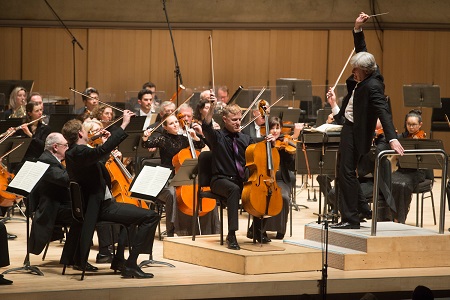
COC Music Director Johannes Debus and COC General Director Alexander Neef. (Photo: bohuang.ca)

But it’s a marvelous creation. I am reminded of Richard Bradshaw’s stated aim, not to make the best opera, but to create the best theatre in Toronto, and that’s indeed what we were seeing. I couldn’t help feeling –in a theatre shared between those who would bravo and those who would whoop, between those coming from the opera side, those in the theatre side, plus those drawn by the Indigenous artists and their culture—that we were experiencing a genuine conversation, a meeting of worlds, of people with different assumptions, goals and objectives.

Above the stage it was enacted for us, in surtitles in three languages (although there were more than three, when you add Michif and Cree and the Latin words of liturgy to the French & English), the singers sometimes shifting from one language to another. The boundaries between cultures were fluid, as they were between disciplines –as we watched Indigenous dance, watched a silent chorus bearing witness to the action, alongside the usual participants of the opera.

I understand that Peter Hinton was brought to this project because of his history working with Indigenous artists, for instance a King Lear that starred Billy Merasty, who appeared in a small role tonight, but whose presence was huge every time he came onstage. What was unsaid or unsung was as important as what was heard and enacted. Hinton explained his objective with the chorus, which included a silent group, as though bearing witness. I had thought it would merely be to frame the action but it was so much more than that, as the legitimacy of what we saw and heard was altered, the centre of gravity for the show shifted.

Some parts of the show work better than others, but it may be that nerves were a factor on opening night. I found the opening song of the original score, a somewhat bluesy song now sung by the luminous Jani Lauzon, redeemed a passage that disturbed me when I first heard it. We hear of Riel sitting in his stolen chair using his stolen silver, and this time I felt a connection and compassion that was always missing for me in the older version.

I have some quibbles, that again might be a case of opening night nerves. I wondered that conductor Johannes Debus—who led a fast, taut reading of this difficult modernist score—sometimes let his brass overpower a cast leaning heavily on lower voices. Yes they played with passion & commitment, those trombones and horns snarling like the wronged id of a whole nation, filling the space with their dark, nasty sounds; but unfortunately they share the same register as the three biggest roles:

  • Russell Braun as Louis Riel
  • James Westman as John A Macdonald
  • Alain Coulombe as Bishop Taché

I’m concerned that these gentlemen will be exhausted before the end of the run if they keep facing such big sounds. Braun’s Sprechstimme (if that’s what it’s supposed to be) danced on the edge of speech, sometimes howling and raging rather than singing. He made the visionary scenes very sympathetic, perhaps because he underplayed them, compared to what I recall from Bernard Turgeon, the originator of the role who gave us more of an image of a visionary on the edge of madness. I worry that he won’t survive the run, but of course I think he poured extra into opening night. Westman’s cartoonish reading, so deftly comical exploited the text and Moore’s many opportunities for comedy in this role, especially a scene where he’s clearly drunk. His voice sailed over the orchestra, which seems much more sympathetic, precisely because it’s rarely as angry or strident with Macdonald, as it is with poor passionate Louis Riel.  Coulombe at times is like the conscience of the opera, perhaps a bit like Arkel (Pelléas et Mélisande) or Sarastro (Magic Flute) with his deep & soulful philosophy, to counter the cynical opportunism of Macdonald or the urgent activism of Riel.

There was a great deal of good work all around. Simone Osborne was especially effective in the most discussed scene of the opera – the one that provoked a mini-conference earlier this week on the protocols for using aboriginal songs in original Canadian compositions—earning the one spontaneous eruption of applause of the night. Otherwise the audience was quiet until the end of each act, erupting at the end in support especially for Hinton and his team.

I can’t mention everyone, but did love the work of Andrew Haji, he of that lovely voice, stepping into someone else’s role because of an indisposition (sorry they made an announcement, so I’m not sure which roles were his and which ones were last-minute). Michael Colvin was quite a piece of work in the most troubling role, namely Thomas Scott, the shit-disturber with the foul racist mouth who promises not to make trouble, and then when after repeatedly breaking his promise is executed. Colvin sounds wonderful, but was physically inside the role. You couldn’t take your eyes off of him, especially in his brutal death scene.

16-17-05-MC-D-0679

(centre) Justin Many Fingers (Mii-Sum-Ma-Nis-Kim) as The Buffalo Dancer in a scene from the Canadian Opera Company’s new production of Louis Riel, 2017 (photo: Michael Cooper)

Justin Many Fingers gave us a glorious buffalo dance, which I heard him explaining on the radio –oh the serendipity of hearing him speak on CBC’s “Q” as I drove home tonight! –as a kind of balancing of another neglected part of the story, namely the slaughter of the buffalo. There are so many more –in a huge cast—but I’ll be back to see it again and will write some more about Riel.

It’s a complex stage picture at times, and perhaps I wished for something cleaner and simpler, but then again Hinton’s concepts are not simple. We are watching multiple groups interacting, and when you watch and listen it coheres. The opera that includes so many dated and troubling moments –now that I recall it—has been re-framed by Hinton and his team. While it’s far from perfect, I wonder if it can be part of that conversation in search of truth and reconciliation. It’s not a closed finished masterpiece, but ragged and rough in places, just like reality. Its ending is wonderfully open and ambiguous, much like that conversation.

I suspect that the COC planners expected Tosca to be the cash-cow with Riel as the exotic project for purists & history buffs. But don’t be surprised if it’s Riel that sells out every show. I saw a crowded theatre full of excited patrons, young and old from diverse backgrounds. I’d suggest you get tickets right away.

Posted in Opera, Politics, Reviews | 3 Comments

Questions for Peter Hinton concerning his Revisionist Riel

Director, dramaturg and playwright Peter Hinton has worked across Canada with many theatre companies. He has been the Associate Artistic Director at Theatre Passe Muraille and the Canadian Stage Company in Toronto, Artistic Director of the Playwrights Theatre Centre in Vancouver, the Dramaturg in Residence at Playwrights’ Workshop Montréal, and Artistic Associate of the Stratford Festival . From 2005 to 2012 he Artistic Director of the National Arts Centre English theatre, where he created a resident English theatre company, with actors from across the country, and programmed the NAC’s first season of Canadian plays.

His own plays for the stage include Façade, Urban Voodoo (written with Jim Millan) and a trilogy of three full length plays entitled The Swanne — George III: The Death of Cupid(2002), Princess Charlotte: The Acts of Venus (2003), and Queen Victoria: The Seduction of Nemesis (2004). Eleven years in the making, all three plays premiered under his direction at the Stratford Festival. In 2006, he co-created with Domini Blythe , and directed the solo work, Fanny Kemble, about the life of the famous British actress and abolitionist.

Peter Hinton has also written the librettos for two operas with composer Peter Hannan: The Diana Cantata, and 12O Songs for the Marquis de Sade, (awarded the Alcan Performing Arts Award in 2002).

Since 1985 he has directed over 75 productions of new plays, classical texts and operas, including premieres of works by Allen Cole (Hush, The Crimson Veil), Blake Brooker (Serpent Kills), John Mighton (Possible Worlds), Michael McKenzie (Geometry in Venice) and Marie Clements (Burning Vision). His production of Gloria Montero ’s Frida K.premiered at Toronto’s Tarragon Theatre in 1995 and subsequently played to sold-out houses in Canada, Mexico City and Madrid. His productions have twice been invited to the prestigious Festival de Théâtre des Amériques (now Festival TransAmériques ) in Montreal: Greg MacArthur’s Girls! Girls! Girls! in 2001, and Marie Clements ’ Burning Vision in 2003. In 2007, he partnered with Britian’s Royal Shakespeare Company in the world premiere of Margaret Atwood’s The Penelopiad. In 2009, he directed Sam Shepherd’s Buried Child in a National Arts Centre and Segal Centre for Performing Artsco-production. He made his directing debut at the Shaw Festival in 2011 with When the Rain Stops Falling, and returned in 2013 to direct Oscar Wilde’s Lady Windermere’s Fan.

He was the recipient of the Jessie Richardson Award for directing in 1995 for his production of Gordon Armstrong’s Scary Stories. In 2009, Peter Hinton was made an Officer of the Order of Canada.

I was delighted to have the chance to talk to Hinton, in hopes that by finding out more about him, we might illuminate his ambitiously revisionist production of Louis Riel for the Canadian Opera Company, opening Thursday April 20th.

silhouette

Peter Hinton

Okay, let’s talk about you, Peter Hinton, and find out about Louis Riel that way. So this first question is one of influence. Are you more like your father or your mother?

Oh God…

Well, I would have to confess, I am a hybrid of the two. My parents were academics, and valued academic achievement very highly, which of course I rejected (nervous laugh).

How did they feel about you going into the theatre?

My parents were oddly Victorian people. They felt the theatre was something you attended, but not something you did, and so we had many struggles about that. Sort of under the purview of “we just worry about you and want you to have something to fall back on…” which of course I interpreted as “you don’t approve”.

It was a fraught time. My parents passed away when I was in my 20s. And so I regret that among many things, that there was this point in my life when I needed their validation, their approval. And looking back now I wonder why did I need that so badly?

But they were definitely a strong influence, in terms of discipline, work habits.

What is the best or worst thing about what you do (you do so many things)?

The best and the worst thing, is that we’re constantly engaged in problem solving. So many problems. How will we do it with the artists we have? how will we do it with the budget that we have? It’s hardly the bane of my existence, because every day I’m asked to solve problems. But that’s also the centre of your creativity, that a good project has a problem, you expose the problem, share the problem to the audience. It’s a balancing act all the time. There’s a lot of joyous creativity in the problem solving.

Okay, so forgetting all about Riel or opera, what do you like to listen to or watch?

Ahhhh that’s such a good question. I was just noticing the other day that my reading is behind the times, I do so much reading for the projects that I do, but that’s the thing I love about the theatre, that it introduces you to subjects that you wouldn’t normally encounter. Earlier this year I directed a play about quantum mechanics, which I’d always shied away from, and gone “okay I’m not a physics guy, I’ll never be able to understand that”. But actually in preparation for that there was some very interesting writing. And so I try to make up for this. I’ve been reading Zadie Smith’s Swing Time and loving it. I adore Zadie Smith.

I have pretty eclectic taste in music. I love a lot of classical music as well as contemporary music. And certainly having a much younger partner influences my exposure to music. Howard Davis is my partner. I find it a challenge, being in your 50s you’re stuck. I noticed with my parents they were contemporary up to a certain point and then they got fixed in a certain time. And it was very amazing to observe that in myself. The biggest cultural influences in my life stop at the year 2000. I don’t want to be an old—school dated thing, I want to live in the modern world, to be literate in what people are reading and listening to.

Can I segue from that to ask a Riel question? Compared to Mozart or Handel it seems so new and yet an opera written in the 1960s: that feels old in the drama world. Do you feel Riel is new or old?

I think Riel is very much of its time. It carries with it signatures of work that was created in the 1960s. On the one hand it’s really provocative. You can see all that it’s reacting against. It reacts against melody, against linear narrative, against assonance in any way. It’s very radical in its conception. It demands a lot of its listeners. (nervous giggle) You cannot put Riel on as background music. Forget it.

Did you try?

I always like to listen to what I’m working on, in my studio. But it was so impossible with Riel because it’s just so dominant! You must listen to it, you can’t do anything else. And so it has that 60s quality to it, which is both dated, and also really vibrant. I have a similar response when looking at wild abstract expression in paint. Look at a Jack Bush painting, that’s 1962. But there’s something so alive in it as well. And so I have that kind of relationship to it. I don’t know how this piece will stand the test of time, 50 years from now, because there are all kinds of entry points into Louis Riel, that the piece doesn’t speak to, that demand pause, demand reconsideration. It’s a wild thing to tell the story of one of the most famous Métis people, but Somers chose a very European based sound. It sounds like very modernist music that’s mid-20th century. And yet he was someone who was very interested in expanding possibilities, adventurous, very exploratory in range.

And it’s my first official real opera that I’ve directed. And so I don’t have a lot of the reference points that a lot of my collaborators do, who are familiar with 19th century opera for example. And so to me it’s very much of its time but it’s modern too.

We’ve talked a lot in rehearsal that there are really three time-lines that are always in play.

  • One is the nineteenth century time-line in which the narrative is enacted
  • And then there’s our own time-line, how is this opera received in 2017, how do we as modern people interpret it
  • And then there’s this time of the 60s in it, which is interesting too.

And so there are three definitive time periods that speak to each other, and are in dialogue with each other over the course of the opera.

Did you see Robert Lepage’s 887 (on last week)?

No, I’ve just been working on Riel.

I ask because it oriented me to the 1960s and the concerns in Quebec (from Lepage’s youth), about separation and the poem Speak White, as they apply to the composition of Louis Riel in the mid-1960s.

Yes it’s very curious that the opera was conceived very much as an allegory for the two solitudes. It’s impossible to interpret that story today from that perspective. It’s a historical reference point, but the Indigenous aspects of the opera are far more alive and relevant to us today.

It seems the COC really knew what they were doing when they hired you. To be blunt: WHY YOU?
RESIZED_neef_Debus

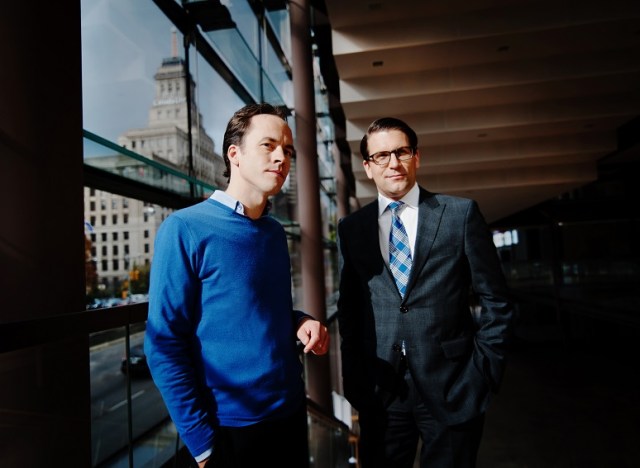
COC Music Director Johannes Debus and COC General Director Alexander Neef. (Photo: bohuang.ca)

Well I think Alexander [Neef] invited me to the project because of his knowledge of the work I’d done at the National Arts Centre with Indigenous artists, and also working with a large institution. It’s a very difficult kind of mix, bringing Indigenous artists into a place that has no experience of that at all. And so I had to negotiate my own position with that very clearly and very carefully, so I could ensure an environment where many voices could be brought to the room, and heard. And there was a willingness on the part of the COC to be influenced and changed by that: which I think there has been.

Alexander approached me because there are few people who could take on that challenge in that way. And I had to think about it a lot, because the Indigenous involvement is really important to me. And I had to figure out how I could direct this story and find the right collaborators to participate with.

There’s risk for you, in your authenticity (being true to yourself) and your relationship to the Indigenous Community. Was that part of your process? Did you experience stress and risk, negotiating your place in this?

Every day! Every single day. That is ongoing.

That’s how art should work. I get the impression (between you and me) that such questions and risks don’t happen often enough.

It’s easy to make assumptions. Every day on this project has been a new negotiation of how the work is interpreted, how to keep it open, and porous in some ways so that there are going to be different responses to it, but also provide guidelines that the artists can feel secure in. And it’s not creating a new piece but dealing with an existent score, an existent text, and how to interpret that becomes really interesting.

And it’s not public domain [like most operas] and so you could also experience push-back from the owners of the score as well. Or maybe we don’t want to talk about that..?

The COC have been very good with Moore’s estate and Somers’ estate, so there was a lot of dialogue about some of the changes we wanted to make and what we would honour in it. I think it’s such an interesting piece, because there are many beautiful, strong strong things in it, and here are also colonial biases within it. And so I was trying to conceive of a production that would shed light on its strengths as well as shedding light on its biases without undermining the piece.

One of the great themes of the opera is this idea of trial. Louis Riel’s trial is a very substantial part of the third act. And yet in the opera there are many things put on trial. Confederation is put on trial. The ideas that forged Canada are put on trial as much as the character of Riel is put on trial. And so in some ways in this production I think of the opera being on trial. And the verdict doesn’t mean it’s a good opera or bad opera, but are its ideas true? Do they uphold to us today? It’s a trial about what needs to be said. And what our future needs to be. This whole Canada 150 is a very interesting phenomenon, because most people that I speak with have a skepticism about Canada 150. What is being quote unquote celebrated, vs commemorated? It’s a hard concept for a lot of people to grasp. And yet it exists, we still do it. And there was an opportunity as an artist to respond to that. I have to say, when I first learned about it, I thought it might be very pro-Canada, “from sea to shining sea” (ironic giggle). Dang! I was really taken with its indictment of our history.

How do you feel about [and I sang it…] “We’ll hang him up the river with a ya ya ya”, which is totally ugly..!? If you’re an English Canadian you’re squirming in your seat.

Racism is front and centre. It’s very critical in that regard.

You know there’s something that has come up a lot. There’s this thing we heard in high school, that Canadian history is BORING? And I wondered is that the Canadian self-deprecation? But in working on Riel I was reminded, there’s like a conscious will to divert us from the atrocity of our history. There’s a huge legacy of injustice. And when they say “it’s boring don’t look at that” is a huge problem we have, and contributes to a kind of cultural amnesia about our history and what we need to reckon with, what we need to be voicing, speaking about… So it’s very challenging on every level.

There’s this quote I have in the previous COC program where you reference John Ralston Saul, and his notion of Canada as a Métis Nation. Could you explain how that’s relevant to Riel?

Well John Ralston Saul’s book A Fair Country opens with that statement. It’s a very historical book about Canada, and speaks about how Canadians sometimes use the colonial bias as the sole means of definition for who we are. And what’s neglected in that perception or analysis is the significant and vital contribution of aboriginal cultures and indigenous cultures to our understanding of ourselves. It’s denying a fact of presence.

And that’s not to undermine or deny any of the history or current action, the cultural holocaust and the legacy of the residential schools and the true abuse. But it’s important that we acknowledge the real commitment and contribution Indigenous societies have made to us and how important and vital they are to our future. I found this book very interesting and very hopeful in a realistic way rather than an ideological way.

Have you met him?

Yes. I met him at the NAC and at the season launch last year. I think he and Adrienne will be there tomorrow [opening night].

I wanted to ask about influences.

It was really important to me that on this production, wherever we could sort of bridge, the people who are cultural advisors would be participants of the show. It’s always odd to me when there’s one group creating and another group advising. And I’ve been so fortunate in my creative practice to be able to work with so many Earth-shattering wonderful Aboriginal performers. So when I knew about Riel having Jani Lauzon involved was a really important collaboration.

16-17-05-MC-D-0258

Jani Lauzon as The Folksinger and Russell Braun as Louis Riel in the Canadian Opera Company’s new production of Louis Riel, 2017 (photo: Michael Cooper)

Jani and I have worked many times together at the National Arts Centre, Billy Merasty as well. I did a very large project of King Lear with forty indigenous actors in it at the NAC. Billy was part of that as well as a Marie Clements play about Norval Morrisseau that Billy played Norval in. And so it was really important for me to have those guys involved in this show. Because I could collaborate with them, I could get their responses, build something with them based on previous work. And Cole Alvis is a remarkable theatre creator.

16-17-05-MC-D-0015

Cole Alvis as The Activist in the Canadian Opera Company’s new production of Louis Riel, 2017 (photo: Michael Cooper)

And Justin Many Fingers who’s a Blackfoot dancer from Calgary who I know from my connections there, I’ve always wanted to work with him. So I was trying to continue to build relationships, that’s the important thing. You do one project with someone, and if you connect, if there’s a creativity that comes from that collaboration it’s very important to continue it, to keep the dialogue going. That’s what I hope for the COC that the artists currently involved will continue. So for example Joanna Burt: INCREDIBLE. She’s in there playing Sara. It’s so exciting to see her in the ensemble. And working with Santee Smith, choreographer. Just trying to break down these walls, with big Euro-based institutions.

Now some of this with opera is based on the discipline, no? singing. Can we expect to see Indigenous Opera singers? Or does opera have to change, or at least perform a different idiom?

Well a bit of both. That’s the thing, the first response I hear from people is just “oh no” that they can’t be opera singers, which is not true. And so part of this production is to change that. Part of this production is to draw attention to future change to that. You know there is a very good generation of classically trained singers. But we also have to look at traditions of training. And how training is acknowledged in different communities, different cultures. And there are different traditions of singing.

Yes opera (and its pedagogy) has this traditional association with power and the endorsement of power, from Louis XIV through Hitler & Stalin, and beyond. So it’s not a medium for empowerment necessarily.

Yes I think that’s a positive breakthrough to this production, that it’s really opened ways of working and challenged assumptions about how things are done. You know, from having a smudging at the Four Seasons Centre, and seeing singers sit with leaders of our Indigenous Community. It is very encouraging to me. But it’s also right, it’s the times we live in.

This opera is not perfect, it is a telling, it’s a target for many points of view, many criticisms, all the reasons people go to a live performance. This can engender a lot of dialogue. It’s where we’re at right now.

Could you talk about how your use of that split chorus –some singing, some silent—might impact the way we watch the opera?

So I wanted to redraw the lens by which we view this opera, and to remind an audience that this is a history that could have many different viewpoints. That you cannot convey a truth by one perspective, especially when there are such inequities of power. And so the chorus is very important to Louis Riel. They’re really the people on which the soloist characters speak on behalf of, stand for, represent, mis-represent.

16-17-05-MC-D-0035

Members of the Land Assembly in the Canadian Opera Company’s new production of Louis Riel, 2017 (photo: Michael Cooper)

And so I wanted to counter a silent figure with a singing figure as often as possible, to show a tension between those who have a voice and those who don’t.

Where is singing powerful and where is it just noise?

Where is silence oppression?

Or where is silence protest?
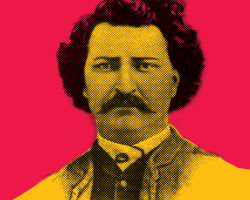
rielI hope the audience sees that. The audience is a part of it too. The audience is watching. The audience is a presence. I don’t go for this thing that the audience is always anonymous in the dark, that we’re all the same: especially in a place like the Four Seasons Centre, where there are rings and tiers. The strata, a sense of hierarchy. I just wanted to reflect that in the show.

There are enormous contrasts in the show between action and reflection. Waiting. Like every time Riel enters, and the people are doing something he tells them to stop. Every time he comes on the stage he says “stop doing this”. And then he has very private reflective tortured arias. They’re not unlike Hamlet. “One must act, but what must I do? Who am I acting on behalf of? Am I called by God, am I called by the people? ” And then he’s interrupted by this enormous onslaught of action. I tried to reflect that on a lot of different levels.

One thing I really love about it is that, for the first time at the Four Seasons there are Indigenous performers onstage playing Indigenous characters. So when the curtain comes up it’s a very long sequence, at the top where it’s about the Indigenous performers looking at the audience as the audience is looking at them. It’s a real moment of dramatizing contact, who’s seeing who, who’s discovering what. That kind of tension runs through the opera and is reflected in the staging.

Is there a teacher or influence you’d care to name that you especially admire?

When I was emerging as a director, thirty years ago, I was very fortunate to have a kind of mentorship with Larry Lillo. Larry was the artistic director of the Vancouver Playhouse. He gave me a lot of opportunities when I was young. He was very tough on me. Very rigorous. And very loving. And I am always very grateful to Larry for those opportunities.

And you’re going off to another show in two days?

Yes I go back to the Shaw Festival, where my home is. I’m doing a wonderful play called An Octoroon, that I start on Tuesday. And I’m going into my seventh season at the Shaw. But this year has been uncharacteristically busy. Busier than I like. I’m not as young as I used to be.

Do you manage to get to the gym?   (laughter)    Did you get any sleep this week?

This week? Forget it. Three years ago I was in my best physical condition, because I was performing and vain enough (laughter) It’s a great motivator. It’s harder with direction because you send a long time sitting and watching other people. It’s so mentally active and yet so physically sedentary. It’s a balancing act.

dogs

I wanted to insert a picture of the pugs who boisterously made their presence felt at one point in the interview.

*******

But before Hinton’s production of An Octaroon at the Shaw Festival first there’s the Canadian Opera Company’s ambitious production of Harry Somers and Mavor Moore’s  Louis Riel, opening Thursday April 20th and running until May 13th.

Posted in Interviews, Opera, Politics | 3 Comments

Boss Baby boffo box-office bodyslams both Beauty and Beast

We’re in a golden age: for parenting and grand-parenting that is. If you’re taking a child to see a film, they’re now so sophisticated that not only will the child like the film but so will you.

No one will be bored, so it has been decreed.

No wonder that these animated creations make so many millions of dollars, as two films for the young make the film-makers go goo-goo ga-ga all the way to the bank.  And after that sentence (OR after seeing the headline, which is based on one of those cheesy box office reports, more or less as I stated it), I suppose there’s no point denying that I have a weakness for alliteration.

When I first heard that a film was being made with the title The Boss Baby and using Alec Baldwin’s voice, I wondered if this might be an offshoot of his Saturday Night Live portrayals of Donald Trump.

Of course that’s a crazy idea. Animated films take years to conceive & organize, requiring hundreds of animators to assemble the eventual result. Brilliant as this film is –and funny—it couldn’t be as recent as Baldwin’s creation of Trump for SNL. There’s even an unforgettable moment when the baby is playing golf, and informs us that the key to management is to delegate, as he watches someone else do all the work. That sure reminded me of the POTUS.

But let’s forget all that. Truth be told, Trump is like the dark shadowy figure in every Rorschach inkblot, the thing we fear that serves to explain almost everything. If he didn’t exist we’d have to invent him, but lucky for us, he burst on the scene like that drunk relative at your last wedding who refused to shut up and had to be dragged away by security.

No, this film is a surprise even though I should have seen it coming. I’m reminded of two amazing animated films, each with an unpretentious title packing an unexpected emotional wallop to your solar plexus. I’m thinking of Inside Out and Kubo and the Two Strings , both hugely successful films enjoyed by children that could be admired in an entirely different way by adults.

I won’t go deep in the analysis, other than to say: it’s deeper than it looks. It’s not at all what it seems. And that’s to be understood as a compliment, to suggest that this is a very good film.  Yes it has all sorts of political overtones.  But a child can enjoy it without knowing any of that.

I’m looking forward to seeing Beauty & the Beast one of these days.

Posted in Cinema, video & DVDs, Reviews | 1 Comment

Questions for Howard J. Davis: C’est Moi

Howard J. Davis is a Toronto based filmmaker, the director of C’est Moi, a short film shot on location, about Marie-Josèphe Angelique, a young slave who was tried, tortured and killed for allegedly burning down the city of Montreal.

ANGELIQUE

Howard is a British born Canadian mixed race actor, singer, dancer and emerging filmmaker who studied at Ryerson School of Performance (formerly Ryerson Theatre School) here in Toronto and has performed in England, Canada and the United States. Already in his career Howard has worked at the The Shaw Festival, on a remake of Romero’s film Something in his eye and in the upcoming feature Downsizing starring Matt Damon and directed by Alexander Payne.

Howard is a creative chameleon taking on many roles: not just director, but cinematographer, producer and editor. For C’est Moi Howard also created the musical score. His previous short “Shakespeare Shorts” was an official of the Stratford-Upon-Avon short film festival in 2014 curated by Sir Kenneth Branagh as well as his film “move4equal”, which was in response to Emma Watson’s heforshe campaign for male
advocacy in support of feminism and Madonna’s #Artforfreedom for women’s rights. He hopes to continue building a practice in telling stories of his heritage, marginalized cultures not at the forefront of history and modern original works with an emphasis on bringing classical, theatrical and historical context to a contemporary cinema. The past can always inform the future.

C’est Moi premiered in Hollywood, has traveled the United States and soon will have its first Toronto screening, at the Censured in Canada Festival May 28th.

https://vimeo.com/198427345

In anticipation of the Toronto screening of C’est Moi I asked Howard some questions.

Are you more like your father or your mother?

My mother is extremely emotional, compassionate person and possesses a heart of gold. I feel that her and I share the same emotional capacity and both wear our hearts and desires on our sleeves. There is never a time when my mother is not willing to give anyone a big hug, kiss or cuddle [yes I still cuddle with my mum when I get the chance]. She has a very cognitive yet visceral perception of the world around her and I think she is still discovering a lot about who she is. At 60 years of age she is just as vivacious and willing to jump into the unknown [my mother recently began the process of looking into her adoption and I am very proud of her for doing so]. My mother is very opinionated like myself. When she decided to be with my father she broke several social norms to be in a interracial relationship and I have to say that her emblem would be to “do unto others as you would be treated” and she stands up for what she believes in without being righteous.

My father is exceptionally hard-working. When I ever complain it is not uncommon for him to say “Stumpy [my nickname] I’ve been working since I was 13 years old. Every time he tells this story the age gets younger and younger for added emphasis. At 66 years of age my father has also known extreme hardship. Growing up as a man of colour in the Southwest of England in the 60’s-70’s had its struggles however my dad dealt with adversity and prejudice in a very simple manner, he fought back. I am proud to say that I do share this quality with him. Whereas I like to think I use my words to deal with standing my ground, my dad used his fist and there are no end of colourful and funny stories of scraps that he and his friends got into growing up together. My dad is a fighter physically and mentally. He is headstrong, willful and talks a lot [like me]. He is a survivor of cancer 10+ years and going strong. He is also very protective, always has the best intentions and I know he will always have my back.

RESIZED Howard

Film-maker Howard J Davis

I think I possess equal qualities of both my parents. I am very proud of my heritage and have used what I’ve learnt of their history and discover new things everyday in my art that informs who I am now, where I’ve come from and how I would like to forge ahead as an artist. I am also in the works of writing about my parents history.

What is the best or worst thing about what you do?

The best thing about what I do is I have many skills that lend themselves to fuelling my artistic endeavours. I began formatively am a performer and grew up doing musical theatre, then trained in classical repertoire and now have begun working in film and television in front and behind the camera. The skills I have include directing, editing, producing, photography, videography, modelling, drawing and music.

The downside of this is explaining what I do to strangers. I don’t just do one thing and find it difficult to encapsulate into one definable term the plethora of things I do. You would be surprised how often people expect me to categorize and define myself as an artist. I don’t like to define myself as one thing. I feel that my career is varied, fluid and will continue to shift and morph as I grow into the artist I know I will be and in whatever medium that will end up being is exciting but also extremely terrifying.

Who do you like to listen to or watch?

I have an eclectic taste but would say I am a sucker for what is trending. I do enjoy watching Netflix, the newest series or film, the Top 40’s etc. I also have a great love for classical films, theatre, poetry and music. I think history is very informative and trends come and go within artistic practices and I believe that art from the past can inform how we share narratives to our audiences today.

What ability or skill do you wish you had, that you don’t have?

I wish I had the ability to speak more languages. If people were able to understand one another more I think that we would be able to solve problems across the globe.
I also wish I had the ability to say no. Saying yes is not necessarily a bad thing but I feel you can get taken advantage of especially as an emerging artist. It takes a lot of gumption and sense of self to say no to things and I think when I begin to care less about other’s think of me I will be able to be self-assured enough to say no.

When you’re just relaxing and not working, what is your favourite thing to do?

I love to cook. It is a fabulous creative outlet and the reward is you get to eat it. I also love thinking, sleeping, Have a new found respect for Crossfit, spending time with my partner and walking my dogs.

Please talk about how you discovered the story that you tell in C’est Moi

More and more lately I’ve had a genuine curiosity into the question of “what is it that makes up the backbone of Canada as we know it today?” Almost everyday I wonder where I stand within this dialogue as a person of mixed diversity, who has emigrated to Canada with a heritage that is heavily contradictory being of European and African-Caribbean descent. 8 years ago, I was fortunate during my University degree, to take numerous courses on the subject of Caribbean and pre-colonial African History studies.
My teacher Terry Roswell, was paramount in sparking my interest on subjects of the African Diaspora which led me to some literature on the subject of Canada’s involvement in the story of Slavery. From there I was led to a book by Afua Cooper entitled the Hanging of Angelique. At the same time I was beginning to create text and movement based work in theatre school that was the leg work for what would eventually become C’est Moi. In no way am I suggesting that I discovered this story however I am proud that I am a contributing voice in the dialogue of this contentious history.

Knowledge is a bridge to self discovery.

If this were 1967 we might see a documentary showing us the events and the trial: exactly what happened to Marie-Josèphe Angélique. But it’s 2017, and so C’est Moi comes at the story of Marie-Josèphe Angélique in a very indirect way. Please reflect on how you came to this unorthodox approach.

In no way did I want the approach to the film to be like the Heritage Moment films that have been produced about significant figures in Canadian History. I love those pieces however that is not my approach to telling stories.

The first thing I wrote was the score, which I had initially intended to use in a musical adaptation before the work became its final realization as a short film with music. Rather than being sung, the lyrics I had written are spoken in the film and are the foundations for which the piece was formulated. My initial goals were that the music accompanied Angélique’s inner peace and thoughts and is almost akin to a lullaby that is juxtaposed with the imagery. The words “c’est moi” were repeated during Angélique’s torture which was the name of the song and seemed an appropriate title for the film. I’ve always had a strong impulse when it comes to creating film and like to approach my work using influences of historical context while wanting to bring to life stories using contemporary cinema. Influences for the use of the camera came from classical techniques seen by Ingmar Bergman.  A big influence for me was the black and white film The Passion of Jeanne D’Arc by Carl Theodor Dreyer which chronicles Joan of Arc’s story.

On the occasion of the Sesquicentennial of Confederation, Canadians are thinking about history, who we are and how we got here. Please talk for a moment about what C’est Moi can contribute to the conversation.

I think the Sesquicentennial of Confederation is a time to commemorate Canada but also to acknowledge. New settlements recently discovered off of Vancouver are said to predate the Pyramids of Egypt by 10,000 years and continue to prove that indigenous people have been in Canada longer than 150 years. Canadians are only just beginning to start a dialogue about their involvement in our controversial history in artistic mediums such as the NAC’s upcoming production of Corey Payette’s Children of God about the residential schools, Redpatch a historical drama that focuses on a young Métis solider in WW1 to Marie Clement’s upcoming show Missing about the missing indigenous women on the Highway of Tears. However that is just a handful of examples of stories of minorities that are finally being shared. Not enough stories of diversity are shared or known and I am glad to contribute another in the story of Black history in Canada. I hope C’est Moi continues in the telling of stories that help acknowledge parts of history that have not had light shed on. In the film, the Plaque de la Déclaration de Montréal Contre la Discrimination Raciale is shown to have been demolished in 2016 by the city of Montreal for “restorational” purposes due in part with Montreal’s 375th Birthday. This recent incident is juxtaposed with Angelique’s history and is the antithesis to the film. In an exploration of the past what is inevitably erased in the restoration of history? We cannot move forward to being better people if we do not address these issues.

Talk for a moment about Jenny Brizard and how she fits into the portrayal of Angélique.

Jenny is the beautiful actress who I was lucky enough to be put into contact with before shooting. Jenny has now had the opportunity to play Angelique in two different mediums. Recently, in the stage adaptation of the same history entitled Angelique by Montreal playwright Lorena Gale performed in February 2017.

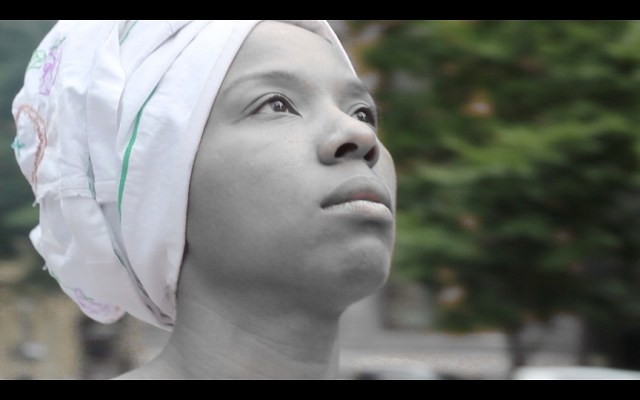
resized C'est Moi Screenshot 3

Thanks to the generosity of Artistic Director of Geordie Productions Mike Payette who directed that show, Jenny came to me October of last year with some understanding of the history however was still receptive to learning more from me. I wanted Angelique to be relevant to today and present amidst a modern day Montreal. When I went to Montreal for the first time I felt Angelique’s presence there and was saddened when I asked people about her and no one knew who she was or the history of their city.

Jenny was very collaborative. She took direction well and listened to what I had to say. In my research I was struck by two opposing ideas that Angelique had either committed deliberate arson or was covering for someone else and was in fact innocent. Jenny and I played with the imagery of Angelique like Joan of Arc who was unwavering from her truth and was burnt at the stake for not folding under pressure. I wanted to portray a woman who was reticent and resolute in her confession. An emotional and strong woman who knew God knew the truth and that she was dying for something bigger than herself. Both theories of Angelique’s crime are valid points of view but my approach lent towards not taking either side. Was she a scapegoat for blame or an emblem of resilience against slavery? Many people attribute ambiguity to being vague but I think ambiguity is mysterious and interesting. I hope the film leaves the audience wondering “did she do it or not?” I know what I believe but as a director it is more rewarding to leave your audiences not knowing what to believe and to make their own choice.

Please describe how your background prepared you for this film.

For me art is an exploration of the self. To quote one of my favourite filmmakers Ava DuVernay director of the documentary “13th” “If you approach your work from a point of view of curiosity and authentic interest you will be successful”. My film began through a genuine interest in the study of my heritage and through questions about Canadian identity. I would go further to what Ava said and add that if you approach subjects conscientiously and with research this is paramount in being not only successful but prepared for your work. Given the historical context of this film I knew it was important to view all opinions before making a statement and having my own view on the history. Having worked on this project alone (aside from the generous collaboration of Jenny Brizard, Paul Moody and Ethan Rising), it has required I utilize all my skills I have however I do look forward to creating work with a team as I continue to grow as an artist.

Are there any shows or films you’ve done that now seem to have laid the groundwork for C’est Moi?

I’ve had desires before this to address gender relationships. I believe strongly that females are not the only people to be advocates of feminism. It is an emblem that men can and should wear and I think my previous work before C’est Moi support this. One short film I created MOVE4EQUAL addresses an issue on the gender wage gap and was in response to Emma Watson’s HEFORSHE campaign, for the advancement of women and to engage men and boys as agents of change. I do believe C’est Moi has established the groundwork for work that tells stories not at the forefront of history about marginalized groups who are victims of oppression. I feel very fortunate to live in Canada and I believe it is healthy to address my own privilege so that I can fight for what I believe in and expose subjects that interest me.

Is there a teacher or influence you’d care to name that you especially admire?

There are a number of people that I admire. I would say every teacher I’ve had from primary school in the UK to theatre school have contributed to my development as a human and artist. I have a varied and eclectic number of artistic influences such as filmmakers Lars Von Trier, Alfred Hitchcock, Peter Jackson, writers Charles Dickens, George Elliot Clarke, El Jones, Lawrence Hill and theatre makers Robert Lepage, Julie Taymor and Sam Mendes. Peter Hinton is also a huge inspiration to me and I could not have completed the film C’est Moi without his guidance and generosity. Thank you Peter for your love and support. Also my family (Mum, Dad, Helen and Katie) and friends.

If you’d like to donate to the film and help it be seen at more festivals and to learn more go to www.cestmoifilm.com and follow us on all social media @cestmoifilm

*******

Howard J Davis’s film C’est Moi comes to the Censured in Canada Festival May 28th, CineCycle, 129 Spadina Avenue.

Posted in Cinema, video & DVDs, Interviews, Politics | Leave a comment

JS Bach’s St Mark Passion according to Heighes

In addition to the two well-known passions by JS Bach (the ones based on the gospels according to St Matthew and St John) there’s also the Passion according to St Mark that we know to have been performed at least twice in Bach’s lifetime. Although the complete musical score has been lost, the availability of the libretto makes it possible to reconstruct the work, BWV 247.

Today I experienced an overwhelming performance at lovely St Barnabas Church, of the St Mark Passion in the reconstruction by Simon Heighes (1995), a preview of what will be presented by the Second Annual Bach Festival on May 28th. And it was overwhelming because I was seated in the front row, a few feet from the tiny orchestra and the soloists, surrounded in the luxurious sounds of some of the best singers & players in this country.

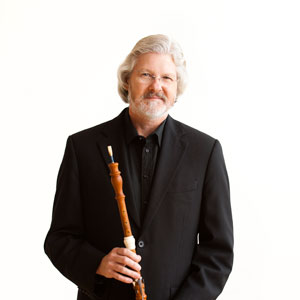
John Abberger

Oboist John Abberger, Artistic Director of the Toronto Bach Festival

If you have any curiosity about this work, if you have the desire to hear good singing & playing, you must take advantage of the opportunity in May. The intimacy of the music requires a space like this one, where you can hear every note clearly, where you can make eye contact with performers wearing their hearts on their sleeves. There are three concerts in the series featuring the vocal talents of Brett Polegato, Asitha Tennekoon, Daniel Taylor (indisposed today unfortunately), Ellen McAteer, Agnes Zsigovics, Jan van der Hooft, Ryan Cairan, Jessica Wright and Larry Beckwith; and  an orchestra comprised of Julia Wedman, Patricia Ahern, Emily Eng, Matt Antal, Felix Deak, Matthew Girolami, Joëlle Morton, Marilyn Fung, Christopher Bagan, Marco Cera, Alison Melville, Anthea Conway-White and directed by oboist John Abberger. I mention them all because everyone had moments of great beauty. In a work played by such a small ensemble, there were exposed passages giving everyone their moment to shine.

Some of the music is familiar, although I don’t know whether it’s Bach’s choice in the original or Heighes’ in his reconstruction, to re-purpose music that we’ve heard before elsewhere. I recognized a couple, for instance, the tune we sing as the Passion Chorale but to different words. We also encounter JS Bach’s setting of Luther’s “A Mighty Fortress Is Our God”, based not on Mark but Psalm 46, so I’m not sure how that manages to get into the piece: even if it’s guaranteed to turn on the waterworks when I hear it sung so perfectly.

asitha_tennekoon_headshot_500px_bw-crop-u36569

Tenor Asitha Tennekoon

The two singers with the largest workload soldiered along without much glory until near the end. Both Asitha Tennekoon as the Evangelist and Brett Polegato as Jesus have large amounts to sing, but mostly in soft recitatives. But in the second part, each gets an aria and it’s worth the wait. The sopranos McAteer and Szigovics soar gloriously throughout the afternoon both from the chorus, and then emerging for their own solo fireworks.

Don’t miss the opportunity to hear the St Mark Passion when it comes again May 28th.

Posted in Music and musicology, Reviews | 1 Comment

TSO Maundy Thursday matinee

Today I had the pleasure of hearing the Toronto Symphony in an afternoon concert, repeating most of last night’s program. The energy is different in the middle of the day especially mid-week. The matinee extends a win-streak of wonderful playing with guest conductors over the past few weeks, as Andrey Boreyko seemed to know exactly how to inspire this orchestra.

The program of four pieces was augmented by a wonderful bonus:

  • Mark Bélanger’s Wink from Drummondville to Toronto
  • Christos Hatzis’s The Isle is Full of Noises
  • Franz Liszt’s Piano Concerto #2
  • The bonus: a brief encore composed by pianist Lucas Debargue, sounding like a soft-rock Rachmaninoff prelude
  • Johannes Brahms’s Symphony #3

Although not in strictly chronological order, the concert felt like a gradual trip to the past.  The newest piece on the program in its TSO premiere was Bélanger’s Sesquie, a two minute romp full of whimsy and broad gestures that made me giggle aloud. As the title suggests, the composer was having a lot of fun and thank goodness this was one of those times when the joke was totally intelligible. Bélanger seemed to be colouring with big fat crayons, employing a brass choir then an answer from the woodwinds, and something subtler still from the strings. What I think we’re seeing with these two minute gems is that the limitations of the commission –a two minutes fanfare after all—serve to inspire the composers rather than limiting them.

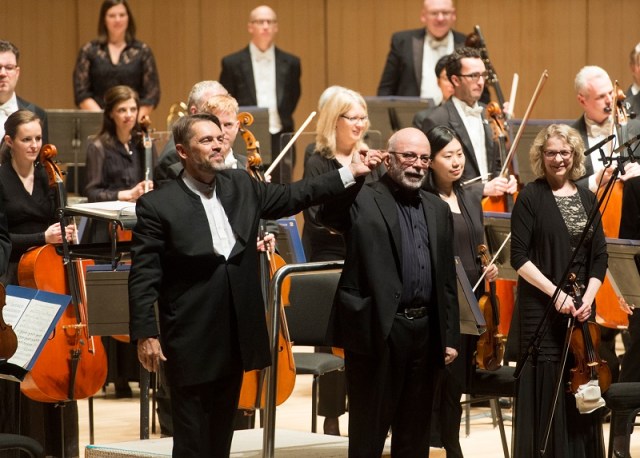
Andrey Boreyko, Christos Hatzis (@Jag Gundu)

Conductor Andrey Boreyko with composer Christos Hatzis (photo: Jag Gundu)

Christos Hatzis’s The Isle is Full of Noises was premiered about 4 years ago by the Orchestre Symphonique de Montréal as part of a Shakespeare-themed program, this piece inspired by The Tempest. I don’t know about you, but I love encountering program music where the composition is intelligible as an expression of the idea it is meant to signify. Hatzis begins with the sounds of human breathing, an activity that naturally comes first in this kind of organic sound-poetry. We work from darkness to light, from abstract to concrete, from disorder to order, as seemingly random or dissonant sounds organize and cohere in a buildup towards a melodic and tonal affirmation at the end. And just as Prospero’s island is sometimes a bit threatening but ultimately a safe place for good people and not so terrible even to those who are evil, so too with the sounds, that never threaten but do surround us safely. I can’t help feeling that for Hatzis –especially after his Juno-award (just a few days ago) for Going Home Star—the possibilities are unlimited. Much of the time we seemed to inhabit a sonic world reminding me of early Stravinsky –perhaps corresponding to his word “impressionistic” in the composer’s program note—as in The Firebird ballet score, but with the occasional addition of unexpected sounds from a different rule-book just to keep us honest. I was thrilled to see how well the audience received Hatzis’s music.

I am not cheating the proper chronology in portraying Liszt’s 2nd piano concerto as the next newest sounding piece, given that Brahms, who came later, always seemed to want to cheat the calendar and emulate a more conservative style & sound; more on Brahms in a moment.

Before I speak of Liszt, let me say simply that Lucas Debargue is an extraordinary and charismatic pianist. Yes, he played the concerto accurately as far as I could tell; as it’s not a concerto that I’ve ever played through—because I don’t like the music very much—I couldn’t tell during some of the thunderous sequences whether he was really playing it right or not. But the sound was magnificent, a big full sound whether in slow forte passages or fast ones. In the lyric middle section we heard an achingly beautiful sound, the legato dripping from his fingers.

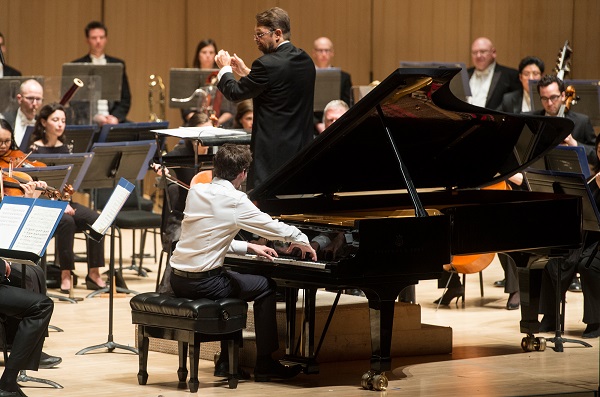
Lucas Debargue, Andrey Boreyko (@Jag Gundu)

Pianist Lucas Debargue, conductor Andrey Boreyko and the TSO (photo: Jag Gundu)

I said “charismatic” because a big part of his appeal lies in his body language, a head that bobbed so much it verges on self-parody, although when you play this well: you can move any way you like! At times he gave us that Glenn Gould style liquid body language, where he is channeling the music without regard for anything else, and totally in the moment of the creation. Boreyko met him halfway with a powerful sound from the orchestra. And I can’t help mentioning a magnificent solo from cellist Joseph Johnson, perhaps just a bit bolder in his playing after his showcase last week in the Schumann concerto, perhaps precisely the kind of payoff one would hope for.

After the interval came the most moving reading of Brahms’ 3rd Symphony that I have ever encountered. Boreyko’s approach was deliberate, understood in a very good way. The conductor’s baton was used to begin and end, but was set aside for the subtler places, namely the two inner movements and the conclusion of the symphony: where we had a chance to hear inner voices in a transparent series of solos. In the big moments the orchestra were wonderfully tight, very clear in their articulation. In the places where the orchestra pauses, Boreyko fully indulged those moments as though for a big collective breath. In additional to so much wonderful solo work in the brass, woodwinds & percussion, we heard exquisite yet restrained sounds from the trombone choir invoking the mystical implications of the instrument that Brahms likely sought, particularly at the end.  The TSO faithfully executed Boreyko’s lucid reading, a profound interpretation of this the most elusive and difficult of all of Brahms’ symphonies.

Posted in Music and musicology, Reviews | Leave a comment

Dialogue on use of Indigenous Songs in Canadian Compositions, hosted by COC

In a press release, the Canadian Opera Company have announced a closed meeting on April 19th –the eve of the premiere of their new co-production of Louis Riel—to discuss “First Nations song protocol and the use of Indigenous songs in Canadian compositions, such as Harry Somers’ Louis Riel.”

The meeting has been organized by Dr Dylan Robinson of Queen’s University.

Dylan Robinson

Professor Dylan Robinson, Canada Research Chair in Indigenous Arts

The press release goes on to say the following:

Those who have been invited to the April 19 gathering are members of the Nisg̱a’a, Métis and other First Nations arts and music communities, members of the 2017 Louis Riel production, representatives from the Canadian Opera Company, National Arts Centre, Canadian Music Centre, and Canada Council for the Arts, as well as advisors and executors to the estates of Louis Riel’s composer Harry Somers and librettist Mavor Moore.

“One intention of the gathering is to begin the process of developing policy related to Indigenous protocol for new music involving Indigenous participants, and music that misuses Indigenous song,” says Dr. Dylan Robinson, Assistant Professor and Canada Research Chair in Indigenous Arts. “This work of creative repatriation is essential in the ongoing process of reconciliation.”

There is a small but essential part of Louis Riel that underlies this dialogue, as mentioned in the press release:

The score of Somers’ Louis Riel includes the “Kuyas” aria, which opens Act III and is sung in Cree by the artist in the role of Marguerite Riel, Louis Riel’s wife. The music for the “Kuyas” aria was based on a Nisg̱a’a mourning song called “Song of Skateen” that was recorded by Marius Barbeau and transcribed by Sir Ernest MacMillan on the Nass River in 1927.

Fast forward to Harry Somers’ composition in the 1960s.

The “Song of Skateen”, a Nisg̱a’a mourning song, was used by Harry Somers without knowledge of Nisg̱a’a protocol that dictates that such songs must only be sung at the appropriate times, and only by those who hold the hereditary rights to sing such songs. To sing mourning songs in other contexts is a legal offence for Nisg̱a’a people and can also have negative spiritual impacts upon the lives of singers and listeners.

The press release makes the following important announcement:

With respect to both the Nisg̱a’a and Métis peoples and in recognition of how the songs of one nation are not the same as another’s, the COC and NAC co-production of Louis Riel acknowledges the current holder of the hereditary rights to this song: Sim’oogit Sg̱at’iin, hereditary chief Isaac Gonu, Gisḵ’ansnaat (Grizzly Bear Clan), Gitlax̱t’aamiks, B.C.

In recognition of the Nisg̱a’a people and to correct the attribution of “Song of Skateen,” the COC’s opening night performance of Louis Riel on April 20 will begin with an oratory and musical address from G̱oothl Ts’imilx Mike Dangeli and Wal’aks Keane Tait of the Nisg̱a’a First Nation with the Git Hayetsk and Kwhlii Gibaygum Nisg̱a’a Dancers, two internationally renowned dance groups from Vancouver, B.C.

The use of the key word reconciliation can’t help but remind us of the Truth & Reconciliation Commission, and its goals.  For a composer seeking to create, the protocols that might be generated in such conversations are very important, in order to avoid the mistakes of the past, however inadvertent they might be.  In 2017 there is no excuse for composers to simply appropriate music, even if this might be more in keeping with the European colonial tradition. It is to be hoped that the ambitions of the TRC lead to a genuine conversation on this occasion, including some directions for composers and producers.

The concluding statement of the press release says the following:

The purpose of the April 19 consultation event is not to reach a conclusive decision, but to open a dialogue between relevant parties and organizations that will clarify these issues in the future.

The press release concludes with the following:

About Dylan Robinson
Professor Dylan Robinson is a scholar of Stó:lō descent who holds the Canada Research Chair in Indigenous Arts at Queen’s University, located on the traditional lands of the Haudenosaunee and Anishinaabe peoples. His research has been supported by national and international fellowships at the Faculty of Music at the University of Toronto, in the Canadian Studies Program at the University of California Berkeley, the Indigeneity in the Contemporary World project at Royal Holloway University of London, and a Banting Postdoctoral fellowship in the First Nations Studies Program at the University of British Columbia. His most recent book, the edited collection Arts of Engagement (Wilfrid Laurier University Press, 2016) examines the role that the arts and Indigenous cultural practices played in the Truth and Reconciliation Commission on the Indian Residential Schools. His forthcoming book, Hungry Listening, focuses on collaboration between Indigenous performers, composers and artists and classical music ensembles.

About the Canadian Opera Company
Based in Toronto, the Canadian Opera Company is the largest producer of opera in Canada and one of the largest in North America. The COC enjoys a loyal audience support-base and one of the highest attendance and subscription rates in North America. Under its leadership team of General Director Alexander Neef and Music Director Johannes Debus, the COC is increasingly capturing the opera world’s attention. The COC maintains its international reputation for artistic excellence and creative innovation by creating new productions within its diverse repertoire, collaborating with leading opera companies and festivals, and attracting the world’s foremost Canadian and international artists. The COC performs in its own opera house, the Four Seasons Centre for the Performing Arts, hailed internationally as one of the finest in the world. Designed by Diamond Schmitt Architects, the Four Seasons Centre opened in 2006. For more information on the Canadian Opera Company, please visit coc.ca.

Posted in Opera, Personal ruminations & essays, Politics, Press Releases and Announcements | 2 Comments

Questions for Evan Webber: Other Jesus

Evan Webber is a writer and performance maker who lives in Toronto. Evan’s work considers the relationship between time and text, and between narratives and institutions.

Evan is an Associate Artist of Public Recordings, a collaborative operation that conjoins artistic research, performance creation, learning, and publication. And he is curator of the HATCH performance residency at Toronto’s Harbourfront Centre. His work’s been shown across Canada, Europe, Australia and Japan. Evan is a graduate of the National Theatre School of Canada, where he is now a guest instructor.

And In May Evan Webber’s play Other Jesus will receive its Toronto premiere through Public Recordings.  I took the opportunity to find out more about him and the project.

head_shot

Evan Webber (photo: Sarah Bodri)

Are you more like your father or your mother?

I can’t muster any objectivity on the subject of parents. My mom and dad have both lived what I would call difficult lives–lives that have taught them a lot about the difference between loneliness and being alone. They are spiritual people, however, and their practices provide them with powerful sustenance. I suppose I am like both of them in the respect that I also look to be sustained not only be material means.

What those other means are I don’t know but presumably art has something to do with it.

What is the best or worst thing about what you do?

Public Recordings’ ongoing project is to make time-based artworks in order to learn about the nature of togetherness, on the ways that groups of people might work collectively, and how they come to share in the projects and feel agency to change them. My own way into this practice is through writing and I take special pleasure in continually re-discovering how this putatively solitary act is, in fact, most lively as a collaborative one. Creating and producing and trying to reach a public through collective means is a lot of hard work but there is nothing bad about it. There’s no worst thing.

Who do you like to listen to or watch?

I really liked listening to Fred Moten and Robin Kelly speak with each other last Wednesday. The hall, which at least three people said was like a Harry Potter set, was packed with people. Moten and Kelly were talking about black studies & indigenous studies & ecology, joy, counter-mapping, the State of Israel & the People in Israel, anti-intellectualism, and how scale is the enemy of the renewal of sociality.

What ability or skill do you wish you had, that you don’t have?

I would be a better accountant–an accountant in the first place. I really appreciate specialized knowledge, especially of mechanics. But I don’t know much about this.

When you’re just relaxing and not working, what is your favourite thing to do?

I like cooking and doing the dishes.

*******

More questions about the creation & presentation of Other Jesuspicture

Other Jesus is being produced in collaboration with St Matthew’s United Church and will be presented inside a church space. Please talk about your relationship with the church, both in their role in the creation and how your text places you in- or outside a church with all its politics.

We didn’t want to do the play in a church. I was worried that if we performed in a church people would think the work is about religion or rationalism or atheism or something. We thought that if people walked into a church then they wouldn’t be able to read any metaphor in the story. In the play, religion is a cypher for the way stories produce power in and among people with precarious lives, which, sooner or later, is everyone.

I guess we were imagining some kind of archetypal church when we developed this opinion; some patinated, vaguely sinister old institution. When we visited St. Matthew’s we encountered a very different reality. It’s a community space in flux; it’s in a process of becoming and its future as a ritual space is far from certain. Most places like it in Toronto are being sold to condo developers. Inasmuch as it’s space where people just experiment with doing things together the church feels very familiar. (There are probably about as many people who regularly attend the United Church services as people who regularly attend experimental theatre and dance, another common point.)

The text of Other Jesus is about institutionalizing practice and the role that performance plays in the process. It’s about how things come together and how they fall apart. And the church itself offers a beautiful and complicated example of this process.

I read that your director Frank Cox O’Connell, said this about you Evan:

“Evan began the process by trying to write an adaptation of the Gospel – but what he ended up writing was a very personal text about trying to believe in something and belong to something when you feel like you’re living at the end of the world. I loved it. I found it strange and fun and ambitious and heartbreaking. I’ve been working with Evan for almost 15 years – this is his strongest work. –”

Please elaborate on this

I was interested in appropriating the “creative strategy” of divine inspiration as a system for writing because to me this is actually the official doctrine of whatever part of capitalism we’re in right now: if you don’t have a lot of capital already, you really need to hope for the best and trust the system to disclose its inscrutable truths. I wanted to really commit to that and see what it produced. So my version was to simply sit and write a gospel, word by word, without any editing, beginning at the beginning and ending when I had to stop, which was usually about fourteen hours after I started. (I repeated this process four times with a lot of research and planning in between.) It’s really a record of my attempt to stay present and receptive to my own imaginative or regurgitative capacities. Incredibly, my collaborators on the project were not only committed to staging the work, but to extending the logic of my formal writing constraints: learning, word for word, this halting document of material experience and trying to act as though it were a kind a naturalistic launch-pad into the supernatural.

I think Frank is wrong in saying it’s my strongest work. It’s absolutely the weakest by the measures of originality and coherence and it’s full of things I would normally consider to be errors. In this sense I would say that it’s authentic, however. I’m curious about how that will feel.

Is there anything you would want the audience to do to prepare for Other Jesus, anything we should read or study? Would it be better to look at the Bible, to forget anything we ever knew about religion: or somewhere between those two extremes?

Matt Sergi, who is theatre scholar at U of T, said at a talk before a performance the other day, “Think about what you know about this story, about what it means, and as you watch the show, try to see how it articulates a contrary meaning.” I found that suggestion widely applicable.

Could you quickly place this in a religious context for us, and how Other Jesus is in some respect a response to your spiritual crises, or the result of your spiritual evolution?

It feels absurd to say that Other Jesus isn’t about spirituality but, for now, I will. I would say it is a response to material that is shared, the story of Jesus and his disciples. And I would say that my community and perhaps my society are presently enduring a crisis of sharing.

Are there any shows you’ve done or seen that now seem to have laid the groundwork for what you’re doing in Other Jesus?

The groundwork is in Public Recordings’ big collaborative works and especially an ongoing writing project I co-created with Ame Henderson called performance encylopaedia which we last did in Toronto at the Art Gallery of Ontario. I’ve worked with Frank Cox-O’Connell for many years too, and we have a shared interest in the problems of canonical western narratives–this work resumes our conversation on that subject. Shows I’ve never seen exert probably the greatest influence because I’ve had to imagine them: Brecht’s unfinished God of Happiness, for example, and Fassbinder’s Blood on the Cat’s Neck. Through the wonderful writer Stephen Mitchell, I discovered that Thomas Jefferson wanted to make a Bible that scrubbed out any mention of magic. He thought the young United States of America deserved no less. The complications posed by magical powers in Other Jesus reflect on this–the potential of the unwritten.

Please talk about how you came to be involved in this project.

I was invited to join the Tarragon Theatre’s playwrights’ unit by Andrea Romaldi. The playwrights’ unit is a yearlong commitment for a group or writers who share their work and have it read publicly at the end. It was interesting to be invited. I never imagined that my work aligned with the Tarragon’s interests. But the context gave me a lot to push against, and the constraints produced the work over the course of the year. In the end I found I had a lot more in common than I had initially supposed.

*******

What’s the difference between a person and a story about a person?

Toronto’s award-winning Public Recordings stages a new play by Evan Webber. In the occupied territories of ancient Judea, a group of spiritual workers consider what’s real while trying to break even–until one of them turns out to have the magic touch. Other Jesus is a performance on the risk and reward of believing and belonging. 

Text & Dramaturgy by Evan Webber. Direction by Frank Cox-O’Connell. Scenography & Costumes by Sherri Hay. Music & Sound Design by Christopher Willes. Lighting Design by Ken MacKenzie. Production Management by sandra Henderson. Additional collaboration and performance by Courtney Ch’ng Lancaster, Ishan Davé, William Ellis, Thom Gill, Ame Henderson and Liz Peterson. 

Produced by Public Recordings and EW & FCO. Co-Produced by Festival TransAmériques. Created with the support of Tarragon Theatre’s Workspace, Videofag and St. Matthew’s United Church.

Toronto Premiere
May 6-14, 2017
Tuesday-Sunday, 8pm
St. Matthew’s United Church 729 St Clair Avenue West, Toronto

Box Office Information:
$25 General
$20 Arts Worker/Student/Senior/Under Employed
Advance Sales: 416-531-1827 // publicrecordings.org/otherjesus

Tickets available at the door
or here.

Posted in Dance, theatre & musicals, Interviews, Spirituality & Religion | Leave a comment

Robert Lepage speaks white in 887

Although I missed Robert Lepage’s 887 the first time it came to Toronto in 2015 (during the Pan Am Games) I’m glad I was able to see it today with Canadian Stage at the Bluma Appel, in a short run that ends Sunday April 16th.

Don’t miss it.

887

Robert Lepage and Ex Machina: 887 (Photo: Érick Labbé)

887 has been all over the world, but speaks with a particular edge to a Canadian audience, especially in 2017. Last night I saw the latest Sesqui: 2 minute compositions in the Toronto Symphony’s Canadian Mosaic series. While the Truth & Reconciliation Commission has shifted the consciousness in this country, to at least make some gestures in the direction of the Indigenous peoples and their cultural holocaust, 887 is a treasure trove of memory to remind me of an earlier version of the national dialogue, comprised of two founding cultures.

887 is a play that is at once, a meditation on memory, an auto-biographical testimonial by Robert Lepage himself, a funny two hours, and a highly political study of recent history. Several times I thought I saw the kernel, the main well-spring of Lepage’s inspiration: and yet so thoroughly are the different threads sewn together that I can’t really say for certain.

  • There’s the poem “Speak White” by Québecoise Michelle Lalonde, a text with which we’re teased throughout as Lepage shares the challenge trying to memorize the poem (and we wonder just how much of it he will eventually retain), which he has been invited to read at an event. As we shall discover, the poem is like the cri de coeur of an underclass seeking equality. This year especially the poem is must reading for any Canadian.
  • There’s the Québec motto inscribed on their license plates, namely “je me souviens”, or I remember. But what do we –or does Lepage—actually remember?
  • I couldn’t help thinking that at one time separatism was such a threat to confederation that every day we heard something in the news, about possible referenda, about the polling numbers for the Parti Québecois. As Lepage gives us his one-man show, I felt the subtext could have been that collective memory lapse, as the once powerful and threatening movement seems to have faded away to nothing.
  • And memory is personal for Lepage. The set is ostensibly a model of his childhood apartment home, but in a real sense it’s a model of himself, of his brain and his influences (and while this thought may seem wacky or strange to say, at one point Lepage made it literally so, allowing the diagram of the apartment to morph into cerebral hemispheres, complete with a bit of explanation about what the different mental apartments might be good for).
  • When he briefly alluded to his grandmother and her struggles with dementia, I wondered if I was the only one in the place suddenly uncontrollably crying –stifling sobs actually—in the way we were suddenly at a bedside. It’s still killing me hours later that the ambiguity of what we were seeing and discussing let the association come up. I thought I heard someone else audibly crying too at that moment. Mercifully we segued to a childhood scene of theatrics, the study of memory both enacted and analyzed.
  • And there’s probably more.  Lepage joked about the whole process of memorizing, which may have been a personal subtext for the show.

The whole question of how and what we remember makes up 887, from the beginning as Lepage muses over phones and phone numbers, how he can’t recall his own phone number, to questions of future memory –posterity that is—in the question of how he will be remembered via “cold cuts”, the pre-made obituaries for famous people.

logo_em_130pxLepage is of course the consummate theatre artist, one of the country’s great exports, thinking of opera productions via his company Ex Machina, with whom he collaborates on this occasion as well for a total theatre experience. The literal design concept underlying 887 reminds me a bit of what we’ve seen in Needles and Opium the Met Opera Ring and Damnation de Faust. In Needles & Opium we watched a rotating box, the addict inside struggling to cope with a moving horizon that simulated the altered reality. For the Ring we saw a big expensive machine that both simulated and symbolized a world in flux, protean, changeable.  In Faust Marguerite sings of the flaming ardor of her love, as we watch her image begin to turn into flames on a huge screen behind her.

In this instance we’re in the presence of memory, watching Lepage go down memory lane with his family, with his neighbours, his city and his explanation of the memories: which is who he has become and who he continues to be. It’s fabulously rich and rewarding.

One could easily underestimate this man who captivates us with his deadpan story-telling skills, who kept me and everyone else laughing for much of the show. He’s up there for the whole show, joking about his ability to memorize lines, while he speaks for two hours. Maybe there’s some sort of prompter (recalling his joke about a prompter’s box, one of the great things he may have wanted to borrow from the opera house), but even so on a purely physical level this is a magnificent display. As I write this it’s, oh, 6:46 pm, and Lepage will be getting up there again at 8 pm, for another two hours in two languages (have no fear, when he starts speaking French he mercifully offers surtitles, or in other words he does indeed “speak white” for most of this show in an anglo city).

For those of us as old as Lepage or older, certain moments will push buttons differently from those who are younger or those who aren’t Canadian of course. Seeing the moment when De Gaulle says “vive le Québec libre” from this perspective is illuminating. The flag debate is also there.

We are less than two weeks from the opening of Peter Hinton’s revisionist take on Louis Riel with the Canadian Opera Company. While Riel was Métis –half French & half indigenous (perhaps Cree, I do not know)—the opera’s focus reflects the cultural assumptions at the time of its composition; the chief anxiety was Québec, an increasingly alienated francophone culture providing the subtext for Mavor Moore’s libretto. As far as I can tell Hinton is seeking to redress the balance –to reconcile the French side of Riel with his Native side—but it’s very important to recognize just how volatile Canada’s conversation was in the 1960s and 70s. Now, when the PQ are dead in the water one could easily forget.

I’m grateful that Lepage reminds us.

Posted in Dance, theatre & musicals, Music and musicology, Opera, Politics | 3 Comments

Dausgaard leads TSO

Judging by the way the Toronto Symphony are responding to their current series of guest conductors, I have to wonder. Are they better than we realize? Perhaps it’s unrealistic to expect so much excitement from a resident music-director. Or then again, maybe this is a glimpse of what’s possible. Tonight I was again blown away, and I don’t know if it’s fair to credit the visitor or the people in this orchestra.

Thomas Dausgaard was the latest guest conductor to work magic on the podium of Roy Thomson Hall tonight in a program including Schumann’s cello concerto, Mahler’s 10th Symphony & another Sesqui (the two minute fanfares commissioned especially in celebration of Canada’s Sesquicentennial), this time by Christine Donkin.

2_Thomas Dausgaard_2 (@Jag Gundu)

Guest conductor Thomas Dausgaard (photo: Jag Gundu) leading the TSO

We began with the most accessible Sesqui yet, at least among the ones I’ve heard. I was reminded of the Simpsons theme by Danny Elfman, an upbeat and vibrant two minutes of pattern music and broad melodies from the brass. Nevermind conservatories and academic approaches. And I wasn’t the only one blown away by Donkin’s direct and crowd-pleasing approach to music.

Joseph Johnson, the TSO’s principal cellist, then took the spotlight playing Schumann’s cello concerto.

1_Joseph Johnson, Thomas Dausgaard_2 (@Jag Gundu)

Cellist Joseph Johnson, conductor Thomas Dausgaard and the TSO, joyfully finishing (photo: Jag Gundu)

It’s unfortunate that the comments in the program –calling the piece “enigmatic in its refusal to embrace virtuosity for the sake of virtuosity”—put such a negative spin on a piece of music that was and is decades ahead of its time. You may as well mock a person for not being a conformist, even though the originality of this piece is surely part of its charm. Johnson brought his gleaming honey sound to the lyrical moments, a performance that was unmistakably popular with his peers in the orchestra. Aside from the joy he brought to the performance, I believe these concerts employing the TSO soloists –for example when principal horn Neil Deland plays a horn concerto or concertmaster Jonathan Crow plays Scheherazade—are wonderful opportunities to build the chemistry of an ensemble, with benefits far beyond what we hear on that occasion.

After intermission came Mahler’s 10th in Deryck Cooke’s realization, the major work of the evening if not of the year so far. This is the first time I’ve heard the piece played live, although I’ve heard a few recordings over the years.

I prefer Dausgaard’s approach, which is to say, fast rather than slow, transparent –with inner voices showcased—rather than opaque, and only moderately loud most of the way, making the climaxes much more dramatic. If you give us too much loudness too soon, you have nowhere to build. And so for example in the first movement, when we get that unforgettable loud chord, a passage roughly ¾ of the way through the first movement, one that’s imitated if not repeated in the last third of the last movement, Dausgaard gave it to us softer than I’ve ever heard it played. Oh I’m not saying it was pianissimo, it was still powerful and forte, but not the ear-splitting loudness we sometimes get. In fact, the sound built from there, to the most dissonant sounds in that movement that were genuinely ff or even fff. The dance-rhythms, though, were very light, very clearly accentuated, the pace quick and energetic. And so we dodged the lugubrious depressive effect some get with Mahler, even if their performances are also legitimate and fascinating to hear, thinking especially of Klemperer, who was my Mahler conductor of choice during my youth. I listened to a recording of the opening movement this morning conducted by Leonard Bernstein, who has been my favourite Mahler conductor; Dausgaard gave us a pace every bit as energetic and vibrant.  For over an hour we were treated to bold confident attacks and precise playing with nary a fluff or mistake, wonderfully together and often at a breakneck pace.  To repeat what i said already, this was among the most impressive playing I’ve heard all year from the TSO.

Wonderful as this reading was, there were times when I thought I detected places to quibble with Cooke, places where I thought Mahler must be cringing if he were listening. The middle movement is stunningly beautiful: but seems to end so abruptly I can’t help thinking that Mahler would have added something or repeated something. The simple tonalities we hear in places during the final ten minutes of the work seem to me to be sketches rather than Mahler’s last word, which is troubling when this movement IS supposed to be Mahler’s last word. Here perhaps the problem is that –for one little stretch—Daugaard gets the orchestra to play in a way that –for better or worse–calls attention to something that’s missing in the score.  I believe it’s inevitable that we notice some shortcomings in this, which is in effect a kind of paraphrase, and only genuine Mahler in the first movement. After so much complexity, after an hour that kicks down the door to the 20th century and stomps all over conventional tonality, it seems so odd to suddenly step back from the brink, to be employing harmonies less adventurous than anything since perhaps his first symphony. I have to think that in these passages Cooke’s version shows us that Mahler had sketched but not really finished his thinking, that if he had heard it, he’d change it. But this symphony is at a disadvantage, because it hasn’t been programmed and played for a hundred years like the other symphonies, but only was completed by Cooke in the 1970s; orchestras likely will find other options, other ways to play through this score that seem more coherent. Or maybe the fault is mine and the way i am listening..? Yet I didn’t notice so much of a disconnect at the end of Nezet-Seguin’s recording, although now i need to re-listen to it. But I think the wonder of Mahler –any of this symphonies—is how many different good interpretations are possible in the same work.

I look forward to Dausgaard’s next visit.

Posted in Music and musicology, Reviews | Leave a comment