Kindred Spirits in Markham

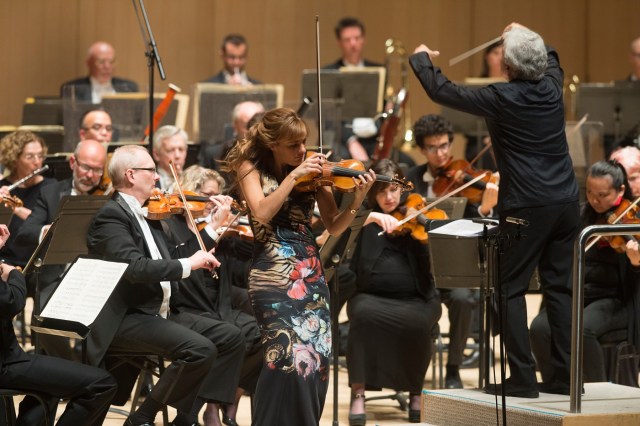
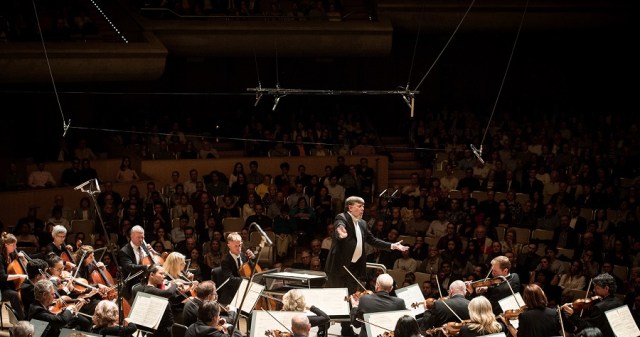
At the risk of saying something really obvious: there’s a great deal of music going on in Toronto, and all around the city too.  I ventured just north of the city to one of several community venues, the charming 527 seat Flato Theatre in Markham to hear a concert by Kindred Spirits Orchestra.  As I’ve observed previously on visits to Barrie & Richmond Hill, the epithet “if you build it they will come” was never truer than when applied to culture.  I watched a concert of Wagner, Schumann & Shostakovich played to a packed audience, responding to the soloists as though they were rock-stars.

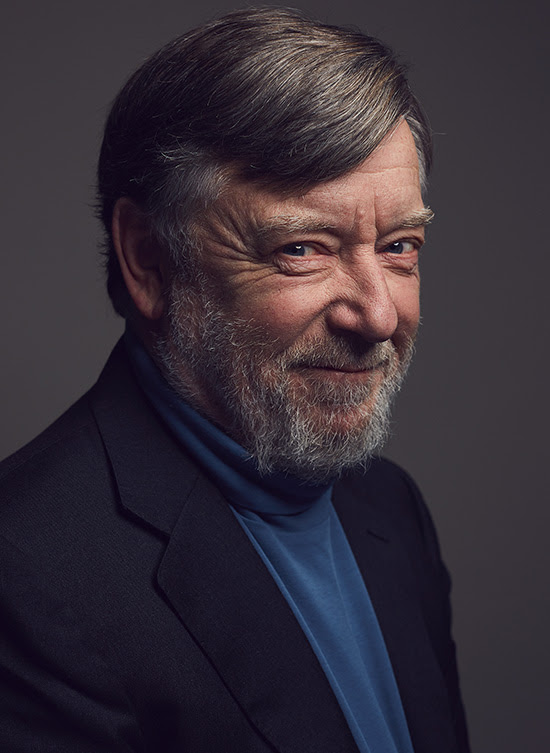
kristian_alexander_portait

Kristian Alexander,founding Music Director and Principal Conductor of the Kindred Spirits Orchestra

Okay nobody screamed or threw items of intimate apparel up onstage.  But a smaller venue such as this one is a wonderful asset, creating a genuine buzz in the lobby –when the audience meets the artists—or in the enhanced acoustic potential of a smaller space to thrill the listener at the most basic visceral level.  We’ve seen the same thing from the small new opera companies in Toronto over the past five years, who generate much more excitement packing a smaller space, less concerned with the number of actual tickets sold. In the end excitement and intimacy are difficult to generate in those larger spaces whose only advantage is the prospect of making money.

As a downtown denizen I have to admit, the physics actually flatters the hinterland and should raise some questions about what we’re getting in those bigger spaces.  If you do the math (which is the key to physics after all):

  • Roy Thomson Hall seats over 2600
  • Massey Hall over 2700
  • the COC’s home at the Four Seasons Centre seats around 2000
  • Koerner Hall 1350
  • Richmond Hill Centre seats 631
  • Markham’s Flato Theatre seats 527.

The spaces are not shaped the same, but just as a concept, imagine that when you’re hearing a big loud Shostakovich Symphony played by the TSO at RTH, you’re sharing the loudest sound with another 2600+ patrons –or at least the space for those seats & possibly bodies too—whereas the same concert played in Koerner Hall will seem louder because you’re now sharing that sound with half the bodies / people, the same orchestral energy energizing a much smaller space, far fewer cubic yards of air being excited.  No, I don’t think the TSO could actually fit the huge Shostakovich orchestra onto the Koerner stage and it might not sound enjoyable. And if you’ve heard them play Mozart @ Koerner and also @ RTH you had a chance to make the comparison more precisely.

But please follow along with me.

mercer

Cellist Rachel Mercer (photo: David Leyes)

I listened to Rachel Mercer play the Schumann cello concerto with a chamber orchestra accompanying, in a 527 seat theatre.  Mercer’s cello sounded almost as though it were amplified, its tone filling the space. I’ve never heard such exquisite sound, and almost wish there were some way that Mercer herself could hear what this is like in the space, although I suspect it sounds pretty amazing from the stage as well.  Imagine that all the orchestral energy that is usually shared by 2600 people at RTH was instead there for a mere 527.  No, the Kindred Spirits Orchestra is not the TSO.  But I think this might explain one of the great recent mysteries in Toronto, that in some circles the Canadian Opera Company orchestra is perceived as better than the Toronto Symphony: because a great orchestra can’t sound as good in a big hall, as a good orchestra playing in a great hall with perfect acoustics.  It’s been an eye-opener hearing the TSO in Koerner, where you discover oh my God they are amazing, but: can’t always discern that brilliance in the big hall.

I was attracted by one item on the program, the chance to hear my colleague Margarete von Vaight sing the liebestod with an orchestra.  I’d heard her sing this already in a practice room at the RCM, where I played it, and by the way, now imagine how it sounds when a voice that can sail easily almost drowning out a full-size orchestra, sounds when you’re alone in the practice room.  I am the O between two colossal Ws, if you catch my meaning, the jaw-dropping “o” you see when someone has their mouth open in shock.   Even so, what one can do in practice isn’t necessarily what one gets in performance, when the adrenaline or Murphy’s Law conspires against you. That’s why live performance is so exciting, why i had to be there to hear it in person.

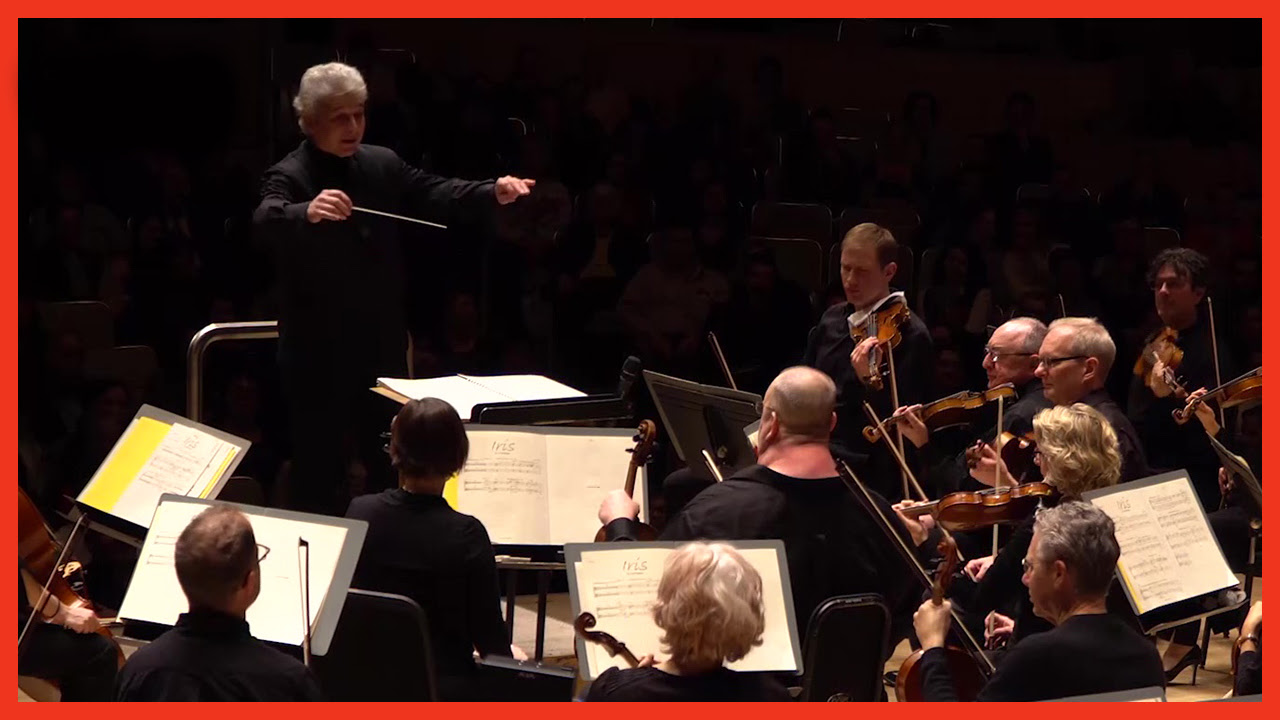
Kristian Alexander is the conductor of Kindred Spirits Orchestra, an ensemble I’d never heard before last night.  They’re an interesting mix of professionals and perhaps 20 young players being mentored.  Alexander has a sure hand, a very clear baton technique who cuts a charismatic figure reminding me of Thomas Haden Church (star of Sideways) in a tux.  Aleander & KSO began with the Prelude, before seguing into the Liebestod, an expansive reading.  While I don’t think this is a full-size Wagner orchestra (perhaps 75 players, not 100-120), the sound in this intimate space was quite powerful.  It’s not just a matter of volume, but rather that you hear nuances to every instrument. The bite of the rosin into the strings, the crackling  aspiration as notes begin on reeds or the momentary swell of the sound in the brass, become part of the blur in a big hall, lost the same way facial details are impossible to discern from afar.  And the big voice doesn’t just sail over the big orchestral sound, but also has shading and delicacy in softer passages.  Von Vaight gave us a strategic sing, singing much of the piece very softly (as it’s written) rather than just blasting her way through as some will do.  Having heard her talk to me about how this is to be sung I knew that the entire piece was planned, to build throughout to a climax resembling physical release, entirely appropriate for an opera celebrating love.  I was reminded of Sondra Radvanovky and Jon Vickers, two singers I’ve observed making clever use of soft notes that project, to catch a moment of rest in a difficult score before pouring everything into the climactic phrases.

Next came the Schumann Concerto.  Playing from the front of that stage I swear I’ve never heard such a big cello sound as what we hear from Mercer, executed with great accuracy.  When the concerto called for dialogue –a series of brief back and forth phrases between soloist and orchestra –the strings of the KSO were wonderfully precise, answering the luscious sounds of Mercer’s cello.  While I don’t know if this was a typical concert the response was an extraordinary ovation, as we’d already seen for the Wagner.  The fact that the worst seat in the house always has a kind of direct relationship with the players onstage might be the key.  I could see them, they could see me.  You don’t make such a direct connection in a big hall.

After an intermission including brief interviews of the soloists by associate conductor Michael Berec, we were on to the most ambitious item (both for the orchestra and as a challenge to this audience), Shostakovich’s 10th Symphony.  Alexander turned them loose.  Where the Wagner and Schumann had been exercises in careful control – respectfully controlling the volume of the orchestra and watching their tempi while seeking to follow soloists—the big romantic symphony was an entirely different animal.  For the strings –who begin the work soulfully—it was mostly a matter of staying together, laying big swaths of sound into the little hall.  The baton is passed gradually in the last three movements as almost all the winds take turns at being soloists or playing in groups, tasked with offering colour, both emotional and timbral, to an increasingly restless emotional landscape.  Solo clarinet, flute, piccolo, bassoon, contra-bassoon, snare-drum, horns (Engliish & French)? You name it, they played it and wonderfully well I might add.

I have to close with two very different thoughts suggesting that our downtown chauvinism may be every bit as misplaced as the superiority I used to rail against from New Yorkers, recalling someone calling us and our talent “provincial” (happy to tell anyone details in private email).

First, this cute little theatre managed to project surtitles on the back wall during the Liebestod.  Isn’t it time that Roy Thomson Hall offered the same courtesy?  I just saw Tafelmusik orchestra & choir at Jeanne Lamon Hall, where I suppose we were being true to tradition (historically informed rustling of programs?) in the absence of text projected on the wall, although in their defense it might be hard to figure out where to project the titles.  Perhaps a screen from the top of the organ pipes?

Second was the rhapsodic audience response.  The soprano’s soft walk in, during the Tristan Prelude was described thusly: “You came on like a F*****  ghost … You were SAVAGE”   That’s from a conversation quoted to me afterwards, so sorry I didn’t hear it in person, although I fear I might have giggled, giving the wrong impression.

KSO’s next concert Aril 14th is titled “Death & Transfiguration”, including , Richard Strauss’s tone poem of the same name, Tchaikovsky’s overture “The Tempest”,  and Rachmaninoff’s piano concerto #3 with Rudin Lengo as soloist.

KSO, with their intermission interviews, surtitles, their intimate venue and ambitious programming? I think they’re on to something.

Posted in Music and musicology, Opera, Personal ruminations & essays | Leave a comment

Remembering Nicolai Gedda

gedda_klein

Tenor Nicolai Gedda

The passing of tenor Nicolai Gedda will elicit testimonials and remembrances of the artist, of the person, of performances & great moments.

I’m just sharing this because I think it’s important to do so, arguably all that we have.  Drama and music are written down on paper, and so we may sometimes lean very heavily on books as authorities, so much so that we badly distort our understanding of the disciplines. It can get a little insane, when some people think the most perfect version is in their head, sitting on a chair reading rather than in a performing venue. Music has been thrown off track by the apparent authority of recordings, which may seem to be live, but distort the reality: in the absence of wrong notes, in the absence of audience coughing, in the artificial stillness. I recall this distortion in a recent film I saw, the curiously ideal film about JS and Anna Magdalena Bach, featuring performances of such perfection as to seem to be inside my head.

61gynx9jmsl-_sy346_pjlook-inside-v2topright10_sh20_

Still available from amazon: because it’s still a valuable resource

Pardon me if this is turning into a diatribe or manifesto. But I remember hearing something that I took to heart back when I was doing my MA in drama at U of T, something counter-intuitive. Professor Lise-Lone Marker relied very heavily on one book, namely A.M. Nagler’s A Source Book in Theatrical History. I took this course a long time ago, but the book’s still available, still a landmark of sorts. The heart of this book is a series of testimonials, reporting things people saw. We can write all the books of theory that we want, but the subjective response to a live performance is very valuable, sometimes the only authority we have. And so I will report a bit of what I heard.

Nicolai Gedda might be the greatest tenor ever, and alas he died recently. His death was reported this week, although it happened roughly a month ago, January 8th 2017. Coincidentally, Leontyne Price, possessed of one of the great soprano voices of all time, just had her 90th birthday. I was fortunate to hear both live (although my recollections of Price –at a solo concert—are a jumble, with spirituals as encores at the end… I was sitting close, staring up in awe)

And I’m highly skeptical about what I really heard with Gedda, as it was long ago. Memory sometimes plays tricks on us.  It was 1970, and my older brother did something very generous, taking me along on a trip to NY to hear the Metropolitan Opera, when I was 14 and he was perhaps 20. We went to operas Tuesday (Die Walküre including Rita Hunter in her Met debut as Brunnhilde, Jess Thomas, and Hans Sotin), Wednesday (Faust with Enrico di Giuseppe, Adriana Maliponte and Cesare Siepi as Mephisopheles, plus Edward Villela and the ABT in extensive ballet in the Walpurgisnacht scene), Thursday (Otello, the prize of the trip: Vickers, Quilico, Zylis-Gara and a young James Levine, including handshakes backstage with Vickers & Levine.) and Friday (Siegfried with an amazing sounding Helge Brilioth, Ursula Shrãder and Thomas Stewart).

My brother was studying with Quilico at the time, so we had lunch with them on one of the days. And there was another bonus, namely the chance to go see the dress rehearsal, yes that famous one, where Nicolai Gedda tried to sing Hermann in Pique Dame (Queen of Spades). Tried? I can still hear that voice in my inner ear, ringing with the words “tre carti, tre carti!!” (that’s how I remember it… as it was in Russian and a long time ago, perhaps I’m not recalling it right). The theatre was pretty empty, so the acoustic wasn’t the way it would be for a regular performance. But wow, the voice rang effortlessly over the orchestra, the sound was powerful, a beautiful stunning sound. But for some reason he chose not to sing the role –and this I only know from reading about it years later. At the time? I assumed he’d sing it opening night, that he’d be brilliant, because he sounded wonderful.

Although in fact I understand why he might have been hesitant. This voice, like the one of my other great favourite, Jussi Björling, is poised on the precipice between lighter repertoire and more dramatic rep. As young singers you heard a greater freedom at the top, a sound more purely in the upper register and not as dark as it would become once the lower register blended in. When you hear their later recordings, they’re both getting darker in their sound, which is intoxicatingly beautiful, precisely because that darker macho sound usually goes with the loss of some of the effortless freedom at the top.

This is a man whose voice could do so much:

  • range, meaning the ability to hit high notes
  • longevity,  in the sense that his career was so long: suggesting that his vocal production was natural and healthy. My touchstone in this category is Robert Merrill, who was still singing the national anthem at Yankee games in his 80s, the voice stll beautiful.
  • beauty of tone, arguably a subjective quality
  • sensitivity to text: and few were as agile in multiple languages as Gedda

I suggest you go to youtube to enjoy what you can while you can. And if you like what you find there buy the recordings.

Posted in Opera, Personal ruminations & essays | Leave a comment

A Bach Tapestry

It’s been a JS Bach sort of week, what with the tiff screening on Wednesday (“Chronicle of Anna Magdalena Bach” coming Friday, March 3 at 6:30 p.m)  and the press release announcing the upcoming Bach Festival, including a reconstruction of a St Mark Passion.

Sometimes we’re more receptive to things, whether it’s food or art or music, depending on what else we’ve been feeling or experiencing. I’m particularly blessed to be coming to tonight’s concert just at this time, a concert titled ”A Bach Tapestry”.

So yes it was all Bach tonight with Tafelmusik Baroque Orchestra and Chamber Choir at Jeanne Lamon Hall, and will be again Saturday & Sunday, Feb 11 -12, as well as Valentine’s Day at the George Weston Recital Hall.

1617-ivars-taurins-portrait-bysianrichards_50

Ivars Taurins (photo: Sian Richards)

We were in the capable hands of Ivars Taurins, not just conducting but actually curating. The word has acquired some cachet of late, in this time of convergence, when the boundaries between disciplines crumble. The program notes were wonderfully suggestive, whetting our appetite for the many varieties of JS Bach we experienced. Bach is an idea, a platonic ideal of music and composition, especially for the human voice singing praise to God. If a concert is understood to be a kind of trial, where the performers advocate for the composer, their performances arguing for the importance of that composer, Taurins & co. succeeded admirably.

Is Bach the greatest composer of all?? A concert like this one certainly seeks to make the case, and it was a persuasive night, via choral singing with a few instrumental appetizers to cleanse the palette.

One of the bizarre challenges Bach poses is in the sheer volume of music, enormous numbers of cantatas written each year of his life. While there are a great number of well-known pieces – two of which put in appearances tonight—there are a great many that aren’t known. And as Taurins says in the programme, it’s not that the unknown pieces are inferior, quite the contrary.

There is a difference, though, when musicians play well-known pieces. There’s a different kind of attention to the familiar, and playing such pieces is different as well. You could sense this when we came to those greatest hits, that were so well received:

  • Chorale “Jesu bleibet meine Freude” from Cantata 147
  • An original arrangement of the Italian Concerto –a solo work for keyboard—as a concerto for two violins, in the manner of Vivaldi.

Another remarkable moment –and for me the highlight of the evening—came in the Chorus “Und wenn die Welt” from Cantata 80, with swirling orchestral convulsions surrounding the simple and direct choral statement of Luther’s reformation hymn “Ein feste Burg ist unser Gott”, as if to illustrate the perils and evils surrounding humankind. I’d never heard this adaptation before, sung so clearly and with marvelous conviction under Taurins’ joyous leadership, but it will now inform every other version (whether the adaptations by Mendelssohn and Ullmann or the original hymn in a church) as I hear them live or in my head. I suspect that for those who are more thoroughly immersed in their Bach than I (a fellow who knows only a few famous pieces),  this too was one of the “greatest hits”; but from now on, me too!

Who’s the greatest of them all? While we may have had a Mozart festival not so long ago, and orchestras will celebrate Beethoven, Bach endures. A full evening of Bach, and I simply want more.  More!

Posted in Music and musicology, Reviews | Leave a comment

BACH IS BACK: 2nd Annual Toronto Bach Festival

2nd Annual Toronto Bach Festival: May 26 – 28, 2017
Toronto (Canada) February 9, 2017…

Artistic Director John Abberger is pleased to announce the 2nd Annual Toronto Bach Festival is taking place May 26, 27 and 28, 2017 in Toronto.

The Festival offers single performances of three unique baroque programs, featuring over 30 renowned baroque and classical artists including Brett Polegato, Christopher Bagan, Daniel Taylor, Alison Melville and Ellen McAteer.

CANTATAS & BRANDENBURGS opens the 2017 Festival on May 26 at 8pm, with a pairing of two remarkable early cantatas and two of Bach’s Brandenburg concertos. Nach dir, Herr, verlanget mich is thought to be the earliest surviving cantata that Bach wrote, and Komm, du süsse Todesstude was written during the composer’s time in Weimar. These magical works are complemented by two joyous concertos: the Brandenburg Concerto No. 6, and the Oboe Concerto in E-flat.

Returning to the Toronto Bach Festival for the second year, soprano Ellen McAteer has been praised for her “sparkling agility” (Toronto Star). Ms. McAteer is joined by alto Rebecca Claborn, renowned for her “mellifluous yet clear” (Music in Victoria) singing, and six period instrumentalists, including Abberger as oboe soloist, and Patrick Jordan and Brandon Chui as viola soloists.

On May 27 at 2:30pm, harpsichordist Christopher Bagan (University of Toronto, Canadian Opera Company and Opera Atelier) presents a dazzling HARPSICHORD RECITAL of early keyboard works. This showcase will explore the programmatic sonata, fashionable in Leipzig in the early 18th century, and pairs Kuhnau’s Jacob’s Wedding with Bach’s Capriccio on the Departure of a Beloved Brother. The performance will also feature Bach’s Six Little Preludes from the year 1717, and the magnificent Chromatic Fantasia and Fugue.

Ellen McAteer returns with vocal soloists including Daniel Taylor, Brett Polegato, Agnes Zsigovics and newcomer Asitha Tennekoon, for a rare performance of ST. MARK PASSION on May 28 at 3:30pm. Only two of Bach’s five passions survived, and this year’s Toronto Bach Festival closes with the presentation of a stunning reconstruction by Simon Heighes. Based on the surviving libretto by Picander, the librettist for the St. Matthew Passion, and fashioned from arias and choruses from Bach’s own works, a vocal ensemble of nine singers together with an intimate instrumental ensemble will present this work as it would have been performed by Bach. This year’s final performance also features the talents of twelve period instrumentalists, including Abberger, Bagan, Julia Wedman, Felix Deak and Matthew Girolami, as well as Alison Melville and Anthea Conway-White (flute), and Joëlle Morton and Marilyn Fung (viola da gamba).

Canadian Daniel Taylor is one of the most sought-after countertenors in the world. Recently moving from Montreal to Toronto, Mr. Taylor is the new Head of Historical Performance in the Faculty of Music at the University of Toronto.

Toronto Bach Festival 2017 performances take place at St. Barnabas-on-the-Danforth, 361 Danforth Avenue, Toronto.

Festival passes and single tickets are available for advance purchase at TorontoBachFestival.com, and may also be purchased at the door before each performance.

Information: (416) 466-8241

LISTING INFORMATION: Toronto Bach Festival presents

CANTATAS AND BRANDENBURGS Directed by John Abberger with Ellen McAteer and Rebecca Claborn. Friday, May 26, 2017 at 8pm Venue: St. Barnabas-on-the-Danforth, 361 Danforth Avenue, Toronto Program: J.S. Bach Cantata, BWV 161 “Komm du süsse Todesstunde” J.S. Bach Cantata, BWV 150 “Nach dir, Herr, verlanget mich” J.S. Bach Brandenburg Concerto No. 6, BWV 1051 J.S. Bach Oboe Concerto in E-flat, BWV 1053a

HARPSICHORD RECITAL Featuring Christopher Bagan Saturday, May 27, 2017 at 2:30pm Venue: St. Barnabas-on-the-Danforth, 361 Danforth Avenue, Toronto Program: J.S. Bach Capriccio on the departure of a beloved brother, BWV 992 Johann Kuhnau Jacob’s Wedding J.S. Bach Six Little Preludes, BMV 933-938 J.S. Bach Chromatic Fantasia and Fugue, BWV 903

ST. MARK PASSION BWV 247 (reconstruction by Simon Heighes) Directed by John Abberger, with Ellen McAteer, Agnes Zsigovics, Daniel Taylor, Asitha Tennekoon, Brett Polegato, Alison Melville, Anthea Conway-White, John Abberger, Marco Cera, Joëlle Morton, Marilyn Fung, Julia Wedman, Emily Eng, Matt Antal, Felix Deak, Matthew Girolami, and Christopher Bagan. Sunday, May 28, 2017 at 3:30pm Venue: St. Barnabas-on-the-Danforth, 361 Danforth Avenue, Toronto 2017

Individual Ticket Pricing: Regular: $30 Senior (65+): $25 Student: $15 3-concert Festival Passes: Regular: $80 Senior (65+): $70 Student: $40 Box Office: Advance Regular and Senior tickets and passes http://www.TorontoBachFestival.com Ticket and passes, including student tickets and passes may also be purchased at the door Information: (416) 466-8241

ABOUT ARTISTIC DIRECTOR JOHN ABBERGER One of North America’s leading performers on historical oboes, John is principal oboist with Tafelmusik Baroque Orchestra and the American Bach Soloists (San Francisco). He has performed extensively in North America, Europe and Asia with these ensembles, and appears regularly with other prominent period-instrument ensembles, including Philharmonia Baroque Orchestra, Washington Bach Consort, Portland Baroque Orchestra, Ensemble Voltaire, Handel and Haydn Society, and Boston Baroque. His recording of the Concerto for Oboe by Alessandro Marcello with Tafelmusik was glowingly reviewed by Gramophone Magazine as “one of the best there is” and “alone worth the price of the disc, even if you have other versions.” In addition to many recordings with Tafelmusik and other period-instrument ensembles, he has produced and recorded two discs of concertos and suites by J.S. Bach. Released on the Analekta label, the recordings have received much critical acclaim, including CD of the Month by the German magazine Toccata/Alte Musik Actuell for the recording of orchestral suites. John serves on the faculty at the University of Toronto, the Glenn Gould Studio at the Royal Conservatory of Music and has taught at the City College of New York. A native of Orlando, Florida, he received his training at the Juilliard School and Louisiana State University. In addition, he holds a Performers Certificate in Early Music from New York University.

~~~~~~~

“Press releases and announcements” are presented verbatim without comment.

Posted in Personal ruminations & essays | 1 Comment

Chronicle of Anna Magdalena Bach: Straub & Huillet @ tiff

Chronik der Anna Magdalena Bach is the original title of the 1967 film by Danièle Huillet & Jean-Marie Straub, that I just saw on a new 35 mm print, courtesy of TIFF / Bell Lightbox, in anticipation of an upcoming retrospective of Straub & Huillet.


chronicle_of_anna_magdalena_bach__dirigeant_

Gustav Leonhardt conducts players of Concentus Musicus, Wien and (I think) a young Bernd Weikl (photo: Barbara Ulrich)

Here’s the context, as described on TIFF’s website:

“Straub-Huillet made their first masterpiece with this account of the last decades of the great composer’s life, featuring glorious, direct-recorded performances of Bach’s music on period instruments.

A cinephile’s dream: a new 35mm print of a classic of modernist cinema, unscreened in Toronto for a decade. Chronicle of Anna Magdalena Bach stars the late virtuoso harpsichordist Gustav Leonhardt as Johann Sebastian Bach and Christiane Lang as his second wife Anna Magdalena, whose journal serves as the film’s narration. An account of the difficult last 27 years of the composer’s life, Chronicle places as much emphasis on economic and social factors as on character and incident, but cedes all to Bach’s music — lots of it, gloriously performed on original instruments and recorded with direct sound to ensure purity and authenticity of reproduction. (Paradoxically, Straub and Huillet insisted on period-specific performance not only for the sake of authenticity, but because at the time it was rare enough to be “new” and radical.) Chronicle achieves grandeur through the interplay of visual design and camera placement, the counterpoint of music and editing, of music and narration, the use of silence and interpolated images of nature, and the many performances of Bach’s music. “One of the most beautiful achievements in film history” (Martin Walsh).”

Straub & Huillet are the film-makers, but perhaps I could just as easily say “chroniclers.” Their 93 minute film reminds me of several paradigms, none of which is quite perfect to describe this unique bit of cinema:

  • The words are de facto history, something like Harper’s Index, the indirect testimony of actual events: except that this is coming from the 18th century, the letters and notes of A.M. Bach.
  • I’m reminded of epistolary novels such as Richardson’s Pamela, a form using a series of letters as the occasion to tell a story: except that this is non-fiction
  • The discourse of this film is an extreme (discursive) marriage perhaps a bit like the actual marriage between JS and AM, a film almost entirely comprised of her words and his music: so much so that several times her words are like the recitative setting up the emotional release of his music that follows.

Perhaps I should add: we are traveling in time. The film purports to take us back to the last quarter century of JS’s life, up to his death in 1750. In the black and white of this gorgeous new print, though what are we really seeing and hearing? The performances may be on the leading edge of performance practice for their time, but are antique compared to what we’re accustomed to hearing in 2017. Yes we do have Gustav Leonhardt and Christiane Lang as JS & AM Bach, complete with performances at the keyboard. Nikolaus Harnoncourt (the great conductor & scholar who passed away less than a year ago) also puts in an appearance –playing a prince—alongside his Concentus Musicus Wien, the band seen and heard playing throughout the film. Baritone Bernd Weikl, who may be familiar for singing Wagner (for instance in the Ring cycle from the era of James Levine in the 1990s), is one of the singers, everyone decked out in baroque-era wigs.

Perhaps the best evidence that Straub & Huillet were on to something is found in a 1969 NY Times review curtly dismissing the film.

“While this “Chronicle,” which had a single showing at last year’s New York Film Festival, is a testament to his ever-living music, it is, unfortunately, lifeless as biography.”
So says A. H. WEILER in April 7, 1969

Watching it today I’m inclined to think of it as a masterpiece, a work of art pregnant with meanings that don’t reveal themselves in a first viewing.

One of the problems a 1967 viewer might face is the departure from the recognizable genre. This is not how Hollywood would approach a great composer, and thank goodness. We meet someone who is struggling, who isn’t appreciated, who has children that die. AM reports –in passing—on the deaths of at least five of them, while telling us of other challenges faced by JS. And the whole time he keeps creating. This is a very different JS Bach, and dare I say it: the real JS Bach

Alongside the de facto text we have perhaps the most important testimony of all, namely
the de facto creations of JS Bach himself, including

  • The piano concerto
  • His Anna Magdalena notebook, seen from a new angle: as we watch AM herself play it at home while supervising one of their many children
  • The St Matthew Passion
  • Goldberg Variations
  • The Italian Concerto
  • The Well-tempered Klavier
  • And other assorted compositions for keyboard, both organ & harpsichord (nowadays often played on the piano)

A positivist might complain “but we don’t find out enough about the life of JS Bach”, which is more or less what that dismissive reviewer says. But of course he mistakes this film for a mere biography, missing the point completely.  Tonight I was pondering how JS Bach lives on. I had him on my piano yesterday, and again today, and the film inspired a very different sensation after this film than before. When I hear his music from Tafelmusik this Friday (including at least one of the pieces named above), the images of the film will haunt me.  We have the platonic ideal of the composer whom we know in our heads and fingers and throats, the one who we sing & play (as we have a “Shakespeare” as well),  brought to life as never before in this film.

There are several intriguing layers to the film that I look forward to probing further next time I see it.

*******

Chronicle of Anna Magdalena Bach screens on Friday, March 3 at 6:30 p.m. as part of TIFF Cinematheque’s Not Reconciled: The Films of Jean Marie Straub and Danièle Huillet, running from March 3 to April 2. Curated by James Quandt, Senior Programmer, TIFF Cinematheque, this first ever Toronto retrospective assembles dozens of their features and short films, many of them to be seen in the city for the first time.

Posted in Cinema, video & DVDs, Music and musicology, Personal ruminations & essays, Press Releases and Announcements | 5 Comments

Ambitious Kindred Spirits Orchestra

I’m going to my first Kindred Spirits Orchestra concert February 11th , intrigued by their ambitious programs but also because I’ve had a bit of a preview from one of the participants.

In previous months they’ve done difficult works such as Tchaikovsky’s Piano Concerto, Brahms’ epic violin concerto, or Berlioz’s Harold in Italy (possibly my single favourite piece of music: except I missed it..!).  While I don’t know how well they play these pieces, the fact they’re trying them at all is a big deal. These are colossal works that can’t be done in a self-effacing way, but only with big bold sounds.

And this coming week it won’t get any easier:

  • Wagner, Tristan and Isolde: Prelude and Liebestod
  • Schumann, Concerto for cello and orchestra, Op. 129
  • Shostakovich, Symphony No. 10 in E minor, Op. 93

My preview was of the Liebestod, in a practice room with soprano Margarete von Vaight. I played through the piano part a few times the week before, totally stoked for what would be my first chance to play this with a real live soprano.  And it was startling, the sound so full and gorgeous it was hard to keep playing, when i wanted to just bask in the sound.

While it will be a different experience with orchestra, I am convinced that hers is a genuine Wagnerian voice, able to handle the challenges of this difficult repertoire.  We heard her sing most of the role of Ariadne –the two big opening arias for example—at Hart House about fourteen months ago, and it seemed effortless.

The  concert also includes Rachel Mercer playing the Schumann cello concerto and the 10th Symphony of Shostakovich, all conducted by Kristian Alexander.  It’s likely to be an epic evening at Markham Theatre.

16559359_138545166658193_1421073675_n

Posted in Press Releases and Announcements | Leave a comment

Chester Brown’s Louis Riel

Last week a fun outing with a child to a bookstore led to a windfall.  I hadn’t expected to find a book for myself but as I browsed through graphic novels I saw a title that grabbed me. “Louis Riel” it said.

louis-01

Louis Riel is Chester Brown’s graphic novel that first appeared in 2003 in hard-cover, released in paperback in 2006, and reprinted many times since.  I’m no graphic novel junkie, even if I do remember Maus both in its initial incarnation and via the AGO as fine art in an Art Spiegelman retrospective just over two years ago.

I find that Louis Riel reminds me of Maus in several ways.

We’re in the presence of an important story and vital issues.  With Maus it’s multi-generational anti-semitism and the Holocaust.  For Riel we’re looking at the history of Canada, sifting for truth amid so many lies, especially surrounding aboriginals and Metis, while telling the story of an important and iconic figure.

At one time the style would have been off-putting. The thought that serious stories could be told through something resembling a children’s comic book was at one time thought of as subversive and revolutionary.  But when history has failed, when culture breaks down, such objections lose any meaning.  High culture can be implicated in these struggles.  I can’t forget that the Wagner who wrote the powerful opera Götterdämmerung that still resonates in my head from Thursday night was Hitler’s favourite.  Opera has often been recruited to legitimize a regime and/or its policies.  The 17th century French court composers were elevated by their King in exchange for proclaiming his divinity in staged allegorical tableaus.  Last night in Toronto Consort’s meticulous First Encounters we were spared any of those pompous sounds, hearing something resembling popular music instead.  The inter-marriage of those cultures –especially the French voyageurs & the native women they impregnated—leads to a place not unlike where we end up at the beginning of the story of Louis Riel, another tale that had utopian possibilities –in the founding of a new province and the quest for responsible government for the inhabitants– that lead to something tragic at least for the protagonist, if not for an entire people.

Last night we only had a hint of what was to follow, namely broken promises and disrespect.  John A Macdonald is very much the same in the book as what we get in Harry Somers’ operatic treatment of the same material.  Brown draws Macdonald with a comically enlarged nose perhaps from his love of drink.  In Mavor Moore’s libretto, Macdonald gets many of the funniest lines of the opera, a witty politician who is not quite as dark as what Brown creates: but perhaps those are two sides of the same cryptic coin.

As we’re in the realm of myth the ideas and the features of this, one of our founding fathers, tend to be larger than life.

I don’t think I was clear in explaining what I meant by “utopian”. The depiction of harmony between the races & cultures last night seized a magical instant that was to be lost.  I’m reminded of Warrack’s Abraham that similarly probes the founding patriarch of three religions in a time before they diverged.  In both cases there’s the hint of the prelapsarian harmony, an Eden that was lost.

But in Brown’s novel you can see it coming, possibly because we know the story so well, that the natives and Métis go in with good faith only to be cheated by the Macdonalds and their henchmen.  I would recommend Brown’s graphic novel to anyone expecting to see the opera Louis Riel this spring either in Toronto or Ottawa. While the treatment of the story isn’t precisely the same, there are lots of similarities.  Yet the media –graphic novel vs   opera –must diverge because one is internal and can be sampled, while the other is performed in three languages.

Soon I’ll be going to see Kent Monkman’s show at the University College Art Centre, steeling myself for some heart-breaking images.  In a time when the media are full of the atrocities & lies of the great & powerful, one can hide in a world of kitties and puppies and cuteness for only so long.

Posted in Politics, Reviews | Leave a comment

Toronto Consort’s Utopian Kanatha/Canada: First Encounters

I totally loved what I saw tonight from Toronto Chamber Choir in collaboration with the Toronto Consort led by their artistic director David Fallis, so much so that I’m taking a moment to double-check. I’m writing about something very complex, likely to omit something, in the small account I offer.

canoe

As I’ve said more than a few times, I especially admire and appreciate ambition in the arts. I was excited by Götterdämmerung last night, a massive work, very difficult to stage because the people who can sing it are rare, and expensive too because of its scale & scope.

I’m even more impressed if I think I see that ambition applied towards something activist or transformational. Lately I am finding politics in unexpected places, seeing activism in simple things like concert programming, possibly because everyone I know including my mom, keep talking about a certain newly elected person whose ubiquity seems to hijack all conversation. I don’t doubt that my taste & preferences are all distorted.

Kanatha/Canada: First Encounters is the title of the program presented tonight and to be repeated tomorrow at the Jeanne Lamon Hall at the Trinity St Paul’s Centre. There are two parts to the program, both of which were quite remarkable. The second half might be understood as the raison d’être for the concert, being a work commissioned a few years ago, namely John Beckwith’s Wendake/Huronia. First performed in Midland, Meaford & Parry Sound in the summer of 2015, here’s the first paragraph from Beckwith’s program note:

“Late in 2013, John French, founder and artistic director of the Brookside Music Association in Midland, conceived the idea of commissioning a special work to commemorate the 400th anniversary of Samuel de Champlain’s voyage to the region of Huronia (known as Wendake to the natives), the first encounter of First Nations people with European explorers in what is now Ontario. The commission was supported by the Ontario Arts Council and I was asked to take it on. I decided to compile a text from various sources, aiming for a sort of chronological summary of the Wendat experience, before and after Champlain. It is mostly in French, with a few insertions in Wendat. The result is a “choral documentary” for choir, alto soloist, narrator, and an early-instrument ensemble including First Nations drums.“

The result is also a surprisingly political piece of art. The de facto texts make it genuinely like a documentary even as the music takes us into something more celebratory and even spiritual.

The evening for the 2017 presentation by Toronto Consort, however, framed the Beckwith work with an opening half curated to offer a proper context, and by that I mean to avoid any sense of exploitation or cultural appropriation, and instead to honour all the peoples represented: a tall order indeed. Can one experience the first encounter without preamble or prejudice? The ongoing drama surrounding the Dakota Access Pipeline is a factor. And then there’s the plethora of memes in social media with classic images of aboriginals, spouting ironic lines such as “Immigrants threatening your way of life? That must be tough” or “Let me get this straight, you’re afraid of refugees coming to America, killing you and taking your property?” So for better or worse, the first encounter narratives –real, bogus, or satirical—are close to the surface of our consciousness.

I think there’s a hunger for something redemptive, a utopian dream that might be best understood by going back in time to avoid the unfolding of history. What if we could go back and avoid what happened? And so the concert takes us back to a special time, offering  a vision of a peace conference from back around 1700, when the atrocities hadn’t happened yet, when it was possible to imagine a dignified coexistence between Europeans and Indigenous peoples.  Where the first half of the concert gives us something stunningly beautiful in its vision of peaceful co-existence, Beckwith’s six-movement piece does take us into the lamentation for the European takeover. It’s a tiny hint, not proportionate to the massive tragedy / holocaust that is to come. But at least it was created in collaboration with George Sioui, a scholar of Wendat descent, who grants a legitimacy to the project.
The first half reminded me a bit of a folk music concert from the 1960s, in its idealism, and perhaps also because the music did at times echo that gentle directness.

The Toronto Consort were joined by:

  • Sioui –not just a contributor to the second half, but a performer in the first half, speaking as a narrator and singing
  • Jeremy Dutcher, a young vocal artist on the boundary between aboriginal and European in his creative idiom. He builds on old aboriginal recordings from roughly a hundred years ago, a bit like a 21st century Bela Bartok in his anthropological cataloguing, but taking us instead towards something at times resembling blues or new age pattern music.
  • Marilyn George & Shirley Hay, singing & drumming

I’m going to listen to more of Dutcher’s music, an intriguing mix of styles.

I can’t help thinking that Fallis and the Toronto Consort may have been influenced by the highly original programming of Alison MacKay, in seeking to go beyond authentic instruments & performance practices, to capture the cultural context surrounding the music in concerts with Tafelmusik such as “House of Dreams”.

Don’t let my failure to unpack its complexities stop you.  This wonderfully rich & rewarding concert, Kanatha/Canada: First Encounters is repeated Saturday February 4th, including a  pre-concert discussion with panelists David Fallis, Georges Sioui, and John Beckwith at 7 pm, an hour before the 8 pm concert.screen-shot-2017-01-31-at-1-41-17-pm-300x109

Posted in Music and musicology, Reviews | 3 Comments

Götterdämmerung

When I did my year-end review of the highlights of 2016, I cited the Canadian Opera Company’s production of Wagner’s Siegfried in January. Here we are beginning 2017 and once again I’ve experienced something that will be hard to beat. Once again it’s the COC doing a Wagner opera, again starring Christine Goerke, brilliantly conducted by Johannes Debus leading soloists, COC Orchestra & chorus.

It’s a long evening, this Götterdämmerung, and come to think of it that’s the short form of the name. It should be “Die Götterdämmerung”, or The Twilight of the Gods. I was at the opening night of the Canadian Opera Company production of this epic work, the prototype for so much of our popular culture, from Lord of the Rings to Game of Thrones, many video games & fantasy novels: and so much else. Tim Albery’s production, with set & costume design by Michael Levine, brings us into a very modern world rather than the heroic setting that’s all too familiar.

The Ring Cycle is a trilogy with a prologue evening (although some call it a tetralogy), recapitulated in this, the final opera, three acts with a prologue. The evening is five hours, when you include two hefty intermissions, but they’re necessary. I noticed a couple sitting near me who left between the second and third act, who missed the best part. Act I can be the hardest because much of it is exposition, setting up the fireworks of Acts II and especially III. I’m not sure if I can be objective when I love so much of this opera. But I’d have to say that if you’re an opera lover who has hesitated with Wagner –because it’s long, because it’s so intense and well Wagnerian—this would be a really good place to start.
Some productions have so much overlaid complexity (director’s theatre) that you lose much of the story, a huge problem for a first time viewer. Not this time. Albery has modernized things, but otherwise the story is mostly clear. No there’s no horse ridden into the fire, but we even have a pair of ravens, and they even catch up to that pesky Forest Bird. And if that makes no sense, ask one of your opera nerd friends to explain.

Loudest applause went to the musical side. Debus moved things along at a brisk pace, which seemed to help the singers, but at times he’s very flexible, as in Siegfried’s story-telling scene near the end, where we slow right down. The orchestral set-pieces were for me the highlights of the evening, especially the Rhine Journey, the Funeral March and the last minutes of the opera. In each case Debus urges his ensemble to take the stage, and they made the most of these beautiful moments, the real stars of the night. There’s a sunrise depicted in each act, each stunningly played but especially the final one.

The scene between Siegfried (Andreas Schager) and the Rhine Maidens: Woglinde (Danika Loren), Wellgunde (Lauren Eberwein) and Flosshilde (Lindsay Ammann) is some of the most difficult and chromatic music of the entire cycle, yet I think it was close to perfect.

16-17-04-MC-D-1488

Andreas Schager as Siegfried (left) with the Rhinemaidens (l-r: Lauren Eberwein as Wellgunde, Lindsay Ammann as Flosshilde and Danika Lorèn as Woglinde) in the Canadian Opera Company’s production of Götterdämmerung, 2017, photo: Michael Cooper

The Rhine Maidens were given two costume choices, reflecting the two sides of their character that we see in this scene:

  • All in black, like the wise norns, who predict the future
  • All in white, as the temptresses who lure men (as in the photo)

When the music for the Rhine Maidens echoes the norns’ music – in preaching about what Siegfried must do, and the consequences for the future—they take on this serious wise-woman aspect.  I’m overwhelmed with gratitude that one of my favourite scenes in all opera was given such a stunning interpretation.  I’ll be hearing their music as i drop off to sleep tonight.

There were plenty of other highlights. In almost every Götterdämmerung I’ve ever seen, the Hagen steals the show, just as Othello/Otello is often stolen by the Jago/Iago. While Ain Anger gave us a powerfully voiced portrayal, the cast was strong top to bottom, particularly on the male side.  The testosterone quotient was high in Act II, climaxing in Anger’s call to the Vassals, a male chorus bristling with spears and a high C.  Wagner had avoided chorus in the Ring cycle until this moment, some of the most challenging –and thrilling– choral writing in any opera, and the men of the COC Chorus answered the call.  And for the few minutes of his role to begin Act II, I couldn’t take my eyes off of Robert Pomakov as Alberich, Hagen’s father. Is this a dream? The scene was indeed spell-binding in its intensity.

I mentioned Schager, who improved as the show went on, tossing off a big loud high C in the last act before his final scene. His was a very sympathetic, fresh-faced reading of the role. Martin Gantner as his blood-brother Gunther was deliciously conflicted, especially as the plot to bring down Siegfried unfolds in the last act.

Christine Goerke is at the centre of this opera, as Brunnhilde, a very long & difficult role. In her climactic immolation scene –done without benefit of fire or horse or logs or anything resembling immolation—her singing was gorgeous, powerful and built to a wonderful climax at the end. The most intense scene of Act I –not usually my favourite but clearly the emotional centre tonight—was the confrontation between Brunnhilde and her sister Waltraute (Karen Cargill). Brunnhilde is usually triumphant as she rejects her sister’s appeals for help, clinging to her ring as proof of Siegfried’s love, but Goerke did something different. She’s wonderfully conflicted, showing us both the sense of joy in her relationship, yet sharing her sister’s anguish, devastated at what she discovers, which is something we don’t usually see. Similarly, in the Act II trio, where Brunnhilde tells Hagen the best way to kill Siegfried (sneak up behind him because he doesn’t usually turn his back on anyone in a fight), we see her horror, rather than just a desire of revenge. It’s a nuanced three dimensional portrait that’s always interesting to watch.

I’ll be seeing this production at least once more, although after seeing tonight’s I wonder if that’s enough.

Posted in Music and musicology, Opera, Reviews | 1 Comment

Questions for Eric Weimer: coaching Götterdämmerung for COC

A veteran of over 30 years at Lyric Opera of Chicago, Eric Weimer has coached over 100 Lyric productions, as well as an additional 100 productions in other international houses, including the Metropolitan Opera and the Bayreuth Festival. Renowned particularly for his expertise in German opera, he has prepared no less than 13 different productions of Wagner’s epic Ring cycle. Active also as recitalist and conductor, he has worked with most of the leading singers and conductors of the past generation.

When I looked on youtube i found the following video from the past summer, a lovely demonstration of his sensitivity.

If you look on his website,  you’ll see that he was just in Toronto until today, January 29th between a pair of engagements with Lyric Opera of Chicago.

  • September–November, Lyric Opera of Chicago Cover conductor, Das Rheingold and Les Troyens
  • December 27–January 29, Canadian Opera Company Head of Music Preparation, Die Goetterdaemmerung
  • February–March, Lyric Opera of Chicago Eugene Onegin

Although Eric leaves town today to return to Chicago to prepare Eugene Onegin for LOC, in the meantime the Canadian Opera Company are about to open Die Götterdämmerung on Thursday February 2nd.  In anticipation of that opening I interviewed Eric.

resized_teresatamstudio_130604_0017-edit_print

Eric Weimer: pianist, conductor, opera coach (photo: Theresa Tam)

1-What is the best thing or worst thing about what you do?

The best thing about my job is easy to convey: I get to work with the very best singers and conductors in the world to prepare some of the greatest music ever written: operas by Mozart, Berlioz, Wagner, Verdi, Strauss, and company. Over the past 27 years, I’ve gotten to prepare some 14 or 15 cycles of Wagner’s epic Der Ring des Nibelungen. How great is that? The worst things pale in comparison and would seem to be mere trivialities or minor annoyances: having to work some evenings and most weekends, an occasional staging rehearsal in which I might not be playing very much or could be playing the same passage over and over again. (But if that’s the worst, then I shouldn’t be complaining!)

2-Who do you like to listen to or watch?

What I listen to: here it comes, I’m a Bach cantata freak, with some 150 cantatas stored on my iPhone (performances all directed by Ton Koopman or Philippe Herreweghe ). I listen to them while cooking at home in Chicago. Call me old-fashioned, but I’m convinced that those series of weekly cantatas that he composed during his first three years in Leipzig (some 50 a year!) constitute one of those titanic artistic outbursts, like the Sistine Chapel ceiling or the Shakespeare canon. What I watch: not much, PBS mostly. Like so many Americans I have been shocked senseless by many aspects of the past presidential election (particularly the results!), so I retain a morbid fascination with the state of the American economy and political world and consider it my duty to stay as informed as possible.

3-What ability or skill do you wish you had, that you don’t have?

To not make so many mistakes while I type this? Seriously, I admire people who have the ability to write floridly, in a manner that doesn’t just convey information accurately, but expresses the individuality and quirks of the writer. Similarly when I speak German (or Italian) I wish that I could just vent some of my joy or anger and not be so caught up in the intricacies of grammar. (Did I use the imperfect subjunctive incorrectly? Even Germans sometimes make mistakes with their word order.)

4-When you’re just relaxing and not working what is your favourite thing to do?

I love to travel, and I love to plan for the trip, i. e., researching museums, attractions, hotels, restaurants, history, and creating a detailed itinerary that permits us to enjoy each day to the fullest. (A 40-page itinerary is not out of the question!) Currently planning a trip to Barcelona, Valencia, and points in northern Spain.

More about preparing Götterdämmerung for the Canadian Opera Company.

1-How did you begin as a coach?

Having spent most of my late teens and 20s in the towers of academe—BA in history from Haverford College and a PhD in music history from the University of Chicago—I barely knew that such a thing as voice coaching even existed. But one does have to put food on the table, and when a job in musicology failed to materialize (thank god!), my mother suggested that with all my skills as a pianist, experience with foreign languages (German in particular), and familiarity with the opera repertoire , I should hang out my shingle as a voice coach. (While in middle school and high school, I spent countless hours listening to operas and playing through opera scores on the piano —doesn’t everybody?) This was obviously a crackpot idea, so to prove her wrong, I took her up on it. One thing lead to another….numerous private voice students as well as a part-time job as rehearsal pianist for the Chicago Symphony Chorus under the indomitable Margaret Hillis. That was a real challenge: learning to follow an unpredictable beat and contending with some extremely difficult rep (Schoenberg’s Moses und Aron, for example).

But the person who gave me my first “break” into the opera world was John Crosby, founding director of the Santa Fe Opera. I was already 35, a bit long in the tooth for starting a career in major opera houses, but John always conducted a major Richard Strauss opera (sometimes from the “forgotten but not gone” category). I was given the assignment of pianist for Die Aegyptische Helena and I must say, after the drudgery of writing a PhD dissertation which tracked style change in some 635 Italian opera seria arias and the first 50 symphonies of Haydn, the discipline required to master at the keyboard a lengthy 350-page reduction of a late Richard Strauss score was a pure delight! Assignments at other houses—Lyric Opera of Chicago (my professional home for the past 30 years), the Canadian Opera, San Francisco Opera, the Met, and the Bayreuth Festival in Germany followed in quick order.

2-Please talk about what you’re doing for the Canadian Opera Company, in helping to prepare their production of Götterdämmerung.

I think the most basic thing I’m doing in our COC rehearsals for Goetterdaemmerung is functioning as a substitute orchestra in all of our staging rehearsals and music rehearsals. This means playing the piano “reduction” (I put this word in quotes since a version for piano of an opera like Goetterdaemmerung is exceedingly complex and difficult to play) in a manner that accustoms the singers to hearing certain solos or themes that they will need to hone in on when they finally get with the orchestra. I also need to be actively listening: to pitches and rhythms, to their German (when a language gives you 16 different possibilities to say the definite article the, the possibilities for going astray are legion!). But language is critical: it’s not only a matter of correct pronunciation, but also of intent. Does the singer deliver the text in such a way that it is clear that they understand the significance of each and every word?

2resized_teresatamstudio_130604_9997-edit-3

Eric Weimer (photography: Theresa Tam)

3-Please tell us about the singers in your production

What’s particularly exciting is when you have world-class singers performing their role for the first time, and this we have with Christine Goerke (Bruennhilde), Ain Anger (Hagen), Karen Cargill (Waltraute), and Ilenna Monltalbetti (Gutrune). Even the veterans of this production, Andreas Schager (Siegfried) and Martin Gantner (Gunther) haven’t sung their roles so many times in the past; in a real sense, even they are still exploring these roles. So in all cases, we’re talking about a process of discovery, and an openness to interpretative suggestions. When we finally get to the main stage and have the orchestra in the pit, we’re in the eleventh hour, so to speak, and singers can be in a bit of a panic whether they can be heard over the orchestra in certain places. I may have to encourage them to “take a few steps forward” or “don’t sing into the wings” to help them achieve maximum vocal impact. (It’s not easy to project a single human voice over a eighty-piece orchestra with lots of brass!) Maybe there’s a place where I feel that a slight tempo adjustment might improve the singability of a certain phrase, and perhaps I can bring this to the conductor’s attention? I cherish my relationship with all of these people. They seem to trust me, and I’ll do whatever I can to improve their performance.

All of these people have been a joy to work with. Christine Goerke I rarely have to give a note to: she’s incredibly disciplined and self-aware in all she does. Only one errant pitch needed to be brought to her attention (which she promptly fixed). And it has been particularly gratifying to see Ain Anger grow in his portrayal of the titanic figure of Hagen. 

4- In your years of listening to the Ring Cycle live or on recording, which versions / performances stand out in your memory?

Frankly, it’s been a long time since I’ve listened to a recording of the Ring! But I have been involved in some 14 or 15 complete cycles. They’re all different, but my favorites are the ones in which really accomplished singers are tackling these supremely challenging roles for the first time. That would mean the current COC production as well as the most recent San Francisco production of 2011, in which so many of the main roles (Wotan, Siegfried, Bruennhilde, Siegmund) were role debuts for their respective artists.

I’ve prepared the Ring with quite a few conductors–(in chronological order) Runnicles, Mehta, Levine, Andrew Davis, Bradshaw, Debus, did I leave anyone out?–but I just realized that Johannes Debus, whom I also assisted last year with Siegfried, is the first German conductor with whom I worked on this monumental German work. It was about time for that, I’d say! It’s been a real pleasure to hear his insights to matters to text and subtext. And he really knows how to bend the tempo to suit the music and text. Our relationship in fact is much like the special relationship I had with the late Richard Bradshaw, when I assisted on the Ring cycle which opened Toronto’s acoustically thrilling opera house in 2006. With both Richard and Johannes I have felt that I can give advice, sometimes on tempo but particularly on balance. The orchestral forces of the Ring are of course colossal and a certain amount of intervention is called for (adjusting dynamics) to improve the stage-orchestra balance. My relationship with the COC goes back in fact to 1990 (Wozzeck and Otello). I very much cherish this relationship and hope to return again in the not-too-distant future.

06-07-03-MC-D-1138

The Rhinemaidens – Allyson McHardy as Flosshilde, Laura Whalen as Woglinde and Krisztina Szabó as Wellgunde in Götterdämmerung (COC, 2006, photo: Michael Cooper)

5- What is your favourite opera and who is your favourite opera composer?

I have often maintained that the greatest opera of all time was Pelleas et Melisande (except for the times when I award that distinction to Don Giovanni).

*******

Eric Weimer has gone to Chicago to prepare Eugene Onegin for the LOC, but in the meantime, the Canadian Opera Company –who he coached over the past two months–open their production of Die Götterdämmerung on Thursday February 2nd.

Posted in Interviews, Opera | Leave a comment