Goodyear plays Rachmaninov

Now I have a better idea what we missed.

Stewart Goodyear was in the news recently when the Toronto Symphony hired him to replace the scheduled pianist at the last minute: until he withdrew due to online harassment. On social media we heard about a wonderful rehearsal that never came to fruition with an actual performance for an audience, of Rachmaninov’s 2nd Piano Concerto.

click for purchase information

The timing was almost perfect when his new recording was released earlier this year: Goodyear playing the 2nd & 3rd Rachmaninov piano concerti with the Czech National Symphony. I can imagine his frustration, that what seemed like a godsend—and a wonderful opportunity to promote his brand-new CD –should fall through.

Yet they do say that there is no such thing as bad publicity. My CD order from Amazon took a long time, possibly because people have been ordering large numbers of the record. It did eventually turn up, and since then I have been listening to those two concerti a great deal in my car. This is not the first time Stewart Goodyear has left me perplexed. I should explain a bit.

I have given a great deal of thought to questions of virtuosi, especially those who are also composers. Franz Liszt was so much more than a great pianist, likely discovering new approaches to sound & composition while playing, thereby becoming a big but unacknowledged influence upon the music of the 20th century, especially via his son-in-law Richard Wagner.  I find myself listening to all composer-virtuosi differently, wondering where there explorations came from. My list of composers subsumed under that title will likely diverge from that used by more conservative students. I don’t limit myself to Liszt, Mendelssohn and Chopin for example. I’d include Debussy, Prokofieff, Shostakovich and Messiaen. Where would compositional vocabulary be without the discoveries Debussy made as an opera improviser, screwing around with the forbidden parallel harmonies that would work so well for him as to become virtually a trademark? As an improviser and inveterate jammer I find myself intrigued by sounds that seem to originate in a mysterious process that’s not easily amenable to logic. Messiaen is still rattling inside my head from Death & Desire this week via Topher Mokrzewski and Against the Grain.  Rachmaninov has therefore been a natural companion over the past few weeks (as i referenced him for his transcription of Wohin after seeing the preview concert at the RBA), as I examine the forbidden fruit of popular influence, melodic rather than dissonant, and embraced in several popular realms:

  • This is the same Rachmaninov piano concerto that is Tom Ewell’s irresistible tool to seduce Marilyn Monroe in The Seven Year Itch. Or as he puts it: “Good old Rachmaninov. The Second Piano Concerto. Never misses.” That’s the first movement
  • Movement 2? That’s the one that became a big seller in the 1970s. Listen to “All By Myself” by Eric Carmen and see if you recognize the debt to Rachmaninov
    …and then…
  • And the third movement of the concerto was for a time the most famous of all, more than half a century ago: “Full Moon and Empty Arms”.

There are great tunes in the Third Concerto too, but for whatever reason the piece has been left more or less un-plundered.

After the preamble I should get back to Goodyear and his new CD. Classical music is full of performers who, when challenged by a score from Beethoven or Rachmaninov, play the music exactly the way everyone else does. Now of course a musician doing the usual thing? That is not going to confuse anyone, although he or she may put a few people to sleep. But Stewart Goodyear has a habit of being different if not completely unexpected. The only thing that is predictable is that his playing will be unique.

I first encountered Goodyear via his Beethoven Marathon, a fascinating exercise that I understood originally as a kind of athletic feat (playing all 32 of the sonatas in a single day) not realizing how good the performances would be, how good they could be. Imagine performing a one-man version of four or five Shakespeare plays entirely from memory, and you begin to get some idea, except that playing Beethoven on the piano is that much more difficult.  I did not expect that in the process of discovering this talented young virtuoso, that he would replace all the other Beethoven interpreters I admired, to become absolutely #1. There were youtube performances of the first and last movements of the Hammerklavier Sonata, Op 106, the fugue finale played so quickly and adroitly that I had to completely change my understanding of the piece.  By now i have youtubed my readership with Goodyear’s reading of that fugue that i should almost have the url in my head.  There is also a live youtube video that I have shared a couple of times showing Goodyear playing the Appasionata finale faster than anyone I have ever encountered, note perfect on an upright piano.  A full set of all 32 sonatas was released with a remarkable set of accompanying liner notes from the pianist suggesting that his penetrating understanding of the music goes far beyond just playing: which is itself a significant achievement. Goodyear has also recorded the Diabelli variations.

And I read somewhere online that as a kind of sequel to his Beethoven marathon, he has a gig to play all five Beethoven piano concerti in a single mammoth concert in the autumn..! if i can get there i want to hear this.

Listening to Goodyear’s Rachmaninov has me –again—revising my expectations. I am reminded of a comment from U of T music professor Olnick long ago, reflecting on the musicianship of players long ago vs now.  He observed somewhat romantically that when we heard the quick violin runs in the Ride of the Valkyries, Wagner would have expected the ragged scraggly hair of a wild horse, not the pristine perfection we now sometimes encounter from a modern orchestra in a digital recording.  A century of improving musicianship has come between us and how those pieces likely sounded in the 19th century.  These concerti, too, are usually played as a flurry of notes, mostly correct with the occasional fluff, the occasional misplaced note, as though the pianist in collaboration with the orchestra were creating a chiaroscuro in a painting, shading light and dark, cleanness and some dirt too. Usually that is.

But Goodyear is of the 21st Century, playing with such athletic clarity as to bring Rachmaninov into focus in a way I have not heard before. While I wonder if Rachmaninov himself would have played this clearly, it does not really matter. This is an account of the concerti that in some respects gives a new look and feel to the works, the piano clean and effortless, with a kind of Olympian purity, muscular without sounding forced, powerful without being percussive. Accompanied by the Czech National Symphony cconducted by Heiko Mathias Förster, this is a confident account of Rachmaninov, lyrical and passionate.

I understand Goodyear has recorded the Grieg & 1st Tchaikovsky concerti as well, which I will have to check out next.

Posted in Music and musicology, Reviews | 1 Comment

#AtGdeathdesire: more desire than death

If yesterday’s Dora announcement is anything to go by the youthful Against the Grain crew are a force to be reckoned with, as they’re up for several awards. Tonight AtG opened their latest, Death & Desire.

Reading the lists of nominees I can’t help thinking about the whole question of genre & novelty. AtG have a unique approach. Their works tend to be daring adaptations showing works in a different light. Death & Desire for example gives us two works in a startlingly new way. But let’s set that all aside, and talk about what D & D really does. I am less interested in musicological considerations than theatrical ones, the drama we encountered.

When a man and a woman meet & begin courtship, I have to wonder. Do they ever speak the same language? Do they seem to come from the same century, the same planet? Oh sure, when you watch conventional plays everyone speaks the same language. But at a deeper level, what is really happening might be better captured in the bizarre display we saw tonight. While we may sometimes believe we are understood, that our loved ones hear us and fully comprehend what we want, what we feel, what we need, what we desire, this may be an illusion. Watching the back and forth, each one had their WTF moments staring at the other, each had their raptures and their horrors.

AtG presented two song cycles. They may have initially planned them as separate performances on either side of an intermission, but someone got the idea to intermingle songs. I saw the expression “mash-up” used in the press, and also saw the process compared to shuffling cards together. What I saw has a frightening integrity, as each singer sticks almost completely to their expressive world. Stephen Hegedus sings Schubert’s Die Schöne Müllerin, while Krisztina Szabó sings Messiaen’s Harawi. He sings German. She sings French plus Quechua (another language) that’s occasionally scattered through Messiaen’s cycle. And (spoiler alert) she also sings a tiny bit of German too.  They go back and forth with the integrity of dramatic portrayals, which is to say that they both have a broad range of emotions, but each within their respective universe, never fully understanding the other.  He seems to be in a conservative romance, while She is in a much wilder place. Where he is articulating the nuances of love almost from first principles, as though the emotion were brand new and had just been invented (we’re in the 1820s after all), she is singing the rational and irrational, her music and emotions showing the sophistication of a different century.

Mezzo-soprano Krisztina Szabo (photo: Bo Huang)

Mezzo-soprano Krisztina Szabo (photo: Bo Huang)

The combined discourse of the two cycles intermingled in performance has precedents to the dramaturgy of other operatic approaches. The back and forth suggests aria- recitative at times, as one is static and lyrical while the other is urgent & active. At other times I was mindful of the interludes in Debussy’s Pelléas et Mélisande or Berg’s Wozzeck, offering non-verbal reflections upon the sung action. But I use those two examples (aria-recit, and Debussy  & Berg) as analogies only. Unlike either of the illustrations, in this conversation, each takes the stage as though they were the star, and yet in the contrast, each functions as a break or reflective pause, removing us from the discourse of the other, although it’s never clear which one is the main course and which one is the side dish.

As in the recent sampler concert at the RBA, I want to call this new even if it is merely a new way of approaching music we have heard before. But we may underestimate the importance of performance convention in how we hear and see musical texts. Context changes the way we understand a piece. The inventive way that these songs are framed defamiliarizes them, and refreshes them. We are alienated in a sense by the curious juxtaposition, yet the songs are sung with great intensity as though there were a real connection, a real interaction between the two singers.

But then again in a romance people behave as though there were a possibility of a connection, that their hearts won’t be broken.  This fractured conversation might be the most realistic snapshot of love i have ever seen.

Topher Mokrzewski played far upstage on the piano, the two singers framed inside one side of the space inside the Neubacher Schor Gallery as though inside a kind of proscenium arch: although some of the audience were inside that arch, and the performers did step outside the “arch”.

I’m still trying to understand what I saw and heard but I do know that the piano was brilliantly played, the songs exquisitely sung. Joel Ivany & Mokrzewski –following their usual format—made something quite innovative out of pre-existing texts.  There is a great deal to unpack in Death & Desire, so much so that I would wish that they would make a DVD or a television program so that I could watch it again. There’s a lot to decode, and yes, a great deal to enjoy and see again. When the next awards are announced (a year from now) I would assume that this one too will be recognized, but for now you have a chance to see the remaining three performances, June 3, 4 and 5.

Posted in Music and musicology, Opera, Reviews | Tagged , , | Leave a comment

Operatic Doras

Awards are a wonderful way to celebrate excellence.  They serve to promote individuals and their performances, while also raising the profile of an entire industry.  I hope that nothing I say here in any way diminishes the work done by so many artists in so many disciplines.  Today the Toronto Alliance for the Performing Arts (TAPA) announced their nominations for the Dora awards for the current season.

A question posed on Twitter a few days ago has me thinking about the whole conversation around awards. Someone was asking about the boundaries, why some companies and shows would be included or excluded from particular categories. It’s a valid question considering how problematic these related questions are:

  • What’s the difference between a musical and an opera, or between various sorts of theatre, sometimes in distinct categories, sometimes sharing one hybrid classification?
  • Are the awards ultimately limited by who saw what show? This means that the mainstream shows with the big companies have an automatic advantage.
  • What happens when someone is nominated twice? I worry because I wonder: will two performances by Kristina Szabo divide votes –like the Liberal and NDP candidates running in a Canadian election—but lose out to the single performance of Christine Goerke? But in fairness Goerke’s role was so huge, it was equivalent to any two performances from the others.

As a permanent inhabitant of the peanut gallery I confess that I need those big guys–the daily papers– to continue their pontifical existence, so that I can seem to be ‘alternative’.  I am an agnostic though about the categories.   I will offer a few comments and opinions now that the nominations are out.

The whole question of categories is somewhat problematic, a case of six of one, half dozen of the other. For example, when I look at the category “Outstanding New Musical/Opera”, I can imagine the difficulties faced by the nominating team. There are four nominees:

  • Airline Icarus
  • Spoon River
  • #UncleJohn
  • Tapestry Briefs: Booster Shots

But wait a minute.

#UncleJohn is a new English adaptation of Mozart’s Don Giovanni. And Tapestry Briefs isn’t one opera, it’s an anthology of miniatures, actually a bit like Spoon River except there’s a single authorial team, not the gaggle you had with Tapestry. I suppose my conservatism is showing when I think that they could split the award between “new opera” –giving that half to Brian Current & Anton Piatigorsky for Airline Icarus— and “new musical”, with that half going to Albert Schultz and Mike Ross for Spoon River.

I am a bit confused with the thought that Ivany is good enough to be in the category I just named—where I think he has a legitimate shot at winning, depending on how all those classical votes trade off against the legit theatre crowd pulling for Soulpepper—yet he’s nowhere to be found in the “Outstanding Direction” category, where the nominees are:

  • Albert Schultz for Spoon River
  • Atom Egoyan for Die Walküre
  • John Tiffany for Once
  • Robert Carsen for Falstaff
  • Robert Lepage for Bluebeard/Erwartung

Why not Ivany, yet why Lepage for a show as ancient as this one, that first saw the light of day decades ago?   Much as I enjoyed that show, it was not really Lepage directing so much as members of l’Équipe Lepage, and an assistant director with the COC. If he is to be rewarded why not the bold Needles & Opium at CanStage rather than this old show? All three COC candidates are worthy nominees, but how does one compare their work to what Tiffany or Schultz did? And it’s the same with “Outstanding Musical Direction” where one must admit how different they are from one another.  Again i would be happy with any winner, but would have no idea how one decides across such broad categories.

Further down the page, where it’s now called the Opera Division, at least we are supposedly looking at a level playing field. For Outstanding Production instead of four different Canadian Opera productions — Bluebeard/Erwartung, Falstaff, Die Walküre and The Barber of Seville— as challengers to Airline Icarus, was there no room here for Tapestry or Against the Grain? In fairness to TAPA (and the COC), all four COC offerings are splendid, worthy members of this category. And there is another category where perhaps they will acknowledge the young artists, namely “Outstanding Performance – Ensemble”, where Tapestry, Soundstreams and AtG face off against Johannes Debus at his best: Falstaff and Walküre.

There are two more intriguing categories to mention.

Bass-baritone Kyle Ketelsen (photo: Dario Acosta)

Bass-baritone Kyle Ketelsen (photo: Dario Acosta)

“Outstanding Performance Male”? Five outstanding candidates slug it out even though I would have included Kyle Ketelsen from the COC Don Giovanni, the most outstanding performance by a male this year. Of the five actual nominees I think Gerald Finley deserves the nod for his Olympian workload, not just for the size of his artificial gut and makeup every night, but his Italianate approach to Sir John Falstaff. Yet every nominee would be a worthy winner including young Neil Craighead.

And “Outstanding Performance Female”? This one is more problematic for me. There are two obvious winners, either of whom will leave me very contented. I will now say what I refrained from saying while I might hurt ticket sales, namely that Ekaterina Gubanova ran roughshod over the Hungarian text of the role of Judith; if the role is nothing more than a loud high “C” perhaps she has the right to be nominated. Perhaps. Serena Malfi was pleasant as Rosina, although she didn’t sing the role as well as the woman with whom she was double –cast, namely Cecilia Hall.  I’d be comfortable with Christine or Krisztina winning: that is Goerke’s Brünnhilde or either of Szabó’s pair of nominations, one for Erwartung, one for Tapestry Briefs: Booster Shots.  Her Erwartung was one for the ages.

(l-r) Elizabeth DeShong as Suzuki and Kelly Kaduce as Cio-Cio San in the Canadian Opera Company production of Madama Butterfly, 2014. Photo: Michael Cooper

(l-r) Elizabeth DeShong as Suzuki and Kelly Kaduce as Cio-Cio San in the Canadian Opera Company production of Madama Butterfly, 2014. Photo: Michael Cooper

Perhaps i seem to be contradicting myself when I say Kelly Kaduce in Madama Butterfly was the best performance I saw all year.  But if she were nominated she wouldn’t win.

It’s intriguing that the two singers i cite both have the initials “KK”.

The Doras will be awarded three weeks from today on June 22nd at the Harbourfront Centre hosted by Gavin Crawford.

Posted in Dance, theatre & musicals, Music and musicology, Opera, Personal ruminations & essays | 1 Comment

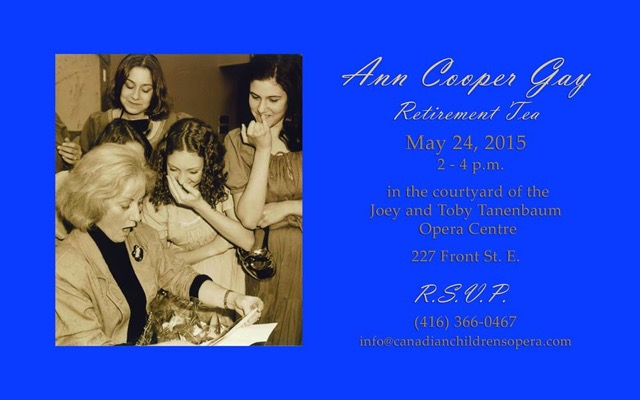
Ann Cooper Gay says goodbye to Canadian Children’s Opera Company

ANN_retirement

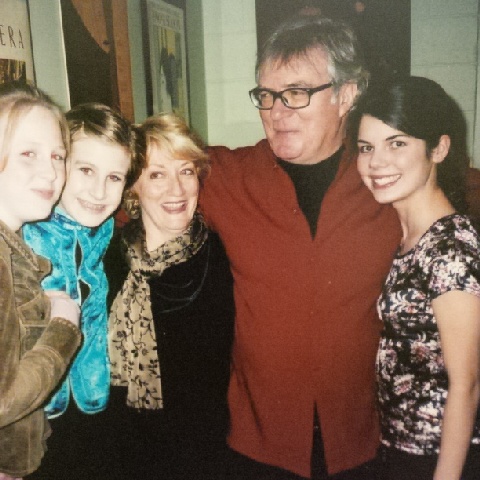
Today the Canadian Children’s Opera Company said their goodbyes to Ann Cooper Gay, their departing Artistic & Executive Director.

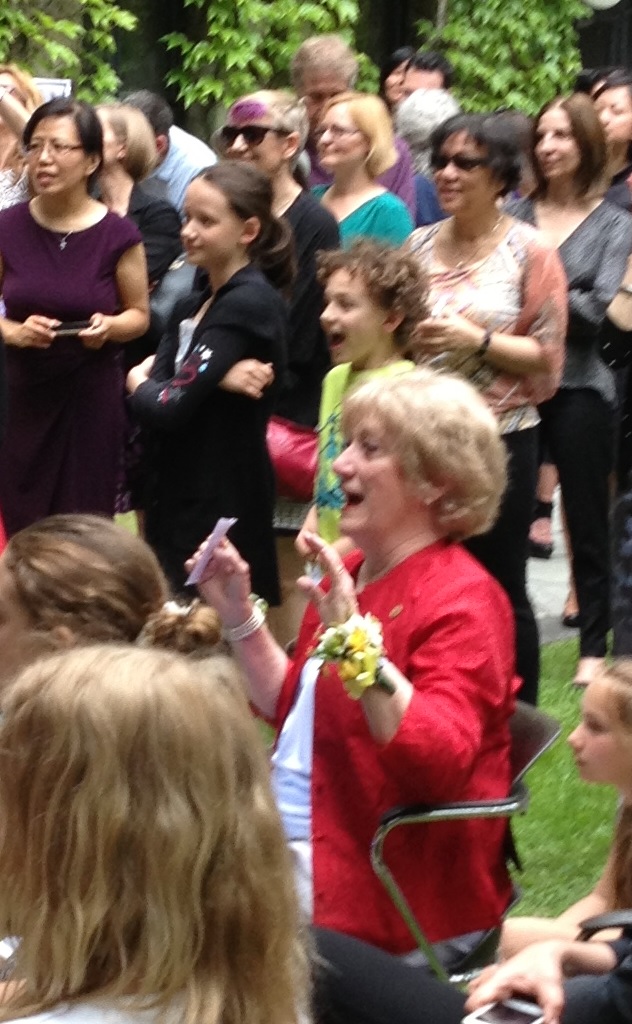
In last year’s interview I alluded to her importance, as one of the most influential figures in opera and music in Canada. The crowd jammed into the courtyard at the Canadian Opera Company’s Joey and Toby Tanenbaum Centre testify to that. The children, parents and alumni were more or less what you’d expect.

But in addition one could see lots of personalities, donors, agents & supporters of opera in this country, including:

  • Stuart Hamilton of Opera in Concert and Saturday Afternoon at the Opera
  • Carol Ann Curry of Dean Artists
  • Joel Ivany, who in addition to being Artistic Director of Against the Grain Theatre happened to direct last year’s show for the CCOC; he and his team (for instance Topher Mokrzewski who also put in an appearance) were rehearsing Death & Desire elsewhere in the Tanenbaum Centre
  • Kate Applin of Metro Youth Opera, one of many CCOC Alumnae present

There were a number of speakers.

Mentorship was something extra Bradshaw was known for. He's gone,  Ann Cooper Gay is still at it...

Mentorship was something extra Bradshaw was known for. He’s gone, Ann Cooper Gay (centre) is still with us.

Composer Norbert Palej suggested that the idea of Ann Cooper Gay retiring is an oxymoron, a contradiction, and unimaginable. I think it’s fair to say that such an energetic artist & administrator as ACG will remain busy in some capacity, and whatever she decides to do will be as intense as ever, likely doing it well. The reason he surmised that Ann was so good at CCOC was because she hasn’t lost her child like quality, especially when speaking to children. Ann doesn’t talk down to them, but speaks to them always as an equal.

Peter Barcza—introduced as the person present who remembers her before she met husband Errol—offered anecdotes from long ago productions with the Canadian Opera Company tour (Cosi fan tutte, la boheme and la traviata) and at the U of T’s Opera Department (Iphigenie en Tauride). Hm, I suppose the fact that I saw those shows means I also qualify as someone who has known her a long time. I was very young, but then again so were they. Or as PB said: they were both 5 years old at the time.

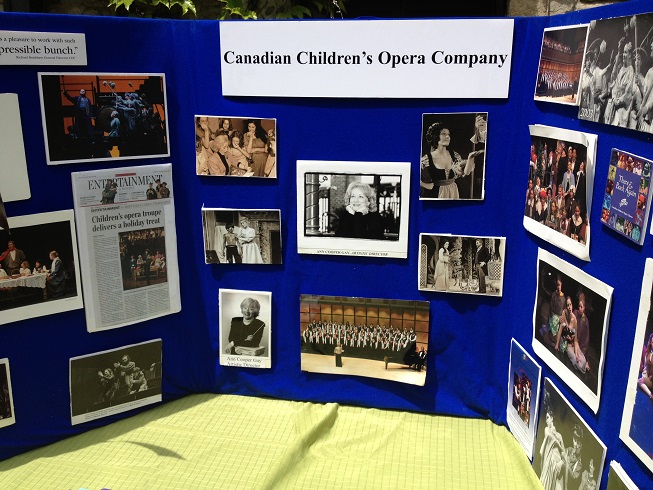
Lots of photos were displayed, including a few from before the CCOC. The two B & W shots to the right of centre show her playing Despina & Violetta.

Lots of photos were displayed, including a few from before the CCOC. The two B & W shots to the right of centre show her playing Despina & Violetta, both of which i saw.

Emily Brown Gibson (a CCOC alumna) offered the viewpoint of her many cast members. As she said, Ann touched so many lives, leaving a huge impact on everyone who worked with her. When she said her thank you to Ann, it drew one of the loudest rounds of applause from the many former members of the CCOC present.

When Ann finally spoke she acknowledged those who came before. She paid tribute to Ruby Mercer, whose vision was responsible for the creation of a year-round CCOC above and beyond the occasional chorus bits in Canadian Opera Company productions of Carmen or Tosca. Ann also tipped her hat to Lloyd Bradshaw as a builder of the company. And she invoked the “it takes a village” notion, thanking all the parents & volunteers, without whom the CCOC couldn’t function as it does.

Towards the conclusion a large mass of singers – former & current members of CCOC—gathered together in benediction singing “May the road rise up to meet you.”

Composers likely would be the first to say their thanks to ACG. As we took in the perfect Sunday afternoon weather in the courtyard of this Canadian Opera Company building—a company who have not successfully brought a commissioned work by a Canadian Composer to their stage in awhile—composers could be grateful to the CCOC, who are responsible for eleven original works. Whoever takes the baton from ACG’s hands, I sincerely hope that they show the same commitment to original compositions.

But for now it’s the time for goodbyes and thank yous. Ave atque vale.

She will be missed.

She will be missed.

Posted in Personal ruminations & essays | 1 Comment

Toronto Consort—a new Play of Daniel

I saw something brand-new, from the 12th century. It’s one of the ironies of theatre or music that sometimes recent works give you comparatively little room for invention, every page stipulating how it must be interpreted. If you want real freedom you have to go back. Generally, the earlier you go, the less specific the text will be about how it must be done.

click for ticket info

Tonight, the Toronto Consort premiered a new version of Danielis ludus, aka The Play of Daniel, a very old play that requires music. David Fallis, the artistic director of Toronto Consort wrote a new English verse translation in couplets, except for the occasional passage in Latin, and arranged the music for the Consort players: Alison Melville, Terry McKenna, Ben Grossman and Kirk Elliott. I’d heard rumblings for months that this was the big project capturing everyone’s imagination, and no wonder. The Play of Daniel resembles an opera with a medieval sound. Bringing it to the stage was a huge undertaking, including the participation of over a dozen adult stage performers and the 22 members of Viva! Youth singers of Toronto.

As a frequent viewer of medieval drama with PLS at the University of Toronto—including a couple of acting roles I undertook—I knew that this would be enjoyable. But I didn’t realize just how remarkable this text is, especially the way it was presented.

We were sitting in Trinity St Paul’s on Bloor Street. Yes it’s a concert venue but first and foremost it’s a church. As the program notes explain, it’s a liturgical drama, which means it would normally be presented in a church, employing a text that’s profoundly different from what we usually expect in theatre. As Director Alex Fallis put it in his notes:

From a dramatic point of view The Play of Daniel is one of the great texts from the Medieval theatre. It is also a sprawling piece that includes a wide variety of episodes, dramatic techniques, moods, and musical colours. It defies our contemporary ideas of genre, and dramatic progression—choruses tell of events before they happen onstage, and very different styles of music are used moment by moment. We have chosen not to try to “smooth” out the sudden shifts, but in fact to celebrate these rapid changes, and I believe that this creates a real sense of surprise and wonder when watching the piece that I hope is very appropriate.

Because it doesn’t employ predictable devices the effects can surprise you. Perhaps more importantly is how it feels from a spiritual or religious point of view. I felt as though I was encountering a purer form of religion, without any of the modern moralistic overlay.
At roughly an hour in length with continuous music it resembles an opera. The last five or ten minutes (I couldn’t gauge because I was so mesmerized) consists of a Te Deum sung a capella, performers processing around the church, as we seem to segue into a genuine service, albeit one from a different world. This is a piece of great simplicity & directness, beautifully costumed by Michelle Bailey, with a set from Glenn Davidson that complements the sanctuary.

Belshazzar - Olivier Laquerre (l) Noble – Bud Roach (r) (photo: Glenn Davidson) .  Olivier Laquerre  and Bud Roach appear courtesy of Canadian Actors' Equity Association.

Belshazzar – Olivier Laquerre (l) Noble – Bud Roach (r) (photo: Glenn Davidson) . Olivier Laquerre and Bud Roach appear courtesy of Canadian Actors’ Equity Association.

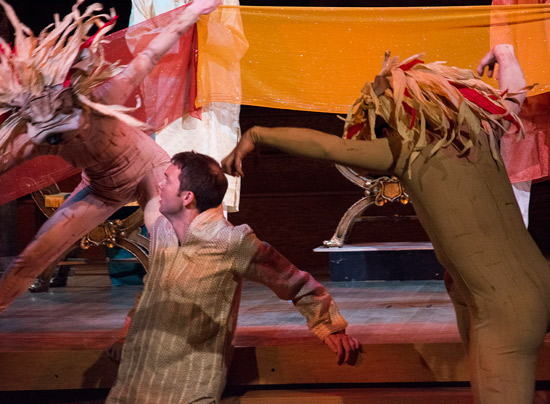
There were no weak spots anywhere in the cast. Kevin Skelton was a youthful Daniel, bringing a light agile voice to the portrayal. Olivier Laquerre, familiar to Toronto audiences for his work with Opera Atelier, was a strong-voiced King Belshazzar. David Fallis and Bud Roach were the jealous rascals from Darius’s Court who end up exiting (spoiler alert), running up the aisle, pursued by lions. It’s a solemn place which might have held some back from laughing at what is a very funny text, especially Fallis & Roach.

I was going to say “there’s nothing like it in town” but in fact the PLS are celebrating half a century, which is one pretense for the upcoming Festival of Early Drama, where you might see something similar. But as good or better? I don’t think you’d be able to surpass what the Toronto Consort achieved on this occasion, between their brilliant musicianship, the wit of the text and the beauty of the presentation. You must see it if you can, the two remaining performances coming May 23rd & 24th at the Trinity St Paul’s Centre.

Lions - Heidi Strauss (l), Brodie Stevenson (r), Daniel – Kevin Skelton (centre) (photo: Glenn Davidson) Kevin Skelton appears courtesy of Canadian Actors' Equity Association.

Lions – Heidi Strauss (l), Brodie Stevenson (r), Daniel – Kevin Skelton (centre) (photo: Glenn Davidson) Kevin Skelton appears courtesy of Canadian Actors’ Equity Association.

Posted in Dance, theatre & musicals, Music and musicology, Opera, Reviews | Tagged , , , | Leave a comment

Festival of Early Drama June 5-7

An anniversary nearly 400 (and 50!) years in the making!Toronto’s Medieval and Renaissance players celebrate their 50th anniversary with the Festival of Early Drama June 5 – 7, 2015Poculi Ludique Societas (PLS) continues its year-long celebration of 50 years of performance research practice at the University of Toronto with the FESTIVAL OF EARLY DRAMA #FoED2015 #pls50th. The festival kicks off at 6 pm on Friday June 5 with a performance of Ben Jonson’s Masque of Queens presented by Loyola University, New Orleans. This opening gala performance will be followed by a celebratory reception at 8 pm at Alumni Hall, Victoria University.FoED2015 includes productions presented by fifteen medieval and renaissance theatre troupes from across North America. Joining us are university theatre companies from New Orleans to Indiana, as well as the University of Western Ontario, Brock, and McMaster Universities and others across Ontario. PLS will also present their own production of Mankind, which is travelling to The Cloisters in New York City May 23 – 24, 2015, before returning to Toronto to headline the PLS roster of productions.With multiple PWYC family-friendly events happening over two days on the U of T campus, FoED2015 is sure to appeal to families, scholars, students, and medieval and early modern history enthusiasts.

When asked what she hoped audiences would take away with them, Artistic Director Linda Phillips said, “Most people know about Shakespeare, but they don’t know about the theatrical traditions that influenced him and his contemporaries. This festival showcases the huge variety of early drama: moralities, farces, comedies, tragedies and more.”

The history of PLS is traced to 1964, beginning as part of the work for a University of Toronto graduate seminar in Medieval Drama when the director, Prof. John Leyerle, invited the class to stage a medieval play. Excited by the success of their production of Everyman, the members of the class came together again the following year to stage another play, and PLS was born. Fifty years and more than 150 productions later, PLS is known around the world for its pioneering performances of the drama of the Middle Ages and Renaissance.

FESTIVAL OF EARLY DRAMA
Celebrating 50 years of Poculi Ludique Societas
June 5 – 7, 2015
University of Toronto Downtown Campus
Festival Box Office: 150 Charles St (At Museum Station)

Free outdoor family-friendly events daily starting at 11 am
Ticket prices: $15 Adult/$12:50 Student
50th Anniversary Reception June 5 8pm: $17
Ben Jonson Masque of Queens + Reception June 5: $27.50
Tickets available online at UofTTix.ca
www.plsfest.ca

 “Press releases and announcements” are presented verbatim without comment
Posted in Press Releases and Announcements, University life | 1 Comment

Andrew Davis – Verdi Requiem

Sir Andrew Davis

The Toronto Symphony are celebrating a 40 year relationship with Sir Andrew Davis, their one-time music director (from 1975-1988) and currently their Conductor Laureate, with a series of concerts over the next couple of weeks.

Tonight’s concert featured Verdi’s Requiem, an ideal work for this sort of occasion. The orchestra gets some powerful moments that knock your socks off, the soloists each have an opportunity to shine.  To be honest I’ve never experienced a performance of this work that managed to be anything more than a series of beautiful moments, possibly because I don’t sense that Verdi understood the mass as anything more than an opportunity for theatre, rather than something genuinely spiritual: although Davis gave it a good try.

The best of the big effects came in the first part, especially the “tuba mirum”, with brass situated in the audience for a three-dimensional effect of the trumpets of judgment, the apocalypse in music.  Davis was his usual energetic self, propelling the ensemble along at a good pace, achieving a true romantic sublime.

The entrance of the soloists in the Kyrie showed us what a splendid quartet had been engaged for the occasion.  They were a curious foursome, comprised of two young women and two experienced men, perhaps an echo of the occasion honouring the Conductor Laureate, who has been a mentor to at least one of the young women.  Both soprano Amber Wagner and mezzo-soprano Jamie Barton seem (at least as far as I can surmise from their biographies in the program) to be in the first five years of their professional careers, while tenor Frank Lopardo and bass Eric Owens are at least mid-career professionals.  While Barton & Lopardo are new to Toronto, we’ve seen Wagner & Owens in a pair of title roles with the Canadian Opera Company (she as Ariadne in 2011, he as Hercules last season).

Owens brought a genuine humanity to his reading.  His ”mors stupebit” was the most genuine depiction of the bewilderment of death I have ever seen at this moment in the Requiem, an approach perhaps more like something from verismo than Verdi, in the delivery of lines in something like a soft parlando.  But he was in the moment as though delivering lines in a film, and thus was very effective, very powerful.

Lopardo could also offer a very vulnerable soft sound, or something more spectacular and befitting a public ritual.  He sang the opening in C minor of his “ingemisco” in the most delicate pianissimo, but then opened up once the major passage begins, with genuine squillo and a completely reliable top throughout.

I had been told to watch out for Barton, whom I have never heard before.  Apparently she was in the Houston Walküre opposite Christine Goerke (and maybe I saw something via social media).  Every note was powerful, clear, perfectly pitched, and now i know why she is considered one to watch.

I wonder if Davis asked to work with Wagner, who made her COC debut as Ariadne under Davis’s baton almost exactly four years ago, when Adrianne Pieczonka was indisposed.  The voice has a spectacular colour, at times reminding me of a Leontyne Price for her full and powerful top.  She may be young but the voice is already a big deal, worth hearing.

Amber Wagner and Jamie Barton, with the Toronto Symphony (Photo: Malcolm Cook)

Amber Wagner and Jamie Barton, with the Toronto Symphony (Photo: Malcolm Cook)

This is one of the pieces that shows off the Mendelssohn Choir to advantage.  At times they were as subtle as a whisper, as for example the first delicate notes of the piece.  But when power and passion were called for they had it.

The Requiem will be repeated Friday & Saturday nights.

Posted in Music and musicology, Opera, Reviews | Tagged , , , , , | Leave a comment

Is #AtGdeathdesire a new genre?

The word “new” is getting old pretty fast.  It’s used every time we encounter something a bit different. Nowadays everything is either retro, new or some combination of the two.  I am hesitant about using the word in the headline even though it’s probably apt: for once.
Toronto’s Against the Grain Theatre presented a sampler from their latest project Death & Desire (coming June 2nd – 5th) under the auspices of the Canadian Opera Company’s free noon-hour concert today at the Richard Bradshaw Amphitheatre.  Death & Desire combines songs from Schubert’s Die Schöne Müllerin and Messiaen’s Harawi in one program.

Some works are puzzles to be solved.  Here for instance is a performance I found on youtube of one of the songs in Harawi to suggest that the puzzle has several solutions.  There’s nothing wrong with it, but it pales alongside what I heard today, not so much a solution to the puzzle as a declaration of puzzlement. 

“AtG” as they’re known have already partnered with the Canadian Opera Company at the Banff School the past two summers, and the distinction between the COC and AtG might be getting a bit blurry.

  • We heard AtG Music director Topher Mokrzewski at the piano, so recently a member of the COC’s musical staff
  • We heard introductory words from AtG AD Joel Ivany, soon to direct the COC’s Carmen
  • It was a delight to once again hear Krisztina Szabó singing challenging 20th century rep.  With one performance left in the COC‘s Erwartung, which I called “one of the strongest performances of any COC season,” her next stop is AtG on June 2nd.

AtG have a reputation for adventurous programming, having brought la boheme to the Tranzac Club, Messiah to a rock music venue including brilliant choreography, Pelléas et Mélisande to an outdoor courtyard location, among several forays into rethinking the ways and means of live performance.  A few weeks ago I watched a workshop of Mozart’s Requiem that challenged the performers, leaving me wondering how it will look in its final form.

When I heard that Death & Desire would incorporate song cycles by Schubert and Messiaen I was eager to hear what they’d do, certain that the encounter between the old and new would serve to both invigorate the more recent work while refreshing the overly familiar older one.  I am glad they decided to try interspersing the two works, which has the potential for the creation of a new genre.

Just as it’s said that all philosophy is mere footnotes to Plato (Google tells me Alfred North Whitehead said that), we have some interesting debts to the poets & musicians who came before us.  In a real sense every song cycle seems to build upon the foundation laid by Schubert.  I envisaged that when we began, we’d be exploring that debt, as indeed two of the first songs were “Das Wandern” and “Wohin”.  The burbling waters created by Schubert in these songs seem to turn up in other compositions, Messiaen included.  When Rachmaninoff offers his piano paraphrase of the latter song, it’s as a well-known tune that he puts it before us, an adaptation not so very different from a famous singer or musician’s cover of a jazz standard. 

The two singers – Szabó in the Messiaen and Stephen Hegedus in the Schubert—begin far from one another.  I didn’t expect they would encounter one another, perhaps because in my literal-mindedness I saw one piece as foundational of romance, the other as very daring and modern.

Silly me, I should have realized.  Indeed the two do encounter one another.  So far at least (in the sample I saw) Ivany & the AtG adaptation aka Death & Desire have an interesting way of putting these two people in the same world.  Of course I should recognize that the narrative thread of the Schubert, while rooted in the early 19th century, is still a fairly reasonable description of male romance in the 21st century, whereas the subtleties of rational and irrational expression found in the Messiaen, that leave Hegedus and the archaic heterosexual males gasping in its wake? they are boldly contemporary.

For example Hegedus sings “Mein” whereby Schubert (or Ivany) would tell us what’s on his young lover’s brain.   

If you weren’t already impressed with Szabó for her work in Erwartung, Messiaen seals the deal.  Even the most authentic & officially authorized performance of “Doundou Tchil” (the same song I cited above) with a piano part played by Messiaen’s widow Yvonne Loriod pales alongside what i heard today in Toronto. Yes it’s odd to cite other performances, but they’re not as good.   You must go see what Ivany, an obstreperous Szabó and a silent, frustrated Hegedus make of this fascinating composition, as if giving an in-your-face reply to the innocent adolescent maleness of “Mein”.   Just as the two COC works she’s concluding –Erwartung and Bluebeard—are essentially battles between male and female, so too with Death & Desire.  I don’t know how it’s going to end, but as of this afternoon, the 21st century female seemed to be slam-dunking the 19th century male all over the basketball court, aka the RBA performance space.

The one i didn’t really mention is the key. Topher Mokrzewski doesn’t just play this music, he enacts it, playfully working with Messiaen.  If someone can coax Peter Oundjian to see this perhaps he’d discover the logical soloist for the Toronto Symphony to play Messiaen’s Turangalila, which is where Topher’s brain was recently (out west).  The meeting between Schubert & Messiaen begins at the piano, and it’s a loving encounter.

I’m curious to see what AtG does with the other songs, how they stage it, light it and dress it.

And I’m curious where this leads us.  As with the “Doundou Tchil” that was so electrifying, the combination of works opens up all sorts of interpretive possibilities, for irony and self-reference, and all sorts besides.  One could be very funny and/or parodic doing something like this, although I suspect that won’t be their first impulse.

Death & Desire is on June 2nd – 5th at the Neubacher  Schor Gallery, 5 Brock Avenue.


Posted in Music and musicology, Opera, Reviews | 4 Comments

Brecht, Music and Culture: Hanns Eisler in Conversation

I have a fondness for interviews, having conducted quite a few on this blog, but I can only look on in awe

  • when I see someone capable of asking really good questions
  • when I see someone capable of making really good answers.

Two heads are better than one, or so it seems when we encounter dialectic.  I suppose I was mindful too of the advantages of two minds working collaboratively as I read the Hutcheons’ book Four Last Songs on Saturday, a book that hijacked my attention, pulling me away from the other book I was reading, which happened to be an explicit conversation (whereas FLS was perhaps distilled from the ongoing conversation between Linda & Michael).

It’s new even though it’s old.

  • Composer Hanns Eisler had conversations with Hans Bunge between 1958 and 1962
  • They were published in German in 1975 as Hanns Eisler Gespräche mit Hans Bunge. Fragen Sie mehr über Brecht, which could be translated as “Hanns Eisler talks to Hans Bunge.  Ask me about Brecht”.
  • And they were just translated in 2014 by Sabine Berendse and Paul Clements, published as Brecht, Music and Culture: Hanns Eisler in Conversation with Hans Bunge (which I shall refer to as BMC)

click for more information or to buy

Let me add, that I am again in awe of the Edward Johnson Building’s library, the collection for the University of Toronto’s Faculty of Music.  Currently I have Harawi (Messiaen) and Die Schöne Mullerin (Schubert) out in anticipation of Against the Grain’s June show, Rachmaninoff piano concerti 2 & 3, as I listen to a new recording i picked up, the Mendelssohn violin concerto (for a recent concert), and songs from Des Knaben Wunderhorn by Mahler, that figured in a recent church service.  I can’t recall the last time I looked unsuccessfully for something in this library.  They regularly have amazing new books on display, where (for example) I’ve also found another fabulous book about Liszt.

A library is a pretense for virtual conversation, the dialectic of minds meeting books.  The magic of a library lies in the oxymoron of a repository for thousands of personalities in a safe retreat for introverts, a silent agora jammed full of virtual people.

The title on the book makes it clear that while Bunge interrogated Eisler, there’s another key figure here, namely Bertolt Brecht, the great man at the centre of many of the questions and the reason for the interview.    I wonder if drama scholars –or the book-purchasers for the drama collections at the university—know about this book, which could easily fly under their radar. I suppose that is one reason I wanted to write this, to alert my friends & colleagues about this remarkable book.

But it’s in the Music Library because Eisler is also a great man, albeit one with a lower profile than Brecht.  I can’t forget the whole question of the life-choices of artists–so prominent in the Hutcheons’ book—as I look at Eisler, a man whose story would make a wonderful film or opera.

  • He fought in the First World War
  • He was a student of Arnold Schoenberg
  • In spite of his rigorous training, he chose to turn his back on serious music, seeking instead to write music that would appeal to the average person.
  • Like his friend Brecht, he was a Communist
  • He came to America, writing music for several films
  • He wrote one of the first theoretical studies of film music “Composing for the Films”, co-written with Theodor Adorno
  • He left America after a run-in with the House Un-American Activities Committee
  • He went to the DDR (East Germany) immediately after the war, composer of the DDR national anthem.
  • He came into conflict with the Communists of East Germany too

You’d never know from this book that Eisler was prone to depression, but perhaps like many comedians, wit is a defence mechanism against depression.  The conversations sparkle without any evidence of depression: at least at this point in his life.

Brecht was his life-long friend & collaborator, first in Germany before the Second World War, then in America, and again in East Germany after Eisler was deported in 1948.  In this series of conversations we encounter Brecht via Eisler.  Bunge orchestrated a series of conversations meant to cover a variety of topics, encouraging Eisler to speak at length, showing his fascinating combination of intellectual acuity and moral fire, a political thinker in every aspect of his art.

So for example, Bunge asks Eisler to talk about Brecht’s understanding of music as well as his taste.  The replies range across several topics, giving us insight into how Brecht’s mind works.  Eisler was a professor, accustomed to speaking at length, and usually with lots to say.  I will offer a single large quote to give some idea of the way Eisler ranges across disciplines & topics.

Brecht never went to concerts because you weren’t allowed to smoke there, and besides, he had a lot on – although I have to admit he did make exceptions.  If a concert piece by one of his friends was performed, he suddenly appeared—I never sent him an invitation—and listened to it.  He did this because, as I said, he possessed a Chinese politeness.  His taste in music was excellent –with one weakness.  You have to understand that Brecht saw all the arts, equal as they all are, from the viewpoint of a playwright, a dramatist.  Art only existed for him in terms of its usefulness; this is what he was interested in.  He found the music of Johann Sebastian Bach useful and he also looked for this quality in music beyond the context of the theatre.  Furthermore, he admired Mozart very much.  He liked certain Turkish Chinese and Algerian music; flamenco, as in folk music; or the ancient and stylistically formal music of ancient China.  I once played him a record –‘the Virgin on the Seven Stars’, or was it the Seven Virgins on One star?”—which thrilled him bcause of the way in which the texts were receited.  And he admired Spanish flamenco.

He never knew what to make of Beethoven.(…)

Indeed, he also read for the most part only what he could use. As he got older, Brecht, who was a highly educated, brilliantly educated man (his education in some areas was astonishingly deep), read only those things that he could use, either for information or as a stimulus to thought.  He read certain academic books for this purpose alone.  Brecht wasn’t an ‘art for art’s sake’ reader; even crime novels, which he read with touching dedication, interested him like a game of chess—how do you weave together the threads of a story? Brecht studied crime novels in order to answer this question, and he always complained loudly to me if he found out in the middle of a book, that he had already read it three times and had just forgotten it.  He’d put it aside.  It was an eternal battle: “aren’t there any new crime novels?” was Brecht’s almost daily cry and all his friends were continually on the lookout.

Apart from that, he also read very difficult things. He was very interested in physics and had a strong mathematical ability even though he didn’t have any formal training in mathematics—it was the same in music.

Sometimes we’re in the realm of popular art, as when we hear of the humiliations of Brecht’s working life in Hollywood, including an encounter with Daryl F Zanuck, head of 20th Century Fox.  Or Eisler gives us something more theoretical concerning Brecht’s politics or dramaturgy.  Eisler speaks about his collaborations with Brecht, music he wrote for plays they did together.  It’s highly entertaining hearing about the famous people they encountered – Chaplin, Odets, Schoenberg, Toller, Reinhardt, WH Auden and many more.  Yes there’s a ton of name dropping but first and foremost we’re in the presence of a great man –Eisler–speaking of one of the titans of the 20th century.

I have to finish the book before anyone else can take it out.

Posted in Books & Literature, Music and musicology, Personal ruminations & essays | 2 Comments

Four Last Songs: aging, creativity and the meaning of life

Click for further information and for link to purchase book

The cover picture shows Giuseppe Verdi sitting with a reflective expression on his face while he plays the piano. The book’s title is Four Last Songs: Aging and Creativity in Verdi, Strauss, Messiaen and Britten, the latest collaboration between Linda & Michael Hutcheon, and I believe it is their deepest work yet.

As usual the work is multi-disciplinary, another interesting meeting place for a couple who come from divergent disciplines. He was a doctor and professor, she was an English professor and literary theorist, both at the University of Toronto. It is no wonder that these two students of conversation (he in his home department of Medicine, Respirology Division, she in her study of discourse itself) should be sharing their masterful conversation with us.

Previously that has meant books such as

  • Opera: Desire, Disease, Death (1996)
  • Bodily Charm: Living Opera (2000)
  • Opera: The Art of Dying (2004).

Their books look at life & death and the fascinating boundary between the two, especially when opera is so often situated right on the interface.

There can be several reasons why this book seems to hit me at a deeper level than the previous ones. Perhaps it begins with my awareness that we’re all getting older. Linda & Michael are now retired. My history with Linda is lengthy, the book Irony’s Edge, a graduate seminar on the multi-disciplinarity of opera, and the Opera Exchange series with the Canadian Opera Company representing delightful encounters over at least a couple of decades. Perhaps all four books are equally weighty, but for me this one seems genuinely momentous, and indeed catching me a bit by surprise. Their other books were entertaining but I think with this one there is something else at work.

While the title suggests Richard Strauss’s familiar “Four Last Songs”, the book studies the compositional choices of four different composers coming to the end of their lives, so that in effect we are looking at four different last songs:

  • Giuseppe Verdi’s Falstaff
  • Richard Strauss’s final compositions, including Capriccio, the Four Last Songs, Metamorphosen, and his second horn concerto
  • Olivier Messiaen’s Saint François d’Assise,
  • Benjamin Britten’s Death in Venice

While we’re ostensibly reading about aging composers and their late compositions, we are encountering them in context. For each composer we are enquiring into the meaning of life: their life, and indeed, any life. Perhaps it is because the focus this time is less the creations than the creators, in these case-studies of the composers themselves and the questions they each faced of how a life can be lived: questions we all must face.

This baby-boomer has been hearing about our aging cohort and the relevance of gerontology for almost as long as I’ve been aware of our cohort, that collective bulge in the population gradually moving its way from youthful rebellion to maturity, success, middle-aged comfort, and now with retirement staring us squarely in the face. I thought I knew what aging was, what the issues were, but after reading Four Last Songs, I recognize how much there is to know, how two-dimensional our cultural assumptions concerning aging truly are. A good analysis is ultimately a kind of deconstruction, and by telling me so much concerning what age and life do not actually mean, Four Last Songs is a book deconstructing our assumptions about aging. Many of our generalizations are wrong.

There are some moments reading this book that I was distracted from the subjects –the composers that is—in my thoughts about how this is relevant to my own life, the people I know who are aging, and yes, my own life choices. I’m grateful for the gift of some new language that I will incorporate into my conversation, and perhaps also into my life narrative. I needed to encounter “Vollendungsoper”: an idea via Constance Rooke (who spoke of the Vollendungsroman), whereby the Hutcheons posit the opposite to the Bildungsoper (or Bildungsroman, the old story idea of the novel of the youth coming of age). This is a story of completion or winding-up, whether it’s the completion to the life of the protagonist or the finale to the career of author or composer.

As far as the critique concerning late style –which segues us back into a discussion of opera, rather than the meaning of life—I like this passage for the way it problematizes the big pronouncements of the critic:

Because, as we have seen in the first chapter, late style is a matter of reception, critics cannot resist seeing and hearing in these last works the “style” of a dying man. But what they mean by “style” is never clear: sometimes it is thematic, while at other times it is formal, or even a matter of a perceived tone or mood. Whatever it is, as we have noted, it is always an interpretation, a projection, in a way, of the critic who knows these are the last works.

Michael & Linda Hutcheon

The Hutcheons have left me with a healthy skepticism concerning sweeping generalizations, even if when I look in the mirror –or re-read what I am saying about their book (which is roughly the same thing)—I seem to be guilty of wielding the same broom. Four Last Songs is at times as accessible as pop culture yet very careful in its language, scholarly in its research and in the conclusions it draws. Age and aging are concepts to be used with care, particularly now –in this era of “60 is the new 40”—when so many of our assumptions are being re-thought or jettisoned outright.

Yet for all its probing questions there are still the composers.  In the final analysis Four Last Songs is an extremely inspiring study of a heroic quartet.

Posted in Books & Literature, Music and musicology, Opera, Reviews | Tagged , , , , | 2 Comments