Closer to the Barber

I had another look at the Canadian Opera Company’s production of The Barber of Seville, this time up close (aka my subscription seats which are in the front of the orchestra).

It’s an interpretation full of clever touches.

The sensibility of Els Comediants (the team behind the direction & design of this production) calls attention to the materialist underpinnings of the opera.  It’s not quite Marxist but most certainly putting money and wealth in the foreground of the story.  The Count Almaviva might be a nice guy, but he’s also wealthy as Croesus.  It means that while we have lots of fun in the opera, there are reminders of the darker side of life.  At moments throughout we see observers who might be street people, average souls who are outside the story watching it unfold, and in the process lending everything a little more dignity if not actual weight.  Near the beginning, when the Count sings for his beloved, he throws great wads of money at anyone in the vicinity, especially the musicians who accompany his serenade.  At the final curtain, money comes raining own on the audience in the front section.

The money that fell from the sky... but that's no Prime Minister's face on that bill.

The money that fell from the sky… but that’s no Prime Minister’s face on that bill.

It’s not real money of course, and it’s just another bit of fun.

As before, the two strongest portrayals were the chief antagonists, namely Almaviva and Bartolo, as played by Alek Shrader and Renato Girolami.  Shrader’s masquerades are slick, his coloratura delicious, his manner so attractive that even a Communist would have to forgive him for being so rich.  Girolami is a thoroughly lovable Doctor Bartolo, feeling very much the authentic buffo comedian in his singing & larger than life mugging.

New to the production on this occasion was Cecelia Hall as Rosina, who’ll sing the remaining four performance of the run (after tonight’s show).  I may be oversimplifying but I’d contrast her approach to Serena Malfi, in an emphasis on musicality & voice; where I think Malfi is funnier, Hall seems to have an amazing range, offering up a great many notes below middle C as well as lots at the top as well.  Joshua Hopkins is a lyrical bel canto voice perfectly suited to the role, energetic in his physical comedy, always with a winning smile.  Robert Gleadow probably got the most laughs per minute onstage as Don Basilio.  And Aviva Fortunata sounded even more impressive the second time, her big voice showcased in this little role in one of the more interesting casting choices of the season, her colour adding a wonderful dimension to the ensembles she’s in.

There are more casting changes ahead, plus a performance by the Ensemble Studio Friday May 15th.

If Rossini wasn't one of the Fathers of Confederation, maybe he should have been.  Click for more info about the production.

If Rossini wasn’t one of the Fathers of Confederation, maybe he should have been. Click for more info about the production.

Posted in Opera, Reviews | Leave a comment

TSO on the road with Lau, Mendelssohn and Bruckner

Tonight’s Toronto Symphony concert was a kind of farewell before going on a short tour to Ottawa & Montreal. The Roy Thomson Hall audience heard the programme they’re taking on the road.

Each of the three works represents a special kind of challenge.

The best reception of the night? I’m not sure. It might have been the response to the most familiar work on the program, namely Mendelssohn’s violin concerto in E minor, played by young Augustin Hadelich.

Violinist Augustin Hadelich (photo: Luca Valenta)

Violinist Augustin Hadelich (photo: Luca Valenta)

Or it might have been the huge response to his encore, Paganini Caprice #5. As I listened to the encore, exquisitely articulate, sometimes soft, sometimes powerful, always bang on pitch and hugely expressive, it was as though to tell us, “sure we all like Mendelssohn’s concerto in E minor, but there’s a great deal more that a violinist can offer.”

Such as a Paganini Caprice.

Have a look.

In our recent interview he explained something about his playing. I had asked him about teachers & influences.

Some of the best teachers I had were chamber musicians: Norbert Brainin (from the Amadeus Quartet), whom my parents tracked down in Italy when I was around 12 and convinced to give me lessons, and later Joel Smirnoff (from the Juilliard Quartet) whom I studied with at Juilliard. Both of them, perhaps partially due to their chamber music background, taught the whole score, beyond just the violin part. It is amazing how many teachers, even the famous ones, do not really study and teach the orchestral scores of the great violin concertos beyond just the violin part. If you look at the violin part by itself, it seems like you have a huge amount of choices and so many different ways you could play it. But the better you know and understand the whole score, the clearer it becomes how you should play. You’ll be able to see how the composer put the piece together, what the other players are doing, and what it all means. A great composer like Mendelssohn would never write the violin melody first and separate from the ‘accompaniment’– rather, the overall harmonic processes and the expression of the violin are interconnected. Even though the violin is leading the concerto, the violinist has to listen and react to–and often also accompany–the orchestra. In the end, the way the soloist, orchestra and conductor interact in a concerto is really not that different from chamber music.

Hadelich played this concerto as though he had thought through the combined effect with the orchestra. It sounds simple, and it’s how every player should work. Yet when I think about it, I’ve heard very few violinists who seem to get this. Stern and Zukerman and Perlman for instance play this way: the most accomplished virtuosi of the past half century. They make their instrument sound beautiful with wonderful cantabile on the slow soulful passages, and bring out the key melodic highlights when necessary: but in collaboration with the orchestra. I’ve heard the outer movements played faster, yet that usually means that something is lost in terms of the clear articulation of the key moments. This dialogue with this orchestra, led by Peter Oundjian—who Hadelich reminded me was himself a violinist and therefore the ideal conductor for such repertoire—was very lucid, very direct.

To begin the orchestra played Treeship, a short work from Kevin Lau, who has been resident composer with the TSO. Sometimes compositions have fanciful programmes explaining the inspiration for the music. I don’t know that I understood the idea of “Treeship” except that the resulting composition was very entertaining, wonderfully tonal. It sounded a bit like film music in its embrace of lush harmonies such as you’d find in a film-score, instantaneous in its effects. There’s some gorgeous work for the cellos, and lots of delicate colours for winds scattered throughout. I don’t know how extensive the dialogue was between Lau and the TSO during the composition, but in Treeship he’s given them a handsome vehicle to open a concert.

To close we heard Bruckner’s 7th Symphony, a work to challenge both the orchestra & audience alike. Forgive me, I had the quintessential Toronto experience listening to this symphony tonight.

And what’s more Torontonian than to be feeling embarrassed by fellow citizens. I’ve been stirred deeply by the way Peter Oundjian has built the TSO audience, standing at the podium with his microphone addressing us across the cold gulf that is the ambience of RTH, an unwelcoming space, inspiring us and his players. He works miracles most times. For two movements of the Bruckner he had the audience listening in silence, a pair of movements of great intensity, played with fabulous commitment by the TSO, particularly the winds.

Bu it’s a long symphony, and challenges an orchestra in the subtlest ways. The fidgeting built up in the last two movements, even though the orchestra wasn’t backing down from Bruckner. Those who left –not so very many—sometimes did so noisily.  It may also have been the warmth of the the day.  There we were sitting right in front of Hadelich –who had come into the hall to listen to the Bruckner & perhaps to simply unwind after his virtuosic display—while we heard all the assorted fidgets and escapes.  I was tempted to explain to him that actually we were all tired from our hard days at work, that Bruckner is a stern test for orchestra & audience alike.

But I am grateful that Oundjian is stretching the audience with a program like this one, works that are well-suited to RTH and the skills of the symphony. We grow from such encounters.

Ottawa & Montreal will enjoy the TSO’s tour: especially Hadelich.

Posted in Music and musicology, Reviews | 3 Comments

Eitan Cornfield passes Music Mondays torch to Ian Grundy

Dear Friends of Music Mondays,

Our series has served as a launching pad for the best of Toronto’s emerging talent since its inception in 1992. We continue the tradition this year with an exciting lineup of performers  both familiar and soon to be familiar.

But before I reveal our brand new season, allow me to express my gratitude to the good folks at Holy Trinity Church, our magnificent performers and to you, our loyal audience for the privilege of directing this historic series. After three joyful years as Artistic Director at Music Mondays, I’ve now moved away from Toronto and, having programmed the coming season, I reluctantly relinquish the reigns. But no fear, I’ve left you in more than capable hands.

I’m happy to announce that the recently appointed  Music Director at Holy Trinity will also be assuming the duties of Artistic Director of Music  Mondays.  Ian Grundy has been active as a choral conductor, organ and harpsichord soloist in Toronto for many years. While Music Director at Christ Church Deer Park, he started a lunchtime chamber music series that has run continuously for over 15 years. Ian is also founder and conductor of VocalPoint Chamber Choir, a CBC Choral Competition national finalist three times running. He’s performed on every major concert series in Toronto, and at most major venues including Roy Thomson Hall and the Glenn Gould Studio for broadcast by the CBC.

Ian is the first to combine the roles of Music Director of Holy Trinity and Artistic Director of Music Mondays. Ian says “This fulfills one of my principal goals, which is to co-ordinate music at Holy Trinity and to enhance the already rich legacy of music at Holy Trinity and make it a cultural, musical as well as spiritual center, at the Eaton Centre – in the center of the city of Toronto. Just as many tourists flock to St. Thomas’ in NYC, or Leipzig, or St. Stefan’s in Budapest or Vienna, my vision is to see Holy Trinity as a musical destination for visitors and residents of Toronto alike. I want to continue to encourage emerging Canadian and International young musicians and give them a first rate venue and a knowledgeable and appreciative audience to perform for.”

We all wish Ian the best of luck.

Now, don’t hesitate another moment. Go to our website right now and see Music Mondays’ exciting lineup of talent for 2015. While you’re there, check out the video highlights of previous seasons on our Media page. Our 2015 season begins on May 4th  with the first of our CBC Young Artist performances. We hope you can make it – and why not bring a friend!

It’s all here:                        http://www.musicmondays.ca/

Sincerely,

Eitan Cornfield

Artistic Director ( Soon to be past)

Music Mondays
10 Trinity Square
Toronto, Ont.
M5G 1B1
416-598-4521 x223
musicmondayscs@gmail.com

Check out our website:
www.musicmondays.ca

Follow us on Facebook:

https://www.facebook.com/MusicMondaysToronto

*******

“Press releases and announcements” are presented verbatim without comment

Posted in Press Releases and Announcements | Leave a comment

10 Questions for Stu and Jess

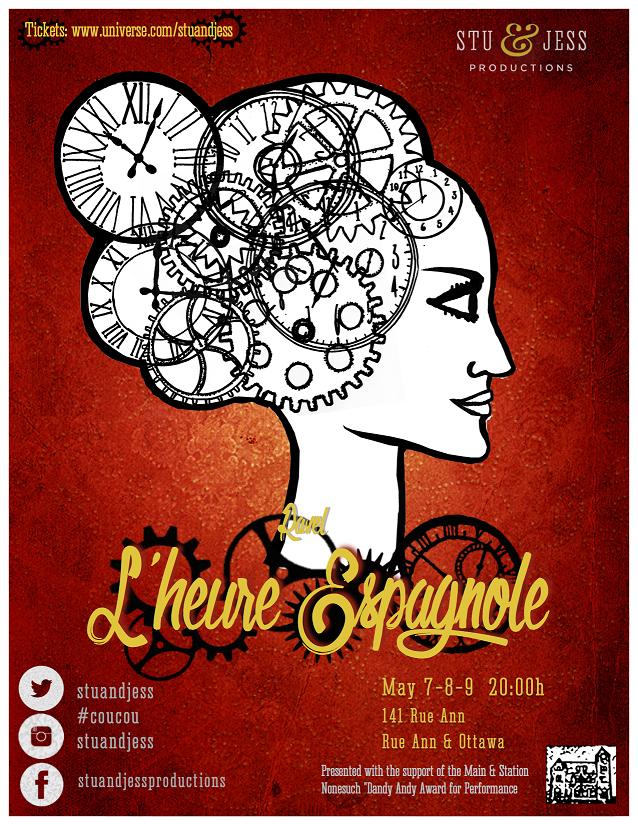
The time is short.  Stu &Jess Productions will be presenting Ravel’s wonderful L’Heure Espagnole in Montreal the weekend of May 7-9.

Stu and Jess are Stuart Martin and Jessica Derventzis.

Conductor and pianist Stuart Martin received his Bachelors of Music at University of British Columbia under the tutelage of Dr. Terrance Dawson in Piano and Dr. Robert Taylor for conducting. In his last year, he was Assistant Conductor of The UBC Concert Winds. Stuart has also been student of Dr. Mark Shapiro at the European American Musical Alliance in Paris, France. In 2013, Stuart was the assistant conductor for Opera NUOVA’s “Don Giovanni”, and an assistant conductor at Accademia Europea Dell’Opera (AEDO) for “La Bohème”. During his time at NUOVA and AEDO he met Jessica Derventzis, and together they created Stu&Jess Productions, a chamber opera company. For their inaugural season, they produced Menotti’s “The Medium” and Bizet’s “Le Docteur Miracle” in Montreal. Just recently, they produced Ravel’s “L’Heure Espangole.” They also commissioned and premiered a new opera, “La Gioconda”, in which Stuart wrote the libretto and another NUOVA alumni, Pasquale D’Alessio, composed the music. This work has also been given a residency with Main & Station to be developed in August 2015. In the 2014 season of Opera NUOVA, he was the assistant conductor of “Candide” under Gordon Gerrard, and had the privilege of conducting the final performance. Stuart also conducted and coached the opera scenes class at the Vancouver Academy of Music for their fall and winter semesters. Coming up for the 2015/2016 season, Stu&Jess plan to produce an opera in Vancouver and Toronto.

Jessica Derventzis is a stage director from Toronto, Ontario. Originally a pianist, Jessica began her studies at Queen’s University as a music major, but quickly added theatre to her studies after accompanying rehearsals for the opera company in her first year, and falling in love with theatre. She went on to direct “Les Dialogues  des Carmélites” and “Trouble in Tahiti,” stage manage “L’Elisir D’Amore,” produce “Glengarry Glen Ross” and “Into the Woods”, design props for “Cabaret,” and become president of the Queen’s Student Opera Company.  After graduating, Jessica took over the theatre department at her old high school, Mentor College. She spent 5 years there moulding young minds and directing over 20 productions including: “Little Shop of Horrors,” “Twelve Angry Men,” “Crazy For You,” “The 25th Annual Putnam County Spelling Bee,” and Neil Simon’s “Rumors.”  Jessica also assisted at the summer opera programs Opera Nuova and AEDO. These programs introduced her to Stu Martin who quickly became her best friend and co-creative mind behind Stu&Jess Productions. So far, they have produced “The Medium,” “Le Docteur Miracle,” and “L’Heure Espagnole” together in Montreal.  Jessica also had the honour of assisting Rob Herriot on two productions with the Calgary Opera in 2014 “Candide” and “Le Portrait de Manon”. Coming up next, Stu&Jess will be writing and adapting their own works and taking their company on the road to Vancouver.

It’s almost time. Ravel’s L’Heure Espagnole goes on May 7.  I had to ask them ten questions, five about Stu & Jess, five more about the opera they’re producing.

Ravel Poster resized

1-Are you more like your father or your mother?

STU:  I would love to say that I am a balance of both but that’s not true. Although I get a few things from my mom, like music, sensitivity and a good liver, I am more like my dad. My dad is a brilliant businessman. He is head strong, completely willing to struggle before coming out on top, and someone who people rely on. I find myself looking up to him and wondering how he does it, but then realizing I am that person, and it shows in the business I am building. Growing up my parents were always very supportive of music, but there wasn’t a lot of music around, except for Barbra Streisand, thanks mom. I grew up around politics, my mom is an elected politician, and business, both my dad and my brother are chartered accountants, and my sister a manager of a bank. There was this really nice balance of how to effectively talk to people, and also build a business. I took on these traits and put them towards music. Conducting needs my moms sensitivity, especially with singers, they are physically connected to their instrument, and you need to be very aware your words. Business side of conducting needs dads skills, organizing, managing, motivating and then ultimately having a successful product you can sell to people.

JESS: This is a complicated question, as I grew up with my mom and step-father, dad and step-mother, plus two very loving grandparents, so I am definitely an amalgamation of all of them. Each is also from a different part of the world, so culturally I am a mixed-bag (Greek, German, Austrian, English, and Portuguese) I find myself saying things that my dad says all the time. He swears a lot in Greek so those have become my favourite curse words- no, I won’t repeat them here! I also look much more like my dad than my mom. However, it’s my grandparents (my mom’s parents) that I think of the most when it comes to decision making, life choices, and general attitude of who I would aim “to be like”. “What would Omi and Opa think of this” pops into my head more so than any other adage.

2-What is the best thing or worst thing about your musical life?

JESS: The best thing about my musical life is that I chose to have it. I decided very early on that I would study piano at university and figure out a career after that, much to the chagrin of my family who wanted me to choose a career path that led to better job security. I’m very happy that I stuck to my guns. Luckily, playing piano for singers led me to the rehearsal hall. In turn, I became a theatre teacher and now I direct operas and run a company with one of my best friends. There are still moments where there is no contract or show on the horizon, or I consider going back to teaching, but ultimately, the fact that I am choosing to be an artist and make music my life, rocks.

STU: The best thing about my musical life, is feeling the high after a performance, or the pride I feel looking back on a production that I have poured months into. The worst thing about my musical life is waking up at 4am having whatever piece I am working on, waking me up and repeating itself incessantly. The only thing I can do to stop it from spinning is listening to David Attenborough talk about penguins or fungi.

3-Who do you like to listen to or watch?

STU: I listen to a lot of podcasts on history. As for music, besides “classical” I listen to anything that makes me want to sing as loudly as possible in my car. Right now, OMI-Cheerleader. I also watch a lot of documentaries.  I have exhausted every documentary in Netflix, and have watched every episode of Nova Science Now.

JESS: In high school, I always wanted to write for Rolling Stone magazine because I love pop culture and the movie Almost Famous. I listen to a lot of popular music: scour the blogs, listen to the radio, and type random things into my iTunes search to see what pops up. I love jazz music most of all and the evolution of THAT style just makes me giddy. My iPod will happily jump from Dixieland to Trombone Shorty.

My favourite TV show is Saturday Night Live. I watch that a LOT

4-What ability or skill do you wish you had, that you don’t have?

JESS: Dancer/choreographer. As a director, I choreograph all the time-to a certain degree. But I’m talking, give me a brand spanking new Broadway musical, a rehearsal hall with a wall of mirrors, and a chorus of tap dancers and let me choreograph THAT! That would be amazing.

STU: I want the ability to have a conversation with my dog. That would be enlightening, especially to find out the reason why he only brings back the ball half of the time. A real skill I would love to have is picking up languages quicker. I love learning new languages, but often I start learning one language it just begins to replace the others.

5-When you’re just relaxing and not working what is your favourite thing to do?

STU:  Favourite things to do are going to the park with my dog, and drinking wine while playing board games with friends.

JESS: I’m an avid walker. Walking helps to clear my head, work through a show, or simply unwind. Especially when travelling to new cities, walking and exploring is my favourite way to spend an afternoon.

*******

Five more about staging L’Heure Espagnole  in Montreal May 7- 9.

1-Tell us about the history of your partnership, how you came to work together and the previous operas you’ve produced.

JESS:  My first encounter with Stu was in the hallways of the residence where we were both staying in Edmonton. We were both assisting at the opera training program, Opera Nuova. I was complaining about the pillow on my bed, and he overheard me and loaned me his because he had brought two of his own from home. We were friends instantly. Our friendship blossomed from there with late-night bowls of cereal, watching RuPaul’s Drag Race, and chatting about our thoughts on the opera and music worlds. Later that same summer, we both went on to do another program in Italy together called AEDO. As a budding director and conductor combo, we knew that we would spend a lot of the beginning of our careers assisting, which is very beneficial, but we were also anxious to stretch our own creative muscles, which was how Stu&Jess Productions was born. For our first production, we decided on Menotti’s “The Medium.”
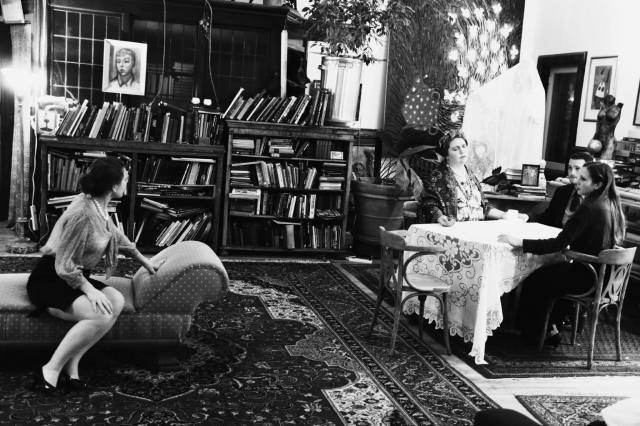
An earlier production: the Medium

An earlier production: the Medium

The eerie plot and gorgeous score drew us in right away. We brainstormed singers that we knew who could pull off the challenging roles of Baba and Monica, and decided on two awesome gals who were studying at McGill at the time, Samantha Pickett and Chelsea Mahan. That is how our love affair with Montreal started. It was also when Stu and I realized how well we actually work together. We trust each other, respect each other’s work, and share the same philosophies for the rehearsal hall; we are both all about collaboration.

2-Talk about what drew you to present Ravel’s L’heure Espagnole

STU: When deciding on our next opera, it takes about 2 or 3 weeks of constant listening and reading. We started looking into a few one-acts that people had suggested, but they just didn’t stick. One rule of thumb that Jess and I go by is, if one of us doesn’t like the opera, we drop it and keep looking. There is no point in doing something that we both aren’t passionate about. I can’t remember who found the Ravel first, but I remember listening to the overture and instantly getting excited. Ravel puts in metronomes at the top of his score to set the scene of the ticking clocks in the shop. Amazing. Then this music starts, and the characters burst through this musical landscape. Each character has their own style of music, Concepcion’s being frantic with hints of seduction, Ramiro being dumpy and innocent, Don Inigo has pompous rhythms and waltzes, and so on. Also it’s such a pay off with this opera because there is no ensemble singing until the finale. You hit the finale and it is this beautiful habanera, with peppy rhythms and accents. When they start singing together it’s like this wave of release of tension that you have not been aware was building. Drama wise, it is also quite wonderful. Fast paced, you can connect with these characters, there’s a clear story, and it’s hilarious.

From rehearsals of L'Heure Espagnole

From rehearsals of L’Heure Espagnole

3) Why this place in Montréal?

JESS: We used this same venue for “Le Doctor Miracle” last season. When we decided on “L’Heure,” this venue popped right into my head because there is a gorgeous, large staircase attached to huge catwalk. In “L’Heure,” our protagonist Concepcion’s lovers are carried to and from her bedroom encased in gigantic grandfather clocks. The stairs add great depth to the setting, allowing us to play with the levels and really encompassing the audience. They will hear commotion upstairs in Concepcion’s bedroom, watch the clocks move up and down the stairs, hear the footsteps, laughter, and any singing that goes on up there.

Stu and I have always been drawn to atmospheric venues, as opposed to traditional theatre spaces. For “The Medium” we used an old church that a man has turned into his home. When the audience walked in, it was like they were in Baba’s apartment. They were so close to the action that they were practically at the séance with the other singers. We crammed 40 patrons plus a 17-piece orchestra into this living room. It was an explosion of sound and a really cool environment in which to experience that particular piece.

In terms of choosing Montreal, it seemed like the perfect fit for Stu and I in the beginning. As I mentioned before, the singers we wanted for “The Medium” were all in school here, so that was the jumping off point. Toronto has a rather large community already to indie opera companies, which is awesome, but Montreal does not. There is only a small handful of companies doing what we do, so we felt that this would be a great place to start and build a niche for ourselves. The art and music scene is already so vibrant, we wanted to explore that.  It has since become a second home for both us, so to speak. Arriving back here and connecting with our friends and collaborators here feels so great.

We are hoping to branch out to Vancouver and Toronto in the future!

4-Talk about your values as artists, what Stu & Jess seek to do when you produce an opera.

STU: As artists, Jess and I are rather similar. We both believe that art should be something that when you leave one of our shows, that you feel like you have experienced something special. We believe that opera was created to be entertaining; it is an art form that people don’t necessarily realize is accessible. This doesn’t mean taking opera and putting shtick after shtick in (unless it involves shoving people in clocks like Ravel has asked), but making opera a balanced force of music and drama. Our goal is to make audience members excited from the moment they purchase their ticket to well after the opera. The idea behind Stu&Jess Productions is that you are going to an event, not just a show to have an expensive nap in. We choose venues that are not traditional in the sense of a theatre, because people feel special when they climb these 3 flights of stairs, open this heavy wooden door and see this loft, as an example. The excitement in the room in tangible and people really get into the opera. We want people to feel comfortable. This extends from the rehearsal room to the audiences in performances. With everything Jess and I do, we try to do with the utmost respect of the artists and people who are paying us to see a show. As a company this isn’t about walking over people, or trying to get on top, this is about creating art, sharing it with the public, and collaborating with a group of artists. We specifically gather people around us that we know want to the same vision of exciting and memorable art. I think one reason we have people still willing to work with us, is that they feel like they really get to explore, and be creative with Jess and I. So often there is a feeling in rehearsal halls that you are told what to do and you move on. With us, we know our vision, but we are not opposed to exploring an idea when it pops up. Two examples in relation to “L’Heure,” are:  In a coaching, our Conception, just for fun, spoke a very important line, and it worked so well that I told Jess that she was in for a surprise at rehearsal the net day. Jess, and the whole room, loved it and now it’s in the opera. Another involves Dimitri Katotakis, who plays Ramiro. He was just kidding around about playing tambourine in this production, and guess what, everyone is now playing an instrument at some point- Dimitri got the tambourine. I hope that if in 10 years Stu&Jess Productions is still around, we will have the reputation of putting on shows that encompass a high quality of music, fantastic drama on the stage, and making it look effortless.

5-Is there anyone out there who you particularly admire, and who has influenced you?

STU: I have many people I admire. Firstly my piano teacher Dr. Terance Dawson who shoved me into conducting class when he found out I was going to take an acting class. This is where I met Dr. Robert Taylor who is one of the most dedicated teachers I have ever gotten to work with. The reason I run rehearsals the way I do is directly tied into how Dr. Taylor does. There is a sense of freedom in the rehearsal hall that you feel like you can still be an artist, but you need to be part of a larger group. Next person on the list is Gordon Gerrard. He has been a friend and mentor for the past 2 years, and last year I assisted him on a production of Candide. Gordon is beyond supportive, and he is always right there when I have a question. I also admire Kim Mattice-Wanat, who is a force of passion. Kim’s program of Opera NUOVA is where Jess and I met, and this year we are going back to conduct and direct their production of Ned Rorem’s Our Town. Lastly, our patron Harvey Lev, who didn’t know us, and gave us his living room for our first opera. Since then we has been nothing but supportive and his arts organizing, Main & Station, has allowed us to get the Dandy Andy award for Performance Arts. He has also now given us a residency grant to work on a new opera we are writing.

JESS: Having had the privilege to sit in a number of rehearsal halls with great directors, I have been influenced by all of them in one way or another. My favourite part of assisting is watching how directors approach their first rehearsal, either the table read or diving into staging. It sets the tone of how the rest of rehearsals will go and establishes the mood in the rehearsal hall. This past year I had the amazing opportunity to assist Rob Herriot on two productions for the Calgary Opera. His approach to directing is the one I am now most trying to emulate. He is incredibly smart and quick-witted. Listening to him talk about his ideas at the production table and then watching how he translates that into a staging rehearsal is fascinating. His mind works in a wonderful way. He is also a fantastic teacher.

On a company level, I have had the opportunity to sit and chat with the Opera5 gang about what we do a number of times over the last few years. Aria Umezawa and Rachel Krehm are two ladies are that I admire very much in this industry. They have built a solid company that is putting on, what I believe to be some of the most creative work in Toronto. They back up a great company mantra with talent and passion; their most recent performance of “Modern Family Opera” is the perfect example of that.

Also, every production of Robert Carsen’s I have ever seen or researched has me drooling and thinking “I would have never thought of that.” His creative brain is one I would love to have a small swim in.

*******

“L’Heure Espagnole” goes up May 7-9 in Griffintown, Montreal. Tickets and more information can be found at www.universe.com/stuandjess


Posted in Interviews, Opera | Leave a comment

Questions for Augustin Hadelich

I’m fascinated to have recently discovered the brilliant, busy young violinist Augustin Hadelich.

click for CD on Amazon

Augustin Hadelich’s first major orchestral recording featuring the violin concertos of Jean Sibelius and Thomas Adès (Concentric Paths) with Hannu Lintu conducting the Royal Liverpool Philharmonic Orchestra, was released in March 2014 on the AVIE label. The disc has been nominated for a Gramophone Award, and was listed by NPR on their Top 10 Classical CDs of 2014. He has recorded three previous albums for AVIE: Flying Solo, a CD of masterworks for solo violin; Echoes of Paris, featuring French and Russian repertoire influenced by Parisian culture in the early 20th century; and Histoire du Tango, a program of violin-guitar works in collaboration with Pablo Villegas. A new recording of the Mendelssohn Violin Concerto and Bartók’s Concerto No. 2 with the Norwegian Radio Orchestra under Miguel Harth-Bedoya is scheduled for release on AVIE this summer (I’ll have to see about getting it!).

The son of German parents, Augustin Hadelich was born and raised in Italy. A resident of New York City since 2004, he holds an artist diploma from The Juilliard School, where he was a student of Joel Smirnoff. He plays on the 1723 “Ex-Kiesewetter” Stradivari violin, on loan from Clement and Karen Arrison through the Stradivari Society of Chicago.

Augustin Hadelich is playing all over. I had already heard about the upcoming tour of the Toronto Symphony (who are playing a fascinating Kevin Lau piece), and then I discovered Augustin Hadelich was coming to play the Mendelssohn concerto in E, one of my absolute favourite compositions since I was a small child.  A first movement as soulful as any ever written, a second movement that you may recognize as the song “I don’t know how to love him” (once it was lifted from the concerto that is) and a last movement like faerie processionals for Midsummernight’s Dream. I can’t wait to hear it again, especially from such a special soloist. The tour takes them to Montreal, Ottawa, after the first concert here in Toronto, this week at Roy Thomson Hall. That’s why I had to ask Augustin some questions.

1) Are you more like your father or your mother?

I grew up in Italy, on a farm. My parents, who are both German, moved there before I was born, and grew grapes and olives. I inherited from my father the passion for music, and a kind of ‘puzzle-solving’ mindset. My father taught himself the cello and piano, how to repair cars, build a house and many other things. Each step is just a problem that he’ll think about for a while, until he knows what to do next. With an instrument as complex as the violin, there are many details no teacher can tell you, where you have to discover the solution yourself. Improving your technique is really mostly about finding solutions to one little problem after another.

And growing up in a rather isolated place, and getting lessons only every few weeks, also forced me to experiment on my own.

My personality, however, is more like that of my mother. She has a more optimistic disposition and believes in the best in people. She’s also passed on her love for languages–it was she who taught me English when I was around eleven years old.

2) What is the best thing or worst thing about being a violinist?

I started playing the violin when I was five years old, and started playing the piano at seven. The violin was always my favorite – its sound is so much like the human voice, so expressive and beautiful. I loved the piano mostly because of the amazing music written for it. While the piano is more of a solitary instrument — pianists spend most of their time practicing by themselves — as a violinist one plays mostly with other people.

Traveling the world as a violinist is what I always wanted to do, and while the constant traveling and work can be stressful sometimes, I really enjoy performing and being on stage. I’ve been enjoying the past couple of years immensely and feel very lucky that I get to do this.

3) What do you like to listen to or watch? When you’re just relaxing and not working what’s your favourite thing to do?

Nowadays it is so easy to watch great movies and great TV series online wherever you are traveling. This definitely makes it easier to be on the road all the time!
I have been really enjoying the Canadian show “Orphan Black”, shot in Toronto actually! I ran across it by chance last year and quickly watched it all.

When I am on a plane, I read the New Yorker magazine on my tablet. I read the whole issue every week and have learnt so much from reading the New Yorker in the past few years. It’s so in-depth, informative, intelligent and beautifully written. I wish there was a magazine of this journalistic quality in German or Italian.

Violinist Augustin Hadelich (photo: Luca Valenta)

Violinist Augustin Hadelich (photo: Luca Valenta)

*******

A few more about the upcoming Canadian tour with the Toronto Symphony beginning at Roy Thomson Hall May 6th.

1) Please talk about the Mendelssohn’s Violin Concerto in E Minor.

Felix Mendelssohn composed his violin concerto between 1838 and 1844 for his friend and concertmaster of the Gewandhaus Orchestra, Ferdinand David. Apparently David asked Mendelssohn to write a brilliant, virtuosic piece, jokingly using the phrase “stilo moltissimo concertantissimo”. Mendelssohn joked back that the soloist’s entire first entrance would consist of a high E. I think the exchange shows that they were great friends.

The work is really well written for the violin, using the instrument to its fullest potential. Even though the Mendelssohn Concerto is one of the most performed and most popular, it is also one of the least appreciated for what a groundbreaking masterpiece it is. Perhaps it is precisely because it lies so well on the instrument, and is often played very early on by young children and students, that it has gained the reputation of being a “student piece”. It’s actually incredibly challenging musically, and I find it one of the most consistently tricky and difficult works to perform in the repertoire. Many later composers (such as Tchaikovsky and Sibelius) were very much influenced by the Mendelssohn concerto and its innovations of the violin concerto form.

2) What’s next for you after the TSO tour?

Later in May, I head to Lausanne, Switzerland to perform the Dvorak concerto there, and after that I play in New York – where I’ve been living for the past 10 years – with the New York Philharmonic! I’ll get a bit of a break in June, before heading off to a busy summer: Performances in Tokyo, Seattle, Aspen, Vail, San Diego, Mexico City, Ravinia Festival, Frankfurt, Oslo… it definitely won’t get boring!
I am also releasing two new CDs this summer: the Mendelssohn and Bartók concertos with the Norwegian Radio Orchestra and Miguel Harth-Bedoya on AVIE in July, and the Dutilleux concerto with the Seattle Symphony and Ludovic Morlot in August.

3) Please talk about the joys of working with Peter Oundjian, and what he brings to music-making.

Toronto Symphony Music Director Peter Oundjian

I first worked with Peter in 2011, in Denver, with the Colorado Symphony (we played the Beethoven concerto). Prior to that I knew him from his violin recordings (when he was playing in the Tokyo String Quartet). The great thing about playing with conductors who are also violinists is that they know the violin repertoire so well. Some violinist-conductors can be very intimidating to play with, and what I love about Peter is that he is very kind and supportive, and has a lot of empathy. I think is also what made him such a good quartet musician–he knows what I’m going to do next, before even I know it. It’s like finishing another person’s sentences, but with musical phrases. And his ego never gets in the way – it is all about the music for him.

We’ve since played together in Seattle (Dvorak concerto), Toronto (Mozart concerto no. 4), and with his orchestra in Scotland (Thomas Adès and Haydn concertos). Each experience was immensely satisfying!

4) Is there a teacher or an influence you’d care to name that you especially admire?

Growing up in Italy, the Italian violinist Uto Ughi was a huge presence there when I was growing up. He was the first soloist I saw perform live, and his lyrical style of playing and beautiful sound was a great influence. I also listened to a lot of David Oistrakh records growing up–he was my other hero.

Some of the best teachers I had were chamber musicians: Norbert Brainin (from the Amadeus Quartet), whom my parents tracked down in Italy when I was around 12 and convinced to give me lessons, and later Joel Smirnoff (from the Juilliard Quartet) whom I studied with at Juilliard. Both of them, perhaps partially due to their chamber music background, taught the whole score, beyond just the violin part. It is amazing how many teachers, even the famous ones, do not really study and teach the orchestral scores of the great violin concertos beyond just the violin part. If you look at the violin part by itself, it seems like you have a huge amount of choices and so many different ways you could play it. But the better you know and understand the whole score, the clearer it becomes how you should play. You’ll be able to see how the composer put the piece together, what the other players are doing, and what it all means. A great composer like Mendelssohn would never write the violin melody first and separate from the ‘accompaniment’– rather, the overall harmonic processes and the expression of the violin are interconnected. Even though the violin is leading the concerto, the violinist has to listen and react to–and often also accompany–the orchestra. In the end, the way the soloist, orchestra and conductor interact in a concerto is really not that different from chamber music.

*******

Augustin Hadelich tours with the Toronto Symphony beginning at Roy Thomson Hall Wednesday May 6th. For tickets and info click here.

Posted in Interviews, Music and musicology | 1 Comment

A Musical, The Importance of Being

I’ve just seen & heard the Toronto Operetta Theatre’s production of Earnest, The Importance of Being, a recent adaptation of Wilde’s play of (almost) the same name.  It was premiered in 2008 by TOT, music by Victor Davies and book by Eugene Benson, a work that I believe deserves to be heard.

The title isn’t just a playful departure from the original.  One of the wonderful things about E,IB as I’ll call it, is how it literally leads with the names.  You may recall that in Wilde’s play –as in this musical work—the drama revolves around the names.  Young Algernon and Young Jack are pursuing Cecily  and Gwendolyn.  They both want someone named “Ernest”.  The discomfort each woman expresses with the other names become exquisite scat, tortured exploration of the sounds of “Algernon” or “Algie”, or “Jack”.  If it’s a truism that a musical begins where words leave off, expressing what can’t merely be said but must be sung, then this central conceit of the play requires music.  I think that raises the stakes, making the transformation from spoken into sung something organic.

There’s a magical moment near the end when Miss Prism tells her story, something that sounds like a bit of Gilbert & Sullivan. That’s what Anna Russell would have told us, and it’s as though Benson and Davies heard her funny bit describing how to write a Gilbert and Sullivan opera.   She tells us about “Dandelion, the large fat contralto with a voice like a foghorn”.  No, Rosalind McArthur is not fat nor does she have a voice like a foghorn (much nicer than that actually!) , but otherwise Benson & Davies follow Anna Russell’s Gilbert & Sullivan template.  Listen to this roughly 1:20 into the excerpt which comes right after the “madrigal”: which come to think of it, ALSO turns up after a fashion in Benson and Davies’s E,IB.  After the madrigal, Miss Prism–just like Anna Russell’s fictitious Dandelion– enters and makes a confession “assisted by the chorus.”

Forgive me if this seems to make light of their achievement.  But part of the brilliance of their version is precisely in the references to what has come before, in alluding to forms & practices to suggest a period and its culture.  Benson & Davies mostly hit the mark.

But excuse me if I mislead you.  E,IB is an eclectic work drawing on several influences. At times I think I hear Romberg alongside the G & S, and sometimes we venture elsewhere, such as a curious ensemble that is like a debate between a can-can (as Cecily confesses her fascination with Paris) and a tango (as everyone else speaks not of Madrid but Birmingham… okay I don’t see why it’s a tango but it sounded great nonetheless.  I am sure Director Guillermo Silva-Marin loved it. And if it sounds good let’s forget about any silly purist notions of how the work should be done. You won’t hear any stipulations from me).

In writing such a review I have to balance my response to the original work –the composition, the adaptation, and the questions of genre—vs the performances and interpretation.  One wonders if one is seeing something that departs from the text and reflects the input of the performers and/or director, or are we seeing something true to the work as written?  And I second-guess, wondering a pair of what-ifs: what if it were written/composed differently, and what if it were performed/interpreted differently.

I believe this work deserves to be heard at a venue such as the Shaw Festival.  But I think the work I heard would be better served by musical-theatre specialists, by performers less intent on singing beautifully (as these were opera singers for the most part), than on being understood.  At times we were hearing fewer than 50% of the lines, which is sad when the chunks of text I did hear were so brilliant.  If it were up to me –and haha in a moment you’ll see why it shouldn’t be up to me—I’d use a smaller band, to make it easier for the singers to be heard, or –as in most musicals nowadays—bite the bullet and use amplification.  I am not a purist, I’m a pragmatist, and I would argue by the way that if Wagner were alive today he’d be the first to advocate amplification, considering that he did the best he could in 1876, by covering the pit at Bayreuth.  While the singing is often stunningly beautiful, the impulse to make a big beautiful sound leads us into a place where lines are unclear.  This is why sub / surtitles are used even for operas in English and might be a welcome addition here.

Clearest pronunciation of the night?  I think it was Jean Stillwell as Lady Bracknell.  I was struck by the thought that she probably looks far more believable than many playing the part, given that the dowager portrayal we sometimes get  (especially thinking of the impersonation by someone like William Hutt) is a handy thing when you’ve got mature actors as Algie & Jack (say in their 40s?) requiring a Lady Bracknell who is completely past it, but must look believably older.  But if the men are as youthful as Cam McPhail and Thomas Macleay? Then Lady Bracknell can be a handsome mature woman, which is what we had with Stillwell.  Forgive me for sounding sexist, but I think there’s additional electricity if for a change Lady Bracknell is beautiful, rather than grotesque.  Stillwell still has star power and her every entrance was aided and abetted by a powerful signature tune from Davies & the orchestra.

Baritone Cameron McPhail

Baritone Cameron McPhail

Macleay and McPhail are an attractive pair with contrasting voices.  Michelle Garlough as Gwendolen and Charlotte Knight as Cecily were stylish in their approach to the comedy, Knight adding lots of delightful coloratura.   Gregory Finney as Canon Chasuble was very pointed in his delivery of his many punch-lines, his warm baritone a welcome addition to the ensembles.

And so, enjoyable as the evening was, the work deserves a chance to be treated not as operetta –that is a funny crossover hybrid where opera singers speak and sing with big opera voices–but an actual musical.  Is that what they wrote and how it should be performed? You tell me, as i think “musical” is as vague and undefined a word as “opera” or “operetta”. We learn ultimately be experimentation, workshops, different approaches.  Among musicologists operetta = musical.  But is there a difference?  I think it’s in emphasis, which is to say, the approach by the performers. Give the piece to a group who can make it as truly brilliant as what was written. Thank you Guillermo & TOT for birthing the baby, nurturing and bringing the work to life; now let it fly out of its nest to find its true home.

Shaw Festival, are you listening?

And one last thought, namely for Conductor Larry Beckwith, who kept the whole eclectic mix going, leading the small TOT orchestra and cast with great clarity & integrity, faithfully serving the score above all.  E,IB has two more performances Saturday night and Sunday afternoon at the St Lawrence Centre.

Posted in Dance, theatre & musicals, Opera, Reviews | 4 Comments

Towards a new theatre vocabulary: Lepage, Cavalia and the legitimacy of aerials

It’s aerial week in Toronto:

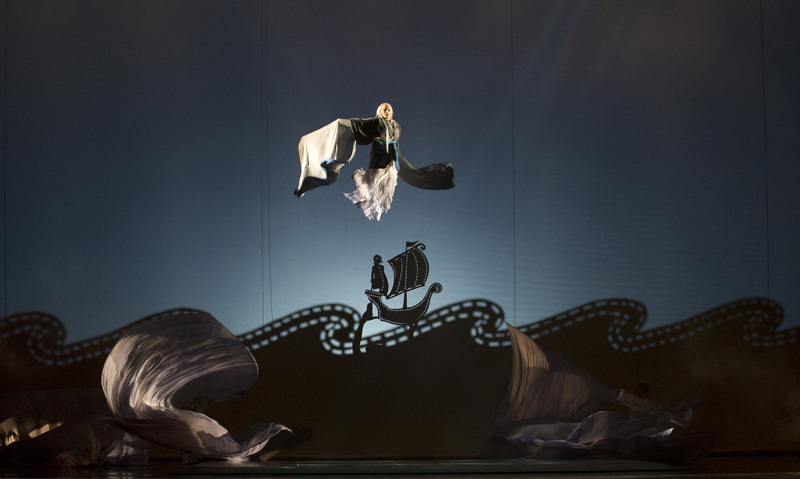
  • Robert Lepage’s pair of brief operas (Bluebeard’s Castle / Erwartung) for the Canadian Opera Company open May 6th at the Four Seasons Centre, including moments when you can’t tell which way is up

    Erwartung, directed by Robert Lepage, set & costumes by Michael Levine

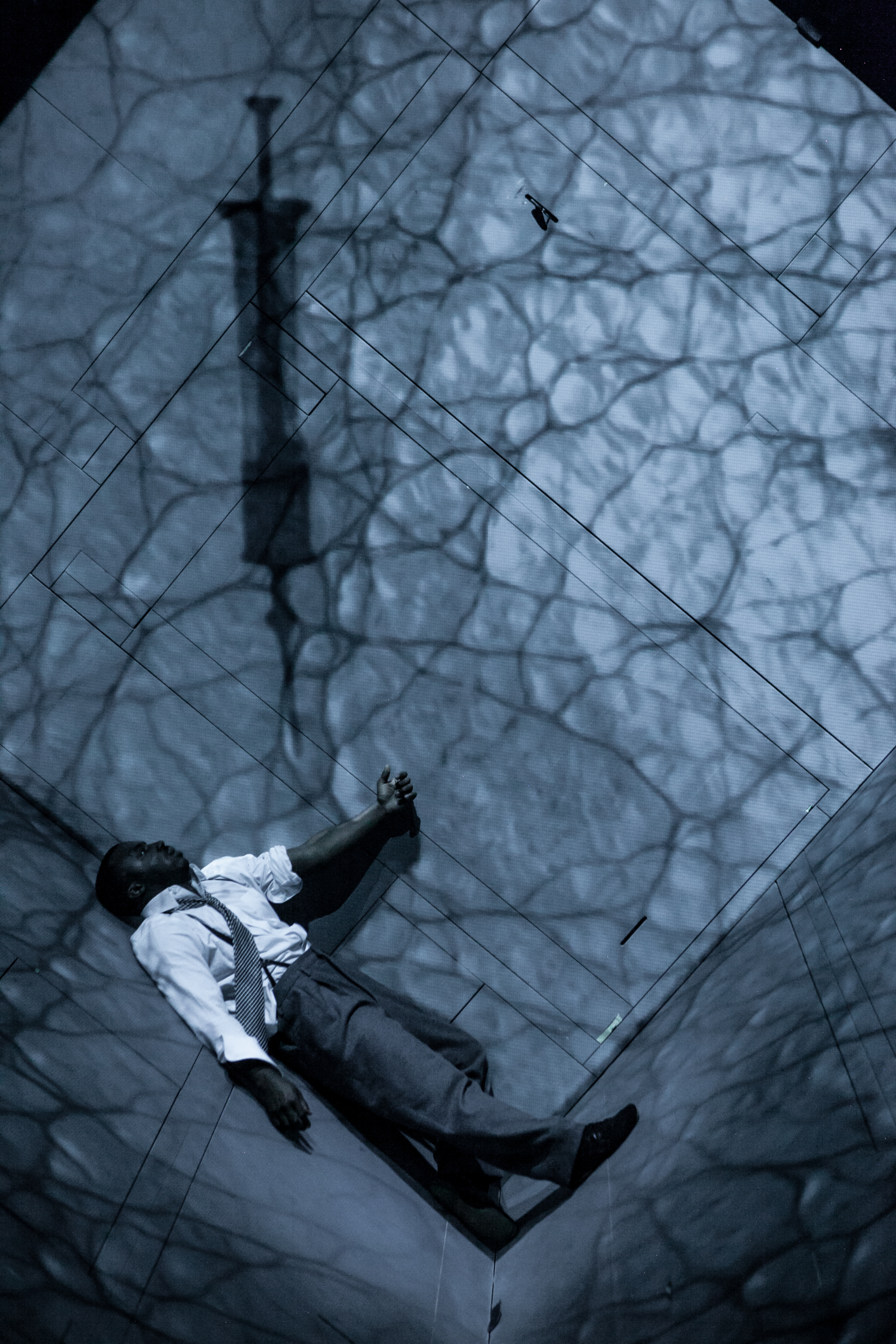
  • Robert Lepage’s Needles and Opium comes back to Canadian Stage May 1st (last seen here just over a year ago), much of it a test of agility as the set rotates while the protagonist attempts to stay right-side-up

     Wellesley Robertson III in Needles and Opium. Photo by Nicola-Frank Vachon.


    Wellesley Robertson III in Needles and Opium. Photo by Nicola-Frank Vachon.

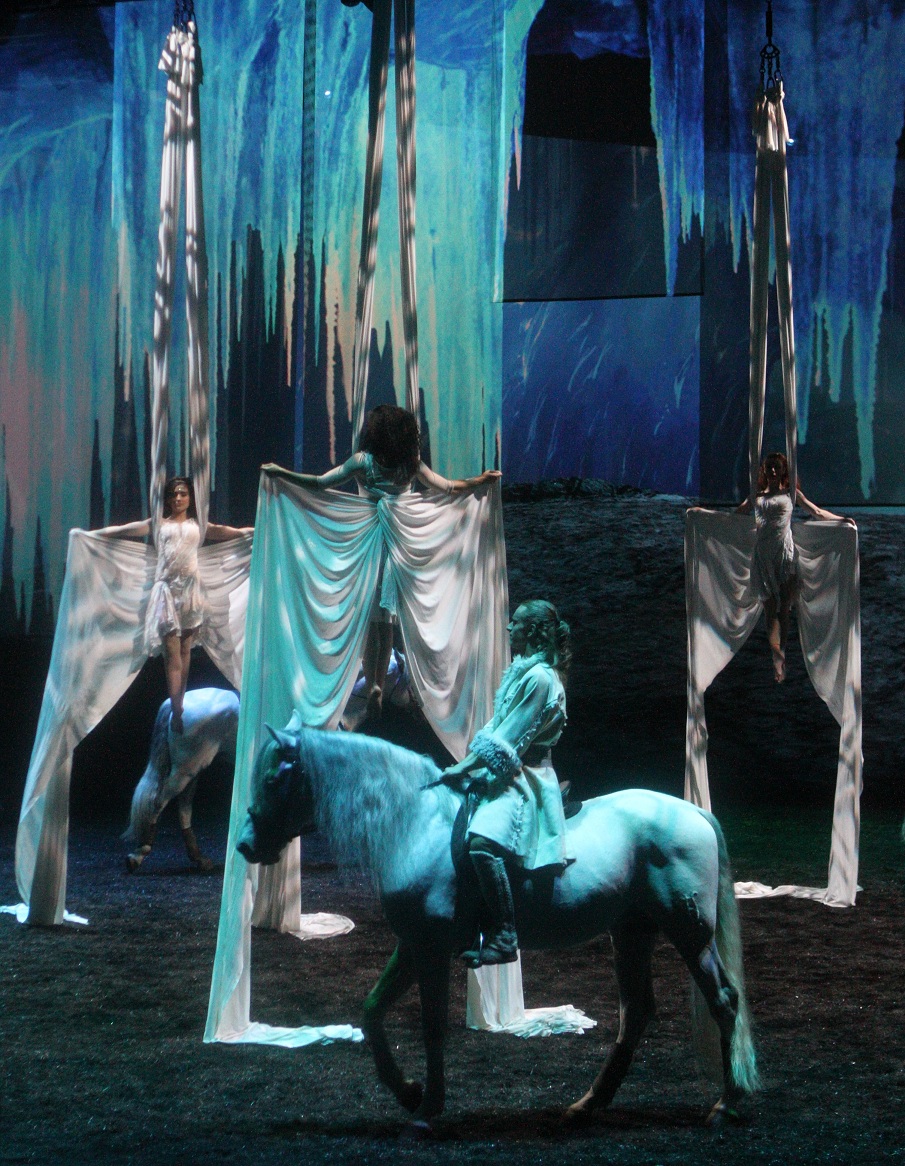
  • And meanwhile, Cavalia continue their mix of horses, acrobats & aerial display in their current show Odysseo on until at least May 24th (review).

Once upon a time someone wrote a song about someone who “flies through the air with the greatest of ease, the daring young man on the flying…”  You know which song I mean because of course you finished the sentence in your head.

But the word “circus” is limiting. None of these shows is really in a ring (the meaning of the word “circus” after all), even if Odysseo does briefly make horse and rider race around inside the confining circle of the enclosed ring space. The “c” word is dated. Gone are the days of entertainments comprised of traveling performers who can barely make a living. No, shows such as Odysseo—currently playing to rapturous crowds under the big white tent on the waterfront in Toronto –or influential precursors such as Cirque du Soleil demonstrate that there’s a lot of money to be made in daring aerial performances.

I’m less interested in the financial questions than I am in the way this plays out in the larger world. What may have started out as a flavour of the month, a case of keeping up with the Jones’s (or Lepages), shows signs of becoming a normal part of opera and theatre. Sometimes such daring displays are necessary, as in a show such as the Broadway Spiderman where the lead character is required to be a daredevil.

But I know I’m seeing these skills deployed elsewhere, and would list more examples if I could think of them. I recall in the COC Love from Afar we saw floating performers to complement the spiritual element of the story.

(left to right) Acrobats Antoine Marc, Sandrine Mérette and Ted Sikström in a scene from the Canadian Opera Company production of Love from Afar, 2012. Conductor Johannes Debus, original production by Daniele Finzi Pasca, set designer Jean Rabasse, costume designer Kevin Pollard, and lighting designers Daniele Finzi Pasca and Alexis Bowles. Photo: Chris Hutcheson

(left to right) Acrobats Antoine Marc, Sandrine Mérette and Ted Sikström in a scene from the Canadian Opera Company production of Love from Afar, 2012. Conductor Johannes Debus, original production by Daniele Finzi Pasca, set designer Jean Rabasse, costume designer Kevin Pollard, and lighting designers Daniele Finzi Pasca and Alexis Bowles. Photo: Chris Hutcheson

In the COC’s production of Semele, recently revived at Brooklyn Academy of Music, at one point Jane Archibald as the heroine has to fly on a wire.

Jane Archibald in the title role,of Handel’s “Semele” at BAM. Photo: Jack Vartoogian (click image for New York Classical Review).

The current Houston Opera production of Die Walküre running until the weekend, puts their Valkyries in the air using machines.

Houston’s Die Walkure (click for more info)

And lest we forget the baroque side of things, Opera Atelier usually have an airborne god or goddess every season: for instance in last month’s Orpheus and Eurydice.  Everything old is new again?

Lepage’s approach seems to be a big part in the shift, making this part of a new normal. He challenges his singers, expecting them to be aerialists.

  • In Das Rheingold he dangles the Rhinemaidens above the stage for 20 minutes, creating a magical effect.
  • Later in the same opera, Loge the trickster god walks backwards up a wall. And at the end of the opera, the gods enter Valhalla, at least with the help of body doubles climbing at a scary angle.  The substitution is similar to the one Lepage makes with Brunnhilde at the end of Die Walküre
  • Lepage’s next operatic venture –in Quebec and also at the Met– was Ades Tempest, again taking us into the air.

    A scene from Robert Lepage’s production of The Tempest at Festival Opéra de Québec, 2012 © Nicola Vachon 2012 (click for more info)

  • Lepage’s first opera at the Met wasn’t really an opera, but Berlioz’s Damnation de Faust, a work that’s wide open to adventurous mise-en-scène. There’s probably more aerial work in this production than any other. My favourite such moment –among many—is the chorus of soldiers & students, when we’re told of the siege of girls’ hearts. The soldiers climb and then die, dangling from the wires, but fresh waves keep attacking and dying; is this a display of futility or simply normal life as it was lived in the time? As usual Lepage drills down into the literal meaning of the text, almost too literal.

Last night I was reminded of those dangling soldiers, watching Odysseo. I tweeted

They resemble angels until the moment it looks as though they might fall. Mortal angels? I guess not. #Odysseo

There is a moment near the end of their routine when the aerialists dangle in a way to remind us that they could indeed fall, as if to say they are mortal after all, very much like Lepage’s soldiers.  Curiously, the photo that was downloaded to media is titled “Les Anges”, suggesting that the overtones of something spiritual aren’t just in my mind.

Les Anges (Photo credit:  Pascal Ratthé)

Les Anges (Photo credit: Pascal Ratthé)

The influences don’t seem to work in the usual way, as this isn’t Cirque influencing Cavalia –two competing spectacles of acrobatic skill. No. I have to think that it’s Robert Lepage possibly influenced by his Quebecois compatriots, possibly himself influencing them. This part of Odysseo is a very abstract kind of theatre that’s far more ambitious than just “he flies through the air with the greatest of ease”.

Because the days of the old-time circus –the place where animals are abused, where survival is marginal–are over and thank goodness.  At the very least Cavalia is a kind of “Circus 2.0”, humane, artistic, and seeking to be profound.  The animals are treated with dignity, the performances an enactment of love.

Don’t be surprised if aerial performance is a regular part of the expressive vocabulary of theatre.

Posted in Animals, domestic & wild, Art, Architecture & Design, Dance, theatre & musicals, Music and musicology, Opera, Personal ruminations & essays | 5 Comments

Barber @ RBA: voice trumps schtick

Today’s noon-hour presentation at the Richard Bradshaw Amphitheatre was a teaser, sampling Act I of the upcoming Ensemble Studio performance of Rossini’s Barber of Seville.  These concerts are usually less than an hour including announcements, but today’s was a very full hour with almost no talk.  I’d say we got our money’s worth, which is fair considering that it’s a free concert.

I’ve already seen the production with the regular cast, a highly visual exploration of the text from Els Comediants that appears to have been influenced by the Commedia dell’Arte.  At times the movement vocabulary from director Joan Font requires his performers to behave as though they were puppets.  I came away from the production feeling a bit unsatisfied, delighted with some brilliant individual performances but unconvinced, at least in comparison to the previous show I’d seen from the same artistic team.

I’m not sure how much today’s concert –using piano (the excellent pianist Jennifer Szeto), and without sets or costumes—is a fair sample of the Ensemble show coming May 15th, but I had many of the same feelings today.  Els Comediants’ understanding of The Barber is something I’d characterize as Regie-light, a director’s theatre that doesn’t mess with the original even as the personas of director and designer are inserted into the field of view & reception.  It’s mostly a good thing, but nowhere near as thorough as the clarity they brought to La Cenerentola.

A concert performance makes it easy to get close to the artistry, without any Comediants interventions to distract us.  All we have is the voices & piano, plus a few stage directions.  While there may be some shenanigans overall voice trumps schtick.  When we were laughing it was because of artistry, not gimmicks.

Tenor Andrew Haji (click image for his website)

Andrew Haji did a star turn today, (echoing the pathway charted by Alek Shrader in the “A” cast) both in his stylish singing and his energetic clowning.  Iain MacNeil gave him a run for his money, making “A un dottor della mia sorte” work the old-fashioned way, namely with a buffo voice & dead-pan delivery.  Karine Boucher showed us that her Berta will likely take a different  interpretative approach than Aviva Fortunata, briefly terrorizing everyone on stage, suggesting that she’s got a genuine gift for comedy; I can’t wait to see what she does with the role, even if it’s brief(was it Stanislavski who said “there are no small parts, just small actors”..?).  Charlotte Burrage, Clarence Frazer, and Jean-Philippe Fortier-Lazure also displayed ample charm & high spirits.

The aforementioned Ensemble Studio performance is coming Friday May 15th.

Posted in Opera, Reviews | 1 Comment

Fearless Metro Youth Opera Béatrice et Bénédict

We live in a funny time.

On the one hand it’s the era of director’s theatre, when operas can be a departure point for elaborate adventures so extreme that the composer’s work becomes mere background music for interpretations of the story that may seem to have little to do with what’s in the text, generating spectacular attention in the press due to booing audiences. Yet at the same time it’s an era of fundamentalism in the musical world, between historically informed approaches, or conductors insisting on an approach of “come scritto”, refusing to interpolate the traditional high notes.

In this minefield of contradictory impulses, companies may surprise us with their productions. Metro Youth Opera is a fairly recent company aiming to create opportunities for young singers & artists in the fields related to opera production.

Perhaps it was an omen that I ran into Linda Hutcheon, literary theorist and author of A Theory of Adaptation at today’s Metro Youth Opera production of Béatrice et Bénédict, Berlioz’s version of Shakespeare’s Much Ado About Nothing. At one time I used to worry about the divergence between the source and the resulting opera, a question I understood as one of fidelity, that I now see as a bogus concern.

Berlioz wrote his own libretto for B & B, freely cutting what I would understand as the main storyline of the opera –the drama surrounding Hero’s slander and eventual redemption in Claudio’s eyes – in favour of secondary plotline concerning  Beatrice and Benedick.  Many of the other characters, both high (Don John) and low (Dogberry) are removed from the story. MYO’s Béatrice & Bénédict is itself an adaptation of Berlioz’s opera by Rob Herriot, using English dialogue and with musical numbers sung in French with super-titles. There’s no chorus and there’s no Somarone (a character we don’t miss). I’m not clear as to whether these omissions are in Herriot’s text or a further change made by MYO, but the point is that MYO presented a very slimmed down B & B, accompanied by music director Natasha Fransblow at the piano, roughly two hours with an intermission. I say this huge preamble in defense of an opera that is outside the standard repertoire (aka the works that are regularly produced) possibly because it’s unfaithful to Shakespeare, even though many popular operas also fail to measure up. Berlioz created a highly original, tuneful piece with much to recommend it, and one that MYO are to be commended for having undertaken.

Alison Wong accomplished a bit of a miracle, shared with her cast members, of making the comedy believable, as though we weren’t watching an opera, but instead experiencing a play.The Aki Studio space is somewhat dry in its acoustic yet so intimate that we’re right on top of the performers, able to see every facial expression. We discover that we care about Béatrice (Simone McIntosh) and Bénédict (Asitha Tennekoon), intrigued by their denials of affection for one another, and the birth of a romance between them. Our empathy begins in the skilful dialogue, as each figure is firmly established. Tennekoon shows us more voice early on, soaring with effortless agility to several high notes.

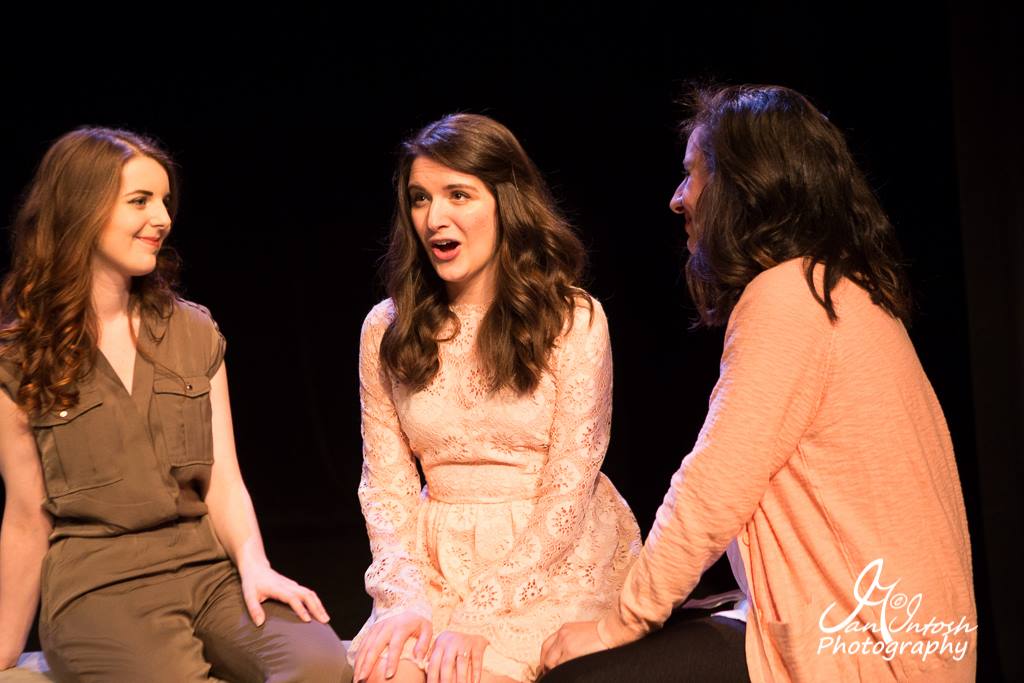
Simone McIntosh, Lindsay McIntyre and Alessia Naccarato (photo: Ian G McIntosh)

Simone McIntosh, Lindsay McIntyre
and Alessia Naccarato (photo: Ian G McIntosh)

McIntosh blossoms in the second act showing off a unique colour; while the role usually goes to mezzo-sopranos she hit spectacular high notes that make me eager to see the path of her future development.

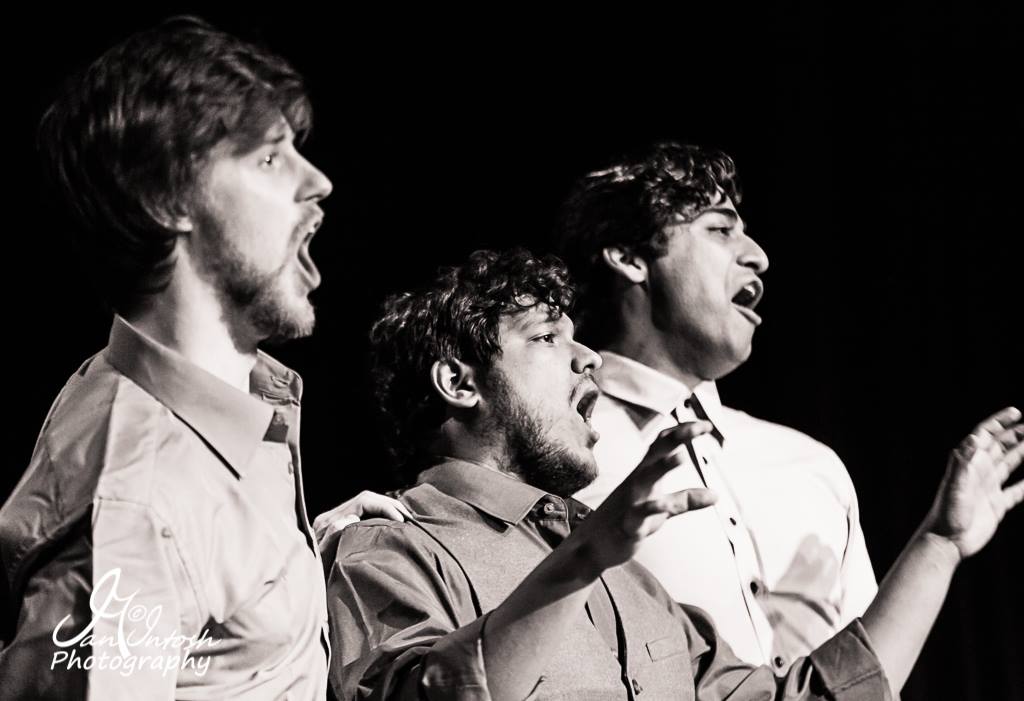
Left to right: Peter Warren Asitha Tennekoon and Janaka Welihinda (photo: Ian G McIntosh)

Left to right: Peter Warren Asitha Tennekoon and Janaka Welihinda (photo: Ian G McIntosh)

Lindsay McIntyre was a delightful Héro¸ especially in her first act aria. Alessia Naccarato’s Ursule was a good addition to the comic mix, her voice blending beautifully in her duets with McIntyre. Janaka Welihinda & Peter Warren were also a pleasure to watch. The performance sparkled on the musical side, the ensembles tightly following Fransblow, often at a brave tempo.

I congratulate MYO Artistic Director Kate Applin for the slightly off-beat choice of opera, an excellent learning opportunity and a brilliant showcase for the fascinating cast she assembled.

Posted in Opera, Reviews | 1 Comment

Youtube’s revolutions, big and small

It’s youtube’s tenth anniversary today.  Much will be written / spoken about the impact of this empowering channel and its imitators, the influence on political movements.  It’s played a role in uprisings & elections, actions both democratic and violent.

And there have been changes in how media are disseminated.  These too are revolutions, even if the changes are subtler.

I’m not troubled by the way youtube helped Justin Bieber, who is really just another teen idol after all.  When all’s said and done he’s a star on merit.

I was more intrigued by the appearance of Gangnam Style (2012) and other overnight video phenomena.   Who could explain the excitement?  People do attempt to explain, but that’s nothing new.  A long long long ago I can still remember how …Don McLean’s American Pie inspired many to try to explain. 

Culture is both the new created object and the conversation that surrounds such objects.

Youtube has impacted everything. Puppets, wrestlers, sports, and yes, even classical music.

A short time ago everyone was talking about Valentina Lisitsa, whose success is inconceivable without youtube, one of the canniest bits of self-invention I’ve ever seen.  What’s so wonderful to me about youtube is how the process has been simplified & democratized.  At one time great artists had to somehow get the attention of a Sol Hurok or a Rudolph Bing, usually with the help of their agents & a step-by-step progression from obscurity to eventual success.  Surely it’s a good thing when artists can reach their audiences without mediation or interference.

But there’s so much more to it than that.  I am inclined to seek the positives, to recognize the ways in which we’re in a golden age.  The internet is a colossal research library, where you can learn about anything at all, and how wonderful that you can also compare versions of your favourite aria or symphony or piano sonata.  Who plays the fastest finale & coda to the Apassionata sonata?  Youtube will help you find this out (and don’t listen to me, do the work yourself).

I did a play in February that included several songs that I couldn’t find in the music library.  The titles and lyrics were in the text, so I thought to look on youtube, finding almost all of them.  And so I notated the songs, which we learned for the show even if they sometimes represented deeply coded texts that could keep a person busy for a lifetime of exploration: which is hardly a problem when we’re speaking of drinking songs.

The fact it’s free is a key part of the equation.  What happens if google (that is, youtube’s owner)  begins charging for the service? Those of us who can’t live without it would adjust somehow, i guess.  I suspect if they do charge, free competition will appear.

In the meantime, I’m sure that things will change, as nothing stands still for very long.  It’s only ten years ago, yet it feels like such a long time.

Posted in Personal ruminations & essays, Popular music & culture | Leave a comment