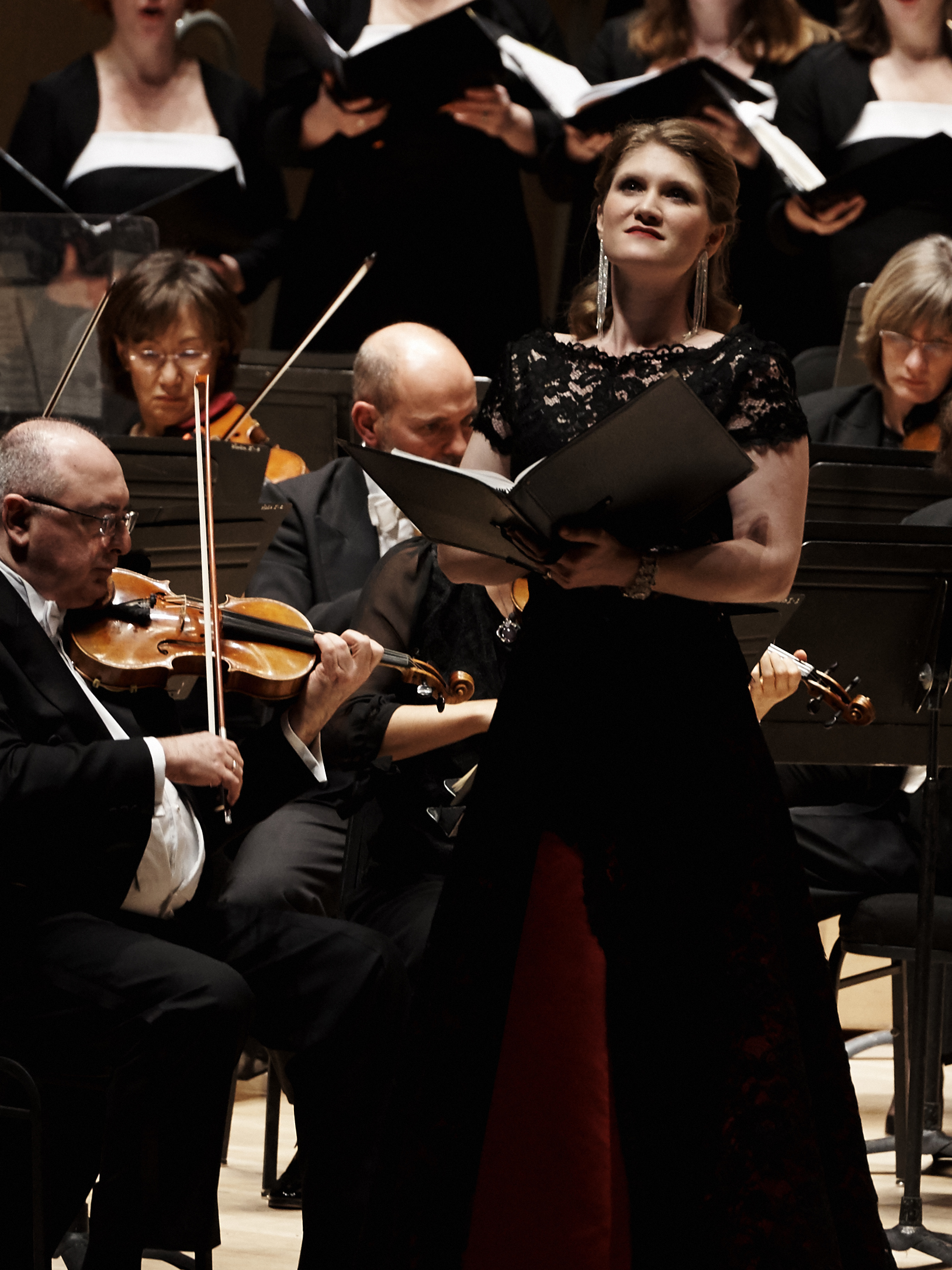
Soprano Jane Archibald with the Toronto Symphony (photo: Malcolm Cook)
It’s Messiah season in Toronto. I understand there are other towns that present Handel’s oratorio, but does any city go quite as nuts as Toronto? Everywhere I turn it’s happening. I sang a bit at my church, a friend conducted some more at her church, and of course, then we all try to hear one of the big ensembles do it.
If you’ll excuse the gross over-simplification, for awhile the city has been divided between the two big alternatives, meaning two approaches that were understood to be diametrically opposed:
The Toronto Symphony Orchestra playing modern instruments in a more modern understanding of Handel
Tafelmusik Baroque Orchestra playing period instruments in a more historically informed understanding of Handel
But if you accept my crude mythology, there were opposite philosophies in place. While the TSO would play the piece in a bigger space with bigger forces (especially the Mendelssohn Choir) using modern tunings, Tafelmusik made it all a bit more effete, with their smaller more elaborated reading.
Except that now there’s been cross-pollination. Tonight I heard the first TSO Messiah of the season led by Grant Llewellyn. If you judged by the tempi or the da capo elaborations you might have been confused, because much of what we heard tonight seemed historically informed. The orchestra and chorus roared through the evening fearlessly. I suppose we shouldn’t be surprised considering what conductors have been doing lately with modern orchestras. I think especially of Harry Bicket when he comes to conduct the COC orchestra, and makes them sound like a period ensemble.
Yes the crowd did stand –and some even sang along—for the Hallelujah chorus. But I think the rules (some overly strict) governing concert behaviour could stand to be loosened. I believe the TSO crowd is unpretentious, out for a good time: and that’s what they found at Roy Thomson Hall tonight.
The four soloists each have a special function or role:
The soprano announces the magical events of Christmas eve such as the angelic appearance, and begins Part III with the direct confession of “I know that My Redeemer liveth”.
The alto sings pieces of great drama, particularly the opener for Part II, “He was despisèd”
The tenor starts things off for the evening, and in Part II plays a huge role in dialogue with the chorus
The bass sings some important announcements, especially “The trumpet shall sound”.
Bass-baritone Philippe Sly displayed a lovely tone, wonderful musicianship even if at times his words weren’t fully clear. In contrast, Lawrence Wiliford made every consonant clear. His second utterance of “comfort ye” was a very original reading (or at least one I’ve never heard before), likely to induce the tranquility and peace he was exhorting us to feel. I saw Allyson McHardy sing Messiah with Tafelmusik a couple of years ago, and it was again marvelous, as she’s very comfortable with this music.
I was sorry to hear that Jane Archibald is nursing a cold, as she was the voice I was most eager to hear tonight, a singer who has had great success in Toronto (Zerbinetta & Semele with the COC, and a Juno award-winning CD before that), and will be right back to take a starring role in a little over a month, her first Donna Anna in the COC’s Don Giovanni. We were grateful that she didn’t cancel, as it was great to see her up there, sounding quite lovely.
It’s a Messiah full of highlights, accurately played and sung, and powerfully dramatic at this time of year. Handel fanatics shouldn’t hesitate.
Handel’s Messiah continues with the Toronto Symphony at Roy Thomson Hall Dec 17, 19 & 20 at 8:00 pm, plus on the 21st at 3:00 pm.
I am way behind in reviewing the CDs & DVDs i have been receiving in the mail, or the ones i have been buying. This little summary may be too late for Christmas shopping although there are also the gifts we give ourselves, in that happy orgy known as Boxing Day (or is it boxing week?). It’s an anachronism speaking of recordings as if they’re exclusively on CD &DVD when so much content is now downloaded, but i find the discs convenient. Does the medium you use matter? I’m really talking about the content, whether it’s on vinyl, 8-track, cassette, VHS, or anything else you can think of.
Looking back at the year’s reviews I can see I’ve been very pre-occupied with certain sorts of content. As I do a quick statistical tally for 2014 I found the following:
I wrote twelve reviews of either CDs or DVDs of classical music / opera
Four would be located in some part of the romantic period: Allureand the three Stratton CDs
One is about half a century old (Riel) while the other three are from the new millennium (Baby Kintyre, Julie, Cobalt)
I am very fortunate to receive recordings from artists & recording labels, including unsolicited surprises turning up in the mail. Sometimes I have to wait a long time before writing, but occasionally I don’t write because I don’t know what to say. I have a few more reviews up my sleeve that I hope to publish in the next little while, likely too late for Christmas.
There are a few recordings that I listen to or watch obsessively.
On my laptop? it’s Gerald Finley. I’ll be posting a review of his Meistersinger one of these days, which I watched on the weekend for the first time. I posted a bit about it (as well as other recordings he’s made) in the wake of the COC’s Falstaff earlier this autumn.
Michael Slattery, who will be appearing with the Toronto Consort in March
In the car? I’ve been playing the Toronto Consort Christmas recording The Little Barley-Corne in the car a great deal lately, which i reviewed recently. Speaking of Toronto Consort, the only CD I’ve played as frequently in the car is Dowland in Dublin, a CD that anticipates a March concert from that same Toronto Consort, who will be welcoming Michael Slattery and La Nef. I marked this on my calendar long ago as one not to miss.
I’ll be posting more reviews in the next little while.
I barely scratched the surface in my review of Against the Grain’s #UncleJohn from late Thursday night. With one prominent exceptionI barely mentioned anyone. I am cocooning Saturday because of the cold that burst in on me like a stone guest (although considering Joel Ivany’s adaptation perhaps Peter Schikele’s “Stoned Guest” might be more apt), pounding in my head. The headline could be me surrendering, even if my laptop is no substitute for a nap. Maybe later…
So where the first piece was an attempt at something logical and orderly, this is more like the remnants of the wedding reception, glasses still half-filled and unfinished plates to be collected. I’ll spare you the sound of my blowing my nose, which has been likened to a cross between a Disney character and a foghorn. Think of Marley’s Ghost played by a duck.
I was struck by a few things reading other reviews, enjoying the agreements and the diversity of responses. I’ll aim to say what hasn’t been said; otherwise I’d already be napping.
I want to look at –and properly celebrate–what Joel Ivany accomplished. Were there three types of action?
Dialogue (which may have been dry recitative originally, but was re-written into fluid lines)
Accompagnato (corresponding to accompanied recitative that you don’t mess with, such as the grim discovery of the body by Anna & Ottavio)
Arias & ensembles
I suppose opera has always been a hybrid whose grafts are visible, where the shifts of gears from one style to another can be jarring, especially if the singer treats the recit as mere preparation for their big solo, and in so doing kills the dramatic illusion, thwarting anything natural and organic in the process. I saw less of that than usual on this occasion, but even so I wondered whether Ivany’s respectful treatment of Mozart may not always have been the best pathway. The flow of the dialogue was so compelling that the music did not always seem like the natural outgrowth it should have been. I’ve never seen opera do this, showing us opera singers acting so powerfully that the music is almost superfluous. Each of the principals is so well thought out, so crisply executed that the music is like icing on a cake. Even so, there are good reasons for recit to sound lame, as it sets up the (hopefully) better segment that follows. If the recit were too good it would disbalance things. Perhaps the solution (if anyone else even thinks this is a problem…) would be to trim some of the cleverness that (for me) seems to upstage Mozart when we finally get to the music, making it seem like an anti-climax or a strait-jacket of convention imposed on something fluid and alive. When it works –as it did in the reinvented Catalogue aria—the setups are golden. I was rapt for the encounter between the Commander and John (and fascinated that Ivany’s translation didn’t shy away from the religious overtones of their confrontation), and then not really satisfied by the closing ensemble: an ensemble that I usually find to be an arbitrary tonal shift that may not fit with what came before; but Mozart didn’t make this one easy for anyone.
Ah but then again my head was starting to explode from my cold so maybe I was more sympathetic to a guy popping pills (just like me the past couple of days!) than all those happy peppy people at the end.
I was in too much of a rush Thursday to properly address several contributions. Most glaring was my omission of Zerlina & Masetto, namely Sharleen Joynt and Aaron Durand. In the worst productions of Don Giovanni that I have disliked, I always still like these two. Can anyone dispute that Zerlina has the most beautiful music in the opera? (disagree? “la ci darem”, “batti batti” and “vedrai carino” would be my choice for the three prettiest tunes in the opera). Mozart was trying to tell us something about love & marriage, as indeed Joel Ivany was also reinforcing with his beautiful & direct translation. How could you not melt listening to Joynt asking Durand to marry her while staring up at him as they cuddled in the middle of the stage?
And no i didn’t take a picture; i was a puddle on the floor, remember? This one will have to do in its place…
L-RL Sean Clark, Miriam Khalil (sorry that she’s facing away,,,) Neil Craighead, Betty Allison, Aaron Durand and Sharleen Joynt, giving Leporello what-for.
I think Ivany is true to what da Ponte & Mozart wanted in three different types of relationship:
Ideal matrimony:
that’s Masetto & Zerlina once they realize it (with UncleJohn’s help actually), and needing very little adjustment in the adaptation
Woman pursuing a man:
Elvira is the most modern of the three women, unsatisfied with the one who has her heart
Man pursuing a woman:
Donna Anna keeps stringing Don Ottavio along, decade after decade (or so it seems); that Anna dumps Ottavio at the end is perfect after what I’ve seen in every other production (sad to say).
This is the first time we’re seeing the adaptation, which had an earlier life in Banff. I hope good #UncleJohn has another incarnation, to see what new ideas they might have, to say nothing of the different chemistry created by casting. AtG seem to be here to stay, a company that’s still small but offering remarkable quality & insight with everything they do. As usual they’re making theatre that’s informed by musicianship.
Next for AtG?
Death & Desire with Colin Ainsworth, Krisztina Szabó and Christopher Mokrzewski in May 2015, in other words Schubert (“Die Schöne Müllerin”) and Messiaen (“Harawi”), presumably in Toronto.
A Little Too Cosy, a new adaptation of Cosi fan tutte in July 2015, in collaboration with the Canadian Opera Company and the Banff Centre (who also host the production).
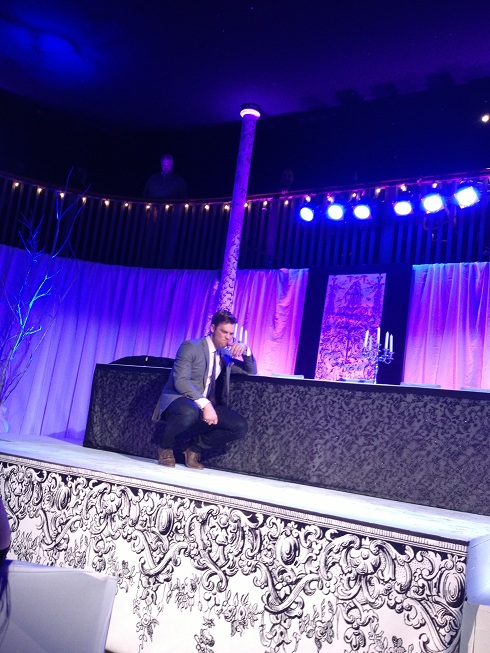
Cam McPhail deep in thought or perhaps it’s just withdrawal. Give the man a tylenol for goodness sake.
Against the Grain Theatre premiered #UncleJohn, their new adaptation of Don Giovanni tonight at The Black Box Theatre at the Great Hall on Queen St West after workshops out west at the Banff Centre. As much as anything this was the first night for a new concept as well as a new show.
AtG partnered with the Canadian Opera Company and the Banff Centre, and will do so again with A Little Too Cosy, their upcoming adaptation of Cosi fan tutte, to complete their survey of the da Ponte trilogy of Mozart operas. The business model is perhaps more exciting and original than the actual opera presented onstage –which wasn’t too shabby—given that opera is in big trouble all over the world. Big companies are struggling with big overhead, in the salaries for orchestras, chorus and other staff members. Opera is understood to be the most expensive art form, so naturally this comes with the territory.
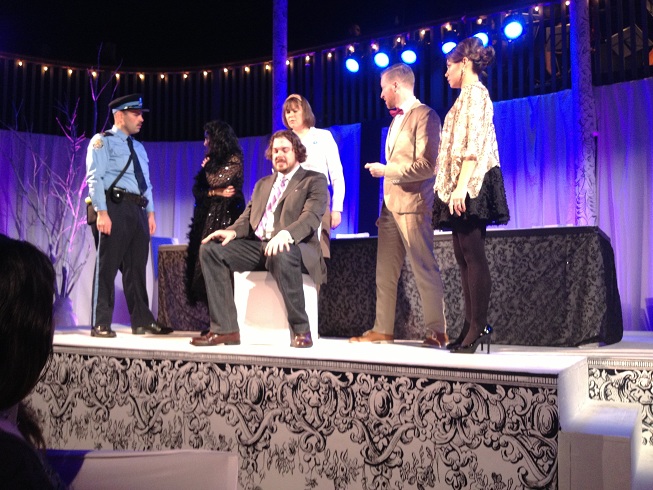
Left to right: Miriam Khalil, Sean Clark, Betty Allison and Cameron McPhail
Or does it? AtG offer something a little simpler. They don’t have a permanent chorus or orchestra, even though they have been gradually tippy-toeing in that direction. While their Messiah last year used a chorus and (if I remember right) their largest orchestra yet, the important point to note is that they have not turned it into something permanent, tying them down with entitlements & pensions. The sound for tonight’s performance was just about right, the small space of the Black Box Theatre filled comfortably by a string quartet plus piano, played by music director Milos Repicky, and no chorus. While the oomph of chorus might be welcome in a few places it would make no sense in Joel Ivany’s modernized story. There are no mass groupings of peasants on an estate, just Torontonians.
There’s no arguing with the business model. It works, or to put it another way, the other one is terribly precarious, depending heavily on private funding and government support. While the government is there in Austria & Germany –where opera has a huge audience and so remains viable—they’re the exceptions to the gradual change to more austere models the world over, Canada included. AtG appear to be in better shape than their bigger parent –the COC—who are in a much more precarious position, balancing huge expenses with revenues from various places. I love the COC orchestra & chorus, but worry about the viability of the company in the long run.
Ivany’s adaptation is every bit as remarkable as what he created with Figaro’s Wedding (first of the trilogy) in 2013. There are aspects that I quibble with just as I did in 2013, yet overall this is new without feeling like Regietheater, where the director is like another author competing or overlaying texts upon the original. It’s simply modernized but still largely faithful to the original text. I don’t want to spoil it for anyone but suffice it to say that almost all the music you know and love is there, including an appearance by the Commendatore in the last scene.
Some of Ivany’s touches are brilliant. By now I cringe whenever I see someone putting a mobile phone into an opera, even if people still titter at the effect. But this time it made wonderful sense when Leporello –who usually disguises himself as the Don to woo Donna Elvira early in Act II—communicates to Elvira through the phone: the perfect modern medium for this sort of dissembling. Neil Craighead is a messy foil to the tidiness of the Don, the man who gets the most punchlines all night and doesn’t miss once. Putting the entire opera into the context of the wedding of Zerlina & Masetto, with Anna as the daughter of the caterer, helps to make up for the mixed blessing of the venue. At times it was bizarrely real to hear music from the other venue blasting into our space, exactly the way it would if we were in one of those rented banquet halls where so many weddings happen in this city.
The concentration of action around that wedding made some sense, even if it was accomplished at a price, namely reinventing Donna Anna & Don Ottavio without any of the nobility that they had in the 18th century version. It made the new version of “il mio tesoro” one of the highlights of the evening, wonderfully sung and acted by Sean Clark, now more of a soliloquy to anyone who will hear his complaint, concerning his manhood, and probing the numb passivity for which the character is known. Donna Anna became Anna, still a character who seems to have little ability to laugh at herself, making soprano Betty Allison’s job extra challenging.
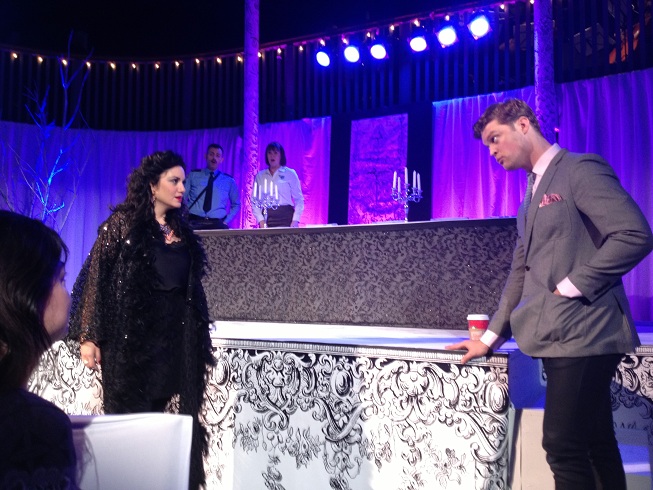
As a result #UncleJohn shuffles the key relationships ever so slightly. Anna and Ottavio are now a comic pair who seem even lower in the social hierarchy than Zerlina & Masetto; that’s only jarring if you insist that AtG do it as written, a stipulation I’d never make. The two key figures are now Elvira and John (formerly Donna Elvira and Don Giovanni), which is perhaps a reflection of the brilliance of the two performers.
Miriam Khalil’s centrality to the production might be a reflection of her centrality in Joel Ivany’s life as his partner and the mother of his little boy. But she makes the most of every moment, including the most scintillating reading of “Mi tradi quell’alma ingrata”, the big aria that usually tests audiences’ ability to stay awake, coming as it does in the latter stages of the opera. It can seem like an add-on, it can seem like part of the battle between two divas seeking to one up each other. Or in this case, it’s a wonderful affirmation of the empowerment that Elvira is seeking while hoping to redeem her relationship with John, and got one of the biggest ovations of the night.
And speaking of John, Cam McPhail demonstrated a level of star power in his singing & acting that suggests something very radical about the COC Lite business model: that there are wonderfully talented Canadian singers who can actually out-do what you see from the COC. This should be no surprise. It’s an open secret, one that has been whispered in my ear repeatedly since I posted a diatribe about the bizarre spectacle of David Pomeroy’s photo advertising a COC Madama Butterfly sung by a pair of imports who were inferior to the Canadian tenor who was busy singing in Manitoba instead.
Back to McPhail, this is a very intriguing reading of Don Giovanni –aka Uncle John (no hashtag because I’m speaking of the character this time, not the opera). He’s cruel yet manages to be likeable. His charisma is genuine. The voice has nuances, including two brilliant re-makes of famous arias:
the champagne aria –“fin ch’han al vino” –becomes the cocaine aria, and suddenly the quickness of the aria makes incredible sense (and yes it’s the fastest reading i think i’ve ever seen)
the serenade by the window –“deh vieni alla fenestre”—becomes a soliloquy about drugs (hm,…no wait, it’s still a love song-serenade, but he’s singing his little love song to the drugs)
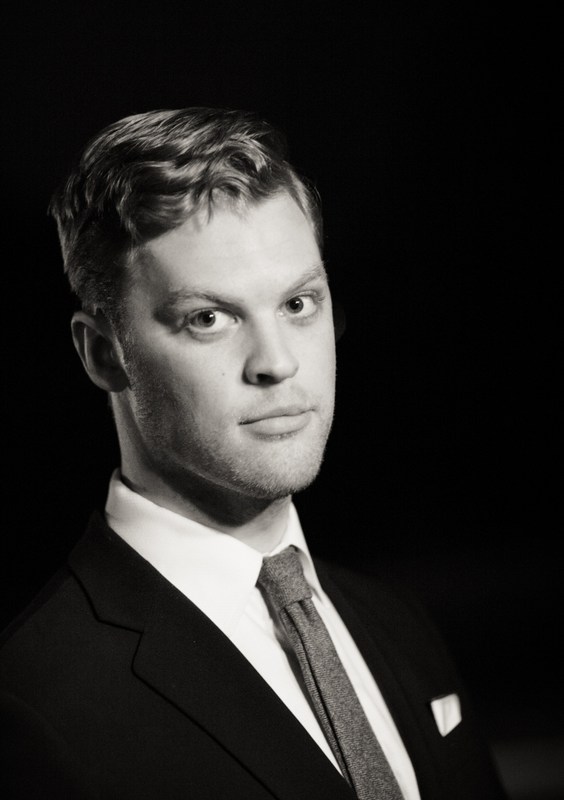
Baritone Cameron McPhail
McPhail carries most of the darkness in the work, more intelligible in his enunciation of the English in this libretto than anyone else in the show, which is a good thing considering he had the most lines by far. But while he’s the one who goes to the dark side, he’s balanced by John Avey as The Commander (formerly the Commendatore), standing his ground musically and physically in this life and maybe the next.
Thank you Edward Johnson Building library, once again I found treasure in the collection that never disappoints.
I’d grabbed a great mass of scores in anticipation of a couple of gigs, never knowing fully what to play, but wanting to let my impulses lead me.
One pathway of association is the magic of transcription. People sometimes want to hear a tune that they know, whether it’s a pop-tune, a jazz standard, or something classical. There’s an incredible sensation of power in playing something as a piano solo that you’ve heard massively from a full orchestra. This is true whether it’s originally for piano and later orchestrated , (as with Mussorgskii’s Pictures at an Exhibition, a suite that I prefer on piano, especially the last few) or an orchestral piece that’s been transcribed for piano. The most exciting composers I’ve ever experienced in transcription are Berlioz and Wagner, two composers of massive scores that defy easy reduction.
It was in the realm of transcriptions that I found the aforementioned gem. Perhaps it’s a lost art, but at one time these transcriptions performed an important function. Without a piano transcription it was otherwise impossible to encounter some new compositions. If you were a composer and nobody wanted to play your orchestral pieces, a transcription could help champion your work: which is precisely what Franz Liszt accomplished for Berlioz & Wagner. Nowadays one can easily hear scores on youtube (or of course via various recorded media that you pay for), but in the 19th century? the only way to encounter some music was via a piano reduction.
And that means either you had to play it yourself or hear it played for you. Live music was the only option.
Live performance represented a special nagging part of Glenn Gould’s life. As you may recall, the Canadian virtuoso, famed for recordings such as Bach’s “Goldberg Variations”, made an unprecedented decision to abandon live performance. It wasn’t because he was a recluse or an introvert (although come to think of it, maybe he was those things too, and the personality type was a contributing factor), so much as his preference for recordings, the control he could exercise over dynamics and background noise in a studio. His was a very modern view of music that is in many ways still far ahead of its time. Recorded music offered a pathway to achieve the perfection one imagines while reading a score.
Let me illustrate further by talking about the gem I found. It’s Glenn Gould’s transcription of passages from Wagner’s Götterdämmerung (or “Twilight of the Gods”). If the opera’s name doesn’t scare you, the published piece is called Morgendämmerung und Siegfrieds Rheinfahrt, or Dawn and Siegfried’s Rhine-Journey. To get some idea of what’s being compressed for the piano, let’s listen to the original. The prologue to Act I of Twilight of the Gods has two scenes:
A slow but portentous scene of the three Norns, who weave fate in the dark: and announce the imminent End of things.
Sunrise, an exciting duet between Siegfried and Brünnhilde, and after they say goodbye, he rides off into the morning (just to confound fans of westerns, where they ride off into sunsets instead).
The recording that follows is also a kind of transcription from the opera. In this one Wagner is edited down to orchestra only, without any singing. Now, listen to this full orchestra version, and imagine how you might distill it further by playing all those louds notes as a piano solo.
This is a kind of program music because the music comes from an opera, deriving at least some of its beauty from its story and what it’s signifying. The story? We begin with the darkness that precedes the dawn. After a shift into B-flat and a quiet statement in brass of Siegfried’s motif followed by Brunndhile’s theme in the clarinet, the music begins to grow in loudness & intensity, as if to suggest sunrise, dawn and perhaps two people going out into the day. The lovers are about to say farewell, as Siegfried goes off in search of further adventure. The duet is a kind of pledge of eternal love, building to a climax as Siegfried rides off. Does the music in any sense depict his journey? Or perhaps we’re presented with ideas and themes relevant to the story that’s to unfold. Whatever it signifies, this is especially spectacular when it’s presented by the unique sound of the Cleveland Orchestra brass.
Did you notice the astonishing array of colours Wagner brings to individual moments? That’s part of the challenge for the pianist, who has to emulate 100 instruments of various colours on a solo piano.
The essence of a piano transcription is live performance, the transmission of a composition through a live medium whereby the pianist defies the complexities –for instance, all the notes played by perhaps 100 players suddenly reproduced by one person on one instrument—in daring to imitate and portray something so huge in a compressed and miniaturized form. No wonder then that this was a common pathway for virtuosi, particularly Franz Liszt. While Liszt was a humanitarian in helping out relatively unknown composers (Berlioz & Wagner most prominently, both through his transcriptions and financial assistance, but also as a champion of their work in his own programming), playing such wonderful music made him look good in the process.
Now let’s zip forward to the 1970s. Glenn Gould last played a live concert in 1964. In transcribing he was not celebrating liveness at all, because his transcriptions would be studio entities. Not only would his performances be on record rather than live, but there’s another dimension that’s pure Gould. There are impossible passages where there seem to be so many notes that two hands couldn’t possibly execute the passage, no matter how virtuosic. How could he do it? I wondered as soon as I heard these recordings, and now have confirmation, both from seeing the score that I took out of the library, and after reading the splendid introductory essay from Carl Morey:
Emeritus Professor Carl Morey
Dawn and Siegfried’s Rhine Journey has the unusual feature (shared with and more extended in the Prelude to Die Meistersinger) of having been written for a kind of four-hand duo performance. Gould first recorded the main piano part, then put on ear-phones so that he could hear his own performance and dubbed a supplementary part over the first recording. The final recording thus presented a texture that is complex beyond the capability of even the most brilliant single pianist.
I’d wondered about this when I first heard Gould’s album of Wagner transcriptions, especially the Meistersinger prelude, where the overdub is very clear.
The irony of this floors me. The live performance of transcriptions affirm virtuosity in a live setting, a display for the pure purpose—and exquisite pleasure—of showing off. These big loud pieces are an incredible ego trip to play: except that’s not what Gould wanted. He sought instead to get closer to the ideal text in the book, the reified distilled essence of Wagner, not the live experience of Wagner. That is what the goofy headline is about, that in contemplating an ideal Wagner in the studio far from the crowd, divorced from singers & live performance, Gould creates something that’s not performable live: not without an extra pair of hands, that is.
Here’s Gould’s performance. There are a few seconds missing at the end, but you have the final cadence and a good idea of the piece. If i had an alternative link to substitute i would.
Gould’s creation (as published in the book i withdrew from the library) is a very playable score, at least until we come to those impossible passages that require you to suddenly grow a third and fourth hand. When one tries the comparable passages in the piano-vocal score (with an accompaniment that’s far from simple) one at least encounters something for two hands, yet even this too can be challenging (and loud!). Gould’s score is more pianistic, a piece that stands alone.
While we’re at it there’s one hugely important detail I want to mention. As a child I encountered the orchestral excerpt –not the Cleveland one, but another version—without any voices. The piece ends with a nostalgic return to the triumphant E-flat of the beginning that gives the piece a wonderful sense of symmetry and a happy ending. But that’s not how it goes in the opera. Oh no. Siegfried does not happily ride off into the sunset. He dies, murdered in Act III of Götterdämmerung. I can still recall the sense of wrongness I felt the first time I heard the opera, a visceral sense of dread and horror before Act I even begins.
Have a listen (three parts) to the relevant passages from the opera including the vocal parts.
1. Dawn and beginning of love duet:
2. Conclusion of love duet, beginning of Rhine Journey:
3. Conclusion of Rhine Journey (the key discrepant passage begins at 4:44):
I believe this discrepancy –between the concert version with its happy ending and the way it flows in the context of the opera—might be one of Wagner’s great achievements. “Might” because I am not even sure it’s his achievement. I understand from my reading that he approved of the excerpts from his operas—that helped publicize his operas—but I don’t know who is really responsible for this insightful ending, going back to E-flat. I believe that it’s implicit in the music, that a tone-poem that were affirming tradition rather than seeking revolution would revert to the home key. I wish I knew more about the creation of the concert piece with its happy ending.
Stanley Kubrick: The Exhibition is currently on at TIFF Bell Lightbox until January 25th. You know it’s a happening when you see people dressed in special costumes.
A droog and I contemplate a model of the maze from The Shining
When the droog is actually a polite gentleman sharing quips with no threats of violence you know you’re in a special place.
I am a great admirer of Stanley Kubrick, a film-maker whose influence is under-estimated in my opinion. As a student & scholar of film-music I believe he is the single most important director of the 20th Century, a pioneer and a great artist. Where Bernard Herrmann is perhaps the most revolutionary composer of the first century of music in the cinema, Kubrick outdoes him with his insights as a director, reinventing film music in the process. Come to my film music course and I’ll be happy to explain in detail.
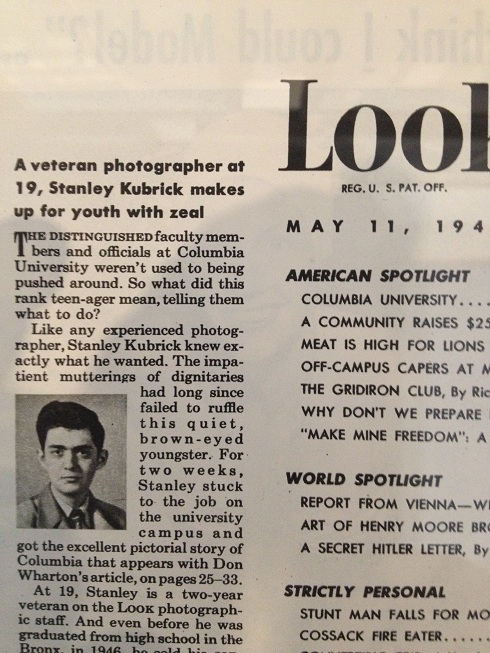
Kubrick’s background as a still photographer in his youth followed by documentary film was important groundwork for his unique style. Part of the exhibit shows us his work at Look Magazine, a career that began amazingly enough at the age of 17. Yes he was clearly a prodigy, a brilliant young nerd before we had even invented the werd… er i mean word.
A picture of a young Kubrick in Look Magazine
Walking through one encounters his work chronologically, a combination of informal still photographs, drawings, paintings, models, story-boards and other artefacts alongside examples from the films themselves.
Model of war-room from Dr Strangelove
It’s highly immersive, as each successive film & its world grabs you, alongside pictures of the actors and the director sharing a laugh or smoking a cigarette between takes.
It’s my very poor photograph, which hopefully doesn’t violate anyone’s copyright. In person they’re quite breath-taking.
Whether or not you’re a fan, you’ll learn more than you expected. I didn’t know, for instance, that Sterling Hayden –the General in Dr Strangelove –also stars in The Killing from a few years previous. I knew about AI, the unfinished idea that Steven Spielberg concluded with the approval of Kubrick’s widow. I didn’t know about the unfinished Napoleon project –which we see diagrammed in detail—that was shot down by studios due to the failure of Sergei Bondarchuk’s Waterloo. I had no idea Kubrick had a holocaust project in mind –again illustrated and explained—that he had to abandon when Spielberg made his own film.
Is HAL getting a little long in the tooth?
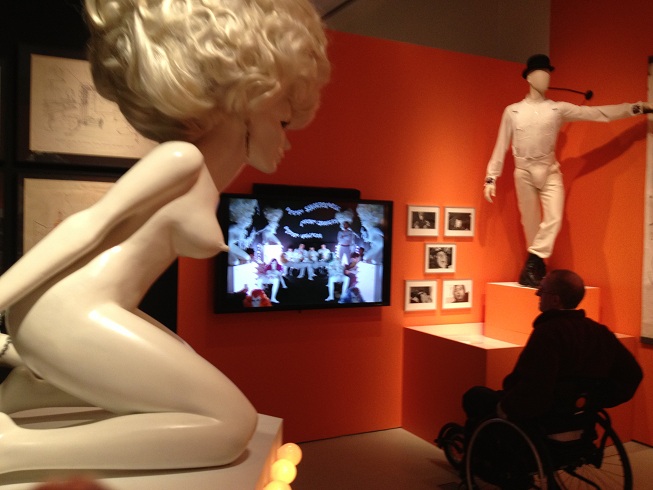
It’s a very densely packed show, with more imagery & information per square foot than you’d normally find at, for example the AGO. I believe art galleries want us to have space to meditate and experience the art, whereas this space is much tighter, with music from (for example) 2001 or A Clockwork Orange seeping into your current space from the room around the corner, unavoidably. I suspect that’s more of an issue for me because I am more aural than visual. Yet it works brilliantly, the way previous films by a director stay in our eyes and ears to impact our current film experience.
The Clockwork Orange room
It’s a fabulous show, brilliantly curated. I’d like to think they’d do as brilliantly with any director, but let’s not forget that Kubrick’s work is above and beyond. See it while you can.
And in the meantime we’re having a Kubrick festival at home the next few days. Spartacus. Lolita. Dr. Strangelove. 2001: A Space Odyssey. Clockwork Orange. Barry Lyndon.The Shining. Eyes Wide Shut.
I’ve never seen tenor Colin Balzer in person, but I did watch his Don Ottavio twice in the broadcast of Tcherniakov’s Don Giovanni presented by TFO less than a year ago: when it was becoming evident that the COC would be presenting the same production here. In my review I made the following comments about Balzer as part of Tcherniakov’s rethink of the opera:
It’s all quite new, even if it’s also very different from what we expect. Is that a problem? I don’t think so, as I love this kind of adventure, especially with a familiar text. For example, in Don Ottavio’s “dalla sua pace”, portrayed by Colin Balzer, we get the real subtext. Although he’s speaking of his desire to help his beloved Donna Anna find peace, we see him go into a foetal position as he sings, taking comfort from her instead.
Sorry, I didn’t mention that the acting is committed, nuanced, subtle, the voice, beautifully coloured and never unpleasant. See for yourself.
Perhaps we’ll see him in an opera here someday, likely in the early rep he’s known for (anything from Dowland to Handel up to Mozart); but he’s also recorded songs by Hanns Eisler, an under-rated composer of the 20th Century. Born & originally trained in British Columbia with an international career, he’s appeared in Toronto before, but I regret that I somehow missed the chance to hear him before.
In a couple of weeks he’ll be here in Toronto to sing in Messiah with Tafelmusik Dec 17th-21st (the latter the sing-along version). In 2015 Balzer, is especially thrilled…
“…to be playing Ulisse in Monteverdi’s Il ritorno d’Ulisse in patria at the Boston Early Music Festival this coming summer. The Festival is doing all three of Monteverdi’s operas this summer, so it is a real thrill to be a part of it.“
But in the immediate future, Messiah, the occasion for asking him ten questions: five about himself and five about his work on Handel’s masterpiece.
1-Are you more like your father or your mother?
Tenor Colin Balzer
That’s a tricky one. I have the volume and quick wit of my mother but the sense of humour and intensity of my father. Also his hairline.
2-What is the best thing or worst thing about being a singer?
Best thing: Being able to physically produce sound waves which might bring even a small amount of beauty into the world. Worst thing: Accidentally spitting on the people in the front row. Apologies to all those who have received a sprinkling for the sake of diction.
3-Who do you like to listen to or watch?
I love jazz. In high school it was jazz that opened the worlds of music to me. I couldn’t get enough of its creativity, improvisation, and sense of play. Be it a solo vocalist like Chet Baker, Sarah Vaughan, or Jon Hendricks, or a vocal ensemble like Take 6 or the latest iteration of The Swingle Singers, I keep coming back to them.
4-What ability or skill do you wish you had, that you don’t have?
Pistol squats. Look it up. Those things are crazy.
5-When you’re just relaxing and not working what is your favourite thing to do?
Probably cooking for my wife and kids. I still get to be creative and improvise but the focus is on putting stuff in their mouths rather than stuff coming out of mine.
Tenor Colin Balzer, bearing his all
Five more about undertaking Messiah with Tafelmusik
1-Talk for a moment about the challenges of Handel’s Messiah, especially for the tenor.
The biggest challenge with The Messiah is its own popularity. How do you balance the expectations of the audience with the need to stretch and surprise them.
As a tenor, you have to hit the ground running with Messiah. You are the first voice the audience hears (at least those that get there on time) so you get to set the tone vocally for the whole concert.
2-Please tell us about working with Ivars Taurins as Handel, and how he is in rehearsal and in preparation.
Ivars is always a joy to work with. He is supremely prepared and I suspect that he has a special nickname for each and every phrase and gesture. Ivars’ Messiah is lithe and agile without being reckless, it is passionate and sincere without being sentimental. Together with Tafelmusik’s fantastic orchestra and stellar choir, it is one of the most enjoyable and satisfying Messiahs that I have had the privilege to be a part of.
And when Ivars dons the persona of Handel, what you have in the Sing Along Messiah is nothing short of epic. If you love music, if you love to laugh, if you are partial to German accents, then you will love the Sing Along. I guarantee that you will leave with more “good will towards men” than when you entered.
Ivars Taurins as Herr Handel (photo by Gary Beechey)
3-What’s your favourite moment in Messiah ?
Definitely the final Amen chorus. It starts intimate and prayer-like. By the end you’ve got church bells ringing, fireworks going off, the heavens opening up… I usually can’t even sing the final phrases I get so choked up
4-Messiah can be seen as theatre, as music, and for some so religiously inspired as to be genuinely sacred. Where do you place the emphasis among those three (drama, music & spirit)in preparation & in performance?
I definitely place the emphasis on spirit. For me it is music with a message. I think that this is one of the reasons why The Messiah remains so popular today: it speaks directly to our humanity. The themes of hope, sacrifice, suffering, redemption, peace and celebration haven’t become any less relevant. Instead of calling it religiously inspired, I would say it is religiously inspiring.
5- Is there a teacher or an influence you’d care to name that you especially admire?
James Fankhauser, my university choir conductor and the former director of the Vancouver Cantata Singers. Under his skilled baton I first encountered so many of the great works from the repertoire, including The Messiah. His art is still the measure by which I judge every conductor I have ever worked with. Most are found wanting.
*******
Tafelmusik present Handel’s Messiah December 17-20, 7:30 pm at Koerner Hall, followed by the Singalong at Massey Hall December 21st at 2 pm:
Directed by Ivars Taurins, with
Lydia Teuscher, soprano
James Laing, countertenor
Colin Balzer, tenor
Brett Polegato, baritone
The Singalong Messiah led by Herr Handel (photo by Gary Beechey)
Brett Polegato is a baritone with a beautiful voice.
He’s a capable interpreter of songs, for example, in the recent Canadian Art Song Project concert:
“I was more delighted by Brett Polegato’s loveliness of tone –one of the nicest baritones to be found in this country—than the actual songs. “ (from March 2014)
But the voice is always at the service of dramatic intelligence, for example as Don Giovanni with the Canadian Opera Company:
“We get a Don for baby boomers: an aging lover, visibly past it, possibly close to the end. Instead of the usual visit from the Stone Guest, come to take the Don to hell for his crimes, his various victims gang up on him. Masetto is disguised as the slain Commendatore. We never see the death certificate, so we don’t know the cause of death, but this Don likely dies from a combination of fright, guilt, and perhaps sexual exhaustion (reminiscent of Strauss’s orchestral Don). This Don, portrayed by Brett Polegato, transgresses Da Ponte’s libretto from the very first glimpse. As with the Eugene Onegin he gave us last season, this is a thoughtful and world-weary lover.” (autumn 2008)
And more recently we saw that in a star-turn in the COC’s Cenerentola:
“While prettier of voice than DiStefano, Brett Polegato’s Dandini gave DiStefano a run for the money. Polegato had a voice that’s apt for bel canto while being one of the comic stars of the performance.” (April 2011)
There’s a comprehensive bio on his website that gives you some idea of his range, including such highlights as Dmitri Tcherniakov’s Bolshoi Wozzeck or Pelléas at the Paris Opera. While we’ve heard him in Toronto singing Messiah with the Toronto Symphony, this time he’ll be singing with Tafelmusik under Ivars Taurins in Koerner Hall. After this engagement, Polegato is headed to England to sing Mahler’s “Lieder eines fahrenden gesellen” in the New Year.
But first, Handel in Toronto. In anticipation of this Christmas treat, I ask Polegato ten questions: five about himself, and five more about the project.
Baritone Brett Polegato
1-Are you more like your father or your mother?
I think I’m pretty evenly split between the two. Although, to be honest, I can only go on what people say about my mother as I was 10 when she passed away. I think I have her sense of humour and her desire for creativity. But I definitely have my father’s temper (which I try to control!) and his bravado (after all, he was Italian through and through).
2-What is the best thing or worst thing about being a singer?
For me the greatest thing about being a singer is that you never entirely figure things out – not your technique, not the music, not the poetry. You can spend your entire career / life striving to understand all three things, but at the end of the day, there is always more to discover about you and about the art form. The worst thing about being a singer is, hands down, the time away from family and friends. Fortunately, you learn to make lasting friendships wherever you go and that helps to see you through the times you are on the road.
3-Who do you like to listen to or watch?
To be honest, I never listen to music when I’m at home. For me, music is not a passive event so I find it hard to have it as background music – I always get caught up in it, regardless of what it is! This is why I hate music in cafes, shops and restaurants. And while I like to watch TV, I am much more of a reader. I have well over 2,000 books in my TBR pile (to be read) and nothing relaxes me more than sitting by the fireplace at home, in a quite house, with a book.
4-What ability or skill do you wish you had, that you don’t have?
I wish I could write. While I am rarely intimidated by people, I confess to getting tongue-tied around authors. To be able to create worlds and populate them with interesting characters is, for me, an unbelievable gift. There is great joy than being moved by words.
5-When you’re just relaxing and not working what is your favourite thing to do?
See above.
Baritone Brett Polegato
*******
Five more about undertaking Messiah with Tafelmusik
1-Talk for a moment about the challenges of Handel’s Messiah, especially for the baritone.
Messiah is, hands down, the piece I have lived with the most in my career – a career which now spans 22 years. I have sung every version of every aria – include the Mozart transcription – and have recorded the work three times. Especially for the baritone, I think the work makes exceptional demands. Clearly, the arias were not written for the same singer! But for me, it is so word-driven that it helps inform my technique. It has a phenomenal range – two octaves alone in “The Trumpet Shall Sound” – and requires the singer to be both declamatory and reflective; to execute dazzling runs and beautifully sustained and lyrical passages. I have sung well over 100 performances in my lifetime and I never get tired of singing it. While this is true of all pieces I perform, I remind myself at each performance of this piece ESPECIALLY that there is someone who is hearing the work for the first time. And someone who is hearing it for the last. And in both cases, I want them to remember it and be moved by what I do.
2-Please tell us about working with Ivars Taurins as Handel, and how he is in rehearsal and in preparation.
Ivars brings such passion and commitment to this piece that he is a joy to work with. I have never seen him go on autopilot in a performance; he gives his all and inspires us to do the same. As a soloist, I feel he respectfully gives me room to be myself and to experiment. And he does all of this with joy and a sense of humour. But make no mistake: he has the utmost respect for Messiah and expects all involved to share that respect.
3-What’s your favourite moment in Messiah?
Hands down, my favourite moment is the final “Amen.” I love how it starts as this lone voice after the extroverted praise of the section before, and then builds to this tremendous climax at the end. It always has me grinning from ear to ear.
4-Messiah can be seen as theatre, as music, and for some so religiously inspired as to be genuinely sacred. Where do you place the emphasis among those three (drama, music & spirit) in preparation & in performance?
While I always try to find the drama and the music in every piece I sing, when I sing concert works I am keenly aware of the spiritual force inherent in so many of them. And when performed at Christmas, Messiah carries a special message for many concert goers. I strive to keep that at the forefront of my performance. The words are incredibly uplifting and – especially in something like “The Trumpet Shall Sound” – impart a sense of hope and peace especially in these troubled times. I have been given a great opportunity and responsibility as a performer and I try to make them count!
5- Is there a teacher or an influence you’d care to name that you especially admire?
There have been so many people who have helped and guided me along the way that there is no way to name them all. But – even 36 years later – I still think of my mother, especially at Christmas, who was the greatest woman I’ve ever known. Her life on this earth was too brief, and I’ve never stopped missing her. I try to live each day in a way that would make her proud.
*******
Tafelmusik present Handel’s Messiah December 17-20, 7:30 pm at Koerner Hall, followed by the Singalong at Massey Hall December 21st at 2 pm:
Directed by Ivars Taurins, with
Lydia Teuscher, soprano
James Laing, countertenor
Colin Balzer, tenor
Brett Polegato, baritone
Tonight was the fourth public competition for membership in the Canadian Opera Company’s Studio Ensemble.
I missed the first one in 2011.
The second was held in November 2012, in the Richard Bradshaw Amphitheatre, aka the space in the upper lobby of the Four Seasons Centre, where free noon-hour concerts are held with piano.
Almost exactly a year ago tonight we come to the third such contest, christened “Centre Stage”. The event was clearly growing, upgraded to the R. Fraser Elliott Hall accompanied by the COC orchestra led by Music Director Johannes Debus, rather than piano. Where the second was a fairly serious singing contest –think opera meets American Idol—the feel of Centre Stage (2013) was decidedly gala & glitz, complete with a rendition of “That’s Entertainment” from the orchestra and Rufus Wainwright as host. The event now had an important fund-raising dimension added (although maybe it was there in year 2 but I didn’t notice).
For 2014 the COC have taken a slightly serious turn, de-emphasizing the glitz and returning to more operatic values. Oh it’s still a fund-raiser as well as a gala competition. But instead of Rufus’s singing we had three solos from someone only announced as a special guest, namely Adrianne Pieczonka, while the judges were off comparing score-cards.
Governor General Michaëlle Jean invests Ben Heppner as a Companion of the Order of Canada at Rideau Hall in Ottawa in 2010. (Fred Chartrand/Canadian Press)
Ben Heppner was a very warm & witty host. His quip “now that’s how it’s done” after Pieczonka’s solos brought the house down. He anchored the presentation in the COC & its history, given his credibility as
one of the biggest stars Canada has ever produced,
coincidentally one of the greatest graduates of the Ensemble Studio and
the current voice of opera on CBC radio.
I don’t see how they can improve on Heppner next year. If they ask him to host again i don’t think anyone would be disappointed. Nobody minded that Johnny Carson was a perennial host of the Academy Awards.
For 2014 the competition was even more concentrated, with seven finalists on the stage at the Four Seasons Centre, instead of the nine we heard last year and the ten in 2012:
Michelle Siemens mezzo-soprano with arias from Roberto Devereux and Le nozze di Figaro
Nathan Keoughan bass-baritone with arias from Il barbiere di Siviglia and Le nozze di Figaro
Zoe Band mezzo-soprano with arias from La clemenza di Tito and Vanessa
(first place) Charles Sy tenor with arias from Die Zauberflöte and L’elisir d’amore
(second place) Dimitri Katotakis baritone with arias from Le nozze di Figaro and Roméo et Juliette
(third place) Aaron Sheppard tenor with arias from Le roi d’Ys and Cosi fan tutte
Eliza Johnson soprano with arias from Idomeneo and Roméo et Juliette
Charles Sy was a popular winner, capturing the Audience Choice Award to go with his first prize.
Sy offers an answer to a question implicit in this competition, namely “what should i sing if i want to win?” Some in the competition showed us their broad range, their versatility, challenging themselves in the process. My first impression of Sy, though, was simply “what a beautiful voice“. Sy’s two arias show us what he can do, pure and simple, and what he does he does very well. If there’s a lesson for anyone musing about what to sing at a future competition, first and foremost, figure out what repertoire shows off your voice to best advantage. This is not like one of those diving competitions where you get extra marks for “degree of difficulty”. If you’re singing something simple but singing it beautifully? I think you have a better chance of winning than if you select something off-beat or clever, no matter how brilliantly you sing it.
While I think Sy was a worthy winner, I have words of consolation to those who didn’t win, including some wonderful performances from people who came up empty. Centre Stage is a contest to select spots in the Ensemble Studio, and that means that you’re partly at the mercy of the luck of the draw. Some years there are holes in the ensemble needing to be filled, due to impending graduations from the existing Ensemble Studio. All seven singers had moments of excellence; they should all hold their heads high whatever the outcome.
Spoiler alert: this discussion requires me to give away a bunch of plot points, so if you haven’t seen this film & want to, don’t read this OR don’t complain if I give it all away.
(OH AND YOU MIGHT LIKE IT A LOT)
One of the roles I play is the concerned parent figure for the kids in my life, watching children’s films to ensure they’re safely watchable. The violence in Maleficent is a bit beyond the current little ones for whom I’m caring, so they’re not going to be allowed to see it anytime soon. Yet someday I do hope they’re able to watch this.
There are aspects of this story that are way beyond what you’d expect in a Disney film. The brand seems to be in another reinvention, given the upcoming Star Wars installment, likely to give them a colossal boost at the box office, if not also in credibility.
This time? we revisit a story known from fairy-tales, indeed from Disney’s own canon. Sleeping Beauty was adapted in the 1950s, including a remarkable step-mother I remember fearfully from my own childhood. In that version there was no mistaking her as anything but the villainess.
But in revisiting this tale Disney give us a fairly sophisticated second look at the circumstances of the story, a rationale for the nastiness that seems so inexplicable in the story. How can we reconcile ourselves with the cruelty of Maleficent? Perhaps if there’s more to her than meets the eye, a back story and a history to justify a nasty curse.
The main character is portrayed by Angelina Jolie, a role with disturbing resonances with her real life persona. See if you see any similarities.
Maleficent is a mother figure. And Jolie is a mother figure, indeed possibly the most remarkable mother figure in the popular imagination, both as the mother of her own offspring and as an adoptive parent.
Maleficent is violated, as she is betrayed by her lover, left crippled by an act of shocking cruelty, waking up with her two wings cut off. Is it just a coincidence that Jolie endured a double mastectomy? I was devastated watching the horror of her violation in the film, and thinking about the horrible parallel to her life. I can’t help wondering if the film-makers were aware of this. We watch Maleficent cope with her emotions, and then see someone who is virtually disabled, arising from her injuries and remaking her life thereafter. I don’t believe I’ve ever seen anyone go through something like this in a children’s film.
I had to confirm for myself that I wasn’t saying something horrible that would upset people, so I googled “maleficent jolie mastectomy”, finding that Melissa Kort in Ms Magazine saw the same thing I saw. Yes of course, this is a violation, but it’s also an epic recapitulation of Jolie’s mastectomy. I know that when the parallel hit me I started crying uncontrollably. I never expected the plot of a film that is so superficially beautiful might take me to such a deep place.
And of course there’s a kind of miracle in the relationship of Aurora and Maleficent that reminds me of the comparable relationship we see in Frozen, another tale from Disney where it’s not the boy-girl pair but an unexpected relationship that is offered up as the example of true love.
This is no kids film, though, given the profound violence onscreen. I’m not comfortable letting a child see so much killing and violation. It will have to be later, when they’re a bit older. A happy ending doesn’t compensate for so much trauma, although I feel healed by the end.


 It’s a Messiah full of highlights, accurately played and sung, and powerfully dramatic at this time of year. Handel fanatics shouldn’t hesitate.