Talisker Players: Puttin’ on the Ritz

click for more information

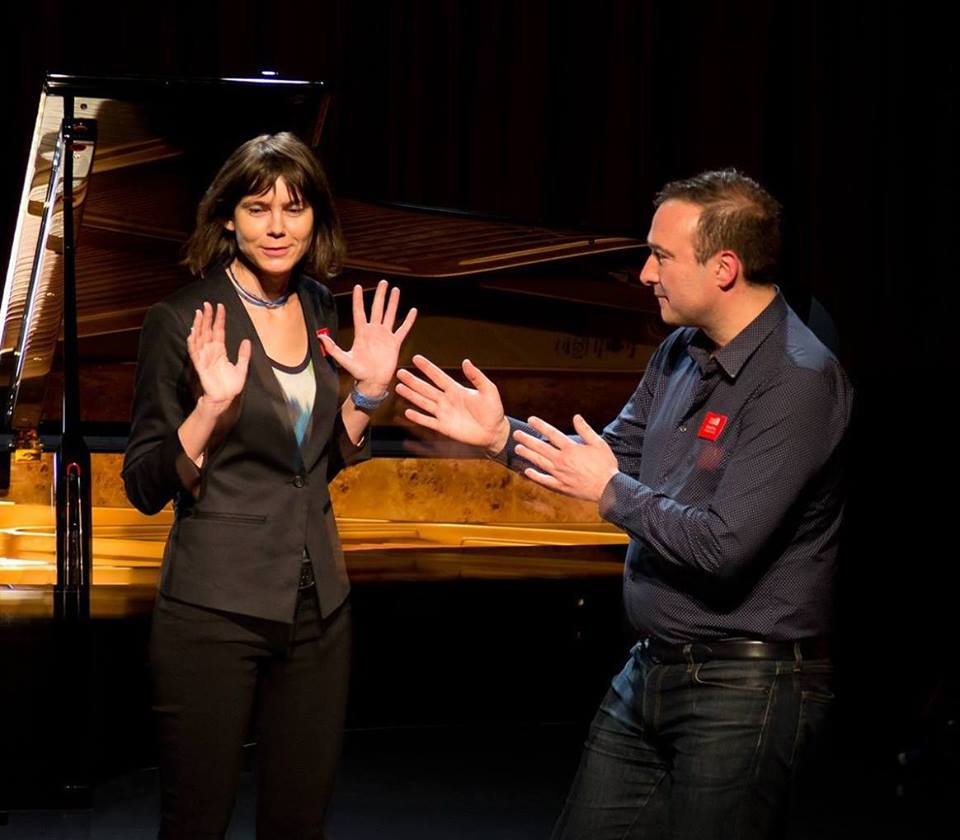
Talisker Players, that inter-disciplinary nexus for music & text, have made another crossover adventure. “Puttin’ On the Ritz” takes us into the world of Irving Berlin, in a series of songs sung by Bud Roach and Whitney O’Hearn.

I’d call it crossover for a number of reasons:

  • Because the songs don’t have anything like the usual sound –such as what you get from a piano, a jazz trio or a pit-band for music-theatre–because they’re instead arranged by cellist Laura Jones for the Talisker Players: a string quartet that includes Jones, violinists Kathryn Sugden & Elizabeth Loewen Andrews, and violist Mary McGeer, Talisker’s Artistic Director.
  • Because the singers are coming from a classical background
  • Because both Talisker and the venue (Trinity St. Paul’s Centre) are strongly associated with serious / classical music

Irving Berlin is surely a worthy focus for such exploration. Jones apologized at the outset to each of us that perhaps they couldn’t present our favourite Berlin song, considering his huge output in a long life (101 years old when he died in 1989 ). This is my favourite, a song that Barack Obama referenced in his first inauguration, bringing tears to a few million pairs of eyes (mine included) in the process.   But there are so many other possibles that weren’t included –as I heard from those sitting near me—that there was no way to satisfy everyone.

They dared venture into Fred & Ginger territory with the set before intermission. It was charming to watch Roach & O’Hearn take on “Top Hat”, “Let’s Face the Music and Dance”, “Let Yourself Go” and even “Cheek to Cheek”. Crossover is always a trade-off. While they’re not dancers, the trade-off? A full house eager to hear this familiar music sung by lovely voices.

Roach is the surprise for me, an early music specialist I wrote about a few days ago. The voice that is so apt for baroque Italian opera or song works really well with Tin Pan Alley. I am recalling comments I’ve heard about the older era of pop singers, and the way Bing Crosby or Frank Sinatra sound as though they’d be fine singing bel canto. The sound begins from the words, like so many good Italian singers (and I’d include Bastianini, Protti and Sinatra in that group) all effortlessly intelligible in their text, with a sound that opens fully instantly, unlike the kind of sound you get from German voices. We’re always told that the Italian songs of the baroque are the ideal training for a voice, and I believe Roach is proof thereof. His gentle tone soars at times as though he were a modern-day incarnation of a matinee idol such as Dick Powell, although when he was having fun with us, his hammy delivery was more like Ethel Merman, effortless and wacky. Either way every syllable was as clear as speech.

O’Hearn’s singing was more like the singing one might have encountered in the earlier years of Berlin’s time, reminding me of an operetta star with a luscious full sound. While she was nowhere near as intelligible as Roach, it’s not really a fair comparison, considering that they were accompanied by a string quartet. Berlin’s songs are rhythmic, often syncopated yet with the string quartet there was a percussion deficiency that was only satisfied by the percussion in the singers’ consonants. In ballads O’Hearn’s luscious voice worked wonderfully, as in “Lazy”, with a very subtle arrangement from Jones to open the second half.

The program will be repeated again Tuesday January 13th at 8 pm at Trinity St Paul’s Centre.

Posted in Music and musicology, Reviews | Tagged , , , , , , | Leave a comment

10 Questions for Jocelyn Morlock 

click for purchase info

Juno-nominated composer Jocelyn Morlock is one of Canada’s most distinctive voices. She is Vancouver Symphony Orchestra’s Composer in Residence having just completed a term as inaugural Composer in Residence for Vancouver’s innovative concert series, Music on Main (2012 – 2014).  I reviewed her recent CD Cobalt, having discovered her original voice in one of Tapestry’s opera workshops.

In the immediate future, though, is the VSO’s New Music Festival on January 15-18. Morlock plays a big role, including three separate compositions. Here’s Morlock’s description of the three pieces: “Theft”; “Ornithomancy” and “That Tingling Sensation.”

Theft (2009)
I. Water Clocks
II. Insomnia
Theft was inspired by two arresting images found in One Hundred Years of Solitude: the insomnia-ridden town, and the “water-clock secrets of the moths.” In Marquez’s novel, we never find out what the moths’ secrets are, and this mystery intrigued me. The moths are a mysterious lot.
Insomnia, on the other hand, has a manic quality loosely based on the feeling of panic/fascination that ensues when you hear the birds start to sing loudly in the morning after you’ve been up all night.
Water clocks are Klepsydrae, literally water-thieves. Long periods of insomnia will rob you of sleep and sanity, and eventually will kill you. You should get more sleep.

Ornithomancy (2013) (a flute concerto)
Ornithomancy is the practice of divination by observing the activity and flight patterns of birds. Though I’m not convinced of their ability to predict the future, I have a long-held fascination with birds of all kinds. Their energy, flight and songs are beautiful, fleeting and strange – a fertile subject for a flute concerto. In keeping with the idea of bird-like flocking activities, Ornithomancy features many short solos and cadenza-like passages that include soloistic playing from members of the orchestra.

That Tingling Sensation (2014)
The inspiration for this piece stems from the fascinating human experience of being physically thrilled by music. When an experience moves or enthralls you, your hair stands up, and you feel the music viscerally. I think this is likely *the* great reason why people love music – that inexplicable visceral reaction to beauty, to energy, to lovely or powerful sound. (This reaction is known as an ‘autonomous sensory meridian response’, in case you’re planning to Google it.) I’ve named my piece out of love for this ideal, and for the kaleidoscopic and electrifying palette of sounds the orchestra can create.

And so, as first female Composer in Residence of the Vancouver Symphony, and on the occasion of their upcoming New Music Festival, I ask Morlock ten questions: five about herself and five more about her professional life.

Jocelyn Morlock

Jocelyn Morlock

1-Are you more like your father or your mother?

I think I’m more like my father, the primary reason being that we have (had? He died in 1999) the same sense of humour. And I always felt like we quietly understood each other even when we weren’t saying a whole lot. He used to send me Far Side Comics in the mail, I still have one up on my fridge, it’s this boa constrictor at lunch, in the process of swallowing an entire pig, and the phone is ringing, and above the boa’s head is the thought “Damn.” We also have pretty much the same eyebrows, which must count for something.

2-What is the best thing or worst thing about being a composer of “new” music?

Being a composer of new music is weird because it is such a niche market, if you will…there aren’t going to be thousands and thousands of people who like it, or even care whether it’s good or bad, and yet it is generally the most important thing in my life. That is kind of confusing sometimes.

On a more daily-life/working level, it is challenging because form in music has pretty much exploded and there are no rules left so every time you write a new piece you need to come up with a new set of rules. Form is the most frustrating and contentious aspect of composing these days, for me at least. Sometimes I crave a nice ternary form…

3-Who do you like to listen to or watch?

All kinds of things – some of the most unusual music that I am fond of is Gambang Kromong from Indonesia –

I can hardly believe it happened, it’s a very distinctive juxtaposition of gamelan, Dixieland trumpet, and slide steel guitar. No, I am not making this up.

Canadian composers I’ve been listening to recently include Michael Oesterle, Nicole Lizée,   Marc Sabat, Thierry Tidrow, Gabriel Dharmoo, Riho Esko Maimets (and lots more too…) On the less “classical” side I’m a huge fan of Laurie Anderson and of Tom Waits, and generally of jazz singers from last century, especially Dinah Washington. I like watching films a lot but I don’t have enough time…(I’m a fan of David Lynch because he’s a big weirdo…also dead people like Tarkovsky and Fellini…)

4-What ability or skill do you wish you had, that you don’t have?

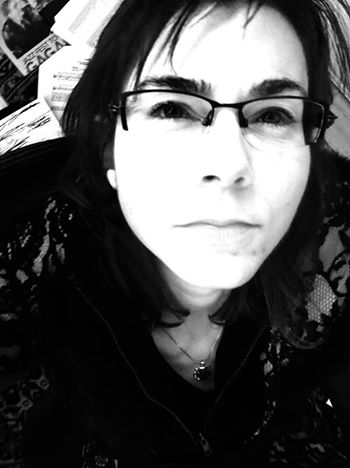
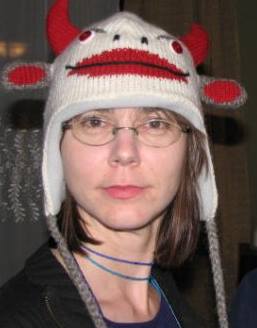
I love this picture as an indication of how unpretentious and real Morlock actually is.

I love this picture as an indication of how unpretentious and real Morlock actually is.

I would really like to be able to fly. Or to be invisible. I admit both of those are pretty unlikely. I think as far as things that might be attainable, being fluent in more than one language would be very cool, but my most desired skill is to be an awesome tango/salsa dancer. A somewhat unlikely acquisition, given that I’m not especially graceful, nor am I taking dance lessons…

5-When you’re just relaxing and not working what is your favourite thing to do?

Erm, not really sure. If I don’t work for too long I get a bit weird. Walking around outside is lovely, or hanging out with friends and laughing about silly things. I like dressing up for Halloween and wearing outrageous things now and then but that doesn’t happen too often.

Five more concerning being Composer in Residence at the Vancouver Symphony Orchestra

1-Being a composer in residence sounds like a grand position. What’s involved with such a title and what are you expected to do?

I suppose the most obvious thing is write new music for the VSO – I just finished a new piece called “That Tingling Sensation” which will be premiered during out New Music Festival, on January 17th. I also help program the New Music Festival, and our Annex Series which is a set of three concerts of new or newish music – i.e. 20th century classics alongside new 21st century rep. I am also the liaison between the VSO and the composers we work with, and I guess you could say I do a fair bit of outreach/promo, talking to people about our concerts, finding out what’s interesting to audience members, stuff like that. It’s a lot of fun, and there’s a lot of variety in what I’m doing.

2- You’re the first woman composer in residence in the history of the VSO. Is that a big deal?

02

Jocelyn Morlock and David Pay (of Music on Main), photo by Jan Gates

Funny that – I didn’t think it was such a big deal, but it seems that it is. I am used to being one of relatively few females in my line of work – when I was younger I thought I’d likely go into computer science, and I was the only girl in my grade 12 computer science class, so this is all fairly normal for me. It hadn’t occurred to me that younger generations of composers might want a female role model, but I guess to some extent I am one of those now! (Yikes! Responsibility!)

3-What’s your favourite Jocelyn Morlock composition and what’s so good about it?

What an evil question! Erm, frequently when I’m in the middle of writing a piece it alternates several times a day between being my favourite piece and the worst thing I’ve ever written…currently I think my favourites are my concertos “Aeromancy” (for two cellos) and “Ornithomancy” (for flute.)

[NB Jocelyn didn’t know i’d include the music when she answered… listen for yourself]


If I had to be even more specific I’d pick just the second movement of “Aeromancy.” What’s good about this music? Well, for “Aeromancy,” the cello lines are extremely expressive, very high and soaring, and the way that the two cellos sing together is almost like having one giant meta-cello. The orchestral colours with them are unusual – predominantly quite lush string orchestra in the background, but also a pair of soloistic oboes, horns, and a significant and quite sparkly glockenspiel line. For me this all adds up to a good thing. The form is rather unexpected but non-random, which I also believe is positive. Describing my own music this way is appallingly difficult!

4- The arts often feel very precarious in this country, spoken of as a luxury even as they starve alongside wealthy hockey teams. Please put your feelings about new music into context for us, especially with respect to your post at the VSO.

The performance of new work is what keeps the VSO (or any ensemble) from being solely a repository of aged treasures, rather than a living art form. An influx of the new is the only thing that keeps us from becoming just a museum.

The Vancouver Symphony Orchestra, with its visionary artistic director, the conductor and composer Bramwell Tovey, makes an unusually strong commitment to innovation and to new music in general.

5- Is there a teacher or an influence you’d care to name that you especially admire?

Yes – the late Russian-Canadian composer Nikolai Korndorf was a huge influence on me. I first heard his music ca. 1998, at a time when I found that much new music I was hearing was leaving me cold and I was craving a stronger emotional connection. As soon as I’d heard Nikolai’s music I decided that I had to study with him, and I was very lucky that he agreed to teach me. He was living in Burnaby, BC at the time, having moved to Canada in 1991. Nikolai had an encyclopedic knowledge of standard orchestral repertoire, and was fascinated by and interested in many, many styles of modern music, and it was fascinating (if very daunting!) to learn from him.

The recording of his monumental “Hymn No. 3 in Honour of Gustav Mahler” (recorded on Sony Classic CD “A New Heaven”) was the first piece of Nikolai’s I ever heard, and it made an incredible impression. Other wonderful pieces include “Concerto Capriccioso” (on Toccata Classics’ release of Korndorf’s complete cello music) and “Yarilo” for solo piano (there are several good recordings of it available including ones by Anna Levy and Ivan Sokolov.)

*******

The VSO New Music Festival featuring three compositions by Jocelyn Morlock runs from January 15 to 18.

Posted in Interviews, Music and musicology | Tagged , , , , , | 5 Comments

Bud Roach: Arias for Tenor and Baroque Guitar

Every now and then a recording or performance comes along to challenge your assumptions, possibly giving you a new way of seeing things.    I’ve been listening to two Bud Roach CDs:

1-Sospiro: Alessandro Grandi Complete Arias, 1626 (recorded in 2012: CD | iTunes)
and
2-Giovanni Felice Sances: Complete Arias, 1636 (recorded in 2013, released just a few months ago: CD | iTunes).

Within a few seconds of putting them on the player in the car, I’m spirited away to another place, another century. Whether or not you understand the Italian text (I pick out parts, but need the enclosed booklet to decode all the wit), it’s a magical combination. Roach is guitarist & tenor for these songs, singing at times with great delicacy, sometimes with a broad & comical approach to his vocal production.

It’s quite a bit to wrap my head around, these solo performances (the what, the how, and more questions than I can throw a stick at). I can’t help wondering who might have heard these, what composers might have been influenced by this music. Were these songs in the ear of the public, and therefore, likely to have been heard by more established composers? and how far did the influence extend? I’m no early music scholar, just a fan. But listening to these songs one wonders how and where these lovely songs would have been heard. Roach’s essay in the enclosed program notes are wonderfully suggestive. I have to include a big quotation.

Proud and haughty/ The true enemy of love/ You make your heart / A preserve of harshness
You give me death/ In exchange for my faithful love / O cruel and pitiless one!
You are so unfrateful to him that adores you / I hate myself for loving you so

So begins the first aria from Alessandro Grandi’s third volume from 1626, one of the finest examples (and collections) of a much-maligned genre from the early 17th century. Musicologists from the beginning of the early music revival have been unusually scathing in their surveys of secular Italian song, whether labelled canzonettas, arias, cantatas or even monodies…Moreover, notions of class-based discrimination appear to inform their thinking, just as they did those of the self-appointed defenders of high art held in 17th century Itality. Uncritical acceptance of the prejudices of mid-20th century academics denies us the chance to explore the beauty of these arias. Then, as now, it is difficult to find critical approval for respectable composers incorporating folk elements in their music. However, when experienced as they were performed at the time, these works can move our hearts as surely as they did those of their contemporary audiences. Recent scholarship has taken a more generous tone…

Part of my background is in drama scholarship, leading me to imagine possibilities and to resist the kind of class bias Roach describes. Writing and telling history is always susceptible to vested interests. I can’t help wondering if the improvised theatre that we call Commedia dell’arte –known to have originated in Italy long before this music—might have employed songs like these.  Serenades that we encounter in other operas sometimes employ lots of musicians (thinking of The Barber of Seville), sometimes very few (Manrico or Don Giovanni).  Whether we’re speaking of the innamorati (lovers) or the zanni (servants) , I recall mentions in the scenarios of songs. Because they’re merely scenarios a great deal is filled in through improvisation. If there were popular songs to which a city was already receptive, surely that would be a good choice for the performer. The many blank spaces in the history of this period are gradually getting filled in by speculative explorations such as these from Roach.  I am reminded of CdA because the world of the CdA is one of traveling performers, disparaged often as thieves, where the class bias is deeply seated. But these performers were not permitted into established theatres—who wouldn’t want the CdA’s free-wheeling bawdiness in their officially sanctioned (aka censored) spaces.

Now in fact Roach’s texts are not as wild as all that, they’re quite respectable: at least in his performances. But the innamorati and their amorous aspirations represented the more conventional aspects of a CdA story, while the servants carried the most anarchistic elements of the stories. Even so, the texts offer improvisational possibilities even when done with a straight face.

So that’s me babbling about the “what” of Roach’s CDs (and going off on tangents as usual), yet I could just as easily get lost in the “how”, in his approach to the performance of these songs. His voice is very easy on the ear. I have listened to him for hours at a time without fatigue. His playing is a big part of the formula. At times the strings are stroked very gently, while at other times he’s highly energetic: but never loud. Roach is also artistic director of Capella Intima , an ensemble I encountered last year in La Dafne, a co-production of Marco da Gagliano’s 1608 opera. In addition to the singing & strumming he’s a fascinating stage performer, judging by his incarnation as Demo in Toronto Consort’s Giasone earlier this year. In my review from April I said

With the exception of Roach whose broad delivery suited a character showing the influences of the Commedia dell’Arte , everyone seemed to underplay in a largely deadpan delivery.

In a real sense this is all research. Creating a role, putting it onstage, or taking a score and realizing it in a new century, one is making a hypothesis of how the text can work, how the music can sound. Roach’s two CDs offer us something that can change the way we listen, challenging our assumptions about the music and how it works.

Yes  I’ll be keeping my eyes open for Roach’s next early music venture, but in the meantime he’s doing something different this weekend, as he joins Talisker Players & Whitney O’Hearn for “Puttin’ on the Ritz”: a pair of concerts celebrating Irving Berlin on Sunday, January 11 at 3:30pm and Tuesday, January 13 at 8pm, at Trinity St. Paul’s Centre.

Posted in Dance, theatre & musicals, Music and musicology, Reviews | Tagged , , , , | 2 Comments

10 Questions for Christine Goerke

It’s a coup when a great international artist comes to your city. But when the artist in question is one of the most talked-about singers of the year? AND she’s choosing to make her most important role-debut here in this city?

That’s a huge big deal.  The moment the Canadian Opera Company announced that Christine Goerke was coming to Toronto to star in Richard Wagner’s epic Die Walküre, in her role debut, might have been the highpoint of the tenure of COC General Director Alexander Neef so far.

Christine Goerke has recently elevated her singing to a new level, possibly because there’s a world-wide appetite for what she does. The audience response to her portrayal of the Dyer’s Wife in the Metropolitan Opera’s Die Frau Ohne Schatten roughly a year ago was rhapsodic, both in person and in social media. Those of us who couldn’t get there could only envy those who got to see and hear her in person. No wonder that shortly thereafter Peter Gelb signed Goerke to be the Metropolitan Opera’s next Brünnhilde. Ditto for Houston Opera.

But before NY or Houston, Toronto will be the lucky ones to hear Goerke in her role debut as Brünnhilde at the end of January in the remount of Atom Egoyan’s production of Die Walküre. Last season she sang Brünnhilde in concert with the New Zealand Symphony Orchestra, but this time the role will be fully staged.

Die Frau ohne Schatten at the Metropolitan Opera with Johan Reuter (click image for Christine Goerke's website)

Die Frau ohne Schatten at the Metropolitan Opera with Johan Reuter (click image for Christine Goerke’s website)

And so I had to ask Christine Goerke ten questions: five about herself and five more about preparing Brünnhilde at the COC.

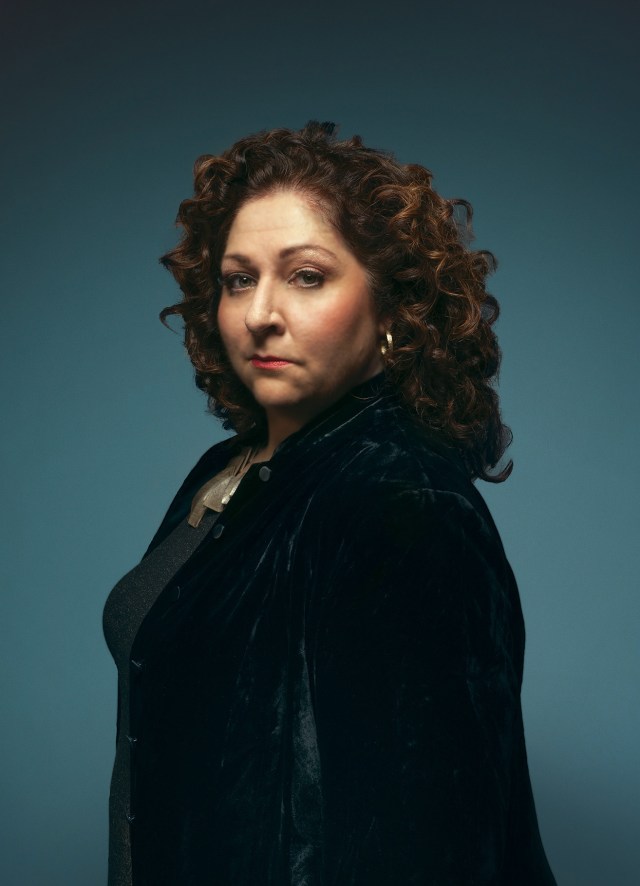
Soprano Christine Goerke (photo by Gary Mulcahey)

Soprano Christine Goerke (photo by Gary Mulcahey)

1-Are you more like your father or your mother?

That’s a tough one… I have to say that I’m really not sure!

My Dad is *super* organized and likes everything “just so”. I’m a little OCD, and if things are out of place? It makes me crazy. My family laughs at me (and sometimes actually tilt pictures on the walls *just* a little to mess with me.. it completely freaks me out!) So, in that way, I’m like my Dad. He’s a very intelligent and self taught man.. so I hope some of that rubbed off also. Unfortunately, we lost my Mom when I was just twelve years old and she was just thirty eight. Though I don’t remember very much about her, sadly, I do remember her as a very gentle, caring, and sweet woman. I pray some of that has rubbed off and is evident in my parenting. I was lucky enough to have had an amazing stepmother in my life from the time I was eighteen until recently, when we sadly lost her as well. I tried to take some examples from her as well, as she was an amazing, giving, and joyful woman. I guess the old question of nature vs nurture comes in here!!

2-What is the best thing or worst thing about being a singer?

Best things…

The way that the music touches my soul. It’s an incredible gift to be part of something so much bigger than yourself.

That I can be transported from my life for a few hours.

The feeling – yes feeling – of the orchestra when I’m on stage. It’s physical, it’s visceral.

Finding that I have an “opera family”. When you settle in a repertoire, you tend to run into the same people over and over, and as lonely as it can get when you’re away? It’s so nice to know that you have “family”.

It’s FUN!

I get to be loud, dress up, and pretend for a living! What could be better???

Worst things…

Being away from my home and family. As a parent I doubt myself constantly about what is best for my children. I hear constantly about how incredible it is to show them that their mother is a role model.. someone who is doing something she loves and more importantly providing for her children…. but my heart breaks every single time I have to leave to go on a gig. Bless Skype and FaceTime. I try to be in contact twice a day with my family no matter where I am in the world. I do my best to plan my schedule to have chunks of time at home with my “monkeys”, and when I am home? Those kids *own* me. It’s so funny… I go from ball gowns to yoga pants. From riding in town cars to driving my mini van. My life is a series of extremes and I love it.

This is going to sound a bit insane and certainly like I’m looking a gift horse in the mouth? .. but I am honestly a little uncomfortable with all the attention that I’m getting now. I kind of liked it better when I was flying *just* under the radar. I just want to show up, be part of something bigger than myself, make music, create art (hopefully), and go home. The rest of this… not my thing. The “soccer mom” in me wins out here.

3-Who do you like to listen to or watch?

Well, as far as listening… I am from Long Island, NY, so if I don’t start my list with Billy Joel? I am officially betraying my “heritage”!

I adore Billy Joel, Queen, I love Earth, Wind, and Fire, Bruno Mars.. I tend to avoid listening to a lot of classical music unless I’m studying it for performances. I will say that as far as “who is the soprano you like to listen to” goes? I am a huge Varnay fan. Something about that voice just gets to me.

What do I like to watch.. I don’t leave for a gig without “The Princess Bride” and “Grumpy Old Men” on my iPad. No matter how bad my day has been? Those two movies always elicit giggles. My guilty pleasure is “Say yes to the dress”. I know, it’s silly… but I like pretty dresses! I also watch Storage Wars, Pawn Stars… kind of silly and light things. I find it’s a good way to take my mind faaaaar away from my job for a while.

I often find myself turning on the Disney channel when I am away. Just out of habit. In a weird way, it makes me feel as though I’m a little closer to my girls..

4-What ability or skill do you wish you had, that you don’t have?

I wish I had the ability to be in two places at once. (is that an ability or a super power??)

I wish I was able to stop thinking and just turn my brain off occasionally. It’s so hard for me to walk away from things that are left undone. Sometimes? We just have to do that for our sanity, and I’m *lousy* at it!

I wish I wasn’t so hard on myself. I preach to my children that life is about learning. That perfection doesn’t exist. I wish I’d listen to myself and believe that! (because that’s right! … I just expect the impossible of myself.)

5-When you’re just relaxing and not working what is your favourite thing to do?

I literally sat staring at the screen for a good five minutes thinking about this one, and realized my answer is … “just relaxing and not working? Is that a thing??” I’m a working Mommy! I guess the answer is sleep????

*******

Five more about undertaking the role of Brünnhilde for the first time in the Canadian Opera Company production of Die Walküre

1- Talk for a moment about the vocal challenges of undertaking your first Brünnhilde here with Maestro Debus & the COC.

Well, first, taking on what is the pinnacle of Wagner roles for me is both incredibly exciting and utterly terrifying! Wagner requires a rock solid technique, stamina for days, and irrational fearlessness! I was told from the time that I was twenty five years old that I would be a dramatic soprano. I thought, “Wow, that’d be cool!” .. but at that age, I was far away from actually singing this repertoire. I made a very happy living with Handel and Mozart operas, and suddenly – around age thirty two? Everything started to change.. and change *fast*. My voice got bigger/louder, deeper, more colorful, and it required me to retool the way that I was singing. It also enabled me to start into this repertoire. I had hoped *so much* to sing this role someday. So few women have the honor… the fact that I am actually doing this? It’s literally a dream come true.

COC Music Director Johannes Debus (photo: Bo Huang, 2012)

We are just a week into rehearsal for me, but working with Maestro Debus is a total joy. When you work with a conductor for the first time, you never quite know what to expect. With a role like this? You hope and pray that you will have a great connection with the conductor. I can honestly say that at the very first rehearsal, it was clear to me that I was safe. Feeling safe in this repertoire is huge. It enables us to take chances. To know that if I look down, Maestro Debus’ eyes will be on me. He’s an amazing musician, and more over? A lovely colleague. That is a big gift.

I’ve also been looking forward to working with the COC since I found out about this contract. I have heard nothing but raves from my colleagues about how incredible the company is, about the amazing people who make up the company, about the acoustics of the house, and about the artistic level here. I can happily report that it’s all true. To be prepared for Toronto in the winter I was told to show up with my score, Sorel boots, and a down coat. Add a flying horse, and I guess I’m all set!

2- What’s your favourite moment in the role of Brünnhilde?

This is going to be odd. I’m not actually singing. No one is! Just after I finish singing my role, there is the big “hug” moment in the orchestra in the third act. It is so unbelievably heartbreaking that I have yet to get through it without sobbing like a two year old. That’s technically in the role, isn’t it???

(..a girl loves a good ho jo to ho, too… 😉

3-Please talk for a minute about your pathway as a modern woman portraying a legendary immortal, a sung role in a stylized opera.

Interesting question… because I find her to be quite human (a huge part of her problem as an immortal… for now.. oops spoiler!). When we singers step on to the stage? We have to leave our daily lives behind. I find Brünnhilde to be one of the most remarkable characters in all of opera. Over the course of the three operas that she is in, she goes through every emotion, every joy, every sadness… In this one, she is young. The teen who knows everything, and knows better than her parents. Well meaning, always… but finding her humanity, leads her to a punishment of … well, humanity. I think that over the course of the three operas, we see how something amazing can come from a perceived tragedy. If that’s not a modern idea, I don’t know what is..

It may seem that the Ring Cycle is about Gods, and Dragons, and Castles… and it’s the stuff of lore. It is! .. but when you look past that? It’s about personal relationships that run very deep and have so much truth for each of us every single day.

It’s why I love it so much.

4-The opera world can be every bit as comical or tragic as the stories portrayed on its stages. Please comment on the business and how you observe it unfolding as an artist and as a citizen.

Wow… well? I can say that I have zero patience for ego and .. well, sorry but .. BS. Politics also. As I said earlier, I’m about showing up, creating something uplifting, and hopefully doing my job to transport the audience for a few hours. I never judge singers when I read about strange demands, etc. This is a reaaaaally weird job that we have, and it takes a lot of nerve to get out on stage and do what we do. We have critics at us left and right, and every person in every seat has a right to their opinion about what we do. That’s not easy! So if someone needs something specific to do that job? I say more power to them.

In the USA (and around the world), we’ve had a very scary run with the economy and we have lost a lot of our smaller companies. I am doing my best to help when I can, but I feel that we must support these smaller companies and bring *live* performances to people. To give them the opportunity to experience this amazing art form live. To have that visceral feeling coming over them as the orchestra starts, as the singers begin.

I would also really like to see less of folks listening with their eyes and more listening with their ears.

5- Is there a teacher or an influence you’d care to name that you especially admire?

I have been really lucky to have two women who have held my hand while I worked through my technique. From my start, I had the amazing mezzo Elaine Bonazzi, and for over ten years now the incredible soprano Diana Soviero. I can’t thank Diana enough for instilling the thought that *all* singing has to be based in a bel canto technique in me. It is the gift of longevity.

I also have to mention my manager, Caroline Woodfield. It’s a blessing to find a manager that understands that my family life is a huge part of my career planning, and that carving time out to be home is a necessity. She is a great “business mom” and I’m so incredibly grateful to have her in my life.

*******

Christine Goerke is Die Walküre for seven performances with the Canadian Opera Company at the Four Seasons Centre, January 31- February 22nd.

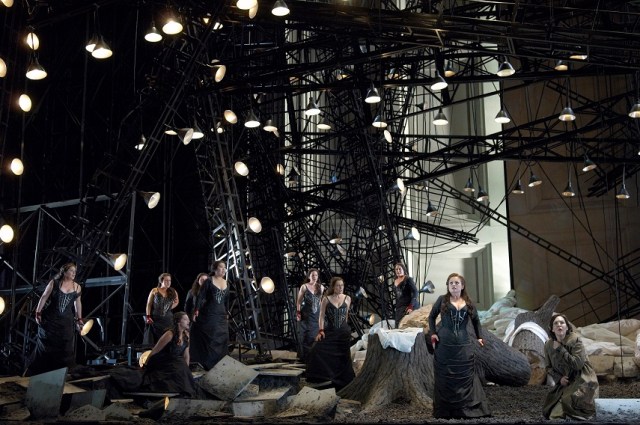
The Valkyries, Susan Bullock as Brünnhilde and Adrianne Pieczonka as Sieglinde in the Canadian Opera Company's production of Die Walküre, 2006.  directed by Atom Egoyan, Set and Costume Designer: Michael Levine (Photo: Michael Cooper)

The Valkyries, Susan Bullock as Brünnhilde and Adrianne Pieczonka as Sieglinde in the Canadian Opera Company’s production of Die Walküre, 2006. directed by Atom Egoyan, Set and Costume Designer: Michael Levine (Photo: Michael Cooper). Click for information about the 2015 production

Posted in Interviews, Opera | Tagged , , , | 2 Comments

Two books for the choral conductor: mortality at my fingertip

As the old year winds down I’m aware of the passage of time.  Reminders of mortality prod me, as if to say “you’re getting old”. To be more accurate, I’ve acted as though I were indestructible, denying my own pain, ignoring the evidence of my own aging.

Today I’m reading because the piano is off limits. Yesterday? I ding’d a couple of fingers closing the garage door in the dark: acting as though I were indestructible.  This morning –overly grateful for an apparent quick recovery – I foolishly jumped into playing Gould’s transcription of the Dawn & Rhine-Journey that I still have out from the library.

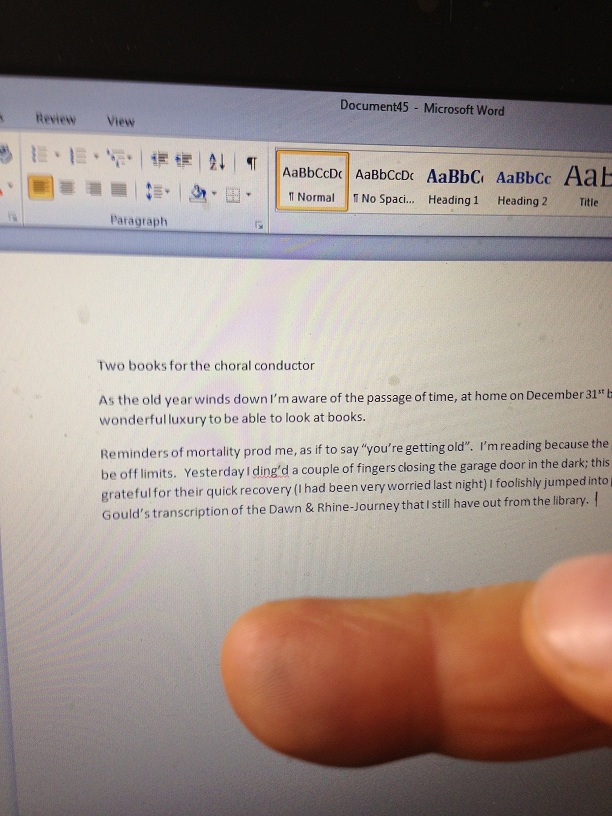
Finger selfie.  The middle finger --shown-- has the worst swelling, roughly an additional half centimeter.

Finger selfie. The middle finger –shown– has the worst swelling, roughly an additional half centimeter.

By the end of it I was barely playing mp-mf instead of ff, because of a blue bulge on the middle finger. It looks like a tummy that’s been over-indulging on Christmas treats, except the fat is in a finger not a waistline, and it’s bruised tissue. Here’s a picture of it as I stop writing for my finger-selfie, and no i don’t mean to give anyone the finger to end the year.  In fact i am very lucky that it wasn’t much worse (even if my Wagnerian celebration of my recovery at the keyboard was premature).

People think of mortality at funerals & wakes.  I attended one earlier this week.  People contemplate their remaining life span and what they’re doing with their lives on Dec 31st and to begin the new year.  And yes, when you get hurt ka-POW you are thinking about mortality.

I had a similar reminder last Sunday. I was so busy making copies on the church’s xerox for the offertory that I missed the warm-up, diving straight into “Shine Jesus Shine”. As in my encounter with the garage door, perhaps a bit more fear would have been wise. There was no swelling or obvious injury, but my top?  AWOL, at least until I’d cajoled my upper register to join in, sometime around mid-morning.

click for more info about this book on Amazon

My awareness of the non-existent high notes was especially heightened by a book I’ve been reading, namely Choral Pedagogy and the Older Singer by Brenda Smith and Robert T Sataloff.  Warmups! people need them at every age but especially as they age. It’s obvious i suppose but i never thought about it before.

I started singing late in the game. I was an accompanist before my own voice changed, and perhaps daunted that before I even had a man’s voice I was playing for an older brother who had one of the prettiest manliest baritone voices in the country. Under the circumstances why sing? I stayed at the piano as an accompanist & music director, only discovering I had a voice when –in illustrating passages to singers in a show—I noticed I had a voice after all: sometime around the age of 40. I always thought of myself first as a beginner, then as a late bloomer, but now as the gray hairs begin to over-run my beard I can no longer deny that I am an “older singer”.

Smith & Sakaloff may be aiming for the choral conductor, but their book reads very much like a text book for a choral curriculum, complete with review questions at the end of each section. I found myself grateful for the summaries, but also intrigued, as I visualized conductors using this book as a tool. My church choir is full of older singers even though it’s only in looking in the mirror of this book that i am confronting the implications of aging:

  • Changes in vocal capabilities (range, stamina, vocal quality)
  • Changes in the body impacting the choir (hearing, sight, back-health etc)
  • Psychology of singing and confronting limitations, aging, loss, and eventual mortality

I’ve been in denial about aging so of course I’ve avoided reading the book straight through. Yet every time I open it I see something valuable (and i’ve sampled almost every chapter). For instance I just opened to a page concerning the “breath gesture,” where it’s noted that there’s a difference between conducting an orchestra and a choir. I’d noticed before that David Fallis & Ivars Taurins (aka Herr Handel) do not assume that the voices they lead are mere machines (who should have their breath ready in the instant of downbeat) but instead offer additional gestures before the down-beat.  And you hear it in the results. Throughout –for instance just now as I glanced at a section concerning the appropriate sized accompaniment for the performing choir (ie piano or duo piano vs orchestra)—the authors always err on the side of that poor vulnerable group of singers, cautioning the conductor to be mindful of the difficulties & challenges facing singers.  Of course this is likely true even if you’re a virtuoso in your twenties, not an aging amateur in a church choir.  It’s always a good idea to treat voices as delicate instruments.  The common sense of this volume applies universally i would say, and not just to aging voices.

But come to think of it: we’re all aging aren’t we..?  It’s the same lesson I should have learned long ago, that we’re not indestructible, not immortal, but human and finite.

click for more info about this book

Another book for the choral conductor is Camerata: A Guide to Organizing and Directing Small Choruses. It’s by Arthur Wenk, a true Renaissance Man. At different times of his life he’s been a math teacher, music professor, psychologist, organist and choir-director and mystery novelist.  Our paths crossed a few times in my life:

  • As the director of my church choir
  • As the most impressive organist I’ve ever seen in person (I was his page-turner for the big items such as Bach’s St Anne Prelude & Fugue or the Widor Toccata)
  • He’s author of two of the key books on Claude Debussy –although I never realized he was the same Wenk until much later—namely Claude Debussy and the Poets and Claude Debussy and 20th Century Music
  • Co-participant in the COC’s Opera Exchange, concerning Pelléas et Mélisande
  • Conductor of Toronto a capella choirs Camerata, and later Quodlibet.

Camerata –the book that is—seems to be a natural outgrowth of this work leading chamber choirs here in Toronto and elsewhere. It seems to be meant to ensure that anyone seeking similar goals should learn from Wenk’s experience, via a how-to guide for this kind of ensemble. This is a very practical book, as the first paragraph illustrates:

Arthur Wenk

Arthur Wenk

Begin by deciding what kind of choir you want to direct. My Camerata choirs are small, mixed choruses specializing in unaccompanied choral music. Their repertoire spans the entire range of a cappella music from Bach to Bartók, and from plainsong to Stravinsky. (When I started the Pittsburgh Camerata, one newspaper ran the phrase “back to plainsong by Stravinsky,” an intriguing notion.) Music for each concert is chosen to fit a theme, and the audience is supplied with program notes including both the original words and an English translation to aid comprehension of the music. (In Québec, this meant providing both English and French translations of works sung in German, Latin, and Italian.)

Ah yes, it’s clear that Wenk has done this before Toronto, in Pittsburgh and in Quebec (where he was also a music professor). The book is full of common sense. For instance, concerning rehearsals, Wenk tosses out some ideas that are good for any discipline, not just unaccompanied choral singing (i quote a few, although there are a great many, all excellent):

You might want to consider some of the following ideas:

  • Purchase 1”-wide three-ring binders and prepunch the singers’ s scores before distributing them. Having and keeping music in order can save an enormous amount of rehearsal time.
  • The time you spend making sure that the music is clear and the texts legible, especially in foreign languages, will repay itself many times over in rehearsal time saved.
  • Don’t rehearse more than sixty minutes without a break
  • Consider the benefits of learning a cappella music without the aid of a piano
  • Consider the benefits of conducting from memory. Keep the score in your head, not your head in the score.
  • End every rehearsal on a positive note by concluding with something the choir
    sings well.

Wenk has done this before many times, and from all angles: as conductor, programmer, composer, and promoter. Needless to say, he offers the tips of an expert, passing the torch to the next generation.

Here’s more information about these two fascinating books, including purchase info:
SMITH & SATALOFF: Choral Pedagogy and the Older Singer
WENK: Camerata: A Guide to Organizing and Directing Small Choruses

Posted in Books & Literature, Music and musicology, Reviews | 4 Comments

Colorature: a CD from Marie-Eve Munger, soprano

My favourite lines in the film The Blues Brothers? The moment when The Brothers arrive at their gig, pretending to be “The Goodtime Boys”, and enquire what sort of music this establishment usually offers.

“oh we got both kinds: country AND western”.

Some people come to music –and this is true whether we’re speaking of country OR western, pop OR jazz, classical OR opera,… or you name it—seeking something new, while others want something safe & familiar. Those words are close to meaningless, given that one man’s safe is another man’s walk on the wild-side. I caution you, reader. When I review something I may be so busy seeking the newness and originality that I fail to properly apprise you of what to expect.

Marie-Eve Munger’s CD Colorature is highly original, or at least that’s how I experienced it. It may not come across that way if one simply wants to hear and enjoy music. And it really does allow for enjoyment, a stunning series of performances from a beautiful voice.  I am afraid however of using that adjective “original” because it may give the wrong impression.  Have no fear whether you think of yourself as open-minded or conservative.

click for ATMA’s website including purchase info

I found myself pondering the word in the title. “Colorature” is the French version of coloratura, a word that is both an adjective and a noun.  A singer who sings certain roles will be known as a “coloratura”, as are the key passages where she earns her money.  Coloratura can be the music and be the singer, or the role or the brief passages in the role  (and in the case of say the Queen of the Night, those 5-10 minutes are the most memorable of the night, the part everyone recalls).  These decorative features in the music are normally wordless. If you’ve never experienced anything like that in opera I’d point to scat in jazz as something similar, where the voice’s expressive power is turned loose in an abstract realm of pure music without reference to the usual need for text in song.

Those of us who teach or who review performances often find a stratified world where functions and styles are separated from one another. Opera is separate from concert singing is separate from jazz or music-hall singing, and separate again from film. Yet in practice singers can be (must be?) all of these at once, especially as they seek careers. The distinctions are largely b.s. if you’ll pardon my choice of words. Sometimes the classifications have more to do with someone seeking to file a review in the right part of a publication or to find the right department in a store than with anything about human vocal anatomy. Versatility is in fact far more natural than specialization.

I mention this because of the CD, where one encounters some intriguing remnants from a more natural world, before things became hyper-specialized. Munger’s rep on the CD is unexpected precisely because it applies the extreme vocal virtuosity one usually finds in opera arias in different types of music.  I wonder, were these pieces ever really popular? And i use that P word in the specialized way we use in speaking of classical rep, where we look at a symphony or opera company staying afloat with government subsidies as “successful”.  These charmers may be obscure compared to familiar coloratura arias but not based on merit.

Some of the singing on the CD is not coloratura. I suppose it’s funny to be phrasing it in the negative, but in a typical opera role, the coloratura is used sparingly, perhaps a little something to jazz up the ends of arias, rather than something continuous, whereas the vocalises for example push a voice.  I wonder what a concert program like this CD would be like for the singer: as in, how difficult.  But I suppose that highlights the many other ways a voice can be used as a colour instrument without necessarily being trapped in the more conventional functions of the voice, especially the verbal/semantic ones.  It’s a bit of a paradox (or an irony if you prefer) that great demands can sometimes seem to overwhelm one, particularly if the performer cannot turn the challenge into display, the moment on the trapeze into an impressive escape from danger. If death is not defied in those high wire moments, the artist is ill-advised to venture into the air, not to tease those of us craning our necks while worrying about the fair maiden’s survival. But this is the happiest sort of performance, one brilliantly assembled to make you rethink what you know about what the voice can do.

She flies through the air with the greatest of ease.

The most typically coloratura moments are in Vocalise-Études by Fauré and Ravel and in Glière’s Concerto pour coloratura, even as the singer is pushed well beyond what we’re accustomed to hearing in well-worn pieces of opera. One of the great challenges with unfamiliar repertoire is the requirement of the artist to make the material their own, to seize the unknown music and make it sing, make it more than just notes. Munger brings a cabaret singer’s charisma, making an intimate connection throughout, and even a bit of swagger. The flamboyance is merely a reflection of quirky material that calls for confidence, masterful technique and precise vocalism. But Munger is at that level beyond, where she’s playing with us, riding the wit of Debussy or the surreal silliness of Milhaud. Her voice is completely at her service and ours, eager and ready.

I am reminded of something I read awhile ago, about opera in an era before pornography, when the only sexual display sanctioned for public theatre was in the vocalism of the diva showing off her brilliant control, her fabulous top (possibly in more senses than one). There’s more than a little ecstasy encoded in coloratura, more than a little pleasure to be had listening to such music. Munger has assembled a CD of startling beauty, requiring personality, charm & taste: and more than met the challenge for each composition. As the review with which I (probably) end 2014, it’s a most impressive assembly of music from the intellectual side, yet a most stirring appeal to the visceral.

Beautiful from beginning to end.

Posted in Music and musicology, Reviews | Tagged | Leave a comment

10 Questions for Darren Russo

Darren Russo is a composer born in 1984 in Montreal, Quebec.  In 2006 he began his bachelor’s degree in music composition at McGill, including studies with Chris Paul Harman, and Jean Lesage. He was awarded positions as composer-in-residence for the Contemporary Music Ensemble and the McGill University Chorus (Tick Tock, Bang Bang – 2009, Missa Syllabis – 2010 (first prize winner of the SOCAN Foundation Awards for Young Composers—Godfrey Ridout category—in July 2011). He had also collaborated with celebrated writer Sheldon Rosen on creating music for his typographical play Hansel and Gretel which was staged at Ryerson University in May 2009, later featured at the LyricCANADA national conference at Brock University in October 2010.

In August 2011, at the invitation of Tapestry New Opera, he participated in their composer/librettist laboratory. There, he worked closely with artistic director and CEO, Wayne Strongman C.M., and Professor Michael Albano (University of Toronto) in an intensive workshop geared towards meeting the challenges of writing music for the stage. It led to the development of his opera Storybook, commissioned by Opera Five in Toronto for their 2013-2014 season, and now scheduled to premiere January 23rd 2015 in Toronto.  He recently completed a Master’s degree at McGill, studying under Denys Bouliane and Philippe Leroux.

Now, on the occasion of Storybook’s premiere I ask Russo 10 questions: five about himself and five more about composing Storybook.
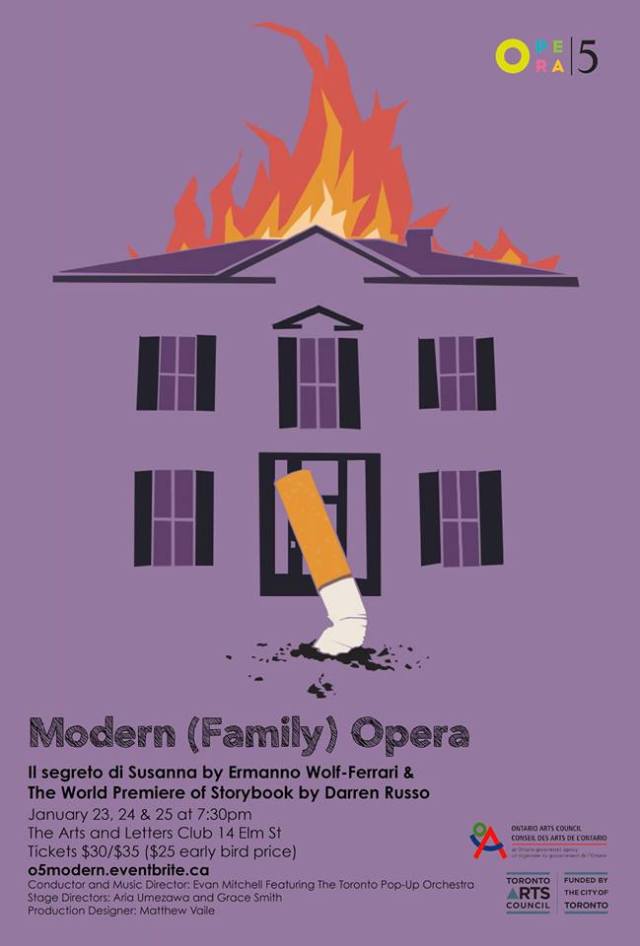
poster

1-Are you more like your father or your mother?

If you asked my mother, she’d probably tell you I’m most like her. If you asked my father, he’d probably laugh at the question. In my eyes, I really am a pretty even mix of the two. My parents are actually very different people: it was interesting growing up watching two opposing forces find a way to work as a team. Like any family, there were bumps along the way and it’s interesting in hindsight to observe the different ways each of them tackled challenges and embraced good times.

From my mother, I take my appetite for books and film; I take the encouragement that fed my active imagination. From her, I take my work ethic and the ability to keep moving through days that are overwhelming without complaint. I take from her the time I need for myself without guilt and without excuses. From my mother I learned how to navigate the subtleties of social interaction and to observe and understand what’s between the lines: I take diplomacy.

From my father I learned a love for food that knows no bounds, often against this formerly picky eater’s will. I learned creativity in the joys of a harmonious blend of flavours and textures. I learned to experiment and to embrace the failures as well as successes. From him, I take the ability to question everything. I take from him the courage to be myself in the face of any situation without worry of offending… so long as the cause is just: I take integrity.

They made me whole.

Composer Darren Russo

Composer Darren Russo

2-What is the best thing or worst thing about being a composer of “new” music?

The worst thing about new music is that it’s dressed in very old clothes. We often use archaic instruments, performers trained in an ancient art form and it seems we so often choose to present it in a highly ritualistic environment filled with out-dated customs. This makes it inaccessible to people who might be somewhat interested but become intimidated by rituals they don’t know how to perform, nor understand. Classical music has the same problem. The pieces that have survived through the centuries and that are still known to most have done so because they are timeless. They still resonate with contemporary audiences because the feelings they bring out are universal. Why then, are we stifling them in a package of obsolete customs?

There are many people, even friends and colleagues of mine that might disagree with this. And they make valid points. Classical music was never music “of the people.” It was performed for the upper echelons of society and that came packaged with a lot of pomp and circumstance. Not to say that the composers of the time were writing music that was pompous and circumstantial, but this wasn’t music that was easily available to the masses. This gradually started to change in the 19th Century, and with it came a gradual increase in the complexity of the new music of the times. When a turn toward the avant-garde took hold in the 20th Century, the composers themselves seemed to alienate audiences who had a difficult time understanding the challenging innovations they concocted. It seemed that a new elite had formed among the artists themselves that relished in complexity, dissonance and inaccessibility. You might think I’m speaking of this as though it was a bad thing, but these were truly bold innovations that probably couldn’t have been developed in an environment of total inclusion. The interesting thing to me is how these innovations gradually filtered down into more popular forms like The Beatles’ A Day in the Life, Pink Floyd, Queen, Radiohead, and electronic dance music.

To use a fiercely snobbish fashion analogy, this trickling down process was described perfectly in The Devil Wears Prada:

                “You go to your closet and you select… I don’t know… that lumpy blue sweater, for instance because you’re trying to tell the world that you take yourself too seriously to care about what you put on your back. But what you don’t know is that that sweater is not just blue, it’s not turquoise. It’s not lapis. It’s actually cerulean. And you’re also blithely unaware of the fact that in 2002, Oscar de la Renta did a collection of cerulean gowns. And then I think it was Yves Saint Laurent… wasn’t it who showed cerulean military jackets? I think we need a jacket here. And then cerulean quickly showed up in the collections of eight different designers. And then it, uh, filtered down through the department stores and then trickled on down into some tragic Casual Corner where you, no doubt, fished it out of some clearance bin.”

But is this really the same thing as with new music? When you think of a fashion show or an art exhibit, what do you see? Where is it taking place? What’s the average age of the crowd? What are they wearing? What are they doing?

If we want an audience to embrace new musical ideas and challenging innovations, I feel we need to present it in an environment that fosters open-mindedness and a level of comfort in communication. I don’t know how that’s possible dressed in our great-grandmother’s clothes performing a set of rituals so elaborate they make the Catholic Church jealous.

3-Who do you like to listen to or watch?

Listen: Ligeti, Mahler, Beethoven, Ravel, Radiohead, Arcade Fire, Jeff Buckley, Nina Simone, Joan as Police Woman, Tune Yards, Joanna Newsom, Outkast, Kendrick Lamar, Queen, George Kranz, Grizzly Bear, Alt-J, Kate Bush, Depeche Mode, LCD Soundsystem, Tool, and yes, sometimes Madonna.

Watch: Game of Thrones, Breaking Bad, Portlandia, Don’t Trust the Bitch in Apt. 23, It’s Always Sunny in Philadelphia, Six Feet Under, Battlestar Gallactica (the new one), Scrubs, Paul Thomas Anderson, and (ok, I admit it), Buffy the Vampire Slayer.

4-What ability or skill do you wish you had, that you don’t have?

I’ve always wished to draw or paint well. Sometimes you just want to communicate everything in an instant. You can’t do that with words or music, and photography lacks the organic flow (for me at least).

5-When you’re just relaxing and not working what is your favourite thing to do?

I’m hopelessly addicted to Netflix.

*******

 Five more questions about the creation of Storybook

1-What’s the story of Storybook?

If I told you, that would ruin it… it’s about life, just go with it!

What happens? Absolutely nothing!  …sort of. People sing what they’re thinking a lot. Nobody really talks to one another (except for that one time (and only to yell at each other (or at themselves?))).

The people here generally are pretty unhappy. Sometimes that’s funny. They’re looking for something, but I’m not always sure what.

People sing what they’re thinking.

A lot.

They have a strange fondness for the poems of William Blake.

They have very active imaginations: there’s magic.

They like to hear themselves talk.

Some of them use mild psychotropic drugs: there’s magic.

Some of them have sex.

Some of them wish they were having sex.

Some of them wish they never had.

Some of them are very alone…

…with their thoughts…

….that they tend to sing…

…a lot.

They’re searching for something.

2-Could you explain how the story of Storybook becomes opera, and how the music works?

Everyone is so goddamn desperate; what could be more operatic? Opera is fantastical melodrama. Except this is all about the painfully mundane ritual of day-to-day life. So, make them all desperately unhappy and it becomes melodrama and they all sing about it. Sometimes that’s funny.

Sometimes it’s really not. Sometimes it’s horrifying. Sometimes it’s heartbreaking. Sometimes it’s sweet. Sometimes it just is.

Storybook had a strange gestation. I’m not sure at which point I decided it was an opera, but it was somewhere about 5 years in (to the 10 year process). The point it became an opera in my eyes was the point it became unified. Suddenly each musical moment had to exist on its own but also relate to other tropes in the stories. And there are quite a few stories, and they don’t always seem to relate to one another at first glance.

That’s where the music comes in. Leitmotif. It’s something Richard Wagner started about 150 years ago to give musical reference points to characters, emotions, ideas and themes. He would then combine them in ways that added layers of complexity to characters and events. Storybook has these and they do much the same thing. They also serve to highlight common themes among seemingly separate storylines and characters. But it’s still vague (and I like vague). Especially here where I feel the themes in Storybook can be interpreted in a million ways. This hopefully will let the audience pick out the things they can relate to so they can interact with the piece and engage meaningfully.

With these systems in place, the music carries the text and creates the threads linking the themes across the stories. To me, that is opera.

But there’s no plot.

So?

3-What’s your favourite Darren Russo composition and what do you like about it?

It is unquestionably Storybook (for now). Next time you ask me, it will be whatever piece I’m currently promoting.

No, but really it’s Storybook. This took a long time to develop. A lot of it was re-written about halfway through the process (the moment I decided it was opera). In no other piece of music have I ever let my guard down so completely. In no other piece have I challenged so freely what I thought to others to think is “new music.” In no other piece have I openly invited all to come and judge me at my most exposed and vulnerable. Because it is exposed and vulnerable, it’s risky and I’m proud of it. When Opera Five approached me about it, I saw the opportunity of a lifetime and knew there would not likely be another chance. I could play it safe or grab life by the balls and go all out. I chose the latter, and whatever the fate of Storybook, this is undoubtedly my favourite composition and the one I’m most proud of.

For now. DARREN_RUSSO

4- The arts often feel very precarious in this country, spoken of as a luxury even as they starve alongside wealthy hockey teams.  Please put your feelings about new music into context for us, especially with respect to opera and the Premiere of Storybook with Opera Five.  

Elaborating on your previous question about what’s the worst thing about new music: I feel it’s in trouble, yes, for perhaps being too exclusive and impenetrable. But then I don’t. Artists will always find ways of expressing no matter how restricting the environment (and, let’s face it, it could be a lot worse). And people will always come in contact with these works, and over time the good ideas will always trickle down in some guise or another.

It would be nice, though, if everyone was encouraged more to take time to create things and express themselves. It would be nice if artists had more opportunities to take the time they need to observe, think and create without having to always worry about he bottom dollar. Complete artistic freedom unburdened by financial woes is a near impossibility here today and now.

The opportunity granted to me by Opera Five came at the perfect moment. I was very fortunate in that I was able to integrate it into my Master’s research, which gave me ample time and a bare minimum of money to live. It’s entirely possible in today’s artistic climate that I may never have such an opportunity again. That makes me both extremely grateful for this one but also somewhat frustrated. On the other hand, it’s entirely possible that this opportunity could open doors leading to more exciting endeavours. It’s a risk to try and live as an artist and it’s not a lifestyle that meshes well with just anyone. It’s kind of exciting though, the uncertainty, and I feel adds an element of adventure to my life that would not otherwise be there. Though, perhaps that’s just cognitive dissonance. I feel I should add that I am in no way advocating putting all your eggs in one basket. I have a wonderful day-job that gives me a unique opportunity to view some of the strangest and funniest things about humanity. Maybe I’ll write an opera about it one day.

5- Is there a teacher or an influence you’d care to name that you especially admire?

I’d like to take a moment here thank my former music history teacher and composer, the late Robert F. Jones. When I was 19 and applying to University, I had to choose two pieces as a selection for my portfolio. I only really had three viable pieces to choose from. Two were dry academic pieces written for the only composition class I had ever had, one with a bitter and tyrannical teacher. The third was something I had written for myself: a setting of the Introduction to William Blake’s Songs of Innocence. My composition teacher had dismissed it as infantile with its simple language and abandonment of conventional structure. I met with Prof. Jones about a day or two before my application deadline to show him my choices. I showed him the two from my class first and he said, “These are quite good. I want to see more, did you bring anything else?” I felt shy and reluctant, but I pulled out the other piece and he looked it over. Anxious for another dismissal, I waited as he looked over the score. Finally, he handed the pages back to me and said, “Send this and only this. These two are great, but this one is you.”

*******

Opera Five presents Modern (Family) Opera:
Il segreto di Susanna by Ermanno Wolf-Ferrari and
Storybook by Darren Russo
January 23, 24 and 25 at 7:30 pm
The Arts & Letters Club 14 Elm St
o5modern.eventbrite.ca


Posted in Interviews, Opera | Tagged , | 1 Comment

Toronto Operetta Theatre’s Mikado

Although I haven’t seen many shows from Toronto Operetta Theatre, tonight’s is timely, after the social media debates between armchair Artistic Directors concerning management strategies. In the years to come we’re likely to see a scaling back of the boldest objectives, including a growing reliance on Canadian talent.

Meanwhile there are companies providing ongoing employment opportunities for Canadian talent, but on a much smaller scale than big companies such as the TSO or COC. TOT, whose Mikado premiered tonight, are one of the regular players on the Toronto scene. They play with a small orchestra in the intimate Jane Mallett Theatre, led by Derek Bate, who also conducts for the COC. Their productions have musical integrity, and a solid professionalism, directed by Guillermo Silva-Marin, who is also behind Opera in Concert and Summer Opera Lyric Theatre.

And speaking again as an armchair artistic director, tonight’s show likely works the same way that other seasonal favourites can work to regenerate fiscal health. The National Ballet have Nutcracker, Lyric Opera of Chicago are presenting Hansel and Gretel while the Metropolitan offer their shortened version of The Magic Flute. Oh and speaking of the TSO, they have their Messiah, as do Tafelmusik. The Mikado can work the same, way: as a wonderful play full of funny lines, familiar tunes, and a timely infusion of cash as well.


Adrian Kramer as Nanki-Poo and Lucia Cesaroni as Yum-Yum

Adrian Kramer as Nanki-Poo and Lucia Cesaroni as Yum-Yum

And why not? As the leads Adrian Kramer and Lucia Cesaroni are an attractive couple with lovely voices, a pleasure to hear and see. This isn’t to be mistaken for one of the Stratford productions of Gilbert & Sullivan, where both the verbal skills & musicianship are flawless. But the singing is almost all excellent, the acting is at times charming and funny, with the occasional flash of inspiration. We only came fully to life when the girls showed up –a bit more like a chick flick than G & S—bringing the energy level higher. The young women show more energy than the men as a whole, possibly because of a holiday season opening before a very well-fed & passive audience.

And speaking of Canadian talent  TOT will be premiering a new operetta adaptation of Wilde’s The Importance of Being Earnest by Eugene Benson and Victor Davies in April 2015.  Artistic Director Silva-Marin and TOT are to be commended.

But this week there’s the irresistible fun and beautiful melody of The Mikado. TOT present Gilbert & Sullivan’s Mikado until January 4th 2015.

Posted in Music and musicology, Opera, Reviews | 2 Comments

Die Meistersinger von Glyndebourne

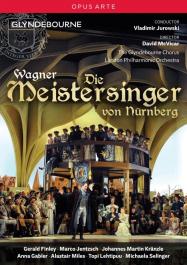
I’m trying to understand why I responded the way I did to the Glyndebourne production of Wagner’s Die Meistersinger. It’s a relatively straight-forward production that might even be called conservative. David McVicar and the team who made the DVD have struck a balance, unlikely to offend anyone, possibly pleasing everyone.

click for details on obtaining

Richard Wagner’s operas are regularly updated and re-thought by adventurous directors. Many of the most adventurous examples of Regietheater (director’s theatre) were visited upon Wagner scores:

  • …because his stories are often symbolic templates right out of Jung that seem to invite re-interpretation
  • …because the production history of his operas for a time couldn’t escape the footprints of Nazi jackboots left over it at the Bayreuth Festival

McVicar doesn’t go there, however, doesn’t impose anything onto Wagner’s text. This is a Meistersinger to please the most ardent Wagnerian. Does that make this a conservative production? If by “conservative”, one means a production that includes almost 100% of Wagner’s stage directions, then so be it, this one is conservative.

But the epithet is misleading.  Whatever McVicar asks of the singers & chorus, we’re in the presence of remarkable high-definition camera-work, directed by François Rousillon. Over the course of this immense opera –the longest one that can in any sense be understood as standard repertoire (and considering how rare Meistersinger productions are, perhaps the designation is misleading) –we get to watch not just the singer singing, but many reactions to that singing as well. I am most impressed by the subtle responses, where so much of the drama resides.

I’ve already alluded twice (1 | 2) to Gerald Finley’s Hans Sachs. If 60 is the new 40, then –as I was pondering how Finley might look as Falstaff—Finley is a 21st century sort of old. He’s active, vibrant, really a baby-boomer’s Sachs because he’s middle-aged rather than aged, alongside a foppish Beckmesser from Johannes Martin Kränzle. Neither is really young enough for Anna Gabler’s Eva, yet because Finley is on the boundary line we can feel his genuine pangs of attraction when Eva looks his way. Marco Jentzsch isn’t much younger looking as Walther, but that doesn’t matter, so long as we can believe that these two middle-aged men might long for the beautiful Eva.

Topi Lehtipuu as David is perhaps the key –with Gabler of course—to making the ensemble tick. In Act I a huge amount of exposition must be accomplished in the scene between Walther & David that follows the church scene (where the attraction between Eva & Walther, the other key fundamental, is established). Lehtipuu is the nerdiest of the apprentices, a quality that sometimes makes him seem very old on other performances I’ve encountered. I love Peter Schreier’s take for instance on that wonderful von Karajan recording (which I listened to in its entirety last week), meticulous in his execution of all those musical details that are an indication to poor Walther of the impossible task he is undertaking in seeking to become a master. Lehtipuu has a stunning gentle tone that is in wonderful contrast to almost everyone else on the DVD, a lyrical voice that floats up to his many high notes, even as he seems genuinely young: which may simply be due to his hairstyle and physicality. Look at this guy!  

This is acting, and the point is –as in much of this production—it’s not when he’s singing. It’s in his reactions. The character never lets up for a second, and for much of the opera I can’t take my eyes off of him. His performance alone –of a part that is almost impossible to do this well—is worth the price of the DVD.

See what i mean about the camera-work? We’re watching reactions, back and forth between singer and listener. They’re very close to one another, making the singing conversational and directed, instead of the unfortunate tendency on bigger stages and in bigger theatres to bellow, making these speeches into pompous and self-congratulatory addresses opened out to the audience (an approach that is boring I am afraid). McVicar and his cast avoid those deadly moments fastidiously. In fact Gabler gives both Finley and Lehtipuu a run for their money, never dull and sometimes remarkably insightful. Jentzsch is very sympathetic as Walther.

Credit too must be given to conductor Vladimir Jurowski , leading the London Philharmonic Orchestra and the Glyndebourne Chorus at fearsome quick tempi, which usually means that the audience is the beneficiary. Choreographer Andrew George has the chorus doing folk-dance moves that seem very authentic looking, even as the simmering class-war—between apprentices and masters, between the guilds and the nobility (meaning Walther)– threatens at times to bubble to the surface, but never hijacks the opera.

With Vicki Mortimer’s stage and costume designs, we are not in the Middle Ages, but rather in a post-Napoleonic Nuremberg. I think that’s important because it’s the time of Wagner’s youth, when Germany was an idea that hadn’t even begun. There was no Germany yet, no military juggernaut for decades yet, just a series of smaller states and cities. As such the dreams of the masters and of Walther can focus on the artistic issues Wagner sought to express, without the directorial gloss.

In case you couldn’t tell, this is the Meistersinger I would recommend to any Wagnerian. The camera work gives it the edge of a good comedy –thinking more of Bergman’s Smiles of a Summer’s Night rather than anything Hollywood produces—even as the musicianship is astonishingly good.  It bears repeated watching.  Lord knows i can’t stop watching it.

Posted in Opera, Reviews | 4 Comments

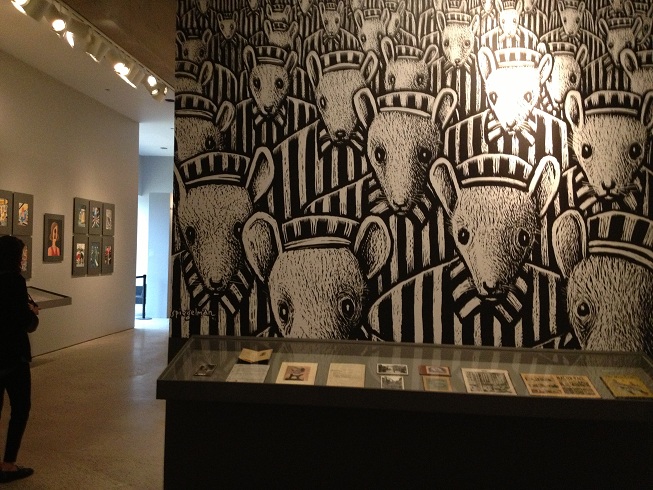
Maus in the haus: Art Spiegelman retrospective at AGO

I saw Art Spiegelman interviewed at the media preview for his retrospective at the Art Gallery of Ontario.  I suppose if I were like a typical critic I’d just start talking without a preamble, because (nervous cough) everyone knows his importance. Or do they? But I don’t work that way, whether I’m talking about someone famous or unknown.

Click for more information about Art Spiegelman’s CO-MIX: A Retrospective at the AGO

But how to explain Spiegelman’s influence? I suspect we’re just now ready to look at that, or maybe still too close to the time. I only know that the world has changed substantially in the last half-century, and that we’re still struggling to understand the ways in which the arts have been transformed. When I was young there was a well-defined phenomenon known as the generation gap. Boomers –those of us who came of age in the 1960s and after—experienced a profound cultural disconnect from their parents, whose values were often diametrically opposed. Spiegelman’s Maus begins for me in that disconnect, in a cultural gap between parent and child that nowadays doesn’t happen, or at least not so violently.

My daughter gets the Beatles, she loves Spiegelman and Maus. We don’t have that kind of gap. Parenting is different now. Are we better parents? I don’t know, but we listen to much of the same music, look at the same movies. Spiegelman is part of that generation of transition in everything beginning with art, but reaching right into the way we understand ourselves and our relationship to the old country.

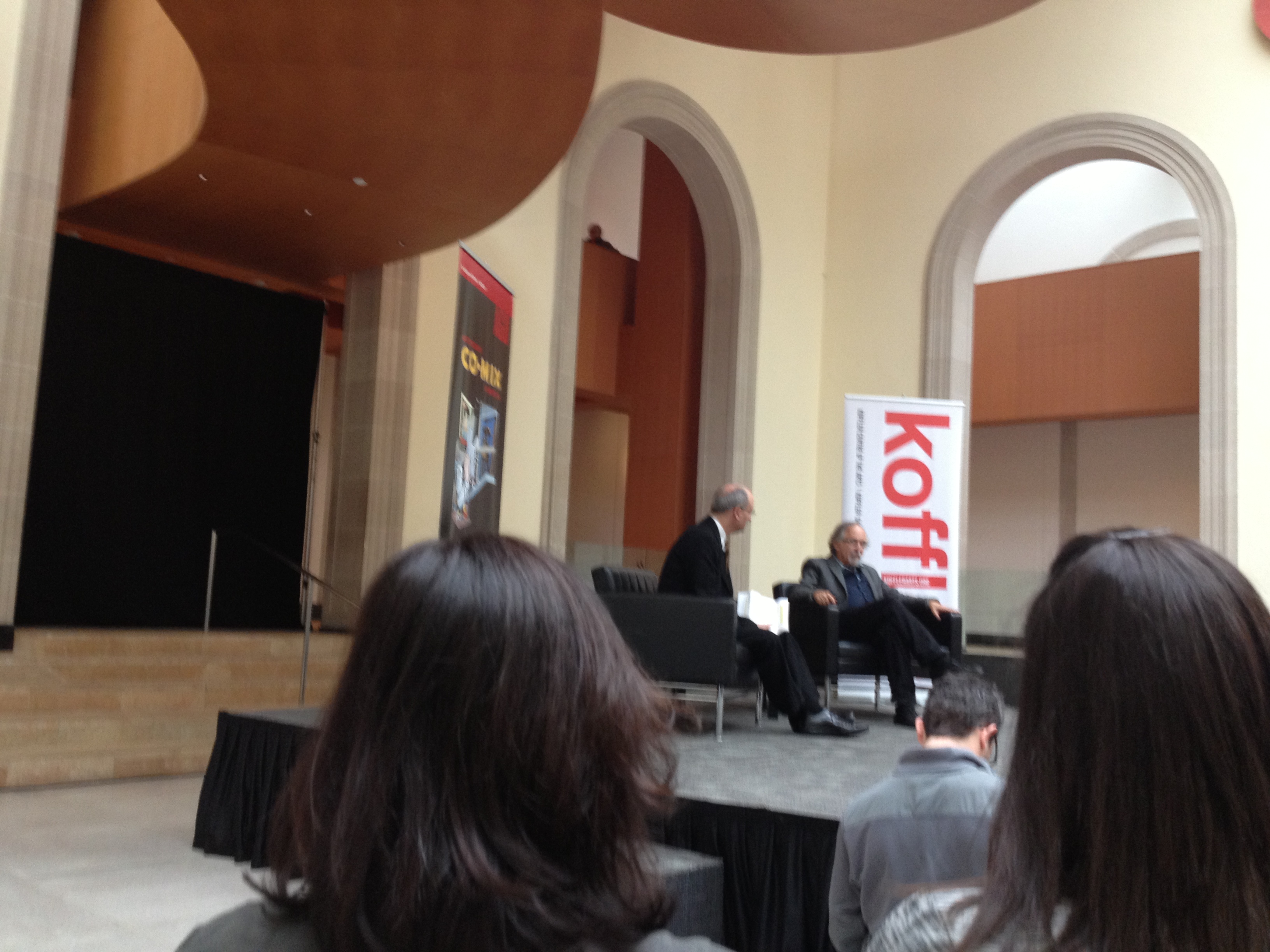
It’s quite the show, five hundred works curated by the artist, making it a genuine retrospective. I’ll paraphrase a few of Spiegelman’s responses to AGO director Matthew Teitelbaum’s questions –as he played Oprah—because you recognize that he’s much more than his art.

AGO Director Matthew Teitelbaum interviews Art Spiegelman

AGO Director Matthew Teitelbaum interviews Art Spiegelman

Spiegelman speaks in aphorisms, not so much because he thinks he’s Friedrich Nietzsche or Confucius, but because his comic art necessitated brief verbal gems to accompany his art. As you discover when you wander around at the show: his verbal gift is every bit as important as what he does with ink on the page, and might be the real reason for his Pulitzer.

The man tells great stories, and knows how to tell them.

When I first heard that Spiegelman was going to give a talk (January 26th at Bloor Hot Docs Cinema: tickets & details via kofflerarts.org) I thought to myself “nice”, but I wasn’t sure how interested I was. After listening to Spiegelman for about 5 minutes, engaging, irresistible, like a time-capsule from the counter-culture, a relic from another very magical time: I knew I have to hear him talk some more.

And do I know what I am talking about? I don’t know. But the question I was tempted to ask –and dammit should have asked if I wasn’t feeling sniffly and coughing and too sick to sidle up to a microphone across the room—would have concerned Spiegelman and the druggy imagery in some of his pictures. Goya was mentioned by one polite questioner, but I suppose I am conflating the artist and the art, wondering not just about the life but also life-style. Does anyone care about drugs anymore? I merely meant, that there’s a druggy hallucinogenic quality to his art. It’s trippy, which is an amazing achievement for still images in black ink. No I didn’t ask because I suppose that, phrased the wrong way, it sounds like a moralistic accusation, when I understand it in a positive way, seeing these images as distant cousins to what de Quincey & Berlioz explored long ago.

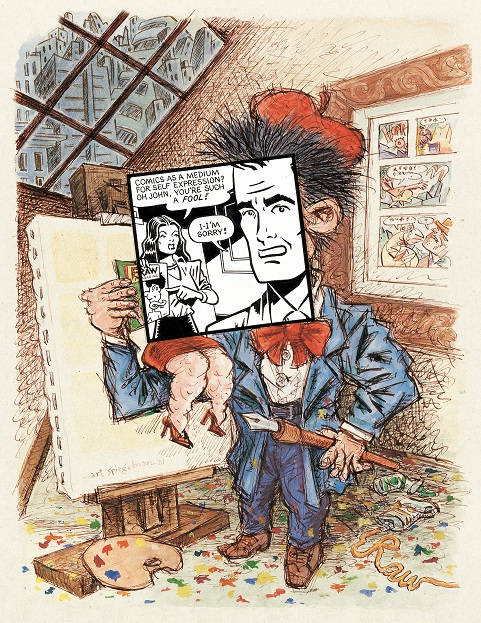
Art Spiegelman Cover art for Print magazine, May/June 1981 Watercolor, ink, and collage on paper. Copyright © 1981 by Art Spiegelman. Used by permission

Art Spiegelman Cover art for Print magazine, May/June 1981 Watercolor, ink, and collage on paper. Copyright © 1981 by Art Spiegelman. Used by permission

It’s ridiculous if not perverse to walk into the gallery and see Maus in its entirety on a wall. We usually encounter it in book form, not spread out on a wall: as though it were a single work of art. But that’s actually what it is. One can’t see much of it unless one were very tall AND able to bend low to take it all in. My eyes feel weak before all the details in these fabulous creations. I ‘m remembering my recent walk through the Michaelangelo show that’s still here at AGO, another tribute to the power in tiny works of art. Small isn’t just beautiful, it can be awesome & overpowering.  I had to step away partway through, a bit overwhelmed by what I’d seen.

Spiegelman told us that until the 1960s the comics were exclusively a commercial product, so they had to all look the same: that is, until the 60s, when comics –and everything else—changed.  I am recalling the shock of those who decided to rebel, artists who decided to be different.  The images had the same powerful impact of the first musicians who had long hair.  I mean, it may seem like a little thing, but at the time it was overwhelming.

Teitelbaum asks the inevitable provocative question: IS IT ART?

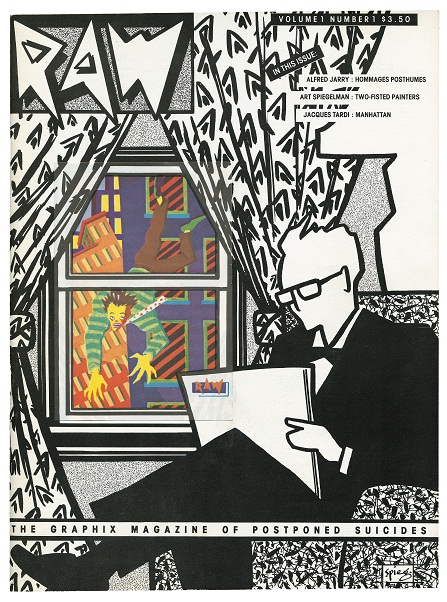
Art Spiegelman Cover for RAW no. 1: The Graphix Magazine of Postponed Suicides, 1980. Copyright © 1980 by Art Spiegelman. Used by permission of the artist and The Wylie Agency LLC. Courtesy Drawn + Quarterly.

Art Spiegelman Cover for RAW no. 1: The Graphix Magazine of Postponed Suicides, 1980. Copyright © 1980 by Art Spiegelman. Used by permission of the artist and The Wylie Agency LLC. Courtesy Drawn + Quarterly.

Spiegelman tells us that “anxiety of place” was something he experienced, as a lower middle class kid. Where do you fit in? Art and especially the criticism of art talks about high and low, good and bad. I sense that his art is addressing the cultural question –connections to the old country and the older generation (as I alluded above)—and that anxiety of place.

Spiegelman is going on with a fabulous lecture that in tiny brilliant chunks explains a lot, while answering Teitelbaum’s “is it art” question.  In passing he speaks of the invention of the cartoon in Montmartre (perhaps thinking of artists like Toulouse-Lautrec?), perhaps to put us at our ease in case we’re hostile to a cartoonist in the realm of great art.

Ha, if only he knew.  Recently we saw shows from Ai wei wei and David Bowie, two others whose aptness for shows at the AGO might also be questioned. I’m glad that the AGO is going aggressively into this discursive space, to interrogate our assumptions, broaden the understanding of what art is.  I’m reminded that maybe Teitelbaum wasn’t merely mouthing questions supplied by his knowledgeable staff, but speaking from his heart.  and yes, i like where the AGO is going.

It took a long time, he tells us, to understand what modernism is about. I wish I could recall where he got this insight –a wonderful one—about Picasso, but wow it’s so clear and simple, and as usual, in a tidy aphorism that knocks you on your ass. If I got it right, he said “just think of Picasso not as a grand artist but as someone going to his studio and jacking off everyday.“

Of course there was this cute moment between Teitelbaum and Spiegelman when they acknowledged that this might not be normal language for such a conversation.

But the importance of that quote is to deflate the aura around the artist, to normalize his work and yes to deconstruct it. Hm I suppose seeing it as masturbation is perhaps deconstruction or possibly just a recognition that the output of these revered artists doesn’t necessarily belong on a pedestal or behind some kind of wall. This isn’t to denigrate the artist, just to put it all in perspective. Spiegelman was –if I recall correctly—trying to explain his own history, his coming to terms with art & artists. Here we are in the AGO with Alex Colville, (whose recognition as a great artist is relatively recent), and Michaelangelo + Rodin; Spiegelman most certainly belongs in their company. The fact that some would question it intrigues me, and i’m grateful for the conversational spaces such questions –especially  the one posed by Teitelbaum– open for us.

Musing away, Spiegelman drops a few more jewels into their dialogue.  He cited Marshall McLuhan, that “when a medium is no longer a mass medium it becomes art or vanishes”. He gave the example of woodcuts. And he boggled my mind when he alluded to the old function of paintings since supplanted by photography, whereby painting lost much of its reason to exist.

It never dawned on me that he was really going to talk about the fading importance of comics.  But by the 1970s comics had ceased to be the popular medium it had once been. As Spiegelman put it, while they were still read widely, they’d been castrated by a comic code.

And then we came to Spiegelman’s projects. As he came up to his 30th birthday he consciously decided he had to do something more significant, and as a result took on something suitably ambitious. There were two projects he envisaged. The other one fell by the wayside, but Maus grew out of his desire to do something significant and important.

In 1972 “The Holocaust” wasn’t known, wasn’t the big topic it would become.  People merely spoke of the war and the things that happened. It was fascinating, I should add, to hear Spiegelman give us some very personal history.

“Holocaust” is one name. Even before that word acquired currency, there was another word coined, namely “genocide”, a word to describe the unimaginable, something that hadn’t been seen before. Then “holocaust” began to be the word used to describe the experience of the war, apparently a word from Elie Wiesel, which Spiegelman unpacked for us, explaining that it’s a word that means “burnt offering”.

Spiegelman doesn’t approve of the word “holocaust” applied to the events of the war, nor, he added, does he approve of the epithet “graphic novel” (something mentioned only in passing).

Spiegelman gave some insight into what he’s really doing when he said ”it’s easier for me to look at drawings than painting. They’re like a seismograph of how the brain works”.
Indeed. As an opera fan who also listens to rock or jazz or folk music, virtuosity and the apparatus of musical expression fascinates me, especially when we come to large-scale works onstage or in the cinema.   The last couple of centuries of art have seen art re-invented and reframed as something more immediate & emotionally authentic. We’ve seen it in the invention of new ways of acting onstage that strip away the alienating theatricality to let us get closer to something and someone with whom we can connect.  The difference between an opera aria and a folk-song –in search of simplicity and authenticity—is very much like the difference between a painting and a drawing. Of course it’s art, but it’s not art that scares you away by being intimidating or difficult.

MY_MICEThere’s a great deal to see at this show, and Maus is only part of Spiegelman’s work. If you know him and his style from the two illustrated novels, you won’t be disappointed. But there’s lots more.

And there’s much more to be said. But maybe that’s best encountered either in the gallery with the art, or perhaps at Spiegelman’s January talk. I know I’ll be back for more.

Art Spiegelman: What the %@&*! Happened to Comics?
Monday January 26, 2015 at 7 PM
Bloor Hot Docs Cinema, 506 Bloor St W, Toronto
Tickets & details: kofflerarts.org

Art Spiegelman’s CO-MIX: A Retrospective opens on
Dec. 20, 2014, and runs to March 14, 2015
at the Art Gallery of Ontario

Posted in Books & Literature, Personal ruminations & essays, Popular music & culture, Reviews | Tagged , , | 1 Comment