10 Questions for Elizabeth DeShong

Elizabeth DeShong is singing big roles in the biggest houses. She’s sung Suzuki (the role she’s singing in a Canadian Opera Company production that’s opening tonight at the Four Seasons Centre) at the Metropolitan Opera and San Francisco Opera Company, Cenerentola at Glyndebourne, the Composer (Ariadne auf Naxos) at Washington National Opera, Hansel & Hermia in Lyric Opera of Chicago. In my review of the COC’s 2011 Cenerentola—one of their most impressive productions of the past decade—I said the following:

Elizabeth DeShong as Cinderella was thoroughly musical, not just coloratura & high notes, but a beautiful tone in her lower register as well.

I could have said a great deal more about her acting, and dramatic ability will be a key in the new COC Butterfly. While the other principals -Butterfly / Pinkerton / Sharpless- are double cast, DeShong appears in all 12 performances between now and Oct 31st. Her performance is fundamental to the success of the show.

On the occasion of the opening, I ask Elizabeth DeShong ten questions: five about herself and five more about undertaking the role of Suzuki.

Elizabeth DeShong backstage with Layla Clare and Placido Domingo in the Metropolitan Opera’s “Enchanted Island”, 2011.

1) Are you more like your father or your mother?

I’d say, I’m a pretty even split between the two of them. My mother is a “doer”.
If there is something that needs to be done, she is on it with laser-like
focus. To that end, I am very determined and focused, which helps in such a
competitive field. There, also, isn’t a harder worker. My mother is a hospice
care provider, and a very good one. Perhaps, I’m flattering myself, but I like
to think that some of the innate strength, tenderness, and ability to sense
the needs of others that she brings to those that she cares for, I can bring to
the characters I portray, especially a character like Suzuki.

My father is a United Methodist minister. While my calling was not to the
church, I am certain that observing my father’s ability to reach people and
present ideas in an honest, and approachable way, has given me, if not
skills, the courage to try. Even though ministry is, from the outside, an
extroverted field, my father is an introvert who has pushed himself outside
of his comfort zone in order to do work that, he believes, is greater than
himself. By seeing my father push through personal boundaries and touch
people’s lives through his work, I gained the confidence (without even
knowing it) to pursue my own goals and the ability to view my work as
something for others.

2) What is the best thing or worst thing about being an opera singer?

Travel.

3) Who do you like to listen to or watch?

My most frequently listened to playlists include The Punch Brothers, Etta James, Dusty
Springfield, Judy Garland, Janis Joplin, and Ben Folds.

If I’ve already prepared a role, and want to be inspired, I seek out recordings of
Christa Ludwig

4) What ability or skill do you wish you had, that you don’t have?

I’d love to be a more confident swimmer. My husband is a certified scuba diver,
and it would be incredible to explore the ocean with him. The videos he captures
on our GoPro are so serene and beautiful! As someone who believes that animals
are meant to be viewed in their natural habitats, and not in captivity, I’d love to see
the life that abounds in our oceans first-hand.

5) When you’re just relaxing and not working what is your favorite thing to do?

I’m happiest if I’m being “productive”. What that means for me is, to “relax”, I end
up binge watching “Gilmore Girls” while knitting a scarf, or doing cross-stitch, or
writing out all of my Christmas cards in October, or online shopping for birthday
presents six months in advance, or researching vacations that I will take two years
from now… You get the picture.

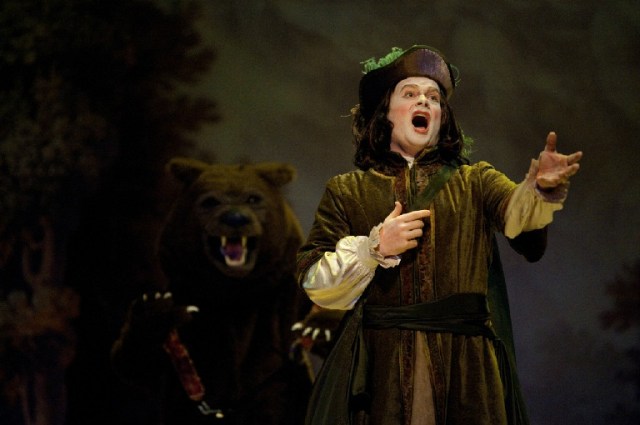
Yes that’s Elizabeth DeShong: as a very boyish Hansel in the Glyndebourne production, 2010. Wow i forgot i sometimes used to stand like that as a boy (no matter how many times my mom told me not to).

*******

Five more about preparing to play Suzuki in the Canadian Opera Company’s production of Madama Butterfly, beginning October 10th.

1-Please talk about the challenges in the role of Suzuki.

Before I got to know Suzuki, and she was just a distant note on my calendar, people would ask me about upcoming roles, and I often shyly responded, “Oh, just Suzuki…”, and went on to list more easily appreciated roles like Cinderella and Hänsel. But, treasure is often hidden, and Suzuki is just that.

Suzuki is truly one of the more interesting characters I’ve portrayed. From the outside, it can be easy to dismiss her, if she is evaluated based on title or by number of notes sung. The challenge in portraying her to her full potential, is to be 100% committed to giving and receiving energy and intention at all times. When Suzuki is quiet, there is a reason. When she speaks, there is a reason. The focus of her gaze, at all times, is intentional. She is a servant, confidant, friend, protector, peacekeeper, etc.. When she speaks, her words are sincere and true. We should all be so lucky to have a friend like Suzuki.

Onstage, as a colleague, a good Suzuki can make Butterfly’s life a lot easier, or a lot harder. In this production, I move screens to motivate light cues, I dress and undress Butterfly, I sneak water to singers, I choose stillness over action to facilitate focus on Butterfly’s emotional journey, I help guide our child actors, etc.. So, the demands on a good Suzuki, are many.

Vocally, the role, again, can be deceiving. You need a meaty lower register, but flexibility at the  top of your voice to pull back dynamically in the more tender moments. You can really paint her text with a wide color palette. The trickiest part of the pacing, is that there are long stretches  where Suzuki doesn’t sing, but also can’t leave the stage. We she does re-enter vocally, Puccini isn’t exceptionally kind with the dynamics and register in which he writes her lines.

(l-r) Elizabeth DeShong as Suzuki, Patricia Racette as Cio-Cio San and Dwayne Croft as Sharpless in the Canadian Opera Company production of Madama Butterfly, 2014. Photo: Michael Cooper

(l-r) Elizabeth DeShong as Suzuki, Patricia Racette as Cio-Cio San and Dwayne Croft as Sharpless in the Canadian Opera Company production of Madama Butterfly, 2014. Photo: Michael Cooper

Altogether, Suzuki is the kind of character that is as important as you make her.

2- What’s your favourite moment in the opera?

Dramatically, there is a small moment between Suzuki and Butterfly that always resonates strongly with me. When Butterfly enters and discovers Sharpless and Kate Pinkerton, Suzuki breaks down. Butterfly comes to Suzuki and says that she shouldn’t cry. She says that Suzuki has been good. In this moment, I always gently shake my head “no”. I think Suzuki always feels she should have done more to protect Butterfly. It highlights the constant struggle between duty and friendship, that Suzuki feels throughout the opera.

Musically, the Act 3 trio between Pinkerton, Sharpless, and Suzuki is a thrill to sing. There is tremendous musical and emotional release expressed by each of the characters. You can feel the tension in the theater so strongly in this moment. I look forward to it every night!

3-How do you relate to the character and the way she’s portrayed, as a modern woman in a western culture?

It seems to me, that we are all wrapped and seasoned with what is deemed appropriate
and/or admirable in our individual cultures. That said, we are all human, and subject to the  effects of love, friendship, loss, duty, betrayal, etc.. Cultures and their ideals clash in this piece, but the underlying feelings are recognizable and relatable, regardless of nationality.

On a more basic level, there is nothing out of the ordinary about a teenage girl who gets pregnant, is abandoned by the father, is left with a responsibility that she is unprepared for, but continues to idealize her circumstances. The life of any teenager is filled with extreme highs and extreme lows. How many of us still recall our first loves with rose-colored glasses?

4- How do you feel about showing actual tears and emotion onstage (and how do you control or reveal your emotions in this role)?

Suzuki is a character that is constantly balancing the ideals of duty and friendship. There are times when it is appropriate for her to remain silent and within the bounds of her station.  However, there are personal moments that are so out of the realm of her normal experience, that she can’t help but be overcome with emotion. It is clearly written in the words and music.  To me, there is no harm in crying actual tears and showing real emotion. Because of the way  Suzuki is paced musically, there is more than enough time to recover and sing comfortably.

More often than not, I shed real tears onstage, and I can’t think of a reason not to allow myself that release, since it is so clearly within what the character is feeling.

5- Is there a teacher or influence you’d care to name that you especially admire?

There are so many people that I could name, who have helped me on my musical
journey. However, special credit has to be given to the educators who teach us to
love music and inspire us to achieve in our early years. With that in mind, I have to
give special credit to one of my earliest music educators, Vi Carr. Vi Carr was my
first piano teacher. She created a space in her home where a young girl could come
and learn, feel safe, but, also gently encouraged when she could have pushed
herself a little bit harder in her practicing. After many years together, nurturing
my piano skills, she had the generosity of spirit to say that she had taken me as far
as she could in my education, and pointed me in the direction of a college
professor who would audition me and allow me to join his studio. Had I not had
her type of warm guidance as a child, I would never have had the skills or
confidence necessary to go as far as I have in my current field. I admire all
educators, not only in music, that inspire a love of learning.

*******

Elizabeth DeShong appears in all 12 performances of the COC’s production of Madama Butterfly, beginning tonight October 10th, through the 31st at the Four Seasons Centre. For further information click the picture:

(l – r) Adina Nitescu as Cio-Cio-San and David Pomeroy as Pinkerton in the Canadian Opera Company’s production of Madama Butterfly, 2009. Photo: Michael Cooper.


Posted in Interviews, Opera | 3 Comments

Falstaff’s Communion

I saw the second performance of the Canadian Opera Company’s production of Falstaff tonight, enjoying it even more than the first time. Where my first view was from up in ring 3—ideal to get the big picture but too far away for subtleties, especially in crowd scenes—tonight’s was from the very front, where I could see details.

Director Robert Carsen’s reading of this wonderful comedy of desire & appetite goes back and forth between the ribald & the gustatory, between blatant challenges to a husband’s fidelity & to a stomach’s capacity. A few of the performances are painted in the colourful strokes of cartoons, larger than life gestures that read even at the very back of the theatre.

You will have heard of Gerald Finley’s return to Toronto, a great star of European opera stages, a favourite in the USA, but taking his first steps on the Four Seasons Centre stage. His is a most Italianate reading, exquisite timing in the “no’s” he hurls at his sidekicks in his big monologue in the first scene (when he asks a series of rhetorical questions about the nature of honour).  Finley shows astonishing depth in this, his first undertaking of the role. It’s not the same as it was opening night, as there were a couple of places where he’s still playing with the sound, sometimes sweet, sometimes edgy and even willing to offer up a strident and unmusical sound, in the interest of a laugh. When we come to the opening scene of the last act we get a properly Shakespearean soliloquy, a mad thieving world he bemoans, at his lowest point in the opera. The last triumphant moments (captured so beautifully on the program cover and on the signage promoting the production) are the occasion for the headline, wherein I see the most perfect expression of the urges that seem to be the subject of Carsen’s exploration of this Shakespearean opera. When all is finally forgiven and everyone sits down to a wedding feast it’s a kind of sharing that reminds me of holy communion, one shared finally by everyone on stage.

The final scene from the Canadian Opera Company production of Falstaff, 2014. (Photo: Michael Cooper)

The final scene from the Canadian Opera Company production of Falstaff, 2014. (Photo: Michael Cooper)

The other two larger than life portrayals?

I mentioned Marie-Nicole Lemieux’s Mistress Quickly, who does her best to match Finley’s energy & commitment, a very physical portrayal with a wonderful lower voice to match, as good as it gets in this part.

The other is perhaps unexpected, namely Simone Osborne, whose energy reminds me of Veronica (Archie’s girlfriend) or some other teenage icon such as Annette Funicello or Gidget. The body language was fun, often silly and always at an energy level making her the star of most of the scenes she was in.

Other performances only really came into focus when I was able to sit up close. The chorus did yeoman service of course, especially in some wonderful ensembles pieces, working with Russell Braun in the lengthy set-pieces in Act II when Falstaff is hiding from a pursuing horde, that Carsen also turned into a kind of crazy cartoon of synchronized slow-motion movements. Braun’s expressions are wonderful, especially in the scene as Fontana, Ford in a wonderfully whimsical disguise that reminded me of a cross between Elvis & Willy Nelson, although I may have missed the intended reference.  Whenever he’s onstage, the comedy has a more serious dimension.

Falstaff’s side-kicks –Bardolfo and Pistola—have a great amount of subtle business that I saw from up close, some of the zaniest moments in the opera, thanks to Colin Ainsworth (in a very different context from what I saw him doing on Tuesday) and Robert Gleadow. There’s a great deal of beautiful singing, with Michael Colvin starting us off (declaiming the opera’s title in the first minute of the work), Lyne Fortin and Lauren Segal as the merry wives at the centre of the story, and the sweet voice of Frédéric Antoun.

And so the COC’s new season is underway. Falstaff will be presented again on Sunday Oct 12th, running until Nov 1st, but first two different stars undertake Madama Butterfly Friday & Saturday.

Posted in Opera, Reviews | 5 Comments

Colin Ainsworth, Stephen Ralls and the songs of Derek Holman

Tenor Colin Ainsworth (photo by Kevin Clark)

Today’s free noon-hour concert at the Richard Bradshaw Amphitheatre was a rarefied affair, offering us a glimpse of some intimate relationships.  Yes a concert is a public event in front of hundreds of people, but that’s only after several stages.  Its conception begins in the solitude of a composer’s study.  Even before that the text emerges from a poet’s fertile pen.  But that’s just a superficial way to see it.

For example, with the three Derek Holman song cycles heard today at the RBA, the relationships are much more complex. All three were written for tenor Colin Ainsworth.  Stephen Ralls likely has a place in the delivery room, as Ainsworth’s mentor and as one of the key collaborative pianists in this country supporting and nurturing the composition of songs.  We heard three cycles.

The Death of Orpheus (2005) with which the program began is what Ralls called a “scena” (I hope I spell that right, as “scene” might also be pronounced that way in some languages) in three parts.  I think it’s a significant distinction from a simple song cycle, because there’s a larger drama unfolding, namely the story of Orpheus’s trip to the underworld, his meeting with Eurydice.  The work arose as part of a festival celebrating Ovid’s Metamorphoses, employing poetry coming to the story somewhat obliquely:

  • “Invocation to Pluto and Proserpine” (an Ovid text in a 1567 translation by Arthur Golding) as Orpheus seeks to gain his wife’s release/return
  • Shakespeare’s Sonnet XVIII, as a kind of hymn of praise to Eurydice upon their reunion
  • “The Elysian Fields” (a wonderful Ovidian text again translated by Golding)

That this was –for me—the least successful (or perhaps more accurately, the least magnificent) of the three cycles should not necessarily be held against the participants.  It may be that our ears need to warm up, to learn how to hear what Holman (as well as Ainsworth & Ralls) are doing.  Even so, Ainsworth brought the work to a poignant climax in recounting the reunion of the separated lovers, now as a pair of ghosts, the words “embracing arms” enacted so fervently tears came.

The second cycle, A Lasting Spring (2004), was occasioned by the passing of Nicholas Goldschmidt, the founder of the Guelph Spring Festival.   As the earliest of the three, I suspect it was also the occasion whereby Holman, Ralls & Ainsworth found one another, to begin their collaborations.  Holman’s music this time is perhaps more conventional, more immediately recognizable in the correlation between the rhetorical direction of the text and the music, such that both the “Lament“ and the sad “Orpheus with his lute” are elegiac meditations.  The third song (which I believe was added a bit later to make the cycle), setting Herrick’s “To Music”, is a sort of paean to the healing energies of music even as the text surrenders to mortality.  In these songs as in the first cycle Ralls played impeccably, rock solid in support of Ainsworth’s occasional moments of exploration, that always seemed to know exactly where the music was going.

The last item on the program was the one I’d been waiting for.  Back in March Ainsworth sang selections from Holman’s A Play of Passion as part of the Canadian Art Song Project concert at the RBA.  This was a chance to hear the entire work.

In context with the other two I couldn’t help speculating on the evolving relationships, particularly Holman’s understanding of Ainsworth’s voice & of vocal writing in general.  If we were to –reductively—attempt to describe the three song cycles purely in terms of their dynamic range, I experienced the first two (in other words, while I may be mis-reading, my response to the pieces as if to suggest a dynamic range on the page)  as if the music is between mezzo-piano and mezzo-forte.  Not only does A Play of Passion (the third cycle)  go at least from pianissimo to fortissimo (if not actually ppp to fff), Ainsworth is also pushed much further in his use of his instrument.  Two of the songs take him to the very top of a tenor’s range, full voiced as well as more delicately.  How did this happen?  Did Ainsworth say “challenge me, Derek”..? Or did Holman say “Colin, I’m going to challenge you this time”..?  Or perhaps Ralls also had a hand in it.  However it unfolded –and I hope someone documents the dynamics between the collaborators—this third cycle is completely unlike the other two, pushing Ainsworth to the limit. His sounds suggest he’s becoming a very different sort of singer.  He has become so much more than the Opera Atelier stalwart, whether in Mozart or Lully.  As I anticipate seeing him sing Bardolpho again this Thursday in the COC Falstaff, one watches and listens to the living breathing evolution of a voice, both a creative growth and an athletic one as well.  While Holman isn’t Wagner, I find myself thinking about what Ainsworth might undertake in future, as his voice acquires greater heft & power with each passing year.

In all three cycles, Ainsworth is as assured as Ralls, which is to say, authoritative.

Posted in Music and musicology, Reviews | Tagged , , , | 1 Comment

Kayla Wong – Allure

I’ve been listening to Kayla Wong’s CD Allure incessantly in my car for the past couple of weeks.

Pianist Kayla Wong

Wong emailed me to tell me about herself and the recording. I listened to a couple of samples, deciding that yes this sounded really good. The CD not only confirmed that first impression, but has been a companion in my struggles with Toronto traffic. Who minds being stuck in rush hour when the piano can spirit you away?

Yes the title “Allure” is certainly appropriate, considering the smile on the cover, but Wong is more than a pretty face. The CD is recorded on her label Luminous Vine Records. And like Stewart Goodyear’s Beethoven set, Wong writes her own liner notes that are a personal response to the composers & their music.

But let’s talk about the music on the CD. There are four very different composers:

  • Ernesto Lecuona
  • Maurice Ravel
  • Sergei Rachmaninoff
  • Samuel Barber

We’re firmly situated in the 20th century, in a place requiring great technique and a romantic intelligence to match these composers. Because of the way the tracks are organized, it’s a CD I leave playing at its conclusion. Lecuono leads off with a decidedly Iberian flavour, followed by two contrasting touchstones of piano virtuosity. Barber to finish? It’s perhaps counter-intuitive, but the angularity of this sonata leads nicely right back to the soulful Cuban.

The Lecuono triptych make an impressive beginning, understated passions that catch fire in “Ante El Escorial”, “Aragonesa” and “Granada”.

The Ravel pair are an impressionistic pair, namely “Jeux d’eau” and “Miroirs: Une barque sur l’ocean”. These two are relatively understated, shimmering playing of great precision.

The six Rachmaninoff Moments Musicaux Op 16 are the largest part of the album, a wonderful series of compositions. Yesterday’s morning-after reflections that included the strange images of Lang Lang with his shiny jacket & hair are a contrast to performances like these, sincerely felt & thoroughly thought out. Where the big star virtuoso seems to come from the outside, with no connection to the music (and I wonder if he realizes how ridiculous he looks & sounds), Wong’s readings are as genuine as method acting, seeming to originate right in the music, rather than merely skimming the surface.

And to close, we’re in an entirely different place with the Barber. The opening movement’s herky-jerky rhythms are like a parody of ragtime syncopations, in combination with other angular shapes. The second movement Allegro vivace is a bit of oddball impressionism, more dissonant than what Ravel might offer yet every bit as shimmery in its gossamer surfaces, a bit like a Chopin etude with a hallucinatory waltz in the middle. The Adagio meanders slowly along vistas of emotional depth, a bit bemused with itself but never losing its way. And the closing Fuga is wonderful frenetic energy, jazzy and playful to bring it home.

If you’re listening allow the Fuga to proceed back to the first Lecuona track, a transition that feels remarkably logical, particularly because both pieces (the closing Fuga & “Ante El Escorial”) are in the same key.  For further information go to Kayla Wong’s website.

Posted in Music and musicology, Reviews | Tagged , , , , | 2 Comments

Girl with Flaxen Hair goes to the opera

What’s the reality underlying the music?

People write music & perform music, and the notes & phrases are parts of our day, parts of our lives.

Last night I wanted to leave early to go to the opera. It was raining, and I wanted to park underground to avoid getting soaked. So there I was all dressed and ready long in advance, and someone else, aka my wife, was, um, unable to decide what to wear.

So I sat down at the piano.

Now of course, when you’re going through your wardrobe trying to calmly find something fetching, decide what to wear, the last thing you want to hear on the piano is Schreker: one of the scores sitting there waiting to be explored, in the wake of reading Michael Haas’s Forbidden Music. I am chuckling because in a real sense this stuff really is forbidden music around here. NOT because it’s from Jewish composers, but because too much dissonance & passion can upset people at certain times of day.

I have safer scores though. I am wondering suddenly, is that why I chose Debussy as my area of scholarship: because I could safely play his music at home with minimal freakout? Debussy is tranquil & a lover of pleasure & beauty above all, famous for tunes like “clair de lune” or “reverie” or “Prelude á l’apres-midi d’un faune” (and thank goodness for the piano reduction),which are for the most-part quiet meditations.
Books I & II of the Preludes sit by the piano for times like this. I pull out “The girl with the flaxen hair”. Nevermind that Debussy’s women seem to have been dark-haired, at least from the photos. Does the title of the piece suggest a fascination with blondes?

Speaking of women, I couldn’t help noticing something in the music, that I’d never spotted before. As Erika tried –and discarded—one outfit after another at the other end of the house (and I could hear her mutter unhappily about how X or Y worked with a particular set of footwear), I was playing through passages on the piano that turn this way then that, going this way then that way, trying this pathway or that pathway.

Or trying on this dress or that dress?

Has indecision ever been so beautiful?

Listen to the piece.

There are lots of versions online. I chose this one –with Lang Lang—partly because a friend brought up the question of sincerity, one lurking underneath considerations of virtuosity. I was dressed for the opera, but without the shiny outfit, and nowhere near so much product in my hair. But even in this performance –especially this one—you can see how clearly Debussy is assembling something of wonderful simplicity into a rhetorical construct, a series of phrases and moments, that are a meditation for us.  There’s lots of wonderful melody, but notice the way the rhetorical construction suggests changes of mind, turning of the head or perhaps changes of direction, as if the piano is painting a picture, telling a story. No I don’t think Debussy was describing his wife getting ready to go to the opera, but I do think he was exploring the eternal feminine, as he saw it. He was an admirer of women.

If we believe what Mary Garden wrote in her memoirs, Debussy was obsessed with her, even if the feelings were not fully requited. If it was a self-serving observation on her part, at the very least we’re treated to a portrait of a man who loved women.

I think the piece is an attempt to create the serenity felt in the presence of genuine beauty, not to be confused with something erotic. And in the end –while we’re on the subject—I think Erika’s final choice was a winner. And we made it to the opera early, avoiding the messy weather outside, that might have mussed everyone’s hair (of whatever colour).

Posted in Music and musicology, Personal ruminations & essays | 2 Comments

Gerald Finley is Falstaff

Every time Gerald Finley takes on the role of Falstaff it means’ a two hour makeup ordeal .  Finley is like a classier version of Mike Myers’ “Fat Bastard”, and yet so much more.

Gerald Finley as Sir John Falstaff in the Canadian Opera Company production of Falstaff, 2014. Photo: Michael Cooper

Gerald Finley as Sir John Falstaff in the Canadian Opera Company production of Falstaff, 2014. Photo: Michael Cooper

Falstaff? Yes he is Shakespeare’s fat man, a bad influence on Prince Hal in Henry IVth, part I, pushed aside when Hal ascends to the throne in Henry IVth part 2, and his death is reported in Henry V.  But he was too good of a character for Shakespeare to ignore, so he had to be brought back in another later play, namely The Merry Wives of Windsor.

Falstaff is also Giuseppe Verdi’s last opera, with a libretto by Arrigo Boito that combines parts from several plays –mostly Merry Wives of Windsor—in a surprising score.  While Verdi may be best known for operas inducing tears –thinking of La traviata  or Rigoletto—Verdi’s last opera is completely different.  It has the necessary pace of a comedy, which is to say, very fast and energetic.

Tonight was the opening of the new Canadian Opera co-production directed by Robert Carsen.  In the lobby conversation beforehand it may have been a pure accident that we were talking about fat people and weight loss.  Why, we mused, must women be thin, and some even undergo weight-loss surgery, when men can still splendidly ignore the pressure to lose weight?  In this respect Falstaff touches a deep nerve, even if the story is relatively trite among the Shakespearean or Verdian canon, a fun romp rather than something profound.  But in a world wrestling with the body-image question, one can’t help noticing that the jokes about fat and eating get huge laughs.   Who doesn’t wrestle with anxiety about attractiveness & our ability to control ourselves?

For those of us who have been eagerly waiting for Finley to appear in an opera here in Toronto –a big star in the opera world, with several amazing international successes & a series of wonderful recordings to his credit—this isn’t what we might have expected.  And yet it’s one of the most impressive performances I’ve ever seen.  Finley is Falstaff, and he’s larger than life physically, vocally, and in every sense that matters.

Like a true Don Juan, Finley’s Falstaff believes his own hype, behaving like God’s gift to women.   Falstaff is a walking embodiment of the pleasure principle, loving his food, his drink and especially the opposite sex.  At times his flirtation is subtle, but when it counts he is the most blatantly physical Falstaff I’ve ever seen, throwing his body into action.  In one magical section in Act II we watch a transformation of sorts, as the presence of Mistress Quickly (and her report of the attractions of Meg & Alice to the supposedly irresistible Sir John) seems to arouse him, getting him to move faster & more vividly.  I suppose the massage to his romantic ego might be the motivation, but it’s immediately manifested in his posture & pace, as he seems rejuvenated.  He begins to caper around the stage a bit like an operatic Jackie Gleason, his moves as smooth as a chubby vaudevillian.

Marie-Nicole Lemieux as Mistress Quickly and Gerald Finley as Sir John Falstaff in the Canadian Opera Company production ofFalstaff, 2014. Photo: Michael Cooper

Marie-Nicole Lemieux as Mistress Quickly and Gerald Finley as Sir John Falstaff in the Canadian Opera Company production of Falstaff, 2014. Photo: Michael Cooper

The chemistry between Finley and Marie-Nicole Lemieux as Mistress Quickly is one of the highlights throughout, as she is one of the few in the cast whose performance can match Finley; although in fairness it’s hard when you can’t take your eyes off the star.  But in the scenes between Lemieux & Finley there’s such a sense of warmth & fun at work, I am sure they were enjoying themselves as much as the enraptured audience watching.

Russell Braun seems to be on a slightly different career path with the COC than before.  At one time he was a romantic lead, for example as Prince Andrei in War & Peace, or Pelléas or Oreste.  With maturity, he’s sometimes in less rewarding parts, even some that might be called thankless, such as the Count di Luna (a very difficult role to sing), or as  the Duke of Nottingham in Roberto Devereux.   As the jealous husband Ford, Braun is again taking on a role that can be daunting, and making much more of it than usual, especially on the dramatic side.  This is the most memorable Ford I’ve ever seen, as I found myself again fascinated by Braun’s choices.

I should acknowledge Robert Carsen’s production, that moves the action from the first Elizabeth to the second, aka the 1950s.  In so doing I sense that Carsen seeks to make more of the opera & its story, a valiant effort.  The tensions we experience—both the one between the original and the modernized version, and of course, between the 1950s and our own time—energize many moments that otherwise are nothing more than fluff in Verdi’s opera.   The scene set in a classic 1950s kitchen is unexpectedly electrifying due to the design features.  We watch Simone Osborne as Nannetta in this scene, upset that her father wants her to marry someone she doesn’t love, begin to stuff herself at the kitchen table, a moment of remarkable innocence considering where we’ve come in the decades since, and a brief glimpse of the dark side of Falstaff’s epic indulgences.

(l-r) Marie-Nicole Lemieux as Mistress Quickly, Lyne Fortin as Alice Ford, Lauren Segal as Meg Page and Simone Osborne as Nannetta in the Canadian Opera Company production of Falstaff, 2014. Photo: Michael Cooper

(l-r) Marie-Nicole Lemieux as Mistress Quickly, Lyne Fortin as Alice Ford, Lauren Segal as Meg Page and Simone Osborne as Nannetta in the Canadian Opera Company production of Falstaff, 2014. Photo: Michael Cooper

Food is everywhere in this production, and because of the decade it’s guilt-free as far as I can tell.  Those were the days.

There’s much more to the production than what I’ve captured here, but the main thing is to recognize that it’s elegant fun, and a delightful departure from the usual.  Gerald Finley puts his fat suit back on to give us more and more Falstaff until November 1st at the Four Seasons Centre.

Posted in Opera, Reviews | Tagged , | 7 Comments

Paride ed Elena: birthday celebrations for Gluck & Essential Opera

Ambition is a good thing, especially from an opera company.  There will always be Bohemes and Carmens galore, but I especially love having the opportunity to see something new, as I did tonight in my encounter with Gluck’s Paride ed Elena, via Essential Opera.  While EO are celebrating their fifth year, Gluck is having his 300th birthday commemorated all over the world.  For example Opera Atelier will present the familiar Orpheus and Euridice (although off the beaten track via Berlioz’s orchestration): but tonight’s show is much rarer.  According to operabase.com –a website recording the activities of the major companies of the world—Paride ed Elena wasn’t presented even once in either of the years they count performances.

And so to EO I say a huge thank you.

I couldn’t help wondering why this work isn’t done more often, why it hasn’t caught on.  Is it because the roles are all female, and even Paris is played by a woman?  Or because there’s not really much to the story (given that there aren’t subplots to flesh out the opera, just the main storyline)?

I can’t help wondering, too, whether one of the big stumbling blocks for most companies –that it includes several dance numbers, identified in the score as “ballo” or “balleto”—is a reason why Opera Atelier might give it a closer look.  Tonight’s EO production did not include any of the dances, and almost all choruses were cut with the single exception of the coro d’atleti (chorus of athletes I suppose?) sung by a trio of singers.  It’s an opera that surely leans upon its divertissements, moments when the tension is lessened in the interest of spectacle.   While grand opera is not out of fashion, that’s when we’re speaking of spectaculars such as Les Troyens or Aida.  An unknown opera full of spectacle might be an entirely other matter for those deciding what to program.

I wish someone would stage it fully, as it’s a charming work full of subtleties and a great deal of character.  It plays like a comedy, especially in the person of Amore, the all-powerful and all-confident God of love.    In tonight’s semi-staged performance by EO, Maureen Batt was especially convincing as the playful god.  I was surprised her performance didn’t elicit more laughter from a polite audience at Trinity St Paul’s Centre, but then again it’s ironic rather than blatant comedy.

Krisztina Szabó’s reading of Paride was startling, considering that she was a late replacement for an indisposed artist (not the first time this week that I encountered singers cancelling due to illness).  Szabó is known for undertaking new music, with such companies as Tapestry or Queen of Puddings, and seems to be the go-to person for the Canadian Opera Company when they have newer music, such as her work in Saariaho’s Love from Afar in 2012 or her appearance in Lepage’s Erwartung coming next May.  I didn’t expect that she’d offer the most idiomatic singing –some adventurous da capo elaborations, fabulous clarity—all while judiciously holding her big voice back for most of the night, wonderfully well balanced with the rest of the singers onstage with her.  A friend told me that in fact Szabó had sung it before–almost a decade ago– but that doesn’t make her performance any less remarkable, a genuine display of virtuosity. She had a few glorious ensemble moments as well, singing with Batt and Erin Bardua as Elena, stunning music that shouldn’t be such a rarity.  Julie Ludwig & Emily Klassen were also splendid, accompanied by Wesley Shen on piano.

Essential Opera repeat Paride ed Elena at the Registry Theatre in Kitchener on October 1st at 7:30 pm.

Posted in Opera, Reviews | Tagged | Leave a comment

Factory Theatre vs the critics

For the second consecutive year, Factory Theatre is in the news.  Last year it was the controversy around its leadership.   That’s ancient history now.

This time it’s an announcement, that critics aren’t invited until the show has already been on for a few days.  While the antagonism may be unintentional, what’s done is done. Here’s the text i saw quoted online:

Factory Theatre, with the unanimous support from this season’s partners, is attempting to redefine what “opening night” means by considering what the artists want from it, and what the audience deserves from it, not just what tradition dictates it should be.

Beginning with The Art of Building a Bunker, we have decided to offer working members of the media complimentary tickets to a media night on October 21 (three performances after opening night) and for the length of the run as long as tickets are available.

We wish to support and celebrate the work of our theatre creators by giving general audiences the first chance to respond to our shows and to be at the forefront of the conversation.  Members of the media are also a part of this conversation, but it is that larger conversation we are striving to facilitate.

This is an experiment.  It might fail, but it might serve the production, the artists, the community, and the conversation it inspires exactly the way we imagined.

We are seeking a new narrative.  It’s time for change.
Welcome to Factory’s 45th Anniversary Season!
Sincerely yours,
Factory’s 2014-2015 Season Partners

Perhaps the critics resent this.  Is this part of the broader transformation of media that’s seeing newspapers and critics drifting towards the slowly circling vortex in the sink?  Music criticism in this city has already been reduced almost to zero.

I suppose free publicity can be helpful.  With this announcement Factory Theatre is once more at the centre of a controversy.  I am more than a bit fascinated by the response, to be honest.   If you google “factory theatre no critics” you’ll quickly find at least two articles suggesting that this pathway is a bad idea, including one from Glenn Sumi in NOW, who made these observations

  There’s also the feeling that with Twitter and Facebook, everyone’s a critic.

But if the 1300 people I follow on Twitter are a good sample, very few Tweeters say anything very critical or substantive about something they’ve just seen (unless we’re talking about TV or blockbusters). There’s lots of cheerleading and selfies and, at worst, silence. Canadians, ya know: so polite.

I too noticed this.  I went to Stratford, and wrote a couple of substantial reviews – of Crazy for You, and of Mother Courage—and saw the brilliant way Stratford uses social media, riding tweets from happy customers, which now serve as a new kind of critical conversation.  Of course it’s not really much of a conversation, is it..? I can’t deny that I felt a bit jealous.  I’m not saying I’m irrelevant, but I do see that the terrain is changing.

Factory Theatre may have miscalculated in not expecting a push back from the critics.  Sumi thinks that the experiment sounds “arrogant”, with the reminder “Whatever happened to the expression:’Even bad press is better than no press‘ “?

No, the paperless office hasn’t happened, but “the press”?  The theatre-going public –that literate, aging crowd– still reads newspapers.  But are the press as important as they think they are?

We shall see.

Posted in Dance, theatre & musicals, Popular music & culture | 2 Comments

Oundjian, TSO: Beethoven and Rachmaninoff

It’s been roughly a decade now that Peter Oundjian has been the Music Director of the Toronto Symphony Orchestra, a time of renewal if not rebirth for the ensemble & its audience.  If tonight’s concert is any indication they’re headed in the right direction.

What one needs is commitment, a sense of occasion, rather than indifference or inconsistency.   On a night including Rachmaninoff’s Rhapsody on a Theme by Paganini and Beethoven’s Ninth Symphony, I found myself asking: what was the occasion?   My kind host (who offered me a ticket) said that it was simply his  first Thursday night concert of the season.  That’s surely what one wants to experience: that any concert in the series seems special.

There was indeed magic tonight.

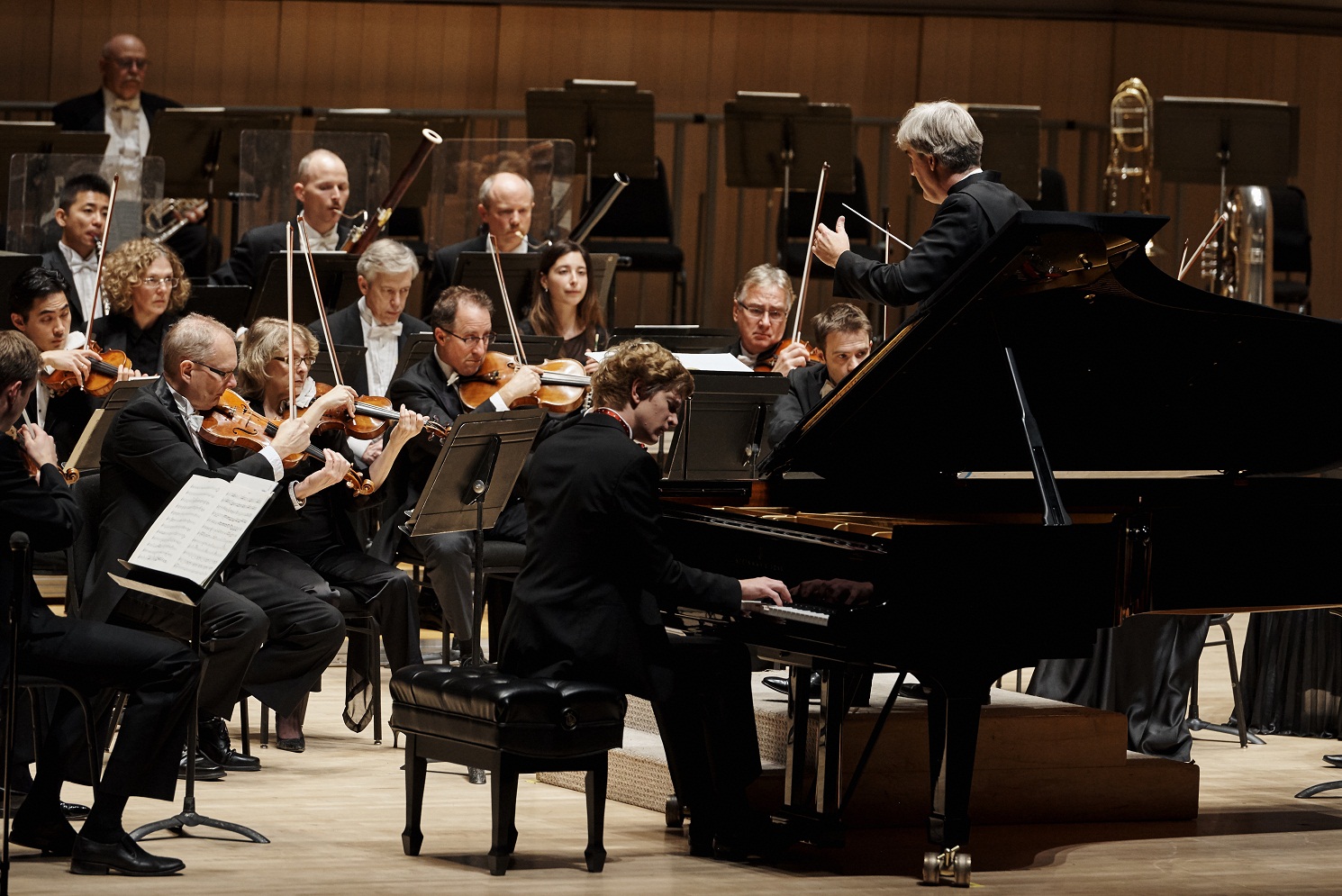
Young Daniil Trifonov got us off to a good beginning with a subtle reading of the Rhapsody, a familar work that benefits from an understated approach such as that favoured by young Trifonov, introduced a a multiple-prize winner in his early 20s.  When he arrived on the stage he was so enthusiastic that after shaking hands with concertmaster Jonathan Crow, he looked ready to shake hands with the whole orchestra.  But appearances are deceiving.  While Trifonov has a guileless look to him, don’t be fooled.  His playing shows sophistication and depth beyond his years.  The first several variations were all underplayed, the deep emotions lurking in this piece presented with a straight face.  When the piece begins to wear its heart on its sleeve, there was as a result lots of room for growth, a natural organic expansion.

Trifonov added a very apt encore, another Rachmaninoff piece based on violin, this time his transcription of the Gavotte from Bach’s partita in E.  While Trifonov began with the Rachmaninoff, like a genuine virtuoso, he elaborated this already challenging piece into something even more difficult. It was one of the most impressive performances I’ve seen in awhile.

And what do you know, when i looked on youtube i found him playing the piece as an encore at another concert.  While this is awesome i swear he played it better –more meaningful, greater dynamic contrast– here in Toronto tonight.  

I was overdue to hear Beethoven’s 9th.  With Franz Bruggen’s passing in August I’ve been listening to his historically informed performance (“HIP”) of the 9th in the car, and now Christopher Hogwood has also died this week.  It’s ironic that the old fashioned Beethoven I heard as a child and in previous performances by the TSO at Massey Hall –Beethoven on modern instruments–is not one I hear so often, supplanted in my mind & record collection by the new generation of H.I.Performers + appropriate instruments.

Yet I have to think that the H.I.P. movement has informed the approaches of conductors such as Oundjian as well, considering his brave tempi in this performance.  This was most noticeable in the finale, one of the fastest versions I’ve ever encountered.  It held together wonderfully well, aiding the singers, and more or less lifting the roof off the place with the help of the ever reliable Mendelssohn Choir.

The TSO will be repeating the program Friday at 7:30 & Saturday at 8:00 at Roy Thomson Hall.

Posted in Music and musicology, Reviews | 4 Comments

They’re back: Ensemble Studio and COC concerts

The free noon-hour concerts at the Richard Bradshaw Amphitheatre are back, and unfortunately, so’s the flu, as three of the young singers scheduled to sing today had to cancel.

It ended up being six rather than nine arias, accompanied by Jennifer Szeto at the piano, but even so it was a lovely re-launch of a series that’s a cultural leader in the city:

Soprano Karine Boucher

  • Iain MacNeil singing “Rivolgete a lui lo sguardo” (Cosi fan tutte)
  • Charlotte Burrage singing “All’affitto è dolce il pianto” (Roberto Devereux)
  • Jean-Philippe Fortier-Lazure singing “Vainement, ma bien-aimée” (Le Roi D’Ys)
  • Karine Boucher singing “O mio babbino caro” (Gianni Schicchi)
  • Clarence Frazer singing Pierrot’s Tanzlied (Die tote Stadt)
  • Andrew Haji singing “Questa o quella” (Rigoletto)

Every year I go to look at the schedule of concerts on the COC website with eager anticipation.  This year’s line-up looks like the best yet.

It’s a wonderful way to promote the opera company, getting a flood of visitors invited into their building.  But opera is the least of it.   The next concert? Thursday is Payadora Tango Ensemble, followed by jazz next Tuesday.   Tuesday October 14th, we’ll get a preview of dances in Opera Atelier’s upcoming production of Alcina.  Jazz, dance, chamber music (beginning October 21st).  I’ve already marked Thurs. Feb 5, 2015 on my calendar for a concert hosted by Emanuel Ax, with two brilliant young pianists –Pavel Kolesnikov and Orion Weiss—playing Opera Transcriptions for Piano.

But most centrally, this series is about voice.  Yes we’ll hear members of the Ensemble Studio  but we’ll also have the opportunity to hear great artists such as Jane Archibald and Barbara Hannigan. That their recitals are offered for free boggles the mind.  

We’re lucky.

Posted in Opera, Reviews | 1 Comment