“Longing for home” is a phrase that resonates in North America, where everyone—immigrant or aboriginal—is in some sense displaced. As a child born in Canada of Hungarian parents I am in a funny place, loyal to the old country of my forebears, but 100% committed to Canada. I have read about the 1956 uprising, and feel a special connection to Hungarian culture (Franz Liszt, George Faludy, Béla Tarr…). In the global melting pot, culture is one way we discover who we are supposed to be, whether in the appropriation of a pretty tune, or in a sudden rush of recognition. Who am i exactly? I felt very comfortable listening to what i thought of as an Eastern-European folk tune in Smetana’s Moldau (the most famous movement from Ma Vlast), deconstructed nicely for me by my Mom who told me that no, it’s actually a Swedish folk-song. Such details are unimportant though, as i could connect to the melody either way.
So much for nostalgia.
Tenor Stephen Bell
I have been listening to tenor Stephen Bell’s CD Kojuigatsus – longing for home a CD suggestive of these tensions, dramas, perplexities. Recording in February 2013 at the Estonian House in Toronto, the CD presents thirteen songs sung by Bell with pianist Charles Kipper.
Like so many of us Bell has a dual identity, having been born in Vancouver, but spoken of on the CD as a “Canadian and Estonian tenor”, a duality captured wonderfully on the jacket photo of the Toronto skyline, and the texts of the songs in both Estonian and an English translation. I have no idea whether Bell can speak Estonian (accented or otherwise), but his pronunciation of the songs sounds persuasive.
Each of the countries of Europe has a culture, painters & poets & composers. That they don’t always attract the attention of critics outside their own country does not negate their importance, especially in the specifically nationalist discourse of a country discovering its unique voice & identity.
With the help of Kojuigatsus I’ve made the first tentative step towards acquainting myself with the music of Estonia, particularly the compositions of Saar (five of the songs) and Tammeveski (three more). The music is attractively lyrical, although a musicologist might observe that the music is tuneful yet derivative: which is another way of saying that the songs are a happy throwback to a time when music was expected to be beautiful. In some circles that may be a weakness, but one could do a lot worse.
Kipper’s piano is strong and full, with a tone redolent of nostalgia; but that’s only fitting considering, as Kipper supports Bell throughout.
Click the CD image for info on how to obtain
Bell’s recital takes you on a trip to another place and time, as though recalling a far-off country and a way of seeing life. The first and last songs are especially reticent, but most of the sentiments are gentle and poetic, never coarse or blatant. In every song Bell’s voice soars comfortably above the murmuring piano accompaniments. At times he sounds effete, perhaps as thoughtful as the poet who wrote the words he sings.
Kojuigatsus – longing for home is like a photo album, a series of snapshots of a place we might otherwise never know. I’m thankful that although Bell takes us on this journey, he’s still here in Canada.
“Press releases and announcements” are presented verbatim without comment.
WINDERMERE STRING QUARTET CLOSES ITS EIGHTH SEASON WITH “THE
ART OF THE FUGAL FINALE”
Contact: Laura Jones (416) 516-8487
ldeanjones@hotmail.com
On Sunday, April 28th at 3:00 p.m, the Windermere String Quartet on Period
Instruments will conclude the eighth season of its Concert Series with a celebration of the fugal finale. The programme will include Haydn’s op. 20 #6, Toronto composer Stephanie Martin’s “From a Distant Island,” and Beethoven’s op. 59 #3. The concert will take place at St. Olave’s Anglican Church, 360 Windermere Ave., just south of Bloor (between Runnymede and Jane/South Kingsway). Tickets are $20; $14 for seniors/students and can be purchased securely online at the Quartet’s website, www.windermerestringquartet.com or reserved by phone at (416) 769-0952. For more information, phone (416) 769-0952 or visit www.windermerestringquartet.com
In the 2011-2012 season, the Windermere String Quartet were honoured to be the
dedicatees of the first string quartet composed by multi-talented Torontonian musician Stephanie Martin. At home in both contemporary and early music, Stephanie wrote us a wonderful quartet, combining traditional compositional techniques with a modern sensibility. “From a Distant Island” closes with a final fugue, which inspired us to explore other classic quartets with fugal finales. What, we wondered, draws quartet composers to conclude their works with this somewhat antique musical form? Does its contrapuntal nature appeal to a sense of instrumental justice, giving each instrument an equal voice? Or is it an opportunity to display compositional virtuosity by fusing intellectual and expressive approaches? The finale of Haydn’s op. 20 #6 leans towards the latter, while the famous conclusion of Beethoven’s op. 59 #3 is an example of the former, a dazzling showcase for all four members of the Quartet. We trust our audience will leave the concert with all their fugal questions answered!
Described by the Toronto Star as “Toronto’s masters of the genre” for period instrument string quartets, the Windermere String Quartet (Rona Goldensher and Elizabeth Loewen Andrews, violins, Anthony Rapoport, viola and Laura Jones, cello) is known for its dynamic performances and distinctive sound. The Quartet’s own series concerts take place in the warm acoustic and intimate atmosphere of St. Olave’s Anglican Church in Toronto’s vibrant west end. The WSQ has been quartet-in-residence at CAMMAC Lake MacDonald and Music at Port Milford, and has also performed at the Toronto Music Garden, Nuit Blanche, Toronto’s Academy Concert Series, Toronto Early Music Centre’s “Musically Speaking” series, and Stratford Chamber Music. Their recently released CD, “The Golden Age of String Quartets,” has been praised for its “period performances that blend life, spirit and soul with a perfectly-judged sensitivity for contemporary style and practice.” The WSQ gratefully acknowledges the support of the Ontario Arts Council.
I was certainly ready for the concert I attended tonight at Glenn Gould studio, to launch Eve Egoyans CD 5 . Work had drained me, and yes, i’d been listening to her CD a great deal.
I found myself thinking a lot about hearing because of the injunction on the CD, to turn the playback level low. Now of course I’ve been listening to the CD incessantly in the car, often with the windows down, which necessitates a certain volume above what might have been prescribed. Even so, I am aware of the soundscape around me. It was with such thoughts in my head that i chose a different path to the concert venue. No I didn’t walk down University Ave or Spadina from my office at the university. Nope. I walked down Huron St, enjoying the human scale of interaction, and while noticing the pets and the gardens and the friendly and gregarious people hanging out early on a Friday evening, I thought this might be a good preparation for the concert. The sounds were softer, more respectful of community and neighbours and even of self, as engines never revved, conversation never shouted. Coming into the hall, I felt the same expectant softness between the patrons in attendance.
I was reminded of something I’d observed in my studies, concerning the relationship between artists and their milieu. I’ve wondered which comes first, not unlike the proverbial chicken and egg. Does the artist create an audience for their work, or does the community feel a need that is somehow answered or filled by the artist? I think it’s a little of both. Certainly this was a sophisticated concert for a sophisticated audience.
Egoyan created a program that reminded me of something I’d read about visual artists, who in some respects refine our sense of sight, teaching us to discriminate and discern in ways that we had not been able before. The artist changes the way we see. Same with Egoyan and our hearing.
Let’s start with that injunction I spoke of, which may or may not have a feminist subtext: that we should listen to soft sounds rather than be conquered by phallic pianists (and if you hear the homonym, so much the better). Egoyan reminded me of the proverbial orator speaking softly, to force an audience to quiet down: in order to hear. And so I was part of one of the best behaved audiences I’ve ever encountered, even if we were given hyper-ears as a result. A couple of times I heard breathing or people stirring in their seats, and I was jarred as if by a massive sound when of course it was simply normal sound, heard by my new attentiveness.
How did she get us to listen?
The first part of the program was like a rondo (a rondo is a form alternating between a theme and episodes, some of which may repeat, as for example A-B-A-C-A-D). But what Egoyan had done was program three short pieces, each of the same sort, namely Nocturnes by Taylan Susam. Each Nocturne is about two minutes, soft, tranquil and meditative.
In each case I was reminded of the part of Hector in Les Troyens; Hector is a ghost who appears to Aenée, warning him of impending doom. Hector’s greatest energy is upon arrival; the ghost’s highest note is his first, while his lowest is his last, as we see him gradually run out of steam, lower and lower and lower. So too with each of the Nocturnes, arcing downwards from the top of the keyboard to the very bottom, one discreet note at a time. By the end of each of these 120 second gems, the audience were quieted and ready for the next item. It’s as if they were pieces of baguette or sips of wine between courses, to cleanse our aural palette. And then in between each of the Nocturnes, Egoyan played a different piece, wildly divergent in style, but anchored in each case by the quiet little gem.
The first episode of the rondo –aka the second item on the program—was Piers Hellawell’s Piani, Latebre, a three movement work whose virtuosic demands made a stunning contrast with the Nocturnes on either side. I need to hear the composition again, as its complexity largely went over my head; but then again I think I was just awash in the pure sensations, watching Egoyan’s hands working, the brilliant passage work, and the sonorities.
The second of the episodes –falling between the second and third Nocturnes, so “c” in my ABACAD schematic—was Claude Vivier’s Shiraz. I was fascinated to read the program note just now, which correlates curiously with what I experienced. I was struck by reminiscences of Stravinsky, particularly Trois Mouvements de Petrouchka, in its use of clusters moving up and down the keyboard and occasional echoes of Le Sacre du Printemps (thinking of the sudden moments of unprepared tranquility after something loud). The mention in the program of a marketplace wasn’t surprising given the brash sound I thought I recognized from Petrouchka. Egoyan’s playing was if anything more virtuosic, yet coming from a surprisingly still and calm player. I felt she was in a zone, very tranquil and still even when the music was frenetic. If good playing is understood as the transmission of body dynamics to the efficient and elegant creation of sound, this was like a master class, her body balletic in its smooth transfer of energy to the keys.
The third episode was what this scheme was surely designed for, namely one of the pieces from the Ann Southam CD, namely RETURNINGS II. The program says it’s seventeen minutes long. Really? I felt the way I did the first time I encountered Philip Glass, back in the 1970s: which is to say, simultaneously calm and yet inside my head, extraordinarily alert. I lost all sense of time, and couldn’t tell you whether Egoyan really played the piece as written or decided to add an extra ten minutes to it. I had no wish for it to end, but of course it’s fine that it did.
Otherwise how would I get home?
Click image for more info about obtaining the CD
After intermission, Egoyan offered another piece that seemed to capitalize on our willingness to listen. Hm, or was that urbanity already characteristic of this audience, and only I was transformed out of my usual rudeness?
SKRYABIN in itself is a large composition by Michael Finnissy that seems to be abstracted from the composer (Skryabin that is, rather than Finnissy). I don’t pretend to understand the relationship, only that I’m inclined to invoke the word “reified”, which is a word I regularly truck out when I sense that someone is so deep inside their head that they’re not nearly as intelligible as they think. I used it not long ago to talk about Thomas Adès, and I think it applies here as well. There’s much to unpack in this composition, which again may have simply gone over my head. Whereas the Southam and the Vivier blew me away, I was –as with Hellawell—wanting another listen before I’d venture any sort of analysis. Even so there were some lovely stretches, particularly the last ten minutes.
I am now looking forward to getting into the car and listening to Egoyan again.
Tonight the Canadian Opera Company opened their new production of Donizetti’s Lucia di Lammermoor, the dark tale of a bride forced to marry against her will who goes mad on her wedding night, killing her new husband. This is not your usual Lucia.
In the past I’d come with low expectations, preoccupied by the singing as if I were watching American Idol, measuring individuals for their high notes rather than the dramatic credibility. But this time, with director David Alden’s English National Opera Production, conducted by Stephen Lord, and starring Anna Christy & Stephen Costello, my expectations were much higher.
For Act I, the production mostly persuaded me, even if there were troubling elements. Alden has moved the action to a more recent time (instead of the 17th century, we’re in the 19th century). While i resisted the production for awhile, let’s cut to the chase, and conclude that I was blown away on the whole. The last act especially knocked my socks off, giving me much more than just virtuosity, but a deep and probing exploration of the story & its implications.
Christy & Costello both deliver. With Anna Christy, you get a Lucia who looks very young. She could have been Juliet Capulet. Her voice was good, but what you remember is the portrayal, which is understated. An article in the Toronto Star said that Alden had used the film Carrie as a model, which come to think of it makes sense, given that in a real sense, Lucia is the prototype for the horror film. The glory of that mad-scene (both in the film and the opera) is that a person who has been wronged breaks free of constraints, and becomes like an avenging angel, righting the huge wrongs that we’ve seen in the previous scenes.
Christy didn’t really surprise me, given what I’d read, and given that the material is so well written/composed as to be sure-fire, working even when the soprano looks 55 rather than 15. But I’ve never –until now—seen an Edgardo that I really liked. He’s a troubling character, sailing off into the sunset early on, and then suddenly appearing self-righteously five minutes too late, romantic in the ineffectual way that’s classic Walter Scott. While it’s really a team effort –that is both soprano and tenor have to paint a convincing portrait of a couple who can love one another, and of people who deserve love—I feel Costello deserves special credit, making such a likable and charismatic Edgardo. I had been warned privately (an email from someone who saw him in NYC in 2007) that while he sings like a god, his acting is mediocre; that was then, and this is now. Not only is the voice spectacular, but Costello has become quite a good actor.
Thank goodness I have tickets already to see/hear them again!
Yet the man with the hardest job is the nub of my objections to the production, playing an impossible role. Forgive me if I sound conservative, but I can’t help knowing the opera, can’t help hearing what the singers are singing. When a director does as Alden did, changing the story slightly, it’s usually in order to create some important effect with the key protagonists: Lucia and Edgardo. In my experience director’s theatre works in the big moments of the opera, but will have at least a few places where it falls down because either it wasn’t fully thought out or worse, where they got lazy. And the usual nexus for this problem is the baritone role. It happened in a Traviata I saw, where “di Provenza” is sung in the strangest locale, but can’t be cut because it’s a pivot in the plot.
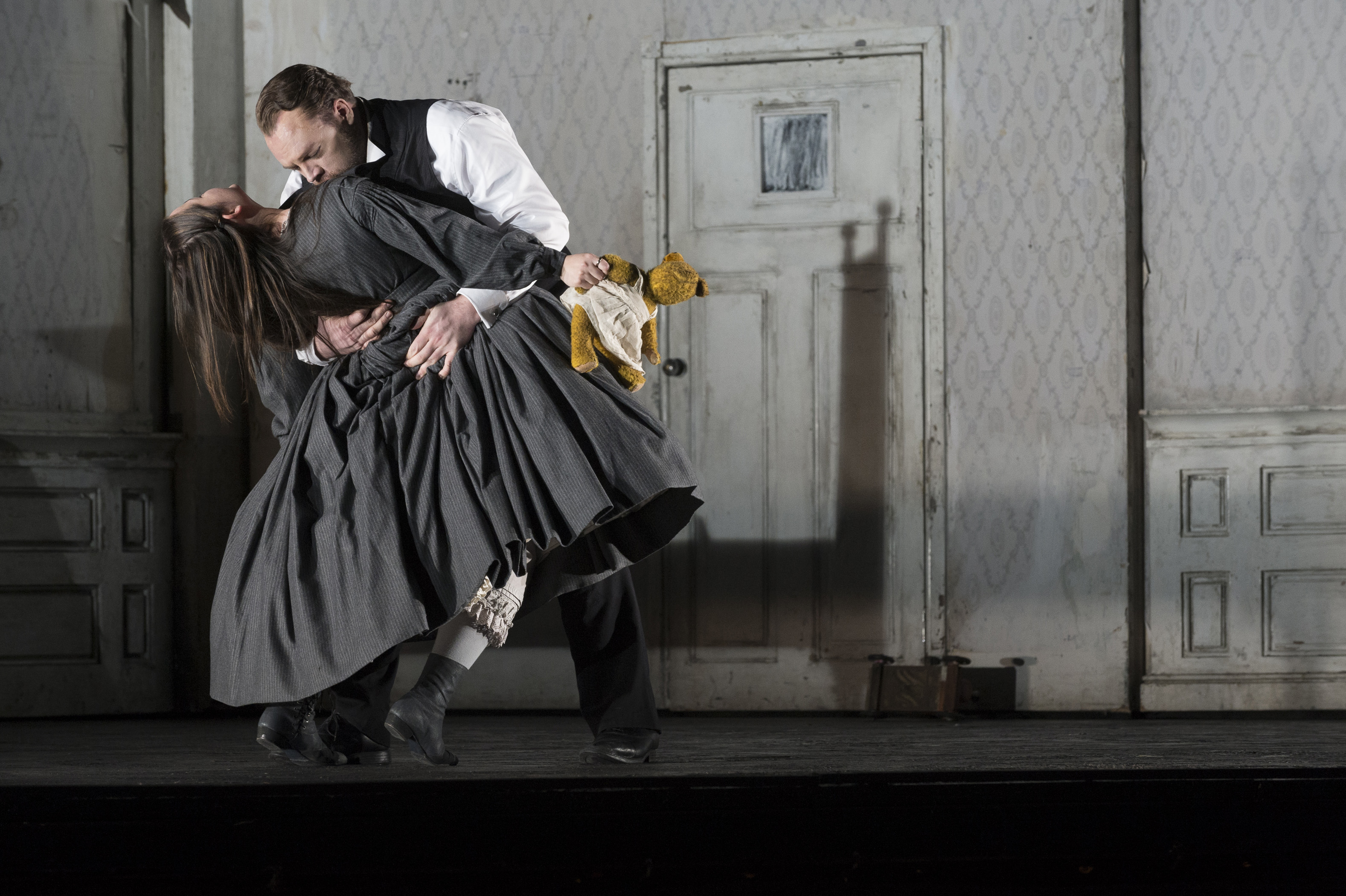
Similarly, tonight I watched the grim brilliance of Brian Mulligan as Enrico. He is the power in this opera even as he struggles to arrange a marriage for his sister to save the family fortune. Enrico blocks the happy ending that should be possible in this story, forcing Lucia to marry the wrong man, forging letters to discredit Edgardo in Lucia’s eyes. In another century he might be the one that gets boos and hisses from the audience. But does he also have to be a pervert who ties up his sister, who jabs his arm under his sister’s dress just as she squeals a high note as if in response? We see him rolling around with Lucia’s doll in her bed, reminding me of Hedley Lamarr as played by Harvey Korman in Blazing Saddles (minus the cry of “where’s my froggy”). If you think i am exaggerating see the opera and then tell me that’s not what Enrico resembles [a morning-after addition to explain the similarity; both Hedley and Enrico are infantile and tyannical, capriciously switching back and forth]. And I reiterate, Mulligan was wonderful, managing to not merely do as he was asked, but to be genuinely unavoidable, the centre of everything, regardless of how blatantly absurd the creation that was foisted upon him by the director. This was grace under pressure. In Act II I was laughing out loud as he played with Lucia’s toys in her bedroom.
Anna Christy and Brian Mulligan (Photo: Chris Hutcheson)
It seemed to me that the opera was being re-framed as a kind of dark comedy, and by the way there were lots of people laughing throughout this scene, so it wasn’t just me (even if i was the big-mouth who started the laughter).
And then in the next act, I stopped resisting Alden, and then it clicked into place. Nathaniel Peake struts in as Arturo, accompanied by quiet thugs who reminded me of those quiet thugs in Yellow Submarine (except the colour scheme is different; but otherwise they move exactly like the tall “bonkers”: those scary cartoon dudes, except nobody drops any apples on anyone’s head).
When Arturo hands his hat to Enrico as if he were simply a valet? Poof! we get a very new kind of tension that makes wonderful sense. The family dynamics suddenly cohere perfectly, even if I wondered whether we really needed all the madcap antics from Mulligan. So I forgive Alden for that, even as I quietly mutter under my breath that it’s a gratuitous attack on the most macho creature onstage. From the wedding scene onward, everything worked magnificently.
Alden does create some wonderful conceits that take us into a symbolic realm suitable for such a story of myth & consciousness. For me the best of these is the use of a stage within the stage, but I am a complete sucker for self-reflexive devices. When Edgardo arrives he comes as if out of a story-book, arriving from that stage, and exiting too into that stage. It will be the site for Lucia’s mad-scene, undermining all the performativity of the coloratura showpiece we’re watching. And later, when we meet up with Edgardo, how wonderful that it’s as though we’re backstage, where the poor hero has gone to meet his not-so-heroic end.
Stephen Lord was quite magnificent to watch, deliciously flexible with the COC orchestra in following the singers no matter where they wanted to go, one of the most impressive displays of musicianship I have ever seen. And the orchestra were in splendid form, especially the horns.
So this is a Lucia that’s much more than just a virtuoso vehicle, with fabulous singing and where there’s madness running through the whole family. All in all, I’d say it’s way better than I dared expect. You should see it.
When one thinks of Beethoven cycles, the mind immediately thinks of symphonies, piano sonatas and string quartets, forms in which we see the complete range of the composer’s voice. The early ones remind us of Beethoven’s influences, such as Mozart or Haydn. The middle ones break free, reinventing the form, and the late ones astonish. In each case –solo piano, string quartet, or symphony—the forces in question trace a line of development. We see the transition begin from the classical to the romantic, the move away from perfect balance & symmetry, towards experimentation, larger forms, and romantic references outside the realm of pure music.
While I’ve played a few of the violin sonatas I can’t pretend I knew Beethoven’s cycle; indeed I didn’t realize its scope. I now have my first recording, from Duo Concertante: Nancy Dahn, violin and Timothy Steeves, piano. I had played some of the earlier ones, and did not realize there were ten in total, again describing a kind of arc through the life of the composer that reveals his growth and development through another lens. With Beethoven one never has enough such lenses, to bear witness to his boundless creativity.
While the cycle leans a bit towards Beethoven’s youth (with nine of the ten composed in the six years from 1797 to 1803, or in other words, roughly between the time he was 27 and 33, before his Third Symphony appeared in 1805), the concentration of works bears witness to progress, innovation and daring.
There’s a note on the record jacket that’s a good indication of what you find on the recordings:
We hope the permanence and consistency of these Beethoven sonatas in our daily lives and the great joy they bring to us are tangible in these recordings.
Indeed they are. The playing is very well thought-out, interpretations that are solidly in the middle of the road. If I were to compare their approach to a set of Beethoven symphonies, I’d say they’re like von Karajan or Furtwangler: interpreters who don’t rush excessively but who make the architecture of the music transparent, with solid emphasis on the necessary contrasts. These are congenial readings of the sonatas that are neither radical nor conservative, but comfortably recognizable as Beethoven.
Dahn’s violin sings sweetly, occasionally fiery but mostly a tuneful instrument. Dahn and Steeves are joined at the hip, as though they shared one mind. Steeves is occasionally centre stage, but mostly seems to work in support of Dahn’s glamorous sound. The pristeen clarity of the recording is ideal, never too dry but with just enough reverb to comfortably display the performances.
This is a set full of stunning music that deserves to be better known; only two or three of the sonatas are what I would call “familiar”. I’m grateful to have found Duo Concertante and to have been led deeper into Beethoven through their intelligent readings of the violin sonatas.
April 22ndDuo Concertante are playing a concert at Gallery 345 in celebration of their new recordings.
Beethoven: Complete Sonatas for Violin and Piano
Performance/CD Celebration by Duo Concertante
Monday, April 22, 2013 at 8PM
Gallery 345: 345 Sorauren Avenue, Toronto
Tickets: $20/$10
Reservations can be made by calling 416 822.9781
or via email info@gallery345.com
Rufus Müllerwas acclaimed by The New York Times following a performance in Carnegie Hall as “…easily the best tenor I have heard in a live Messiah.” The British/German tenor is celebrated as the Evangelist in Bach’s Passions, and his unique dramatic interpretation of this rôle has confirmed his status as one of the world’s most sought-after performers. He gave the world premiere of Jonathan Miller’s acclaimed production of the St Matthew Passion in London, which he also recorded for United and broadcast on BBC TV; he repeated the rôle in three revivals of the production at the Brooklyn Academy of Music in New York (“a sensational Evangelist”- New York Times. Müller is also a leading recitalist, performing worldwide with pianist Maria João Pires.
In addition to Müller’s success in live opera and oratorio, his recordings include Bach’s St John Passion and Bach Cantatas with John Elliot Gardiner for DG Archiv, Mozart’s Die Zauberflöte and Beethoven’s Choral Fantasia with Roger Norrington for EMI, Messiah with Tafelmusik and with Washington Cathedral Choir, Haydn’s Creation with Edward Higginbottom and New College Oxford, Handel’s operas Ariodante with Nicholas McGeganand Rodrigo with Alan Curtis, songs by Franz Lachner with Christoph Hammer on Oehms Classics, and Ned Rorem’s Evidence of Things Not Seen with the New York Festival of Song on New World Records.
The 2012/13 season includes recitals with fortepianist Christoph Hammer in Germany and New York , Britten’s Serenade in Toronto, Hans Zender’s version of Winterreise in Montreal, Bach’s Passions in Oxford, Stockholm, New York, San Francisco and Washington DC, Cantatas in Seattle, Messiah in Montreal and Washington, Mendelssohn’s Paulus in Madrid, Haydn’s Creation in Norway, Satyavan in Holst’s opera Savitri with Little Opera Theater New York, a Britten recital with guitarist David Leisner in New York, recitals and masterclasses in Japan, and the title rôle in Monteverdi’s Orfeo in Germany with Andrew Parrott.
Müller was born in Kent and was a choral scholar at New College, Oxford. He studied in New York with Thomas LoMonaco. In 1985 he won first prize in the English Song Award in Brighton, and in 1999 was a prize winner in the Oratorio Society of New York Singing Competition. He is Assistant Professor of Music at Bard College, New York.
On the occasion of Müller’s participation in Tafelmusik’s upcoming A Handel Celebration on May 1-7, I ask him ten questions: five about himself and five more concerning a historically informed approach to baroque repertoire.
1-Are you more like your father or your mother?
We are always surprised by our resemblances to our parents, and not always pleased by them! But I recognise as I get older that people love us for all of it, and that we can learn from both what we think of as positive traits and negative. My obvious, exterior traits are very much my English mother’s, a certain eccentricity , and an old-fashioned approach to the English language, for example. Like her, her mother, and her grandmother, I “cannot hold my tongue in any language”. I have her obvious flair for the dramatic, too. But I get much from my German father, such as a certain fastidiousness, which often leans into being over-critical. But he was a great preacher, and professed a very human view of Christ, so that now, some years after his death, I recognize him in my interpretations of the Evangelist rôles in the Bach “Passions”, and in “Messiah. Physiognomically , I have my father’s mouth and facial expressions, and my mother’s bones and family nose, as well as her father’s hair, or lack of it!
2-What is the best thing or worst thing about being a singer?
The best thing about being a singer is that I get to move a large number of people, generally through a beautiful and universal medium. The worst thing is the freuqent inability to remember that that is what it is about, and to focus instead on the worry about what it sounds like!
3-Who do you like to listen to or watch?
Wouldn’t it be obvious for a tenor to talk about listening and watching my hero tenors, such as Caruso and Wunderlich, who keep reminding me of my aspirations! I confess I spend much more time with Joni Mitchell, the 1970s Elton John, Donny Hathaway, Billy Holiday, Sarah Vaughan, Stevie Wonder, and Motown in general. My partner Max is a huge source of wonderful music of all kinds which moves me. I’ll relax very often to instrumental music, though, jazz, baroque, string quartets. My favourite piano soloist is Maria joão Pires, with whom I have had the pleasure of performing many recitals around the world, including at least a dozen performances of Schubert’s “Winterreise”. Being at a performance with her, whether as a spectator or participant, is to be transported completely to the bliss of the present moment. The Real Thing.
4-What ability or skill do you wish you had, that you don’t have?
I’d love to be passionate about, and really good at, accounting. I’d never get behind with the taxes, and I’d be a lot richer!
5-When you’re just relaxing and not working what is your favourite thing to do?
I’m a beach bum. And I love to play tennis. Boring of me, I know, but work is more than interesting enough, and I don’t get many breaks!
~~~~~~~
Five more concerning Müller’s participation in Tafelmusik’s upcoming A Handel Celebration on May 1-7
1-What are the challenges you face with baroque repertoire (in a “historically informed style”)?
Really the only real challenge I find in some of this repertoire is not to starve or attenuate my sound in the interests of staying “light”. The style requires a much more subtle and demanding form of physical support, but it must be there. I have never enjoyed an over-ethereal sound in “Early” music, except as a special effect, and baroque music is as passionate and sexy as anything from later periods. So the challenge consists of being all that, but still maintaining a transparent texture. With Tafelmusik I have never felt the need to hold back, thank goodness! But when, after years of singing with the orchestra, I sang Beethoven’s Ninth Symphony with them, there was some surprise that my romantic singing was so much louder and fuller than they were used to with the usual baroque repertoire!
2-What do you love about the repertoire you’re playing?
Sophie Daneman, soprano (photograph: Sandra Lousada)
Händel is one of the ultimate “singers’” composers, like Verdi, for example. His coloratura is generally singable (!), and he more often than not knows that singers have to breathe occasionally, something that Bach often seems to forget, much as I love him! I love this programme for its contrasts, the alternation with choir, obbligato instruments, full orchestra, and the lovely duets with my old friend Sophie Daneman, the epitome of elegant and sexy. And if I could name one orchestra in the world whom I consider family, it would be Tafelmusik, and its chorus, and conductor Ivars Taurins. Such long and, yes, intimate relationships with whole groups of musicians and the individuals in those groups – these are rare and precious.
3-Do you have a favourite moment in the program?
Yes, I do – the duet “As Steals the Morn”. I first sang it with the Mark Morris Dance Group in Mark’s setting of “L’ Allegro” in the Edinburgh Festival a long time ago, and that sealed it as an all-time favourite. It comes near the end of this programme, and I’m so glad about that. It shimmers in the distance throughout the evening, and then we finally get the treat.
4-How do you feel about the relevance of music & the performing arts, particularly the music you play, as a modern citizen?
When I was living through the seeming endless double term of President Bush the Younger, it became very clear to me that audiences in the States in particular were becoming deprived of reliable truth, both in public discourse, and in the decisions taken on their behalf by their government. I felt a kind of collective starvation on a deep, spiritual level, even in places like Carnegie Hall. And when they got the Real Thing, even just one aria or song of complete honesty and integrity, of presence and deep feeling, there was a palpable sense of collective relief and emotion, a transformation. That hunger has not gone away enough, despite the changes at the “top”. Governments nearly always cut funding to the arts as soon as the economic going gets rough, deeming them a luxury, rather than the lifeblood we know them to be. In our best moments as performers of music, we have the power to give new impulses to that lifeblood, and it nourishes both us and our listeners and viewers. Love, despair, joy, grief – these outlive, and have relevance far beyond, any temporal powers, and our ability to interpret them and make them accessible to any number of people is our privilege, as well as our calling.
5-Is there a teacher or an influence you’d care to name that you especially admire?
All I do as a singer is of course my own personal statement. But for many years at the start of my career, I knew how I felt and how I wanted to transform an audience, but didn’t have the technical means to achieve these things. My voice, though always elegant, didn’t make enough sound to be heard in an opera house, and had other weaknesses which frustrated me. In the end I found a wonderful teacher in New York, Dr. Thomas LoMonaco, and had lessons with him for almost 20 years. Tom, who died at the beginning of last year just short of his 90th birthday, having had a long battle with Parkinson’s Disease, was one of the old-school, Italian-based teachers, with a particular and personal flair for building up voices, and healing those that had gone off the rails. Under his guidance, I learned to access much more of my voice, and after about a year I was ready for my first opera of many. I continued to have lessons with Tom until 6 months before his death, and have just recently had my first lesson with his widow, Ilka LoMonaco – there’s nothing like going as close the source as possible! We played recordings of Tom as a young man at his memorial service, and his strong, golden, musical and passionate voice reminded me of what I am still working to achieve. The singer’s journey is never done.
~~~~~~~
Tenor Rufus Müller joins Tafelmusik for A Handel Celebration on May 1-7. Click image below for further information.
Tafelmusik Chamber Choir, directed by Ivars Taurins (left foreground). Click for concert program & Taurins’ notes.
Isn’t that life, in a way: trying to accommodate dissonance
–Ann Southam
In the realm of disco or heavy metal, we’re told to turn up the volume. I saw something new, though, on the booklet for Eve Egoyan’s CD 5. The recording of five posthumous pieces by Ann Southam has the following instruction clearly spelled out:
This music is intended to be quiet.
Please adjust your playback level accordingly.
That’s a new one to me.
But oh that doesn’t mean the recording doesn’t reward the listener who turns it up. Sorry Eve (and Ann), I did try it loud as well. I submit that it makes more sense to listen as we’re instructed, and sorry if i am disobedient. I can’t help but think that i was being a sophomoric male, in being loud and disobedient. The fact is it’s lovely with the piano murmuring quietly rather than booming. The CD has dynamics but they’re always understated, and within a narrower range, the difference something like what happens when you switch from a larger-than-life player banging out Liszt or Rachmaninoff, to a collaborative pianist accompanying a lieder singer. This is a recording of wonderful intimacy, showing a respectful treatment of materials from after the composer’s death. We are hearing something hushed as though we were in the presence of something magical, and if i didn’t know better i’d say it’s reverence for the composer.
That’s a beautiful thing to encounter.
When I looked into the liner notes I saw something rather astonishing that in retrospect makes wonderful sense. Let me explain my astonishment by quoting the liner notes:
In a 2010 interview, in remarks that we can safely extend to the pieces on this disc, Southam described Returnings I [a very similar piece to what’s on this CD, one of Southam’s last compositions] as the continual asking of “Why?” each time in a slightly different way. She also spoke of a “red dissonant line” that she literally saw running through the very consonant, repeating patterns in so much of her music – the dissonance created by a 12-tone row.
“Isn’t that life, in a way: trying to accommodate dissonance” she said.
For those of you who know what a tone-row is, you probably have something in your head, corresponding to the dissonance of a composer such as Webern or Kurtag.
Now of course, this example –or any of the other twelve-tone compositions that come to mind –is nothing like what Southam has accomplished, in her lovely and gentle compositions. In a nutshell, she’s taken the dissonances that one normally finds in a tone-row, and removed the usual edginess. Removed? No that’s wrong. She’s taken the diamond blade that would usually cut us and suffused it in soft velvet. Imagine Berg given acid, and –in the latter, reflective part of his trip—making tone rows with the meditative calm of Philip Glass. Of course this isn’t the usual framework, because there are lots of extra notes, lots of diatonic patterns to accommodate the chromaticism, grounding & calming. If nirvana is a kind of enlightened peace, this is what it sounds like, an acceptance and even love of dissonance, reinvented and reframed as assonance.
I can’t avoid the gender subtexts.
I have had Southam in the back of my mind for a long time. I was working on a movement-theatre piece in the 1990s called Dreams of the Goddess when I was also aware of a dance work with a score by Southam called Dancing the Goddess. I won’t deny I was frustrated and perhaps jealous:
Because I was working with students, not professional dancers
Because I was ignored and never dreamed anyone would notice me (yes the green-ey’d monster had me in thrall). No i am not proud of my sentiments.
Because the people I invited to see the work (fool that i was and still am) judged the work solely on the competency of our movements (wonderful as our performers were, they were not professional dancers… duh!), and didn’t bother talking to me about what I was trying to do, seemed to have no concept of dramaturgy or music. Oh well, I suppose I should have been grateful they had even shown up, but I became very uninterested in types of dance that seemed only interested in how well people could move, perhaps as my own over-reaction. And yes some of you know I am obsessed with the issue of virtuosity. This is part of that ongoing conversation.
I only mention that because there might also be a feminist subtext here as well, and that, unfortunately, in my single-mindedness, I clearly lost track of Southam, an important composer. So now, so much later, I want to think about this all over again and hopefully catch up.
Speaking of feminism, I’ve sometimes felt that modernism is a particularly gendered phenomenon, music that follows rational patterns as though music has no reference anymore to feelings or emotions, to cultures & reference points. It was the soundtrack for a period of music history that was box office poison, because let’s face it: it’s not tuneful or popular, and has never broken through to any sort of mainstream acceptance. The tone-rows you get from Webern et al struck my ear as a very lonely and essentially male phenomenon, even when the main character onstage –thinking of Berg’s Lulu—might be a woman. While there are brilliant productions of the opera that are sensitive to the sexual politics of the work (for example the La Monnaie production reviewed here), I am merely speaking of the broad modernist project I saw. When you’re telling a story of anguish and alienation such as Lulu then by all means, give us the sounds that match those emotions.
Southam’s music is truly another kind of music, a music of reconciliation and accord, rather than brash discord. I can’t help reading something feminist into this, as though she were attempting to re-boot and reinvent the style, without the angularity and dare i say it maleness that jars you.
I think you’ll find that once you start listening to Egoyan’s CD, you could easily leave it on your player for quite a long time. It doesn’t invade your sonic space and so easily becomes a comfortable background for your life.
Egoyan launches her CD in concert Friday at 8 pm, at the Glenn Gould Studio.
Ever notice that conversations can reinforce and honour contrary positions? When you sit down with someone over latkes, beers or (name your pleasure), the celebration and enactment of community & indeed, communion, makes the points where you diverge immaterial. You have the affirmation of life in the filling of your tummy, and so what if your brains and your arguments go in different directions?
At least that’s how I feel. You may disagree(!).
I find that the way the media portray ideas, they tend to view debates like football. One side wins and one side loses. When there’s disagreement it must be resolved in a shoot-out or sudden-death overtime. There’s no tolerance for ambiguity, no subtle equivocal position allowed.
I bring this up because I am noticing how many possibilities there are for big ideas in theatre. In the past year I had already tossed out a few thoughts on Regietheater (director’s theatre), where the original text becomes a site of contention, as the audience seem to witness a multi-level conversation, or even a kind of debate, where the text and its encoding (both as a performance and as a series of remmants of a moment in time) collide with the present, both in the audience’s demands and the layers of meaning added by the mise-en-scène.
I am realizing now that this conversation –very contentious in some quarters—is really a small part of a bigger tension that we may lose sight of, that shows itself in works that have been adapted multiple times. Over lunch yesterday it was as though I heard a younger version of myself declare its love for Verdi’s Otello, an opera that I once had placed at the very top of the heap. I’d seen Jon Vickers, Louis Quilico and Theresa Zylis-Gara at the Met in Zeffirelli’s production, conducted by a young James Levine, and had in various ways had tried to scale Parnassus by playing the score & hearing singers, enlightening me while deafening me. Having later seen a few productions of Shakespeare’s play, including one where I deconstructed the play in the role of composer, I lost my adoration for what Verdi and Boito had done. Their opera is still fascinating, brilliant in so many ways, yet their Iago is so different from Shakespeare’s. The divergence is substantial, revolving around the nature of good and evil. There’s room in my life for multiple adaptations of this story, as I realize that I’d like to have another look at Rossini’s Otello (which I recall dismissing, when I noticed the uncanny resemblance between the music where the Moor stalks his wife to the music where Elmer Fudd hunts Bugs Bunny in The Bunny of Seville).
Composer Thomas Adès
It’s perhaps a matter of emphasis. While I enjoyed & admire Adès’s Tempest I recall that its emphases are displaced in some of the same ways (albeit with the exactly opposite metaphysical assumptions… but more on that in a moment) from the original play, as to what I observe with Verdi/Boito and Otello. I am in awe of the intelligibility of the libretto, which surely is at least partly the work of Meredith Oakes, a series of short lines that flush iambic pentameter down the toilet. Mark Shulgasser’s libretto –for Lee Hoiby’s Tempest—has much more of a feel for the Shakespearean line: which makes it less intelligible in the theatre. Recalling what Mallarmé said about Debussy (when Debussy set his “afternoon of the faun”, he said something like “but it’s already music”): poetry is already music. Why (and how?) would you set iambic pentameter to music? Oakes made a canny choice, sacrificing a certain sacred cow –Shakespeare’s diction—on the altar of dramatic expediency. And I believe it was the right thing to do. Boito cut the first act of Othello more or less for the same reason: because opera is not the same medium and so compromises are necessary.
I am thinking, too, of the way Oakes / Adès end their Tempest, which seems to sacrifice a key element of the play. As I recall one of the best productions I saw at the Stratford Festival in the 1980s, directed by John Hirsch, music by (?), the masque element of celebratory performance was front and centre in all its delicious redundancy. I’ve never seen Shulgasser/Hoiby’s opera, but as I recall they do not minimize this element. The lovely ending of the Adès opera we saw at the Met last year has a decidedly ecological slant to it, with a sort of epilogue showing us the natural world of the island after Prospero et al have buggered off back to their homes in the civilized world. If one has no use for the celebratory (and sees nothing transcendent in this) then of course this makes sense, and is surprisingly satisfying, even as it is itself somewhat counter-discursive, an anti-Tempest.
I was playing through some of Parsifal at the piano again this morning, as Toronto eases slowly into spring, after yet another storm. I’m still enjoying the endorphins, the rush I get playing it. I think I’ve found at least part of the nub whereby Adès diverges from some composers & theatre artists, and it’s at the core of that divergence I spoke of in Tempest. Speaking of storms, it doesn’t matter that we have at least two Tempests, as there’s room for all these different views.
In Adès’s book Conversations with Tom Service the composer savages Wagner (and i addressed some reasons why this is at the very least a good career move a few days ago). I am thinking of my lunchtime conversation because there’s surely room for his viewpoint and mine, the same way that there’s room for those of us who go to church and have a powerful experience, and those who are unmoved. Unlike some, I believe God does not punish those who don’t believe, as their unbelief is its own reward. You don’t go to Hell for not believing, as “hell” or “Hell” is a primitive construct that’s nowhere to be found in the Bible, at least not in the variants we see in Medieval drama or in Dante.
Adès tells us very plainly in his book about his metaphysics, and that’s really all I needed to understand his response to Parsifal, and by implication, why his Tempest goes off in the fascinating direction it goes. I pair it in my mind with Boito’s paraphrase of Otello because in each case, one can see just how many possibilities are possible in the magic of adaptation.
In rejecting Wagner he says the following:
I mean, so much of Parsifal is dramatically absurd, which would be fine if the music was aware of the absurdity, but it is as if the music is drugged and we all have to pretend that it’s not entirely ridiculous. And it seems to me that a country that can take something as funny as Kundry seriously, this woman who sleeps for aeons and is only woken up by this horrible chord, a country that can seriously believe in anything like Parsifal without laughing, was bound to get into serious trouble. (Adès 15)
Please don’t accuse me of taking this out of context. Adès goes on quite a bit longer, but always taking huge pot-shots at the mysterious cultural assumptions underlying this, calling Wagner & his music a fungus, that the music works as though someone had drugged you. Sounds like maybe he resents its power? Or is even susceptible at some level? Don’t get me wrong, I am very impressed by much that Adès says, particularly in his understanding of the epistemology of music itself, his understanding of the magic that music has to prolong a moment, even if he seems to reify a great deal, and speak in metaphors from deep inside his head. But it’s okay, because they’re illuminations rather than evasions, whereby we come closer to his process and the music itself.
But the key that unlocks it all –his response to Wagner & his particular paraphrase of Shakespeare—came in a discussion far removed from music:
For some reason I started reading positivist philosophers when I was about fourteen. I can’t remember why. Around the same time I was being introduced to Schenkerian analysis at the Guildhall School of Music and Drama, and I suppose you might say it was a time when that part of my brain, such as it is, was beginning to function. To try to put the logical positivist idea very simply –I believe it starts from Wittgenstein: there are only two types of statement, types of sentence that you can say, apart from ordering or questioning. Those two types are an observation based on reality, or a tautology. There’s nothing else. And that made me think: ‘What does that leave us?’ If that’s true, there are no relationship, there’s nothing. Everything is simply dead, you put something down on paper and it’s dead. There’s no echo to anything. There’s just a kind of matt surface that soaks everything up. (Adès 65-6)
It seems fitting –in this Easter season particularly– that Adès first name is “Thomas”. And so no wonder that Adès sees no point in Parsifal and ended Tempest as he did. The celebratory element of music –which is surely a tautology—doesn’t seem to reach him. I played the Good Friday music from Parsifal this morning precisely because it’s redundant & a tautology, to repeat something that’s an affirmation of something permanent. It’s a curious piece the way I decode it these days (with the help of Girard’s production, as i look forward to the encore next Saturday at this time), sitting on the boundary of a church that affirms and heals, and a church that is itself human, deeply flawed, wounded, and in need of healing. Such transcendent possibilities bounce off a positivist. Yes the music is manipulative, and afterwards maybe I too feel “as though someone had slipped something into my drink” (Adès 60)
The fast-rising young tenor Stephen Costello has firmly established himself as one of the current generation’s most impressive artists. He came to national attention in 2007 when, at age 26, he debuted at the Met’s season-opening night and was quickly invited to appear again that same season. In 2009, Costello won the prestigious Richard Tucker Award. He subsequently made his debuts at a number of the world’s most important opera houses and music festivals, including London’s Royal Opera House, Covent Garden, the Deutsche Oper Berlin, the Salzburg Festival, and the Vienna State Opera. In 2010 he inaugurated the role of Greenhorn in the Dallas Opera’s acclaimed world-premiere production of Jake Heggie and Gene Scheer’s Moby Dick.
His performances as Cassio in Verdi’s Otello, conducted by Riccardo Muti at the Salzburg Festival, were released on DVD in 2010 (Major/Naxos), and his Covent Garden debut in Linda di Chamounix was released on CD in March 2011 (Opera Rara).
Next week Stephen Costello will headline Donizetti’s Lucia di Lammermoor at the Canadian Opera Company as Edgardo opposite soprano Anna Christy in a revival of David Alden’s ground-breaking English National Opera production.
It was in Lucia that the tenor made his house debut at New York’s Metropolitan Opera back in 2007, when his portrayal of Arturo so impressed Met Music Director James Levine that the young tenor found himself undertaking the opera’s male lead that same season. As Parterre.com reports, thanks to his “youth, sweet timbre, precocious poise, and emotional involvement” as Edgardo, it was Costello who “got the biggest ovation at the end” of the night.
Now the Richard Tucker Award-winner looks forward to reprising the role for all nine of the Canadian Opera Company’s upcoming performances between April 17 and May 24.
I ask Stephen Costello ten questions: five about himself and five more about his portrayal of Edgardo in Lucia di Lammermoor.
1) Are you more like your father or your mother?
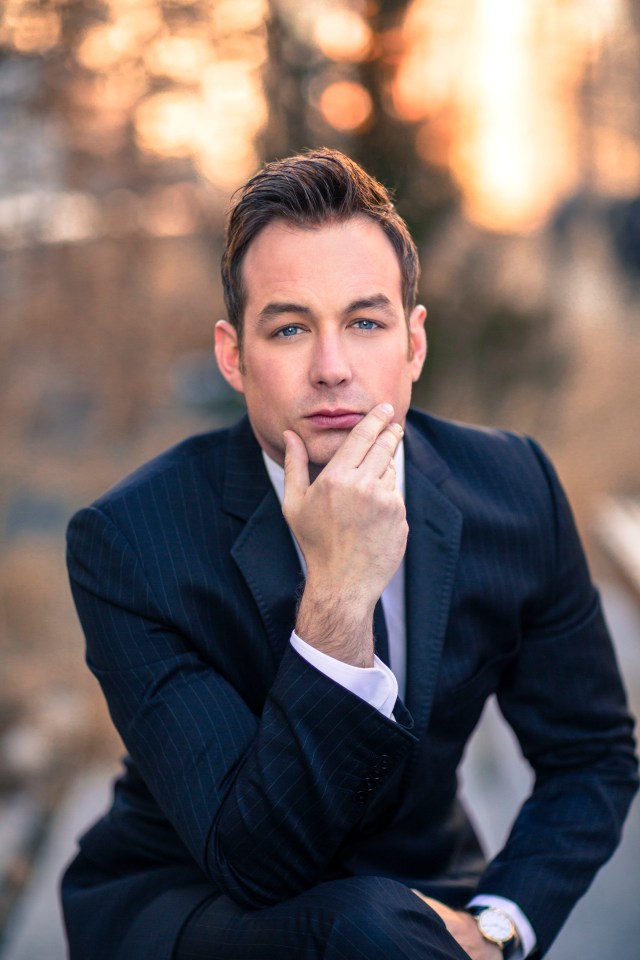
Tenor Stephen Costello (photo: Dario Acosta)
I am not really sure. I am sort of a mix of both I think. I can’t complain I had great parents growing up.
Sure like all families we have had fights and I am sure I have said terrible things at one point, but I love them both very much. They have taught me to be polite and respectful, and never forget who you are and where you have come from. That also keeps me grounded as a person.
2) What is the best thing or worst thing about being a singer?
There are so many great things about being a singer. You get to travel all over the world, work with amazing artists and musicians. You also get to bring music and joy to audiences and people who really need to be entertained and forget about life for a while. These are the things that keep us in the business.
The worst part about being a singer is not seeing family and friends. I spend weeks away from my wife at a time and it is terrible. I have also missed watching my nephew Sean and Godson Patrick grow up. I have missed birthdays and Christmases. In this business you have to be willing to make sacrifices. That is the worst part of being a singer. A lot of people will say rejection, I think that makes you stronger. It is not seeing the ones we love, that’s what gets me.
3) Who do you like to listen to or watch?
I listen to everything and everyone. The more you listen to, the more ideas are in your head. I can watch YouTube for hours. I feel it is important to watch the stars of the past and the stars of today and see what makes them famous or special. I think we learn more as a singer watching others. I have been on a Bruno Mars kick for a while. I think he is so talented. I also love watching movies. Anything with Jimmy Stewart, Tom Hanks, or Johnny Depp, I am There. Would love to meet these guys and pick their brains.
[Is it my imagination or does Stephen Costello resemble the young Tom Hanks? see for yourself]
4) What ability or skill do you wish you had, that you don’t have?
I wish I had the ability to make a decision. I can make decisions on work, but nothing else. It is awful. I will end up trying to decide on lunch or dinner, and then it is too late. I also wish I could fly, but then again who doesn’t.
5) When you’re just relaxing and not working what is your favourite thing to do?
Hangout with friends and go to the movies. If I am not doing that I am getting in touch with family members and planning trips to see them all. I think family is the most important thing in a person’s life.
*******
Tenor Stephen Costello (photo: Dario Acosta)
Five more concerning Edgardo in Lucia di Lammermoor
1) How does portraying Edgardo challenge you?
Edgardo is a role that I had to grow into. The first time I had sung Edgardo was on stage at the Met and I think I was 25 or 26. I was so young and just hoping not to pass out from nerves. However, I had one of the greatest conductors of all-time leading the way in the pit, Maestro James Levine. Knowing that he believed in me and my ability gave me confidence and security as the night went on. Today having worked with him is something I will always remember and treasure.
Since then I have had a chance to get to know the role better. That happens with every role the more you sing it. It is a role that is not long, but very demanding. I have also had tonsil surgery so I have also had to re-vocalize the role as well.
I feel more comfortable with Edgardo and enjoy singing it very much. It is mostly realizing to not get excited and dramatic too soon. It is easy to get carried away in the wedding scene or the Wolf’s Crag scene, but you have to remember there is a very taxing tomb scene still to come. Pacing is the key to singing Edgardo.
2) What do you love about preparing Edgardo for the Canadian Opera Company production of Lucia.
I love working with this cast. It is a great group of people and never a dull moment. Plus the COC has been such an inviting company. I only wish that the weather was nicer!!!!!! [The forecast for tomorrow is for a mix of rain & snow, with a wind-chill in the 20s Fahrenheit. Hopefully it will be warmer by opening night next week]
I also enjoy working with a good friend and mentor Stephen Lord. He has helped me so much in this process. I look forward to working with him more and more.
3) Do you have a favourite moment in the opera?
I love the Wolf’s Crag scene in this production. I get to feel like a stunt man. They throw me around and pour water on my head, it is a lot of fun. Plus it is such a good duet.
4) How do you relate to Edgardo and the story of Lucia di Lammermoor as a modern man?
It is hard for me to relate to Edgardo. I was married into a family that has welcomed me with open arms. I think I relate to his passion for Lucia and his beliefs, but thankfully I have never had to feel his pain.
5) Is there a teacher, singer, actor or an influence that you especially admire?
I admire my teacher Bill Schuman very much. He has been by my side from the beginning and has believed in me from day one. He has also given me the tool to be in a career and now support my family. I will always be thankful and grateful to him. He is part of our family. I look forward to many more years together.
*******
Stephen Costello opens in Lucia di Lammermoor with the Canadian Opera Company on April 16th at the Four Seasons Centre. Further info
I couldn’t help understanding Topher Mokrzewski’s concert today at the Richard Bradshaw Auditorium (the intimate concert space in the upper lobby of the Four Seasons Centre) as a goodbye. As is usual, the introduction told us a bit of the performer’s resume, but we were poignantly reminded that Topher’s moving up in the world. The collaborative pianist, repetiteur & coach who worked on the COC’s Tristan und Isolde and who was again at the heart of musical matters with Opera Atelier’s Magic Flute that opened a few days ago, will be conductor of the Calgary Opera next season, and conducting a chamber ensemble in Against the Grain Theatre’s upcoming production Figaro’s Wedding, in a few short weeks.
Today? It was a very personal program of solo piano music, interspersing stunning 20th century classical piano masterpieces with jazz transcribed for solo piano. The first triptych placed Mokrzewski’s paraphrase of Bill Evans’ “Peace Piece” between the first and eleventh of the Vingt regards sur l’enfant Jésus, underlining the jazziness of Messiaen, the classical purity of Evans, and the common ground they share:
extended harmonies, perhaps pointing to their common ancestor Debussy
exquisite use of the upper octaves of the piano
deceptive enharmonic effects
Of course a big part of the connection was Topher’s, not just in leading us to the resemblances, but in the way he executed the pieces. The dissonances one hears in some readings of the Vingt Regards don’t need to be emphasized, Topher opting to let those extra notes sound quietly, suggesting overtones without blurring the luscious melodic lines. His reading of the Messiaen is among the gentlest I’ve heard, pedaled just enough, very patiently allowing the bell-tones to sound and decay respectfully in the sonorous space.
It was as though Evans were the Christ Child, inserted between Pere et la Vierge (Father and virgin).
It appears to be a non-sequitur in a program of 20th century music
And if that seems tenuous, I can’t forget that I recently viewed such images at the AGO in their Florentine show, the AGO that employs someone near & dear to Topher. He’s been so busy he often misses out on the AGO shows, so i am hoping he did manage to get to the Florentine show. If he saw it then maybe this isn’t such a crazy understanding of the programming. Or maybe I am reading too much into it.
The next three items were the movements of Ravel’s Sonatine. We were again hearing a composition that might have influenced Evans. The middle movement ending reminds me of the middle of Gershwin’s three Preludes, a sudden blues note hanging there. The outer movements offered more extended harmonies, surprise enharmonic shifts, plus a soupcon of Ravel’s neoclassicism. Topher’s fingers were as pristine & shimmering as the light effects inside the RBA, where we seemed to float inside a crystalline box of light.
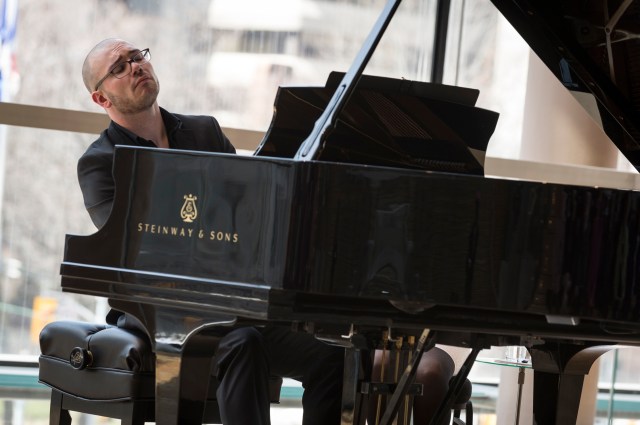
Pianist Topher Mokrzewski (photo: Chris Hutcheson)
The last four pieces were a back and forth between Poulenc and Evans-via-Topher. Where the juxtaposition the first time (in that triptych I imagined) mutually reinforced a jazzy mood, the effect was much more explosive this time, with emotions of every sort.
First was Poulenc’s Improvisation #7 in C major, a wonderfully understated piece in a similarly neo-classical place to the Ravel, but instead of flash, Poulenc offers a relaxed and entertaining charisma. As if in response, Topher made his most exuberant and powerful gestures, in a reading of “On a Clear Day”. In the RBA, on a clear day you really think you can see forever, or at least as far as Calgary.
But I really was thinking of goodbyes, as the final pair were the darkest of the whole program. Am I projecting? Poulenc’s Novelette #3 in E Minor went to a sad place, followed by the exquisite nostalgia of “Some Other Time”, from Topher’s hero Leonard Bernstein (via Evans).
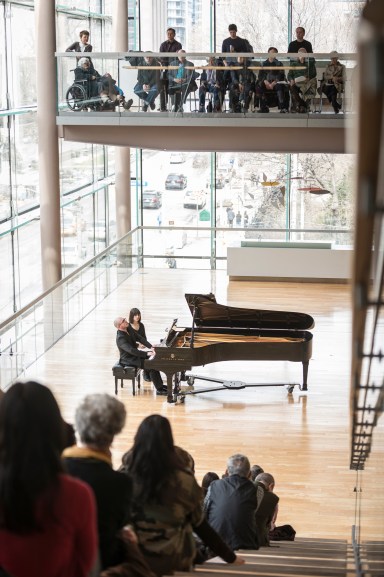
Richard Bradshaw Auditorium (photo: Chris Hutcheson)
Where has the time all gone to? Haven’t done half the things we want to Oh well, we ll catch up some other time
This day was just a token Too many words are still unspoken Oh well, we ll catch up some other time
Just when the fun is startin Comes the time for partin But let s just be glad for what we ve had And what s to come
There s so much more embracin Still to be done but time is racin Oh well, we ll catch up some other time
There s so much more embracin Still to be done but time is racin Oh well, we ll catch up some other time
I don’t think I’m imagining something retrospective, bittersweet in its awareness that it’s time to move on to other things. In this day and age one doesn’t need to fear that a musician is leaving: not when a career entails travel all over the globe. But the relationships will change, as close friends at the COC, Opera Atelier, Against the Grain also move on to other adventures.
The program was remarkable, but that doesn’t nearly capture its magic, the delicacy of touch, the facial expressions, the erudite introductions at the podium… It’s amazing how much he already means to this city, how much he’s done.




 I’d love to be passionate about, and really good at, accounting. I’d never get behind with the taxes, and I’d be a lot richer!






 barczablog