COC 2013/2014 Season announcement

 “Press releases and announcements” are presented verbatim without comment.

For immediate release: January 23, 2013

 COC’S 2013/2014 SEASON FEATURES THREE COMPANY PREMIERES, THREE NEW PRODUCTIONS AND MORE OPERA STARS THAN EVER BEFORE

   Toronto – The Canadian Opera Company unveiled its 2013/2014 season today at a press conference at the Four Seasons Centre for the Performing Arts.  The company’s 64th season stars the world’s best singers, conductors, directors and designers in a performance year with seven operas, including three COC premieres and three new COC productions.  The COC presents Giacomo Puccini’s La Bohème with a new production featuring some of Canada’s brightest stars; COC Music Director Johannes Debus makes his Benjamin Britten debut when he conducts Peter Grimes with a production starring acclaimed Canadian tenor Ben Heppner in the iconic title role; Wolfgang Amadeus Mozart’s Così fan tutte with a new COC production by renowned film and theatre director Atom Egoyan with Debus conducting; Giuseppe Verdi’s Un ballo in maschera starring great Canadian diva Adrianne Pieczonka in a role debut; George Frideric Handel’s Hercules with a COC premiere and new COC production by world-renowned director Peter Sellars with a star-studded cast; Gaetano Donizetti’s Roberto Devereux with a COC premiere starring soprano Sondra Radvanovsky in a role debut; and Jules Massenet’s Don Quichotte with a COC premiere featuring Debus in another conducting debut and the world’s pre-eminent bass Ferruccio Furlanetto in the title role.

The 13/14 season ranks among the most exciting yet for the COC with more Canadian and international stars on the mainstage than ever before.  Making their COC debuts in the upcoming season are singers Phillip Addis, Sir Thomas Allen, Paul Appleby, Layla Claire, Lucy Crowe, Grazia Doronzio, Joyce El-Khoury, Giuseppe Filianoti, Ferruccio Furlanetto, Ekaterina Gubanova, Teodor Ilincăi, Eric Owens and Roland Wood; conductors Carlo Rizzi and Corrado Rovaris; and directors Linda Brovsky, Sergio Morabito and Jossi Wieler.  Returning artists include singers Russell Braun, Alice Coote, Richard Croft, Tracy Dahl, David Daniels, Alan Held, Ben Heppner, Quinn Kelsey, David Lomelí, Allyson McHardy, Marie-Nicole Lemieux, Adrianne Pieczonka, Dimitri Pittas and Sondra Radvanovsky; conductors Harry Bicket and Stephen Lord; and directors Neil Armfield, John Caird, Atom Egoyan, Stephen Lawless and Peter Sellars.  All performances take place in the company’s home, the Four Seasons Centre for the Performing Arts, and feature the renowned COC Orchestra and Chorus.

“More than ever, you can see how the COC has become a destination for artists of exceptional talent and renown.  The artists we invite to work with us, and the opera companies that choose to collaborate on productions with us, are among the best in the world,” says Canadian Opera Company General Director Alexander Neef.  “Looking beyond the extraordinary calibre of the artists coming to the COC next year, audiences can expect a season that invites them to engage with opera in a way that’s only possible by being part of a live theatrical experience. In the end, it is the electric exchange between artists and the audience that makes the art come alive.”

The COC’s 13/14 season opens with one of opera’s favourite and most poignant love stories, Puccini’s La Bohème.  This masterpiece of youthful flirtation, passionate love and heartbreaking tragedy was last performed by the COC in 2009 and returns in a new company production directed by Canadian-born Tony Award-winning director John Caird (Don Carlos, 2007).  One of the leading conductors of his generation, Italian Carlo Rizzi, leads the COC Orchestra and Chorus.  The sets and costumes that capture the romance of France’s Belle Époque are created by Olivier Award-winning and Tony Award-nominated designer David Farley.  Making their COC debuts in the role of the fragile seamstress Mimì are two recent graduates of the Metropolitan Opera’s prestigious Lindemann Young Artist Development Program, already acclaimed for their renditions of this starring role: Italian soprano Grazia Doronzio and Canadian soprano Joyce El-Khoury (Oct. 9, 19, 27, 30).  The role of the poet Rodolfo, Mimì’s lover, is sung by two rising young tenors, Mexican David Lomelí (Rigoletto, 2011) and Romanian Teodor Ilincăi (Oct. 9, 19, 27, 30).  Also appearing as the flirtatious singer Musetta, El-Khoury shares the role with COC Ensemble Studio graduate soprano Simone Osborne (Gianni Schicchi, 2012; Rigoletto, 2011; The Magic Flute, 2011) (Oct. 9, 19, 27, 30).  In the role of the painter Marcello, Musetta’s lover, are two standout Canadian baritones: Joshua Hopkins (Carmen, 2005) and, in a company debut, Phillip Addis (Oct. 9, 19, 27, 30).  The role of the philosopher Colline is shared by two celebrated bass-baritones: American Christian Van Horn (Tosca, 2012) and Canadian Tom Corbeil (Death in Venice, 2010) (Oct. 9, 19, 27, 30).  Addis also takes on the role of the musician Schaunard.  This production of La Bohème is a COC co-production with Houston Grand Opera and San Francisco Opera.  La Bohème is sung in Italian with English SURTITLES™ and runs for 12 performances at the Four Seasons Centre for the Performing Arts on October 3, 6, 9, 12, 16, 18, 19, 22, 25, 27, 29, 30, 2013.

In the centenary of Benjamin Britten’s birth, the COC presents Peter Grimes, his gripping opera about an alienated fisherman and the seaside village he struggles to inhabit.  Acclaimed Canadian tenor Ben Heppner (Tristan in Tristan und Isolde, 2013) returns to the COC in the title role.  COC Music Director Johannes Debus makes his Britten debut when he leads the COC Orchestra and Chorus through Peter Grimes’ evocative score, last heard at the COC in 2003.  Award-winning Australian director Neil Armfield (Ariadne auf Naxos, 2011; A Midsummer Night’s Dream, 2009; Billy Budd, 2001) directs this co-production from Opera Australia and Houston Grand Opera.  Singing the role of Grimes’ unwavering advocate, Ellen Orford, is recent COC Ensemble Studio graduate soprano Ileana Montalbetti.  Captain Balstrode, one of Grimes’ few friends, is sung by one of the leading singing actors today, Alan Held (Kurwenal Tristan und Isolde, 2013; A Florentine Tragedy/Gianni Schicchi, 2012).  COC Ensemble Studio alumni, tenor Roger Honeywell and baritone Peter Barrett, portray the vengeful Bob Boles and Grimes’ friend, Ned Keene, respectively.  Canadian bass-baritone Tom Corbeil (who also appears in 2013’s La Bohème) is the lawyer Swallow, and critically acclaimed American mezzo-soprano Jill Grove (Aida, 2010) is Auntie.  Peter Grimes is sung in English with English SURTITLES™ and runs for seven performances at the Four Seasons Centre for the Performing Arts on October 5, 8, 11, 17, 20, 23, 26, 2013.

   Renowned Canadian film and stage director Atom Egoyan (directing Salome, 2013) returns to the COC with a new production of Mozart’s sublime musical depiction of the frailties of the human condition, Così fan tutte.  Egoyan’s concept takes its inspiration from the opera’s subtitle, The School for Lovers.  He approaches the production as one where love is examined, dissected and manipulated, exploring the themes of love, temptation and deceit in this wry comedy about two couples gambling with one another’s faith and desire.  Award-winning set and costume designer Debra Hanson makes her opera debut with Così fan tutte and, with Egoyan, creates a production that stylistically progresses through time from the 18th-century to present day.  Led by COC Music Director Johannes Debus with the COC Orchestra and Chorus, this new production features a cast of up-and-coming opera talent in the roles of the young lovers, alongside distinguished veterans.  Cast as the sisters are two Canadians: soprano Layla Claire in her COC debut as Fiordiligi and Ensemble Studio graduate mezzo-soprano Wallis Giunta (Annio in La clemenza di Tito, 2013) as Dorabella.  Singing the roles of the sisters’ two suitors are American tenor Paul Appleby in his COC debut as Ferrando and COC Ensemble graduate bass-baritone Robert Gleadow (Steersman in Tristan und Isolde, 2013; Publio in La clemenza di Tito, 2013) as Guglielmo.  World-renowned Canadian soprano Tracy Dahl makes a highly anticipated return to the COC stage after a 19-year-long absence, in the role of the conniving Despina.  Sir Thomas Allen, one of the finest lyric baritones on the world stage, makes his COC debut as the wily Don Alfonso.  COC resident conductor Derek Bate leads the COC Orchestra and Chorus for one performance.  Così fan tutte was last performed on the COC mainstage in 2006 and is sung in Italian with English SURTITLES™.  The production runs for 10 performances at the Four Seasons Centre for the Performing Arts on January 18, 24, 29, February 1, 6, 7*, 9, 15, 18, 21, 2014.

*ENSEMBLE STUDIO PERFORMANCE COSÌ FAN TUTTE ON FEBRUARY 7, 2014

The young singers of the Canadian Opera Company’s Ensemble Studio perform Mozart’s Così fan tutte on February 7, 2014 at 7:30 p.m. on the mainstage.  This special performance stars the Ensemble members with the full COC Orchestra and Chorus under the direction of Così fan tutte’s conductor Johannes Debus and director Atom Egoyan. For casting, please visit the COC website at coc.ca. Tickets are accessibly priced at $25 and $55 per person.

In contrast with Mozart’s tale of young, uncertain love, the COC’s 13/14 winter season continues with Verdi’s more mature and bittersweet story of forbidden passion, Un ballo in maschera.  Requiring singers who can mine vast reserves of musical power and sensitivity, the COC has cast one of the world’s best dramatic sopranos, Canadian Adrianne Pieczonka (Tosca, 2012; Ariadne auf Naxos, 2011), and tenor Dimitri Pittas (Rigoletto, 2011) as the opera’s two lovers embroiled in political intrigue beyond their control.  Pieczonka and Pittas make their role debuts as Amelia and Riccardo.  British baritone Roland Wood is Renato, Amelia’s husband, acclaimed Canadian mezzo-soprano Marie-Nicole Lemieux (Rodelinda, Tancredi, 2005) is the fortune-teller Ulrica, and rising soprano star Ensemble Studio graduate Simone Osborne is Oscar, the page.  Not unlike the opera’s plot itself, political machinations have played a huge role in Un ballo in maschera’s history.  Originally forced to change the opera’s setting to Boston from Sweden to quell censors’ fears of real-life assassination plots, Verdi and his opera are proof that his theme of “love in a dangerous time” is both a universal truth and historically fluid.  In this same spirit, acclaimed directing duo Jossi Wieler and Sergio Morabito have revealed a layer of political and historical relevance to the plot by placing this Berlin Staatsoper production in the American South of the 1960s, with its undertones of Kennedy-era tensions, assassinations and power plays.  Stephen Lord (conducting Lucia di Lammermoor, 2013), one of America’s most distinguished conductors of opera today, returns to lead the COC Orchestra and Chorus.  Un ballo in maschera was last performed at the COC in 2003.  Sung in Italian with English SURTITLES™, Un ballo in maschera returns to the COC for eight performances at the Four Seasons Centre for the Performing Arts on February 2, 5, 8, 11, 14, 16, 20, 22, 2014.

The opera company’s 13/14 spring season offers a trio of COC premieres: Handel’s Hercules, Donizetti’s Roberto Devereux and Massenet’s Don Quichotte.

Internationally renowned director Peter Sellars (directing Tristan und Isolde, 2013) returns to the opera company with a new production of Handel’s HerculesSellars propels the incendiary Greek myth of Hercules into the modern day, giving voice to the untold horrors of war and the unspoken complications faced by veterans returning home.  With his frequent collaborators, set designer George Tsypin, costume designer Dunya Ramicova and lighting designer James F. Ingalls, Sellars has created a minimalist production that evokes ancient Greece while still locating the action clearly in the present.  This co-production with Lyric Opera of Chicago earned unequivocal praise when it opened in Chicago in 2011. “An opera performance this great is plenty rare. But opera capable of inspiring moral action is for the ages,” said the Los Angeles Times while the Chicago Sun-Times described it as a production that “will follow you home and keep you thinking as well.”  The same star-studded cast from Chicago take to the COC mainstage: American bass-baritone Eric Owens makes his COC debut as Hercules; British mezzo-soprano Alice Coote (Ariadne auf Naxos, 2011) is Hercules’s wife Dejanira; American countertenor David Daniels (Xerxes, 1999) returns to the COC as Hercules’s trusted aide, Lichas; American tenor Richard Croft (Così fan tutte, 1991) returns as Hercules’s son, Hyllus; and British soprano Lucy Crowe makes her COC debut as Iole, the princess whose father died at Hercules’s hand.  Conducting Handel’s glorious music is internationally renowned Baroque specialist and COC favourite Harry Bicket (Orfeo ed Euridice, 2011; Idomeneo, 2009; Rodelinda, 2005).  Hercules is sung in English with English SURTITLES™ and runs for seven performances at the Four Seasons Centre for the Performing Arts on April 5, 11, 15, 19, 24, 27, 30, 2014.
American soprano Sondra Radvanovsky (Aida, 2010), the world’s leading interpreter of the great 19th-century Italian prima donna roles, returns to the COC to take on a new challenge with her role debut as the central character Elisabetta in Donizetti’s Roberto Devereux.  Making his COC and role debut as Roberto Devereux, whose life hangs in the balance for having betrayed his Queen’s affections by falling in love with the wife of one her courtiers, is celebrated lyric tenor, Italian Giuseppe Filianoti.  Also making role debuts are internationally acclaimed and COC favourite, Canadian baritone Russell Braun (Il Trovatore, 2012; Love from Afar, 2012; Iphigenia in Tauris, 2011) as the Duke of Nottingham and acclaimed Ensemble Studio graduate mezzo-soprano Allyson McHardy (Semele, 2012; Madama Butterfly, 2009) as Sara, the Duchess of Nottingham.  Donizetti’s show stopping melodies and sumptuous period costumes bring the intrigue of the Elizabethan court to life within a Shakespearean Globe Theatre-inspired setting in this Dallas Opera production by acclaimed British director Stephen Lawless, who also staged the COC’s hugely popular Maria Stuarda in 2010.  Acclaimed Italian conductor Corrado Rovaris makes his COC debut leading the COC Orchestra and Chorus.  Roberto Devereux is sung in Italian with English SURTITLES™ and runs for seven performances at the Four Seasons Centre for the Performing Arts on April 25, 29, May 3, 10, 15, 18, 21, 2014.

Italian Ferruccio Furlanetto, the world’s pre-eminent bass, makes his COC debut in the title role of Massenet’s intensely moving Don Quichotte, which closes the COC’s 13/14 season.  Massenet’s autumnal outpouring of lush melody, based on Cervantes’ iconic novel about the idealistic dreamer, Don Quixote, also stars Metropolitan Opera star, Russian mezzo-soprano Ekaterina Gubanova, in her COC debut as Dulcinée.  American baritone Quinn Kelsey, acclaimed for his COC performances as Rigoletto in 2011, returns to makes his role debut as Sancho Panza.  American director Linda Brovsky makes her COC debut with this enchanting production where characters spring out of giant leather-bound storybooks and windmills are fashioned from oversized quills.  COC Music Director Johannes Debus conducts his first Don Quichotte when he leads the COC Orchestra and Chorus through a score that represents Massenet’s tribute to the last days of chivalry, but also his own poignant farewell to a soon-to-be-lost golden age of French Romanticism.  Don Quichotte is sung in French with English SURTITLES™ and runs for seven performances at the Four Seasons Centre for the Performing Arts on May 9, 11, 14, 17, 20, 22, 24, 2014.

All repertoire, dates, pricing, productions, and casting are subject to change without notice. For more complete casting and creative team information, please see the production pages at coc.ca.

The Canadian Opera Company webcast the announcement of its 13/14 season live on coc.ca on Jan. 23, 2013, at 10 a.m. from the Richard Bradshaw Amphitheatre in the Four Seasons Centre for the Performing Arts. The webcast is available for streaming.

For more information on the Canadian Opera Company’s 13/14 season, please visit coc.ca.

Posted in Press Releases and Announcements | Leave a comment

Night before…

The child who goes to bed on Christmas Eve awaiting a visit from Santa Claus may have given clues.  Sometimes Santa gets a letter.  Sometimes he gets a visit in the department store.

I’m just like that kid, awaiting the Canadian Opera Company announcement of their 2013-2014 season, to be made tomorrow morning.  I didn’t actually tell Santa (aka Alexander Neef) what I wanted, so I suppose it’s unlikely I’ll get what I want.  But even so, I’m going to put this out there.  Who knows, maybe he’ll see this, maybe he’ll bring me something next year.

There are several ways to please this child.

Singers:

Considering that one of my big wishes is being satisfied in the next few days –Ben Heppner as Tristan—I’m inclined to think that maybe it’s worth dreaming big, to name one’s fantasy aloud. Who knows… maybe?

Tenor:  Adam Klein.  I saw him at the Met, and approached him for an interview, which confirmed for me what i’d already seen, that he’s a terrific singer of intelligence & wit who can sing just about anything.

Baritone:  Tómas Tómasson, who’s singing the Dutchman in Los Angeles in a few weeks, who sang Dr Schön and Telramund on videos I saw in the past few months: a wonderful voice with great stage presence.

Bass-baritone:  Canadian Gerald Finley is the voice I’m perhaps most eager to hear from the Four Seasons Stage,  a man at home in any century or style.

Soprano also has a Canadian angle.  If we’re fortunate Neef will bring back Sondra Radvanovsky and Jane Archibald, two of the most impressive performers to grace Toronto stages.  But while we’re creating a wish-list, let me add Barbara Hannigan (whose work i wrote about recently) .

Mezzo-soprano: Anna Caterina Antonacci is a singer who should have sung at the Met  by now.  Neef has shown a willingness to bring people to Toronto before they get to the Met (Harry Bicket for example), so maybe we’ll see her too?

Directors:

Calixto Bieito in another city would be a risky deal.  Toronto? As I’ve said before in this space, the balance at the COC is unique. We’re a major theatre city who embrace adventurous designs & concepts.  Why not bring in the most adventurous & risky director and simply turn him loose?  They say there’s no such thing as bad publicity.

I wonder.

Operas:

  • Der Vampyr by Marschner?  It’s an opera that either the COC or Opera Atelier could present, and likely –with even half-decent design—sell successfully.
  • Satyagraha is an opera that plays to the COC’s strengths, namely orchestra & chorus. It doesn’t require stars, although one role—Gandhi—should probably be a good singing actor.   But Glass’s opera, like War & Peace a few years ago, could be a terrific showcase for the company, and I believe it would capture the city’s imagination, just as it did in NYC when the Met presented it.
  • And while we’re talking of showcases and box office, I think it’s time to re-stage one of the Ring operas.  Maybe the whole cycle is too expensive, but putting on one of them? Surely the Tristan experience –and the brisk ticket sales—suggest that we need to keep Wagner in the repertoire every season.  François Girard’s Parsifal is supposedly coming one of these years, but in the meantime, why not revive Rheingold for example (which is maybe the easiest to cast)?

Wednesday morning?  …see what’s under the tree.

Posted in Personal ruminations & essays | Tagged , , , , , , , , , , , | 3 Comments

Silver Linings Playbook

The National Hockey League resumed play this weekend after a lengthy lockout.  I’m situated in Toronto, a city where fans cheer loudly while having lost all hope.  The Maple Leafs are widely understood to be the most successful and lucrative franchise in hockey, if not all of sports. Why? Because no matter how bad this team gets –having last won the Stanley Cup in 1967—the team sells every seat.  This is also the city that for a time had the best attendance in baseball: while they were winners in the early 1990s.  When the big free agents (Molitor, Winfield, Carter, White, Morris etc) were gone, so were the fans.  We’ll see if some of that excitement will return when baseball season opens.

It’s the last Sunday before Super Sunday, the week when the finalists are determined for the championship of American professional football.  San Francisco eliminated Atlanta in the NFC game.  As I write this Baltimore and New England are slugging it out for the AFC title.

There were several other cities whose teams were involved in the tournament.  Denver, Seattle, Green Bay, Houston….

But Philadelphia?

While they’ve been to the big show (they didn’t win) they’re in a kind of wilderness recently.  The closest they’ve been to a superbowl are divisional battles with the Giants or the Cowboys.

No wonder the film Silver Linings Playbook (or “SLP”: based on a recent novel of the same name by Matthew Quick) is framed around the Philadelphia Eagles, a team who have disappointed their fans often over the years.  It’s not the Toronto of the NFL, because they’ve known the torment of occasional success, the agony of dashed hopes.  In Toronto we laugh at the Leafs, whereas in Philly they still believe enough to rage and roar against cruel fate.

SLP is the latest in a series of comedies pushing the envelope of what we understand by the genre.  When I wrote awhile ago about Young Adult (a dark comedy starring Charlize Theron, written by Diablo Cody, assembled without the usual happy ingredients) I looked at this trend in comedy.  While it can’t be mistaken for reality TV, I think tastes & the boundaries of realism are changing radically, as they must.  Our tolerance for pain in the aftermath of 9-11 and assorted televised atrocities means that comedy works differently.  While I don’t think I am remotely cynical, my capacity for faith and trust have been shaken in various ways, setting me up for a darker sort of punch-line.

Okay, there is one way in which I am cynical, and that’s as an observer of Hollywood industry dynamics.  When I saw the trailer for SLP all I could see was the latest step in the reinvention of Bradley Cooper as a serious actor, the same way so many stars legitimize their work by going outside their usual comfort zone.  It’s a noble idea, when a comedian does drama, or an action hero tries comedy.  I believe in stretching myself, so I must open my mind to this.  Even so I kept wondering how the film might have worked with a different star, perhaps because I was so unconvinced by this portrayal, couldn’t buy it. Sorry.

But what do I know? Cooper has an Academy Award nomination for best actor, so maybe I am an ignoramus.  Remarkably each of the four principals has an Oscar nomination.  The other three?

  • Jennifer Lawrence is wonderfully quirky.  Whenever she’s on the screen you can’t take your eyes off her, a performance totally unlike her work in Hunger Games and already her second Oscar nomination.
  • Jacki Weaver vanishes into the film, a performance so smooth it doesn’t look like she’s acting
  • Robert De Niro is perhaps a bit over-the-top in places, as ostentatiously mad as his son, even if the hint of a generational dimension to their rages gives the story an extra weight.

So I am not saying I don’t like the film; quite the contrary.

For the first hour of SLP I wasn’t sure what I was seeing.  In places it’s very dark.  I enjoyed that sense of dislocation, of not really knowing where it’s going although the film softens considerably in its last half hour.

Now I have to read Matthew Quick’s novel.

Posted in Reviews | Tagged , , , , , , , , , , , , , , , , , , | 1 Comment

Creative ecology

As I examined the choices for music in a play, I thought of a great scene in a film.  Now I am not talking about the music in that film, oh no.  I am talking about that classic scene in The Devil Wears Prada (2006) where we get a glimpse of something I am calling “creative ecology”.  This is where I’d say “roll the clip” except of course it’s a youtube link, and you’re going to have to click on it yourself.

Why is this relevant?

I received a series of attachments in an email.  The play’s director forwarded a series of PDFs (music) from the choreographer, that i’m to play in the show.  The three compositions are from Die Fledermaus. No we’re not staging an operetta, it’s actually a farce, but the music is being used in various ways for dances, in a play of that era.  And that’s what reminded me of the dynamic described by Miranda Priestly (Meryl Streep’s wonderful creation, in the clip).  We’re not like the gormless Andy Sachs (the laughing Ann Hathaway) in her blue sweater, but yes, we are further down the imaginary hierarchy from the Canadian Opera Company, who staged Die Fledermaus this past season.  While people often think of opera as a separate category from theatre, i am reminded of Richard Bradshaw’s stated intention of making COC shows the best theatre in town; with Fledermaus at least, i’d say the COC succeeded admirably.

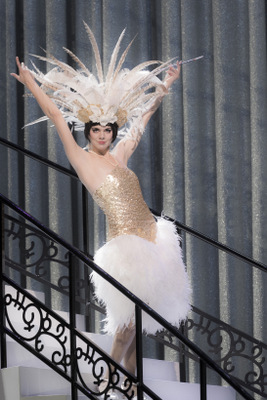
Ambur Braid as Adele, directed by Christopher Alden, set designed by Allen Moyer, costume designed by Constance Hoffman (Photo: Chris Hutcheson)

Ambur Braid as Adele, directed by Christopher Alden, set designed by Allen Moyer, costume designed by Constance Hoffman (Photo: Chris Hutcheson)

I am mindful that the Canadian Opera Company will be announcing their new season this week.  Nothing had the impact locally this year of their Fledermaus production.  Is it any wonder that this music is echoing in the ears of our choreographer & director, likely enchanted by the COC’s production of an operetta?  Influence is intangible, but I wonder if it works something like what we see in the clip from the film.

And the fact that an operetta of all things was their edgiest show has me wondering… will they announce another operetta for 2013-2014? You’d think so, if they can repeat the formula for their success:

  • Find another good operetta (there are lots of them to choose from)
  • Turn a quirky director like Christopher Alden loose: a stirring prospect
  • …with designers in tow, ready to match the director’s vision
  • Cast Ambur Braid in a leading role again (or someone as exciting: which is the reason the easiest option might simply to hire Braid)

The COC announce their new season on Wednesday.  I am looking forward to hearing the predictions of my bloggy colleagues.  And further down the food-chain, the rest of us reverberate with their past work, while we antipate what’s to come.

Posted in Personal ruminations & essays | Tagged , , , , , , , , | Leave a comment

Peter Sellars in conversation with Richard Ouzounian

Peter Sellars. Click the picture to read a review of this production from Paris in 2008.

Monday, Jan. 28, 2013 – Star Talks: Peter Sellars at the Appel Salon

Location: Bram & Bluma Appel Salon in the Toronto Reference Library, 789 Yonge Street, Toronto, ON, M4W 2G8

Time: 7:00 -8:15 p.m.

FREE tickets can be booked in advance by registering at the Toronto Public Library website.

An exclusive opportunity to listen to renowned director Peter Sellars in conversation with Toronto Star music and theatre critic Richard Ouzounian. Mr. Sellars will be in Toronto to recreate his Opéra national de Paris Production of Wagner’s Tristan und Isolde.

For more information visit the Toronto Reference Library Appel Salon website.

Posted in Press Releases and Announcements | Tagged , , , , | 2 Comments

From Troyens to Tristan

December seemed to be a month obsessively occupied by Hector Berlioz, particularly Les Troyens in versions onstage at the Met, the High Definition transmission, DVDs, plus the score at home.  It’s January, and Berlioz is still echoing through the corridors of my thoughts.

At the end of this month I’m looking forward to the Canadian Opera Company’s main commemoration of the bicentennial of Richard Wagner’s birth in a production of Tristan und Isolde directed by Peter Sellars.

While Wagner had many influences I am particularly mindful of Berlioz’s influence on Wagner simply because my head and my ears are so full of Berlioz.  I am not interested in the question of who is the key influence on Wagner, when the answer is beyond us.  I’m more like a foodie wandering in a city, noticing that there are resemblances between the food on either side of the street, traces of a flavour or a colour.

I will be thinking of this for the next few days, expanding on this.  For today I am moved to toss out a few glib pathways for exploration.  Simplistic? If you say so, but first have a look.

1) idée fixe and leit-motiv

Berlioz doesn’t use themes the way Wagner does.  I wouldn’t dream of saying one is better than the other.  Each has its merits.  When you come to Symphonie Fantastique, which premiered in 1830, we encounter a use of a recurring theme that in its way is simultaneously conservative compared to Wagner, yet in its way, beyond anything Wagner ever attempted.  How? The theme is relatively static as an idea in the first three movements.  In the nightmarish last two movements we get (in IV) a furtive little snippet as the hero is about to be executed, and then (in V) a kind of parody of the theme in the last movement.

2) druggy music

Thomas de Quincey

First off some of you may find this a totally disrespectful category in the first place.  Before even talking about music, however, I want to establish this firmly as an artistic category, arguably an important trope in music & the arts.  Some writers such as Thomas de Quincey and more recently, Aldous Huxley, Hunter Thompson or William Burroughs are famous for their explorations of altered states.  Music has been intimately associated with drug culture(s) since the 20th Century, but that’s not where it began.  Berlioz is one of the first composers to not only use drugs but to depict the subjective experience in their music.  In speaking of Wagner we may not find a powdery trail (evidence of drug use), but the music and its subjective experience is something else again.  

3) powerful endings

This may seem like the most superficial connection, but I would argue that it’s under-estimated.  When you listen to one of Berlioz’s overtures or orchestral compositions, they often have endings of extraordinary power, and for me, looking at them in historical context, these endings dwarf anything that came before.  While some of Beethoven’s endings are remarkable –and as unprecedented in their time as Berlioz’s pieces are in the next era—for me this is when I feel a kind of quantum leap.  The thing that’s different with Wagner is not that his endings are bigger & more powerful than Berlioz’s endings.   They’re not actually.  But with each subsequence work –especially once we’re out of “romantic opera,” after Lohengrin and into “music drama” with the Ring operas begun in the 1850s—we see a greater and greater concentration of the musical materials, making the concluding gestures of acts remarkably symbolic, a kind of epitome of the larger action.

Here’s just one example (Berlioz), but there are a great many to choose from.

4) love music

Before Berlioz & Wagner, as far as I know, you’d sometimes see characters in love onstage.  Their duets would be their love music.  Had anyone yet abstracted love from the situations onstage as pure compositions without words, to show the feelings of lovers: their desire, their ardent actions, their intoxication, and their passion upon parting? Not as far as I can remember, and certainly not with the clarity Berlioz & Wagner would bring to the subject.

Awhile ago I mentioned Wagner’s thank you to Berlioz, acknowledging his respect for Roméo et Juliette.  What if anything connects these two compositions? Hm, we’ll see.

~~~~~~~~~~~~

That’s a partial roadmap for January and some of the things I’ll write about on the path from Troyens to Tristan.

Posted in Essays | Tagged , , , , , | Leave a comment

AS: seeing red with Dr. Alan Ebringer

Discovery is a funny business.  Sometimes explorers set out for the new land, braving dangers & going where no one has gone before.  And sometimes the process is much more serendipitous than that.

And it can be funny.

Dr Alan Ebringer. (Photo by Akil Simmons), Click link for more…(!)

I am thinking of the story I heard about Dr Alan Ebringer, which may be at least partially apocryphal.  In conversation with one of his patients, he suggested –in jest? Or in exasperation? –that the patient should consume only foods that are red: red wine, red meat & tomatoes.

Later –surprise surprise—when he followed up, inexplicably, the patient was in much better condition. I don’t know if this is a true story, but it has the bizarre ring of truth to it.

The patient’s ailment? Ankylosing Spondylitis, or “AS”, an inflammatory condition that is sometimes thought of as a kind of arthritis.  It leads to such symptoms as morning stiffness, excess bone growing in areas such as the neck or tailbone, and can lead to other conditions, some innocuous such as eczema, some more serious such as iritis.

The accidental discovery –through the red items—seems to be that some foods may trigger AS.  What was it about the red items? They had no starch, it turns out.

And so Ebringer is now an exponent of a dietary solution to AS, that may indeed apply to a series of other inflammatory ailments: the no starch diet, aka “NSD”, or low starch diet aka “LSD” perhaps in combination with drugs.

The really funny thing about this?  Pharmaceutical companies can’t make big money off of a dietary choice.  When my doctor asked me to take one of the “biologicals” –drugs that repress the immune system and leave you vulnerable to minor infections—I refused.  The one she suggested sometimes causes leukemia.

Great(!)

So nameless doctor, wherever you’ve gone, I hope you can forgive me if I chose not to turn an elephant gun upon myself. Already –without knowing about Ebringer–i was seeing red.  I retreated to the internet seeking alternatives, and google came to the rescue.

And I found one, thanks to Dr Ebringer, whose fame is all over the internet even if you’ve never heard of him. You can read about the NSD here.

Imagine then the choice, between….

  • a carcinogen, that cost $10,000 a year (paid by my health plan), that requires one to go to an emergency ward if you get the sniffles?
    Or
  • a non-invasive dietary choice that costs nothing

What’s more, it seems really clear to me that the expensive solution fights with my body’s inflammation but does not stop the inflammation at its cause, whereas the dietary choice fixes the inflammation at its root: in the digestive system.  Even if this weren’t so, isn’t it safer to avoid expensive & dangerous drugs? Surely.

Here’s Ebringer talking about AS, as well as another related condition, namely fibromyalgia. 

Finally… i hope no one is offended when i decline potatoes, rice, pasta or bread when offered.  It’s simply because I’m seeing red: just like Dr. Ebringer.  Oh and one last thought, namely THANK YOU DR EBRINGER. 

Posted in Personal ruminations & essays | Tagged , , , , , , | 10 Comments

Alla Ossipova: Memorial Benefit Concert

I received the following email that I reproduce verbatim:

Dear Opera by Request Supporter,

It is with great sorrow that all of us associated with Opera by Request received the news on Christmas Day of the untimely passing of Alla Ossipova.  It was only a few short months ago that Alla delivered a stunning performance of Fricka in Wagner’s Die Walkure, the latest in several superb performances which Alla delivered over the years.

To commemorate her life, her husband George Ossipov requested a concert be presented in her memory.  Such a concert will be presented a week Friday, on January 18, at 7:30 pm at College St. United Church, College and Bathurst Sts.  A number of singers who performed with Alla in recent years will share their talents in her memory.  Donations collected at the concert will be shared by Opera by Request and Summer Opera Lyric Theatre, the two venues where Alla was most recently able to showcase and develop her talents.

Your presence will be gratefully appreciated.

Please feel more than welcome to share in this event.

Yours,

Bill Shookhoff
Opera by Request
416 455-2365

~~~~~~~~~~~~~~~

I can only add the two reviews I wrote of Ossipova’s performances that you can read here, as a reminder, plus an example of her voice, now stilled.

Posted in Press Releases and Announcements | Leave a comment

Remembering Frida and Diego

Better late than never, right?

In October I had the pleasure of walking through the Art Gallery of Ontario exhibit Frida & Diego: Passion, Politics and Painting, displaying artwork and images associated with the lives of Diego Rivera & Frida Kahlo, a mind-boggling show I wrote of a couple of times (Frida and Diego @ the AGO  and Latent Frida), and whose influence hung over everything else I lived through for weeks like a sweet perfume.  One of the natural places to end a great show is in the bookstore, where one hopes to capture and maybe take home a bit of the magic felt in the gallery.  Sometimes it works, sometimes it doesn’t.

It’s only now that I am really looking at the books (better late than never), enjoying happy flashbacks.

The exhibit is recorded in a book called –naturally—Frida & Diego: Passion, Politics and Painting.  Edited by Dot Tuer & Elliott King, this is an instant reminder of the magic of the show, and can be found online for all of $19.95.

It’s not a huge book, but sufficiently substantial, boldly mixing photography with the art in the same way the exhibit juxtaposed their art & their lives.  It’s tempting to see them separately because of the contrasts between their work.  For Diego, you see examples of European art influencing his work, reading too about influences such as the Mexican revolution & Soviet realist art.  For Frida, we see her at home, her health issues, and read of influences, even as we see her original –and seminal—voice burst forth in her work.   The book suggests some of the ways in which the influences were mutual, although for that one must read between the lines.

The other volume I brought home is very different, namely Frida Kahlo: Portraits of an Icon.  I didn’t see it in the online catalogue (which probably can’t list everything considering how large the bookstore’s catalogue…), but I suspect this is the place in Toronto if you hope to find it, rather than seeking it online.

Where the show (and its catalogue) is wonderfully eclectic, combining photos & art to take us through the tumultuous decades of the two artists’ lives, the portrait book is very dry and restrained.  There’s a wonderful essay to begin the book, by Margaret Hooks.  I was reminded of Harper’s Index, with its deadpan assembly of factual data without commentary.  This time, however, the “index” is a series of over fifty photos capturing Frida Kahlo throughout her life, beautifully reproduced in a presentation as restrained and quiet as an art gallery.  We see her in childhood photographed by her father, in her youth, sometimes with Diego, often holding or sitting with one of her many companion animals.  For anyone who is too distracted by the unibrow to notice what a stunningly original & beautiful woman Kahlo was, these photos are truly eye-openers.  Many images are powerful reminders of Kahlo’s art, because of course, many of her paintings are self-portraits.  The portraits in this book seem to calibrate her paintings.

For what it’s worth, Frida & Diego: Passion, Politics and Painting is open at the AGO until January 20th.  While you can capture the show in a book, it’s still there in the gallery for a little while longer.

Posted in Art, Architecture & Design, Books & Literature, Reviews | Tagged , , , , , | 2 Comments

Benefit concert: You’re a Good Man, Charlie Brown for Actors’ Fund of Canada

“Press releases and announcements” are presented verbatim without comment.

Theatre critics and personalities unite in the concert version of You’re a Good Man, Charlie Brown in support of the Actors’ Fund of Canada.
Barrie, ON – After a triumphant fundraising performance of The Producers for the Actors’ Fund in 2010, Talk Is Free Theatre (TIFT) is delighted to follow up with a fundraising, concert performance of You Are a Good Man, Charlie Brown. The performance will be held on Sunday, February 10 at 8PM at the Young Centre in Toronto.
You Are a Good Man, Charlie Brown follows an average day in the life of Charlie Brown and the little moments picked from all the days of Charlie Brown, from Valentine’s Day to the baseball season, from wild optimism to utter despair, all mixed in with the lives of his friends (both human and non-human) and strung together on the string of a single day, from bright uncertain morning to hopeful starlit evening.
The Globe and Mail Theatre Critic J. Kelly Nestruck will play the title character, with National Post Theatre Critic Robert Cushman appearing as Schroeder and Now Theatre Critic Glenn Sumi taking on Linus. There will be surprise guests in the roles of Lucy and Sally. The role of Snoopy will be divided into small cameos to encourage a wider representation of the theatre company with  Theatre 20 Artistic Producer Adam Brazier, Broadway World Kelly Cameron, Rose Theatre manager Costin Manu and Dean of the Performing Arts at Sheridan College Michael Rubinoff as agreed participants to date. More casting confirmations are expected to follow shortly.
The event will be directed by Mitchell Cushman. Musical director is Ryan de Souza, designer is Erika Connor, stage manager is Carolyn Mykytyshyn and producer is  Arkady Spivak.
“We’re grateful for all the hard work that Arkady Spivak and Talk Is Free Theatre have put into organizing this tremendous fundraiser, as well as for everybody who has committed their time and energy to make this a great event,” says Actors’ Fund Executive Director David Hope. “The spirit of community that this fundraiser embodies is at the heart of the Actors’ Fund, the community stepping up to help its most vulnerable members during their time of need. We’re excited for this unique show that is sure to be remembered for years.”
Tickets are $30, $50 and $100 (this category qualifies for VIP seating and admission to pre-performance reception). Tickets are available through Talk Is Free Theatre box office by calling 1-888-792-1949 or website www.tift.ca. Sponsorship, pledges and program advertising opportunities are available by contacting Arkady Spivak at arkady@tift.ca or (705) 792-1949 ext. 22.  
Posted in Press Releases and Announcements | Leave a comment