COC Ensemble Studio Competition

As I drove downtown this morning, one track seemed very apt for an evening featuring the Canadian Opera Company’s second annual studio competition.

Michael Slattery’s CD of Dowland songs –reimagined to explore his alleged Irish connection—concludes with a melancholy song known as “His Golden Locks”.  Of course those golden locks have turned silver.  See which way my thoughts are headed?

The last haunting lines of Slattery’s version could just as easily be a cautionary reminder to singers exulting in their triumph in a singing competition:

Beauty, strength, youth are flowers but fading seen;
Duty, faith, love are roots and ever green.

Ah yes,  our time is brief.

So too for the period with the COC Ensemble Studio.  While the years spent with the Ensemble are not to be mistaken for a complete career – though for some singers that’s sadly not far off— I am still mindful of the brevity of youth, of voice and of fame.  Already –in seeing the singers who are the current Ensemble stars—one wonders where they’ll go, what they’ll undertake, and how much of a career will ensue.

I’m old enough to remember an education system built around competition, so busy identifying excellence that egos got crushed in the process.  I wish we could all take the time to discover and recognize everyone’s unique gifts.  The occasion tonight pitted ten voices against one another, each quite wonderful in some respect or other.

I was thinking of something I heard on American Idol, where a singer was warned that her risk, in undertaking a famous tune, was that she invited a comparison.  And so I second-guessed the repertoire choices.  Some singers were way out there in their repertoire, while others hewed closer to the tried and true.  Some singers showed –or offered to show—extraordinary virtuosity, some chose a much safer programme.

The competition was both for prizes and part of the selection process for the Ensemble Studio.  I wasn’t sure whether the current cohort was a factor or not: that is, in the availability or shortage of particular voice-types.  Whether or not the winners were at least partially chosen to fill a need in the ensemble, it’s difficult comparing apples and oranges.  We heard ten singers.  I was quite thrilled with the choice of winner –bass-baritone Gordon Bintner—but would have accepted quite a few other voices as winners.  In fact I was delighted by the quality of the musicianship & drama on display.

Second place went to tenor Andrew Haji, while third place went to mezzo-soprano Charlotte Burrage.

I will be very interested to see how these singers might fit into the Ensemble and the upcoming seasons of operas from the COC.

Bass-baritone Gordon Bintner

Posted in Reviews | Tagged , , , | 5 Comments

Keszei’s religious art

I know Attila Keszei as an artist working in several media, on a few recurring subjects.

Attila Keszei

Sustainability has been a key preoccupation for him, both in his professional life at the University of Toronto, and in his art.  Images exploring his understanding of science & technology, particularly when it comes to energy, seem like a natural consequence of such interests.

Images of nature figure prominently as well, sometimes in traditional landscapes, sometimes in more unorthodox imagery, such as Keszei’s raku representations of geological phenomena, and studies in physics.  He visualizes the unimaginable –the heat of an atomic blast– reframing the violent cataclysm as  something organic, an egg or an eye, re-imagining it for us as if to suggest birth rather than death.

“In Memory of JR Oppenheimer” (1997), raku fired ceramic. 36″H x 72″W x 8″D See also the companion mural: “In Memory of Leo Szilard”.

Political commentary also figures in the work of this Hungarian expat, and no wonder, given that he came into the world when Josef Stalin was still ruthlessly controlling the USSR and the Eastern Bloc satellite states.

There is a fourth major category in Keszei’s work, and that’s religious art.  It might be more accurate to say “Biblical” rather than “religious”, given the absence of sermonizing or lectures telling us how to read his images.

The Astronomers: the Three Kings

Keszei will be part of a group show that opens this Sunday at 1:00 pm at 137 Melville St, Dundas Ontario.  There’s no stifling his usual tendencies, as these recent Biblical works still show us the other preoccupations: sustainability, nature, politics, all figure in these images from the Bible.  He understands John the Baptist as a figure of protest as well as prophecy.  The three kings following a star are astronomers. Keszei gives us the stations of the cross, in dramatic and compassionate imagery.

The First Cell

Keszei’s recent work also includes several natural images and one delightful piece –titled “The First Cell” that again seems to bestride the frontal lobe that’s home to both art and research.  Happily none of his work can be easily stereotyped or categorized: like the artist himself.

Why Me: the biblical Job

Posted in Essays, University life | Tagged , , , | Leave a comment

Canadian Stage 2013-2014 season

“Press releases and announcements” are presented verbatim without comment.

Tuesday, November 27, 2012
Canadian Stage announces  groundbreaking 2013.2014 season Featuring work by Robert Lepage, new productions of a 5-star hit from London and award-winning plays from Broadway, and productions helmed by four of Canada’s leading female artists Kim Collier, Jackie Maxwell, Jennifer Tarver and Crystal Pite.

Toronto, ONCanadian Stage today announced the details of the people and productions featured in the 2013.2014 season, programmed by Artistic & General Director Matthew Jocelyn. Showcasing artists from Canada and around the world, the season celebrates groundbreaking and new work from the leading directors, playwrights, choreographers and theatre collectives.

Celebrating Canadian Stage’s mandate to present contemporary, multidisciplinary theatre and dance that spans a variety of performance styles, the upcoming season continues to share world-renowned work with audiences through innovative productions and powerful pieces from the best story tellers working today. Thirteen productions will be featured at Canadian Stage’s three venues, the Bluma Appel Theatre, the Berkeley Street Theatre and the High Park Amphitheatre.

The 2013.2014 season at Canadian Stage already has us dancing with excitement,” said Jocelyn. “I’m proud to bring the work of four of Canada’s most exceptional female artists, Kim Collier, Jackie Maxwell, Jennifer Tarver and Crystal Pite to our largest stage, alongside Robert Lepage, Stan Douglas, Chris Haddock and Akram Khan, four internationally acclaimed creators. This season, Canadian Stage will explore extraordinary texts, breathtaking choreography and an important, unorthodox musical. We continue to revitalize the Berkeley Street Theatre with vibrant programming, and are honoured to continue our collaboration with York University by giving our joint MFA program an important place in the season. Finally, after bringing productions from around the world to Toronto, we will be at the root of a multidisciplinary spectacle that will premiere in Canada before embarking on an international tour.”

Jennifer Tarver will direct a new production of Venus in Fur, the Tony Award nominated play that Vogue Magazine called “smart, sexy, hilarious”. International phenomenon Robert Lepage will return to Canadian Stage with a new version of his iconic 1980s hit, Needles and Opium. The Shaw Festival’s Jackie Maxwell will bring the Canadian premiere of London Road, the 5-star musical documentary, to life alongside musical director Reza Jacobs. Canadian Stage Resident Artist Kim Collier’s latest project, co-created with renowned visual artist Stan Douglas and award-winning screen writer Chris Haddock (best known as the creator of Da Vinci’s Inquest and current writer and co-executive producer of Boardwalk Empire), will have its world premiere at Canadian Stage. Called Helen Lawrence, this new media and performance art piece uses newly patented CGI technology and will tour internationally following its Toronto run. Two dance-based works round out the programming at the Bluma Appel Theatre, including Canadian dance luminary Crystal Pite’s new piece The Tempest Replica and the critically-acclaimed DESH from superstar dance creator Akram Khan, recently celebrated for his choreography in the Opening Ceremony of the London Olympics Games.

As part of the upcoming season, Canadian Stage’s partnership with York University continues with the inaugural participants of the York University MFA Program in Stage Direction in collaboration with Canadian Stage, Ted Witzel and Ker Wells, directing two productions each. The landmark initiative, designed to support the development of directorial talent for the national and international stage, is a two-year program that allows students to integrate studio work at York with involvement in artistic projects at Canadian Stage, offering highly specialized, advanced training in large-scale theatre directing.

Canadian Stage and York University are pleased to announce the incoming participants, selected by jury, who will begin the program in September 2013: Estelle Shook, former artistic director of the Caravan Farm Theatre, and Matjash Mrowzeski, an internationally recognized choreographer based in Montreal who trained at the National Ballet School.

The ongoing revitalization of the Berkeley Street Theatre programming continues with the presentation of two original creations, a new production model and ongoing partnerships. Opening the season at the Berkeley Street Theatre will be two productions by Sarah Berthiaume, a rising star of Quebecois theatre, whose work has been produced in Paris and Berlin. The Flood Thereafter, directed by Ker Wells, and the English-language premiere of Yukonstyle, directed by Ted Witzel will be presented for the first time in English outside of Quebec in partnership with Hopscotch Collective and York University. Crow’s Theatre returns to Canadian Stage, co-producing Winners and Losers created and performed by Marcus Youssef and James Long and directed by Chris Abraham, with two of British Columbia’s most provocative companies, Theatre Replacement and Neworld Theatre. Tribes, a jarringly emotional play that won 2012 Drama Desk and New York Theatre Critics Circle awards, gets its Canadian premiere from Canadian Stage in collaboration with Theatrefront, with a new production directed by Daryl Cloran. The Company Theatre will also return to the Berkeley Street Theatre with a yet to be announced production.

For the first time in more than 20 years, Canadian Stage will present two Shakespearean productions in repertoire at the High Park Amphitheatre, pairing one of Shakespeare’s earliest comedies, The Taming of the Shrew, and his powerful tragedy, Macbeth. Helmed by Witzel and Wells, respectively, and presented in collaboration with the Theatre Department in the Faculty of Fine Arts at York University, the productions will run on alternating nights under the stars as part of this favourite summer tradition.

2013.2014 Subscriptions are on sale beginning November 28, with 4-show packages starting from $98, 6-show packages starting from $144 and 10-show packages starting from $228. Subscriptions may be purchased by phone at 416-368-3110 or in-person at the Canadian Stage Box Office: Bluma Appel Theatre (27 Front St. E.) or Berkeley Street Theatre (26 Berkeley St.). Single tickets will be on sale in May 2013. Full details on the productions, casting and subscription packages are available online at www.canadianstage.com.

In addition to the work presented on stage, Canadian Stage continues to support the artistic community through a variety of professional development initiatives and investments in artistic creation. The company offers artistic and learning opportunities for children, youth, educators, young professionals and adults in schools and communities year-round.

Full 2013.2014 season playbill and show details continued below

Canadian Stage is supported by: BMO Financial Group, CIBC, TD Bank Group, Scotiabank, RBC Foundation, Sun Life Financial, Manulife Financial and One King West Hotel & Residence, The Hal Jackman Foundation, The Brian Linehan Charitable Foundation, The George Cedric Metcalf Foundation, The Joan and Clifford Hatch Foundation, The Henry White Kinnear Foundation and the John McKellar Charitable Foundation. The company is also supported by The Canada Council for the Arts, the Ontario Arts Council, the Toronto Arts Council and the Government of Canada through the Department of Canadian Heritage.

About Canadian Stage:
Founded in 1987 with the merger of CentreStage and Toronto Free Theatre, Canadian Stage is one of Canada’s leading not-for-profit contemporary theatre companies.  Under the direction of Artistic & General Director, Matthew Jocelyn, the company presents multidisciplinary theatre with a focus on emerging performance styles that integrate theatre with other artistic mediums such as dance, film, visual arts and more. Sharing innovative and vibrant theatre from Canada and around the world, the company stages an annual season of work at three major venues (the Bluma Appel Theatre, the Berkeley Street Theatre and the High Park Amphitheatre) and runs a series of artist development and education initiatives, as well as youth and community outreach programs.

For more information visit www.canadianstage.com

Posted in Press Releases and Announcements | Leave a comment

Tapestry 2012/13 announcement

“Press releases and announcements” are presented verbatim without comment.

TAPESTRY ANNOUNCES UPCOMING 2012/13 SHOWS INCLUDING TORONTO PREMIERE DATES FOR SHELTER

TORONTO, ON…Tapestry announced details for its upcoming 2012/13 season shows including the much-anticipated Toronto premiere of Shelter, a new opera by composer Juliet Palmer and librettist Julie Salverson.

“This season we are proudly offering Toronto audiences three different opportunities to experience some of the best new opera being created in Canada,” said Tapestry’s Artistic Director Wayne Strongman.  “And we are particularly excited that the Canadian Opera Company is generously supporting the Toronto premiere of Shelter in the Imperial Oil Opera Theatre following on the heels of the partnership with Edmonton Opera for the world premiere in Edmonton.”

In February, emerging young opera singers will perform a selection of favourite contemporary arias from the company’s rich catalogue in The Tapestry Songbook, a concert showcasing pieces written by Canada’s leading composers and librettists.  The singers will be joined by acclaimed contemporary music performer and Tapestry Songbook Clinician, Carla Huhtanen. The Tapestry Songbook takes place February 16, 2013 at the Ernest Balmer Studio in the Distillery Historic District (9 Trinity Street, Studio 316).

Next, audiences are invited to a workshop presentation of Ruth, a new opera by composer Jeffrey Ryan and librettist Michael Lewis MacLennan.  The opera is a contemporary re-telling of a timeless immigrant tale – the struggle to find welcome in a new land: “for your people shall be my people”.  This workshop is presented in collaboration with Wilfrid Laurier University’s Faculty of Music, with celebrated Canadian mezzo, Kimberly Barber, in the title role.  The workshop performance of Ruth will take place on May 7, 2013 at the Ernest Balmer Studio in the Distillery Historic District (9 Trinity Street, Studio 316).

The season concludes with the Toronto premiere of Shelter, a collaboration between Toronto-based composer Juliet Palmer and Kingston librettist Julie Salverson who first met in Tapestry’s intensive Composer-Librettist Laboratory in 2002. Shelter tells the fictional story of a nuclear family adrift in the atomic age. The opera explores “the dangerous beauty of science” and challenges the audience to consider the impact of mankind’s quest for knowledge and scientific breakthroughs.

“And for those whom opera has primarily meant large-scale mainstage productions, here’s a chance to see completely different, and equally valid operatic values.” Mark Morris, Edmonton Journal

The cast includes mezzo-soprano Christine Duncan as the mother, Claire, baritone Peter McGillivray as the father, Thomas and soprano Maghan McPhee as the daughter Hope.  Tenor Keith Klassen sings the role of the Pilot and mezzo-soprano Andrea Ludwig creates the real-life character of nuclear physicist Lise Meitner.  The creative team includes director Keith Turnbull, music director Wayne Strongman, with stage & costume design by Sue LePage, and lighting & video design by Beth Kates and Ben Chaisson. Tapestry recently travelled to Edmonton for the world premiere of Shelter – a co-production with Edmonton Opera – the show was described as “an engaging coming-of-age story” by the Edmonton Journal.  “Ms. Palmer’s excellent score helps us to relate to the action and to draw the real message from this remarkably provocative production,” said the Calgary Herald.  Shelter will run June 6, 7, 8 and 9, 2013 in the Imperial Oil Opera Theatre (227 Front Street East).

Subscription packages to all three events in Tapestry’s 2012/13 season are $95 (including HST) and may be purchased online at tapestryopera.com or by calling 416-537-6066 ext. 243.  Single tickets are on sale now and can also be purchased online; prices range from $29 to $50 (including HST).

ABOUT TAPESTRY

Tapestry is a not-for-profit arts organization whose mandate is to work collaboratively to create, develop and perform new opera nationally and internationally; to promote the advancement of emerging and established artists in the field of new opera; and to offer innovative education opportunities for youth and adults.  Beginning with composers and writers, Tapestry provides dramaturgical guidance and support through the process of new work creation.  Tapestry offers creative teams access to leading directors and performers as part of an intensive dramaturgical program.  Tapestry seeks opportunities to develop and showcase new works to local, national, and international audiences.  These new works are relevant; grown out of contemporary situations by living artists, speaking directly to the experiences of today’s audiences.  Tapestry works to advance the dialogue surrounding opera creation, with each new project helping to redefine the art form. For more information on Tapestry visit www.tapestryopera.com.

Posted in Press Releases and Announcements | Leave a comment

Incidental words

A “CD launch” or a “book launch” is a fascinating phenomenon.  I say that even though, cough cough, I’ve never really been very fascinated by them.

Books and CDs are art objects we usually experience in private rather than as a public performed event.  Launches are usually in some sense public, and performed.  Forgive me, I am about to use a word that I use the way addicts use heroin.  The launch is by definition multi-disciplinary or at least inter-disciplinary, thereby inviting us deeper or stripping away the veils on that realm of privacy.  I suppose I usually rebel against this because I don’t want my experience launched or mediated, I want to find my own way.

Okay, maybe sometimes I am just plain wrong.

I attended a very different sort of launch, one that complements & facilitates the book in question.  Lydia Perović’s novel Incidental Music –a book I haven’t finished, please note—can be understood on several levels.  One of the important relationships in the book unfolds with a big meta-text as well.  Romola is singer who lived through the Hungarian Uprising and has come to Canada; she’s losing her memory.  As she encounters the much younger Petra, who offers her care, the story unfolds both in the present of their inter-actions, and in dazed operatic recollections of the old singer.

The behaviour is not pathologized –that is, not objectively labelled as a particular kind of dementia—but permitted to unfold with some ambiguity.  It’s a very poetic device, luring us into the depths of Romola’s memory.

I believe that’s the superficial justification for the performances we saw in this launch, as part of the Gladstone Hotel’s THIS IS NOT A READING SERIES, although that doesn’t nearly sum up the resonances set up by the performances.  In keeping with the eternal operatic question—concerning the relationship of words & music—the event was divided into Act One: La Musica and Act Two: Le Parole.

We began with a series of solos & duets between soprano Erin Bardua & mezzo-soprano Margaret Bardos, accompanied by pianist Christina Faye.  The duets in particular make an excellent –and suggestive—pathway to access Incidental Music, a novel featuring more than one love relationship between women.

The ambiguities of these moments where a pair of women sing loving words, while they portray a male-female couple (one of the women in trousers) are deliciously suggestive.  We heard duets from Contes d’Hoffmann, Béatrice et Bénédict, L’Incoronazione di Poppea and Idomeneo.  In addition we heard solos from each of Chérubin, Alcina, Orfeo ed Euridice, an a capella Hungarian folk song and a song by Kurt Weill.  I’m especially sorry i missed Bardua’s recent participation in The Threepenny Opera after hearing what she did with Weill.

In other words, Bardua, Bardos & Faye gave us a substantial concert experience, complete with wonderfully informal tongue-in-cheek commentary, as a kind of knowing prologue to the book itself.  Under the circumstances, my title –incidental words—now makes some sense, as we were then eased into the discussion of the book, a Q & A between Jim Bartley & Perović.

Incidental MusicI’ve read most of the book, and will post a review one of these days.  I heartily recommend it, as a second generation Hungarian who can identify with its bittersweet exploration of Toronto from an exile’s point of view.  The lesbian themes are new to me, but certainly fascinating, and the descriptions hauntingly beautiful.  While it may be early to use such language, the novel suggests a utopian view, the city, the family, and the bedroom all as places where one seeks meaning if not transcendence.

As Bartley rightly observed, Perović’s achievement, writing in her second language (they invoked Conrad & Nabokov) is something extraordinary & rare.  I expect big things from Perović.

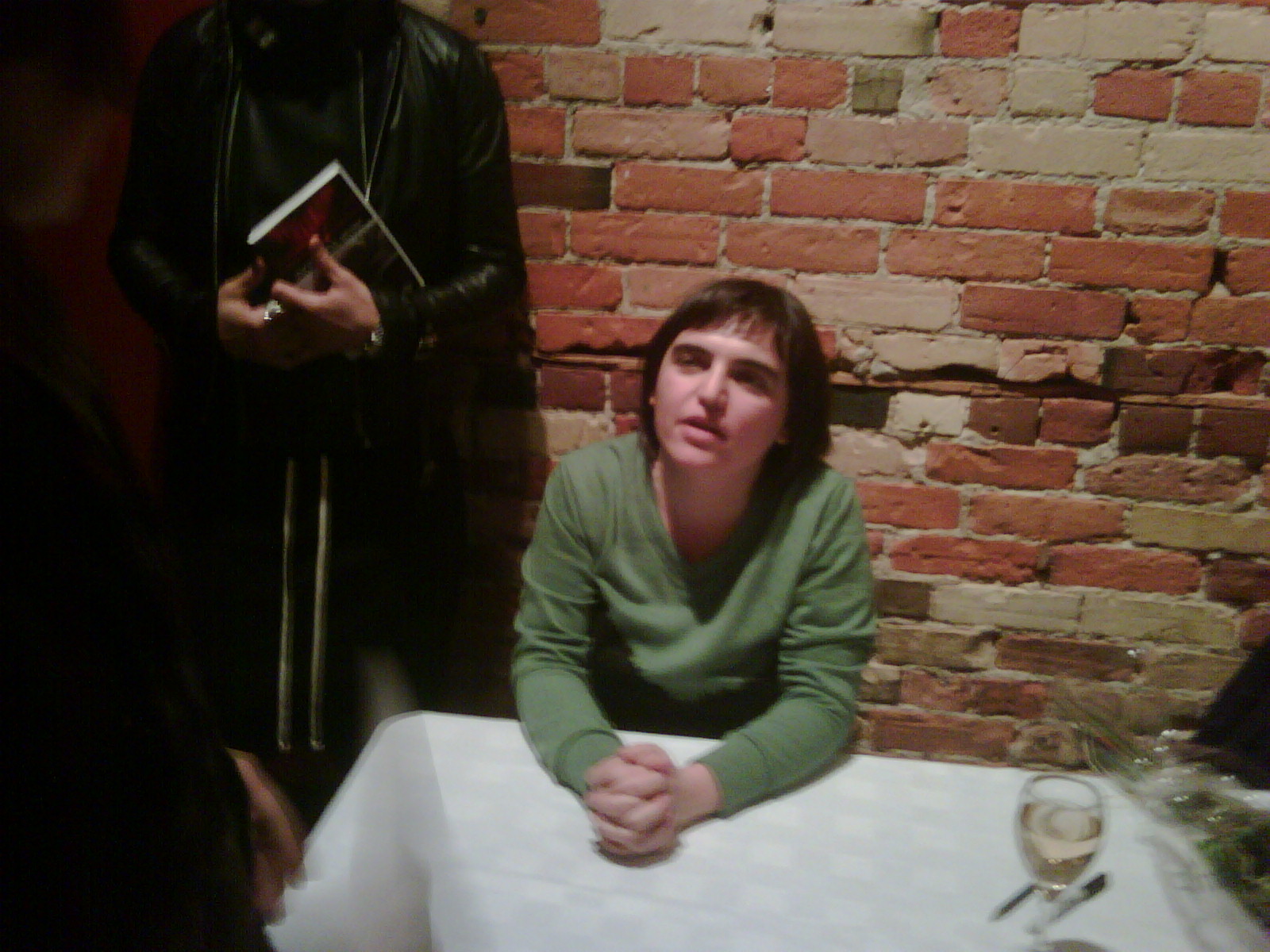
Lydia Perović between autographs

Posted in Personal ruminations & essays | Tagged , , , , | 6 Comments

Celebrate

Do you need a reason?

If so –that you can’t simply CELEBRATE, but do need a rationale– I can toss a few your way:

  • If you’re a Torontonian you may be rejoicing in the victory of the Toronto Argonauts in the 100th Grey Cup Game on the weekend.  Jason is perhaps the least admirable hero in all mythology, even if his actions provoked even more outrageous behaviour from his ex, Medea.
  • If you’re a Torontonian you may be rejoicing in the judgement announced today concerning alleged conflict of interest, that aims to remove our Mayor from office, at least pending appeal.  This would be a victory for law and process, even if opponents are claiming that this is undemocratic, that no one voted for the judge.
  • If you’re a RIM investor you may be thrilled that your stock has gone up so many days recently

And there are likely other reasons you could be grateful.  Even if you’re not, even if you’re merely living a carpe diem sort of life, chances are you’d be open to celebrating, because celebrations are fun.  Life is a celebration, and the things we do in celebrating–eating, drinking, dancing, making love– are among the reasons we enjoy life, possibly the very reasons we’re here (particularly the biological imperatives).

Whatever your subtext, I offer you five ways to celebrate.

#1, one of the oldest, affirming order in the world, admittedly of a Christian variety.  If you’re not Christian, chances are you may still enjoy the music.

#2 is a hymn to the planet and the regenerative powers of Mother Nature.

#3 takes you in a different direction again. I have no idea what this choir is singing, a very affirmative positive song in another language (I don’t even know the language).

#4 is a commercial song called “Celebration” from the 1980s.  Is popularity a bad thing? You be the judge.

#5, finally is counterpart to #1, the other well-known song of celebration, and pardon me if one composer gets to be heard twice.  Never mind getting mad.  Be joyful…!

balloon

Posted in Personal ruminations & essays | 5 Comments

Roméo et Juliette 2008

I watched TFO’s broadcast of a live performance of Gounod’s Roméo et Juliette, from a 2008 Salzburg production.

There was a bit of drama backstage, with Anna Netrebko’s cancellation, replaced by the unknown Georgian soprano Nino Machaidze.  Machaidze was only 25 at the time, with a hectic month to prepare.

Nino Machaidze

Georgian Soprano Nino Machaidze

She’s not as dark of voice as Netrebko, which is likely a good thing in this role, making her a very convincing Juliette (considering that the role is supposed to be a teenager).  She was much more than a pretty face, though, giving me the best Juliette i’ve ever seen.

She appeared opposite a surprisingly lyrical Rollando Villazon, sounding mostly excellent.  Yes, he did go off a bit in his big aria (flat on two of its three B-flats), but he got better as he went on.  There seemed to be a gentle romantic chemistry, a sexual tension between the two.  Even in close-up, their energies never dropped, the genuine passion kept me involved to the end.

Russell Braun? I’ve posted his Queen Mab aria before on this blog, a performance of wonderful intensity.  

I admire Braun’s approach.  His voice matches this rep very well.

At the controls, Yannick Nezet-Seguin gave us a reading of dignity and weight where required, the festival orchestra sounding wonderful throughout.

The production is available on DVD and Blue-Ray.

Posted in Reviews | Tagged , , , , , | Leave a comment

Mrs Lincoln

In the latest Canadian Opera Company podcast, we were asked about the way women are used and abused in opera.

As soon as the question was posed, and no one else started to speak, I seized the opportunity, to launch into a bit of a rant, knowing that if I didn’t get it in right away, chances are nobody in the room would really want to listen to my theoretical lecturing (notwithstanding the excellent manners displayed by Gianmarco Segato, John Gilks & Lydia Perović).  I was dimly aware that what I might be saying could be read as politically incorrect, even though I was really addressing something procedural about opera.  And I knew it might seem to be against the current of the historical progress of women in society, even though I was describing (and even a bit unhappy with what I saw), rather than prescribing.

Mary Todd Lincoln

Mary Todd Lincoln

I didn’t finish what I was saying before I had to yield the floor, because of course I was blathering on way too long.  Speaking of me going on too long, please bear with me, as I will eventually justify the title, which may seem like a non sequitur.

Opera for much of its history, particularly in the baroque, has been a form that combines structural features segregating action and passion.  Arias in the old model were static and passionate, while all the action was confined to recitative.

I only got so far as explaining societal expectations:

  • men were expected to be silent and to take action
  • women were endowed with special insight about our feelings, and so were sanctioned as the voice of passion

I argued that women are not just permitted, but even expected to sing about their feelings, and as a result we endow the diva with a special importance.

But there’s more.  I didn’t get to the functional part.  For a composer it’s usually easier to write a vocal line up above the ensemble, whereas a male voice is more of a challenge, because it competes against many of the instruments that would accompany.  I alluded to this briefly in my review of Julie Boulianne’s 2011 CD Mahler Lieder.  For example, while Richard Strauss wrote his Four Last Songs for high voice –without prescribing gender—the songs are usually sung by women because the voice harmonizes better with the orchestra, and is more easily heard over the big ensemble.  Women can undertake just about any song usually done by a man, whereas the reverse doesn’t work.

I was thinking of this as I watched Steven Spielberg’s Lincoln today.  While much will probably be written about the film, Tony Kushner’s screenplay, Daniel Day-Lewis’s portrayal of the American President and Sally Field’s approach to playing Mary Todd Lincoln, my thoughts were again on opera and our discussion of women.

I will strive to avoid giving too much of the film away.  Yes I admit that Lincoln is shot, but i suspect you knew that.  Everybody knows he was shot while attending a theatre, knowledge Spielberg & Kushner play off of in teasing the audience.

For me, the remarkable thing about the relationship Kushner & Spielberg elaborate between husband and wife –which may or may not be based on historical fact—is the classical delineation of their roles along the lines I spoke of above with respect to baroque opera.  Mary Lincoln is privileged, the irrational voice articulating the wild emotions of a nation at war, mourning, raging, suffering, alongside the man who—to use the modern phrase—“keeps it all together”.  While the Abe Lincoln we see is at times emotional, he is mostly larger than life in his ability to master himself, and almost too perfect: which is not surprising in a film about a national icon.

The film reminds us how far both black people and women have come in the last century.  Abe Lincoln was privileged to enter the arena of world events, while Mary Lincoln’s life was circumscribed, limited to the bedroom, the kitchen and the ballroom; and as such she was still among the most privileged of her gender.  Sally Field was given a series of moments not unlike arias, where her passion counter-pointed the prevailing maleness of the film.  While there are at least two other prominent female roles in the movie, Field’s place is especially foregrounded. And in the process Kushner & Spielberg flesh out this world for us, going far beyond historical details.

Seeing Field’s portrayal is an excellent reminder of the distance we’ve all come.  It’s not just that women can and do enter the same arenas as men.  We watch Joseph Gordon-Levitt’s portrayal of young Robert Lincoln, ashamed that he had not been able to enlist as a soldier.  And so men too are now liberated because we are now free to sit on the sidelines.

In case you can’t tell, I like the film.
Lincoln

Posted in Reviews | Tagged , , , , , , , , , | Leave a comment

Quilico’s Rigoletto

Some artists have an abundant recorded legacy, while others are curiously under-represented.  At times I find this irritating, because I suspect it’s more a reflection of market forces than an indication of real quality.

Quilico

Baritone Louis Quilico

I believe if Louis Quilico had been American, he would be recognized as one of the best if not the best baritone of the 20th century.  Growing up in Toronto, I have a very odd perspective on singers.  Because I tuned in regularly to the Metropolitan Opera broadcasts, not only did I hear great American baritones such as Robert Merrill, Cornell McNeil, Sherrill Milnes, and more recently Thomas Hampson, but the regular assertion that their singers were the best.  Yet in Toronto we had the privilege of hearing Louis Quilico.

Quilico only arrived at the Met when he was a bit past his prime, yet even then he was a formidable talent.  The only other voice I would consider comparing it to –that is, for such key attributes as stamina, beauty, and range—is American Robert Merrill.  I think Merrill’s voice may have been a bit better, considering his longevity.  But from what I’ve seen Merrill was somewhat one-dimensional as an artist, without the same grasp of the text or the theatre as Quilico.  But it’s absurd to compare these superb artists, each wonderful in his own way.  On the day after American Thanksgiving i am inclined to ask: isn’t it wonderful that we had both?

Still, the truly unfortunate part is that, whereas Merrill (and Warren and McNeil and Milnes and Hampson) was recorded frequently, Quilico’s talent has not been properly documented.

That’s one reason why I was thrilled to hear about a complete live performance by Quilico in his signature role, namely Rigoletto.  See and hear it while you can. 

Quilico manages to balance his portrayal of the jester on the edge between creepy and sympathetic, the grotesque element infused with something very vulnerable and even lovable.  The voice has an angry edge to it in some scenes, and a marvellous bel canto line when called for.  He is a perfect match in his over-the-top histrionics for the melodrama of the role, for instance at the moment he discovers the trickery of the courtiers kidnapping his daughter.

I saw Quilico play this role many times over the years. As far as I have read, there’s no studio recording of him in the role.

Thank goodness for this video, also starring Luciano Pavarotti as the Duke of Mantua. The rumour I heard was that this video was shelved (although I think excerpts from it were released), rather than being broadcast in its entirety, because Pavarotti flubbed a high note.  Yet I am thrilled by his singing, a voice I miss every bit as much as Quilico.  While Pavarotti’s voice was recorded abundantly –even in roles he never undertook onstage—it’s one of the great voices of all time.  If he’s not at his best on this occasion (massacring the D-flat at the end of the “addio, addio” so badly that he hides his head in shame behind Gilda; oh but my heart goes out to him) even so I’d still take him over anyone singing the role nowadays. And so while i am willing to cut Pavarotti some slack –because he sounds so good even with that bad note- it upsets me to think that the bad note came between us and this immortal performance by Quilico.  Thank Goodness that the Met have seen fit to make it available.

Christiane Eda-Pierre is the Gilda, in an attractive and solidly sung portrayal.

James Levine conducts the Met Orchestra & Chorus in a traditional production.  For Torontonians it’s like a trip down memory lane, even if this recording captures Quilico when he was past his vocal prime.

Posted in Reviews | Tagged , , , , , , , , , | 7 Comments

Perović’s Incidental Music

There’s a line in Lydia Perović’s new novel Incidental Music that has so far stayed with me like a motif.

Incidental MusicRoughly a quarter of the way into the book, Petra & Martha, two of the main characters start chatting, having made incidental acquaintance at a party.  While their ethnicities might be different, there’s no reason for that to be an impediment.

Martha makes the classic self-deprecatory remark, so typical of a representative of the white anglo middle class, negativity that is contagious.

Petra sees it differently however, bringing a faith in something more transcendent –or illusory—to the moment, when she replies.

Well then maybe you’ve created an island here in your home.  A refuge for the sect called the Lovers of the Art of Conversation.

It’s a wonderful moment, one of several that capture Toronto bourgeois life.  But it stayed with me because it reminded me so much of Lydia Perović herself.

I just had the pleasure of meeting her c/o the COC’s great podcast #6.

Our chemistry (between myself, John Gilks, Gianmarco Segato, plus Lydia Perović) on this occasion was different, fluid, laughing, ebullient, and I have to think the catalyst was the High Priestess of the sect called Lovers of the Art of Conversation.

And if there isn’t such a sect, there ought to be.

I have just devoured the first chunk of  Incidental Music like a good meal, sad to go to bed and leave that world behind, but glad to know I’ll resume reading tonight.  I’m very happy with what I’ve read so far.

Posted in Reviews | Tagged , , | 2 Comments