Today I escaped from the urban rat race in the company of hundreds of fans of designer Kaffe Fassett. We’d gone where the GPS won’t go, somewhere in the vicinity of Brantford Ontario.
Fassett is the Mick Jagger of the quilting world. I suppose that’s a bit of an oxymoron, considering how quiet that community is. In other words, if anyone had thrown their underwear at the stage it would only happen because the owner wanted to show off a clever design.
But our quilt and knit rockstar is an extraordinarily humble man, genuinely interested in reaching out to his audience. It wasn’t just a book signing, not when the book is Fassett’s autobiography, My Life in Colour. I had no idea he’d be such a flamboyant speaker, holding us spellbound with tales of his fascinating life & times, his creativity, and several funny stories.
And for what it’s worth, the title of this piece is his mnemonic to explain how to pronounce his name.
Although I’d wondered at one point before I heard the fluidity of his delivery whether there were any ghost writers in the picture (and apparently there was one for one of Fassett’s earlier books), once i saw Fassett take the stage, as charismatic as a talk-show host, there were no doubts in my mind. The artist is also a wonderful writer.
Fassett is already known for his work in several disciplines: painting, knitting, fabric design, quilting, patchwork…. And while I would suggest he add writer to the list of occupations, he’s been doing this for quite some time in several books. The only thing different this time out is that we’re reading about Fassett’s life rather than his quilt patterns or his designs.
As the author himself puts it, My Life in Colour is a “narcissistic trip down memory lane”. He said that with a straight face, as the entire place roared with laughter.
In the book and in his talk we hear how Fassett became Fassett.
early life as a visual artist, working in an academic context, and then his gradual retreat from that context
decision to go to England
discovery of the wonderful colours found in the wool in a Scottish yarn store
learning how to knit from a woman he accosted on a train
He spoke eloquently to some of his key philosophical preoccupations, procedural preferences representing his beliefs as surely as they are etched in his work.
Fassett feels very strongly that colour is instinctive, and was revolted by the systematic approach to colour in school. As he put it, “when they brought out the colour wheel I said ‘get thee behind me’”. Fassett is strongly anti-formulaic, against the use of systems, and preferring instinct to a scientific approach to colour.
This meant that his approach to painting began as very understated, with so little colour early on that Fassett became frustrated. Or as he put it “beige clothes, beige skin, beige hair…” And he pulled a face, accompanied by a roar of laughter.
By going into yarns and knitting, where he could happily employ bold colours, it was as though a restraint had been removed from the artist & his work. Fassett would then take his bold designs to Vogue where they were quickly acclaimed as the most original approach to knitting that had been seen in a generation.
As Fassett acknowledges, his work was “wrong” in terms of following correct procedure. In this sense he’s a genuine crossover artist, bringing a fresh philosophy to a moribund discipline screaming for something new.
Or as he put it, “’It would look like cat vomit in the wind all higgledy piggledy.” Fassett showed us the gorgeous front, then the slightly messy back. Only a total purist would object, as –naturally—Vogue were thrilled and chose to highlight his work.
My Life in Colour tells us a great deal about Kaffe Fassett the man & his process, illuminated with illustrations and glosses worthy of a poem by William Blake. The book is as consistently beautiful as his work.
My Life in Colour is available in stores such as “Red Red Bobbin”.
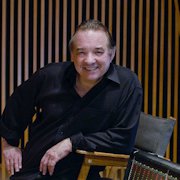
Alex Pauk is an artistic activist, a composer, a conductor, driving force behind many commissions for other Canadian composers, and the Founding Music Director & Conductor of the Esprit Orchestra, an ensemble embarking upon their 30th Anniversary Season with a very special program on October 14th.
What better introduction than the statement by the jury of the Canada Council, upon Pauk’s selection for the 2007 Molson Prize…(?)
“A passionate and visionary conductor, artistic director, composer and educator, Alex Pauk has demonstrated remarkable skills in the arts of initiative, risk-taking and the building and promotion of a leading Canadian arts organization, Esprit Orchestra, which is recognized around the world. A fervent believer in the richness and vitality of Canadian new music, he is a cutting-edge leader in the cultivation and presentation of contemporary music, in Canada and abroad. His true brilliance has emerged in the way that he has introduced new audiences – including young people and more traditional audiences for orchestral music – to the joys of exploring uncharted terrain, both musically and in the new and unusual venues where he has set his performances. Alex Pauk is a true champion of new music who continues to introduce Canadian and international composers to the world.”
I ask Pauk 10 questions: five about himself and five about leading Esprit into this special season.
1) Which of your parents do you resemble (what’s your nationality / ethnic background)?
Alex Pauk
I don’t think I resemble one of my parents more than the other but rather, have qualities passed on to me from both of them equally that affect how I do things in both personal and professional situations. My mother’s steadfast approach and stamina in getting things done raising a family of five kids under all kinds of circumstances, was an example to me in how to persevere in building the various new music groups I’ve been involved with – especially The Esprit Orchestra. Through his sense of humor and his practicality, my father showed me a lot about relating to people and realizing dreams through realistic organizational approaches. Three of my grandparents were Ukrainian and one grandfather (on my mother’s side) was Polish. Both of my parents were born in Canada and I was born in Toronto.
2) what is the BEST thing / worst thing about being a conductor interpreting modern compositions?
The best thing about being a conductor of modern compositions is that you become completely engrossed in the music and what you are doing to successfully bring performances to their optimal levels of quality. This is quite different from relying on the comfortable, sure knowledge of performing well-known classical repertoire even though this is also rewarding.
It’s also a wonderful experience working with composers to bring their new pieces to the public for the first time. There is truly an electricity, tension and excitement in trying to get things right at a premiere performance. It’s also always rewarding to get reactions from the composers and audiences when history is being made through a premiere. There’s a wonderful feeling in knowing that some kind of ongoing development of music is taking place through your hands and thoughts.
Perhaps one of the worst things about being a music director for new music is worrying about the technical, administrative and scheduling details involved – will the players’ parts for a brand new piece arrive on time? – is all the right percussion equipment available in town? – can we get the musicians we need for enough rehearsal time when they are busy with other projects? Conductors of all kinds of music have administrative responsibilities but the situation is more intense with new music.
3) who do you listen to or watch?
My range of listening is really eclectic – everything from the playing of the jazz great Bill Evans to Lady Gaga, Ravel, Bach, Mozart, Berio, Ligeti and all the new composers surfacing around the world. I like to know about all the things that are exciting and influencing people. The same is true regarding my taste in movies.
I especially like Glenn Gould’s interpretation of Bach and was happy to attend the recent Glenn Gould conference at the University of Toronto where Gould’s impact on all kinds of arts and entertainment was explored.
4) what ability or skill do you wish you had, that you don’t have?
I wish I had more ability to memorize the music I conduct. But usually, the music I perform is quite complex rhythmically and in terms of orchestrations and doesn’t lend itself easily to being memorized. It would be generally hard for anyone without a photographic memory to memorize most new music. The fact that one doesn’t get to perform new works more than once or twice also limits one’s opportunities for memorizing through repeat performances.
5) When you’re just relaxing (and not working) what is your favourite thing to do?
When relaxing, I like going to movies of all kinds. At home, I’ve recently taken a strong interest in cooking as kind of useful hobby. This was inspired by the delight of sampling so many kinds of tapas on a recent holiday that my wife Alexina and I had in Spain. The problem is that I have to battle with Alexina to get control of the kitchen. She is a gourmet cook and questions me about what the heck I’m doing there. She and my kids usually do end up eating and liking what I make.
Esprit Orchestra: Alex Pauk, Music Director & Alexina Louie, Composer (Photography: bohuang.ca Hair and Makeup: Ivy Lam Hair and Makeup)
Five more concerning Pauk’s roles with Esprit Orchestra and their upcoming 30th anniversary season
1) How does your role as Music Director & Conductor of Esprit Orchestra challenge you?
My role as Music Director and Conductor of Esprit Orchestra provides the challenge of continually coming up with ever more interesting programmes but keeping them affordable from a budgeting point of view. In recent years, I’ve been able to increase the number of musicians I’ve had on stage and this has enabled me to explore a wider range of repertoire.
But a large orchestra is very difficult to maintain financially. With Esprit, there is a real balancing act going on in this regard. As for the conducting aspect, I’ve never programmed a concert that did not require full, intense attention to performing and interpreting the music. This is an exhilarating kind of challenge – often on the knife’s edge.
2) What do you love about Esprit Orchestra & your programme for the upcoming season?
I love the coming Esprit season because it is both a reflection on the solid work we’ve done in building relations with composers and audiences over a considerable period of time, as well as the fulfillment of my dream of gathering a large number of musicians together who know how to play new music well and want to do it. The composers commissioned for the season are those for whom Esprit has been important and who have likewise been important to Esprit. While there is a strong link to composers we’ve worked with in the past, we are also presenting the music of Zosha Di Castri, a Canadian rising star that will soon have attention around the world.
Composer R. Murrray Schafer (Ottawa Citizen photo by Patrick Doyle)
In terms of the musicians, I love the fact that at the start of each season I feel no trepidation about starting to rehearse again. I only feel support from them and know that there will be good vibes and a productive, rewarding artistic environment. This season I’ve been able to build much of the programming around the theme “The Tuning of the World” after the title of a book by R. Murray Schafer. While some of the pieces relate more directly to our acoustic or natural environment than others, I feel the title is apt in that all composers are “tuning the world”.
3) Do you have a favourite composition in the upcoming season of concerts?
I can’t say that I have a favorite composition in the lineup this season because I’ve programmed with the idea that I like each piece a lot. And each piece is there for a good reason in the flow of repertoire. Of course I don’t know what all the pieces are like because most of the commissioned works are still being written. That being said, I’ll give an idea of how my planning works using the first concert as an example. The Tuning of the World brings Murray Schafer’s thoughts about and concern for our sonic environment to the fore. In the new composition of his that we’ll premiere on October 14th, Wolf Returns, he brings the sound world of the wilderness to Koerner Hall (employing chanters from his Wolf Project in the piece) and contrasts the listening space of urban life with that of the lakes and forests where distant listening is possible. The programme continues with Xenakis’ For the Whales, not only suggesting the images of massive whale bodies and oceans in sound, but offering a plea to save them from harm by mankind. The imagined sounds of the Cosmos in Alexina Louie’s piece O Magnum Mysterium: In Memoriam Glenn Gould, blend with fragments of Bach and Mahler that she embedded in the work when she learned of Glenn Gould’s death 30 years ago. McPhee’s Tabuh-Tabuhan is a vivid portrayal of the life, culture and environment of Bali, drawing on pulsations and colors derived from the Balinese gamelan orchestra (made up of gongs and metal bar percussion instruments). John Rea’s musical depiction of the Icarus legend directly links us, psychologically and physically, to conditions in nature that we can or cannot use and control to varying degrees.
4) How do you relate to Esprit Orchestra as a modern man?
Esprit’s relevance to modern man has to do with keeping us abreast of recent trends in music and the relationships of that music to how we think about our present condition. By way of comparison, we don’t expect doctors to use medical equipment from the 1800s in their practices today, so why should we expect musicians to only perform music from the past? I enter into my work with Esprit with a sense of adventure and discovery and I want my artistic colleagues, as well as audiences, to share in that experience. While there is sometimes a degree of entertainment value in what we do, the idea of moving music forward in a pure sense is important. We aim to provide a sensual experience as well as an intellectual one – one that relates to life in a meaningful way today.
5) Is there anyone out there who you particularly admire, and who has influenced you?
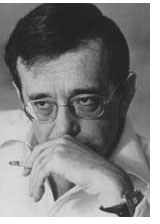
French composer Marius Constant (click picture for obituary)
I had a mentor, the conductor/composer Marius Constant, who passed away several years ago. His work both in Paris (where he lived) and around the world, inspired me and proved to me how important it was for me to maintain my interlocking interests of composing and conducting. These two areas inform one another. As a composer, I’m much better able to deal with composers and new music than I would be as a performer only. As a conductor I’m able to determine better what things are practical to write and what won’t work. My musical life is rather all encompassing – it is really more a lifestyle than a vocation. I learned how to operate in this realm by being around Constant a lot. His influence is still with me as I deal with an ever-expanding range of composers, musicians, technologies, and audience environments.
~~~~~
Esprit Orchestra begin their 30th Anniversary Season with a concert October 14th, “The Tuning of the World,” a spectacular program incorporating the launch of R Murray Schafer’s book My Life On Earth and Elsewhere. The concert includes works by Schafer, McPhee, Louie, Rea and Xenakis.
The Tuning of the World
Sunday, October 14, 2012
8:00 p.m. Concert / 7:00 p.m.
Book Launch and Pre-concert Talk
Koerner Hall / Royal Conservatory of Music
TELUS Centre for Performance and Learning
273 Bloor Street West, Toronto
For tickets (Regular: $55/Seniors: $50/Under 30: $20),
Please call (416) 408 0208 or visit performance.rcmusic.ca
Subscriptions Available. For more details: www.espritorchestra.com
When you think about it, the notion of a “radical cycle” is a bit of an oxymoron. Cycles are usually understood to be stable and repeating, which is hard to imagine if something is radical.
Radical Cycle is also the title of a CD from Dani & Sageev Oore, a pair of musical brothers. Dani plays the saxophone, Sageev plays the piano. The CD resembles a song cycle even though there are no vocals.
Listening to the CD the first time, I was more aware of the radical than the cyclical.
Saxophonist Dani Oore
Does repetition make the radical normative in some sense? Could one take something edgy, and by repeating it, get accustomed to it? Where the cycle is actually a cycle of musical compositions, and it’s on a CD that you can listen to repeatedly, there’s a possibility to test this proposition, investigating what happens when you repeat the radical.
Hm, that’s almost exactly what I asked myself listening to the CD.
First time? Not knowing where it was going there was a great deal of edginess, alright, because of the contrast between the tracks, unmitigated by any familiarity.
When I listened to the CD a second time, I started to perceive it as a cycle. I couldn’t tell if it had been conceived this way, or assembled from pre-existing elements. But with each listening I got accustomed to it, and its edginess became something I could live with, the contours of a shape i could fathom and even learn to like.
The compositions range across several styles, which is at least part of the “radical”. Classical songs are channelled in several shapes, sometimes with a jazzy flavour, sometimes klezmer. Dani’ s sax sometimes shows a breathy sound resembling a human voice, sometimes the tragic-comical klezmer sound of the clarinet, sometimes a more conventionally jazzy sound.
My favourite track is a curious fusion of two romantic compositions, namely Schumann’s “Träumerei” (from Kinderszenen) and Schubert’s song “Gretchen am Spinnrade.” The paraphrase of the two pieces combine elegantly, a natural kind of segue as if the day-dreams of the Schumann lead us to the troubled thoughts of Gretchen in the Schubert lied. I can’t really get across how deep it is, only that I didn’t expect it to work so well. While the piece was likely an outgrowth of their jazz work, it’s a curious fusion of styles, in its way the epitome of anything you’d find on this CD.
Speaking of cycles, it’s now a pleasure to keep the CD in circulation in the car playing it repeatedly.
Tuesday October 2nd, the Brothers Oore bring their unique fusion of styles to the Richard Bradshaw Amphitheatre, a free noon-hour concert.
How about Verdi or Wagner? That was one big question tonight. While some people chose to attend the opening of the COC’s Il trovatore, I opted for Wagner, namely Die Walküre. Oh dear, …I’m better with the food questions….
The concert performance in the intimate confines of College St United Church was an opportunity for some wonderful singing.
There was Michael Robert-Broder singing a very different sort of Hunding. In my experience the part is usually a brute, loud and scary. How atypical then to have a Hunding who was capable of being loud but also soft, precisely in tune, and full of subtlety. And since when does Sieglinde have an attractive husband? This was a fascinating & unexpected transgression.
Hunding was busy trying to scare his unexpected guest, namely the Siegmund of Lenard Whiting. In the concert this was a tuxedoed Siegmund, sung with wonderfully clear diction and remarkable accuracy. While Whiting might be a little light to sing Siegmund in a big venue with orchestra, he was just fine on this occasion, showing excellent stamina.
Wotan was the truly godlike presence of Andrew Tees, not only bringing power to the angry parts, gentle and musical pianissimos to the introspective parts in the second act, but also unexpected resourcefulness when confronted with a pianist re-writing chunks of Wagner. Wotans are not usually expected to improvise their role, but my hat’s off to Tees, who sang with bold conviction.
One of the most exciting moments of the night came during the Ride of the Valkyries, when Margo Levae, Naomi Eberhard, Christine Turingia, Karen Bojti, Erin Armstrong, Dolores Tjart, Monica Zerbe and Olga Tylman provided, first the happy diversion that opens the act, followed by their rescue of Sieglinde and the powerful confrontation with Wotan that follows.
Alla Ossipova as Fricka was progressively more powerful with every line sung, a goddess to match Tees’ god.
Acts Two and Three were sung without intermission, which must have been taxing for all of the performers. I was impressed that they were able to carry on so ably.
I suppose my biggest question was how to reconcile my Pollyanna principles (that if you can’t say anything nice, don’t say anything at all), with the desire to honour so many people who worked hard and did great work. This bizarre review is one solution to that question.
I hope that if this offends anyone, they’ll not be harsh in their criticism.
It’s almost 2013, the bi-centennial for both Giuseppe Verdi & Richard Wagner (that is, a pair of composers born in 1813).
Last night I watched the dress rehearsal of Il trovatore at the Canadian Opera Company’s Four Seasons Centre. Tonight I watched Stephen Fry’s very personal BBC documentary about his lifelong love affair with Richard Wagner. Saturday Sept 29th will be the opening night for Trovatore, but I’ll be seeing Opera By Request’s concert performance of Die Walküre instead (and catching Trovatore again, later on in the run).
I wonder if the next year will be one long series of forks in the road, as we’re asked to choose between these two giants…?
Stephen Fry
But tonight was about Fry & his trip through Wagner. Fry is a Jew, coming to terms with the beloved music from a loathed composer. It’s a mostly chronological study taking us through Wagner’s adult life including his Swiss exile, his trip to St Petersburg (an excuse to hear some of Gergiev’s Wagner), and eventual salvation via Ludwig II of Bavaria (taking us backstage at Bayreuth).
In the last portions of the roughly hour-long documentary, we’re confronted with the great cloud over Wagner, namely his relationship to Hitler, the Nazis and their ideologies. Fry muses that the person most hurt by Wagner’s anti-semitism is Wagner himself. The way Fry agonizes over it, it’s as if he wants to talk to Wagner, hoping to rescue him from his future condemnation in the hearts and minds of the world.
Fry is a genuine Wagner nerd, delighted to step across the threshold at the Festspielhaus in Bayreuth. The film has an odd balance, between his love of Wagner and his allegiance to his own people, particularly when speaking to a Holocaust survivor, a cellist who played in the Auschwitz orchestra.
Fry feels that our modern understanding of the composer has been distorted, by being forced to look at Wagner through the tiny lens that Hitler used, judging him by those same criteria, and in the process missing all sorts of other aspects.
Yet, as Fry says near the conclusion, “Hitler wasn’t the first nor the last dictator to exploit art. They always do so, from the Medicis to Stalin & Chairman Mao.”
Here’s the documentary (enjoy it while the link is still working)
I saw and heard the dress rehearsal of the new Canadian Opera Company Il trovatore at the Four Seasons Centre.
While it’s understood that singers are permitted to mark, the headline tells you everything you need to know:
Tenor Ramon Vargas
Ramón Vargas’s Manrico was beautifully sung, including a strong high C in “Di quella pira”. If this is what he sounds like holding back(!?!), he’ll blow the roof off on opening night (Saturday).
Elena Manistina sang a powerful, if unsubtle Azucena, singing some of the loudest low notes I’ve heard in a long time.
Elza van den Heever in comparison sang a carefully modulated and subtle Leonora, including an interpolated C in the Miserere, (even while underplaying much of that scene), while jubilant in her big solos.
Russell Braun gave us the prettiest singing of the night, and unquestionably the best acting, even if I felt he’s wasted in a role that resembles an old-fashioned villain (NB that Azucena can get away with one-dimensional melodrama). Braun is especially brilliant at the conclusion of the opera, for me the unexpected focus of the last moments
While I am a staunch defender of experimental staging at least in principle, I still expect the drama to work. Trovatore used to be Verdi’s most popular opera, but in the past century has slipped behind both of the (roughly) contemporary middle-period operas that seem so much less anachronistic, namely Rigoletto and La traviata. Trovatore is more melodramatic than either of the other two, which might be one of the reasons the work seems to resist modernization, an unlikely tale from a period that’s remote from our own in every sense. I think it’s short-sighted to assume that you can make these characters resonate with a modern audience simply by putting everyone in modern dress and then pretending this is a modern story.
And then there’s the religious content, further complicating things for any prospective director. As I look at the changing fortunes of our Troubador and his fall from grace, I can’t decide which aspect is most responsible. Does a modern audience resist melodrama, or is it no longer as open to the religious imagery? Under the circumstances, one modernizes at one’s own peril.
I am looking forward to catching a performance later in the run, eagerly anticipating another opportunity to hear the wonderful singing, hoping it all works better next time.
Il trovatore opens Sept 29th at the Four Seasons Centre, running until October 31st.
Today and this week, we celebrate the 80th birthday of a famous Canadian. If Toronto is Glenn Gould’s city we live in “Gould burg”. In the Beaches there’s a plaque not far from his high school reminding us of his childhood. Downtown there’s a sculpture of the pianist in front of the Canadian Broadcasting Corporation (CBC) building.
Although come to think of it, the CBC gained a great deal from Gould, an artist who seemed to put the network and the rest of us on the map. Of course you’re going to hear hot and cold running Gould on the air, when Gould is like the CBC’s godfather. Harold Innis & Marshall McLuhan are understood as our media prophets: not just among Canadians but perhaps for the world. We should have learned a few things, perched as we were on the edge of the great American Media Pond. Yet I think Gould had a great deal to say in this regard.
Every time you click on an article about Gould you’ll have to brace yourself for another barrage of attempts to explain his significance, lists of his achievements, anecdotes seeking to capture his wit unique flavour.
Some will talk about his wit & unique personality.
Others will discuss his pianism & his musicianship. In a summer where I’ve spoken more about piano music than usual, I surprise myself. I like some recordings more than others, but I won’t go there. Let’s leave this aside.
And others will talk about his experimental media creations, creating the impression of a genuine visionary.
No, I have only one axe to grind concerning Gould. I think he had one insight that dwarfs everything else, or perhaps it’s where all the rest really begins. Although I think it began as his personal preference it grew into something verging on a prophecy.
The world was surprised when Glenn Gould announced that he would stop doing public concerts, and make his music solely in a studio instead. Did it begin as performance anxiety as some have said? Was it a kind of futurist project, extrapolating along a few specific trajectories from the present? Gould predicted that concerts would stop, echoing earlier thinkers troubled in various ways by liveness. Brahms once said he’d rather experience a particular symphony from a score in a chair in his living room, than in the concert hall. Maurice Maeterlinck said he’d rather read Shakespeare than encounter the bard in performance because something of Hamlet dies when he’s portrayed on stage.
It is in their tradition that I’d like to see Gould’s choice to retreat from the realm of the live into the virtuality of the studio, a pledge of allegiance to music. In the world of the concert Murphy’s Law rules, whether it’s the bad weather that disrupts airplane schedules, or a simple cough robbing us of the silence from which music emerges. In a studio you can simply record another take, whether the issue is noise or a wrong note. One can overdub or adjust the pitch (as sometimes happens for singers).
The coolness of Gould’s output has always reminded me of McLuhan. Live performance is a hot medium at the very least because of the possibility of wrong notes, the implicit drama of audience applause (or the lack thereof). By removing the applause & the errors, it all becomes much cooler, much more ambient, and therefore virtual.
When I listened to Gould’s transcription of Wagner’s Die Meistersinger on youtubeI was asking myself the same question I’ve asked myself since I first heard the vinyl recording that I grabbed at the record store when the performance was first released, which can be re-phrased in this perverse way: is it even a performance?
When I listened to it, so calm and cool and balanced as the ideal of the musical academy itself, I had to wonder if Gould had overdubbed. He plays so many notes so cleanly, that it’s not the old-fashioned transcription we know from Liszt, the bravura reduction for the piano. Whether Gould plays it live or constructs it in a series of overlaid tracks, the performance is as calm as the technicians with him rolling tape. It is a triumph of musicianship even as its pristine perfection would likely have freaked Wagner out. No, it’s not music by Eno or Glass, yet there’s a kind of tranquility to the recording –no I won’t call it a performance—that belies the original.
I don’t like everything Gould plays but he brings a special excitement to his readings precisely because they’re not like what you’d hear from anyone else.
And now? We’re in a period of textual fundamentalism, when conductors & performers seem to have less leeway to interpret, when the recordings rarely have the kind of excitement to them that a Gould could generate. In this respect, however original he may have been, Gould belongs with the generation of virtuosi of the mid-century.
His recorded legacy is large. And then there are the television programs. I have a great deal of listening & watching ahead of me as I catch up with yesteryear.
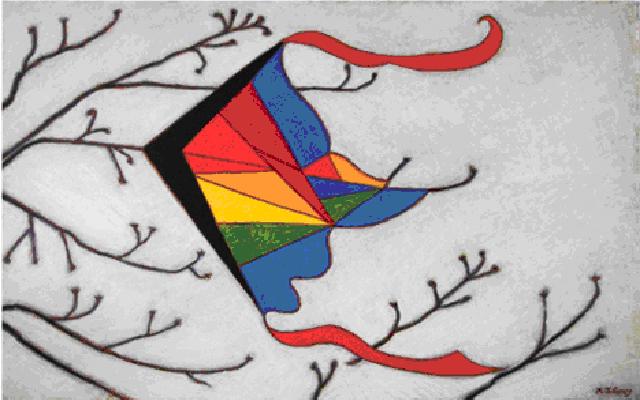
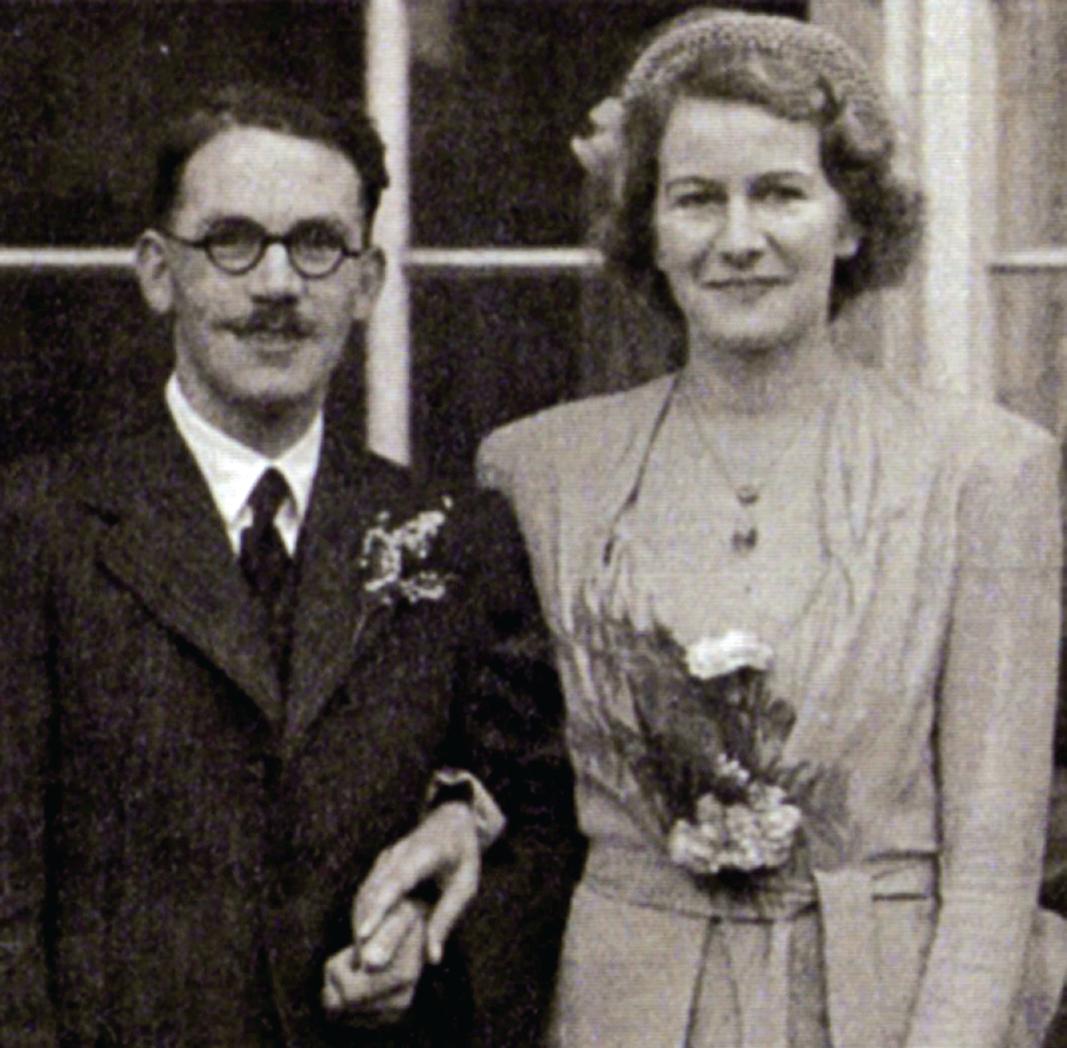
A.J. Gray, aka Alison Gray, was born in England. Parents with talents of their own encouraged an interest in the arts.
A.J. Gray: “The Greater Philosopher’s Kite,” pure powdered pigment and varnish on canvas, 36” 48”
While it is still not clear which of these would have been most appropriate as an occupation, many years have been spent working on paper and canvas. While Gray says, not without irony, that the work has always been documentary in nature, sometimes literally, as a landscape painting, hers is a poetic sensibility with an eye for beauty & meaning in everything.
She recounts how the desire to prove a point in a dispute over unnecessary noise prompted the purchase of a videocamera with some fairly good microphones built in.
It was almost inevitable that recording performances would be an attractive pursuit, and an interest in all kinds of music has led to the acquisition of peripherals that allow more sensitive recording of the audio track using strategically-placed condenser microphones. Every kind of music, from large orchestras and opera to rock and roll, has been covered, along with theatre and dance productions.
At this relatively early stage in her career as the creator of documentary video I ask Gray 10 questions: five about herself, and five about her videographic activities documenting performance.
1) Which of your parents do you resemble (what s your nationality / ethnic background)?
I was born in England, and both of my parents had a mix of English and Scottish ancestry.
AJ Gray, on the job
In my Dad’s case there was a little Welsh thrown in, and the part of Scotland that my maternal grandmother came from was probably invaded by Scandinavians. When I was a young adult, many of my parents’ friends would remark that I resembled my Dad. More recently, the people taking care of my Mum would say how alike we were.
2) what is the BEST thing / worst thing about video documentation?
The best thing is the addition of a fourth dimension, i.e., Time, to the ones I was already using. Outside of recording performances, some of the most interesting projects for me have been the ones in which the camera, trained on the sky, would be running for several hours. The resulting data can be edited down in all kinds of ways.
The worst thing would have to be the constraints about publishing. So much of the great material that I have recorded in the past few months is for archival purposes only, so I can’t put it out there, much as I’d love to. Then, in addition to the need to abide by the policies of the Musicians’ Union, there are other factors to consider. When minors are involved, it’s especially delicate and I prefer to err on the side of caution.
3) who do you listen to or watch?
I’m a fan of opera, also love the ballet and have been known to attend shows by David Byrne and Randy Newman, and Lou Reed. I am still kicking myself for missing Paul Simon. Brazilian drumming and World Music in general have a lot of appeal for me.
4) what ability or skill do you wish you had, that you don’t have?
It would be great to have skills in musical performance at a level that would permit playing with a group. It’s so wonderful to see the interactions between players who have been practising together for so long that all it takes is the movement of an eyeball to give a cue. I can’t think of many other human endeavours that create these kinds of relationships. Soccer might be one.
5) When you re just relaxing (and not working) what is your favorite thing to do?
For me, the 50 metre pool and the running “track” are where the best unwinding can happen. For sheer goofing off, it’s nice to get together with others and trade stories.
Five more about video documentation
1) How does video documentation challenge you?
The challenges are usually only technical. In a club at close quarters there may not be anywhere to put a pair of mic stands, or it might be in a huge church with the performer moving from one end to the other. In such a case, a second pair of microphones would be helpful, meaning another 400 feet of XLR cable, a much more elaborate set-up. It can take as little as 20 minutes for me to have everything hooked up and ready to go. Sometimes it’s hard to find a place where the camera has a clear view of the performers. Flexibility is key.
2) what do you love about making documentary video?
I love my camera. It was a fairly big investment, and has had things added to it, the wide-angle lens adapter being significant. It’s wonderful to be able to get everybody in the orchestra in the frame, and to zoom in on someone’s fingering allows the viewer the same kind of intimacy with the instrument that otherwise only the player would have.
I’ve barely scratched the surface of what it can do and am amazed sometimes. Once a battery ran out but the camera kept going for another 10 minutes anyway, thereby capturing the tail end of a great show that went on longer than expected. It was such a thrill to discover that nothing had been lost.
3) Do you have a favourite video that you’ve created?
A couple of my favourites are Night Falls and The 90th Annual Warriors’ Day Parade. Night Falls is a pretty early example where eight hours of video gets taken down to about five minutes. This was made before I’d figured out how to fiddle with the audio, so the editing is fairly arbitrary because I wanted certain sounds kept in.
The Warriors’ Day Parade video, from last year, is nearly half an hour long, also put up in installments as the editing progressed. There are some sweet and poignant moments, and Part One has a funny little sub-plot concerning a chap in a green shirt. My hope was to try and make it so that all of the participants (or their grandchildren) could see or hear themselves at some point in the video. It seemed a massive task, until compared with the sacrifices made by some of the Veterans in the parade.
4) How do you relate to video documentation as a modern woman?
As a modern woman? Since my little operation is fairly compact I can usually carry my own gear. There is still sometimes an odd vibe suggesting that I can’t possibly know what I’m doing because I’m not a guy, likely coming from someone even more old-fashioned than I am, so I try to be understanding about his or her perspective..
Whatever it may have to do with being a woman, modern or otherwise, there are always the options of asking for help or advice, and continuing formal education. Being primarily a visual artist using a recording device that is primarily a camera, I know there is much to learn as far as the audio engineering is concerned. So I consult a long-time friend (John S. Gray) who has many years of experience recording performances.
5) Is there anyone out there who you particularly admire, and who has influenced you?
Michael Snow
That list would run to several pages and it’s hard to know where to begin. In art school (Queen’s, BFA) in the 70s we had sessions with the film department, and one example we were shown was Wavelength by Michael Snow. It still stands up. Back in those days, making movies was prohibitively expensive and while I never dreamed I’d be doing what I’m doing today, having seen that film I wanted to.
Also, European cinema was starting to be available at some theatres in Toronto, so Truffaut, Fellini and Bergman, among others, had a big impact. Nowadays I’m way behind with my movie-viewing, hoping to catch Werner Herzog’s latest at some point. He never disappoints.
Paul Simon’s video for The Afterlife seems to me to be a beautiful example of what I’ve been aiming to do. It’s a very straightforward piece. The music, and the relationships that the musicians have with their instruments and each other, take precedence over special effects. It’s almost not so much a document about the music and performers as it is about the positive energy they create.
It’s nice to imagine that this energy increases whenever someone uploads a video of people making music and having a good time. The world can always use more so I’m happy to help.
AJ Gray’s work can be found on her youtube channel, or her Vimeo page. If you’re an artist, band, or ensemble interested in video documentation you can email her at capabilitygray@gmail.com.
It sounds overblown, but Brian Wyers’ recent paintings are a genuine study in the power of the human spirit. I’ve watched this painter and the drama enacted on his canvases paralleling the struggles of his life, so much more than one can possibly speak of in such a short article as this. Brian has said that he “lost everything”, suffering a major illness at the same time he was losing the love of his life.
Last year I wrote a pair of essays on Wyers’ work, fascinated by allegorical depths that remind me of painters such as the symbolists Paul Gaugin or Maurice Denis: 1) Brian Wyers and 2) Wyers subjectivities .
And then there was a radical change, no more symbolism. For the past year Wyers has been florally obsessed, painting enormous canvases. Walking among these big surreal blasts of colour, one seems to be a honeybee in the presence of gods and goddesses, massive fountains of nectar and colour, with deep chiaroscuro crevasses.
They tend to grow on you. Online they’re powerful enough, but in person? Suddenly I am more gnat than honeybee, the honeybee being too exalted and massive a creature, in comparison to these majestic compositions.
I got a big clue from a Facebook remark from one of Wyers’ friends, connecting the garden to Sandra, Wyers’ deceased wife. It’s indelicate to talk about lives, both his and hers, but let me simply state the obvious, that Wyers loved his wife very much and has not only been mourning her passing. If the garden was the Wyers’s special shared place, the exploration of flowers takes on a whole new meaning, as though the paintings were meditations. That the garden was their shared place, however, suggests that maybe these flowers are much more symbolic than I ever understood.
And now Wyers is undertaking human shapes again. In the last week he’s created three different canvases, each a portent of a kind of renewal.
Brian Wyers: Solitude, oil on canvas, 48 x 48
“Solitude” resembles a photo printed in sepia, a cloisonist’s series of blocks, embellished with a humanizing shock of hair falling in the foreground. I invoke the cloisonist because the chunks of colour take us towards the abstract, requiring a moment to resolve the ambiguities into the slightly uncommon composition. Or should I have said “conception” rather than composition? Wyers’ Solitude seems to be emerging from an egg. As with the earlier series of human figure paintings I obsessed about last year, we’re on the boundary between abstract and realist, between dreams and waking.
I only saw Solitude online (that is, via my laptop) last week, but had the pleasure of seeing it in the flesh today. In person? Wow. Jaw-dropping, luscious, and very much alive even though there’s another ambiguity to the form, as we can’t really tell how alive this female form might be.
I spoke earlier of renewal. The next two that I saw –(first via the computer earlier this morning, giving me the urge to go over to see them in Wyers’ studio in person) confirm that assessment.
I don’t know the sequence for these two but they share key features with Solitude, even though they are more differentiated, less abstract. They make me feel that the renewal is progressing out of Solitude’s “egg”, a rebirth of sorts.
Let’s address the two simultaneously. We’re again in the kind of ideal place we’ve seen in the wistfully surreal last half-hour of Tree of Life. One is called “Breathe”, the other “Rapture”. As with Solitude, we have a female form. Where we saw a head in Solitude but saw no sign of wakefulness or motion (indeed, if one were being macabre, there is the slight possibility that Solitude is a portrait of one who is not alive: but the picture glows with life, and yes, fertility… she is inside an egg but seems nubile with her own eggs, strong, muscular and so healthy I wanted to reach out and touch), both Breathe and Rapture are dynamic.
Brian Wyers: Breathe, oil on canvas, 52 x 48
Breathe seems to be like a moment of birth, a head that is unseen above the water, while we see the body relieved at the moment of breaking the surface. Perhaps it would be better to think of re-birth, that impulse to survive and inhale, after being submerged? Forgive me if I project, thinking of Wyers’ ordeal and his return to life.
Rapture is more languid, its colours warmer than those of Breathe. Where you can feel the coldness of the water in Breathe –and the relief to be getting your head up and OUT of that water—in Rapture, the water is a safe sensual place to bask and languish. This pair goes together so well, I wonder if Wyers thinks of them as a set (I didn’t think to ask him when i was at his studio). As far as I know he wouldn’t insist that you keep two paintings together for fear of breaking up a set, and indeed I wonder if he even realized how brilliantly these two seem to balance one another.
So far we have no faces, but at least Wyers has emerged from his reflective garden, has lifted his head out of the pool to breathe again.
Elliott Hayes was a playwright & dramaturg, the literary manager of the Stratford Festival for awhile in the 1980s.
A friend of mine introduced me to him, a really big deal I thought, an opportunity to maybe get some input on what I should do, where I should take my work. I had an operatic project I was working on. I sent it to the friend who showed Hayes.
I had the one meeting with Hayes, highlighted by a sentence that I resented at the time. Hayes said –of my confused unfinished libretto fragment—that it contained “big ideas”.
When he said “big ideas” his face contorted somewhat with the words: as if big ideas are bad. Here I was talking to this great man (I’d just seen his new play Blake), and uh oh I felt as if I had urinated on the floor, except somehow instead of urine, the floor was immersed in my “big ideas” which I couldn’t possibly retract or conceal.
Yeah it was pretty embarrassing.
That one encounter was back in the 1980s. Unfortunately I never had a chance to atone, to either show him that wait, look here, I really could create small ideas, see?
But as it turned out that conversation was seminal (if you’ll excuse my use of a metaphor that echoes the one I used for the big ideas all over the floor), as I pondered my sense of humiliation, that I wanted to take up the debate about the value of big ideas, hoping to show him.. Sadly and tragically Mr Hayes died an untimely death in 1994, before I could ever discuss it with him.
Big ideas? Maybe you wouldn’t want to see them in a new spoken word play. But they’re essential in opera. Opera is a symbolic medium where there’s simply less time for words, so each one much carry much more weight.
I don’t bring this up to debate Mr Hayes, wherever he’s gone. He was reflecting the conventional wisdom. Big ideas are unwieldy. But they are also the essence of the difference between opera & spoken word theatre.
When I think of the most successful original operas over the last 35 years (and forgive me if that number is arbitrary, to allow particular examples), you’ll notice something they have in common.
Philip Glass wrote Einstein on the Beach, then Satyagraha, then Akhnaten
John Adams wrote Nixon in China, The Death of Klinghoffer and Doctor Atomic
Every one of the operas listed concerns big themes.
I suppose in fairness, all that Mr Hayes sought was the usual outcome any good dramaturg seeks: to fix a bad text and make it better.
I submit that there are at least two things you can do to a text that’s full of holes. A dramaturg can change it, of course. But sometimes what’s missing isn’t text.