When did music begin to imitate its subject, begin to be ambitious about signifying? Is Mozart’s gentle rococo tuba mirum (so understated compared to Verdi’s dies irae or Mahler’s resurrection in his 2nd Symphony) an attempt to show us what it would sound like on that day, or rather a humbler idea of what the music accompanying the singer should do? When Handel’s trumpet sounds, and the bass tells us the trumpet shall sound, are we to think that the D major trumpet in some sense imitates what one would hear on that day? After hearing Hollywood movie music portend both God and Godzilla, my ear is jaded, struggling to get back to a purer sort of hearing beyond mere imitation.
At one time music had not yet become the Wagnerian monstrosity to which we’re now accustomed.
Music was not explaining. Music simply played.
Musicians weren’t expected to underscore the scene to explain the story.(affecting music for the heroine, scary music for the monster). Music simply played.
Music wasn’t burdened with meanings, telling us who was the good or bad guys. In Shakespeare for example, whether you’re a Stuart or a Plantagenet, you get a small fanfare to announce your entry (look for words such as “tucket”: a kind of ta ta ta ta to denote a major personage). Hm, so in the sense that music meant personage, its ability to signify goes back quite a way.
It may be simplistic to want to think of music having only recently acquired its baggage: its ability to signify beyond the moment. Maybe music always did this to some extent. Even so, listening to something like Vivaldi’s Four Seasons I can’t help thinking that the process of signification is so much more innocent. Vivaldi did not worry when presenting the composition to the first audience about the possibility of anyone disrupting that first performance with a phonecall or a text message.
It’s summertime and for some of us the living is easy.
Driving through the modern countryside seems the perfect counterpart to listening to Vivaldi’s The Four Seasons on the car’s sound system.
It’s so hot outside that it’s scary, global warming being the unspoken horror.
Tafelmusik’s innocent sound takes us back to a time when the seasons were natural and disciplined, surely less concerned with a perfect imitation of the weather in the music, than simply an occasion to raise our spirits.
As we zip along with the air conditioning blasting away any sensation of the inferno outside, Tafelmusik bring us a soundtrack of balance and harmony as green as an unspoiled forest filled with birds and animals, not yet poisoned or slaughtered.
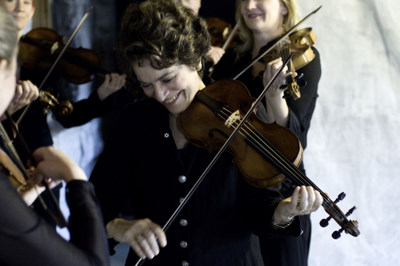
Tafelmusik Music Director Jeanne Lamon (Photographer: Sian Richards)
The performances are a corrective on other versions I’ve heard. Jeanne Lamon’s solo violin has such calm tranquil beauty, without the neurotic tendency to rush, to over-emphasize phrases, as I’ve heard in so many versions. Is this the sound of nature? Perhaps that’s one way to understand it. But more fundamentally, Lamon and the ensemble she leads are playful, relaxed, and above all organic. As we drove along I could almost believe that the risks to the natural world were all in my head. Vivaldi in Tafelmusik’s recording puts me at ease with nature.
Of course the world will go on, with or without homo sapiens.
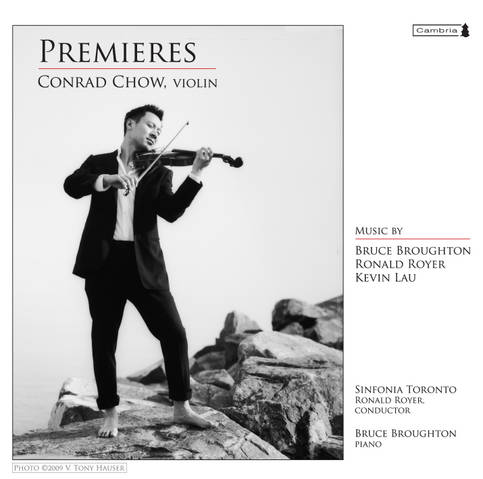
Whatever you think of the music on PREMIERES – violinist Conrad Chow’s CD of original musical compositions for violin with different groupings of accompanying instruments— the concept seems to be original.
My eyebrows went up when I heard that a young violinist was recording a series of new compositions. Honestly, I don’t know if this is really an original idea or simply something new to me; but it seems like a very fresh idea, to team up an unknown player with unknown music.
One of the saddest realities is the fate of the so-called “new music” commissioned for concerts. Few compositions survive their first presentation. That’s makes the title of Chow’s CD portentous if not ironic, when you consider how few compositions survive the premiere, to be revived, let alone entering the performing repertoire for that instrument.
Having a soloist commission composers is an ideal gig, because the goal is symbiotic, a win-win relationship. Soloists need the music going forward, and so inevitably will give the composition subsequent performances, thereby avoiding that dreaded fate of the premiere/farewell performance.
I don’t know whether Conrad Chow simply sought out a series of composers, or whether there was something more complex. (recording label facilitating the matchup? composers sharing the gig?)
I’ve been listening to PREMIERES for days now, the CD that’s in my car, in my laptop at home, or in my office downtown. It’s a kind of acid test, pressing a recording into this kind of extreme service, one that exposes the good and the bad. Having been through it completely at least seven times, plus a few extra visits to specific tracks, I’m very pleased with Chow’s project, with the compositions, and the resulting CD.
Different pieces have grabbed me at different times over the past few days. Each one has to be considered a success, given that I surrendered to each one, and have decided I adore some.
(left to right) Conrad Chow with composers Kevin Lau, Ron Royer and Bruce Broughton.
Bruce Broughton’s contribution was for me the most significant, representing the pieces that are holding on to me with a series of friendly ear-worms that refuse to let go.
Broughton opens the CD with Triptych, a piece that puzzled me for the longest time: until I noticed the subtitle “Three Incongruities for Violin and Chamber Orchestra”. Earlier this week, my back was up in response to the way these three pieces bump into one another like flavours that shouldn’t be on the same plate: that is, if one expects them to be unified. Once I noticed the sub-title (forgive me, I was listening to the music in my car over and over, not in a concert hall), the composition clicked into place for me.
The first movement sounded like a modernist take-off of the prelude from Bach’s Partita in E.
Take-off? Parody? I want to include all possibilities, such as tribute, playful imitation, stretching the boundaries a bit even while reinforcing the trope. I want to invoke a sense of fun even as the piece reminds us of something antique. We are again in the presence of many of the same disciplinary concerns as one finds in Bach’s writing, both for the composer (who at times feels as though he is paraphrasing or commenting, while at other times, inventing out of nothing) and then for Chow as the fiddler. Broughton mentions Prokofiev in the program notes, which isn’t surprising considering the neo-classical touches (e.g. using woodwinds in a concertante manner), the transparent textures & the unapologetic pacing. The second movement soars with the violin, including sections where Chow seems especially comfortable with the agile turns of melody.
By the third part of the triptych we’re in an entirely different place, a folky fiddle sound that took me by surprise. Yet –after being a bit perturbed initially –I see now that they work off of each other beautifully, like the apple following the cheese.
Broughton’s other contribution is a series of short pieces called Gold Rush Songs, that I’ve been humming –badly—all week. The glimpses of Broughton’s playfulness in the Triptych are consummated in these happy pieces, containing snatches of tunes that tempt you to sing along even as they refuse to do the obvious thing (and making them deceptively hard to emulate).
Speaking of happy, I find myself more and more impressed by the work of the most junior contributor, namely Kevin Lau’s Joy. I found myself perhaps a bit like that insomniac Princess of that fairy tale with the pea causing her to toss and turn in her bed. Joy opens with several strong gestures from the orchestra, phrases reminding me of some compositions I’ve heard before –that I love—before moving through a series of moods. After listening a few times, I’ve grown more and more impressed that Lau took the stage boldly, a self-assured voice with something to say. Joy is a troubling piece precisely because it questions happiness and joy, teasing us with lovely moments that refuse to promise us an easy happily-ever-after. Lau is to be commended for bravely undertaking the old romantic project of exploring philosophical truths in his creation. I love his ambition, and even more, I believe he did a fair job in his exploration of the idea.
Ronald Royer contributed two wonderful pieces, each in two movements. His Rhapsody begins with an eclectic sound reminding me at times of jazzy bits of Ravel, at other times of Hindemith. His In Memoriam, JS Bach is another neo-classical piece (recalling that the first piece on the CD from Broughton also incorporates older music in a new frame-work), although far more adventurous than Broughton’s piece. Where Broughton’s writing reminded me of a commission where the soloist might have said “please don’t let it be too dissonant”, Royer manages to wander away from the old, without the need to be dissonant or overly complex. His writing has wonderful clarity, several gestures coming directly from the violinist that connect it solidly to the tradition of a performer demonstrating their virtuosity.
Conrad Chow with his 1933 Gaetano Pollastri violin
Indeed, the entire album is a stunning showcase for Conrad Chow, who bursts onto the scene –or at least into the soundtrack in my car—authoritatively and decisively. Chow shows us a broad array of styles (ably accompanied by Sinfonia Toronto), so many ways of playing and being musical in diverse styles, that the recording will surely raise his profile.
Jean Cox, heldentenor (click picture for details of Cox’s extensive work at the Bayreuth Festival)
Cox was a great American heldentenor, who died on Sunday. By coincidence it’s the same day that Franz Crass passed, and not many weeks after the death of Dietrich Fischer-Dieskau.
I am pondering the workings of the culture machine, a bit mystified that whereas DFD is universally known and loved, and FC also well-known, Cox never made the same deep impression, at least in North America (but then again Cox is likely remembered far more in Europe than in America)
Of course nobody –certainly not me–can know objective truth. Maybe the way these male artists are remembered is the proper reflection of their ability.
Maybe. Yet I suspect that in fact other factors are involved.
Timing seems to be a big factor in fame. Singers have a window of opportunity to make an impression. For some that window is very brief indeed. If you listen to this sampling of tenors –all singing the same brief passage in the last act of Götterdämmerung –you get a sense of the brevity of careers. New cohorts of singers replace the older ones, and the changing recording technology may distort the singers’ actual voices.
If you come along at the right time for a key project you will be remembered.
Wolfgang Windgassen came along at the right time to be the Siegfried on that first seminal Ring cycle conducted by Georg Solti.
Manfred Jung was the Siegfried on Chereau’s Ring conducted by Pierre Boulez
Helge Brilioth and Jess Thomas share the Siegfried duties on the von Karajan Ring
That’s where timing comes in.
I saw Jean Cox sing the Siegfried from Götterdämmerung at least a couple of times in 1973 (with the Canadian Opera Company, in the unfriendly confines of the O’Keefe Centre). His portrayal was riveting, a confident physical presence at ease moving, acting and singing. His voice combined power, lovely tone & nuanced expression in this difficult role.
I also heard him on CBC radio broadcasts from Bayreuth conducted by Horst Stein (another talent who somehow fell through the cracks). To my ear Cox sounded much better than Windgassen or Jung. While I adore the quirky interpretations of the von Karajan Ring (Brilioth for example), Cox never had a recording whereby he could stake his claim as one of the great heldentenors of the century.
Recently I saw a discussion online about tenors where some put forward the notion that Jay Hunter Morris –admittedly a reasonable performer in the Met’s Ring—was one of the great tenors of the century. Why? Again, it’s a matter of timing, being in the right place at the right time.
Here’s a little sample of Cox’s death scene from Götterdämmerung, beginning at 3:20 in a clip that also includes the unique voice of Franz Mazura.
(left to right) Conrad Chow with composers Kevin Lau, Ron Royer and Bruce Broughton.
Whether performing at the Mozarteum in Salzburg, Disney Hall in Los Angeles, Carnegie Hall in New York, or Qingdao Grand Auditorium in China, Canadian violinist Conrad Chow has won over audiences with his interpretations of music from different centuries, continents, and styles. A laureate at the International Stepping Stone Competition in Quebec, Conrad Chow leads a rich performing career as a soloist and chamber musician. He is also a devoted teacher. Despite his young age (Dr. Chow is 30), he is currently on the faculty of the Royal Conservatory’s Young Artists Performance Academy in Toronto, Canada, and Visiting Professor of Violin at the University of Jinan College of Music in Shandong, China. He performs on a 1933 Gaetano Pollastri violin.
Canadian violinist Conrad Chow launches his debut CD, PREMIERES with a special performance at Toronto’s Gallery 345 on Thursday, June 28. The recording, on Cambria Master Recordings (Cambria CD-1204; distributed by Naxos) features premiere recordings of music by Bruce Broughton (an award- winning film composer from the USA), Ronald Royer and Kevin Lau, teaming Conrad Chow with SINFONIA TORONTO conducted by Ronald Royer. PREMIERES also includes a bonus track, featuring Conrad Chow and Bruce Broughton in a transcription of Chopin’s Nocturne in C# Minor for violin & piano. Chow’s June 28th appearance is with Canadian pianist Angela Park.
Chow added the following personal note addressed to me at the end which I thought it would be appropriate to share:
“Premieres represents two years of work, and also two years of enjoyment to me. I hope you get to experience and hear it for yourself!”
I haven’t yet heard the CD but in the meantime, I ask Conrad Chow ten questions: five about himself and five about his new CD PREMIERES.
1) Which of your parents do you resemble (what’s your nationality / ethnic background)?
Conrad Chow with his 1933 Gaetano Pollastri violin.
I’d say I’m a pretty balanced mix between both my mother and father. Recently, I’ve noticed people saying how much I sound like my father though! My parents were both born in Hong Kong, and came to Vancouver in their teenage years. My ancestral home is in Shandong China (the province that contains the city of Qingdao, of Tsingtao beer fame, and is also known as the city of the violin).
2) what is the BEST thing / worst thing about being a violinist?
The best thing about being a violinist is not having to buy an extra plane ticket for a cello or wheel around a bass while shouldering a stool. The worst thing is feeling envious of the piccolo player as she stuffs her instrument into her shirt pocket.
Seriously though, the best thing about being a violinist is getting to bare your soul on an instrument that is at once almost as human as the voice, but can also produce timbres and colours that are unique to the instrument. From the deep and emotionally sensitive, we can do a 180 and immediately burst into insane licks and agile fireworks. When it all flows, you feel like you can slow down time, and I imagine acrobats, dancers, and racecar drivers must all feel something similar.
3) who do you like to listen to?
I’ve always loved Gil Shaham’s sound. I met him once when I was a teenager at the Aspen Music Festival, and I remember that his personality was as engaging and welcoming as his sound.
For non-classical music, I like MC Jin – a freestyle rapper who is as quick and clever with his improvised lyrics as his rhythm and delivery are biting and dynamic when he engages in rap battles. Performance is all about feeling the audience and working with them to create a specific atmosphere – Jin is a master at this art.
4) what ability or skill do you wish you had, that you don’t have?
I wish I could play volleyball, basketball, and chop vegetables without worrying about my “precious fingers”. One day…one day!!
5) when you’re just relaxing (and not working) what is your favourite thing to do?
I like to meet with friends.
~~~~~
Five more concerning Conrad Chow’s new CD PREMIERES.
1) How did the compositions on the CD PREMIERES challenge you?
Since all the pieces on the CD are actually premieres, I really had to trust my instincts and communicate with the composers to see how I could best interpret their ideas. There was no ‘act to follow’, so to speak, so that was a challenge and blessing at the same time.
Also, with the depth and breadth that Broughton, Royer and Lau brought to the project in their compositions, I worked very hard to convincingly convey that variety in an interesting way. Even just stylistically, there were elements evoking the Baroque, Classical, Romantic, Gypsy, and 20th Century idioms throughout the CD. The second movement of the Broughton Triptych was actually inspired by Prokofiev, and I found myself going back to the 2nd movement of the G minor Violin Concerto to compare and contrast.
Likewise with the Royer Rhapsody and Ravel’s Tzigane, and Lau’s Joy with Barber’s Violin Concerto, or even the slow movement of Bruch’s Concerto.
2) What do you love about compositions such as those by Bruce Broughton and Ronald Royer (such as those featured on the CD)?
They are instantly accessible, but also multifaceted. Chess is all about being easy to play, but difficult to master. Similarly with their music, I find that audiences always enjoy their first experience, but repeat listening is where a lot of the deeper enjoyment and understanding can be found. Things like polyrythmic meters, octatonic scales, hidden themes, kind of rush by on a first sit-through, but after hearing the pieces a few times, these are the interesting aspects of the works that keep them fresh. Meanwhile, I like to know that when I’m performing these pieces, people don’t feel that they are too esoteric or opaque, and yet, there’s plenty of “steak” for me to bring out, along with the sizzle.
3) was there a favourite among these pieces?
The Broughton Triptych is the real centre-point of the CD – I think that it is a considerable achievement in composition and deserves to be played and heard throughout the world. For me, it was the most technically challenging, but it was so satisfying to put it all together. With Ron Royer conducting the live world premiere of the piece with the Scarborough Philharmonic in April of 2011, we knew that this would be an amazing focal point for the project.
The Royer Capriccio and Sarabande are also special for me, because I actually performed them almost 10 years ago, but never had the opportunity to record them properly until now. They are always fun to play, and I especially enjoy the interplay between the ensemble, solo violin, and harpsichord.
The Lau Joy, is…a joy to play. It’s so filled with verve and passion, and only brings out good memories for me. I actually met Kevin just a month before premiering that work in 2008, and we’ve become close friends and colleagues since then. It seems to be a favourite amongst hopeless romantics and dreamers of the world (and I often count myself in that category!)
4) how do you relate to these virtuoso violin pieces as a modern man?
Violin and virtuosity represent timeless concepts, whether they come from the 17th century, or the 21st. People like to see humanity, emotion, drama, and connection. They’re also tantalized by bravado, energy, seductiveness, and mastery of difficult challenges. The violin is a particularly potent tool to evoke all of these fundamental, primal concepts, and it’s our challenge to bring those to light in a way that is fresh, and will keep audiences engaged. I love being a (virtuoso) violinist!!
5) is there a violinist out there whose approach you particularly admire, or who has influenced you?
My two heroes whom I’ve never met are Itzhak Perlman and Yo Yo Ma. They have a populist approach to making music – everybody should be included – and their message is always positive and inspiring. That’s what we should all be here for…
My personal heroes are the teachers who have formed my skills and opinions about music-making. From my first teacher, Janet Wilchfort, to my teacher at the Canadian Royal Conservatory, who taught me during my formative teenage years, Alec Hou, to my university professors Miriam Fried, Pamela Frank, Ani Kavafian, and Philip Setzer, and finally to my post-collegiate mentors Philippe Djokic and Eduard Schmieder; all are consummate artists, and continue to be immense inspirations to me.
PREMIERES will be available in record stores June 26th. You can see more of Conrad Chow here on youtube, or visit Conrad Chow’s website .
Sunday June 17th was the day I watched Extremely Loud and Incredibly Close (let’s call it ELIC) for a second time. I’d seen it Friday night, and reviewed it. I remarked that for me its chief subject was not 9/11, but the issue of manhood as viewed through the lens of fathers and sons traumatized by loss.
By a curious coincidence Sunday was Father’s Day. Second time through –knowing the arc of the plot and its eventual destination—I was more fully ready for the mythic dimensions of this film. Friday’s review reflected my ambivalence. I loved parts, disliked some aspects, and wasn’t sure about it overall. Today I am much more certain, particularly the way this film fits into a recent pattern of dogmatic critics. I don’t care if I come across as Polyanna, in my dislike for negativity.
And pardon me if I am repeating myself, in mentioning these recent instances of daring or original productions rejected by some, yet embraced by others:
Lepage’s Ring Cycle at the Metropolitan Opera over the past couple of years: dissed thoroughly in the press & social media.
The Canadian Opera Company’s Semele, a production that could be accused of disrespecting the original work
Stewart Goodyear’s Beethoven Marathon. No critical response I saw denied that his playing was wonderful. Yet this achievement was little more than a blip on the radar when it could have been a paradigm-shifting moment comparable to Glenn Gould’s recording of the Goldberg Variations.
Oh well. My enjoyment and/or confidence in the excellence of those projects wasn’t dampened by sourpuss critics.
9. “Despite its overweening literary pretensions, Extremely Loud and Incredibly Close is about as artistically profound as those framed 3-D photos of the Twin Towers emblazoned with ‘Never Forget’ that are still for sale in Times Square a decade after 9/11. […] It’s Oscar-mongering of the most blunt and reprehensible sort.” Lou Lumenick, NY Post
I understand how New Yorkers may need to own these events for a long time (how could they not?), resenting any attempt to tell this story in terms that don’t correspond to their version. As a foreigner my perspective will seem skewed. I also understand how film critics think they understand a film because they’re in this tunnel of celluloid, in a groove of watching a few movies every week and writing pithy reviews, deconstructing each pathetic attempt to scale the heights of excellence. But seeing too many movies can inure one to excellence, or blunt one’s ability to appreciate what’s actually there, due to a kind of cynicism that sets in, forgetting that artists are people and that many in the audience don’t have the same cynicism. That Lumenick compares this to “framed 3-D photos of the Twin Towers emblazoned with ‘Never Forget’” says more about Lumenick than about the film. Actually, ELICworks very hard at coming at the topic indirectly, perhaps the most oblique treatment one could imagine.
8. “Poor little Oskar! Such an adorable, pint-sized heap of neuroses. What better mouthpiece for an author, or a filmmaker, to use as a way of exploring the personal cost of a great communal tragedy. Do you get the idea that Oskar must emerge from his own teeny-tiny personal prison and, yes, embrace the world? Never has the tragedy of 9/11 been made so shrinky-dinked.” — Stephanie Zacharek, Movieline
But who said ELIC ever purported to be the last word about 9/11? As I said earlier, I think this film is about manhood (speaking of shrinky dinks), about fatherhood, about war. The characters suggest a sad series of parallels, an ongoing chain of bad karma:
[SPOILER ALERT]
Boy who has lost his father (played by Tom Hanks)
Father (Hanks) who himself had no father (grandfather was traumatized victim in the previous war)
Grandfather (Max von Sydow) who is mute after the horrors of living through the Dresden bombing (both parents killed right in front of him)
But the characters are universal, rather than individualized in that karma. They’re not saying anything about the USA or New York; rather it’s about war, period.
7. “Extremely Loud & Incredibly Close isn’t about Sept. 11. It’s about the impulse to drain that day of its specificity and turn it into yet another wellspring of generic emotions: sadness, loneliness, happiness. This is how kitsch works. It exploits familiar images, be they puppies or babies — or, as in the case of this movie, the twin towers — and tries to make us feel good, even virtuous, simply about feeling. And, yes, you may cry, but when tears are milked as they are here, the truer response should be rage.” — Manohla Dargis, NY Times
They’re right about one thing: that it’s not about Sept 11. This movie does not try to make anyone feel virtuous (and to suggest this after seeing this movie suggests a heart as cold as ice). The film is full of thorny and painful images. I came away from it the first time troubled and conflicted.
Notice that #7 is almost a perfect contradiction of #6
6. “Oskar is a nasty piece of work. On that dreadful day, Oskar comes home early from school. He hears his father’s voice messages. He hides them from his mother, Linda (Sandra Bullock). He denies her listening to Tom tell her he loves her. Oskar is selfish. He sneaks out and buys an identical answering machine, records the identical outgoing message, and keeps the old one for himself. He counts his lies. Oskar has ‘head-up-his-ass’ platitudes and has read too much Jean-Paul Sartre.” — Victoria Alexander, Film Festival Today
Yes indeed, this largely corresponds to what I felt first time through on Friday. Oskar is very creepy. That’s exactly the opposite of what you read in #7 (about kitsch). But again, they show that clearly the film is not really about Sept 11: not about that brooding need America still has to articulate its nameless rage and sorrow. When Oskar starts smashing things –and it happens more than once—he’s such an unattractive image, he can’t possibly be the epitome of American angst. Oh no. Instead make it be a buff ex-marine who’s able to shoot people or kill them with his karate reflexes.
Note to America: not everyone is good enough to be a Marine. There are some real geeks out there. Oskar speaks to the geek in me, I promise you, and I am not even American.
5. “Almost half a century after Dallas, I still have trouble watching film of President Kennedy’s assassination. Yet Stephen Daldry’s screen version of the Jonathan Safran Foer novel, adapted by Eric Roth, proves hard to handle for other reasons. The production’s penchant for contrivance is insufferable —- not a single spontaneous moment from start to finish -— and the boy is so precocious you want to strangle him.” — Joe Morgenstern, Wall Street Journal
Very true. This isn’t a realistic film. It’s at least partly a symbolist film, with its multi-generational tale of fatherless boys. It’s challenging because one often doesn’t know which year one is watching.
Damn but isn’t that exactly how trauma works: that we always feel it in the here and now.
4. “Mixing the horror of 9/11 with a cutesy story about a boy’s unlikely quest just comes off as crass. Throwing a tragic old man on top — to no apparent purpose, really — cheapens things further. Extremely Loud and Incredibly Close is the kind of movie you want to punch in the nose.” — Tom Long, The Detroit News
Tom, I congratulate you for being honest enough to admit you didn’t understand the symbolism of the old man. I suppose it never occurs to you that 9/11 is not the first time anyone was ever bombed or victimized. Believe it or not it’s happened before, often with Americans dropping the bombs. In Dresden btw there weren’t 3, or 4,000 dead, but 100,000.
3. “[I]t will always be ‘too soon’ for Extremely Loud And Incredibly Close, which processes the immense grief of a city and a family through a conceit so nauseatingly precious that it’s somehow both too literary and too sentimental, cloying yet aestheticized within an inch of its life. It’s 9/11 through the eyes of a caffeinated 9-year-old Harper’s contributor. […] GRADE: F” — Scott Tobias, AV Club
This critique came closest to my feelings on Friday, and is partly the reason for my headline. I believe the subject is still too raw for Americans: that it’s still too soon. But at the same time, I find the process of criticism almost evil in its tendency to project motives onto the process of artistic creation (ie when he says that the film “processes the immense grief of a city and a family through a conceit so nauseatingly precious…”etc). Actually the critic is projecting when he says that. There were thousands of different experiences, and no one person has any claim on being the epitome of grief.
2. “Thomas Horn is a terrible actor; I don’t want to call him annoying because that might be the way Oskar is written, but dammit, I wanted to throttle the twerp pretty much for the whole movie. […] This film is so spectacularly bad that the bar for pretentious, deep-thoughts movies has been lowered roughly the length of my middle finger.” — Capone, Ain’t it Cool News
This one? Suggests very strongly that the film hit a nerve. Cheese whiz crisis, Capone, have you never seen a character in a film you wanted to throttle? I saw Untouchables last week btw, and yes, in that case his name is Capone (played by a certain Robert de Niro…?). You watch him and probably don’t like him nor his henchmen. That Horn made you hate him suggests he did a great job.
“Thus endeth the lesson,” …to coin a phrase.
1. “This is a film so thoroughly rotten to its smarmy and diseased little core that tearing into it here hardly seems an adequate method of dealing with it — going after the negative with battery acid and a sledgehammer might be closer to what it deserves. […] This is a film that takes one of the most terrible tragedies in our history and reduces it to a level of kitsch that makes a painting of the burning World Trade Center done on black velvet with a sad clown on the side bearing witness seem dignified by comparison.” — Peter Sobczynski, eFilmCritic
Going anywhere near the subject seems to touch some very raw nerves. I suppose for some people, the topic requires a moratorium, perhaps for another decade or so. As we saw with Viet Nam, there are many ways to approach aspects of the subject. But no single film is really capable of telling the story of Viet Nam. And to go anywhere near the subject in the wrong way (or how someone still suffering might call the wrong way) seems like exploitation of the worst sort.
[And here I am responding to all nine]
The horror of this film, (backdrop for a tale of a family in pain) is the horror of the event, if not of all war. Oskar is the primal embodiment of America on 9/11. On the morning of that day, you were a spoiled, self-absorbed child, unaware that some envious bastards were about to give you a sucker punch. How could anyone be heroic in the face of such evil? The soft and deranged vulnerability of this child, disturbing as it is to see, is one possible mirror, but doesn’t purport to be the best or the most accurate reflection of that insane event.
Adam Klein as Tamino in a 1990s production, with a bit of a nod to Billy Idol.
Adam Klein is a man of many guises. He’s a tenor, singing in many different styles. He’s a composer. A teacher. An instrument maker.
No wonder Klein seemed to be a natural as Loge in Das Rheingold at the Metropolitan Opera earlier in 2012, the singer who seemed most ready to exploit the challenges of Robert Lepage’s carnivalesque production, singing sideways on a wall (with the help of wires) as if he were Spiderman. Klein first sang there in 1971, the first boy that the Met entrusted with the role of Yniold in Debussy’s Pelléas et Mélisande. He’s sung lighter roles such as Tamino in The Magic Flute, yet also has sung Tristan in Seattle in 2010.
Klein is a classically trained composer with a few operas under his belt, who also teaches composition. Speaking of opera, Klein teaches voice, and also shows you pronunciation if you need to sing in several foreign languages. He’ll show you how to build several instruments, and then once you’ve built them, show you how to play them as well.
Up next: Klein is Rodolfo the poet in Puccini’s La bohème, June 29th and July 1st with Nickel City Opera, just across the lake from us in North Tonawonda NY.
I ask Klein ten questions: five about himself and five about his upcoming appearance with Nickel City Opera.
1) Which of your parents do you resemble (what’s your nationality / ethnic background)?
Adam Klein as Chevalier de la Force in Poulenc’s Dialogues des carmélites
I have my mother’s hair and ears, my father’s eyebrows, nose and mouth, and an exact combination of each’s eyes. Being male, the rest of my body more resembles my dad’s.
On my mom’s side I have mixed German-Australian/British (her mom) and 100% Swedish-American (her dad — Stellan Windrow, the first Tarzan of films, drafted into WWI during shooting but they used shots of him in the trees in the final cut which only has Elmo Lincoln’s name on it); from my dad I get mixed German American-British American-Native American (his dad) and 100% Irish-American (his mom).
2) what is the BEST thing / worst thing about being an opera singer?
Best: when opera works, there’s nothing like it, except perhaps Mahler’s 8th Symphony — but that’s almost an opera. The goal of the founders of modern opera, back in CE 1600, was a simultaneous presentation of music and drama, and if each component is at its best, nothing — not film
Worst: the absolute lack of financial stability.
3) who do you listen to or watch?
I’m going to answer this as if it meant: whom do I like to listen to or watch, or whom do I learn from when I listen to or watch them, since I really have no choice but to watch and listen to everyone I’m on stage with, or anyone who’s doing a role I need to learn and don’t have time to work on in the proper way, namely, just memorize it from the score without reference to any recordings or performances, since only then will the role have a chance of being my own and not a composite of what I’ve already witnessed. This caveat is far from complete but also already too long.
Before I give any names, I should say that on my off time I don’t really listen to opera, or watch it, so some of these names will seem mysterious unless one knows what they do. So I guess I’d better give short descriptions.
Watch:
Mamady Keita, jembefola and leader of the African drumming troupe Sewa Kan . I would watch other drummers but I have no films of them. I do watch them live, though.
The entire cast of Firefly (TV show)/Serenity (movie); same for
Iron Man I & II (particularly Mickey Rourke),
Men In Black I & II,
Guest, McKean & Shearer, in their prime
Galaxy Quest, and all the Christopher Guest/Michael McKean movies, starting with Spinal Tap; most of the cast and many of the guest stars in the first eight seasons of Stargate.
There are some others but that will do.
In opera: Vladimir Ognovenko. Andrei Popov. Vladimir Galouzine. My wife Tami Swartz.
Listen: my brother singer/guitarist Moondi Klein in whatever band he’s in, currently Jimmy Gaudreau & Moondi Klein. Other musicians/groups: Ani diFranco. Hamell on Trial. Voo Voo. EastWest Rockers. Huun-Huur-Tu. Yat-Kha. They Might Be Giants. Talking Heads. Bob Marley. On A Dead Machine.
In opera: Birgit Nilsson. Ramon Vinay.Walter Cassel. Pamela Armstrong. Mark Delavan. Greer Grimsley. Brenda Harris.
These are the names that pop off my head without thinking too hard about it. There are probably many others, but unlike a search engine I can’t access all my memories anytime I like.
4) what ability or skill do you wish you had, that you don’t have?
The ability to persuade people to stop doing such stupid things to the planet. The dexterity needed to be really good at piano, guitar, violin, horn or many other instruments. Infinite patience: mine has limits, and they’re shrinking.
5) When you’re just relaxing (and not working) what is your favorite thing to do?
Geek out watching a rerun of some of our favorite sci-fi movies or shows – or read through a script of one out loud – after having prepared a priceless and unique gourmet meal of organic ingredients, accompanied with excellent local New Jersey wine (when we’re in NYC or NJ: Twenty Valley wine when we’re in the Buffalo-Toronto area) -Amalthea, Valenzano or Sylvin wines (Calamus or Featherstone in the Twenty).
Not quite Rupert but still resplendent
Or wake up in the screened-in porch at our NJ swamp house in spring and summer and listen to the wood thrush we have named Rupert the Resplendent, along with the frogs, or later in the season, katydids and tree crickets.
~~~~
Five more concerning Klein’s appearance as Rodolfo in La Bohème with Nickel City Opera.
1) How does playing the role of Rodolfo challenge you?
I refuse to take the Big Aria down a half step like Luciano and so many others did and still do. [Say it ain’t so Jussi! this one is taken down a semi-tone]
I don’t see the point of doing Rodolfo if you can’t sing the C — not because it’s written that way because it’s not in the score — but because Puccini wrote it in A flat, not G (at least, that’s what the SCORE has, but the key changes between that aria, Mimi’s aria, the little conversation after it, and the duet that ends the act, make me suspect that some of these keys are not original — they’re just a half step or whole step off from where I expect them to be); and because the duet before it sounds so dull when taken down a half step; and because like the Duke’s big aria you can’t sing it without the interpolated high note and show your face the next day. I say all this because, though the C is not hard for me to sing, when I’m singing a lot of this stuff, I’ve had ten year at the Met doing low and character parts with nothing above B flat, except for The Nose which has two pages with 16 high C’s and nothing else — but I covered Gordon Gietz in that and didn’t peform it, so doing the high C in public after not having sung the role for six years is a bit scary.
Other challenges: I’ve been lucky, with a very few exceptions, to have had great casts and good directors and conductors every time I’ve done Rodolfo elsewhere, so there’s no longer the challenge of doing it the first time, or doing it with another cast, conductor or director. We haven’t started rehearsals yet, so there’s a possible challenge, knowing the piece as well as I do, of doing it differently from how I’m used to playing it — one gets set in one’s ways after doing enough repeats of a part, one decides what works in a part and what doesn’t, and one’s patience with breaking in new people or working with a “radical new concept” — actually, trying to make the concept work — can wear quite thin, so keeping an open mind is always a good goal.
For the piece itself, what makes Bohème special to me, in a way that the other Puccini operas don’t, though it’s present in most of them to a degree, is the irony pervading the whole plot, and other aspects of oppositeness: trying to keep a light spirit while one is freezing to death, Mimì struggling with every ounce of strength left to her to make sure she tells Rodolfo what she needs to say, and so many other examples — I always hope the production in question is able to get that point across to the audience, because for me that’s what it’s about, not just the singing or the antics. It’s the theatrical core, and as Rodolfo I try to bring it out as much as I can regardless of who else is out there or how it’s being directed. With a less acting, more singing cast, that can be quite a challenge. I’ll know more after the first day of rehearsal.
2) What do you love about Puccini’s operas?
Composer’s POV: That in an age where “serious” composers faulted him — and some Ivory Tower bigwigs do still — for being sentimental or writing music that was passé, as if Schoenberg’s Blind Alley was the way to the Promised Land and anyone who thought differently was an idiot, Puccini stuck to writing music that the people listening could understand with not one second of classical music schooling, because his music is the language of emotions.
Singer’s POV: That he wrote such deliciously singable lines, and so many of them, and made the high notes mean something — integrated them fully into the drama of every moment. Not every opera composer does that.
Actor’s POV: That he carried on Verdi’s torch of writing serious music theater — though I do regret that he never traveled the US to see that there is no desert in Louisiana, at least not in its current dimensions.
Director’s POV: That he used plots that were simple, or at least easily distillable into archetypal gestures to which he wedded ageless archetypal music that sounds as if it’s been there since the dawn of time, that makes it hard to conceive of such words without hearing his music with them. (Listen to Leoncavallo’s Boheme as a test of that.) But also that he made sure his archetypes were present in real people, not as, ooh I don’t know, singers with big plastic chestplates on.
3) Do you have a favorite moment in La Bohème?
The moment which makes me cry, which is Marcello’s line in Act II: “Gioventù mia, tu non sei morta”.
4) How do you relate to Rodolfo and Puccini’s opera about bohemian life as a modern man?
Not much has changed for disinherited/runaway artistic twentysomethings in any big city, so it’s not a stretch. I didn’t have Rodolfo’s life, though, at least not at that age, but I knew people who did – one soprano I knew, about 21, was living — squatting — in a condemned building in Lower Manhattan, when she wasn’t sleeping in her car. She had nothing but enmity for her dad — odd, and yet on reflection not odd, that in the opera no mention is made of any of these kids’ parents, as opposed to Germont in Traviata.
Also, I have my own leanings toward counterculture – for just one example, I knew a man and woman who refused to be married by any state-sanctioned official, since the state didn’t recognize the right of every loving couple, regardless of gender, to marry. So they got married on a mountaintop with their families present. I had more respect for that act of defiance of the State than for most other actions I’ve learned about by anyone.
Another example I can’t resist citing: please, Canada, keep growing the hempseed I eat every morning in my cereal, since the US doesn’t allow domestic production of the plant we get canvas, oil paint and the most concentrated plant protein on earth from, just because it can also make you high. The original Levi’s jeans were made of hemp fiber. But since those in power keep carrying this Double Standard (to wit: alcohol makes you drunk, impairs your motor skills and is addictive, but is legal; cigarette smoke gives you cancer and is addictive, yet it’s legal; Mary Jane gets you high with little or no motor skill impairment and is not addictive, yet it’s illegal), I’m forced to identify with a Counterculture because I disagree with them. But that’s the funny thing about being Other: from one’s own perspective it’s everyone else who’s not behaving right. I am my own personal Establishment. Anyway, Bohème is timeless because the issues it presents are universal topics of humanity.
What does it mean to live your life? Do you take the path laid out by your parents and become, say, a dentist, nice safe job, wife, kids, dog, retirement — or do you make your own path and live your life in the moment, as the Bohemians did? This is a romantic notion even now, and whether or not the audience is conscious that this is what Marcello and company are doing, they see it happen and they can see themselves in their shoes. I doubt this will ever change until the present civilization collapses, and then — maybe — relating to these characters might become more difficult.
5) Is there anyone out there whom you particularly admire, and who has influenced you?
Besides my parents, you mean? No really, they’re special people, Bohemians in their own way – my mom, 90, is an oil painter; my dad, just turned 81, a classical pianist (also plays pretty good jazz). He is Muggle-born, I like to say [you may insert a Harry Potter explanation here for your readers if you deem it prudent: the metaphor is, people in Art are Wizards; people without Art, Muggles]: his family did not appreciate his towering musical talent. She was from Wizarding stock (her dad Stellan was in the theater world all his life, and she was in films as a kid and on Broadway in her “tweens” (a Hobbit term), among many other pursuits. They met and subsequently managed to become and stay part of many erudite artistic circles, so really they made their own path in this life.
But there are many, many people “out there” who have influenced me, some long dead, though Art has a way of smearing that boundary. Verdi, an Atheist among Catholics, yet revered by them; Stephen Jay Gould who carried the torch of reason for decades against the Zealous Right’s attacks on science in schools, and who sang hymns in choirs in Boston. Among the living: Joss Whedon, who gave us the universe of Firefly, which Fox failed to kill. Paul Gross and Christopher Guest and their respective teams of thespians who continually bring us offbeat, independent gems of theater, proving that neither Hollywood nor Vancouver owns the business. Jane Goodall, still trying to get humans to stop eating their cousins to extinction. And as a blanket praise for all whose names my mind is blanking on this evening: anyone who stands up for reason, integrity and doing the right thing and who cannot be bought. Sadly, few and far between – but more than many realize.
For those of you accustomed to reading my accolades for singers, artists & pianists it may seem that you’ve stumbled into the wrong page, with a headline like this.
Oh my God, he actually says negative things? yes
Isn’t that against his credo ? actually… yes… keep reading because this isn’t as negative as it looks
Okay, enough self-mockery.
I watched Extremely Loud & Incredibly Close tonight, a film i craved for a number of reasons. Having lost my father at a young age, i was intrigued watching a film about a boy who lost his father. For me, at least, this theme will never lose its interest, a theme that is likely secondary to film-makers mostly concerned with a portrayal of 9/11 and its impact upon a family.
And so I was totally conflicted. I found myself struggling throughout, liking aspects of it, and yet revolted in other respects. Perhaps that sounds bad.
Rather than mutter about the things it did wrong, i want to at least give thanks for the things it did right:
Max von Sydow gives a wonderful performance
Sandra Bullock gives a fairly good performance in a thankless sort of role: a mother and wife, expected to cry meaningfully after losing her husband in 9/11, as her son becomes even nuttier than before
Thomas Horn? a bravura performance of a very unlikely character, one who clearly got under the skin of the complainers on movieline.com: except that his craziness is entirely believable.
Speaking as a Torontonian –that is, someone traumatized by 9/11, but also, a distant observer who doesn’t claim to understand what this felt like to New Yorkers–i thought the film has merit as an exploration of some really complex feelings.
Coming away from this film “conflicted” –as i put it earlier–is understandable. I wonder if it’s still too soon to be attempting this sort of film. All i know is that the complexity of the material deserves something so complex that it isn’t easily understood or seen. I want to give the film another look.
I am having some serious thoughts about critics & criticism, frustrated and maybe even a bit angry. Critics seem ready to hurl abuse when they don’t understand something, a tendency i find reprehensible in the extreme; if one doesn’t understand something surely one should keep quiet, at least until one has figured it out (although in the case of this film, unlike the other critiques i’ve seen lately, the film’s detractors probably feel confident they understand this film through and through). I feel grateful for this film, and feel that thanksgiving should be our central sacrement:
gratitude for the blessings we have in this rich & beautiful country of ours
gratitude for brilliant & eloquent artists
gratitude that someone might listen to what we have to say
In other words i am mightily tired of critics who spend more words cutting down than building up, more energy spent on dissecting than on synthesizing and helping explain. A critic can perform a hugely useful role when encountering something new, if s/he would only use their words to help people understand. But i find that critics in Toronto lately seem to be tangled up in their own credentials, so intent on proving their competence that they jump on anything that diverges from their narrowest definitions of their form.
I’ve had a series of similar experiences over the past few weeks, watching adventurous artists attempt something new, but encountering more negativity from critics than from the audience. No, the audiences in fact are ready for newness, whereas the critics are defending the ramparts of the status quo, an empty citadel long deserted by all but the most literal-minded. (again that’s more relevant to my experiences with music & opera than this film, but it still seems to be the overall pattern, of critics who are too ready to knock things down).
It’s late as i write this, so I mustn’t let my fatigue stop me. The film i saw wasn’t perfect, but also much better than you’d expect from reading those nine scathing responses. I shall see it again at some point, hoping to reconcile all those swirling feelings & contrary emotions.
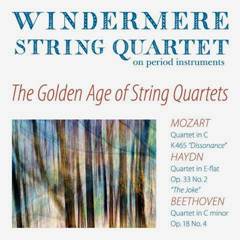
Given what I’ve said in previous reviews concerning historically informed performance (HIP), you won’t be surprised to find me eagerly eating up a recent release from Windermere String Quartet (Laura Jones -cello, who was so prominent recently in Essential Opera’s Alcina, Anthony Rapoport –viola, Rona Goldensher-violin and Elizabeth Loewen Andrews-violin). I find myself pondering the title “The Golden Age of the String Quartet”, a CD including Mozart’s K465, Haydn’s op 33 #2, and Beethoven’s op 18 #4.
I was never particularly blown away by these pieces when played with modern instruments. I didn’t actively dislike them, but I came to the “golden age” of string quartet with modest expectations.
But these pieces are completely different when played by modern instruments: with the edge smoothed out. A HIP approach to these quartets makes so much more sense.
If we’ve been listening to quartets on modern instruments, chances are the more recent works will sound better on the modern instruments, while the older pieces sound somewhat bare, missing some essential drama. I swear, long before I ever heard a HIP performance, I was already wondering about Beethoven’s early string quartets Op 18. I had the Amadeus quartets set on DG, a nice enough set of recordings, except that the way they played those quartets made them seem like immature Beethoven. After what people like Bruno Weil & Stewart Goodyear have shown me recently, that simply won’t do. One must read all compositions with integrity and never with condescension.
The Windermere recordings? From the first track (the Mozart K465 quartet), something is definitely different. There’s more mystery in the quiet introduction, due to the personality of each player. There’s more drama in the Allegro, a plaintive and pliant theme that pulls obstreperously at your heart strings like a very strong child. In this kind of performance the “child” is still innocent, but Windermere don’t infantilize, nor do they subdue the wildness of this child. There’s no calculated appeal to your heart. It’s a natural beauty that is at times counter-intuitive, precisely because we’ve had a particular notion of classical music rammed down our throats for much of the 20th century, that Mozart of Haydn should be safe and understated. Rejecting such assumptions isn’t anything new –given that it’s entirely consistent with other HIP recordings going back 30 years or more—but even so I find myself re-thinking what I thought I knew about chamber music.
The proportions are fundamentally altered, not because the instruments are so different so much as due to an entirely different aural shape. I am perplexed because in spite of myself, I did not expect this. For example when I hear Tafelmusik accompanying singers the orchestra tends to be gentler, less likely to drown out a singing voice.
But individually? These instruments are quirky, sometimes unruly sounding. Indeed, the reason modern instruments have been the dominant choice is because they’re so reliable. In these delicate pieces I am suddenly seeing these composers in an entirely different way. While the melodies unfold in directions that I used to think of as predictable and tranquil, they acquire an additional performative dimension. Each instrument, each player has the eccentricity of an opera singer. Part of this comes from their entirely normal practice of avoiding vibrato. In a small group this overturns the usual expectation, making these pieces sound not just brand new to my ear, but much deeper than I ever understood.
There’s a bounce to the Mozart Menuetto that doesn’t just suggest dance, but actual conflict. There are so many sounds available –some smooth, some more jagged, some singing, some quietly plaintive—that even a simple tune such as this acquires new depths.
The highlight of the recording for me is the brief scherzo in the Haydn quartet. Subtitled “The Joke” we’re presented with a bouncy section in triple time resembling belly laughs, contrasted by a trio of glissandi phrases as silly as a feline serenade. But then again I may have an over-active imagination.
As I said earlier, I am considering a second meaning to the CD’s title “The Golden Age of the String Quartet”. If these pieces –rather than later works such as Beethoven’s mature quartets, let alone those by later composers—are not just a warm fuzzy memory but actually the pinnacle for the string quartet (that is, the time when composers brought the medium to its peak), one needs to reflect on how they sound on modern instruments. For me, modern instruments –whose agility and tuning may be superior, and whose tone tends to be subtler—are well chosen for late-romantic compositions such as Brahms’ wonderful violin sonatas, or Debussy’s Quartet. But in this period that Windermere identify as the “golden age” perhaps they make a case for being the genuine champions of these compositions, and re-orienting our notion of what constitutes the ideal for a quartet.
I’ll be watching to see where they perform, hoping to find out what additional benefit one gets from hearing them live and in person.
Einstein on the Beach has finally come to Toronto, an opera whose importance and influence is out of all proportion to the actual number who saw it. Einstein’s a perfect example of that crazy 20th century phenomenon, where the idea of the thing is more important than the thing itself. There have been many books & articles, lectures, and even films about the work.
And now I have finally seen it tonight in a production authorized by Robert Wilson & Philip Glass, conducted by Michael Riesman with choreography by Lucinda Childs, at the Sony Centre in Toronto.
While in some respects it’s very much of its time (full of 1970s references such as “David Cassidy”, “I feel the Earth move”, and “male chauvinist pig”) its themes transcend its era. Glass reinvented himself after Einstein, writing the other two “portrait” operas (Satyagraha and Akhnaten) in an accessible style that has made Glass relatively mainstream, whereas Einstein on the Beach is unknown but for the audio recordings that created a cult following for this opera. Listening to the work tonight I remembered the old avant garde Glass.
Wilson echoes Lang. Photo: Charles Erickson 1992
Robert Wilson too has become relatively mainstream in the opera world as a director. I can’t help noticing an echo of Wilson in Robert Lepage’s designs (the compartments of the space-ship scene replicated in Lepage‘s Damnation de Faust, even as Wilson himself paid homage in that scene to Lang’s Metropolis). It’s curious that bodies and parts of the set shift in slow-motion several times during Einstein, considering that I encountered a similar slow motion movement vocabulary from Melati Suryodarmo this afternoon at Stewart Goodyear’s Beethoven marathon.
Einstein is the ultimate open work, daring us to make the meaning. For much of the work, the text is functional without any discursive meaning; we get choruses singing syllables of sol-fa (such as doh-re-mi), or sequences of numbers. At other times the text is a banal conversational chatter, repeated over and over; the obsessive repetition argues for the importance of the words even as the discursive content teases us with passages full of banality.
While superficially it’s an opera that is very elusive in meaning, it employs several recognizable conventions from opera.
Dance functions as a kind of diversion –in the old sense of “divertissement”—to rescue the audience, who are taxed by a work exceeding four hours in length, and often challenging our ability to decode
Instrumental music serves a function we’ve seen before in the orchestral interludes of music drama, taking us into the realm of the unconscious or the inarticulate. And although much of the music is in those patterns of repeated notes that tend to induce a meditative state and imply stasis, at least one –the spaceship—seems to suggest an almost Wagnerian build-up to a climax.
The non-verbal figure of Einstein playing the violin seems to use music to escape the horrors of life
I can’t help noticing –listening to the television in the background as i write this—that Einstein is roughly the same age as Saturday Night Live. But where one has been an open book and part of the mainstream, the other remains mostly a mystery, only known through theatre history books, and now this production that’s traveling around North America. I hope that Glass & Wilson will authorize a DVD of this production so that the work can be better known.
I attended the first section of Stewart Goodyear’s “Beethoven Marathon” today at Koerner Hall. I am still trying to wrap my head around this experience, which was in some respects more of a happening than a concert. We were given a big TV screen displaying an enlarged view of the keys from overhead; I was reminded a bit of the Jumbotron at a sporting event, only this time we were watching pianism, not pitching.
Movement artist Melati Suryodarmo: (shown in a very different sort of movement piece than this one)
The concert also featured a performance from Melati Suryodarmo, commissioned for the occasion to create a complementary composition of subtle movement. I don’t claim to understand the idiom, and admit that I was sceptical at first (wondering if this was an indication that someone didn’t believe Goodyear’s performance was sufficient on its own). The movement was very subtle, reminding me a little of the glacially subtle vocabulary of butoh, a wonderful meditation rather than a distraction. The longer Goodyear played, the more I was hypnotized by these gradual movements. It was as if the broad concert hall/theatre imagery –of pianist and audience, active and passive—were represented on the stage, Suryodarmo’s expressions and movements signifying a kind of concentrated version of our responses. I wonder if I will ever see anything like this again: which I found completely beautiful & lovely to experience.
When the doors opened I was the first one admitted to the downstairs level. As I walked into the empty hall, I stared at the gleaming Steinway on the bare stage, feeling an irrational desire to go up there and play it. But no, the irrational impulse is actually the one that’s been drilled into me and the rest of the us western concert-goers, the one that says “keep silent”, “do not touch” and more fundamentally “repress your joyful impulse to cheer and dance”. And so we (me and others who likely feel the same way) all resist the pull of that sleek animal seductively inviting one to stroke or strike. That only one person gets that privilege-yes privilege-is part of the magic, as if they were the chosen champion of our race, fighting on our behalf.
“Fly me to the moon…”
I am reminded of the early morning photos (and HELLO it’s 9:40 am: not the usual time for a concert) of the Saturn V rocket gleaming on its launchpad, awaiting the lonely voyagers’ arrival, when they will honour us with their risky undertaking. I could understand it as a coming-out party, as Goodyear laid his claim as one of the great Beethoven interpreters on the planet. Yet as of 2 pm when we’d completed the first four hours and thirteen sonatas (#1 through #11, plus #19 & 20), with more than half of the music and arguably the hardest sonatas ahead, I wondered if this was simply a four hour warm-up. Unfortunately I could only attend this part, having too many commitments this weekend.
Speaking of the Saturn V, I wonder if it’s also a launch party, considering that a new recording was available in the lobby: Goodyear’s complete cycle of all 32 Beethoven Piano Sonatas. I might add that the one sour note for me was that the friendly chap was selling them for a very reasonable price but couldn’t give me a receipt. Am I supposed to buy a set of CDs without a paper receipt in case one is defective? And so I somehow resisted the impulse to make the purchase (sigh).
I am reminded of something I heard recently from Bruno Weil, also concerning Beethoven: “One should approach the “Eroica” pretending you do not know the Fourth through Ninth Symphonies yet.” In other words one should come to each sonata or symphony without the benefit of hindsight nor making any judgment upon the composition. Neither Goodyear nor his audience showed any signs of treating even a single movement as anything but canonical composition. From the opening pair of easy sonatas, namely 19 & 20, that afforded Goodyear a chance to ease into the larger performance, every note was played with respect, often faster than I’ve ever heard it, and achingly expressive. There were some highlights, likely a reflection of Goodyear’s preferences, whereby he brought a higher level of intensity to his playing.
Sonata #3 in C Major was for me an early highlight. I remember this one from a Peanuts cartoon where Schroeder somehow plays it (or at least some excerpts) on his toy piano (NOT a Steinway)
I think Charles Schultz helped me discover this sonata, although I have no idea what motivated Goodyear, whose reading of this sonata was for me the highlight of this concert. All four movements were in some respect extraordinary. The first was rock steady in its meter, precise, and always incisive in its attacks. The second? Goodyear seemed to channel Leonard Bernstein in his romantic approach to tempi & expressive phrasing. Where some pianists who bring fiery readings don’t have a passionate answer in the slow movements that can properly balance that fire, Goodyear comes across as a very mature artist, one who lives his Beethoven from the inside out (a feeling supported by the eloquent program notes Goodyear himself has written). Often in slow movements such as this one, Goodyear’s head drifted back, his eyes on something other than the instrument, as if he were becoming Ray Charles, because he didn’t need to look at the keys. The scherzo sounded like vaudeville complete with its own laugh track: the quick descending octaves sounding like an audience laughing it up. I’ve never noticed this about the piece before, possibly because I’ve never heard anyone play it this quickly. Even at that astonishing speed Goodyear was crisp and clean throughout.
The final rondo of Op 2 #3 was again, faster than I’ve yet heard it, mostly played with gossamer softness, except for the big climaxes. On the screen my mind boggled watching the smooth movement of the right hand floating up and down the keyboard.
So…. Let’s say that they were all pretty amazing, some more amazing than others. I believe the difference is likely an indication of Goodyear’s energy levels, not his abilities, given that he was marshaling his bodily energy for this 32 sonata ordeal. The metaphor they gave us in the programming –“marathon”—makes the physical side of the challenge clear. There’s also a mental side. Consider that for example, an actor who is onstage for an entire 3 hour play must learn all those words & movements. Each sonata movement is like its own self-contained drama, some bigger, some smaller. Goodyear had the entire performance in his head, without a score or a prompter. It’s a physical and mental ordeal unlike any I have seen.
And considering that I only saw one part of it, I still haven’t seen it… I wish I had.

 Driving through the modern countryside seems the perfect counterpart to listening to Vivaldi’s The Four Seasons on the car’s sound system.