Salome: from Matthew and Mark, through Oscar, Richard and Atom

It can be enjoyable to trace the changes in the way a story is adapted and/or interpreted.

Salome begins in the Gospels of Matthew and Mark.

Matthew 14:1-11 (NIV)
1 At that time Herod the tetrarch heard the reports about Jesus, 2 and he said to his attendants, “This is John the Baptist; he has risen from the dead! That is why miraculous powers are at work in him.”
3 Now Herod had arrested John and bound him and put him in prison because of Herodias, his brother Philip’s wife, 4for John had been saying to him: “It is not lawful for you to have her.” 5 Herod wanted to kill John, but he was afraid of the people, because they considered John a prophet.
6 On Herod’s birthday the daughter of Herodias danced for the guests and pleased Herod so much 7that he promised with an oath to give her whatever she asked. 8 Prompted by her mother, she said, “Give me here on a platter the head of John the Baptist.” 9 The king was distressed, but because of his oaths and his dinner guests, he ordered that her request be granted 10and had John beheaded in the prison. 11His head was brought in on a platter and given to the girl, who carried it to her mother. 12John’s disciples came and took his body and buried it. Then they went and told Jesus.

Mark 6: 13-29
13 They drove out many demons and anointed many sick people with oil and healed them.
John the Baptist Beheaded
14 King Herod heard about this, for Jesus’ name had become well known. Some were saying, “John the Baptist has been raised from the dead, and that is why miraculous powers are at work in him.”
15 Others said, “He is Elijah.”
And still others claimed, “He is a prophet, like one of the prophets of long ago.”
16 But when Herod heard this, he said, “John, whom I beheaded, has been raised from the dead!”
17 For Herod himself had given orders to have John arrested, and he had him bound and put in prison. He did this because of Herodias, his brother Philip’s wife, whom he had married. 18 For John had been saying to Herod, “It is not lawful for you to have your brother’s wife.” 19 So Herodias nursed a grudge against John and wanted to kill him. But she was not able to, 20 because Herod feared John and protected him, knowing him to be a righteous and holy man. When Herod heard John, he was greatly puzzled; yet he liked to listen to him.
21 Finally the opportune time came. On his birthday Herod gave a banquet for his high officials and military commanders and the leading men of Galilee. 22 When the daughter of Herodias came in and danced, she pleased Herod and his dinner guests.
The king said to the girl, “Ask me for anything you want, and I’ll give it to you.” 23 And he promised her with an oath, “Whatever you ask I will give you, up to half my kingdom.”
24 She went out and said to her mother, “What shall I ask for?”
“The head of John the Baptist,” she answered.
25 At once the girl hurried in to the king with the request: “I want you to give me right now the head of John the Baptist on a platter.”
26 The king was greatly distressed, but because of his oaths and his dinner guests, he did not want to refuse her. 27 So he immediately sent an executioner with orders to bring John’s head. The man went, beheaded John in the prison, 28 and brought back his head on a platter. He presented it to the girl, and she gave it to her mother. 29 On hearing of this, John’s disciples came and took his body and laid it in a tomb.

In each of these accounts what’s consistent is Herod’s fear of John, his promise to Salome, and the motivation for the murder, namely Herodias’s request of her daughter.

Oscar Wilde (1854-1900) wrote the play Salome (1891) in French, but banned in England until long after Wilde’s death. He never saw it produced in his lifetime, as it was given a single performance in Paris in 1896 during the time of Wilde’s imprisonment.

Wilde originated the “”Dance of the Seven Veils” and changed Salome’s motivation. Where the Biblical accounts have Herodias’s request as the reason for the dance and the demand for Jokanaan’s head, in Wilde it becomes an expression of Salome’s own desires. Salome kisses the mouth of Jokanaan. Wilde also adds the conclusion, where Herod in disgust orders Salome killed.

Richard Strauss’s opera Salome (1905) using a libretto taken from Wilde’s play also met with resistance in some cities, although it has become a standard work in opera houses all over the world.

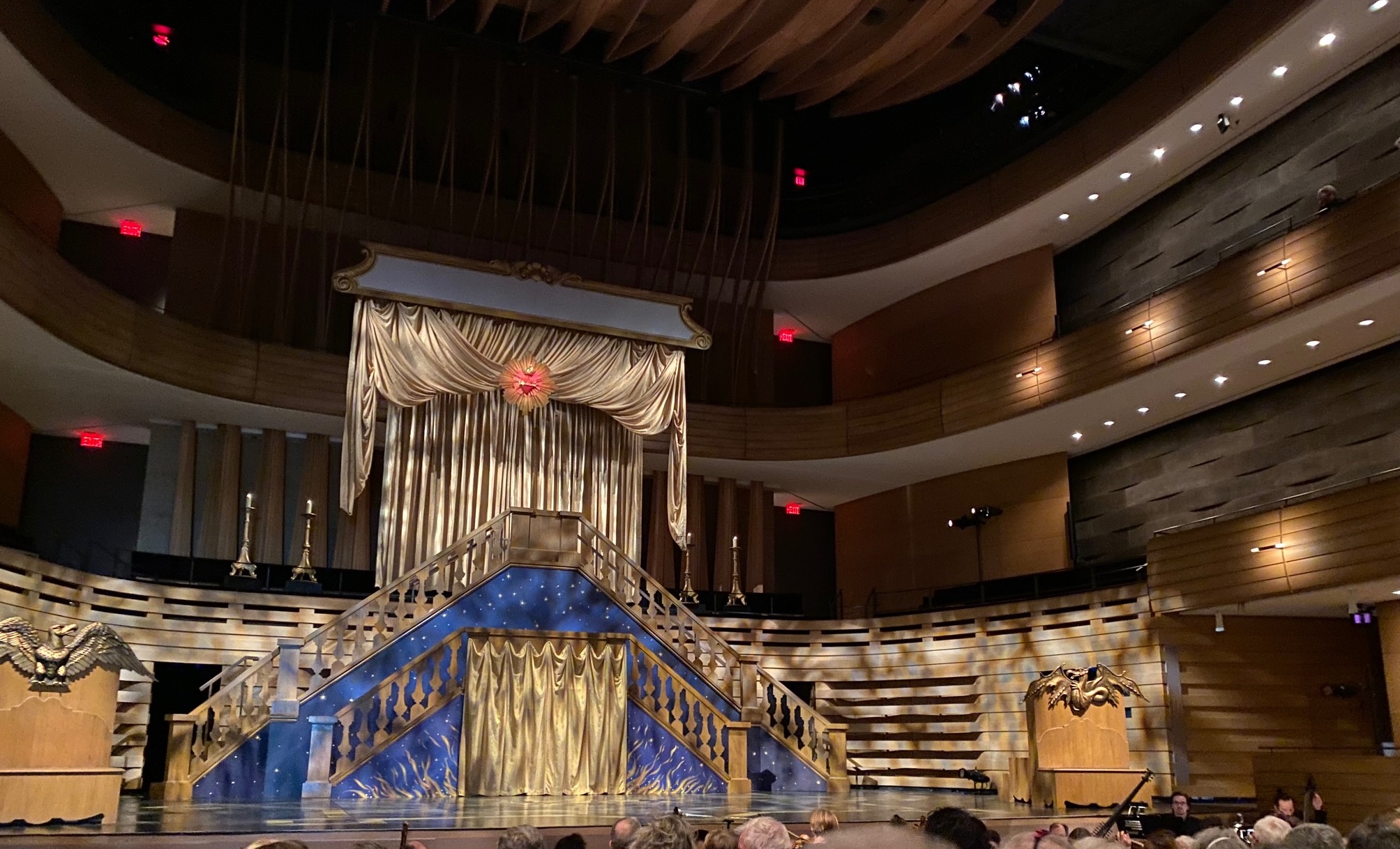
Directors theatre or Regietheater is sometimes understood as a conversation between existing works and the performance text, an opportunity to revisit works that have been produced so often as to have become kitsch, images and sensations that deserve to be interrogated. The orchestral style of Richard Strauss and composers of his generation that was adopted in Hollywood became a kind of cliché. There is an overlap between the aesthetic we see in conservative productions of Salome that rigorously follow the instructions in the score, and Biblical epics on film such The Ten Commandments (shown here).


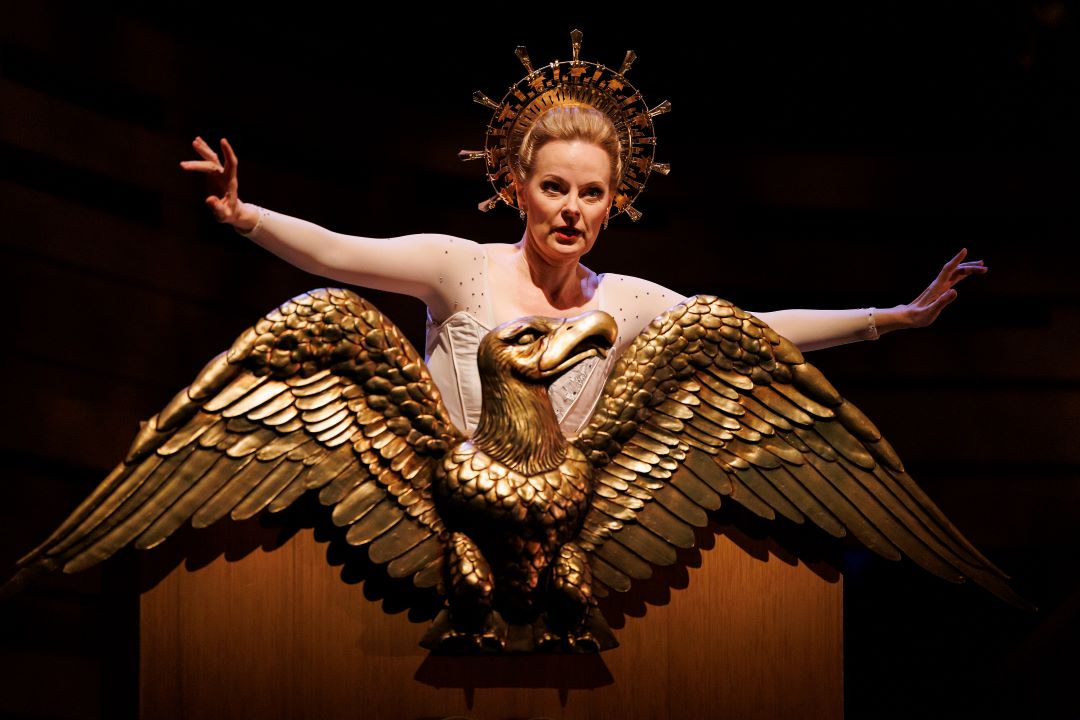
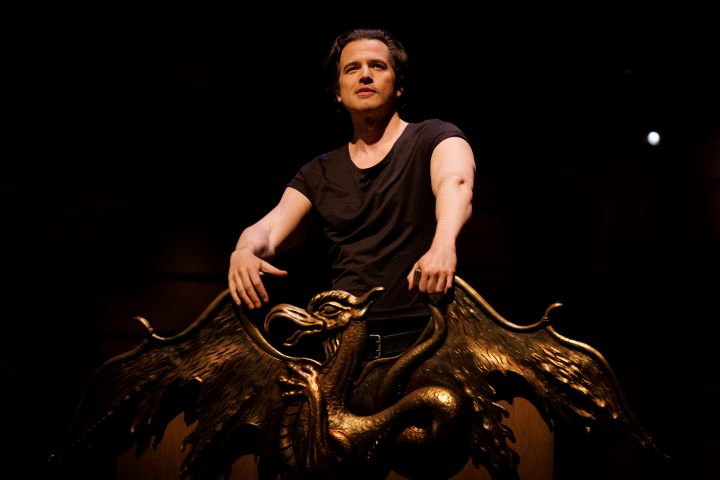
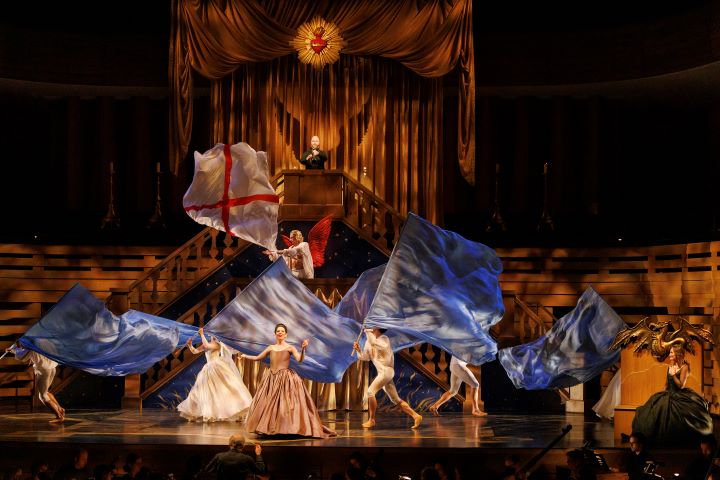
A production such as the Atom Egoyan Salome, previously seen in Toronto with the Canadian Opera Company and being revived this month, might avoid some of the baggage of the past. Salome opens Friday February 3 at the Four Seasons Centre.

Salome’s Dance from the 2013 COC production directed by Atom Egoyan (photo: Michael Cooper)
Posted in Art, Architecture & Design, Books & Literature, Cinema, video & DVDs, Dance, theatre & musicals, Opera, Spirituality & Religion | Tagged , , , , , , | Leave a comment

Guth Ideas to save Figaro

The Canadian Opera Company have revived Claus Guth‘s production of Mozart’s The Marriage of Figaro that they presented to us in 2016, this time with a slightly different cast and conductor.

The three and a half hours fly by on the wings of birds, cherubs and assorted eye candy, quirky moments in the production to keep you amused and wide awake. Full disclosure. Much as I love the music in the last act I’m yawning & may desperately want it to be over.

Not this time. The headline may offend those who think of the opera as flawless, but it’s also very long. Guth’s combination of sex, violence and beautiful images kept me alert. And the audience ate it up, giving the production a huge ovation at the end.

As expected Conductor Harry Bicket is a key contributor, leading the orchestra in a wonderful authentic reading at a terrific pace and very tight with the singers throughout. While Mozart is well-served, the music is always at the service of the comedy.

Whether it’s me or the production that feels different this time, I love it. Last time the small parts stole the show while the leads were adequate but a tad too serious rather than spectacular. This time the leads are especially good, taking us back to the realm of genuine comedy. And thank God for that.

Last time I remarked on Emily Fons (Cherubino), Robert Pomakov (Dr Bartolo) Doug MacNaughton (Antonio) and Sasha Djihanian (Barbarina). Except for the Barbarina (now brilliantly played by Mireille Asselin) they’re all back and as excellent as before.

What’s new is the star-power of the leads, both vocally but especially dramatically. Gordon Bintner brings that remarkable voice of his –lovely tone and precise intonation—and matches it with a stage persona to contrast his last appearance. Where he was a sweetly lovable & vulnerable Papageno, his Count is scary in the amount of violence he channels, a terrific bullying presence that amplifies everything implicit in the text, never holding anything back. Usually when the Count asks to be forgiven at the end it’s a touching moment, not an instant of laughter from an audience who don’t believe he can be trusted. Is that a symptom of modern audiences who no longer want or believe in the happy ending? I’m looking forward to seeing what Bintner sings next, a star in the making.

(l-r) Uli Kirsch as Cherubim (sic) and Luca Pisaroni as Figaro (photo: Michael Cooper)

The other big upgrade was with Luca Pisaroni’s Figaro and especially Andrea Carroll’s Susanna. The chemistry between these two, particularly in the last act, is a highlight of the show. Carroll is another note-perfect singer like Bintner, her “Deh vieni non tardar” a heart-breakingly beautiful moment in the last act, a stunning answer to Pisaroni’s “Aprite un po’ quegli occhi,” when he tells us (the men in the audience) not to trust women, and don’t discuss the rest (complete with horn-calls for the cuckold). What a joy that two of my favorite pieces were done so perfectly, and vividly dramatized.

They sing it well, but they especially connect to one another. Last time I feel that the Figaro (Josef Wagner) and Susanna (Jane Archibald) were obedient to the darkest colours of the director’s vision, taking us away from anything really comic. This time that underlying and undeniable romance is back. I find that whenever we have a Director’s Theatre production, its original stridency fades under the mitigating influence of a revival director (Marcelo Buscaino this time) or simply the natural inertia from centuries of doing the text as written. But I’m not complaining. I like seeing a Figaro and a Susanna who seem to really love one another. There’s a mischief to their chemistry.

Lauren Fagan is a good Countess, although last time we had Erin Wall who was wonderful as well. But the chemistry between Fagan and Bintner is riveting, extraordinary.

(l-r) Countess (Lauren Fagan), Cherubino (Emily Fons) and Susanna (Andrea Carroll) photo: Michael Cooper

And the scene between Fagan and Caroll in the second act with Fons is enormously fun, turned on its head when Bintner comes storming back and terrifies everyone.

Countess (Lauren Fagan) and Count (Gordon Bintner) photo: Michael Cooper

While I think this was all there in the production last time, it never quite gelled as well as what we saw this time.

Reconciliation between Count (Gordon Bintner) and Countess (Lauren Fagan) Photo: Michael Cooper

I suppose I should mention Uli Kirsch in the silent role listed in the program as “cherubim”, which is problematic when we remember that this is the plural of the word “cherub”. But I recall that when I’m a stickler I lose my sense of humour, so I’ll ignore this in the spirit of the show. He’s well-liked by the audience regardless of his name, indeed much more so than last time. I think it’s the best indicator that the production is working, that he now feels like an organic part of the show, a bit of eye-candy, helping to keep us alert & awake. Or is it simply that I’ve lightened up? Either way, it’s a good show.

I’m looking forward to seeing and hearing it again. You should too.

Posted in Opera, Reviews | Tagged , , , , , , , , , , , , , , , | Leave a comment

Fifteen Dogs at Crow’s Theatre

I loved the book (André Alexis’s 2015 novel Fifteen Dogs).

I love the play (adapted for the stage and directed by Marie Farsi at Crow’s Theatre).

The book hit me in totally different places than the play. When you read something to yourself it may not evoke laughter the way watching a human actor portray a dog will do. In Guloien Theatre today I was fascinated by the many times people giggled and laughed at things that I saw in more ambivalent terms.

When Benjy the beagle tells Majnoun about his ability to get a response from people by rolling over in the book, it’s a dark admission, that the dog can manipulate a human. But when Benjy (played by Peter Fernandes) demonstrates this to Majnoun (played by Tom Rooney) and all of us in the theatre, it’s hysterically funny. There’s a tonal shift as the prevailing tone of the show is lightened by the enormous amount of laughter. When you’re watching people impersonate dogs the laughs are guaranteed, and perhaps the first casualty is some of the seriousness that I might have craved.

It’s not that Farsi has done anything wrong, so much as the misanthropic sensation I have about my fellow humans, who seem to laugh at things that aren’t funny, that are profound or disturbing. I like to think I’m an extrovert but a moment like this makes me wonder, do I really prefer books to plays? Even though Rooney, Fernandes et al play with a resolute deadpan refusal to tip off any gags, the audience howls with laughter throughout. Even at moments that are dark & troubling there are laughs, although maybe some of those are of the nervous variety.

Let me repeat, I love this adaptation, amazed that the whole story seems to be there without omissions, that the subtleties are captured.

Apollo (Tyrone Savage) faces off against Hermes (Mirabella Sundar Singh), while the other four cast members are also visible (photo: Dahlia Katz)

I can’t recall the last time I saw a show where every single player seemed essential, an indispensable part of the whole but that’s what Farsi and her team have created. I’d go so far as to suggest that the book and/or the play is a bit like a Rorschach inkblot test, where your favorite character or your favorite story-line might be a reflection of your issues. So in other words, the players I emphasize likely reflect my own sensibility.

My favorite parts of the show were the poems from Prince, the dog whose poetic gift earns him exile from the pack. While I found these fascinating to read in the book, they take over the play in the most eloquent creations from the team of actor Stephen Jackman-Turkoff (portraying Prince) and the music and sound design from David Mesiha. When I read the book I wondered if music might come into play for these moments and was thrilled with the flamboyant result. Jackman-Turkoff is sometimes giving us something resembling rap, sometimes dancing and never dull. We see a totally different approach when he’s playing Zeus or Miguel.

I found it hard to take my eyes off Fernandes in his various roles. While I was a bit uncomfortable with the book-version of Benjy, the one whose cleverness leads several dogs to their deaths and whose cynical canine dramatics I mentioned above. Is my own beagle also faking me out, I wonder? Say it isn’t so. But there I was laughing at Fernandes showing up the gullability of humanity, and impossible to ignore in every one of his canine creations.

Rooney’s Majnoun represents one of the most important dogs in the story, the character with whom I identified for most of the book when I read it. I found Rooney’s underplaying set up some of the best laughs, as when he goes to join Nira on the couch and promptly walks in circles on the couch precisely the way a dog would. Yet he’s always dignified, straight-forward and compelling precisely because he seems so human: as a dog.

Nira is one of several characters from Laura Condlln, who showed a great range in playing eight different parts, human, canine & immortal. By turns cute, scary, seductive, or lovable, she is one of the anchors of the production.

Tyrone Savage is a more likeable Atticus than I would have expected from the book, injecting a kind of sympathetic charisma into his portrayal of one of the scariest dogs in the story. And he’s a funny Apollo.

Mirabella Sundar Singh did as much heavy lifting as Condlln in seven diverse roles including an irresistibly mischievous Hermes, who also takes on additional canine incarnations in dreams.

Farsi’s adaptation seems to have it both ways. On the one hand, yes this is a popular subject. Yet there are classical overtones what with the appearance of gods we might see in classical tragedy (even if Apollo and Hermes are not consuming ambrosia but simply having a beer at the Wheat Sheaf Tavern in Toronto). So it felt perfectly natural today at Crow’s Theatre when Marie Farsi began her adaptation for the stage with a kind of choral prologue for all six of the players that wouldn’t be out of place in Sophocles or Aeschylus.

From there it’s not a huge leap to watch the fifteen dogs in a west-end veterinary clinic having their lives altered by divine intervention, portrayed by those same actors. Pet owners regularly wonder what their pets are thinking, whether they’re happy, and voila, the story where the gods grant 15 dogs human consciousness as an experiment in happiness.

I did a double take when I noticed the book is from 2015, when it seems to anticipate MAGA and the political developments in the USA.

Fifteen Dogs has been held over at Crow’s Theatre due to popular demand. I can’t recommend it highly enough, but hurry. The tickets will soon be gone.

Posted in Animals, domestic & wild, Books & Literature, Dance, theatre & musicals | Tagged , , , , , , , , , , | 1 Comment

Telling stories of dogs and gods

Anecdotes are one sort of story.

For example I heard that in 2020 COVID caused a surge in canine adoptions.

Later I heard there was a flood in reverse, dogs being given up when people changed their minds.

No I don’t know how true the anecdotes might be, only that Erika and I again have chosen to bring a rescue into our home. Sam was an older dog we welcomed back in 2019, who passed away back in April 2022.

If Sam seems a bit blurry it’s because she’s actually reflected in the surface of the piano.

Barkley is an eight month old beagle who has lived in at least four homes so far. Hopefully we’re his last.

Barkley: please note he already had the name Barkley before he became a Barcza

As I ease into the role of doggie daddy with Barkley I’m extra sensitive to current canine discourse in our society. In post-pandemic social media dogs and cats hold a special place, helping us cope with stress, bringing light into lives that otherwise would be darker.

By “canine discourse“ we would expect to mean humans conversing about dogs, rather than conversations of dogs talking to other dogs. But come to think of it, there is some of that. In a few days Erika and I look forward to seeing the Crow’s Theatre production of Fifteen Dogs, adapted by Marie Farsi, from André Alexis’s 2015 novel of the same name.

A play adaptation is another sort of story.

I decided to read the original, the Giller Prize winning novel, to sample the story from André Alexis in order to have some idea of the adaptation.

The Crow’s website summarizes / promotes the play with these words, that are apt for the novel as well.

Is it possible to die happy?
That is the question the gods Hermes and Apollo ponder over a beer at the Wheatsheaf Tavern in Toronto. They make a bet, grant 15 dogs human consciousness, and watch from above as the pups discover the poetry and the pitfalls of complex thought and emotion
.

If you’ve read the book you likely don’t need persuading. You surely like the book if you read it, but like me you may wonder: how can the novel be turned into a play?

As a fan of opera and film I find the process of taking something from one medium (like a play) and turning it into something for another (such as live theatre) endlessly fascinating. My mom and I have watched and discussed several different film or tv versions of Jane Austen novels. Some people –like my mom—prefer an approach that errs on the side of inclusivity, leaving out nothing. So of course my mom far prefers the 16 hour Pride and Prejudice that she watched via PBS’ Masterpiece Theatre to any of the 2 hour film versions.

Because I was reading online using the Toronto Public Library interface I was told that I read the novel in about seven hours (mostly yesterday and finishing today). Imagine if it took that long in the theatre(!). Even Die Meistersinger (Wagner’s longest) doesn’t take that long. I’m sure the Crow’s Theatre adaptation won’t approach that massive size.

But thinking about that, the process of going from one medium to another, you have to recognize that this always entails some sort of trade-off. If you include everything –as they did in that PBS experience—your audience has to sit through 16 hours of television. Sometimes that might seem like a good idea but in Hollywood they usually shorten the story down to something more commercially viable, for fear of scaring off the customers. Marie Farsi at Crow’s Theatre likely will make a similar sort of adjustment.

There are also trade-offs in the media themselves. In a book I can go back to re-read what I missed, especially in the first part where you’re still getting to know the names of the characters. In a theatre they don’t do that, although they may build in some repetition to help you.

In a book my imagination has freedom to run wild. Once you put the character in front of me that may limit what I can imagine. Chances are they know that and will approach the story with that in mind.

Music sometimes is helpful if there is something verging away from the real towards the symbolic, the unreal or the spiritual.

If I’m reading about dogs my mind may readily jump to the images in a way that I might resist in live theatre. I recall that when we saw the caged tiger near the beginning of the play Bengal Tiger, also at Crow’s Theatre, it was a female actor standing inside the cage. I’m guessing that the 15 dogs will in some sense be portrayed by humans, not dogs. There are many ways one can imagine doing this.

In the meantime I’m listening to Barkley, with the novel resonating in my head. I believe we are attracted to certain genres of storytelling because of how they fit into our lives. We watch romances while contemplating the meaning of love, and when we’re loving our dogs, a story like this one resonates.

As with George Orwell’s Animal Farm or Wes Anderson’s film Isle of Dogs, Alexis’s novel is an apologue, a kind of allegory that uses animals to illustrate a moral point for us. One of the things I love about this new book is its subtlety. I cried like a baby at the end, surprised by how strongly I was moved. In a work such as the Orwell or the Anderson, politics seems to be the author’s allegorical focus. For me Alexis is chasing something much subtler that I wouldn’t presume to summarize so glibly. Perhaps it’s the nature of art and happiness.

I’m hopeful that the play can capture some of the magic of a book that I enjoyed so much.

Posted in Animals, domestic & wild, Books & Literature, Cinema, video & DVDs, Dance, theatre & musicals, My mother | Tagged , , , , , , , , , , , , , | Leave a comment

TSO – TMC Mozart Requiem: Best Concert of the Year

The headline is only partly in jest. Yes it was the best concert so far in 2023, as of January 11th. Many are still saying “Happy New Year” and writing the wrong date on cheques (if they even write cheques anymore).

But it was truly brilliant.

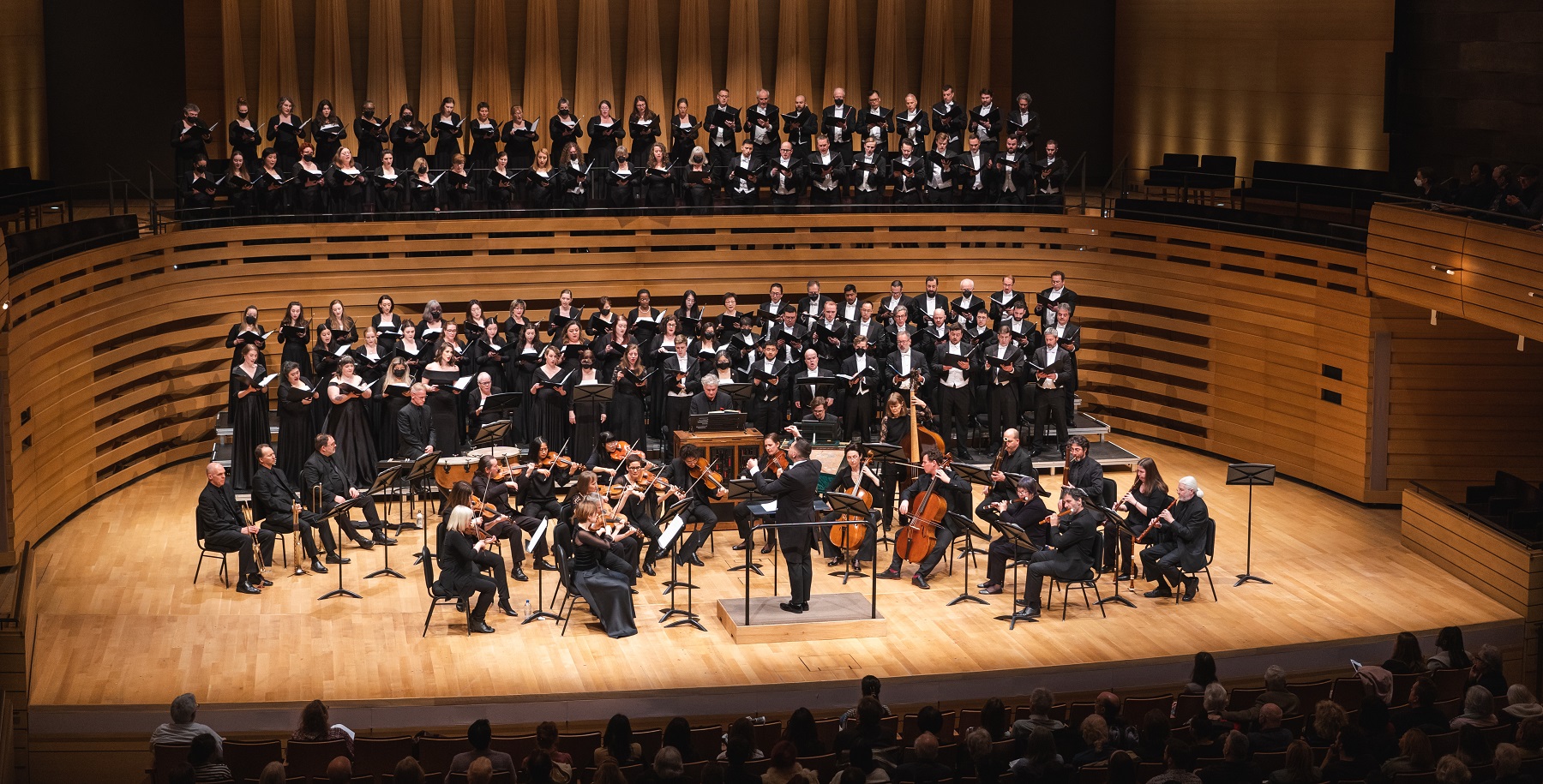
The Toronto Symphony and the Toronto Mendelssohn Choir were led tonight by Michael Francis in a program that left me speechless with wonder. The question of whether this marvel was curated by our own TSO wizards (who did such magic in October) or the visiting conductor was settled when I peeked at Francis’ 2023 schedule, which shows he will conduct the same program on July 2nd in Speyer, Germany (if you scroll down far enough). So clearly it’s Francis who deserves the praise.

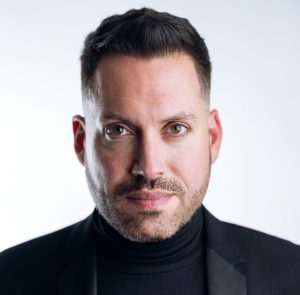
I should have known from his witty patter at the microphone. And of course that’s to be expected when he’s also Music Director of the Mainly Mozart Festival in California, The Florida Orchestra, and Deutsche Staatsphilharmonie Rheinland-Pfalz, all at the relatively youthful age of 47.

Michael Francis, image from the Mainly Mozart Festival website

Why am I so stunned?

Before intermission we heard:
-Von Bingen’s O virtus Sapientiae
-Mozart’s Masonic Funeral Music
-Beethoven’s Grosse Fuge
-Allegri’s Miserere

Full disclosure: for years I’ve been conflicted about Roy Thomson Hall, sometimes enjoying its sound, even as I join the gaggles of seniors struggling to get to the washrooms (myself included), not always able to reconcile the modern architecture and classical music.

Tonight it was as though someone (Francis? Or the ghosts of Mozart, Allegri, Beethoven & Van Bingen) sought to consecrate the hall, to bless this space. For the moment I’m in an altered state as I recall the experience, seeing and hearing it in a whole new way. The first half of the concert was like that, not just the music but also the way it was executed.

For the brief von Bingen opener, lights were dimmed. Ten female voices processed in one by one, carrying their music with only enough light for their upper body and their pages. The text is almost secular in its focus on wisdom.

The Masonic Funeral Music is something I have to revisit, trying to discern whether it usually sounds as macabre & morose, or if that was Francis’ doing in his interpretation, pushing the darkest colours. We’re listening to some remarkably dark orchestral timbres supplied by contrabassoon and some brass in this tiny majestic piece.

Then we were plunged into something different again, a modern-sounding reading of Beethoven’s Grosse Fuge in its free¬standing string version (as opposed to its place in the string quartet where it originated). Again I was particularly impressed by the low voices, this time work of the double basses with their edgy lines. Francis takes this piece without apology to the limit, meaning quickly and in the bolder passages without restraint. We experience big contrasts, but then again the program is all contrasts, every piece a change of pace.

And just when I thought I knew what to expect came what was for me the highlight of the evening. The presentation of the Allegri has me thinking of the modern hall in a new way. Nineteen singers were illuminated at the back of the stage in the choir loft, the first voices we heard. Tenor Isaiah Bell was the answering solo voice, coming to us from backstage. The third group, the high voices in the parts of this composition that everyone remembers best, were situated out among us in the audience (I couldn’t see where, but perhaps on the higher balcony). I see in the program (even if I couldn’t see them for myself) that this group consisted of Rebecca Genge, Rebecca Claborn, Simon Honeyman and Neil Aronoff. There we were in Roy Thomson Hall as though encountering proper antiphony, voices exchanged across the big space, but without the excessive reverb you might have in an old church. It was the best of both worlds truly.

If you can’t see this concert in Toronto (Thursday and Saturday at 8 pm) or North York (Sunday at 3 pm) go to Germany if you can (but then you won’t have the TSO, TMC or the soloists… and that’s a pricey option). It’s outrageously good.

That first part was a little over half an hour, to set up the presentation of Mozart’s Requiem after the intermission.

The version we heard is the Robert Levin edition from the 1990s. Again I’m not sure how much of this is really the edition and how much is Francis. The pace was often breath-taking, passages I’ve known previously as leisurely, suddenly taking on intensity I hadn’t expected. Soloists Jane Archibald (sorely missed around here of late), Isaiah again, mezzo-soprano Susan Platts and bass Kevin Deas were all stylish, in tune, and well-balanced against the forces of the TSO and the Toronto Mendelssohn Choir.

I don’t know what share of the excellence comes back to the input of the new Artistic Director of the TMC, Jean-Sébastien Vallée, but they’re sounding better than I’ve ever heard them. They’re precise and accurate, powerful when called upon by Francis, but delicate when necessary.

If your experience is anything like mine after that stunning opening, you’ll come to the Requiem ready to be moved, tenderized and vulnerable. Francis, the soloists, the choir and the orchestra will not disappoint you.

It’s a great start to 2023, that I suspect will be mentioned in my list of the “best of 2023”.

Posted in Art, Architecture & Design, Music and musicology, Reviews | Tagged , , , , , , , , , , , | Leave a comment

Best of 2022

I enjoy recalling the best moments of the past 12 months.

There’s a fork in the road, however. One pathway leads towards that which is truly “new”, while the other relies on what we’ve seen before. Need I mention, the unknown work lies on a risky path that is less likely to generate big box office returns, even if we’re not also reeling from the aftermath of a pandemic whose impact is still present in the bottom line for arts companies and especially their artists. If there were ever a year when one could justify “selling out” (whatever that means to you), it would be over the past two years, particularly since CERB ended. As someone who had a dayjob for decades, I’m the last person who would judge, but I must salute those who choose to believe in the appetite of the audiences for something fresh and daring, who have chosen the road less traveled. There are many good performances that I’m skipping over in this summary, as my focus is mostly on the decision-making of the folks in charge.

The company and artistic director responsible for the two boldest shows of the year: Tapestry Opera led by Michael Hidetoshi Mori.

Michael Hidetoshi Mori (photo: Dahlia Katz)

Their two big successes in 2022 strike me as the greatest achievements that this company has ever had. By what criteria? not money or box office, but rather the proper melding of text to music and spectacle, two daring examples of what opera can be at a time when many artists and companies were scurrying for cover. I’m speaking of RUR A Torrent of Light and Gould’s Wall, two pieces that had been in development for a long time. RUR, composed by Nicole Lizée, libretto by Nicholas Billon, was for me the most exciting new work, the best opera I’ve seen anywhere in a long time.

Krisztina Szabó in R.U.R. A Torrent of Light. (Photo: Elana Emer)

While RUR was more visually flamboyant in its creative choices (between its use of new technology to enhance the visual impact in the OCADU space and its remarkable physical movement vocabulary) than Gould’s Wall, the single most memorable thing about the latter is Lauren Pearl’s eye-catching aerial work: speaking of risk.

There were so many performers one could cite in either piece, but I’ll simply mention conductor Gregory Oh for RUR, somehow co-ordinating performers at two ends of the performance space.

If it were merely a question of how many new shows, my assessment above would be unfair, given that my favorite theatre programming in Toronto right now is found at Crow’s Theatre, and thank you Chris Abraham.

Crow’s Theatre Artistic Director Chris Abraham

Three of their 2022 shows would be in my top ten: if I had such a thing. Full disclosure, I don’t believe in competitions, finding awards very problematic, let alone top ten lists. That being said, I can’t deny that I was blown away by Uncle Vanya (in a new translation), Bengal Tiger, Red Velvet , and to continue the winning streak, Gay for Pay. Last year (the little bit of a year that we were vouchsafed in 2021) MixTape and Cliff Cardinal’s radical re-frame of As You Like It were two of my favorites. Obviously Mr. Abraham and the Crow’s team are doing something right. We had planned to go see his Cyrano in Niagara on the Lake (with tickets to the closing show) but COVID prevented us; thankfully Shaw were good enough to refund us the tickets. In the not too distant future Abraham will also be directing Much Ado about Nothing in Stratford.

The other favorite show I must mention is Talk is Free Theatre’s Sweeney Todd, brilliantly conceived in an unexpected space as a thrilling immersive experience. I keep an eye on what TIFT are producing (usually up in Barrie), a wonderful team led by their Producer and CEO Arkady Spivak, and Michael Torontow who is Artistic Director.

Arkady is the one on the right, in a pre-pandemic photo in Barrie.

Sometimes what’s new means it’s old but new to us. That’s the way ARC ensemble has been changing the musical landscape, with a series of recordings and performances from their “Music in Exile” series, curated by their artistic director Simon Wynberg. ARC Ensemble are Artists of The Royal Conservatory, their research activities enhancing their teaching & performing here in Toronto at the RCM, unearthing the music of composers we should have known about, but who have been buried or obscured by the political landscape of the 20th century. Every new discovery they share is like a new world opening up.

Similarly, we get a new angle on the old through the activities of Gustavo Gimeno, the Toronto Symphony’s conductor and Artistic Director. Yes he’s an exciting conductor as we’ve seen from his work with the TSO.

Gustavo Gimeno, Toronto Symphony’s conductor and Artistic Director

But the programming choices they’re making this season are also boldly original, as for instance in a concert we heard in October.

We heard several outstanding performances. My favorite was Yuja Wang playing Magnus Lindberg’s piano concerto #3, although Yuja would find a way to turn anything she plays into a virtuoso vehicle. When I recall the cancellation of her April 2020 TSO concert as one of the first big disappointments in the pandemic, her return is an omen of restoration.

Yuja Wang playing with the Toronto Symphony (photo: Gerard Richardson)

There was lots to enjoy during 2022. I’m a huge fan of Eric Woolfe whose deadpan style with magic and puppets alternates between terror and hilarity with Eldritch Theatre (both TWO WEIRD TALES in spring and Requiem for a Gumshoe in autumn). Gay for Pay was insanely funny but also a lesson about sexual & gender politics, following up on a year that included Sky Gilbert’s hair-raising Titus. And Tanya’s Secret, a queer-trans Onegin, has me reconsidering opera, as the ideal medium to explore the performative aspects of gender, sexuality, identity and life itself.

It might seem simplistic for me to speak of a changing of the guard, except there seems to be so much going on in cities other than Toronto. The pandemic underlined this, brutally winnowing the city of companies and artists, while discouraging attendance. Elisa Citterio is gone from Tafelmusik, and the creative life of Jeanne Lamon and her contribution was celebrated in a beautiful concert. Joel Ivany may still be with Against the Grain but he has apparently moved his life to Alberta where his life-partner and fellow AtG creative force Miriam Khalil is now teaching at a university. We were again offered Messiah/Complex online, and they’re bringing in a British co-pro of Bluebeard’s Castle in a new English translation, yet even so it still feels as though AtG are looking westwards. Messiah/Complex was one of the most truly Canadian projects ever made, embracing multiple languages, cultures, and yes, all parts of our country. It’s long overdue that our so-called national companies break out of Toronto and/or Montreal.

Kyle McDonald

But there are new artists and companies. The first that comes to mind is Kyle McDonald and Mightier Productions, a company that makes content, including opera and film.

McDonald sings, writes libretti, directs and above all, is the entrepreneurial energy promoting his various projects. This past year we saw two original works. First came The Lion Heart, a serious new rescue-opera with music from Corey Arnold, another over-achiever who also sang. Where Kyle is a bass (also busy in the voice-over field) Corey is a tenor. In May we saw Conan and the Stone of Kelior, a campy pasticcio opera that was unlike anything I’ve seen.

I’ll be watching to see what Kyle and Corey are up to in 2023 and beyond.

Toronto is an expensive place, increasingly gentrified, so we shouldn’t be surprised if theatre companies and theatre artists are forced to look elsewhere, unable to afford this place. It’s a funny time. Some people say the pandemic is over, and they look at me as though I’m crazy when I continue to wear a mask. I’m grateful for the companies such as Tarragon or Red Sandcastle theatre that insist on masks for everyone. Crow’s Theatre offers their performances Tuesday & Sunday to a mask-only audience: when I am happy to attend.

The Paris Opera (led by Alexander Neef) production of Enescu’s Oedipe (directed by Wajdi Mouawad) reminds me of the Canadian Opera Company’s recent production of Abduction from the Seraglio.

Playwright & director Wajdi Mouawad

Alexander Neef has now gone from the COC to be General Director of the Paris Opera, once again calling upon Wajdi Mouawad (who directed that COC production , now director of Théâtre national de la Colline since 2016) for Oedipe. If you want to see that Oedipe, you can find it here.

Meanwhile, in Toronto the Canadian Opera Company are still in business while taking the path of financial prudence, led by their new General Director Perryn Leech.

COC General Director Perryn Leech

Of the six operas this season, five are revivals, while the sixth is a new production of Verdi’s Macbeth. In the next few weeks we’ll be seeing revivals of Egoyan’s Salome and Guth’s Nozze di Figaro. It’s almost as though we’re paying off the expenses for those previous goodtime adventures, now that we have a new more sensible (rather than extravagant) general director, watching familiar productions that are like old pictures in our COC family album. It doesn’t seem fair to the one who inherits the job of cleaning up the previous guy’s debt, to right the ship. While this is not the daring bold path taken by Tapestry or Crow’s let alone the Paris Opera, in all fairness they are doing a good job keeping the COC afloat. The COC Orchestra and chorus continue to be the backbone of every show, holding things together. Soon we’ll hear the announcement of what they will do next season.

As you may already have noticed, I missed a lot of live performances, extra careful about infection as I continued to take meals to my mother 2-3 times per week. She’s still going strong at 101. While cataracts make it very hard for her to see, forcing her to write in block capitals using a sharpie, and while her hearing isn’t great either, she’s completely lucid. The following rhyme was written at around 2 am in December on a cold night.

She wrote :
THE BRANCHES AND THE WIND ARE FENCING
ICE AND SNOWFALL ARE ROMANCING
TWO COLDEST MONTHS ARE ADVANCING
FIGURE SKATERS KEEP ON DANCING
IT WILL DO NO HARM
IF YOU STAY INSIDE WARM

In the interest of staying safe, I’ve chosen venues carefully, and as a result spent much of the past year reading books or watching shows & films online.

And while Sam our old rescue passed away back in April, in January 2023 we welcome a new rescue into our lives, Barkley.

Barkley, a nine-month old rescue

Happy New Year..!

Posted in Cinema, video & DVDs, Dance, theatre & musicals, Music and musicology, Opera | Tagged , , , , , , , , , , , , , , , , , , , , , , , , , , , , , , , , , , , , | Leave a comment

There’s a place for us: in Scarborough

I’m thinking about two films I saw recently.

Last week I finally saw Spielberg’s West Side Story. One of the songs in that film is the lens through which I viewed today’s film: Scarborough.

In the 1961 film and the original musical from the 1950s, the young lovers Tony and Maria dream of a happy ending to the story in the song “Somewhere”. They say “there’s a place for us” even though it’s not clear that they will ever find such a place.

But that’s not how Spielberg gave it to us. In the 2021 version of the story, Rita Moreno plays Valentina, the proprietor of a drugstore where Tony lives. She of all people sings the song, a text that speaks to something more universal than anything else in the musical.

I wonder if they got the idea from a live concert performance she gave in 2019..?

That’s the lens through which I’m thinking about the new movie I saw today, Scarborough (2021), co-directed by Shasha Nakhai and Rich Williamson, written by Catherine Hernandez in her adaptation of her novel of the same name.

I’ll get to Scarborough, but I can’t avoid the way I see 2022 through the filter of the song we heard from Rita Moreno in Spielberg’s film. Having someone old sing it accomplishes a few things. It reminds us that the dream is universal. That someone who played in the original West Side Story when she was young and vital is now singing “Somewhere” makes it feel like a poignant link to the original film, as though her character has grown old and still dreams of peace and acceptance sixty-one years later. I was disoriented and can’t be the only one who experienced this. Of course the issues haven’t gone away. We know she was in that film in her youth. And now in 2022 people still face this challenge, wondering if there really is a place for us. When you see someone old and seemingly alone singing this, it hits you differently.

“Somewhere” seems to pose a question, the longing for what we don’t yet have, underlying everything right now. The news often tells us of refugees dying or arriving, of floods of immigrants at the southern border of the USA, of a war for turf in Ukraine, where the Jets aren’t a NY street-gang but actual fighter-planes, of the simmering hostility in Korea. In Ontario we hear that developers will be helped by the government in coping with an expected surge in our population, a highway is to be built through the greenbelt, that housing is unaffordable in our city, and not much better anywhere else.

When we hear “there’s a place for us” it could be the singers themselves wondering: where will their companies be housed? The Distillery District no longer houses Tapestry Opera or the other arts organizations and artists they used to welcome. The performers are squeezed by the lack of affordable housing.

Gentrification is driving people away from Toronto.

Sigh….

The film Scarborough makes a terrific chaser to West Side Story. Here’s the description from IMDB:
“Scarborough is the film adaptation of the award-winning novel by Catherine Hernandez. Over the course of a school year, 3 kids in a low-income neighbourhood find community and friendship at a drop-in reading program.”

Don’t let me scare you away from Scarborough. Yes there’s some darkness in this film, some abusive behaviour, some racism from one loudmouth parent, a brilliant creation from Conor Casey. While both films show us people in the midst of a wealthy society that offers them minimal assistance, this isn’t a world of choreographed dances or fights. We don’t get to escape from reality during a song, tempting as that might be. It’s as real as children in a playground playing, bullying and then rescuing each other.

Scarborough is full of excellent performances, especially the children. I’m a bit hesitant about names because I’m not sure who played whom. Everyone was very good. I mention Anna Claire Beitel as Laura because she does an amazing job with a very important character in the film, and in this instance I’m certain I’ve identified the right person.

Anna Claire Beitel as Laura

Co-director Rich Williamson shot and edited the film, giving it a truly beautiful look and feel. We’re often intimately close with the kids as they speak the astonishingly authentic dialogue. We may be seeing them in camera angles literally looking up at adults, the ones with all the power. Some of them are scary, some of them are actually nice, just like real life.

The musical score from Rob Teehan is sometimes moody to gently set the scene, sometimes more powerful to reflect the tensions of the characters. There is nothing I’d change, the film sounds and looks perfect.

After seeing Elvis a few days ago, I re-watched Baz Luhrmann’s Strictly Ballroom, his first big success. While Scarborough is much darker, more realistic in tone and in presentation than Strictly Ballroom, there is some of the same giddy joy to finish the story. In the end, if a story’s resolution doesn’t connect to the situation or the characters, or if it seems too unlikely then it’s going to be troubling rather than satisfying. They’ve made the last half hour gorgeous, and yet it has heart, emerging perfectly out of what has gone before.

I will watch it again and recommend it to anyone looking for a good movie. I’m doubly proud that this film bears the name of the place where I live, a wonderful example of Canadian cinema. I love it.

It’s currently available on Crave.

Posted in Books & Literature, Cinema, video & DVDs, Dance, theatre & musicals, Reviews | Tagged , , , , , , , , , , , , , , | Leave a comment

TOT: Revenge of the Tenors

This afternoon the Toronto Operetta Theatre’s production of Johann Strauss’s Die Fledermaus (or The Bat) opened to a sold-out audience at the St Lawrence Centre.

It’s sometimes called “The revenge of the bat” although today I was inclined to think it’s more the revenge of the tenors, who seemed to take over the show in the second act.

I’m not complaining. Tenors are the butt of so many jokes—in this work and elsewhere—that one doesn’t always want to admit one’s vocal range for fear of being mocked. Anna Russell famously said that heldentenors have resonance where their brains ought to be. In the Strauss operetta it’s even worse than that.

Scott Rumble and Kirsten LeBlanc (photo: Gary Beechey)

We begin with Alfred (played by Scott Rumble) as a tenor whose romantic pursuit of Rosalinda (played by Kirsten LeBlanc) includes his habit of singing chunks of opera on the assumption that she and everyone else wants to hear him. No shrinking violet, he.

Rosalinda is married to Eisenstein (played by Keith Klassen) another tenor. She and her maid Adele (played by Andrea Núñez) both make plans to go to a party at the villa of Prince Orlofsky (played by Greg Finney) who is not a tenor.

Andrea Núñez and Greg Finney (photo: Gary Beechey)

Given that some productions take a walk on the wild-side at this point, it’s worth noting that TOT offer something relatively wholesome.

The production is especially strong on the musical side, Derek Bate conducting the tiny TOT orchestra and the chorus to great effect.

When Greg Finney appeared in the second act it was almost predictable what would happen: that the show would suddenly come to life, as it usually does when he shows up in a TOT show. His relaxed and natural demeanor makes everyone a bit better, a lot funnier, and more believable. This is especially true for the two women. While they sang tremendous performances – LeBlanc with her big powerful voice, Núñez offering brilliant coloratura—both shone brighter in the presence of Finney’s madcap portrayal of the Prince. He makes it look easy.

The other remarkable performance came from an unexpected source, namely Guillermo Silva-Marin, the Founder and General Director of TOT. Guillermo stepped into the role of Frosch, another tenor. We watched as he and Alfred took over the show in the last scene, singing lots of tenor music not by Strauss. I knew that Guillermo could sing –indeed he was once a tenor in NY with the Metropolitan Opera and the NY City opera—as well as the Canadian Opera Company. I saw him sing in the COC’s excellent 1988 Ariadne auf Naxos.

Left to right: Guillermo Silva-Marin, Theodore Baerg, Tracy Dahl, Christopher Cameron & Dennis Giesbrecht in the Canadian Opera Company’s 1988 Ariadne auf Naxos (photo: Robert C Ragsdale, FRPS)

He still has a voice. Who knew? Obviously Guillermo did, casting himself in this comic turn. I was going to say it’s a “small part” but you know what they say. There are no small parts.

Hearing Scott Rumble and Guillermo together was a huge thrill, as the tenors took over the show for awhile.

Guillermo Silva-Marin and Scott Rumble (photo: Gary Beechey)

Die Fledermaus, The Revenge of the tenors, sorry that should be, the Revenge of the Bat, continues with performances Friday December 30 and Saturday December 31 at the St Lawrence Centre.

Posted in Dance, theatre & musicals, Opera, Reviews | Tagged , , , , , , , , | Leave a comment

A Blue Christmas pointing me to Elvis’s redemption

The recent Saturday Night Live hosted by Austin Butler persuaded me to watch the recent biography of Elvis Presley, starring Butler.

As we watched, Erika pointed to the similarity between Butler and Elvis, two men who both lost their mother relatively early in life, suggesting that might help his portrayal. Watching Butler speak of his mother during the monologue was the first of three times that I cried (tears but no sobs) during this episode of SNL.

Butler himself teared up while he spoke. I suppose it’s contagious.

The second and third moments with teardrops were really about Cecily Strong, my favorite SNL cast member, whose departure from the show was announced with this episode. She came at it in her usual use of bizarre metaphors. In the Weekend Update segment she spoke in character of going to jail, as a metaphor for leaving SNL. More tears but no sobs.

Later, speaking of her plan to leave her job at Radio Shack (again, a metaphor for leaving SNL), host Austin Butler came out to sing “Blue Christmas”.

Seeing this we decided we would watch the Elvis film, speaking as someone who has done a few Elvis impersonations of my own during singing telegrams. No I’m not as good at this as Butler. In the film he looks and sounds like Elvis. Amazing.

When I speak of “Elvis’s redemption” I mean a new perspective on someone I used as a kind of cartoon character, someone I understood as a dinosaur, a relic of the 1950s mocked throughout popular culture.

For instance who can forget the “Song of The King” from Joseph & the Amazing Technicolor Dreamcoat?

That’s one of the more dignified versions of Elvis.

Elvis Presley turns up in Forrest Gump, getting ideas from watching Forrest walk with his leg-braces.

Elvis’s voice & clothing were easy to recognize and usually gave people a giggle when I mimicked him. I never challenged the assertions of his importance as one of the innovators in music history, a bridge between white and black culture: although I understood him more as a Pat Boone type, a white guy appropriating black music, rather than someone authentic in his own right. His eventual fate as a target for so many comic imitations suggested that he was also committing self-parody, which I realize is simply unfair. Of course now I’m coming at this after reading Gabor Maté, who links addictions to trauma and without blame.

I think we’re ready for a new take on Elvis.

Because it’s directed by Baz Luhrmann, a director known to be sometimes over the top, one must come at the film with some skepticism. As with the eccentric Ken Russell or the flamboyant Terry Gilliam, I embrace the poetic excess of Baz’s films whole-heartedly. I first encountered this sensibility in Strictly Ballroom (1992), loved the opportunities Moulin Rouge (2001) affords for examining music in film, and was totally won over by his approach to The Great Gatsby (2013), especially when compared to the pallor of the 1974 adaptation.

There were many places where I knew Baz was taking liberties with the truth. No the film has not fully erased my earlier impressions, nor will it really change our understanding of the cultural icon. But I come out of this thinking that Elvis has at times been misunderstood, as he’s more of a victim. In the 1960s and 70s our culture saw fatness as weakness, recalling John Belushi’s imitation of Liz Taylor for example. Drug addiction too was judged in moral terms.

Butler’s superb performance is the starting point, although in the latter part of the film we segue into films of the actual Elvis, as though to authorize what we’ve seen. Frankly I don’t think it matters. This is an enjoyable movie that makes me like Elvis more than I’ve ever liked him before. I’ll have to watch again. At the very least I found I liked Butler’s Elvis, Baz’s Elvis, if not the actual Elvis, whom I’ll never really know.

Tom Hanks is at the centre of this project in his portrayal of Colonel Tom Parker, the man who managed Elvis for most of his career. For the first part of the film we’re seeing the story through the lens of the Colonel. Hanks plays completely against type, in an Oscar-worthy performance although perhaps Butler will be one of his rivals for the statuette. While this is again a symptom of Baz the entertainer or Baz the poet, the facts underlining this are genuine. Elvis was ripped off by his manager, of this there is no doubt.

Baz’s divergence from reality in this aspect of the story is one that I quite like. I won’t spoil the film by telling you, except to say that it reminds me of the scene in Quentin Tarentino’s Inglourious Basterds (2009) when the Nazis are slaughtered, a scene I ascribe to poetic justice, the way we might wish the story had ended. If you apply similar justice to Elvis perhaps he would have avoided his eventual lonely fate, but at the very least Baz’s Elvis does acquire some lucidity and freedom, even some dignity. Alas the truth is even sadder.

It’s a fascinating film, wonderful looking and tremendous sounding, worth a look and a listen. I’ll see it again.

Austin Butler sings to Cecily Strong on SNL, the reason we watched the film.
Posted in Cinema, video & DVDs, Dance, theatre & musicals, Popular music & culture | Tagged , , , , , , , , , , , , , | 10 Comments

Gustavo Gimeno’s First TSO-TMC Messiah

The surest sign the city seems to be returning to something like normal, is Handel’s Messiah performed all over. I’m seeing many friends on Facebook either reporting that they’re singing it or feeling left out because so many others are doing it.

There’s Tafelmusik in their historically informed approach, Soundstreams / Crow’s Theatre offering their Electric Messiah, or even the award-winning Messiah / Complex you can now find online from Against the Grain Theatre. Yes it’s that time of year, and we could feel that eagerness in a packed Roy Thomson Hall.

You may recall that last year the Toronto Symphony offered an 85 minute version, which was the best option available at the time, given concerns over our hygiene.

Tonight I went to hear the first of five 135 minute Messiahs the TSO offer this year under the leadership of Gustavo Gimeno. I’m excited to hear a longer version but also delighted at the opportunity to see another side of GG, watching our new Music Director take on something a bit different from what we’ve heard from him so far in his brief tenure.

TSO Music Director Gustavo Gimeno

The stars of the evening were the Toronto Mendelssohn Choir, prepared by Jean-Sébastien Vallée, who, like Gimeno, is also new in his role as Artistic Director.

Toronto Mendelssohn Choir Artistic Director Jean-Sébastien Vallée

The choir were often very soft, particularly in the early portions of a piece such as the Hallelujah Chorus, building throughout. Their phrasing was impeccable, undaunted by the acoustical challenges of a bigger space such as Roy Thomson Hall. I loved the quick tempi they took in “All we like sheep” or “Lift up your heads”, each word distinct. It was a team effort, between Gimeno or Vallée shaping the phrases of the chorus with the orchestra building to spectacular climaxes again and again.

In the past I’ve noticed the TSO responding to Gimeno’s leadership, and tonight saw the TMC similarly inspired.

The four soloists (soprano Lauren Fagan, mezzo-soprano Stephanie Wake-Edwards, tenor Michael Colvin and baritone Elliot Madore) were superb. I was especially impressed by Colvin’s dramatic readings of the Part Two tenor solos, powerfully moving and very musical.

Tenor Michael Colvin (photo: Eloise Campbell)

The TSO – TMC Messiah continues with four more performances on consecutive days from Sunday Dec 18 (a matinee) to Wednesday Dec 21.

Posted in Dance, theatre & musicals, Music and musicology, Reviews | Tagged , , , , , , , , , , | Leave a comment