It can be a kind of March madness. With the arrival of St Patrick’s Day we celebrate a change of season through indulgence. It’s supposed to be fun.
I remember the St Patrick’s Day in my late teens when I went to the Brunswick House tavern before a piano lesson. While I did not consume enough green beer that I started to resemble the Hulk, it was still memorable. I remember the discussion with my piano teacher (who saw red rather than green), and who listened to me play even though I was obviously intoxicated. I played accurately because I had memorized the pieces. We were both surprised, actually… much better than I had any right to be considering what I had been doing. But it was a good exercise, confirming what Frank Zappa might tell you if he were still here: that whether you’re stoned or drunk in rehearsal, you must sober up when you perform.
This weekend I picked up from The Kingston Social, whose St Patrick’s Day menu extended until Saturday.
Sam greeted me at the door when I brought dinner home, obviously intrigued by what her nose was telling her. We’re still being careful what we feed her as she’s not fully recovered from her December illness, so we couldn’t give her any…
I had a Guinness braised lamb stew (diced lamb, turnips, carrots, new potato, shallots & even as Irish as the Guinness in the gravy) served with soda bread. Erika had the smoked blueberry back ribs dinner, and then she shared with one another.
We enjoyed the accompaniment of the Konzelmann Shiraz that I find so congenial to just about anything.
The portions were generous, perhaps in keeping with the spirit of over-indulgence that I associate with St Patrick’s Day. We were both so stuffed at this point that we had to adjourn for a bit,… I took the dog outside for a walk.
No I didn’t forget to feed the dog.
Before partaking of the dessert that we had from Kingston Social I made coffee. The cupcakes were also St Patrick’s- themed, a bit of an allegory of the treasures one might find at the end of the rainbow.
The moral of the “story”? Eat it!
Notice the gold on top of the chocolate, and the actual rainbow.
No leprechauns in sight
We split one Saturday night, with another for Sunday morning.
I hope the lamb stew will be back and won’t just be once a year. It’s one of the most delicious creations I’ve discovered in a long time.
My title might be an unconscious imitation of Tom Robbins’ Still-life with Woodpecker.
Might?
I suddenly felt the need to make a parenthetic google search. Tom Robbins. Is he still alive?
And I see that he was born in 1932, author of lots of books, several that I’ve read. Holy cow he’s going to be 90, and seems to be alive & well.
Yes he’s an influence on me, someone I realize I’ve long been imitating for better or worse. Robbins is one of my touchstones of writing & coolness.
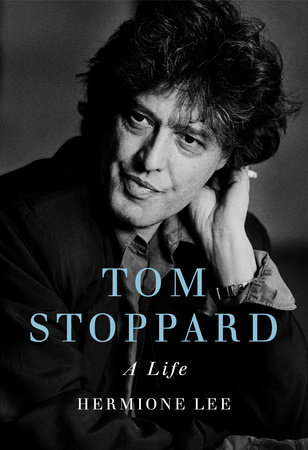
I am thinking about this as I read Hermione Lee’s new biography of Tom Stoppard.
He’s another writer named Tom, another hero of mine come to think of it. Stoppard & Robbins both manage to be funny, to be cool, to be profound, sometimes in the same sentence.
I was already doing lots of retrospective thinking, pondering who I am and where I came from in this curious time-out that has been upon us since 2020 and continued into 2021.
Stoppard was born in 1937, five years after Robbins. Both men are engraved in my head as the witty writers of my youth: even though they are no longer youthful.
Sigh.
Whether you work at home or continue to work in the front-lines, everything looks a bit different. Rush hours tend to be quieter. Pedestrians in Toronto often behave in new ways, usually honoring physical distancing but eyes twinkling behind their masks.
It can be an opportunity if you notice.
Every day I walk Sam. I worry about her mortality looking for evidence that she’s healthy while disquieted by symptoms like lumps (the big one in her side is growing).
The lump is bigger today than when this picture was taken. But it doesn’t seem to bother her.
And yet she seems okay. She outruns me, which come to think of it isn’t such a great achievement. But she runs..!
When we’re outside we watch the sky. Okay, she looks up and I think she sees the moon sometimes, where I’m probably being a little more finicky in my observations. She’s very calm, grounded in the here and now, at least until she begins barking at possible intruders or meals.
When someone walks by I can’t be certain whether she thinks of people as threats or appetizers.
Are we humans overthinking? If it smells good taste it. If it tries to hurt you, bite it.
Of course humans have invented lawsuits & liability so maybe we had better not be quite so quick to bare our teeth at others.
The sky is a safer place to look. Will it rain? Will it be cold? I can’t deny that I have all sorts of help, from the weather network, from my iPhone’s weather app. In February & March these are important questions to ponder before venturing outside, given that the temperature variation can be rather large. Last Thursday we hit +19 while just last night the wind chill was -17.
Not so long ago
No wonder the plants seem confused.
I hope those cute little flowers will be okay.
The path that the sun seems to follow changes every day.
I say “seems” because of course it’s not the sun moving, it’s the planet. We’re circling the sun once every year, and rotating on our axis once every day. Every day there’s a time when the sun seems to come over the horizon aka “sunrise” and later a time when it seems to go under the horizon aka “sunset”. Because of that orbital traveling each day the sun’s arc (the path from sunrises to sunset) in the sky is a wee bit different.
Being outside with the dog I see the changing seasons in the sun’s daily arc. If you find a reference point, you can see the differences in where the sun is rising and setting. It varies ever so slightly each day just as the length of day varies a tiny bit each day. On the shortest day of the year I made a note of where the sun set. Currently it’s a bit further north, moving yet further north every day. That makes sense right? In the depths of winter, the sun is further to the south of us, its rays indirect and not terribly warming, giving Argentina & Australia their longest days, while leaving those who are further north, like the Scandinavians, let alone the Arctic, in darkness. And on the summer solstice (that longest day), the sun will be more overhead, its rays more direct: and for that reason, much warmer.
With the help of my iPhone weather app I see the times for each sunrise and sunset.
Sounds like a song doesn’t it?
Today March 15th for example, it tells me that the sun will rise at 7:26 and set at 7:23. It’s almost exactly 12 hours. That makes sense. The equinox will be upon us soon. Equinox comes from Latin, when the night is equal to the day. The magic day is probably sometime next weekend (around the 21st), and after that date the days will be exceeding the night, gradually getting longer and longer until the peak is reached sometime around June 21st. And then it all turns around the other way, with the days getting shorter, the nights getting longer, and equal on or about September 21st.
In December the sunset was much earlier and further to the left (south) using this building as my reference. And by June sunset will be way further north.
The last of the snow has melted this week, although it was still very chilly this morning with that -17 windchill.
Sam likes it all the same.
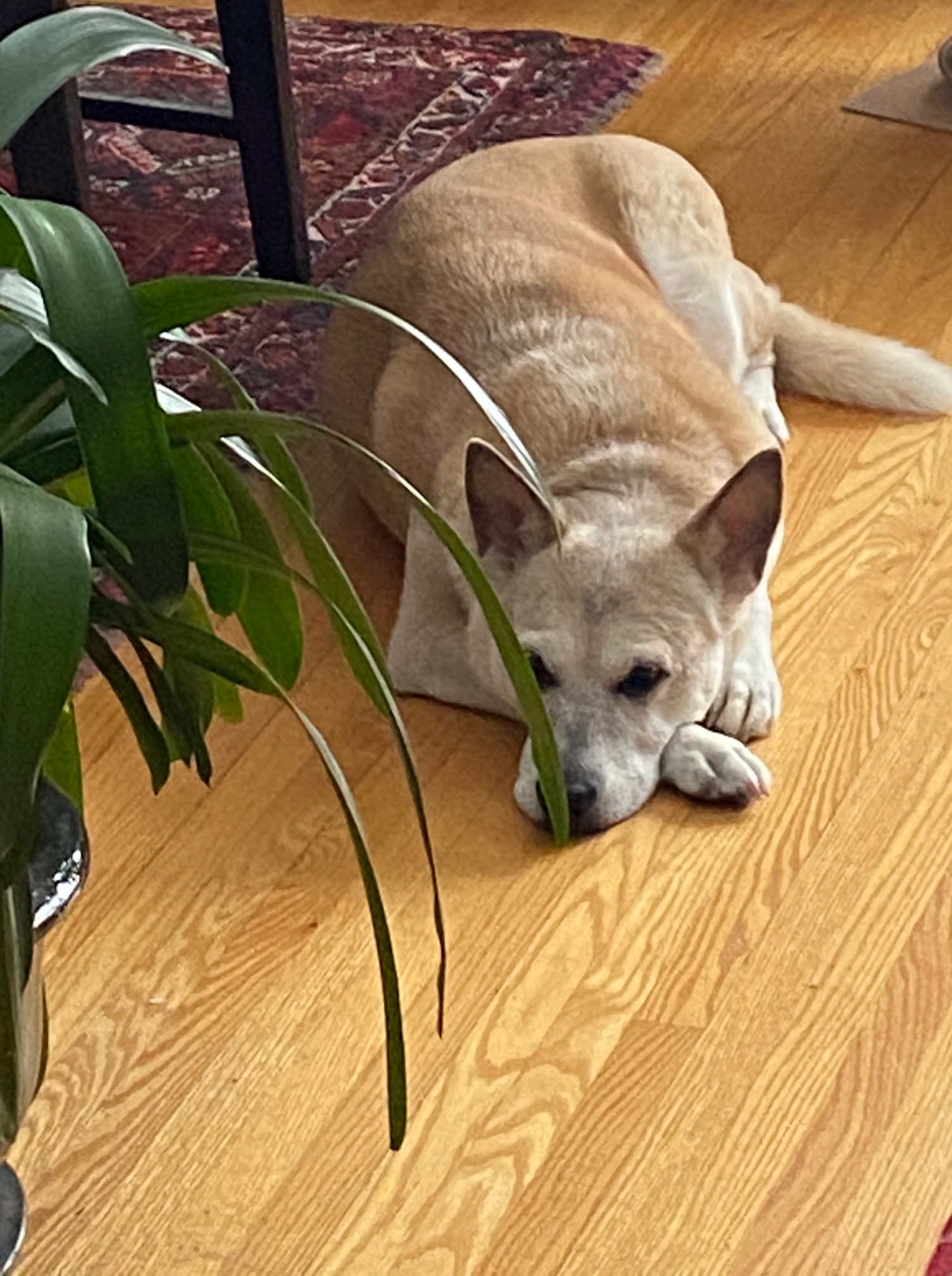
I hear people complain about the weather. Never mind that it’s beyond your control (although if you’re living in Toronto and want the weather to be warm why stay if you could move south?). I have the dog as a reminder. She appears to be happy when she’s warm. I meant to get a photo of her this morning after being outside in the cold , when she basked in the sunshine on the living room floor like a big pussy cat.
And she rolls around in the snow when she gets the chance.
As I ponder the future of streaming performances & concerts, I’m checking out Wagner’s Ring Cycle as produced by the San Francisco Opera in 2018 in their co-production with the Washington Opera. If you go to https://sfopera.com/opera-is-on/ you choose between “stream for free” and “subscriber/donor”, the latter presumably offering greater options.
I wonder if we’ll see something like this one of these days from the National Ballet of Canada or The Canadian Opera Company? As a free visitor I’m enjoying the offer of one Ring opera each weekend beginning with Das Rheingold.
Whether you think of Rheingold as the first night of a tetralogy or the prologue to a trilogy I’ve had great fun watching Francesca Zambello’s creation, a director I only know through her production of Les Troyens that I saw at the Met a few years ago. Both operas are epic works requiring vision, indeed they’re among my favorites. Could Zambello repeat her Troyens magic on the Wagner opera? I think so.
On the SFO site, she offers the following commentary on her production, that’s often called “the American Ring” for its approach to the materials.
“The Ring is always contemporary. We are presenting a world in some ways familiar to our audience but also one that will feel very mythic as we look to our country’s rich imagery. The great themes of the Ring—nature, power and corruption—resound through America’s past and haunt our present.” –Francesca Zambello, Director
I don’t think there is an opera that offers more opportunity for directors or designers to show us their creative brilliance. Presented as written –that is without any embellishments—the work requires us to see giants, dwarves, gods, a giant serpent, a toad, nymphs swimming in a river, a mountain-top, subterranean caves, a rainbow bridge to a distant castle, and scene changes traversing the transformation from one setting to another. Zambello’s American orientation means that for example the building of the castle offers us a modern construction crane, while the gods (awaiting their new home) look eagerly at the blueprints. But the production hasn’t strayed far from the text, at least not in the first of the operas.
I like some of the performances, but must say that the best thing about this streamed opera is Zambello’s inspired direction. Yes there are wonderful things in the design, but I’m indifferent if the eye-candy isn’t purposeful. It must be redeemed by a soul, by something in the text to make it truly good. It’s early to be concluding anything, but so far I’m totally enamored of this production.
A few moments stood out for me.
The usual dynamic in the story involves a misguided bargain to pay the giants for building Valhalla by giving them the goddess Freia. The gods must get her back, and so conspire to steal the ring Alberich has made out of the Rhinegold, a prize that the giants will accept as ransom in lieu of Freia.
Got that?
In Freia’s part –as written– she complains when she is threatened and then given (temporarily) to the giants in scene two, and she’s expected to show relief when she is released in the last scene, as part of the bargain for the ring. Of course some modern directors have played with that a bit.
Patrice Chereau (1976) for instance follows the usual template until the moment when Freia is released: and she dashes away from the giants AND away from the gods, perplexed by what she’s been put through.
Robert Lepage in his recent production has Freia revolted at first but starting to warm up to Fasolt by the end.
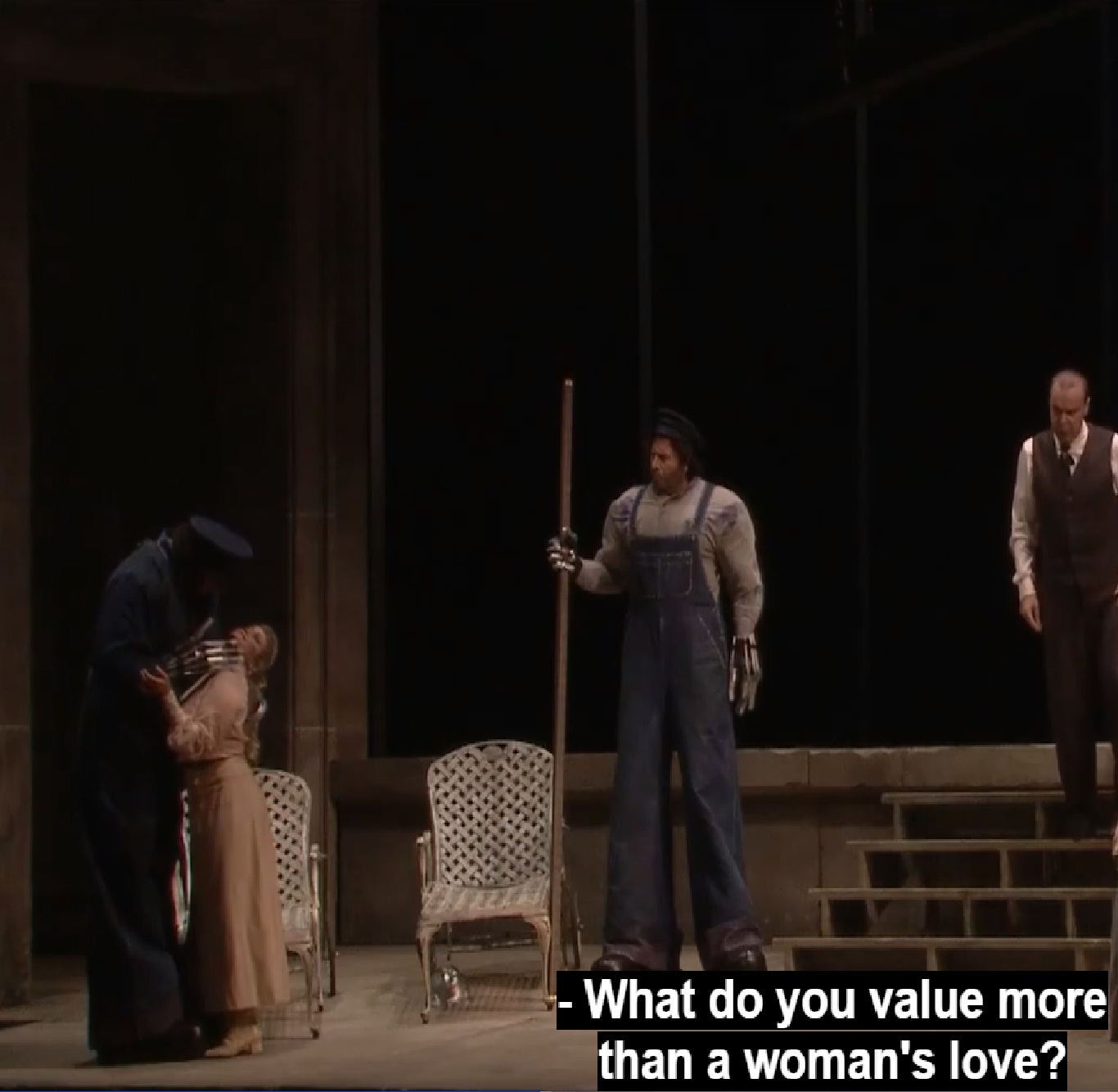
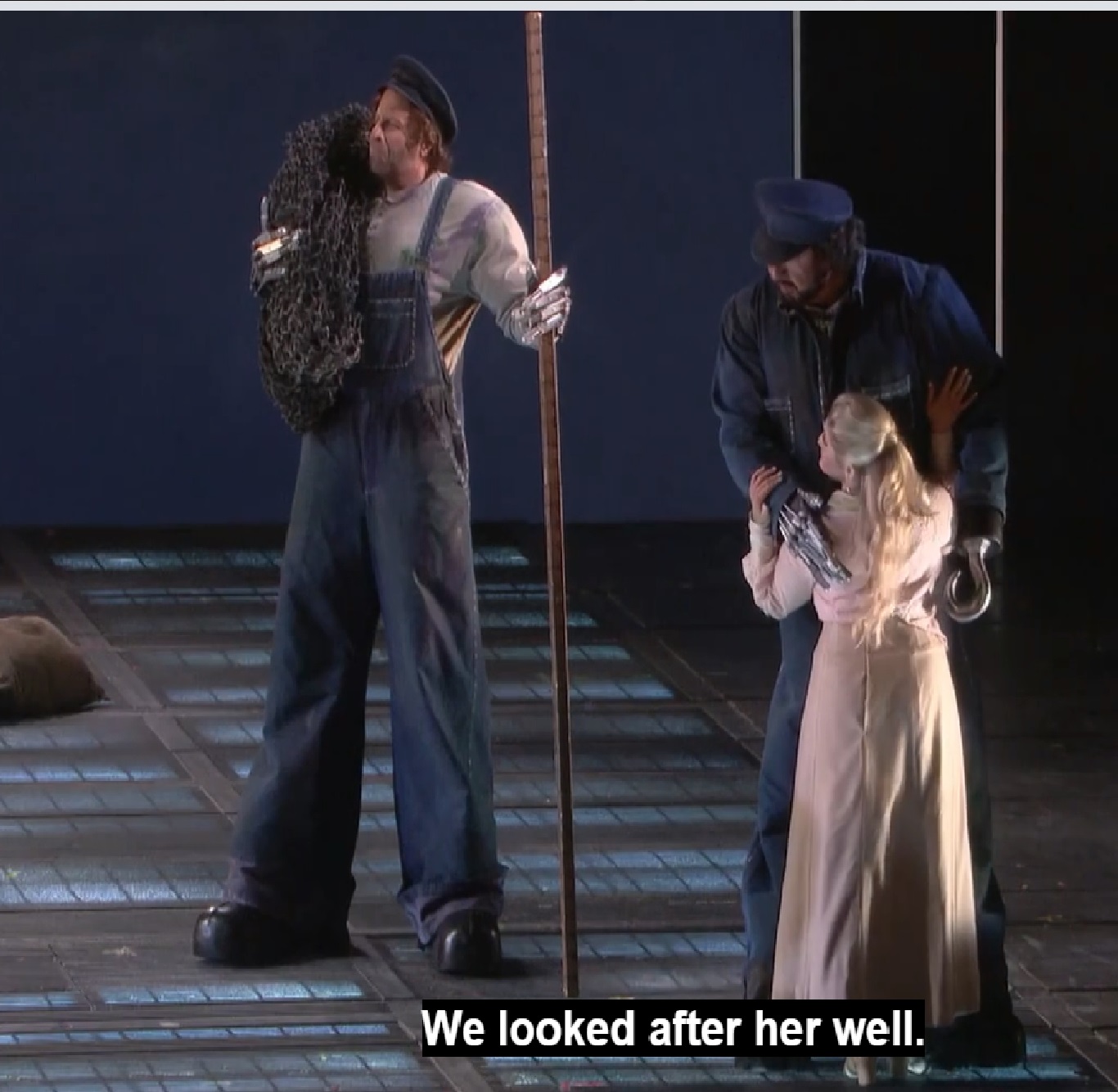
Zambello takes this much further. Where Freia is afraid of Fasolt at first –a creature who resembles a giant Edward Scissorhands—by the end she seems smitten with him, and genuinely upset when he dies.
Initially Fasolt’s rough handling of Freia terrifies & alienates her…..
Fasolt is played by Andrea Silvestrelli, Freia is Julie Adams.
…but Freia seems to be smitten by the end. (from left) Fafner (Raymond Aceto), Fasolt (Andrea Silvestrelli) and Freia (Julie Adams)
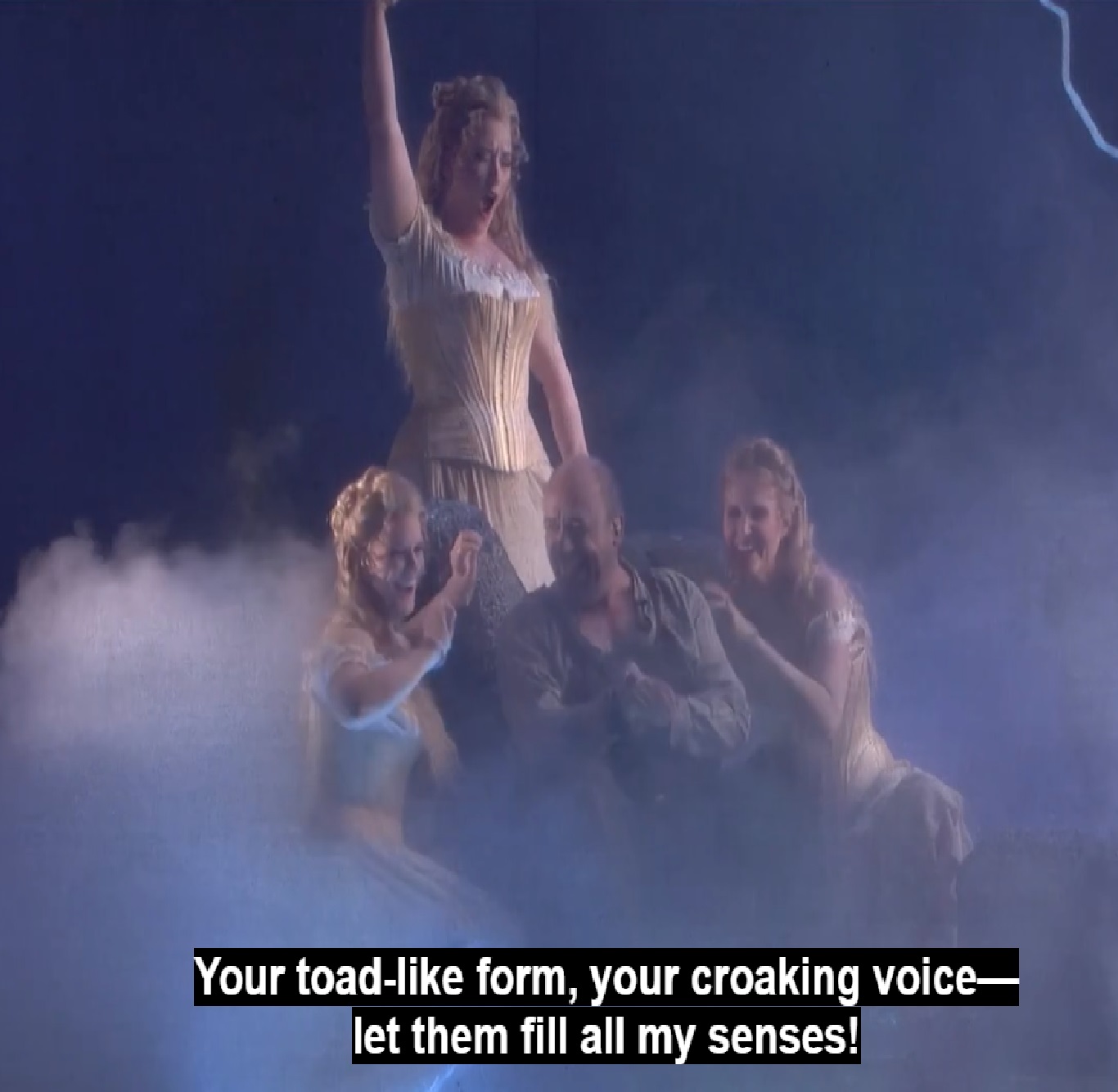
The opening scene likely would please the composer if he were alive, compared to so many productions that mess with the content. We see almost exactly what we should be seeing.
The Daughters of the Rhine, namely Woglinde(Stacey Tapan), Wellgunde (Lauren McNeese) & Flosshilde (Renée Tatum) mock Alberich (Falk Struckmann)
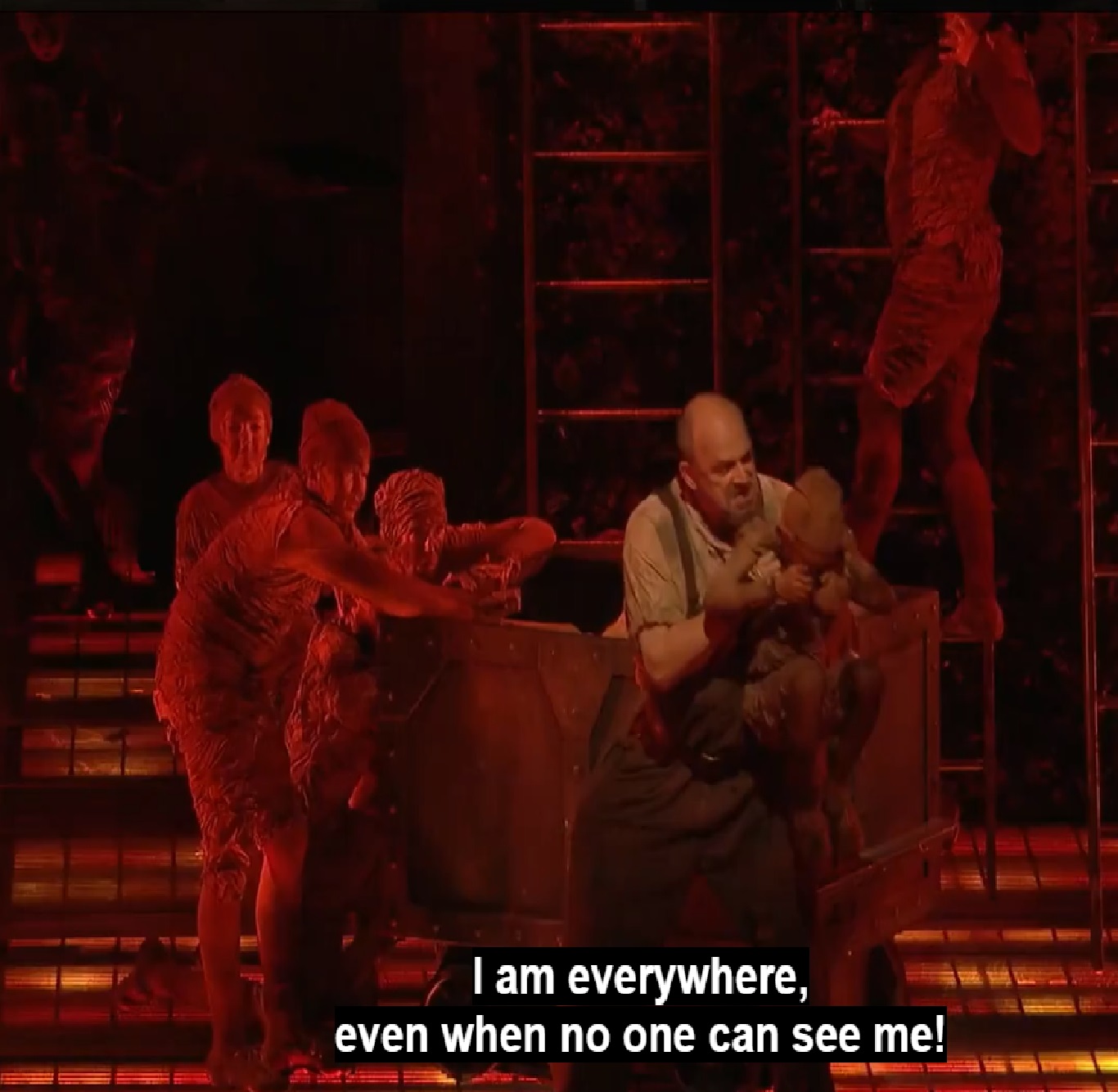
Yes Zambello’s Alberich does enter looking a bit like a prospector looking for gold in California, but once we get past the funny hat, he’s more or less like any other Alberich: except that Falk Struckmann gives an exceptional portrayal. Struckmann has a vulnerable charm as he makes his futile play for the Rhine-maidens, who dance around him mocking & teasing. Zambello’s interpretation is very relatable, her characters all wonderfully fleshed out. When Alberich’s frustration boils over his anger is stunningly three-dimensional & entirely sympathetic. In the subterranean scene –where we meet him after he has renounced love & forged the Rhine gold into a ring—he is brutally scary, bullying the Nibelungen dwarves, some played by children whom he lifts up in his arms.
Alberich (Falk Struckmann) terrorizing the Nibelungen
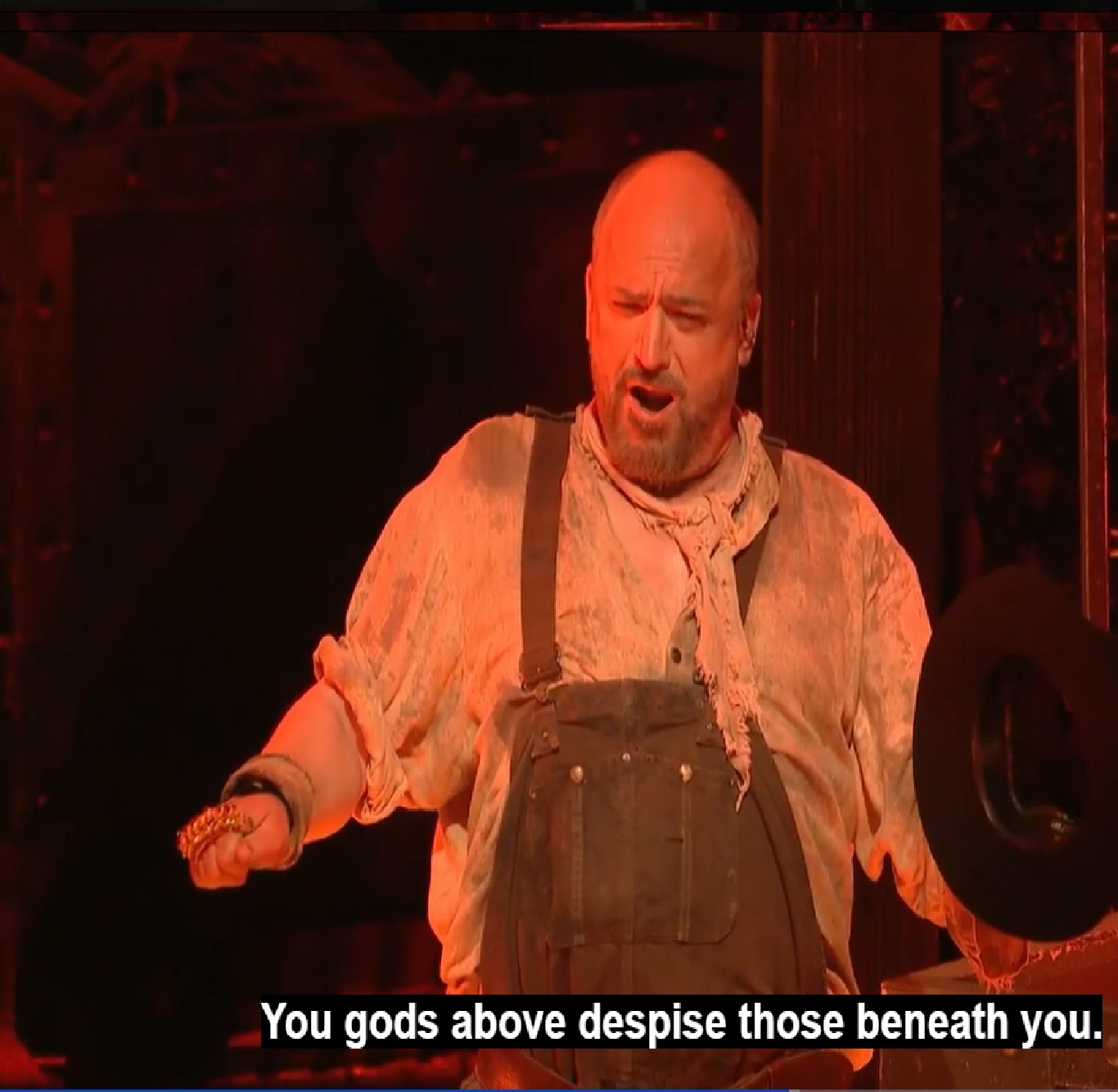
I have never seen the dynamics of the scene when Wotan & Loge come to visit his underground home so perfectly enacted. As Loge & Wotan flatter him, Alberich grabs Wotan’s hat, provoking the angry eruption that’s in the score, while Loge struggles to keep a lid on that anger.
Alberich (Falk Struckmann) with Wotan’s hat in his hand
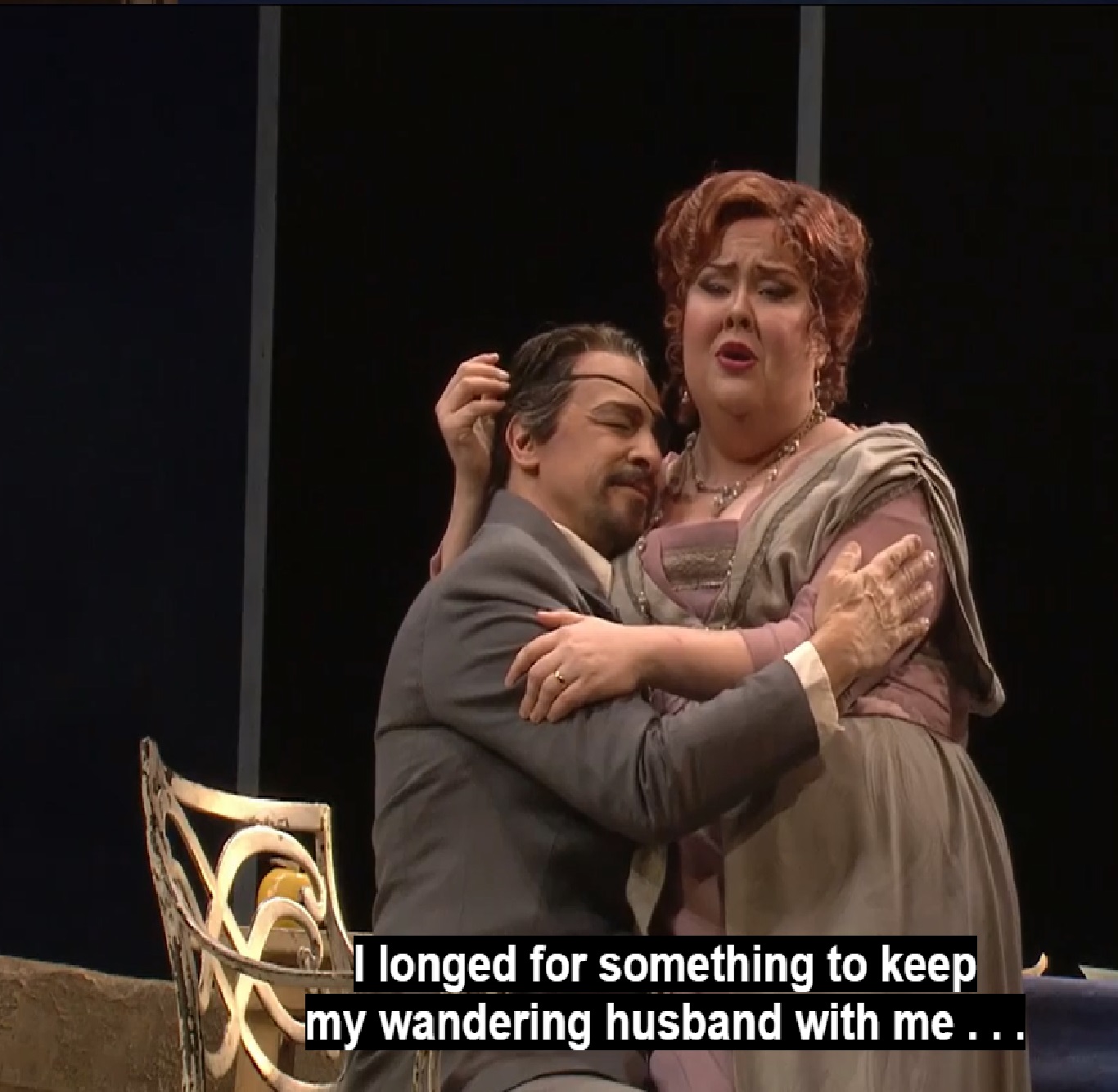
Stefan Margita is a superb Loge, admittedly in the most fun role in the opera, the provocative trickster- liar. Greer Grimsley brings a lot of authority to the role of Wotan although I found he yelled through much of the role, missing many of his notes. Jamie Barton was his wife Fricka, constantly contradicting her husband, and deliciously contrary to Grimsley in her perfect singing.
Wotan (Greer Grimsley) and Fricka (Jamie Barton)
I also love what Zambello makes of Erda the Earth goddess, gloriously sung by Ronnita Miller.
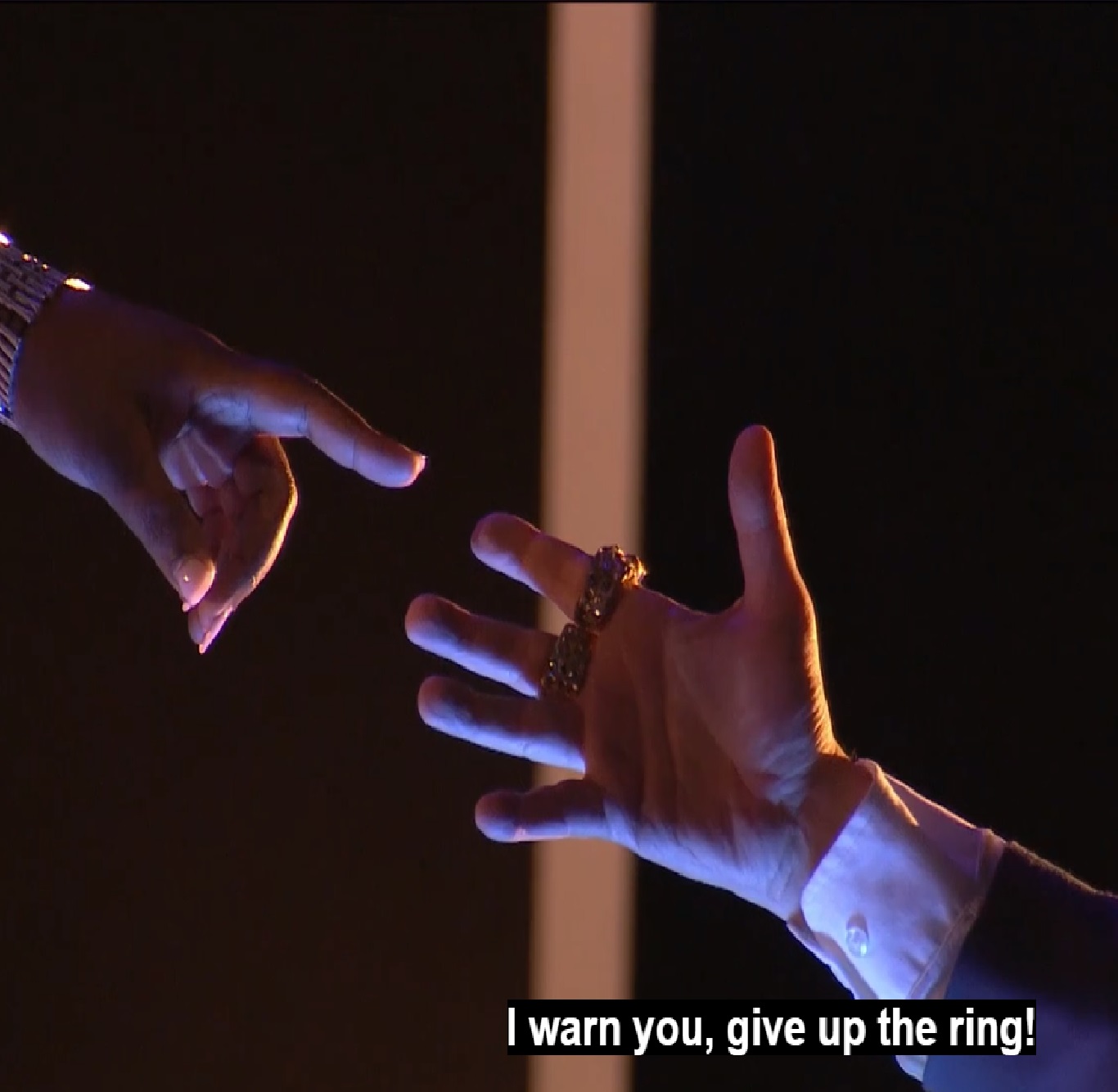
Erda reaches towards Wotan, advising him to let go of the ring upon his finger.
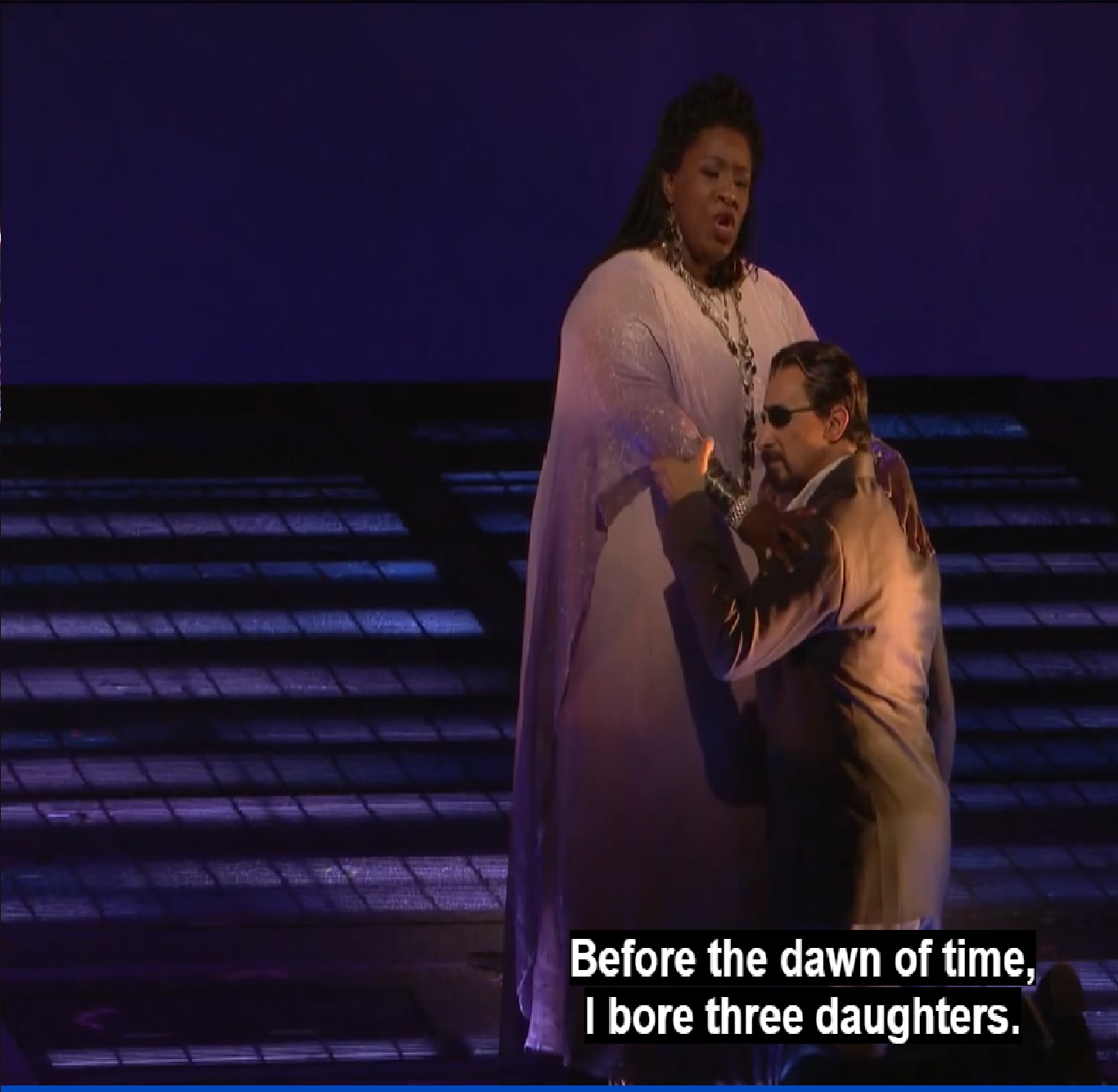
In a few short minutes Zambello has Wotan worshipfully kneeling to Erda, whom he will impregnate before the next opera.
Wotan (Greer Grimsley) kneels to Erda (Ronnita Miller)
Sir Donald Runnicles leads the SFO orchestra & the cast in this production. I was very fond of the CGI, projections making scene change magic, including S Katy Tucker whose name may be familiar for her work with Against the Grain & on the COC’s Hansel and Gretel just over a year ago. In addition to Zambello & Tucker I must also mention others on this wonderful team, namely set designer Michael Yeargan, costume designer Catherine Zuber, lighting designer Mark McCullough and the original projections designer Jan Hartley. It all hangs together beautifully, a superb experience.
The pandemic has offered a measure of clarity to the world of performing arts. Artists have been knocked for a loop by the lost pay due to gigs that couldn’t happen. Businesses are badly messed up by lost revenues, wondering whether they’ll recover when the threat from the virus abates and we begin to emerge from hiding places, resuming our normal lives, if at all possible.
And in the meantime we’re all relying on our computers & phones. Instead of going in to the office many work from home, relying on Zoom or other virtual tools. To keep from going crazy we’re consuming arts & entertainment through our devices rather than live.
This week I’m nostalgic as I recall the first week of March in 2020, one year ago.
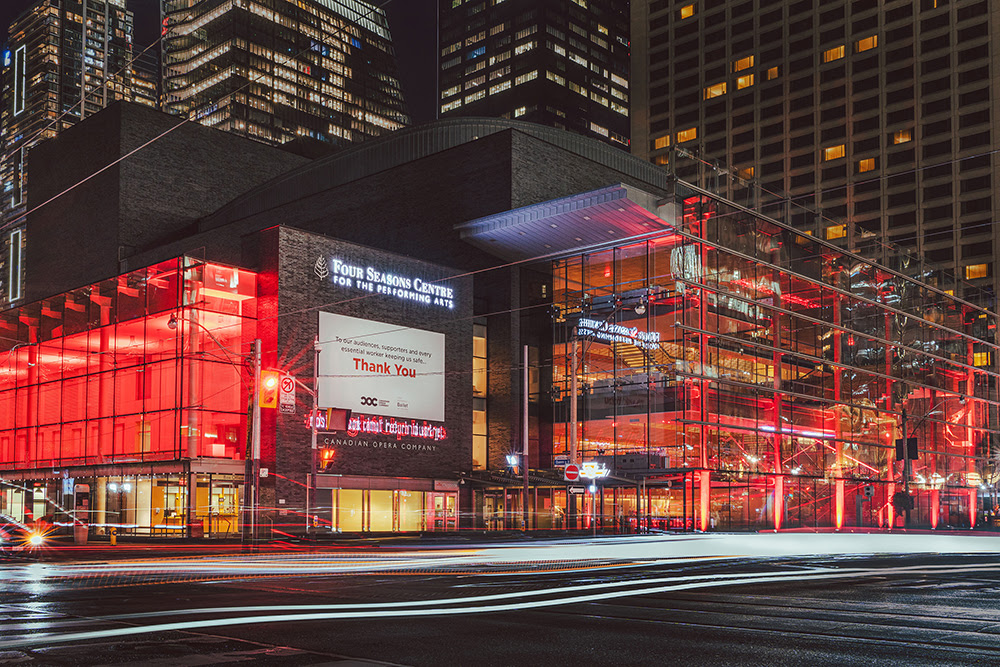
On March 1st I saw the National Ballet, including Angels Atlas, in my final visit to Four Seasons Centre before the cancellations began.
Artists of the National Ballet in Angels’ Atlas. (Photo: Karolina Kuras)
And on the Saturday night March 7th I saw my last theatre performance of the year, Toronto Operetta Theatre’s HMS Pinafore.
Since then, everything has been online. Alexander Neef has just left the Canadian Opera Company, after years of excellent productions. I remember the sadness as they closed, knowing that we couldn’t see them again. Today I watched the first installment of a Ring Cycle from the San Francisco Opera, available for free until tomorrow from their website. Next weekend they’ll offer the next opera via the same URL, and so on.
Erda (Ronnita Miller) cautions Wotan (Greer Grimsley)
Other nights we’ve been able to watch a free recorded performance from the Metropolitan Opera’s accumulated wealth of shows, previously offered in their High Definition series or even earlier as “Live from the Met”.
And of course there’s the content that you pay for.
I’m jealous.
If we had the kind of technology of either the Met or SFO, our pandemic experience could have been lightened by locally produced work rather than foreign imports. I can’t be the only one thinking “gee I wish we had something like that here in Canada”. Sure I like the free shows, but wouldn’t it be great if the tickets were supporting a Canadian company. Imagine if they had the additional revenue stream from the virtual performances to complement live.
And let me add, I know Toronto isn’t really the centre of the world much as it may seem as though Torontonians think so. It’s a bit embarrassing when you notice that we have the Canadian Opera Company and the National Ballet of Canada, perhaps as vestiges of a time when we thought that no other city could support such an endeavour, notwithstanding the many cities across Canada that actually do have lots of opera, symphony, ballet etc. Thank goodness there are occasional tours, although they don’t go to the whole country anymore (if they ever did).
But wow, what if those operas or ballets were captured for virtual viewing..? Then their national names would be fulfilled, because the citizens from Cornerbrook to Cranbrook could see their so-called “national” companies in action without coming to Toronto.
For tonight, I was enjoying that SFO production of Das Rheingold, not the COC or National Ballet. I will be catching up on other virtual performances by Canadians when I get the chance.
Tapestry Opera begin offeringOur Song D’Hiver, starring Mireille Asselin and pianist Frédéric Lacroix.
Toronto Operetta Theatre will again feature Gilbert & Sullivan, although in a virtual version, as they present The Gondoliers beginning March 19th; further info via this link
And of course there’s lots more available online.
In the meantime, stay safe and soon we’ll have vaccinations & sometime thereafter live performances.
I’m not sure I understand the title, but it’s a perfect description all the same.
I sat through Jon Stewart’s new film Irresistible tonight, sometimes moaning sometimes laughing but unable to tear myself away.
So whatever it means, the title is a pretty accurate description. I surrendered to it.
Whether it’s opera, theatre or film, I’m often less interested in the material than in the opportunity to watch the talent at work. There are some people I’ve never seen in a bad movie.
Chris Cooper? I first noticed him in American Beauty (1999) although in short order he seemed to be in every movie I was watching, making an impact even in small roles. In Irresistible he might be the character to whom the epithet might be applied, as Jack, the former Marine whose youtube diatribe propels him to fame as the great hope of the Democratic Party in rural America.
Ever wonder what Jon Stewart has been up to? This is certainly one answer, namely writing & directing this film. I miss Stewart who was for me the most eloquent yet pointed critic of the American political scene on his Daily Show: until he left in 2015. While Irresistible might be just his second time as a director, based on what I saw, it won’t be his last. The dialogue is authentic, sometimes infuriatingly real, and always fluid. The pace is natural. I couldn’t tear myself away.
I’m a great admirer of Steve Carell, especially his voice work as Gru in the Despicable Me films. I like him, and so was stunned to watch him cast against type as Gary, a total jerk working for the Democratic Party. Carell is well cast given that he resembles a nice guy enough to lull you into believing him to be a nice guy: until you listen to what he’s just said. Repeatedly through the film I was wtf-ing aloud, watching him rampage through the film, and recognizing this energy. I think we’ve seen people just like this. The writing & performance capture something real.
Yes, Stewart is doing something really important, as he dissects the Democrats, especially in Carell’s character, who is pathologically insincere. While he faces off against a blatant liar from the GOP, played exquisitely by Rose Byrne, we see a different species of liar in Gary the well-meaning operative who talks down to people without noticing how insulting & inauthentic he is. For me it captures the ongoing disaster that has been the Democratic Party: perhaps even now.
Alongside Cooper, Mackenzie Davis as Jack’s daughter Diana is the other pillar of integrity. And the rural Wisconsinites in a variety of smaller roles are also understood as honest, while the big city folk who descend upon the small town offer varieties of creepiness. While it may be a bit mechanical as I describe it for you, it works really well, especially once you mix in the surprises Stewart has in store in the last half-hour of the film.
I’m looking forward to watching again tomorrow. And I’m wondering if the Democrats can stop doing what we see in this film, and yes, on the news too. Stewart’s diagnosis feels absolutely right.
I’m ridiculously late, overdue writing about Seraphia, the gourmet shop in Scarborough that has been as essential to me as my left hand. Maybe that’s why I’ve been so slow to write, clearly taking them for granted.
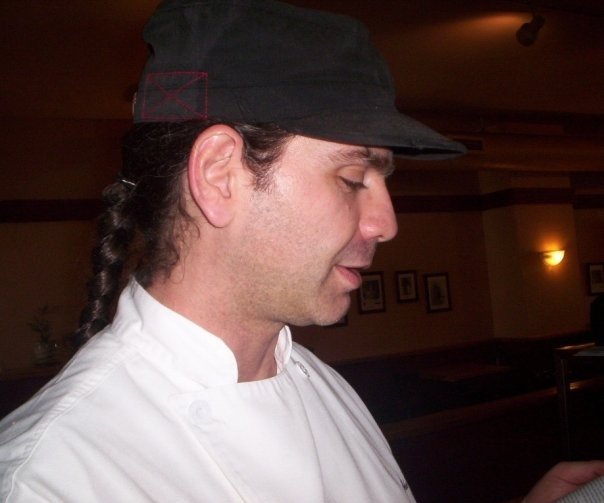
Peter Captsis is the heart & soul of “Seraphia Inspired Cuisine”.
Peter Captsis, in a 2009 photo from his Facebook page, although he looks the same
Thank God their location at 2979 Kingston Road in Scarborough is not far from my home. If you’re lucky enough to live close by (near where St Clair meets Kingston Rd), you should check it out, although I think it’s worth the trip if you’re further away.
Come to think of it, I realize that I’m writing about a different Seraphia. Like many restaurants, they’ve had to adapt to the pandemic, change or die.
The tables are gone of course, as they’re now exclusively a take-out operation with big plastic partitions for protection even before we get to the masks everyone wears. If more than 3 or 4 (I can’t recall the limit in the space), one stands outside waiting. It may be my imagination but I think his customers are the nicest most polite people, perhaps under the influence of the food.
Their menu is now smaller, although Peter did manage to do some amazing things at Christmas time.
But never mind December, let me simply talk about the daily magic, recalling the ways we continually lean on Peter & his genius. I think it’s not an exaggeration to call him that, given the way he reconciles amazing speed & efficiency with flavor.
Today is Thursday, which means lasagna. I picked up two of them plus a large Caesar salad for dinner.
Earlier today (yes I often go there more than once per day) I also bought soup. Although it’s available hot in a single-serving size, which is how we always used to get it, recently he’s made it available in big beautiful mason jars, cold in the refrigerator.
The view in our fridge, including some remarkable jam. NB the squash bottle was out (for use… see below)
I bought myself the butternut squash, which is a nice prelude to the lasagna I’ll be having shortly, as I type this.
When a butternut squash freak says it’s the best squash soup he’s ever tasted? believe it.
Right now it’s roughly 6:30. Dinner’s at 7. I also bought the lentil which is wonderfully spicy with carrots, that I split with my mom, plus chicken noodle (Erika’s favorite). He also has beef with barley, potato leek & mushroom, and every one of them is delicious.
We take lunch to my mom a couple of times per week, so Peter’s help is invaluable.
At lunchtime today Mom got the lentil soup (roughly one third of the jar, that I heated up for her), a small Greek salad that I split with her, decorated with chicken cooked on a skewer. I take the pieces off the stick and put it on top of the salad. She loves it, and so do I come to think of it.
So in addition to her lunch (soup, salad and chicken) from Seraphia, I also brought a tuna sandwich that will be her snack later today or tomorrow.
Earlier this week, Erika & I had chicken-caesar wraps. I can’t recall what that was paired with, as we do this so often. Sometimes it goes with Peter’s soup, sometimes one of his salads. We also sometimes get Peter’s poutine.
Or a hamburger.
Or a steak sandwich.
I’m not certain but I’m pretty sure that Peter doesn’t use much salt. His usual approach is understated, classic, never over the top but just right. The flavor of that lasagna is as good as anything I’ve ever had in a restaurant: and oh boy I have it for dinner tonight (yippeee!!)…. right after I finish this in fact.
And his breakfasts are good too. The quick easy one is the toasted western, although when we’re hungrier, one gets eggs + choice of sausage, peameal or strip bacon + choice of bread (white, multi—grain or rye) + home-fries, although we usually substitute sliced tomato.
Did I mention that he also has baked items? I often grab a brownie, date square or a tart (butter or pecan tart). And he has loaves of bread, and he has a slicer. And he has different types of muffins. I usually get an apple-oatmeal and/or a bran one, although there are others. He has croissants. He has quiches & meat-pies (and dammit this is the first meatpie I have EVER eaten that I didn’t dislike…. I actually liked it).
And this is his reduced menu…!
There’s coffee as well, but I make it at home so I never buy it anymore (although I used to… another really good option btw). When the pandemic is over perhaps we’ll be back to some of the mid-week meal options that he discontinued for the time being.
The guy is very talented. He’s pleasant enough, and plays Q107 (I think) when you go in to make the pickup. We like to call ahead because I think it makes it easier for everyone.
Seraphia can be reached at 416-264-8951, and yes I memorized the number. I know it like the back of my left hand.
The co-founders of Amplified Opera invite you to join them in conversation as they discuss their organization, their new appointment as Disruptor-in-Residence at the Canadian Opera Company, the complexities of the opera industry, and their views on the role the arts play in broader national conversations.
JHI Faculty Research Fellow Caryl Clark (she/her) facilitates this discussion between performers and creators Asitha Tennekoon (he/him), Marion Newman (she/her), and Teiya Kasahara 笠原 貞野 (they/them), and stage director Aria Umezawa (she/her) as they explore what it means to use art as a catalyst for uncomfortable conversations.
Some things are very consistent, the same every year. That doesn’t mean that people notice, of course. When one has nowhere else to turn, there’s always the sky & the planet we inhabit. The manifestations of our celestial journey, the regular movements of earth & sun, signal the changes of our seasons, triggering responses among humans, animals, and the trees.
It can be dark outside, but every day is a little longer. The shortest of the year almost exactly two months ago in December wasn’t as cold as we’ve had recently in February. While you hear about a polar vortex, the winter only started to get serious about a month ago. Yet there’s more sun, and it will gradually warm us. As the sun gets closer to being overhead and spending a slightly longer day its rays are more direct, brighter and warmer. This week the split is getting closer to even with the day just short of 11 hours, the night just over 13 hours. We’ll get to 12 & 12 on the equinox (which is what the word means) one month from today.
The animals here in Scarborough have noticed the changes even if the humans have not.
We’re having reports of coyotes on local streets. While they probably don’t pose any danger to humans there have been reports of small pets getting taken. Apparently it’s mating season, so they’ll sometimes be seen in pairs. I suppose the solo animals are looking for a mate.
A little over a year ago a neighbour posted this photo taken near our home
Even with a dog as big as our Sam (roughly 50 pounds and fiercely territorial), I won’t let her off the leash when it’s close to sun-up or sun-down. While she likely could protect herself, a bite from a sick animal could mean her death, so I’m very careful attentive to the changing lengths of day. Today for instance we were out a few minutes after 7:00 just around sun-up: although the sun wasn’t visible in the overcast sky.
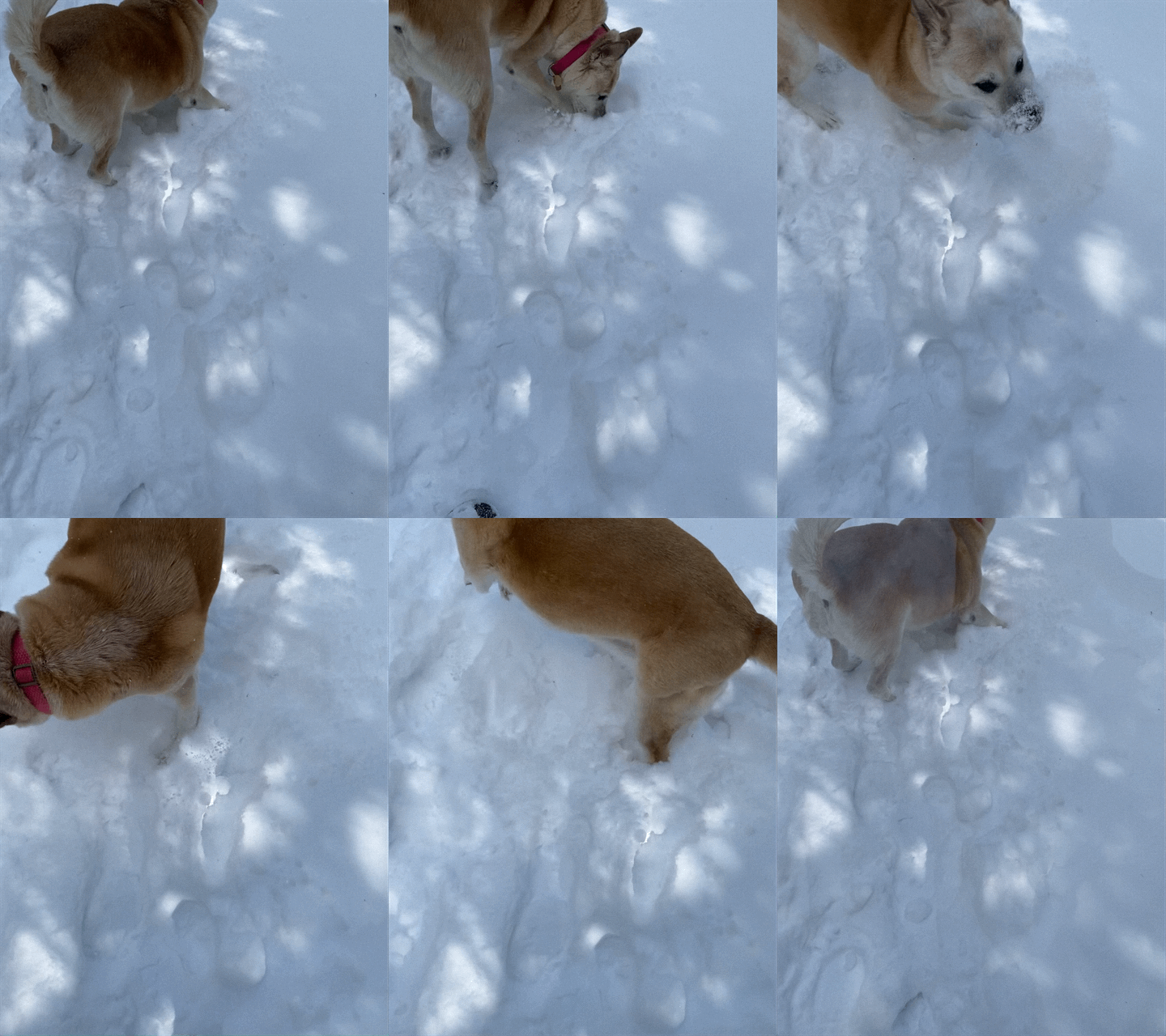
The snow seems to excite Sam, not just because it’s harder work moving through it when it gets deep. She’s very playful, zipping around in circles as you see in this looped gif I made, or when she lies on her back rolling in the snow.
While she may have come from the southern USA she seems to love the Canadian winter. When she’s romping in the snow she’s often snuffling around for traces of animals who have passed. It must be a bit confusing for a creature that relies on their nose, when the cold weather of winter shuts down or reduces many of their nasal stimuli. Sam stopped yesterday to snuffle about with her face into animal tracks, possibly with faint traces of a rabbit or a squirrel.
Skunks are another reason to be careful with the leash. While they’re supposedly nocturnal, they too depart from that schedule when they’re mating. Earlier this week I freaked out when I spotted a skunk in the neighbour’s yard while Sam was off the leash and far from me. The encounter was at 1:00 in the afternoon. I was worried Sam would get through the fence; she has her ways when she’s excited & pursuing prey. Luckily I caught her before she caught wind of the skunk: who once s/he heard us in the yard, sprayed and ran.
A few minutes later (after Sam & I were inside) I saw the skunk emerge in the front, but across the street.
It looks almost like a black cat, and bad luck if you get too close
This is the best picture I could manage. Gee…The animals never stop and let you take their picture.
Domesticated animals not only keep us company, but they mug for the camera.
But if the animals choose to come out during the day is it a sign of anything beyond their desire to mate? Hunger? curiosity? Whether or not they see their shadow, spring is getting closer & closer.
Toronto – In an announcement made this morning by the Department of Canadian Heritage, the Canadian Opera Company will receive $644,372 in crucial funding provided through the Canada Cultural Spaces Fund toward the Digital Infrastructure Enhancements Project at the Four Seasons Centre for the Performing Arts. The infrastructure plan, developed in partnership with The National Ballet of Canada, aims to implement a range of digital upgrades to the opera house, significantly boosting both organizations’ recording and broadcast capabilities in the immediate, as well as helping to improve both community and global access to Canadian artistry and other community programming showcased in the space.
“Today’s announcement is wonderful news for not only the Canadian Opera Company, but for so many of our artistic peers and community partners,” says COC Deputy General Director Christie Darville. “In carving a path forward through the fluidity of our current reality, investments like this allow us to better stage and safely share more original content, while also enabling us to share digital resources with others. The COC wants our home base at the Four Seasons Centre for the Performing Arts to showcase not only in the best in Canadian opera but also to serve as an accessible platform for new and diverse voices; this digital enhancement project is helping to make that goal a reality.”
“This forward-thinking investment from the Department of Canadian Heritage allows for high quality digital capture of performances, making our artform accessible to more Canadians and giving us the ability to showcase our work to the world,” says Barry Hughson, Executive Director of The National Ballet of Canada. “The National Ballet of Canada is thrilled to be a partner on this timely initiative and thanks the Government of Canada for investing in our future.”
Erika & I watched A Dangerous Method (2011) tonight. Have you seen it? It’s a fascinating film directed by David Cronenberg starring Viggo Mortensen, Michael Fassbender & Keira Knightley, all three in fine form portraying, respectively, Sigmund Freud, Carl Jung and Sabina Spielrein.
I wrote about itback in 2012 when it was still fairly new, keeping my focus on Howard Shore’s film score, that adds layers of subtext to the already dense two hours with his paraphrases of Wagner inserted into the film for diegetic & non-diegetic cues.
Watching it tonight I noticed something new, or at least something I missed last time. Shore takes a small passage in Act II of Siegfried, using it at least twice that I noticed.
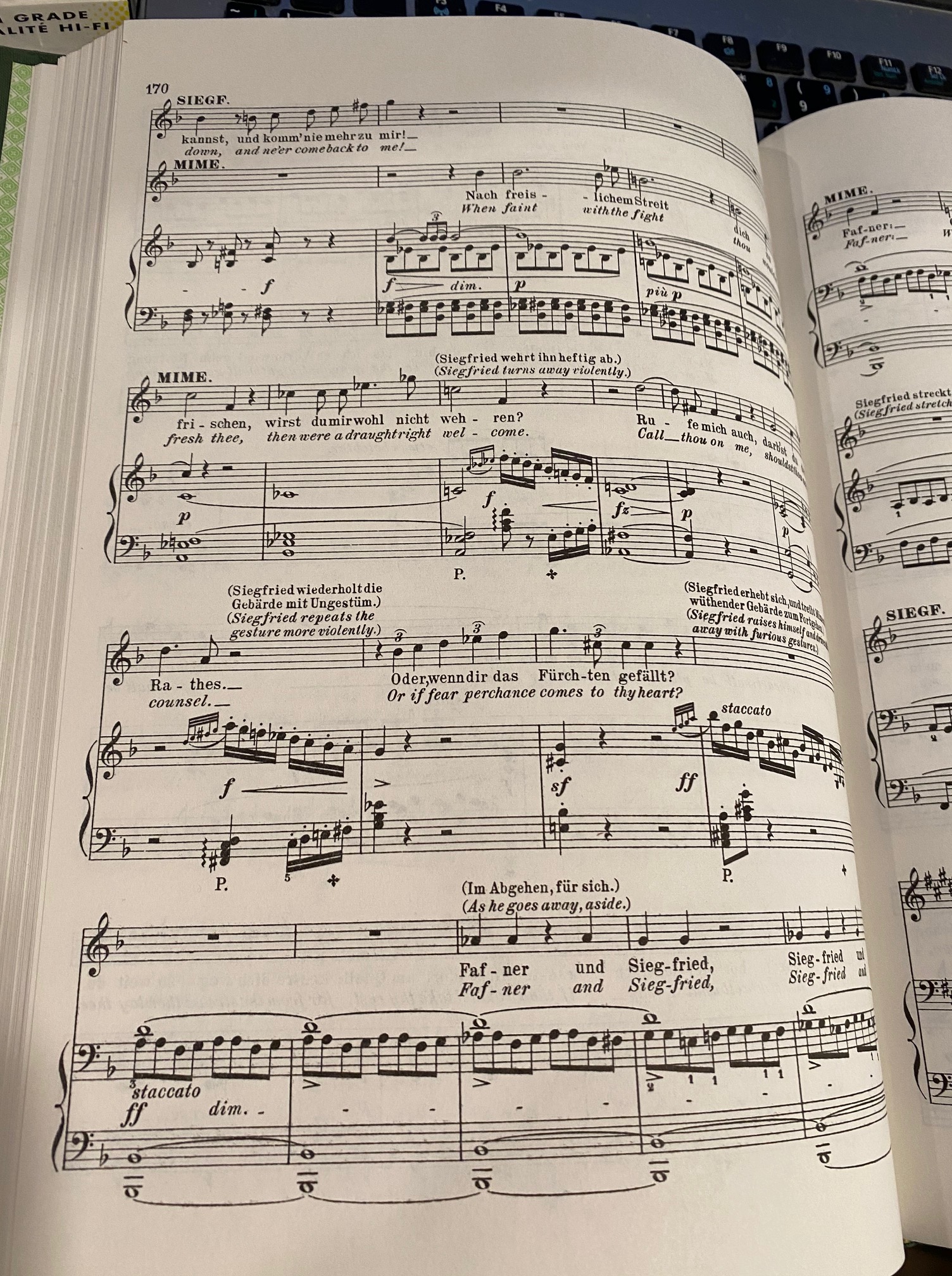
In the passage being quoted, Mime has led Siegfried to the lair of the dragon Fafner. As he exits the stage, Mime will express his heart-felt wish that Siegfried & Fafner should kill one another in the upcoming battle:
MIME: Fafner und Siegfried Fafner and Siegfried Siegfried und Fafner Siegfried and Fafner Oh! Brächte Beide sich um ! Oh if they could kill each other!
You can hear it on this video, which should start at 29:10, and goes for less than half a minute, coming a little bit before the beginning of the musical passage known as the “Forest Murmurs”.
The relevant orchestral passage that Shore will use comes before Mime begins singing, as the orchestra is picking up on a theme associated with Mime.
The important phrase is that pattern music in the right hand, eighth notes gradually shifting harmony downwards.
Howard Shore grabs this little bit of music at least twice that I noticed in the film. Each time, there’s an encounter between Freud & Jung going on. Isn’t it intriguing that Shore should put this passage, where the dwarf is muttering about the two epic figures about to fight..? There’s a calmness on the surface, belying the war that’s about to explode between the two.
The first time we hear this music, we’re with Freud & Jung on an ocean liner traveling to America for a conference, still ostensibly on friendly terms although there is tension simmering under the surface, as they spar politely. Shore expands the passage considerably, much more than the six bars of the original, the pattern of modulation downward continuing on.
The second time is one of the last times they are seen together, as their antipathy grows until they break off their relationship altogether.
For me it becomes a new theme an altogether new leitmotiv if we look at what that music was originally signifying, as Wagner wrote it. That repeated note pattern is an off-shoot of the music associated with the Nibelungen dwarves, and represents Mime. But I don’t think Shore means the theme to suggest Mime –the observer—rather than the two epic combatants (Siegfried & Fafner), as this is simply an opportunity to call subtle attention to the simmering conflict. In each of the passages Shore is changing Wagner slightly, while still alluding to this moment before the big battle.
I am of course ever the nerd, happily riding out the cold of February & the social distancing of the pandemic, via the escapism of film. The Wagner adds additional depths to the film whether or not one picks up on associated leitmotivs. I don’t think Shore was just picking any old Wagner at random, given how many possible themes he had to choose from..
As often happens I find myself wanting to go back and see/hear it again, to see what else I might discover. The film is first & foremost a study of human motivation, probing beneath the surface of polite society. There is an enormous amount going on under the surface between the principals, and that’s amplified in Shore’s gentle allusions to the relationships in the Wagner music dramas.
Morning after addendum: As Erika & I sat over breakfast, we recalled the film, discussing impressions. The film has a deep impact. Erika does not perceive the Wagner the same way as I do (given that I immersed myself in the music as a nerdy teen, and respond to the mythology in a manner not unlike Jung & Spielrein, who both made deeply personal connections with the operas, both the music & the stories). I remembered that one thing that Shore accomplished with his use of the Mime motif (an incessant repeated phrase that you can see in the musical sample above) was to remind us of one of the contemporary readings of the music & the character: Mime being decoded as a subservient sneaky Jew by an anti-semitic audience. And so, add that layer to the Freud-Jung jousting, that the older man was always going to be disrespected by some, possibly by Jung himself. Freud reminds us in the film, in a chat with Spielrein, that in the end both of them are Jews whereas Jung is aryan, the master race. While this is long before Hitler rears his ugly head, the anti-semitism is there in the normal behaviour of the culture. We discover it in the story of Mahler, who converts to Christianity, at least as a way to advance his career. It’s troubling stuff. Erika spoke of how shocking the final graphics are, giving us as epilog the outcome of each protagonist’s life. Freud flees the Nazis, dying of cancer in London in 1939. Spielrein who was living in Russia, dies with two daughters, murdered by Nazis. Jung lives to a ripe old age, dying in the early 1960s. Needless to say: we will watch the film again. We both felt that neither Cronenberg nor his actors, especially Keira Knightley, get proper credit for their work in this film because it is disturbing, and perhaps people don’t want to be disturbed. Cronenberg seems to enjoy provoking a response. I’m grateful as I sit in my safe home hiding from the pandemic & winter’s blast, that I have a few of Cronenberg’s films to disturb me and get me thinking. At the very least it makes it easier to find gratitude instead of seasonal affect disorder: speaking of psychology…I have to pull out my Freud & Jung books…. and perhaps look for something by Spielrein.













 barczablog