Seraphia in Scarborough

I’m ridiculously late, overdue writing about Seraphia, the gourmet shop in Scarborough that has been as essential to me as my left hand. Maybe that’s why I’ve been so slow to write, clearly taking them for granted.

Peter Captsis is the heart & soul of “Seraphia Inspired Cuisine”.
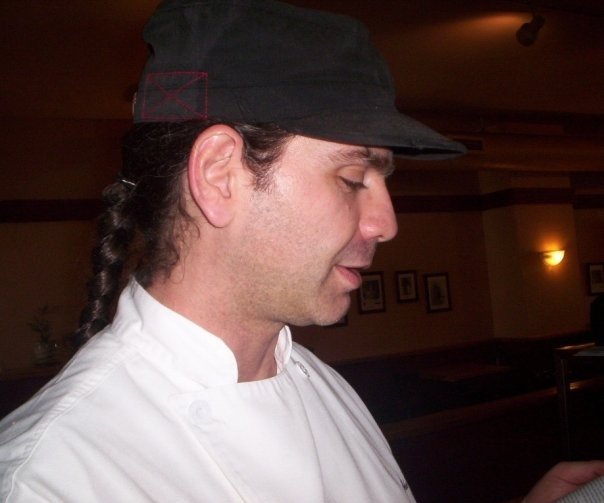
Peter Captsis, in a 2009 photo from his Facebook page, although he looks the same

Thank God their location at 2979 Kingston Road in Scarborough is not far from my home. If you’re lucky enough to live close by (near where St Clair meets Kingston Rd), you should check it out, although I think it’s worth the trip if you’re further away.

Come to think of it, I realize that I’m writing about a different Seraphia. Like many restaurants, they’ve had to adapt to the pandemic, change or die.

The tables are gone of course, as they’re now exclusively a take-out operation with big plastic partitions for protection even before we get to the masks everyone wears. If more than 3 or 4 (I can’t recall the limit in the space), one stands outside waiting. It may be my imagination but I think his customers are the nicest most polite people, perhaps under the influence of the food.

Their menu is now smaller, although Peter did manage to do some amazing things at Christmas time.

But never mind December, let me simply talk about the daily magic, recalling the ways we continually lean on Peter & his genius. I think it’s not an exaggeration to call him that, given the way he reconciles amazing speed & efficiency with flavor.

Today is Thursday, which means lasagna. I picked up two of them plus a large Caesar salad for dinner.

Earlier today (yes I often go there more than once per day) I also bought soup. Although it’s available hot in a single-serving size, which is how we always used to get it, recently he’s made it available in big beautiful mason jars, cold in the refrigerator.

The view in our fridge, including some remarkable jam. NB the squash bottle was out (for use… see below)

I bought myself the butternut squash, which is a nice prelude to the lasagna I’ll be having shortly, as I type this.

When a butternut squash freak says it’s the best squash soup he’s ever tasted? believe it.

Right now it’s roughly 6:30. Dinner’s at 7. I also bought the lentil which is wonderfully spicy with carrots, that I split with my mom, plus chicken noodle (Erika’s favorite). He also has beef with barley, potato leek & mushroom, and every one of them is delicious.

We take lunch to my mom a couple of times per week, so Peter’s help is invaluable.

At lunchtime today Mom got the lentil soup (roughly one third of the jar, that I heated up for her), a small Greek salad that I split with her, decorated with chicken cooked on a skewer. I take the pieces off the stick and put it on top of the salad. She loves it, and so do I come to think of it.

So in addition to her lunch (soup, salad and chicken) from Seraphia, I also brought a tuna sandwich that will be her snack later today or tomorrow.

Earlier this week, Erika & I had chicken-caesar wraps. I can’t recall what that was paired with, as we do this so often. Sometimes it goes with Peter’s soup, sometimes one of his salads. We also sometimes get Peter’s poutine.

Or a hamburger.

Or a steak sandwich.

I’m not certain but I’m pretty sure that Peter doesn’t use much salt. His usual approach is understated, classic, never over the top but just right. The flavor of that lasagna is as good as anything I’ve ever had in a restaurant: and oh boy I have it for dinner tonight (yippeee!!)…. right after I finish this in fact.

And his breakfasts are good too. The quick easy one is the toasted western, although when we’re hungrier, one gets eggs + choice of sausage, peameal or strip bacon + choice of bread (white, multi—grain or rye) + home-fries, although we usually substitute sliced tomato.

Did I mention that he also has baked items? I often grab a brownie, date square or a tart (butter or pecan tart). And he has loaves of bread, and he has a slicer. And he has different types of muffins. I usually get an apple-oatmeal and/or a bran one, although there are others. He has croissants. He has quiches & meat-pies (and dammit this is the first meatpie I have EVER eaten that I didn’t dislike…. I actually liked it).

And this is his reduced menu…!

There’s coffee as well, but I make it at home so I never buy it anymore (although I used to… another really good option btw). When the pandemic is over perhaps we’ll be back to some of the mid-week meal options that he discontinued for the time being.

The guy is very talented. He’s pleasant enough, and plays Q107 (I think) when you go in to make the pickup. We like to call ahead because I think it makes it easier for everyone.

Seraphia can be reached at 416-264-8951, and yes I memorized the number. I know it like the back of my left hand.

Posted in Food, Health and Nutrition, Reviews | Tagged , , , | 4 Comments

We Interrupt This Program: A Conversation with Amplified Opera

The co-founders of Amplified Opera invite you to join them in conversation as they discuss their organization, their new appointment as Disruptor-in-Residence at the Canadian Opera Company, the complexities of the opera industry, and their views on the role the arts play in broader national conversations.

JHI Faculty Research Fellow Caryl Clark (she/her) facilitates this discussion between performers and creators Asitha Tennekoon (he/him), Marion Newman (she/her), and Teiya Kasahara 笠原 貞野 (they/them), and stage director Aria Umezawa (she/her) as they explore what it means to use art as a catalyst for uncomfortable conversations.

Wednesday 10 March 2021, 1-3pm

This event is free and open to all

Register via Zoom:

www.amplifiedopera.com

recent podcast interview: https://soundcloud.com/elmntfm
https://humanities.utoronto.ca

“Press releases and announcements” are presented verbatim without comment

Posted in Opera, Press Releases and Announcements | Leave a comment

Animals in the neighbourhood

Some things are very consistent, the same every year. That doesn’t mean that people notice, of course. When one has nowhere else to turn, there’s always the sky & the planet we inhabit. The manifestations of our celestial journey, the regular movements of earth & sun, signal the changes of our seasons, triggering responses among humans, animals, and the trees.

It can be dark outside, but every day is a little longer. The shortest of the year almost exactly two months ago in December wasn’t as cold as we’ve had recently in February. While you hear about a polar vortex, the winter only started to get serious about a month ago. Yet there’s more sun, and it will gradually warm us. As the sun gets closer to being overhead and spending a slightly longer day its rays are more direct, brighter and warmer. This week the split is getting closer to even with the day just short of 11 hours, the night just over 13 hours. We’ll get to 12 & 12 on the equinox (which is what the word means) one month from today.

The animals here in Scarborough have noticed the changes even if the humans have not.

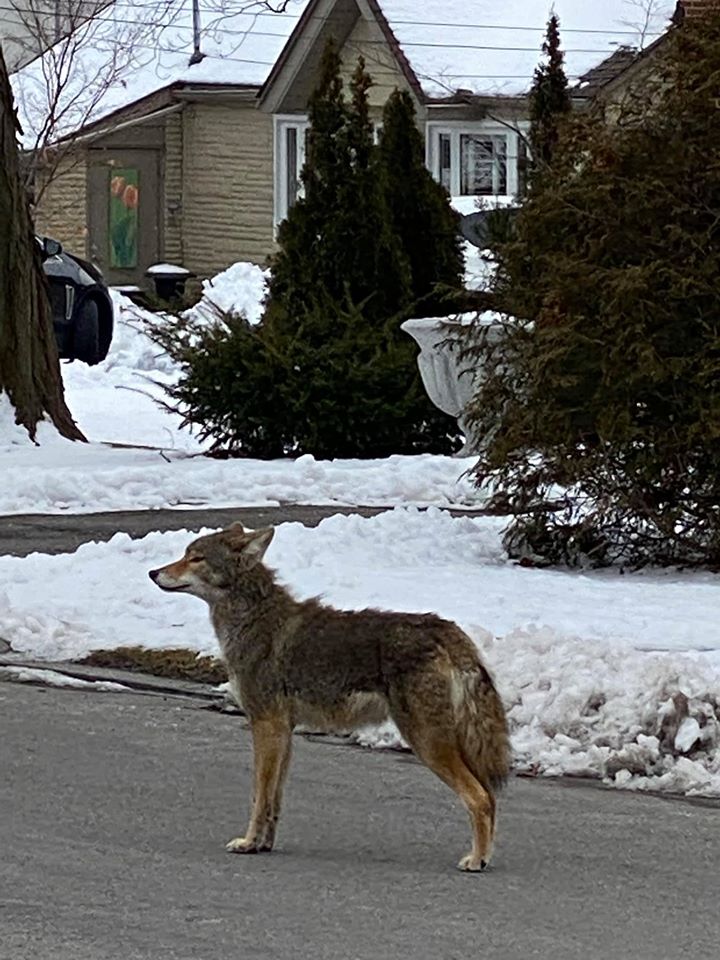
We’re having reports of coyotes on local streets. While they probably don’t pose any danger to humans there have been reports of small pets getting taken. Apparently it’s mating season, so they’ll sometimes be seen in pairs. I suppose the solo animals are looking for a mate.

A little over a year ago a neighbour posted this photo taken near our home

Even with a dog as big as our Sam (roughly 50 pounds and fiercely territorial), I won’t let her off the leash when it’s close to sun-up or sun-down. While she likely could protect herself, a bite from a sick animal could mean her death, so I’m very careful attentive to the changing lengths of day. Today for instance we were out a few minutes after 7:00 just around sun-up: although the sun wasn’t visible in the overcast sky.

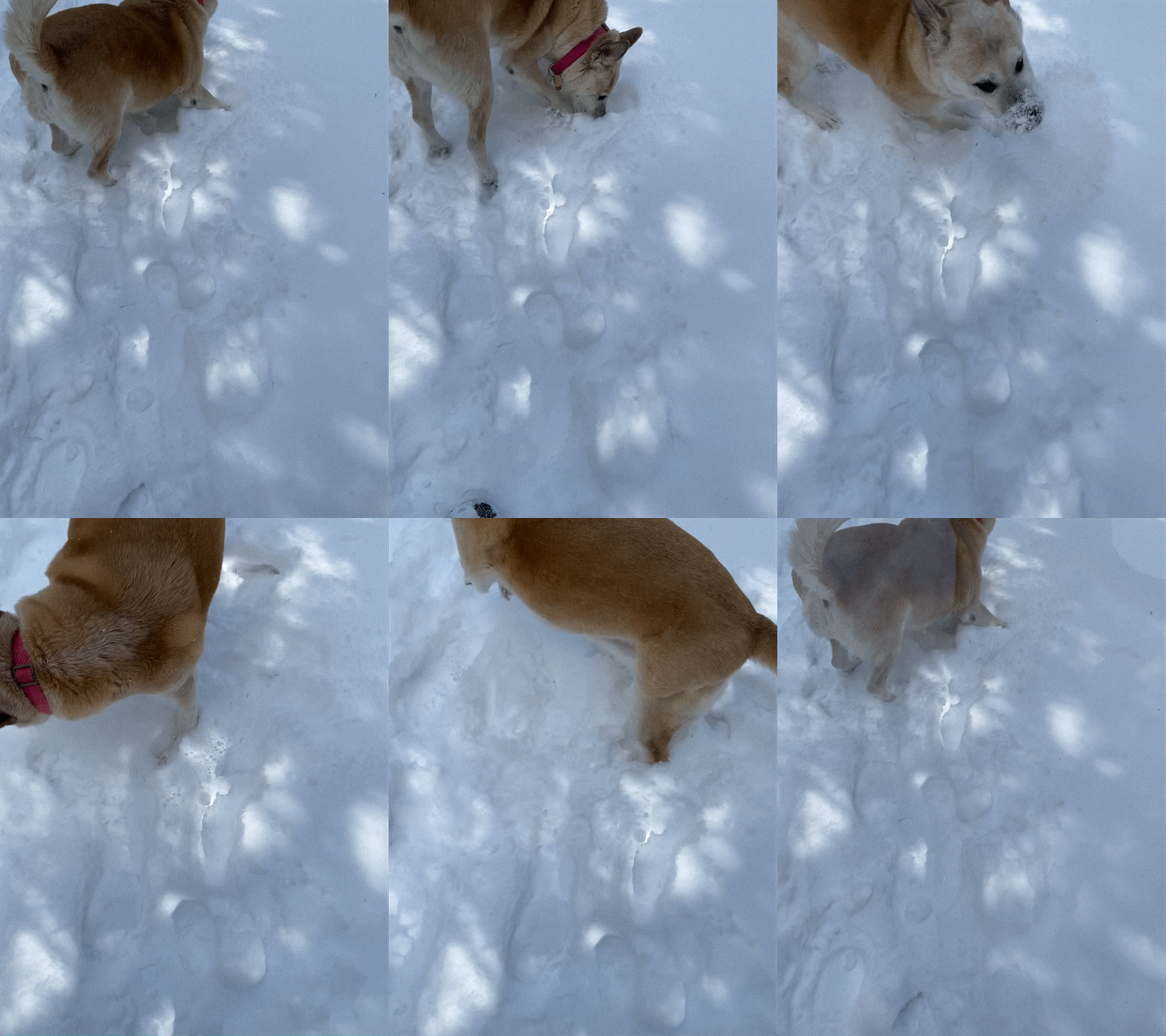
The snow seems to excite Sam, not just because it’s harder work moving through it when it gets deep. She’s very playful, zipping around in circles as you see in this looped gif I made, or when she lies on her back rolling in the snow.

While she may have come from the southern USA she seems to love the Canadian winter. When she’s romping in the snow she’s often snuffling around for traces of animals who have passed. It must be a bit confusing for a creature that relies on their nose, when the cold weather of winter shuts down or reduces many of their nasal stimuli. Sam stopped yesterday to snuffle about with her face into animal tracks, possibly with faint traces of a rabbit or a squirrel.

Skunks are another reason to be careful with the leash. While they’re supposedly nocturnal, they too depart from that schedule when they’re mating. Earlier this week I freaked out when I spotted a skunk in the neighbour’s yard while Sam was off the leash and far from me. The encounter was at 1:00 in the afternoon. I was worried Sam would get through the fence; she has her ways when she’s excited & pursuing prey. Luckily I caught her before she caught wind of the skunk: who once s/he heard us in the yard, sprayed and ran.

A few minutes later (after Sam & I were inside) I saw the skunk emerge in the front, but across the street.

It looks almost like a black cat, and bad luck if you get too close

This is the best picture I could manage. Gee…The animals never stop and let you take their picture.

Domesticated animals not only keep us company, but they mug for the camera.

But if the animals choose to come out during the day is it a sign of anything beyond their desire to mate? Hunger? curiosity? Whether or not they see their shadow, spring is getting closer & closer.

Posted in Animals, domestic & wild, Personal ruminations & essays | Tagged , , , | Leave a comment

Canadian Opera Company and National Ballet of Canada to receive government support for digital infrastructure

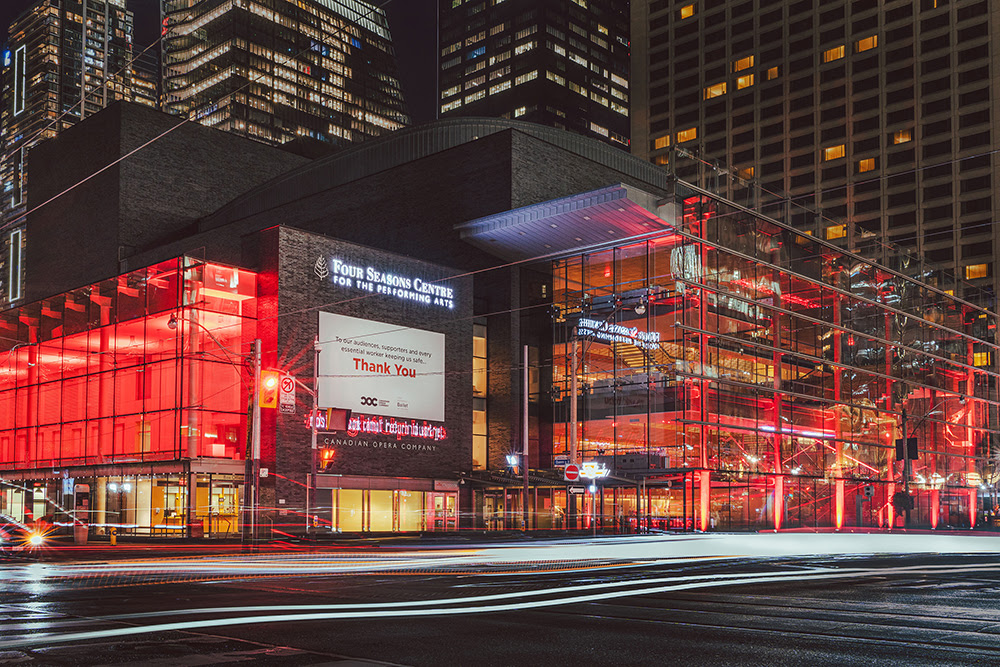
Toronto – In an announcement made this morning by the Department of Canadian Heritage, the Canadian Opera Company will receive $644,372 in crucial funding provided through the Canada Cultural Spaces Fund toward the Digital Infrastructure Enhancements Project at the Four Seasons Centre for the Performing Arts. The infrastructure plan, developed in partnership with The National Ballet of Canada, aims to implement a range of digital upgrades to the opera house, significantly boosting both organizations’ recording and broadcast capabilities in the immediate, as well as helping to improve both community and global access to Canadian artistry and other community programming showcased in the space.

“Today’s announcement is wonderful news for not only the Canadian Opera Company, but for so many of our artistic peers and community partners,” says COC Deputy General Director Christie Darville. “In carving a path forward through the fluidity of our current reality, investments like this allow us to better stage and safely share more original content, while also enabling us to share digital resources with others. The COC wants our home base at the Four Seasons Centre for the Performing Arts to showcase not only in the best in Canadian opera but also to serve as an accessible platform for new and diverse voices; this digital enhancement project is helping to make that goal a reality.”

“This forward-thinking investment from the Department of Canadian Heritage allows for high quality digital capture of performances, making our artform accessible to more Canadians and giving us the ability to showcase our work to the world,” says Barry Hughson, Executive Director of The National Ballet of Canada. “The National Ballet of Canada is thrilled to be a partner on this timely initiative and thanks the Government of Canada for investing in our future.”

Further information, from Government of Canada website.

“Press releases and announcements” are presented verbatim without comment

Posted in Dance, theatre & musicals, Opera, Press Releases and Announcements | 2 Comments

Shore’s new leitmotiv

Erika & I watched A Dangerous Method (2011) tonight. Have you seen it? It’s a fascinating film directed by David Cronenberg starring Viggo Mortensen, Michael Fassbender & Keira Knightley, all three in fine form portraying, respectively, Sigmund Freud, Carl Jung and Sabina Spielrein.

I wrote about it back in 2012 when it was still fairly new, keeping my focus on Howard Shore’s film score, that adds layers of subtext to the already dense two hours with his paraphrases of Wagner inserted into the film for diegetic & non-diegetic cues.

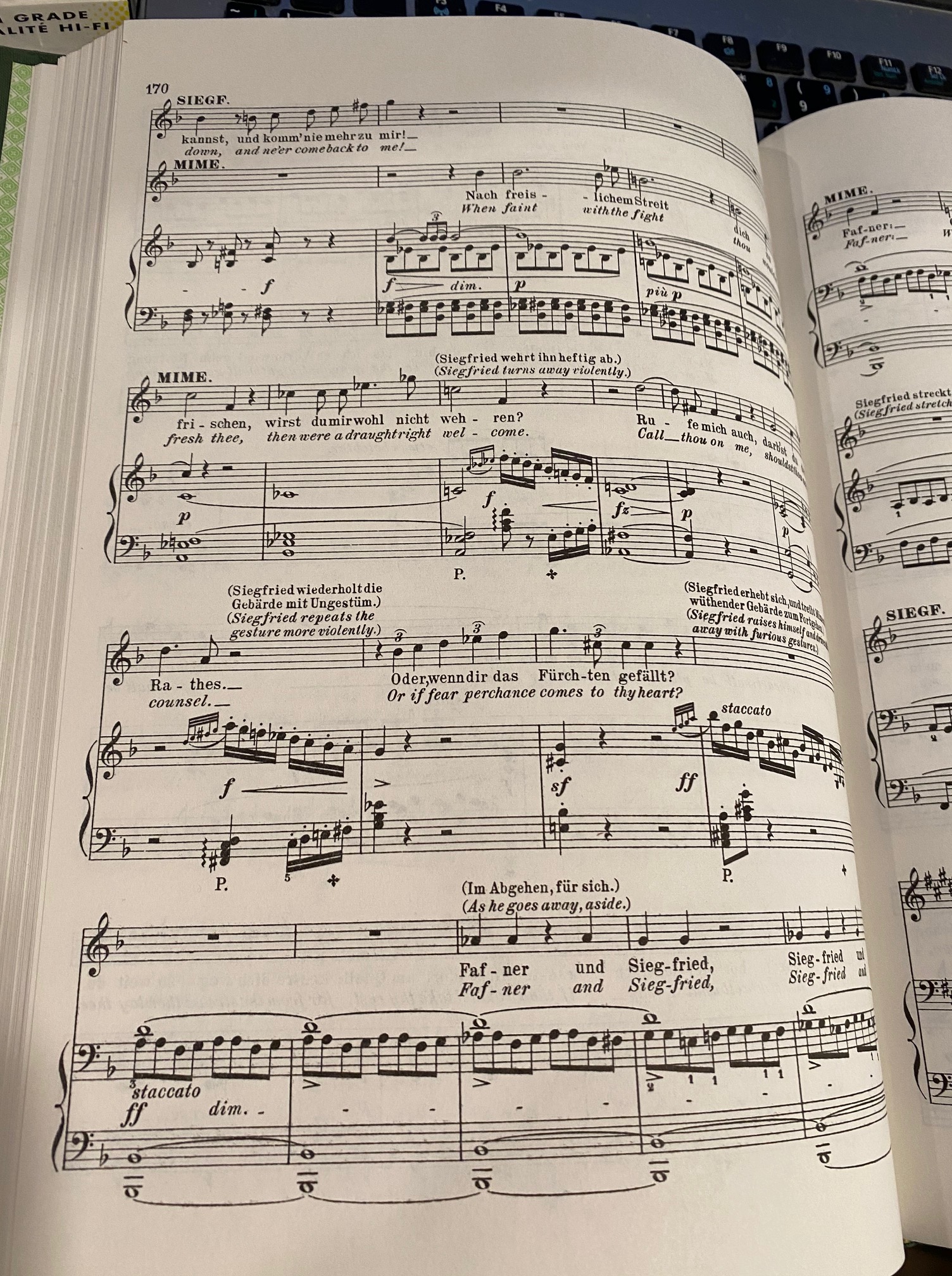
Watching it tonight I noticed something new, or at least something I missed last time. Shore takes a small passage in Act II of Siegfried, using it at least twice that I noticed.

In the passage being quoted, Mime has led Siegfried to the lair of the dragon Fafner. As he exits the stage, Mime will express his heart-felt wish that Siegfried & Fafner should kill one another in the upcoming battle:

MIME:
Fafner und Siegfried Fafner and Siegfried
Siegfried und Fafner
Siegfried and Fafner
Oh! Brächte Beide sich um !
Oh if they could kill each other!

You can hear it on this video, which should start at 29:10, and goes for less than half a minute, coming a little bit before the beginning of the musical passage known as the “Forest Murmurs”.

The relevant orchestral passage that Shore will use comes before Mime begins singing, as the orchestra is picking up on a theme associated with Mime.

The important phrase is that pattern music in the right hand, eighth notes gradually shifting harmony downwards.

Howard Shore grabs this little bit of music at least twice that I noticed in the film. Each time, there’s an encounter between Freud & Jung going on. Isn’t it intriguing that Shore should put this passage, where the dwarf is muttering about the two epic figures about to fight..? There’s a calmness on the surface, belying the war that’s about to explode between the two.

The first time we hear this music, we’re with Freud & Jung on an ocean liner traveling to America for a conference, still ostensibly on friendly terms although there is tension simmering under the surface, as they spar politely. Shore expands the passage considerably, much more than the six bars of the original, the pattern of modulation downward continuing on.

The second time is one of the last times they are seen together, as their antipathy grows until they break off their relationship altogether.

For me it becomes a new theme an altogether new leitmotiv if we look at what that music was originally signifying, as Wagner wrote it. That repeated note pattern is an off-shoot of the music associated with the Nibelungen dwarves, and represents Mime. But I don’t think Shore means the theme to suggest Mime –the observer—rather than the two epic combatants (Siegfried & Fafner), as this is simply an opportunity to call subtle attention to the simmering conflict. In each of the passages Shore is changing Wagner slightly, while still alluding to this moment before the big battle.

I am of course ever the nerd, happily riding out the cold of February & the social distancing of the pandemic, via the escapism of film. The Wagner adds additional depths to the film whether or not one picks up on associated leitmotivs. I don’t think Shore was just picking any old Wagner at random, given how many possible themes he had to choose from..

As often happens I find myself wanting to go back and see/hear it again, to see what else I might discover. The film is first & foremost a study of human motivation, probing beneath the surface of polite society. There is an enormous amount going on under the surface between the principals, and that’s amplified in Shore’s gentle allusions to the relationships in the Wagner music dramas.

Morning after addendum:
As Erika & I sat over breakfast, we recalled the film, discussing impressions. The film has a deep impact. Erika does not perceive the Wagner the same way as I do (given that I immersed myself in the music as a nerdy teen, and respond to the mythology in a manner not unlike Jung & Spielrein, who both made deeply personal connections with the operas, both the music & the stories). I remembered that one thing that Shore accomplished with his use of the Mime motif (an incessant repeated phrase that you can see in the musical sample above) was to remind us of one of the contemporary readings of the music & the character: Mime being decoded as a subservient sneaky Jew by an anti-semitic audience. And so, add that layer to the Freud-Jung jousting, that the older man was always going to be disrespected by some, possibly by Jung himself. Freud reminds us in the film, in a chat with Spielrein, that in the end both of them are Jews whereas Jung is aryan, the master race. While this is long before Hitler rears his ugly head, the anti-semitism is there in the normal behaviour of the culture. We discover it in the story of Mahler, who converts to Christianity, at least as a way to advance his career. It’s troubling stuff. Erika spoke of how shocking the final graphics are, giving us as epilog the outcome of each protagonist’s life. Freud flees the Nazis, dying of cancer in London in 1939. Spielrein who was living in Russia, dies with two daughters, murdered by Nazis. Jung lives to a ripe old age, dying in the early 1960s. Needless to say: we will watch the film again. We both felt that neither Cronenberg nor his actors, especially Keira Knightley, get proper credit for their work in this film because it is disturbing, and perhaps people don’t want to be disturbed. Cronenberg seems to enjoy provoking a response. I’m grateful as I sit in my safe home hiding from the pandemic & winter’s blast, that I have a few of Cronenberg’s films to disturb me and get me thinking. At the very least it makes it easier to find gratitude instead of seasonal affect disorder: speaking of psychology…I have to pull out my Freud & Jung books…. and perhaps look for something by Spielrein.

Posted in Cinema, video & DVDs, Opera | Tagged , , , , , , , , , , , , , | Leave a comment

Two Voices juxtaposed by Opera in Concert

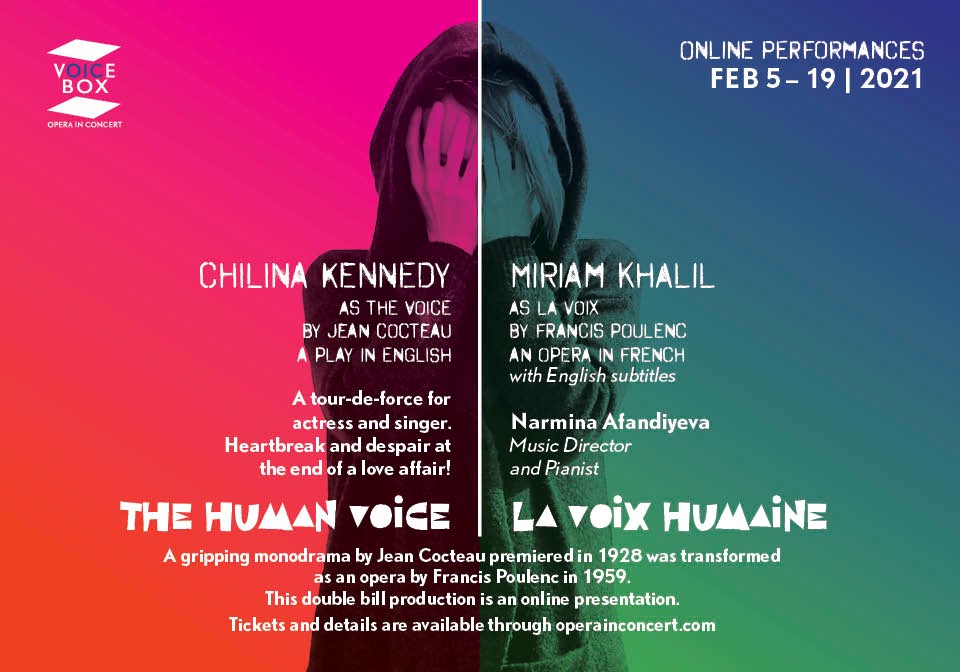
The one act play La Voix Humaine was written by Jean Cocteau in 1928. The one act opera La Voix Humaine based on that play was composed by Francis Poulenc in 1958. Each one is a monodrama, presented by a solo performer onstage alone, although the opera also has piano accompaniment.

Voicebox Opera in Concert are currently pairing the two in a unique double-bill as an online presentation. The play is presented in English translation as “The Human Voice” starring Chilina Kennedy as “Elle,” followed by the opera in French starring Miriam Khalil as “Elle” with piano & music direction from Narmina Afandiyeva, three exquisite performances in the two works.

In 1975 Stuart Hamilton, founder & Artistic Director of Opera in Concert, paired Cocteau’s play with Poulenc’s opera, a programming idea that the current Artistic Director Guillermo Silva-Marin is repeating this month, but as an online presentation.

Imagine that the solitary person onstage is only connected to the world through an electronic device…! It sounds very familiar in this year of the pandemic, even though the idea originated almost a hundred years ago with Cocteau. Great Northern Productions created the videography and audio recording of the two shows, that can be accessed at the Opera in Concert website until Feb 19th.

Chilina Kennedy as Elle

When I said “two voices juxtaposed” I could mean the two works or the two different performers. Chilina Kennedy speaks the role in English while Miriam Khalil sings it in French. Each is extraordinary in their own discipline, two different approaches to the same character contrasted as much by their respective disciplines as by the personalities.

Miriam Khalil as Elle

I am especially intrigued by the opportunity presented by that juxtaposition. Have you ever wondered about the differences between an adaptation & its original? We may wonder why a scene or a character was changed. Reading or watching Shakespeare’s Othello we discover a whole act that didn’t make it into Verdi’s Otello just as the operatic Carmen differs in several ways from Merimée’s novella. But the chance to study a play and its operatic adaptation side by side on the same bill? That’s a particular rarity indeed.

The 1975 pairing is fundamentally different from ours in 2021. Both play and opera were offered from a stage with an audience, requiring a stage actor’s trained voice or an opera singer’s voice to reach the whole audience. This time as we’re peering at and listening to each star on our own electronic devices, the game is different. Cocteau’s play becomes a teleplay on film with all the intimacy that the medium affords. I wonder how Chilina Kennedy would present Elle if she were performing on a stage? For this virtual version Chilina had the luxury of whispering into her phone. I say luxury because she didn’t have to project her trained actor’s voice to fill the theatre. This is one of the great challenges of a role such as this one when presented in a big theatre, that we’re to believe the actor is whispering into her phone even as she makes enough sound to be heard by however many hundred people are sitting with you observing her melt-down or intimate moments while we overhear. Chilina is sometimes lying to her lover, tipping us off with a facial expression that can be subtler than usual in this filmed version.

But if you think that’s difficult, soprano Miriam Khalil’s challenge is bigger still. The score more or less dictates how the part must be sung. While Miriam sang as delicately and softly as the part would allow, in many places it is written as though the singer must be heard in a big theatre: even in this intimate virtual context. It’s opera, right? And so even though we’re watching on our own device, the medium requires Miriam to sing with the piano even if the moment could work more softly & intimately.

The juxtaposition between the two versions is a dream come true if you’re a student of dramaturgy, studying how a play or an opera works. One of the things you notice is how Cocteau builds silences into his play, the moments when Elle is listening to her invisible lover on the other end of the phone. Somehow Elle must make us believe that there’s a person there, that her pauses are motivated by the inaudible words she hears that we can only imagine as she stands before us holding the phone. Poulenc’s operatic treatment is different because the silences are more infrequent. While the operatic Elle isn’t always singing, the piano is often playing into those “silences”, assembling the lines into something of an arioso, creating something very different from what we had in the play. In effect there’s another non-verbal voice, coming from the piano. At times the effect is of a Greek Chorus as we might find in a Wagner opera, where his orchestra fills in details or even the emotional underpinnings. As a result the soprano has less interpretive leeway, the score preventing her from being as free as the spoken word actress portraying Elle. Miriam pushed the role a long way away from the kind of ostentation we see on a stage, where the big voice and presence of a soprano may seem larger than life. And that’s how I have usually experienced this opera, come to think of it. Miriam softens the role as much as humanly possible.

The double bill of The Human Voice and La Voix Humaine are available from Opera in Concert’s website until February 19th.

Posted in Books & Literature, Dance, theatre & musicals, Music and musicology, Opera, Reviews | Tagged , , , , , , , , | Leave a comment

Jussi 2021

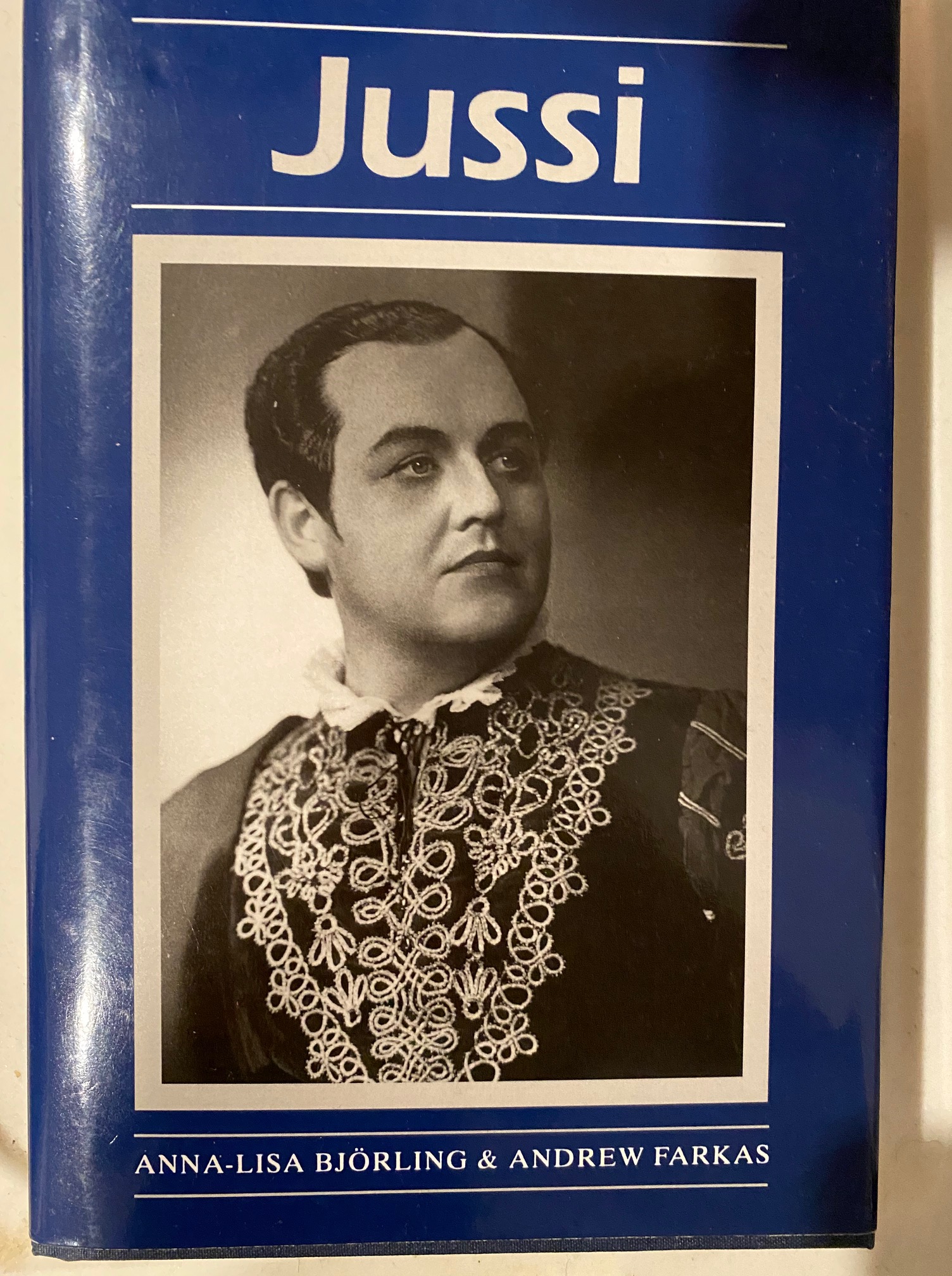
I’m reading Jussi, a biography of Swedish tenor Jussi Björling from his widow Anna-Lisa Björling, and a surprisingly honest look at the life of a famous singer.

It’s an appropriate week to think about Jussi. He used to celebrate his birthday on February 2nd , not realizing that his actual birthday was February 5th (as explained in Anna-Lisa’s book). Jussi liked the numbers of that wrong birthday, 2-2-11, observing that the 22 was double the 11. The tenor has been dead over 60 years, having passed away in the night September 9th 1960. So whichever day you choose for the celebration (speaking of lucky 11s) he would be having his 110th birthday this week.

I borrowed the book from my mom, expecting to escape from the horrors of the present into a kinder gentler world. I didn’t expect so much truth… There’s all sorts of uplifting stuff in this book, and it’s not as innocent as I expected. We read about Jussi’s alcoholism, the occasional temper tantrums, his child with another woman out of wedlock (from his teens, before he knew Anna-Lisa), and we read Anna-Lisa describing her heroic attempts to integrate young Rolf into the household with the other children, mostly by getting out of the house to let the kids (hers plus Rolf) get along.

Jussi started singing very early. By the time his voice changed in his teens he had already been singing for over a decade with his brothers & his father (the strict figure you see in the photo below), including touring in the United States.

Björling’s childhood was far from easy. He lost his mother at the age of six, his father at the age of 15, forcing the boys to disband their singing troupe.

While Anna-Lisa would report the increasing size of Jussi’s fees (surpassing $1,000 for a single performance at the Met in the 50s, to become their highest paid singer of the time) but when he began? He was like any other artist, just trying to make a living, and sometimes doing other jobs to support himself.

In those early days when Jussi was young & just starting out he made some popular music recordings: because he needed the money. John Forsell who was both Jussi’s Artistic Director and voice teacher insisted that if he must make recordings at the same time he was working for the Royal Swedish Opera, he must not bring his employers into disrepute or worse. “If you’re going to make these records, at the very least you must change your name!”

And so Jussi had a pseudonym. And he sang with a slightly different vocal tone so he wouldn’t be recognized. Or at least that was the plan. His other name was Erik Odde. Here’s one example, where Jussi –as “Erik”—ascends into the stratosphere with his light lyrical voice.

Jussi is a book full of great anecdotes about famous artists, and a few lectures about how to sing, including a few from Jussi himself. He may or may not be your vocal ideal. His vocal toolkit is considered ideal by some yet heavily criticized by others. The voice was sometimes very smooth, sometimes called “cold” by those who missed a more Italianate approach to vocalization. I love his singing including his occasional tendency to go sharp on climactic notes.

His acting? I never saw him in person, but only on recordings of old TV appearances, so I can’t really tell. But he is not considered a great singing actor, indeed he’s marginally competent in most assessments when it comes to the dramatic side of the opera equation. There are lots of testimonials in Jussi from colleagues defending his acting, which is a bad sign, at least an indication that the perception was that he was a good singer whose acting was weak.

One of the joys of opera biographies is the chance to encounter famous singers & artists of the past. If you enjoy that sort of thing, Jussi is a treasure trove, indeed I’d go so far as to call it an unparalleled glimpse of its time. It seems very authentic, very accurate.

We met Hugo Alfvén, the composer of “The Forest Sleeps” (or “Skogen sover”), who we discover was another admirer of the tenor, especially when he sang that song.


You see Regina Resnik and Robert Merrill not just as singers but coping with Jussi’s alcoholism, his hangovers & his bad temper, and all working together to make opera onstage.

You hear tell of the Björling children terrorized, overwhelmed by kisses in their backstage encounters with an affectionate Bidu Sayâo. We hear of Jussi’s strength, challenging & beating Errol Flynn or anyone else who tried to best him at arm-wrestling, the short stocky guy with a barrel chest, strong hands and a shy smile. We get to see beyond the onstage personas to an environment of collegiality & genuine love for art & fellow artists.

And there is the episode of the Ballo recording in 1960 with Georg Solti & John Culshaw. If you know what happened, especially if you’ve read Culshaw’s account, you might be surprised by Anna-Lisa’s version of events. At one time I used to see Solti the stubborn egomaniac as the villain of the story but reading Jussi I am now more inclined to take issue with the corporate creature Culshaw, doing his job. The tenor, on loan from another label, was expendable…

At best it’s heart-breaking, at worst a disgusting parable to illustrate the realities of business as it bursts into an otherwise happy story. I guess you can tell that I am not pretending to be objective about this. I believe this sorry event shortened Jussi’s life.

There are many inspiring moments before & after. Anna-Lisa tells us the details of Jussi’s final days, and his passing, a surprisingly moving account. I can’t deny Jussi is one of my favorite singers, a largely simple & straight-forward man afflicted with an addiction, and an artist of remarkable depth. On the occasion of Jussi’s 110th anniversary the book makes wonderful reading, but it must be said: it’s also largely about Anna-Lisa and the romance between the tenor and his most ardent fan.

I find myself liking her a great deal. She passed in 2006.

Posted in Books & Literature, Dance, theatre & musicals, Music and musicology, Opera, Reviews | Tagged , , , , , , , | 2 Comments

François Girard’s Flying Dutchman

François Girard’s production of Richard Wagner’s The Flying Dutchman is tonight’s free opera on the Metropolitan Opera website, available also tomorrow until the early evening when Rigoletto takes over. It’s new as in, having premiered in 2020.

I heard & read some horribly negative reviews, and so I had very low expectations, yet was pleasantly surprised and recommend you have a look if you have the chance. The singing is wonderful, and there’s nothing wrong with the production, at least nothing when you compare it to Girard’s previous work. This is the same director whose Parsifal was to grace the Canadian Opera Company stage last fall but for the pandemic, and who had previously impressed with Siegfried and Oedipus Rex, to say nothing of his cinematic work which I’ll omit except as far as saying it raises the stakes and audience expectations. I adored Parsifal (as the Met broadcast the same production years ago, and I have it on DVD), while being conflicted about the other two. The cast for the last incarnation of the Siegfried included some of the best talent I’ve ever seen on a COC stage, making up for shortcomings in the production.

Dutchman is a fascinating opera, Wagner’s first masterpiece, even if it sometimes seems to be straddling the boundaries between genres, perhaps evidence of the birth-pangs of something new in the theatrical world & Wagner’s imagination. While the story of Senta & the Dutchman concerns spiritual matters, they inhabit a world that mixes romantic comedy and gothic romance. I think the chief problems I see in all the negative reviews concern Girard’s choice to mostly ignore the conventions of the earlier forms, and focus the entire opera on Senta & the Dutchman.

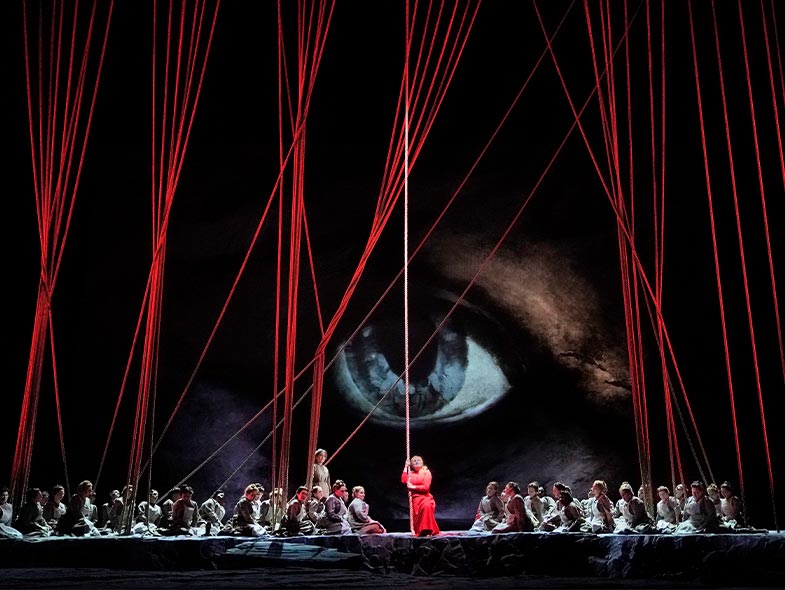
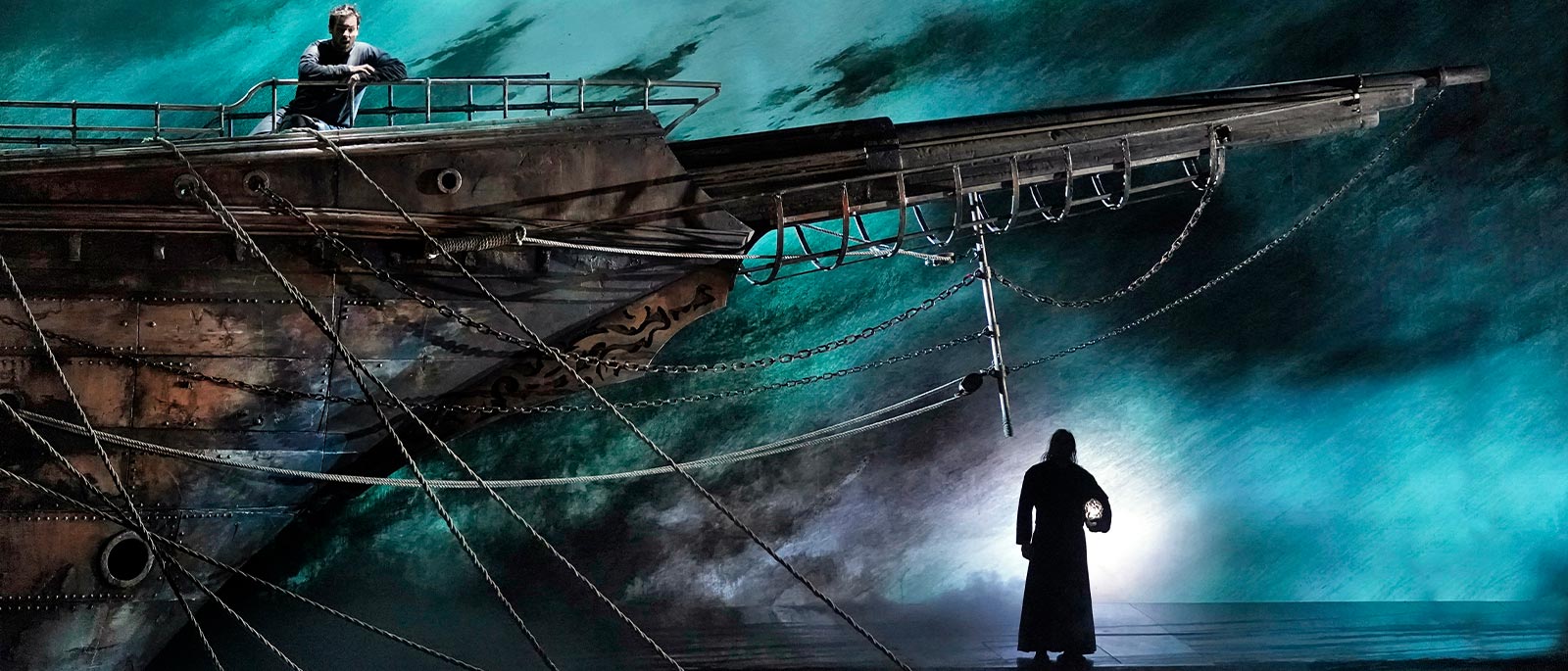
Senta is the focus. We see a picture frame with an eye that might be that of the Dutchman inside it. The story centres on the ballad of the Dutchman, whose image is in a painting we encounter in Act II; but Girard shows it to us in the overture, and from time to time throughout the work. Girard frames the Act II chorus of young women as a kind of portrayal of the norns, as we see huge ropes strung across the set, strummed and eventually tangled.

Girard’s Flying Dutchman production, set design by John Macfarlane

The trick is not to show up with stipulations, disgruntled by what’s missing, but instead to allow Girard to do what he’s doing and see it for what it is. No it’s not working in the usual ways of a romantic opera, but at times it’s spell-binding, beautiful, effective: at least for what it is.

While we see parts of the ship of Senta’s father Daland and the sailors of that ship, we never see the Dutchman’s vessel nor his sailors even though that’s in the score. The change isn’t a big deal if you surrender to what Girard is doing, which is quite effective. There’s a computer-generated effect that reminds me of something we saw in Robert Lepage’s designs for Damnation of Faust, where the movements of the Dutchman are animated into huge ghostly shadows, synchronized with his movements, that sometimes dominate the background.

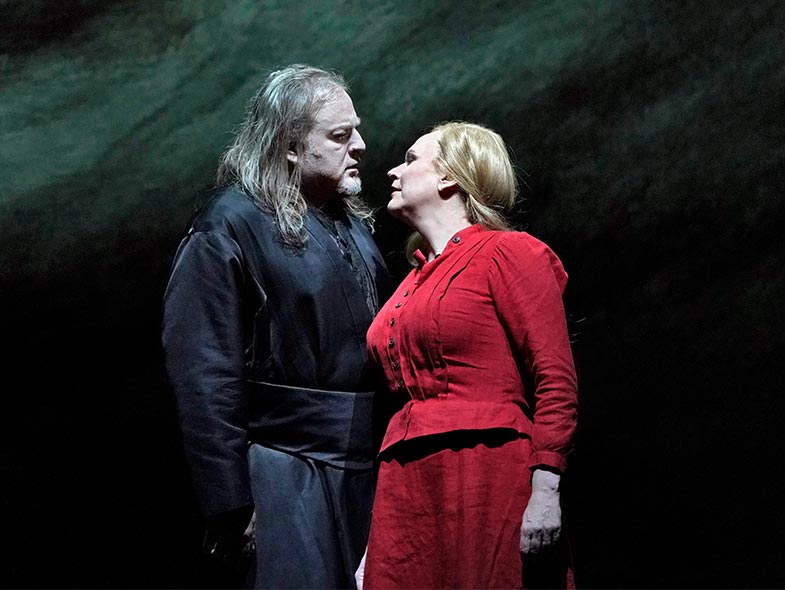
Musically it’s wonderful, the Met Orchestra sounding great under Valery Gergiev. Anja Kampe sings a glorious interpretation of Senta, a role that sometimes comes across as crazed in her obsession, totally convincing even in the close-ups of a high-def broadcast. Evgeny Nikitin, a late replacement for the injured Bryn Terfel, was restrained, mysterious & otherworldly in his dignified portrayal of the Dutchman; he’s more of a baritone, wonderful in the higher parts of the role.

Evgeny Nikitin and Anja Kanpe

Franz-Josef Selig was a conventionally comic Daland, while Sergey Skorokhodov stole the show as the best Erik (a hunter in love with Senta) I’ve ever seen.

If there’s a problem it’s with the weighty objectives of a director determined to show profundity in an opera that’s often light-weight & comic in tone. Yet it works if you let go of your assumptions and the score and simply go with it, seeing what’s in front of you. The choral set-piece in the last act is totally unlike any I’ve seen before, quite lovely & a curious companion piece to what we see in Parsifal, another opera where Girard assembles groups that are all of one gender (although in Dutchman it’s actually written that way).

The staging of the ending is a bit weak but that’s true of every production I’ve ever seen. Directors all struggle with the requirements of the story, and this one is far from the worst.

Posted in Art, Architecture & Design, Cinema, video & DVDs, Music and musicology, Opera, Reviews | Tagged , , , , , , , , , | Leave a comment

Mandala: The Beauty of Impermanence

I heard from Larry Beckwith, who is Artistic Producer of Confluence Concerts, that they’re offering something titled Mandala: The Beauty of Impermanence:

“Premiering Online
Wednesday,
January 27, 2021
6:30 pm Pre-Concert Chat:
Make a Mandala
6:50 pm Concert
Available until
Wednesday,
February 10, 2021 on
Confluence Concerts’
YouTube Channel
CLICK HERE

Mandala is a word, rich with associations in different cultures.

Erika designed a birthday card awhile ago that included a mandala.

Erika Barcza’s original design for a birthday card for a friend.

I recall the Buddha statues in Afghanistan, destroyed by the Taliban. I couldn’t help thinking that if we could ask the Buddha about it we might be told something like “don’t worry, this too is what it is”, because of course, whether we speak of a small circle of coloured sand erased by the sweep of your hand, or a huge statue exploded by dynamite: the lessons are the same.

Lately concerts or performances have often been postponed or cancelled due to the coronavirus. Businesses have gone under, and of course, many lives have been cut short.

If we are very precise in our language, we think of the mandala as a shape, a design, a symbol. But we may recall that a mandala is a kind of model for the world and life. The shape becomes a mirror or even a portal through which we look as we meditate, helping us to shed our immediate concerns (what’s for dinner? Did I pay that bill?) to peer deeper at what’s right in front of us.

There’s a bit more in the message from Confluence, from Suba Sankaran

Welcome to Mandala: The Beauty of Impermanence. Mandala is a universal symbol meaning “circle” in Sanskrit. It is a spiritual and ritual symbol in Hinduism and Buddhism, representing the universe. The circular designs symbolize the idea that life is never-ending and everything is connected. In this concert, and in every song and poem, you will experience a mandala within the music itself, whether sacred or secular, be it as a singing round, a ground bass, an ostinato pattern, a recurring rhythmic cycle, or within the lyrical or poetic context.

From ancient to modern, spanning several centuries and styles, the repertoire ranges from Hildegard von Bingen to Joni Mitchell, Schubert to Steve Reich, and Monteverdi to Sting. You will hear music from India, the U.S., Canada, the U.K., Europe and Iran, original compositions and arrangements, and Sufi poetry as well.

I’m excited and humbled to have an embarrassment of riches with the artists participating in this show, and I want to thank them for the many gifts they brought forth. These artists include Confluence Concerts’ artistic producer Larry Beckwith and artistic associates Andrew Downing and Marion Newman, as well as Gordon Gerrard, Bijan Sepanji, Sheniz Janmohamed, my husband, Dylan Bell, my father, master drummer Trichy Sankaran, and my dear friend and bandmate Ed Hanley, who makes a cameo appearance playing a singing bowl, in addition to having captured and edited most of the video for this show.

During the pre-concert chat, Sheniz’s voice will guide the audience through a nature mandala creation. Don’t forget to take a photo of your creation before you “disappear it”! Send a copy of the photo to manager@confluenceconcerts.ca. We hope to create a community collage of your spontaneous inventions! A MESSAGE FROM SUBA SANKARAN This is a reminder that these beautiful mandala creations are in-the-moment and then disassembled, giving one the sense that nothing lasts, and so we must enjoy the experience in the now. That is the hope of this concert, Mandala: The Beauty of Impermanence. Experience and enjoy this musical journey and audio-visual feast as fully as you can, as it happens, and gracefully let it go as it naturally comes to an end.

Thank you for joining us, and enjoy the show!

Posted in Art, Architecture & Design, Personal ruminations & essays, Press Releases and Announcements, Psychology and perception, Spirituality & Religion | Tagged , , , , | Leave a comment

A tale of the stub, or Pollyanna Interrupted

As I was choosing my wardrobe for a trip to my mom’s place for lunch, I opted as usual to try to look a bit nicer for her, pulling out a pair of dress-pants that I realized haven’t been touched for months.

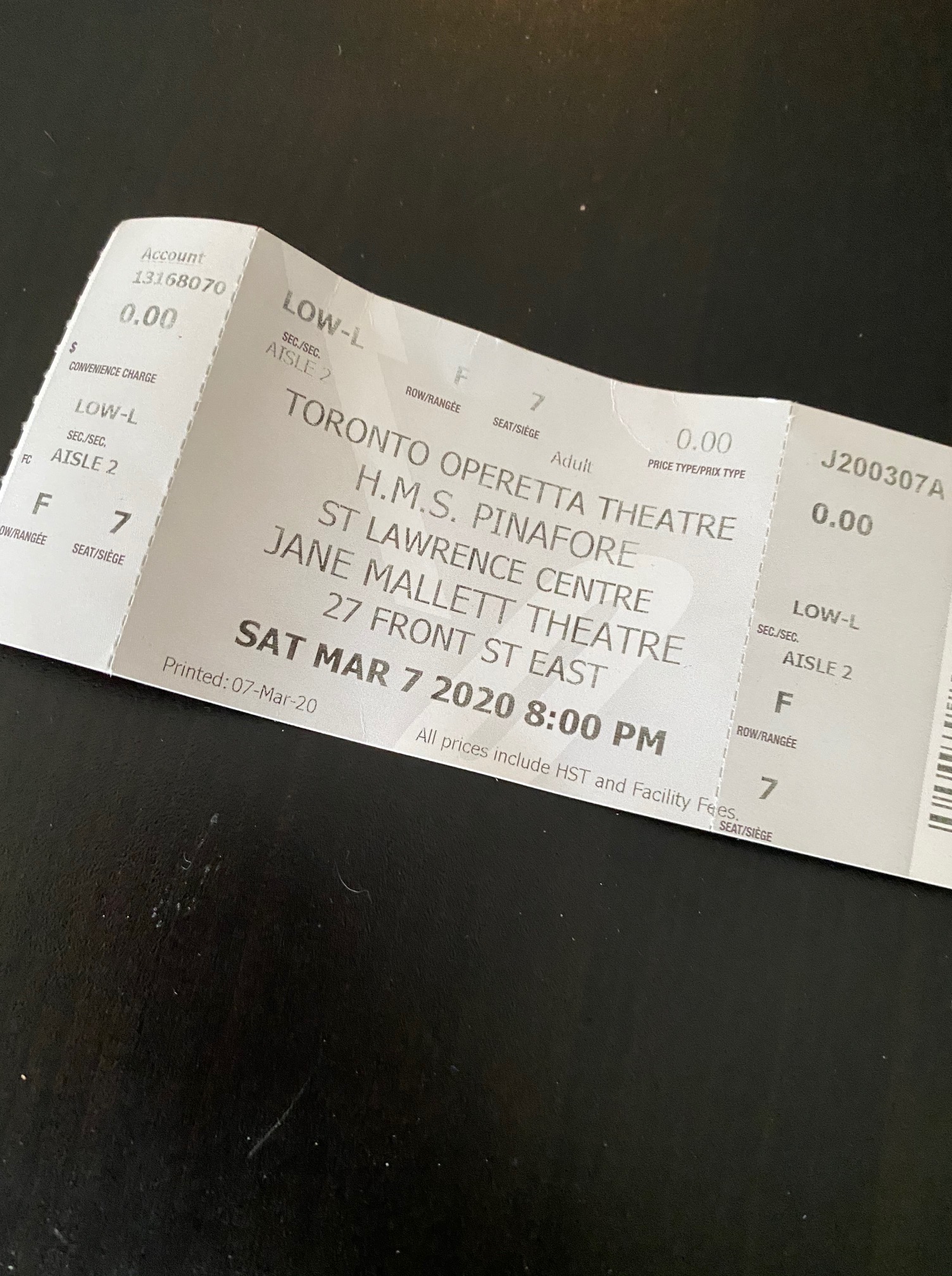
When I was trying them on, I felt a ticket stub in the pocket. Wow it’s the last show I saw, a week into March 2020.

March began with such promise.

Sunday March 1st was a matinee of the National Ballet. Chroma, then Marguerite and Armand marking the farewell of Greta Hodgkinson, and finally the world premiere of Crystal Pite’s Angels’ Atlas.

Thursday March 5th was a Koerner Hall concert by James Rhodes, my first Beethoven concert of what was supposed to be a year celebrating his 250th anniversary.

And finally Saturday March 7th was that Toronto Operetta Theatre’s HMS Pinafore.

After 67 days (31 days of January, 29 for February + 7 days in March) that was it for live performance in 2020.

Suddenly it was all about cancellations. Nederlands Tans Theater with another work from Crystal Pite,…? Jan Lisiecki to play Beethoven with the Toronto Symphony,….? and the next week, Yuja Wang, to play Brahms….? The spring season of the Canadian Opera Company….? All either gone or postponed.

I’m not sure when I became conscious that this was going to last, but I was incredibly busy at work, writing procedures, doing long hours…So I couldn’t blog as often, and when I did it was more likely to be about a book or a film, or music I was making at home. And I was being extra careful to stay positive (as Stacey advised me), which is a big reason I talked so much about Sam the dog lately. She cheers me up.

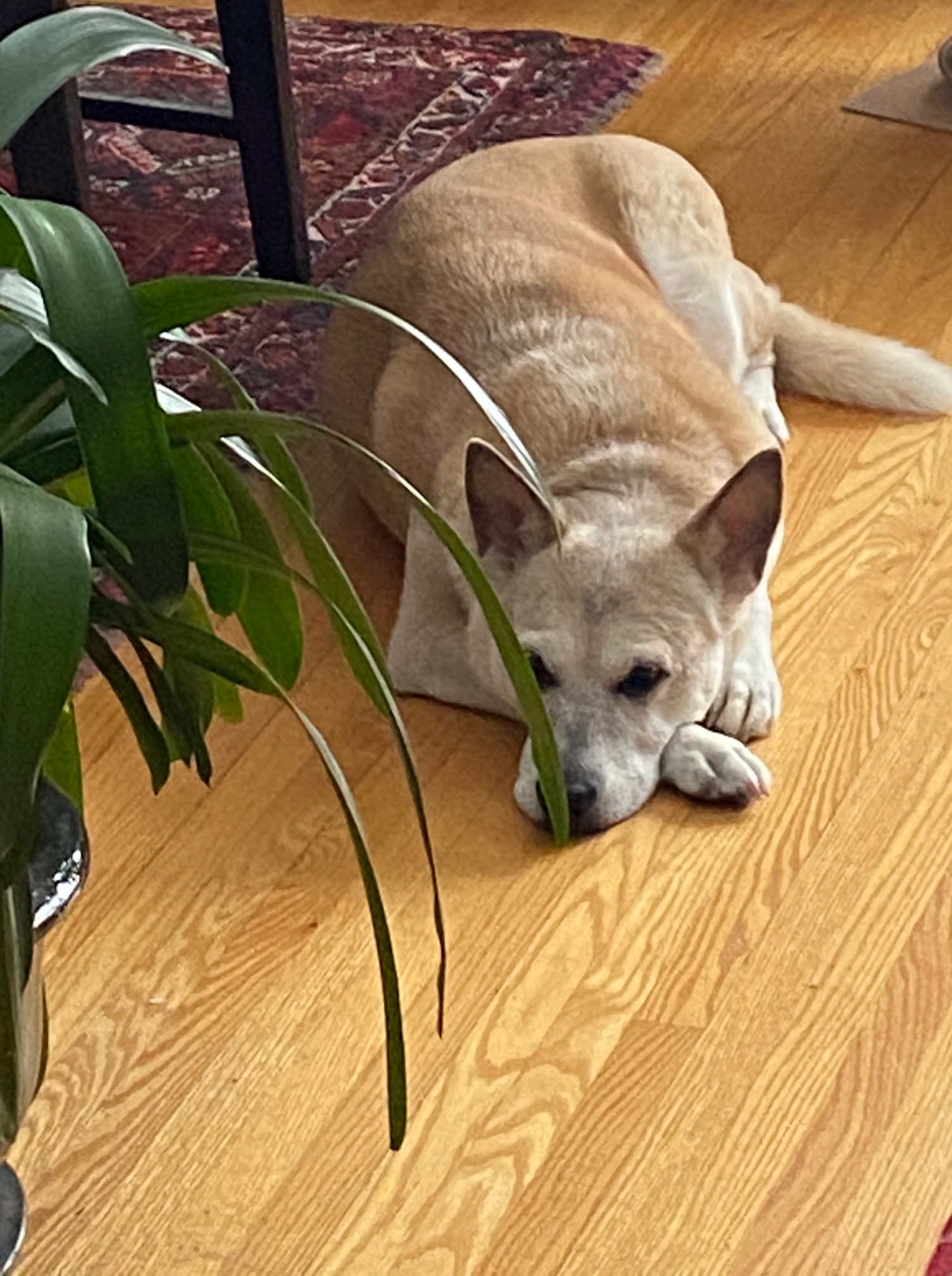
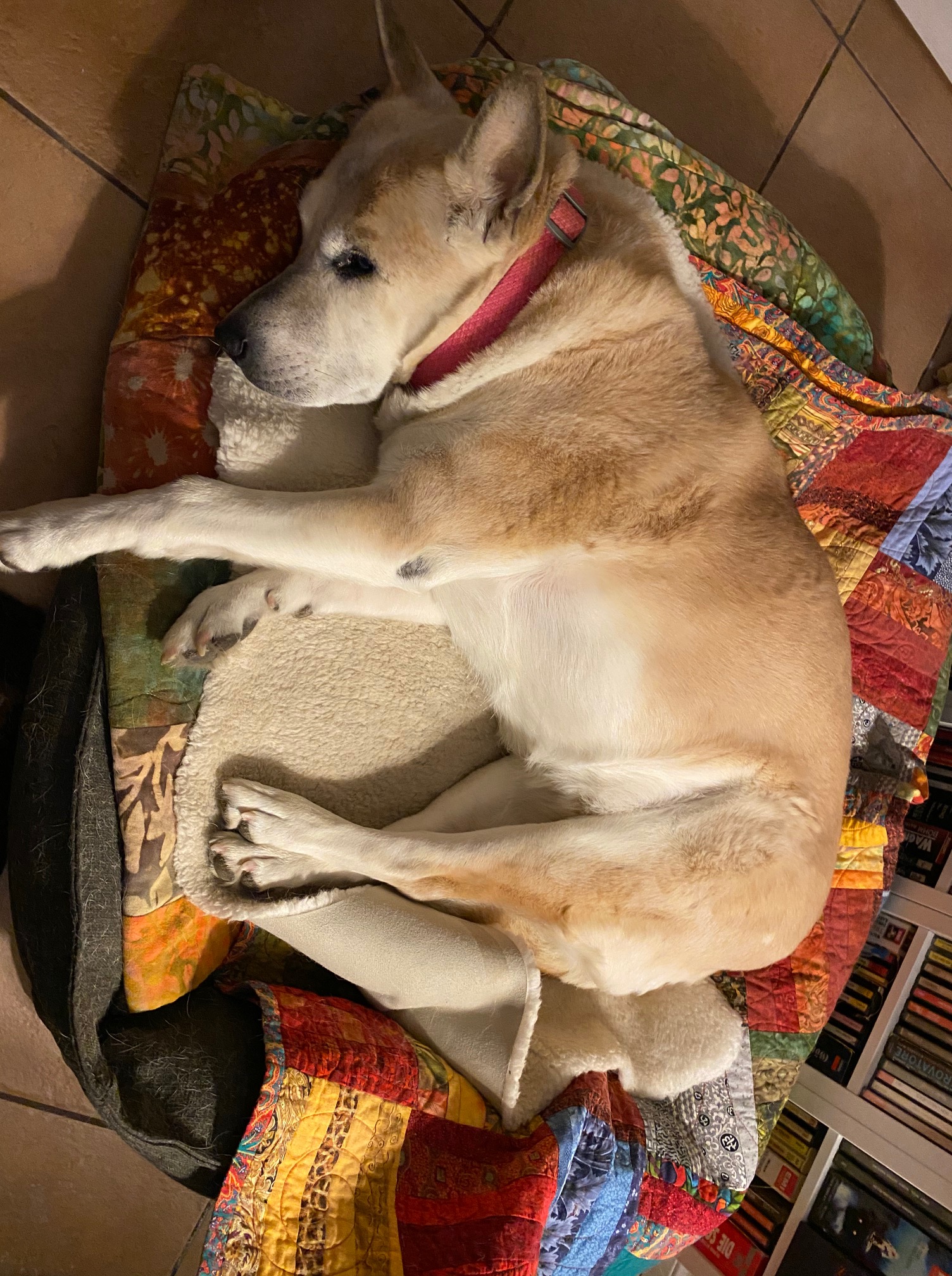
If she could talk, she might say “you again?!”

I’m publishing this today because it feels like a natural beginning: January 20th being a significant date south of the border. As a retrospective for 2020, I don’t think I can do the usual best of Pollyanna thing as in other years, not when “the year” was so short. Instead I will make a couple of observations.

Alexander Neef has been succeeded as General Director of the Canadian Opera Company. The Neef decade was remarkable for its casting triumphs, for a fascinating parade of directors & productions, and for some unanswered questions about company finances. I’m hopeful that Neef’s successor Perryn Leech will be good for the health of the company, coming during this natural break imposed by circumstances.

Perryn Leech, incoming General Director of the COC

The next show will be a new beginning.

Meanwhile, am I the only one who found it odd that the COC were promoting their flagship attraction of Parsifal (meant to premiere in the fall, but cancelled) as “monumental”, trumpeting about how many hours long it is? Monuments are what you put up for dead people. Monuments are big heavy things, no? Long shows don’t usually attract an audience, especially not with this kind of language. Why not just hand out sleeping pills. And—a tiny quibble—if you’re going to play a sample of the opera for the audience at the season launch, why not try to excite the listeners? Why not give us the first ninety seconds of Act II, and played with conviction? Perhaps I’m asking too much, but I’m a subscriber. I was not impressed, even though as a devoted Wagnerian and admirer of the production, I’d be sure to see it at least a couple of times.

I have been pondering a few questions for months now, and confess that I don’t have the answers. We’re in a funny place right now, where the arts are prohibited in the usual venues in the usual ways, but are sometimes permitted in a variety of virtual arenas, depending on the medium. The rich are getting richer, whether we mean the companies like Shoppers Drug Mart, Walmart, Amazon, youtube, and telecom companies who profit during our lockdowns, or the clever entrepreneurs. And some are in big trouble.

I’ve been wondering about whether the virtual media are only a temporary replacement or the new normal. And my gut feeling is that we have to face facts. Of course I prefer live to the artificial, I’d rather singalong with Messiah than see it on TV, I’d rather be at a concert venue or theatre, always. The business model was always a bit precarious, leaning heavily on government & private support. I think circumstances have forced a great many artists to learn how to zoom, how to record & share their art. I hope the coming year –whenever we get to the promised land after COVID of course–sees a huge explosion of audience gratitude, even as I cringe thinking of artists & companies who are suffering, trying to pay bills with so many gigs cancelled. Virtual has been competing with live for quite awhile now. Long before the high definition broadcasts, there was already a fund from the recording industry in support of live music. This isn’t a new issue but one that has been underway for decades, if not centuries.

I wonder too about trained voices, meaning the ones that can be heard without amplification. I couldn’t help noticing that the virtual realm changes the paradigm. In Messiah / Complex the most authentic looking and sounding performers were the Indigenous voices not the powerful trained voices. It’s not terribly logical of me to use one event as somehow indicative: except that it confirmed exactly what I expect. I am reminded of the time of the early talkies, as captured in Singin’ in the Rain, when the rules changed due to a paradigm shift. Obviously it’s way too early to be making pronouncements, predicting winners and/or losers, but I think it’s a fascinating time. Hang on to your hat, the winds of change are blowing.

So I would recommend that you think about who and what you really like, who you want to support, and then if at all possible, to lend a hand. Whether you prefer dance, opera, music, a place of worship, restaurants,… they all are hurting in different ways right now. I wish our government would offer paid sick-leave, as I saw the advantages this confers while at the U of T, where they had the vision to be super lenient with staff whose possible illness might or might not be that virus. Mr Ford, this is no time to be cheap and worried about the deficit. There are lives at stake.

In the meantime, you know what to do to stay safe.

Posted in Animals, domestic & wild, Dance, theatre & musicals, Music and musicology, Opera, Personal ruminations & essays | Leave a comment