Two schools

My review of the Canadian Opera Company La Boheme that I saw last night alluded to two different approaches. I hope you’ll bear with me. I know many people who would roll their eyes. Why bother at all with Boheme, this warhorse?

Perhaps that’s the problem, like the people who have given up on voting, having decided they can’t trust the process or the promises of the candidates.

We can understand two extremes, with all sorts of combinations between the two poles.  Ideally a production would unify styles, rather than offering two or more approaches on display in the same production.  For better or worse, I meant these two extremes:
1: “old fashioned” was what I called it in the headline. It wasn’t a euphemism, it was literally true. Many in the audience gobble this up, and some prefer their opera this way. This is how things used to be done: singers standing and gesturing and mugging, while placing almost their entire focus on singing, a histrionic style rather than one that’s recognizably modern.
2: “naturalistic” might be an absurd word to use, when we’re still talking about operatic performance. But one can sing in a way that the feelings being expressed emerge as though the performer just thought of them (operatic method acting??). Singers who are looking out into the audience, staring at the conductor or parking themselves in one place to sing are less believable than those who engage with the diegetic reality of the story and with one another, reacting and seeming fully alive.

There are moments in Boheme that are more conducive to one style than the other. I think the two arias side by side in Act I don’t have to be done the same way. Where “che gelida manina” does have some business (he touches her hand after all), it’s really about a text that builds to a big high note, followed by a gradual diminuendo to the last notes on a question to Mimi. Just as we might say boys will be boys, so too tenors will be tenors.  I won’t go so far as to say “egomaniacal narcissists will be egomaniacal narcissists” even if I do watch way too much CNN and read the tweets of a certain politician.  If the tenor isn’t totally self-centred, it’s already a win. And so long as the high notes are there, all is forgiven.

Her answering aria is conversational, some of its most beautiful effects are actually in the orchestra –where I hear clearly Puccini telling us that her life is a passive fatal reaction to circumstance, that she has a dark cloud hanging over her–and not in the vocal line, unlike the tenor’s aria. The role of Mimi is different, because it’s really all about what she shows us in her reactions, which tells us how she will live her life.

Maybe I need to admit that this opera is full of moments that I have seen done both ways, both the older style or someone aiming to find something authentic.

When Musetta & Marcello end their exchange in Act III with insults (it’s a bit like a duet but functions as part of a quartet, given that Rodolfo & Mimi are also onstage) , this can seem very real. I was surprised at how natural this exchange seemed last night, as Musetta walked off with another man, while Marcello’s replies had less than the usual anger: because he seemed deflated & jealous. Just when you think you know how a scene should sound, someone surprises you.

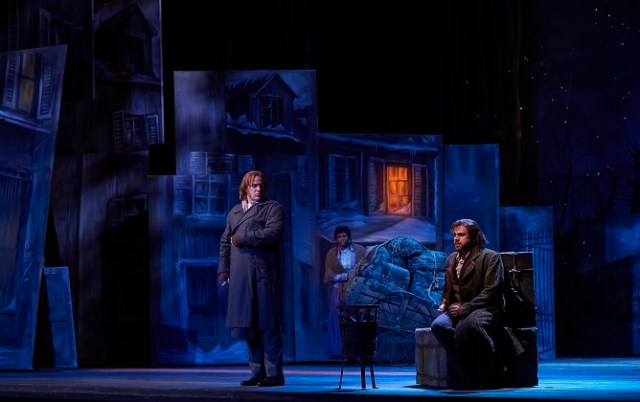
18-19-05-MC-D-2850

(l-r) Lucas Meachem, Angel Blue (background), Atalla Ayan (photo: Michael Cooper)

The ending of the opera is a musical- drama event that can be very powerful. The way it’s written it should work like clockwork, yet frustrates me over and over. We watch a sequence of events, as

  • Mimi dies
  • Schaunard is the first to notice and tells Marcello
  • The music gives us a little bit of melody then silence.
  • Gradually each of the singers onstage notices & privately responds, until Colline (who has just returned with money) innocently says “how’s it going?” (literally “come va”).

There is silence. What the opera does in this silence can be quite magical, even if done in the old-fashioned way.

  1. Rodolfo speaks into the silence wondering at the others, and the reality begins to dawn on him (and the question for the performance is: how quickly? how much? how soon?).
  2. Marcello is the first to address the reality, saying “Coraggio” (courage) to Rodolfo
  3. And Rodolfo finally understands, going to the bed crying “Mimi!, Mimi! Mimi!

The old fashioned way to do this usually gives us a Rodolfo who is sobbing very early, and alas that’s what we got last night. What I understand in this composition is that Puccini meant for the orchestra’s loud chords to signify recognition, the blast meaning a gut-level knowledge.  The ending is much more powerful if Rodolfo somehow resists the impulse to be a ham, resists the impulse to steal this moment from the audience by over-acting.

I’ve seen it done another way that would seem more naturalistic, in the sense of letting the emotions emerge in tune with the music and building in a way that seems more like what Puccini had in mind. At ‘1’ we don’t need to have a shouting voice. Rodolfo should begin this relatively neutral, if not hopeful At the very least he is questioning, confused, rather than too loud too soon. If he’s too loud he upstages Marcello’s line. I recall Against the Grain doing it with this emotional logic, Ryan Harper as Rodolfo & Justin Welsh as Marcello, directed by Joel Ivany back in 2011. If Rodolfo isn’t too loud, then Marcello’s line has the simple dignity that opens the flood gates to what follows. Rodolfo should not really know too much too soon. I can handle histrionics, stand-and-deliver singing, two-dimensional characterization, sentimentality: so long as there is a clear emotional logic. Otherwise you’re wasting Puccini’s melodrama.

I’ll see it again. Perhaps the production will be more fluid when they’re done a few more performances.

Posted in Opera, Personal ruminations & essays | 2 Comments

Old-fashioned Boheme

Tonight was the opening performance of the Canadian Opera Company’s revival of John Caird’s production of La Boheme directed by Katherine M. Carter. As with their earlier return to Atom Egoyan’s Cosi fan tutte a few months ago, the concept wasn’t as tyrannical the second time around, allowing the opera to get back to what it used to be, to work more like usual.

In other words we were watching star performances vying for our attention, Puccini’s wonderful melodies & a sentimental story that can make you cry.

Much of the action is sophomoric, scenes that could be subtitled “boys will be boys:” that is until romance rears its head with the arrival of Mimi. The opera is so well-written that it can’t miss, each performer getting their moments to shine, with a few variations.

I’ve seen a lot of Bohemes in my life, sometimes more realistic in the characterizations, sometimes more operatic, relying on the music to make the biggest statements. This cast is an interesting combination of both approaches.

In the last act everyone is mostly leaning towards that operatic approach –as you might gather from my headline—in readings that are less realistic than operatic, the voices all quite good. Carter reconciles the performances with the concept, so that the images around the stage don’t jar the way they did when Caird first showed us his reading of Boheme.

Atalla Ayan is the impetuous poet Rodolfo, Lucas Meachem is Marcello the painter. Ayan had a lovely Italianate sound & all the high notes you could ask for. Meachem gives us a commanding Marcello, owning the stage every time he wanted our attention with a powerful presence and a bigger voice than one often gets: although I’ve heard it said that Marcello is almost written like a helden baritone. We had the luxury of lots of sound in our Marcello, allowing for a fascinating contrast between the two men, one commanding the other more of a real poet.

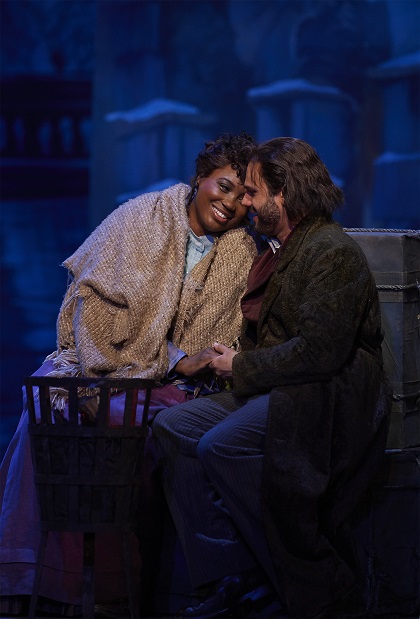
18-19-05-MC-D-2840

Angel Blue and Atalla Ayan (photo: Michael Cooper)

While I used to focus on the music I spoke of as sophomoric –when I was more of a kid myself—with maturity I’ve gradually changed my understanding of the opera, so that Mimi has come to be my favourite character every time she’s on stage. Angel Blue was remarkably original for two acts, accomplishing that miracle in a well-known story like this one, where you dare to dream of a different outcome (which is ridiculous of course). Hers was a youthful & innocent Mimi, giggling and cheerful in ways I haven’t seen in a long while, when so many play her as doomed and tragic. Even in Act III, when the eventual outcome becomes unavoidable, she made a great deal of her encounter with Rodolfo.

Andriana Chuchman’s Musetta was the perfect match for Meachem’s Marcello, every bit as charismatic as he had been and beautifully sung.

18-19-05-MC-D-2850

(l-r) Lucas Meachem, Angel Blue (background), Atalla Ayan (photo: Michael Cooper)

You might say that Brandon Cedel as Colline & Phillip Addis as Schaunard were a bit out of step with the others, because their acting was so naturalistic & believable. If this was a problem for me, it was only in the last moment of the opera, when Addis’s response to Mimi’s death totally slayed me, and then the more melodramatic work by everyone else onstage, while normal for this opera, left me cold. But I had tears during Blue’s Act I aria and again in the wonderful duet between her and Ayan in Act III. So it works in some places better than others.  It’s a Boheme with a little something for everyone, gorgeous to look at and beautifully sung.

One other major player had a big impact on the performance, namely conductor Paolo Carignani. I recall once long ago hearing (third hand, quoted from Ernesto Barbini) the assessment that Boheme is the hardest of all operas to conduct, because tempi have to be so variable, sensitive to solos, ensembles, duets, with rubato and nuance and flow. At times Carignani seemed intent on imposing his ego on the performance, leaving soloists scrambling to catch up a few times, and totally hanging the children’s chorus out to dry as though he were a sadistic school-master. So in other words maybe Barbini was right about how difficult this opera is to conduct. The big climaxes were all there, the solos sounded great. In a few a piacere moments he gave a bit more introspective space for the soloists, although this was inconsistent, as in other places the pace was unforgiving. Carignani kept me conscious of the process, keeping me at arm’s length from the story and often unable to really surrender myself to the story: although maybe that’s just me.

I was thinking of Paris, the site of this story and of course the site of the big story in the news this week. Recalling that Victor Hugo said

The greatest products of architecture are less the works of individuals than of society, rather the offspring of a nation’s effort, than the inspired flash of a man of genius.

So much of Toronto, so much of Canada is new. Our lovely new Four Seasons Centre is our temple to the arts, where the COC presents its operas to us, one of our greatest treasures. I’m so happy to be there, happy we have this wonderful place to gather and celebrate all that is beautiful.

We are so lucky.

Posted in Art, Architecture & Design, Music and musicology, Opera, Reviews | Tagged , , , , , , , , , , , , | 3 Comments

Pondering wandering

I like the sound of that headline. As I do what it says, pondering wandering, I am a bit lost in the ambiguities. If we knew where we were going it wouldn’t be wandering, would it.

The time of year encourages such thinking, the mind drifting onto certain well-worn pathways as several religions have some of their most important holy days.  I’ve been mulling over some of the things I saw recently, that have taken me on a kind of metaphysical journey.

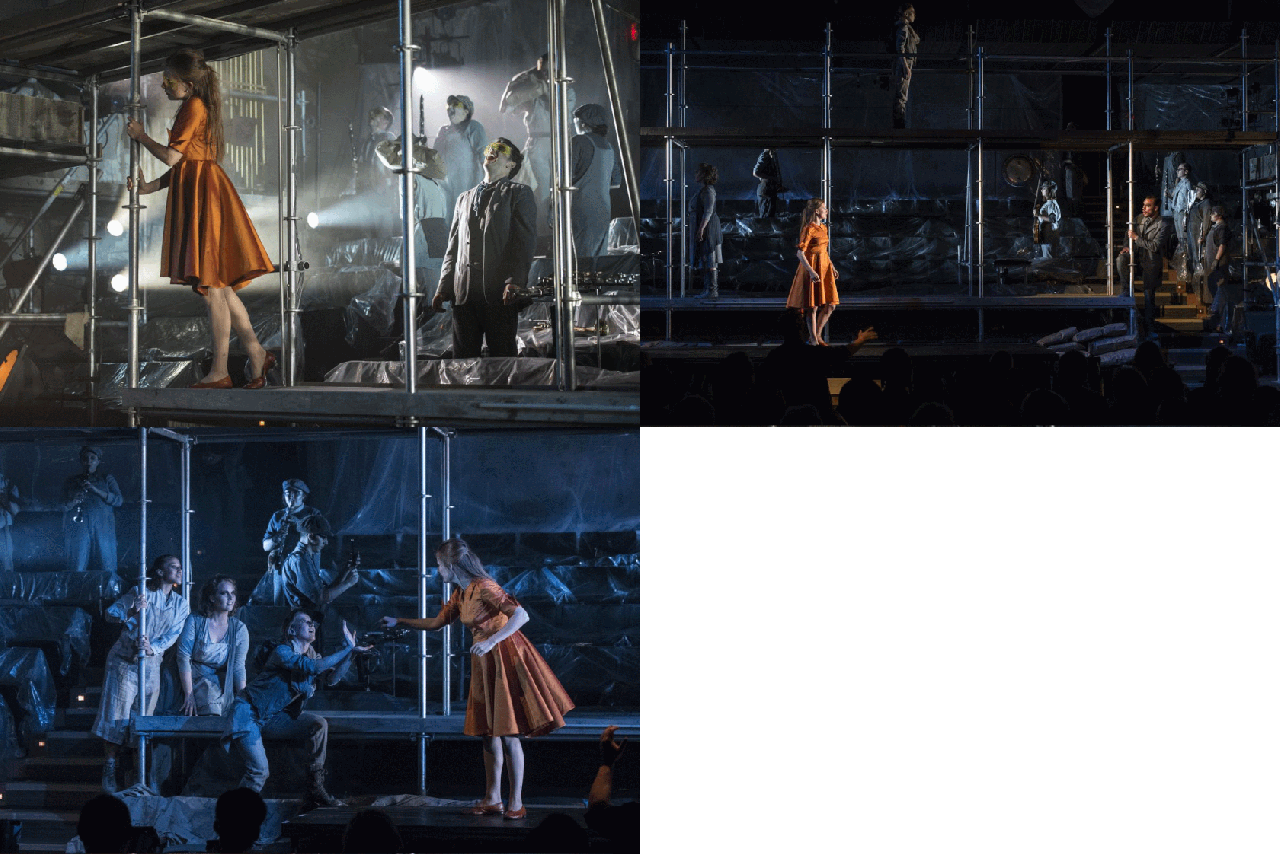
  • Vivier’s Kopernikus in Against the Grain’s recent production at Theatre Passe Muraille (and because it closed I can now blather on a bit more)
  • Berlioz’s Damnation de Faust in a live performance on youtube that I played while I stumbled through spreadsheets during a long day at work Thursday
  • Mallick’s The Tree of Life, that I watched until midnight Friday night
  • The Third Act of Wagner’s Parsifal, that I played through Saturday afternoon
vivier

Composer Claude Vivier

I left out certain aspects of my experience of Kopernikus when I wrote my review.  Am I concerned I might foist my particular spirituality upon anyone?  Or is it simply that I wonder if I am just admitting how totally I felt in synch with Vivier, how deeply I identified with his meditation.  But as I went through this little cycle of spiritual and quasi-spiritual works, the parallels and similarities seem so strong I thought I wanted to write about it, both to capture it for myself in this public diary, but also in case this might be illuminating for anyone else in their own journey.

I wish I could see Kopernikus again for at least a couple of reasons. There was a great deal going on in different places in front of us at the theatre. The first time through has a certain magic, but I submit that we really need to be seeing it more than once, given that it’s written (thinking of Vivier) and presented (thinking of Joel Ivany’s direction, Matjash Mrozewski’s choreography as well as the various performances) as ritual. The opera is subtitled “a ritual opera for the dead”, which put Ivany & Mrozewski into a bit of a bind. We don’t get to see it multiple times, so the movement & action needs to somehow signify ritual. Our handouts in the theatre also clued us in to a great deal, although I don’t know that there’s any one way, no right way. It’s wandering, right? That means some are on the path, some aren’t and indeed, those in the bushes may actually be closest to the true way. I think I am having my usual ambivalence, where an invitation sometimes turns me off if it’s too blatant, thinking of this theatre as a kind of temple of the arts but also as a place for Vivier’s ritual celebration.

After the performance I chatted with Joel & Topher Mokrzewski. I wondered about the closing image, which I alluded to indirectly but left out of the review, as I avoid spoilers at all cost. But I realize maybe it would have been useful to talk about this, to in effect give a future audience some idea as to where the storyline goes. Is it a spoiler when they tell you on Good Friday that Jesus rose 3 days later? that we’re saved? That’s the difference between watching a religious epic without any idea of the import or context, as opposed to being a believer who waits for the expected ending to affirm their faith.  Kopernikus’s conclusion at Theatre Passe Muraille was so similar to Robert Lepage’s final image in his Met Production of Damnation de Faust I wondered if Joel & Topher had seen it. I thought of it as an influence and a wonderful one at that, not taking issue with the similarity but admiring its universality.

But they knocked my socks off when they showed me that it’s in Vivier’s score, the most explicit thing in the whole piece. Where everything in Vivier is ambiguous, a verbal labyrinth that is 70% a made-up language (in Topher’s estimation), the ending is clear-cut, as they (or is it Agni only? I can’t recall because I only had a moment to glance at the score that Topher showed me) ascend and walk out a door, a door that shuts with a big sound, to conclude the work.

Bigtime shivers I am recalling at that moment, and surely everyone in the theatre had them too.

The moment at the end of Lepage / Berlioz was elegance itself, and I recall being frustrated at the time. Marguérite goes to heaven. After the massive celebration of the devils in their funny made-up language (uh-oh! another parallel), Berlioz has the angels gently beckoning to Marguérite, inviting her up to heaven. And so we see Susan Graham climb up a ladder, no magic or fancy mise-en-scène. It’s so simple, very much like what we see in the Vivier (and once again there’s Lepage asking his singer to take a physical risk). It turned things a bit upside down to think that, no, Joel wasn’t influenced by Lepage, but maybe Lepage was influenced by Vivier at some level..?   (did he ever come across the piece? I wonder…. No, I would doubt it)

Berlioz figures again in Tree of Life.  I stumbled on this by accident, the day after choosing to listen to Damnation at work, there it was on TV. I hadn’t seen it in awhile but voila, there it was being broadcast and I was irresistibly drawn. I hadn’t noticed that Mallick employs the opening brooding music from Harold in Italy in a sequence of the young Jack, the brooding character we see as an adult played by Sean Penn. How did I miss it the first time through?

And so when in the final ecstatic reconciliation images, the bodies wandering on a beach, reminding me so much of what Joel & Matjash did in Kopernikus, a labyrinth of wandering spirits in a kind of nowhere (whether it’s a beach as in the film, or the brutally blank space Jason Hand made for us in Theatre Passe Muraille), it made sense that Mallick took us from the misery of his Byronic wanderer Harold to the serene affirmation of Berlioz’s Requiem.

I was left alone yesterday (aka Saturday) with the dog. And not just because of the time of year but also because of where my head is at, I pulled out Parsifal. The last act begins with a musical image of wandering that likely resonated with Vivier. I’ve had this conversation in various ways with a few new music practitioners I admire, and whatever their misgivings about opera or romantic music, it’s surprising how often they admit their admiration (that word again) for Parsifal, one of the earliest 20th century compositions, written in the 1880s. That opening is in its way a version of the passage in Harold in Italy, a melancholy wandering lost in a spiritual waste-land.

Redemption in the story and in the typology is to find one’s way: to no longer be lost. The sacred castle of the Grail Knights can’t be found by just anyone but only through grace, through the intervention of higher powers.

It’s very low-key in much of its preaching, letting the beauty of the spring speak to the healing power of spirit in the world, even if the world seems lost. After hours of yard work it’s the most natural thing in the world to sit at the piano and trace that lost pathway, leading to the Good Friday music, and then the angry confrontation between the Knights & Amfortas, before Parsifal appears in the final apotheosis.

Some of us are luckier than others, that the grace finds its way to us, or that we find our way to grace. If you need proof before you open your heart, if you need to see the happy ending, like a movie trailer where they show you clearly how the film ends? That’s what the journey is for, if it has a purpose at all, to get us past the simplistic questioning, to give us the ability to live with ambivalence and doubt.

(afternoon addendum, wandering with the dog in the rain…Wondering if Faust was written by Berlioz at this time of year. He has his Faust in a comparable moment of misery about to kill himself, and he hears an Easter choir (“Christ vient de ressusciter!” they say.) Salvation!? and a moment later, Mephisto appears.  So the tidy ending is perhaps dangerous. Do not be too cocky about your faith, on holy week)

In the meantime, enjoy the spring, enjoy your journey.

Posted in Dance, theatre & musicals, Music and musicology, Opera, Personal ruminations & essays, Spirituality & Religion | Tagged , , , , , , , , , , | Leave a comment

Youthful leader inspires TSO

Maybe I’m exaggerating. Kerem Hasan is 27 after all, and we aren’t supposed to be ageist anymore in the 21st century. The conventional wisdom says that an experienced maestro is the ideal leader of an orchestra.

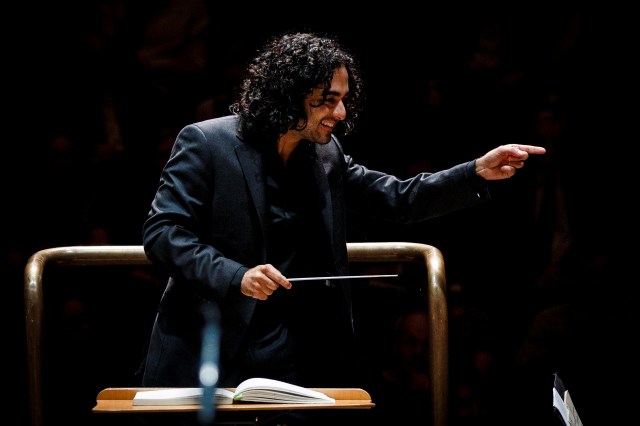
Kerem Hasan_c_TristanFewings

Conductor Kerem Hasan (photo: Tristan Fewings)

But tonight I saw the best Toronto Symphony concert I’ve seen in a long while, led by a very young conductor. I’m sorry I can’t suggest you go see him because it was the final one in the series. I understand that Hasan stepped in at the last minute, a replacement at the podium for an indisposition.

That seems even more impressive, don’t you think?

Perhaps the program helped. All three items represent compositions that were revolutionary works in their time.  Hasan brought an urgency to each one, a kind of excitement as if the music were brand new, no matter what century it was composed.

I wonder if Hasan has conducted them before?

  • Debussy’s Prelude to the Afternoon of a Faun
  • Szymanowski’s first violin concerto
  • Beethoven’s Eroica Symphony

This was one of the best concerts I’ve ever seen from the TSO. Young Maestro Hasan inspired the orchestra, drawing committed playing every moment, and intriguing readings, well-thought out and impressive.

It was a fast but tight reading of the Debussy which is how I like it. The ensemble responded to the conductor’s every gesture after allowing the flute solo to unfold.  Every player paid close attention to his every gesture.

The concerto was well played by soloist Christian Tetzlaff. But Hasan kept the orchestra out of the way, never letting the ensemble get too loud when the violin was playing. There was one huge climactic explosion of sound in the leadup to Tetzlaff’s cadenza near the end of the work (a marvelous creation from the soloist), but otherwise this colorful piece was gently expressive.

I wondered as we came to the main work on the program after the interval, namely the Eroica Symphony of Beethoven: what was Hasan’s secret? All three pieces were approached with great energy, care, sensitivity. Inner voices were clear, and the phrasing made everything very coherent.  You would think their lives depended on it, the way they followed the conductor.

Hasan led a crisp energetic reading of the Eroica, among the best playing by the TSO that I have ever heard in all my time attending Roy Thomson Hall.

I wonder if the TSO will try to bring him back? I hope so!

Posted in Music and musicology, Reviews | Tagged , , , , , , | Leave a comment

Boisterously brilliant Bigre

Watching people tortured can be funny.

Bigre, a Compagnie le fils du Grand Réseau Production, presented by Canadian Stage in collaboration with Théâtre Francaise de Toronto, opened tonight at the Berkeley St Theatre. In our modern gentrified cities, the impossibly tight spaces people are being forced to live in present the opportunity for phenomenal physical comedy.

It’s co-written and co-created by Pierre Guillois, Agathe L’Huillier & Olivier Martin Salvan, directed by Pierre Guillois, and performed by Guillois alternating with Bruno Fleury, Eléonore Auzou-Connes alternating with Agathe L’Huillier, and Jonathan Pinto-Rocha.

RESIZED_2-lpPkq4

Agathe L’Huillier, Jonathan Pinto-Rocha and Pierre Guillois (photo: Fabienne Rappeneau)

By accident I watched the recent film Stan & Ollie earlier this week, a bio-pic about the latter years of Laurel & Hardy that reminds you of some of the simplest tropes in comedy. Ditto tonight, including some gags that are literally centuries old: and still getting laughs. Guillois, Auzou-Connes and Pinto-Rocha each had moments of genuine brilliance.

It’s one of those shows that I watched, envying the performers, wishing I could be up there on that stage.  You could see how much fun this was, although the work is hard, not for the faint of heart.

The space –letting us peer into three tiny adjacent apartments—is really a pretense for humour.  The seeming impossibility of life inspires the ingenuity of each of them in different ways, like little flowers that insist on bursting out of the dirt.   Lighting, sound & music help segment the sequences, some long, some short, as we get deeper and deeper into the world of this fascinating trio. I defy you to see this show and not fall in love with them. While there’s pain there is also pathos & vulnerability. The emotional range is surprising.

The laughter moves around in the theatre. I found myself fascinated that at times people near me were guffawing, at other times they were silent when it was my turn.  Sometimes it’s painful, nervous laughs, sometimes pure fun.

Glimpsing three people living in the tiny space, tripping over one another, driving one another nuts? Yet life happens. They eat, they sleep, they have all their bodily functions (yes all of them), desperately human and totally hilarious.

While there’s an enormous amount of sound and noise, we’re not hearing words. Mouths move. Hands & legs gyrate. Hair gets very messed up. The wind blows. But especially bodies, three bodies sometimes discreet and separate, sometimes interacting.  All three performers show genuine physical eloquence.

This is one of those inspiring shows that reminds you of the possibilities of live theatre & creative performance. You will likely hear people telling you to go see this, and I’d echo that sentiment.

What is it exactly? There are elements of burlesque, of Commedia dell’Arte, clowns, comedy. Knowing what to call it is not important. It’s funny. It’s not verbal but physical. And it’s truly magical.

Bigre continues at the Berkeley St Theatre until April 28th.

TUTSONDE

L’Huillier, Pinto-Rocha & Guillois (photo: Fabienne Rappeneau)

Posted in Dance, theatre & musicals, Reviews | Tagged , , , , , , , , , | Leave a comment

Questions for Sky Gilbert: Shakespeare’s Criminal

I’m a great admirer of Sky Gilbert, the playwright, performer, professor, and activist: and I didn’t nearly cover it all. You can read his Guelph university bio here …where they list him as an expert in Canadian theatre, Creative writing, Drag queens and kings, Gay, lesbian, and transgender politics, Noel Coward, Poetry, Queer theatre, Queer theory.

I discovered that Orpheus Productions will present three performances, in a workshop presentation, of Shakespeare’s Criminal: a new chamber opera with music by Dustin Peters and libretto by Sky Gilbert, starring Marion Newman, Dion Mazerolle and Nathaniel Bacon, April 26-28, 2019 at Factory Theatre.

I was thrilled to ask Sky some questions, especially about Shakespeare’s Criminal.

1. Are you more like your father or your mother?

My mother. I wrote a book called The Mommiad, about my mother and her influence on me. She was an amazing person; she ran for political office in Buffalo in the 60s, started her own business and raised two children. But more than that she nourished my creativity — I remember that as a teen I was torn between music and theatre as professions and she had an upright piano installed in our tiny flat in East York just so I could practice. It’s a long story, but let’s just say that her beauty and her wit were what inspired me; her dark sense of humour about the world is probably also mine today.

2. What is the best or worst thing about what you do?

Being alone. Both best and worst. I am oddly misanthropic — I don’t really like people sometimes, but I love being around them, and especially love being anonymous in crowds. I value being alone and need it to write — but that’s also lonely sometimes.

resized Sky Gilbert headshot

Sky Gilbert

3.Who do you like to listen to or watch?

I’m a narrative junkie, love stories. I see at least three movies at theatres a week, and a few on Netflix. I’ve just discovered Dorothy B. Hughes and Arnold Bennett, two great novelists. I’m particularly fond of late nineteenth and early twentieth century British novels and novels written by women (a real fan of Barbara Pym, my play A Few Brittle Leaves was inspired by her work — as well as of Barbara Comyn).

I love art films, but usually quirky ones with a sense of humour or a dark sort of compassion. I think remaining in the past — old novels and films with narratives — means I don’t feel threatened by modern art and can create my own reality/fantasies of what novels and poems and movies might be. The opposite is true when it comes to theatre. I recently saw Milos Rau’s Five Easy Pieces in New York City, a play that features children acting out scenes from the history of a child serial killer — it inspired me to develop a play called Kink Observed. In theatre I am all about challenge, viewing it and creating it.

4. What ability or skill do you wish you had, that you don’t have?

I would say that my imagination fits in the category of something that I love about myself but is dangerous. I have trouble sometimes separating reality and fantasy (I know critics of my non-fiction essays will say — he certainly does!). This means that I can write a novel — I can’t stop imagining. In real life it can be frightening.

5. When you’re just relaxing and not working, what is your favourite thing to do?

Play Emily’s Delicious computer games and watch CNN Trump news. I admit it.

More questions about Shakepeare’s Criminal, workshop performances at Factory Studio April 26, 2019 @ 8pm and April 28 @ 2 pm. And on April 27th the workshop also includes a fund-raiser (more info below…)

1. With over 30 plays, 5 novels, 9 films listed on your Wikipedia page you’re an extraordinarily prolific artist. But I didn’t see any opera librettos listed. Will Shakepeare’s Criminal be your first attempt at an opera libretto?

I have been trying to put together an opera for years. I wrote a couple of finished librettos in the past and started working with composers who dropped out somewhere in the process. I understand why now; working with Dustin I have learned that the composer/librettist process is collaborative.

Dustin Peters headshot

Composer Dustin Peters

I have written this opera ‘song by song’ with Dustin, and his input has been invaluable; I have learned from it. I’ve been particularly passionate about opera since about 1998 and I’ve always been obsessed with music in general and classical music. I have written many musicals and starting in 1998 when I left Buddies my ‘hobby’ became listening to opera. I went from Donizetti to Massenet to Rossini and Bellini to Verdi and finally to R. Strauss — my interest is in Bel Canto and Romantic. Though how I am listening to Gretry and Wolf-Ferrari — so my tastes are becoming more rarified. I think for me it’s a combination of the two things I have been most passionate about — music and theatre, and also, as I’ve explained above, opera is pretty queer.

2. The press release for Shakespeare’s Criminal includes the following exciting idea:
The structure of Shakespeare’s Criminal is inspired by musicologist Ellen T. Harris’s notion that male composers were able to ground the emotional core of their operas through the wild, uncontrolled female voice (something which eventually led to the tragic romantic heroines of Verdi and Puccini).  Should we expect to see that kind of dynamic between male and female enacted in your opera?

The short answer is yes and no. The opera is about males and females interacting, but even though I am a male writing a female role, I’ve done my best to show a new twist and I’ve tried not to ‘objectify’ the female. True my female lead is something of a sorceress, but she is a desiring woman (as opposed to being a sex object) and also an intellectual and I think, wholly sympathetic.

The only thing that will be challenging for some audience members who are misogynist (and many people are, I think) is that they will have prejudices against a woman who is intellectual, sexual and has magic powers. The play is almost like peering into the brain of one of the ‘witches’ on the heath in Macbeth.

3. What’s the difference as you understand it, between a play text and an opera libretto?

Huge. My favourite thing is dialogue; love writing it, thinking it, imagining it. There is no dialogue in a good opera, in my view. There is only singing, showing off, spinning into emotion — I.e. Massenet’s WERTHER —.
Anyway, I have to think poetically rather than in dialogue, and this is something I have learned working with Dustin. I have written some songs as poems, and others I have written as prose. — but tried to make them as little like dialogue as possible. A couple of comic songs involved ‘dialogue’ but that is me indulging myself.

4. One of the promotional texts for Shakespeare’s Criminal says the following
Shakespeare’s Criminal celebrates the eternal bond between gay men and the women who love them. As long as gay men have been looking for sex and romance, their best female friends have been supporting them. What’s that about? What is the special relationship between gay men and their BFFs?”
Please talk about that “eternal bond”. Do you feel that it goes far beyond any particular decade or century?

In Ellen Harris’s book the phrase is  ‘rake, whore, catamite’ and it is intended to refer to a straight young man, a sexual woman and a man who desires other men. She suggests that the triumvirate — this friendly gang of three is transhistorical, going back to the 17th century. In other words there is something archetypical, in western culture at least, about a ‘catamite’ inserting himself into a relationship with a man and a woman — as friend. I have switched that slightly in my opera, and there is a song entitled ‘rake, whore, voyeur, in which Shakespeare is the rake, the young man the whore, and the woman the voyeur. So I am fashioning a new variation on an old trope. But I would say that straight women and gay men have a special bond, which I suspect is transhistorical — even though ‘gay’ is a relatively new phenomenon — there have always been men and women who desire men, and that bond they share both oppresses them in a sexist, homophobic society, and liberates them to share their loves, fantasies and desires, in a creative friendship.

5. I always felt there was a natural affinity between gay men & opera divas, because they appreciated larger than life emotions & gestures. I associate the use of the word “diva” in popular culture with the operatic world, a conservative community that welcomed gay people both in the audience & onstage long before mainstream acceptance. When we speak of the phenomenon of the drag queen I feel a natural affinity with the larger than life features of the opera diva. Does anything in Shakespeare’s Criminal draw upon the drag world?

As Susan Sontag says in ‘On Camp’ Bellini has for a long time been accepted by gay men as a camp figure. It’s important to remember that this does not mean that Norma is a laughing-stock, in fact the most misunderstood aspect of camp is that it is as serious as it is funny. Drag queens adore the women they portray, because they have a little bit of women in them, and there is a lot of ‘their mothers’ in them, that they can’t rid themselves of, no matter how hard they try. At any rate, Wayne Koestenbaum has written extensively about the relationship between camp and opera in a book called The Queen’s Throat. Belllini was being quite serious when he wrote Norma. But the fact that she is a tragic sorceress in a kind of prehistoric culture is a little funny — partially only because we have the distance of years to look at that, and also aesthetic distance because we don’t write bel canto anymore in the same reverent way. Camp gives us the opportunity to enjoy melodrama again, as we can be both serious and funny about it at the same time. Dustin has provided Marion Newman with a ‘curse song’ that I think is camp. On the one hand it is all about a woman’s fury at a closeted gay man (ie a ‘straight’ man), on the other hand it is all about two gay men revelling in that fury. And frankly, I think that’s okay.

6. You have been around long enough to remember when homosexuality was illegal & covert, when it was a threat to at least some in the establishment, when many chose to be in the closet for fear of violence, reprisals or worse. Your gay theatre was an activist theatre, perhaps captured in that name “Buddies in Bad Times”, an organization you founded. The word “gay” is safer, less threatening and perhaps a reflection of our times. I read a wonderful comment on your blog, observing the
“mega-musicals that celebrate tolerance. Funny, but I personally have never been very fond of being tolerated.”
Writing an opera in 2019, does your work still seek out edginess, activism & revolution rather than to aim for being tolerated?

I have to take issue with the first part of your paragraph. All of this is not over, we are still suspected of converting people, people are still in the closet, there is still fear of violence, and not only in Brunei. The problem is that young gay men are in a trap; many have turned to drugs as a way out. They have been told the lie (and I am not accusing you of this, it’s out there) that there is no more homophobia. And yet they are still terrified to tell their parents, and eventually some of their acquaintances out in the world, that they are gay. How does one live with that terrifically discomfiting irregularity between truth and the general discourse —with having to pretend that everything is alright with gay men in our culture, but knowing it’s really not? At any rate, I do the antique thing of writing about gay men because gay men still exist and are still oppressed. Period. Up until recently, HIV positive gay men (and others who were HIV positive too) were jailed simply for being a possibly ever present ‘danger’ to society.

The criminal in my opera is an HIV positive young man who loves to spread the liquids around. We are not ‘over’ AIDS. Does any group ever get over a holocaust? I don’t think so. We will never forget that we were blamed and shamed for this tragic illness, and many died overwhelmed with that shame and blame. THAT will never go away.

7. Two of the works in the current Canadian Opera Company season (Hadrian & Eugene Onegin in the fall) came from homosexual composers, but that’s hardly surprising considering how many great gay composers there have been (in the last century: Britten, Barber, Bernstein, Cage, Copland, Adès, Hoiby, Poulenc, Menotti, and before, Schubert, Tchaikovsky perhaps Handel & Lully, and many more I didn’t mention). Will the music of Shakespeare’s Criminal sound anything like the music of a gay composer (listed or otherwise)?

The first one that comes to mind is Samuel Barber. I am fond of his opera Vanessa believe it or not, and the denseness of the quintette in that is not unlike his famous adagio. Here is an intensity of sound and a beauty, of course in the trio for our opera that reminds me of Barber. I think Dustin’s music lives in that area between Barber, and R Strauss and Wolf-Ferrari — he might not agree but that’s my take.

resized Dion Mazerolle headshot

Baritone Dion Mazerolle

8. Please talk about the team presenting the workshop of Shakepeare’s Criminal.

It would be better to ask Dustin this. I am not incredibly familiar with Dion Mazerolle’s work — though I’ve heard him sing and he sings and performs beautifully. I’m eager to start working for him.

The part of ‘The Academic’ was written, to some degree for Marion, that is Dustin and I both had her in mind when we were writing the opera. Of course that means that we have all her technical facility to work with, and the chance to show off her beautiful voice had to be utilized to the fullest.

She also radiates integrity and strength, both qualities which are needed for the role.

resized Marion Newman headshot

Soprano Marion Newman

We decided to cast a musical comedy singer, Nathaniel Bacon — in the role of the Young Man, and I had worked with Nathaniel before. He was in a play I directed My Dinner With Casey Donovan, and a play of mine that was produced at 4th Line Theatre called St. Francis of Millbrook. I only became aware that Nathaniel was a singer when I heard him sing Hedwig so beautifully at LOT (Lower Ossington Theatre). We think the young handsome gay musical comedy singer will be a nice contrast to the more classically trained opera artists and will say something about one of the themes of the play ‘earthy vs arty’.

Shakespeare's Criminal - Nathaniel Bacon

Nathaniel Bacon

9. What’s your favorite opera (the one you like most) & your ideal opera (the one whose structure / dramaturgy you would put on a pedestal as the best)? In writing Shakespeare’s Criminal would we see anything that resembles or imitates features of either your favorite or ideal opera?

Probably R. Strauss’s Arabella. I think what I love most about that opera is the wistfulness with which he flirts with waltz music. Recently I’ve been trying to appreciate German operetta without much success, and then I realized that it was R. Strauss that led me to this stuff, because the beautiful waltzes that he gives us glimpses of in Arabella and Rosenkavalier that so charmed me. Then I realized that Strauss’s music is nostalgic, and of course camp in this way, it is about wanting to hear beautiful melodies but only getting a taste of them. But Strauss’s flirting with these melodies from operetta is actually more beautiful and compelling and profound than these waltzes in the old operettas themselves. A reviewer of Massenet’s Griselidis once said of one of the melodies in that work that it was not the melody itself that was so beautiful but what how we missed it when it was gone. The last lyric in our opera is ‘gone’ and there is some of this wistful nostalgia, I think , in our opera for the beauty of melody, without always being melodic.

10. Is there a teacher or influence you’d care to name that you especially admire?

I want to mention Robert Spergel in this context. When I played in a quartet workshop at the Royal Conservatory back in — oh this would be probably 1970? — our teacher was Robert Spergel. I was playing the cello, badly, in the quartet, and he was always very annoyed with me. He of course had been a child prodigy (his sister was Mildred Kenton) and he had written a quartet and two symphonies — he played the Kol Nidri on the cello with Ernest MacMillan and the Toronto Symphony when he was 10. Anyway when I worked with Robert Spergel I was scared of him, and I thought he was kind of mean, but now I realize — no, he just loved music more than anything else more than people, and more than anything he wanted to see music done RIGHT. I have to respect this in a teacher, however tyrannical! And now that I have seen photos of a young Robert Spergel, it’s especially charming to see that he was at one time a very beautiful, petulant looking young man! Always a surprise, to learn this about the old!

*****

All Tickets for regular performances $35:
Friday April 26th, 8:00pm
Sunday April 28th, 2:00pm
https://www.factorytheatre.ca/what-s-on/

On April 26, 1977 Studio 54 opened in New York City.
On April 27 2019, Orpheus Productions will have a wild fundraising party to celebrate the venerable sex-positive, party-positive New York City hangout from the disco era and honour our new Chamber Opera ‘Shakespeare’s Criminal’.

All April 27th Tickets $80
Includes the workshop presentation, pre-show talk with the creators, post-show cocktail party with disco deserts, and scandalous performances for your voyeuristic pleasure by Hélène Ducharme and Shane MacKinnon! Dress in your favourite 70s outfit and dance the night away Studio 54 Style!

Buy tickets NOW and take yourself back to Studio 54
Saturday April 27th, 8:00pm https://shakespearescriminal.brownpapertickets.com

This is a Canadian Actors’ Equity Association production under the Artists’ Collective Policy.

Posted in Interviews, Music and musicology, Opera, Politics, Popular music & culture | Tagged , , , , , , , , , , | 2 Comments

Against the Grain: Vivier’s Kopernikus

Claude Vivier’s Kopernikus has been promoted on social media as “Canada’s most famous unknown opera.” And Joel Ivany is quoted saying “I think this is Canada’s greatest opera ever written.”

After seeing what Against the Grain did with Vivier I’m a believer.

vivier

Composer Claude Vivier

I think I drove Joel Ivany & Topher Mokrzewski a bit nuts talking their ears off after the performance tonight, Kopernikus in the intimacy Theatre Passe Muraille. Joel is the stage director, Topher the music director, and they’re keys to Against the Grain Theatre’s continuing excellence. It’s almost a decade isn’t it, that this young group have been dazzling Toronto audiences. While there have been several moments to identify as highlights, here’s another one that might be the greatest yet, possibly their most ambitious project of all.

Any interpretation is a kind of solution to the challenges posed by a text. Any score is a kind of puzzle that can be solved in more than one way. When something becomes part of standard repertoire, when a composer becomes known, those pathways are less mysterious, indeed we may err in forgetting to properly interrogate the page when we may become accustomed to the way others have answered the implicit questions in a piece. But when something is new and/or unknown you are truly face to face with enigmas.

Vivier doesn’t make it easy. On the one hand his music emulates the adventures one might call “modernist”, sometimes tonal, sometimes dissonant or ambiguous.  But on the other hand sometimes he asks his performers to deconstruct that modernist surface, giving us self-references bordering on parody, approaches to vocalization by the singers that might seem to mock the whole process.  Is he kidding?

vivier_small

Claude Vivier

But having died in his mid-30s back in the 1980s, Vivier couldn’t be reached to answer the questions.  The mysteries of his scores will persist.  Indeed his short life with its violent ending is a fascinating additional subtext for his works, especially those such as this one with metaphysical overtones.

How serious is the tone of this work, I wondered, addressing the two creators: who were very polite with my questions. There’s a solemnity to the subject, the passage from the material world to the realm of spirit. I was reminded of Debussy’s Pelleas et Melisande, another opera raising spiritual questions (and another opera that has been presented by Against the Grain) that is serious all the way through without any humour. Perhaps it depends on the audience, Joel suggested, as to whether they laugh. I recall a comment from the theorist Tzvetan Todorov, who noticed that some works are received with great enthusiasm during one cultural epoch, when that culture is willing to make a special effort to meet the work on its own terms; and without the special effort (corresponding to the beliefs etc of that group) the work fails or leaves people mystified. It strikes me now in hindsight that what Ivany & co. achieved was to bring most if not all of us to a place of commitment, without any requirement that we truly buy into this world or share a cultural consensus.  Indeed I was persuaded without any idea of what it might mean. While much of it is deliberately nonsensical or unintelligible in an invented language yet we buy into it all the same.

AtG’s achievement tonight, building on a workshop of this work at the Banff Centre in 2017, is to make sense of something extremely challenging, a score that problematizes signification with a text that is full of complex sounds to go with the nonsense syllables (I wasn’t sure until I asked them about it, but they confirmed this), a musical inkblot connoting the blurriness of dreams & the surreal.

I wondered about the concluding image, which reminded me of an interpretative choice from Robert Lepage: but Joel showed me that it’s right in Vivier’s score. Powerful as the piece is, its final minute is especially compelling, and might remind you of something you’ve seen; but I won’t spoil it for you by spilling the beans, except to say that it’s very simple and totally remarkable.

The ensemble includes some wonderful talents, all working as a team. I was amazed by the precision of their response to Topher’s conducting. Bruno Roy created a fascinating characterization that seemed like a cross between Cabaret’s Master of Ceremonies and Dracula. Dion Mazerolle had some beautiful moments when his lovely baritone filled the space. There are many more I could name, both onstage and working as part of the creative team.

The main thing is to recognize that this score is full of stunning moments, indeed gorgeous from beginning to end especially in this reading in this tight little space.  The intimacy of the venue magnifies the effect. This gif from their website gives you some idea.

website_gif

I hope they record it. I need to hear it again and I’m sure I’m not the only one who feels that way.

Kopernikus continues this weekend & next, closing on April 13th.

Posted in Dance, theatre & musicals, Music and musicology, Opera | Tagged , , , , , , | 1 Comment

Idomeneo: Marshall Law

The question running through my head as I watched tonight’s opening of Opera Atelier’s Idomeneo at the Ed Mirvish Theatre was: “who is the star?”

In this their first performance in a new venue I could say “it’s the space”.  Although it has a slightly larger capacity than the Elgin, from where I sat the acoustics seem far better than at the Elgin, where things always seem to be soft & fuzzy. Tonight things sounded crystal clear in comparison, which is surprising considering the size, bigger than the Four Seasons Centre, at 2200 (or so says the oracle according to Google). But there was a crispness to the orchestral sound, a precision to the voices that we never heard in the Elgin. Everyone sounded better as a result.  And so I’d pronounce the debut of Opera Atelier in the new space as a definite triumph.

It was a curious experience all in all. The nice ladies sitting beside me brought in beer that they sipped after intermission. A seller came around with ice cream bars. Wow! (and of course I ate one!) Before you ask me if I think this is in some sense a violation? No! This is much more in the tradition of opera in the 18th century & before, when you might have wenches hawking oranges, when the lights were up. Arguably it would be entirely appropriate to let people have their mobile phones on (and I say this having heard plenty of buzzes from those nearby). I still dream of someday seeing a Handel opera done with the lights up and the free-and-easy audience deportment that would be an emulation of that time. We are weird, in our 21st century lights out try to keep a lid on it repressed approach to theatre. I wish people would be less inhibited about showing appreciation, as that too would not only be more authentic but a whole lot more fun.  But in other words, letting people have beer & ice cream is a step in the right direction.

There are things about this production that are historically informed and other aspects that are decidedly modern or at least new, brainchildren of the director Marshall Pynkoski. We get a curious mix of the two that might best be understood as the Opera Atelier brand. Tafelmusik Baroque Orchestra + the interpretive brilliance of music director David Fallis give their operas legitimacy even when there are liberties taken, extra dance numbers that I can’t find in the score (although perhaps there’s a different version? I wonder); but at least they sound like Mozart. Nobody minds if there is an aura of historicity. And so while there were no strobe lights in Mozart’s time (an effect used several times in the opera), we accept it because the set, costuming and movement vocabulary mostly connote an earlier time. I say mostly because at times dancers of the Opera Atelier Ballet offered some spectacularly romantic moves, particularly in the last hour. But I’m not complaining.

And so, while you’re probably waiting for this review to declare that Measha Bruggergosman or Colin Ainsworth or perhaps someone else was the star, I’m not going to say that. The two biggest stars for me were 1) The Ed Mirvish Theatre, blowing me away with the acoustic, & the intriguing experience of beer & ice cream, and especially
2) Marshall Pynkoski, getting his singers to dance more than ever.

It’s funny, I had the funniest thought, reminded of Robert Lepage. You may recall that he faced a rebellion from his Brunnhilde a few years ago, when Debbie Voigt refused to climb onto the machine in her portrayal, although she did eventually relent. Directors sometimes push the envelope with their performers. Lepage has sometimes asked a great deal of his singers, as Julie Taymor did with the performers in Spiderman. Is anyone revolting against Pynkoski? Not that I can tell. But wow he demands more and more of his singers with every show. A few weeks ago I watched Mireille Asselin—one of the finest young singers in this country—dancing as part of a show at the ROM. Tonight every one of the principals was being asked to dance.

I have to wonder, too, as Measha Bruggergosman seemed to be limping. I wonder if she was injured in rehearsal? My heart went out to her, as it’s hard enough singing the role of Elettra without the additional choreographic challenges imposed by the director, or perhaps in collaboration with the choreographer Jeannette Lajeunesse Zingg.

Colin Ainsworth was very sympathetic in the title role, showing us more power than ever: or is that just the acoustic of the theatre? I heard an interpolated high C in one of the arias, and it seemed he was bringing a more dramatic sound than usual most of the way, even if he did take something off the sound when he was engaging in fast coloratura. It’s a huge sing.

Wallis Giunta (Idamante) & Meghan Lindsay (Ilia) were a great pleasure to watch, a romantic couple who worked entirely within Pynkoski’s scheme even as they gave us their stunning Mozartian vocalism, perfect intonation, while honouring the physical demands. At one point Ainsworth throws Lindsay across the stage, a bit of stage fighting that was delightfully fluid, and as much a dance move as a real fight. I’ve missed Giunta’s presence on Toronto stages, and it’s clear she’s developed a great deal in her time overseas, perhaps the most cojones of anyone onstage tonight in a swaggering trouser role.

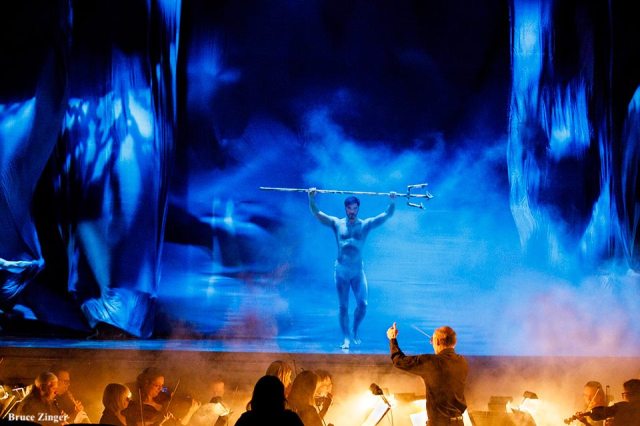
While we didn’t hear as much of Douglas Williams wonderful voice as I might have wished he was arguably the most important figure onstage, unless one includes the massive trident he wielded.  Whoever you want to call “the star”, Opera Atelier depends upon conductor David Fallis, whose baton even commands the gods of this story.  The orchestra, chorus & soloists sounded wonderful, sometimes soft & delicate, sometimes terrifying.

Neptune_David

Douglas Williams as Neptune, wielding a bigger baton than David Fallis conducting in the pit: but we know who the orchestra will follow don’t we…! (photo Bruce Zinger)

Idomeneo continues until April 13th at the Ed Mirvish Theatre.

Posted in Dance, theatre & musicals, Music and musicology, Opera, Reviews | Tagged , , , , , , , , , | Leave a comment

887: a quest for redemption for Robert Lepage

There is some irony that Canadian Stage are bringing back Robert Lepage’s 887, both because it’s a powerful piece of theatre that you must see if at all possible, but also as an exploration of memory. Throughout the work Lepage is asking himself what he can remember, what anyone can remember.

And then there are the more recent events for Lepage.  They say that “there’s no such thing as bad publicity”. I wonder if Robert Lepage believes it, after the controversies of 2018, his annus horribilis.

If people are talking about you it’s supposed to be a good thing, right?

  • In the summer it was SLAV, a show including white people singing the songs of black slaves. After protests it was cancelled amid charges of cultural appropriation.
  • In December it was Kanata, a show scheduled for Paris about the settlement of Canada. After protests from the Indigenous community it was cancelled when the backers backed out.

And now in the spring of 2019, Lepage’s Ring des Nibelungen is being revived at the Metropolitan Opera, with some phenomenally negative reviews. They only seem to have positive words for the singers:

I wrote about this production (really four productions, given that the style varies from one opera to the next) at great length as each of the operas appeared, both as high-definition broadcasts and from attending two of the four operas in the house. From the intensity of my enjoyment my American friends might think I drank some sort of kool-ade, perhaps because I’m Canadian. Yet my scholar friends speak the name “Robert Lepage” with a kind of reverence that might puzzle Americans who only know him from his work with Cirque du soleil or the Metropolitan Opera.  Lepage is taken seriously in Canada.

This is from the rave review I wrote about 887 back in April 2017:

887 is a play that is at once, a meditation on memory, an auto-biographical testimonial by Robert Lepage himself, a funny two hours, and a highly political study of recent history. Several times I thought I saw the kernel, the main well-spring of Lepage’s inspiration: and yet so thoroughly are the different threads sewn together that I can’t really say for certain.

  • There’s the poem “Speak White” by Québecoise Michelle Lalonde, a text with which we’re teased throughout as Lepage shares the challenge trying to memorize the poem (and we wonder just how much of it he will eventually retain), which he has been invited to read at an event. As we shall discover, the poem is like the cri de coeur of an underclass seeking equality. This year especially the poem is must reading for any Canadian.
  • There’s the Québec motto inscribed on their license plates, namely “je me souviens”, or I remember. But what do we –or does Lepage—actually remember?
  • I couldn’t help thinking that at one time separatism was such a threat to confederation that every day we heard something in the news, about possible referenda, about the polling numbers for the Parti Québecois. As Lepage gives us his one-man show, I felt the subtext could have been that collective memory lapse, as the once powerful and threatening movement seems to have faded away to nothing.
  • And memory is personal for Lepage. The set is ostensibly a model of his childhood apartment home, but in a real sense it’s a model of himself, of his brain and his influences (and while this thought may seem wacky or strange to say, at one point Lepage made it literally so, allowing the diagram of the apartment to morph into cerebral hemispheres, complete with a bit of explanation about what the different mental apartments might be good for).
  • When he briefly alluded to his grandmother and her struggles with dementia, I wondered if I was the only one in the place suddenly uncontrollably crying –stifling sobs actually—in the way we were suddenly at a bedside. It’s still killing me hours later that the ambiguity of what we were seeing and discussing let the association come up. I thought I heard someone else audibly crying too at that moment. Mercifully we segued to a childhood scene of theatrics, the study of memory both enacted and analyzed.
  • And there’s probably more. Lepage joked about the whole process of memorizing, which may have been a personal subtext for the show.

I want to recall what I said about 887 as I think about what Lepage chose to do with Wagner’s Ring cycle. There is again a kind of literalness in the design concept, a concrete focus that is easy to underestimate.  I like simplicity especially when it works.

  • In Damnation de Faust, Marguérite sings of the flaming ardor of her love: and her CGI projected image seems to catch fire on the big screen behind her onstage.
  • For much of the Ring cycle we are seeing the events exactly as specified in the score, and sometimes for the first time in decades. In Das Rheingold we see the Rhine-maidens swimming in the river (usually impossible to do), in Götterdämmerung when Siegfried travels on the river with his horse, we actually have a horse signified, at least in a puppet version.
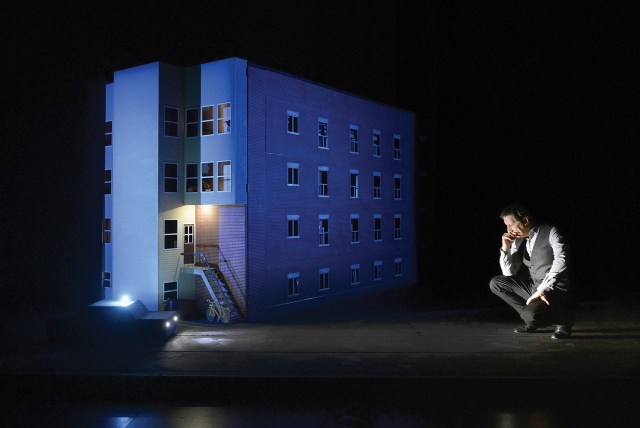
  • In 887 we see a model of Lepage’s childhood home (the title refers to his street address) as he contemplates his/our past.  (AND as I wrote: “The set is ostensibly a model of his childhood apartment home, but in a real sense it’s a model of himself, of his brain and his influences (and while this thought may seem wacky or strange to say, at one point Lepage made it literally so, allowing the diagram of the apartment to morph into cerebral hemispheres, complete with a bit of explanation about what the different mental apartments might be good for).
887

Robert Lepage and Ex Machina: 887 (Photo: Érick Labbé)

Lepage will be back to remind us what he can do, as he performs 887, an Ex Machina Production May 3-12 at the Bluma Appel Theatre.

Posted in Dance, theatre & musicals, Opera, Politics, Reviews | Tagged , , , , | Leave a comment

TCO Traviata

giuseppe_macina

Giuseppe Macina

Toronto City Opera? While the name is new to me, reading the history I see the lineage, going back over forty years to the legacy of Giuseppe Macina’s Toronto Opera Repertoire.

You can read more of their history here.

This continues the tradition of building an educational experience from out of music & theatre, singing & staging an opera. There are lots of people in the chorus having the time of their lives, while a few soloists enact the actual story.

Tonight they opened their production of La traviata at the intimate Al Green Theatre, the first of three performances led by the team of Artistic Director & conductor Jennifer Tung, pianist & music director Ivan Jovanovic, and Alaina Viau as Stage Director.

After reading TCO’s mission from their website I’d have to say that they have fulfilled their goals.

Toronto City Opera is passionately committed to opera for everyone. We give young professionals a chance to perform principal roles with coaching in musicianship and stagecraft. We give our amateur choristers inspiration and skills, so that they too can perform in a fully staged opera. And for our community we provide affordable access to this grand synthesis of music, drama, dance, and design to raise up the human spirit of everyone it touches.

The production is somewhat modernized, but without harming the story. While I was caught up in the happy vibe during the two party scenes (including a large and enthusiastic chorus), we still achieved the tragic effect at the end. Most importantly everyone seemed to have a really good time, and Verdi was along for the ride.

If you’re looking for a good community theatre experience, I recommend this without reservation, especially if you’d rather sing Verdi or Mozart instead of Rogers & Hammerstein. Soloists have to audition, and are on a different educational level than the chorus members.  I was pleasantly surprised that the music was presented with a great deal of cohesion & discipline.

For further information, including pictures from past productions and contact information, here’s their website.

Posted in Dance, theatre & musicals, Opera | Tagged , , , , , , | Leave a comment