Living through the daily assault upon one’s sensibility leads one to take protective measures. Whatever does get you through the night?
I vacillate between truth and escapism. Truth consists of various sorts of political content, whether on a news network or in some sort of film or documentary. Escapism will sometimes take me to music, opera, or movies although the best escape sometimes is simply to stare at a cute kitten or puppy. Social media reflects our taste, where one can see kitties & puppies or political memes, vying for one or the other side of our brain.
The film world has noticed too. Recently I saw Wes Anderson’s Isle of Dogs. See what I did in the headline above? That’s just me, catching on to what Mr Anderson already did. When you say “Isle of Dogs” aloud can you avoid the homonym? “Isle of Dogs” is an unlikely phrase, and sounds a whole lot like “I love dogs” even before you factor in a story awkwardly on the boundaries of English due to translations from another language. Not only does Isle of Dogs explore –indeed celebrate—the love of dogs, but it ventures more than a little into the political side of the brain as well. After seeing it, I pulled out The Royal Tenenbaums and Rushmore, a pair of films I have owned for years, and the next day brought home The Grand Budapest Hotel from the library for another viewing.
Fanciful & poetic as Anderson’s films are, they also include a great deal of political content. In The Grand Budapest Hotel we see some violent confrontations that look a lot like moments in the Second World War. Ditto for Isle of Dogs: and I’ll say no more for fear of giving it away.
Tonight, it was Mr Spielberg’s turn, working in the company of Meryl Streep, Tom Hanks and one of his oldest collaborators, John Williams. The score is understated but at the climactic moments I was moved to tears, largely due to JW’s contribution. The Post is in some ways more of a nostalgia trip than Grand Budapest Hotel. Where Anderson’s film takes us to a place in the past that never really existed, Spielberg reminds us of a recent version of the USA, one that seems lost in the current climate.
I’m reminded of Philip K Dick’s novel The Man in the High Castle, a book that posits an alternative world where the Axis powers won, where America ends up occupied rather than victorious. How crazy is it, then, that today’s world feels like Dick’s nightmare world: where the wrong guys have somehow overturned everything achieved in the last half century, breathing new life into fascism and the KKK and the worst xenophobia. Spielberg’s film would remind America of what she once was, for fear that she forgets, that she loses herself altogether.
Today I saw a Huffington Post article citing James Comey’s memos:
headline: “Trump Floated Idea Of Jailing Journalists To Make Them ‘Talk'”
quote: ‘They spend a couple days in jail, make a new friend, and they are ready to talk,’ full article |memos
Does that make you want to close this page, and instead find a picture of a dog? (sorry if the picture above misled you) or something political?
Isle of Dogs is not a children’s film. It’s rated PG-13 because of violence and thematic elements, an allegory about our own time, which is precisely why Anderson chose to set it in a remote place in a stylized fashion. If you too live in a house where the TV is tuned to CNN 80% of the time you’ll be open to the plot elements in a movie to remind you of current times. No, there’s nobody with a bad comb-over or a real estate empire. Maybe I’m making too much of the story. It does include (SPOILER ALERT)
Fake news
A leader who follows a strategy of demonizing a powerless group
A leader who follows a plan to exterminate that group in a kind of final solution that almost comes to pass
I’m reminded of a few artists, when I try to characterize Anderson.
Gustav Mahler, for that ambivalence that mixes high and low, comic & tragic often in the same instant.
Terry Gilliam for the ambitious & layered stories, the use of models & elaborate art direction
The live-action animation we’ve seen from Tim Burton, although I don’t think Burton ever achieved anything as deep as Isle of Dogs
Tomorrow I’ll be escaping into a baroque opera with a classical story-line. I comfort myself that on the weekend the only firing the POTUS will do, will be balls fired out of bunkers on the golf-course.
In the recent Canadian Opera Company Cosi fan tutte from just over 4 years ago, Tracy Dahl’s sparkling portrayal of Despina was the breath of fresh air that we desperately needed in Atom Egoyan’s dark intense interpretation.
Here’s what I wrote in my review:
I hadn’t laughed once before Tracy Dahl arrived as Despina, but whenever she appeared, the mood lightened. Not only did she manage the usual comic bits, but she brought extra, especially in her scenes with the two young women. (full review)
Every time she came on stage she made us smile. I expect she’ll have the same impact when she returns for the COC revival of the production next season.
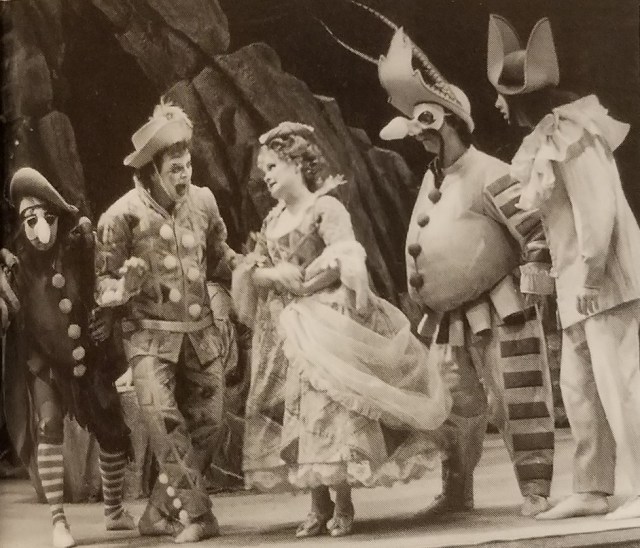
And so it was as Zerbinetta in Lotfi Mansouri’s 1988 COC production of Ariadne auf Naxos alongside Judith Forst as the Composer.
Left to right: Guillermo Silva-Marin, Theodore Baerg, Tracy Dahl, Christopher Cameron & Dennis Giesbrecht in the Canadian Opera Company’s 1988 Ariadne auf Naxos (photo: Robert C Ragsdale, FRPS)
Next week Forst and Dahl reunite for Bernstein’s Candide with the Toronto Symphony at Roy Thomson Hall. But I’m remembering Dahl in 1988. Here’s what George Heymont wrote.
The major hit of the evening was soprano Tracy Dahl’s first Zerbinetta — a phenomenal artistic triumph for this tiny young singer who, last season, stole the San Francisco Opera’s production of Offenbach’s Tales of Hoffmann right out from under Placido Domingo’s feet. Dahl’s Zerbinetta was a naughty baby doll whose spicy cascades of coloratura never got in the way of a brilliant theatrical characterization; one of those landmark performances that will not only be treasured for years to come but could easily make a major talent like Kathleen Battle look like a tired old has-been.
(full post here)
I can direct you to a biography either for Tracy Dahl the singer (with Dispeker Artists) or the teacher (at the Desautels Faculty of Music at the University of Manitoba), but neither captures the magic that you encounter in person. I am not going to lie to you. Our interview is no substitute for the live experience of Tracy Dahl. I’m looking forward to seeing and hearing her next week with the TSO, and next season with the COC.
In the meantime I had the privilege to ask her some questions.
Are you more like your father or your mother?
That is probably a question for my siblings to answer for me. My sister Jane is definitely like my father. I cannot boast as many likenesses as she can. My husband says I remind him of my father. My father and mother were both amazing human beings and to be like either of them would be, to say the very least, an honour. My father wanted to be very fair. He gave money to each political party so everyone would have an opportunity equally to let us know what they could do for the community. He always wanted to give to each child “equally” and if ever there was an imbalance he would try and explain why. He was a peace-maker. I wish I had more of that quality. He was an excellent listener and I think I can do that well when I am one on one. My father loved a good joke: Ice cubes down the back, hiding desserts when you stepped away from the dinner table — so much of it revolved around the dining room table. And of course who made that possible, but my mom. She would be the last one at the table and often so am I at our house. I taught our budgie how to talk while I sat and waiting for our youngest to finish his meal. My father was a good conversationalist and enjoyed being with people and I am a people person, too. If I am tired often I seek a good conversation with someone to get re-energized, rather than taking a nap. I guess that’s the extrovert in me. My father and mother were both very supportive of my singing before it was ever a career choice. I know they worried a great deal about financial security and stability heading into it all, but they were always there. My dad would sit down and send me a note after a performance or competition and tell me what he really loved about it. He was a multi-tasker. I am definitely that, and probably, like him, get over-stressed about the number of hats I am wearing at any given time. My dad acknowledged how much others did around him, and he valued everyone’s contributions, whether it was at work or church or the curling club. I think both my Mum and Dad gave me the sense of every person is to be valued.
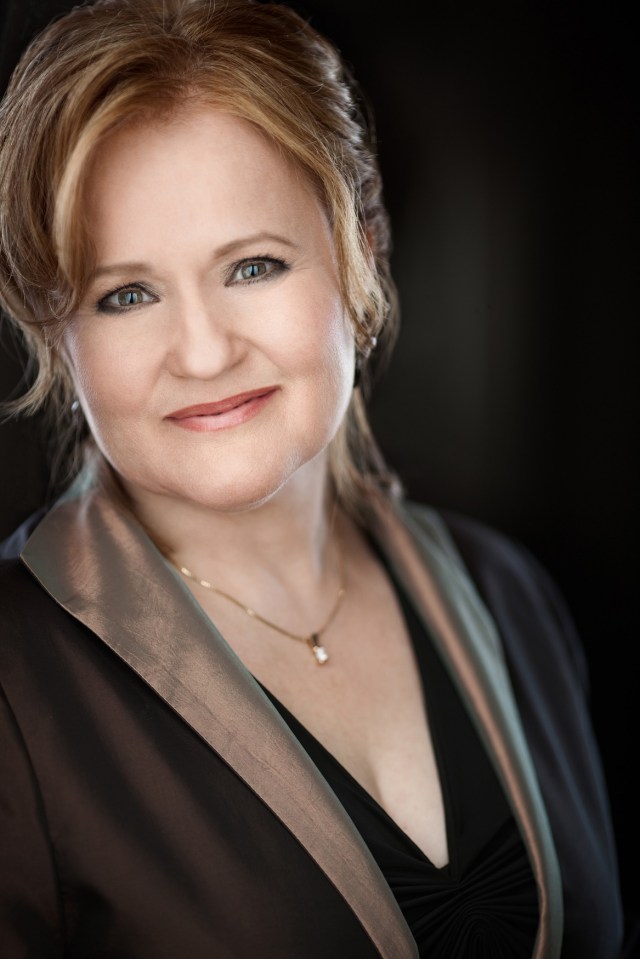
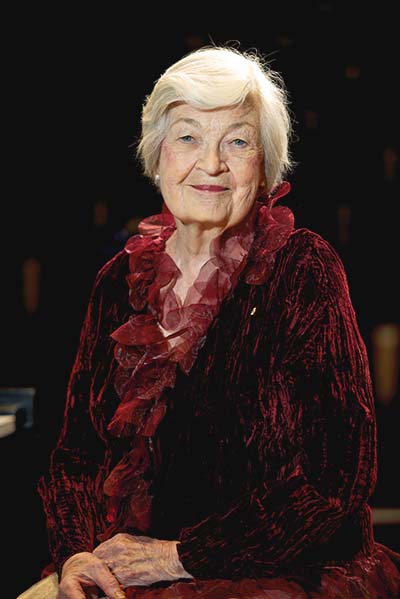
Soprano Tracy Dahl (Dispeker Artists)
What is the best or worst thing about what you do?
The worst thing about my work is leaving my family. It has never gotten easier. In fact I think it got harder as our children got older, because although we have so many more ways to connect to one another technologically, it came at an age when my children were beginning to establish their own lives. Depending on where the job is when you are doing opera, it can be a very lonely time. In cities where all the artists are staying in the same place, they often are closer than when we are working in the big opera houses where everyone heads their own way at the end of the day.Trying to remain in good health is another un-fun part of my job. We all try, but a singer’s job — and pay cheque! — is in jeopardy if they become ill. It can be tiresome trying to avoid getting sick – though worse still is having to cancel an engagement when you are sick.My other professional ‘hat’, teaching voice, is most difficult when the “marriage” of teacher and student doesn’t mesh. It can happen for many reasons. I think I feel like I let my student singers down when I can’t help problem-solve, but at the same time I know it is a two-way street and they have to commit as well to the creative process and the work of internalizing their craft. It is hard work. The student has to do the work. When they don’t invest in the work it is frustrating. I love the work. I fell in love with the journey — the techniques, the learning — when I began studying with Mary Morrison (a national treasure, and not just by my reckoning!). I love the creative process almost as much as I love being in front of people and performing.
Flipsides; I have been to some amazing places — in Europe, in Australia, and around this continent— with my family that I, or they, would never have seen together or maybe even traveled to, had it not been for the chance to perform.I have made friends in this business that I will have for life. There is a connection in the process of theatre that makes fast friends. We may not see each other often, but I have found that it is like no time has passed when we get together.There isn’t really a flip side to good health – one just needs it. I have been through a serious health crisis — I am a Stage 3 breast cancer survivor — and know that a cold is just not a big deal, even if it means a missed fee. It will pass. But I think having cancer and surviving that year was enough to give me some valuable perspective on health.With regard to my teaching career, I would say that I love having to “improvise”. I like looking for new ways to describe a technical journey. I use a lot of metaphors and my students and I often laugh in our lessons – at the metaphor or at ourselves. When the student is willing to explore their creative ideas, the possibilities are endless. I love that, every hour, I can learn something new about how to sing or express a phrase, because every hour a new person comes in the door. The art of music brings to mind a line in Richard Strauss’ opera Ariadne that I love: “eine Heilige Kunst” — the ‘holy art’. It is uplifting. This came to mind last month, when I was on the stage in the middle of a symphony orchestra playing Mahler …can it get any more transformative? I am very blessed to do what I do.
Who do you like to listen to or watch?
I listen to folk music. My chosen go-to discs often have a Celtic feel to them. I love acoustic guitar. My son Jaden has learned this year to play guitar and it is so relaxing. If I am not listening to our shared ITunes account, which has mostly my teenage children’s music on it – then I might have on violin music. I leave the radio on one of the two classical stations we have in Winnipeg, and I have recently taken to listening to good talk radio (long live the CBC!) or podcasts (This American Life, Because News) that are recommended to me. As for TV, our family watches a lot of comedy at our home on Netflix. I don’t watch network TV often, except when I am on the road and I have too much time on my hands. I think people would be surprised to know I watch curling and figure skating whenever it is on. I have always loved figure skating. The best figure skaters – Kurt Browning is the best, in my opinion! – move on ice the way I envision my sound would be, if it were movement. With figure skating, I can see what my sound feels like. And an opera singer who loves curling? Don’t ask! Maybe it has to be because I am like my father! I like the thoughtfulness and strategy of the game. I can’t really explain it, but I know it was a comfort to me during my chemotherapy. I was always at my worst after treatments on the weekend – it was during the winter — so there was lots of curling to be seen during that time, and now I am hooked.
What ability or skill do you wish you had, that you don’t have?
I wish I could ice-skate. I was once in a production of The Tales of Hoffmann where I had to perform my aria as Olympia on roller-skates! But I have had two nasty falls on ice-skates in recent years that have got me spooked, even though I adore the beauty of figure skating, and would love to be able to do a spread eagle. It is such an open and generous action. It looks like it opens the soul.
When you’re just relaxing and not working, what is your favourite thing to do?
I love walking our dog; I don’t consider that work. I enjoy working in our yard — also not work. I don’t feel the same way about cleaning the house — that is still work! BUT I love decorating the house for Valentine’s Day and Easter and, obviously for Christmas.I love being outside with my family, cycling, hiking, swimming or canoeing.I love being in the car with my family on a road trip. We get some really good talks in the car. I hear their music and listen to them sing. It’s great.
*******
More questions about Candide and Despina in Cosi fan tutte
Please talk about Cunegonde, your role in Candide
Cunegonde is a role I have sung since I began my career. Now to be truthful I wasn’t in a staged version of it until, well, recently – avoiding putting an age to it 🙂
It is often done as a semi-staged concert since the sets and costumes for such a crazy opera are hugely expensive. I have done concert versions all over the world and Cunegonde’s big aria (“Glitter and be Gay”) is almost a party piece. In fact it was an unexpected ‘command performance’ at my 50th birthday party where without any prep at all I had to sight-read new lyrics and sing the aria in front of our family and friends — the opening line re-written to say “FIFTY is okay… so my sisters say …” , etc. There were some classic lines in that version, thanks to my nephew Graham and his clever lyrics. In fact it is the best I probably ever sang the aria, as it was so spontaneous.
When I learned the aria in Banff in the Musical Theatre Program, I had just discovered from voice instructor Dodi Protero that I had those notes above the staff. I learned it singing with her. She sang all of it with me. All I had to do was listen and follow her and because both our voices were meant to do that coloratura, it seemed easy. I think that was a real blessing. I didn’t have to imagine what it ought to sound like or listen to 20 Youtube videos – the sound was present and in front of me. I just had to feel the sound she was making and “imitate it”. I have since learned that Cunegonde’s role is difficult. I didn’t learn it the way I would necessarily teach it. BUT I practise it now the way I teach it; in slower sections of detail work in arpeggios and scales, legato and staccato. Honestly it was such a good thing that I didn’t understand how hard it was when I learned it!
If your voice is meant to sing it, then there are parts that are a breeze but I will say the first time I sang the famous syncopated section with an orchestra I had no clue where I was. I don’t know that there is any way to prepare for that moment when you move from piano to orchestra except to give you a heads up – it is a different ball game with the orchestra a beat ahead of your part. If anyone wonders why women who sing Cunegonde dance a bit during that aria – that may be the reason; dancing to the beat of our own drum. In some ways, because I sang it in my early musical theatre days, it was never associated with operatic aspirations. It was fun. It is fun. Well, it ought to be fun! The extreme highs and lows of the piece are meant to be melodramatic. She is a character of extremes. In her first duet with Candide, we learn how she aspires to an entirely different world than the one of Candide’s dreams. So the piece is really about living her dream … only as all the characters find out, the dreams come at a cost. The version we are doing in TO is all the more challenging, because it really includes all the musical theatre elements that are required of Cunegonde, as well. You can’t sing the role like Lucia di Lammermoor – it wouldn’t sound right. So, not unlike Despina, in Cosi fan tutte, you look for other colours or, when in musical theatre, do like the musical theatre singers do, and put character in your voice.
As I have aged with the piece I have learned more about how to sing it, pace it and play with it. One needs to be in fine health to sing it and have all your tools at your command – and always be mindful of what you are doing to keep it lined up.I hope people will find it funny. It is pretty hard not to tap your toe once the coloratura section starts and that toe-tapping temptation includes me and the orchestra! They get two goes at it, since it is in the overture as well.
Bernstein is a curious composer, who wrote classical music and musicals and jazzy pieces. Please reflect for a moment on the challenges a singer faces reconciling those aspects in Candide, a piece that sits right on the boundary.
He is an American composer. He wants everything from us as performers. I think he respected the classical traditions. I think we should sing it with the same respect and accuracy that we do in classical music and in the intricacies of 21st century music for rhythm and pitch. I feel the same way about Sondheim. Yes, he bridges the world of musical theatre and classical, but it seems clear to me in this piece where the line is drawn and most of it needs to be classically delivered. It is fun to throw in a line or two of character-voice and to sing it back in my old musical theatre version of me. It needs it. It can’t be sung as Lucia – it is Cunegonde. If you get a chance watch the video of him working on the recording of West Side story – he wanted it as he wrote it. One should not try to be more clever and more of a genius than Bernstein; simply respect him and the libretto, and it will be clear.
Fortunately, because I began in musical theatre and my voice is not a full lyric soprano, I can still pull off the crossover parts of this work. The parts of the role that demand bel canto singing are never abandoned. Singing in one’s own language changes things somewhat, but my aim is still to communicate and that is the same whether it is Strauss or Bernstein.
You sang Despina in Atom Egoyan’s Cosi fan tutte when the COC last presented it, and will be one of the anchors in its revival next season. The opera is sub-titled “The school for lovers”, an aspect Egoyan exploits in his concept. If it were “The school for singers” you might be the principal, and so I wonder: what lessons would you teach us?
Funny question! I think I would rather not be the principal. 🙂 I would like to be with the teachers in the rooms doing the creative work, not the discipline, paper trails or policy work. That being said, I think I get your question. I don’t know that I can answer that in a complete way because there would always be a subsequent question or explanation wanted. Here is some of the advice I have given over the years: When you do an audition or a recital set out a list of goals (none of which can be memory with text or pitches) that you will evaluate yourself at the end of the day. I suggest five goals. The results of auditions are out of our hands but how we feel at the end of that audition is in our control. If the only goal is to get the job you will end up disappointed too often. Take ownership and make your own goals. In my set of five goals I want three I will do and rarely miss – and two that are a challenge to myself to improve in places where I do not always succeed. We all want to strive for perfection but getting there is an impossible task so don’t ask for a perfect audition. I will steal something I read on line recently; the job is auditioning. The perk is the job. Be yourself, not some version of an admired artist or described professional. Sincerity will win out.
Please, oh please, don’t let the business or school rob you of your love of music. That being said if you want a career in this profession you will need to love the journey as much as the performing. One spends so much time preparing alone before we ever get to the first rehearsal when we start to collaborate and then again before we finally get to perform in front of an audience. Be prepared. You never know when that opportunity to step up and show what you can do will happen.
Don’t take everything that comes your way – or take a dream role simply because it is offered. Sometimes the timing is wrong. I have, at times, advised singers to say NO. You will have mentors who can advise you. Trust their knowledge of the business and your instrument to know if it is a good opportunity at the right time or not. If you take on something before you are ready and it goes poorly it will be harder to put it behind you both in your confidence and in the eyes of the professionals who heard it. Career building is an art form.
I think you have a gift for comedy. Is all acting & theatre the same regardless of genre, or is there something you do differently in comedy?
Thank you for that compliment. It is very hard to address our strengths as artists but I do trust this element of my performing. All acting needs to be sincere and come from within the story and character, and that includes comedy. I am not sure how to describe this in a way that will not leave your readers asking more questions. Comedy is about listening, about beats and about clean ideas. It usually is crisp in execution. Watch Carol Burnett if you want to know where I think most of my ideas were formed! We watched that as a family every week when I was growing up. I still to this day will say – “Thank you, Carol Burnett!” You need to be willing to take risks in rehearsals to find those moments. When I was working with Sir Thomas Allen, we had a blast. It was always consistent and true to the character but there were nuances that would change. Opera can’t be improvisation because there are too many elements that rely on being consistent. HOWEVER the process of staging is a place to play and that is where the comedian in me gets to explore and improvise.
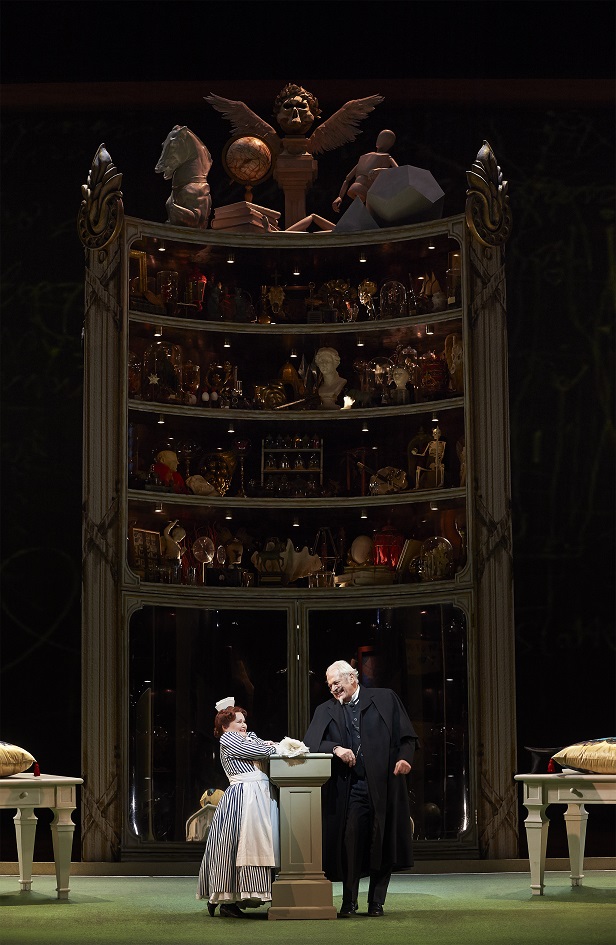
Tracy Dahl and Sir Thomas Allen in the COC’s Così fan tutte, 2014 (photo: Michael Cooper)
If you could reprise any of your favourite roles, here or anywhere else, what would you sing?
I have been blessed to sing a variety of roles in my life as a performer. I never tire of singing Adele in Die Fledermaus. She was the perfect bridge from musical theatre to opera. She is trying to pass herself off as a lady of society – and in some ways that is how I felt coming into opera. Truly, she is the best example of your question above and, because there is so much dialogue, often there was room or even need to improvise while troubleshooting props and such.I really loved singing Titania in AMidsummer Night’s Dream but I only sang it once. The same is true of Sophie in Der Rosenkavalier. I would love to sing that again. Baby Doe … I learned and performed in ten days for Calgary stepping in. I would love to sing that role again. Marie in La Fille du Régiment, is probably the role I feel really let me live out all my strengths as a singer. It is a very physical role, one of the ones I would often get asked to do a cartwheel in. (Those years of gymnastics were good for something!) It has dialogue – which I love doing; ties me back to my straight theatre days. It is comical and heart-breaking. My favourite moment in that opera is saying good-bye to the soldiers and Sulpice at the end of Act 1. I always felt really connected to the male chorus in that opera.I would be happy to sing Lucia (di Lammermoor) or Gilda (in Rigoletto) again … I love to sing. I know it is a blessing to still be singing and being given opportunities to share the gifts God gave me. I have no expectations moving forward, but to be prepared and ready if and when I am asked to step on stage.
Is there a teacher or an influence you’d care to name that you especially admire?
There are four teachers I would like to thank. Marie Enns, my elementary music teacher who saw something special in me and first put me on the stage as “Piggy number 1” in the Three Little Pigs in grade 3, and then on a dinner theatre stage in Winnipeg. I learned a lot about performing from her and responsibility and being accountable as a performer. She still is making music in seniors residences and care homes in Winnipeg. Her love of music has never diminished.
My second vote of thanks: Herbert Belyea and his wife Audrey who were my private music teachers when I started in Winnipeg, voice and piano. I made some wonderful friends in that home. I learned in a safe and supportive environment about singing – I still remember the day Mr. Belyea said, “Did you hear that? That was your vibrato”.
Dodi Protero was the first teacher to identify that I was a coloratura soprano and taught me Glitter and Be Gay by singing it with me. My teachers in Banff were are all special people but Dodi was the one that could look me in the eye – she was also petite – and sang with me. I don’t think I would have discovered that voice without her.
Mary Morrison
The biggest influence in my musical life has been Mary Morrison. I met her at Banff as well, and it was the beginning, as Bogart said, of a beautiful life-long friendship and mentorship. I have no stronger musical champion than Mary. I have learned SO much about singing from Mary. I was a very natural singer when I met Mary but she very gently began a process of teaching me. I remember going to Mary and asking where my larynx was, because everyone was saying it had to be low. LOL. She showed me and told me to forget about it, mine was “just fine”, she said. It was with Mary that I got a thirst for understanding how my voice worked. I wanted to do scales. Honestly I think we spent more than half our lessons then just singing exercises. Her passion for a scale and a vowel never tires. All of it is based in wanting to serve the texts and the music of the poet or librettist and composers. I can hear her voice in my head now as I write, laughing at how many different ways I could sing an “Ah” vowel! I call her often and ask her advice now on singers I am working with and on ways to troubleshoot their issues or simply to bend her ear and have a teacher moment of “Can you believe!”. Every conversation includes a pep talk encouraging me in my own singing. She is truly an inspiration. I am so grateful for the way she somehow made the journey in technique so much fun and so informative. I am grateful to her for her never letting go of the desire for my sound to be better. I never left discouraged. I always left wondering how I could make those sounds again, which I could because Mary made that part of the process. She empowered her students. Mary always made time for me in her busy schedule. I was a fly-in student – of which she had many. I didn’t do the university route. So I was coming in for lessons when I could. She opened her home to me and to many other singers as they would fly through and run in for the 10,000 mile check-up.
*******
Next season Tracy Dahl reprises her portrayal of Despina in Atom Egoyan’s production of Cosi fan tutte with the Canadian Opera Company. But first there’s her portrayal of Cunegonde in Candide with the Toronto Symphony conducted by Bramwell Tovey, Thursday April 26 and Saturday April 28 at Roy Thomson Hall.
Continuum is thrilled to present our first full-scale multimedia opera in this special collaboration. Set in the 1950s, the classic hockey rivalry between Toronto and Montreal takes centre stage with a side of organized crime. Love, lust, scandal, blood, betrayal – in sudden death, who wins and who loses is determined not by fate but by the final shot.
Co-produced with Ensemble contemporain de Montreal (ECM+) and the Toronto Comic Arts Festival.
PROGRAM
Hockey Noir André Ristic (CA)
Artistic Director and conductor: Vêronique Lacroix (CA)
Composer: André Ristic (CA)
Librettist: Cecil Castellucci (US/CA)
Illustrator: Kymberlyn Porter (CA)
Stage Director: Marie-Josêe Chartier (CA)
PERFORMERS
ECM+ with special guests Pascale Beaudin (soprano), Marie-Annick Béliveau (mezzo), Michiel Schrey (tenor) and Pierre-Etienne Bergeron (baritone)
TICKETS
$40 adults / $30 seniors & arts workers / $20 students Buy tickets now or at the door
PRODUCTION SPONSORS
*********
“Press releases and announcements” are presented verbatim without comment.
There’s another signature production for the Canadian Opera Company. At one time it was Robert Lepage’s double bill of Bluebeard’s Castle & Erwartung but I think a more recent Lepage opus has at least joined it, if not taken its place.
Premiered in 2009, and having since been co-produced by Festival d’Aix-en-Provence, Opéra de Lyon and taken on tour by the COC to the Brooklyn Academy of Music in 2011, The Nightingale and other short fables is back at the Four Seasons Centre. The demand for tickets means that they’ve already added another performance even though it just opened this weekend.
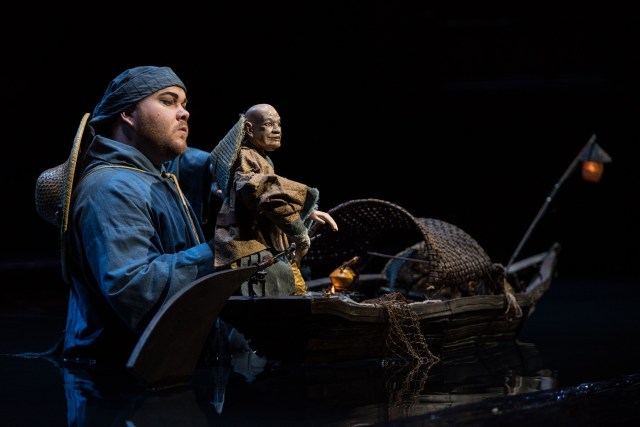
Tenor Owen McCausland sings and operates The Fisherman (Photo: Gaetz Photography)
I remember it from 2009, and with the benefit of hindsight think I see its influence. In the decade since its premiere we’ve seen similar flamboyance from smaller companies in the city, and I can’t help thinking: Lepage was their inspiration. It’s an opera that isn’t precisely an opera. We’re looking at a short opera –The Nightingale is subtitled ”conte lyrique”—while the only other piece that might qualify as opera is a “farmyard burlesque in one scene”. The evening is filled out with songs & instrumental music surrounding a flamboyant assortment of visuals, including a variety of types of puppetry. What Lepage showed us was that genre really doesn’t matter. As “Against the Grain Theatre” showed us (to name just one example), is that an opera company makes theatre whether or not the text being presented is “opera” or not. I remember asking a listserv the question “what is opera”, as I struggled with definitions; one answer I received was “if opera singers do it, it’s opera”. I laughed that off, but realize now that this is essentially what we’re seeing. If you were presenting a musical or a song cycle with an opera singing cast suddenly it’s a viable text for an opera company, as we regularly see all over North America. If you take a bunch of songs and assemble them into a piece of theatre using opera singers + serious musicianship you can legitimately present such things as opera. That’s what we’ve been seeing in Toronto for several years, and maybe it started with this seminal creation.
I think it’s better this time. Directed for the revival by Marilyn Gronsdal, conducted by Johannes Debus, and starring Jane Archibald (the Nightingale) and Owen McCausland (the Fisherman), the production seems as light as spun sugar, but without the calories. There’s a great deal of beautiful singing in addition, from Danika Lorèn, Allyson McHardy, Miles Mykkanen, Lauren Eberwein, Lindsay Ammann and Oleg Tsibulko (just to same some of the shining lights). And the COC Chorus shine as well.
I wrote about the show as a spoil-sport the first time I saw it, perhaps unkind rather than properly appreciative. I joked that Lepage really wanted to show the singers & conductor who’s boss:
Evicting the orchestra from the pit, which was then filled with water
Putting the orchestra at the back of the stage
Getting many of the singers to slog around in water up to their waists (for instance look at Owen McCausland in the photo above)
I’m reminded of the first time I saw one of Pina Bausch’s pieces where she radically re-thinks the stage, such as those pieces where she lays sod on top of the stage-floor, creating a subtly perfumed air in the theatre. This is something like that. You walk into the theatre and immediately can sense something fundamentally different in the air. Sometimes the light is bouncing off the water, creating a fabulous light-show inside the theatre all around. Sometimes you’re watching the show reflected in the water.
And of course there’s the matter of the diverse assortment of puppetry, a kind of smorgasbord, coming at you from several directions in different ways. Michael Curry, Martin Genest and Caroline Tanguay share credits for the puppet designs, choreography + revival choreography. We read in our history books about periods in the history of opera when spectacle was key, for instance in those operas with a deus ex machina, or some sort of machinery and stage magic. But I think this –brace yourself for a bad joke—blows them all out of the water. I saw a very happy little child (perhaps three or four years old?) who had a whale of a time. The material is simple rather than pretentious, direct and uncomplicated.
I am back to a question I regularly get asked, “what’s a good first opera”? Try this one. You’ll have beautiful music and every moment is fascinating to watch and hear. It helps that instead of one big story, we’re in the presence of one medium-sized story plus a series of smaller ones.
Nightingale & other short fables runs until May 19th at the Four Seasons Centre. I’ll be seeing it again at least one more time, and I recommend it without reservation.
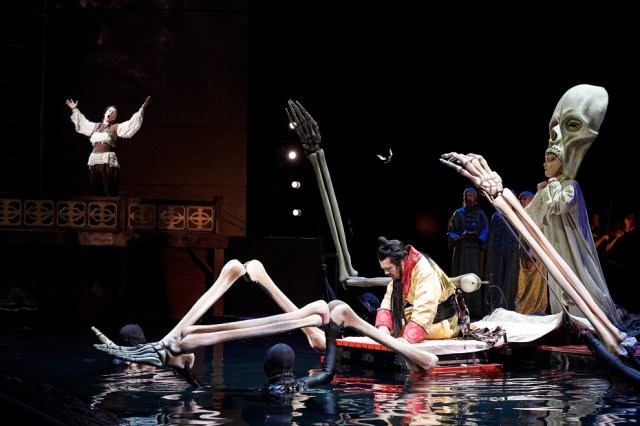
(l-r) Jane Archibald sings the Nightingale, Oleg Tsibulko is the Emperor (centre) and Lindsay Ammann sings Death in the COC’s The Nightingale and Other Short Fables, 2018, (photo: Michael Cooper)
It’s interesting that on consecutive days, the Canadian Opera Company gave their noon-hour concert in the Richard Bradshaw Amphitheatre over to a performance resembling an act of remembrance.
Yesterday was Jeremy Dutcher’s concert, in which he seemed to address the unseen spirits around us. Today it was soprano Sara Schabas’s turn, in a vocal concert including Laura D’Angelo violin and Geoffrey Conquer piano.
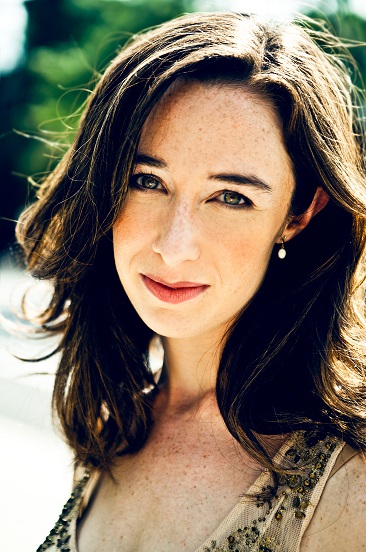
Soprano Sara Schabas (photo: Kirsten Miccoli:)
Where Dutcher sang in a language that was mostly unknown to the listeners (and curiously apt in an opera house, when I remember that for much of my life I was watching and hearing operas in languages I did not understand, and without benefit of the surtitles we’ve been blessed with since the 1980s), Schabas sang mostly in English, or in German with the benefit of a translation in the program. I hope it’s not controversial to be comparing the two concerts. Where we’re accustomed to speaking of the Shoah, a Holocaust that killed 6 million Jews in the Second World War, the Indigenous experience in Canada was at the very least a cultural holocaust –as children were stripped of their heritage, force-fed Christianity and English, over-writing their language & religion—to say nothing of the actual deaths of so many that we cannot count their numbers.
It’s a sad day of commemoration in Israel, one that began at their sundown, which occurred almost exactly at the conclusion of the noon-hour concert. I can’t help but be impressed by the timing of today’s concert, that spoke directly to the audience assembled today. Where yesterday’s listeners seemed younger & hipper on the whole, whooping and cheering for Dutcher, today’s solemn group were there to remember and be reminded, a serious and painful path.
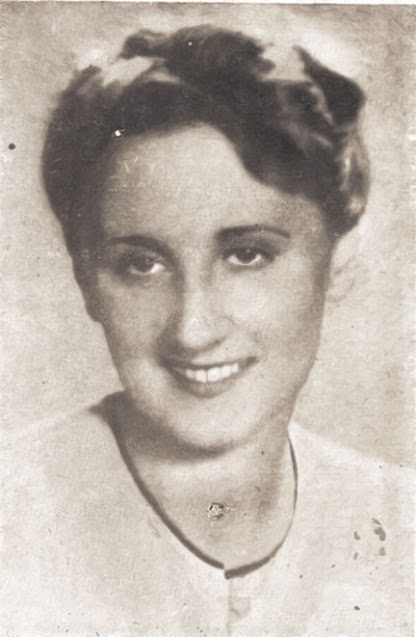
Born Jewish with the name Sonia Landau, she became Krystyna Zywulska.
The main work on the program was from Jake Heggie’s opera Another Sunrise, with text by Gene Scheer, concerning Krystyna Zywulska, a survivor of Auschwitz, one of two operas given their Canadian premiere recently.
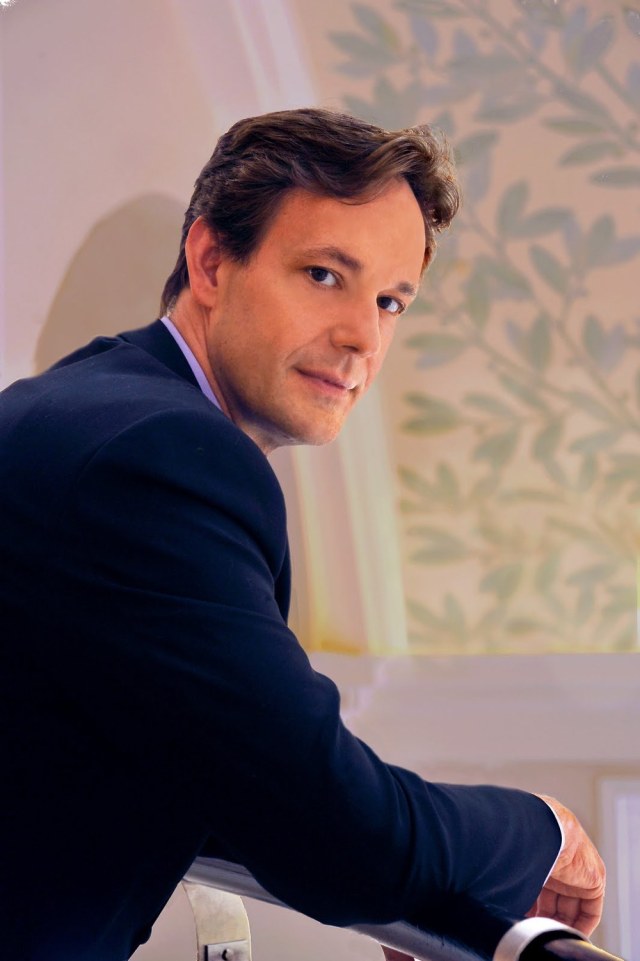
Composer Jake Heggie
Schabas gives us a monodrama accompanied by Conquer at the piano. The title figures in the last moments of the work, as she tells us that she is alive to see another sunrise. The opera is like an act of remembrance, taking us to a very curious place, a conflicted and guilty perspective, considering that Zywulska was able to survive by getting a position at Auschwitz. Needless to say hers is a dark perspective of anguish and pain, but surprisingly celebratory and life-affirming all the same. I think for anyone of Jewish heritage it is not just a matter of empathy but of the necessary celebration and honouring of those who went to the camps. It’s a national ritual in Israel where there are still survivors, let alone their descendants.
Schabas eased us into the concert with lighter fare to begin. We started with songs from composers who lived awhile in the bogus camp of Theresienstadt, which was a kind of model camp set up for PR purposes misrepresenting for the outside world what was really happening. The two composers would be executed in Auschwitz.
First came Carlo Taube’s “Ein Jüdisches Kind”¸ a poignant little song with a violin line that was almost another character in the song, at times muttering something very similar to prayers. I couldn’t help but be moved. Then came a trio of Viktor Ullmann songs, displaying his wonderful approach to tonality, songs that were for the most part sad, overshadowed by the facts of the composer’s life. I was especially struck by his “Abendphantasie” (or “evening fantasy”), where we hear of his impossible dream of a peaceful and serene old age after youth has burnt itself out. I couldn’t help remembering the poignant treatment Derek Jarman gave ”depuis le jour” in Aria featuring Tilda Swinton. What could be more poignant than dreaming of a life-long romantic affair or even a long life, when one already has a death sentence in one’s youth? (Ullmann in the camps, Jarman with an AIDS diagnosis).
Conquer was quite magnificent in support. At times he’s barely there, like a soap bubble in his soft presence, but in the Heggie at times he enacted military precision, the relentless machinery of the trains and camps, seen grimly by Schabas as Zywulska, while the piano painted the picture. At other times, especially in the songs, we heard softer tonalities, sensuous playing to match the dreamworlds in these flights of fancy.
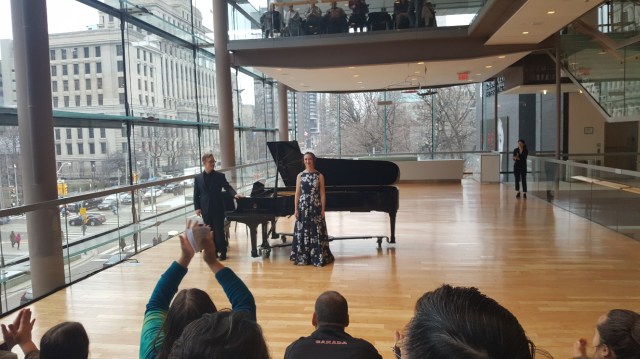
Geoffrey Conquer, Sara Schabas, plus violinist Laura D’Angelo in the background at the Richard Bradshaw Amphitheatre
I’m going through a series of retrospective experiences.
Yesterday was Jeremy Dutcher’s concert exploring and re-visiting music from his culture. Today I heard a Holocaust memorial performance (review still to come).
And the whole time as a kind of background there’s the CD in my car that I’ve been playing incessantly.
Unlike the two aforementioned experiences, this bit of remembering is a joyful project from University of Toronto Schools.
I’ve spoken of this institution a few times in passing, particularly when interviewing or reviewing an artist alumnus, such as
University of Toronto Schools = UTS. It was projected in the plural when founded in 1910, but is still a single institution. And it’s singular, one of a kind.
The headline means at least two things. There is a CD titled “I remember” that has been produced by UTS. But when I say “I remember: UTS” I’m unavoidably thinking back on a place that has been indelibly etched into me, because of course I’m an alumnus. When I think for example of the phrase uttered by that unforgettable teacher in “The Prime of Miss Jean Brodie,” (a film that appeared when I was in grade 8 at UTS by the way), saying loosely paraphrased, “give me a girr-rull at an impressionable age, and she will be MINE for LIFE”..?
Of course I can’t find it on youtube.
Even so it has a great deal of truth to it. I remember looking about me at the time, taking in the godlike masters (as they called the teachers in those days), and thinking I would have no ability to resist their imprint.
When I was at UTS it was boys rather than girls (and they called us “old boys” not “alumni”), although the school has been co-ed since the year after I left.
As far as the CD is concerned, it’s unique, a remarkable recording unlike any I’ve ever encountered.
If you come to the recording without any connection to UTS you might simply enjoy the diverse assortment of performances:
Scriabin: Valse in A flat major, Annie Zhou (‘16) piano
Brahms: Scherzo, Amir Safavi (’10) violin & Aaron Dou (’18) piano
Dukas: Villanelle, James Sommerville (‘80) horn & Annie Zhou (’16) piano
Vieuxtemps: Souvenir d’Amérique, Emma Meinrenken (‘17) violin & Su Jeon Higuera piano
* Rapoport: Waldberauscht, James Sommerville (‘80) horn & Annie Zhou (’16) piano
* Royer: Danzon, Conrad Chow (‘99) violin, Aaron Schwebel (‘06), violin, Ronald Royer cello, & Aaron Dou(’18) piano
* Shugarman: Carousel, Conrad Chow (‘99) violin, Aaron Schwebel (‘06), violin, Emma Meinrenken (‘17) violin, Donna Oh (‘18) cello, Ronald Royer cello, Mark Laidman bass
*Eddington(‘98): Bubblegum Delicious based on poetry of Dennis Lee (‘57), Cynthia Smithers (‘06) soprano, Rebecca Moranis (’16) flute, Conrad Chow (‘99) violin, Donna Oh (‘18) cello, Aaron Dou (’18) piano, David Fallis (’73) narrator, Alex Eddington (‘98) conductor
* Bao (‘14): Dance, Billy Bao (’14) violin & Ronald Royer cello
Mendelssohn: Auf Flügeln des Gesanges, Alastair Thorburn-Vitols (‘22) boy soprano & Derek Bate (‘71) piano
* Signifies premiere recording
Notice that plethora of asterisks, meaning that roughly half of the recordings are premieres, original compositions getting their first hearing. That’s new music.
But alongside the new, are the memories that I remember. I remember that when I was there, the music program was not as it is now. The school produced an amazing assortment of talented grads, and –no offense, UTS! –it was not due to the excellent music program. I was a cellist when I arrived at UTS at the end of grade 6, going into grade 7, but: they didn’t have a string music program. Nope. Of course that was in another century. The music program in those days was co-ordinated with the cadet corps, and so we played wind instruments. And so the cello was set aside (my family couldn’t afford private lessons, at least, not for that plus the piano I was already studying). I started playing the euphonium and later took up the tuba, marching around as the smallest guy in the UTS band, with the biggest instrument.
Don’t get me wrong, it was fun. My single most enjoyable moment in my whole time at UTS is a memory of being in the band at an assembly playing “La Cumparsita”, alongside George Stock on trombone.
But my point is, Derek Bate, David Fallis, James McLean et al (the ones who went in that pre-co-education era, 1910-1973) don’t come from a brilliant music program. It was a school full of nerds, which meant we showed up already primed and ready, usually taking private lessons. And the current generation of nerd? They get the additional push of a really good school music program, to kick it up a notch. That’s why you have a generation of wonderful musicians coming out of the school.
The recording is an anthology of recordings to celebrate the school by anthologizing that talent. Some, like Bate & Fallis, who are from that Precambrian era before there was much of a music program, got their education via private study (Derek Bate) or great church mentors (David Fallis). But the majority on this CD come from that later era when the school took the gifted kids and saw to it that their nerdy sensibilities had good music instruction to kick it up a notch. And some on the CD are from that eager team of teachers. Everyone on the CD is affiliated to UTS in some way either as graduates or instructors. Ronald Royer was the driving force behind this labour of love although you’ll notice a number of participants who don’t have their graduating year bracketed after their name, indicating that they did not actually go to UTS. It’s a fascinating CD, and as I listen, I really do remember.
And it’s a nice feeling.
I Rememberwas released through the Cambria Music label and is distributed through NAXOS Direct. The recording is available on more than 65 streaming services worldwide and through vendors such as Amazon, iTunes and University of Toronto Schools. OR go to this page
This time we heard him alone. Having just released his first solo CD a few days ago, Dutcher brought his unique sound to the Richard Bradshaw Amphitheatre for another of the Canadian Opera Company noon-hour concerts, in a space that felt more like a magical sanctuary than ever.
If you’ve never been to this space, it’s a curious combination of informality (everyone sitting on the steps upstairs inside the Four Seasons Centre) and glamor (everyone floating in the sky above University Avenue). It’s a block away from city hall, down the street from the provincial parliament and hanging above one of the city’s main streets. As Dutcher sang and played we saw and heard three different emergency vehicles, sometimes seguing nicely into his music, and always reminding us that music is part of rather than an escape from life.
Dorian Cox, program manager of the Free Concert Series, quoted Louis Riel’s words in his introduction to the concert:
My people will sleep for one hundred years, but when they awake, it will be the artists who give them their spirit back.
And then Dutcher seemed to enact them.
At several points in the concert Dutcher consciously and ostentatiously invoked spirit. To begin he took a drum and walked through the space as though addressing those unseen in the space around us. And he reminded us shortly thereafter, that while there may seem to be empty seats, they are filled by spirits.
We heard him sing along with an old recording of an indigenous song, that he elaborated into something simultaneously honoring the tradition yet something new and liberated, in its use of modern sounds. Dutcher is working to keep his culture & language alive.
Dutcher’s is a fascinating voice, classically trained but not at all like the usual opera singer, given his flexibility, a tone that can mix raw power and soft delicacy.
At another point in the concert he depressed the pedal, and sang into the piano, as the strings picked up his sound and vibrated sympathetically. I’m sure everyone has tried this. But it was magical in a new way, poignantly fading in the air like a suggestion of a spiritual presence in the air with us.
And of course he was accompanying himself the whole time. Dutcher has an interesting approach at the piano. At times his playing reminded me of Keith Jarrett although it’s not fair to call it jazz. While there’s an improvisational quality to his playing he always seems to know exactly what he’s doing, where he’s going. This was the first time I’ve seen the RBA piano swung around to face directly into the audience. While I would have liked to see his hands working the keys, we also got a wonderfully direct performance of remarkable intensity.
In the hour of his solo concert we heard a broad range of music, sometimes gentle, sometimes more powerful and celebratory.
My visit to the eye doctor today reminds me that when all’s said and done I must look at the world through my own lens.
I was at the theatre tonight to see Mixie and the Halfbreeds by Julie Tamiko Manning and Adrienne Wong, directed by Jenna Rodgers. For better or worse, my review must be through that lens. I feel especially aware of my subjectivity, the limits of my own perspective.
I’m reminded of my time studying drama, doing shows with students. The energy of a young cast is such a vital beautiful thing. I’m older now, and so it’s especially poignant to take in the youth of this cast, in such a small space at Scotiabank Studio Theatre at the Pia Bouman School.
Zoé Doyle as Mixie (photo by DahliaKatz)
I’m reminded of the proposal process, the ambitions of play-creation, as I work on a proposal of my own (another lens). I can’t help wondering about Mixie’s creators and what they expected coming into the project. What were their ambitions and expectations? I see some wonderful things, some beautiful moments, some satire & comedy. And as I sat there –a person of mixed heritage from Eastern Europe rather than China or Japan or the Philippines (among the places mentioned in tonight’s show)—I didn’t always understand, even as I noticed others in the theatre, of a different ethnicity, laughing at times when I was staring blankly. “My lens” means I got only some jokes, only understood some of the moments pointing a critical eye, that didn’t fully read from where I sat. Some of that may be due to coding, language that is understood differently if you’re of a particular ethnic group, or indeed gender, in a show played entirely by females.
Mixie is ambitious, and I like that. We’re in the presence of a discourse mixing media, with words, music, dance, and lots of blonde wigs. I think I understand what the wigs signify, although they read differently depending on who you are, in other words, what lens you look through. I think the energy of this show could fill a huge stage, reaching the deepest recesses among thousands of spectators, but there we were in a tiny space.
I read what Julie Tamiko Manning said in an interview.
“In Canadian theatre, shows are written, produced and then they’re done. To be able to revisit and rewrite as an artist who has grown in the last 10 years was a really wonderful opportunity.”
I understand it was shorter last time, and I suspect at that time it was tight, where this time, by enlarging it, they may have weakened it in the process. This past week I saw The Overcoat: a musical tailoring, also a piece from years ago that has been revised and revisited, one of the best things I’ve seen all year. As I look to revisit an old piece of my own, to make it better next time, I see the risks in re-creating something.
I went to the library last week to get John Ralson Saul’s A Fair Country, a book Peter Hinton cited when I interviewed him last year for Lous Riel. I wanted to unpack Saul’s observation that we are a Métis nation. We are rarely that British country of good government that is sometimes spoken of in school, except for the occasional misstep, such as 1885. More often we are a country who are surprisingly ready to inter-marry, a Métis country. And so I wondered, as a Hungarian-Canadian, recalling from my reading the way Canada welcomed Hungarians into this country via Jack Pickersgill (ensuring my mom’s lifelong loyalty to the Liberals), and more recently have welcomed refugees from Syria. We are not a melting pot –admit it, you knew I was going to invoke this cultural cliché—but more of a mosaic, and indeed neither metaphor is really adequate to account for Saul’s idea. But maybe Canada is a place we are still figuring out, discovering through books like the one by Saul, or by plays such as Mixie.
When Zoé Doyle as Mixie and Vanessa Trenton as Trixie –the two leads—were trading lines back and forth, the dialogue was always interesting, sometimes quite brilliant. In the last five minutes it was especially good, when they lowered the energy level to speak with great sincerity & commitment, giving us something less like a satirical sketch on SNL. I would like to hear the whole thing again, but delivered more softly, as I think the dialogue is full of poetry and wit, occasionally very powerful. There’s a fair bit of dance throughout that’s quite impressive, and at times stunningly beautiful, although other than the pointed satire of these dark-haired women of different ethnicities in blonde wigs, the dance was an explosion of energy that did not often seem to connect for me with the rest of the play. It was as though there were two separate shows going on, which can be wonderful, but they only intersected occasionally.
Mixie and the Halfbreeds continues until April 15th.
Tonight I heard the first of five performances to be given of JS Bach’s Mass in B Minor by Tafelmusik (four at Jeanne Lamon Hall in Trinity St Paul’s Centre, April 5-8 inclusive, and one more at the George Weston Recital Hall on the 10th).
It’s not the fastest nor the slowest you’d ever hear. But it’s remarkably meaningful, intelligible, music and words connected.
Ivars Taurins (photo: Sian Richards)
Ivars Taurins offers his usual thorough scholarly exploration of the score, leading the orchestra & their chamber choir. I’d like to think we were hearing something that JS Bach might have enjoyed had he been there in the church space to hear and see. A generation or two ago, one would encounter something bigger and fatter, both in the choral forces and especially in the orchestration, and usually at a glacial pace. Sometimes the leaner meaner approach of a historically accurate performance style –like the one often favored by Tafelmusik–can get so quick as to lose touch with the text being expressed. While I love those big climaxes as much as the next person, they can be achieved with a moderate sized ensemble raising the roof in a lovely little space, such as what we heard on this occasion.
Tonight’s was just right.
The five soloists gave us excellent work. I was especially moved by the simplicity of tenor Charles Daniels, who showed me how this should be sung, Bach being one of the most difficult composers to sing right. He made it look easy, but I don’t want to underestimate what he accomplished, a deceptive ease that is the product of great artistry. Daniels floated up to the high notes, sometimes very delicate, sometimes forthright, but never pushing, and always perfectly in tune & matching the text being expressed. He is a genuine student of the work, immersed in the score all night except when he had to come forward to sing. Less is more.
Laura Pudwell’s colour shone brightly without ever going beyond a mezzo-forte , the picture of restraint and elegance in her fluid delivery.
Mezzo-soprano Laura Pudwell
Soprano Dorothee Mields is new to me, but I enjoyed watching her both in her solo work or when she gazed about her enthusiastically at the chorus and orchestra at work.
Baritone Tyler Duncan brought his burnished sound, especially effective in the “Quoniam tu solus sanctus”, a solo aria where his low voice, accompanied by the lower orchestral sounds (string bass, bassoon, horn) remarks that Jesus only is the most high, a moment of wonderful humanity.
But the Tafelmusik Chamber Choir were the real stars, especially in the second part of the program, when the fireworks really happen. In the “Symbolum Nicenum”, we get the parts of the Nicene Creed. It’s one thing to speak this solemnly in church, but Bach dramatizes this profession of faith, so that we’re given a miniature Biblical epic, complete with Jesus’s birth, crucifixion, death, and glorious resurrection.
At the apt moments the chorus and orchestra erupt in celebratory glory. Coming at the climax of the Christian Year, Bach’s Mass is an overwhelming experience, with a proper focus on the text and its meaning, rather than virtuosity and display for its own sake.
Muse 9 Productions is a Multi-disciplinary Music Theatre production company based in Toronto, Canada.
Founded by Operatic Stage Director Anna Theodosakis (COC, UofT Opera, MYOpera) and Collaborative Pianist Hyejin Kwon (COC, UofT Opera, Lyric Opera Baltimore), Muse 9 strives to showcase unheard voices in the Indie opera scene in Toronto, and seek out talented individuals across artistic mediums who inspire the company to collaborate and tell feminist stories in unique ways.
Muse 9’s first production, “From the Diary of Virginia Woolf“, is a theatrical art song performance featuring the music of Dominick Argento and Amy Beach paired with excerpts from Woolf’s novels, letters, and diaries. It is an artistic exploration into the life and mind of the brilliant writer and feminist icon Virginia Woolf through the performances of Mezzo Soprano Victoria Marshall, Actor Keshia Palm, and Dancer Renee Killough.
“Each of the three performers represent a facet of Woolf ranging from her public persona to her inner most thoughts.” Explains co-founder and Stage Director Anna Theodosakis, “Different parts of her personality and experience are portrayed through a combination of song, dance, and Woolf’s own writing. It’s been exciting to see the diverse ideas these three women bring to the rehearsal and creation process based on their unique disciplines.”
Staged at the Ernest Balmer Studio in Toronto’s Historic Distillery District on April 13th at 8pm, it will feature music direction and piano by Hyejin Kwon, stage direction by Anna Theodosakis, and lighting design by Wesley McKenzie. Proceeds from the event will go to CAMH. Tickets are available at brownpapertickets.com under From the Diary of Virginia Woolf. https://www.brownpapertickets.com/event/3351476
Anna Theodosakis is a Toronto based stage director and choreographer originally from Vancouver. This fall Anna was the Assistant Director for the Canadian Opera Company’s Arabella, choreographed UofT Opera’s Don Giovanni, assistant directed Tapestry Opera’s Briefs, directed Tafelmusik’s Haus Musik, and directed the premiere of Shot for the Hamilton Philharmonic Orchestra. Select 2017 directing credits include: L’italiana in Algeri (MYOpera), Les contes d’Hoffmann (Opera Laurier), dawn always begins in the bones (Canadian Art Song Project/COC Ensemble Studio), La boheme (Muskoka Opera Festival) and L’elisir d’amore (COSI). Upcoming projects include directing The Tender Land (Opera Laurier), choreographing Of Thee I Sing (UofT Opera), assistant directing The Nightingale and Other Short Fables (COC), and coaching the COC Ensemble Showcase. She is a dramatic coach for the COC Ensemble Studio and teaches dance for UofT Opera. Anna is the recipient of the Vancouver Opera Guild’s 2017 Career Development Grant.
Pianist and co-founder of Muse 9 Productions, Korean pianist Hyejin Kwon is currently based in Toronto, actively working as a vocal coach. She has received her Bachelor of Music and Masters of Music degrees from Peabody Conservatory and Artistic Diploma from University of Toronto opera. She is also a graduate of Canadian Opera Company Ensemble Studio. Hyejin has worked as a music staff at Canadian Opera Company, University of Toronto Opera, St. Andrews Opera Workshop by the Sea, Repertory Opera Theatre in Washington, Lyric Opera Baltimore, and Shoestring Opera, and was a vocal accompanying fellow at Aspen Music festival. This upcoming summer she will be one of the fellows at the Music Academy of the West.
*********
“Press releases and announcements” are presented verbatim without comment.





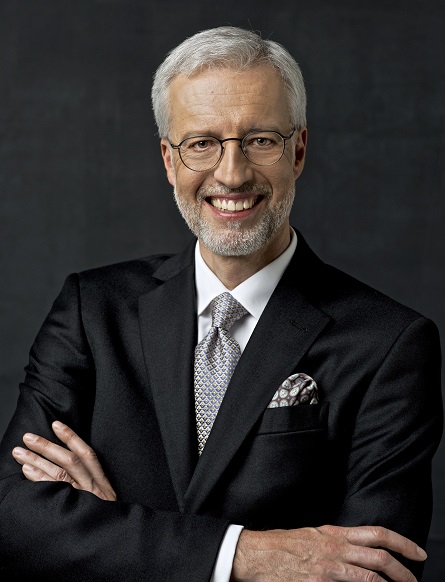
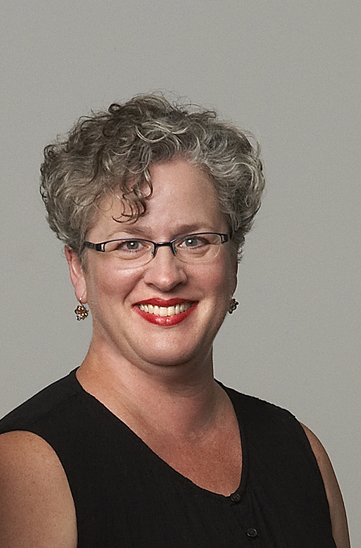
 Founded by Operatic Stage Director Anna Theodosakis (COC, UofT Opera, MYOpera) and Collaborative Pianist Hyejin Kwon (COC, UofT Opera, Lyric Opera Baltimore), Muse 9 strives to showcase unheard voices in the Indie opera scene in Toronto, and seek out talented individuals across artistic mediums who inspire the company to collaborate and tell feminist stories in unique ways.
