TSO and Walton’s Decade

I can’t be the only one who made the connection, watching the Toronto Symphony tonight at Roy Thomson Hall.   It felt like a special concert.

Sir Andrew Davis was just announced this week as the TSO’s interim Artistic Director for the two seasons following the conclusion of Peter Oundjian’s tenure (while they search for his successor).  Is it just a coincidence that tonight’s program included one of the works used to christen the new Roy Thomson Hall back in 1982, under a much younger Andrew Davis?  Of course William Walton’s Belshazzar’s Feast is larger than life, so no matter what’s happening at the time, there will be a sense of celebration in the air.  The programming was made weeks ago but I can’t help wondering, did they already have this planned?  Davis once again –just like the concert last week—seems very much in command, the TSO seeming as responsive as a sports car with brand new tires on a dry road.  And I am sure Davis had a much better time of it in 2017 than in the launch three and a half decades ago, after the renovations addressing the acoustical weaknesses of RTH.  Even if it’s just a coincidence, there was a genuinely festive mood to the concert, and they didn’t disappoint us.

davis

Sir Andrew Davis (Photo: Jaime Hogge)

And speaking of decades, this was another of the concerts in the “Decades Project”, this one highlighting the decade of the 1930s.  Had I encountered this program three or more decades ago, I would have had a very different response than I did tonight, hearing music by Paul Hindemith, Alban Berg and William Walton.  At one time Hindemith & Berg seemed to be the future of music, while Walton would seem to be a stretch, as an exemplar of his decade.  Yet from the perspective of 2017, Walton seems every bit as influential: when you factor in film music.  Belshazzar’s Feast reminds me of a Bernstein, maybe a wee bit of Leonard but a whole lot of Elmer, thinking of film-scores such as The Ten Commandments or even The Magnificent Seven.  No there’s no logical reason why this Biblical cantata should resemble a film about bandits and gun-fighters, but Walton’s syncopated brassy sound has me thinking of Marlborough country, a sound heard in cinemas worldwide, and likely by far more people than have ever heard either Hindemith or Berg.

The TSO were joined by two choirs, namely the Toronto Mendelssohn Choir and the Huddersfield Choral Society, as well as baritone soloist Alexander Dobson.  Davis seemed to have a whale of a time leading the choirs and the TSO through this work with Biblical sources, that contains almost no spirituality that I could detect.  In this respect Walton’s score is true to his time, seemingly more intent on effects than in making a genuine connection with the religious meaning of the text.  I can’t help being reminded of the Pandemonium scene from Damnation de Faust, where Berlioz imitates what the minions of hell might sound like, when Walton gives us the rites of the Babylonians, plus a very lurid response from God, worthy of Cecil B Demille.  But if we cut Walton some slack –and let the orchestra have some fun playing this score—it’s an amazing thrill ride, ear candy if ever there was such a thing.  And thank you Andrew Davis for taking us along.

The first half of the concert was the more seriously musicological visit to the 1930s, a pair of contrasting works,  Hindemith’s Concert Music for Brass and Strings and Berg’s Violin Concerto.

I never understood why Hindemith didn’t catch on, a composer who always excites me with his command of orchestral colour and intriguing way of making old ideas new.  Concert Music for Brass and Strings is a playful exploration of sound that gave Davis reason to stretch a dozen brass players in an arc across the back third of the stage, sometimes barking sometimes snarling, always impressive, with roughly forty string players clustered at the front as if in refuge.  Hindemith always sounds to me like the sort of composer you would use to show off a sound system or to test a new concert hall, not unlike Belshazzar’s Feast, and Davis seemed to hold nothing back in putting them through their paces.

In sharp contrast to the Dionysian impulses in the Hindemith, Jonathan Crow unpacked the sweetest subtleties as soloist in Berg’s violin concerto.  Davis allowed details to be heard, restraining the orchestra for the most part while giving Crow space to play gently, in an interpretation sounding at times like chamber music for its delicacy.


Posted in Cinema, video & DVDs, Music and musicology, Reviews | 2 Comments

Christopher Cameron: Dr Bartolo’s Umbrella

This one is different. I’ve encountered memoirs written by artists I’ve respected from afar often created with the help of a ghost-writer.

But Chris Cameron’s Dr Bartolo’s Umbrella and Other Tales from my Surprising Operatic Life, perhaps a bit like Chris Cameron himself, doesn’t conform to usual expectations. Dr.-Bartolos-Umbrella-Cover-rev2

This is not the story of a big star, at least not if you believe the humble words of Mr Cameron.  One of the most refreshing things about this book is the absence of a self-congratulatory tone, replaced by a nuts and bolts approach.

No this is not a triumphalist account painted in primary colours.  We’re in a world of real people, presented warts & all.  The author is front and centre without pretense, a likable fellow telling a fascinating story– his own — while commenting on the business.

The devout followers of Canadian opera likely would undertake reading this book even if it weren’t wonderful, insightful, fun, and well-written.  But this is not a ghost-written book where the author is barely discernible.  I don’t think we usually talk about the writing ability displayed by an opera singer, especially when there are great ghost writers around (although sadly dear Donald Arthur –who co-wrote memoirs of Astrid Varnay, Hans Hotter, Lotfi Mansouri & James King—has passed away).  I inhaled this book, partly because I was interested in the material, mostly because it flows.

As a memoir of someone close to my age if not quite contemporary, I recognize many of the names he mentions.  Yes there are other memoirs of this period – for instance two that I’ve reviewed here, Lotfi Mansouri: An Operatic Journey & Stuart Hamilton’s Opening Windows—but they are of an older generation.  Cameron is still relatively young even if he no longer sings.

It needs to be said that Cameron can write.  Oh sure, the other books are readable. But Cameron is not just recounting a series of anecdotes, not just taking us through his resume.  We’re hearing an account of a life, with a consistent & original philosophy, punctuated by some edgy commentary.  But let me put it out there, that Chris Cameron is a good writer with lots to say above and beyond recounting his life-story.  I flew through the book, breathless to be reminded of so many familiar names & scenes.

ChrisCameronPhoto-268x300

Singer & author Christopher Cameron

And Cameron is full of lessons for any artist.  But you won’t be hearing anything that sounds like the career advice of a brown-noser. Cameron boldly goes where no singer has gone before, as far as I can recall, even if he has good things to say about everyone.  I love when he’s reporting his nervous internal monologue while freaking out in sheer terror of the challenging first notes he’d sing as bass soloist in Beethoven’s 9th Symphony.  I won’t spoil it, but let’s just say that I laughed out loud.  There and elsewhere, this is a fun book from an affable artist without bitterness, yet still more than a little bemusement at what a strange world we live in.  Cameron is a frequent observer of the absurdity of the business, especially the Canadian version.

I would recommend Dr Bartolo’s Umbrella to the young singers I know who are considering a career, even if the world he describes has largely vanished.  A question I keep asking myself is whether one can still have a career in opera.  Oh sure, if you have a magnificent voice, fine.  But what if you’re not very tall, and always cast as the old man even in your mid-20s?  We go through many fascinating stages in his career, including the poignant moments towards the end when he recognizes he has had enough.  His simple eloquence will surely speak to anyone who has ever performed.

In passing Cameron is writing a history of the musical scene, reminding us of the Festival Singers, the beginning of Ontario Place, of Tapestry (before they started doing modern opera), the early days of the Ensemble Studio under Lotfi Mansouri, encounters with Seiji Ozawa, Andrew Davis, Ben Heppner, Elmer Iseler, James Craig plus many more artists both well-known and obscure.  Being a crazy opera nerd I devoured it without any signs of indigestion.

I believe Dr Bartolo’s Umbrella could be a fun first look into the world of opera & classical music for those who don’t know anything about opera, educational without being solemn or academic. There’s a welcome absence of technical jargon, and a directness that makes for a fun read.  It’s a pleasure to encounter something in the language of a real person, an artist without a phony bone in his body.

And if you know some of the names, so much the better.

Posted in Books & Literature, Opera, Reviews | 2 Comments

TSO: Sir Andrew Davis to be interim Artistic Director, Peter Oundjian Conductor Emeritus

davis

Sir Andrew Davis (Photo: Jaime Hogge)

May 31, 2017: The Toronto Symphony Orchestra (TSO) announces today that Sir Andrew Davis will act as Interim Artistic Director for two seasons following the conclusion of Peter Oundjian’s 14-year tenure as Music Director at the end of the 2017/18 season. Maestro Davis will provide artistic leadership through to the middle of 2020, when the TSO anticipates that a new permanent Music Director will be in place.

Gary Hanson, Interim Chief Executive Officer of the TSO, comments, “As our Music Director Search Committee completes its work, we are grateful that Sir Andrew will step in to provide artistic leadership, just as he did in 2001 when our search for a Music Director led us to Peter Oundjian.”

The TSO’s process to name a successor to Peter Oundjian as Music Director began in 2016. The confidential search is being conducted by a committee composed of TSO musicians, members of the Board of Directors, and senior management representatives. The Committee is chaired by TSO Board member Tom Smee, who notes, “Our Committee is rigorously reviewing the qualifications and potential of many highly qualified prospective Music Directors, most of whom would be familiar to Toronto audiences as recent and forthcoming guest conductors.”

Sir Andrew Davis has had a 44-year relationship with the TSO including 13 years as the Orchestra’s Music Director, from 1975 to 1988. Maestro Davis will open the 2018/19 season and will return to the TSO stage for five weeks in each of the two seasons. “I love being part of the TSO family. My years here have been some of the happiest in my career, and I am deeply honoured to be asked to serve the Orchestra during this transition,” adds Sir Andrew Davis.

In the month of June this season, Sir Andrew Davis will take the podium to conduct Belshazzar’s Feast on June 2 and 3. The biblical oratorio by Sir William Walton depicts the liberation of the Hebrew slaves from captivity in Babylon. Canadian baritone Alexander Dobson takes centre stage, and is joined by the 200 voices of the Toronto Mendelssohn Choir and Huddersfield Choral Society combined. Music by Hindemith and Berg’s Violin Concerto—featuring TSO Concertmaster Jonathan Crow—round out the program. Belshazzar’s Feast is part of the final instalment of The Decades Project.Peter Oundjian named Conductor Emeritus of the Toronto Symphony Orchestra

*******

May 31, 2017: The Toronto Symphony Orchestra (TSO) is pleased to announce that Peter Oundjian will be honoured with the title of Conductor Emeritus when he completes his tenure as Music Director of the TSO at the end of the 2017/18 season.

By then, Peter Oundjian will have served in the role of Music Director for 14 seasons, the second longest tenure in the TSO’s history, surpassed only by Sir Ernest MacMillan, who was at the helm of the TSO for 25 seasons. Beginning with the 2019/20 season, Mr. Oundjian will return for a number of annual engagements, conducting the TSO at Roy Thomson Hall as part of the flagship Masterworks series.

Oundjian’s drive and devotion to the TSO have yielded extraordinary accomplishments. “Peter has brought the Toronto Symphony Orchestra to new and diverse audiences and has put his seal on the refined and wonderful sound that we hear from the Orchestra today. His contribution and commitment will continue to be a great benefit to all of us,” said Cathy Beck, Chair of the TSO Board of Directors. Gary Hanson, Interim Chief Executive Officer of the TSO adds, “Peter has built a lasting legacy, including, without doubt, his success in attracting and selecting the very finest players from a global talent pool.”

Over the course of his tenure, Oundjian has selected more than half of the current musicians of the Orchestra. Moreover, he has selected two-thirds of the principal players, including Concertmaster Jonathan Crow.

The announcement of Peter Oundjian’s honorary title, in recognition of his contributions to the TSO, comes as the institution proceeds in its selection process to name a successor to Oundjian as Music Director. The confidential search, which began in 2016, is being conducted by a Search Committee composed of TSO musicians, members of the Board of Directors, and senior management representatives. The Committee, chaired by Board member Tom Smee, is on track to conclude its work in 2018.

Peter Oundjian conducts the TSO at Roy Thomson Hall

Text is taken from press releases

Posted in Music and musicology, Press Releases and Announcements | 1 Comment

TSO: back in Toronto, eh?

After an exciting tour to Israel and Europe, the Toronto Symphony are back in Canada.

“Back in Toronto eh” could just as easily be “back in Toronto A” given what we heard tonight, a program consisting of a pair of works in A. They’re back home geographically and back home to the same note you always hear when an orchestra tunes up, whether it’s plunked out on the piano –as it was for the piano concerto—or intoned by an oboe, as is more usual.

The orchestra were led in the concerts over the past two nights by their conductor laureate, Sir Andrew Davis, an avuncular figure whose familiar presence on the podium has been a steadying hand on the tiller, a constant for audiences & players alike.

Sir Andrew Davis_2 (@Jag Gundu)

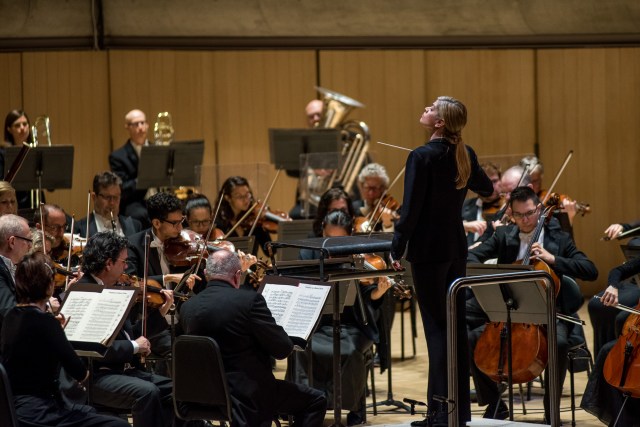
The Toronto Symphony, led by Sir Andrew Davis (photo: Jag Gundu)

And so the TSO are home: and welcome back.

The two pieces on the program showed us two different approaches from both Davis & the TSO even if the pieces aren’t so very different. Excuse me if I make too much of the contrast, when both pieces were delightful. But I was struck by how professional Davis was and is, how well he adjusted the orchestra to the different requirements in a concerto with a romantic virtuoso and a symphony played in a classical style.

We began with Grieg’s A minor concerto, played by Jean-Efflam Bavouzet. This was a reading in the romantic tradition, tempi entirely at the discretion of the soloist, and the orchestra following his every tempo change like Ginger Rogers dancing backwards in high-heels, always keeping up with Fred (or Jean-Efflam).

I merely meant by that comparison that they followed with amazing precision, and no slips.

Bavouzet’s touch emphasizes melodic lines, a wonderful ability to bring out voices and to thereby underline what Grieg was doing in his concerto. It’s always a thrill when a performance lays bare the composer’s structure, showing us the inherent drama in the score.  Davis followed diligently, helping to bring out the big moments such as the 2nd movement horn solos, as clearly—and in a kind of dialogue—as those of Bavouzet from the piano keyboard.

And so I wondered if Davis would conduct the Beethoven the same way, given that I’ve heard conductors bring out the romantic side, especially for a flamboyant work such as the Symphony #7 in A. By romantic, I mean for example, to play up the contrasts – as they did in the concerto—and to play fast and loose with tempo.

Beethoven isn’t that many decades away from Grieg, especially when I recall the way some people (for instance Leon Fleisher with George Szell & the Cleveland Orchestra, the recording of the Grieg + the Schumann concerti that I knew best) hewed closer to the classical rather than the romantic tradition, seeking to honour tempi, only making small rubati and avoiding the big crowd pleaser of a finish that you sometimes encounter.

But no, Davis and the TSO gave us something quite different when it came to the Beethoven. This was a performance with a different aesthetic, a kind of integrity. All repeats were honoured, and long passages building up were permitted to be inexorable and gradual rather than mistaking Beethoven for Tchaikovsky and suddenly speeding up for the big finish. This more painstaking approach to the long passages – both in the second movement, the scherzo and the finale made the drama authentic, which is to say, true to Beethoven.

The orchestra seem very relaxed, and in a wonderful groove, playing everything really well, sounding fabulous. I’m so glad they’re back.

Posted in Music and musicology, Reviews | 1 Comment

Bad Jews: laughter and tears

Tonight I was held captive by the eruptions of emotion in Joshua Harmon’s 2012 comedy Bad Jews, receiving its Canadian premiere production at the Small World Music Centre, in the Koffler Centre for the Arts, directed by Michèle Lonsdale-Smith.

Yes there are lots of laughs, but I can’t help remembering Robin Williams, the avatar of comedy made out of sadness. Happy people do not create comedy. Why are there so many great black and Jewish comedians if not because of their expertise in handling and articulating pain?

BadJewsToronto-photobyDahliaKatz-Koffler-1

Daphna (Rebecca Applebaum, left), Liam (Kristopher Turner) and Jonah (Daniel Krantz) Photo: Dahlia Katz

We meet Jonah and Liam, two brothers who have lost their grandfather, a holocaust survivor. Daphna is their cousin, and Melody is Liam’s Gentile girlfriend. In the immediate painful aftermath of the death, each of the three Jews struggles with their grandfather’s legacy, including one who would marry the cute blonde girl who isn’t Jewish, each seeming to assert that theirs is the most authentic way to live as his successor. While that may sound serious it’s the framework for painful laughter in the conflicting value-systems, the accusations and insults hurled at one another from a place of truth and authenticity.

I can’t help wondering how the four cast members held it together in the tiny Koffler Centre space, so serious, even when I was guffawing just a couple of feet away.

Rebecca Applebaum (Daphna), Daniel Krantz (Jonah), Kristopher Turner (Liam) and Julia Vally (Melody) pitched their voices without ever sounding like actors, without ever using voices that sounded trained or loud, no artificiality, no reminders of acting technique interfering with the perfect illusion.  And it helps that the writing is so fluid, the dialogue so truly human. We were in a living room surrounded by these embarrassingly exposed people from the first moment to the last. It was so real!  I even saw some private anatomical parts, shown inadvertently of course. They may have seemed uncomfortable with one another, thrown together as they were: but they never seemed to mind this audience of voyeurs staring at them with such indecent intimacy, let alone when we laughed at or with them.

It must be very hard for the actors not to giggle when surrounded by a laughing mob, aka the audience.

Applebaum was a driving force for the production. I heard that she was eager to play the quirky Daphna, the self-appointed custodian of Jewish tradition in this family. It’s fun watching the inevitable conflict with her agnostic cousin Liam, a slow motion train-wreck of a cultural  clash. Liam’s claim on the cultural hardware—their grandfather’s chai, treated as sacred by Daphna because he carried it through the holocaust–is pragmatic rather than religious. Jonah and Melody are mostly observers of the big debate, and at times seem likely to end up as collateral damage in the all-out warfare that ensues.

It’s so real, so true to family dynamics. The volume in the small theatre gradually ramps up as the passions are laid bare. But it’s totally real, and hysterically funny, even if I was surprised by tears a couple of times.

I feel sensitized to this kind of comedy from having watched a very funny film last night about a Jewish comedian, leading me to wonder about the nature of comedy. Anger and sadness are central to the film, and again it’s true for Bad Jews. Our own sadness leads us to recognize the universality of these situations, to see ourselves and/or our families up there on stage.  And of course that’s why we were howling with laughter.

Bad Jews continues until June 4th at the Koffler Centre of the Arts. See it if you can.

BadJews_900x500_FINAL_rev

Posted in Dance, theatre & musicals, Reviews | Leave a comment

The Comedian: Jews, good and bad

Sometimes the stars align, and guarantee that things will fail.

Stars do that? Hm, Shakespeare did say something, that the fault, dear reader, is not in our stars. I don’t think he was talking about casting, no not that sort of star. He meant more like Mercury retrograde or whatever astrology does to ensure you get bad reviews.

And why do some films do so well if not some planetary push? But truly I feel lucky, that the stars –meaning celestial influence– are making miracles.

The timing of the film I saw tonight is serendipitous, thank you stars (both the kind from the sky or from Hollywood).

  • I saw a commencement address by Helen Mirren shared on Facebook today. She refers to “Taylor” a couple of times, and I wondered who she meant. It’s her husband of course, Taylor Hackford, who’s directed some wonderful films (An Officer and a Gentleman, White Nights, and Ray for example).

  • I’m seeing the opening of Bad Jews tomorrow, a comedy about family dynamics and you guessed it, the family is JewishBadJews_900x500_FINAL_rev
  • After a glass of wine I noticed a video sitting beside the TV that my wife purchased namely The Comedian
  • And lo and behold I noticed that the director was none other than Taylor Hackford
  • And as I started to watch it, I discover that the comedian–played by Robert de Niro– is supposed to be Jewish.

Surprise surprise! A film about comedy featuring Jewish family dynamics.   Not only does tonight’s film feel like a perfect prelude to the play tomorrow, it also happens to be the most enjoyable film I’ve seen in ages.

But why haven’t I heard about The Comedian?  What happened? When I look at the internet I see that it opened in December of 2016 to bad reviews, and so it vanished without a trace. And yet on the small screen in my house this was a film that I need to watch again: because we missed lots of jokes due to our uncontrollable laughter. When I think of the funniest films I have ever seen, they also hit me that way. For example The Producers or Superbad required multiple viewings because the laughter was so loud as to cover some lines that couldn’t be heard the first time. Even on the second or third viewing there were big laughs.

The Comedian is several things, and they’re all good.

It’s a film with a jazz score by Terence Blanchard. If you hate the film you can still listen to it.

It’s a film with moody cinematography that transports you instantly to its locations. I don’t know how they did it, seguing from one place to another with an exterior shot to evoke the sensations and feelings of distinct parts of New York, or of places in Florida that I can’t claim to know.

It’s a film with a very good cast.

Robert de Niro plays a Jewish comedian, Danny de Vito plays his brother, Harvey Keitel plays a mobster, Leslie Mann plays the mobster’s daughter. Can you say “playing against type”? De Niro and de Vito play Jews, while Keitel –who is Jewish by birth at least—plays an Italian.

If I were to attempt to describe the type Leslie Mann usually plays it would be as a sweet-voiced appeaser, someone who is always apologizing in that whiny voice. But she meets de Niro’s comedian while doing community service, as both of them are in anger management.

And there are other wonderful cameos, such as Cloris Leachman, Billy Crystal, Charles Grodin, and Patti Lupone just to name the first ones that come to mind.

Everybody in this film is nuts, which is another way of saying, the story and the situations are totally relatable, lovable, enjoyable. If you’re not laughing you need to check for a pulse.

But when I watch the trailer I see immediately how it could have shot itself in the foot. The joke you get right off the bat in the trailer between Jackie (De Niro) and his brother Jimmy (De Vito) sounds offensive out of context.  See for yourself,  when Jimmy says his child is getting married and Jackie says “I thought she was a dyke” and Jimmy corrects him,  “you say ‘lesbian!'” No wonder no one came to see a film sounding so bigoted and ugly.

Yes it is abrasive. But the trailer gives you none of the good –the brilliant humour– just an immediate impression of negativity.  Yes there is anger in this film but there is also brilliant wit and catharsis.

It’s a thrill to discover a movie that seems to be flying under the radar, that deserves another chance. I hope the word gets out on this one, because it’s not just okay, it’s one of the funniest films I’ve seen in a very long time.

It’s a natural preparation for the play I’m seeing tomorrow.

Posted in Cinema, video & DVDs | Leave a comment

Oksana G review

Tonight was the world premiere of Tapestry Opera’s Oksana G¸ a new full-length opera with music by Aaron Gervais and libretto by Colleen Murphy, stage direction by Tom Diamond and music direction by Jordan de Souza.

As an event promoted by the Indie Opera Network of eleven companies, it’s worth noting that this is the most genuinely operatic production yet seen from the network. There were none of the usual shortcuts such as presenting a song-cycle as though it were an opera, presenting an opera in concert or with piano or semi-staged. Oksana G is a substantial work, over two hours in length not including the intermission, a work with a small orchestra and chorus.

And Gervais & Murphy answered the most blunt challenges Tapestry artistic director Michael Mori might have posed with flying colours. Is it opera, and does the music really add anything to the story? Yes and yes.

I was braced for something unpleasant when I read that Oksana G would be an opera about human trafficking. I wondered if the opera might exploit its topic, and so I cringed a bit in anticipation. But I was wrong to worry. Murphy’s libretto gets inside the lives of the protagonists. Yes we see lurid scenes. But we’re given a compassionate exploration of this seedy world, never losing touch with their humanity, their desperation to escape, and their shame, even as they fear the judgment of their parents. And we listen to the parents missing their children. If nothing else it’s an excellent opportunity to lose your preconceptions.

OksanaGPromoShoot_HeatherKilner_2

Natalya Gennadi (photo: Heather Kilner)

Natalya Gennadi is Oksana, a young Ukrainian lured into a nasty world from which she struggles to escape. If there’s an operatic prototype, think of Gilda who is abducted by the Duke’s courtiers in Rigoletto, but unable to escape from the shameful life into which she has been pressed. I am mindful of Gilda because she too is essentially a victim, unable to break free of the role imposed upon her. One of the huge challenges in this sort of story is the lack of agency of the heroine, making the story very much like a classic melodrama, where everything seems to be beyond her control, and an antagonist like this one inevitably becomes a villain in our eyes.  In La traviata, too, there is some of the same melodrama, so this is familiar territory in opera.  Her part was originally announced for Ambur Braid, leaving me to wonder what the opera would have been like with her instead of Gennadi. But even with the short notice – the casting change only having been announced in the winter—this part that calls for singing in Ukrainian, Russian as well as English fits Gennadi remarkably well, a Ukrainian speaker who also coaches singers in Russian.

sillhouette

Natalya Gennadi and  shadow that might be Keith Klassen (photo: Heather Kilner)

Keith Klassen is Oksana’s chief antagonist, Konstantin, whom Murphy seeks to sketch as a complex character, an obsessive human trafficker who sometimes seems to believe his own sleazy pickup lines, a Slavic cross between Don Giovanni, and Sparafucile (the hit man in Rigoletto). I can’t decide if I’m missing something, in seeing the story as ultimately formulaic, especially in the way the last scenes unfold (which I won’t spoil for you), captive of that melodramatic impulse. But Klassen was a powerful presence, using his voice and physique to great advantage. I think this is the best thing I’ve ever seen him do.

Jacqueline Woodley’s powerful voice made a huge impression in the role of Natalia, a friend of Oksana’s. Similarly Kristina Szábo as Sofiya – Oksana’s mother—anchors every scene in which she appears, the most authentic person onstage musically and dramatically. Adam Fisher is very sympathetic as Father Alexander.

Jordan de Souza ran a tightly organized show, at least as far as I could tell. With a new score one wants to reconcile the input of the creators, with the interpretation of the performers. In a score such as this one – largely tonal, and only rarely so virtuosic as to push singers out of their comfort zone—I think I can say with confidence that the performance does justice to the opera, that the composer & librettist were well served by the singers, orchestra and chorus. Gervais’ arioso reminded me at times of Leos Janacek, employing a broadly melodic style full of repeating patterns in the orchestra. There was one scene that was for me the most magical part of the score, when we found ourselves in a bar, where there seemed to be background music coming from a diegetic band onstage playing a sort of Eurotrash disco. The arioso of the characters onstage emerged from that rock-ish texture. I wish more composers would attempt this! Christos Hatzis does something like this in a bar-scene in Going Home Star¸his Juno award-winning ballet. Modern music needs to connect to the musical vernacular, aka the music most people listen to in their normal lives. For a few minutes Gervais made a brilliant connection, and you could feel the electricity in the room.

Oksana G continues at the Imperial Oil Opera theatre until May 30th.

Posted in Opera, Reviews | 2 Comments

Dr. Bartolo’s Umbrella launching May 24th

Dr.-Bartolos-Umbrella-Cover-rev2Introducing Dr Bartolo’s Umbrella: Christopher Cameron’s funny, irreverent, touching memoir of his life as a Canadian opera and concert singer in the 1970s and 80s.

His often hilarious stories about performing offer insight into their historical context, plus such arcane facts as why an opera singer’s voice can be heard above a whole orchestra while other people can barely be heard across the dining room table. The genial approachable tone of the book makes it accessible to people of diverse ages and interests.


Please join us for an event celebrating the publication at….

The Arts and Letters Club
14 Elm Street, Toronto
Wednesday May 24, 2017
6:30 p.m. to 8:30 p.m.

Reading at 7:15
Book signing at 7:45
Published by Seraphim Editions
For further information or to purchase click here.

Posted in Opera, Press Releases and Announcements | Leave a comment

The real prize, and never mind appropriation

While I knew what was coming, I was still stunned.

jesse-wente

Broadcaster Jesse Wente

When Matt Galloway asked Jesse Wente to address the question of cultural appropriation raised a few days ago by Hal Niedzviecki’s Write Magazine editorial, I knew what was coming. I follow Wente on Twitter, enjoy his regular spots on Metro Morning, and was in no doubt as to which side he would take.

But that’s just it.  Listen to Wente, and discover what this is all about. The reason you need to listen to this or to watch this is to pick up the key element, namely his emotion.

The first time through this, I was in my car.  It was magic to hear this without the visuals, because I was blind-sided by Wente’s passion, overwhelming and unmistakeable.  I got to work, went looking for this and saw that a friend had already shared it to Facebook: and so I did likewise.

Later in the day I saw the piece shared as a video (because Metro Morning is both a radio program but also captured on camera). That’s what I am sharing here.

When I saw this I had a bit of an epiphany. Pardon me for seeming presumptuous but I’ve seen lots of people discussing the question of appropriation over the past few weeks.  I will personalize this, even as I try to speak to the gap between Niedzviecki and Wente, and insert myself in there, unasked. I think the key is found in this paragraph from Wente, who said:

None of us that I’ve seen want to limit free speech. I wish there were so many more stories written about Indigenous people. But those stories come with responsibility. Indigenous people know this all too well, we are beholden to our communities. When we say these things, we know exactly who will hold us responsible. Who is that for non-Indigenous writers, when they don’t have these connections to the community? Do they truly understand the reason that these stories are sacred?

I’ve been thinking long and hard about this for weeks, as I have immersed myself on a few occasions in powerful passionate discourses, such as They Can’t Kill Us All¸ about Black Lives Matter, or the Canadian Opera Company’s diligent attempt to redeem Louis Riel, an opera that appropriated an Indigenous composition.

There are limits to what a person from outside a culture can truly understand.  I know my limits, no matter how many times I try to understand, try to listen, try to watch, I wouldn’t presume to speak for anyone especially because I don’t see things the same way.

I think the key is that when we use the word “culture” we’re not always talking about the same thing.  And when an Eastern European comes to Canada we usually use the melting pot approach to culture, learning English and assimilating ourselves as soon as possible into the dominant milieu.  I don’t mean this to be a shot at Niedzviecki. Quite the opposite.

Culture for a Hungarian like me? I love Franz Liszt & George Ligeti and Zoltan Kodaly, and I am dimly aware of folk music.  I love to eat schnitzels –notice that I immediately gave my own cultural artifact an assimilated name?  SCHNITZEL is a German word because of course the Austrians loved their meat too, and as they were the dominant race & language, they got the naming rights.  Hells bells, Franz Liszt is actually Liszt Ferenc, but the world knows him by his German alias “Franz”.  So I can’t really speak for Niedzviecki but Hungarians have this remarkable skill at assimilation.  As such, when we try what Niedzviecki proposed – to imagine other peoples and cultures – it’s what Hungarians do obscenely well, so well in fact that we lose ourselves in the process.

(PLEASE NOTE I don’t know what culture Niedzviecki comes from, although it sounds like another country in Eastern Europe, like Hungary).

So this isn’t me defending Niedzviecki. This is me attempting to translate.  When I think of my childhood in Toronto, it was with a strong awareness of the barrenness of Canadian culture in the 1960s.  We had the Met broadcasts on the radio, the records on the record player. And white bread and not much more.  In suburbia there was no real ethnicity at this time.  From what I’ve read, the arrival of Hungarians in their big exodus in 1956-7 after the uprising, brought a great deal of culture to Toronto, and is one of the first steps towards the multi-cultural reality we know today.  Awhile ago I wrote about the Coffee Mill, a restaurant known to have been the centre of Toronto culture, literally the place where TIFF was allegedly conceived born, over coffee & cake.

One can’t really compare this to what Wente’s talking about.  Meaning no disrespect to any Hungarians, we didn’t come here and then associate with fellow Magyars.  And maybe I should be left out of the conversation even more, given that my mom & dad left Hungary via Sweden in 1948 or so, long before the big exodus.

Now let’s go back to Wente’s key passage, and recall that for white Eastern Europeans like my family, cultural assimilation was effortless.  He says

When we say these things, we know exactly who will hold us responsible. Who is that for non-Indigenous writers, when they don’t have these connections to the community? Do they truly understand the reason that these stories are sacred?  

I think the obvious answer to that big question has to be no, especially when you hear the passion in Wente’s voice as he concludes (“This is our strength, this is me being in touch with my ancestors and feeling them sitting beside me.”). I almost lost it myself when he said that, wishing I had a comparable connection.

Setting aside our relationship to the Indigenous community (and our recognition that their stories are sacred) it needs to be asked: what sort of community do we come from and what sort –if any– do we share amongst ourselves?  Some of us are refugees (certainly within my family), with roots on the other side of the ocean.  Some have cut their ties, and have re-invented themselves here over a period of decades.  It’s admirable and beautiful: but totally alien to what Wente’s speaking of.  While we give lip service to the great metaphor of Canada – that  up here, we’re a respectful mosaic rather than an oblivious melting-pot like the USA— we need to take this to the next level.  We can’t simply say live and let live, while our own behaviour is a passive-aggressive expression of disrespect.  The notion of appropriation that Niedzviecki would honour is one consistent with the ethos of the melting pot, where everyone is free to imagine something else and to dream big. This is how Canada was explored in the 19th century and subdivisions developed in the 20th.  This is how many composers and artists understood culture: as though you take and blend and mix, and make it yours without asking.

But I think Canada and the world needs something better than that.  Either all cultures vanish into a true melting pot (which experience has shown isn’t about to happen), or we find the grace and the humility to listen to one another, and to discover one another, distinct and different.

Conversations like this one are valuable. I hope Wente doesn’t lose hope. I heard such despair in his voice this morning, it was truly heart-breaking.  But I do understand that part.  I wish more people would hear him: his emotions, his passion. THAT would be the genuine imaginative act reminiscent of the one Niedzviecki called for when he spoke of an appropriation prize.  If only we saw that kind of effort.

To seek, to understand.  To empathize.  That would be the reward and the real prize.

Posted in Personal ruminations & essays, Politics | Leave a comment

Time stands still in Carsen’s middle ground

Every now and then the stars align for something extraordinary.  Yesterday’s final high-definition broadcast from the Metropolitan Opera brought us something unique, with the help of Robert Carsen’s production of Der Rosenkavalier.

Carsen has found a niche for himself in a middle ground that doesn’t lose sight of the original text, mollifying the hard-core old guard who are upset when a beloved old production is retired.  Such was the case with Carsen’s Falstaff, and such is again the case with Rosenkavalier (thinking of the productions replaced at the Metropolitan Opera).  Yes he updates productions, but he is fastidious in his attention to textual detail.  As director’s theatre goes, you could call it Regie lite, a very gentle pathway to the new that works through the text.

For Richard Strauss’s fin de siècle comedy this meant updating the story to the time of its premiere (1911), a trope we’ve seen a great deal of late, thinking for example of the Glyndebourne Meistersinger or assorted Parsifal productions that seem to be set inside Wagner’s head.  Carsen makes the subtexts of the opera manifest in his updating.  Baron von Faninal is indeed an armaments manufacturer, although the 2nd Act opens with more of this than usual.  Nobody in 1911 expected the war that began so soon thereafter, adding to the poignancy of the moment, as though Carsen has this story hanging off the edge of a cliff.

Rosenkavalier is especially an opera about time and aging.  Usually we’re watching the 30-something Marschallin graciously letting go of her young teenaged lover Octavian.  And because this is opera, we’re watching someone older in each role.   There is a curious sort of magic at work in the use of a trouser role to signify the youthful male, which mysteriously shuts down or confounds our usual disbelief.  We get to a kind of perfect ideal place in our minds, watching Octavian with the Marschallin, that surely couldn’t happen if we were watching an actual teenage boy with an actual woman in her 30s.

What made this season finale so special were a pair of farewells, from Renée Fleming and Elīna Garanča in the roles of these two.  And so when we saw Fleming looking about at the latter part of the first act, she might have been taking in her own fate as an older singer as much as she was heard in character to muse about the passage of time.  And again, even more poignantly at the end of the opera when she re-appears as though to ensure the succession, passing the amatory torch to a younger lover, she could also be signalling her surrender of the role itself.  Her very gentle “ja ja” with which she steps aside was fraught with additional meanings in a theatre full of seniors (it felt weird at 60-plus years old, to be wondering if I was the youngest person present).   Garanča seems fully capable of playing this part a whole lot more, given her wonderfully male body language, but she too has announced that this is her last time in the part.

Yes there were lots of other wonderful performances, especially the Ochs of Günther Groissböck, the Sophie of Erin Morley, the Metropolitan Opera orchestra sounding especially fine under conductor Sebastian Weigle.   One of the great joys of the production was watching the dense stage action captured by the high-definition cameras.

RESIZED_neef_Debus

COC Music Director Johannes Debus and COC General Director Alexander Neef. (Photo: bohuang.ca)

I can’t help wishing that Alexander Neef might again import a Robert Carsen production to the Canadian Opera Company stage.  He has given us several delightful tastes of Carsen already, via Orfeo ed Euridice, Iphigenie en Tauride, Dialogues des Carmelites and Falstaff.   Perhaps Rosenkavalier can be the next one.  It would make a great vehicle for Adrianne Pieczonka, who has sung this production abroad,  and for the COC orchestra led by Johannes Debus.

One can dream.

Posted in Opera, Personal ruminations & essays, Reviews | 2 Comments