Cavalli’s Elena from Toronto Consort

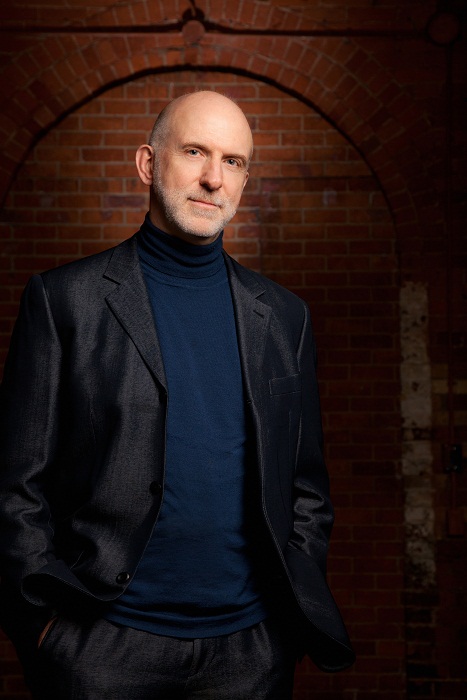
David-225

Toronto Consort Artistic Director & conductor David Fallis

Francesco Cavalli’s Elena received its Canadian premiere tonight at the Jeanne Lamon Hall in a partially staged performance that was still more than enough to charm the audience in attendance. As my companion observed it was a nerdy bunch, ready to laugh at every little gag, no matter how obscure, the loyal followers of The Toronto Consort and their Artistic Director David Fallis, whose sensibility and musicianship seem to be such a key component of the local music scene.

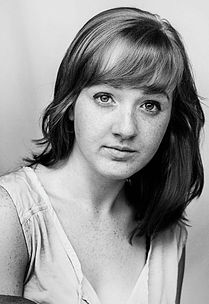
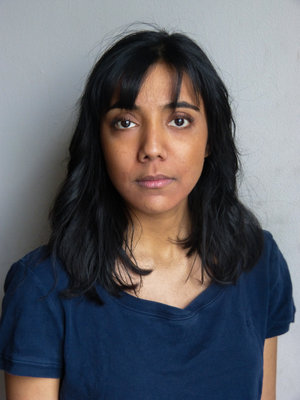
He was surrounded by an all-star cast of baroque specialists, beginning with Consort members Michele DeBoer as Elena and Laura Pudwell as Ippolita, and guests Kevin Skelton as Menelao, Vicki St Pierre as Peritoo and Bud Roach as Iro.  There were no weak spots in the cast, that included some wonderful singing.  St Pierre and Pudwell showed off their darker colours to great effect, while DeBoer’s higher voice had what seemed to be the biggest part by far.

Michelle-225

Michele DeBoer

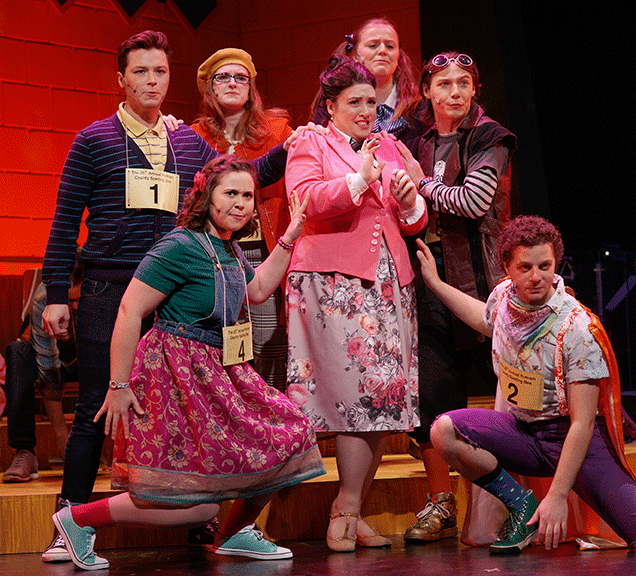
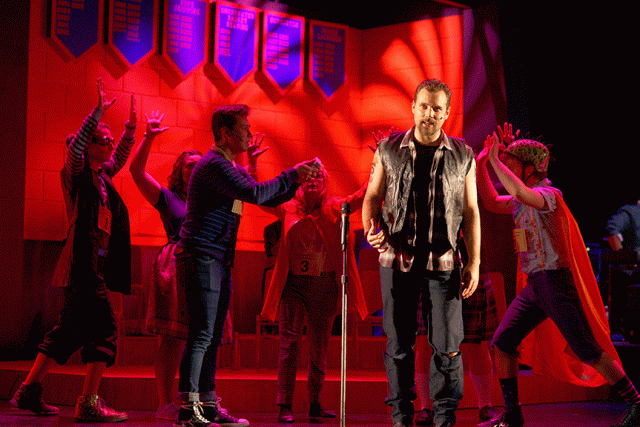
Elena is a comic opera, one of the first to survive. The story isn’t quite what we’re accustomed to, as we’re not confronted with the horrors of the Trojan War but instead watching Menelaus dressing up as a woman to attempt to seduce Elena (aka Helen) by posing as a wrestling coach. However much scenery or illusion one puts into a staging of this opera, and Toronto Consort used very little set or costuming beyond a hint of Wonder Woman for Menelaus’s amazon outfit plus a golden fleece brought in by Castor & Pollux, the plot is pretty silly, as a series of figures from the heroic age of Ancient Greece are busy trying to seduce one another.

Cavalli deserves to be better known. As with his other operas, his style is a very fluid one, allowing swift progress in the plot. While there are some airs, we’re not yet at a point in opera’s development where the music stops the action for very long, although we did enjoy lovely displays of virtuosity from the singers. The dramaturgy is recognizably baroque with a desire to embellish and to show off skill in the singing & the playing. But because the scale of the work is small – fewer than 10 musicians—the singers were never in danger of being drowned out. I can only speculate on how close we came on this occasion to what would have been heard back in the 17th century, especially given that the original employed castrati, whereas this version juggled the vocal parts a bit.

I was most intrigued by Bud Roach’s character Iro, who is identified as a court buffoon, seeming to echo the tradition of servants such as Harlequin from the Commedia dell’Arte, which was known to have been an influence upon Cavalli. He made his entrances through the theatre, not unlike a Shakespearean clown, in his ability to shatter any possible fourth wall. Roach was diametrically opposite from the rest of the cast in his approach, both in his willingness to look and sound more like a comedian than an opera singer, but also in carrying his own guitar that he played. I wish someone would undertake a fully staged production someday. Not only does Cavalli’s music & story-telling deserve this, but so do we, because these operas are so good.

Elena will receive encore performances Saturday May 13th at 8 pm & Sunday May 14th at 3:30 pm in the Jeanne Lamon Hall, on Bloor St West. More than a mere historical curiosity, this is a work full of beautiful music that’s worth hearing.

Posted in Music and musicology, Opera, Reviews | 1 Comment

Precarity in the alternative space of Other Jesus

Evan Webber’s new play Other Jesus, that has been getting presented nightly at St Matthew’s United Church on St Clair, opens a discursive space that I’ve been contemplating. I’m not entirely sure I’m objective about this, given that I’m projecting meanings onto the play that may not be there. What, I’ve wondered, are the conditions that create a religion and a faith community? And what is the relationship between the pure experience of revelation –the visions of a prophet—and the subsequent stories, the rituals, and the music?

The essence of any proposition is a hypothetical, the creation of a world where we explore the “what if” that goes with certain assumptions. Webber takes us somewhere that’s almost impossible to imagine, a crucible where a religion might be born, through a kind of speculative fiction that one could find in science fiction: except the circumstances have more to do with religion and faith than starships or aliens.

I don’t mean to disparage, when I say that Webber’s work reminds me of some conceptual art I’ve seen & heard of, where the idea is sometimes better in the mind than in its execution. And perhaps the shortcomings are a necessary part of the ideal version that can only exist in our heads. This may be partly because the idea is still unfinished or in need of further revision. I say this because I think there’s more to this than Webber realized, that might yet be brought forth in the next iteration of Other Jesus: if Webber gets the opportunity to revise and then remount the work.

head_shot

Evan Webber (photo: Sarah Bodri)

And yet a big part of my experience in this production from Public Recordings, directed by Frank Cox-O’Connell, is its roughness, the miserably incomplete body presented to us: not unlike the experience of faith itself. We’re reaching for shreds and remnants, intimations rather than a concrete and provable fact. Think of Nirvana or Pearl Jam, the way there was a purity to their music precisely because they were rough and unpurified. I think this was the essence of the grunge sound, which was a kind of neo-classical return to first principles, the angry shapeless id that used to rule rock music back in the ‘50s and early ‘60s. I apologize to anyone who thinks of the voices of Eddy Vedder or Kurt Cobain as pretty or refined. What I admire in them is precisely that they did not make a pretty sound, that they were raw and unpasteurized, very direct and emotionally authentic. This is what we get with Other Jesus. The music at the beginning and end and a few times in the middle, is unsophisticated and noisy, a discourse of questions rather than answers, seeking rather than finding. The best things in the play were the unexpected and the ironic, rather than the moments conforming to the genre, such as it was. While we were watching a kind of anti-religious pageant, this was comprised of moments that were both the recognizable and unrecognizable. We were closest to the pure raw essence when we didn’t know what was coming next, when we were forced to lean forward in bafflement.

The word precarity comes to mind, a word usually associated with a precarious existence on the fringes of our economy. It occurs to me that this is the world that Jesus inhabited, among thieves and whores and the sick and the lame, rather than the wealthy property owners and the Pharisees. But the discursive realm too is precarious, balanced on a kind of edge where we don’t know what to expect. Surely this is where it begins, where the visions of the prophets occur, out of hunger or pain, seeking water or healing: and recalling that the word “save” is about healing, or “salving”.

That was the precarious place made–discursively and physically— by Webber and Public Recordings. That we were in a church as we explored a kind of hypothetical gospel of a hypothetical Jesus, only underlined the exploration all the more. As someone observed in the program, St Matthew’s is a church community that is itself being re-negotiated, rethought, and perhaps is also somewhat precarious in its exploration of a new sort of covenant & relationship to its community. I felt too that the neighbourhood—whether you call it “Wychwood” or “Hillcrest”—is being reinvented around us, a series of new chi-chi places to eat and shop. Cox-O’Connell made the witty observation that the regular population going to church is about the same size as those regularly going to plays. Too true! And in both cases there’s an alarming fear that each group is far too grey, although in this case – the edgier theatre—one can rejoice in the youth one sees filling the space.
It was sold out tonight and likely for the rest of the run.

picture

I couldn’t help noticing, too, that for me, the most exciting parts of the performance, like the best parts of any church service, are the music. No sermon ever persuades me nearly so much. Similarly, much as I enjoyed Webber’s ideas, the abstract music and Thom Gill’s song seemed to be the most eloquent moments. But we’d never have been opened to those without the speculative world laid out in Webber’s prose.

Need I add, that this all feels very timely when we’re living in a world that seems on the verge of upheaval, that there’s an existential precarity I wish I could forget, that I escaped for a few moments tonight, until I walked back out the door. As Cox-O-Connell says in his director’s note, “the act of a group of friends putting on a play continues to be a search to believe in something and to belong to something.” The raw fragility of it all can’t be missed.

Is this all there is? Maybe.

Posted in Dance, theatre & musicals, Reviews, Spirituality & Religion | Leave a comment

Vittoria! COC’s fell-good Tosca

They didn’t change the ending but that’s the best I’ve felt coming out of a Tosca performance in a very long time. You wouldn’t normally think of an opera where all three of the principals die as a feel-good opera.

(haha I almost typed “fell-good” which is apt for
an entirely different reason…!
But I won’t be a spoiler)

Tosca is one of the operas I have seen so many times, played, coached, sung parts, that I literally know every note at least of the piano vocal score, and I will always proclaim it to be one of the best operas ever written. It’s indestructible.  It still works whether the hero and heroine are handsome or chubby, young or old, the villainous Scarpia blatantly scary or subtly gnarled. And wonderful as my experience was today I’m happily looking forward to hearing & seeing it again from a different part of the theatre.

Today was the first turn for the #2 cast in the Canadian Opera Company’s current production of Tosca, singing the first of their five of the 12 performances in the run, and who can likely be forgiven for exemplifying that old motto of Avis Rent-a-Car. The slogan for the #2 car rental company was “we try harder” and so it seemed at the Four Seasons Centre today, as they wanted us to notice them too.

Keri Alkema as Tosca gradually won me over more and more. While I enjoyed her work in the first two acts, including the big aria, it was the last act that left me all verklempt and teary-eyed at the end. I don’t think I’ve ever seen a Tosca who persuaded me that she is a different person at the end, at least until now. She seems shaken at what she’s done –the pious innocent who has killed Scarpia—and now is a very dark and troubled woman in that last scene. The other Toscas I’ve seen usually play optimism and hope, setting you up for the disappointment of the fake execution and pursuit. For whatever reason, Alkema made me believe she truly did feel sorry, after the lines in Act II “È morto!
Or gli perdono!” (“he’s dead. Now I forgive him”). In some productions these lines make me giggle because they are so difficult to do without seeming ridiculous, absurd.

But that’s the thing. Alkema doesn’t do so much of the grinning one sees in the last act of a Tosca. For whatever reason –partly due to her chemistry with her Cavaradossi, Kamen Chanev—she is not there to cheer up her despairing painter. Once he sees her, he is the smiling and adoring one, while she seems ashamed, profoundly upset with herself. When Chanev sang “oh dolci mani” it was the first time I really got this aria, really understood what the opera is doing at this moment, possibly because at this moment Cavaradossi is trying to console her, to remind her who she is (a good person?) in the face of her horror at what she’s done. Who thought that after so many productions, they’d show me something new?

16-17-05b-MC-D-1890

Kamen Chanev as Cavaradossi and Keri Alkema as Tosca in the last act of the Canadian Opera Company’s production of Tosca, 2017, photo: Michael Cooper

This was the most moving “Trionfal” I’ve ever seen. Most moving? Perhaps it’s the first time I have ever seen this moment really work! If you know the opera, you know that Act III opens with an epic utterance from the horn section, a magnificent uplifting tune capturing the spirit of hope that might come to fruition if the plot turns out the way Floria Tosca hopes it shall. This mysterious melody comes back, in the bold declaration by Tosca & Cavaradossi just before the mock execution (that is actually a real one due to double-cross), the boldest singing as they stare down-stage at us, defying us to doubt their resolve, daring us to tell them that they will not succeed. It works as a tragedy if the characters have been properly developed, more than two-dimensional cartoon cut-outs. And yes Chanev and Alkema sing this passage beautifully. We dare to hope for a different outcome, believing it might end differently this time.

I know. It’s not rational.

But wait, there’s quite a bit more to come and hahahah I won’t tell you too much because I don’t want to steal the tears out of your eyes, should you perchance come see it. I will say that Alkema is the most convincing Tosca I’ve ever seen in her moment of heart-break, when she goes from “let’s go Mario” (to run away for the happy ending) to “let’s go Mario” (body language and face telling us what she takes in, that he’s not okay, …will never be okay). And the rest? Yes there’s more that’s very good. I couldn’t make a sound for quite awhile, although I did manage to recover in time to offer my applause.

I may have been messed up in advance, seeing the result of the French election on social media between the first and second acts, primed for Cavaradossi’s adolescent outburst of “Vittoria”, believing for a moment that there is an answer to tyranny and fascism. Director Paul Curran gives us a Tosca full of well-thought moments, details & objects used mindfully. We were staked to a great start with the revolutionary gravitas of Musa Ngqungwana as Angelotti followed by the delightful Donato Di Stefano (so brilliant in the Cenerentola a few years ago), the latter, one of a vanishing breed of singer with some understanding of the buffo tradition, making the Sacristan the focus whenever he was onstage.

Conductor Keri-Lynn Wilson gave us a beautiful performance, and please let me explain. Yes the COC orchestra and chorus played what sounded like a flawless fluff-free performance, possibly because of the give and take at the podium.  I don’t think I’ve ever heard such stunning cello playing (Paul Widner?) to begin Act III.
[NB, I was subsequently told in a comment shown below that the cellist in question was Alastair Eng]
And I’ve heard performances that were more inexorable in Act II – when we might want the conductor to be as much of a fascist as Scarpia, driving the orchestra relentlessly—but if the suspense is accomplished in a wild ride that leaves the singers behind? Then I’d rather not do it that way. Conducting Puccini is hard. I recall someone long ago telling me when I was very young that this is the hardest music to conduct: if you’re doing it right. There must be give and take, otherwise the singers get sacrificed on the altar of brisk tempi. There are arias in this opera that require mindful leadership. And so Wilson didn’t disingenuously press on at the end of “Recondita armonia” but instead stopped decisively for the applause, that conductors don’t always allow us. A good conductor can be like a safety net or like a cattle prod, either making the singers more comfortable about the risks they are taking, or terrorizing them. And I feel I should add that in a production where there seemed to be no concessions –no attempts to cast someone based on their nationality, as Canadians or as ensemble studio members –it must be observed that Keri-Lynn Wilson is there on merit, not because she’s Canadian or a woman.  What I saw and felt and what erupted out of my eyes was Wilson’s doing, in a production that was very musical, stunningly beautiful from beginning to end.

keri_lynn

Keri-Lynn WIlson (photo: Daria Stravs Tisu)

Craig Colclough was a strong-voiced Scarpia, at times underplaying the usual loud readings for something subtler, for example as in the moment when he commands Spoletta to go get Angelotti, (catching Tosca in a huge lie).

Meanwhile, there are two casts singing this opera of pure gold until the closing performance on May 20th. I know I’ll see it at least one more time. You should consider it.

Posted in Personal ruminations & essays | 6 Comments

Tafelmusik: now wait for next year

Tafelmusik are finishing their 2016-17 season with a series of concerts this weekend at Koerner Hall: that portend great things for next year. And maybe that’s what they wanted to do, leaving us all hot and bothered in anticipation of the season to come after the summer’s over.

Clever!

Tonight’s program was a clever reconciliation between two of Tafelmusik’s myriad personalities. Consider that sometimes:

  • They play in the pit for Opera Atelier
  • They work with Tafelmusik Baroque chorus, especially when it’s time to do the Messiah,
  • They started out with a heavy emphasis on the baroque
  • But they also play classical (tonight we heard Haydn & Mozart) and even romantic (next year we’ll be hearing more Beethoven, but have ventured deeper into the 19th century than that: as we shall see).

The baton has been passed, in this curious triumvirate who lead this orchestra, even though the conducting is mostly done without a baton:

  • David Fallis leads when they play opera as they did just a couple of weeks ago at the Elgin Theatre (and he’s the only one with a baton), and again when they’re in Versailles on the Opera Company’s imminent tour
  • The choral repertoire is under the capable leadership of Ivars Taurins
  • Jeanne Lamon retired, and now we’ve had opportunities to see her successor, Elisa Citterio leading while also playing the violin

The two aspects of Tafelmusik heard tonight were the classical symphony side, in a Haydn Symphony led by Citterio followed by Mozart’s incomplete choral masterwork, his Mass in C Minor, led by Taurins.

Yes it sounds great. But I can’t help seeing it all as a brilliant exercise in kaizen, continuous improvement, pushing the orchestra to ever higher levels of achievement and enlightenment. Under Taurins they’re led by a choral conductor whose gestures seem to equalize all parts of the score, treating each entry –whether instrumental or vocal—with the same sense of importance & drama, with the same loving care. Under Citterio they’re led by one of their players, listening and following one another as though a big loud symphony were chamber music. In each situation one watches and listens differently.

They’re learning and growing every time they play.

Need I add, that tonight’s concert was stunningly beautiful from beginning to end, a masterful piece of programming executed with care & love.

We began with Citterio leading Haydn’s Symphony #98. The passions in this work seem to erupt, the orchestra powerful and brassy at times. The performance was very tight, but still loosy—goosey as far as any sense of tension or discomfort. Hm, that doesn’t sound very technical does it? but this orchestra seems very happy working with Citterio, very eager to respond. And Haydn fits this ensemble rather well, whether in the soft & lyrical moments early on, or in the occasional sturm und drang with which we’re presented. As the season approaches its end –and they prepare to fly off to Europe—this is a very self-assured band who know who they are. I don’t think it’s my imagination that they love playing with Citterio, and the feeling seems to be mutual.

RESIZED_Julia-Doyle-HighRes-credit-Raphaelle-Photography

Soprano Julia Doyle (Raphaelle Photography)

After the interval it was Taurins turn along with the Tafelmusik baroque choir and soloists Julia Doyle, Joanne Lunn, Asitha Tennekoon and Joel Allison, in the Mozart. The orchestra sounded truly heavenly throughout, the chorus matching them. In the dark “qui tollis peccata mundi” it was a delight to watch Taurins bringing out inner voices, signalling both the performers and the audience to help us navigate the contrapuntal complexities.

Doyle was especially fine in her solos in the Kyrie and the “Et incarnatus est”, her pitch pristine, her phrasing angelic.  But much as I love Tennekoon’s light fluid voice, I’m not sure whether he’s over-parted in this fach, or that the sopranos were simply too loud, and forgot themselves in competing with one another, both in the trio & the quartet. I giggled to myself imagining if one of these had been Constanze Mozart (given that the composer’s wife sang one of those soprano parts). But in a sacred piece such as this I would have expected more attention to balance, more restraint. It’s not opera. Hm or maybe it could have been fixed had the singers been given the acoustical “sweet spot” at the front of the stage, rather than relegated to a place with the chorus. But I’m being a perfectionist, reflecting on a concert that flirted with perfection.

RESIZED_Tafelmusik_MusicDirectorDesignate_Elisa_Citterio-01-HighRes-Credit-Monica-Cordiviola

Music Director Designate Elisa Citterio (photo: Monica Cordiviola)

The concert was unforgettable in so many ways. I’m sure I’m not the only one thinking “see you in September”, wanting to hear more, and eager to hear Tafelmusik again with Citterio. Their chemistry seems to be very good. If you can’t wait until the autumn this wonderful program is repeated Saturday night at 8 pm & Sunday afternoon at 3:30.

Posted in Music and musicology, Reviews | 1 Comment

The Return and its promise

Three performances remain of The Return (il ritorno) at the Bluma Appel Theatre, the last of Canadian Stage’s “Spotlight Australia”, a kind of festival that they’ve offered the past few weeks.  The Return, from Circa appears to be the creation of Yaron Lifschitz, who wrote an extensive program note, a kind of manifesto in defense of circus as so much more than what it’s usually permitted to be.  In my case he’s preaching to a convert.  This could be a version of Monteverdi’s opera Il ritorno d’Ulisse in patria, although we get bits of Monteverdi interspersed with lots of other music. This is not the conventional approach to telling a story.  The singing is lovely but it’s in Italian without titles. If you’re open to it, you’ll connect mostly to the physical element, the bodies in many different positions.

YARON

Yaron Lifschitz, creator of The Return with Circa

There are many people I’m wishing could go see this, as it’s a kind of textbook study in semiosis & signification.  The stage picture before you separates the discreet channels physically, so that it’s almost like bun raku, where you have the puppet on one side and the story-teller on the other: except this time it’s a split between music-makers and physical performers.  One channel is aural / musical  and mostly static, while the other channel is that of the dance or the circus, of pure energy, effort, and the ongoing struggle with the law of gravity.  It’s fascinating and likely to inspire anyone making theatre, dance, circus, opera, or any combination of the above.  If you are any of those, do whatever is necessary to get a ticket.  See it!

There are times when the movements are astonishingly impressive, beautiful to watch,  heart-stopping, original, creative: but only loosely connected to what we’re hearing.  The music is reduced to something that adds a bit of a cachet and glamour to the lovely movement. The idea of The Return —the predicament of the characters– may be signified in a general sense. If you’re open to it, if these images speak to you, then the connections will be made in your mind.

I have been desperate to see something like this: that is, what the Return purports to be. Yes I’ve been waiting for this.  No seriously, for years and years I have been dreaming of this moment, after getting the first glimmer back in the 90s.  “Circus” is a whole vocabulary, a discourse (or perhaps more accurately, a series of discourses, if we distinguish between aerials and acrobatics and animals and the other pathways that don’t immediately come to mind, that could be subsume under that broad circus tent) that could do so much more than the roles to which it’s often relegated.

Last November I saw a show that had similar ambitions, namely Balancing on the Edge  a meeting between new music and circus.  It’s truly like comparing apples to oranges in trying to speak of these shows.  I’ve wanted to see circus step more boldly into the arena of theatre & story-telling.  It can be done, and it’s the same challenge that has been faced before.

We’re talking about making an abstract form signify more exactly and precisely, a challenge faced several times:

  • Music leans upon text, and has employed a written program to create a “tone poem”, whereby something entirely musical aims to tell a story
  • Dance too can tell a story, especially if movement is codified as in the style at the Bolshoi, where we are able to read movement without recourse to text
  • And circus has been used as parts of other shows, thinking particularly of Robert Lepage’s theatricals, especially the operas such as The Tempest¸ Damnation de Faust, or the Ring Cycle, where aerials and acrobatics enlarge the expressive possibilities of a theatre form. But there are others, such as the Fura del Baus troupe.

On the occasion of Balancing on the Edge last fall, I asked whether disciplinarity is a kind of safety net that both assists us in our decoding but also prevents us from breaking through to something genuinely new.  What I really loved in The Return was the ambiguity. Sometimes I felt i was watching figure skating, a formal duet of sorts between two people, even as they defied expectations.  Sometimes I couldn’t tell whether this might be a kind of dance or a kind of circus /  floor exercise.  The longer it went on, the more I felt that they themselves had their own rigid procedures, as one or two of them would come on or go off, doing an exciting series of movements that could just as easily be a duet or a pas de deux, in their preoccupation with a kind of display, showing off as blatantly as anything you find in opera or ballet. That’s good, even if it was a different set of procedures in play.  Perhaps this is early in the development cycle, and they’ll evolve further.

The Return is wonderful to watch, full of moments suggesting new possibilities.  I felt I was watching an athletic kind of dance, really, as there have been dance companies in Toronto employing at least part of this movement vocabulary.  This is a very enjoyable show.  I can’t help thinking that the arrival of a troupe from afar should be inspiring, opening new imaginative vistas.  Claude Debussy’s creative life was spurred by the international Paris exposition in 1889 when he first heard the gamelan.  This visit by our friends from afar could be every bit as inspiring.

But you have to go see it to find out.

Posted in Dance, theatre & musicals, Opera, Reviews | 3 Comments

On the road again: TSO prepare to tour

Tonight was the first of two farewell concerts for the Toronto Symphony before a two week tour taking them to Tel Aviv & Jerusalem, and then Prague for a residency that Conductor Peter Oundjian spoke of, to honour Karel Ancerl, who was the TSO’s Music Director from 1969-1973 (the year of his death). I can’t be objective about such things, having been very young at the time but I do recall a couple of amazing concerts and a live recording I had of the TSO playing Beethoven. The naïve expectation among my friends (when people speculated about the name of the new concert hall) was that it would be Karel Ancerl Hall, but this was before it became standard practice to name halls for donors rather than leaders.

Tomorrow’s concert (at 2:00 pm please note!) includes:

Oundjian also mentioned Dvorak’s 7th Symphony as a work to be played on the tour.

Tonight’s program included the following:

  • Oscar Morawetz’s Carnival Overture,  a great choice for the visit considering that Morawetz was born in what is now the Czech Republic, was a Canadian for most of his life, and just had his 100th birthday in January.
  • Pierre Boulez’s Le soleil des eaux, a challenging work with soloist Carla Huhtanen plus chorus. Tonight we heard Soundstreams Choir 21 although they are not accompanying the tour.
  • Nicolai Rimsky-Korsakov’s Scheherazade, a work that’s becoming their calling card, recalling that the TSO played on the 2016 Florida tour and that they’ve recorded it

Pleased as we can be with the TSO’s ongoing commitment to new Canadian compositions in this Sesquie-season, it’s worth noting that each program has at least one Canadian piece on offer even if they’re not much more than what R Murray Schafer called “un pièce du garage” (and I quote from My Life on Earth and Elsewhere)

A commission from the Toronto Symphony Orchestra followed that from the MSO a year or so later. The contract read: ‘It is agreed that the work shall have a minimum duration of approximately seven(7) minutes and no longer than ten (10) minutes.’ That is, the work was to be what Canadian composers call a ‘piece de garage’, intended for performance while the patrons were parking their cars.

Neither piece exceeds ten minutes, but yes at least it’s something, and forgive me if I seem to be asking too much.

Morawetz’s overture is a lively affair, coming from the very beginning of his career, before his emigration, and therefore of special interest for the concerts in the Czech Republic.

Carla Huhtanen 2

Soprano Carla Huhtanen (photo: Tobin Grimshaw)

The Boulez that followed was a fascinating study in 12 tone composition, delicate and lyrical without any unpleasant dissonance that I can recall. Carla Huhtanen is a wonderful ambassador not only for Canadian music but especially for the modernist composers such as Boulez. Her voice has a kind of acuity whether she’s singing baroque & classical music for Opera Atelier, or pushing the envelope with music from recent times, a wonderfully precise intonation and clarity of tone.

vanessa-fralick

Vanessa Fralick, Associate Principal Trombone of the Toronto Symphony

And speaking of Opera Atelier, Soundstreams Choir 21 were prepared by David Fallis, who just last week led Opera Atelier’s Médée, and who will again go back to early music for Toronto Consort’s staging of Cavalli’s comedy Helen of Troy next weekend. While the Boulez is not a long work, it’s a very unique sounding work. I don’t find it matches the surrealism of the text, being instead much more random, a smattering of colours and tones rather than being able to reference images or moods that one might call surreal. But wow it’s intriguing all the same.

To conclude the TSO gave us a piece I heard three times in Florida on the 2016 tour, a series of marvellous performances. The live experience of the TSO playing Scheherazade isn’t at all what you get on their CD (which has a more conventional interpretation), as Oundjian fully exploits the potential theatricality of the piece in a live performance. When, for example in the 2nd movement, we get the portentous exchange of solos from trombone and trumpet, instead of doing it as written, Oundjian plays up the contrast, getting Vanessa Fralick to play it super slow and loud, while getting the trumpet’s answer to be a comically tiny cartoony echo, like something from vaudeville. It’s brilliantly wacky, and not the only example. Concertmaster Jonathan Crow is given several opportunities to draw out the schmaltzy drama in his solos, as if to call attention to the story-telling.  I think it’s fair to say that the audience gave them a wild send–off with some of the biggest applause i’ve heard all year, leading Oundjian to joke about wanting to take us along on the tour.

I wish…!

After tomorrow afternoon’s concert, the TSO leave on their tour Sunday for two weeks, returning towards the end of the month.

Posted in Music and musicology, Reviews | Leave a comment

The Music Gallery: new locations for May

We’re on the road until the end of the season! Due to issues with our performance space we’ve had to reschedule our remaining shows – see below for full listings. Please join us for our first Emergents outside of the church, visit us in the intimate confines of the Burdock Music Hall for an early showthis Friday.


The Music Gallery presents
Emergents IV: Stereoscope Duo + Harp Society 
curated by Chelsea Shanoff
Friday, May 5, 2017
Doors:
 6pm | Concert: 6:30pm
Burdock Music Hall
Tickets: $8 Members/Students | $12 Regular/Advance at musicgallery.org

***NEW VENUE & TIME***

The first set focuses on The Toronto Harp Society, whose mandate is to cultivate and foster an appreciation of the harp, as well as to encourage new works for harp by Canadian composers. The society is also adamant about supporting arts education, which has resulted in tonight’s featured performers being the winners of their annual competition.

Robert Taylor – J’ai tant rêvé de toi Aria for voice and harp by , performed by Myriam Blardone, winner of the Judy Loman Award from the Toronto Harp Society Scholarship Auditions.
Glenn Buhr – Tanzmusik: IV. Cantilène Elégiaque
Paul Hindemith – Sonata for Harp performed by Clara Wang, winner of the ARCT category of the Toronto Harp Society Scholarship Auditions.
Patrick Arteaga – A Portrait of Tschamiu performed by Angela Schwarzkopf
Henriette Renié – Pièce Symphonique en trois épisodes performed by Angela Schwarzkopf

The second half of the night features Stereoscope Duo, Toronto’s newest saxophone duo – Olivia Shortt (last seen during X Avant as a member of Dialectica) and Jacob Armstrong. This creative and quirky duo aren’t afraid to use electronics, collaborate with dancers and other artists or make new sounds. It’s all in a day’s work.

Robert Lemay (CANADA 1961- ) – Fragments Noirs (2016) for soprano and alto saxophones
Ben Wylie (USA/CANADA 1992) – Dichotic (2015) for two alto saxophones
Anthony T. Marasco (USA 1986- ) – Werewolf (2017) *World Premiere
Finola Merivale (IRELAND 1987- ) – Home (2015) for alto and baritone saxophones and voice
with Dancer Kathleen Leggasick and soprano Lindsay McIntyre

The Emergents Series is generously funded by Roger D. Moore.


The Music Gallery and Canadian Music Centre present
All In: Creating Safer Spaces For Music 
***POSTPONED***


The Music Gallery presents
Pharmakon + Mamalia + Kristina Guison
+DJ Garbage Body
***NEW VENUE***
The Baby G, 1608 Dundas St. W.
Saturday, May 27, 2017
Doors:7:30pm | Concert:8pm
Tickets: $15 Regular | $10 Members/Students | $13 Advance at musicgallery.org


The Music Gallery presents
DKV + Icepick + Invisible Out
Thursday June 15, 2017
Doors:8pm | Concert:8:30pm
Burdock Music Hall, 1184 Bloor St. W.
Tickets: $15 Regular | $10 Members/Students | $13 Advance at musicgallery.org


“Press releases and announcements” are presented verbatim without comment.

Posted in Press Releases and Announcements | Leave a comment

Questions for Natalya Gennadi – Oksana G.

Ukrainian Canadian soprano Natalya Gennadi was recently announced as a replacement in the title role of Tapestry Opera’s Oksana G, when the original singer had to cancel. Oksana G tells the story of a young Ukrainian woman lured into the world of sex trafficking by a recruiter who unexpectedly falls in love with her.

Natalya has performed the role of Suor Angelica with Cathedral Bluffs Symphony Orchestra and Opera Oshawa, and recently made her debut with the Brott Opera as the Countess in Mozart’s Le Nozze di Figaro.  She has also sung Yaroslavna in VoiceBox’s Prince Igor, Zemfira in Aleko with Opera Five, Tatiana in Eugene Onegin with Slavic project Tchai, Donna Anna in Don Giovanni with Opera Nuova and Opera by Request, Fiordiligi in Cosi fan tutte with TSOW, and covered the part of Santuzza in Cavalleria Rusticana with Maryland Lyric Opera, USA. Natalya successfully collaborates with Vesnivka choir, Toronto and is a guest soloist for the annual European Union Christmas Concert in Notre Dame Basilica, Ottawa. Recent recipient of the IRCPA’s Karina Gauvin Scholarship, she was awarded the Career Blueprint grant from the National Opera America Center and Sondra Radvanovsky.

I had the pleasure of asking Natalya some questions in anticipation of the world premiere of Oksana G May 24th

OksanaGPromoShoot_HeatherKilner_2

Natalya Gennadi (photo: Heather Kilner)

Are you more like your father or your mother?

Although I love and respect my mother a lot I am undoubtedly my father’s daughter.  Restless and passionate about everything he took on, he had a mind of a mad inventor: he built furniture, houses, could draw cute puppies and was a successful engineer at a big plant during the Soviet era. I think I inherited his fearlessness when it comes to decision-making and I am the handyman of the family. However, my mother and I are more similar when it comes to music as my father can’t string two notes together in a tune while my mother plays piano and still sings duets with me at the dinner table. She’s the one who read us Pushkin and Tolstoy as bedtime stories and played opera recordings casually.

What is the best or worst thing about what you do?

I do many things because I have to provide for my family. I call these things “survival jobs” and they have run the gamut from co-writing for Forbes Ukraine, being an usher for a Cirque du Soleil production to playing a speaking part of Rob Ford’s friend on The Daily Show with Jon Stewart. These experiences helped me learn discipline and time-management and allowed me to meet so many hard-working and friendly people.

However, I do struggle with finding a healthy balance. Do I go to a competition, or enroll my son in French lessons? Should I pick up a longer shift, or should I rest and be a real diva on a dime? With experience these little decisions become easier to make, but they are still a major challenge, I am sure, for many singers. But whenever I get the chance to sing and perform, it makes the “survival jobs” worth it.

Who do you like to listen to or watch?

Maria Callas all the way! Her interpretations are always on point. I also like watching videos of Sophia Loren, Catherine Deneuve, or Patricia Petibon before a performance or audition to get me in the right mood. Most recently, I was preparing a modern aria about an abuse victim for Tapestry Opera’s Oksana G., so I watched several heavy documentaries on the topic before opening my music.

What ability or skill do you wish you had, that you don’t have?

I’ve always wished I could play piano better. I started out as a biologist and later became a linguist so I never thought that I’d benefit from learning how to play piano well. I do play well enough to get through my notes when preparing the music, but I wish I could just spontaneously break into a jazzy arpeggio.

I’ve also always wanted to learn ballet and take some serious dance lessons. However, I am quite athletic and have had some basic, yet very valuable dance training at the University of Toronto. Let’s just say that no feet were stepped on when I had to dance in productions, but pointy shoes are probably not happening any time soon

When you’re just relaxing and not working, what is your favourite thing to do?

My partner, Ivan Jovanovic, is a pianist and we like to travel on the rare occasion we both have time off. Even a little day trip can be very special, whether it’s a trip to Montreal or to the ROM.

On weekends, we usually explore Toronto with my son, who’s almost 12 and is the best companion for gastronomic and historical adventures. Normally you can get a brief lecture on European history over a burger and a milkshake, or, God forbid, a full classification of Pokémon. Never a dull moment.

gennadi_headshot

More questions about preparing
Oksana G in a production for Tapestry Opera…

You’ve been brought in to play the lead in Oksana G. Talk about what that means, learning the part so close to the opening.

It’s a very ambitious role for me and the music can be challenging. Usually I prefer the role to settle in before I start rehearsals, but the Tapestry team has been so helpful and supportive – our motto is “divide and conquer” and we work with pianist Gregory Oh daily. I luckily have a significant advantage with Ukrainian being my second language and the comfortable tessitura of the piece so now I’ve been focusing on dissecting the scenes into excerpts that are easy to memorize.

What kind of music is this?

I would define Oksana G. as a Greek drama, but Tom Diamond, who’s the Director, describes it as an opera vérité and I completely agree. The topic of human trafficking is heavy, but the libretto is very realistic and does it justice. And I find that the music is truly respectful of the story it’s conveying. It consists of a series of dialogues that is more movie-esque than conventionally operatic – each character has their own specific way of talking and it’s incredibly clever. For example, the main anti-hero, Konstantin, who lured Oksana and many others into the world of human trafficking, has a very unsettling, immediately recognizable leitmotif – an eerie variation on Georgian folk singing.

What sort of role is this?

Oksana is such a unique and beautiful heroine. She has the purity and strength and all of the imaginable misfortune of Puccini’s heroines. However, she’s much more alive and detailed and is truly a breathing human being. With this comes the great challenge and responsibility of making her real on stage. Not to spoil the plot in any way but, I think there is a lot of Cio Cio San’s youth and strength in Oksana, accompanied by Tosca’s power. The role was written for a coloratura or a high lyric soprano, however my full lyric brings a wider palette of very Slavic colours to it.

What language or languages do you have to sing in this opera?

Oksana speaks Ukrainian, Russian and English, which is a really fortunate coincidence for me.

How would you describe yourself & your voice?

My voice has been going through some positive changes in the past few years. I’m coming from singing as heavy as Santuzza to finally settling into much more lyric, fluid repertoire. Oksana is comparable to Donna Anna and Violetta, and that’s where I find myself comfortable these days.

Oksana G. tells a story about human trafficking in Eastern Europe. Please unwrap some of the politics of this opera for us.

sillhouette

Natalya Gennadi (photo: Heather Kilner)

I grew up in Ukraine in the post-Soviet 90s and I find Oksana G. to be extremely accurate. Times were tough, people were naïve and desperate to make a living. Children, especially girls, are so vulnerable when such economic disasters unravel. I remember seeing one of my classmates suddenly coming to school dressed in a fur coat and sporting a new purse…

There were stories that my mother would share quietly over the phone: a friend of a friend went to Cyprus to work as a maid and left her old mother and a little daughter in Ukraine. They haven’t heard from her since. Those were regular women – mothers, sisters, daughters, wives, friends. They were just looking for a regular, paid job because there were no opportunities in Ukraine at the time. Oksana is an average girl – loved by her family, applying to university and looking for a summer job that can pay for tuition. Her recruiter knew exactly how to lure her and convince her parents, giving them a “legitimate” solution to their financial problem.

This issue is not in the past, unfortunately. Human trafficking is something we are dealing with right here in Canada too with hundreds of women being lured into its dark underbelly. It’s truly unsettling.

Are there any shows you’ve done or seen that now seem to have laid the groundwork for what you’re doing in Oksana G?

Suddenly I am looking at operas through the prism of Oksana G. , which has led me to question conventional operatic stories. For instance, Suor Angelica never mentions the man whom she had her son with. If she were in love, why wouldn’t she pray for both of them, or even curse the man’s name?

Is there a teacher or influence you’d care to name that you especially admire?

It’s a small village really. I’ve been working with soprano Frédérique Vézina for the past three years and am very grateful to have her as my teacher. During my university studies I was lucky to be in the studio with Ingemar Korjus and then Lorna MacDonald, whom I still consult with.

There are also people like Wendy Nielsen who inspire and guide me even though I don’t study with them regularly. Her Donna Elvira at Opera Lyra was my first memorable Canadian operatic experience, and as an emerging artist I’ve learnt a lot from her both on a professional and personal level.

*******

Oksana G has its world premiere May 24th at Imperial Oil Opera Theatre starring Natalya Gennadi, running until May 30th. Click here for tickets and further information.

poster_oksanaG

Posted in Interviews, Opera | Leave a comment

MYOpera + Rossini = the perfect marriage

I like an opera with ambition. Tonight I saw a production with style & wit whose chief ambition was to make us laugh: and it succeeded admirably because it was unafraid of sometimes being totally silly.

MYOpera launched their 2017 offering, the first of three performances of Rossini’s The Italian Girl in Algiers at the Aki Studio in Daniels Spectrum.

One might expect that a company whose stock in trade is giving opportunities to young performers can’t measure up to big money productions featuring mature talent. But sometimes that tendency can work in reverse. In theatre I immediately think of Romeo and Juliet, and the credibility the story gains from a young cast. In opera it’s even more pronounced when one factors in the complex skills required to portray a Mimi, a Butterfly, a Lucia or a Juliette, meaning that the singers employed are normally older than the role they’re portraying.

I think there was at least a little of the shock of recognition in the audience with me tonight watching a lovely young group of performers, drawing us into their story-telling and music-making.  It felt authentic and right.

In an early chapter of Karol Berger’s Beyond Reason, a lengthy study of Richard Wagner that I’ve been reading lately, we encounter Rossini, whose madcap operas are explained and embraced in terms of “organized lunacy”. I felt the greatest possible surrender to that impulse in this production, a fearless embrace of the wacky and the whimsical. Berger cites Alessandro Baricco, who spoke of Rossini’s creation of a theatre of marionettes, mechanical music and singing. Director Anna Theodosakis took this to the next level. No it’s not the first time I’ve seen a Rossini production reduce the performers to something mechanical—we saw this for instance in the 2015 Barber from the COC—but this seemed to take it further, as it was executed with complete abandon and commitment. At times the movements & actions of the singers seemed totally koo-koo: which certainly helped create many laughs tonight.

There is a possible international subtext to the story that happily was side-stepped, in favour of the sexual politics underpinning this redemptive tale of an independent female, a kind of inverted version of Abduction from the Seraglio, as it’s the woman rather than the man who undertakes the heroic rescue. By framing the story early in this century with at least a hint of silent film via the projected titles, we were encouraged to sidestep the problematic issues one might observe in the original text, while turning instead to the era of the suffragette.

a_N.-Fransblow-crop

MYOpera music director Natasha Fransblow

MYOpera offer a complete package, both the dramatic values and musical ones too. Natasha Fransblow led a thoroughly organized performance, leading several quick ensembles where the singers listened to one another with fabulous attentiveness: a useful component both in the creation of cohesion and intelligibility. Sometimes the performers were singing quickly while executing complex physical moves as well.

I have a hunch that the production was built around Camille Rogers, whose intriguing looks and remarkable mezzo-soprano voice likely led the production team in their selection of repertoire. Without her confident strutting presence, the story falls apart. But whenever she came onstage, the Rossini comedy machine clicked into a higher gear.

a_Warren-P.

Bass Peter Warren

Her rival in the operatic power struggle that triggers many of the laughs was Peter Warren’s Mustafà, a bass who was a triple threat, making us laugh with his physical plasticity, his endless array of facial expressions, or with fearsome poses and characterization. And he can sing too.   Jan van der Hooft as Lindoro, Isabella’s long-lost love, gave us some of the most impressive singing of the night even though he too was conscripted into the comedy corps. There were no weak spots in the cast, especially in the beautifully balanced ensembles.

I need to mention one of my chief sources of pleasure, in the stage configuration. By accident we chose to sit on seats immediately beside the stage, a privilege I’d recommend to anyone who might be seeing one of the remaining two shows this weekend. By sitting where we did, we were watching the show obliquely, often watching singers facing an audience who thereby deconstructed any pretense of an illusion. The silliness was right in our faces, within inches. I am a sucker for theatricality, and in this show Theodosakis required her cast to work harder, coping with those of us poised right beside their performances. At times singers had no choice but to include us in the action, which can be magical, but also nerve-wracking for the singer.

If you can get there, go see The Italian Girl in Algiers because you might see a future star or two, because it’s musically excellent and yes, because it’s full of laughs.

A_IGA-Homepage-Banner

The Italian Girl in Algiers featuring Camille Rogers (pictured above)

Posted in Opera, Reviews | Leave a comment

CCOC’s 50th Anniversary Season Announcement

Ben Heppner and other opera stars join the Canadian Children’s Opera Company for thrilling 50th Anniversary Season

TORONTO – The Canadian Children’s Opera Company presents the thrilling lineup of its 2016/2017 50th Anniversary Season.  Founded by Ruby Mercer and Lloyd Bradshaw in 1968 to provide the children’s chorus for the Canadian Opera Company, the CCOC has gone on to become an internationally-recognized organization in the field of children’s opera.

50th Anniversary Celebration Concert

On October 26, 2017, the CCOC will kick of its momentous 50th anniversary celebrations with a celebratory concert at Canada’s foremost opera house, the Four Seasons Centre for the Performing Arts.  The company has shared the stage with countless opera stars over the years and we are happy to invite some of the best Canada has to offer to share the occasion.  Internationally renowned tenor and radio personality Ben Heppner will host, with performances by Richard Margison, Krisztina Szabó, Simone Osborne and Andrew Haji.  CCOC Music Director Teri Dunn will conduct the choruses of the CCOC while former music and artistic directors John Tuttle and Ann Cooper Gay will lead a chorus of the company’s many alumni.  The event, one of the largest in the CCOC’s history, is generously supported by our partners at BMO Financial Group, Donnelley Financial Solutions, and the Canadian Opera Company.

The Monkiest King

The main opera production for the season is the world premiere of The Monkiest King, a new CCOC commission by award-winning composer Alice Ping Yee Ho and librettist Marjorie Chan.  The duo won the 2013 Dora Award for Outstanding New Opera for their Toronto Masque Theatre commission of The Lessons of Da Ji.

The story is adapted from the Song Dynasty mythological figure of Sun Wukong – the Monkey King.  The character, which grew to include Taoist, Buddhist and Hindu influences, spread outside of China throughout East and Southeast Asia.  He has appeared in many forms and adaptations, prominently including the Classic 16th-century novel Journey to the West by Wu Cheng’en, and remains prevalent in the modern day with appearances in Hong Kong action movies and video games.  A proud trickster character reminiscent of Raven or Loki, Sun Wukong rebels against heaven, but ultimately learns humility.

While we in Canada are most familiar with the European tradition of opera, storytelling through the combination of art forms transcends cultural boundaries.  The CCOC, with this commission, has proclaimed their dedication to exploring the cultural diversity of Toronto and Canada while celebrating the stories of our whole community.   The premiere production will feature a number of Chinese-Canadian artists in addition to the composer and librettist, including orchestral musicians  and choreographer Emily Cheung, Artistic Director of the Little Pear Garden Dance Company.

I am absolutely thrilled to write a new opera “The Monkiest King” for the incredible Canadian Children’s Opera Company.  This is also my second collaboration with award-winning librettist Marjorie Chan in our exploration of new story from an old Chinese tale. The legendary Chinese character “The Monkey King” is probably the most famous modern day Chinese “Marvel” hero – it is a dream project for me to bring this mischievous good-natured character to life in a contemporary children’s opera setting.  The “Monkiest King” will certainly inspire and educate children performers the magic of music/drama in a different cultural premise, the production is a promise of both fun and challenges to all!

-Alice Ho, composer

The Monkiest King

by Marjorie Chan and Alice Ping Yee Ho
May 25-27, 2018
Lyric Theatre
Toronto Centre for the Arts

Featuring members of the CCOC.
With a mixed chamber orchestra of Chinese and Western instruments.

A Cup of Kindness – Choral Concert

In late November, the CCOC presents its annual winter choral concert, presenting all six divisions of the company performing operatic and choral music.

Myths & Monsters – Junior Divisions

In the spring, The Junior Divisions (children aged 3-10) will be presenting Myths and Monsters, a collection of music and theatre examining the fantastic and frightening in the world of myth and legend.  This will include a production of Dean Burry’s opera for young performers, Theseus and the Minotaur.

Chip and His Dog – Youth Chorus

Since 1968, the CCOC has commissioned no less than 12 major operatic works and the Youth Chorus of the CCOC (for older choristers and changed male voices) will present one of the first, Chip and His Dog, by the prominent international composer Gian Carlo Menotti.  In the late seventies, the company’s founder, Ruby Mercer,  commissioned her friend to compose the work. It was premiered at the Guelph Spring Festival in 1979 and has gone on to countless international productions in numerous languages.  The CCOC is excited to be bringing this opera home again.

The Canadian Children’s Opera Company’s 2016/2017 Season continues

Commedia
Saturday, April 29
7pm
Tanenbaum Opera Centre

Spring in Song
Sunday, May 28
5pm
Grace Church on-the-Hill

Brundibár
International Tour of the critically-acclaimed CCOC production
July 2-12, 2017
Prague, Krakow, and Budapest.

About the Canadian Children’s Opera Company

Currently in its 49th season, the CCOC consists of six choruses for ages 3 to 19 and is the only permanent children’s opera company in Canada. Led by Artistic Director Dean Burry, Managing Director Ken Hall, and Music Director Teri Dunn, the company engages young people in the vibrant world of opera by offering intensive musical and dramatic training and numerous professional performing experiences. In addition to their own concerts and opera productions, members regularly perform with the Canadian Opera Company and other major professional organizations, record, and tour nationally and internationally.

“Press releases and announcements” are presented verbatim without comment.
Posted in Opera, Press Releases and Announcements | Leave a comment