A year and a half ago it was a conceptual Marriage of Figaro including a mysterious cupid and bird carcasses, in Claus Guth’s production at the Canadian Opera Company. Now it’s Opera Atelier’s turn in a production at the Elgin Theatre this week, a revival of one that we saw back in 2010. This is one of the most popular operas, a story to mostly make you laugh with occasional tears, three quicksilver hours that zip by before you know it.
Is Mireille Lebel as Cherubino being marched off to war by Douglas Williams’ Figaro? non piu andrai indeed. (photo: Bruce Zinger)
OA seem to improve their productions with every iteration, probing and exploring beyond the previous time. I remember how excited I was in my first experience of Figaro with the previous design concept (one I first saw in the 1990s that was revived in 2003), even if in that earlier version, the company still seemed so obsessed with their mission of foregrounded historicity as to miss much of the fun. What struck me back in 2010 was a growing maturity from Marshall Pynkoski’s concept, a willingness to make great theatre, less interest in proving a point in the history books and–finally! — more of a willingness to just have some fun.
Today I saw a cast working hard to be intelligible, singing the opera in English with surtitles even if we could understand almost every syllable without recourse to those titles: which made the comedy effortless. Conductor David Fallis has Tafelmusik playing gently without ever covering the singers. In the biggest passages that can be trouble for other productions such as the Count’s Act III aria or the finale to Act I –that is, without the protective envelope provided by Fallis, Tafelmusik and the acoustics of the Elgin Theatre–, there was still no problem hearing the singers. It’s an extra pleasure seeing Elisa Citterio, the violinist who is the new Tafelmusik Music Director in the spot once occupied by Jeanne Lamon. Their pace and their approach is the most historically accurate element in this production, from an orchestra that is one of the cultural treasures of this city.
Pynkoski gives us a very theatrical Figaro that opts for winks to the audience over heavy-duty illusion, an energetic romp from a young cast. While the design is influenced by the Commedia dell’Arte subtext, that influence is inconsistent in its application, especially in the jarring use of the sticks smacked together, upstaging anything else happening at the time (especially singing). But other than that minor concern you will come out of this Figaro smiling and happy, I think.
This is the usual handsome stage picture, designed by Gerard Gauci (set) and Martha Mann (costumes). For fans of the Opera Atelier Ballet, it may be disappointing to see so little dance in this opera, but the other bodies onstage are so attractive as to compensate somewhat. The cast are young attractive performers. Figaro & Susanna, the young couple embarking on marriage, are Douglas Williams & Mireille Asselin, while the Count & Countess Almaviva are a striking pair, namely Stephen Hegedus & Peggy Kriha Dye. Mireille Lebel is a charismatic and believable Cherubino both because of her height and body language. In addition to this strong nucleus, as good a cast as any Opera Atelier production I’ve seen before, the smaller parts were also well cast. Olivier Laquerre as Antonio stole the show every time he opened his mouth, while Laura Pudwell as always was a delight as Marcellina.
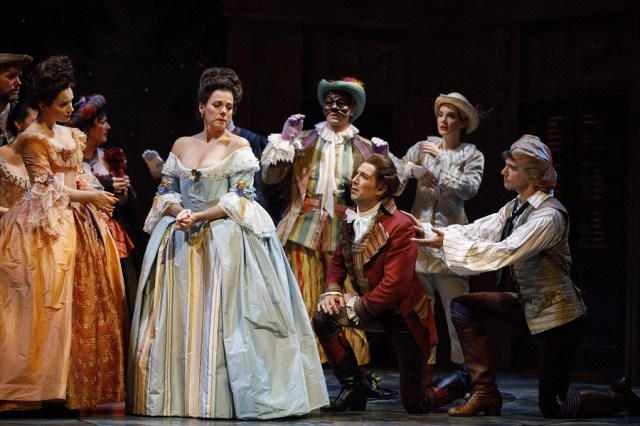
Will she forgive him? The company, including Peggy Kriha Dye and Stephen Hegedus (photo: Bruce Zinger)
Hegedus & Dye give the production its necessary gravitas to counter-act the non-stop shenanigans of the servant class. Asselin & Williams are a very classic pair in their lightness of touch, likable manner, and flair for comedy. Lebel makes the most of her vocal opportunities as each of her famous arias is the highlight of that act.
Never mind obscure concepts (thinking of Guth), this opera is a near-perfect creation that is a delight to hear and see, particularly when given to a gifted group of performers. Opera Atelier’s Marriage of Figaro runs until November 4th at the Elgin Theatre. I strongly recommend that you see it and hear it.
You knew this had to be a different concert from the beginning, the second half of an exchange, that had begun with the Toronto Symphony’s visit to Israel last year. Roy Thomson Hall was really full, including the seats behind the Israel Philharmonic orchestra. When they came in that big crowd erupted into applause, that was even bigger for the arrival of conductor Zubin Mehta
We started with “Oh Canada”, and I sang along (in French because I don’t know the words in English. They’ve changed them so often). Then came the Israeli anthem which I don’t know, and curiously far more people sang along with that one than with “Oh Canada.” In other words, maybe a big reason Roy Thomson Hall was so full was a patriotic one.
This is the third time I’ve seen Zubin Mehta conduct.
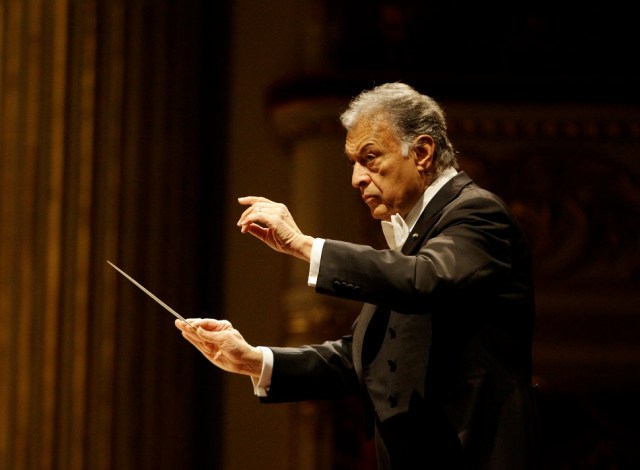
Zubin Mehta (photo: Marco Brescia- La Scala)
At 81 years old, he is one of the oldest remaining masters, now that so many have fallen recently:
Neville Marriner
Frans Brüggen
Claudio Abbado
Cristopher Hogwood
Lorin Maazel
Nikolaus Harnoncourt
I remember hearing back in the 1960s from one of my siblings that he was married to a Hollywood actress, which is only surprising if you haven’t seen Mehta: the handsomest orchestral conductor since Carlo Maria Giulini, who passed away a decade ago. In fact Mehta feels like the last of his generation, especially when I look back at when and how I saw him
In 1974 Mehta conducted “The Concert of the Decade”, presenting Act I of Die Walküre with the Toronto Symphony, Birgit Nilsson, Jon Vickers and William Wilderman. They did it twice, I watched the first of the two (as a teenager incredulous that some could afford to attend both concerts).
In 1993 I was in Chicago giving a paper at a conference, although the highlight of the trip was seeing the Lyric Opera of Chicago’s production of Siegfried including Eva Marton (amazing)
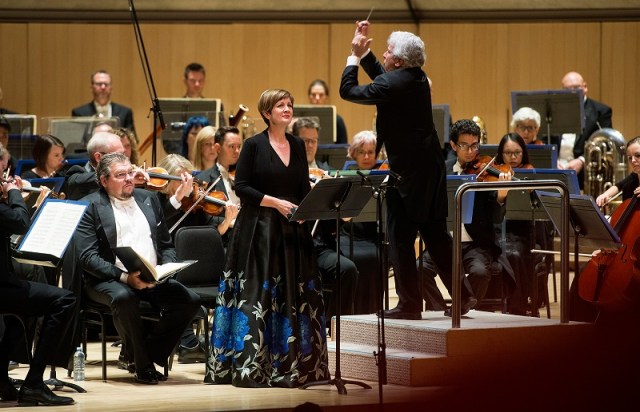
And tonight an older Mehta led the Israel Philharmonic
He’s still very distinguished looking, leading with the most economical gestures. If you watch this video –Mehta leading the Berlin Philharmonic in the G minor Slavonic Dance, the same one the Israel Philharmonic gave us tonight, but back in the 1990s—you see the same variety of baton movements as we saw tonight, including those wonderful little swoops in the middle section, where he lets one brief gesture stand for a whole bar. But as he’s older, he walks slower, he isn’t as ebullient in his conducting, but every bit as precise.
The program consisted of three items:
Amit Poznansky’s Footnote, Suite for Orchestra (the only one of the three for which Mehta employed a score; the others were conducted from memory)
Maurice Ravel’s Daphnis et Chloé Suite No 2
Richard Strauss’s Ein Heldenleben
Poznansky’s piece is from a film, music that I’d sum up as moody pattern music with some atmospheric strumming by the pianist inside the instrument. At times there’s a quirky waltz that reminds me of the Shostakovich waltz in Eyes Wide Shut. And suddenly it was over.
We then came to a pair of pieces making this the best orchestral concert I have heard in this space in a long time, perhaps ever. I think back on the Berlin Philharmonic, and assorted inspired nights with the TSO, but this one had more intensity, and more commitment in the music-making. Conductor and players were working hard, putting everything into it.
The Ravel was subtle, very clear, very detailed. I could hear every instrument, every phrase articulated. Nothing was thrown away. Gradually the intensity built up to a powerful ending, strong but never forced.
The performance of Ein Heldenleben is a natural climax to the past few weeks obsessing over Richard Strauss, as I mulled over opera scores in anticipation of Arabella. This is the Strauss piece I probably know best, a work of a myriad themes and cross-references to other compositions that resembles a self-portrait, or a musical therapy session. The hero is Strauss himself, and the heroic life is composition, facing the critics who are caricatured mercilessly in the score. Whereas the opening statement of the theme might be inspiring, after his encounter with his enemies, the hero seems to sink into despair. He’s rescued by the emergence of his inspiration, his muse, portrayed mostly by a solo violin although her themes are circulated through the orchestra in time. And so epic as the eventual battle might be, the great moments are silences (when you really see how perfect Mehta’s leadership and control actually are), eloquent solos from the violin or the horn, whose duet in the closing minutes would have messed up my mascara if I wore any. I was struck by the beauty with which this most Jewish sounding instrument, played by David Radzynski, in a portrayal of Strauss’s muse, should be balancing the exquisite horn playing of principal James Madison Cox as the masculine side of the equation, sounding oh so Wagnerian. For the moment at least that duality (male & female, German & Jewish, and perhaps by implication, Wagner & Jews) seemed to be happily reconciled, perfectly balanced.
The clarity of the Strauss was shocking to me, even in places of great dissonance & complexity. Mehta brought out inner voices & dramas that made me think of this as a contrapuntal piece, which is ridiculous. But there’s so much in this work, that one can’t hear if one lets the dominant voices drown out the subtler answering ones. It was only clear just how judicious Mehta had been, when we heard the Dvorak encore, and the horses were set free and allowed to gallop full tilt. Everything was still very disciplined and controlled but wow what power, and what elegance.
Bass-baritone Douglas Williams is now performing the title role in the Opera Atelier production The Marriage of Figaro that runs this week at the Elgin Theatre.
His repertoire reaches over four centuries, being a sought-after interpreter of Monteverdi, Handel, Bach, and Mozart, in addition to the romantic and modern eras. You can read more about his extensive professional credits around the world but even find examples of his poetry & photography on his website.
I’m eagerly looking forward to seeing him onstage especially after seeing his answers to my questions.
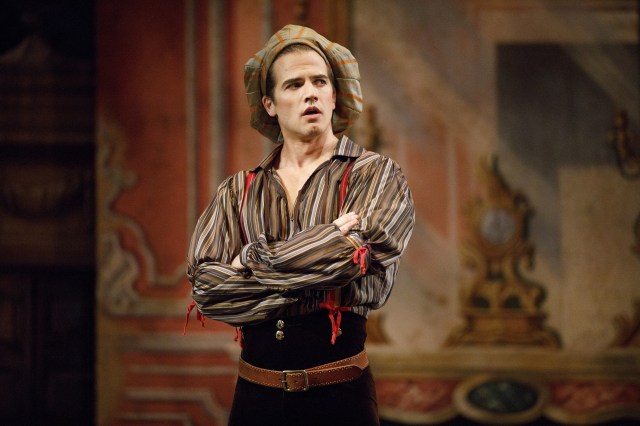
Bass-baritone Douglas Williams as Figaro (photo: Bruce Zinger)
ONE) Are you more like your father or your mother?
I supposed one of the joys and shocks of getting older is discovering just how much you are your parents’ child. From my father, a retired electrical engineer with unique hobbies, I inherited a sense of process, diligence, curiosity for what lies around the corner, independence, stubbornness, and a peculiar sense of humor. From my mother I took my entire emotional palette, including laughter, passion, and dreams.
TWO) What is the best thing about what you do?
The best thing about what I do as a singer is getting to explore all that makes me human, and then share that with other humans through my performance. I’ve learned a lot about myself and my body through training as a singer. Our voice is one of the chief mediums for how we put ourselves into the world, and there are all kinds of layers and ideas about identity, who others perceive us to be, how we perceive ourselves, that can prevent us from finding our true voice. This is the journey of the singer. There is technical mastery but for many, myself included, this parallels a journey into the self. Ultimately then I get to sing for an audience and they receive something of the freedom and truth that I’ve been mining from my body and my psyche, expressed in song.
The acting part of singing of course also allows you to shine light on all sort of emotional corners of yourself that we don’t get to visit or express in day-to-day life.
THREE) Who do you like to listen to or watch?
One of the best pieces of advice I received as an adolescent who loved music, was to keep my listening tastes broad. Right now I’m really into the American composer John Luther Adams, in particular his works for strings, The Wind in High Places and Canticles of the Sky. These are expansive, painfully beautiful plaintive pieces that fill me with wonder and stillness when I listen. I’ve also been listening for the first time to works of Johann Rosenmüller, an early German Baroque composer who wrote in the majestic Venetian style. Just the other day I was thinking, I bet I am the only person at this gym listening to Rosenmüller!
Also George Enescu symphonies, Christa Ludwig, Kurt Elling… just to name a few.
I do not watch any television show regularly. I’m looking forward to watching the new installment of Twin Peaks, perhaps after this Figaro closes. I think there are lots of interesting short things to watch online these days, too. I like the surreally edited youtube videos by Vic Berger, commenting on the ridiculous state of politics and the media in the U.S.
FOUR) What ability or skill do you wish you had, that you don’t have?
I wish that I was a better pianist. I want to write songs for my own voice – something I haven’t done since high school. But I’m afraid that the piano accompaniment will be extremely rudimentary, and the thought of embarrassment is precluding me from just trying.
FIVE) When you’re just relaxing and not working what is your favourite thing to do?
Spend time in beautiful natural places. Last May, I did a solo pre-dawn hike up Telescope Peak in Death Valley National Park, arriving at the 11,043 foot summit just in time for sunrise. This was perhaps the most ecstatic experience I’ve had in nature, just being alone with the black silhouette of the mountain, hiking in high open desert terrain under the canopy of stars. Then witnessing the approach of dawn across a vast sea of mountain ranges, as if it were the moment of creation itself. There was a sense of safety and wholeness as I traversed that ridge, alone in the vastness, and I will treasure forever the serenity and awe of that early morning. I think that feeling is the same source that allows artists to create great works of music and art. For me there is a vital connection between spending time in nature and making music, and next to my list of repertoire I’d like to sing, I have a long list of places I’d like to visit.
*******
More questions for Douglas Williams as he undertakes the title role in Opera Atelier’s Marriage of Figaro
ONE) Please talk about the advantages of doing Figaro in English, even if in this might make it harder for you.
Probably like my colleagues in this cast I had my doubts about doing an Italian opera in English.
But these doubts are only because we have all heard bad English translations of all sorts of works, or bad performances in English that make the language sound stiff and artificial. But this is an excellent translation, intelligent and funny, and retaining the sense of vivacious cleverness of the original Italian. Of course some people say that English not as lyrical as a language as Italian, where all of the emotional information is a carried in vowels, bouncing from syllable to syllable. But I am convinced that English is a beautiful language for singing and I think we have taken care in our preparation at Opera Atelier to make it beautiful and communicative, alive with the lilt of theatrical dialogue, and lyrical and gorgeous to express the charm of Mozart’s music.
Dramatically, the advantages of doing this opera in the vernacular are now very clear to me. The audience is hanging on every word, they are reacting to the development of my thought in real-time as I explain to them the Count’s deceitful plans for my Susanna. They laugh at the jokes as they happen, not from a surtitle screen. This is very important for comedy to be truly funny. We want to laugh at a joke in the first degree, without being removed from the humor as it pops on state.
As an actor you really can’t beat getting to sing in your native tongue. I have developed sufficient proficiency in the main languages of opera to emotionally connect to the text — that’s our job! But nothing can compare to English, the language I was raised in, where every word is going to have a web of emotional associations both conscious and subconscious because I have spoken that word thousands of times in thousands of contexts over the course of my life. The job of the singer-actor is that much easier and alive.
Mireille Asselin & Douglas Williams (photo: Bruce Zinger)
TWO) As you make your Opera Atelier debut, I’m sure you’re aware that this is a company devoted not just to historicity but a very self-conscious approach to movement vocabularies and carefully researched period performance, through their director Marshall Pynkoski. Please talk for a minute about historically informed approaches to music and theater, both your experience and your preferences.
Since 2003 I have appeared in operas with the Boston Early Music Festival, a company that does historical informed stagings of baroque opera. This was one reason why some Canadian colleagues of mine had suggested I might be a good fit for Opera Atelier. I like all kinds of stagings, and I’ve done it all from the abstractly futurist, to the most pure, to something that can feel almost too bound to historicity. In working on The Marriage of Figaro, I’ve enjoyed Opera Atelier’s approach, which I would say is very stylistically aware of the period, but also very sure of itself as live theater for a modern audience. The staging must always communicate clearly to the audience — that is paramount for Marshall.
The physicality that I inhabit in this production feels right to me for the ubiquitous elegance of Mozart, and the confidence and wit of Figaro. It’s quite satisfying actually to feel the music and the staging and the character all meet together in your body — and I find that this is especially possible when doing a staging where your movement is informed by the period. It’s like putting a costume on from the inside out.
THREE) Please talk about the special challenges of the role of Figaro vocally and dramatically.
I first did Figaro a year ago with Edo de Waart and the Milwaukee Symphony. Our Marcellina was the great mezzo soprano Susanne Mentzer, who sang Cherubino for much of her career with the greatest singers of our time. She told me that regardless of the production the Figaros always found this role tiring because there is so much running around, bursting onto the scene, getting slapped, diving for cover, etc. I don’t think it’s possible to do a Figaro that isn’t athletic. You simply must bring the zeal, the energy, the silvery cunning and assuredness to every scene. He is the engine of optimism in this opera. So it is physically tiring, but you have to save enough to sing properly. I sweat through my shirt in every act.
Is Mireille Lebel as Cherubino being marched off to war by Douglas Williams’ Figaro? non piu andrai indeed. (photo: Bruce Zinger)
FOUR) What are your favourite parts of the opera?
My favorite parts of the opera would be the finales that conclude acts II and IV. They are such genius works of music theater, it’s baffling to think of how Mozart conceived of this music. The text and music are so fluidly intuitive that I think he had no process. He just had the brilliance to know immediately how to interweave all the voices together, conveying disparate worlds of thought among the characters but with such gorgeous, effortless music. To sing these ensembles is really a joy. The act IV finale is like a carnival ride. You step on and you go!
But if I could sing any aria from any repertoire that is not for my voice it would be Susanna’s “Deh vieni, non tardar” from act IV. I love getting my heart broken by this song, night after night.
Mireille Asselin sings it beautifully.
Mireille & Douglas (photo: Bruce Zinger)
FIVE) One of the special challenges in some roles is the desire as a feeling person to react, to feel. A performer who is reacting emotionally –perhaps crying or laughing—has lost some if not all of their control, and is no longer performing, having become another of the spectators. In comedy this is especially problematic, if one starts laughing at the funny things one sees onstage. How do you stay clear in a role like this one, where your feelings may overwhelm your thought process, where you might giggle at what you see and lose your focus?
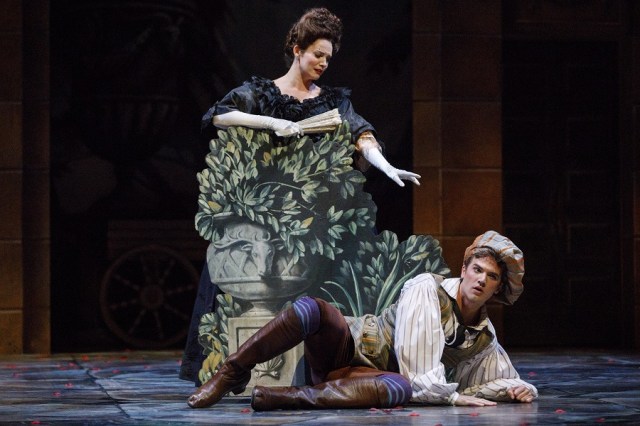
Speaking of “Deh vieni, non tardar”, this is the one point in the opera where I allow my emotions to overcome me. I get to lie on the floor, in hiding, listening to Susanna sing to a man who is not me. Because I only have one short line of distressful recitative after her aria I can afford to let the heartache of this moment break me.
This is a trick of singing, to pull so deeply from your emotional sources, but to ride them in your voice and, in almost every case, never become so overwhelmed that you cannot sing beautifully. With Figaro the draw at times is to become a bit aggressive, like in the opening cavatina “Se vuol ballare” or overly bitter in the act IV aria “Aprite”. The emotions are so real because the situations are very relatable, and the music is so powerful that you become seduced into the true emotion. But you can’t do that, because in real life when you are angry or bitter the body’s natural response is to tense up. This is when I have to remind myself, I don’t have to feel everything for the audience to get it. Sing the text, be in the moment, don’t over-show, do the gesture, but always sing, and from the stage the audience puts the pieces together in their own experiences.
Neil Semer
SIX) Is there a teacher or an influence you’d care to name that you especially admire?
I would like to thank my teacher, Neil Semer. He has been a true guide, showing me what is possible beyond what I imagined of not just my voice, but my self. When I started with him we worked on the Figaro arias but it felt like a stretch for me. I told him that these Mozart arias felt like something outside of me — I couldn’t imagine myself in that world, like clothes that didn’t fit.
He told me there would come a day when I would laugh at that notion.
*******
Douglas Williams, Mireille Asselin & the rest of the cast of Figaro will be onstage at the Elgin Theatre until November 4th.
The company, including Peggy Kriha Dye and Stephen Hegedus (photo: Bruce Zinger)
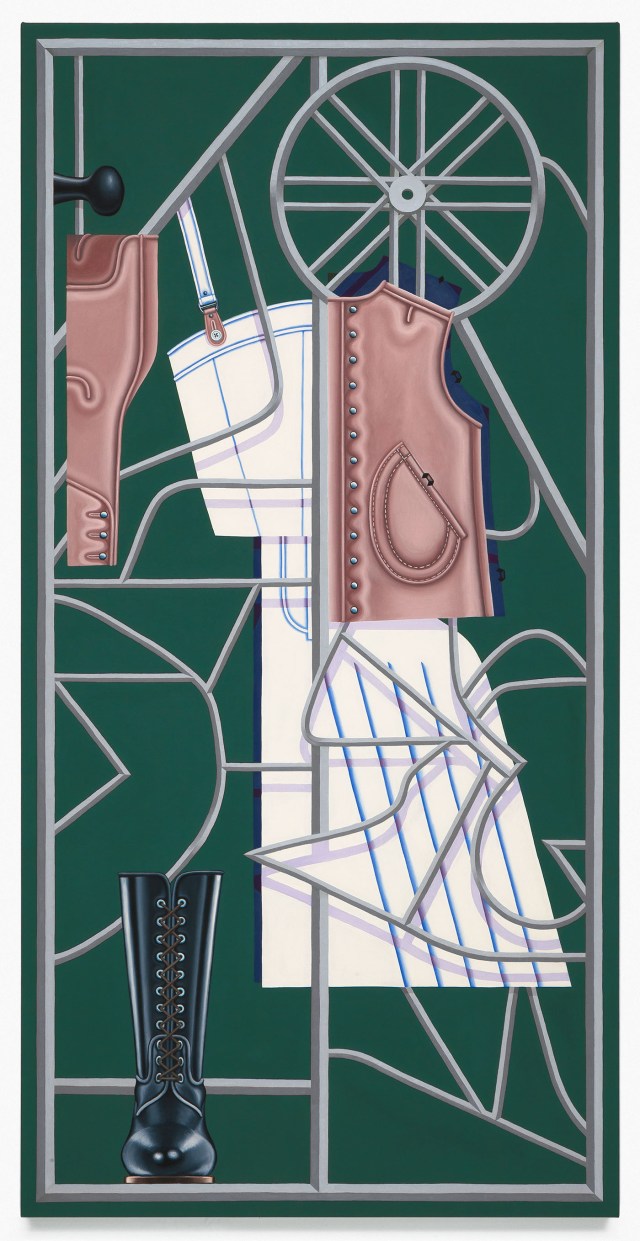
The painting is called Sir Michael’s Tarp, by Orion Martin, 36 inches by 72 inches.
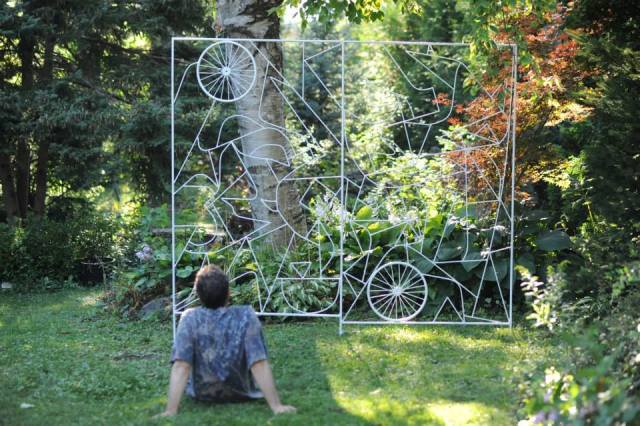
When I was shown the painting, it didn’t seem familiar right away. If I hadn’t been told I would never have made the connection to a piece of outdoor art co-created by Zoe Barcza and Alfred Boman. They assembled their piece a few years ago, on a patch of grass out of welded rebar painted white, sunk into the turf. And it’s even bigger than what Martin painted: but then again, it has to be considering where it’s installed.
The piece is titled Axl Rose and is 6′ by 6′, not counting the additional rebar sunk in the ground.
Do you see the resemblance? Zoe and Alfred did, and I believe they had a friendly chat with Martin about the painting. Little did I know that they would simply feel honoured that their imagery has another life in someone’s painting.
Zoe told me that she thinks the image came from a photo in social media somewhere, perhaps Instagram?
I’m naïve in my 19th century ideas, recalling the lawsuit against George Harrison. Listen to the melody and chord changes of “She’s So Fine”.
His later song called “My Sweet Lord” DOES sound exactly the same. Unconscious emulation?
But then again, in that famous case there were millions of dollars at stake. In this case there’s nothing so massive at stake. And the similarity is more allusion than imitation.
I don’t usually see movies when they’re brand new. But I feel daring and all caught up because I’ve just seen The Big Sick, Kumail Nanjiani’s auto-biographical comedy. It’s a film that came out back in January.
It feels even fresher because I’d just seen Nanjiani on Saturday Night Live last week, one of the funniest monologues I can recall. The monologue references the reception of the film, what he read online.
He quotes one person’s comment:
“I watched the whole movie, I just don’t like race-mixing”.
(pause)
Yeah.
First of all, nobody good ever uses the phrase “race—mixing”. Even if someone said “I’m pro-race-mixing” I’d be like “why are you talking like that?! Are you an undercover KKK Dragon?”
The other thing. Why do you watch the whole movie? Were you hoping for a twist at the end? Did you think I was going to rip off a mask, “haha, it’s Chris Pine. I’m a white person.”
I don’t know about you, but I’m eager to hear this kind of comedy. I love This Hour Has 22 Minutes and of course SNL for their political edge. Whereas CNN is like a bad dream (will someone please wake me up?), comedy is now taking over from the news networks, giving us glimpses of the truth.
Nanjiani is such a breath of fresh air, especially on US television. We’re spoiled by the comedic genius of Sean Majumdar and Russell Peters in Canada. Nanjiani is perhaps similar, even though he’s a complete original, as we saw on SNL:
…which brings me to my problem with most racism. Here’s my problem with most racism. It’s the inaccuracy. That’s what bugs me. I’m like “DO THE RESEARCH! PUT IN THE WORK! You will see the benefits!”
I’ll give you an example. If someone yells at me “Go back to India,” I’d be like “that guy’s an idiot”. But if someone was like “Go back to Pakistan: which was part of India until 1947, and is now home to the world’s oldest salt mine,” I’d be like “that guy seems to know what he’s talking about… I’ll pack my bags.”
Just because you’re racist doesn’t mean you have to be ignorant. An informed racist is a better racist!
Now after that ridiculously digressive and self-indulgent preamble (which wouldn’t have been necessary if youtube had the monologue; maybe next month?): let me caution you! The Big Sick is nothing like that. It’s not a series of comedy routines, it’s a serious film. YES Nanjiani does portray a stand-up comedian. But by now, after our encounters with Robin Williams’ life, it should be clear: comedy can be a desperate and unhappy profession.
We see the most unbelievable bad set from the comedian that Nanjiani presents for us in a comedy club, as he goes up onstage while coping with the emotions in his life. His girl-friend Emily is sick, on the verge of dying. His family meanwhile want him to marry a Pakistani Muslim girl, not a white American.
This is no to get into the right mood to go onstage.
It should be no surprise that The Big Sick was produced by Judd Apatow, that daring purveyor of difficult comedy. What do I mean by “difficult comedy”? I’m thinking of films that are really pushing the envelope of what might be considered funny, films that some would say failed miserably:
Cable Guy
The 40 year old Virgin
Knocked Up
Funny People
Okay I have a confession. I love Funny People, that movie where Adam Sandler is cracking up, and gets the shit beat out of him by Eric Bana. And I love Superbad, but who doesn’t.
The Big Sick defies the usual expectations of genre. Is it even a comedy? For much of the film we’re watching someone who seems to be dying, and I mean in addition to the inept comedy we see onstage. What happens when people get close to one another in a hospital while standing by someone on the verge of death? If you’ve been there—and I confess I have—this film will be poignant beyond anything you see in formulaic Hollywood comedy.
We see Nanjiani in the hospital with Emily’s parents, played by Holly Hunter –whom I’ve missed terribly over the past few years—and Ray Romano. I didn’t recognize RR right away. He underplays so well we doesn’t resemble an actor, but a real human. I think that’s a good thing even if critics likely were thrown for a loop. He’s unrecognizable, and I think that’s a good thing.
I think we’ll see a lot more of Nanjiani, especially if he and Apatow have any other projects up their sleeves. I love that my ideas of comedy are being played with, enlarged, and revised by the great writing and courageous performances. I’ll see it again mostly because it feels like the best film I’ve seen in months, and also to see how it feels the 2nd and 3rd time. I have to see it again! The first time I was hesitant about laughing in many places that were painful. NOW, knowing how it ends (and I hope I am not accused of being a spoiler by reporting that in this romantic comedy, the girl at death’s door in the hospital ICU –played by Zoe Kazan—does actually survive), I think I’ll dare to laugh in a few places that were painfully scary the first time.
The Toronto Symphony presented the first of two concerts titled “A Tribute to Maureen Forrester” tonight, a celebration of a great Canadian artist, and two premieres.
It felt a bit like a radio program, given that
Ben Heppner was “host” for the evening
His comments as well as those from conductor Peter Oundjian went back and forth between our two official languages
We even had a little bit of an old CBC interview of Forrester played.
If tonight’s concert was being recorded for some sort of broadcast, I believe that the levels will work better in the re-produced version than they did in the hall, as I strained to understand Maureen, even if it was a wonderfully precious moment to hear that familiar voice speaking.
The program included the following:
John Abram’s Sesquie Start
Howard Shore’s song cycle L’Aube, for mezzo-soprano & orchestra , sung by Susan Platts
Gustav Mahler’s Das Lied von der Erde, sung by Platts and tenor Michael Schade
As a tribute to Forrester the occasion did push some buttons for me, in the performance of a Mahler work she had sung and with which she was associated. In our opera class a couple of weeks ago, I played a performance of her singing “Von her Schönheit” both as a demonstration of her unique voice and to encourage the class to come to this concert.
There was a definite sense of occasion.
Abram’s Sesquie was two minutes of wacky sound, reminding me of the music one hears in cartoons, unpretentious & fun. It made a great impression.
Next came Howard Shore’s new song cycle with texts by poet Elizabeth Cotnoir, an occasion for some lovely sounds, including a wonderful trumpet solo in the first song, a brass choir in the last, and of course the rich voice of Susan Platts. I’m very fond of Shore’s work in films. He’s known for the Lord of the Rings films, but my favourites are his subtly psychological work with David Cronenberg such as Dead Ringers or Crash. I wish I could say there was comparable profundity here. It’s my first listen to the cycle, and so perhaps I just don’t get it; but I felt that Shore was being very self-effacing and supportive in most of the songs, ambient and rarely very dramatic rather than taking the stage and showing us something distinctive. But the music was beautiful, if rather undistinguished. I couldn’t help contrasting Shore’s work to Abram’s, where one composer boldly sought our attention, where the other seemed very self-assured and relaxed.
But to be honest I was really there to hear the Mahler, to hear Platts, Schade, Oundjian and the TSO, and they did not disappoint.
Michael Schade waits his turn, while Susan Platts sings, with Peter Oundjian’s eloquent leadership of the TSO (photo: Jag Gundu)
Again, I’m mindful of broadcast. In the two loudest songs, namely the first (“Das Trinklied vom Jammer der Erde”) and fourth (“Von der Schönheit”), the big sound of the TSO covered the singers. Perhaps you have to be a Vickers or a Forrester to avoid that fate? I’m not complaining. The flood of sound from the orchestra was very rewarding, whether in the flawlessly executed solos or in powerful tutti, with Oundjian favoring faster tempi. I’m conflicted because I prefer faster Mahler, just the way Oundjian did it, yet for this occasion and our reminiscence of Forrester, I suspect slower would be a more accurate evocation of her era and the conductors such as Bruno Walter with whom she worked. But that’s splitting hairs.
Schade continues to be a revelation, with a voice that can make claims on repertoire bigger and heftier than what we used to expect. While he still sings a stylish Tamino there is a power suggesting he could undertake heavier roles if he wanted to. While not quite a helden tenor, the sound was ample for this occasion.
Platts gave us a profound and thoughtful interpretation, particularly in “Der Abschied”, the massive song that closes the cycle. She had quite a big sing tonight, with the Shore piece as well.
Oundjian continues to get better results from the TSO all the time. It can’t simply be because he’s no longer dying his hair –since his 60th birthday—and as a result getting a different sort of respect from the orchestra. Maybe it’s that with every new player, there’s a bit of a shift, and fewer players left from before his era began. That era is approaching its conclusion, and I find myself enjoying his presence, his kindness and warmth onstage. He has nothing left to prove, and as a result might simply be enjoying his remaining time with the TSO.
A little something has nagged at me for days after seeing Arabella at the Canadian Opera Company on the weekend, a moment stuck in my head like an ear-worm.
It’s not a musical ear-worm, it’s a linguistic one.
I have this funny feeling about this opera, a piece of music theatre that is full of subtleties. Sometimes they require closer study, as when there’s a reference to another piece of music, as I mentioned already a couple of times:
A tiny bit of Wagner’s music
A few bits of Strauss’s own music
But Arabella is a subtle story that likely is understood differently depending on your background. When the opera appeared in the 1930s, I can’t help wondering what audience Strauss & Hofmannsthal imagined. Whom were they addressing, whom did they picture in the audience? I ask this as a Hungarian, perpetually fascinated by the relationship between Austria & Hungary, indeed between any cultures coming into contact with one another. Arabella is many things, and one of them is a study in an inter-cultural encounter.
That question comes up for me as I keep mulling over one little word that was repeated more than any other, a word that actually doesn’t exist. I kept musing on this word, wondering just what I had heard.
Finally today I went to the libretto.
Mandryka is from abroad, and while it’s not precisely spelled out during the opera, I understand he’s from Croatia (when I looked it up online), a place where he has lots of land & money. Mandryka has just met Arabella’s father, Count Waldner, who is totally broke: but of course hasn’t admitted it to his prospective son-in-law.
The generous young man offers the older one a few huge notes, lots of money that he hands over in a very nonchalant fashion.
When he does this, he says the following:
Teschek, bedien dich!
Waldner is so thrilled by this, he staggers around as if in a dream, repeating the phrase at least six times (or is it more?). Zdenka thinks her papa is cracking up, perhaps due to the strain of their financial difficulties, and so has no idea what he’s talking about.
And what IS he saying, Zdenka and the rest of the audience might ask?
Google is quite clear in telling me that “bedien dich” means “help yourself” or words to that effect.
And Teschek? I tried google out on that one, using German and Croatian. Maybe google was stumped, but all that came back for “teschek” was the same word OR “Teschek” with a capital T.
And then it dawned on me that maybe Hofmannsthal had something else in mind. This was an opera set in Vienna after all. A visitor to Vienna might use a different language, namely my own.
The headline I put on this, of “Tessék” with a question mark is, as usual, both an indication of what I’m writing about and a bit of an extra joke. Tessék interrogative is another way of saying “I beg your pardon”? Please note, that the word “tessék” in Magyar phonetics is pronounced virtually the same as a German would pronounce “Teschek”. The ss is said like an sch gets pronounced by a German- or Austrian-speaker or an sh in English.
The key meaning though for Tessék is the one likely intended by Hofmannsthal. Tessék as a declaration simply means “here you go”, which is perfect in this context, meaning almost exactly the same thing as “bedien dich”. Surely that’s what the phrase means.
In fact in a society where Hungarian words may have been inserted, references to dobos torta and Tokay (or perhaps Tokajer if you’re speaking German?) tossed around politely. I think it’s possible Hofmannsthal meant to signal a mis-pronunciation, rather than a correct one. A provincial visitor such as Mandryka might affect Hungarian but get it wrong, saying Teschek rather than “Tessék” (where that accent signifies a similar e vowel to what you get for instance in French with your accent aigu).
It’s also possible that Hofmannsthal expected the correct pronunciation to be known, although I am guessing that if that were so, there’d be some indication in the score. The repetition over and over suggests that the librettist & composer were very deliberate, and were not making a mistake.
I wonder, did they mean for Waldner and Mandryka to make the mistake?
Tapestry Opera receives gift of $225,000 Bösendorfer piano; ‘pays it forward’ with disaster relief concert on October 25
Opera and jazz greats unite to inaugurate “the Stradivarius of pianos” with proceeds to benefit relief efforts across the world
(Toronto, ON) – Tapestry Opera has received a historic and transformational gift with the donation of a 9.5-foot Imperial Bösendorfer 290 Concert Grand Piano, one of the most highly sought-after concert pianos in the world and one of only 12 in Canada. Valued at $225,000, the piano was privately donated in September by Clarence Byrd and Ida Chen, marking one of the most significant gift of a piano to a performing arts organization in Toronto’s history. To inaugurate the instrument and celebrate its public debut as part of the musical community, Tapestry Opera will hold a disaster relief concert on Oct. 25, 2017at the Earnest Balmer Studio in the Distillery District, featuring many greats of the Toronto opera and jazz scenes.
In honour of the monumental generosity shown by Byrd and Chen—and as a way to pay it forward—Tapestry Opera will present two concerts on the evening of Oct. 25th to benefit disaster relief efforts around the world, specifically those underway in Puerto Rico, Dominica, Mexico and India. All proceeds will be donated to the Medecins san Frontieres and Global Medic, who are working to rescue, support and rebuild the lives of millions affected by recent extreme weather events.
The Bösendorfer Imperial is widely regarded as the world’s premier concert grand piano (with its signature extra half-octave of keys). With its recent arrival to the city, the piano will be among the most valuable instruments publicly available for use to musicians and concert producers in Toronto, adding the Ernest Balmer Studio to a short list of destination classical and jazz music venues in the city. During a technically demanding installation process, the piano was carefully lifted by crane through the third-storey window of its new home in Tapestry Opera’s Ernest Balmer studio, capturing the attention of onlookers in the Distillery District.
“This is a momentous gift for our creative and performing arts community,” said Michael Mori, Artistic Director of Tapestry Opera. “By making world-class instruments available to the public, we are able to support a whole new generation of exciting artistic achievements. It also puts the Distillery District on the map as Toronto’s newest destination for jazz and classical chamber music, which is especially significant at a time when live music venues are vanishing.”
Toronto’s brightest young opera stars will unite in a performance of favourite arias and scenes, including selections from musical theatre. Featuring soprano Simone Osborne, mezzo-soprano Erica Iris Huang, tenors Asitha Tennekoon and Keith Klassen, baritone Alexander Hajek and others, the two-hour concert will take place at 7 p.m., with tickets priced at $30.
A late-night concert of piano greats presented by Yamaha Canada will follow at 10:00 p.m., featuring jazz legend Robi Botos and classical concert virtuoso Younggun Kim. This concert will mark the first opportunity to hear two of Toronto’s most gifted pianists grace the Imperial Bösendorfer. Tickets are $30.
“There is a deeply felt sense of civic duty and community spirit within Toronto’s cultural landscape, and we were overwhelmed when our single Facebook post to solicit participation generated such an incredible response from artists willing to donate their time and talent,” said Mori. “Tapestry is honoured to be in a position to facilitate something so meaningful and inspiring. It’s also a fitting way to introduce our wonderful new instrument to the community – one act of generosity begetting another.”
Tapestry Opera is grateful for the visionary generosity of Clarence Byrd and Ida Chen, and the gracious support of Robert Lowrey Pianos, Wayne Strongman, O.C., and Yamaha Canada.
ABOUT CLARENCE BYRD AND IDA CHEN:
Clarence Byrd and Ida Chen reside in Ottawa, and over the past 40 years have written over 150 books on accounting and tax, widely used both by students and professionals. In addition, Mr. Byrd has held positions at a number of Canadian universities. Currently, most of their time is devoted to preparing the annual edition of Canadian Tax Principles, the most widely used university text on taxation.
Both Clarence and Ida spent many years studying piano. In addition, Clarence played professionally for a number of years. While they no longer have an appropriate home for the Bösendorfer, they have several other pianos and try to spend some time each day playing.
ABOUT TAPESTRY OPERA: Tapestry Opera is a Toronto-based company that creates and produces opera from the heart of here and now. For 38 years, the company has presented award-winning works by preeminent artists, brought to life by some of the most talented and versatile performers of the contemporary stage. As Canada’s leader in opera development, Tapestry Opera is committed to cultivating new creators and performers to serve the evolution of the art form and build a lasting Canadian repertoire.
The Poetry of Apocalypse:
The Films of Andrei Tarkovsky
First Toronto retrospective in 15 years devoted to the visionary
Russian auteur, including full theatrical runs for sci-fi masterpieces Stalkerand Solaris
November 9 — 30, 2017
TIFF Bell Lightbox
The Mirror (1974), Photo Credit: Janus Films Solaris (1972), Photo Credit: Filmswelike Stalker (1979), Photo Credit: Janus Films
“Tarkovsky for me is the greatest [director], the one who invented a new language, true to the nature of film, as it captures life as a reflection, life as a dream.” — Ingmar Bergman
Arguably the greatest director of Soviet cinema and one of the most influential figures in film history, Andrei Tarkovsky has made an immense impact with a filmography that consists of a dozen titles, including only seven feature films. Known for his long takes and distinct use of time, religious iconography, the spiritual struggles of characters, his particular approach to science-fiction, and consistent visual motifs, Tarkovsky’s legacy reaches far and wide, continuing to influence countless filmmakers, and remaining relevant across continents and disciplines decades after his death.
Curated by James Quandt, Senior Programmer, TIFF Cinematheque, The Poetry of Apocalypse: The Films of Andrei Tarkovsky is the first Toronto retrospective in 15 yearsdevoted to the Russian visionary. The programme runs November 9 to November 30 and showcases eight of Tarkovsky’s works, five in 35mm and three digital restorations. The series also includes a documentary on Tarkovsky by Chris Marker, who was a personal friend of the auteur. Highlights include:
The full-length version of Andrei Rublev (1966), Tarkovsky’s masterpiece on the 15th-century painter, which is almost a full hour longer than its original release.
Week-long theatrical engagements for the new digital restorations of Tarkovsky’s two science-fiction masterpieces, Stalker (1979) and Solaris (1972), starting November 17 and 24, respectively.
University of Chicago film scholar Robert Bird, author of Andrei Tarkovsky: Elements of Cinema, will offer an introductory talk on the aesthetics of Tarkovsky’s work and his influence on Soviet Cinema on November 14, prior to the first screening of Stalker.
Click here for the complete schedule or visit tiff.net.
“Press releases and announcements” are presented verbatim without comment.
It’s my second consecutive opera involving a romantic beverage at the Four Seasons Centre with the Canadian Opera Company, and no I don’t mean what I was drinking.
In yesterday’s the women are powerless; today, in contrast, two men attempt to please a woman who is the powerful one
Yesterday’s was German, today’s was Italian
Yesterday it was water at the centre while today it was a magic elixir (you’ll have to see the opera to find out the actual ingredients of the drink)
Both operas feature Canadians; although yesterday’s biggest star was a European, today’s best performances were all by Canadians
As I stood at the urinal after the opera, I couldn’t help overhearing the shouted conference on either side of me, comparing the two. “Today’s opera was better”, they said, and his wife was cited as the ultimate authority for what was wrong yesterday.
Who was I to argue? (and I felt I was intruding)
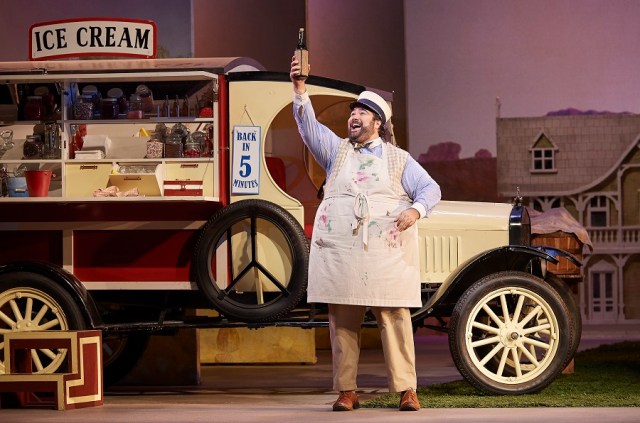
Perhaps it’s a triumph of promotion over resistance, a production that deconstructs opera’s forbidding surface into something gently lovable. We’re watching Donizetti’s Elisir d’Amore re-framed as though it were Meet me in St Louis or Music-Man, a very approachable stage picture that puts us at our ease immediately. There we are supposedly in what the program note calls “Anytown USA circa 1914”, on the eve of WW One. It doesn’t matter whether it felt Canadian (with the inclusion of our flag) or American (mostly red white and blue banners). What it did NOT resemble was a scary opera set, especially when you add in the chorus and Nemorino’s ice cream truck.
Andrew Haji as Nemorino in the COC’s Elixir of Love, 2017 (photo: Michael Cooper)
And in passing I wonder if we’ve ever had a season like this from the COC. The opera composer giving us two operas isn’t Puccini or Verdi or even Wagner. It’s Donizetti of all people (Anna Bolena still to come, a bel canto opera of a completely different flavour).
And we were in the presence of beautiful music, magnificent singing, where the plot was really a pretense for arias and ensembles, a story that’s pleasant but not earth-shaking, while we get lost in some pretty music. As I have been discussing with students in my opera class, the distinction between musicals and operas isn’t always a big one.
Who’s afraid of opera? No one in this audience, especially once we had a chance to sink our teeth into the performances by a capable and authentic sounding bel canto cast led by Andrew Haji, Simone Osborne and Gordon Bintner. All three have a genuine gift for comedy, aided and abetted by this charming opera.
Haji plays dumb. I mean that although he’s a very intelligent fellow, he’s very believable in playing up Nemorino’s gullibility, his naive belief in the power of a magic potion. The voice soars without forcing, an authentic bel canto approach that is Italianate and oh so musical. Osborne is Adina, a cruel tease for much of the opera who melts near the end, even though her top notes were as radiant when she was heartless as when she becomes sympathetic to Nemorino at the end.
Bintner as Belcore is the classic miles gloriosus, that braggart soldier we’ve seen since ancient times in everything from A Funny Thing Happened on the Way to the Forum, to Don Giovanni, and even though he doesn’t get the girl in the show he’ll be just fine marching off to further conquests. The voice is powerful and seems effortless.
The cast was rounded out by Andrew Shore as Dr Dulcamara –who sells the elixir that may or may not have changed Nemorino’s life—and Lauren Eberwein as Adina’s friend Giannetta. Conductor Yves Abel led a very tight performance by orchestra & chorus.
The Elixir of Love continues at the Four Seasons Centre until November 4th.