Othon: au revoir à Straub et Huillet

The mystery of Straub and Huillet has not been solved by watching their films.  This afternoon TIFF presented the final screenings of Not Reconciled: The Films of Jean-Marie Straub and Daniéle Huillet. And while the TIFF series may be over I will have to investigate further on my own.

This is the 9th in a series of pieces. Everything I’ve been seeing or reading over the past two months has been informed by their politics, their rigor, their aesthetic.

chronicle_of_anna_magdalena_bach__dirigeant_

Gustav Leonhardt conducts players of Concentus Musicus, Wien and (I think) a young Bernd Weikl (photo: Barbara Ulrich)

And finally, today’s program of Proposition in Four Parts (the film with the SHORTER title of today’s films) followed by Eyes Do Not Want to Close at All Times or Perhaps One Day Rome Will Permit Herself to Choose in Her Turn.

Maybe it’s the mood I am in today, but I found today’s selections disappointing: as I shall explain.  I suppose I was hoping for something especially powerful to close the retrospective: an unreasonable expectation on my part.

We began with Proposition in Four Parts, a 40 minute film that re-purposed or more accurately re-visited images I had seen before in other Straub – Huillet films.  The program guide says this:

Straub-Huillet fashion a caustic critique of capitalism,
suggesting that not much has changed since Griffith’s analysis.

I was more of the opinion that maybe it’s more that not much –or not enough—has changed in film-making since DW Griffith. Their zen approach that can be so tranquil, full of lyrical beauty is at times puzzling, for instance in using an excerpt from Moses and Aaron.  I don’t mind that it’s obscure. I just don’t think it accomplishes very much.  I find myself hungry for pointed commentary, for writers or film-makers willing to take a position.

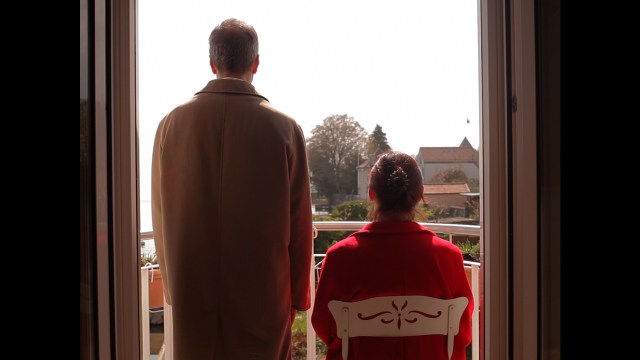
The main item on the program—the film with that impossibly long title—is an adaptation of Corneille’s late tragédie Othon.  I know I wasn’t the only one puzzled, as I heard others in the audience, exchanging questions as they exited the theatre.  We saw some of the same curious dramaturgy seen in Moses and Aaron and Too Early/Too Late—both operas by Arnold Schönberg –even though we were watching an adaptation of a spoken play rather than opera.  I hope I can be forgiven for calling these Brechtian devices, in their tendency to call attention to artificiality, for example

  • personages in classical costuming even though we could hear traffic noises and see modern buildings
  • quirky camera work as we’d zero in on one person in a conversational exchange while we would only hear the replies and not see the person speaking those replies.
  • Personages (both in Othon as in the two operas) delivering their lines without eye contact, standing still while firing out their lines, sometimes with extraordinary speed

I’d felt strange about the delivery of the lines in French.  I saw a curious remark in the closing credits from Straub & Huillet, (ex-pat French living abroad, largely because Straub had avoided the draft during the 1950s, during the Algerian War) , dedicating the piece to those who had not had the opportunity to hear the glory of the French Language (and excuse me that I may not be quoting this accurately, as I grabbed this quickly from the credits –in French—as they zipped by).

But the colossal irony of all this? The cast were not French. Adriano Aprà (Othon) is Italian.  Anne Brumagne is Belgian, and almost everyone else is also Italian.  At times the lines are being delivered in accented French, and often very quickly.  It is the most curious thing, this sense of alienation brought about by a sort of frozen delivery, from people making no eye contact, even when speaking of love and loyalty.

While there is a musicality to the delivery, it’s the music of Rossini, as though the lines are being delivered mechanically without empathy or emotion.  I wonder what Corneille would make of it.  I believe the result is very reified in the manner of our own reading, where we are deep inside the text and its implications and not distracted by the personages performing: even though some of them were very beautiful to look at.  I am sure Brecht would approve.

But this is most emphatically what one must encounter in a retrospective. Not just the greatest hits. Not just the famous parts, the popular moments.  To properly explore any artist we must see the extent of their work, whether we like it or not whether we get it or not, and attempt to reconcile all these parts.

book_cup

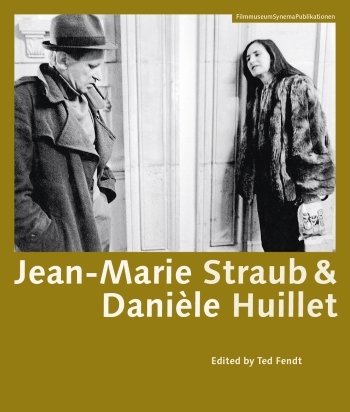
Cover of the Columbia University Press book edited by Ted Fendt. Click on the link to see more about this book.

Yes I am very much reconciled to Straub & Huillet, even if I have a project ahead of me: to find books about the film-makers, and to dig up their films. As James Quandt told us (in the interview)

“The best possible primer on Straub-Huillet is the new volume edited by Ted Fendt, published by the Austrian Film Museum.”

Thank you James Quandt.

Thank you TIFF!

Posted in Cinema, video & DVDs, Reviews | Leave a comment

TSO’s Beethoven & Stravinsky

There are several different currents flowing through Roy Thomson Hall right now, and each one is inspiring the Toronto Symphony and their audience in different ways.

  • We’re hearing two minute Sesquis: original little jewels to commemorate the Canadian Sesquicentennial.
  • We’re encountering core classics alongside new pieces
  • We’re meeting brilliant young artists to inspire both the orchestra & the audience, possible candidates to lead the TSO in the future.

In the first half we were treated to Karen Gomyo’s precise & passionate reading of the Beethoven Violin Concerto.

Karen Gomyo, Robert Trevino_ 2 (@Jag Gundu)

Violinist Karen Gomyo with the TSO conducted by Robert Trevino (photo: Jag Gundu)

Gomyo pushes the envelope with her dynamic range, beginning some of her phrases very softly, letting her tone crescendo through phrases, sometimes seeming to erupt with emotion. Her commitment was hypnotic drawing the audience into the drama of this titanic work.

For the second consecutive week I watched a new face lead the TSO. Last week it was conductor Hannu Lintu, leading a Beethoven symphony and a brand new work. Tonight it was Robert Trevino as the conductor, ably leading the TSO through the newest of the 2 minute fanfares to Canada’s birthday—a contrapuntal piece with palindromic tendencies from Cheryl Cooney—to lead off. Trevino followed Cooney’s Sesqui with the Beethoven violin concerto and concluded with the 1947 version of Petrouchka.

trevino_1

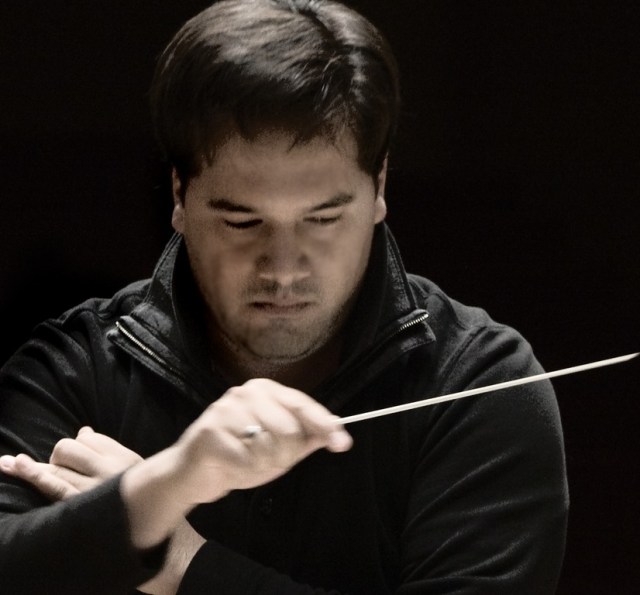
Conductor Robert Trevino (photo: Irene Haupt)

Where Lintu let his baton do his talking –leading a stirring performance—Trevino showed us the most affable podium manner this side of Peter Oundjian, explicating the Stravinsky score in such an unpretentious way as to highlight the comedy in the story of this ballet.

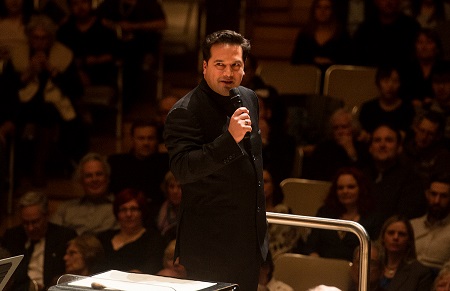
Robert Trevino, speaking (@Jag Gundu)

Robert Trevino, the charismatic story-teller, before he picked up the baton to conduct (photo: Jag Gundu)

Dare I say it, that this is what the TSO desperately needs?! I wasn’t the only one laughing, but more importantly, when the various comic bits came up in the score, people guffawed and giggled with genuine recognition.

And the performance! This isn’t easy music. Recalling the google doodle that you may have seen a couple of days ago, commemorating the 150th birthday of Sergei Diaghilev, there were three consecutive important ballet premieres from Stravinsky with the Ballets Russes:

  • Firebird in 1910, with a big romantic score that was mostly tuneful and caused no scandal
  • Petrouchka in 1912, where the edginess of the music corresponded to a grotesque story of puppets and magic. For my money this is the most surprising and original of the ballets from Stravinsky, with its use of folk music and mechanical patterns suggestive of non-humans moving, apt for the humans portraying puppets in this ballet
  • Le Sacre du printemps in 1913, famous for its riot, although the riot may have been as much for its actions & dance as for the music, admittedly a bit noisier and more dissonant than Petrouchka

I should perhaps also mention that Sunday’s concert for the TSO also includes Debussy’s Prelude á l’après-midi d’un faune: an 1893 composition that was also made into a ballet by Diaghilev in 1912. In tonight’s concert Debussy’s piece was not included. I’m not sure why they give us the shorter program Saturday. Petrouchka is full of amazing solos, much of it highly challenging music. I wish I knew who the piano player was, as their playing was especially good, one wonderful soloist among many (in the slower section resembling a piano concerto): but the others get their names listed in the program. Trevino was undaunted by the varied time-signatures, keeping the orchestra together, while gradually building the intensity and tempo to a scintillating conclusion.

I hope we see him again.

Posted in Music and musicology, Reviews | Leave a comment

Extra Trouble – Jack Smith in Frankfurt

“Extra Trouble – Jack Smith in Frankfurt” at Künstlerhaus Mousonturm Frankfurt a.M. Th. 22.11. — Su. 25.11.2012

Guest blog by Zoe Barcza recalling November 2012

jack-smith-in-frankfurt-opening-night-22112012-extra-trouble

The poster for the 2012 festival

The festival “Extra Trouble – Jack Smith in Frankfurt” (a dense weekend of screenings, talks, art exhibits and panel discussions) was held to commemorate and seemingly to canonize the influential underground filmmaker, who inhabited many roles during his prolific life: filmmaker, performer, photographer, playwright, “extreme artist and pioneer of queer and camp culture” (as the schedule pamphlet phrased it). Smith, who died of AIDS in 1989, has previously only really achieved a sort of cult-fame amongst experimental film nerds (I use the phrase with love), and is only now being digested by the “art world”. He’s been credited with being a visionary of camp aesthetics; his trashy-baroque hallucinogenic orgiastic films would influence Andy Warhol, John Waters, and many others in the underground film ecosystem. Also he attained notoriety when his 1963 film Flaming Creatures was seized by the New York police, along with Jean Genet’s Un Chant D’amour and Kenneth Anger’s Scorpio Rising, and deemed by the Supreme Court to be obscene. This episode was so traumatic he never “completed” a film thereafter, safeguarding his films so they could never be stolen or viewed in the wrong context, only screening them during live film performances where he would stand at the back of the room with the projector, re-editing the material as he went along, manually adding in a soundtrack by intermittently playing pop records from his collection.

The main reason I missioned to Frankfurt to catch this festival was the chance to view some very rare prints of his films that have until recently been inaccessible. Even having the opportunity to see the better-known films screened properly with a projector and audience is a universe apart from watching the films on UbuWeb on my laptop screen. And the films were deliriously beautiful Technicolor pageants; the lack of conventional storylines and the durations of the screenings induced a sort of trance-state, dissolving one into a haze of pure receptivity to the procession of projected images. (Adding to the trance-vibe was the 50/50 chance of getting stuck in a lecture given entirely in Deutsche…) But all of this I was expecting.

94_Live_Film_Jack_Smith_RGB__jpg_540x300_q85

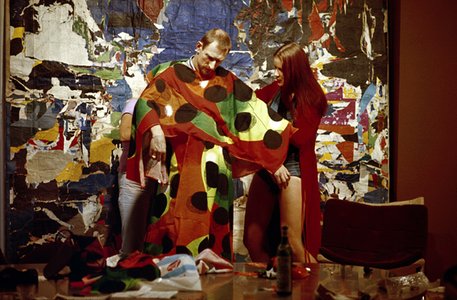
Jack Smith preparing for Rome, Cologne, 1974

What became more interesting to me during the festival and symposium was the discussion circulating around his films, as Smith posthumously begins to attain wider cultural recognition. At one point Jerry Tartaglia, the man responsible for restoring several of the films, compared what was happening to the legacy of Smith to watching a plane takeoff. But since Smith’s cultural impact is just now being venerated, Tartaglia stressed the responsibility and importance of recording the history correctly. And the history of Jack Smith is one that can be retold through many conflicting voices, and is rife with discontinuities and disputes. At one point Tartaglia made a theatrical show of reading from an article written by Ken Jacobs, and then furiously crumpling it up and wiping his ass with it. Jacobs, an accomplished filmmaker himself, was a contemporary and former friend of Smith, before the two had an angry falling out. The scene of people working together on Smith’s films was friends and lovers. Frequently they were completely high during filming. Jack Smith academic Marc Siegel, while in conversation with Smith’s beloved drag starlet Mario Montez, made a special point of noting that Ms Montez’ recollections could definitely be trusted since she was the only one not partaking in intoxicants on the set. And his nerdly enthusiasm was palpable when he frequently would interrupt Montez to confirm or correct some seemingly minute detail within her account; things to the tune of, “don’t you mean that you edited that material on East 33rd St, not East 35th?”

One aspect I appreciated was the attention payed to the physical life of the celluloid films themselves, it became somewhat like a forensic exegesis, and with so many original participants in the room one could get a sense of the full picture being cobbled together. Special attention was payed to whether we were viewing original or negative prints of the films (it turns out you can tell the difference by observing whether the dust and scratch marks are black or white). At one point Jerry Tartaglia was amazed to see footage that he thought was lost included in the program, in a German TV special “Kino ’74 – Jack Smith”, to which the filmmaker Birgit Hein, who was in attendance, admitted that Smith had handed her the loose film stock and she had had it in her possession ever since.

tartaglia_SmithExoticLandlordism

Film still from Exotic Landlordism, courtesy of Jack Smith Archive and Gladstone Gallery, New York and Brussels

Smith left no will and quite likely wished for his films to be destroyed. After his death the archive of films was kept in his friend Penny Arcade’s house, and despite attempts, no funding could be secured from museums or institutions to properly restore the films. There then ensued a lengthy legal battle, in which his long-estranged sister appeared out of nowhere and tried to gain control of his estate. It was only when private gallerist Barbara Gladstone acquired Smith’s estate that Jerry Tartaglia could be hired to restore the films. There was an air of suspicion to many of the questions during the weekend.

Ostensibly Smith was being transformed into a commodity of the art world; how was this ok, when Smith was so outspokenly socialistic and anticommercial in every aspect of his life and art? “Is this what Jack would have wanted” was repeatedly asked. And furthermore, by canonizing Smith through the weekend’s academic lectures and events, through selling blown-up Chromogenic prints that were initially just stills from his films, were we participating in sucking the life out of his work, mummifying something that was intended to be breathing and ephemeral? As I mentioned the evidence suggests that Smith wanted his films to be destroyed, however I guess ultimately I’m still grateful that the material is available and circulating somehow, even if in a somewhat ethically compromised way.

Posted in Art, Architecture & Design, Cinema, video & DVDs, guest blog | Leave a comment

Raiders: Williams & the matter of popularity

The recent fad for films with live accompaniment is shining a light on artistry that has often languished in obscurity.  Oh sure, film music composers are well paid, especially someone like John Williams, composer of the score for Raiders of the Lost Ark: the film shown tonight in a partnership between TIFF & the Toronto Symphony.  But in a normal screening, or watching a film on TV, who notices the film’s music: other than a nerd?

(guilty as charged)

I hope this new way of seeing film catches on: which is to say, I hope that the TSO does a whole lot more of this, because I think they’re merely scratching the surface.  Tonight the energy was electric.  When conductor Steve Reineke referenced the TSO a couple of times he reminded me of the announcers at a ball game. It wasn’t “Your Toronto BLUE JAYS” but rather “Your TORONTO SYMPHONY”, and the cheer was every bit as boisterous and unanimous.

head_shot_Michael_Tammaro

Conductor Steven Reineke

The partnership between the TSO & TIFF is very neighbourly.  When I see a film at the TIFF Bell Lightbox I park under Roy Thomson Hall, just a couple of blocks away.  Yes there will be more films at RTH next year, and maybe somehow the favour can be returned, if TIFF opens up to some sort of music there (as we saw recently from Against the Grain).

It’s worth itemizing differences, the ways in which live showings re-frame and re-invent the usual experience of film.  Reineke presented this to us as a concert, and in a real sense that’s what it was, accompanied by powerful visuals on the screen looming over the stage.  In the cinema, while the music may still be “there” in some sense, it comes from invisible sources on the film, and it’s recorded rather than live.  The liveness is a big deal. I heard a couple of fluffed notes that I cite not to complain, but rather to celebrate the magic of liveness, like the blemishes on the face of a model: before they’re photo-shopped out of the image.

In this live context, the dynamics are totally different.  While we have the spoken voices available –and they can turn the volume up ridiculously high to ensure we hear every deathless word from Harrison Ford or Karen Allen—those are always going to feel canned, fake, artificial, when compared to the music.  And what the TSO played is mostly much louder than what you get on the DVD or in a normal cinema, where the levels are all adjusted and mixed to suppress the orchestra except at a few climactic moments, such as when the heads are melting.  But this was like an oratorio, as the music-making took the space and made something celebratory out of the film.  Even the silly set-pieces –I hate the truck chase, with all those killed soldiers, although I quite like the chase scenes through the market place, complete with a quasi-Egyptian music for atmosphere—can become serious when the orchestra is playing with such intensity.

And that’s another thing that is truly different.  In Raiders–that is in any film presented in the usual way– normally you are hearing recordings of music made from sessions assembled into a quilt, bits of music patched together.  But live? Those brass players only have the mouth they brought to RTH for the 7:30 beginning, even though they have several powerful sequences that they must somehow survive, lips intact.  Nevermind Reineke, who worked his butt off, with only the occasional silence studded through the two hours of the film, the players had a very full evening’s work.

I am hopeful that this kind of programming will bring a new audience to the TSO, intrigued and bemused by the familiar and the popular.  I am reminded of another critical frontier, namely the question of popular operas, lambasted in some quarters even though they are a guaranteed success at the box office.  The most notorious of these is coming to the Canadian Opera Company, namely Puccini’s Tosca, the opera that Joseph Kerman & George Bernard Shaw are both known to have loathed.  Nevermind their objections, they represent a similar issue to what we see in Raiders, a popular entertainment. It’s as though the critical acclaim is in inverse proportion to box office success.

And yet what Puccini accomplished in Tosca or what John Williams pulled off in his score for Raiders is far from easy.  If it were so simple to replicate lots of other composers would do so: and Williams wouldn’t be a multi-millionaire, in demand for what he does in films such as Jaws or Star Wars.

But at least TIFF & the TSO have discovered the magic of these live concert-showings.  The effects were heightened tonight, the snake music snakier, the love music more romantic.  And the closing credits, when we hear that main theme –a march, ringing out from the whole orchestra—was like that popular song played at the close of a rock concert, where everyone knows the tune, and explodes into rapturous applause at its conclusion. When I went to the washroom afterwards it was uncanny how almost every single person –not kidding!–was humming or singing that march tune aloud: infected with Williams’ ear-wurm.

As with Tosca we’re talking about something well-known that can’t miss, can’t fail.  When everyone knows what’s coming that doesn’t invalidate the experience, but rather makes it almost like a public ritual, comparable to hearing the national anthem or a hymn.  We see something similar when we get to the Hallelujah Chorus and everyone stands (however lame that might be), every note and word known to everyone present.

I’m looking forward to more of the same, more films with live orchestral accompaniment from the TSO, and yes, Tosca from the COC.  Serious art has its place, but that doesn’t mean we should avoid the works that move us, the works we know and love, music that is so well written that it can’t miss.

Posted in Cinema, video & DVDs, Music and musicology, Opera, Reviews | Leave a comment

Kommunisten: Straub sans Huillet

TIFF have been presenting “Not Reconciled”: which is both the epithet attached to this powerful retrospective and the first film from the uncompromising collaborative team Danièle Huillet and her husband Jean-Marie Straub. Tonight we ventured into a very dark, place, namely the decade since Straub was left alone, with the passing of his partner in 2006. Straub is now 84 years old. What kind of films would we see from the aging auteur, suddenly bereft of his companion and artistic partner?

Tonight we saw three of the last four films Straub has made alone.

  • Kommunisten (2014) 70 minutes
  • The Algerian War! (2014) 2 minutes
  • The Aquarium and the Nation (2015) 31 minutes

IMDB also mentions a film that we did not see tonight, namely In omaggio all’arte italiana! from 2015, at ten minutes another short film. This ‘homage to the art of Italy’ includes footage from History Lessons. Similarly, Kommunisten (the film of the three upon which I want to focus) includes footage from a few previous films.

KOMMUNISTEN_Malraux_3

A moment from Kommunisten (2014)

The published program from TIFF explaining the six vignettes that comprise Kommunisten says,

“five of these are gathered from Straub-Huillet’s previous films, making Kommunisten a kind of career summa.”

I suppose it makes sense that the film-maker should bring back images from before, at least as a kind of reminiscence or celebration of his collaboration with his deceased partner, if not to perhaps attempt some sort of valedictory or last statement. I couldn’t help thinking of the way musicians will re-purpose existing music, whether at the organ in church or creating a film – score, making something seem totally new. This can be both a pragmatic choice –when you have something that works and it’s much harder to make something entirely new & original – as well as an opportunity for inter-textual references. I can’t pretend that I got all the references, especially considering that some of the significance may be more personal concerning Straub’s own memories of Huillet rather than something meant for the audience to read. Setting aside the decoding of inter-textuality—which I can’t do without a great deal more research—I believe there’s a lots to be made simply from the composition of these vignettes, as a final statement in the same thematic area as the previous films. Most of the Straub / Huillet films explored aspects of Brecht & Marx, offering fresh views of class-struggle, celebrations of the common person & the material world (“material” in the sense of Marx not Madonna), and at the same time exploring new ways of employing Brecht’s dramaturgy on film.

For a Marxist widower in 2014-5, looking back on his body of work with his wife, in the quarter century since the USSR fell apart and the Marxist struggle more or less collapsed, I think he wanted to make a kind of statement.

I wonder if I was the only one in the theatre overcome by a profound sense of nostalgia in Kommunisten hearing the way he began the film.  We start with a tune that for me represents the impossible dream of class struggle, at least in the 20th century, namely Hanns Eisler’s national hymn for the GDR. Let the words and melody be a kind of image of the dream, that would be unfulfilled in GDR, especially for the composer.

Consider that

  •  The melody is about ideals and reconstruction
  • Eisler’s tune reminds me of The Internationale
  • That the GDR in practice never came close to practicing the ideals sung in their beautiful  anthem
  • Eisler himself was a martyr to that hypocrisy, first black-listed and then thrown out of the USA for being a communist, then after going home to East Germany as a true believer, hounded by the GDR government
hannseisler1

Composer Hanns Eisler

In the film proper we see interrogations, the persecution of those who admitted to being communist. We again see the dignity of people filmed as they go about their business, in huge numbers and without any individuality. We see the land and the insignificance of humanity in the presence of mountains and nature’s majesty. And we come to some relevant texts, both retrospective (looking back at the fascist period in Italy) and prescriptive / idealistic, dreaming of what might be. The ending is upbeat.

The second film was only two minutes, yet sustained tension for what felt like much longer. In all their films I find that Straub & Huillet play with our perception of time. On this occasion we’re confronted with the war that a much younger Straub evaded, going to Germany instead: in its personal impact for him and anyone else for that matter. The film closes with the mad intensity of Schubert’s ballad Der Erlkönig, suggesting some of the obsession Straub must have felt concerning this war.

The last film began in the most innocuous way. Of the roughly half-hour of The Aquarium and the Nation, we spend the first ten-fifteen minutes watching fish swimming in an aquarium that fills the screen. It’s our whole world, which as we’ll discover, is totally apt. We see a reading from what I believe is a Malraux novel, linking the innocuous fish we were watching with something more metaphysical, as we’re told that fish don’t see their aquarium. Transcendence comes in an excerpt from Jean Renoir’s film La Marseillaise, the higher meaning coming in the new idea of a “Nation”.

I’ve been in very odd places. Saturday I was spirited away on the sublime sounds of the Tallis Scholars singing unaccompanied religious music in a reverberant basilica. Last night it was Kiss Me Kate on TCM, one of the more ambitious Hollywood musicals, but still, a very commercial alternative to Saturday, and again with tonight’s intensity. Tomorrow it’s back to something more commercial in the form of Raiders of the Lost Ark at Roy Thomson Hall with the Toronto Symphony.  Straub & Huillet are (or in her case, were) artists with no interest in commercial success. If he does have any sense of a mission—and I think that’s a big “if”—it would be to inspire the next generation of activists & artists. I can’t deny I feel very inspired by tonight’s program, and am eager to see the last two films in the retrospective, taking us back to the 20th century for Othon (1969) and Proposition in Four Parts (1985).

Posted in Cinema, video & DVDs, Politics, Reviews | 1 Comment

Tallis Scholars & friends: Magnificat

Tonight felt like a kind of affirmation of permanence in the face of change and disorder in the world.

The Tallis Scholars, conducted by Peter Phillips, joined forces with two University of Toronto ensembles –Schola Cantorum and Theatre of Early Music—conducted by Daniel Taylor. While the repertoire ranged from the renaissance to our own century, we were listening to unaccompanied choral music, using religious texts: Magnificat, Pater noster, Ave Maria and Nunc Dimittis, all in multiple settings.

As a student of the phenomenon of musical signification especially as it applies to religious texts it was a special experience to be able to compare different approaches to the same words, across different periods, the different strategies and styles applied to the same spiritual concept and similar words.

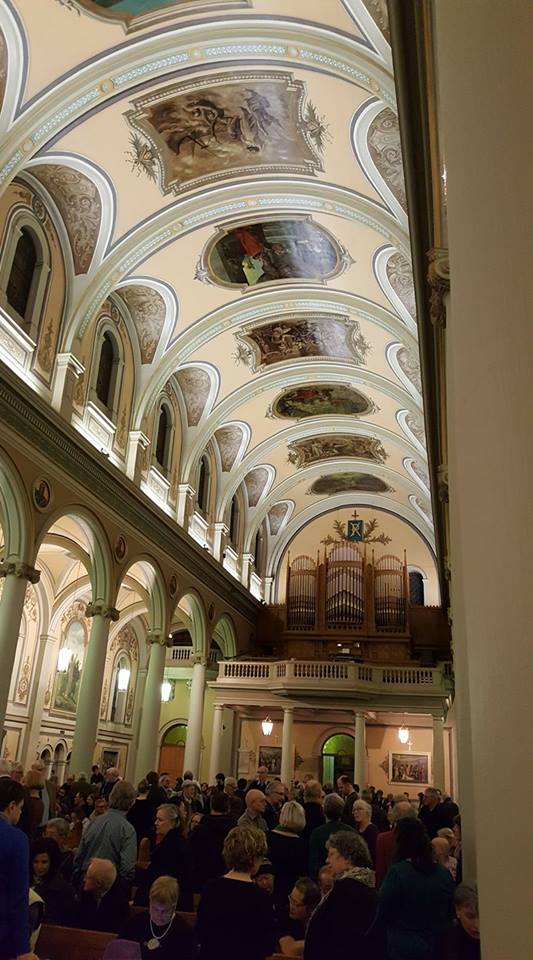
St Paul’s Basilica at Queen & Power was packed with eager listeners, attracted no doubt by Tallis Scholars’ wonderful discography, but also perhaps aware of the new kids in town, Taylor’s two ensembles that shared the program and are now also recording for SONY.

basilica

The crowded interior of St Paul’s Basilica in Toronto tonight

The acoustic plus the visuals are a dream come true for musicians presenting this kind of program. Where a theatre with spoken word must be dry (less than a second reverb) and an opera house aims to have less than 2 seconds of reverberation time (say 1.5), concert halls may be around 2 seconds or more. But this was quite a bit more, perhaps in the vicinity of 4 seconds of reverberation: ideal for a different sort of music that was composed with a reverberant church in mind.

For a few of the pieces we saw the combined forces, as in Praetorius’ Magnificat V to begin or Holst’s Ninc Dimittis to close the program. For most of the evening, though, we were listening to the Tallis Scholars, as many as ten singers, but sometimes fewer.

The thing to remember after listening to this precise sample is how different that sounded in the Basilica space where everything was super live and reverberant.  I daresay this is how this music was conceived.  While we’re in the midst of Lent, the music was nonetheless full of celebration, even jubilant at times.

Notice too that the singing is very direct and without excess vibrato (as you’d find in styles from later periods). The notes—especially the ones sung way up high—are totally exposed, and requiring nothing less than perfection of intonation.

I shall investigate further: through the magic of recordings.

Posted in Music and musicology, Reviews, Spirituality & Religion | 1 Comment

Beyond Reason: Wagner contra Nietzsche

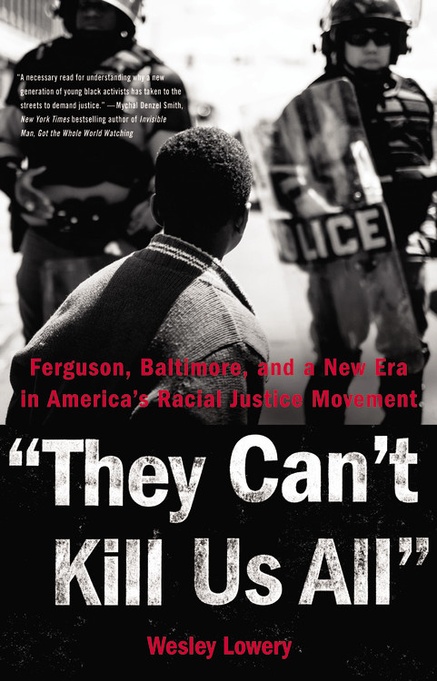
I finished my previous book last night (They Can’t Kill Us All). I began the review of that fascinating book—filled with the keen-eyed observations of Washington Post reporter Wesley Lowery—by a kind of apologetic preamble about my life in fantasyland, my blessed existence as a reviewer of opera & concerts.

Where that book was like a digression even as it seemed to bring me closer to the real world, the next book brings me back to something normal, namely the operas of Richard Wagner.  Yes you may think i live a topsy-turvy life, where exploring opera is the norm.

cover_image

I have barely begun Karol Berger’s Beyond Reason: Wagner contra Nietzsche, a colossal 412 page book from University of California Press, that includes appendices & notes swelling it well beyond 500 pages.  Every time I visit the Edward Johnson Library I poke my nose into the shelf with the new arrivals. I grabbed this when I saw it: the first book I’ve seen with “2017” on the spine and a year that is also seen in the copyright indication at the front of the book.  I am probably the first one to take it out.

Berger’s introduction proclaims his objectives.

I started out convinced that Nietzsche’s objections to Wagner were by and large well taken, and that the study of their encounter would likely illuminate Wagner’s dramas but not Nietzsche’s books.  Today I still admire Nietzsche’s critical acumen, but I see as well not only that Wagner’s works can defend themselves surprisingly effectively against some of the philosopher’s central strictures, but also that these works implicitly offer an unexpectedly perceptive critique of a number of Nietzsche’s most cherished doctrines.  That is why I felt the need to amplify Nietzsche contra Wagner with Wagner contra Nietzsche. 

I haven’t read enough of the book to be able to review it, only to express my interest in it. To read this book at all is an act of faith, an expression of interest, given how many have undertaken the project of explaining / exploring Wagner, and making sense of his works in the broader context.

I’ll be reading this for awhile, yet even here reality & politics won’t let me escape fully from the broader contexts of our world.   I am for example, drawn deeper by these passages:

   But I expect that the book will also find readers who are already familiar with these works and whose main interest is to understand the philosophical-ideological significance of the Wagner phenomenon.  These readers will want to concentrate on the final sections of chapters 2 through 4 and the epilogue, reading the prologue for the background it provided. If they resemble the author at all, they are likely to be conflicted about Wagner’s achievement, loving and admiring it and at the same time being disturbed and even revolted by it.  I do not intend to help them resolve such conflicts; rather I aim  to shift the component within this unstable mixture and hope that, like myself they will close this book equally, but differently, conflicted.
(Berger xv)

instructorPhoto

Karol Berger teaches music history at Stanford

Berger goes on to lament the usual focus of Wagner studies.

The history over the Wagnerian roots of Nazi ideology has been succinctly characterized by Hans Rudolf Vaget: “In their examination of the Hitler-Wagner nexus, Mann, Adorno, Viereck, and others highlighted a whole range of ideological affinities, among them nationalism, megalomania, the substitution of myth and fairy tale for history, the totalitarian mind-set, demagoguery, self-praise, love of pomp, the rejection of liberalism, the espousal of revolutionary dynamism for its own sake, and the obsession with racial purity.  Today, however, it seems fair to say, that the topic of anti-Semitism virtually monopolizes the debate about the historical legacy of Richard Wagner.”  In a sense I would like to return to this earlier, and richer, stage in the debate.”
(Berger xvi)

I share that hope, and look to Berger to illuminate the subject in my upcoming reading.  I’ll get back to you when I’m done to let you know what I found.

Posted in Books & Literature, Opera, Politics | 1 Comment

They Can’t Kill Us All

I may seem to lead a divided life, vanishing into realms of violins and sopranos, opera and oratorio, without much apparent connection to the struggles of people in the 21st century: with the possible exception of the singers trying to make a living.

But this year seems very different. It may have begun with the surprise outcome of the American Presidential Election in November. And now as performing arts companies are at least nodding towards our Sesquicentennial, history rears its head in the most curious places:

  • Earlier this week the Toronto Symphony presented Accused a song cycle showing individuals confronted by oppressive regimes across different centuries, languages & cultures. Their New Creations Festival a few weeks ago was especially edgy this year.
  • Kent Monkman’s pictures at the University of Toronto hold up a mirror to a cultural genocide
  • Each of Tafelmusik and Toronto Consort offered a musical reflection on our relationships of centuries ago with the Indigenous peoples of this continent
  • The Canadian Opera Company are now rehearsing Louis Riel, in a production with a revisionist approach to this opera about Canada and its colonialist past
  • The Straub-Huillet retrospective at TIFF (still with a little over a week to go) has been offering several films challenging the usual understanding of history and power

They Can’t Kill Us All is the title of Wesley Lowery’s book.  I heard about it via Matt Galloway and Metro Morning on CBC.  I remember thinking somehow that I wanted more, that there was something elusive, unsaid, that needed to be articulated.cantkillusall

And now I’ve read the whole book and even after finishing I still feel the same thing.  Wesley Lowery does some great things in this book.  He’s a young journalist, going around the USA assembling stories of the resistance to racism, protests inspired by horrific shootings.  We know the saying “Black Lives Matter” that has spawned a movement in social media and elsewhere .  The book is a very useful primer because it helps give you a clear picture of who’s who, of what happened where and when, going beyond the superficiality of TV and twitter.

And yet he stops short of what I hunger for.

(How do I put this?)

Lowery is not James Baldwin or MLK. He stops short of making the big sweeping statements.  He’s a journalist and very factual, very careful in his statements, and certainly not a poet or a preacher.

And he’s a black man treading carefully at a very dangerous time. The quintessential narrative would be, the black man in the presence of police, being super careful not to give offense: and getting shot anyway.  The book has to reference this template both in the incidents reported and in Lowery’s own polite language.  He stops short of calling the USA a racist or fascist country.  The book is factual.

As a white Canadian perhaps I can say what’s missing.

The title hints at what’s underlying this book and under the surface of black life in America, the implications underlying the phrase “black lives matter”.  If you need to say it, then clearly it’s in question. The horror underlying the assertion that “they can’t kill us all”, is that no one is safe, that the unthinkable needs to be put into words:  as though everyone really could be killed, that some of the racist element in the USA might even want that.  After reading Monkman’s text in his exhibit –where he chillingly quoted someone speaking of “the final solution” to the aboriginal problem—I think reconciliation must be far more radical, far more profound in its goals, whether we speak of indigenous truth and reconciliation, or the equivalent conversation concerning black lives in USA.

There is one very powerful moment that might sum up this attitude, the clear statement Lowery would make, concerning the current limits of action.  Brittany Packnett, who Lowery describes as a “thirty-one -year- old  Ferguson protester”, told him a story.

    One evening when she was eight years old, her father and younger brother came bursting through the front door, her brother in tears. They had been out for a drive and had gotten pulled over. As the officer had approached the vehicle, he has asked Mr Packnett to step out of the car, and then had thrown him onto the hood and put him in handcuffs. The officer didn’t believe that this black man could possibly own the Mercedes he was driving.
    The entire family was outraged, and Packnett’s brother was traumatized.  Her father, who was among the most politically connected black men in St Louis, called the police chief and demanded that the officer apologize personally, in front of his son.   
    As she grew older, Packnett became an outspoken minority in her predominantly white private schools, sprinkling her class assignments with asides about equity and racial justice and helping to organize a regular seminar on diversity and inclusion. That drew backlash in the hallways of her majority-white high school.  She recalls that one particular student, a young white man from a prominent local family who was a year ahead of her, began following Packnett around in the hallways, mocking her.  “Is my whiteness oppressing you today?” he would ask as she moved from class to class. She  would ignore him.  Then, one day, she didn’t.  She turned around, just outside the women’s locker room, and told him to stop speaking to her that way.  In return he spit in her face.
    Packnett said her track coach, one of her mentors in high school, insisted she tell the principal, who forced the boy to apologize.  Immediately, the memory of her late father’s interaction with the officer who pulled him over flashed back into her mind. That officer like this boy, had been made to apologize.  But had either actually been held accountable? Or did the system send the message that abuse of a black body can be negated and papered over by an “I’m sorry” no matter how reluctantly uttered.  
    “It’s this idea that all a person had to do was say ‘I’m sorry,’ and then they never had to be held accountable for their actions.” Packnett said.  “Thinking about those two incidents is, for me, a constant reminder that this system was never built for us in the first place.”
(Lowery 228-9)

When you plunge into a dark lake you need to know how to find your way to the surface and to the shore. I came up for air regularly as I read the book,

  • grateful to be Canadian
  • grateful to be white, even if that carries some responsibility: to be helpful and active rather than to passively hide away in my safe hidey-hole
  • and wondering what it would be like to be raising sons, particularly if I were black

Watching the news in 2017 it seems to be a troubled time in the USA.  During the election campaign, Donald Trump claimed that it’s worse than ‘ever, ever, ever’ for black people.  With his victory over Hillary Clinton, the phrase has a curious resonance now.

Barack Obama turns up in this book, and he’s a fascinating reference point, the obverse side of that reflective template that recurs throughout the book that I mentioned above, black man encountering police.  Obama as President is the dream, while the police shootings are the nightmare, each a benchmark of the same sad fact: that the civil rights struggle is far from over.  The election of a black president was supposed to signify something, but if anything it signaled a renewed push back from the extreme other side, the alt-right, the KKK, those who resented Trump’s presidency.  Sadly, little has really changed, especially in the deep south.

They Can’t Kill Us All is not a book to show you the path forward, so much as a forensic examination of the labyrinth in which we’re currently stuck.  Nobody seems to know the path forward, although to his credit, Lowery speaks to the new generation of young activists who will be part of any coming transformation.  This is a compassionate and methodical journey to several front-line encounters, uncensored and direct.

If you’re needing motivation, if you want to read and get angry, this book can work for you.  I wanted something a little more strident, but found it very polite, not unlike the young black man who has to walk carefully, for fear that he might trigger something by seeming too strident or dangerous.  I was kind of heart-broken by this book.  If you think Afro-Americans have made progress and that the civil rights movement is over, you should read this book.  I need something more to feel better about my place in this society.  I recall feeling un-moored and dizzy coming out of Monkman’s show, and this is somewhat parallel.  I hope the black experience in Canada is better than this –oh my God I hope so—particularly with police.  I can’t help feeling humbled, that as a white person I have privileges and a safer status.

And we’re still a long way away from true reconciliation.

Posted in Books & Literature, Politics | 2 Comments

Lintu Finesses TSO

I don’t know if Hannu Lintu is a candidate to succeed Peter Oundjian or not, but I wish he were.  The Finnish conductor enticed some of the finest playing I’ve heard all season out of the Toronto Symphony in a program from three different centuries.  We heard a modern oxymoron sandwiched between two antiques, and all three were fabulous examples of committed playing by the TSO.

We’re accustomed to a degree of ostentation in singing, an approach that may offer a display of both the sound of the voice and the person of the vocalist.  And yet that’s not the only option.  I’m thinking of Pellèas et Mèlisande, an opera that is other-worldly in its subject and almost devoid of the usual material that we expect in opera.  No arias. No displays of virtuosity.  As an opera it’s an oxymoron, a contradiction between the expectations of the form and the actual work.  There are other such works I could point to, for instance, Melati Suryodarmo who danced on butter—or should I say slipped around on top of butter, deconstructing the whole idea of virtuosity and perfection.

Anu Komsi_2 (@Jag Gundu)

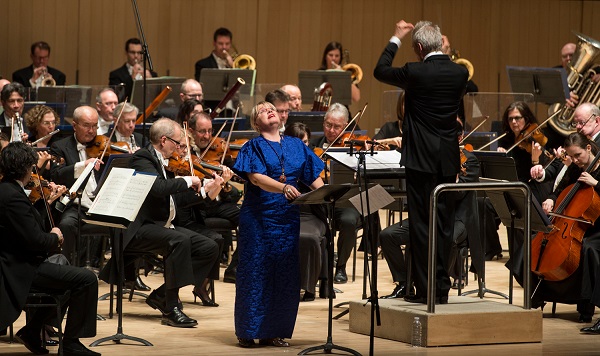
Soprano Anu Komsi with the TSO and conductor Hannu Lintu (photo: Jag Gundu)

Did composer Magnus Lindberg actually want us to hear every note and nuance of soprano Anu Komsi’s performance in his Accused: Three Interrogations for Soprano and Orchestra?  If this work were Harold in Italy or perhaps one of Beethoven’s concerti, no matter how epic the struggle between soloist and orchestra, we’d expect to be able to hear the soloist and clearly discern their performance, in keeping with the ideas of heroism in the music of the romantic period.

But not this time, and I have to think that was intentional.

And so maybe you can tell that I am conflicted.  This work is as contemporary as the blur surrounding the question of fake news.  Three different scenarios are presented, one French (from their revolution), one German (from the 1970s) and one in English (from this century).  That the answers to the interrogation were often inaudible probably shouldn’t be blamed on the acoustics in Roy Thomson Hall, as it appeared to be a deliberate choice of composer + interpreters as this work received its Canadian premiere in this week’s concerts.  Part of me wishes I could have heard some of those ultra-soft replies from Komsi (download the text as part of the concert’s program here), yet they are singularly apt, like the dance in butter or the absence of virtuosic display in Pelléas.  In a work that seems to flout its own divergence from the norm, that makes new rules, I’m inclined to applaud, intrigued by this daring and original approach.  We need to hear this with 21st century ears, attuned to the buzz of fake news and bogus media.

Komsi was precise, accurate as a coloratura at times, yet delicate and dignified even when overwhelmed by the huge orchestral forces Lintu whipped up around her and  –it might seem – against her.  In some ways Lindberg’s score answers a question I posed a few days ago, concerning the next generation of  12-tone, as we heard music with none of the nasty dissonances you find in Schönberg,  a wonderfully tuneful and assonant sound even as it offers a great deal of ambiguity.  I think the orchestra had a great time with this piece, as they responded with some lovely delicate sounds, as well as some wonderfully boisterous playing.

After the interval we went in a different direction, in a stunning reading of Beethoven’s Sixth Symphony.  The level of commitment I thought I saw and heard from the players tonight led to a memorable performance.  The first and third movements were on the brisk side, while the other three were conventional, or even slower than what’s written.

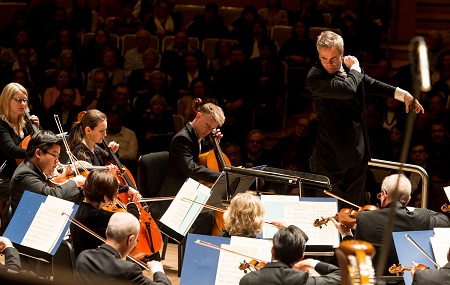
A flamboyant gesture from guest conductor Hannu Lintu (photo: Jag Gundu)


Lintu has a very clear baton technique, opting sometimes to move once per bar or even (rarely) standing and watching the orchestra play rather than religiously beating every note.  When he wanted something extra his gestures were frenetic, including one lovely moment reminding me of a batter losing his bat, when the baton went flying: suggesting a wonderfully loose technique.  The music is the real test, and it sounded glorious.  At times I was reminded of the Cleveland Orchestra and their colourful brass and winds, both in the first movement (where the horn part was highlighted more than any time I’ve ever heard), and the last.  Phrases in the finale were particularly elegant, allowed to make their full eloquent statement, hymn-like, solemn, glorious.

I was totally a mess at the end of a concert that had already taken us into the hellish criminality of regimes tormenting whistle-blowers in Lindberg’s score, to a glowing re-affirmation of the natural world in the hymn that closes the Beethoven. I’ve never heard those final coda passages played so firmly, so clearly.

Yes the world will still be here in spite of our current craziness.

We opened with Sibelius’ suite of incidental music from The Tempest, (perhaps to match the storm in the penultimate movement of the Beethoven?).  This was a more restrained sort of music-making, but a wonderful way to start the evening.

Posted in Music and musicology, Reviews | 2 Comments

COC’s 2017 Revival of Louis Riel: “from a more inclusive perspective”

CANADIAN OPERA COMPANY’S 2017 REVIVAL OF LOUIS RIEL FEATURES VOICES NOT HEARD BEFORE

A Uniquely Canadian Contribution to Opera Revisited for the 21st Century
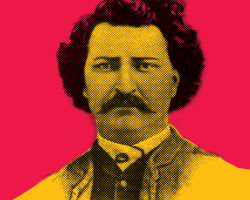
rielToronto – Louis Riel, composed by Harry Somers with libretto by Mavor Moore, is a uniquely Canadian contribution to the opera world. First performed in 1967 and last performed by the COC in 1975, Louis Riel returns to the stage in 2017 in a new co-production between the COC and National Arts Centre (NAC) that works to revise the opera’s colonial biases and bring forward its inherent strengths and power. Louis Riel runs for seven performances by the COC on April 20, 23, 26, 29, May 2, 5, 13, 2017 at Toronto’s Four Seasons Centre for the Performing Arts before making its way to Ottawa to be presented by the NAC on June 15 and 17, 2017.

Somers’ Louis Riel is the epic presentation of an intensely contentious moment in Canada’s political history dramatizing the story of the Métis leader, Louis Riel, and Canada’s westward expansion, while also being a landmark work in the canon of Canadian opera. At its 1967 world premiere, the Globe and Mail announced that with Louis Riel “[Canadian opera took] its first gigantic step forward,” Time magazine declared it an “undeniably masterful score,” and Opernwelt deemed the libretto “a masterpiece of dramatic concentration.” Its subsequent revival in 1975 at Washington’s Kennedy Center was met with the pronouncement of being “one of the most imaginative and powerful scores to have been written in this century” (Washington Post).

“Even 50 years after its creation, Louis Riel still hits us with its bold and commanding vision. Somers and Moore created a unique, powerful and daring statement that makes the piece rank amongst the most important and interesting works of music theatre of the last century,” says COC Music Director Johannes Debus, who conducts the COC Orchestra when Louis Riel is presented in Toronto.

In reviving the opera for 2017, the COC/NAC co-production confronts the traditions and demands of an art form that make Louis Riel a dynamic and compelling opera and its collision with the voice, culture and representation of indigeneity. This production uses historical research and multiple community perspectives to expose the lines between truth and mythology and co-existing perspectives of settler and indigenous stances as Riel’s story is told and retold.

“The challenges are many and well worth the undertaking. We’re looking at this opera from a more inclusive perspective,” says Louis Riel director Peter Hinton. “We’re not changing the intentions of the piece, but revisions are being made that honour the virtuosic complexity of the music, while allowing for the introduction of voices that have not been heard before.”

“We have an opportunity here to give the performance history of Louis Riel a new point of reference,” adds Debus. “We want to make sure that this striking piece of music theatre is done right to see its importance and continued relevance.”

Louis Riel distinguishes itself from other operas with its musical diversity. In addition to incorporating original folk music and traditional melody lines, Somers wrote in an abstract atonal orchestral style which heightens the dramatic intensity and sets the orchestra entirely apart from the singing. Electronic music also comes into play, creating at times an auditory surrealism that mirrors the distortion and confusion of events unfolding in the narrative.

Louis Riel demands singers to demonstrate a range of vocal techniques and dramatic intonation, sometimes in harmony with the orchestra and sometimes in conflict, and other times delivering gripping musical lines with the voice completely laid bare to scrutiny and unsupported by the orchestra. An orchestra of 67 musicians, including strings, woodwinds, brass, piano, and large percussion ensemble requiring six players, accompanies the cast and chorus.

Unique to the score of Louis Riel is the “Kuyas” aria which opens Act III and is sung in Cree by the artist in the role of Marguerite Riel, Louis Riel’s wife. The music for the “Kuyas” aria was based on a Nisg̱a’a mourning song called “Song of Skateen” that was recorded by Marius Barbeau and and transcribed by Sir Ernest MacMillan on the Nass River in 1927. The words for “Kuyas” were selected by Somers from Cree Grammar by Rev. H. E. Hivers and the English-Cree Primer and Vocabulary by Rev. F. G. Stevens, as well as from a story told by Coming Day to Leonard Bloomfield on the Sweetgrass Reserve in Saskatchewan. The composer was further assisted in ascertaining pronunciation and feeling for the language by Mrs. Lou Waller of Cree descent from Alberta, to whom Somers dedicated the “Kuyas” aria. With respect to both the Nisg̱a’a and Métis peoples and in recognition of how the songs of one nation are not the same as another’s, the COC and NAC’s co-production of Louis Riel acknowledges the current holder of the hereditary rights to this song: Sim’oogit Sgat’iin, hereditary chief Isaac Gonu, Gisḵ’ansnaat (Grizzly Bear Clan), Gitlax̱t’aamiks, B.C.

For the 2017 production, Louis Riel will continue to be sung in English, French and Cree, however, it will now feature a new translation of the Cree and include spoken dialogue in Michif, the official language of the Métis that would have been spoken in the 19th century, in select scenes between Métis characters. The new Cree translation is by Manitoba-born actor and writer Billy Merasty, who is of Cree descent, and the Métis dialogue is translated by Norman Fleury, a Métis elder, Michif language expert and translator, professor, and historian. The 2017 production of Louis Rielwill also feature English, French, Cree and Michif SURTITLESTM.

The role of the chorus in Louis Riel has also been redesigned. The original opera called for a single large chorus to act and sing a variety of groups and assemblies in the narrative. For the 2017 revival, there will be two choruses performing in contrast to the historical figures represented by the principal cast, representing the modern dynamic of debate and protest that continue of this history, both in the houses of parliament and on the land.

The COC Chorus takes on the role of the Parliamentary Chorus and represents a group of settler and immigrant men and women. The Parliamentary Chorus sings and is seen but does not participate in the physical action of the narrative, only commenting and debating on what should take place. They serve as a modern-day Greek Chorus while also representing the functions of Members of Parliament who legislate and validate the struggles of all Canadians in Ottawa. Additional members of the COC Chorus will be members of the Métis Nation.

A group of Indigenous men and women will be cast as the physical chorus known as the Land Assembly. On stage throughout the opera, the Land Assembly is a silent chorus in protest, and stands for the people for whom the opera has not provided a voice. The Land Assembly shift and transform in response to the actions on stage and are a constant, physical representation of the Indigenous men and women who are directly affected by the outcomes, victories and losses of Riel. The players in the Land Assembly will be announced at a later date as part of the COC’s complete casting release for Louis Riel.

New characters have been introduced to bring Indigenous voices into the opera as well as present a more informed history of the Métis and Indigenous peoples in Riel’s history. The previously unattributed opening vocal line is now delivered by a character known as The Folksinger, to be sung by a contemporary Métis singer. The role of The Activist, to be played by a Métis actor, will deliver the Land Acknowledgement as the opera unfolds, setting the tone for interpreting the action playing out on stage. The artists in these roles will be announced at a later date as part of the COC’s complete casting release for Louis Riel.

The 2017 production of Louis Riel is made possible through the financial support of individuals, corporations and charitable foundations and trusts. The COC gratefully acknowledges its underwriters: The Catherine and Maxwell Meighen Foundation, Philip Deck and Kimberley Bozak, Asper Foundation, and The Max Clarkson Family Foundation in honour of Harry Somers; with additional support from Mark and Gail Appel, Margaret Harriett Cameron, Catherine Fauquier, Sally Holton, Michiel Horn and Cornelia Schuh, Michael and Linda Hutcheon, The Michael and Sonja Koerner Charitable Foundation, Peter Levitt and Mai Why, John D. McKellar, Trina McQueen, Roger D. Moore, Sue Mortimer, Dr. Shirley C. Neuman, Tim and Frances Price, Dr. Joseph So, Philip Somerville, Françoise Sutton, Dr. John Stanley and Dr. Helmut Reichenbächer, The Stratton Trust, and John Wright and Chung-Wai Chow. Louis Riel has also been made possible by generous donors to the National Arts Centre Foundation, who believe in investing in Canadian creators, including Kimberley Bozak and Philip Deck, Earlaine Collins and TD Bank Group.

Louis Riel was the first opera written by a Canadian to be presented by the COC, and the COC is the only professional opera company to date to have ever performed it. Somers and Moore were commissioned in 1966 by the Floyd S. Chalmers Foundation to write an opera to commemorate the centennial of Canada, and it was subsequently performed by the COC in 1967 and 1975.

The NAC presents Louis Riel on June 15 and 17, 2017 as part of its Canada Scene festival in Ottawa. For more information on the NAC’s performances of this production of Louis Riel, please visit http://www.nac-cna.ca.

TICKET INFORMATION
Single tickets for Louis Riel range from $35 – $235 and box seats, when available, are $350. Tickets are now on sale, available online at coc.ca, by calling 416-363-8231, or in person at the Four Seasons Centre for the Performing Arts Box Office (145 Queen St. W.). For more information on specially priced tickets available to young people under the age of 15, standing room, Opera Under 30 presented by TD Bank Group, student groups and rush seating, visit coc.ca.

About the Canadian Opera Company
Based in Toronto, the Canadian Opera Company is the largest producer of opera in Canada and one of the largest in North America. The COC enjoys a loyal audience support-base and one of the highest attendance and subscription rates in North America. Under its leadership team of General Director Alexander Neef and Music Director Johannes Debus, the COC is increasingly capturing the opera world’s attention. The COC maintains its international reputation for artistic excellence and creative innovation by creating new productions within its diverse repertoire, collaborating with leading opera companies and festivals, and attracting the world’s foremost Canadian and international artists. The COC performs in its own opera house, the Four Seasons Centre for the Performing Arts, hailed internationally as one of the finest in the world. Designed by Diamond Schmitt Architects, the Four Seasons Centre opened in 2006. For more information on the Canadian Opera Company, please visit coc.ca.

~~~~~~~

“Press releases and announcements” are presented verbatim without comment.

Posted in Press Releases and Announcements | Leave a comment