
Tonight’s installment of TIFF’s retrospective “Not Reconciled: the films of Jean-Marie Straub and Danièle Huillet” must have seemed like a remarkable opportunity to James Quandt and the team assembling the schedule. Each film is almost exactly an hour long, a pair of films that appeared consecutively, and perhaps the two most dissimilar in the entire retrospective. Of course they paired them up.
- From Today Until Tomorrow (from Von heute auf morgen) (1996), a one-act comic opera by Arnold Schönberg came first.
- Sicilia (1998) followed, described in the TIFF program guide as:
“a four-part “road movie” that follows Silvestro, an immigrant who is returning home to the island after 15 years in America” based on an anti-fascist novel from 1939 that was banned at the time.
I shall address them as two separate films, but first want to address what TIFF gave us. Each film can be seen as a critique of the whole question of genre especially as understood in the world of popular cinema, straddling categories. Because they’re only about an hour long they preclude themselves from a commercial release, even before we consider how commercial a twelve-tone opera might be, comic or otherwise. Sicilia too would be puzzling to the average viewer who might not know what they’re seeing, in its tonal ambiguities: which I’d consider good.
In other words forget the usual objectives of a commercial cinema, to create a product and to make money.
But genre is sometimes nothing more than a handle, a lifeline for someone trying to climb out of the dark place that is the average theatre. Genre can be both pigeon-hole and pigeon, both the classification into categories, but also a series of attributes and descriptors. In these two instances I think one is better off staying away from such questions, as they only lead one astray. We’re better off in the here and now of the film in front of us, trying to discern what’s being exhibited, rather than trying to develop a set of expectations based on the genre we think we’re seeing, that might lead us to expect certain sorts of outcomes.
So watching this opera unfold, I am convinced that it needs to be staged more often for performers to have a better idea of how to make it work: meaning, how to make it successful as a comedy. If you consider that singers come up through school singing arias from Puccini, Verdi, Mozart, or Handel, and then when trying to do an opera, have a sense of the style and may even have experience of the music in their voice. And then there’s Schönberg. I saw online that Von heute auf morgen has only been staged a couple of times EVER. As with Moses and Aaron, screened by TIFF last Sunday, this adaptation in no way resembles realistic drama, as the singers tend to stand and deliver, rarely even making eye contact with one another. This might be a Brechtian device (as in: whenever Leslie sees something puzzling that makes no sense, he tries to justify it via theory), given its similarity to how the singers were posed and prevented from interacting like real people in Moses and Aaron (although if you can tell me how real people interact when they’re singing at the top of their lungs, please give me a call).
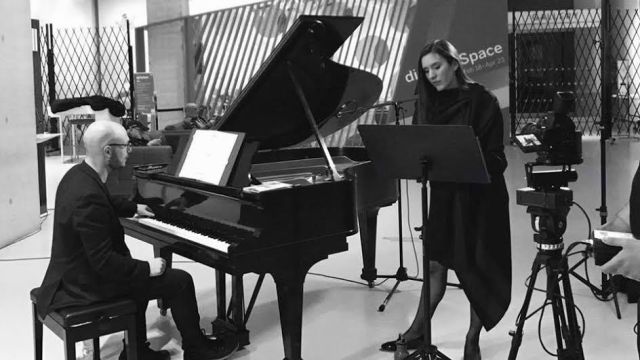
I want to mention a brief Facebook conversation I had with Topher Mokrzewski, who played & music directed the twelve-tone excerpts sung by Adanya Dunn before the two Schönberg films last Sunday.
I said:
i wonder, do we need a second generation of 12 tone, to tteach us how to do COMEDY and IRONY?…..it’s great for tragedy and pain, but also, should be able to portray love and sexuality…i’m still waiting 😉
Topher said:
“I just wish someone would write anything funny!”
After tonight’s film, I see two issues. Part of the problem is just practicing and performing this repertoire more often, because this rep is hard to do. Dunn and Mokrzewski were wonderful together last week. But what about this comic opera? Can it be made funnier somehow, perhaps by a gentler handling of the singing & playing? I couldn’t help thinking that heavy metal tends to do everything with the volume set to 11 (as they said in This is Spinal Tap). Not all Schönberg is quite that extreme, but I wonder: are performers having too much fun wailing and blasting their way through, when they need to show some delicacy and lightness of touch: as Topher showed us last week..? Or maybe the composers need to hold back, by all means employ the twelve-tone palette but use more restraint, subtlety. Stop using dissonance the way a heavy metal band uses their guitars.
Sicilia leads me to a book I will have to obtain, namely the novel that the film is based on. I read in TIFF’s programming guide, that the film comes from Elio Vittorini’s 1939 novel Conversations in Sicily, banned by the Fascist government.
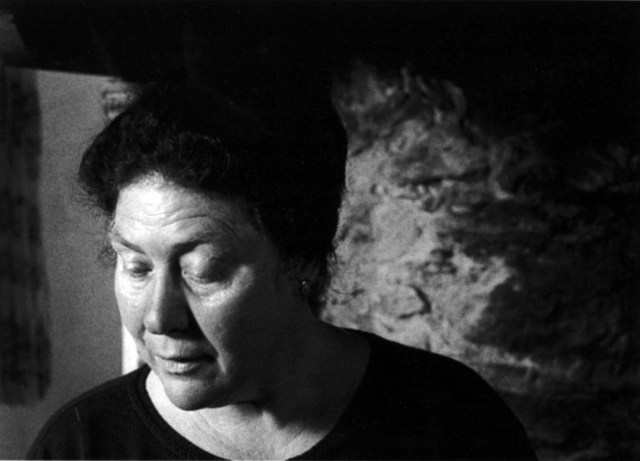
Angela Nugara in Sicilia
Where the opera shows Straub & Huillet being so faithful to the composer that they seem to kill the humour in the opera, a curious sort of battle between man and woman, Vittorini gives them what they always seem to want, namely a site to celebrate humanity and class struggle, seen from an oblique angle. This is not a book about revolution, sharing much of the dark tone of futility I spoke of in last night’s film Too Early / Too Late. Life can be celebrated even when one is poor. We get this from several angles, the different vantage points of the people encountered in the journey, a series of dialogues. As in History Lesson the film goes back and forth between different sorts of dialogue and other calmer sorts of cinema, tranquil imagery setting up some intense bursts of language, sometimes resembling opera without any scoring. This is an amazing little film, a piece of art that makes me want to go back, to see it once more. Alas I wonder if I can get my hands on it. There are a few little snippets on youtube, and no sign of it in any library I know of. But I’ll have to explore further. My only option may be to find the book and pray that the growing reputation of Huillet & Straub leads some distributor to make the film available some day.
Here’s a beautiful segment, to close the film. The man with what resembles a bicycle is a sharpener, and although the subtitles aren’t English, it’s stunningly musical in its composition & execution. I don’t really miss the translation, as it brings my focus to the composition, to the rhythm & the performance. The sense of futility I spoke of comes up in a conversation where they speak of sharpening cannon, rather than scissors or knives, and payments to cover bread, wine & taxes. They close with a fascinating exchange of abstractions: reasons for joy, reasons to love life. In any language they are unmistakable.


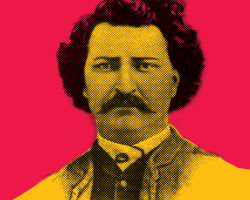 Toronto – Canadian history comes to life on the stage of the Four Seasons Centre for the Performing Arts this spring when Harry Somers’ Louis Riel returns to the Canadian Opera Company. A new production of this uniquely Canadian contribution to the opera world is being conceived by one of Canadian theatre’s most acclaimed and inventive directors, Peter Hinton, with the COC’s celebrated music director, Johannes Debus, conducting. This production of Louis Riel is proudly presented by the COC and its co-producer, National Arts Centre (NAC), in anticipation of Canada’s sesquicentennial and the 50th anniversary of the opera’s premiere. Louis Riel is sung in English, French, Michif and Cree with English, French, Michif and Cree SURTITLES TM, and runs for seven performances by the COC on April 20, 23, 26, 29, May 2, 5, 13, 2017 at Toronto’s Four Seasons Centre for the Performing Arts. It will premiere in Ottawa by the NAC on June 15 and 17, 2017.





 barczablog