A first look at La Reine-Garçon

I attended the Canadian Opera Company’s presentation of La Reine-Garçon, their co-production of a new opera with a libretto by Michel Marc Bouchard and music composed by Julien Bilodeau.

Today, February 2nd, is Bouchard’s birthday. In addition to this libretto for an opera co-commissioned and co-produced with Opéra de Montréal, Bouchard wrote the screenplay for The Girl King, a 2015 film that tells a similar story to the opera.

Instead of Girl King we get Queen Boy (Reine-Garçon).

Opera is a very different medium, especially once composer Julien Bilodeau has his turn, a piece that I think is much much better than the film. Speaking as someone who tries to go to every new opera I can attend, I’m very glad to hear what Bilodeau has created, adding something wonderful to the story. I will go see another performance later in the run. My priority is to talk about the composition, although I shall also write about the production and its cast.

There are several things I could talk about but I want to call attention to something rare in this opera. Bilodeau’s setting displays a sense of humour. Sometimes he’s ironic, sometimes he’s blatantly funny. But I can’t recall the last time I heard that in an opera although it would be from the 20th century in something like Rake’s Progress (Stravinsky) or L’Heure espagnole (Ravel). Opera seems to have lost its sense of humour when we look at the operas of Philip Glass or John Adams or Thomas Adès.

Not so with Bilodeau! There were three different scenes displaying irony and humour, so much so that I heard big laughs from the audience.

Mother (Aline Kutan) confronts daughter Christine (Kirsten MacKinnon, photo: Michael Cooper)

In the scene where we meet Christine’s mother, a soprano who might remind you of the excessive outbursts of the Queen of the Night, especially as we saw her in the film Amadeus (where Milos Forman shows her coloratura as if the composer is sending up his nagging mother-in-law), there are more notes sung as laughter than words, laughter picked up by the audience. The role is memorable, full of startling sounds from soprano Aline Kutan who was once the Queen of the Night in a COC production of Magic Flute awhile back.

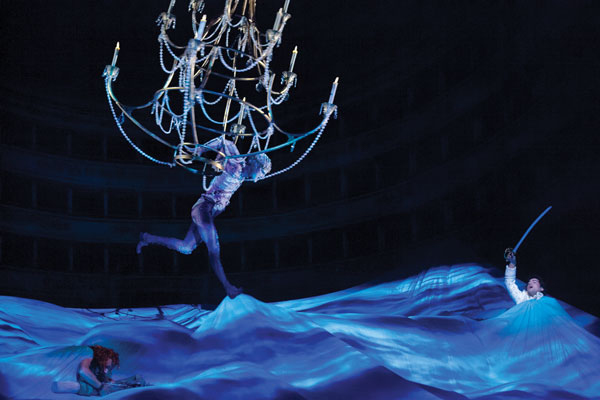
Count Johan and his friends think they’re impressing Christine (Kirsten MacKinnon, photo: Michael Cooper)

In the scene where Johan attempts seduction in the attire of a stag, prancing about the stage before being rejected by Christine, the music is very playful. We heard something similar in the piano paraphrase played at the RBA concert a couple of weeks ago, suggestions of dance rhythms. It’s absurdly excessive. Isaiah Bell played this part opening night but because he was indisposed today, we heard Wesley Harrison, currently a member of the Ensemble Studio, earning some of the biggest applause of the day.

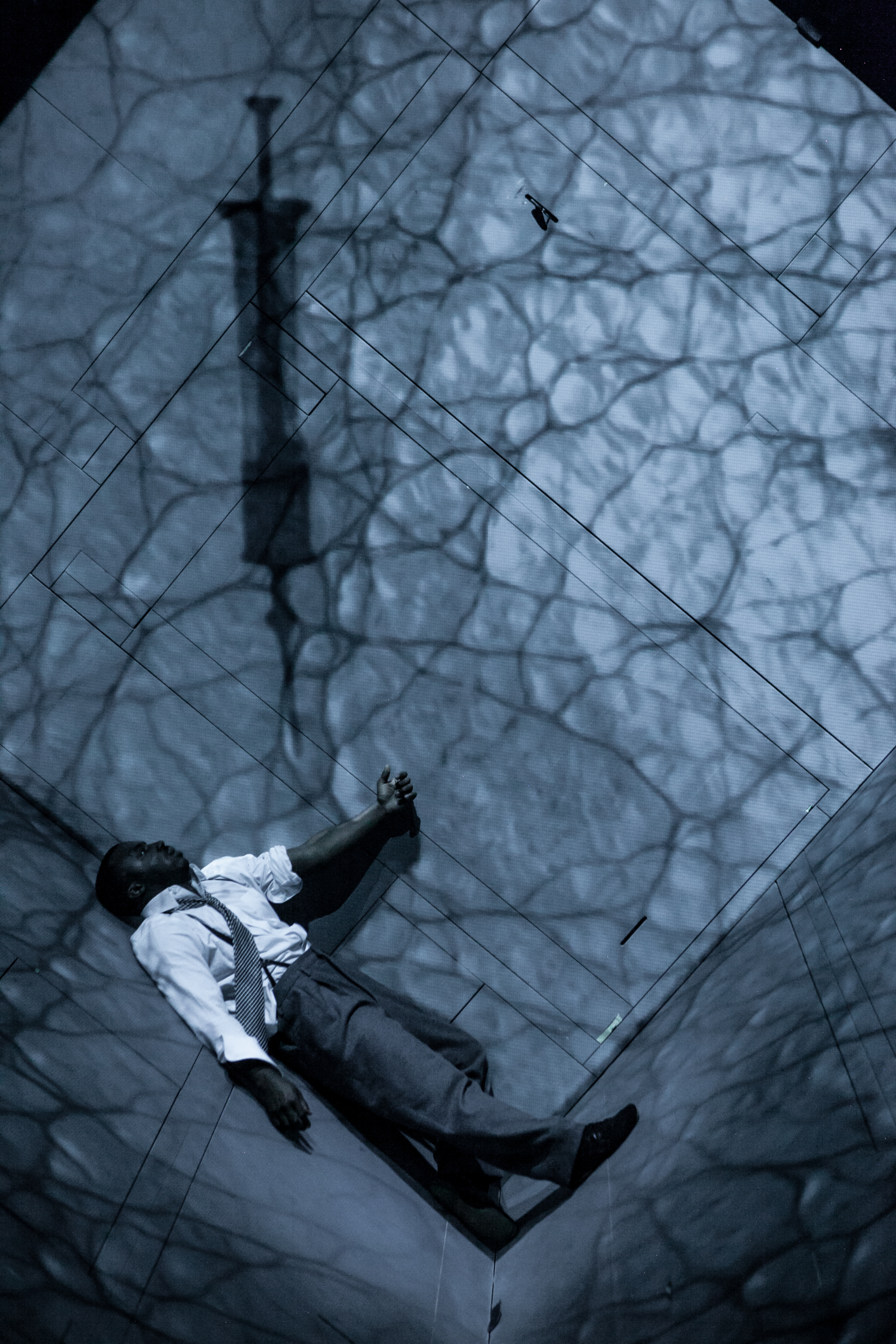
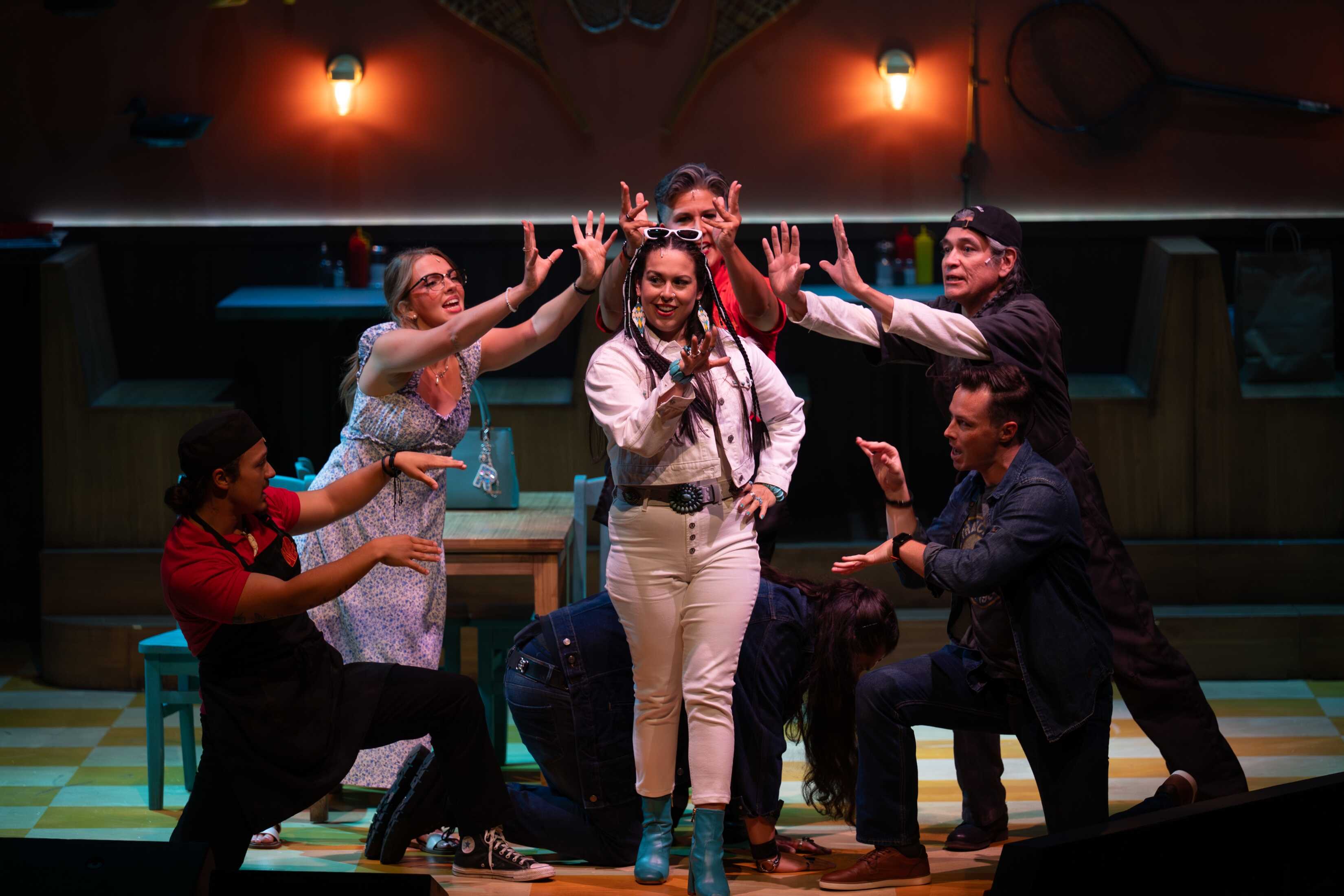
A scene from Canadian Opera Company’s presentation of La Reine-Garçon (photo: Michael Cooper)

And the scene where Rene Descartes probes human anatomy seeking to understand how the brain works is bizarre in the best way, his ambitions clearly shown. As in the piano paraphrase, we heard music that’s as complex as a brain that’s overthinking. It was great to hear Owen McCausland again for the first time in a few years.

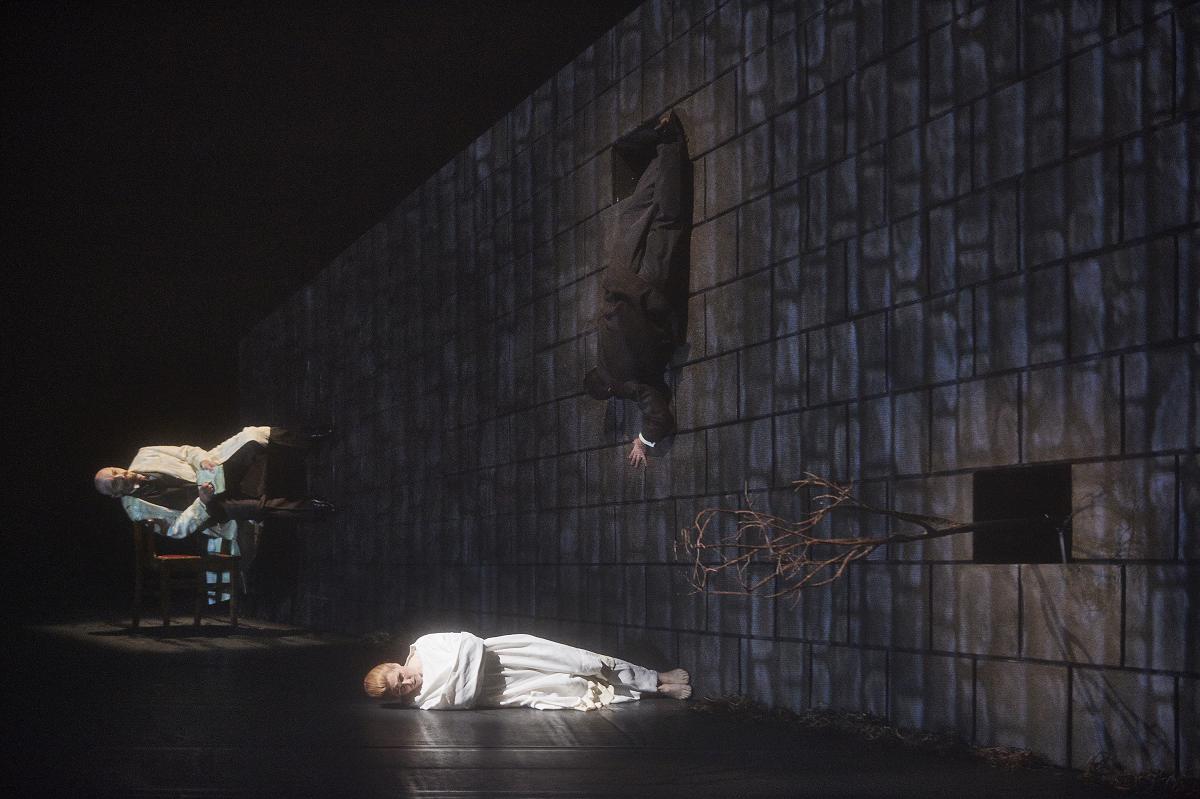
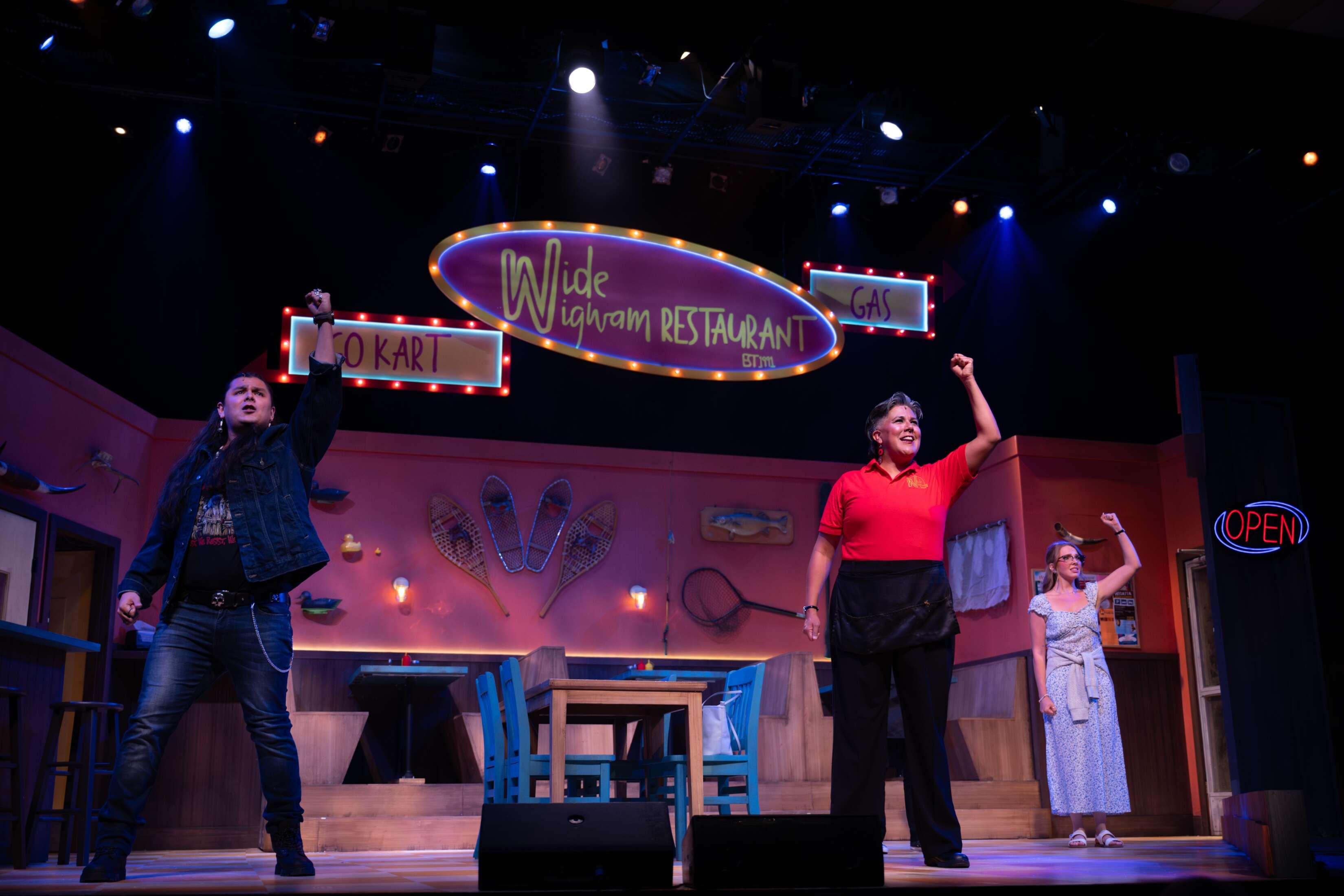
A scene from Canadian Opera Company’s presentation of La Reine-Garçon (photo: Michael Cooper)

Bilodeau used a recurring sound from the first scene until the last regularly throughout the opera, identified as kulning, a strident animal call sung without vibrato by soprano Anne-Marie Beaudette. Sometimes we would be looking at a landscape, snow falling or northern lights, achieved via wonderful projections by Alexandre Desjardins, the sound like an atmospheric effect, jarring even as the opera went on.

Christine (Kirsten MacKinnon) on stage with CGI northern lights (photo: Michael Cooper)

I am looking forward to hearing the opera again, hesitant about trying to characterize Bilodeau’s compositional voice when I’ve just discovered him first at the piano concert last month and now at the opera. But there’s a dramatic logic to Bilodeau’s choices, sometimes encouraging quick exchanges between singers, sometimes letting them sing something more like an aria with more lyricism.

That’s especially true of the Christine and Count Karl Gustav. Each of them expresses romantic wishes. Bilodeau is tonal, melodic, but sometimes full of surprises as far as the harmonies he employs. Philippe Sly’s presence is subtle at first, emerging gradually in the second act as he has greater moments of passion. Kirsten MacKinnon as Christine is at the centre of the opera but often softly observing, not always given the opportunity to comment on the drama her life has inspired: which ends up being a good choice by Bilodeau and Bouchard, a story swirling around her until finally she begins to emerge in response to the pressures placed on her. Countess Ebba Sparre (sung by Queen Hezumuryango) also is given her clearest opportunities to show us who she is towards the end.
Christine (Kirsten MacKinnon) and Countess Ebba Sparre (Queen Hezumuryango, photo: Michael Cooper)

The co-pro with Opéra de Montréal looks and sounds magnificent. Johannes Debus gets a stunning sound from the COC Orchestra and chorus, who are for the second show this season often singing sweetly in support as a wordless chorus (recalling their lovely sound in the humming chorus in Butterfly).

New opera doesn’t have to be atonal or dissonant. Bilodeau’s lovely sound world captures the passions and depths of Bouchard’s clever writing for La Reine-Garçon, more performances upcoming February 5, 7, 9, 13 and 15. I’m seeing it again, and recommend you do so too.

Posted in Opera, Reviews | Tagged , , , , , , , , , , , , , , | 2 Comments

Varieties of virtuosity: an interview with Piano Lunaire founder Adam Sherkin

Last month I was delighted to discover Adam Sherkin at a free noon-hour concert in the Richard Bradshaw Amphitheatre, a brilliant pianist & composer I probably should have heard sooner and founder of Piano Lunaire.

Adam Sherkin of Piano Lunaire

I jumped at the chance to hear his concert as an opportunity to explore Julien Bilodeau’s La Reine-Garçon through a series of piano paraphrases based on his opera. I am a bit obsessive about such music both as a listener and as a pianist even if these virtuoso pieces are sometimes beyond my abilities. I wanted to know more, so I had to interview Adam.

*****

Barczablog: Are you more like your father or mother?

Adam Sherkin: Artistically speaking, I am more like my mother. She is a painter and poet and has worked in the visual arts her entire life. I grew up adjacent to her practice and would frequently visit her studio. She is also an author of children’s books on colour, form and shape, encouraging young minds to appreciate our world in multi-color and contrasting spectra, not just in black and white. 

My father – a successful entrepreneur and corporate professional trained as an industrial engineer – has ever been supportive and understanding of the so-called “artistic life,” firstly supporting my mother’s pursuits when they married and then in turn, his son’s (ie, moi). In fact my entire family has been overwhelmingly supportive of my musical practice. We grew up, more or less, in an artistic household. (I have a sister who is a talented photographer and musician, amongst other impressive skills including pottery, darning and wood-working).

Both of my parents knew something about playing music: my father used to bring out his clarinet on occasion and even was a stand partner in high school with Hollywood’s famed composer, Howard Shore. My mother’s father was a pianist with a gifted ear and might have gone further had he not turned his sights to the Canadian Armed Forces in the 1930’s. He would often listen to me play in his senior years and heartily encourage my piano practice when I was an adolescent. He has a knack for Sergei Rachmaninoff and Duke Ellington, often commingling the two at the keyboard in a single (somewhat improvisatory) sitting.

BB: What is the best or worst thing about what you do?

Adam Sherkin: I suppose like many freelance artists and many professionals for that matter, part of my days are spent on tasks I don’t particularly find engaging nor creatively nourishing. Gone are the days when a pianist/composer could simply devote the entire work day to their art and trust others to manage one’s career. While a handful of artists still enjoy this existence in the 21st century, I do not have such luxuries. I constantly hanker for more creative time: both at the piano and with my manuscript paper (I still try to compose by hand!) Nevertheless, the power of our digital media platforms cannot be undervalued and indeed, much of my success and the development of my career betrays a great debt to digital media and the power of networking both on and off the screen. It is still most important to get out and be a living, breathing part of one’s musical community. While the Covid-19 Pandemic has upended that practice and changed our comfort levels of interaction, I still favour real-life connections in a professional ecosystem. Fortunately, I have always been a social creature and this part of the job comes easy to me.

The best thing about what I do? Striving for that ol’ cosmic connection of course. Sure, the business side of Piano Lunaire has been truly rewarding and our commissioning work and outreach is something I’m eminently proud of. But the heart of the matter, the real deal, is to connect with other humans in timeThat is ever the goal: to reach an audience in new ways and to urge them, compel them, grip them in the time continuum of dialogue and expression. Our great task – (and one we rarely achieve) – is to move our audience through the medium we wield and move in. At its highest of callings, we are tasked on stage to transform our audience and in some way change them – their humanity – for the better. That’s the name of this relentless game. It’s a calling, a purpose, a dedication or great folly. But as I am about half-way though my life now, there’s no going back. I have been a devoted musician since the age of twelve and a musician I shall be until the end, (this go-around anyway.)

One thing is steadfastly true: there remains no better place I know in this realm of existence than being on stage, at a fine great piano, with a full house and with a masterwork to play for them.

BB: Who do you like to listen to or watch?

Adam Sherkin: When I was younger I had a more eclectic palette but there’s just too much darn good music under the sun. So, these days, I listen/watch traditional and new classical music almost all of the time. On a good day, I will sit down with a (new) score and listen to a work I do not know. This is a special kind of active listening, highly advisable for composers. It instills new ideas and often inspires one to keep writing their own work. One of my teachers at the Royal College of Music in London, David Sawer, adopted this daily practice and it’s a good one. I also enjoy decent films and have a soft spot for old comedy shows of the British variety: Keeping Up Appearances and Two Fat Ladies* are (not so) guilty pleasures.

*The delights and merit of these two unexpectedly hilarious celebrity cooks must n’ere be underestimated! (May they rest in peace.)

Occasionally, I’ll attend a jazz set and have recently become more compelled to hear organ music. Living in New York (and a stone’s throw away from the Metropolitan Opera), I have endeavored to make more space in my life for opera, though I prefer the contemporary ones or at least those written in the last 100 years.

Hands-down, my five favourite composers have long been: Haydn, Fauré, Copland, Claude Vivier and John Adams.

BB: What ability or skill do you wish you had, that you don’t have?

Adam Sherkin: I wish I could have the sort of scientific mind that can think fluently with advanced mathematics and more specifically, a mind that creates and invents in the sphere of cosmology and theoretical physics.

BB: When you’re just relaxing and not working, what is your favourite thing to do?

Adam Sherkin: Spend a day exploring the city; a picnic in the park with a book or hosting an intimate dinner party.

BB: What was your first experience of music ?

Adam Sherkin: While my first musical experience was performing Rudolph the Red-nosed Reindeer at a Christmas recital aged 6, my first important musical experience was at the age of twelve: I heard Emmanuel Ax perform Mozart’s 22nd piano concerto, K. 482 with the Toronto Symphony Orchestra under the baton of Jukka-Pekka Saraste. After hearing such sublime collaboration and the artistry of Ax doing, well, just the kind of thing that Ax does best, I was hooked; It was on that night that I decided to become a musician.

BB: What is your favourite melody / piece of music?

Adam Sherkin: Ach! Nearly impossible to choose. How about this:

First light:  any Domenico Scarlatti sonata in D major

Midday: something lyrical and andante-ish by Aaron Copland OR: the first movement of Century Rolls by John Adams

Day’s close: a late nocturne by Gabriel Faure

BB: Are there any well-known transcriptions by classical composers (Rachmaninoff, Liszt, Busoni ) that you enjoy playing…?

Adam Sherkin: When I was a teenager, one of my teachers, Boris Lysenko, revealed himself to be a crazed fan of Liszt operatic paraphrases. Specifically, he loved the Mozart transcriptions and performed the Don Giovanni paraphrase (aka Réminiscences de Don Juan, S. 418) often in his own career. He urged me to find a less familiar Figaro-Giavanni transcription, hard to come by in those days. It was left unfinished (semi-improvised?) by Liszt, S.697 and was – and is – fiendishly difficult. It paraphrases two operas: The Marriage of Figaro and Don Giovanni. I got a hold of a score completed by Leslie Howard, the great Australian Liszt specialist, and to this day I still can’t really play it. Perhaps I’ll dig it out one summer and honour Boris Lysenko’s memory, learning it properly.

Amongst the more reasonable bag of paraphrasiastic tricks is Liszt’s Ballade from The Flying Dutchman (after Wagner) which I enjoy performing. Another memorable piece in my repertoire is the Liszt transcription from Wagner’s Parsifal, “Solemn March to the Holy Grail. (My performance of it, live)”. I had the good fortune to play this work on a Steingraeber piano for Udo Steingraeber, honouring his visit from Bayreuth to Toronto and the 200th anniversary of Richard Wagner’s birth: May 22nd, 2013. It was Steingraeber & Söhne who built the Parsifal bells for Wagner in 1882, as included in the opera at Bayreuth.

A comparable piece to the march is Busoni’s Funeral March for Siegfried’s Death from Wagner’s “Götterdämmerung.” I also have enjoyed performing paraphrases by Rachmaninoff as well. While not technically paraphrasing operas, Rachmaninoff’s works from his later years are superb and I have played them often:Paraphrase of Mendelssohn: Scherzo from the Incidental music to Shakespeare’s A Midsummer Night’s Dream (1933) and; Paraphrase of Tchaikovsky: Lullaby (Cradle Song Op.16, No.1).

Moving forward to our own time, Thomas Adès has revived the genre somewhat with dazzling paraphrases on his own operas. Perhaps the most famous of these is the Concert Paraphrase on Powder Her Face, taken from his first and highly acclaimed opera. To his catalogue, he has added various pieces from The Tempest and The Exterminating Angel. The dark and beautiful Berceuse from The Exterminating Angel is included on my recital programme in Montreal this month, featuring Bildoeau’s complete paraphrases on La Reine-Garcon and selections from my own solo piano cycle, Northern Frames.

Perhaps one fine day, when I finish my own first opera, I’ll have the chance to write and perform (my very own) operatic paraphrases!

BB: do you have any ideas about reforming / modernizing classical music culture to better align with modern audiences.

Adam Sherkin: Too many to recount here. It’s an involved discussion and an ever evolving set of ideas. It’s been the focus of my presentation. since I left college in London in 2008. In brief: don’t underestimate your audience (ie. Challenging them is good). The venue lights shouldn’t be too bright, the program not too long, the bar should remain open throughout and the atmosphere must have a buzz. The slicker the venue, the more modern the feel. Intermission needs to come after one hour of music AT MOST and the ticket prices need to be reasonable. Don’t bore your audience and don’t ever, ever take them for granted. Put yourself in their shoes from first to last experience, including ticket purchase, arrival at venue and final round of applause.

BB: You are both a pianist and a composer .  Talk a bit about your background training, and how you got here. 

Adam Sherkin: My training began at the keyboard. I was fortunate enough to have excellent piano teachers all along the way, beginning with Claire Hoeffler at her studio in High Park. I entered the Glenn Gould School academy training program when I was 16 and thereafter the university level courses at age 19. My years at GGS were formative and I learned a great deal from the teachers and masterclasses. Leon Fleisher, Marc Durand, Boris Lysenko, Andre Laplante and John Perry: what a roster! The conservatory atmosphere was ideal to focus on musical development and the small student population forged great camaraderie.

In my second year, I performed Messiaen’s piano concerto, Couleurs de la cité celeste, with the orchestra, under the baton of Alain Trudel. This really turned me onto contemporary music. That same year, I also began to compose in earnest. Jack Behrens, who was Dean of Academic Studies at the time, (and who passed away in December of 2024), was especially generous in his encouragement of my compositorial abilities. After the creation of some early pieces I took a year off in between bachelor and master degrees and worked up a compositional portfolio. Jack was very supportive of my studies in this field and so I applied to attend a master’s program in composition with a minor in piano performance, (as opposed to the other way around!) I settled on the Royal College of Music, London and figuratively set sail for the Old World.

In London, the opportunities seemed limitless. I had excellent training there as a composer (much needed by this point) and I was fortunate to study performance with pianist Andrew Ball, a specialist in new music. It was in London that I found my pianist/composer profile and upon graduation, embarked on a career in both disciplines.

After three years and some performances and composition work in London, I returned to Canada. Freelancing in Toronto started immediately and I also worked at the Royal Conservatory and helped out in the New Music Ensemble there, under Brian Current. After nearly a decade in Toronto and multiple seasons of solo recitals, premieres, chamber music and vocal coaching, I decided it was time for something new.

I applied for the professional studies program at Mannes College in New York and mentored there with composer Lowell Liebermann in Fall of 2019. Through the pandemic I remained in Canada but finally completed my studies at Mannes by Spring of 2022. Since then I have made my home in both New York and Toronto and brought the production company and record label, Piano Lunaire, to the USA.

I have been fortunate, as a Canadian, to have worked and studied in these three locations: London, Toronto and New York. It is important, even today, for Canadian artists to gain such wider perspectives, if providence and luck allows. Spending time in both Britain and America respectively have taught me more about my relationship to Canada and this country’s (still very young) musical lineage.

BB: You’re performing the six paraphrases based on Julien Bilodeau’s opera, La Reine-garçon. Please give me a synopsis of how you understand  the six pieces: the story / idea that the composer is trying to tell us in each piece. 

Adam Sherkin: Originally, Julien and I conceived of one paraphrase containing various sections. That vision quickly augmented into three paraphrases and before we knew it, Julien had produced SIX! He seems to believe it vital to include each of these complementary profiles (pieces) to give a full overview – a condensed form – of the opera. Interestingly, the paraphrases evolved as a kind of character suite, highlighting the major roles and the various dramatic junctures that occur throughout the narrative of La Reine-Garcon. While this is not a literal transcription, musically speaking, Julien has distilled the essential aspects of each character and offers tableaus that can one enjoyed irrespectively of the operatic experience.

Composer Julien Bilodeau and pianist Adam Sherkin

The six paraphrases, in chronological order, are entitled: “Butor,” “Faraud,” “Courroux,” “Fleur de peau,” “Cogito” and “Libre arbitre.” Generally speaking, these pieces are fast and virtuosic: highly demanding and technical. But within the virtuoso textures, varying expressions emerge and intersect. The character profile of each is palpable.

Julien describes this process in his composer’s note to the score:

The Paraphrases reveal many thematic aspects of the opera: Christine’s struggle (the queen of Sweden), the characters surrounding her, (Descartes, her two suitors – Gustav and Johan – her irascible mother) and her quest for free will. Each of the pieces, lasting approximately five minutes, develop the musical materials of the opera at the solo piano. Through these six paraphrases, the listener is transported on a condensed journey, relating the highlights of the opera, while being able to appreciate pianistic writing that is both virtuoso and poetic.”

BB: Thinking again of the six paraphrases, did any of these scare you or give you trouble when you first played them?

Adam Sherkin: There were some initial discussions for revision. Julien produced a first draft in August and we met in Montreal in mid September (2024). Over two intense days of workshopping, we played through the entirety of the score and revised certain passages, clarified notation and adjusted pedaling. Julien has been particularly fond of the sostenuto (middle) pedal in this work so we spent quite a lot of time on performance logistics related to the sostenuto pedal. He also has a predilection for wide intervals: 9ths and 10ths. While I can span particular 10ths, not all are manageable for me. In the hands of another pianist with a larger span, these passages might be doable but at least for our immediate purposes, 10ths were generally rewritten as octaves. 

Through the next working phase this past Fall, as these six paraphrases came up to performance level, some of the tempi proved too quick to realize at the piano (the orchestra can sometimes play faster than keyboards!) So Julien has been most gracious in reducing the speed of the metronome markings; this also can depend on the venue and specific acoustics (ie. reverb, dryness, immediacy of sound, etc.)

BB: how difficult are these paraphrases for the pianist to play? 

Adam Sherkin: In many respects, these paraphrases are on par with those works of the same genre by Liszt, Rachmaninoff and Busoni. Julien does not hold back in his demands on the pianist, writing multiple textures and constant barrage of notes and episodic changes. The trick here is to make the music sound easy and always within the performer’s control, all the while being technically demanding, requiring extra stamina. 

These paraphrases are indeed on the order of virtuoso pianism. That’s why we have themed the tour, “Paraphrases for a New World.”  Julien and I will continue to make adjustments and find more efficiencies in realization here as we premiere and eventually record this music, but they nonetheless remain difficult pieces for almost any pianist who opts to tackle them.

BB: It was great to see you and Julien Bilodeau sharing the RBA stage for the concert January 23rd, collaborating and discussion working together. How did you meet and how did you begin to collaborate?

Adam Sherkin: I was familiar with some of Julien’s work through Nouvel Ensemble Moderne and my time attending a workshop in Montreal with the Bozzini Quartet. Colleague and friend, pianist Matthew Fortin had premiered Julien’s piano concerto in 2012 (with much success) so when COC announced their 2024-25 season last Spring in Toronto, I approached Julien straight away and suggested a collaboration for the RBA Free Concert Series, analogous to the opening week of La Reine-Garcon. Both he and the staff at COC proved receptive to the idea and we began to make plans and source funding for a new commission (Six Paraphrases) and the revision of Julien’s existing piano music (Quatre Etudes).

BB: When you’re playing a piano piece based on an orchestral work as you do with paraphrases based on operatic composition, how do you imagine yourself reconciling the two extremes, between aiming to channel the orchestra’s sound vs playing the piece as written. 

Adam Sherkin: I do not conceive this as a challenging of two extremes, rather I perceive orchestral tonal palettes informing the work in this instance even more than usual. We often hear talk of colour and orchestration in piano pedagogy, regardless of whether the music in question exists in a symphonic or other comparable form but I think there is a starting point here with a full orchestral score-to-keyboard (ie. clarinet solo or percussion sonorities). The next important step is for the pianist to evoke that orchestral sonic vision and expand it, offering conviction from the keyboard’s special vantage point. This remains a significant aspect in crafting (and performing!) a successful solo recital.

BB: In the era of the old-fashioned competitive virtuosi, when Busoni or Brahms or Rachmaninoff had their own paraphrases, they wouldn’t play those of other pianists: which is a shame. And of course maybe I’m foolish to think you listen to a contemporary pianist. But could you comment as to whether we could ever hear for example Stewart Goodyear play your transcriptions or vice versa (you playing his)? I think it would be wonderful. 

Adam Sherkin: This raises an interesting point. In principle, I am an advocate for my community, colleagues and, well, direct competitors. I believe that when one of us excels, we all can, especially in Canada and specifically, Toronto. We must nurture one another and support a healthy ecosystem of music-making, idea-sharing and commissioning of those composers we believe in and respond personally to.

An American colleague and fine pianist in New York, Konstantin Soukhovetski, has a particular knack for skilled transcriptions and has written some very beautiful examples; I have plans to perform some of them soon. On March 15th of this year, at NYC’s Merkin Concert Hall, Anthony de Mare and I will perform a duo piano programme that includes four opera transcriptions by Canadian composer Rodney Sharman. 

Now, I admit that I am unfamiliar with Stewart Goodyear’s Nutcracker transcription (as many excellent such essays of the ballet already exist for keyboard) but I am keen to change that and hear them. Stewart Goodyear is an excellent example of a pianist-composer who challenges himself and his audiences to expand their notion of the 21st century virtuoso. Perhaps I can ask him for the score of his Nutcracker transcription and in turn, offer Bilodeau’s paraphrases on La Reine-Garcon

Since Piano Lunaire and I helped to commission Bilodeau’s new music, we have exclusivity for a few years now but once that time is up, I would be thrilled if other pianists wish to take up these new operatic transcriptions. This is a novel and topical contribution to the Canadian keyboard repertory.

BB I want to ask you about your own compositions. I saw that you composed four piano sonatas, written over a span of fifteen years: 2008 to 2024. Tell me more.

Adam Sherkin: I was lucky enough to present a quasi-retrospective recital in September in New York: all four of my solo piano sonatas. Rarely do I have an opportunity to play an entire performance featuring only my own work. I presented these pieces in chronological order and discussed each one, offering a context for their conception, autobiographical details and their evolving performance and recording practice. The fourth and final sonata to-date (2024) included a part for toy piano.

The first sonata, “Sunderance” was recorded on my debut album in 2012, As At First. Sonatas nos. 2 and 3: “Cŵn Annwn” and Ended in Ice” respectively will be included on my next solo album, to be released in late Fall 2025, Open Myths.

BB: It was an unexpected thrill to hear the way you play the Mozart K 311 on Youtube (my favourite of all the Mozart sonatas), especially your willingness to elaborate / depart from the score as written, creating something fresh & new.

I’m certain Mozart would approve, as surely what you’re doing was normal in his time.  Should we expect any other classical works in the future of Piano Lunaire? 

Adam Sherkin: I am so very pleased to hear that, thank-you. I used to present a lunchtime series at the St Lawrence Centre a few years back (2013 through 2018) that took place on the first Thursday of every month, themed Write Off the Keyboard. I enjoyed these recitals immensely. They offered an opportunity to work on traditional repertoire by composer-pianists from our not-too-distant past: Scarlatti, Haydn, Beethoven, Chopin and Liszt of course; Brahms, Granados and yes, MOZART! I’ve always adored Mozart’s keyboard music and therefore relished the opportunity to present it alongside contemporary works. Much new music exists from our own time that either pays homage to the famed Viennese composer or takes inspiration from his catalogue and uses existing (original) materials. 

But of that particular compositional school, my first love has been the piano works of Franz Joseph Haydn. I have always felt free and spontaneous amongst the (fifty-plus!) sonatas of Haydn and always experiment and embellish, ornament and invent. This proclivity likely shows itself in my Mozart interpretation also as I revel too in finding new and unexpected ways to infuse Mozart’s well-worn keyboard music with a sense of discovery, adventure and a healthy dose of joviality. (The recitals on the Write Off the Keyboard series that features Mozart’s works were entitled “MOZART: Involuntary Genius.”)

BB: Yes! K311 often sounds like laughter, and you bring that out beautifully.

Adam Sherkin:As for Piano Lunaire’s Mozartian programming prospects, they remain slight as we tend to favour Haydn. Just this past summer in both New York and Toronto, we piloted the “High Summer Haydn” festival, offered on midweek evenings at a pay-what-you-wish price point. With a later start time of 9:00 pm and an open bar, these summer concerts were rather successful. The focus was, naturally, on Haydn’s piano music and included highlights from his minor-keyed sonatas, works the maestro wrote in London on his trips there in the 1790’s and keyboard music written expressly for Prince Esterhazy II. We even brought a fun and quirky set of Haydn’s Scottish (!) folk song arrangements to Toronto’s Arts & Letters Club in September, featuring mezzo-soprano Chantelle Grant and TSO violist, Ivan Ivanovich. Currently, we are in the midst of planning for this coming summer at Piano Lunaire and will have more of Haydn’s irresistible inventions to reveal, with concert dates – soon!

Existing live recordings from the festival will be available on our YouTube page. An exciting part of this year’s festival includes small commissions from emerging composers that form companion pieces to Haydn’s keyboard sonata catalogue.

BB: Do you ever feel conflicted, reconciling the business side and the art?

Adam Sherkin: I used to feel more conflicted as a young person but I have developed these skill sets apace as I move through my career. I suppose I am young enough to have been taught about making your own way and not always relying on others to manage you. Moreover, the resources young artists have at their disposal today are impressive, overwhelming even. Despite my familiarity with the demands and the hustle, I often never feel like there is enough time for my art, a sad admission to make. Our world’s technological compulsions don’t help this, as there is ever a reason to be pulled away from the analogue and into the digital: endless emails that replying to, messages, posts, texts, promotional requests, listings, coordinations, banking, contracts, travel bookings, collegial discussions, Zoom meetings, on and on ad infinitum. 

However, many successful artists navigate these fatiguing waters each day and enjoy wildly successful careers so, there is hope and there is a way forward!* It was firebrand, soprano Barbara Hannigan (ever an inspiration to me, not to mention a Canadian national treasure) who I first heard openly share her experiences around finding such balance. She continues to struggle with it but has achieved incredible success in her career and always engages – enthralls – her public. Through her integrity, devotion to the craft and ultimately humane approach to her business obligations, she provides us in this kooky industry a shining example of what is possible. We can both thrive at the business side and soar at the artistic, all in a single day. 

* This reminds me suddenly of Sergei Rachmannoff, who after first visiting America in 1909 on a concert tour in that “accursed country,” complained of the inordinate emphasis on, “the business, the business…they are forever doing, clutching you from all sides and driving you on… I am very busy and very tired.” (From a letter to his cousin, Zoya Pribitkova.)

BB: Could we talk about virtuosity?  When we think of Bob Dylan or KD Lang reconciling sincerity & skill, nobody insists that they hit high notes or play difficult riffs on their instruments, so long as there’s a connection.  As artists are we trained animals showing off? Debussy and Wagner both spoke of the virtuoso as a kind of circus animal, and the applause as a kind of trap.  I wonder what you’d say, as a performer who likely enjoys applause, especially given that you’re working as a virtuoso pianist, where I’m asking about virtuosity as though that were somehow measurable… Does this influence the way you write and how you perform? 

Adam Sherkin: Hopefully, all performers enjoy applause! And equally, all audiences enjoy real pyrotechnics and feats of virtuosity. But this cannot be all a performer offers to their audience, especially not when that performer eventually grows up (ie. post 21 years old)

Virtuosity and technical prowess does influence the way I write, at the piano and off it. I believe that it is necessary to energize and incite our listeners. Sure, we can mutter, whisper, play quietly, slowly and poetically but this is a permission we need to earn on stage. Similar to how actors must earn their silences, musicians must gain the trust of audiences by showing them we can do almost anything: the journey we endeavour to take them on will be stimulating, nourishing, worthy and perhaps even surprising. We engage in a bond of confidence with our listeners, proclaiming we somehow know what we’re doing, that we can do the thing exceedingly well. They will get their money’s worth. If they trust us and we first prove that they can extend this trust, they just might leave our keyboard side elevated, inspired and forever changed.

BB: Since the pandemic a great many ways artists are working virtually, both as teachers and as performers. Do you have a preference between live or recorded performance and when you record how do you make it seem live?

Adam Sherkin: I have always enjoyed both live and recorded performance. During the pandemic, Piano Lunaire originated a digital performance platform, as did many organizations: LUNAIRE LIVE offered as close an experience to live performance as was safe during that period. But something was always missing when playing in an empty room with recording crew and myself alone, it could never replicate a true concert experience. On one occasion during a live stream, a fellow composer came to the outside of my living room, near to the piano, so we could open a window and she could hear her work played – such times! At any rate, the eventual return to live performance was warmly welcomed in my corner.

I tend to believe that truly fine recordings are an art form unto themselves. The medium of the proverbial long-playing record is to be cherished and celebrated, exactly for what it is. There are magics begotten in the recording studio, just as there are in a live concert hall.

BB: If you could tell the institutions how to train future artists, what would you change?

Adam Sherkin: As I don’t do a lot of teaching nor have ever held a full time position at a music institution, I might not be the most qualified to answer this. I will be ever grateful to my own teachers, many of whom have sadly passed on: Jack Behrens, Boris Lysenko, Colin Tilney, Leon Fleischer and Andrew Ball, among others.  

If I could perhaps  insist on one point though it would be this: instill a love and fearlessness in the young artists of today. Nothing is impossible and a dream-career can be yours for the taking, so long as you are prepared to seek it on your own. Our society (particularly in North America) might try and dissuade you and don’t wait for it to come find you: be brave and singular, drive out the noise and blind your sensitivities to all else that will never serve your artistic practice: this higher purpose.

*****

Paraphrases for a New World

Paraphrases on La Reine-Garçon is a collection of piano pieces based on the Opera La Reine Garçon: as this will be performed at the Canadian Opera Company in February 2025 on its main stage, Sherkin’s recital is designed to accompany its production by presenting Bilodeau’s musical style as well as providing a taste of the opera itself. The Paraphrases will reveal many thematic aspects of the opera: The struggle of Christina, Queen of Sweden, the characters surrounding her (Descartes, her two suitors – Gustav and Johan and her irascible mother) and her quest for free will. Each piece has a duration of approximately five minutes and develops the musical material of the opera for the piano. Through these six pieces, the listener will be transported on a condensed journey that recounts the highlights of the opera while being able to appreciate a pianistic writing that is both virtuosic and poetic.

January 23: 12:00-1:00pm Canadian Opera Company Free Concert (review)
February 5: 12:00-1:00pm Toronto Arts and Letter Club
February 8: 8:00-10:00pm Tenri Cultural Institute New York City
February 12: 7:30 pm – 8:45 pm Salle Paul-Desmarais du Centre canadien d’Architecture Montreal
February 20: TBA Canadian Music Center Toronto

Posted in Interviews, Music and musicology, Opera | Tagged , , , , , , , , , , , , , , , , , , , | Leave a comment

New COC Butterfly gets it right

Everything clicked today in the Canadian Opera Company presentation of Puccini’s Madama Butterfly at the Four Seasons Centre. I’ve been enjoying the music of this opera all my life in spite of shortcomings, never having experienced a production that was as perfect as this one.

Pinkerton (Kang Wang) and Butterfly (Eri Nakamura; photo: Michael Cooper)

The principals were superb beginning with Eri Nakamura in the challenging title role. When I think back on recordings I heard with Italian sopranos such as Albanese or Tebaldi, or COC productions starring a mature singer, we were always required to make a huge suspension of disbelief. How could it be otherwise, when the role calls for a dramatic soprano portraying a beautiful teenager. I don’t think you can improve on Nakamura’s portrayal, from the sparkling high notes in the love duet, the unshakeable resolve in her big aria “un bel di”, an unexpectedly light comic touch in her scene with Yamadori, or her brilliant handling of the horrific drama in the last act. The role is demanding, yet her voice was better as she went on, perhaps because she conserved some of her resources earlier on.

There is a certain irony in having Nakamura in this cast, given that the usual optics for the opera are missing. Casting the Asiatic Kang Wang as Pinkerton defuses some of the usual racial tension. We still have an imperialistic American sailor singing “America Forever”, who marries Cio-cio San even though he drinks a toast to the day he will eventually marry a real American wife. But at least he’s not also enacting white supremacy.

During intermission as I chatted with someone seeing Butterfly for the first time in her life (what a treat, especially when their first is such a good production), I couldn’t help thinking how relevant Puccini feels right now in addressing contemporary issues such as poverty (Boheme), tyranny (Tosca) and American imperialism (Butterfly).

It’s a delightful surprise to encounter a racially inclusive cast in an opera where race is so central to the story, but all the principals are persons of colour. The effect was unexpected. I felt Wang’s remorse in the last act was more believable than the usual Pinkerton, the relationship somehow more romantic as a result. But the main thing was how well these two portrayed their roles, singing and acting flawlessly.

The production co-commissioned by Houston Grand Opera, the Grand Théâtre de Genève and Lyric Opera of Chicago, was directed originally by Michael Grandage but in the revival by Jordan Lee Braun.

I understand that Puccini can be one of the hardest composers to conduct, using big orchestral effects resembling Wagner even while the singers require more flexibility of tempo and dynamics from the leader, controlling that huge sound. Conductor Keri-Lynn Wilson led a sensitive reading, the COC orchestra sounding superb especially at the beginning of each act. The COC Chorus was nicely blended into the whole in their offstage moments. The result was brilliantly musical in support of the story-telling.

Keri-Lynn WIlson (photo: Daria Stravs Tisu)

There were no weak spots in the cast. Hyona Kim was a standout as Suzuki, Butterfly’s servant, at times anticipating the audience’s emotions in her sympathetic responses to the plight of her mistress, and the voice wonderfully eloquent. Michael Samuel was the other empathetic figure as Sharpless, the lynchpin of the plot as he helps Butterfly. Julius Ahn was an energetic Goro, with a touch of mischief. Gene Wu was a superb Bonze including a magical moment nose to nose with Wang’s Pinkerton.

The Bonze (Gene Wu, holding the spear) denounces his niece Butterfly (Eri Nakamura), as Pinkerton observes (far left in naval uniform) among family members who hear the Bonze’s accusation of Butterfly’s betrayal of her culture
(photo: Michael Cooper)

Samuel Chan was an intriguing Yamadori, singing some of my favourite music in the opera (i always desperately wish Butterfly would accept his proposal, but sigh it never happens). Whether Yamadori is an unattractive older fellow being pushed by the opportunistic Goro or the handsome younger one we saw today, the scene serves as a light interruption in the tragic plot.

Left to right: Suzuki (Hyona Kim), Butterfly (Eri Nakamura), Yamadori (Samuel Chan) and Goro (Julius Ahn; Photo: Michael Cooper)

Madama Butterfly continues with six more performances February 1, 6, 8, 12, 14 and 16.

Left to right: Suzuki (Hyona Kim), Sorrow (Naleya Sayavong) & Butterfly (Eri Nakamura; photo: Michael Cooper)

Posted in Opera, Reviews | Tagged , , , , , , , , , , , | Leave a comment

Paraphrases on La Reine-garçon from Sherkin & Bilodeau

Today was my first time attending a noon-hour Canadian Opera Company concert in a long time, tempted by a few magic words: a world premiere performance of excerpts from a suite of paraphrases composed by Julien Bilodeau, whose opera La Reine-garçon begins its run with the COC beginning January 31st. Today’s concert was first in a series from Bilodeau.

How could I resist?

Bilodeau composed in collaboration with Piano Lunaire, an organization founded by the pianist we heard today, Adam Sherkin.

Composer and virtuoso pianist Adam Sherkin

Their website describes the paraphrases this way:

Paraphrases on La Reine-Garçon is a collection of piano pieces based on the Opera La Reine Garçon: as this will be performed at the Canadian Opera Company in February 2025 on its main stage, Sherkin’s recital is designed to accompany its production by presenting Bilodeau’s musical style as well as providing a taste of the opera itself. The Paraphrases will reveal many thematic aspects of the opera: The struggle of Christina, Queen of Sweden, the characters surrounding her (Descartes, her two suitors – Gustav and Johan and her irascible mother) and her quest for free will. Each piece has a duration of approximately five minutes and develops the musical material of the opera for the piano. Through these six pieces, the listener will be transported on a condensed journey that recounts the highlights of the opera while being able to appreciate a pianistic writing that is both virtuosic and poetic

The program for today’s recital was as follows:

Ligeti: Etude No 15
Sherkin: Etude No 1 Op 21
Bilodeau: #3 and 4 of the Quatre Etudes du printemps
Bilodeau: #2, 4, 5, 6 of the Six Paraphrases sur La Reine-garçon 

Both Bilodeau and Sherkin were generous in explaining their approach to collaboration. Bilodeau explained that the six paraphrases in the suite each tell us about a character in his opera. We heard four of them today, each distinctive in its sound.

First in the suite came #2 Faraud. I’m not sure I fully understood this one, as we were told that the character being portrayed was someone who saw themself as more competent & adept than they really were in fact. The music was playful with phrases suggesting dance, but I didn’t hear ineptitude. The funny thing is that even here the music was stylish and beautiful.

Next came #4 Fleur de peau, for an interaction between Queen Christine and another woman, when she felt something like attraction. I thought this one worked well, a series of repeated notes to suggest a trembling excitement, first high then lower as a sort of motif for the new idea, among luscious sensuous clusters of notes. It was clever, powerfully suggestive. Or maybe I have an over-active imagination.

Next came #5 Cogito, which was about Rene Descartes, who Christine invited to help understand her psychology. Of course there was no Freud in her century, so Descartes was a good idea, even if he was intent on figuring out the anatomy of faith, looking inside a cadaver for the organ connecting the mind and the spirit. I was reminded of the music Richard Strauss employed in the “Of Science” segment of Also sprach Zarathustra, a complex music to suggest mental complexity and over-thinking. But in time the music settles into something calmer, quite beautiful.

We moved into the last segment without pause 6 Libre arbitre. This was the most fervent and passionate of the pieces, reminding me of Schumann’s closing section of his Scenes from childhood titled “the poet speaks” or the finale of Ravel’s Mother Goose. All four of the paraphrases make me eager to hear the opera, gorgeous music full of drama and emotion.

I am reminded of a famous quote from painter Maurice Denis who said “Remember that a painting—before it is a battle horse, a nude model, or some anecdote—is essentially a flat surface covered with colors assembled in a certain order.” This is important when we recall that pieces of piano music that might tell a story or remind us of a picture or character, are first and foremost a series of notes on the page, a piano composition to challenge the pianist. I bring it up because whatever the relationship between the piano paraphrases and the opera, we heard some gorgeous playing from Sherkin, especially in the paraphrases. We heard a virtuoso playing effortlessly in front of us on the Steinway.

In a friendly chat with the composer afterwards, he remarked that this isn’t quite the usual we know from the paraphrase tradition. We know of a history of virtuoso compositions with a few usual objectives.

  1. to show off the pianist’s abilities
  2. to show us the music being paraphrased in a different light
  3. to promote the composer being paraphrased

Franz Liszt was one of the first composers making concert paraphrases of everything from Schubert songs to operatic quartets from Verdi. I’m a big fan as a listener and as a player even if I can’t always manage the pieces, which are a wonderful challenge and a new lens through which to see the original piece.

Bilodeau admitted, however, that his paraphrases were a bit different from what we’d seen before. The usual paraphrase (if we can speak of such a thing when the traditional type happened long ago) would take a familiar piece such as a Schubert song and then turn it into something quite new. Yes we would recognize the melody but the pianist was offered a showcase for their brilliance.

We can think of them as adaptations. Let’s recall Linda Hutcheon’s observation that the pleasures of an adaptation lie in the layers through which we perceive the original. If we don’t know the new Bilodeau opera, if we have not heard it yet, the paraphrase hits us in a different way than if we’re hearing a paraphrase of a well-known melody, because we could not distinguish the new from the old, as it’s all new to us.

But there’s also another way that such a composition works, as Liszt showed in his time. Before we had recordings, the pianist brought unknown music to the world that otherwise would have been ignored, thereby publicizing and popularizing music that had not yet been heard, such as the music of Berlioz or Wagner.

We had an impressive display of pianism, with more to come. Piano Lunaire will be offering this program (with a few extras in some of the venues) a few more times in Toronto, Montreal & New York.

February 5 — 12:00 pm. Toronto Arts and Letters Club, Toronto
February 8 — 8:00 pm Tenri Cultural Institute – New York City
February 12–7:30pm Montreal
February 20–TBA Canadian Music Center – Toronto

Further information can be found on Piano Lunaire’s website.

And of course we also have Bilodeau’s opera coming to the COC January 31st until February 15.

Adam Sherkin and Julien Bilodeau

Posted in Music and musicology, Opera | Tagged , , , , , , , | 1 Comment

Auspicious beginning to (unofficial) TSO Beethoven festival

This week the Toronto Symphony offer the first in a series of concerts featuring the music of Ludwig van Beethoven, one of the most popular and best loved of all classical composers. Wednesday night’s performances were a brilliant start.

I took this selfie five years ago in NY. Is he the most popular of all the classical composers?

No it’s not really a festival, even if it feels like it to this admirer. I’m just calling attention to their programming because it’s exciting to get to hear so many of Beethoven’s best-known works over a relatively short period of time. Maybe the TSO programmers did it consciously? maybe not. Let me quickly summarize what’s to come, and you judge for yourself whether I’m wrong to point out the high number of Beethoven works we’re about to get. I can’t help being excited looking at this list.

  1. This week: Beethoven’s Violin Concerto (plus Schumann’s Symphony #2 and Unsuk Chin’s subito con forza, a brief modern homage to Beethoven last played by the TSO in October 2022), to be repeated Thursday January 23rd.
  2. February 5 & 6: Jan Lisiecki plays and conducts all five of the piano concerti on two consecutive nights: quite a feat from Mr Lisiecki!
  3. February 15: The Toronto Symphony Youth Orchestra get into the act with Beethoven’s 5th symphony alongside John Williams music from Star Wars and Kevin Lau’s Artemis.
  4. March 23: Beethoven Lives Upstairs is offered twice, a Young People’s Concert that also includes a Beethoven performance by Brampton’s Youth Orchestra the Rosebuds in the North Lobby.
  5. May 16: Beethoven’s 5th, this time from the National Arts Centre Orchestra. Maybe the TSO asked the NAC to play Beethoven?
  6. May 28, 30 & 31: Beethoven’s 3rd symphony Eroica, plus Arvo Pärt’s Cantus in Memoriam Benjamin Britten and Stewart Goodyear’s Callaloo—A Caribbean Suite for Piano and Orchestra
Spotlight Artist Jan Lisiecki’s virtuosic journey on Feb 5 & 6 takes us through all of Beethoven’s piano concerti, which he both plays and leads.

And so: there’s lots to hear whether Beethoven is new to you or your oldest vice. This week as I continue to ponder the recent passing of my mother at 103, I was looking at the oldest records in the family collection, my father’s old vinyl recordings, including the Toscanini set of symphonies and the Emperor aka concerto #5 played by Arthur Rubenstein, my first exposure to Beethoven. Whatever else you do raising your children, expose them to Beethoven.

But that reminds me. Yes I saw and heard a concert Wednesday night including the Beethoven violin concerto. While I grew up listening to the Mendelssohn concerto on another of my father’s vinyl discs, I recall the abrupt shift when I first heard the Beethoven concerto, one that for me stands alone above all others, possibly because it’s one of his greatest creations. I don’t think of it as a virtuoso piece so much as a brilliant composition that happens to be a violin concerto, one of the pieces where fundamental issues of sound are being explored. Again we must marvel at the creativity of a composer on the pathway to deafness exploring sonic attributes that he must have heard in his head if not in the real world.

Conductor and violinist Nikolaj Szeps-Znaider (photo: Lars Gundersen)

Nikolaj Szeps-Znaider, who has been music director of the Orchestre National de Lyon since 2021, was both the TSO’s conductor and violin soloist in the concerto.  We must somehow get this brilliant artist back for another concert as soon as possible. His conducting, his playing, his artistry are remarkable. And actually he is back (as he is still here in Toronto) , for Thursday night January 23rd, so that’s the next chance to hear him repeat this program both as a soloist and as a conductor. My head is still pulsing with the music I heard tonight.

Znaider’s violin is part of the magic, an instrument once played by Fritz Kreisler, as he told us when he offered that composer’s Liebesleid as a stunning encore accompanied by the TSO. I shouted myself a little hoarse not truly in hopes of an encore, but simply overcome, tearful, listening to the Beethoven concerto.

Does it matter if the violin’s tone is sweet, that the violinist shapes phrases exquisitely? That’s the ideal. I love this concerto but heve never heard it like this, often played with great delicacy, restraint while letting the orchestra command the conversation: as so often happens in this unique concerto. I was a bit dumbfounded as to how the orchestra stayed with him, when he slowed, when he hesitated without a clear signal (he was busy playing after all), yet they knew to follow. I suppose that’s what rehearsal is for. But OMG this was stunning.

The first movement is epic in scope, as the timpanist begins almost inaudibly with a motif that we will hear throughout the movement, simply a pattern of five repeated notes. From this the first melody opens up passionately, sometimes in winds sometimes in strings, and in due course carried by the soloist himself. After so much drama, the second movement offers us a peaceful resting place, before the catharsis of the third movement. It’s brilliantly constructed, so that we gradually go from something more like an internal struggle to something extroverted, like a celebration in its dance rhythm.

I’m reminded of Anton Kuerti’s program notes in his complete sonatas recording when he said that to play Beethoven in a sense you have to become Beethoven, your identification a natural way to read the music. If we accept that idea –which I find very compelling–it makes even more sense to have a concerto that is also conducted by the soloist as we saw tonight. and we will have that opportunity again next month when Jan Lisiecki gives us all 5 piano concerti as player and leader of the orchestra on consecutive nights. The unity between Znaider’s violin and the orchestra was unmistakeable, as though they were reading minds: although I think this was as much about visceral feeling as intellect.

And it helps that Znaider’s violin has the most beautiful violin sound I have heard in a long time, perhaps ever.

After the intermission we heard a short piece that the TSO played in October 2022 namely Unsuk Chin’s subito con forza, a brief modern homage to Beethoven. We were now listening to Znaider the conductor, as he worked without a baton giving us something substantially different from what we heard last time. At that time I enjoyed what Chin had created even though her piece seemed somewhat incoherent, a series of effects. Znaider did something to subito con forza that we would also see him do with the concluding Schumann symphony. He looked at the score, decided on a prevailing effect and then organized the players around that effect, making the work seem more coherent. The effect borders on the miraculous, as he analyzed and then shaped the interpretation for desired impact in specific places. I suppose that’s what an interpreter does?

I use that word “miraculous” because of what I heard in the TSO performance of Schumann’s symphony #2. Znaider worked without either score or baton, conducting from memory. Presumably the program was one he asked to conduct, a fascinating combination of pieces. This symphony has a lot in common with that violin concerto, another work full of passionate appoggiatura moments, when we are suspended and teased by the composer’s tendency to leave us almost resolved and then hanging a note away for a moment or two. The impact is something resembling passion, emotions that feel unfulfilled.

Znaider led a very clean clear reading unlike any performance of the work I have ever heard. The thing about the Schumann second symphony is how difficult it is to really make it work as well as what we heard tonight. There are many notes, many voices, sometimes overlapping: unless you insist that the players observe careful phrasing and get off their notes judiciously, precisely, carefully. OMG that’s what I heard tonight, a revelation in a work I thought I knew. In several places the strings were playing very softly, the trumpet motif that can sometimes overwhelm the rest of the orchestra was held in check, blended rather than blasting. As with the short work, Znaider seemed to have clear ideas, an interpretation built around a series of coherent effects, when one or another section would clearly be heard while others got out of the way, or delicately answered: but without covering one another. To make Schumann sound so sane is quite a feat.

Znaider and the TSO will repeat the program Thursday January 23rd at 8:00 at Roy Thomson Hall. Go hear it if you possibly can!

A flattering version of Beethoven that sits on my bookshelf.

Posted in Music and musicology, My mother, Reviews | Tagged , , , , , , , , , | Leave a comment

Wights: a fit of words against words

From its title on down, Liz Appel’s new play Wights that opened at Crow’s Theatre last night had me astonished, perplexed, wondering whether I’d seen comedy satire or just the real lives of smart people using big words in their kitchens, an intense virtuoso display from a pair of actors who left it all out there on the stage.

It’s a passionate roast, a debate to the death, but what’s dying is truth and love and hope in the final days before the 2024 American election. As Appel located her story so precisely– in Connecticut among people confidently asserting Kamala’s expected victory–on Halloween night 2024 in a kind of academic never-land of activist optimism, I felt a satirical impulse in the absurdity of the behaviour we saw and heard.

We meet the first three of our four characters, engaged in friendly conversation surrounding Anita, who hosts her two guests on the night before an interview for a job that would change her life and validate her political beliefs. Celine and Bing are helping Anita prepare to be interviewed by Yale’s “Centre for Reparative Thought and Justice,” a fiction that’s a nice match with that expectation of Kamala’s victory. I wasn’t laughing, given that I too had naive hopes about how November 5th would turn out. Maybe the satire was close to home.

Bing (Richard Lee) playfully speaking to Anita (Rachel Leslie) in her kitchen table. (photo: Dahlia Katz)

Before Anita gets very far in reading through her presentation, her husband Danny comes home, seemingly exhausted from a difficult day, and clumsily letting the guests plus the audience hear the disparaging way he refers to them, until he realizes that the guests are actually there, and he snaps back to a fake friendly jocularity with Bing.

left to right: Anita (Rachel Leslie), Danny (Ari Cohen) and Bing (Richard Lee, photo: Dahlia Katz)

In due course hungry tired Danny will snack before dinner, while Anita tries to read her presentation, with Bing playing a devil’s advocate role to help her prepare. Celine is more supportive.

Anita (Rachel Leslie), Danny (Ari Cohen), Bing (Richard Lee) and Celine (Sochi Fried, photo: Dahlia Katz)

The masks they wear in polite social conversation gradually slip as their exchanges push closer and closer to truths underlying their lives. As each guest reveals their darker core beliefs, a polite dinner is impossible, as Bing & Celine rush off.

Without the moderating effect of the guests Danny and Anita go that much deeper in their exchanges. Their fantasy of control is slipping, whether in the sounds of their child through the baby monitor signalling their failure as parents (if you think I sound harsh, you should hear how they talk about the child!), doors falling off hinges, or an accident with a corkscrew leaving Danny bleeding. While people may intend to make things happen, in the real world of Murphy’s Law people fail to understand, as things inevitably will go wrong.

We are in a discursive space where meaning is being probed and poked to the point where it snaps, and the process of communicating might have broken. If you’re waiting for a clear explanation it’s not there. I’m reminded of the way Kubrick’s 2001: A Space Odyssey challenges the viewer by resisting the easy explanation, the clear resolution. The promotional literature for Wights is bang on, when it says that it is at once enigmatic and hard-hitting, WIGHTS delves into the intricate power of language and its profound influence on our relationships, society, and the very fabric of reality. Yes. just like 2001 its ending is mysterious, poetic, elusive. But then again the world itself is a big mess right now. There’s nothing warm and fuzzy here, just like the real world. There are apocalyptic overtones in the sound design, which at times is going to make you jump, jolted in your seat. I love that, even if I’m not saying I know what it means.

As I wrestle with my impressions I’m falling back on the genre question, that can be a handy way to tell people what to expect. I heard a lot of laughter in the first half of the show, but very little towards the end. I can’t decide if I should think of Wights as satire, a comedy of manners, or a dark drama, as we are not given clear signals as to how to react. I recall how Shakespeare broke all the rules in the ways he would combine elements across genres, confounding genre expectation.

Speaking of Shakespeare he comes up in the conversation, as Danny and Anita refer to sonnet 106, including only the title while commenting on the limits to expression. No the sonnet itself isn’t in the play but I thought it might be worth having a refresher.

Sonnet 106:
When in the chronicle of wasted time
I see descriptions of the fairest wights,
And beauty making beautiful old rhyme
In praise of ladies dead and lovely knights,
Then, in the blazon of sweet beauty’s best,
Of hand, of foot, of lip, of eye, of brow,
I see their antique pen would have express’d
Even such a beauty as you master now.
So all their praises are but prophecies
Of this our time, all you prefiguring;
And, for they look’d but with divining eyes,
They had not skill enough your worth to sing:
For we, which now behold these present days,
Have eyes to wonder, but lack tongues to praise.

I wonder if Liz Appel felt any sense of futility writing a play about breakdowns in discourse. Wights is a bit of an oxymoron, so many words about failures of meaning and breakdowns in understanding. What a troubling and paradoxical site for drama.

That word “wights” in the title and the sonnet has at least two meanings, plus the third sprinkled throughout the play’s text.

Can you see the definition?

A wight is a being or creature, very much as Shakespeare used it, and was no big deal until fantasy started employing the word to suggest something supernatural or unearthly.  I think it’s the same word but simply with added connotations. If I point my magic wand at you and call you a creature, that’s not really an additional meaning, just a different context via another genre.

While I may be over-thinking in noticing a third extra meaning I hope I can be forgiven for that, in a play populated by compulsive over-thinkers. But it’s the unavoidable homonym, the accusation with the unspoken word that lurks in the relationship between Anita and Danny. While Anita is a visible minority, Danny passes as Caucasian with his white privilege and the association with white supremacy, and is tormented by guilt that inspires impulsive actions: and I won’t say more for fear of spoiling the play for you.

Sometimes people are allowed to speak at length, sometimes they are interrupted incessantly. Do people normally listen? I ask that as a question of verisimilitude, and the conventions we build into drama or film, that simply don’t apply to real life. In Appel’s play there are lots of words, the cast delivering them at break-neck speed and largely getting out of the way when a tirade begins. In my experience I don’t find that people are usually this polite, to hear someone out when they go on at such length, especially when they’re passionate or angry.

Anita (Rachel Leslie) and Danny (Ari Cohen, photo: Dahlia Katz)

As Ari Cohen is much bigger than Rachel Leslie, when he starts ranting at her in the last half hour he can compel her attention by intimidation, although (tiny spoiler alert) thank goodness he doesn’t hit her. Ah but then this is a fictional space regardless of its resemblance to modern reality. My speeches get interrupted. Angry people strike one another or walk away.

The performance came in at two and a half hours due to rapid fire delivery of huge numbers of lines from Danny and Anita. As they relax into their roles perhaps they will deliver some parts more slowly, which might be interesting to see. So yes: I want to see the play again.

A Crow’s Theatre commission directed by Crow’s Theatre Artistic Director Chris Abraham, Wights will be onstage at least until February 9th at the Guloien Theatre.

Posted in Dance, theatre & musicals, Politics, Reviews | Tagged , , , , , , , , , , , | Leave a comment

Alceste on Bloor

After half a century at the Jane Mallett in St Lawrence Centre on Front St, Voicebox – Opera in Concert presented Gluck’s opera Alceste today at their new venue, Jeanne Lamon Hall in the Trinity-St Paul’s Centre on Bloor St West.

It’s a new beginning.

There are two difficult roles, while the remainder of the parts are tiny in comparison. Without detailing the story taken from Euripides and adapted by Calzabigi, it’s a dark love story, as Apollo has proclaimed that Admète must die unless some other person offers to sacrifice their life for him: and his wife Alceste does so. Their displays of love and loyalty so impress the gods that a happy ending that they are saved from death after all is proclaimed by Apollo himself.

Alceste was undertaken by Lauren Margison, a remarkably difficult role, a great deal of singing over the afternoon. I saw no signs of fatigue, indeed Lauren seemed strongest in the last scene. In our recent interview I shared her recent recording of the great first act aria “Divinités du Styx”. At intermission I chatted with Ryan Harper who recorded this performance, as we mused on what we heard today, even more impressive. Where the video version is more carefully modulated and even, the live version was much bolder, more daring. The high notes popped with extraordinary energy.

Talking to Ryan, we were talking about the interesting acoustic in the Jeanne Lamon hall, that’s so warm and reverberant that Lauren was able to pull back in places to a very soft pianissimo, that was still precisely articulated, perfectly on pitch and distinct. Her legato was exquisite. While the role is not one that she is likely to get to sing again given that the work is relatively rare, I would wish someone would produce it to hear her sing this again.

Lauren Margison (photo: Sam Gaetz)

Admète was sung by the ageless Colin Ainsworth, a tenor known in the Toronto area for his many roles with Opera Atelier, a lovely light voice that has lost none of its youthful agility while seeming perhaps a bit bigger and more powerful.

Tenor Colin Ainsworth

We heard in Guillermo Silva-Marin’s introduction that Colin had surgery recently, which meant he did not memorize the piece and used a music stand. Yet the result was superb. While Colin may be a fair bit older than Lauren they seemed perfectly matched, a truly romantic pair together who made the classic love story completely believable, irresistibly genuine.

Let me put in my usual plug for Canadian talent. Lauren and Colin are as good as anyone in the world in this sort of rep. I hope we will see them someday singing at the Canadian Opera Company, who might be Canadian in name, Canadian for their orchestra and chorus, but regularly import singers for roles that could be sung by Canadian artists like these two.

The libretto of Alceste is by Calzabigi, who set out a series of reforms in the preface to the published version of the opera.

Reforms? While the arias of Handel for instance would have a contrasting middle section then repeat the opening section (aka “da capo arias”), Calzabigi and Gluck wanted to avoid vocal display for its own sake, aiming to make the words more dramatic with less repetition and improvised cadenzas. The goal was to make opera less a playground for show-offs and more genuinely dramatic. And yet there is still ample room for drama through music. Gluck the reformer wrote beautiful music that had me hooked on the story rather than preoccupied with a soloist’s coloratura.

I loved the work of Lauren and Colin. Pianist and music director Suzy Smith played flawlessly, articulating clearly while leading a tight performance of the entire ensemble, including the OIC chorus led by Robert Cooper. Speaking of reform, the chorus are as integral to the work as if they were another character in the drama, well-articulated, sometimes very gentle and understated, and thoroughly engaged with the story. I especially liked the suggestion of the underworld, the masks lending a theatrical edge to the proceedings.

As I’m speaking of the new location and the history of Opera in Concert, going back to the days of founder Stuart Hamilton so long ago, I thought today’s show might be subtitled “a bridge too far“. Except for Colin –who was recovering from a recent surgery–everyone doing a solo in the show memorized their lines and moved about the stage. That’s impressive and a step beyond the old opera in concert. In its day Stuart’s shows were done entirely from music stands, with minimal interaction between the players. Director Guillermo deserves credit for trying to make theatre out of opera, indeed that’s a hobby horse of mine. Yes opera is drama, a hybrid form of words and music and therefore sometimes under-estimated as something that’s only a musical form.

The problem? I saw a cast that was often singing out of tune and/or mispronouncing their French words. Maybe that’s unavoidable, maybe there wasn’t sufficient time for rehearsal, but I submit that the cast were aiming too high (ergo the bridge too far reference). I was spoiled by Colin and Lauren whose pitch was bang on throughout their roles. Only Ryan Hofman in his brief impressive appearance as the Infernal God was also precisely on pitch and accurate in his diction. For every other tiny solo yes they memorized lines and moved about the stage, but their French words were either badly pronounced, off pitch or (gulp) sometimes both. The two small soprano parts (wasn’t sure which was which) were also accurate, to be fair, but not the rest of the male cast (I won’t name them). Maybe more rehearsal might fix this, but I believe that if Guillermo simply chose to focus on the concert performance, coaching the vocal performances while letting them sing from music stands instead of asking them to memorize and move about the stage, we’d get a better result. I don’t expect theatrics in an opera in concert but I really do wish people would sing their text (this time in French) correctly and on pitch. (okay end of tirade). I usually avoid naming names, but was spared that transgression because the mess-ups were so nearly universal.

Any location has its strengths and weaknesses. Guillermo explained that for a matinee, with light streaming in through the beautiful stained glass, the projected titles were a bit harder to see at times, although future shows will be at 8:00 pm. Yet the words were big and clear, making them easy to see. I think Jeanne Lamon Hall is less conducive to theatre than Jane Mallett. Our sight-lines in this church space from the orchestra seats, looking up at the performers, make it harder to see subtleties: but its warm acoustic is more conducive to concert performance. Their half a century in the old space means they learned short-cuts, clever ways to make things happen, sometimes using aisles and figuring out the best way to deploy their personnel. I’m looking forward to seeing how Guillermo and his artists work in future in the new space. I admire Guillermo’s theatrical ideas, but hope he will make sure his singers first get their lines and pitches correct before undertaking ambitious stagings.

Upcoming from Voicebox-Opera in Concert: two performances of Puccini’s La Rondine March 20 & 21, and Meyerbeer’s Robert le Diable April 25th.

Posted in Opera, Reviews | Tagged , , , , , , , , , , , , , , | Leave a comment

Talking to Lauren Margison about Alceste

Canadian soprano Lauren Margison will sing the title role in Gluck’s Alceste on January 12th with Voicebox Opera in Concert.

Lauren is a graduate of the Canadian Opera Company Ensemble studio, the Atelier Lyrique de l’Opéra de Montréal and a multi year alumna of the Highlands Opera Studio. In 2024 she was a first prize winner of the Sullivan Foundation and the recipient of a Sylva Gelber Foundation Grant. She was a first prize winner of the 2018 George London Competition, and was also the youngest finalist in the Meistersinger von Nürnberg competition in 2016. In 2020 she was a semi finalist in the Glyndebourne Cup, in 2021 a grand prize laureate Jeunes Ambassadeurs Lyriques and in 2022 a semi finalist of the CMIM competition in Montreal, the recipient of a Sylva Gelber Foundation grant, and the first prize winner of Edmonton Opera’s inaugural Rumbold Vocal Prize. In 2023 Lauren was a semi finalist in the Paris Opera Competition.

Wow.

Lauren Margison as Desdemona in Verdi’s Otello, Staatstheater Mainz, 2024 (photo: Andreas Etter)

Her recent credits include Desdemona in Otello, Nedda in Pagliacci, Anna in Le Villi (Staatstheater Mainz); Micaëla in Carmen (Pacific Opera Victoria); the titular role in Vanessa (VoiceBox Opera); the titular role in the Csardas Princess (Toronto Operetta Theatre); Tatiana in Eugene Onegin, Donna Anna in Don Giovanni, the titular role in Suor Angelica(Highlands Opera Studio) and as the soprano soloist in Beethoven’s Ninth with the Quebec Symphony.

Anna in Le Villi, Staatstheater Mainz, 2024 (photo: Andreas Etter)

24/25 season highlights include the role of Mimi in La Boheme with Opera de Montreal and her titular role in Alceste with Voicebox Opera in Concert next week.

I asked her a few questions.

Barczablog: What is the best or worst thing about what you do?

Lauren Margison: The best thing about what I do is connecting with others. Whether it be my colleagues onstage, the audience, the composer, the orchestra, the director, the conductor, etc. Making music and sharing that music is by far my favourite aspect of this career. The capacity for vulnerability through music is immense, and without vulnerability true connection is impossible. I find that through music I am more ready to be vulnerable than I often feel in my daily life and I have really tried my best to learn to embrace vulnerability from the act of making music.

The worst thing about what I do is facing loneliness, rejection, and the general existential crises that so often accompany a life so steeped in instability. It’s worth it though. The pros far outweigh the cons in my mind.

Lauren Margison (photo: Sam Gaetz)

BB: Who do you like to listen to or watch?

Lauren Margison: As far as music I must admit that I don’t frequently listen to classical music unless I am learning a piece. Some artists on my regular loop would be Joni Mitchell, Sufjan Stevens, the Beach Boys (in particular their album Pet Sounds), Fleetwood Mac, Cat Stevens, Gordon Lightfoot… I could go on and for the most part the artists would be along these same lines. I discovered Chappell Roan this last year and am entirely enamoured of her energy and the music she makes. If I am listening to classical music I am most likely getting lost in some Strauss, Mozart, Britten, Barber, Verdi, Puccini, Mahler, Beethoven… some of the usual suspects!

I am also really enjoying spending a lot of time with Gluck as I prepare Alceste.

BB:What ability or skill do you wish you had, that you don’t have?

Lauren Margison: I would love to be a bit better at being kind to myself. Thankfully this is something I am working on with my fantastic therapist!

I’d also love to have the power of teleportation… airplane tickets are expensive!

BB: Ha, I’ve heard that one a few times before (Star Trek captures it beautifully).

So when you’re just relaxing and not working, what is your favourite thing to do?

Lauren Margison: I am a sucker for reading classic lit. If you ever find me out and about without a book in my bag then there has been an invasion of the body snatchers incident that should be looked into. I’m currently reading Anna Karenina and while I have some qualms with Tolstoy and his seeming need to write women as either homely and impossibly pure, or fallen vixens, I am quite enjoying it. I love a good crossword puzzle as well and tend to attach my self worth to how long it takes me to complete the daily NYT crossword.

Going for woods walks with my mother Valerie and our family dog Pippin is also high on my list of favourite activities, and family time in general. Finding time together as a family of artists is challenging to say the least, and every moment of it is deeply cherished.

BB: What was your first experience of music ?

Lauren Margison: I have spent a good while ruminating over this question because to be honest I don’t feel I have a first experience. I have it in the same way that I have a first experience taking a breath.

Music has been there at the formation of my cells as my mother played viola in the National Ballet and Canadian Opera Company orchestras while I was in utero, she even went into labour with me while playing Falstaff. Music has been there as a baby hearing my father warming up in the next room. Music has been there as a toddler singing “If I Only Had a Brain” ad nauseam. There was no first experience because it is as much a part of me as the air I breath.

BB: Like Eileen Farrell or Renee Fleming, you don’t just sing opera but also sing jazz and popular music. Will you be singing anywhere nearby sometime soon, that we can hear you sing something non-operatic?

Lauren Margison: As a matter of fact I will be. Highlands Opera Studio, the company that my parents cofounded and run is having a fundraising concert sponsored by one of our biggest donors Vanda Treiser which will feature superstar soprano Christine Goerke and four HOS alums (myself, Simona Genga, Scott Rumble, and Samuel Chan) on February 9th at the Jane Mallett Theatre.

Vanda Treiser with HOS General & Co-Artistic Director, Valerie Kuinka
Image Credit: Brenden Friesen
Christine Goerke, soprano
Image Credit: Arielle Doneson

I can’t divulge the program yet, but it will be an event not to be missed and on top of opera I will be singing some jazz and a piece that I wrote.

BB: Wow…! That’s very exciting. I’m happy to share the link for the event:

Fundraiser: Christine Goerke & HOS Alums In Concert

Next question…. As a child of a famous artist, do you think you experienced opera differently because
you knew your father was a singer. And did it mean you had more or less pressure when you
started to sing?

Lauren Margison: I didn’t think I had experienced it differently until well into my twenties listening to how friends had found their way to opera and the way they would talk about certain opera singers like they were talking about movie stars. As a child I grew up spending time around my parents various work colleagues and friends which is how I saw them.

Here is a fun little anecdote that still makes me smile many years later. At one point when I was around 8 or 9 years old my father was singing in Australia and my mother and I were joining him for the trip as it landed over my summer break from school. Richard Bonygne was conducting and his wife, Dame Joan Sutherland was there with him. My parents wedding anniversary fell on a day off from rehearsal and they were discussing how to go about finding a babysitter, at which point Dame Joan offered to babysit me while they had a lovely anniversary meal. As an adult this story still flabbergasts me, but as a child I simply thought “I want this woman to play with me, and all she is doing is sitting there knitting”.

Regarding the pressure that may or may not have been placed on me there was none from my parents in terms of my becoming a musician. They let me find it on my own and encouraged any and all interests that I had. I am very lucky to have had that level of trust and support from a young age.

I always felt a draw to performing but I also saw first hand the pain that accompanies this career choice. Most people would have seen my fathers busy schedule and thought “what a fabulous career he’s having” but all I thought was “why does dad always have to leave” through eyes blurry with tears. Even with that pain I couldn’t escape the inner pull to performance. I think the most pressure came from within. I wanted to make sure that I could make a name for myself in a genre where “Margison” meant nothing. I wanted to make sure that I was worthy on my own. I fell in love with jazz and had a wonderful time when I was working in that genre, especially my time with the Real Divas, a jazz group I was part of which was created by the wonderful Bill King. However, in due time I felt the unmistakable pull of opera and the rest is history.

BB: What is your favourite melody / piece of music?

Lauren Margison: This feels like an impossible question! The Strauss Four Last Songs are my classical desert island music, that is for sure.

They are just transcendental. I go through periods of being completely obsessed with a particular song and will just listen to it on repeat until I can’t stand it for a time. I remember Kathy’s Song by Simon & Garfunkel being on the top of my list for much of 2020 and it seems to be one of the only ones that I never tire of. I am also lucky enough to fall madly in love with whatever piece of music I am working on.

Special mention goes to the entire score of the Lord of the Rings Trilogy which never ceases making me weep.

BB: Talk a bit about your background training, and how you got here.

Lauren Margison: I have partially answered this a few questions above, but I will discuss it with a bit more detail. I really felt that I wanted to perform by the time I was about 6 or 7 years old and my parents gifted me with a karaoke machine for Christmas. I secretly prepared about an hours worth of Britney Spears, Backstreet Boys, N’Sync etc. to perform for them randomly one evening. I marched into the kitchen with this machine and said “ok I’m ready” and they were naturally confused about what exactly it was that I was ready for, “I’m ready to give you guys a concert”. And that is exactly what I did. They reacted the way any kind parents would react and gave me a standing ovation, they also had a lot of questions.

I demanded I be in voice lessons or choir or anything that would involve me singing. Shortly after that I auditioned for the Canadian Childrens Opera Company and met the effervescent Ann Cooper Gay without whom I don’t know that I would be a singer today.

Ann Cooper Gay

The love that she has for this art form and the kindness and patience she has with children is unmatched. I loved my time in the CCOC and the highlight for me was being part of the Canadian Opera Company production of La Boheme and then twenty years later having the opportunity to sing Mimi in La Boheme with the Canadian Opera Company while I was a member of the ensemble, ( this remains one of my favourite full circle moments in my career thus far). From there I started taking voice lessons with Cydney London, and then Elaine Overholt who helped open my eyes to the jazz world where I met Bill King and joined the Real Divas singing group.

In my late teens I learned a great deal from working with Mary Morrison who really gave me a solid foundation along with working with my father and my mother as teacher and coach respectively before I started my time in the Atelier Lyrique with the Opera de Montreal working with their incredible faculty of teachers, coaches and guest mentors. After that I joined the COC Ensemble and worked with another incredible faculty of teachers, coaches and guest mentors. That is where I first started working with Rosemarie Landry who along with my father became my primary teacher when I went to the Universite de Montreal during the pandemic to do my Masters. In terms of summer programs I first started auditioning for my parents program Highlands Opera Studio when I was 19 years old and for the first few years of auditioning received very kind rejection letters from my mother while she was sitting mere feet away from me. It was a very exciting day when I finally got in.

I feel very proud and grateful to be a product of Canadian operatic training. It is amazing the resources that we have here.

BB: Yes. I don’t think people realize how good our singers are. 50 years ago the COC had no choice but to import because the foreign singers were so much better. I don’t think that’s true anymore, although it’s not commonly understood. You’re a perfect illustration of the excellence of our Canadian talent.

You’ll sing the title role in Gluck’s ALCESTE in January. Talk about the challenges of the role.

Lauren Margison: It is an immense and sweeping role with many technical challenges. It goes from high to low to middle to low again to high and all around. I have really fallen in love with the piece as a whole. It is a massive undertaking but one that I am feeling very excited about. The satisfaction that comes with working hard and seeing the results is unmatched. There is just something so intoxicating about the act of learning music. I have spoken to a good number of friends and colleagues about their processes and it really seems to be a unique experience for each artist. There is no one size fits all approach to learning music and with each new piece I undertake to learn there comes a deeper understanding of my own artistic process and a deeper trust that I build with myself as an artist. This piece took a lot of work and a lot of trust, but I’m really looking forward to getting it on its feet with VOICEBOX Opera in Concert and the amazing team they have assembled.

BB: Gluck is sometimes seen as an austere serious composer, a reformer and influence to later composers such as Berlioz & Wagner, but not as much fun as Rossini. Do we get him wrong, and if so, what would you suggest to producers / directors, as to how we should produce Gluck?

Lauren Margison: Austerity is such a great word and one that I’d say is somewhat accurate in describing Alceste. I’d say it is also triumphant, sensual, melodic, exciting, bombastic and at times understated. There are certain sections of this piece that have skyrocketed to the top of my “goosebumps” list, there are also certain sections that make me understand why it isn’t often performed.

Mozart clearly enjoyed Alceste enough to be influenced by some of the music. Keep an ear out and keep in mind the Commendatore in Don Giovanni. Wink, wink!

As far as how to go about directing the piece I wouldn’t venture to guess. My job as a singer in this context is to show up with my music learned and an open mind. If I were preparing to direct this piece myself, I would certainly have more to say. My job is to bring to life the vision of the director and that is what I plan to do within the context of who I am as an artist. I have worked with Guillermo Silva more than once and I trust him as a director, so I know that I am in good hands which will make the entire process all the more fulfilling. Colin Ainsworth who is singing King Admete is also a good friend which is an added bonus!

BB: Besides Alceste, what’s coming up in the new year for you?

Lauren Margison: I am so excited to be returning to Opera de Montreal later this season to sing Mimi in La Boheme. I am a graduate of the Atelier Lyrique and it was such an incredibly formative time for me that I am over the moon to be returning in such a fabulous role to a company that feels like home.

I’ll also be revisiting Gluck this summer singing Euridice in a special performance of Orfeo ed Euridice with Highlands Opera Studio alongside my dear friend Nils Wanderer singing Orfeo with my mother Valerie Kuinka directing.

And of course I’m looking very much forward to the fundraiser for Highlands that I mentioned a few questions back.

BB: If you could tell the institutions how to train future artists, what would you change?

Lauren Margison: I’m not sure that there are things I would necessarily change, but I think that there needs to be quite a bit more open discussion about success and what that means. I’d also say that it wouldn’t hurt to have more training in fields that are adjacent to being a performing artist. There is no shame in having more than one stream of income, in fact I think it is quite realistic and something that needs to be more widely discussed.

It can be so challenging to find your “team” in this business because inevitably where there are people there are egos and where there are egos there are politics and it can be very stressful for young artists to feel that they are making the right connections and doing so with honesty and authenticity. I’m not sure there is anything viable that I would change because the existence of politics is ever present so long as humans co-exist. My advice to future artists would be to lead with love. Lead with the love of this art form and the love you have for it. That energy is contagious and you will be much more likely to find your people with that energy. However, don’t be naive. Not everyone will want the best for you and that is no reflection on you.

BB: Do you have a favourite teacher or influence you’d like to mention?

Lauren Margison: The voice teachers that I have had in my life have all imparted things that I still carry today. From Cydney London, to Elaine Overholt, to Mary Morrison, to Wendy Nielsen, to Rosemarie Landry to the teachers that have been my primary mentors and educators for my entire life my father Richard Margison and my mother Valerie Kuinka. These are all voice teachers that I have spent at least one year working consistently with and I have learned a great deal from each and every one of them.

Lauren, her father Richard Margison and her motherValerie Kuinka

The fact is there is no end to the list of influences I have had in this business because the wisdom is there if you are open to it. I discussed the importance of vulnerability earlier in this interview and I really feel I need to come back to it because that is the crux of being an artist. This business at its best is about connecting, creating, and sharing. One of the most challenging aspects of it is opening yourself up to the threat of being hurt or rejected but holding fast to the hope of being seen and understood. There is no end to the list of individuals from whom we can all learn and find guidance.

Every human that we encounter can impart wisdom (even if that wisdom is simply witnessing how we don’t want to conduct ourselves) and we can do the same in turn.

*******

Here’s a reminder of what’s upcoming for Lauren Margison.

Sunday January 12: title role in Alceste with Voicebox Opera in Concert.
Sunday February 9: taking part in the Fundraiser: Christine Goerke & HOS Alums In Concert

Posted in Interviews, Opera | Tagged , , , , , , , , , , | Leave a comment

My mother

There is so much I can say about Katherine Barcza, born in 1921, although I will let the pictures speak.

Katherine and Josef Barcza

My mom used to light a candle on December 30th on the anniversary of my father’s passing in 1960, exactly sixty-four years ago. Perhaps it’s fitting that she passed peacefully in the night, Saturday morning December 28th in her 104th year.

December 2022, almost halfway through her 102nd year

While I have almost no memory of my father, that is balanced somewhat by the good fortune of having my mother sharing an extraordinary life with me and my siblings. At this moment I simply wanted to announce her passing, while sharing a few photos even if they can’t possibly do justice to such an amazing person.

If you live to 100 expect some sort of message from our King or Queen.
Summer 2010
Easter 2008

My dad died in 1960, culmination of the decade when she also lost her middle child of five in infancy (four survive) and her father also died back in Hungary. I can’t do justice to her sense of humour, the resilience of someone who could bounce back from anything life threw at her. She had a wonderful sense of perspective.

This glib joke on the wall is true to my mom’s sense of humour.

The bereaved housewife speaking only Hungarian and a little Swedish reinvented herself, gradually learning English, still with a charming accent, working, remarrying & divorcing (when it didn’t work out), and then getting a teacher’s certificate. I’m sorry she didn’t write a memoir of her time teaching at Humbergrove, never taking sick days never stopped by the snow, until her retirement in 1986.

Or was it ’87? It makes me a bit crazy to think that I can’t ask her…(!)

There were stories from the war, from the arrival of the Russians in Budapest, and after, amazing anecdotes of a teacher who loved her students as if they were her own kids. If there’s a lesson in this it’s to tell you how important it is to capture memories, to record your stories, either writing them down or on tape. Memory fades and right now I am perplexed at how it is all slipping away. And I think I have already said too much as I have no confidence in words to express what needs to be said.

Her joyous outlook was still there a few days ago, the last time I saw and heard her, singing in Hungarian. Her mind was so sharp, remembering details about her favourite novels (she read over 150 in the past decade or so), old movies (Shop Around the Corner was her favourite), song lyrics in multiple languages, places.

I learned a lot about how to live from my mom, a genuine social butterfly who came to life around other people. While she bravely lived a long life alone, after divorcing her second husband, she would regularly host one or more of her four children and friends.

Easter 2008 at my mother’s house

She knew how to cook but perhaps more importantly, she knew how to enjoy life.

Blue was her favourite colour.

I am full of gratitude for what I experienced, to her and to my siblings who shared her care over the past few years.

Posted in My mother | Tagged , , , , | 28 Comments

Year(s) of Czech Music at the piano

2024 is the year of Czech Music, a celebration that’s held every decade in the year ending in 4. Speaking of ending, this year’s instalment is swiftly coming to a close, a year that saw the Canadian Opera Company present Cunning Little Vixen early in the year, and the Canadian Institute of Czech Music offer a series of concerts and operas.

I had my own little version at the piano.

But the reason I put that s in brackets–suggesting a plural rather than singular– is in recognition of how Czech music has been a staple for me, especially since COVID. When you can’t go to concerts or theatre, both because of the pandemic and as a careful caregiver avoiding infection, the solitary pursuit of music at home takes on a new significance.

When people mention Czech music they are usually thinking of Antonin Dvořák, the great symphonic and operatic composer who was a focus for a book review as well as an interview with John Holland earlier this year. Dvořák is not the only Czech composer I’m looking at in this piece but he must get the lion’s share of attention to properly reflect his importance to me, the composer who for me is most synonymous with Czech culture.

Antonin Dvořák

Of course Dvořák also wrote lots of piano music. Years ago I found a Dover edition collecting shorter works at the Edward Johnson Music Library (my usual resource for new discoveries) including the marvellous Humoresques and the charming Silhouettes, lots of fun.

The big thrill in this edition were Robert Keller’s two handed arrangements of the first four Slavonic Dances that Dvořák originally composed for piano four-hands, and better known when we encounter them in Dvořák’s own arrangements for orchestra.

The orchestral versions are full of intricate voices and vivid rhythms: because they’re dances, right?

Now here’s the four-handed piano version, the original that is the first in the eight dances from Dvořák’s Op 46.

The dynamics on piano are so deliciously subtle, they’re a fabulous complement to the orchestral versions. I submit that they’re truly the originals, even if the version most people know and have encountered in concerts or on radio is the version for orchestra. This is true of many of the great compositions we hear from orchestras, that the composer only orchestrated them later.

I stumbled by accident upon the two-handed versions in this Dover collection: but only the first four of the Op 46. Robert Keller is my hero, the man who reduced these towering creations into something for one person. Sometimes the two hands are struggling to fit all the notes onto the page, under the hand.

I have been playing this piece for years now, trying to get every note, trying to articulate every voice, trying to properly shade the dynamics. It’s tempting to go really fast: which is a sure way to mess up, if the adrenaline of the furiant gets the better of you. One ends up like Icarus, crashing and burning because one was too ambitious.

The “furiant” is a “rapid and fiery Bohemian dance in alternating 2/4 and 3/4 time“. We see that in the ambiguities Dvořák built into the piece, right on the first line, where one can see phrases that accent as though the count were in 2, while the bars are in 3.

I found another collection of music that includes not just the eight Op 46 Slavonic Dances, but also the later set of eight more, opus 72, all in the two-handed reductions by Robert Keller. That was my big thrill during the pandemic and since. I wish I could promote the book, but as I peruse the Dover website, I couldn’t find the title. Perhaps it’s no longer available. If you see it, I suggest you grab it.

So for example, picture this exquisite four-handed piece, the eighth of the Op 46, which is one of my favourites. Imagine that of all people Jan Lisiecki & James Ehnes play it..! Here they are at a Toronto Symphony concert, with the TSO’s music director of the time (it was recorded in 2018):  Peter Oundjian as page-turner.  

Notice how delicate the soft melody sounds when Jan picks it up in the middle of the piece. In Keller’s two-handed version it’s not nearly so simple, of course, as the reduction attempts to get all those notes usually played by two people –into an arrangement (i almost said “derangement” which might feel closer to the truth, at times) as played by the soloist.

Now this performance is gentler and more sedate than what one is tempted to do, in surrendering to the passions of the furiant, again with occasional ambiguities between phrasing in 2 or 3. I want to play it at least as fast as James and Jan, indeed, my touchstone for this is the orchestral version i saw done by Zubin Mehta in his last visit to Toronto leading the Israel Philharmonic in 2017. Here he is, conducting a different ensemble in the same piece.

The energies of an orchestra changing tempo furious with the furiant from slow to break-neck fast, are possible when you’re a soloist. That is the magic and madness of playing it solo. Indeed, when a pianist is emulating and imitating a full orchestra one may imagine in one’s fantasy that the piano is an orchestra.

So for the Op 46, there are eight different dances, and only #1 and #8 is a furiant. Here is a list of the dance types of Op 46.

No. 1 – Presto, C major (furiant)
No. 2 – Allegretto grazioso, E minor (dumka)
No. 3 – Allegretto scherzando, D major (sousedská)
No. 4 – Tempo di menuetto, F major (sousedská)
No. 5 – Allegro vivace, A major (skočná)
No. 6 – Poco allegro, A flat major (polka)
No. 7 – Allegro assai, C minor (skočná)
No. 8 – Presto, G minor (furiant)

I retrieved that from the Dvořák website, where I also found lots of fascinating information and images. The numbering on this site corresponds to a different ordering than what I have in my book of the Keller arrangements/reductions. I have adjusted the list to reflect the Keller ordering and the keys as they appear in my book.

I already defined a furiant as a “rapid and fiery Bohemian dance in alternating 2/4 and 3/4 time“, as you find in #1 and #8.

The dumka, as you find in #2 is  “a type of instrumental music involving sudden changes from melancholy to exuberance“. That’s a perfect description of the second Op 46 Dance, which starts slowly in a minor key then bursts into a fast melody in major. It’s a split personality of a dance, going from one extreme to the other.

At the piano a soloist may be tempted to make even more extreme and abrupt alterations of pace & mood. I know I’ve tried and I cannot deny that it’s daunting because when one surrenders to the impulse one may suddenly discover that one can’t play all the notes accurately. Argh…

The sousedská as in #3 and #4 is a slow Bohemian dance in three quarter time. It has a calm, swaying character and it is usually danced in a pair. I found that parts of #3 when played at the piano, functioned as extreme ear-worms. When I speak of something as an ear-worm I see that as a compliment to the composer, that they made something that becomes an obsession, refusing to leave my head. #3 is delightful.

Then there’s #4, which is something else. I found that this piece haunted my memory (another sort of ear-worm I suppose?) for years before I found the piano piece, because the melody moves me so much. I remember the first times playing through this piece it made me cry: which can be really awkward when you’re trying to read the page. I say this giggling at the memory but still, fully captive of this piece.

Its first utterance is gentle and builds to a fortissimo climax in the 45th bar.

The place that always gets to me is passage where Dvořák brings back the melody. He surprises us by putting it in a tenor register, meaning in the left hand. It sounds so faraway and forlorn it totally messes me up even writing about it.

Notice that the left hand has to articulate the melody while the RH is pp, super soft and not stealing the focus. Of course that’s much easier if you’re part of a duo or in an orchestra. In the solo version it’s extra tough AND coming right after a brutally awkward page turn. How brutal? here’s a picture of the torn page, victim of my attempts to get to that soft recapitulation of the main theme.

Collateral damage… I blame the composer

Two hands play the piano and then somehow there’s a hand turning the page as well. Or tearing it.

For #6 it’s a polka, a dance that originated in Bohemia in 2/4 time. I find this the most soothing of the eight op 46 dances, even though at times it takes off in a huge hurry. Keller does a superb job of making sure everything is right under the hand even when we’re playing something super fast and loud, as we do at the bottom of the first page. Where #2 is really hard to play anywhere near up to speed, this one seems to naturally work without any struggles.

Or maybe the simplicity is a reflection of Dvořák’s genius, the simplicity of the piece before Keller arranged it for two hands.

The Skočná as in #5 and #7 is a rapid Slavic folk-dance, normally in  2/4 metre. I am again guilty of madly tearing a page. It happened when i was trying to play #7, the piece I have known the longest. I first encountered it in the film Allegro non troppo as an animated cartoon by Bruno Bozzetto, that I used to watch with my daughter Zoe when she was quite young.

No wonder we christened / retitled it as “Bunch of bums”.

Dvořák via Keller’s arrangement had me madly trying to play the piece up to speed even as I sight-read it for the first time. Folly.

I inserted my fart machine.(identified as “Sound Effects”) into the torn page for the purposes of the photo, to show how badly I deranged the page in my haste.

The piece daunts me as I obviously can’t manage all those notes up to speed, AND the page turn.

There is another set of eight Slavonic Dances op 72, although I confess they don’t move me nearly so much as the first set of 8. #1 and #2 are the two I like and know best, the remainder are perhaps best understood as compositions to be learned and played in another Year of Czech Music. The next one is coming in 2034, by which time hopefully I will have mastered the other set of 8 slavonic dances.

I said there are other Czech composers to mention. Let me speak of two, one who likely will be a total surprise.

Bedřich Smetana. wrote Má vlast or “my fatherland” a suite of six symphonic poems. I saw a four-handed version of the complete suite in the library, but never expected to find any of it reduced to piano solo. But by a fluke there I was in the Edward Johnson Music Library, and I found the best-known of the six, namely The Moldau, concerning the river. The transcription was there among other reductions of big orchestral pieces (such as Night on Bald Mountain). Schott offer this transcription by Lothar Lechner, a challenging arrangement that is again, full of temptation to surrender to the passions of the piece rather than the prudent management of the fingers.

I love this piece. I sang the melody for my mom a few days ago, as it encouraged her to recall some old tunes. She’s still with us at the age of 103. I was intrigued to read in the introductory essay to the Schott edition that Smetana was living in Sweden, under Liszt’s influence. Maybe his desire to write tone poems is perhaps due to the presence of Liszt. But I’m also intrigued by his exposure to Swedish culture. The familiar melody is Smetana’s take on the Swedish folk tune “Ack Värmeland, du sköna”.

Smetana uses this tune among several in his tone-poem. It first shows up in the pickup to bar #40, and will return after several episodes take us elsewhere on the “river”.

Once I’ve returned the library book you can get it if you like

My one quibble is that the melody we know best is Swedish, not Czech. Perhaps we can forgive Smetana, considering that in our journey down the “river” of the piece we also encounter a rustic wedding complete with a polka tune.

And so the other composer I want to put forward as part of my year of Czech music at the piano–coming from a Hungarian living in Toronto after all–will surely be unexpected. Gustav Mahler was born in Bohemia. I have two books to mention as part of my year of Czech Music.

The first is another marvel from Dover, although I can already anticipate the resistance to the idea of thinking of this as Czech. Perhaps that’s anti-semitism, perhaps it’s simply accurate, given that Mahler himself didn’t identify himself as Czech.

But as I look at the 3rd Song of a Wayfarer, I see something I noticed a moment ago when looking at Dvořák. Remember the “furiant”, identified as a “rapid and fiery Bohemian dance in alternating 2/4 and 3/4 time“? The first line of “ich hab’ ein gluhend Messer” also goes back and forth between duple and triple time, very much as we saw in the first and 8th slavonic dances.

I won’t comment on where any of the other melodies might have come from, only that if we’ll allow Smetana to employ a Swedish folk-tune for his tone-poem surely Mahler can be given some leeway.

My other Mahler is a transcription of the 5th Symphony that I found in the same fortuitous windfall I mentioned above when I saw the Moldau arrangement. Library shelves can be amazing that way!

This arrangement is by Otto Singer, or as it says on the title page “bearbeitet”. Does that mean transcribed or edited? I’m not sure.

I share that picture because it has the signature of Harvey Olnick, a University of Toronto professor who gave the score to the library. I remember him fondly for his deep voice and generous manner.

I found it stunning to read (when I google him) that
He exerted great influence at the University of Toronto Faculty of Music; it was largely through his efforts that its music library became the finest in Canada, and he also helped to organize its Electronic Music Studio and plan the Edward Johnson Building.”

Yes. This score for example was his direct contribution.

While I’m playing a reduction of this symphony it’s an astonishing experience to have the whole thing in front of me. At times I think there must be Bohemian folk melodies in this symphony: although I’m illiterate really as far as Czech or Bohemian folk tunes, so I can only speculate. Where does that brash melody come from that opens the 3rd mvmt? Sure let’s give Mahler credit but also, we should consider the possibility that it’s an adaptation of something he heard. Ditto for the melodies in all his symphonies and songs.

A couple of weeks ago I waded into an online discussion about the Adagietto, aided by the perspective I discovered via this reduction. Oh sure, I can’t claim authority. But as “experts” offer opinions based on their experience as listeners to the symphony, I was able to speak as an interpreter, which is insane when you think about it. I’m no conductor. But I can play the whole 80 minute symphony on the piano, which gives me some perspective as to the role of this gentle 4th mvmt in context with the 5 mvmt whole.

I only bring Mahler up in this discussion of the Year of Czech Music, because I’ve been playing this reduction obsessively, even if I will never get through it up to speed without making mistakes.

I’m especially grateful to the Edward Johnson Building Music Library, who helped me discover so many wonderful scores.

I almost forgot to include this picture: one of my initial impulses for this piece. In 2019 I posted this picture, Sam watching me play Dvorak. The caption when I shared it on Facebook: “Sam (the dog) and Antonin (the composer) may be gone but Alison’s painting still encourages us to believe in possibilities.

Posted in Books & Literature, Music and musicology, My mother, University life | Tagged , , , , , , , , , , , , , , , , , , , , , , , , , , , , , | Leave a comment