Back to music for loyal supporters of TSO

It’s been a difficult week. The Toronto Symphony’s players, tonight’s conductor Jukka-Pekka Saraste, the would-be soloists Valentina Lisitsa and Stewart Goodyear, and the audience have in various ways been through an ordeal. Arriving at the concert tonight, we walked past perhaps a dozen placard wielding demonstrators chanting in support of freedom of speech & the originally scheduled soloist.

Demonstrators outside Roy Thomson Hall before the concert tonight

Demonstrators outside Roy Thomson Hall before the concert tonight

The other soloist has been on an emotional roller-coaster, first in his surprise invitation, and then cancelling in the face of harassment. Inside, burly security guards were in evidence. The concert was anything but routine, a day when people who don’t usually notice the TSO were talking about the events of the past week, and not in a good way.

The extra expense for an organization already in the red must be enormous:

  • Ticket-holders were offered refunds or a free ticket to another concert
  • New programs –with no mention of either soloist—were printed
  • The orchestra was paid to rehearse a work they won’t perform in public anytime soon.

But the performance of Mahler’s Fifth that I witnessed tonight was like a ritual affirming support for the Toronto Symphony, complete with a unanimous standing ovation the instant it ended, the crowd’s roar lancing the boil on the butt of this city.

With all the tensions in the air, the chance to play music must have been a huge relief. The first two movements, which are so full of pain & darkness, were electrifying, played with great energy. Saraste was coming back to an orchestra that he led in the 1990s, which likely still includes some players from that time, even though the ensemble has been reshaped by his successors.

I couldn’t help thinking, though, that this man had a plane to catch, and maybe wishes he could get on that plane tonight.  Surely he wants to get out of town, wants this ordeal to end. For all the work, the magnificent solo playing by the TSO, especially in the brass, in preparing this, the TSO in effect gave this concert away in their offer to refund tickets, somehow behaving as though the concerto –the shorter work– was the really important work.  Yes it’s true that both soloists have a big following, but Mahler’s 5th is hardly chopped liver.   Saraste? I thought he seemed to be very tightly contained, a very remote figure even as he sometimes erupted with enormous amounts of energy (but then again, perhaps i’m spoiled by Peter Oundjian? Saraste is the anti-Oundjian, stoic and remote, rather than effusive and chatty). Sometimes Mahler was well-served, in the delicacy opening the third movement for example. But I found much of the piece seemed rushed, a lot of sound without being connected to genuine feeling. And who could blame him? In the applause I thought his body language said he was embarrassed by the ovation, waving but without even the hint of a smile in evidence. It must have been painful, this strange week. There were some musical oddities, as for instance in the last big turn for home in the rondo, when the main theme is announced. The orchestra didn’t hesitate or even slow as the cadence leads us finally into the home key and the triumphant statement of the main theme.  No, they seemed to take the transition passage on two wheels as they dashed for the finish. It’s one of my favourite pieces of music, yet I hardly recognized it. It was the oddest performance, containing as it did so many wonderful solo moments, so much accurate playing.  This was genuinely brave and deserving of the ovation.

I wish I didn’t have to sound critical. I don’t believe the decision set a “precedent” (to use the key word found in pieces in both the Toronto Star & Globe and Mail) because of course the real precedent was the decision made by Peter Gelb to cave in to pressure, in removing The Death of Klinghoffer from the Metropolitan Opera’s schedule of high definition broadcasts a few months ago.  The cat’s already out of the bag.

The orchestra soldiered on in the face of a very unpleasant sort of scrutiny this week. Goodyear decided to pack it in, whereas the orchestra, who did all the preparation, were left with the one work on the program. Saraste must have felt particularly conflicted, having prepared the Rachmaninoff with the orchestra. To hear Goodyear’s report, their rehearsal a few days ago was a revelation, which doesn’t surprise me. But an orchestra isn’t to be confused with a bunch of laborers, who perform so long as you pay them. These are sensitive people, and morale couldn’t have been high this week.

But as Scarlet O’Hara once said, tomorrow is another day.

Posted in Personal ruminations & essays | Leave a comment

Toronto Symphony: last moment program change

From a press release:

“The TSO has taken a decision to remove Rachmaninoff Piano Concerto No. 2 from this week’s programme.  The concert for Wednesday, April 8  and Thursday, April 9  will focus entirely on Mahler’s Fifth Symphony.  The concert begins at 8pm and will have no intermission.”  Ticket-holders have the option of a complementary ticket or refund.

Posted in Personal ruminations & essays | Leave a comment

TSO controversy: it’s not about the music anymore

The similarities between Valentina Lisitsa and Justin Bieber were noted years ago.

  • They’re self-made stars
  • They get millions of hits on youtube
  • Their overconfidence has led them into trouble

Perhaps Lisitsa needs to have a celebrity roast, as she seeks forgiveness and redemption in the public eye. Right now? She appears unrepentant, unaware that her tweets are in any way problematic.

No, I haven’t seen the tweets in question (except for a couple), but on CBC’s afternoon drive-home show Here and Now, the Toronto Symphony’s Jeff Melanson gave an interview in which he claimed that the Lisitsa dossier contains over 200 offensive tweets, quoting a couple on air.

I miss the good old days, when it was clear who was right and wrong. When Baryshnikov defected here in Toronto, we knew that the USSR were the villains, the artists the heroes of the story. It’s not so clear now, however. However offensive the remarks may be –and I’m not arguing with Melanson—I wanted to hear her play the piano, not speak.   While we’re talking about Bieber (let alone popular culture), nobody usually  cares when an artist sometimes transgresses. Indeed, that’s a great way to generate publicity & buzz. We’re always hearing about actors and rappers getting in trouble with the law or worse. On this occasion I congratulate Melanson for a canny choice, that will increase the attention –and ticket sales—for this concert even as he manages to take the high road. At the same time I’m frustrated, because I was looking forward to hearing Lisitsa. I love Wagner’s music too, speaking of people with views that offend some people.

Protest outside the Metropolitan Opera / Adam Kredo (click image for article “Pro-Israel Protesters Disrupt Anti-Semitic Met Opera”)

A friend of mine observed that the precedent for this cancellation may be the decision by Peter Gelb of the Metropolitan Opera to omit John Adams’ Death of Klinghoffer from the high definition broadcast schedule. Gelb couldn’t ignore pressure from groups calling the opera anti-Semitic.

Lost in all of this is the music.  It’s not about  Mahler or Rachmaninoff anymore.

Stewart Goodyear and Valentina Lisitsa are both wonderful artists, indeed I mentioned them both in a piece awhile ago, assessing the best pianistic talents in history. I regret that Goodyear’s performance is in some ways overshadowed by the sensational story. Similarly, Jukka-Pekka Saraste’s return to his old orchestra to conduct Mahler’s titanic Fifth Symphony is almost an after-thought: a work that dwarfs the piano concerto at the centre of the story.

Posted in Personal ruminations & essays | 1 Comment

Stewart Goodyear replaces Valentina Lisitsa

A change has been announced for the Toronto Symphony concerts this week on April 8 & 9, a concert I was eagerly anticipating, wanting to hear Valentina Lisitsa in person (as I wrote yesterday).

But today the announcement was made that it will be Stewart Goodyear instead of Lisitsa, a performance that I’m just as eager to hear, even if these are hardly ideal circumstances for Goodyear.
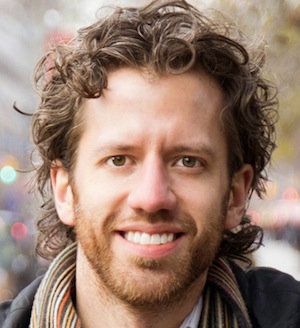
There are critics lined up on each side of the question, perhaps rushing to judgment before all the facts are known. Norman Lebrecht questions the TSO’s actions.

On one side you can read something supporting Lisitsa. The language of this post is as hyperbolic as a Soviet era diatribe.

It is no secret that nowadays many alternative media activists face appalling state-sponsored censorship in many nominally free and democratic Western countries. Now it seems that such censorship has penetrated much deeper than we have come to expect. Art itself, the truest form of free expression, is being silenced.

On the other side you can read an analysis that’s much more even-handed, simply quoting the pianist and some of her remarkable comments.

On August 28, 2014 Ms. Lisitsa Tweeted despicable racist commentary with photos of African villagers juxtaposed with Ukrainian schoolteachers. Her snide remarks scoffed at African stereotypes because they wear “tribal dress” as being inferior and unworthy of “Europe”.

I recall the old adage that there’s no such thing as bad publicity. This concert was already news, but the TSO have taken the extraordinary step of paying Lisitsa her fee even as they cancel her appearance. That she’s being replaced by someone who is a favourite son in Toronto mitigates the cancellation. I’m an even bigger fan of Goodyear, even if I am disappointed that we didn’t get to hear Lisitsa.

Jukka-Pekka Saraste

While I don’t know who to believe, it’s nothing new to have artists –especially the great ones–who are fools, monsters, jerks. Wagner was a notorious anti-Semite. I wrote about Lisitsa in context with Justin Bieber, never suspecting that maybe she too will need a celebrity roast to persuade us to feel sorry for her, and maybe to forgive her.

And overshadowed in the circus, does anyone remember that Jukka-Pekka Saraste is coming back to Toronto? I’m looking forward to hearing him conduct the Mahler 5 with the TSO.

Posted in Personal ruminations & essays | 4 Comments

Virtual virtuoso: Valentina Lisitsa to play Rachmaninoff with Toronto Symphony this week

I’ve been thinking about the way that concert performances idealize a work.  Even the most elaborate productions of opera require short-cuts, some sort of suspension of disbelief when fully staged.     The question about concert performances of opera is really a question of virtuality, as we saw in a recent piece in the NY Times by David Belcher.   I grew up listening to opera on vinyl, and later on CDs, only rarely encountering opera on video.  But even a DVD of a live performance is still a kind of virtual performance, because it’s not truly live.   We always watch from the perfect camera angle without the possibility of the head of that tall guy sitting in front of us momentarily blocking our view. And isn’t it funny that singers always manage to hit the high notes: possibly because they only videotape near-perfect performances. Working from an audio recording or a concert performance, our minds complete the visual picture building upon that ideal auditory world.

I have never seen Valentina Lisitsa perform.  Oh sure, I’ve seen her play the piano on youtube.  But is that the same as “seeing” her perform?

Maybe.

I first encountered her playing this Rachmaninoff piece.   The fluidity of her technique is evident in the way her arms move.  Come to think of it I don’t think I’ve ever seen anyone –male or female—play a complex piece with bare forearms (Glenn Gould?  Vladimir Horowitz? Perhaps Martha Argerich).  They’re hypnotic, and yes, very beautiful to watch.

You may have heard Valentina Lisitsa compared to Justin Bieber.

  • Not because she’s been arrested
  • Not because she’s been roasted by celebrities
  • Not because he (meaning the Stratford native) plays Rachmaninoff or Liszt

But there are some intriguing points of contact.

  • They’re both musicians who caught the public imagination via the self-publishing realm of youtube
  • They’re both attractive, indeed beauty is surely a factor in their success (as in the meditation upon her forearms)

What’s remarkable –come to think of it—is not her success, but rather the success of others.  Who authorizes a virtuoso, who decides what pianist or singer is worthy of excitement?  I suppose it happens when a Pavarotti’s high C is heard over and over, creating a buzz.  Youtube –for Bieber, for Lisitsa, and for the next phenom to come—shortens that process, allowing the talent to emerge much faster.

Here’s something of Lisitsa I heard just a couple of weeks ago, playing a ferociously difficult piece, a Busoni transcription of Bach.

Valentina Lisitsa will be in town to play Rachmaninoff’s 2nd Piano Concerto with the Toronto Symphony this week, April 8th  & 9th at Roy Thomson Hall in a program also including Mahler’s 5th Symphony.  Live and in person..!

Posted in Personal ruminations & essays | 2 Comments

What does this Requiem do? Ivany meets Mozart

The calendar reminds us of the relationship of our society and religion.  This week is one of those times of year when people may make their only annual visit to a church or synagogue, while those who are regular attendees or church musicians are expected (or required) to show up more than usual.

While religion is just a shadow of its formerly influential self (setting aside the states ruled by fundamentalists), it has left vestiges scattered through our lives, in the oaths we swear in court, the promises we make when we get married, and the ways we say goodbye to loved ones who have passed away.

Director Joel Ivany

Director Joel Ivany

Today, in the middle of Holy Week I was present for an experiment, a semi-staged version of Mozart’s Requiem directed by Joel Ivany, at Canadian Stage’s Rehearsal Room.  I feel lucky and privileged to have been present to see something Ivany called a workshop presentation of Mozart’s Requiem that he’ll be doing with the Toronto Symphony Orchestra next January.  Next year’s Requiem will employ an orchestra of sixty players or so, with a chorus of forty singers or so inside Roy Thomson Hall.  For the workshop, however, Ivany employed eight soloists –that is, the usual complement of four vocal soloists (soprano Ambur Braid, alto Rihab Chaieb, tenor Chris Enns and bass Aaron Durand), plus another four to sing the respective sections of the chorus (soprano Meher Pavri, alto Danielle MacMillan, tenor Joshua Wales and bass James Michael Baldwin) —with a single pianist (Jenna Douglas) all conducted by Robert Cooper.

Unlike your usual Requiem, where singers are formally attired, stiffly standing with scores in black folders, this was an exploration of something different, befitting Ivany’s description of a “workshop presentation”.  As with the Against the Grain Messiah presented in December 2013, the singers moved and inter-acted, having memorized their music.  While that occasion included a choreographic component as well, that might seem inappropriate here, considering the subject; I suppose I’m contrasting the celebratory aspect of Messiah with the fundamentally mournful character of a Requiem.

The question I posed in the headline is a fundamentally dramaturgical one.  Recognizing that performance is a process for performers and for the auditor, how does it work and what is the effect, or in other words “what does this Requiem do”?

The experiment can be understood in several contexts.

  • One can look at Mozart’s original and ask fundamentally what that work does, even before one decides on an approach. Does it mourn, does it celebrate, and how does one reconcile the prayerful with the performative aspect: the fact that soloists seem to be addressing God, at times in prayer even as the singing unavoidably shows off their abilities.  Does one choose to embrace the virtuoso element (an approach that is very much out of fashion for the past half century or so), or seek to subsume that element in a pure portrayal of the textual / prayer element (as this workshop indeed seemed to prefer to do)?
  • What does the Latin text supply, whether we come to it as existing before Mozart or if we attempt to bring it into our own much more secular time? How do we reconcile ourselves to the questions of mortality & mourning, and what part do they have in our lives? Will it be a specialized ritual set off from our normal life –and that’s what we get when we dress in black, and assume specialized language & posture—or somehow normalized?  How much mourning can we even handle?
  • What does it imply that the singers are dressed informally, in fact very much the way I was dressed having come from a normal Wednesday? At one time church was a place every bit as formal of dress as the concert hall, and still a place where I am uncomfortable attending without dressing nicely.  Is this a deconstruction –of Requiem and of the rituals of mourning—or simply a more normal way of embracing death and its emblems, without stiffness and possibly with more emotional authenticity?
  • The work is in several movements, segmented as per the text (eg the Offertory, Sanctus or Agnus Dei), yet there appear to be portrayals and interactions, emotions expressed that may or may not arise from the text. There were some very emotional moments for cast that seemed to continue straight through from one segment to the next, even though the music comes to a full stop, the text implying a new thought.  The movements & inter-actions appear to be motivated by the preparation that Ivany gave his cast, exploring the themes of a Requiem, of loss & mortality.

I found that with the Against the Grain Messiah my momentary resistance melted in the presence of a compelling musical performance, in the pleasure of a whole new way of seeing a familiar work.  Similar feelings & thoughts were with me this time, even though we were in the presence of something darker, and still wonderfully dynamic and unfinished.  There are clearly unexplored possibilities that Ivany likely will explore in future interpretations / incarnations.  I don’t pretend to understand it –what it’s doing, what it aims to do, what it means–but then again I’m a bit overpowered by the intensity of it, and I say that in the spirit of having my senses filled to overflowing.

The performance today in this little space with an audience of roughly sixty was very special, with possibilities for intimate communication that can’t happen in the bigger space with the larger forces, although the trade-off of the chamber approach is in sacrificing the possibilities for the wallop of big climaxes from a full orchestra & chorus.  I can’t help wondering how it will work with the TSO, a forty-member chorus, conducted by Bernard Labadie and in Roy Thomson Hall, which seats roughly 2,000.

That will be yet another experiment.

Posted in Music and musicology, Opera, Personal ruminations & essays | Tagged , , , | 2 Comments

Louise in Concert

Concert performances of opera can be a wonderful alternative considering the expense of fully staged productions. Works that would otherwise rarely see the light of day –such as Rossini’s William Tell (hard to sing) or Benjamin’s Written on Skin (recently  composed) —are more likely to be produced in this slightly reduced way. The format usually represents a trade-off, as some aspects of the ideal version are compromised. Without set, costumes or much in the way of spectacle, the focus shifts to the musical side of the equation. For those who are leery of directorial interventions it’s a good thing, allowing one to be certain that the singing will be foregrounded.

The Toronto company Opera In Concert have been offering rarities for over 40 years. Last year for example, they produced Rameau’s Hippolyte et Aricie, Verdi’s Stiffelio and Britten’s Gloriana. This afternoon I heard their production of Charpentier’s Louise.  Although the cast is one of the biggest ever seen in an Opera in Concert show, with roughly twenty different solo parts (there’s one reason it’s a rarity), at its core the plot is a kind of love triangle, between Louise’s overprotective father and her lover Julien. The scenes involving the four key characters (Father, Mother, Louise and Julien) were the most successful, but that’s not surprising. Concert performances may have an ambitious artist or two as their raison d‘être, whether in a singer trying out a role or perhaps even taking their first tentative steps with a new vocal type. With an opera such as Louise it’s an especially precious opportunity, given that

  • a singer learning a role usually hopes that the effort in preparing the role is rewarded with future chances to sing the role; that can’t happen if the role is a rarity such as Louise
  • because it’s a single performance chances are the singers can really give their all, because they don’t have to save themselves the way they do in a longer run
  • and of course, there’s the rarity (the opera) itself

Peter Tiefenbach made an excellent case for Charpentier’s score from his piano. Any Opera in Concert music-director is conflicted between his support of the singers & his need to make his own musical statement. Tiefenbach’s playing was beautiful throughout, keeping a good pace throughout in a reading that was very tight, especially in the crowd scenes.

Soprano Leslie Ann Bradley (photo: Lisa-Marie Mazzucco )

Soprano Leslie Ann Bradley (photo: Lisa-Marie Mazzucco )

Unlikely as it may be, I hope Leslie Ann Bradley gets a chance to play the part of Louise again. It’s a role that’s usually a vehicle for a star such as Renée Fleming, given that a production would be built around a diva who could fill seats.  Yet the way Fleming sings the big aria “depuis le jour” on her CD –not so different from the way Maria Callas sings it—suggests that this opera is ruined by being handed to stars, particularly considering that Louise is supposed to be young, her aria a celebration of the first days of a first love. When Fleming sings “je suis heureuse” it’s precious and phony, given that the moment calls for a sense of sensual abandon. Bradley? She sang the aria at a quicker pace than Fleming, reflecting both passion and youth. Her diction throughout –not just in the aria but at every moment—was crisp and clear. Her command of the role was so secure that one could simply get lost in her performance, the most accomplished singing I’ve heard at an Opera in Concert performance in a very long time.

Dion Mazerolle and Michèle Bogdanowicz were Louise’s Father and Mother. We watch the characters change over the course of the opera, the Father becoming more unhappy, objecting to his daughter’s new love, while the Mother in some respects seems to moderate, becoming the mediator between Father and daughter. Bogdanowicz sounded great, in a very understated reading, while Mazerolle showed off his wonderful top notes in his dramatic scenes after the interval. Julien was assumed by Keith Klassen, the third person announced in a role after two other tenors worked on it. It seems to be a very challenging role and seems to lie quite high, so I’m grateful to Klassen for giving us a demonstration of Charpentier’s writing; we couldn’t expect the same exquisite chemistry with Klassen as between the other three, considering how recently he undertook the role.

Opera in Concert return in November with Borodin’s Prince Igor.

Posted in Opera, Reviews | Tagged , , , , | 7 Comments

Slattery & La Nef bring “Dowland in Dublin” to Toronto

The concept was discovered almost by accident. At a Christmas Party a few years ago, members of La Nef attempted to play the music of John Dowland as though he were Irish. It turns out that there’s evidence that Dowland may have been an Irishman, and that the experiment could have been the authentic sound of the composer.

click for information about the CD

That’s the basis for the 2012 CD “Dowland in Dublin”, a series of songs.  Some are instrumentals, some are sung by Michael Slattery in collaboration with La Nef, arrangements by Seán Dagher, Sylvain Bergeron and Slattery. I was thrilled when I heard that the Toronto Consort were bringing “Dowland in Dublin” –meaning La Nef & Slattery in concert –to Toronto: tonight at the Trinity St Paul’s Centre.

The numbers alternate between instrumentals and vocals, between syncopated dance tunes and more introspective songs such as “His Golden Locks”, a meditation upon our mortality where Slatter accompanies himself on a shruti box (an Indian instrument that by a curious coincidence makes sounds resembling a bagpipe, and therefore seems apt).

The song (which you can see and hear Slattery perform in this video, but minus La Nef) concludes with these lines:

Beauty, strength, youth are flowers but fading seen;
Duty, faith, love are roots and ever green.

Lovely as the CD is, the live performance is a huge thrill, as we can see them improvise, and we recognize that the music will be a bit different when they offer this concert on Saturday night. Sylvain Bergeron’s lute playing is sometimes whisper soft, sometimes a bigger sound, but always seeming to emerge as fresh as the expressions on Bergeron’s face. Seán Dagher on the cittern underpins everything, both with the steady throb of his playing, or with the stomp of his feet, his strumming attack resembling the percussion section. Alex Kehler plays violin –in a characteristic early-music style minus the vibrato—often lending a wonderfully celtic sound to the melodies, as does Amanda Keesmaat from her cello. And Grégoire Jeay on flute or recorder had the ability to put a smile on every face in the hall, especially in the triptych of Kemp’s Jig /Mistress Winter’s Jump / My Lady Hunsdon’s Puffe.

I’ve never heard anyone make this music sound so fresh, so alive. At one moment –during “Say Love if Ever Thou Didst Find”—I swear I thought I was listening to Led Zeppelin, given that we were in exactly the same key (a minor) as “Stairway to Heaven” with similar sonorities in play, while Jeay played his recorder alongside Bergeron’s Lute.   That back and forth between A minor and D roughly 45 seconds in reminds me of Zeppelin.  Now that may sound odd to mention, but although we were in Toronto’s temple of early music –the home to both Tafelmusik & the Toronto Consort, complete with a welcome introduction at the beginning from David Fallis–the concert’s mood was altogether different.  We could have been in a pub given the absence of pretentiousness in the music-making.  Accomplished as the players were, this was a very relaxed affair.

The majority of the songs concern love. Slattery is in the moment throughout, La Nef seeming to invest each song with the impression of having invented their response on the spot, played perfectly but always seeming freshly conceived, with an electricity in the eye contact between each of them. The live performance is better than the CD, different every time.

We would have closed with “Now, O Now I Needs Must Part”—did Dowland ever use it to close his gigs I wonder?—were it not for their generous response to our applause, namely the encore “Come Again”. Slattery opens slow & soft in the first verse alone with his shruti box, joined by the ensemble for faster subsequent verses. It’s a microcosm of the concert, from the soft beginning to Bergeron’s concluding strum on his lute.

Slattery & La Nef are on to their next project which hopefully will bear fruit soon. In the meantime there’s another chance to hear “Dowland in Dublin” Saturday night here in Toronto.  I suppose i am a bit hesitant because i’ve written so much already about Slattery & La Nef, but i have to say that this was a wonderful concert, that the playing is hypnotic, beautiful, and the singing as lovely as anything i’ve ever heard.

Posted in Music and musicology, Reviews | Tagged , , | Leave a comment

Michael Slattery’s voices

I’ve been listening to Dowland in Dublin, Michael Slattery’s collaboration with La Nef, for a few years now.  I was lucky that someone brought it to my attention.  Since that time it’s been a regular feature on the CD player in my car.

While playing it for a friend the other day, there was a wonderful moment of recognition.

I had been trying to put my finger on the quality in Slattery’s voice, as he sings ”Come Again”.    

Come again! sweet love doth now invite
Thy graces that refrain
To do me due delight,
To see, to hear, to touch, to kiss, to die,
With thee again in sweetest sympathy.

The youtube clip–unlike the CD– is a live performance, please note. Slattery makes lovely sounds, using his voice in the usual ways throughout.

But Slattery sounds different on the CD Dowland in Dublin.  At first listen it might sound like a bad thing..!? It’s unconventional and daring.  I was observing that as Slattery sang the phrase “to die” he sounds totally vulnerable, reminding us of the two meanings of the word “die”: both mortality and consummation.  He sounds as though he is dying in every sense, abandoning himself to the note not like an opera singer but sounding for all the world, like a boy, like a vulnerable human, unmanned by his orgasmic passion.  It’s wonderfully expressive.

Vocal pedagogue Carol Baggott-Forte

In fact the sound –the one on the recording that is– is falsetto.  My friend pointed this out, invoking our mutual vocal authority, Carol Baggott-Forte.   When you’re learning with Carol she uses the techniques of Cornelius Reid, who wrote –among other books—The Free Voice.  There’s a falsetto sound you’re encouraged to make, isolating one of the two registers.  It’s not a sophisticated sound, oh no. In fact it’s a sound unlike that of professional singers, a very strange sound for a singer.  This is not the sound in the youtube clip –where he’s singing full voice, in a live performance—but on the CD, we get a different sound.   Slattery has the nerve to use this odd sound, a wonderfully brave & expressive approach at the perfect time.

Slattery is a very skilful performer, employing several different sounds, combining his registers cleverly.  I’m looking forward to hearing him live for the first time Friday at the first of two concerts by Slattery & La Nef with the Toronto Consort at Trinity St Paul’s Centre.

Posted in Music and musicology, Personal ruminations & essays | Tagged , , | Leave a comment

Escher & Farmer at National Gallery

Gallery attractions are sometimes from a permanent collection, sometimes brought in from elsewhere.  When you visit the National Gallery in Ottawa next month you’ll be able to see the Alex Colville show that was seen in Toronto at the AGO last year.

But currently the attractions I found most impressive at the National Gallery actually come from their permanent collection.  They own such a large number of pieces by MC Escher—the third largest collection of his work in the world—that they were able to assemble a big show from among those pieces. Escher is the draw right now, being a famous artist with a big sign on the outside of the gallery. As your typical baby-boomer, I believe I’ve been staring at Escher for most of my life. It’s a thrill to see so many images that I’d once owned as reproductions on my wall in the dim & distant past. His craftsmanship is impressive, his eye frighteningly astute.

One of the odd correlations that likely doesn’t mean anything was to walk into a room with the following:

  • A brief essay on the wall talking about the influence on Escher of a visit to the Alhambra Palace, where the Islamic tiles were organized in repeating geometric patterns. The word that came to mind was “arabesque” even if this wasn’t precisely what we saw.
  • But then we saw “Sky and Water I”, which indeed suggests arabesques.
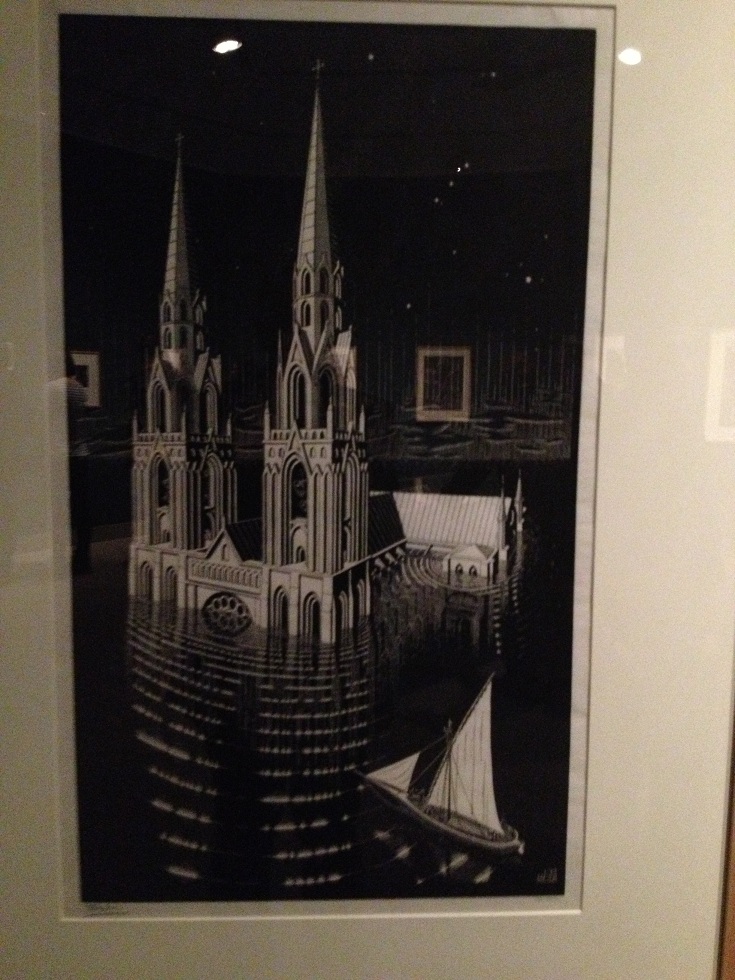
  • And then we come to a picture called “The Drowned Cathedral”.  If you look closely you see that the bells in the cathedral are moving.
M.C. Escher: The Drowned Cathedral, January 1929 woodcut on laid japan paper, 79.2 x 48.3 cm;  image: 72 x 41.6 cm Gift of George Escher, Mahone Bay, Nova Scotia, 1985 National Gallery of Canada, Ottawa M.C. Escher’s “The Drowned Cathedral” © 2014 The M.C. Escher Company-The Netherlands. All rights reserved. www.mcescher.com

M.C. Escher: The Drowned Cathedral, January 1929
woodcut on laid japan paper, 79.2 x 48.3 cm;
image: 72 x 41.6 cm
Gift of George Escher, Mahone Bay, Nova Scotia, 1985
National Gallery of Canada, Ottawa
M.C. Escher’s “The Drowned Cathedral”
© 2014 The M.C. Escher Company-The Netherlands. All rights reserved. http://www.mcescher.com

I might be the only person making this correlation: that Claude Debussy not only wrote a pair of pieces titled “Arabesque” (#1 and #2 that is), but spoke of the arabesque patterns in musical scores of others (for instance JS Bach). And of course he would then write a piece of music called “The Drowned Cathedral”, aka “Le Cathedral Engloutie”.  Presumably Escher and Debussy were familiar with the same legend.

Maybe it’s just a fluke, a coincidence of no real significance. But there are books written about Debussy and design. Roy Howat’s Debussy in Proportion presents the hypothesis that Debussy’s music is organized on the page according to strict principles of proportionality: not unlike what Escher did.

The page of the score is beautiful, no? Compositions can look good on the page, but perhaps none more so than Debussy’s.

I have no revelations to add, only that it is interesting to see that coincidence, between the arabesque perfection of Escher & Debussy, AND that they both created works celebrating the legend of the drowned cathedral.  Debussy was a symbolist, and maybe Escher too responded to symbolist influences, considering the philosophical implications of his works (a whole other matter worthy of detailed investigation). Escher being the later artist (Debussy dying in 1917, Escher in 1972) maybe it’s as simple as a matter of influence. Perhaps the artist was influenced by the composer..?  But more likely, they were a pair of artists influenced by a cultural current.

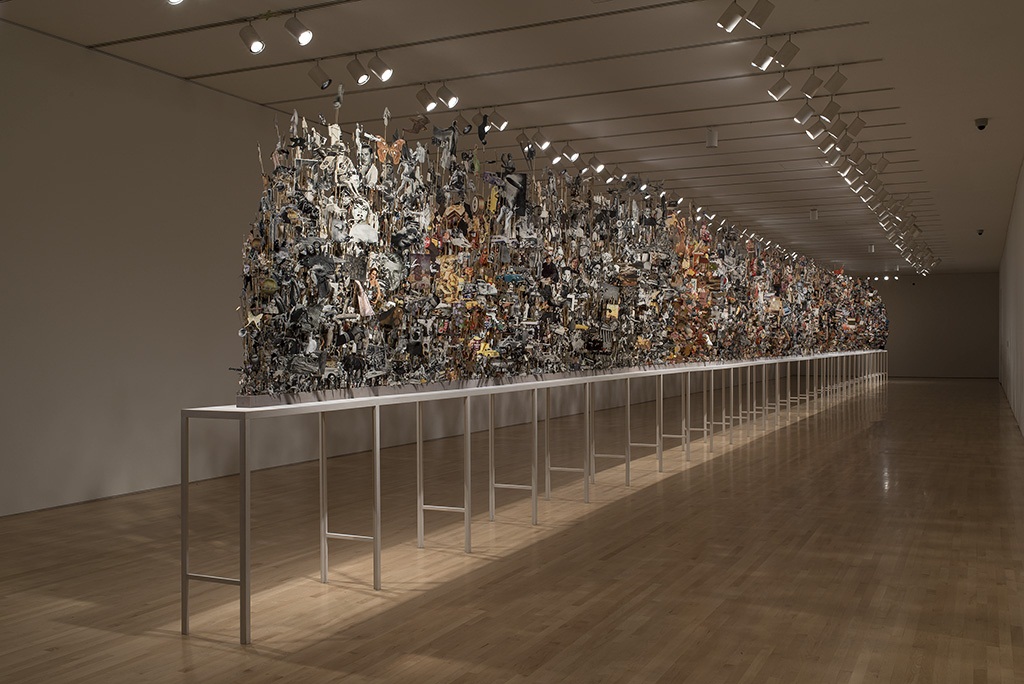
Famous as Escher may be, I was surprised to find something unexpected and powerful lurking around a corner in the gallery. You walk into the room where Geoffrey Farmer’s 2012 work “Leaves of Grass” is assembled, and you will be amazed. I was reminded of the first couple of times I saw that sequence in Gone With the Wind when Scarlett goes looking for the doctor at the Atlanta train station, and the camera pulls out upon an immense scene of casualties lying, waiting for someone.
No I don’t mean that Farmer’s piece is tragic or sad. But –as in the film—you don’t immediately understand the scale of what you’re looking at. Hugeness is sometimes incomprehensible.

As it began to dawn on me that I was looking at something immense, I struggled to quantify it. We’re looking at a two sided installation of many photos mounted on bamboo. The notes on the wall say over 16,000 photos from over 900 magazines. I quickly paced a small part of the floor –as the piece sits on a table that’s in regular segments—and concluded that the piece sits on a table that has 31 segments, each roughly four feet in length. So in other words we’re in the presence of a piece of art that’s 120 feet long, on two sides of this large assembly. The picture included can only suggest some of that process, where we are confronted with so many images and such a sense of immensity.  The best way to really grasp this –including the disorienting struggle that likely begins your orientation to the work– is to experience it in person.  More than any art work I’ve seen recently it requires the human experience of the piece, as this cumulative effect can’t be understood in any virtual reproduction such as a book.

Geoffrey Farmer: Leaves of Grass, 2012 installation view, 2014-2015 at the National Gallery of Canada Courtesy of the artist, Catriona Jeffries Gallery, Vancouver and Casey Kaplan, New York Photo © NGC

Geoffrey Farmer: Leaves of Grass, 2012
installation view, 2014-2015 at the National Gallery of Canada
Courtesy of the artist, Catriona Jeffries Gallery,
Vancouver and Casey Kaplan, New York
Photo © NGC

You walk along this two-sided wall, picking out images that are recognizable alongside those that are not. We’re told it’s an assembly of the period between 1935 and 1985 in chronological order. At the bottom, the images are smaller, while at the top, they’re bigger. We’re looking at people and objects. There are a great many cameras on display, typewriters, cars, and other products, presumably from the ads in the magazine. We see the iconic people of that time –movie-stars and singers and politicians—and the products sold to pay for the magazines. There’s so much there, that one can’t possibly grasp it all in one visit. It’s epic, truly massive in the same way as that scene in Gone With the Wind, but much more ambiguous and variegated.

Purchased by the gallery, “Leaves of Grass” is part of the permanent collection and hopefully will stay on display. I will revisit the piece next time I am there.  I urge you to check it out too.

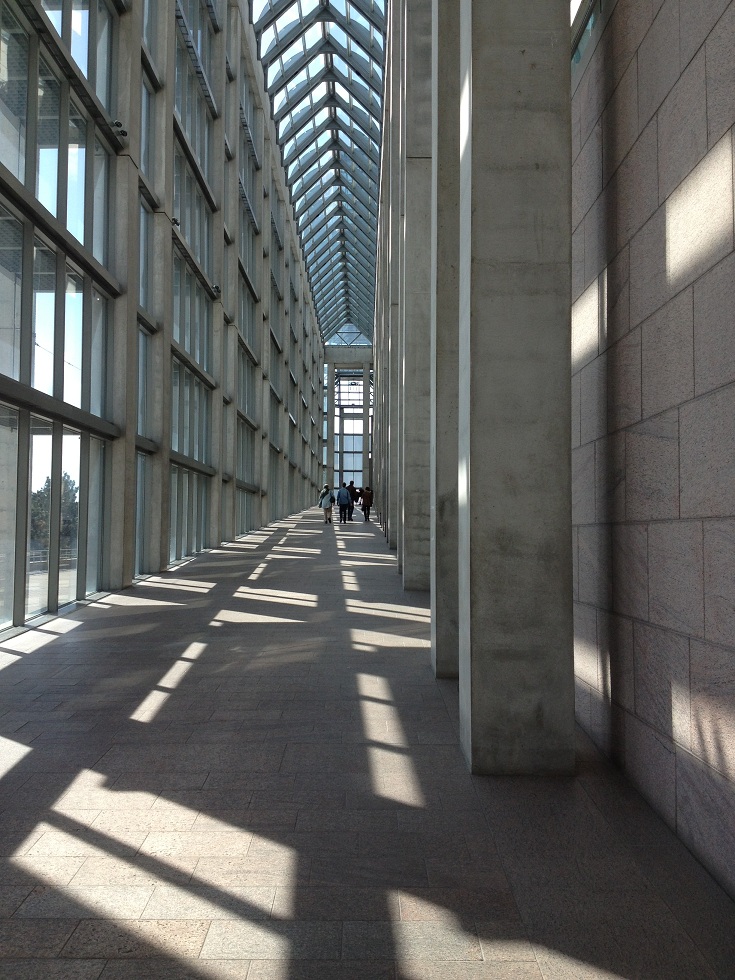
And in passing, i couldn’t help noticing how much the National Gallery’s architecture is itself like a reminder of Escher–almost a meditation upon geometric design– making the building a wonderfully suggestive home for his work.

The National Gallery designed by Moshe Safdie

The National Gallery designed by Moshe Safdie

Posted in Art, Architecture & Design, Music and musicology | Leave a comment