“A Mind of Winter” is the name of a composition as well as the title for tonight’s Toronto Symphony concert in their New Creations Festival, curated by composer George Benjamin and featuring the residency of singer & conductor Barbara Hannigan.
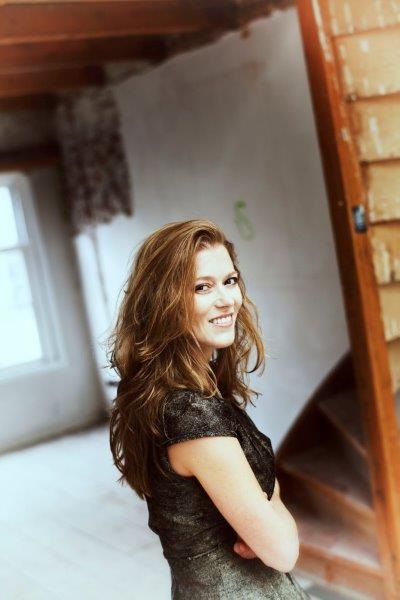
Barbara Hannigan (photo: Elmer de Haas)
The winter-themed composition that gave the name to our evening was Benjamin’s youthful setting of a Wallace Stevens poem sung by Hannigan. This one begins in the most remarkable way, its string harmonics & high winds making me shiver. It was a curious perception to notice that “high” or “low”, like cold or hot are relative concepts, that sometimes a soprano can sound high, and sometimes sound low alongside those shimmering sounds. As in the concert co-presented by the TSO & COC earlier this week, Hannigan held back, letting her voice emerge from the midst of the orchestral sound, almost as though she were merely another instrument. It seemed to end too soon, but I suppose that’s a sign of a good composition: that you don’t want it to end.
I wonder, does one contemplate winter differently from in the middle of it –as we currently are—or from a distance? Vivian Fung’s second Violin Concerto “Of Snow and Ice” conceived by an expat Canadian living in California received its world premiere tonight. I suspect I’d welcome a chance to be plunged into virtual cold at the height of a heat wave, whereas the desolation of this endless winter might leave me less patient than I might otherwise be. While I was impressed by the playing of TSO concertmaster Jonathan Crow in the concerto, I don’t think I really understood Fung’s composition, a forbidding portrait that had my companion saying “it’s just like winter: because it’s too long”.
Two other pieces on the program with no connection to winter opened & closed the program, respectively Dai Fujikura’s Tocar y Luchar, and Henri Dutilleux’s Métaboles. Benjamin led a sensitive reading of Fujikura’s piece to open the evening, while TSO music director Peter Oundjian and the TSO were especially inspired in Métaboles. As with temperature or pitch, newness too is relative. While the Dutilleux may have been edgy and new at one time, the TSO played with a conviction to suggest that we were hearing a modern classic. When music is played infrequently, certainty can be elusive: but not this time.
Oundjian can be pleased at the crowd—enthiuastic recipients of the TSO’s offerings—who assembled to hear contemporary music on a February night. New Creations is prospering, with more to come next week (click logo for more info).
It’s a cute phrase I heard in a Tom Robbins novel, as someone speaks in passing of “the meaning of meaning”. I love it because it simultaneously references our understanding (and what it means to mean) and yet sounds like nonsense (repeat any word enough times and it becomes pure sound, while becoming less meaningful).
David Lang, composer & librettist of The Whisper Opera (photo: Peter Serling)
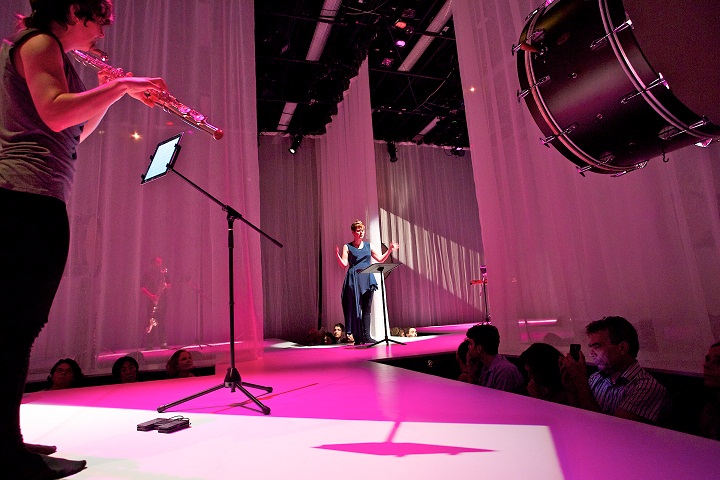
David Lang’s The Whisper Opera, presented by Soundstreams at the Theatre Centre struck me as a new flavour of minimalism. I invoke that word not because we were hearing anything I’ve previously understood as minimalism such as pattern music. Lang is both the composer & librettist. His text takes fragmentary passages, suggestive phrases sometimes barely heard, and tosses them around, sometimes repeating them obsessively, sometimes going from one thing to another.
If we accept the axiom that meaning is created in the mind of the observer –beauty in the eye of the beholder, right?—then it’s a fascinating game to offer enticing little bits for the observer to assemble. The observer can’t help making sense from the incomplete fragments, particularly because they’re presented meaningfully, presented with conviction. We attribute sense and even weight to these phrases, having no full context except the immanent moment of performance.
Lang’s subtext almost sounds like a manifesto. He stipulates that the performance must never be recorded or videotaped, a small rebellion against our usual practices. It’s therefore designed to be intimate, so that only a very few people can hear it at a time. That’s one reason it’s the whisper opera. We’re therefore in a rare social situation. As you look at the stage, you see a few heads popping up through the risers in which our seats are embedded, foregrounding our selves in the most curious way. I was reminded of a horrific yet comical image from David Hockney’s marvellous designs for The Rake’s Progress, where the heads poke up through the floor, in this scene from Bedlam.
David Hockney’s design for the scene in bedlam from Stravinsky’s Rake’s Progress
Our heads —in the audience—become a creepy / comical part of the backdrop of the performance. The design is by Jim Findlay, a wonderful representation of the world Lang is presenting to us in The Whisper Opera. See what i mean? the heads are part of the show.
Lang wonders about authentic connections between people, problematizing it for us in this presentation where the real heads of this tiny audience are juxtaposed against the dada realm of text swirling quietly around our ears. We are in the bedlam of the virtual world, making sense out of nonsense.
click for more information about Soundstreams’ presentation of The Whisper Opera
The music is quite lovely at times, never boring, often arresting. Yet it’s a very visual kind of concert, the performers above us on their risers, while our heads poke this way and that trying to see everything. It’s a bit of an installation really, because one can’t see everyone easily, and some of us –like this writer—are partially disabled and therefore unable to turn their heads very far. It’s a mixed blessing, as it brought my focus on everything in front of me, especially my fellow audience members, when the performers had wandered to another part of the performance space. The work is presented by soprano Tony Arnold and The International Contemporary Ensemble (ICE).
The Whisper Opera, a splendid metaphor for our world, continues at The Theatre Centre until March 1st.
Conductor Leslie Dala aka Les Dala is especially well-known out west, having conducted at the Vancouver Opera, Pacific Opera Victoria and Vancouver Bach Choir, at Banff Centre and UBC Opera Ensemble. In October 2014 he conducted Vancouver Opera’s world premiere production of Stickboy by Neil Weisensel and Shane Koyczan, and just this month he stepped in to lead a production of The Magic Flute at Edmonton Opera.
An avid performer of contemporary music, Dala has recorded three dramatic works by Canadian composer Harry Somers, including Death of Enkidu starring tenor David Pomeroy for Centrediscs, and worked with all of the leading contemporary music ensembles in Vancouver, including the Hard Rubber Orchestra, Standing Wave and the Turning Point Ensemble. While Music Director of the Prince George Symphony he led several premieres of newly-commissioned works. Dala comes to Toronto next year to lead the Canadian premiere of Philippe Boesmans’ 2012 opera Julie in a co-production by Soundstreams & Canadian Stage. But he’s already here at the University of Toronto’s Opera Department, leading Dominick Argento’s 1971 opera Postcard from Morocco in a production running March 12-15th at the Edward Johnson Building.
On the occasion of his return to U of T, I ask Dala ten questions: five about himself and five more about conducting Postcard from Morocco.
1-Are you more like your father or your mother?
I think I am a real cross between the two. Physically I resemble my father in a way that is almost scary and I think I share a lot of his personality traits. When it comes to the whole artistic side of things, that is really from my mom. She was a very talented and ambitious young musician growing up in Budapest in the 1940’s who studied piano, organ, violin and singing and dreamed of having a career in music. Then came the revolution in 1956 and life changed quite drastically…
She passed on her love of music to myself and my three siblings (my brother, Peter is also a conductor) and she sang in the church choir for years. Sadly she now has dementia and is in a care facility but she still responds to classical music.
2-What is the best thing or worst thing about being a conductor?
Conductor Leslie Dala
It is both an exhilarating and humbling feeling to stand in front of a group of instrumentalists and/or singers and to be able to initiate and shape the music that they play/sing. At the best of times, it is like being part of something bigger than life especially if the repertoire is something like Beethoven #9 or Shostakovich #5.
Regardless of the size of ensemble, I am true believer that all music making should be like chamber music and it requires everyone involved to be fully committed and to feel that their individual voices are essential to the whole experience. At the worst of times, it can feel like you are a lone voice in the wilderness trying to create order out of chaos.
3-Who do you like to listen to or watch?
My tastes in music are quite wide ranging. I love listening to everything from John Adams to Frank Zappa! I go through phases where I tend to listen to one composer for a while, usually to balance out whatever rep I am working on. The past month has been really interesting as I have been working on the Magic Flute, Shostakovich #5, Elijah and Postcard from Morocco with rehearsals and performances overlapping so at times like that Bach instrumental music and David Bowie provide nice relief!
As far as watching, I rarely sit in front of the TV but I do like to watch sporting events whether it be a hockey game, football, baseball or tennis just for the something different. I think YouTube is one of the greatest things ever and I enjoy watching performances of classical music. It is such an incredible resource and learning experience!
4-What ability or skill do you wish you had, that you don’t have?
I wish I was more of an athlete. I have tremendous respect for people who push themselves to the brink of their physical abilities.
5-When you’re just relaxing and not working what is your favourite thing to do?
I love to go for walks, especially by the seawall in Vancouver where I live or read or just sit and enjoy a nice cold beer or a glass of wine.
*******
Five more about conducting Postcard from Morocco in March for University of Toronto’s Opera Department.
1-You lead professional opera productions and student ones (for instance at UBC). Please talk about the difference(s) between leading a professional production of an opera and one at a university opera department.
On the one hand, the process is the same and ideally the expectations are the same: namely, to collaborate with everyone to put together the best possible show we are capable of. The primary difference between the professional world and the student world is not the level of talent but the level of experience. We live in a time where there are so many excellent young singers receiving very fine training who are determined to succeed in this very challenging profession. This is my second opera at U of T and I find the singers to be at a very high level and they are extremely well prepared and very willing to work hard. When people have the right attitude and are willing to work hard, there is nothing they cannot accomplish!
2-Please introduce Dominick Argento’s Postcard from Morocco to a first-time listener of this 20th century work.
This is a piece I only knew by title before I started learning it. I have been marvelling at what a finely constructed score this is and so colourful. Some of it may strike the listener as being strange or modern but most of it is, I think very approachable. Argento writes extremely well for the voice and for the small instrumental ensemble and there are many hauntingly beautiful musical moments. The story on the other hand is quite bizarre and I am still not really sure what is going on! The story is set in 1914 in a train station in Zurich with the seven characters all sharing or guarding the contents of their suitcases. Some of the episodes are quite surreal!
Michael Cavanagh
I am so grateful that we have the amazing Michael Cavanagh directing this show. He is so wonderful at deconstructing what is going on and giving the singers very clear directions on how to tell the story. I would suspect that there will be many people who will come to the show and leave scratching their heads wondering what they just saw and heard but I think it will stay with them in a good way.
3- what’s your favourite moment in the opera?
It is difficult to pick just one, but I am awfully fond of the aria that the soprano sings in the latter part of the show with the text : “I keep my beloved in a box…this box…my lover is in here at this moment..” the music is very slow and still and it makes me think of the music of Olivier Messiaen, one of my favourite composers. There is also an amazing instrumental interlude called “Souvenirs de Bayreuth” which is basically a foxtrot based on themes from Wagner’s works. Some of the themes are obvious and some are hidden but Argento skilfully weaves them together in a most virtuosic manner. I am still not sure what will be going on dramatically at this point as it has not been staged yet but I am sure it will be something quite delicious.
4-How does it feel as an alumnus to come back to conduct an opera at the MacMillan Theatre?
It is very enjoyable to work in a place that I have so many fond memories of as a student. When I was at UofT, I was a piano performance major studying with William Aide and although I had a lot of singer friends, I literally had no involvement with the opera program. I was the accompanist for the Chamber Choir led by Doreen Rao for three years which I really enjoyed doing as my early education was at St. Michael’s Choir School so singing has always been very close to my heart. I still feel very much a student so it is just nice to know that I can hopefully offer something to people who are just starting out and try to encourage and guide them as best as I can over a short period of time.
5-Is there a teacher or influence who you recall that’s especially important to your development, that you’d care to mention?
Lorand Fenyves
I have been so fortunate to study with many amazing musicians like William Aide, Marek Jablonski, Lee Kum Sing and Lorand Fenyves for chamber music. When I was a teenager I studied the violin with a remarkable Hungarian lady named Elizabeth Tomosvary. She emigrated to Canada in her sixties and taught virtually up until her death at the age of 99! She had a tremendous passion for music and she was always curious to learn more and had incredible patience teaching young beginners. She was a subscriber to the TSO and she would go to so many concerts and she would always share what she had learned from the experience, whether it was the fingering or bowing someone had used or whether it was the stage presence of a particular performer. I thought to myself then that I would like to be like her and love my craft and always want to learn more.
*******
Postcard from Morocco
MacMillan Theatre, Edward Johnson Building
80 Queen’s Park
March 12 to 14, 2015, 7.30pm
March 15, 2015, 2.30pm
–
For more information on our season, please email info@uoftopera.ca or
call the Faculty of Music at 416.978.3740.
The title of the movement is “Entrückung”, the text by Stefan George, the score to the String Quartet by Arnold Schoenberg, the concert part of the New Creations Festival curated by George Benjamin, a late-afternoon incarnation of the Canadian Opera Company’s free noon-hour concert series. Benjamin was not just programming but maybe also illuminating Barbara Hannigan, the soloist in the last two movements of that quartet and his star in Written on Skin.
Maybe “collaborator” is a more politically correct word than “star”, but I can’t avoid that four letter word. Hannigan is very humble, speaking of herself as a singer and a conductor. A word that’s conspicuous for its omission is “actor” (or actress if you want to use an older less PC construction), considering Hannigan’s gifts, as in her Lulu that’s still available online.
Barbara Hannigan (photo: Elmer de Haas)
At one point the rapture (or “Entrückung”) of the song is expressed in terms that seem to epitomize Hannigan and her artistry.
Ich löse mich in tönen, kreisend, webend,
Ungründigen danks und unbenamten lobes
Dem grossen atem wunschlos mich ergebend.
[or in other words]
I am dissolved in swirling sound, weaving
fathomless thanks with unnamed praise
yielding wishless to the mighty breath.
It echoes Schopenhauer’s view of the divinity of art, and Wagner’s Liebestod and the world-breath with which one finds ultimate unity. Watching Hannigan emerge from the midst of the Toronto Symphony’s Chamber Soloists (Jonathan Crow, Peter Seminovs, Teng Li and Joseph Johnson), beginning to sing only in the third movement, it’s as though she verbalizes and articulates what’s latent in the music. The movement’s conclusion is a hymn to art.
In einem meer kristalinen glanzes schwimme –
ich bin ein funke nur vom keilgen feuer
Ich bin ein dröhnen nur der heiligen stimme.
[or in other words]
In a sea of crystal splendour—
I am only a spark of the holy fire,
I am only a roar of the holy voice.
We were genuinely in a realm of chamber music rather than the operatic spaces where I’ve usually encountered Hannigan’s work. With a few exceptions, she sang more like a lieder singer than an opera singer, rarely pushing beyond a gentle mezzo-piano that sailed comfortably through the string sounds arrayed around her. There were a few wonderfully climactic phrases, presented with such authenticity that one felt the entire work pointed organically to that climax. And although Crow has a sound apt for a concertmaster with a strong & supple line when he wants to assert himself, he too mostly opted for subtlety and self-effacement. It’s a quartet that begins conventionally enough, the vocalism saved for the last two movements.
Chausson’s Chanson Perpétuelle followed, the TSO quartet and Hannigan augmented by the addition of Liz Upchurch at the piano. This piece from the 1890s is the oldest composition I’ve ever heard from Hannigan: an artist with whom I associate edgy performance & challenging composition. This too was an occasion for understatement, Chausson being a composer who gives the singer the eloquence of a poet rather than the extroverted mannerisms of a virtuoso.
In case you’re wondering, yes Hannigan can play it that way too. But she chose to honour the text and the occasion.
Barbara Hannigan is one of Canada’s most remarkable exports, a brilliant singer, conductor and actor of rare conviction. While I haven’t heard her use the word “actor” to describe herself, how can I omit it, when I struggle to describe her 2012 Lulu portrayal from La Monnaie? the single most impressive operatic portrayal I have ever seen. When I went back to look at the review that I wrote, I discover to my great joy that the link is still there! I’ll include it here, recognizing that if there’s too much traffic maybe it may suddenly be closed (if you want to see something bold, edgy, and especially if you want to see an amazing performance, don’t hesitate to click). If you’ve ever sung anything difficult (let alone Berg) you’d recognize how much harder it is to sing and also tumble or roll around a stage: as Hannigan does, sometimes while playing (impersonating? incarnating?) a ballerina.
Or if you’d like to see something more recent, here’s a brief performance of Ligeti (another difficult composer. Remember Kubrick’s 2001: A Space Odyssey? Yes, that Ligeti), performed in January and uploaded this past week.
Although Hannigan’s career has taken her out of Canada –to enormous success in Europe and abroad—we’re fortunate that the Toronto Symphony are bringing her back for a kind of residency during their New Creations Festival:
February 28th program includes A Mind of Winter , George Benjamin’s evocative setting for soprano of the poem “The Snowman” by Wallace Stevens
March 4th program includes Danish composer Hans Abrahamsen’s song cycle let me tell you treating the words of Ophelia in Shakespeare’s Hamlet in striking ways
Mar 7th composer George Benjamin conducts a concert performance of his 2012 opera Written on Skin
On the occasion of Hannigan’s TSO residency I ask her ten questions: five about herself and five more about her work in the New Creations Festival.
1-Are you more like your father or your mother?
Actually, I’d say I am a combination of both. My father is very organized and can never sit down. He is always working at something! My mother is a very creative person and thinks outside the box. We lived in the country and spent a lot of time in the car on the way to music lessons. It must have been very difficult for my mother, with 4 kids, to manage us all, with our various activities, but we were most certainly supported in our musical endeavours, and 3 of the 4 of us have degrees in music.
soprano & conductor Barbara Hannigan (photo: Elmer de Haas)
2-What is the best thing or worst thing about being a specialist in “new” music, creating original work?
I spend a great deal of my time and energy singing music of the 20th and 21st century. It can be incredibly rewarding when a composer writes a piece with my voice and personality in mind which, though different from all other pieces which may have been written for me, seems to fit me like a glove. I can say this of both pieces I’ll sing with the TSO – Hans Abrahamsen’s let me tell you and George Benjamin’s Written on Skin. Each brings out an aspect of my voice and psyche which I would not have discovered on my own. The worst thing? I can’t say there is a worst thing. I love to work hard and I enjoy the struggle of “breaking” through a difficult piece and finding the key. For me, there must be an emotional entrance to the music – the intellectual aspect of a score is merely architecture. I always am looking for the heart. If I can’t find it, I’m in trouble, because then the connection of breath to sound doesn’t go through the soul – I don’t have the need to sing…and then I am unhappy and feel out of sorts.
3-Who do you like to listen to or watch?
I don’t listen often to recordings. I prefer to attend concerts live, because the electricity of the performers giving their all in the public arena is very moving to me. I enjoy all kinds of music, but the dimensions of the orchestra are most attractive to me, because I am touched by so many people working together, concentrating and listening, and breathing together at one time. I also listen a lot to radio – CBC Radio 1 or BBC Radio 4. My favorite programme is the BBC’s Desert Island Discs, which is an interview where the guest chooses 8 recordings they would bring to a desert island. I always love to hear why. I enjoy beautiful and vulnerable vocal performances – Jeff Buckley, Fatoumata Diawara, Alim Quasimov. I admire good timing and rhythm…percussionists of all styles, but also performers like Danny Kaye and Jackie Chan.
4-What ability or skill do you wish you had, that you don’t have?
I wish I was able to just “chill out”. This does not seem to be a part of my nature…
5-When you’re just relaxing and not working what is your favourite thing to do?
See above. Relaxing would be something I’d need to study….
*******
Five more concerning the Toronto Symphony’s New Creations Festival
1-What are the challenges in The Snowman, let me tell you and Written on Skin (and I hope I didn’t miss anything) you’re performing.
The first piece is actually called “A Mind of Winter” (the poem it is based on is called the Snowman, I think).
My goal is to witness the music – to be present in every note and word and phrase – not only my own but those of my colleagues onstage. I find this by deeply listening and by trying not to expect a certain sound but to let it come to me as fresh as the first time I heard it. I love rehearsing, as I said earlier, it moves me to be a part of the large group of musicians who are all working on the same goal. In performance, the emotions are heightened, and time and space feel different. There are many more distractions, and it takes strong focus to stay right where I need to be. I use various methods for this – some drawn from sports psychology – to bring my focus into a very small place and expand it when necessary. The act of performing requires one to be very open, and I am careful to look after myself as best I can in the days and hours leading up to a performance so that my voice, mind and heart can be at their best.
2-As far as your personal politics vis a vis works such as Written on Skin or let me tell you, can modern music lead to a different way of seeing tragedy and violence in theatre & story-telling?
Barbara Hannigan (photo: Elmer de Haas)
Of course. But I would say, all art, all music. Again, to the idea of witnessing, I become the characters in both pieces but I, along with the orchestra and the audience, am also witnessing their experience at the moment of performance. I see it as a kind of ritual. I feel this is all music I perform, but some roles, like Lulu, have become very powerful leaders in this way of thinking. I was Lulu, she was also me, we were both Berg, and she was also a kind of mirror for the other characters of the piece. And then, ultimately, a mirror for society. I take characters who may have traumatic experiences, and I give them voice, strength, a fresh perspective. I incorporate them. I seem to have been dealing a lot with famous women: Ophelia, Eurydice, Lulu – they appear through different composers in different ways. And they influence one another. Lulu most of all, has permeated every other character I sing. Or at least, she tries!
3-Please talk about reconciling the different parts of your life, as a singer & conductor, a performer often in the forefront of commissions of new work.
I don’t feel the need to reconcile anything. It is just what it is. I am a musician, and whether I am leading an orchestra, singing a phrase, commissioning new works – I am always the same musician. Like a tree with branches reaching in different directions, I suppose.
I have a very busy schedule, this is part of my nature and has been so since childhood.
Sometimes it is too much and I realize I’ve spread myself too thin, but most of the time it feels just right. I have some wonderful opera productions coming up – my first Pelleas et Melisande, a new Lulu production, revisiting Written on Skin in New York and London, La Voix Humaine in Paris. But also new creations, including Ophelia (Brett Dean), Alice in Wonderland (Gerald Barry), and Eurydice (Salvatore Sciarrino) in the coming time. I also remain loyal to my repertoire, programming pieces like let me tell you and Dutilleux’ Correspondances as much as possible, also bringing works by other composers including Vivier and Grisey to a wider audience. The conducting is a path I will continue to explore, and I try to invest as much as I can in it, while keeping my singing in shape. Eventually, I expect I will only conduct, but that won’t be for quite a while…for now, I make special programmes, and concert by concert, add one or two new pieces. I love my job, whatever it is!
4-Please put your feelings about new opera and new music into context for us.
I have always been passionate about new music. I decided very early on that this would be my path, and though perhaps the venues have gotten bigger, my goals remain the same: to perform the music I love, to the best of my ability. I do not feel allegiance to one particular branch of modern music, or of any style of music, in fact. But I connect to some composers more than others, and I think the reason is how I feel their connection to their own true voice. Whether it is Boulez or Dutilleux, Ligeti or Benjamin, Abrahamsen or Vivier…I could go on and on…these individuals have an emotional/intellectual core which touches me and makes me want to sing. I do not prefer opera over concert performances: both contain a dramatic element for me, although somehow the concert stage is more direct and also more vulnerable, because it lacks the lights, makeup, and sets which can create a space between performers and audience. Opera feels (most of the time) easier for me, because there is so much more rehearsal time. For an opera production we usually have 5-7 weeks of rehearsal. For a concert – 3 or 4 days at most!
5-Is there a teacher or an influence you’d care to name that you especially admire?
Conductor and pianist Reinbert de Leeuw
The conductor, pianist and composer Reinbert de Leeuw has been a great mentor for me, ever since we started working together in the late 1990s, and I still go to him when I feel I may be losing my “core focus” – when things may get too hectic and I forget what is most important. I’ll call him (in Amsterdam) and if possible, drop by his house, and we’ll talk, about nothing in particular…could be a violin bowing in a Messiaen piece, could be a problem I’m having with a Mozart role I’m singing, or he will share his latest discoveries in an old or new piece of music. But the way he speaks of music, the intensity and the dedication and the respect, and his feeling for space and time…all those things bring me back to where I need to be. And so I leave his perpetually smoky house feeling like I’ve filled my artistic lungs with the purest oxygen.
******
Barbara Hannigan is coming to Toronto for the New Creations Festival. For further information visit the TSO’s website.
Due to unforeseen circumstances, Iestyn Davies will be unable to appear as scheduled. Fortunately, countertenor Bernhard Landauer, who is just concluding a run of Written on Skin with the Royal Swedish Opera in Stockholm, will be able to join the cast in Toronto.
A Mind of Winter
Sat, February 28 at 8:00pm – Masterworks Series
The opening concert of the New Creations Festival showcases intriguing music by some of today’s most engaging composers: George Benjamin’s evocative setting for soprano of the poem The Snowman by Wallace Stevens; a new Violin Concerto by Vivian Fung that the TSO commissioned for Concertmaster Jonathan Crow; and a dynamic work by Japanese composer Dai Fujikura that was inspired by the celebrated music education-programme, El Sistema.
Dai Fujikura: Tocar y Luchar (Canadian Première)
George Benjamin: A Mind of Winter (Canadian Première)
Vivian Fung: Violin Concerto No. 2 “Of Snow and Ice” (World Première/TSO Commission)
Dutilleux: Métaboles
Peter Oundjian, conductor and host
George Benjamin, conductor
Barbara Hannigan, soprano
Jonathan Crow, violin
Pre-concert Performance in the Lobby at 7:15pm
Intermission Chat in the Lobby
Post-concert Party in the Lobby
TICKETS: $33—$145
let me tell you
Wed, March 4 at 8:00pm – Masterworks Series
The second concert of the New Creations Festival features the fascinating equal partnership of piano and orchestra in George Benjamin’s Duet, and Danish composer Hans Abrahamsen’s song cycle that treats the words of Ophelia in Shakespeare’s Hamlet in striking, novel ways.
Chris Paul Harman: Lieder und Arien (World Première/TSO Commission)
George Benjamin: Duet for Piano and Orchestra (Canadian Première)
Hans Abrahamsen: let me tell you (North American Première)
Peter Oundjian, conductor and host
George Benjamin, conductor
Barbara Hannigan, soprano
Ryan MacEvoy McCullough, piano
Pre-concert Performance in the Lobby at 7:15pm
Intermission Chat in the Lobby
Post-concert Party in the Lobby
TICKETS: $33—$145
Written on Skin
Sat, March 7 at 7:30pm – Casual Series
The New Creations Festival concludes with George Benjamin’s widely lauded 2012 opera. It tells a compelling story of lust and murder set in Medieval France. This authoritative performance is conducted by the composer and features members of the première cast.
George Benjamin: Written on Skin (opera-in-concert in English with SURTITLES™)
(Canadian Première)
George Benjamin, conductor
Barbara Hannigan, soprano
Krisztina Szabó, mezzo-soprano
Bernhard Landauer, countertenor
Isaiah Bell, tenor
Christopher Purves, baritone
Pre-concert Performance in the Lobby at 6:45pm
Post-concert On-stage Chat with the composer and cast
Post-concert Party in the Lobby
Ah such a long title. I’m already being Wagnerian.
He’s everywhere whether you know it or not, Wagner not precisely über alles, but still ubiquitous. We talked about him inevitably last night in class, discussing the dramaturgy of silent film, but we could just as easily have been talking about the device on which you’re reading this. Ever notice that when your device wants to inform you that you’ve made a bad choice there’s a funny wonky sound? Or if you’re being notified that you have something good, such as a new text, you get an affirmative sound? Yes that’s Wagnerian, that unity between the machine and the content.
No Wagner didn’t know about computers or silent film (having died back in 1883), but he did toss out the concept of Gesamtkunstwerk. It’s sometimes translated as “total art work”, but that’s confusing. He was writing about an ideal, back in a time when designers and directors and performers were upstaging one another, rather than working together towards a single unified concept. So many things work that way now –not just artistic creations like our films or plays but also our machines too–that it’s hard to remember that things used to be way way messier at one time.
And so of course i have to think about Wagner after having seen: Wagner. I finally made it to the Canadian Opera Company Die Walküre, late in the run. Everyone knows their music and their movements exquisitely well by now, how arrogant I am to think I can walk in there for oh 4.5 hours, and then what… create comments within an hour, when they’ve been working on this for literally weeks? Yes, I suppose I must sound a bit like Wagner, a man with a colossal ego and the ability to upset whole nations. If nothing else he is a lesson in remembering that just because an artist is a complete jerk doesn’t mean his art can’t be wonderful.
I was joking to my friend sitting beside me: “I don’t need my voice tomorrow”. We bravo’d extensively. She actually emitted something more like a scream at one point, although I was assured that it was carefully executed to leave the voice intact.
It struck me as ironic that there were as many departures from the text in Atom Egoyan’s production of Walküre as in Dmitri Tcherniakov’s Don Giovanni. But –as my friend reminded me—with Wagner we’re long accustomed to Regietheater (director’s theatre), indeed it’s almost de rigueur at this point. I think Robert Lepage’s Ring at the Metropolitan Opera met with at least some critical disapproval because Lepage had the temerity to tell the story as written. Audiences experienced Götterdämmerung without any fancy conceptual overlay.
I wonder though if I should call it “Egoyan’s Walküre”? Oh he certainly made some interesting choices, don’t get me wrong. But in a real sense, one could question whose Walküre this is, as so many contributed to the total work. Given that the run is almost over –a great success by most standards I am sure—why don’t we try to answer that question, and find some candidates.
When you sit down for the first act, the story seems to be a love triangle.
But before we see anyone we’re listening to that COC orchestra led by Johannes Debus. The orchestra doesn’t go quite as fast as they did in Richard Bradshaw’s day –a quality I loved—but it’s still often quite quick, as for instance in the opening ten minutes of the last act, played brilliantly. Would it be Debus´Walküre?
Hm. Nobody would call it Hunding’s opera, yet what about Dimitry Ivaschenko, so impressive as the wronged husband, lugging huge hunks of animal haunch that he munches on when he’s not noticing how much his dinner guest resembles his wife. The voice is fabulous, powerfully penetrating, as is the stage presence. Given that he’s likely to use this as a stepping stone (although he’s already very successful in Europe) as Americans come to Toronto intent on hearing the soprano and discovering this wonderful artist, you would at least be justified in calling this Ivaschenko’s Walküre.
Clifton Forbis is back in the role of Siegmund that he created when Egoyan’s production (haha bet you though I was going to call it “Egoyan’s Walküre”..! whoops I guess I just did….) was new more than a decade ago. Physically it’s a mature Siegmund, who looks older than his onstage twin, at least from my vantage point in the second row. But the voice? He missed part of the run due to illness, and even tonight we heard coughs. But whenever he appears the story seems to be about him, the music coming to life. The further we got into the role, the better he sounded. Forbis’ Walküre? Perhaps.
The production places a great deal of emphasis on Sieglinde and her visions. Heidi Melton’s Walküre? I cried at her big climax in the last act. I admit I giggled a bit when I saw Christine Goerke begin to give Sieglinde—who is pregnant, we discover—advice as a mom, recalling some of the posts she’s made on social media. Both Melton & Goerke have such lovely vibrant facial expressions, it was a particular pleasure sitting up close. When the two women were singing it was totally amazing.
Soprano Christine Goerke (photo by Gary Mulcahey)
How about Christine Goerke’s Walküre? I think you could make a solid case, considering the excitement her casting created. Had she been merely okay the audiences would still have been centred on her. But in fact this was –as you may have heard—completely worth the hype, a performance that even had some genuine swagger to it. When Goerke sings that battle cry to introduce herself at the beginning of Act II she made it a bit of comedy, teasing her dad, at times shining that wacky light –part of Michael Levine’s design—onto him. If the triumph were only in the vocal realm that would still be huge news, given the shortage of genuine dramatic sopranos. Goerke is also a wonderful actress, and will be a joy to watch as she works through the different parts of Brunnhilde in the other two Ring operas that are ahead.
Even so, there might be others who might want to wrest the opera away. Johan Reuter as Wotan gets the last words, and they’re particularly beautiful the way he sang them. While the story in Act I seems to be all about the twins, while the story then gets complicated with the arrival of immortals for Act II, this opera is really about Wotan and his estrangement from himself: enacted via his daughter Valkyries, especially Brunnhilde. In passing I should mention that another Valkyrie, namely the role of Helmwige, can be understood as a future Brunnhilde given that she sings her own brief version of the war-cry in the opening to Act III. Aviva Fortunata was exquisite in her brief appearance.
Who else might claim Walküre?
There’s the fellow whose set & costume design is being used again, namely Michael Levine. I adore these designs, which serve the opera wonderfully. They serve the comical opening to Act III, the metaphysical overtones in Act II (when Wotan & Fricka are debating the whole love triangle, while standing over the sleeping bodies of Siegmund & Sieglinde). There’s so much one could say about the design, although I think it’s almost too much of a good thing. My favourite moment in the production as I saw it in the old theatre over a decade ago was largely invisible where I was sitting, obscured by parts of the set. Was I sitting behind a pillar? Nope, I was about ten feet away from the conductor. He didn’t see it either. Is this set too much of a good thing? I ask that in context with the comment from Debbie Voigt during the documentary on the Lepage Ring, when at one point she categorically refuses to get back on the set, although she eventually would relent. There are no moving planks in this set, just lots of small parts that seem designed to trip up singers. I didn’t see anyone fall, so perhaps I sound unkind. I repeat, I love this set. It manages to simultaneously suggest the grandeur of the gods –especially in Acts II and III—and the process of decay, pieces of flooring coming up, the tree chopped up into pieces. It always gives us several wonderful things to look at throughout, when it’s not almost blinding us with glaring lights.
So while I may sound as though I am making the case for Levine’s Walküre I am inclined to look elsewhere. There’s the company’s General Director, Alexander Neef, whose assembly of talent is the reason for the excitement. I love that he brought us Tcherniakov‘s DG, complete with Russell Braun, Michael Schade, Jane Archibald, etc, yet he’s also giving us a decidedly Canadian company, whether in the Zerlina of Sasha Djihanian, the Helmwige of Aviva Fortunata, or several other contributors, Egoyan and Levine perhaps most prominent among them.
I suppose I should simply upload this now and go to bed. On the weekend there’s another performance of each opera remaining. If you can go to either –or both—I would heartily recommend you do so. It’s quite an amazing pair of productions.
The quote in the headline is the witty riposte of Ian Henderson as part of the conversation about Dmitri Tcherniakov’s Don Giovanni. You may have thought of it as Mozart’s Don Giovanni,…? ha! but when a modern opera director gets their hands on one of the warhorses it can be contentious.
Ian’s comments (found here if you skip to the bottom of my review of opening night) are wittier than most, but in context with concerns about the production’s misogyny. While it may be true – that at times the director is rough on the women in this opera— I feel it goes both ways, as life is every bit as rough on the men, Don Giovanni included, who is the chief victim of this version of the story.
I got to see the show for a second time tonight, fresh from a production of von Horvath’s Tales of the Vienna Woods at Ryerson Theatre School. Mozart is a great cure for the chronic ear-worms I have from hearing and playing so much Johann Strauss over the past month of rehearsals & performances. Resounding in my head at the moment? the glory of a COC cast without any weaknesses –Russell Braun, Jennifer Holloway, Jane Archibald, Kyle Ketelsen, Michael Schade, Sasha Djihanian, Zachary Nelson, Andrea Silvestrelli– and the orchestra.
Russell Braun’s Don Giovanni sometimes resembles a singer in a monodrama (borrowing an idea from one of James Jorden’s reviews, coincidentally about another Don Giovanni, but in a very different sense). How ? While Kyle Ketelsen or Jennifer Holloway are singing powerfully in his face, Braun sings some of the quietest subtlest recitative I’ve ever heard. Sitting up close I recognize that it’s as though he’s in his own little private Espagna, crooning to himself, hallucinating at times (twice seeing someone who looks just like the Commendatore venture onto the stage), when he isn’t living the high life (or the life high). The portrayal is better, deeper & more powerful than what he gave us opening night, but it may also be the benefit of sitting closer, picking up little nuances that you miss when you’re sitting further away.
Michael Schade continues to impress me with his range of emotions. In “dalla sua pace” he runs the gamut of emotion, not just the moment when he’s in a foetal position that I alluded to in the earlier review, but instances of power, passion, reflection, sadness, triumph, all in the space of a wonderfully dynamic few minutes.
It’s really crazy to single anyone out though. Kyle Ketelsen is amazing, even better up close with his physical eloquence, including everything from popping bubble gum to trick moves with a yo-yo. Jane Archibald sounded better tonight, possibly because she’d been announced as unwell back in December when she sang in the TSO Messiah, and has finally shaken off her virus; and she was deliciously comical, once I began to wrap my head around Tcherniakov’s version, a reading that’s very dark at times, never dull, but often hysterically funny. I felt like a fish out of water, sitting beside a newcomer to the opera, and in the second row, which meant we were immersed in the comedy. I don’t understand why there weren’t more laughs, unless it’s because some people think you’re not supposed to laugh at an opera. But I do understand why there weren’t more bravos during the show, as there were many times that everyone was silent in a kind of awe. Where the music signals a clear break for applause, they went wild.
I feel there’s a cautionary note that should go with productions such as this one. “If you’re a person who arrives with stipulations, either lose them now or prepare to feel frustrated”. Seeing an opera isn’t like buying real estate. Yes you can insist that your house must have a walk in closet or 4 bathrooms or whatever floats your boat. Stipulations at the opera? They may help you understand what you’re seeing but they will not make you happy. Nope. Happiness is arriving at the opera, ready to let the opera move you any way it wants to move you. Now of course there are moments where I am not sure precisely what was happening. We didn’t get the usual gag from Donna Elvira’s arrival, because Tcherniakov does it differently. I don’t pretend to understand what his version “means” in the arcane subtextual world created for the performers. So what. In most of the opera it makes exquisite sense even at times like this, when I’m scratching my head. There are far worse examples I could point to, where a director’s insight that works 80% of the time leads to moments or entire scenes that are ludicrous because of how badly they serve the text & the performers, but slavishly serve a concept. Tcherniakov’s concept illuminates a far higher percentage of the text, and perhaps more importantly, when it works it’s amazing, especially when you sit up close.
And here’s another thought, from the morning after, that perhaps this is really about our society’s maturation. DG is a throwback of sorts, certainly someone valorized in other centuries. The first time I was confronted with Tcherniakov’s modernization i too was stuck in that slough of despond where everyone seems stuck for much of Act II, unable to shake off the heavy legacy of past DGs, of honour and lies and behaviour that’s ultimately unhealthy. Last night I realized what that Act II struggle was about. We watched the three women gradually come back from a very dark place, we see Ottavio man up, and Masetto have his own crisis, so that in the end the cast seems to outgrow the childishness of what DG represents, the old false social archetypes that we no longer can live honourably. Perhaps this is like an ordeal for the collective unconscious, as each archetype grows up: except DG himself. DG (and also Don JianGhomeshi too, yes we can use Ian Henderson’s version) represents everything we are outgrowing, in the glare of the trials and the screams of sexual assault.
Don Giovanni runs until February 21st. See it if you can.
click for more information (photo by Michael Cooper)
The show must go on, and it usually does
(from Janos Gereben in California).
Pocket Opera ( http://www.pocketopera.org/ ), Donald Pippin’s inimitable
38-year-old performing organization, has always lived on pennies, but now –
thanks to clueless thieves the day before Super Bowl – it has nothing…
except will and talent.
Just before the Feb. 1 performance of “Lucia di Lammermoor” in the SF Legion
of Honor, the company’s truck was burglarized and the idiots stole
everything essential to Pocket and without any value for anyone else
(except, maybe, another small opera company – that could be a clue). Gone
were costumes, props, equipment, and music.
Production Manager Nicolas Aliaga wrote: “I hope the thief enjoys watching
the Super Bowl in a bloody nightgown and kilt!”
But the show must go on, and it will on Feb. 8 (Legion) and 15 (Berkeley
Hillside Club), while the company is asking not only for financial
contributions (info@pocketopera.org or 415-972-8930) but the following items
that perhaps never before appeared on a list of requests:
– 14 music stand lights
– a piano bench for Donald Pippin
– Scottish sporrans
– Scottish kilts
– Styrofoam tombstones
– extension cords
– power strips
– old laptop computer for supertitles
– bloody nightgown
– various other costume pieces
And what happened on Feb. 1? Aliaga says:
“It was actually a great performance. We kept the stage lights all the way
up so the orchestra could see without stand lights, we had a couple of the
costumes in another bag. Maria Graham and Dan Yelen, our costumer and props master, came up with several creative solutions, and the show went on!
Really, everyone was so wonderful, it almost wiped away the rage we were all
hit with at first.”
There’s a well-known waltz-tune by Johann Strauss Jr called Tales from the Vienna Woods.
It begins with an air of mystery, suggestions of the country, woods, birds, and also the use of unsophisticated instruments such as the zither.
It’s an evocative title I’ve never fully decoded, except via the suggestion of a tension between city and country, and successive layers of ethnicity in a civilization. I think i want to ponder that further. Our tensions in Canada are likely different than in Austria, as we have appropriated a continent from aboriginals who are like exiles in their own land. The tales of our woods? they would be fraught and messed up. Whose woods are they after all? Whereas I suspect the idea in Europe was that the forest was a place of authenticity. I recall tales involving foresters and hunters in central European opera (Der Freischutz and Der Fliegende Hollander for instance). The forest was the site of a pre-Christian link to the land through the old gods. For a country that was undergoing massive transformation, especially through immigration and urbanization, the forest would be a special place. You wouldn’t find any immigrants in the woods.
The fascist fascination with ethnicity and history –thinking of the Aryan myth– would naturally mean that folk tales would be revered. It gives me chills to think of the way they might read that waltz title. It scares me to think of how the title was understood by the composer, a fantasy underlying the beautiful music. Will I ever be able to forget what just became clear to me? i think not.
Are the woods the mysterious place of the original people, the folk that are alluded to in Hitler’s car for the people, the volks-wagen? Volk is the same word used when they speak of the master race. It’s the root (ha I almost said “rot”) of many Nazi slogans.
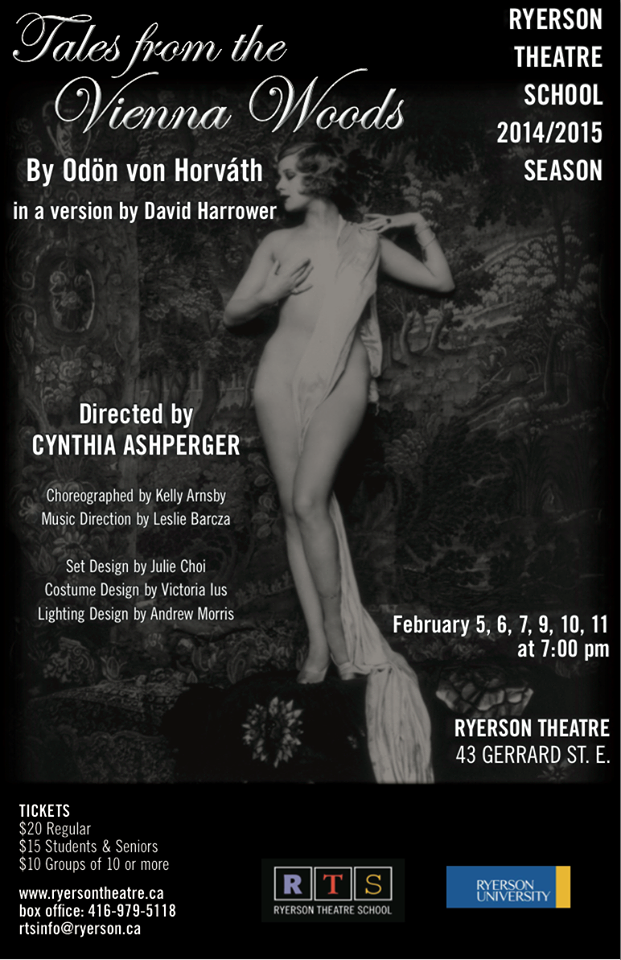
Ödön von Horváth wrote a play with that same magic title: Tales from the Vienna Woods, and premiered in 1931 not so long before the moment when Austria was swallowed up by the Third Reich, in the Anschluss of 1938. At this point it was still possible to write something bravely defiant of the impending annexation. Nazis are mocked in the play even as it seems to show the inevitability of what was to come, a tragic-comedy with amazing resonance even now. And where the title had an innocence to it for Johann Strauss II, whose life fits entirely into the 19th century, perhaps it had a whole other kind of depth for the playwright in one of the most troubled decades of the 20th century. Looking back, listening to the music, one can apprehend both the innocence and sophistication at one time.
Ryerson Theatre School are presenting Tales from the Vienna Woods February 5, 6,7, 9, 10 & 11 at Ryerson Theatre. I’m immersed in this world as the music director. Several of Strauss’s waltzes figure prominently in the play, as you might expect. But while I may once have understood them as happy waltzes, i see them now in a new light. They’re a kind of snapshot of a zeitgeist, a distillation of the impossible aspirations of a people unable to live up to their own dreams. The nostalgia in the music for the imperial moment that is irretrievably lost hangs like a fog over the play.
There’s a great deal of joy & fun in this play, also frustration, pain, suffering. I will never look at Cabaret the same way again. I find the relationships portrayed in von Horváth’s play are among the truest I’ve ever encountered in a play, truer than anything I see coming out of Hollywood even now. It’s also embarrassing to see so many moments that echo conversations I’ve heard in my family. This is a manners comedy holding up a mirror, but in many places nobody is laughing.
2015-2016 Toronto season includes internationally lauded Armide and Lucio Silla
FOR IMMEDIATE RELEASE: Toronto, ON (January 27, 2015) – Opera Atelier’s 30th Anniversary Season will celebrate the company’s status as the busiest touring opera company in North America. A new Canadian production of Mozart’s Lucio Silla (Apr. 7-16, 2016) will form the cornerstone of Opera Atelier’s anniversary season in Toronto, paired with a revival of its landmark production of Armide (Oct. 22-31, 2015). The company has secured a recurring engagement at the Palace of Versailles and will present one of its Canadian-made productions at the famed Opéra Royal every second year. Armide will return to Versailles following its Toronto run in the fall of 2015. Today’s announcement by founding artistic directors Marshall Pynkoski and Jeannette Lajeunesse Zingg comes just weeks before they make their debuts at La Scala Opera House in Milan with their celebrated staging of Lucio Silla. Both operas in the 30th Anniversary Season are rarely performed works that have recently been given international profile by the artists of Opera Atelier.
For this important occasion, director Pynkoski and choreographer Zingg are proud to announce their ongoing collaboration with a group of Canadian artists whose work has helped make Opera Atelier an internationally sought-after brand. “We are privileged to have enjoyed such longstanding and fruitful partnerships with these artists, several of whom have been with the company since our first performances in 1985,” say the pair. Both productions in the 15-16 season will feature Toronto’s acclaimed Tafelmusik Baroque Orchestra conducted by David Fallis, and Canadian designers Gerard Gauci (sets) and Bonnie Beecher (lighting), as well as the Artists of Atelier Ballet.
Pynkoski and Zingg’s staging of Lucio Silla created a sensation at the Salzburg Festival and Mozartwöche in 2013 and will soon appear at the La Scala Opera House in Milan (February 26 – March 17, 2015). Opera Atelier will bring this staging to Toronto audiences with a new Canadian production with brand new sets and costumes. The titular ruler will be sung by Kresimir Spicer, alongside Inga Kalna (as Cinna), Mireille Asselin (as Celia), Peggy Kriha Dye (as Cecillio) and Meghan Lindsay (as Giunia). Written by a 16-year-old Mozart, this astonishingly inventive opera seria contains some of his most memorable music for soloists, chorus and ballet. Lucio Silla will be sung in Italian with English surtitles.
Armide will reunite the cast that created Opera Atelier’s 2012 production, which enjoyed sold-out houses and critical acclaim in Toronto and Versailles. Reprising their roles as the ill-fated lovers are soprano Peggy Kriha Dye (as Armide) and tenor Colin Ainsworth (as Renaud), along with soprano Carla Huhtanen, bass-baritone Olivier Laquerre, soprano Meghan Lindsay, and tenor Aaron Ferguson. Joining the cast are Stephen Hegedus (as Hidraot) and Daniel Belcher (as La Haine & Aronte). Armide will return to the Opéra Royal at the Palace of Versailles, France (Nov. 20-22, 2015) to participate in the events commemorating 300 years since the death of Palace creator King Louis XIV. This French Baroque masterpiece by Jean-Baptiste Lully (libretto by Philippe Quinault) was first performed in 1686. Armide will be sung in French with English surtitles.
The company has recently undergone a change of leadership, with John MacKinlay of PricewaterhouseCoopers becoming chair of the12-person board of directors. National leadership partner for the Financial Services Consulting practice of PwC, MacKinlay brings his strong corporate network to Opera Atelier to complement the company’s artistic excellence with business savvy. He took over from Bryan Graham at Opera Atelier’s Annual General Meeting on November 18, 2014.
Performances for Opera Atelier’s 2015-2016 season will take place at the Elgin Theatre (189 Yonge Street) in Toronto. Armide runs October 22 (media night), 24, 25 (3:00pm), 27, 30, and 31 (4:30pm), 2015 (start times 7:30 pm except where noted). Lucio Silla runs April 7 (media night), 9, 10 (3:00pm), 12, 15, and 16 (4:30pm), 2016 (start times 7:30 pm except where noted). Subscriptions start at $95 and are on sale now by calling 416-703-3767 x222. Single tickets go on sale on August 10, 2015. For more information visit Opera Atelier’s website: http://www.operaatelier.com.
2015-2016 Major Sponsors
Season Presenting Sponsor: BMO Financial Group
Season Underwriter: Michael A. Wekerle of Difference Capital
Production Sponsor: Scotiabank
Opera Atelier gratefully acknowledges the ongoing support of The Canada Council for the Arts, the Ontario Arts Council, and the City of Toronto through the Toronto Arts Council.
Opera Atelier is North America’s premier period opera/ballet company, producing the opera, ballet and drama of the 17th, 18th, and 19th centuries. While drawing upon the aesthetics and ideals of the period, Opera Atelier goes beyond “reconstruction” and infuses each production with an inventive theatricality that resonates with modern audiences. Led by founding artistic directors Marshall Pynkoski and Jeannette Lajeunesse Zingg since 1985, Opera Atelier has garnered acclaim for its performances at home as well as in the United States, Europe and Asia.
“Press releases and announcements” are presented verbatim without comment

 Oundjian can be pleased at the crowd—enthiuastic recipients of the TSO’s offerings—who assembled to hear contemporary music on a February night. New Creations is prospering, with more to come next week (click logo for more info).