“Press releases and announcements” are presented verbatim without comment.
Shared Dreams of Freedom
The Romanian General Consulate & One Room Theatre invite you to a literary evening and a reception, which will bring together Romanian-Canadian and African-Canadian poets, celebrating Romania’s National Cultural Day and the anniversaries of Mihai Eminescu and Martin Luther King, Jr.
LOCATION: Romanian General Consulate, 555 Richmond Street, Suite 1108, Toronto.
DATE & TIME: 15 January 2014, 6:30 p.m.
TICKETS: Free
• The event will be introduced by Antonella Marinescu, Romanian General Consul in Toronto.
• Eminescu’s poems will be followed by an excerpt from King’s “I Have a Dream” speech.
• Romanian-Canadian Calin Mihailescu and Diana Manole will join African-Canadian Pamela Mordecai and George Elliott Clarke, Toronto’s Poet Laureate, voicing their own dreams through poems in both English and Romanian.
• A short reception featuring the infamous Dracula wine and tasty traditional snacks will conclude the evening, giving everyone a chance to talk to the writers and the other guests.
*Organized by Dr. Diana Manole, artistic director of the One Room Theatre, with the support of the Romanian General Consulate in Toronto.
Mihai Eminescu, who came to be called the Evening Star of Romanian poetry,
was born on 15 January 1850 in Botosani, in the Northern province of Bucovina.
A Romantic writer and a sharp journalist, his work greatly influenced the subsequent development of the national language and literature. His philosophical and romantic lyrics, including “The Evening Star” (“Luceăfarul”), his masterpiece, are some of the most famous Romanian poems. Eminescu also addressed political and historical subjects, particularly in his epic “Epistles” (“Scrisori”), as well as in “Emperor and Proletarian” (“Imparat si proletar”), but also in his newspaper articles and pamphlets in The Time (Timpul). His scorching political satire is complemented by his passionate plea for freedom and justice, as well as gentle or feisty expression of patriotism.
“What I wish for you, sweet Romania, my country of glory, my country of yearning” remains one of the most touching declarations genuine patriotism.
Martin Luther King, Jr., born on 15 January 1929 in Atlanta, Georgia, was an American clergyman, activist, humanitarian, and leader of the African-American Civil Rights Movement. Between 1957 and 1968, King traveled millions of miles and gave over twenty-five hundred speeches, while he wrote five books as well as numerous articles. King also helped to organize, in 1963, the peaceful March on Washington, D.C. There, in front of over 250,000 people, he delivered his famous “I Have a Dream” speech, considered one of the most passionate and effective political statements of the 20th century. In 1964 King was the youngest recipient of the Nobel Peace Prize, awarded to him for combating racial inequality through nonviolence.
He was assassinated on 4 April 1968, in Memphis, Tennessee, a martyr whose death testified to the truth that dreams of democratic change do not easily become reality.
“Now is the time to make real the promises of democracy,” King still appeals to us across decades in an increasingly globalized world.
GUEST WRITERS
George Elliott Clarke
Hailing from Nova Scotia, George Elliott Clarke is the author of sixteen collections of poetry, in addition to dramatic plays and opera librettos, a verse novel and a prose one, numerous journal articles and a comprehensive study of African-Canadian literature, an academic discipline he pioneered. His numerous awards include the Governor General’s Award for Poetry (2001) but also the Poesis prize for the anthology of poems Poeme incendiare (Oradea: Cogita, 2005), translated by Flavia Cosma. He is currently Toronto’s Poet Laureate and the William Lyon Mackenzie King Visiting Associate Professor of
Canadian Studies at Harvard University.
Diana Manole
Diana Manole is an award-winning Romanian-born Canadian poet, playwright, theatre director, scholar, and professor. She has published eight poetry and drama collections, poems in several national and international anthologies and magazines, as well as nine scholarly articles and book chapters. Her work has been reviewed in The History of Romanian Literature: Drama (2008) and The History of Romanian Contemporary Literature 1941-2000 (2005). She founded and is the artistic director of One Room Theatre, a company specialized in multimedia performance inspired by poetry.
Călin-Andrei Mihăilescu
Călin-Andrei Mihăilescu is a multilingual writer and a professor of Comparative Literature, Critical Theory, and Hispanic Studies at the University of Western Ontario in London, Canada. Among his many authored volumes are Ţară europsită (2002), 16-17~ Renastere, manierism, baroc (2005), and, among the edited volumes, This Craft of Verse by Jorge Luis Borges (2000) and What Was It Like? Something Like That… Memories from the Years of [Romanian] Communism (2006). His most recent book, Happy New
Fear!, came out in Bucharest in 2011.
Pamela Mordecai
Born in Jamaica, educated there and in the USA, Pamela Mordecai earned a PhD in English for a dissertation that proposes a cognitive style called prismatic vision, which she examined in the poetry of Kamau Brathwaite and Derek Walcott. She writes poetry, fiction, and plays for adults and children, as well as occasional critical articles. Her fifth collection of poems, Subversive Sonnets, was published by TSAR Publications in 2012. She lives in Kitchener, ON. http://www.pamelamordecai.com
I had the most curious experience during my second look at The Great Upheaval, the imported show from Guggenheim’s Collection at the AGO.
The first time through I more or less bought into the official story of this show, an impressive assembly of art for the period 1910-1918. There are overlapping stories.
politics
art
collectors building a collection
First time through, my big conclusion concerned the parallel narrative of the assembly of the Guggenheim Collection—a canny assembly of art that cleverly assessed the best and most important movements of the time—and the background context of political & artistic movements. We go through the artworks a year at a time, encountering them in the linear stream of chronology without the superimposition of layers of interpretive museology.
And speaking of linear, the show’s design echoes that perfectly linear space, the Guggenheim Museum in New York. I get that it’s more of an ascending helix than a straight line, but I’d rather encounter art in a gentle spiral pattern rather than a truly linear space such as an airport terminal or a train station.
I’d left aside the real question connecting the history of the art & the politics of that period. We knew that the First World War began in the middle of this period. While the show covers roughly eight years, from 1910-1918, the period from 1914-18 is a surprisingly small part of the show. Each year from 1910-1913 merits a big space. And then the second half of the show is jammed into one little room. Jammed? no. Sparsely displayed, because even in that one room comprised of four years, there’s really not so very much on display.
I had assumed a kind of parallel narrative, where the war gets in the way of culture, stopping anything tender or sensitive, imposing a new brutality in its place. The paucity of art for the second half of the period was an apt reflection of what was happening. Either art was no longer a priority for a world at war, or artists were dying off in the trenches.
Yet the second time through, I sensed another way of seeing this period, one that was far more troubling, particularly once i s aw the disturbing echoes of our own century.
First time through?
I thought of war as external to the show, a kind of nasty obstacle. And more to the point, I thought of the “upheaval” as the series of avant-garde movements in the different European cities. I figured that all that upheaving stopped dead in the presence of the Great War, the War to end all wars and to end all art. So of course war was a perfect pretext for artists to fall silent. War seemed to require a break in the cultural discourse, whether as a result of the guns drowning out the gentler voices of musicians & painters, or because those artists lost their audience, their preoccupations, and in the end, many of them also lost their lives.
Ah but what if war is not external at all? The last room of the show includes several paintings where the ugliness of war is very close to the surface, if not an explicit participant in the conversation. No, the cannons weren’t really speaking anymore than paintings or statues speak. And the soldiers were not making artistic statements.
The Great Upheaval? Really a series of upheavals, revolutions, explosions against a staid society. A series of movements seeking to redefine the possibilities of art. And I can’t forget that this is the beginning of something altogether different in art. Speaking of the helix shape, the art-world has been on a downward spiral ever since. The upheaval was a fundamental questioning of culture itself, a movement away from everything art had once been (thinking of values such as representational, decorative, explicit, or commercial) towards more problematic and ambiguous objectives. Among the artists mentioned in passing was Arnold Schoenberg, whose ideas are the cornerstone of a musical movement resolutely turning its back on the audience. Cubism is certainly another such movement, leading the artists into brave new directions, often at the expense of easy popularity.
Especially intriguing among these movements is the group known as the Futurists. Their aesthetic is one that seems to have been the most enduring of the last century. They celebrate strength and the manifest destiny of science moving towards an ideal future. Ideal for whom? Ah, that’s a good question. War and power were ideals some futurists clung to, a cluster of values pointing towards Mussolini and the fascists. This aesthetic, valorizing powerful machines & sleek buildings that point to the future, sometimes seems to have a life of its own. There’s an unexamined infatuation with the future, progress, machines and power, all as ends in themselves. If we notice how the contention between the various manifestos and avant-garde positions resembles a debate, if not an actual war, in a real sense the futurists won the great upheaval, if not the entire century.
Walk into any store selling media devices and you’re in a kind of watered down futurist temple. Listen to the news and you’re really listening to a kind of futurist sports report, tallying the competition in several key arenas (economy, technology and the biggest sport of all, namely war).
In the century since the upheaval, I can’t help wondering. Has the upheaval ended? Or is it merely working its magic? Are we now seeing more honest versions of what was merely hinted at in the artwork of the last century?
Life-style reality TV?
It’s a celebration of raw media power, people so iconic, so important that we’re supposed to genuflect to their every bodily process.
The preponderance of violent films?
an infatuation with power and pure strength. Notice for example the trailer for the film Pacific Rim, merely the most extreme recent example of an ongoing competition to make the biggest and most spectacular celebrations of life and death.
Science fiction?
I grew up reading sci-fi, so I’d plead that there are several different versions & flavours. But nevermind the books, look at film. I am very conflicted by much that I see on the big screen, a prostitution of the possibilities and ideals of the texts adapted in films.
The catalogue for The Great Upheaval is a wonderfully inexpensive book, selling for less than $20 (plus tax) at the AGO bookstore. There’s much there to ponder. The more I look the more I see its relevance to our own time.
This is the moment when bloggers look at their annual stats, notice trends, and perhaps say thank you to the community that supports them.
According to my stats I posted 232 different items over 365 days. This is a moment to thank you for last year. Thank you readers. Thank you participants.
January: Wallis Giunta, wearing McCaffrey Haute Couture (photo Mark Cooper)
Speaking of numbers & participants , thirty-two of those 232 are of particular interest. I’m especially honoured to be facilitating the conversation that one finds in the questions surveys. In addition to a pair of offbeat surveys—one directed whimsically at the different Rodolfos sharing the COC Boheme, another for Topher Mokrzewski concerning the Liszt transcription of liebestod that he played for a Wagner conference—I directed ten questions at thirty different people.
That’s three hundred questions even without including the other two surveys.
Why a summary like this one? Maybe I’m reluctant to let go of the year. Maybe I want to register my gratitude, but also to catalogue these creations to encourage you to either re-visit or –if you never read them the first time—to see them now, crudely categorized. I say “Crudely” because people don’t fit into categories, and I may be dishonouring some in the process. Some of the Canadian singers are also international, opera people are also theatre artists, singers are also musicians, and some people like David Warrack or Topher Mokrzewski occupy several categories. But I hope the divisions are recognizable.
February: bass Franz-Josef Selig (Anne Hoffmann)
The page is a reflection of tendencies, possibly my own. Does the preponderance of tenors and sopranos reflect my bias? or say something about the world at large? And maybe i need to correct that in future. I have no idea whether this page will be useful to anyone other than me, but i hope people will consider using this interface to revisit some fascinating conversations.
*******
Theatre artists: David Ferry (TIFT’s The Last of Romeo and Juliet) Nina Lee Aquino (fu-Gen Theatre & Tarragon’s carried away on the crest of a wave) Melissa Hood (Gun Shy Theatre’s Stop Kiss)
*******
April: tenor Stephen Costello (photo: Dario Acosta)
Impresarios & builders: Guillermo Silva-Marin (Opera in Concert, Toronto Operetta Theatre, Summer Opera Lyric Theatre) Stuart Hamilton (founder: Opera in Concert, collaborative pianist & coach, CBC Opera Quiz) Marshall Pynkoski (founder/co-artistic director Opera Atelier)
September: composer, musician, innovator, teacher John Mills-Cockell
Identified by Opera News as one of the “25 Most Powerful Names in US Opera”, Stephen Lord is a conductor known for his sensitive handling of singers. In my review of April’s Canadian Opera Company production of Lucia di Lammermoor I said the following:
Stephen Lord was quite magnificent to watch, deliciously flexible with the COC orchestra in following the singers no matter where they wanted to go, one of the most impressive displays of musicianship I have ever seen.
That’s not surprising, considering that Lord began his career as a pianist, before becoming a coach & accompanist. Lord also teaches and mentors artists, whether in his previous role as Music Director at the Banff Festival Opera, or more recently as artistic director of opera studies at New England Conservatory. He is currently music director for Opera Theatre of Saint Louis, formerly was music director of Boston Lyric Opera, and has led productions at companies such as Lyric Opera of Chicago, San Francisco Opera, and English National Opera.
On the occasion of the new Canadian Opera Company production of Verdi’s Un ballo in maschera I ask Lord ten questions: five about himself and five more about his work on the COC Ballo.
1-Are you more like your father or your mother?
Conductor Stephen Lord (photo: Christian Steiner)
You know, I think I am truly a 50/50. I used to look like my mother, now I look like my father – especially when passing a shop window and seeing my reflection. “Who is that old man?” I am intensely curious about things like weather and all sorts of world news, farming (he was a fruit grower), etc. But I am at times hyper energized like my mother who, at 87, is doing quite well.
2- What is the best thing & worst thing about being a conductor?
I came to conducting late after having spent my first fifteen years in career as a coach and, even luckier, coach to many of the great singers ending the golden age of the 50’s and 60’s and then the best of the singers in my generation. So the BEST thing about being a conductor is that the thing that challenges so many opera conductors – the theatre and the vocal styles – is second nature. As a pianist I was always slightly nervous as playing a wrong note was anathema to me and, since I came to piano in my teens, I never truly had the assurance of those that start in their single digits. In spite of that it all seemed to work, but the comfort level was an issue. When I started conducting, the possibility of wrong notes is someone else’s problem! I was suddenly liberated to conduct the music, live the music, be inside the music and the feeling when younger of loving it so much you wanted to climb into the stereo speakers, is now a realized sensation. And I can do theatre when doing opera. I spent a lot of time on stage in my past in various types of plays, shows and even operas and so realizing the theatre in music and discovering it is a huge joy for me. While there are no doubt greater conductors than I everywhere, the fact that I know theatre and am intensely interested in it is my ace in the hole.
The worst part of conducting opera, and there is a downside are the long periods away and on the road in unfamiliar digs. I am not someone who does this job as a step in last minute thing as I love being involved in the whole process. And this takes time to rehearse, work out various aspects musically and theatrically, etc. The average away time is 6-8 weeks and when one goes from one to the next with little time between, it becomes a living nightmare. But there IS the music and some truly wonderful colleagues. Right now, in the Ballo cast, I knew everyone but two, some from their very beginnings. So one is never lonely for the familiar. And meeting the terrific director, Sergio Morabito, and working with him is incredible fun.
COC Music Director Johannes Debus (photo: Bo Huang, 2012)
The COC, a company I have been involved with in many capacities since the early 80’s, is a welcoming, warm and first rate operation. This starts from the top with Alexander Neef and Johannes Debus, plus my old friend Sandra Horst and many others. This is great compensation for the sometimes devastatingly lonely times alone in terrific but strange digs.
3- Who do you like to listen to or watch?
Wow. This is a tough one. I have to drive a lot and in my car I have Sirius radio and I often listen to The Metropolitan Opera Radio. This is at times thrilling (older performances with idols like Melchior, Bergonzi, Tebaldi, Sutherland, etc.) and sometimes shockingly disheartening, especially in the years 1990 to the early century. Now, however, I hear people on there I either knew in the beginning of my career or, in some cases, actually started a career and it is wonderful to hear them all grown up and giving of themselves so well.
In the USA, we have NPR, which is terrific and gives me thought provoking subjects to follow.
As for music, just last week on a long car trip it was the whole MESSIAH (which I admit I didn’t hear as I was singing along too much), Carlos Kleiber doing Beethoven and Dame Myra Hess. Sirius also has a Frank Sinatra station, and Elvis station and a 40’s and 50’s pop station. These make me smile as they were sincere and you could still understand the words.
I rarely play piano any more. I developed tendinitis when I was at the end of that career from playing in Dallas on a terrible piano. And that was probably good since I started learning my conducting scores away from the keyboard and in my head. It helped develop my ear and score reading abilities. I have the urge to play piano occasionally again, though, and might get back to it.
4- What ability or skill do you wish you had, that you don’t have?
Woodworking
5- When you’re just relaxing and not working what is your favourite thing to do?
I confess to being a terrible gardener and I just love doing it. I prune too aggressively, and don’t design what I plant carefully, I love buying guy toys by John Deere (my Gator is an especially fun one and the new, big, and more rugged lawn mower might just be coming). One more admission — while pruning on a ladder by myself with a chain saw, I did cut too aggressively, the limb pushed me off the ladder, I landed in a pile of rocks, broke four ribs. Mercifully, or not mercifully, my head hit grass between the rocks. So I am terrible and love doing. I also love working on ways to improve my home. Being on the road is dangerous because I start thinking of what to do next.
Stephen Lord (Photo: Christian Steiner)
*******
Five more about Ballo at the COC
1-Please talk about the challenges in leading the COC production of Un ballo in maschera.
I used to think some operas were relatively easy to conduct. The older I get the more I realize the folly of that stupid notion.
Because we are dealing with humans on the stage and humans in the pit and humans in the public experiencing it live, the unknowns are tremendous. Sometimes conducting an opera like Ballo is rapturous, sometimes conducting any of them is triage as one tries to analyze all sorts of real time issues and find solutions to them in a split second. Because we have such great resources available in the form of past and/or favorite recorded performances, a great challenge is forgetting what one has heard and inventing it fresh. And, of course, there are naturally times when you’re used to hearing one thing but tailoring to the available forces is the immediate issue. Also, when one has a very strong point of view, as our production does, one has to constantly remind the singers that the action follows the music and the sometimes untraditional action is not the beginning but the end result of the music itself. Theatre in opera comes from music but many fine young singers use the action as an end result. But the music inspires the action, the words inspire the music, and the action is a result of the other two. If a singer thinks the production style is their biggest job, we can get lost. It is my job to bring them back to the truth of the music as their primary impulse.
Ballo has a lot of back stage music, which is always a worry as you can’t see them. Mercifully, I have Sandra Horst, who is brilliant doing that along with the chorus.
The other great challenge, of course, is that the roles in this opera are big, full, grown up opera roles. And with these, come the pressures on the singers to stay in tip top form because if one is in less than best form, the piece cannot happen.
Musically, the challenges in this piece start with the libretto. The poetry of Piave in something like TRAVIATA, for example, is direct. This libretto has some very atypical word and sentence structure and some very unusual text for Verdi. And this affects the musical phrasings. So learning these and getting them into the brain is difficult.
On the plus side, of course, is the COC orchestra. They know opera and play it with heart and soul.
2-What do you love about Ballo?
What do I love about Ballo? Well, let me start by saying I have never been driven to be rich or famous and so I have been fortunate enough to be able to only do pieces I either love or that are very interesting and curious to me. There may be times when I wish I would just go and phone something in and take the money but that is not me. So, Ballo is a piece I love and I am honoured to have been invited to do it. This way we start with the wanting to show my love for the piece by being involved with it again. For the one and only audition I ever did and play on piano, I chose Amelia’s second act aria as the aria selection. I love the danger in the piece — the vocal danger of the role of Amelia and the conquering of the repertoire’s most difficult high C, the length of the role of Riccardo and the stamina it takes to do this, the dangerousness of the dramatic situation – all of these make the superhuman challenge of doing a super performance of this opera make me love its challenge. It is like Everest – it is THERE.
At this point in Verdi’s oeuvres the orchestral writing gets more and more exposed for solo instruments. The cello has quite long stretches of solo writing. The English horn in Amelia’s aria seems a prelude to the oboe writing in AIDA. The trombones probably play more in this opera than in any other of Verdi. In this period of Verdi, everyone has great challenges on stage, chorus, pit, backstage. And my challenge is to see that it is all of one style, theatrical, beautiful, and in the rare occurrence that something goes wrong, to do my best to fix it.
3) Do you have a favourite moment in Ballo?
I think for me the most thrilling moment in this opera is the moment in Act 2 when Amelia confesses her love to Riccardo, the tenor. This is, of course, one of those moments when one’s assistant comes and says “Maestro, the orchestra is too loud here.” I of course listen but also realize that there are times, very occasional, when the sum of the parts (orchestra and singer) is greater than any one thing. The overwhelming moment here in the orchestra tells us more than the singers do. In our age of having recorded performances always perfectly balanced (like the unrealistic MET HD performances) our public oftentimes gets lulled into thinking singers are always forefront and forget that at times the orchestra becomes the soloist. I am not one of those bombastic kind of guys, but there are times you just have to let the race horse run.
4) How do you feel about Un ballo in maschera as a 21st century performer?
And now we come to the hornet’s nest! This probably is worth a whole book of writing. And I have some very strong opinions here. I am totally for whatever brings the piece to life. I think an issue with what some people call Regietheater is that those that produce it bring a particular and often peculiar personal idea to the fore without truly knowing the people in the seats. But the personal and expensive point of view, while interesting, at times supersedes the spirit of the music and the interest of the public. This does not at all mean that these things should not be tried. But the producer who forgets his public and, like a spoiled child, says LOVE IT OR LEAVE have now often reaped the “rewards” and people have left.
Think of the great pianist Glenn Gould who made his career on the works of Bach played on an instrument Bach could possibly never have imagined. The spirit of the music is always there and it brought a lot of this music to the attention of the public. Now, had he worn a clown suit while playing it, the music would have been lost for the distraction of cosmetics. And yet he updated the performance with an instrument the public could relate to.
I firmly believe that the rise of this kind of production (and don’t get me wrong, I appreciate it when done well and musically) coincided with a precipitous decline in musical and vocal standards in the world. I am not talking the early music repertoire, because that is vocally and conductorially less demanding. I am talking about the style of singing that is athletic and as dangerous as NASCAR. I am talking about the singer who has to bat 1.000, while a star ball player can be in a slump and still be paid millions. When the dinosaur generation died off, who on the norm studied longer and at younger ages and were immersed in the repertoire in their cultures and families, replacing them has been a struggle, with exceptions of course. So to replace the visceral thrill that made opera so very popular, people felt forced to replace that thrill with a more intellectual/personal/controversial sort of thrill which, when done badly drives the public and donors away and, when done well, at least has the press and spin doctors abuzz.
My conducting colleagues need to shoulder some of the blame for the bad stuff. When they show up at the end of the rehearsal period and have no input into the process and THEN complain, they have no legs to stand on in my book. Bear in mind I am talking about new productions here, not revivals for which one has been hired. But the uninvolved conductor has been one of the reasons this art form has suffered some bruises. I think even with a production of dubious taste a conductor can make a difference and help the producer by motivating the action with the music and keeping the cast on a tight leash stylistically.
5) Is there anyone out there who you particularly admire, and who has influenced you?
Conductor Tullio Serafin (click photo for more information: scroll down to Tullio Serafin)
Conductor wise, one cannot deny Toscanini, Carlos Kleiber, Tullio Serafin, Antonino Votto, Mitropoulos. Directorially, there is always Jean Pierre Ponnelle, a true renaissance man whose work in the whole repertoire and not simply a niche was exemplary and musical. So many singers have touched my heart they are impossible to name.
But those I admire most? With no question I admire those who are out there, leaving home and family to entertain the public. Each and every one of them.
And if they get the added thrill of a great performance that moves him, all the better.
*********
Stephen Lord leads the Canadian Opera Company production of Verdi’s Un ballo in mascherathat opens February 2nd (further information).
click for information about tickets to the production, originally from Berlin Straatsoper (Photo: Ruth Walz)
Every work is really several possibilities, depending on the emphases in the interpretation. There are several operas inside each opera, several musicals inside each musical. And this is particularly so when we speak of operetta, a form that can seem like a special class of opera, or simply a popular musical, depending on which direction favoured by the interpreter. Yes, musicals are operettas. Die Fledermaus, Chicago, Land of Smiles and Dirty Rotten Scoundrels may seem like a broad range until we recall that opera includes Actéon and Zauberflöte, Aida and Zaide…and so much more besides.
When I see a musical at Stratford or Shaw (Niagara-on-the-Lake) they don’t usually let anyone onstage whose speech isn’t pristine. For them—those sacred institutions of acting & speech—their priorities are clear. Whatever music goes on, the dialogue takes precedence, the story-telling and dramatic values over-ride musical concerns. Sometimes that bothers me because I may not like the musical effect; but I understand their philosophy and with their brand I know what I’m getting.
Click image for ticket information
Toronto Operetta Theatre is a different brand. The pre-show talk for Lehar’s The Land of Smiles, currently playing at the St Lawrence Centre, rightly alludes to the inter-cultural issues in the work, but would situate the work in a line with such serious operas as Madama Butterfly and Turandot, rather than more recent musicals such as South Pacific or Flower Drum Song. Lehar’s work can be understood for its broad comedy or its fabulous music. TOT didn’t miss the opportunity to showcase singing talent, as i believe that’s the TOT brand in a nutshell: emphasizing the great vocals above all.
It’s a truism about musicals that the music begins when the words can’t go any further, saying what cannot be expressed through words alone. This is certainly true of this Lehar score. We’re listening to schmaltzy waltzy melodies in Act I, an idiom that may have been popular at one time, but nowadays feels at least as distant as the Roaring Twenties. And then we’re whisked to another far-off musical realm, this time an evocation of China in pentatonic harmonies plus a bit of chromaticism to give us more schmaltz. While at one time the mid-European waltzes may have been understood as heimat or homeland, both places now feel equally remote & artificial.
Tenor Ernesto Ramirez
Artistic Director Guillermo Silva-Marin gives his story-telling to wonderful singers, and so, while their dialogue may at times resemble the lead-up to an aria, they do give us an endless series of brilliant solos or duets. Tenor Ernesto Ramirez has a wonderfully fluid line and brilliant high notes, while soprano Lara Ciekiewicz matched him high note for high note. They made a sympathetic couple both visually and in the way their voices blended, and ably supported by the TOT orchestra led by Derek Bate.
Land of Smiles is mostly a light & sunny work, romantic & schmaltzy, and also funny with only occasional glimpses of darkness, depending on the emphasis of the director. For the most part Silva-Marin connected Lehar to the operatic pathway of high art rather than surrendering to low comedy, even though from time to time the text leads us into deliciously zany territory.
I was especially impressed by Keenan Viau’s fearless portrayal of the court eunuch, repeatedly playing up double entendres, in stark contrast to Curtis Sullivan’s furiously deadpan uncle. I found Act II – where the comedy hit its stride—much more enjoyable than Act I, which was gorgeously sung but uneventful. Land of Smilesis a charming tale of exotic romance, at times in danger of being hijacked by its own comedy, but Silva-Marin never allowed the anarchic wackyness to overwhelm the romance. At its heart this is a cute and touching story, one that wears its heart on its sleeve in three-four time.
Land of Smiles continues at the St Lawrence Centre for seven more performances this weekend and next, concluding January 5th.
Last year around this time you might have seen “Pollyanna’s Picks for 2012”, a list looking “through the rose-coloured glasses of someone who prefers to avoid negativity.” Had I not been knocked back to the Stone Age by a power failure I would have done this sooner. Forgive my tardiness, but first I had to celebrate Christmas and then reconnect to the internet.
Anniversary commemorations It was an odd year celebrating the bicentennials of Richard Wagner and Giuseppe Verdi, the centennial of Benjamin Britten, and the 50th anniversary of the death of Francis Poulenc. Highlights?
The Canadian Opera Company found time for a single opera from each of Wagner, Britten & Poulenc this year. Although Verdi was allocated two operas neither of them fell during 2013 itself (Il trovatore in the fall of 2012, and Ballo in maschera coming early in 2014): and so he’s absent from my list. Tristan, Peter Grimes, Dialogues des Carmelites all happened in 2013. The most special event in this group? A toss-up between Tristan and the Carmelites. On the one hand a rejuvenated Ben Heppner, the offbeat video of Bill Viola and especially the COC orchestra under an inspired Johannes Debus made Wagnerian magic. But Robert Carsen’s well-traveled Carmelites starring Adrianne Pieczonka and Isabel Bayrakdarian was every bit as powerful.
After seeing the high-definition broadcast of the Metropolitan Opera’s Parsifal I’m eager to see this co-production of the Met, Lyon Opera & yes, the COC finally show up here in Toronto, even if it’s unlikely we’ll get a cast to match the dream team onstage at Lincoln Centre.
Books:
In a year of anniversaries Paul Kildea’s book Benjamin Britten: A Life in the Twentieth Century seemed to be the most successful book concerning the four commemorated composers (Poulenc, Verdi, Britten & Wagner): a book I did not fully read and didn’t review. I was most intrigued by two very different books:
Thomas Adès’ Full of Noises:Conversations with Thomas Service was a book I couldn’t put down, even if the book was happy to return the favour. Howzat? its chief quality was its readiness to put down other composers. Wagner was Adès’ most famous target, famously called “a fungus”. As I observed in one of the pieces I wrote about the book –as I said, I couldn’t put it down—Adès rhetorical stance and dismissive language made for fascinating reading even if I was fighting it most of the way.
I couldn’t put Stuart Hamilton’s Open Windows down either, but for a very different reason. For starters, the karma is precisely the opposite of Adès, but this is also a fun read, an unavoidable and important book for anyone who cares about Canadian singing & opera. Hm, time to read it again.
Most impressive singer
Franz-Josef Selig is the male voice that impressed me the most because I had the privilege of hearing two very different performances –his intimate concert “Love’s Dark Shore”, and his portrayal of King Marke in Tristan und Isolde.
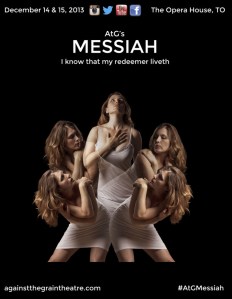
On the female side, I’m not as sure, and so I’ll cite two women. Shall we call it a tie? Wallis Giunta’s concert at Glenn Gould Studio showed several different approaches to singing, after she’d gone completely incognito channelling Michael Cera in her nerdy portrayal of Annio in La Clemenza di Tito. That would be the winner if I hadn’t just been blown away last week by Jacqueline Woodley’s singing and (yes) dancing in the AtGMessiah, to go with her brilliance nine months ago in the 40 short dissonant pieces of Kurtág’s Kafka-Fragments. It’s not as though there weren’t other wonderful female voices, especially Adrianne Pieczonka in Dialogues des Carmelites, Ambur Braid’s Mozartian triptych (a bespectacled Konstanze, a charismatic Queen of the Night plus a Vitellia that I missed), or anything featuring Carla Huhtanen, always versatile, likeable, and amazingly in tune.
Excitement?
I’ve alluded to Richard Bradshaw’s stated aim to produce the best theatre in Toronto. This was not a year when anything onstage at the Four Seasons Centre was anywhere close to that goal.
Not when one could see big companies produce Lepage’s Needles & Opium (Canadian Stage) or Adam Paolozza’s hysterical The Double (Tarragon).
Not when smaller, leaner companies were creating magic without benefit of big voices or big expenditures. Small companies? Against the Grain Theatre set the bar very high with two remarkable productions. In the summer their reboot of Mozart as Figaro’s Wedding may have been the best thing seen all year, while their recent Messiah was every bit as original, seeking to blow the cobwebs off the oratorio. But there was also Opera Five’s brave Halloween program of three operas based on stories by Edgar Allan Poe. There was also Loose Tea Music Theatre’s in your face Peter Brook Carmen. I have to also mention the workshop of Savitri & Sam, an opera I’m hoping to see staged, and Tapestry Briefs, a very promising laboratory for future works.
While I spoke of two COC commemorations, their production impressing me the most was Christopher Alden’s Clemenza di Tito featuring Isabel Leonard & Michael Schade, an interpretation managing to critique and problematize its text while never obscuring the original meanings.
One of the most stirring nights wasn’t opera but a concert, namely The Minimalist Dream House Project from Toronto Summer Music. The willingness to break free from convention inspired me even if one couldn’t miss the tension in the room between those loving it and the more conservative patrons.
Comeback of the year? That would be Ben Heppner, a man who sang two wonderful portrayals in Toronto during 2013, and who is reborn on radio as congenial and lovable host when he’s not singing.
Ave atque vale (or hail & farewell)
Topher Mokrwezski is off to Calgary with occasional visits to Toronto if we’re lucky
If you’re a child born on December 22nd you might grow up perpetually frustrated because of the proximity of your birthday to Christmas. There you are, early in the sign of Capricorn, and everybody’s celebrating someone else’s birth instead of yours.
Bummer.
But this is still an auspicious birthday.
It’s the day in 1808 when several remarkable pieces of music came kicking and screaming into the world at a long concert by Ludwig van Beethoven. I’m most interested in the premieres of the masterpieces, namely the Sixth Symphony, the Fifth Symphony (the sequence they were played in, not how they’re numbered) and his Fourth piano concerto. There was lots more Beethoven (the Choral fantasy, excerpts from the Mass in C and even more besides), but those are the works that make this such a special event.
Any one of these inserted into a modern program is likely the highlight, given that these three are so powerful. It’s hard to imagine anything one could program with any of the three that would overshadow or overpower them. But what if you suddenly picture all three together on one program?
Now imagine hearing even one of those pieces for the first time. I think of these two symphonies and the Eroica as being especially ground-breaking, that an audience accustomed to Mozart and Haydn and grappling with Beethoven’s new chamber works would still have been flabbergasted by any one of these works.
Just for the sake of a popularity contest –the sort of thing I usually detest except as far as it might tell us something about audiences & culture—which one do you think is the most popular right now? I toss the question out having no clue what the answer might be, but pondering the implications of such a question. We could look at how many performances are programmed –the way operabase.com tabulates opera popularity—but that would miss recordings and downloads. We could consider appropriations recorded in IMDB for film-scores or look at Beethoven’s overall filmography (where you find 1204 entries of which # 1201 and 1185 seem to be the Pastorale aka Symphony #6; but there appear to be many more entries for the bagatelle Für Elise and for the moonlight sonata). Churchill used the dit dit dit dah of the Fifth because it signifies V for victory via morse code.
I heard a safety chime system at the University of Toronto that plays a series of tunes when doors are open, including bits of Christmas carols, popular songs and yes, that opening motto in C minor. Okay, so in other words both symphonies seem to have penetrated into our collective unconscious.
How important are they? I don’t propose to evaluate such things. But it’s hard to imagine Liszt and Wagner without these two symphonies, and many other composers besides. And while I can’t trace the direct influence of the concerto on subsequent works, it too is a work of daring & originality.
Just when you were mulling over those these great compositions, I’m going to derail your train of thought. Dec 22nd might be the date of that famous concert, but it’s probably best known–in musical circles at least– as the birthday of Giacomo Puccini, a composer of some of the most popular operas. Speaking of popularity, I will again think of operabase.com, who tabulate opera performances worldwide, helping companies assess which composers are most likely to help them pack the opera house, and thereby stay afloat in one of the most expensive art-forms.
In their 2012-13 stats Puccini has moved up a spot, nudging out Mozart for #2, behind Giuseppe Verdi who is #1. Here’s what Operabase reported in 2009-10
If Puccini objected to being born so close to Christmas I’ve seen no evidence that he either minded, nor that it hurt him. Still, i won’t be thinking of Happy Birthday for either him nor those famous Beethoven compositions, not when all those amazing tunes are competing inside my head.
“Press releases and announcements” are presented verbatim without comment.
Dame Evelyn Glennie, Winnipeg Symphony Orchestra &
Composer Vincent Ho
Launch Indiegogo Campaign For New Recording
First recording with a major Canadian orchestra & first foray into crowdfunding for Glennie
For Immediate Release – Toronto, ON – December 3, 2013: Virtuoso percussionist Dame Evelyn Glennie, the Winnipeg Symphony Orchestra(WSO) and Canadian composer Vincent Ho have teamed up to launch a crowdfunding campaign (Indiegogo) for a new recording of Ho’s critically-acclaimed percussion concerto, The Shaman. The 60 day campaign is being launched today, Tuesday, December 3, and will end on February 1, 2014.
Since its world premiere in 2011 with Glennie and the WSO, conducted by Alexander Mickelthwate, The Shaman has been hailed as a triumphant success, receiving unanimous acclaim and rave reviews. It has been described as a powerful work that merges the spiritual world of Native American culture with the modern classical world to create a compelling journey. Oscar, Grammy and Pulitzer Prize-winning composer, John Corigliano, says of the work: “I heard the world premiere of The Shaman, and was blown away by it. The work is masterfully written, with gorgeously complex sections contrasting with simple and elegant statements. I love the piece.” While concertgoers in Winnipeg, Toronto and Taipei have experienced Glennie’s phenomenal performances of it first-hand, this new recording would enable listeners to experience it worldwide.
Given the success of the work, Glennie, Ho, Mickelthwate and the WSO have made plans to record The Shaman for worldwide distribution. The Shaman is a large-scale work of 33 minutes, and Ho remarks: “the costs for making a high quality recording of a work of this scope are extremely steep.” As such, the team is appealing to the public through the Indiegogo crowdfunding platform in order to raise a minimum of $85,000 CAN. The recording will become the featured work on a Vincent Ho compilation album, to be released for global distribution in the 2014/15 season. The recording sessions are scheduled to take place in May 2014, following Glennie and the WSO’s performances of The Shaman in Winnipeg – just a week before its next performance at Carnegie Hall in New York City on 8 May 2014.
About the work, Ho comments: “For me, Dame Evelyn Glennie is a modern-day shaman. I always felt that her performances were more than just visual or aural experiences – they were ‘spiritual’ events. She has the uncanny ability to draw the audience into a magical world and take us on wondrous journeys that are beyond material existence. Every performance she delivers leaves the audience spellbound and spiritually nourished. So there is no question that she is the perfect interpreter for this piece.”
This project is a first foray into crowdfunding for both Glennie and the WSO. In the video of the Indiegogo campaign, Glennie comments: “With The Shaman, I have had this chance to explore a sound world that is always evolving and developing; and that curiosity is always on fire. The fact that we can now communicate together and make it our project is very special indeed.” This will also be her first recording with a major Canadian orchestra, and of a work by a living Canadian composer.
There is a range of donation incentives as part of the Indiegogo campaign, including: personal thank you notes, advance downloads of the recording, autographed copies of the score, tickets to a Winnipeg performance of The Shaman, original jewelry designed by Glennie and, at the highest level, an exclusive invitation to dine with Dame Evelyn Glennie, conductor Alexander Mickelthwate and composer Vincent Ho.
Dame Evelyn Glennie is the first person in musical history to successfully create and sustain a full-time career as a solo percussionist. As one of the most eclectic and innovative musicians on the scene today she is constantly redefining the goals and expectations of percussion, and creating performances of such vitality that they almost constitute a new type of performance.
Born in Ottawa, Ontario in 1975, Vincent Ho has emerged as one of the most exciting composers of his generation. His works have been hailed for their profound expressivity and textural beauty. Since his appointment to the WSO as composer-in-residence in 2007, Ho has presented a number of large-scale works that have generated much excitement and critical praise. His Arctic Symphony has been described as “a mature and atmospheric work that firmly establishes Ho among North American composers of note” (Winnipeg Free Press). His percussion concerto, The Shaman, composed for Dame Evelyn Glennie was hailed as a triumph, receiving unanimous acclaim and numerous standing ovations. His cello concerto, City Suite, composed for Canadian cellist Shauna Rolston, received similar praise. In September 2010, Vincent Ho was signed by the prestigious Promethean Editions.
About The Shaman
Dame Evelyn Glennie has performed The Shaman with the Winnipeg Symphony Orchestra (January 2011), the Toronto Symphony Orchestra (March 2011) and the Taipei Chinese Orchestra (May 2012). She will reprise the work with the Winnipeg Symphony Orchestra (May 2-3, 2014), and with the Hong Kong Chinese Orchestra (June 27-28, 2014). On May 8, 2014, Dame Glennie and the WSO will perform The Shaman at New York’s prestigious Carnegie Hall.
Praise for The Shaman
“Ho’s work is entrancing and hypnotic even when the music builds to one of its many crashing crescendos.” – Winnipeg Free Press
“Who better to deliver a challenging new work than the unique Dame Evelyn Glennie…Her sharp focus on the music never fails to spark a similar rapt response in the audience…[The Shaman] has a driven trajectory with jazzy rhythms and cross-rhythms, and contains an energetic cadenza. It rushes to an exciting and abrupt ending – and a totally wild audience response.” – ConcertoNet.com
“The percussion soloist is the shaman and it’s hard to imagine anyone being able to conjure more musical magic on stage than Dame Evelyn Glennie. She moves with an arresting combination of force and grace…” – The Toronto Star
For further information & interview requests for Vincent Ho and Evelyn Glennie, please contact: Francine Labelle/flINK 416 654-4406 labellefrancine@rogers.com
Media contact for The Winnipeg Symphony Orchestra and Alexander Mickelthwate:
Lisa Abram, WSO Director of Marketing & Communications
204 949-3981 labram@wso.mb.ca
I added “my” to the headline because otherwise a reader would assume I’m referencing the annual feature in Time Magazine.
Given the usual content in this space you might expect me to pick a composer or a performer. Pollyanna will still offer his picks for 2013, just as I did last December. No, this is a different sort of message I suppose.
This is a year when I noticed a few people.
Nelson Mandela passed away near the end of the year. While the story of his life has been tidied up, the blemishes air-brushed away, he was a real person, genuinely larger than life. What I most admire about him? I am not sure whether I am more impressed by his steadfast opposition to the leadership in South Africa, his willingness to go to jail for his beliefs, or his enlightened refusal to hold grudges. He is a man for the ages, one of the great men of the 20th Century.
Where the 20th Century was a time of heroism, the 21st Century? more like a century of absurdity and banality so far. The biggest blip on the radar this year is the Ford phenomenon in Toronto, a pair of brothers who seem to be changing the rules. In a real sense Rob Ford must be Man of the Year, the unavoidable topic that has been #1 in the news. Yet I leave it to others to deal with that story. I don’t pretend to understand it, and most assuredly won’t celebrate either of the brothers in this space.
Hm no that’s not accurate. At one point I actually thanked Mr Ford for helping Torontonians appreciate our library system: one of the best in the world. Without the acrimonious conversation started by his acidic critique, would we ever have properly taken inventory, noticed what fabulous resources we had? I said thank you to him.
Pope Francis? I am pleased at his performance so far. Who ever expected a real Christian as a Pope (which is to say, a compassionate champion of the poor, rather than the leader of a big political organization)? Our expectations in the office-holder, after the last one especially, are so low that we jump for joy at the slightest thing. No question, Francis is remarkable, breaking the mold. But for me he’s not my person of the year.
At the same time I keep reading about Edward Snowden.
Today I saw something adding to the accumulating pile of evidence already pointing to the importance of this brave figure, one story among many saying the same thing. Was Mandela a moral compass? his choices were –however brave they undoubtedly were—inevitable. But he did not really face anything ambiguous, just daunting, terrifying and evil. He was brave & a perfect role model precisely because he faced down an authority that needed to be challenged and taken down, looming unavoidably.
Edward Snowden (Photograph: Sunshinepress/Getty Images)
Snowden? This man discerned wrong where others did not. That is an entirely different sort of bravery. Indeed, it’s ironic to be putting it alongside a Pope, given that he’s understood to be infallible. But of course it’s one thing to be infallible a priori—which is more or less, being right because you’re the boss—and something else again to be right because of your finely tuned moral sense, without any guarantees, without any support.
This story quoted above suggests his vindication, judges confirming that his moral compass points to the true north, when others had no clue, or kept silent when they knew they were doing wrong.
Snowden would have been considered a hero in the America of a century or more ago, when freedom was valued above safety. Since September 11th 2001 the game has changed, if you’ll excuse the choice of words. Given the primal importance of fear in the national psychology –it’s the cornerstone after all—no wonder personal security now trumps respect for our fellow human.
Warfare is prosecuted automatically by drones that sometimes hit the right target, and sometimes take out innocent people. But when security is most important, accuracy and respect for life are inevitable casualties.
Michael Moore
I admire Noam Chomsky and Michael Moore, Jon Stewart and Adbusters. Like Mandela they say what needs saying. Admiring them makes me feel good because the media make it easy, with Facebook pages, fans, friends with whom i can discuss their positions and laugh at their wit. They are brave people, but at least they have some kind of consensus of support behind them. And their positions are not just intelligible but well-known to both those in opposition and those in agreement. We know where they are on the moral compass.
Snowden is the bravest man I know because he doesn’t have an audience or a cheering section. My mind boggles at his bravery, without any parallel i can think of other than the one we are reminded of at Christmas season: the one generously risking Himself in a higher calling. Hopefully he will not follow the obvious martyr’s path that’s been blazed for him.
The Sunday church service the morning after the ATG Messiah (and the effort to do it justice in my review) is like a meditation on what does and does not work in a ritual.
As I ponder Christianity I keep coming back to one central idea, that I never see anyone state. It’s important in understanding why people desert the church & to perhaps understand what brings some of us –me for instance—back.
(I wonder, too, if it’s relevant to people also deserting opera, but that’s a parenthetical thought, for now).
Religion is hard. Is that a crazy idea? I don’t think so. In other centuries –when churches were full and believers were the norm rather than the exception—I don’t believe (excuse the choice of words) anyone noticed how difficult it is to do Christianity well –or any other religion, I reckon. It’s not a thing, but rather it’s a process, involving human interactions. I suppose we might call Christianity a discipline, both the practice of the faithful and the ministry as well.
The main thing though is to recognize that while disciplines are sometimes practiced well, sometimes…? Not so well! Is it a radical thing to say that Christianity has been let down by shoddy practice, arrogant clergy & entitled elders not putting the stewardship of the religion high enough in their list of priorities? If they were neglecting that care in the service of others –for instance, forgetting to properly recruit members in their lavish care for the sick, or the poor? I’d feel better.
But of course that’s not what’s happened, has it…
As I watched the service this morning my experience –a joyful one to be sure—was thoroughly informed by the ATG Messiah experience from last night. I was struck by how something that’s overly familiar –whether it be a Christmas carol, or a passage in Messiah—benefits from being made unfamiliar, breaking out of the strait-jacket of ritual. I was going to talk about semiotics and signification, but i am already risking losing the 2 people who might be reading this, so i will stifle the impulse to be pompous & academic. I will try to be simple & intelligible.
In a church –as in the opera house–the newness, the departure from familiarity & ritual is inherently unsafe and risky. While it’s not so uncommon to speak of performances as risky, we don’t usually associate risk with church: and maybe that’s the problem. But I connect this to one of the central conversations in opera, concerning Regietheater (aka “director’s theatre”). While opera is often understood as moribund –if not dead– for its respectful treatment of a large body of old works, a more radical approach would be to seek to make a familiar piece of text seem unfamiliar.
I am reminded suddenly of a regular blog written by Rev. John Elford, a Methodist Minister friend of mine called Keeping Jesus Weird. How better to understand the Gospels –or Handel’s Messiah—than to seek to make the repeated and the familiar seem new and even problematic? to seek out the edgy and the strange instead of sweeping it under a rug.
That’s what I especially welcomed in the AtG show last night, and i realize, that’s also what I seek out in church each day. If our texts or performances don’t feel fresh and new, they’re old and stale.
It’s true with theatre and opera. It’s true with bread and wine. Why shouldn’t it also be true of ritual? If that weren’t difficult enough –finding the right creative path– one needs to balance also with the competing preferences of the congregation / audience (between those seeking the preservation of what is, with those seeking something new). I like some familiarity. Am i average, normal? I wonder.








 barczablog