Opera York: True to Verdi

It’s exciting when you get a chance to test an offbeat theory, and even more exciting when you prove it.

Giuseppe Verdi’s Il trovatore was at one time –perhaps at the end of the 19th century—the most popular opera in the world, the sine qua non of beautiful singing & dramma per musica.  Now? According to operabase.com’s 2012-13 stats Trovatore is merely the fifth most popular of Verdi’s operas –after Nabucco for crying out loud—and merely 20th most popular. And their earlier survey for 2005-6 through 2009-2010 puts Trovatore at 23rd.

And so as I’ve pondered why it fell in popularity, i had my theories. Maybe the problem is that the work is never allowed to work the way it’s written, which is to say, as a conservative and mechanical melodrama heavy on religion and old-fashioned values.  When you tell the synopsis to people they often speak of it as embarrassing, as though opera were somehow supposed to be realistic; what, Das Rheingold or Rusalka are realistic or believable?  We’re okay with the witch in Hansel and Gretel and the nasty lady with the high notes in the Magic Flute but NOT the one in Il trovatore??

Directors who modernize only heighten the disconnect, as if you’d taken a medieval mystery drama telling the biblical myth of Noah and decided to stage it as though there is no God, and no boat.  In my review of the COC’s recent Trovatore for example, i acknowledged how nice it sounded, but I felt it made little or no sense (but i didn’t address that in much detail).  OR as Richard Ouzounian of the Star put it:

And while it’s generally acknowledged that the strength of Il Trovatore is in its passionate characters and sublime music, it needs a strong hand on the design and directorial elements to make its overwrought saga of gypsy vengeance ultimately not seem risible or dull. It doesn’t get that assistance here.

And so no wonder that it’s always believed that if only the director were  to fix it the thing would work, when the whole problem is directors fighting the work’s naturally melodramatic tendencies, fixing something that isn’t actually broken.

Tonight I saw Opera York stage a conservative reading of trovatore, largely driven by melodramatic acting and staging.  We were in the intimate space of Richmond Hill’s Centre for the Performing Arts, a comparatively small space with exquisite acoustics.  Where the Four Seasons Centre seats around 1900, I believe this space is somewhere around 600.  Opera York’s Artistic Director Sabatino Vacca conducted a small orchestra (22 players) ensuring that no singer was ever covered.  Opera York’s chorus is likely a group of 20 amateurs, a bit daunted by the complexities of Verdi, bravely singing some of the most glorious numbers ever written even as they’re often unable to muster a collective sound as loud as a single genuine operatic voice.  The costumes suggest the middle ages as if we were watching a B-picture from the 1950s.

And yet for me it was far more satisfying than what I saw from the COC, precisely because the opera was allowed to work the way it was written.  Director Gabe Graziano doesn’t fight the inevitable, allowing his cast to mostly stand and deliver in those situations that Ouzounian had spoken of as “risible or dull”.  And my theory is confirmed, that directors have been fighting Verdi, whereas Graziano more or less let Verdi work as written.
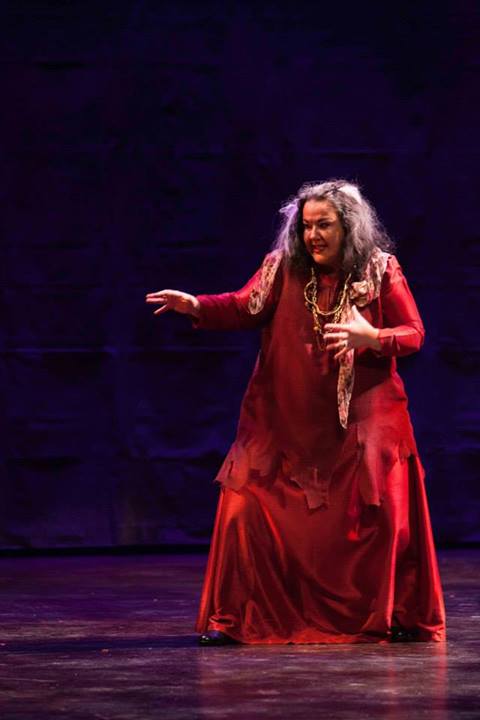
Kristine Dandavino as Azucena in Opera York's Il Trovatore

Kristine Dandavino as Azucena in Opera York’s Il Trovatore.   Click picture for Opera York website.  (photo: Lance Gitter)


This is especially so with Kristine Dandavino who was an over-the-top Azucena, or in other words, giving us the gypsy woman the way the role is written.  We watched an interpretation so blatant as to resemble a throwback to Verdi’s time, an authentic piece of melodrama always in character.  The voice is startlingly powerful with a few soprano high notes interpolated, and an amazing chest voice.  Her work in Act II was so chilling the audience was too stunned to applaud at the end of her big –and brilliantly sung—aria “stride la vampa”.

Paul Williamson’s Manrico was much more about the voice than the dramatic characterization, which –again—is consistent with how I believe the work should be done.  We watch someone whose emotions turn on a dime, someone who—like Siegfried or Rhadames—believes what he’s told, a hero whose reactions are instant and genuine, without intellectual depth.  This too is exactly what the melodrama requires, particularly the luscious line and the high notes.

Nicolae Raiciu was the most enjoyable Count di Luna I think I’ve ever seen.  I should mention that I believe this role is largely un-singable.  With a full orchestra (rather than the 22 players in a tiny house) much of the role tends to get drowned out.  Di Luna is a jerk, a jealous obstacle in the plot whose actions are unsympathetic in any presentation attempting to give the characters depths.  While I loved Russell Braun’s singing & sophisticated portrayal with the COC, it ultimately made little sense because the opera doesn’t reward three-dimensional characterization.  Raiciu was savage, as jealously romantic as a French apache dancer.  Yes, the smaller orchestra changes everything, but in fact Raiciu had lots of voice with a spectacularly full top.  Di Luna often sounds like a bizarre hybrid, a transitional creation from Verdi that’s partly bel canto, and at times has to honk out impossible lines during ensembles.  This is the first time I’ve ever heard those notes.  In fact I could hear everyone clearly.

Rachel Edwards had some great moments, especially in the last act, and was very good dramatically.   Henry Irwin was a very dynamic Ferrando, especially in his big scene at the beginning. Also rounding out the solid ensemble were Sarah Hicks, making a lot of the small part of Inez and Richard Iannello, a very sweet-voiced Ruiz.

On balance I believe Opera York should be very proud, a company gradually building a foundation for the future.  Vacca kept things moving at a brisk pace, getting a lovely sound from this small orchestra, easily filling the intimate theatre with more than enough power, and delicacy when necessary.  This is an opera company with a great future.

Posted in Opera, Reviews | Tagged , , , , , , | 1 Comment

Songs in the key of F Mayor

Meaning is where you find it.

Toronto’s mayor is bigger than ever.  He was always large, but now he’s becoming an international icon.  If he wanted it, I’m sure a reality TV show could follow His Worship and his brother around town.  The talk shows are waiting for him if he’s willing to go there.

And the whole time it appears that support for our mayor is growing.  No wonder, when the chief issue is not finances or gravy or libraries, but Ford himself.  He is the biggest issue. All the others who would run define themselves by him.

In the meantime I’m seeking solace in various pieces of music, presented herewith as a kind of therapy.  Can music help?  I got the idea from John Terauds of musicaltoronto.org  If you’re anything like me, you’ve had enough headlines & humour. The joke’s on us.
I present these examples without prejudice, and in each case, with a title that I hope connects it to current events.

“News” 

“But who are you, actually?” 

This is a longer segment from Verdi’s Otello, directed in his usual over-the-top way by Franco Zeffirelli.  Cassio leers after Desdemona.  Otello sees it and so does Iago.  So let’s have a drinking song, some drink, and poor Cassio gets drunk. Before you know it everyone is laughing at him.  He’s set up by Roderigo & Iago. Moments later –after the foolish fight—Otello comes out angrily, demoting Cassio.

“Drink & reputation go hand in hand.” 

“A bully” 

“And the bullied.”

Thank you Adams, Beethoven and Verdi three times.

Posted in Personal ruminations & essays, Politics | Tagged , , | Leave a comment

Reinventing the audience

No, I am not reinventing,  I am the anthropologist busily observing, and seeking to articulate something that’s out there among the specimens.  Humanity –at least the western version thereof—are busily changing the social consensus.

Surely the changes have been underway for decades, like the movements of subterranean tectonic plates.  The young are flexible, mobile, active.  When they change they influence everyone, including their immobile elders, who—no matter how they may deny it—regularly imitate youth.  I’ve seen more upheaval in the past ten years than in the previous forty, but maybe it took a kind of critical mass for any of that to surface.  And then again when society is reinventing itself, the last place this manifests itself is in the concert halls & opera houses I frequent, performances where the average age is somewhere around 60.  If I don’t miss my guess, the consensus –itself an unspoken set of assumptions that were never really discussed—seems to be changing.

I made a list of remarkable moments, not in any special order.

  • Tapestry Briefs a few weeks ago offered a series of short operatic experiments.  The premise was a kind of theatrical speed-dating, where composers & librettists were mixed & matched, in search of theatrical gold.  Leaving aside the texts, in production several of these played with our understanding of the interface between audience & performance.  The most troubling moments were confrontational.  In one, a performer sang about her fertility in a narrow space resembling a birth canal, surrounded by uncomfortable auditors.  In another the singer dialogued with someone just stabbed by a machete (and yes it was really uncomfortable).
  • Bruce Barton’s YouTopia used a set resembling a jungle-gym both to enable aerial work and a kind of sculptural commentary on our civilization, while putting us in headphones for a layered soundtrack.
  • I was a guest at Figaro's Wedding

    I was a guest at Figaro’s Wedding

    Toronto Summer Music’s Minimalist Dream House Project dared to take its audience out of their comfort zone.

  • Einstein on the Beach (receiving its final performance just a few weeks ago in LA, after touring around North America the past couple of years) encouraged us to go in and out as we pleased.
  • Stewart Goodyear’s Beethoven Marathon created a happening out of a concert, reinventing (at least temporarily) the role of the virtuoso along the way.
  • Sasha Lukac’s production of Move(me)ant. The Marat/Sade Occupied at York University in 2012 incorporated social media.
  • Figaro’s Wedding by Against the Grain Theatre, in a Queen West space, was the highlight of the early summer.  For much of the evening we could have been at an actual wedding.  I shared a picture of myself taken during an intermission next to a wedding cake on Facebook.

There are really several audiences of course.  You don’t see the same behaviour at bars as at theatres or concert halls, and again, it depends whether you’re listening to ear-splitting rock, jazz, or classical.  As a super-vocal loudmouth I am regularly at a loss to know how to behave when I change milieu.  Friday night’s concert at Gallery 345 was in the land of clapping and the occasional bravo, whereas yesterday’s play in Tarragon’s Extraspace was in the land of the woot-ers, a curious species of enthusiastic creature who aren’t really very loud –I can’t woot 1/10th as loud as I can bravo—but well-meant.  Of course when the woots morph into screams –and yes I mean my own—we can be much louder.  Pardon me if this sounds critical, but all I’m getting at is that each group seems to have restrictions and unspoken boundaries they don’t transgress.  In some places –for instance in the jazz world—you clap immediately when you love something, no matter what’s happening.  The last parts of solos are often drowned out by raucous applause.

I wonder, then, is the movement of those tectonic plates I spoke of partly because of the intersection of strata?  There are age strata of course, where the old meet the middle aged meet the recently young meet the young, or the cultural strata, where woots meet bravi meet screams or other sorts of cheers.

Okay, let’s stop this discussion for a moment.  You probably think that the good old days are gone now, the time when nobody would dream of texting during a film or a play because those devices hadn’t been invented.

But no, I actually long for a return to a golden age of a different sort.  I long for a time much more remote from our own.  Nevermind those quiet audiences.

At the premiere of Hector Berlioz’s Harolde en Italie, a wonderful concerto for viola with a program based on Byron’s poem, the audience asked for encores of the middle movements.  I love it so much, why wouldn’t they want to hear it again? We play tracks on our CDs over, why not in a concert?

We live in a funny time, when we’re told that there’s no applause between movements of symphonies.  The concert I was at Friday night, Ernesto Ramirez sang a series of Mexican songs that by usual practice call for applause at the end of the group.  My hands kept wanting to applaud, partly because he was so good, partly because it’s simply un-natural to hold our applause the way we are always told to do.  At a few points in this concert, attended by at least a few family members, applause erupted in the middle of groups of songs, and protocol be damned.

We have much to unlearn.  While mobile phones are spoken of as a curse, I am loving this dogfight between the rules for repressing human impulses, and those unquenchable impulses.

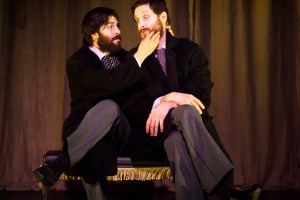
Adam Paolozza and Viktor Lukawski in The Double (photo by Lacey Creighton)

Adam Paolozza and Viktor Lukawski in The Double (photo by Lacey Creighton)

I close with a quote from Viktor Lukawski, whose words in the talkback for The Double and afterwards in conversation largely stimulated me to write all this.  Speaking about the contrary human impulses we observe in a theatre, we were discussing the different responses humans make in different places, the respectful crowd that in some places resembles a church congregation afraid to let loose, and the inter-generational thing I alluded to.  In fact this whole essay is really just expanding on what he said so succinctly.

We’re trying to fight against the “church congregation”. Hopefully, by doing this kind of work, and the cabaret-style itself, allows people to relax those stiff shoulders. The idea is to make it feel like you’re watching a concert, rather than some period piece. … Maybe then the inner wild high-schooler might have come out in the older audience! 

We shall see.  And hear.

Posted in Personal ruminations & essays, Popular music & culture, Psychology and perception | 2 Comments

Late to the party: The Double’s Trio

Getting to Tarragon Theatre’s Extraspace 20 minutes before the start of The Double, would have been early for most shows in Toronto.  But all the good seats were gone, and so we were forced to sit near the back.  I’m late to this party.  I missed TheatreRun’s production of The Double last year.  And today an admiring crowd beat us to the good seats.

Whatever else one says about The Double first and foremost, this is a hysterically funny show, powered by elegant performances.  When they told us at the talkback that for high-school kids the show becomes complete pandemonium, I totally got it, speaking as someone who struggled to make sure my laughter didn’t cover any witty lines.  I came out of the theatre as high as a kite, wondering what I might have felt in the front row, where the wackiness would have been right in my face.

Based on Dostoevsky’s short story, The Double is a one of a kind experience, a whimsical adaptation that restores my faith in the theatre and its magic.

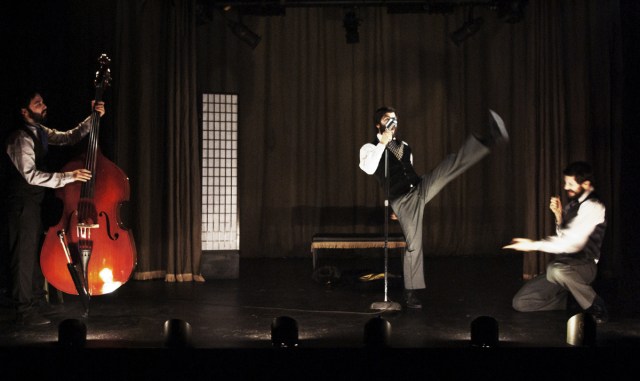
Created & performed by Adam Paolozza, Arif Mirabdolbaghi & Viktor Lukawski, directed by Paolozza with original music by Mirabdolbaghi, this is a self-reflexively theatrical creation.  Theatre nerds will feel like they’ve died & gone to heaven with this show, a virtual compendium of the many ways to make you laugh & create illusions, and no wonder considering the delightful nerdiness of the creators.  Sometimes it’s verbal, sometimes it’s vocal, sometimes it’s visual, sometimes it’s physical, and always it’s delicately balanced on the edge between a kind of psychological truth & existential horror.  Dostoevsky anticipates the psychiatric breakthroughs to come in Freud & Jung, although this story (supposedly a failure in the lifetime of the writer) is so far ahead of its time as to seem a foretaste of Woody Allen or perhaps the Marx Brothers, especially via the vaudevillian enchantment of this trio.

Mirabdolbaghi’s bass acts as self-effacing back-up to the onstage shenanigans, when he isn’t himself in the spotlight as the narrator.  In the talk-back session Mirabdolbaghi spoke of a parallel he saw, between the curious awkwardness that a string bass player might feel, finding himself suddenly all alone onstage–divorced from his usual role in support of the melodic instruments such as violin or cello—and the character of Golyadkin.  It’s one of several happy accidents.

Adam Paolozza (photo: Lacey Creighton)

Adam Paolozza (photo: Lacey Creighton)

Paolozza is Golyadkin, the man who may or may not have a double, although it is certain that Paolozza delineates two very distinct characters & voices in the same body.  We’re unable to tell for sure whether he’s delusional, even in those moments when he and his double share the stage.  We’re sometimes in a realm of shadows or vaudeville silliness, sometimes watching a radio-play with overdone foley sounds created by hands and voices.

Lukawski –like Paolozza a graduate of Ecole Jacques Lecoq—plays everyone.  I mean, yes he plays everyone else, but at times, when Paolozza is trying to be two people, Lukawski even jumps in to momentarily be Golyadkin: one or the other version.

I can’t help thinking about narrative devices in adaptations, as I’m currently watching a stylish BBC serial of Dickens, using expensive costumes, horses, and authentic buildings. When story-telling makes the jump to the stage, one has several possible choices, combinations of enactment & mediation, depending on what sort of reality one seeks to create and how much money one has at one’s disposal.  In this instance, we’re watching the impossible enacted not through expensive mise-en-scène, but at low cost with the aid of our imaginations, invoked through a clever use of theatrical devices and aided by a wittily ironic narrator.

Less is more, although it helps to have physically gifted performers.

There’s a  segment near the end of The Double that reminded me of a sequence right at the beginning of Tom Stoppard’s Jumpers.  Stoppard’s heroine suffers a kind of cultural overload, free-associating clumsily through a series of songs to do with the moon.   I was reminded partly because I had the unfortunate task of playing forensic music-director, trying to re-construct something coherent from a text resembling a crime scene (as we try to put together how to make it work as it did in that first production).  In The Double, we don’t begin as Stoppard did, in the place of incoherence and find our way towards a kind of logic; instead we begin in a place of relative order and move deeper into the realm of the subconscious.  We watch a stand-up comedy routine that seemed to be brain-stormed around the idea of someone who thinks they have a double.  There were famous Rat Pack songs, and “Who are You” from The Who. Sorry, I was too busy laughing to remember the song names!  Yes these are anachronistic, like the reference in the first minute of the show to Gordon Lightfoot, which is to say, they’re part and parcel of a witty & theatrical approach to story-telling, not a BBC costume drama dripping authenticity.

The text? As a creation from a collective, it’s marvellously coherent now, but I have to wonder how it could possibly be documented, and whether anyone in future will be able to capture the quicksilver magic of this perfect trio, exquisitely balanced.  What we saw was astonishing, leading me to wonder how it would be recorded for posterity, and whether the musical component would be scored with the text—as though it were a musical or melodrama—or simply implicit in a few stage directions.

As I said, I’m late to the party.  Toronto’s theatre crowd know about this show, because they were all there before me, grabbing all the good seats.  But you can still see the brilliance of the trio who present The Double if you’re quick, as this amazing show runs until November 24th (click photo for more information).

Left to right, Arif Mirabdolbaghi, Adam Paolozza,  & Viktor Lukawski (photo: Lacey Creighton)

Left to right, Arif Mirabdolbaghi, Adam Paolozza, & Viktor Lukawski (photo: Lacey Creighton)

Posted in Dance, theatre & musicals, Reviews | Tagged , , , , | 5 Comments

Bogdanowicz & Ramirez: a common language

I met some new people tonight.  Some of them were singers, some were composers, and everyone got along beautifully in several languages.

Mezzo-soprano Michèle Bogdanowicz

Tonight Michèle Bogdanowicz and Ernesto Ramirez sang a quintessentially Canadian program at Gallery 345, with pianist Rachel Andrist.

It’s an old truism that the difference between Canadians and our American neighbours is that their social fabric is a melting pot, in a country with a solid national identity that demands allegiance, whereas ours is a mosaic that doesn’t require you to sacrifice your heritage.

In the past year I’ve seen examples of artists finding inspiration in their own parentage.  Last week I listened to Beatriz Boizan’s authentic Cuban piano playing. A few months ago, I reviewed an album of Estonian songs sung by Stephen Bell exploring his roots in that community.

Tonight was even more intensely multi-cultural, given that there are two nationalities in the marriage of the Polish Michèle Bogdanowicz and the Mexican Ernesto Ramirez.  The tension between their ethnicities electrified the concert.

They began the concert on neutral turf with an aria from a Mozart opera.  In some respects this was the most remarkable performance of the night, as Bogdanowicz sang “non piu di fiori” from La Clemenza di Tito, an operatic aria including a clarinet obbligato: played by Ramirez.  I’ve never listened to the aria this way before, watching a man play those soulful passages that seem to unfold all the emotion inside the soul of the woman standing beside him, the woman to whom he’s married.   While that was the last operatic item on the program, there was much more drama to come.

Bogdanowicz next sang Poulenc’s eight Polish Songs, a remarkable series of apparent folk melodies accompanied by rhythmic piano passages that often sound like Chopin.  Other than visits to a Polish church,  I can’t remember the last time I heard someone sing in Polish.  These are stunning compositions that I wish I’d heard before.

Bogdanowicz followed with a special treat she’d prepared to honour her father, namely Four Lyrical Moments. This was a commission of original Polish songs composed for this occasion by Norbert Palej, setting texts of Halina Poswiatowska, a young Polish poetess.  The songs were passionately melodic, subtly capturing the powerful texts.  Bogdanowicz seemed especially comfortable with these songs.

Bogdanowicz began the second half with some of Viardot’s transcriptions of Chopin for piano & voice.  Here, as in the Poulenc, Andrist’s subtle playing never pushed the piano into the spotlight, her rhymic clarity supporting the songs, without ever upstaging the singer.  Bogdanowicz’s dramatic abilities shone in songs that were by turns dark¸ droll, or dynamic.

Tenor Ernesto Ramirez

Then I heard Ernesto Ramirez for the first time (unless you include his clarinet playing), a pleasant discovery indeed.  This is one of the  most melodious voices I’ve heard in a very long time, an effortless sound that was a constant joy to hear.

The final numbers were duets by Viardot, an especially romantic meeting ground, with two transcribed from Chopin, followed by a Habanera.  But in the end they always had a common language, namely music.  And now I wonder if I will ever hear anything like that again, whether in a recording or concert.  I hope to hear Bogdanowicz & Ramirez together again someday.

Posted in Music and musicology, Reviews | Tagged , , , , , , , | 9 Comments

Live Light in the Piazza

On June 15th 2006, Beverly Sills welcomed the television audience to the Vivian Beaumont Theatre for a live performance of The Light in the Piazza.  Yes, I was busy that night in June 2006, unaware that I should have been watching.  A few weeks ago I saw and reviewed a production of Adam Guettel’s musical here in Canada, posing that classic question: are the weaknesses because of the text or the production?

It’s not often that such questions can be answered so conclusively. Wow.

A kind friend, seeking to answer my question made the performance available for my viewing.  Too bad this magical performance hasn’t yet been offered as a DVD, but perhaps that omission will be corrected someday.

It’s counter-intuitive. One would not expect that a production in a larger space employing a larger band would be subtler.  But when you think about it, that’s precisely what orchestras offer in place of chamber music, provided that the conductor keeps them under a tight rein.  If I can hear the separate parts in a string quartet as though they were soloists, that grabs my attention in a way that blended strings will not.

They –the local production that I reviewed—lost me early.  The Light in the Piazza has a magical premise for a musical.  We watch & hear miscommunications all night.  When the lead steps on stage as a young Italian, singing in Italian, and supposedly unable to understand the sweet American girl visiting Florence, if we don’t believe his accent, the whole evening is shot.  Sorry folks, I go to opera a lot.  I see professionals, mostly Canadians & Americans, who manage to sing Italian phonetically.  It’s just not good enough to hire a handsome young man for his good looks if he can’t make me believe he’s Italian.

In contrast, almost everyone in that American production was so easy to believe that I felt like a foreigner in Florence: as I should.  I shouldn’t be sitting there thinking “he’s a good singer whose accent is bad”.

Patti Cohenour (photo by Thomas Bliss)

The one singer whose Italian accent was merely passable, rather than fluent, must deliver the funniest lines of the entire night, namely Patti Cohenour as Signora Naccarelli.  And wow she nails those lines stopping the show when, in the middle of “Aiutami”, the hysterical number in Italian, is interrupted by her deadpan translation. Fabrizio, the young man on the verge of heartbreak, should be hysterical.  The rest of them should be much drier and more restrained in comparison, that this number is first and foremost about him.  Unfortunately that’s not how the local production did it but wow, listen to this one. Cohenour manages to be upset and detached and sexy all at once.  Amazing.

It’s a dream cast in a dream production.  The subtlety of their reading is easier to see when you’ve been to another production.  Victoria Clark’s vulnerable reading of Margaret Johnson, alongside the understated reading of Chris Sarandon as Signor Naccarelli –including a stunning kiss—makes so much sense.   Katie Rose Clarke, the Clara on the broadcast, is especially compelling dramatically, rather than vocally.

Distance serves this production well, in a bigger theatre.  Putting it into a smaller space with a smaller ensemble is risky without a very clear vision.

You can find much of this production available on youtube, but I sincerely hope the broadcast will be made available on DVD, if only for its advocacy on behalf of Guettel (music & lyrics) & Craig Lucas (book).

Posted in Dance, theatre & musicals, Reviews | Tagged , , , | 5 Comments

O Gamelan

“Press releases and announcements” are presented verbatim without comment.

O GAMELAN

An exotic evening blending Traditional Indonesian & Modern Western Sounds
Sunday, November 17, 2013 at Koerner Hall

For Immediate Release: October 30, 2013 – Toronto, ON: On Sunday, November 17, Esprit Orchestra returns to Koerner Hall with O GAMELAN, an evening of music influenced by gamelan or combining gamelan and orchestra. Esprit shares the stage with Evergreen Club Contemporary Gamelan. Toronto’s unique group of eight musicians continues to expand and develop gamelan repertoire by interspersing traditional Indonesian techniques with contemporary Western ones. The colourful program is highlighted by the premiere of José Evangelista’s O Gamelan (commissioned for the occasion), and Chan Ka Nin’s Éveil aux oiseaux. André Ristic’s Projet «Peuple» for gamelan and orchestra, Lou Harrison’s Threnody for Carlos Chavez for viola and gamelan (spotlighting violist Douglas Perry), Scott Good’s arrangement of Claude Vivier’s Pulau Dewata and Alex Pauk’s Echo Spirit Isle round up the evening. Esprit’s 2013/14 season is sponsored by BMO Financial Group.

Hailed as “One of the world’s leading performers of contemporary music for gamelan”, the Evergreen Club Contemporary Gamelan is an ensemble of eight highly skilled Canadian musicians who perform and record using an assortment of bronze and wooden instruments from Indonesia. Collectively these instruments are known as a gamelan – a traditional instrument ensemble that plays an important role in the Indonesian culture. Formed in 1983 and based in Toronto, Evergreen Club is a unique performing ensemble dedicated to the development and expansion of its repertoire through the commissioning of new works from Canadian and International composers, and interpreting traditional and contemporary Indonesian pieces. Visit http://www.evergreenclubgamelan.ca

The concert’s title evokes José Evangelista’s work, O Gamelan. “Gamelan comes from Javanese gamel, hammer. It designs a variety of Indonesian ensembles where tuned percussion instruments predominate,” he explains. “The gamelans of Java and Bali are the best known and probably the most sophisticated. Traditionally, Javanese music is slow and meditative, Balinese music is noisy and strongly rhythmic. Since I became acquainted with gamelan music I thought of it as an ideal in music: the textures are refined and complex still the music is often direct and catchy.”

Chan Ka Nin’s Éveil aux oiseaux is written for 11 western instruments and 9 Gamelan instruments. The sound worlds of East and West are pitched against each other at the beginning and later combined to a uniquely transformed sound. This signifies the “awaking of the birds”, a childhood experience the composer had when he was growing up in Hong Kong. He remembered that every morning he was wakened by hundreds of sparrows dwelling in a big mango tree next to his home.

Lou Harrison’s gamelan compositions always bear a personal stamp. The American musician (1917-2003) began composing for traditional Javanese and Sundanese gamelan instruments in 1976, soon using the gamelan as a backup orchestra for Western solo instruments. Among the earliest pieces to call for this type of cross-cultural mixture was the 1978 Threnody for Carlos Chávez for viola and Sundanese gamelan. This Esprit performance spotlights Toronto violist Douglas Perry.

A stay in Bali in 1976 marked a turning point in Claude Vivier’s career.  Most of the subsequent works were to show the influence of the atmosphere of this Pacific island, whose inhabitants call it the “Island of the Gods,” or Pulau Dewata. This is the title given by Vivier to a work specially dedicated to the people of Bali.  “I wanted to write a piece imbued with the spirit of Bali: its dances, its rhythms and, above all, an explosion of life, simple and candid”, wrote Vivier.

André Ristic’s work, Projet «Peuple» for solo doublebass, small wind orchestra and gamelan ensemble was written in 2005. The young Quebec composer describes his music as «a kind of rhythmical shuffle-zapping of elements taken from a collection of instrumental phantasms, often times resulting in self-cannibalism of the music itself, one of the musical ideas ending up devouring all the others».

“I made an in depth study of Javanese gamelan music and had become fascinated by the vitality and richness of the genre”, says Alex Pauk, stating that Echo Spirit Isle “is not intended as an imitation of the gamelan, but rather is designed to transform the essential qualities of that music into an orchestral experience with its own unique frame of references.”

O GAMELAN
Sunday, November 17, 2013
8:00 p.m. Concert / 7:15 p.m.  Pre-concert Talk
Koerner Hall / Royal Conservatory of Music TELUS Centre for Performance and Learning

273 Bloor Street West, TorontoFor tickets
(Regular: $55/Seniors: $50/Under 30: $20),
Please call (416) 408 0208 or visit
performance.rcmusic.ca
For more details: www.espritorchestra.com

Posted in Press Releases and Announcements | Leave a comment

R.I.P.

“Requiescat in Pace” is the last line in the third of three operas presented by Opera 5, namely Cecilia Livingston’s The Masque of the Red Death, whereby we had the name for the evening’s program. I wonder if Poe’s story ends that way? I do know that “In pace requiescat!” is the last line of Poe’s story “The Cask of Amontillado”.  I suspect the phrase could fit somewhere into any of his stories.  Note, that in Latin one can reverse the order of the words without disrupting the sense.

And so “RIP” is what i shall call this trio of operas based on stories by Edgar Allan Poe.

I’ve always felt that I prefer performers whose ambitious striving leads to errors, rather than a more cautious perfection.  Professionalism in this country often leaves us with polished performances whose shiny surfaces belie the lack of heart on the inside.  Notwithstanding a boldness that sometimes leaves RIP teetering on their tightrope like a circus act, RIP is so very bold, taking us to three very different places, both because of the divergence in story, in compositional strategies & dramaturgy, but also in the mise-en-scène.

We began with Cask of Amontillado by 20th Century American composer Daniel Pinkham.  The story I remember builds to a climax, as a man is locked into a vault, crying out for mercy, but none is shown.  The intriguing choice made by director Aria Umezawa was that the party revellers from earlier in the story become in effect part of the set, as though they are the vault.  It’s a fascinating choice, one that alienates us from the horror in the story, making us instead party to the fury of Montresor, and reducing the outcome to something a bit more comical rather than genuinely horrible.  From the beginning –because we’re seeing a Poe story enacted rather than simply told—we not only see the set up for Montresor’s plan and his cold calculation, but an added layer of alienation because of the use of chorus.  I wondered how Pinkham wanted the story enacted for his opera, and what he’d say about this presentation; or did Umezawa give us exactly what Pinkham specified? Either way I found it very clever, and portraying an additional layer of horror in the implacability of the chorus.  The alternative –showing the actual erection of layers of masonry–would be very difficult (and expensive) to achieve on a stage.

Baritone Adrian Kramer

Baritone Adrian Kramer

Second up was none other than Claude Debussy, in his thrilling La Chute de la Maison Usher, the one that felt truest to the spirit of Poe.  In places it was as though Golaud was visiting from Allemond, although the textures were just a bit crazier, the harmonies more chromatic than Pelléas et Mélisande.  .In this one especially I was very moved by Adrian Kramer, a voice I’ve missed since he left the COC Ensemble, likely working outside of Toronto.  His singing was stylish,  while his dramatic presence was always a quantum leap above everyone else in the show.  He was at the centre of a charming directorial conceit for the triptych, whereby each story was introduced by a small passage read aloud from a story, grounding us in Poe before we moved into the operas.  It was good to see Kramer back on a Toronto stage.

Where the first two operas were done with piano, led by Opera 5 music director Maika’i Nash, The Masque of the Red Death was done with a small orchestra led by Constantine Caravassilis.  In some respects the first two were like a prelude to the third work, which was a more serious effort in every respect.

Livingston’s opera is in a pragmatic mix of styles, sometimes sounding like Kurt Weill when the raucous chorus was singing, sometimes more like Philip Glass when the pattern music kicked in.  I say “pragmatic” because the styles work with the textual requirements of the libretto.  Linvingston’s arioso is very easy to understand, even in the passages building to a powerful climax.

Opera 5’s program “In Pace Requiescat” continues October 30th & 31st at the Arts & Letters Club in Toronto. Click picture for more information.

Posted in Opera, Reviews | Tagged , , , , , , , , , , | 2 Comments

The Italian Lesson

Yesterday I was on the University of Western Ontario campus, attending a special performance of Lee Hoiby’s The Italian Lesson in a production from Diva Lounge Productions.  UWO welcomed back alumnae Sonja Gustafson (soprano & Diva Lounge founder) and Tanya Ellis (pianist), in a remount of a show seen in the recent London Fringe Festival.

Sonja Gustafson  ( Sylvia Mioduszewka –fiveonenine photography)

Sonja Gustafson ( Sylvia Mioduszewka –fiveonenine photography)

The Italian Lesson is an attempt to capture monologist Ruth Draper.  The words belong to Draper, famous for her flamboyant one-woman shows in the first half of the 20th century.  Hoiby set a text organized by Mark Shulgasser, even if the words of the libretto are Draper’s rather than Shulgasser’s; the “libretto” credit is Shulgasser’s even if he is self-effacing about his role.

The piano part is like nothing I’ve ever heard.  I want to make an analogy about the relationship between the voice(s) & the piano part, thinking of this as a kind of sonic canvas upon which composers paint operas.  I’d usually think of the orchestra –or our virtual impression of the orchestra via a piano arrangement—as representing the background, perhaps giving us the horizon line for a portrait painting, or the three-dimensional microcosm that encloses the voices.  Normally we expect the orchestra to hit notes both higher and lower than the voice, playing both before and after entries of voices.  Usually it’s an unequal comparison, the voice being like a boat or a swimmer afloat in a larger body such as a lake or ocean, sometimes overwhelmed by the power of that larger body.

That’s not what Hoiby did in this case, not by a long shot.  While it’s true that the piano begins & ends the piece, the balance is much more equal than usual.  Ellis’ piano is so understated that at times her notes are like a thin cracker almost imperceptible under Gustafson’s hors d’oeuvre spread on top.  The monodrama is truly the whole show.  Hoiby knew what he was doing.  The effect is that the voice –which is to say, the monologist— seems to be the creator of the monologue, her sentences emerging as distinct musical thoughts: as you’d hope.  It’s a remarkable achievement because we’re not aware of the presence of a composer’s ego (or style, which is more or less the same thing) in the music, interposed like an unwelcome presence via ostentatious writing.   No.  Hoiby creates a delicate texture that is just enough to shape a musical characterization of Draper, but always puts the monologist front and centre of the stage and all over the score.

I found myself swept up in the work & its texture, as much in awe of the elegance of the writing as I was enthralled by the light textures between Gustafson & Ellis.  One has to wonder in the presence of a new work whether what one is encountering is really in the text or might be due to interpretive choices from the artists.  The freedom with which they worked had me wondering about the way the score is notated, particularly whether the text encourages a piacere attacks.  The spontaneity in Gustafson’s performance and Ellis’ effortless following had me wondering if this was all in Hoiby’s score or something of their own.

Whatever the origin of the effect, whoever is responsible (likely all four: composer, librettist, singer & pianist) I believe Draper is well-served.

Shulgasser may have been addressing this sense of fluidity & freedom in a remark he made in our recent interview:

“The Italian Lesson” is certainly a very niche-y piece and perfect for the kind of singer that Sonja Gustafson is, who blurs the border between cabaret and opera. (I can’t actually remember when it was last done with orchestra.)

The piece and the artist are a good match.

Hoiby’s score seems to suggest that Draper’s persona is really multiple personalities, a series of voices that show different aspects of this woman, as she puts on different masks.  Gustafson literally sings with a few different timbres, teasing us with several colours.  Sometimes she’s doing something more like sprechstimme, sometimes it’s a bit of a croon, sometimes the line is from a pop-singer, sometimes fuller & boldly operatic. The colours are sometimes light, sometimes dark, and everything in between.

I’m hoping the project was recorded.

Composer Lee Hoiby and his partner/collaborator Mark Shulgasser at The Falls, Long Eddy, New York.

In the meantime –and this has no connection to Diva Lounge or Gustafson / Ellis—Shulgasser also told me of an uncoming New York production of The Italian Lesson December 6-8, by Darynn Zimmer, accompanied by Ted Taylor, directed by Beth Greenberg. (http://eastharlempresents.org).

I’m delighted,  This is a work deserving to be heard.

Posted in Opera, Reviews, University life | Tagged , , , , , , | Leave a comment

Opera Atelier Abduction from the Seraglio

I had a wonderful time at the dress rehearsal for Opera Atelier’s new Abduction from the Seraglio.  It’s a remount but as usual they probed more deeply this time, accentuating the comic elements of the work.  Anyone who’s seen this opera expects to laugh in certain places, such as Osmin’s aria where he speaks of hanging or in Pedrillo’s serenade.  Without giving anything away –and spoiling the laughs—let’s just say that Marshall Pynkoski makes you laugh in places you wouldn’t expect to laugh.

This is a company with some claim to authenticity in terms of its use of period dance, movement, singing and an orchestra playing a historically informed style, yet this production is clearly meant for a modern audience, as seen in surtitles referencing “shagging” and “getting it on”

Pynkoski addressed misconceptions in a recent interview:

We are eager for people to understand that Opera Atelier is not a museum and our productions are not artefacts. A period production is simply an opportunity for us to challenge ourselves in a new way as artists in the 21st century. We explore the aesthetics of other eras and cultures in order to help us look to the future. Our recent production of Lucio Silla for the Salzburg Festival was greeted as one of the most radical productions to take place in Salzburg for decades.

A period production is the new avant-garde of the 21st century.

Opera Atelier make marvellous use of their dance troupe during comical set-pieces.   And so we see baroque dancers brandishing instruments of torture.  We see a farcical kidnapping enacted during the overture.

I was struck by an absurdly ironic thought tonight.  Opera Atelier use ballet more than one might expect.  Across town, the Canadian Opera Company seem to avoid using dance even in works –for instance their recent Aida—where one would expect to see dance.  Otherwise their repertoire seems to deliberately avoid any grand operas that include ballet.  Of course dance is expensive: even when you happen to have dance personnel in your company.

It’s a funny town.

I keep harping on a theme that obsesses me.  Those who show up with stipulations—especially the critics—will miss what’s right in front of them.  So maybe it’s true that Marshall & his choreographer co-artistic director Jeannette Lajeunesse Zingg give us dance in unexpected places, and more than we might expect (and more than some people might like).  But it’s often in the service of the comedy or the story-telling, and always in step (excuse the pun) with the score.

Singing in German with English dialogue, the cast was strong throughout.  Lawrence Wiliford is a wonderfully elegant Belmonte, contrasted by the likeable comedy of Adam Fisher as his sidekick Pedrillo.  Gustav Andreassen as Osmin & Curtis Sullivan as Pasha Selim are a formidable pair, who manage to be intimidating but never too scary.  Andreassen is physically and vocally a wonderful clown, while Sullivan’s Pasha has the requisite dignity that we want to see, particularly in the last scene.

Soprano Carla Huhtanen (photo: Tobin Grimshaw)

Soprano Carla Huhtanen (photo: Tobin Grimshaw)

Carla Huhtanen always impresses me with her fluid voice, never off pitch even in a dress rehearsal, this time including an interpolated high note somewhere near Earth orbit.  She’s an artist of range & intelligence (often appearing with Talisker players or last month in Tapestry Briefs), and usually my favourite in whatever she does.

But Huhtanen had competition tonight, admittedly in a role where one expects fireworks.  Ambur Braid’s Konstanze met the challenges of her role in an unexpected way.  There’s the big aria “Martern aller Arten” for example, where one sometimes sees a singer gamely struggle.  Not only did Braid make it look easy (although  we should also credit conductor David Fallis in the pit for supporting his singers so perfectly that they’re easy to hear), but of course Pynkoski & Zingg make this hysterically funny.  I won’t say how.  Sometimes we’re watching overdone romance, a young woman in tears for her missing BF, sometimes we’re watching her defy her scary captors.  It’s wonderfully funny, owing much to Braid’s comic gift, which we saw amply displayed last year in Die Fledermaus.  Yes Braid can sing, but she’s very smart and never dull.

So naturally it’s another wonderful Opera Atelier production, opening Saturday.  The singers are good, Tafelmusik sounds ravishing throughout under David Fallis, and the ballet is charming.

I want to see it again.  Click the picture for information.

Posted in Opera, Reviews | Tagged , , , , , , , | Leave a comment