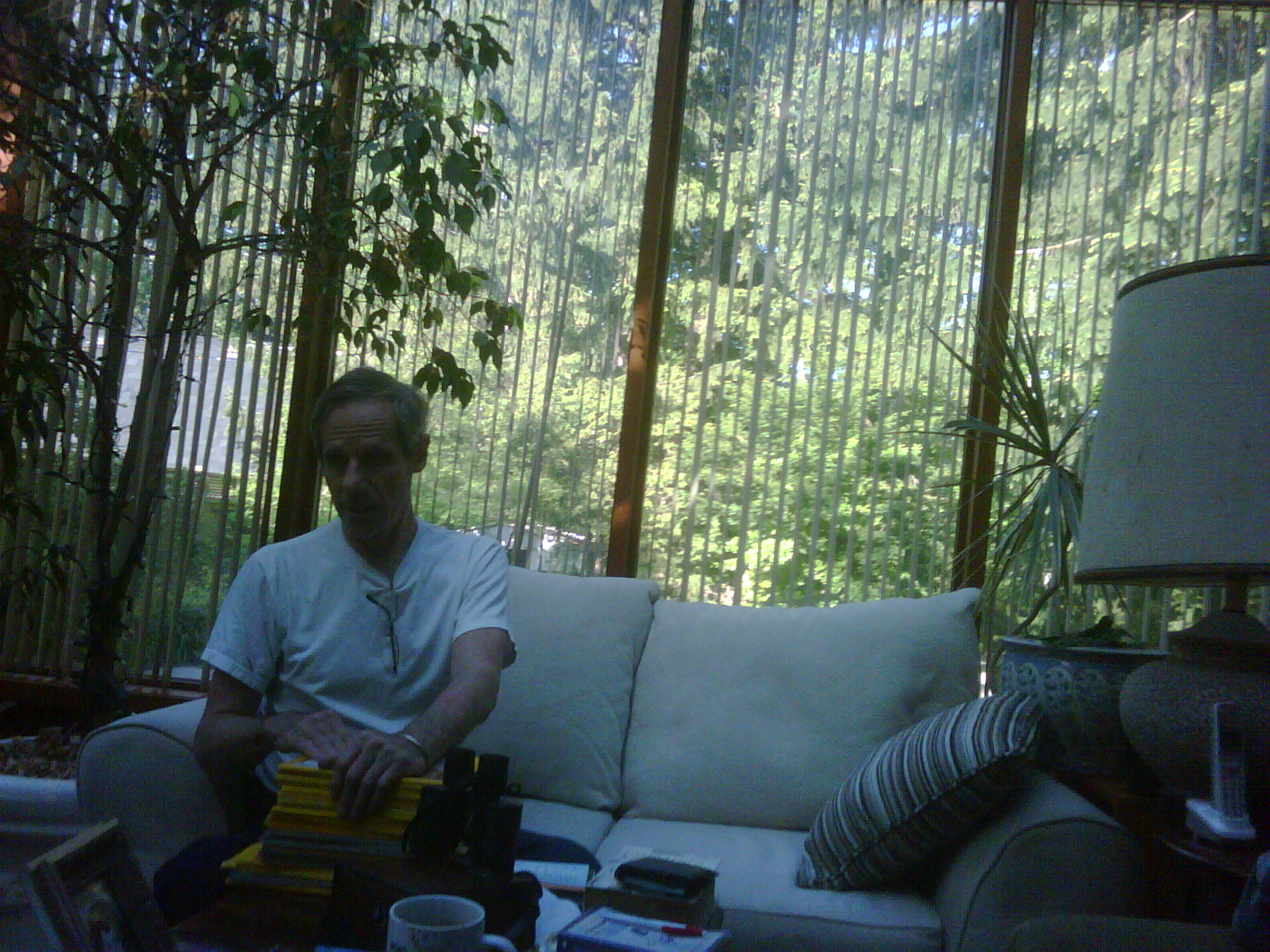
Brian Wyers: artist at work

It’s Victoria Day long weekend. Fireworks are exploding in my neighbourhood as I type this. It’s not fair to call it the Canadian equivalent to the 4th of July, as there’s no particular patriotism, no national myth underlying the date, unless you mean the relationship Canadians have with Britain and royalty.  To most of us the holiday means cottagers making their first visit of the season, examining the winter’s damage. We’re on the cusp of summer, even though there may still be a residual chill in the air, and even a mass of ice still floating on the lake (but that depends on how far north you get).

I went to visit my friend Brian Wyers, a painter I’ve written about a few times. I’ve been fortunate to visit him at home where I can see works in progress. I think we’re kindred spirits in a number of ways:

  • Arthritis: which means we both deal with pain
  • We both have a stiff-necked way of standing & walking
  • We both work very quickly.  Currently that’s the blog, although I could speak of plays & music compositions that I’ve pumped out very quickly; in his case it’s paintings normally done in a few days, or in the case of one he showed me today, a single day(!).

And I wonder if our pace is related to pain & arthritis..? Do we work quickly to avoid pain? Or are we in pain because of what we do?

skylitBrian’s dad, who was also present, made us tea. He makes excellent tea.

Brian talked to me about his artistic journey and the directions he’s been going. The paintings & the environment –particularly the skylit room where Brian works—led to various questions about art and the meaning of life. Brian is gradually learning to live again since losing his wife to cancer. His creative pathways seem to be a kind of mourning, and evidence of his gradual recovery & return to life.

Last fall I’d already commented on his enormous florals celebrating his love, and the first tentative paintings of bodies.

Brian explained that the florals have been a very congenial pathway, allowing the paintings to be done very quickly. By a happy coincidence, they’re in demand. In his self-deprecatory way, he called them “decorative”, recognizing that market forces don’t necessarily reflect the preferences of the art critic.

But he has ventured out of that lucrative comfort zone. Sometimes it’s in the most indirect and subtle manner, taking the floral subject into new, more abstract territory.

unfinished_whiteThis unfinished painting works from a photograph that Brian is using as his departure point. The work already diverges from the “source”, but employs a kind of ambiguity, in using an image that isn’t immediately recognizable as floral. The flood of white invading a dark field plus the tiniest bit of colour adds up to the usual Brian Wyers subject (likely as marketable as ever), but at the boundary of the representational.

outoffocus

There’s also “Peek-a-boo”, a tromp l’oeil game playing with the viewer, placing something suitably floral into a vase that’s deliberately out of focus (don’t blame the photographer).

foil

And then there’s a new work that’s much less representational even if the source is concrete. “Foil” re-creates the sensuous magic of –you guessed it—a piece of foil. In this case, the details required Brian to slow down a bit, requiring a third day of painting.

As I was leaving the painter admitted that while he’s still in mourning, it’s not the agony he felt before. He keeps painting.

Life goes on.

Posted in Art, Architecture & Design, Personal ruminations & essays | Tagged | 3 Comments

Book of Dialogues

Dialogues des Carmélites Dale Travis as Marquis de la Force and Isabel Bayrakdarian as Blanche de la Force in the Lyric Opera of Chicago production. Photo Credit: Robert Kusel © 2007

Dialogues des Carmélites
Dale Travis as Marquis de la Force and Isabel Bayrakdarian as Blanche de la Force in the Lyric Opera of Chicago production.
Photo Credit: Robert Kusel © 2007

Momento #1 of that production I haven’t yet seen was the DVD.  I reviewed it a few weeks ago, fascinated to see Robert Carsen’s take on Poulenc’s opera Dialogues des Carmelites in its La Scala incarnation from 2004.

I stumbled upon Momento #2 at the Edward Johnson Building’s Library at the University of Toronto, a treasure trove of scores, recordings and yes, books too.

The volume in question appeals to me mostly as a picture book, another by-product of the La Scala collaboration between Carsen & Muti that led to the DVD.  It bears the title Francis Poulenc Dialogues des Carmelites, and includes the names “Riccardo Muti” and “Teatro alla Scala” even though as far as I can tell, Muti did not write any of the essays in the book.  It’s atmospheric, conjuring up the time when the opera premiered in 1957: at La Scala.  Poulenc may have been thinking like a Broadway artist, trying his opera out in the boonies (ha… Milan would never see it that way) before bringing it to Paris.  Forgive me if this sounds impertinent.  There are many great photos of Poulenc, of the first production and the recent one on the video as well.

Ah but I suspect there’s a great deal of politics behind this book, especially after reading a fascinating blog post from Albert Innaurato this week. Clearly Muti had supporters and detractors, and maybe the book was itself a battle site, a skirmish between factions.  I’ll know better when i finish reading it.

Speaking of pictures, if one were to attempt to gauge the relative importance of the director or the conductor(or their power in the company) it’s 7-1, Carsen only managing to get into the same group bow with Muti on stage after the opera.  I would have liked to have seen something of the creative process; but then again, perhaps Muti did not like the production?

I regret that I won’t likely find out much more about Muti.  I recall surveying recordings of Le Sacre du Printemps decades ago, eating up the ear-candy of Muti’s reading with the Philadelphia Orchestra, its solo playing of stunning virtuosic clarity, the tuttis powerful yet supple; I found it a bit too self-infatuated, not unlike his photos (or maybe i’m jealous that he’s handsome as a matinee idol).  But to my youthful ear it was great fun all the same.

The grown up Muti is a man of more balance and reserve.  His Dialogues –as I observed—makes the case for the orchestra he’s built in Milan.    This is the man whose moving reading of “Va pensiero” –including his comments about cuts to arts funding as an attack on the country, and invitation to the audience to join in the encore—showed more integrity, and yes, cojones (sorry I don’t know the Italian equivalent) than any conductor I know of anywhere. 

Whatever the subtexts, it’s a beautiful book.  If you look for it online it’s still available new & used.

Posted in Books & Literature, Opera, Reviews | Tagged | 2 Comments

Figaro’s Wedding

“Press releases and announcements” are presented verbatim without comment.

FOR IMMEDIATE RELEASE: MAY 14, 2013
Against the Grain Theatre puts new spin on Mozart classic with Figaro’s Wedding

TORONTO (May 14, 2013) — Against the Grain Theatre (AtG), the daring indie opera company that has received critical acclaim for its unconventionally staged works, presents a brand new production of Mozart’s The Marriage of Figaro this spring, re-titled Figaro’s Wedding. Taking place at The Burroughes on Toronto’s Queen Street West, four performances will be presented on May 29, 30, 31 and June 2, 2013 at 7:30 p.m.

Staged as a real wedding with audience members as guests, the production is directed by Joel Ivany with musical direction by Christopher Mokrzewski. Marking an AtG first, Figaro’s Wedding is accompanied by Music in the Barns Chamber Ensemble in a special arrangement with Mokrzewski at the piano. The cast brings together several of Toronto’s hottest young opera talents in the lead roles: soprano Miriam Khalil as Susanna, the blushing bride; bass-baritone Stephen Hegedus as Figaro, the stressed-out groom; soprano Teiya Kasahara as a gender-bending Cherubino; soprano Lisa DiMaria as Rosina, the modern Countess; and baritone Alexander Dobson as Alberto, a re-imagined version of Mozart’s Count. Gregory Finney sings the traditional characters of Bartolo and Antonio, who have been transformed into the wedding officiant and florist, respectively. Michael Ciufo is Basilo, the wedding planner, and Loralie Kirkpatrick is Marcellina, the wedding venue coordinator.

The creative team reunites lighting designer Jason Hand and costume designer Erika Connors, who were praised for their work on AtG’s 2012 production of Britten’s The Turn of the Screw. Patrick DuWors makes his AtG debut as set designer, transforming the 6th floor event spaces of the Burroughes—where real weddings frequently take place—into the setting for Susanna and Figaro’s comedic and contemporary wedding-planning angst.

The bride’s gown—the most important item of any wedding—is custom-designed for the production by Toronto couturier Rosemarie Umetsu. The dress will have its debut on opening night, wrapping Susanna in a truly original creation.

“We’ve set our Figaro in the way everyone always wanted it,” said Ivany. “I’m often asked why we would mess with a good thing; I really think you have to take risks if you want to present truly new, engaging musical experiences. We’ll be true to the most important elements of the opera: Mozart’s sublime score and the funny, charming dramatic core.”

The Burroughes is located at 639 Queen St. W. Tickets start at $35 and are available at www.againstthegraintheatre.com.

A special preview of Figaro’s Wedding will be offered on May 16, 2013 as part of the Free Concert Series in the Richard Bradshaw Amphitheatre at the Four Seasons Centre for the Performing Arts. The hour-long free performance begins at 12 p.m. Tickets are available on a first-come, first-served basis with the doors opening to the public at 11:30 a.m. Details about the series may be found at http://www.coc.ca.

A video trailer for Figaro’s Wedding may be viewed at http://www.youtube.com/watch?v=il5lWdVqTlo.

For more information, please visit http://www.againstthegraintheatre.com.

Figaro’s Wedding is generously supported by BMO Financial Group; the Canada Council for the Arts; McAuslan Brewery; Cointreau; Chairman Mills; and friends of Against the Grain Theatre.

Susanna is dressed by Atelier Rosemarie Umetsu.

About AtG
Against the Grain Theatre is a five-person collective comprising Joel Ivany, Christopher Mokrzewski, Nancy Hitzig, Caitlin Coull and Cecily Carver. The wider but closely-knit AtG community includes musicians, actors, dancers, visual artists, photographers, and arts professionals who come together to turn the classics sideways. AtG’s inaugural season in 2010/2011 included three critically acclaimed concert presentations and a fully staged production of La Bohème. Last year’s highlights include sold-out concert performances of The Seven Deadly Sins (and Holier Fare) and a four-run production of Britten’s The Turn of the Screw.

Posted in Press Releases and Announcements | 1 Comment

10 Questions for Nancy Hitzig

Opera, theatre and the live arts are Nancy Hitzig’s passion, and she leads an active cultural life in pursuit of new opportunities to experience and explore the best Toronto has to offer. A dedicated and tireless arts community “connector”, Nancy was formerly the manager of education and marketing at Opera Atelier, where she developed the keen project management skills that she applies as General Manager of Against the Grain Theatre. She currently works in development for the Institute for Canadian Citizenship, and is actively involved in the Toronto arts community as an often-sought volunteer and performer.

Near the end of this month Against the Grain will open their updated version of Mozart’s Nozze di Figaro, namely Figaro’s Wedding. In anticipation, I ask Hitzig ten questions: five about herself, and five more about being an operatic Wedding planner.

1) Are you more like your father or your mother?

Nancy Hitzig

Nancy Hitzig, General Manager of Against the Grain Theatre

Outwardly, I have my mother’s communications skills and mannerisms. On the inside, I like to think I have my father’s determination and integrity. The older I get the more I realize I’m turning into my mother and that I’m okay with it. She’s a pretty remarkable woman.

The Hitzigs are very much a team. My parents have been self-employed for 30+ years. I remember being a little girl and helping pack shipments for my dad in his warehouse with my mom. We often joke that we’re a sales family but each of us have a different style. My mother is the soft seller, my father the hard seller and I’m somewhere in between.

2) What is the best thing or worst thing about being the manager of a company presenting opera “against the grain”?

Best thing: The feeling of community. The speed of our growth is thanks to the strength of our partnerships. I love that artists, patrons and volunteers leave our shows feeling inspired and end up talking about the experience of “AtG” long after the show is done. What a great feeling!

Worst thing — or, rather, most challenging — ensuring we keep our ethos and remaining “against the grain”. That we don’t “sell out.” Everyone conforms, for a variety of smart reasons. Risk and innovation are exciting but also extremely stressful. It takes a huge amount of energy to be truly different. The reward is often greater than the work, but it continues to be a challenge.

Left to right, Joel, Nancy, Cecily, Topher & Cait (click photo for more info)

On a personal level, as an arts administrator — or producer, or general manager or whatever you want to call me — sometimes you do a lot of work for very little glory. People don’t understand that AtG is a collective, that it is a company that belongs to six people, six artists/administrators. Often the buck stops with Joel and Topher, who deserve their success and kudos, but never quite gets to Caitlin, our communications impresaria, and Cecily, our outreach advisor. I find people don’t get that we’re a team that accomplishes unbelievable results versus one person’s company. It’s a common tendency in the arts to believe that the artistic director IS the company. At AtG, WE are the company, along with the numerous incredible artists who work with us. It’s why we love what we’ve created; because each one of us breathes life into every project and aren’t labelled “administration” versus “artistic”.

Oh, and money. We have no operational funding. Every show is a huge risk. Figaro’s Wedding is the most ambitious thing we’ve ever done. Receiving donations are a pleasure, but soliciting them can be a challenge. I am a fundraiser by day and I love my work, but you have to be very persistent. There are a lot of start-up companies in Toronto, which is great for the artistic landscape of our city. But it also presents stiff competition, and we’re constantly struggling to stay afloat and to do our best work. One of the strongest parts of the AtG mandate is to pay artists fairly, and we hope that being an equitable employer of emerging artists and a truly DIFFERENT producer of great theatre will motivate donors.

3) Who do you like to listen to or watch?

I love classical music but I listen to early jazz the most. Every day I listen to WWOZ.org — the New Orleans Jazz and Heritage station —for their traditional jazz show. Somehow it seems to know exactly what I need to hear at that moment.

click to go to their site (which allows you to click and listen)

4) What ability or skill do you wish you had, that you don’t have?

Gillian Smith (click for further information)

The ability to fly. Or to be in two places at once. I often find things all happen on the same nights in Toronto and I wish I could make it to multiple events in a night. Although, friends sometimes comment that they think time moves differently for me. My boss and mentor at the Institute for Canadian Citizenship, Gillian Smith, is often referred to as “a 48 hour woman in a 24 hour day”. I like to think of myself in the same way.

5) When you’re just relaxing and not working what is your favourite thing to do?

My friends tease me because I can’t sit idle very long. I love to cook. I find it extremely relaxing. I often will start a meal, text some friends and invite them for an impromptu dinner. I am the forever hostess.

~~~~~~~

Five more questions about going ‘Against the Grain‘ at Figaro’s Wedding.

1) How does being the General Manager of Against the Grain Theatre challenge you?

I love live theatre. I believe it’s transformative.

AtG challenges me because I’m constantly learning — how to run a company, what is required for dressing rooms, how to get a piano in a salvage shop, etc. It never stops and it’s always something new.

Also, I love ensuring the Front of House (FOH) experience is as good as it can be. People don’t remember good FOH, but they certainly remember bad or disorganized experiences. I strive for us to be finessed, and I think about the audience member’s experience from the moment they walk in the venue.

It’s also a challenge to juggle this on top of my day job. We don’t pay ourselves at AtG, so it’s truly a labour of love. Keeping on top of a million details for an upcoming show is a task that keeps us on our toes in our non-working hours; for example, Cait and I often conduct meetings and touch points on our cell phones while working out at the gym, grocery shopping, and tending to the other things that help us remain functional members of society!

2) What do you love about presenting operas in Toronto?

The Toronto arts community is incredible. Whether it is helping us source a bed for The Turn of the Screw or cross-promoting shows, we are extremely supported. I also love the reception we receive, and the utter magic that’s created in the room for each show. I always tell people about our 7 Deadly Sins show at Gallery 345 where Toph and Daniel Pesca were hammering out John Adams’ Hallelujah Junction. There was this moment of silence and then everyone leaped to their feet. That is the power of live theatre. The entire team is important in that moment, because we put those people in that room. It’s an honour and a privilege to be a part of that.

Toronto is also great because we never lack for interesting venues, inspiring collaborators or a great neighbourhood pub to take over after the show!

3) Out of the complex planning and development cycle, what’s your favourite moment when you mount an opera?

That silence I mentioned, right before applause. You can almost see the audience registering what they have just seen and reacting to it. It’s a pretty powerful moment.

There’s also a vino verde drinking tradition shared with the AtG girls before every show that marks the “letting go” moment – we’ve done everything we can do by the time that bottle is uncorked!

4) How do you relate to the opera community as a 21st century woman?

Well, I am certainly a strong motivated woman. I am my mother’s daughter after all! I like to think I have a fearless attitude that makes me a perfect fit in opera. My energy and passion are boundless and I love talking about the artform to people of all ages. At times, I think people feel intimidated coming to the opera, but even when I was running workshops for school kids at Opera Atelier I used to always tell them, opera is about compelling storytelling. If you understand human emotion, there is nothing to be afraid of.

The Right Honourable Adrienne Clarkson (click for more information)

AtG gives us the opportunity to present exciting works in innovative ways that include and inspire our audience, rather than isolate or alienate them. It makes them feel like a part of team. And I think that’s a new thing for opera in the 21st century – inclusivity.

5) Is there a teacher, singer, or an influence that you especially admire?

I am fortunate enough to work full time as the Development Officer at the Institute for Canadian Citizenship, which was co-founded by Adrienne Clarkson. I spend a lot of time talking to her about the arts and culture scene in Canada.

I find her passion and commitment to the arts tremendously inspiring. I really perceive her as one of the most vocal champions for the arts in Canada. Her love of opera specifically resonates with me. She told me one story about how the Metropolitan Opera’s Saturday Afternoon at the Opera was the first thing she felt she discovered on the radio without the aid of her parents as a young child and it had a huge influence on her

~~~~~~~

Don’t miss Figaro’s Wedding May 29-June 2 from Against the Grain Theatre.
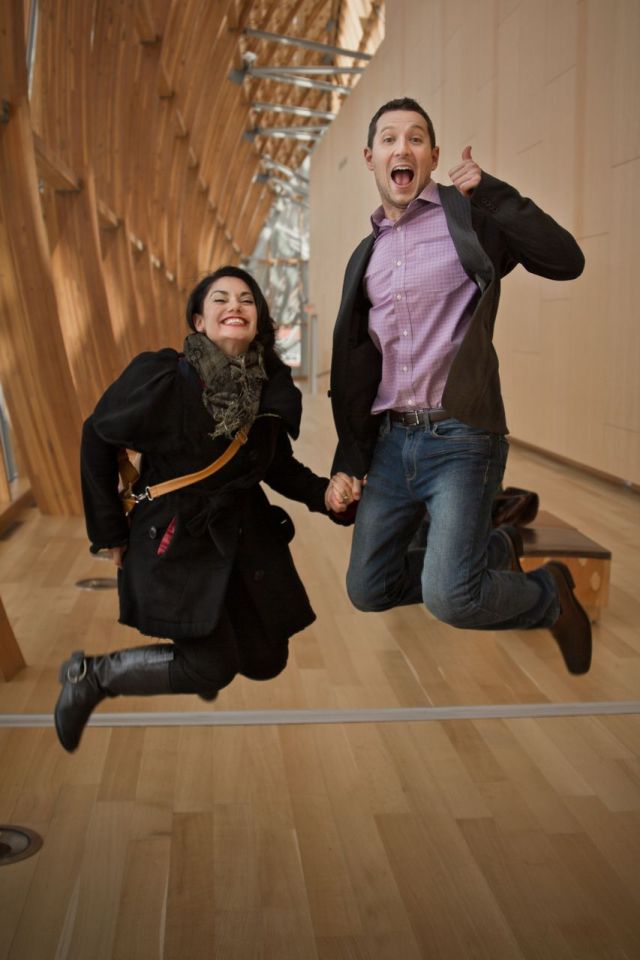
Susanna and Figaro

Posted in Interviews | Tagged , | 1 Comment

Visions: not saying “no”

I’ve been listening to a CD of piano music, contemplating the word “no”.   It may seem like an odd combination, a strange segue.

Why would I wonder about the word “no”?

I’ve been thinking a lot about how people make choices.  Whether you’re big or small, opportunities present themselves in various forms.  Some people seem to live in a rarefied world of a few high-quality projects.   I have no idea what demands are made upon them, but I have to believe that someone doing only a few discreet projects, is someone who says “yes” carefully, and indeed must be saying “no” much of the time.

I’ve seen people who seem to be perpetually in demand, who seem to never say no.  I believe they’re in demand partly because of that positive outlook, that they’re inspiring in their energy and their upbeat approach.

I think about this (saying YES or NO) all the time, as I wonder what I am going to do with my life; and  I think about this (saying YES or NO) when I see an artist who seems very busy, clearly someone who is asked to be part of projects, who is positive & a dynamic inspiring person.

I had these thoughts listening to Christina Petrowska Quilico’s new double CD Visions.  The project is so daring the first thing I had to wonder about was how it could even happen.  And that’s why I see CPQ as the catalyst, the one refusing to say no.  Visions is a series of original piano compositions from Constantine Caravassilis.  It‘s an unlikely project, an enormous double CD of great scope.  The title is apt, as the music is visionary.

But for a visionary to get anywhere? Someone has to say YES.  CPQ clearly said yes, as she does so often.   I connect that YES to the whole artistic-appreciative process.  When someone says something that might be poetic, do you say “no” or “yes”?  Do you consider the possibility?  Some people are more open to this than others.  Listening to the CDs –and I continue to listen to them—I have to say CPQ is genuinely open, positive.  Her playing is inspired on the CD, possibly because she was inspired: by the music.

There’s much more one can say, about the music, the paintings she’s gone on to do in response… But I’d suggest you investigate Visions for yourself.  It’s unexpectedly wonderful.  I gave it a listen, and I am glad I said yes.

CPQ is a very active artist in the GTA (perhaps again because she doesn’t say no).  Monday night? the Quilico Awards at the Richard Bradshaw Auditorium.  (click image for more info)

Posted in Personal ruminations & essays | Tagged , , , | 1 Comment

A reception experiment: Lucia last night

I remember from Psych 100 that one of the ways scientists learned about the brain was from what they called natural experiments.  In the war, sometimes a man would suffer a catastrophic wound to part of his head, allowing scientists to test hypotheticals that were otherwise unbearable to contemplate in an actual experiment.  What happens if you sever the corpus callosum —the nerve pathway connecting the left & right cerebral hemispheres– to see how the person’s brain functions? It’s a disgusting thing to contemplate as an experimental psychologist; but if someone walks into your life who has already suffered this trauma due to a bullet wound (a pre-existing circumstance, making it a natural experiment), why not study the effects?

I had a natural experiment last night at the Four Seasons Centre, watching Lucia di Lammermoor.  It was the second time i’d seen the production.  I sat beside someone who didn’t know the story but who had seen my review.

I am not necessarily an advocate pro- or con- for textual fidelity, but in the process of my experience last night, I inadvertently was part of an experiment last night.  As I was simply a passive observer, i’d like to call it a “natural experiment”, and thankfully nobody was injured in the process.

As I said, the person with whom I sat said they were unfamiliar with the opera.  Partly because of time constraints, partly because of a little instinct, I suggested to her that she not bother reading the synopsis.  I said enjoy it just as it is in front of you, and don’t worry.

And she loved it.

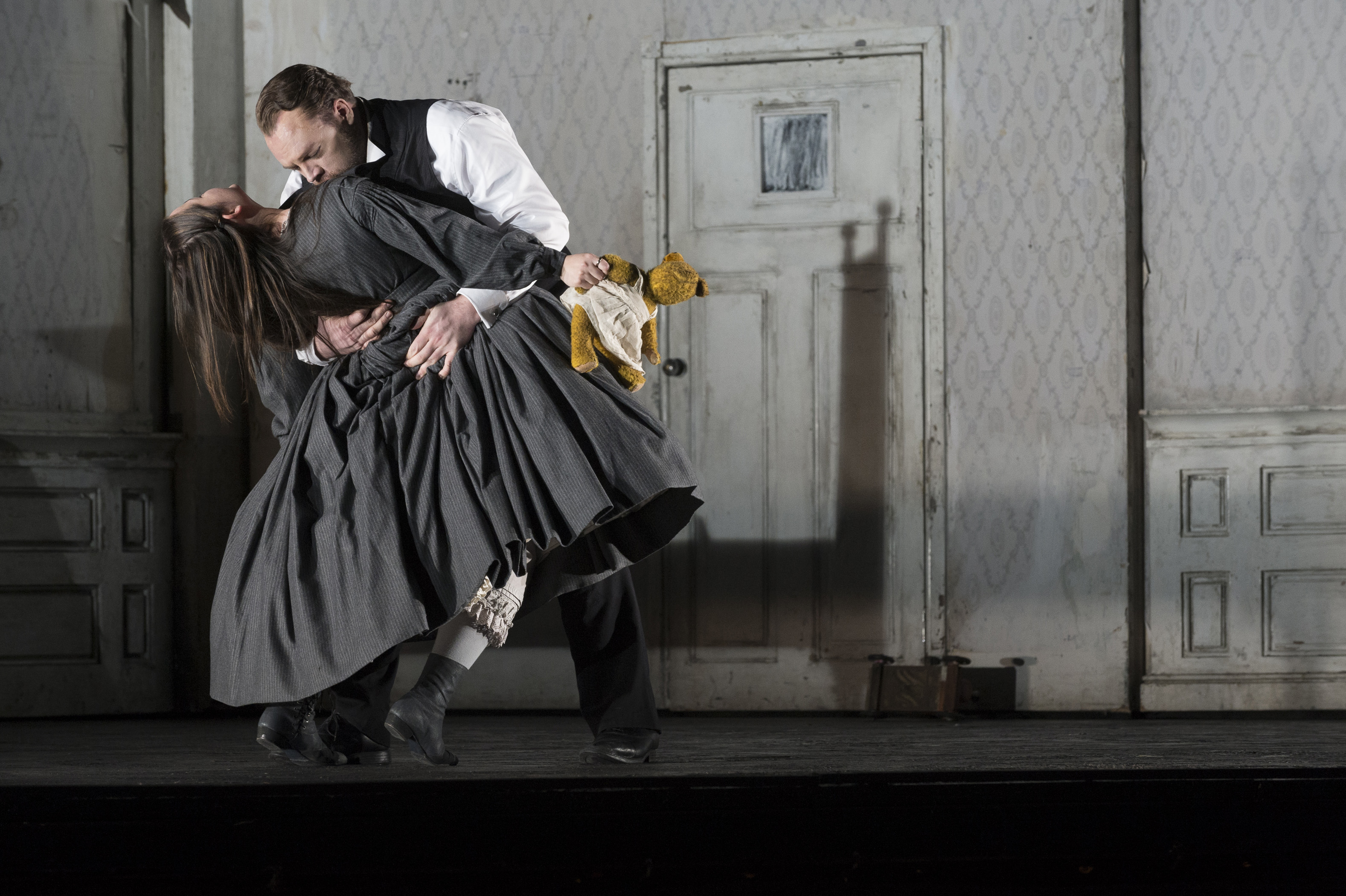
Then, at the interval I ran into a friend.  As we exited, i discovered that my friend shares my misgivings about the production, or at least some of it. Portraits are used as a design element several times to suggest a reverence for ancestors, so much so that Enrico clings to a portrait of his mom through “Cruda funesta smania”.

Here’s a more typical reading of the aria.  It’s one of several macho displays from Enrico, a character whose rage is one of the unavoidable elements of this opera: unless you deconstruct his rage into something pathological & ridiculous.  In later scenes we watch him play with his sister’s toys, tie her up, and yes, violate her in various ways.

Anna Christy  and Brian Mulligan  (Photo: Chris Hutcheson)

Anna Christy and Brian Mulligan (Photo: Chris Hutcheson)

As my friend & I laughed and joked about what we’d seen –a mix of positives and negatives– i sensed the consternation from the other party (who had sat happily beside me up to the interval without any misgivings whatsoever). Afterwards she suggested i was wrong in my review, as she felt the director was spot on.

Let’s put aside the question of my review or indeed of the production itself.

I can’t help concluding that one has a decidedly different experience watching an opera with previous experience or knowledge of the text, than coming to the performance, the surtitles, the music and the mise-en-scene without prejudice.  Nevermind which might be better or worse.  It seems rather interesting, though, that this little experiment underlines the politics of Regietheater (director’s theatre), the awareness of the opposition between directorial intervention and the text itself.

In passing, I felt much the same as before: that Enrico was caught in a kind of crossfire.  The concept was designed for Edgardo & Lucia, not Enrico, who seems to be shoe-horned into the production as an after-thought.  There are subtler ways to do what this production did, but to do so requires a slightly different approach to Lucia & Edgardo, and instead of hitting us over the head with Enrico’s obsessions.

The musical treatment was as wonderful as before, but this time i was less than ten feet away from the glass harmonica accompanying Anna Christy in the mad scene, giving me shivers throughout.  Christy’s underplayed performance made more sense to me, that she only fully cut loose in the last minute or two.  Stephen Costello seemed quite fresh in the last scene, although this time i was ready for the violation of the last moments when Enrico “kills him”.  Yes it’s in quotes because it’s a strange moment among many.  I wasn’t sure whether Enrico is really there or not, given the various surreal & symbolic moments in the production.  I had a funny –perverse– thought afterwards, perhaps an echo of my blithe suggestion to Atom Egoyan on how he should have directed his Salome.  What if, after all the gross and nasty imagery, if –in a scene that i understood could be Edgardo’s subjective experience– we were to see something nice?  In this version Lucia shows up all bloody in Enrico’s arms (and sorry if that’s a spoiler for any of you).  What if instead, we had a mute echo of Lucia’s first scene, when she speaks of the ghost.  What if Lucia wanders by Edgardo, as he speaks of seeing her in heaven. OR what if –my mushy romantic heart on my sleeve– you do something like you get at the end of Les Miserables?  Why can’t he imagine his angel leading him to heaven? we’ve been in Edmund Gorey goth-hell for 3 hours, why not a minute or two of something nice, even blissful?

Is that too much to ask? Of course it is.  I guess i’ll just have to get my own opera company if i want to do something different.  That’s another way of saying that i respect what they’re doing & how difficult it all is, no matter whether i agree with it or not.

Posted in Essays, Psychology and perception, Reviews | 2 Comments

Full Circle: JT and The 20/20 Experience

I seem to have come full circle with Justin Timberlake.  An opera-loving friend of mine moaned that Justin Timberlake is among the “Time 100“, a list purporting to identify the 100 most influential people in the world.  I don’t think the facts were in question.  JT is important.  His concern what what this seems to say about American culture.

Oh tempora oh whatever…

Nobody from the operatic realm (or classical music or visual art) made it onto a list that also includes Jay Z, Beyoncé and The Jimmies, Fallon & Kimmel.  But I’m okay with it.  Of course I don’t read Time so my friend’s tirade was the first I’d heard of it.  Even so, JT has come a long way, and that’s what i mean by full circle.

Sure, I heard he’d been a Mousketeer, a fact you can confirm if you have a look.  He’s listed there with Britney Spears , Christina Aguilera and Ryan Gosling.  While at least two of that threesome might seem to underline my friend’s point (about the depths to which he claims we’ve sunk), I don’t believe in trashing any of the popular forms of music.  If anything the matter deserves more study, which is what brings me here in the first place.  I get especially interested in debates about work that’s denigrated because lots of people love it.  I’ve written about Tosca for example.  And although it’s hard to believe, poor Bernard Herrmann denigrated his own work in film, all the while seeking success in a concert hall or the opera house; meanwhile history has caught up, as it’s now normal to consider his scores for such films as Psycho or North by Northwest as genuine art.

No, JT isn’t to be confused with Herrmann or Puccini.  But I’d rather not dismiss him just yet.

  • He played in a boy band from the 90s called ‘N Sync.  I can’t remember a single tune, even after playing through a greatest hits compilation I found on youtube.
  • My current opinion about him begins about ten years ago, at the Toronto SARS concert.  In July 2003 Toronto hosted a huge concert featuring the Rolling Stones, and lots of other talent.  Timberlake came as well, perhaps a fish out of water among so many established acts with a particular heavy rock sound.  I saw him play while dodging bottles hurled at him on the stage.   Whatever else you might call him, he’s a trouper.  It was one of the most impressive displays I’ve ever seen.  Nothing would seem hard after that, I suspect.
  • Timberlake has been in several films.  I don’t think he’s made much of an impact yet, but there was nothing wrong with his work in The Social Network.  He’s also in a bunch of films I never saw (Trouble with the Curve, The Love Guru, Friends with Benefits, and Bad Teacher).
  • And he’s been on television a fair bit recently.  I always liked his appearances on Saturday Night Live, especially alongside Andy Samberg in those crazy retro duets    A few weeks ago JT hosted a very good episode, his fifth time as host.
  • And he was on Jimmy Fallon several times, interviewed and playing his music.
  • And of course he was on the Grammys, playing from his new album The 20/20 Experience.

I was given The 20/20 Experience as a present recently.  It’s a polished piece of work that has a lot of the same canny awareness of history, musical styles & the fashion that we see in the video with Samberg.   I am reminded of some of my favourite pieces in pop music, that boldly fuse old and new, and never mind if it makes sense.  Life is full of contradictions, right?

  • The Band did it regularly in most of their biggest hits. In this piece, how does one reconcile the contrary stylistic elements, except to simply listen, enjoying the juxtaposition of idioms and associations? decades later i am still in complete reverent awe.  
  • And at least on this one occasion, so too did Little River Band.  When in time exactly are we in this musical vortex?

Timberlake knows his history & his styles.  “Retro” is a very imprecise and sloppy word for what JT is able to do.   The juxtaposition of older styles with the edginess supplied by Jay Z makes them both better.

Yes I find myself feeling old listening to lyrics that seem designed for kids going out to dance.  Or maybe it’s because I am listening to this as though it were jazz or classical music.  The production values are excellent, the charisma of the star unmistakeable.  My one complaint is that I find it very difficult to resist the urge to exceed the speed limit when driving.

As I listened to JT on any of these performances, especially playing to a live audience on SNL, i can still see the brave trouper dodging bottles at the SARS concert, still eager to find an audience who will love him.

I think he’s found it, and then some…

Posted in Popular music & culture, Reviews | Leave a comment

Toronto Opera Collaborative Le Cid

Tonight Toronto Opera Collaborative presented Massenet’s Le Cid, an opera that is outside the boundaries of what’s usually understood as the “standard repertoire” of operas one usually encounters in an opera house.  There’s a single piece that some might recognize, namely Rodrigue’s aria “O Souverain!” but otherwise it’s a work that isn’t well known.  This means not only that it’s a risky programming choice from the commercial angle of attracting an audience (given the usual assumption that people flock to their favourite Puccini & Verdi operas rather than a more obscure work), but for cast members as well (given the effort required to learn a role that’s unlikely to be staged elsewhere; with roles in popular operas you have slightly more chance of getting to sing them somewhere).

For TOC to undertake this challenging and rare work is a special opportunity.  I was disappointed that the audience wasn’t bigger for this bold programming choice from TOC even as I enjoyed the opportunity to hear this fascinating work.

Le Cid is in some respects old fashioned in its story, concerning honour and parental control of their children.  We can see some of that in Romeo and Juliet or Othello but the parents are disregarded; otherwise there’d be no story.  In Le Cid Rodrigue and Chimène are in love.  Don Gormas, father of the Chimène, has a quarrel with Don Diègue, father of Rodrigue.  Don Diègue asks Rodrigue (his son) to avenge him, which means that Rodrigue kills Don Gormas (Chimène’s father).  Luckily he’s virtually the saviour of the Christian World, and so when Chimène demands that Rodrigue be punished, the king hesitates, needing the services of the great warrior.

Soprano Kristine Dandavino

Kristine Dandavino brought an extraordinary passion to the role of Chimène, the most vivid portrayal of anyone in this concert production.  In some respects the format makes sense, given that so much of the opera concerns passionate discussions of situations.  Standing still but singing and emoting with great passion, Dandavino showed us all those contradictory emotions, including several wonderful high notes.

Jason Lamont as Rodrigue got better as he went along, giving us a very spiritual reading of “Oh Souverain”.  While I’ve never looked in the score (except the famous aria), I am fairly certain this is among the most difficult roles one could find.  Lamont has a heroic voice, which is apt for roles such as Florestan, which he sang with TOC a few months ago;  I am not sure this is a perfect fit, even if there are few men in the world who can sing this role.  And by the way, that’s also a big reason why this opera is rarely staged.

None of the other roles are nearly as difficult.  Michael Robert-Broder continued to show his lovely lyrical line, even if he was often an observer of the passions of others.  The two fathers were central to the plot, even if their roles weren’t huge.  Grant Allert as Don Diègue and Fabian Arciniegas as Don Gormas believably gave us the context of ego and macho honour that’s the basis for the plot.  Marion Samuel-Steven as the King’s daughter had some wonderful moments, sounding lovely throughout.

Music Director and Pianist Michael Rose gave a wonderful account of this unfamiliar score, opting for a pianistic reading, always clearly articulated, strongly rhythmic, and tuneful yet without being percussive.

Posted in Reviews | Tagged , , , , , , , , , | Leave a comment

Besame Opera

There’s lots of kissing in “Bésame Ópera”, the Spanish double bill from Opera 5 currently playing at Gallery 345.   Sometimes it’s even human beings doing it.

I feel lucky that, by a curious coincidence, the new work in Monday’s farewell concert from Queen of Puddings, which employed poetry from Federico Garcia Lorca, was the perfect preparation for these two works.  Lorca’s surreal vocabulary put me in the right frame of mind for what i saw tonight.

First came Manuel de Falla’s El Retablo de Maese Pedro, a chivalrous episode presented as a shadow puppet play within the opera, for an audience of one Don Quichote, who jumps up from time to time, unable to distinguish illusion from reality until finally he overturns the whole presentation.  While it doesn’t seem like much, I found it very powerful.   It’s a very lean score, relying upon percussion and a spare accompaniment to vocal lines that are often chanted, without lots of lyricism anywhere to be found.  As a result the dramatic expression in the words is fully foregrounded, unconcealed by any fancy orchestral footwork or vocal fireworks.

Conrad Siebert did double duty as Maese Pedro—sounding very mellifluous—and playing percussion (is that how the character is written?), and Rachel Krehm was very charming, getting a few laughs as his helper Trujaman.  Giovanni Spanu was an understated Don Quichote, very believable in his pompous responses to the presentation, and never entirely ridiculous.  I was very moved.

At intermission, this opera company named for our five senses again encouraged us to use other senses in the delightful cuisine & beverages to be had.  While I resisted their sangria –because I had to drive home—I’ll surrender to the invitation now (at home).

(walks to kitchen, pours a glass of wine…. Comes back)

After intermission the program continued with a much bigger work, Goyescas by Enrique Granados.  I was first and foremost struck by how ambitious Opera 5 have become.  I’ve been writing about the plethora of small companies in the Toronto area that have sprung up lately.  But mostly they do concert performances and song cycles.

In December their program Opera Eats which consisted of three short operas (Rachmaninoff’s Aleko, Hindemith’s Hin und Zurück, and Milton Grainger’s Talk Opera) was fully staged, including chorus.  Tonight, while the de Falla opera was a kind of miniature –both in terms of length and in its focus upon the delicate imagery of shadow puppetry—Goyescas is another full-fledged work.  Opera 5 put a chorus of eight onstage with the four principals.  In the relatively tight quarters of Gallery 345, they very appropriately raised the roof, in this work exploding with the most basic human impulses.

Opera Five Artistic Director Aria Umezawa

Opera Five Artistic Director Aria Umezawa

Director Aria Umezawa took us deeper into the realms of the surreal and the fantastic.  The challenges posed by tight budgets are perhaps an inspiration to her creativity.  There were two memorable images near the end of Goyescas.  As Emily Ding sings about the nightingale, members of the chorus in black spread her dress as though it were a series of banners to be unfurled.  I was intrigued, not quite sure how to process the image, as the character almost resembles a puppet, manipulated by the people in black, or perhaps a flower whose petals are unfurled.  And then, when Siebert sings with her in the final duet, mortally wounded, instead of blood, he’s effusively giving off red flowers from his chest.  I was –again—very moved.

Opera five Music Director and pianist Maika’i Nash (Photographer Emily Ding)

It makes it very hard to bravo when you’ve lost your voice that way.

I was once again impressed by Maika’i Nash’s masterful music direction.  Need I say that there are other groups in the GTA presenting works in concert, standing with their music in front of them who are no tighter –and sometimes far more haphazard—than what Nash achieved, and this while the chorus were costumed, off their books and at times dancing.

There’s one more performance May 2nd.  And Opera 5 will present an even more ambitious season for 2013-2014.

Posted in Reviews | Tagged , , , , , , , | Leave a comment

Farewell to the Queen

This afternoon we said goodbye to Queen of Puddings Music Theatre in the same manner we’ve known them, namely through yet another premiere of a new work. QPMT’s finale under the auspices of the Canadian Opera Company’s free noon-hour series in the Richard Bradshaw Auditorium in the Four Seasons Centre gave Chris Paul Harman’s song cycle La selva de los relojes (the Forest of Clocks) its debut.

How apt that the ending of this era should be signified through a work intimately connected to time & its observance.

And it felt like a special time.  As is fitting for the last scene of a play or opera, everyone seemed to take the stage.  Dáirine Ní Mheadhra and John Hess, Artistic Directors of QPMT, each had their moment; she conducted, he gave the introductory talk, and afterwards they shared a bow for their 2+ decades of work. Onstage we were again treated to the subtle artistry of Krisztina Szabó, who had previously sung in Svadba.  Nearby in the audience I saw Wayne Gooding of Opera Canada, critic Robert Everett-Green, and fellow partners-in-bloggery Joseph So & John Gilks.  And I was thrilled also to see at least one of the key QPMT board members, namely University Professor Emerita Linda Hutcheon;  I can’t help but think that the whole phenomenon of these concerts, which feel like a kind of artistic outreach, seems to continue the tradition of multi-disciplinary explorations that she started in the COC’s Opera Exchange.

Harman’s cycle, which uses texts by Federico Garcia Lorca, reminds me of something Mallarmé said.  When approached by the composer Claude Debussy who meant to set Afternoon of the Faun to music (and in the original version, a much more elaborate setting than the eventual tone-poem) the poet said “but I’ve already set it to music”.  No wonder that Debussy chose to leave the words alone and write music without words.  Perhaps Harman felt some of the same sentiments coming to Lorca, whose poetry is full of dream imagery, let alone the musical colours of the words.  In his introduction to the concert, co-artistic director John Hess said he’d hoped to persuade Harman to compose an opera: which hasn’t happened yet.

But who knows..?

Click for more about Blake (note, the image is an analogy i use in this review)

Harman gives us a composition that’s very respectful of Lorca, as though we were hearing the poems read with a kind of subjective gloss, the music (both the instruments of the chamber ensemble as well as the singing voice) super-imposed over the text as though we were hearing something like Blake’s illuminations.  The words came through clearly, but radiant with the colours of the ensemble Harman chose: flute/piccolo; clarinet; cello; harp; celesta or piano; percussion, and the human voice in two variants (sung & spoken).  In addition we had sounds of wind blowing through instruments, the ticking of metronomes, and perhaps other sounds I am not recalling.  I am not sure what Lorca would think of the various sounds rendering his subjective landscape (pardon me, the phrase “magic realism” lurks in there too), but then again, Mallarmé recanted once he’d heard the magnificence of Debussy’s rendering.

I was surprised at the accessibility of this work. Harman’s language is mostly tonal, which may partly be an implication of the occasion, our celebration of the passage of time.

Soprano Krisztina Szabó

I couldn’t help observing that for all the personnel, for all the timbres on display, that we did not end in a complex place.  Why more instruments?  I am thinking there’s a very good reason that has more to do with celebration than with complexity.  I wrote something a few weeks ago, that you can read if you have lots of energy, observing the way we perceive additional instruments.  It’s a social thing too –one I equate with Spain btw—where we think of dance music and party music; while additional players may seem redundant musically they add to the sense of occasion. More instruments can mean more celebration, both in terms of volume (even if Harman’s dynamics are under-stated throughout) and in the visual impression of all those bodies on a stage.

I don’t have much to offer on the performances, other than to observe that Krisztina Szabó was once again front & centre, a singer whose readiness to explore new material places her in a select group.  Although I was sitting very close, Szabó sang so softly at times that I don’t know how many p’s would be needed to notate such delicacy.

And so I wonder.  Are Queen of Puddings really gone? Or will they (and/or their key players) reappear in a new recipe / guise?  Will we hear Harman’s cycle again, or indeed, will he finally write that opera?

That’s a question for another time.

Posted in Reviews | Tagged , , , , , , , , , , , , | Leave a comment