I watched the last hour of Killers of the Flower Moon today.
I had heard terrible things about the violence in this film, although the same was true of Taxi Driver, another Martin Scorsese film with a brilliant orchestral score from a composer (Bernard Herrmann) making his last film. The title is a dead giveaway (if you’ll excuse the choice of words). So I downloaded the film and have been watching it on the small screen at home rather than submitting to the relentless dominance of a movie theatre.
I stopped partway through, earlier this week.
Yes it’s violent, but that’s not what I’m posting about. Let me simply say parenthetically that I now see a whole new market for streaming and downloading, where a movie might be overpowering in a theatre. I saw Oppenheimer in an IMAX theatre, and to be honest, was disappointed.
It’s almost time for the Academy Awards, an annual ritual that tends to drive me nuts. While I like the notion of celebrating excellence I don’t believe in awards that would say, for example, that Christopher Nolan’s direction of Oppenheimer is somehow better than Martin Scorsese’s direction of Killers of the Flower Moon, whether or not they even admit Barbie into that conversation.
I wanted to see Killers of the Flower Moon for a number of reasons, and I’m glad I bought it, as I will watch it again. It seems to capture our exploitive and genocidal relationship to the Indigenous populations rather well, horrific as it is. I always like Scorsese’s work, painful as it may be to watch.
But I was especially interested in hearing what Robbie Robertson contributes to this epic exploration of genocidal violence and exploitation in an American Indigenous community. After a lifetime of collaborations between Robertson and Scorsese this would be the climax.
I was not disappointed.
Robbie Robertson and Martin Scorsese in 1978 (Photo: Richard E. Aaron/Redferns)
I believe Robbie Robertson deserves the Oscar for best Original Score. That may sound kind of stupid when I’ve only seen one other nominated film, namely Oppenheimer.
The nominees are:
AMERICAN FICTION -Laura Karpman INDIANA JONES AND THE DIAL OF DESTINY -John Williams KILLERS OF THE FLOWER MOON -Robbie Robertson OPPENHEIMER -Ludwig Göransson POOR THINGS -Jerskin Fendrix
If Karpman or Fendrix win, that would be a fascinating and unexpected turn of events. Perhaps they deserve an award. As mentioned, I haven’t seen those two films.
If the 92 year old John Williams wins I won’t be upset. But Williams has won the Oscar before. Williams is old, while Robbie Robertson died this past summer. Please note, I am not proposing Robbie Robertson as winner because he’s dead.
I saw Göransson’s film, which many are touting for best picture and best director and best actor nods.
What gets a little crazy is when the voters decide they need to reward a film in adjacent categories, that they love a film so much that it needs to win multiple Oscars. It made me crazy that Blade Runner, the most cleverly art directed film I’ve ever seen, with its brilliant imagery of a future dystopia, should lose the Art Direction Oscar to Gandhi, in that film’s sweep of the awards. Something similar may happen with Oppenheimer, even though Göransson, like Williams, has won an Oscar before.
Let me offer my criteria. The touchstone for me of music to accompany a play or film has always been Felix Mendelssohn’s music for Shakespeare’s A Midsummernight’s Dream. The 1935 Max Reinhardt film of the play, in the debut of Erich Korngold, makes a most impressive use of Mendelssohn to underscore the film.
Why is it impressive? Mendelssohn created a musical style for each of the three social milieux represented in Shakespeare’s play, namely 1) faeries 2) lovers and 3) mechanicals. Each of them has a distinct kind of music that aids the story-telling. For me that’s the ideal.
Robbie Robertson’s score isn’t playing music for three different groups, but it does underscore the social divide in Scorsese’s film, between the Osage Nation and the settlers of the American west. There are times when the music functions as a greek chorus, telling us what’s really happening beneath the surface. I want to watch it again and listen more closely, as I thought I detected times when Robertson underlines the cultural divide with music that illustrates a comparable spiritual divide.
Robertson’s roots from a Cayuga and Mohawk mother lends the musical score a special authenticity and authority.
Scorsese has a habit of showing up in his films to play a small part. I loved his appearance in Hugo as a cameraman filming at Georges Méliès’ studio. I wonder if the 81 year old Scorsese suspects he is coming to the end of his life, given that this time (spoiler alert) he delivers the stirring final speech of the film.
At the end we see that the film has been dedicated to Robbie Robertson. An additional heartbreaking thought that Erika gave me just now, is that the composer who died in August likely never saw the finished product, released in October.
I’m looking forward to seeing and hearing it all again.
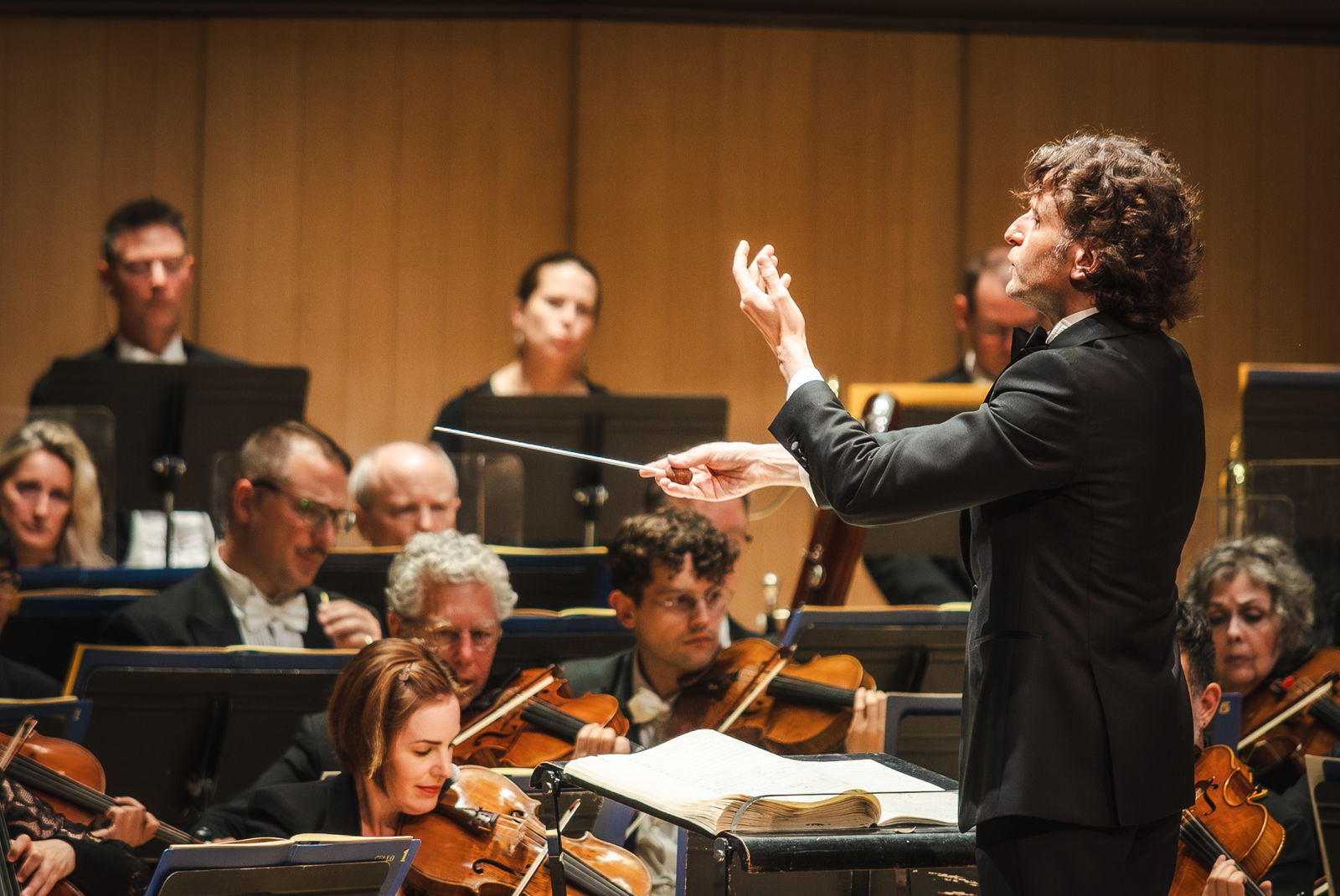
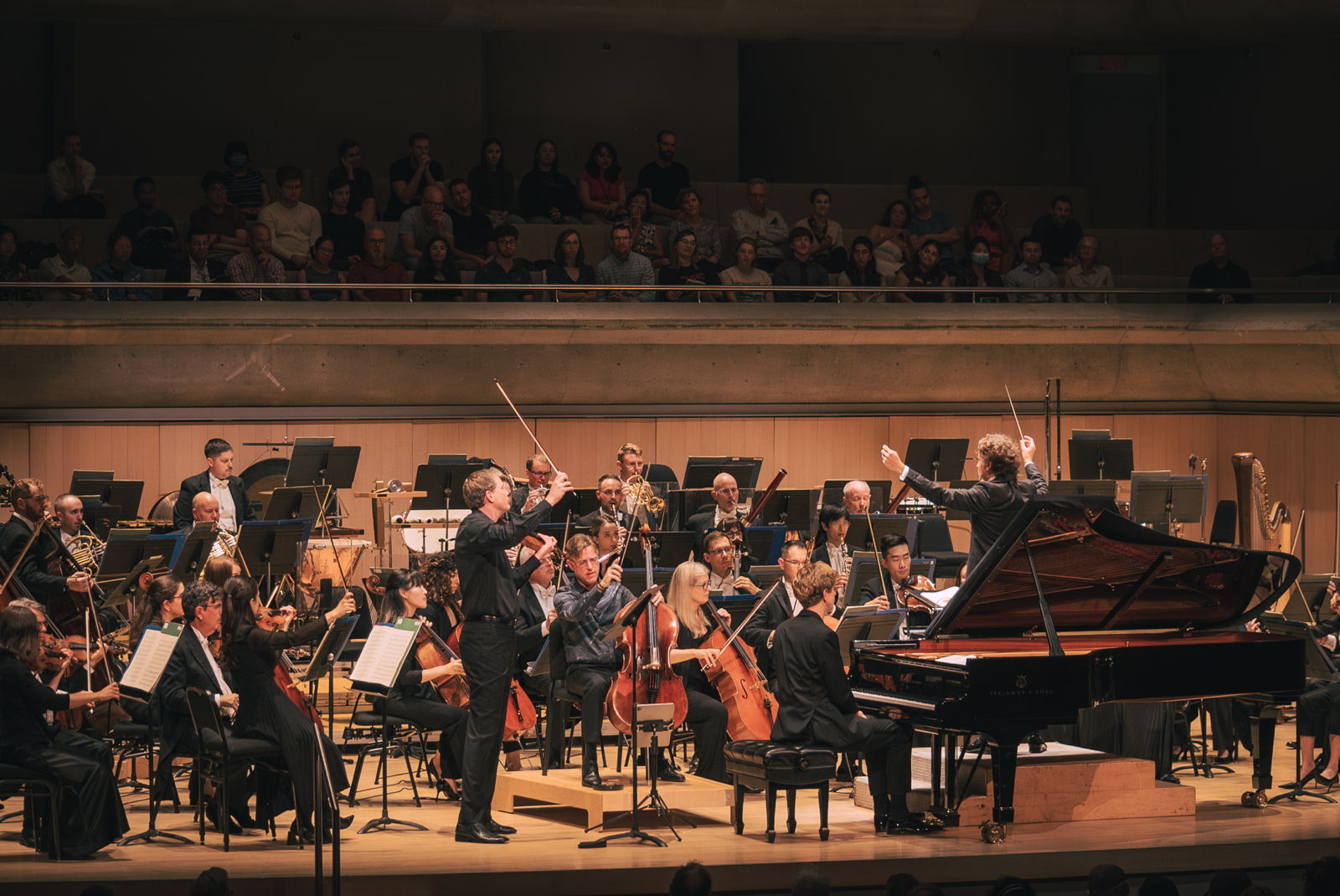
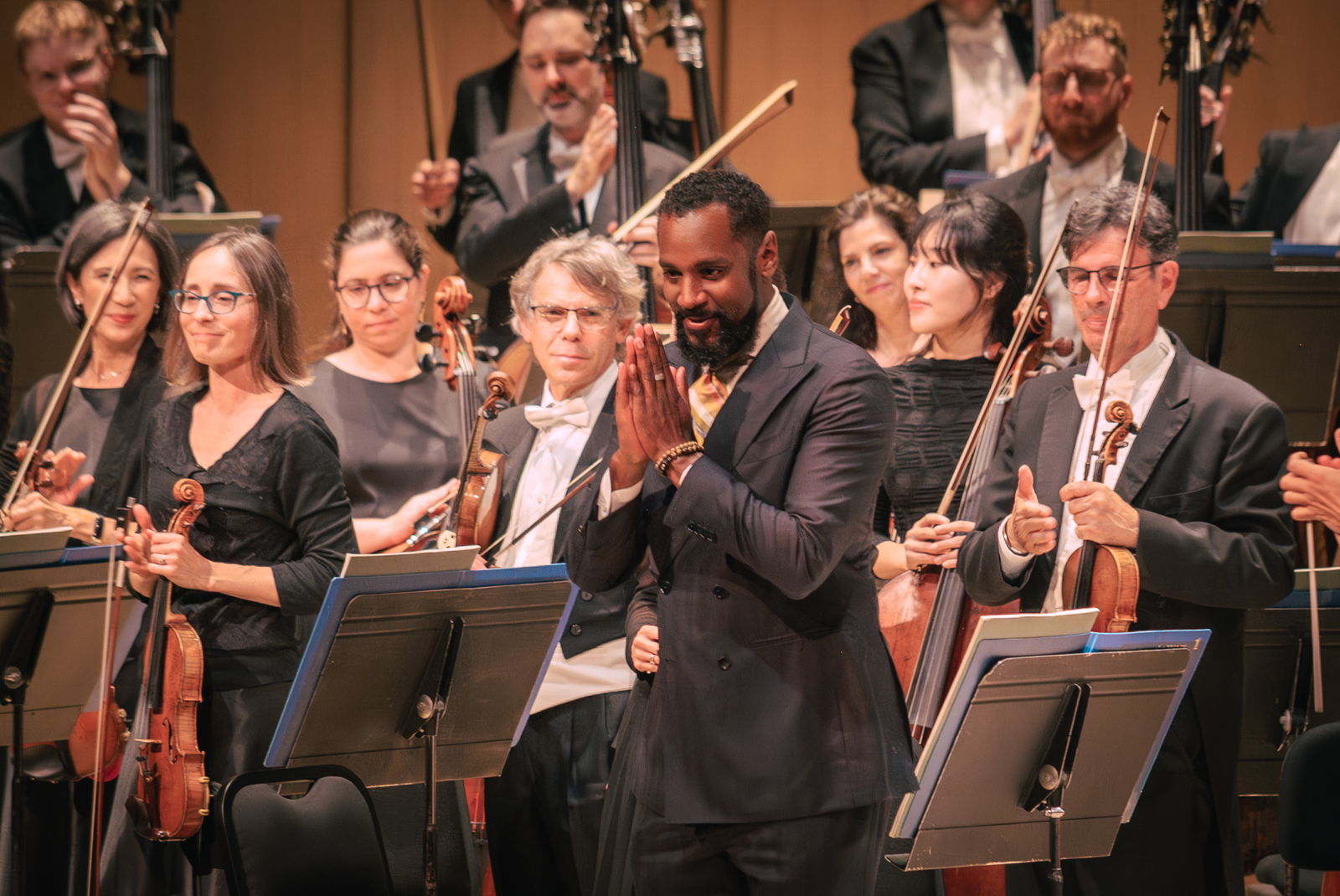
Tonight Gustavo Gimeno and his Toronto Symphony presented their latest TSO live concert at Roy Thomson Hall, recorded for future release by Harmonia Mundi recording label. We were a well-behaved audience, not making any disruptive noises, like polite voyeurs watching an ongoing love-fest between an orchestra and their leader that wouldn’t have been out of place last week for Valentine’s Day, a romantic comedy with a guaranteed happy ending.
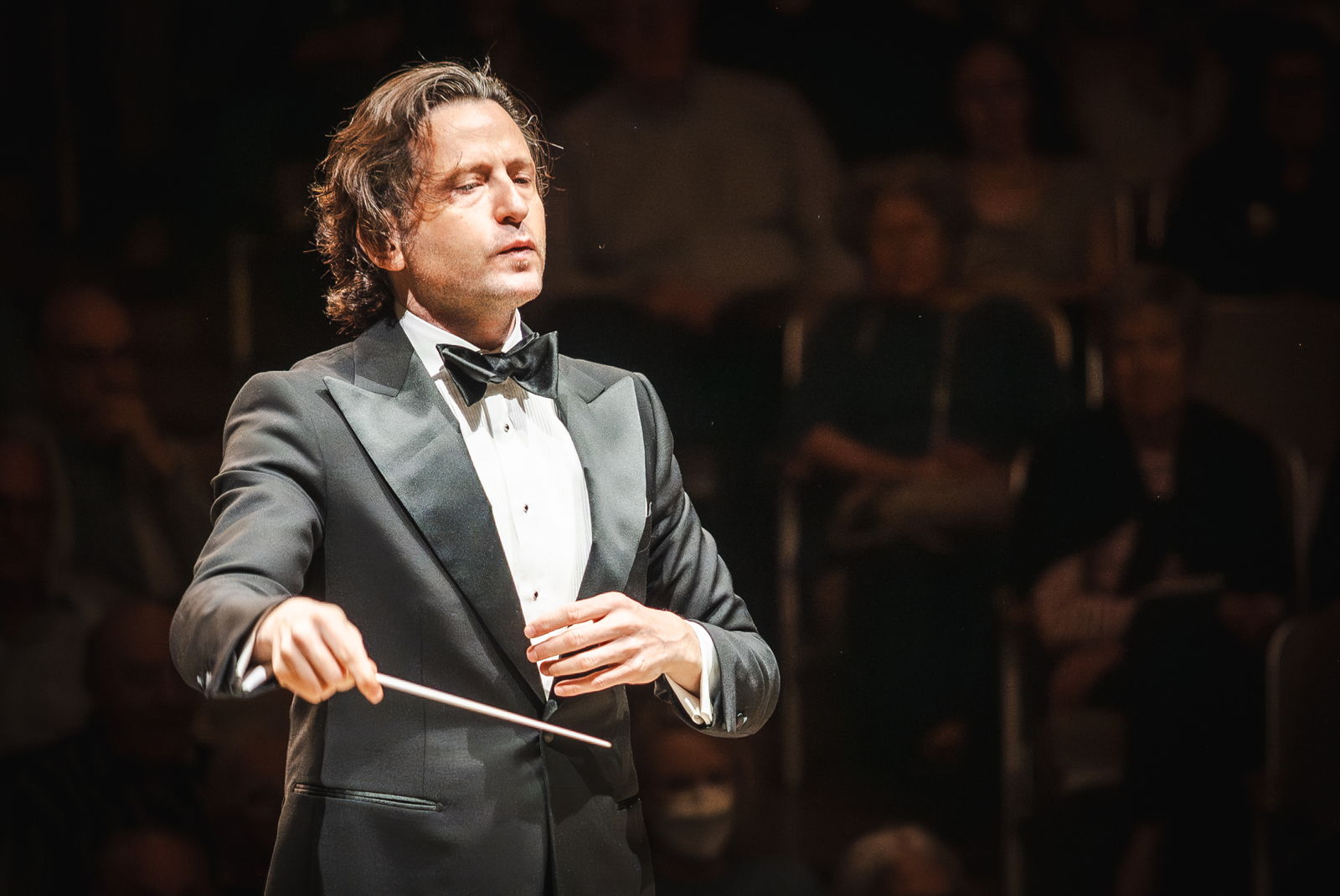
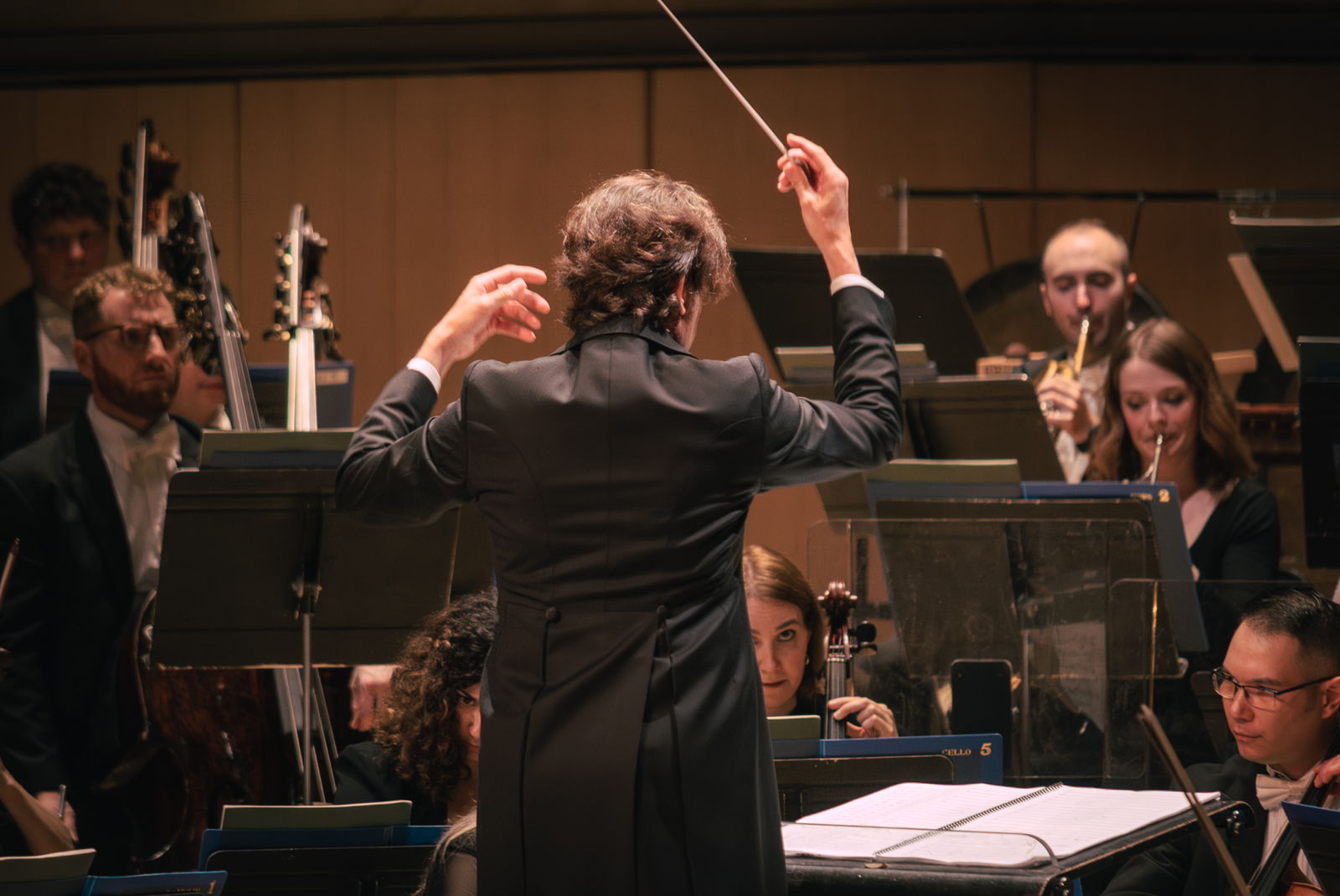
Gustavo Gimeno (photo: Allan Cabral)
All three works on the program for the concert titled “Stravinsky’s Pulcinella” refer back to other musical influences or texts:
Kelly-Marie Murphy: Curiosity, Genius, and the Search for Petula Clark Igor Stravinsky: Divertimento from Le Baiser de le fée (the Fairy’s Kiss) –intermission– Igor Stravinsky: Pulcinella (complete ballet)
While Murphy’s ten-minute curtain-raiser was commissioned in 2017 to celebrate Gould’s birthday and his relationship with the TSO, via his experience listening to Petula Clark on the radio, it was ideal for this occasion, alongside pieces making connections between musics, a good appetizer for the ear and the mind. I searched but didn’t find Petula Clark’s music in Murphy’s score but that doesn’t matter. The piece lives up to its title encouraging us to sit forward in our seats displaying curiosity. And Murphy gives the percussionists a workout on several instruments, soloists in several sections interacting with flamboyance and verve as a warmup for what was to come.
It made a superb preparation for two works by Stravinsky that rework music from other composers namely The Fairy’s Kiss and Pulcinella. I have to wonder, did Stravinsky get tired of making music that caused riots, as with Rite of Spring, and decided to create something of stunning beauty, while still employing the most original means? These two works still sound so original a century later even as they reframe older melodies and styles in a newer framework. It challenges my understanding (and overuse) of the word “new”.
I have had a longterm relationship with Stravinsky’s music for Fairy’s Kiss. First came the multi-year struggle to find this piece, having been seduced to the bottom of my soul when I heard bits of it on the radio, missed the part where the host tells you what it is, and then puzzled over it. Because it’s hardly mainstream and in a style that defied my understanding, it would lurk in the back of my head as possibly the most beautiful thing I had ever heard. I was chasing the afterglow, as elusive as an actual fairy kiss. I wonder if Stravinsky had something like this in mind, writing a piece that vaguely alludes rather than quotes older music. Fairy’s Kiss (1928, revised 1949) is much subtler in its relationship to the past than Pulcinella (1920). When I stumbled on piano music by Tchaikovsky including compositions that served as sources for Stravinsky they hit me like deja vu, a magical experience. I believe the composer was aiming for something like this. So while I can’t promise anyone a lifelong relationship with the piece on first hearing it, I can’t be objective about a piece that has lived inside me like a remnant of the half-forgotten dreams we chase in the morning.
For the twenty or so minutes before intermission, Gimeno led a confident polished reading. There are passages where the sections are massed together, a choir of horns in one movement, a clutch of flutes in another. The horns were subtle and gently athletic without stridency or excess. The flutes were ravishing, the strings seductive. It makes me smile to think that I can get this on a recording one of these days to hear the beautiful passages whenever I want.
After intermission we were in a different kind of sound-world. Stravinsky’s ensemble for Pulcinella is much smaller than what we’d heard in the previous pieces, as is appropriate for the baroque. But it’s not really old, not when the materials are used this way.
Pulcinella was part of the ongoing interest in commedia dell’arte that lurked in the theatre decades after the form had effectively died out, especially around the beginning of the 20th century. Diaghilev (who had already called upon Stravinsky for his most famous ballet scores in the previous decade, namely Firebird, Petrushka and Rite of Spring) would have been aware of Meyerhold’s ongoing interest in the masqued figures of the CdA and may have seen Faure’s nostalgic romance Masques et bergamasques premiered in Monaco in 1919: and Stravinsky responded.
It’s as though Stravinsky’s score, turning away from his big flamboyant scores said “and now for something completely different.” I wonder how much of Stravinsky’s inspiration for the neoclassicist breakthrough of Pulcinella began in the pragmatism of the re-purposed music one finds in a theatre. Neoclassicism can be understood as a frame that’s a bit like a mental proscenium arch, through which we look and listen. I’m reminded of Linda Hutcheon’s metaphor of the palimpsest, a page where we can see one text written over top of another; her analogy is that with this kind of adaptation it’s as if we’re looking through layers, seeing both the original version and the newer one. Inside that magical gate we see the past but it’s re-framed in an edgier modernist package, still recognizably old but reconstituted.
Speaking of frames, for Pulcinella I felt as though we were in a recording studio observing a session between Gimeno, the TSO and the three wonderful soloists, namely tenor Paul Appleby, mezzo-soprano Isabel Leonard and bass-baritone Derek Welton. While these were TSO premieres, two of the three have been heard at the Canadian Opera Company before. Appleby was Ferrando in the Atom Egoyan Cosi fan tutte in 2014, Leonard was Adalgisa in Kevin Newsbury’s Norma and before that a brilliant Sesto in Christopher Alden’s Clemenza di Tito in 2013.
Isabel Leonard as Sesto in the Canadian Opera Company’s production of La clemenza di Tito, 2013, director Christopher Alden . Photo: Michael Cooper
For Pulcinella I must return to my earlier suggestion of voyeurism at a recording session. While I loved what I heard, while I was impressed by musical values, we were on the outside of that charmed circle of musicianship where Stravinsky was brought to vivid life. Gimeno and the TSO made something I will certainly obtain for my collection. The quality of the soloists helps sell the project to the outside world. I was again frustrated that while the Italian text with translations is printed in the program, we were sitting in the dark unable to make any use of the wonderful program notes. That’s probably necessary, a wise choice given the necessity for silence in a recording, when hundreds of rustling pages might be audible. Why in this day and age that we didn’t have projected titles baffles me. If the music with sung text is just a soundtrack for a ballet, all well and good: except we were watching a concert performance without any ballet. Yes I’m sounding like a stickler, but when I watch a film in another language I expect subtitles unless I know the language. Leonard, Appleby and Welton are gifted singing actors. There was one segment where Appleby –standing close to the microphones– sings almost inaudibly, mysterious, that the titles might have explained his interpretive choice. Yet by the same token I regularly miss lyrics of songs by Beyoncé or Billie Eilish that I have to search out later, so maybe I’m out of step. The next time I’m listening to this music will likely be on the HM recording, when I expect I can refer to the liner notes for text.
The concert will be repeated at 8:00 Saturday night February 24th at Roy Thomson Hall, highly recommended.
Afterwards the soloists (Derek Welton, Isabel Leonard & Paul Appleby) enjoy applause (photo: Jae Yang)
Tamara Wilson is one of the best singers in the world. Yes we import Europeans to sing opera but some Americans have no equal.
We’re lucky to have heard that voice in Toronto, usually the most impressive sound in that show, whether she was Turandot or Desdemona (Otello) or Rosalinde (Die Fledermaus).
Tammy Wilson’s Facebook profile pic
Back in January when she told Facebook that she had tested positive for covid, she agreed to answer some questions while convalescing.
Barczablog: The first question to ask turns up in the headline. When you’re working do you prefer “Tamara” or “Tammy” or “Ms Wilson”?
Tammy Wilson: In the professional sphere when people don’t know me, Tamara. If we work together or know each other privately, Tammy. Ms. Wilson is only if I’m getting called at the doctor’s office. 😉 Plus in Europe, Tammy isn’t really a thing. With my family I’m Tammy.
BB: Do you believe the pandemic is over / do people foolishly believe it’s over?
Tammy Wilson: Covid will never be over, it will now mutate. Just like influenza. It’s arrogant to think that another pandemic won’t happen.
BB:Did you wear masks before, believe in vaccination. I think singers are especially at risk.
Tammy Wilson: I feel like no one learned from what happened. I feel like, if you are sick, you should wear a mask not just because of being a singer but because you don’t know everyone’s underlying health issues.
My experience in France (in public) is zero % of adults cover their mouths when they cough or sneeze. The children are much better at it.
BB: How does a singer protect their voice?
Tammy Wilson: First and foremost rest. Real rest. No talking, no singing. Letting your body heal. As far as practical things when I get a cold: Mucinex, DayQuil, Flonase, Gelo Revoice tablets, and a ton of throat coat tea.
BB: Is paid sick time a solution for singers and those in the gig economy?
Tammy Wilson: I think that would be good for singers on a weekly fee. Most principals are paid per performance or in one lump sum at the end of the performances. If you are sick for a performance, you forfeit that fee.
BB Do you describe yourself as a nerd, and if so, what’s your focus, between music, theatre, sciences and other disciplines.
Tammy Wilson: Oh, there is a full spectrum of nerd and my focus knows no bounds. I love Dungeons and Dragons, Star Wars, vintage movie musicals, watching history videos, archeology, economics, woodworking, video games, gardening, musical theater, painting, physics, the list goes on.
As far as reading, I’m currently in the Court of Thorns and Roses series and the V.E. Schwab’s Shades of Magic series, and N. K. Jemisin’s Broken Earth Trilogy.
BB: What are you working on right now
Tammy Wilson: Too many. Brünhilde, Abigaille, Lady Macbeth. There are many more but that’s through the end of the year.
BB: Tammy you have a big voice. I want to quote two recent interviews.
ADAM KLEIN said: “broadcasting opera favors the smaller voices, and worse, it disfavors the larger ones, because the close body mikes they use simply can’t handle the decibel level, upwards of 110 in many cases; and it equalizes small and large voices, removing the amazement we feel, when in the physical space, that a human unamplified could be making that much sound, and it’s still pretty. In fact, the mikes often make us sound ugly: Callas is the premiere example.”
ALEX HAJEK said: “the whole idea of overtones of the human voice can never be captured on a recording properly. IYKYK”
BB: Adam also spoke of the travesty of the Björling-Nilsson Turandot as an example. Recalling your own recent Turandot here in Toronto, I wonder: can your voice be captured properly in recording or in a high definition broadcast?
Tammy Wilson: I would say it’s doable but you need a sound engineer who understands it. If you can record heavy metal singers shouting directly into a mic, you can record a room with opera singers. I think it deals a lot with how sensitive mics are now. Head mics are not it though. The worst seat to hear an opera singer is right up close. It’s not pretty.
It also has a lot to do with time. Recording is expensive and the classical world is trying to find the cheapest way to get content out. I’m mostly speaking of live performances. We don’t have pick-ups or sound checks really. We never get feedback for how we can help recordings. Also, the performers are usually mic’ed up the show or two before for the engineers to get levels. We normally don’t get to hear those before we do a final recording. The singers have zero control over how we sound and any notes to make it better. Plus, any recording of an opera is owned by the orchestra and company, singers don’t get a say. Our job first and foremost is to the audience in the theater. Whatever gets put into the mic is out of our hands.
When I recorded a half album in the studio it was also all about time. Popular recording artists have time in the studio to talk to their engineer and tweak things. They can do multiple takes and curating the album. We don’t really have that luxury. I recorded in a day. Only got to record about two takes per song. I don’t know how it works with opera singers recording solo albums with classical labels so I can’t speak to that.
Also, this whole big voice little voice thing is a construct. Yes, some people are louder than others. It’s who has optimized their resonance to cut through the orchestra and fill a house. A voice doesn’t need to be large. A person doesn’t need to be physically large. Their resonance needs to cut.
We keep people in boxes too. I started singing Mozart. 15 years ago. I in no way thought I was going to sing what I sing now. I haven’t changed how I sing now from how I sang back then. It’s the same technique. What did change is people allowing me to try different repertoire and different styles so I could learn how to negotiate them with my voice.
BB: Is there any music you’d say that corresponds to your spirituality?
Tammy Wilson: There is one and only one piece that makes me contemplate the eternal. Duruflé Requiem.
BB: Do you believe in astrology and if so, what’s your birth sign?
Tammy Wilson: Kinda yea. Just for fun though. I’m a scorpio.
BB: What was your first musical experience?
Tammy Wilson: Watching: probably Disney or Fairie Tale Theater. Live: Sweeney Todd. Scared the crap out of me. 6th grade. Being in: Bye Bye Birdie as Mrs. MacAfee. 8th grade.
BB: What was your first theatre experience?
Tammy Wilson: High School. Midsummer Night’s Dream.
BB: Do you bother with award shows such as the Academy Awards, and if you have seen any of the nominated films, what’s your favorite?
Tammy Wilson: I used to love watching award shows but now that everyone has an opinion about every second of every show and it’s all over social media the next day, it’s taken the joy out of it.
I saw Barbie and Oppenheimer. Loved both. Past Lives, Poor Things, and Killers of the Flower Moon are on my list.
BB: I was just watchingKillers of the Flower Moon today.
Tammy Wilson: It was weird this year because I was either in Europe when things came out or just missed it in theaters. I can’t wait to watch Past Lives because members of my favorite band wrote the score, Daniel Rossen and Christopher Bear. They are from the band Grizzly Bear.
BB: What are you watching as you convalesce?
Tammy Wilson: Dimension 20’s new season of Fantasy High on DropoutTV. A lot of Smosh videos on YouTube. Horror films. Just watched Talk to Me and Rise of the Evil Dead. I also watch videos of farming and caring for livestock. They calm me.
BB: The beach or the forest? (vacation preferance)Beach or forest/cottage or something else? Mountains?
Tammy Wilson: Oh I’m a forest person. I love the beach but I’m the color of Casper the Ghost. I’m not made for it. If there is a place with mountains, trees, lakes, and a valley, I’m there.
BB: Dogs or cats?
Tammy Wilson: I love both. One day I would love a Corgi or a Swedish Vallhund. I love a short dog.
BB: Stephen Sondheim or Andrew Lloyd Webber? And did you know they have the same birthday? (Same birthday as me as it turns out which is why I noticed.) Do you have a favorite musical, by them OR anyone else?
Tammy Wilson: I did not know they had the same bday. That’s cool. You can’t make me choose. They are the best for their own reasons. If I had to pick purely by my favorites of each of theirs Sondheim’s Into the Woods would win. I do love Starlight Express though.
BB: Taylor Swift or Beyoncé?
Tammy Wilson: More power to Taylor. I like about 5 of her songs. Nothing against her, just not my vibe. I love Beyoncé.
BB: Taylor Swift or Travis Kelce? (in other words, Taylor’s music or NFL football?)
Tammy Wilson: Neither, I do not care. I’m just happy they found love. Good for them. Everyone needs to leave them alone.
BB: Agreed!
Barbie or Oppenheimer?
Tammy Wilson: Again, two different vibes that shouldn’t be pitted against each other. Both did great things for storytelling.
BB: YES! I find awards problematic, comparing apples to oranges.
Was Greta Gerwig snubbed?
Tammy Wilson: Yes. Unequivocally.
BB: Favourite character on Succession?
Tammy Wilson: I haven’t watched it but whatever Matthew Macfadyen is in, I will like his character.
BB: Yes, we were watching the 2005 Pride & Prejudice, gobsmacked to see him in that. He showed me subtleties as Mr Darcy that are missing in other versions.
Tammy Wilso Have you seen the British show Spooks (MI-5 in the States)? Such a good show.
BB: No, I’m way behind in my tv watching. Still need to see the last season of Ted Lasso.
Favorite old tv show?
Tammy Wilson: Things I binge all the time, Parks and Recreation, New Girl, Bones, Brooklyn Nine-Nine, Turn.
BB: Who is your favorite SNL personality?
Tammy Wilson: Kenan Thompson. Grew up with him on Nickelodeon and now SNL.
BB: Giving me a reason to post a video of Kenan Thompson? yay!
BB: Verdi or Wagner?
Tammy Wilson: I love singing both. I hate learning Wagner, too long and too many words. Once it’s learned though, love it
BB: Tebaldi or Callas?
Tammy Wilson: I don’t have a favorite. I listen to everyone. When I’m learning something, I gather as much as I can to listen to. I don’t listen to singers for pleasure like I used to. Now it’s all analytics. When I listen to my rep, I do deep dive listening on how singers’ phrase, breathe, approach certain phrases. I try not to listen to one recording too much though because I want to make my own choices.
If I do listen for fun they aren’t in my repertoire. I love listening to Cecilia Bartoli and Philippe Jaroussky.
BB: Favorite opera?
Tammy Wilson: Favorite to see: Carmen. Hear: The Rake’s Progress or Midsummer Night’s Dream. To Sing: Always changing.
BB: Favorite music that’s not opera?
Tammy Wilson: Indie music by singer/songwriters. Heavy Metal. The bands played the most on my lists: Grizzly Bear, Punch Brothers, Alter Bridge, The Pretty Reckless, Peggy Lee, Huey Lewis and the News
BB: What is your favorite sport?
Tammy Wilson: Baseball. I love the game and the ambiance. My first game was when I was 6. It was an Oakland A’s game. Then when we moved to Illinois it was Cubs games at Wrigley.
Now it’s the Astros in Houston. Favorite team? Savannah Bananas. J (look them up)
It’s the anniversary of Derek Jarman’s passing, February 19th 1994. He was 52 years old when he passed.
I was looking at Jarman’s IMDB entry, where there are a pair of pictures with him with Amy Johnson, listed on IMDB as “the old lady” for Jarman’s segment of Aria (1987). When I wrote about this a couple of years ago I observed that Jarman chose this short aria, celebrating new love and youth, at a time when I feel certain he was wondering about his future, having recently been diagnosed with AIDS.
Amy Johnson in Jarman’s segment of Diva
While I can only guess at Amy Johnson’s age at the time, it struck me today that Jarman himself would now be in his 80s. The old lady is bowing, receiving adulation from an audience. Of course, I realize now, as I watch my own mom reach an advanced age, or Leontyne Price celebrating a birthday in the 90s and see others who haven’t made it, that this is of course cause for celebration for someone expecting to die young.
Meanwhile I think of how much one can accomplish in 30 years, or in the four minutes of an aria or song.
As you look at Jarman’s IMDB entry with 94 directing entries, one notices that most of them are short. He did a great many music videos for Pet Shop Boys, Bryan Ferry, The Smiths. And then his contribution to Aria is really just another music video, employing Leontyne Price’s version of “depuis le jour”.
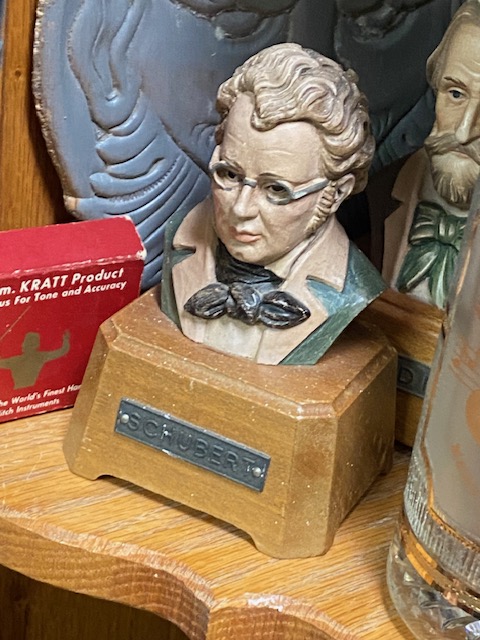
Like Chopin or Schubert, Jarman was a miniaturist. If you don’t expect to live a long life perhaps you get busy making perfect little creations rather than expecting to finish something massive like a full-length symphony, opera or feature film. Yes Jarman made some enigmatic & challenging features, a body of work that deserves to be better known.
And Schubert & Chopin made some full-length works. It still upsets me when I think that Schubert never heard his amazing 9th symphony performed in his short lifetime. Why am I so lucky to have multiple recordings of a piece the composer only heard inside his head or perhaps paraphrased at a keyboard.
I miss Neil Craighead, who’s currently studying, working and living out west. You may know him as a Dora Award nominee in 2015 for his Leporello in #UncleJohn with Against the Grain Theatre.
L-RL Sean Clark, Miriam Khalil (facing away,,,) Neil Craighead seated, Betty Allison, Aaron Durand and Sharleen Joynt.
Time flies, look at how young he is in that picture. Fast forward to 2023, with Neil studying at UBC including a portrayal of the Forester in their production of Cunning Little Vixen.
Neil Craighead as the Forester in The Cunning Little Vixen, UBC (photo: Sarah Race)
Neil was already a superb comedian, stealing the show in that Against the Grain transladaptation of Don Giovanni. In graduate school while singing several roles in his spare moments he’s sure to get better.
This interview was my chance to catch up with him.
~~~~~~~
Barczablog: Are you more like your father or your mother?
Neil Craighead: Maybe it’s a cop-out but I think I’m a pretty good mix of both. I have my mom’s tenacity and focus, which has served me well as a musician and in pretty much every other job I’ve ventured into. Physically I’m more of my dad who is also tall, and luckily, I’ve inherited a strong head of hair as well. I’ve just turned 40, and as I spend more time with my parents lately, I find it’s my dad’s calmness and kindness that I want to emulate more in my own behavior. I admire my parents’ relationship which is still going strong after more than 40 years.
BB: What is the best or worst thing about what you do?
Neil Craighead: The best thing about what I do is just the act of singing. The physical sensation of joyfully making music with one’s own body is irreplaceable. At its core singing is a primal, communicative function rooted millennia in the past, perhaps even predating language, and it just feels good. Society places all kinds of expectations around what it should or shouldn’t sound like that place hangups, mental hurdles, technical and physical blocks along the way, but in the end, singing for oneself can be extremely gratifying, regardless of the ‘product’.
BB: Who do you like to listen to or watch?
Neil Craighead: We could do a whole article on my listening and viewing preferences. I LOVE to listen to music of all kinds and have a vinyl collection with over 1000 albums that grows constantly (I just rescued 35 from Value Village here in Victoria). I adore Pavarotti singing pretty much anything, but especially Rodolfo, Cavaradossi, and Calaf on those fabulous Decca recordings. I’m also a Kaufmann fan, and regularly find myself watching the ‘Nothung’ scene from Walküre on YouTube for a shot of energy. Amongst my own voice type, I’ve always admired the singing of Nicolai Ghiaurov since I was introduced in undergrad to him singing “Le veau d’or” on his fantastic LP of operatic hits. George London is also a favorite of mine with his booming power that seems effortless. Outside of the classical realm I listen to a lot of beat heavy music like jazz, funk, and hip-hop, especially the 90’s-2000’s era niche. I’m fascinated by beat producers like J Dilla or Dr. Dre, and that’s led to a love for classic hip-hop, drum-n-bass, house, and electronic dance music. Other highlights that regularly make a spin on my turntable are Billy Joel, Joan Baez, Chicago (the band not the musical), Johnny Cash, Zeppelin, Wu-Tang Clan, Rage Against the Machine.
BB: Sigh, I’ve got a few discs that I haven’t listened to in awhile, because my turntable isn’t working, hasn’t been set up in awhile. But I have a big CD collection. We need to have another conversation about our collections…
What ability or skill do you wish you had, that you don’t have?
Neil Craighead: I wish I was a better pianist. My brain struggles with multiple musical lines as I’m used to processing music horizontally as a soloist, reading multiple notes vertically is slow. I have incredible respect for all the pianists I work with on a regular basis.
BB: When you’re just relaxing and not working, what is your favourite thing to do?
Neil Craighead: Fishing. Over the last few years, I’ve become an avid fisherman and spending the day on the ocean or a lake is my favorite way to pass the time.
Neil posted this picture on Facebook 6 days ago with the following caption: “Yesterday I staged my whole role in Ainadamar. Today I had a costume fitting and then I caught some rockfish!”
I love the peace of an early morning sunset on the water before the crowds arrive on the beach or the water-skiers crank up their music. I caught my first pink salmon this past year from the beach in West Vancouver, a highlight of the summer for sure.
Neil posted this one day ago with the caption “Only one bite today but it was a good one!”
BB: What was your first experience of music ?
Neil Craighead: My family is musical and though I can’t recall a specific first experience, music was around me my whole childhood. My mom’s mother was the church organist and my mother is a decent pianist. My father played the guitar, and his brother was in a band. I joined the Calgary Boys Choir at the age of 8 and spent nearly a decade in the choir which at that time was led by Gerald Wirth, the current director of the famed Vienna Boys Choir. He is in my mind, the reason I am a classical musician today as he instilled so many lessons to us youngsters about theory, instruments, languages, and world music. He was also one my first voice teachers and guided me through my break from 1st soprano to 2nd bass over the course of a summer.
BB: What is your favorite opera?
Neil Craighead: My favorite opera is I Pagliacci. In my humble opinion, it is a near perfect example of what opera can be. Its brevity combined with the density of spectacular music from the prologue to the commedia finale is unmatched. The characters are all so visceral, Canio’s soul crushing pain, Nedda and Silvio’s hope and passion, Tonio’s jealousy, and the chorus’s horror. Second place might be Salome, which is just so weird and wonderful I could listen to it endlessly. John the Baptist is a bucket list role for me. I’ve always had a soft spot for Hansel and Gretel as well.
BB: In November 2023 you were the Forester in a student production of Cunning Little Vixen at UBC, but will be in professional productions at Pacific Opera Victoria in February and Edmonton Opera later this spring.
Neil Craighead as the Forester in The Cunning Little Vixen, UBC (photo: Sarah Race)
BB:How did you approach the role of the Forester? And do you find much of a difference between student & professional shows?
Neil Craighead: My approach to learning a role is no different for a student or professional production at this point, as I must assume that if the role is a good fit, I will sing it again. Cunning Vixen is an incredibly challenging score in so many ways, not the least of which is the Czech language which uses sounds and letter combinations (especially the rolled r/z) that we North Americans struggle with. I have some experience with the language as I spent two summers in Czechia (then the Czech Republic) during my undergrad at UBC, which has a partnership with a theatre in Teplice. The most important component for me is translating the language so that I understand each word in Czech, this is my memorization method as I find it much easier to remember words and phrases than syllables and sounds. Then working to combine the text with the complex rhythms and not quite tonal melodies takes quite a bit of time and repetition. I started working on the role nearly 4 months before we opened the show and listened to Thomas Allen’s version on YouTube quite a bit.
Between student and professional shows there is very little practical difference. UBC’s program produces 3-4 operas a year with orchestra, sets, costumes, lighting, hair and makeup, and most of the features of professional productions. This is amazing training for the students, and they emerge ready to participate in mainstage productions anywhere in the world. The major difference is in the funding and budgets of productions. This forces schools to be resourceful, whether building and saving their own sets, furniture, props, and costumes, or limiting rehearsal and performance schedules. Students themselves also take on major roles of stage managers, set builders, stage crews, costume teams and most of the other backstage positions that would be filled by industry union professionals. Double casting is another feature of student productions that allows more people an opportunity to get stage time and learn alongside peers, but this also means splitting rehearsal time, which means one must be efficient to learn and memorize staging quickly.
I enjoy my role at UBC as a professional student. I have opportunities to mentor the younger students and help them figure out a Mozart recit or how to see the conductor in a vital moment. I also have opportunities to try out a role like Forester in a safe environment with guidance from a teacher.
BB: You’re appearing in Golijov’s Ainadamar at Pacific Opera Victoria. Tell us about the role and the opera.
Neil Craighead: When I got the phone call about participating in Ainadamar I said, “come again?” and my agent laughed before explaining this wonderful show to me. It tells the story of the tragic end of the Franco-era Spanish poet and thinker Federico Garcia Lorca (sung by Polish mezzo Hanna Hipp) through memories of his muse, actress Margarita Xirgu (played by my wonderful friend, soprano Miriam Khalil).
Federico García Lorca and his muse, Margarita Xirgu
The opera is sung in Spanish (a first for me!) and includes flamenco vocals, guitar, drums, and dance in some sections. It is at times groovy and musically thrilling, while also managing to find moments of stark beauty and sadness. The cast is small and made up mostly of women (Lorca is a trouser role), with an all-female chorus and dancers. My part is that of José Tripaldi, a falangist guard who provides a moment of humanity before Lorca is disappeared. A highlight of the production is Spanish tenor Alfredo Tejada whose flamenco singing is something to behold.
BB: I was excited to see you’ll be taking on the role of Wotan in the Edmonton Opera Das Rheingold in May. Tell me about your preparations, how you’re finding the role so far.
Neil Craighead: Wotan is a dream come true, but also a daunting task to take on. I have been preparing slowly since I found out, starting with buying and preparing a score. For me that means underlining my text, translating it all myself, including everyone else’s lines (I use DeepL which if you haven’t tried it, puts google to shame), tabbing all my entries, along with all the usual music markings that get added to a score as reminders to wait, sing through, don’t go flat, be quiet, etc. So far, its going well, but the scale of the score is unlike anything I’ve done before. The scenes are endless and the text is long, which just means its more of everything to remember. I’m starting to see why prompters were a necessity for so long.
On the vocal side of things, Wotan is a gift. It just feels wonderful to sing. That’s not to say it’s easy, as it requires a level of engagement that goes beyond much of the standard repertoire, but it is written in a way that allows you to exist in comfortable registers for much of the role, with moments of intensity that require that extra gear. I’m really enjoying working on the role with my teacher Patrick Raftery who is no stranger to the demands of Wagner and joys of his music.
Patrick Raftery
As far as being Wotan moving forward, I have no expectation that they will cast me in the next three operas, but I would definitely be open to the possibility. Having just turned 40, I really feel as though the next phase of my career is just beginning, and I would love to make Wagner’s music a major part of it. And of course, I have a wonderful relationship with the city of Edmonton through Joel Ivany and everyone at Edmonton Opera, and Kim Mattice-Wanat at Opera NUOVA, who has been a mentor and supporter of my career as a singer and pedagogue.
BB: You’re taking a graduate degree at the same time that you’re a practitioner onstage. What does the practical teach you about theory, and do you ever find your theoretical studies changing your approach to singing opera?
Neil Craighead: Returning to school as an adult student has been challenging and invigorating. I’m really loving the seminar classes that I’ve taken as part of my doctorate, and they are forcing me to flex brain muscles I haven’t used in some time. I think my practical experience only makes the theoretical more meaningful, as I can relate it to my time in the industry and on stage and evaluate different theoretical approaches through that lens. Where I’ve really enjoyed being challenged is in relation to positionality, hearing other perspectives and starting to notice my blind spots. Opera can be a polarizing art form for the modern consciousness, dealing with issues of violence against women, cultural appropriation, and insensitive programing are all conversations we must embrace rather than shy away from. I’ve learned a lot from my interdisciplinary professors and the readings I’ve absorbed and I’m grateful for their knowledge and perspectives.
I’m not sure that theory has altered my approach on stage, but it changes the way I think about my professional career and our industry when I’m off stage. I’m a singer, but I also have aspirations of producing opera or being involved in the running of a company or school at some point. I think its important to understand the landscape of modern academia and theoretical thinking and familiarizing myself with things like feminist theory or critical affect make me a better thinker. So much of being a performing artist or actor is an accumulation of life experience and knowledge that all contribute to your toolbox as an actor and your ability to think outside yourself. In that regard, everything I learn or experience makes me a better, more rounded artist.
BB: If you could tell the institutions how to train future artists for a career in opera, what would you change?
Neil Craighead: I think there needs to be a rethinking of the way we group singers in with other musicians in school training. The thing that separates us and forces us to be more than exclusively musicians, is text. It is impossible to separate the importance of text, namely poetry and scripts, from the job of singing the notes. I feel that the current system focuses more on music theory and history, and not nearly enough on poetry, text interpretation, languages, and acting. I would love to see more collaboration between music and theatre departments, training singing actors from the beginning rather than teaching singers to act once they have sufficient technique. I also feel like there needs to be a relaxing of the “classicalness” of the academy to permit more of the broad public who want to hear more musical theatre, jazz, pop, and modern vocals. If we can attract more singers from diverse backgrounds and introduce them to classical singing alongside their practice of “music for fun” we stand a better chance of finding the future stars of our artform.
BB: Does one have to be an extrovert or even an egotist, to be a good opera singer?
I believe that to be a great opera singer one needs a sense of self belief, that we have something to say and a voice worth listening to. I’m not sure that’s the same thing as being extroverted, at least not all of the time. Many of the best singers I’ve encountered on stage are mild mannered and quiet off the stage, while just as many are as loud in the pub as the rehearsal room. Many artists suffer from imposter syndrome and self doubt, so the battle is between that and the quiet voice that says “keep going”, and I have been fortunate to have a team of supporters and mentors that push me and encourage me to continue on the path in times of struggle.
BB: Toronto is insanely expensive. Do artists, singers need a dayjob nowadays?
Neil Craighead: Vancouver is no better, so frankly, yes! I reject the idea of starving for your art, and I believe the best art comes from a place of freedom to create, which requires stability. I have had all kinds of jobs since I began my singing career, from waiter, to carpenter, to singing teacher, they were all necessary at the time, and all taught me something I needed to know, adding to my ‘toolbox’. I’m trying to make singing my day job, hence the doctorate degree. I really enjoy teaching and I feel like I have a lot to give in that regard, so I’d like to have the stability of a university job, along with the benefits and pension which are unheard of for freelance singers. This also reflects the reprioritization in my life since my children entered the picture and the need for family stability, reduced travel, and a plan for the future.
BB: Singers come out of training programs, including the ensemble studio of the COC. And then what? Some people can make a living, some can’t. Stratford Festival and National Ballet function as places to employ almost 100% Canadian talent. Yet the fiction is out there that we need to bring in singers from abroad. Can you imagine Canadian opera with Canadian personnel?
Neil Craighead: One has to acknowledge the power dynamics in play here. As freelance artists we have no job security, no reliable paycheque beyond our next contract, and our relationships with producers are extremely important, thus some artists will be very careful in their answer to such a question.
I have said for some time that the current model of opera in Canada doesn’t serve artists at all. I have mentioned the challenges that we face as self-employed independent contractors, and I would really like to see the system change to provide a more livable experience for artists. I like seeing things like artists in residence programs that allow for stability and family life, and I think that idea could be expanded to see small fest-like core ensembles in major companies.
I have zero issue with flying in a major talent to sing a big role that makes the production possible, but I find it frustrating to see secondary and comprimario parts go to foreigners, when there are limited performance opportunities within the country and visa restrictions on singing internationally for Canadians. How is one expected to make the leap from an ensemble position to the working profession if we cannot cut our teeth on these intermediary roles. It limits opportunities for all except the early exceptional.

It also forces Canadian singers looking for stability to leave the country and seek it elsewhere, namely German speaking Europe, which on the one hand is an impressive export, but on the other, sends many of our most talented singers oversees and renders them invisible to the Canadian public.
BB: Do you have any influences or mentors you’d like to acknowledge?
Peter Barcza
There have been so many influential people in my career it would be hard to acknowledge them all.
I’ve already mentioned a few, Gerald Wirth, Kim-Mattice Wanat, and J. Patrick Raftery, but I need to include Wendy Nielsen who has been a wonderful voice teacher and friend for many years and Liz Upchurch for her guidance and persistence during my time in the COC Ensemble.
Your own brother Peter Barcza was a formative influence during my undergraduate years at UBC, and Jason Howard was a catalyst for the latest phase of my career. Our exchange of renovations for voice lessons was one of the most productive times in my life and I miss our lessons in his kitchen (pity his neighbors, imagine two Wagnerians bellowing on the other side of a duplex).
BB: What’s coming up for you this year?
Neil Craighead: February 21, 23, 25 & 27: Golijov – Ainadamar – Jose Tripaldi – Pacific Opera Victoria (POV) Easter – Bach – St John’s Passion – Soloist, Jesus – Vancouver Bach Choir April – Mozart – Cosi fan tutte – Don Alfonso – UBC April – Mozart – Reqiuem – Kamloops Symphony May – Wagner – Das Rheingold – Das Rheingold – Edmonton Opera September – Doctoral recital (Likely rep: Glinka – Farewell to St. Petersburg, Wolf – Michelangelo Lieder, Vaughan Williams – Songs of Travel. TBA Fall Mozart role Winter 2025 – Dove – Flight – Minskman – Vancouver Opera
The Metropolitan Opera’s 2023 production of X: The Life and Times of Malcolm X, the 1985 opera with libretto by Thulani Davis and music be her cousin Anthony Davis, was shown on PBS over the past week, likely as a nod to Black History Month. Although I’ve seen Davis’ music described as jazzy or jazz-inflected, except for the scene in Boston with the street, I think that description is unhelpful and misleading, possibly meant to encourage listeners to take a chance on the work. The score reminds me of Stravinsky or Zappa in its willingness to build melody from jagged shapes, and to make meaning through repetition. The frequent repeated cells do not in any way make the score minimalist even if at times –especially in the most spiritual moments such as the hajj undertaken by Malcolm– we are hearing chants and repeated phrases.

The libretto is an impressive creation, entirely intelligible to my ear. The ability to write phrases that can be understood seems to be an elusive goal, given libretti that lose track of the need for simplicity, of the fundamental transactions in drama seeking to communicate meaning to an audience. Thulani Davis makes poetry out of long thoughtful aphorisms that when repeated have the power of the spiritual, even if the opera didn’t already have the religious context hanging over the piece. I may have lost my objectivity, listening to this work at this particular time.
Will Liverman as Malcolm
My headline may seem absurd when one recalls that Malcolm had a conversion experience in prison, discovering Islam through Elijah Mohammed. But I’m talking about my encounter with the opera via my own path & my own spiritual journey while watching the Met on PBS. I’m looking through so many lenses I may seem to be like a kid holding his binoculars backwards, peering in at the wrong end. Yet maybe that’s the right way to address fundamental questions of faith.
I’ve been reading John Elford’s award winning book Our Hearts Were Strangely Lukewarm, subtitled The American Methodist Church and the Struggle with White Supremacy.
I came to the book through social media, where I’ve followed John, a classmate of mine from over half a century ago. John’s book is a careful history that is easily readable regardless of whether you’re a scholar or not, written in very direct language that doesn’t mince words.
His title might be the best signal, a poetic snapshot of the cognitive dissonance suffered by those perplexed by a church that fails to live up to what Jesus preached or what the founder John Wesley laid down as guiding principles. “Strangely Lukewarm” as the church sometimes seemed not just quiet about slavery but even speaking to endorse slavers. Or at least the church wasn’t as zealous in opposition as it might have been. Yet John is not judgmental or simplistic in his exploration of the different branches of the church.
Let me just say that Christianity is hard. You think about it on Ash Wednesday or Easter, when the teachings of the Gospel challenge us. I try to remember not to judge, not to presume to speak of what others are going through when I haven’t walked their walk, when their journey is so different from mine.
Reading John’s book recently I was mindful of the whole question of communities of faith and how we choose to belong or resist being in such a community. My own path, as a child of a single working mother, left me with a memory of church and Sunday school, but into adulthood without any connection to a congregation. How happy are those brought up in the bosom of a church family. I noticed this especially at funerals for church members, surrounded by members who may treat the departed as a saint of the church.
I was startled by how much I identified with Malcolm X in his journey. He loses his father early, and his mother is so distraught that the children are taken from her and placed in care. I remember that when my father was dying my siblings and I were taken into the home of our Pastor and his family for a time, while my mom lived beside my father in his hospital room. (or so it seemed) Even then when I was only 5 years old, I knew my mom was distraught by what had happened.
Malcolm’s youth is presented with the jazziest music in any part of the opera. The seedy community life in Boston living with his sister is dominated by Street, a charismatic tenor character so reminiscent of Sporting Life from Porgy and Bess that I have to think the similarities are deliberately built into the opera. Sporting Life is the agent of corruption, tempting Bess with happy dust (cocaine).
We see Malcolm (sung by Will Liverman) end up in prison perplexed by the futility of his life so far, listening to his brother recommend another pathway that he himself found, via Elijah Mohammed.and the Nation of Islam. As this idea revives a despondent Malcolm we will meet Elijah, another charismatic tenor character played by the same singer as Street (Victor Ryan Robertson) even as he inspires him in the opposite direction.
Malcolm X begins his own ministry throughout the USA, an electrifying speaker who helps the Nation of Islam grow in the decade from 1954-1963. But Malcolm’s words after JFK’s death bring him into conflict with Elijah, who commands Malcolm to be silent for a time.
We come to the most spiritual portion of the opera, as Malcolm decides to trust in Allah to help him, going to Mecca on a pilgrimage. The chorus are chanting behind many of Malcolm’s lines. I felt solidarity with him as a stranger in a strange land listening to chants in another language, as he sought meaning and clarity. I found his demonstration of humility touching, his conclusions about unity moving.
As for the rest of the work leading us back to USA and Malcolm’s assassination in 1965, the opera does its job with remarkable economy of means. When I think of the time put into the deaths of most opera characters, whole arias devoted to their last moments, this is so brief as to take your breath away. You barely have time to register that yes, the onstage banner tells us it’s the Audobon Ballroom where we may remember that Malcolm was shot, and we see that Malcolm is on stage with the child version of himself, Young Malcolm who we saw earlier in the opera. I was grateful for this merciful choice considering the brutality of the event.
The Met production features dancers choreographed by Ricky Tripp working in a variety of styles, sometimes African sometimes American, sometimes suggesting other cultures. They underline many scenes like a non-vocal greek chorus, married to the story-telling, and underlining the energies of the music. They expand our sense of a community in each scene where they appear.
Directed by Robert O’Hara with projections designed by Yee Eun Nam, the story unfolds before us on multiple levels, something like what we see in the current Toronto production of Cunning Little Vixen, where details and motivic elements are projected before they’re enacted. The stage space is rarely employed in a way that I’d consider representational or realistic, but rather in a series of scenes suggesting something static like oratorio, the singers at times standing and delivering as though preaching, and I don’t limit that to the two actual preacher characters (Elijah and Malcolm). Everyone including Malcolm’s brother Reginald (Michael Sumuel), his sister Ella (Raehann Bryce-Davis) and the dual roles of Malcolm’s mother Louise & his wife Betty (both played by Leah Hawkins) are given moments of declamatory singing that wouldn’t seem out of place in a Bach oratorio.
It’s wonderful singing, beautiful music, some superb dance in an opera I wish someone would present here in Toronto. I know we have the talented singers who could undertake the main roles if someone would produce this fascinating work.
I’ve saved the opera on the DVR where I will listen again.
Jack Hui Litster has recently had two original operas produced by OperOttawa.
Jack is a multi-instrumentalist and composer of concert music and film and TV score based in Ottawa, blending his classical and popular music training. As Composer-in-Residence for OperOttawa, Jack composed and produced his first opera “The Day You Were Born”, an innovative online performance using videos of the cast members singing from their homes during the coronavirus lockdown, informed by interviews Jack conducted with midwives and new parents and by Jack’s own experiences as a father of two young children. Jack’s second opera was premiered by OperOttawa in June 2022. Titled What Is Love?, this opera grows out of poetry from Kahlil Gibran’s beloved book The Prophet. Links to both operas can be found at the end of the interview.
Jack began his musical career as a jazz drummer, then decided to broaden his horizons and complete a degree in International Development. In the non-profit sector, he spent ten years fighting for international human rights and collaborating with community activists from Africa, Asia, and Latin America. All the while Jack stayed engaged in the Ottawa music scene, notably with his retro-pop music duo The Ticket, a collaboration with Adam Waselnuk, as well as performing in diverse styles of music including folk, Afro-beat, jazz, and opera.
Composer Jack Hui Litster (photo: Curtis Perry)
Sunday March 10th will see the world premiere of Jack’s Gates of Heaven: Requiem for a Life of Peace to be presented in Ottawa. A kickstarter campaign launched today February 8th to raise funds for the requiem.
To find out more about Jack’s music and his upcoming project with OperOttawa I asked him some questions.
Barczablog: Are you more like your father or your mother?
Jack: Starting off with a deep question here Leslie! I’ll need to give this some thought… Let’s see, I would say that I have a lot of characteristics of both of my parents in me. From my Mum I get my spontaneously evolving creativity, and the drive to create new projects and new artworks. My Mum and I are both people who step up to take on ambitious large creative projects, even in instances when we can’t yet clearly foresee the end result of a project before we take the first steps. My Mum has done this time and time again throughout her life, from creating incredible artistic projects like an intergenerational dance and documentary film project, to completing a semi-autobiographical book. For me this comes through in all the times when I take on a new project that I’m pouring my own personality and character into, projects that express my own artistic visions, like the operas and requiem that I’ve had the opportunity to write for OperOttawa. I think my Mum and I are both unafraid of embarking on a creative journey into the unknown, without a roadmap or a model to follow, armed only with the faith that the journey (and the connections made along the way) will have been worth it in the end. From my Dad I get the love of honing a craft, of developing an artistic skill set that you can then put into practice in community with others. My Dad is the one in my family who demonstrated to me what it is like to be a musician in collaboration with others and within the community. He played piano and sang at our church when I was growing up, he was the accompanist for countless musical theatre projects in schools, he sang in choirs. My Dad always made space for me and my brother to join him and participate in those musical projects, and he was always a supportive guiding presence for us, also always giving us the freedom to find our own way to express our own art. I will always love performing music live and making music with others, whether in professional, community or family spaces, and the joy that I receive from those experiences is something that I inherited from my Dad.
BB: What is the best or worst thing about what you do?
Jack: The best thing about what I do is the open door. When you are a freelance musician like me, there is no single set path that you are expected to follow. There is no rigid framework that you need to work within. There is no workplace with norms and an established list of acceptable methods, roles and responsibilities. Instead there is the open door. Each musical project, each collaboration, each opportunity, and on a more micro level, each song and even each note of music, is a gateway into nearly-infinite realms of possibilities. And the longer that you work as a musician, and the more projects you have worked on, the more diverse and different are the doors can become open to you. I’m not talking here in terms of privilege and opportunity – the question of who gets funding, who gets recognition, who gets an audience – though those are of course real factors that we all are forced to navigate in our work as artists. What I’m talking about here, though, is the freedom that we inherently have as artists to define who we want to be as an artist, and what forms of art we want to create. We have the freedom to determine what we want to express with our art, who we want to express it with, how we want to express it. The freedom of that open door and the fuel that it gives to my imagination, is unparalleled. I am so grateful that I am able to pursue that creativity, because it is a journey into who I am, what my art can express, and what that might mean to the world that I live in.
BB: Who do you like to listen to or watch?
Jack: Good question Leslie! I do a lot more listening than I do watching, to be honest. As a father who is quite active in the work of our household, taking care of our two children, cooking, cleaning, etc. I don’t spend much time watching tv or films. We actually don’t have a television set up in our house. But I’m always listening to music. For most of my life, I have generally listened to between 6-12 hours of music every day. I do have particular albums that I come back to, I have favourites. But I like to keep finding new artists, new and old, to listen to, to enjoy and to be inspired by. So I’m sure if you asked me this same question again in 6 months my answer would be quite different. The “who am I listening to” response keeps changing and evolving. But for now, as of February 2024, I’m listening to a lot of music by Hauschka (Volker Bertelmann), and I’m also studying a lot of Stravinsky’s music at the moment, primarily the music that he wrote for ballet. Those are the two artists on heaviest rotation for me at the moment. But I also spend a lot of time listening to recordings by local artists, because the Ottawa music scene is so rich and vast. So I’m listening to recordings by Dinuk Wijeratne, Raphael Weinroth-Browne, Nick Schofield, and Nathanael Larochette at the moment, and feeling grateful to be living in the same city as amazing artists like them and so many others.
BB: What ability or skill do you wish you had, that you don’t have?
Jack: I wish I was a better cook. I’m okay as a cook, I can often make food that tastes pretty good. But I wish I had a more innate understanding of flavours, ingredients, dishes, and cooking processes so that my cooking could be as diverse and wide-ranging as the music that I try to make!
BB: When you’re just relaxing and not working, what is your favourite thing to do?
Jack: Hands down, my favourite pastime is to hang out with my family. That often involves reading chapter books together with my kids, and also board games. But we also love spending time outside, whether that means going for walks in the neighbourhood or on hiking trails, or just playing at the park. Also, I must say that one of the most relaxing things for me has always been to sit and read a good book. I could get lost for hours in a good book.
BB: What was your first experience of music ?
Jack: My first memory of music would be when I was maybe 4 or 5 years old. It was around then that I remember learning how to turn on our stereo, put a vinyl record on the record player and drop the needle. I remember putting on records like James Taylor’s Greatest Hits and just lying down on the floor in the dining room where our speakers were, so that I could listen and get lost in the music. My first-ever favourite song was James Taylor’s song “Carolina in My Mind.”
BB: What is your favorite opera?
Jack: I’ll cheat a bit on this one and give two – one really old and one quite new. If I had to just pick one it would be Tan Dun’s opera “The First Emperor” which premiered at the Met in 2006. I love Tan Dun’s music. He is one of my favourite musicians of all time. When I was studying at Carleton University for my graduate degree, my thesis was an exploration of the intercultural music that Tan Dun composed for the film Crouching Tiger, Hidden Dragon. Intercultural composition is on display in a big way in The First Emperor as well. In that opera, Tan Dun, a Chinese American composer, tells the story of one of the most epic leaders in Chinese history, Emperor Qin Shi Huang, the man who implemented the construction of the Great Wall of China. And Tan Dun uses his deep understanding of Chinese opera traditions integrated with the lush melodic grandeur of late Romantic Italian opera. It’s an epic opera: fitting for an epic historical figure.
My second favourite opera, if I may – and this one is also not one of the more predictable choices – would be “King Arthur” by Henry Purcell, which premiered in 1691. Now I know for the purists out there, technically this is actually a semi-opera, as the principal characters have spoken roles, but the music in it, including arias, duets and choruses, and many instrumentals, are performed as concert pieces frequently to this day. King Arthur was a major influence for me when I was writing my first opera, “The Day You Were Born.” I had been commissioned by OperOttawa, and I was seeking examples of operatic music in English that would fit well with an opera company who specializes in early music, particularly Baroque. Listening and understanding how Purcell used the particular harmonic language of his time and the way he set English text to music, was massively influential for me.
BB your style blends classical and popular influences. Talk about how that works for artists and singers performing your music.
Jack: So as a performer I come from a popular music background, and as a composer I’ve studied orchestral and choral writing. I love finding the ways that these different musical traditions can influence each other. Musicians have been blending classical music and pop music for generations, and one of the styles of music where this has been happening in fascinating and creative ways for several decades is in film music, which is the style of music that I associate myself most with as a composer. I write music for recordings and music for performance. When I’m writing music for performance, my favourite way to approach this is to write for the specific musician or singer. The instrument they are performing on is important as well of course, but at the heart of it I am really trying to write for the particular player. This is more feasible in chamber music and when you are writing for the solo voice or a solo player. When I wrote my first two operas I very much had each soloist in mind for each piece that I wrote for them, always being mindful of their particular sound, their character and personality, and their own distinct individual musical superpowers. I take it as an honour and a privilege to write music for another artist to perform, so I want to always take the time to set them up to really shine and feel at home and comfortable in the piece that I’ve written for them. In my upcoming requiem we are keeping it pretty traditional in terms of instrumentation, using a small string section along with two brass and three woodwinds, percussion and 18 women’s voices. However, I do have a new project in the works which will likely take shape and hopefully come to a stage in Ottawa sometime in late 2024, which will feature improvising musicians on a mix of orchestral instruments and instruments from pop music and African musical contexts.
Composer Jack Hui Litster
BB: Do you prefer using trained operatic voices, and do you ever use microphones as in popular music?
Jack: It all depends on the project, and the parameters for every project that I work on are always somewhat different from one to the next. When I’m working with OperOttawa, one of our main goals is to create new music that can be performed by trained operatic voices. It has been such an honour for me to be able to write for these singers, and to gain some insight into what is and what is not comfortable for each of them to perform. In terms of using microphones, that’s an interesting question. We don’t amplify our performances with OperOttawa as we’re working in an a style of music that evolved in a time before amplification was even invented, so the sound mix, the balance that we have acoustically with the instruments and voices we use with OperOttawa is already strong and does not require microphones. We certainly use microphones for recording OperOttawa’s performances though! And in other projects that I’m working on, we don’t necessarily always have operatic singers, and much of my music uses microphones and electronics of all kinds. But it really depends on the aesthetics of each individual project.
BB in your bio it says you have “a degree in International Development” and that In the non-profit sector, you “spent ten years fighting for international human rights and collaborating with community activists.” Please talk about your experiences.
Jack: Sure! I mean it was ten years of my life so I could talk for days about what those experiences were like. But in a nutshell, I first studied music, and worked as a professional performer in my early 20s before realizing that I wanted to go back to school and study a broad range of subjects outside the scope of music. I completed a Bachelor of Social Sciences degree in 2009 with a focus on international development and then I was fortunate to find work in international human rights organizations here in Ottawa. After working for the Canadian Council for International Cooperation for three years, I spent from 2013-2020 working as a Community Engagement Manager for Inter Pares. I was able to co-organize several speaking tours throughout Canada for women’s rights activists from the Philippines. I was able to meet and get to know Inter Pares’ committed donors throughout BC, in Alberta, Manitoba, throughout Ontario and Quebec, and in the Maritimes. I got to work as the liaison with Inter Pares’ board of directors, I got to work on foundation grant proposals and reports. I received my designation as a Certified Fundraising Executive. I was on several hiring committees to bring excellent new staff into the organization. I built and managed a volunteer program. I got to emcee and provide background music for one of the organization’s largest-ever annual events, a performance of a documentary play about women’s rights. I helped to build a strategy for the organization to engage more deeply with Indigenous rights activists across Canada.
It was a lot. I loved it, and I met such inspiring people and lifelong friends. But at the end of the day, when you are an artist, your art keeps calling you. And I came to a point when I realized that if, God willing, I live to a ripe old age, I don’t want to look back on my life and ask the question “what if I had given my music a second chance?” I knew that I needed to find out the answer to that question. So I left Inter Pares to go to Carleton University where I spent two years completing my MA in Music and Culture (during the pandemic!). By that point I had already begun working as a composer for OperOttawa. And so far, the opportunities have continued to blossom. So I’m thankful that this transition has gone smoothly. And I’m grateful for the decade that I got to spend in nonprofit organizations.
OperOttawa Artistic Director and Conductor Norman E Brown
BB: In his October interview Norman E Brown founder and Artistic Director of OperOttawa said One of reasons I chose do an entire season only using female voices (Suor Angelica, an all female Magic Flute, and a world premiere Requiem by Hui Litster written specifically for female voices in March 2024) is the fact that there are so many amazing female singers in and around Ottawa who are underutilized. Tell us what voices you will be using and what this piece will sound like.
Jack: We will have 18 amazing, accomplished operatic singers from Ottawa and Montreal performing this requiem, which is titled Gates of Heaven: Requiem for a Life of Peace. With the exception of two movements which feature solo voices, this requiem is primarily choral.
Several of the movements feature 6-part harmony, and I had such a great time writing close harmonies for these women’s voices, who between them have a range of two and a half octaves.
This requiem will be sung by the talented singers of OperOttawa, including Melanie Anderson, Patricia Beckett, Stephanie Brassard, Katie Gratton, Ania Hejnar, Jean-E Hudson, Erinne-Colleen Laurin, Beverly McArthur, Carole Portelance, Sue Postlethwaite, Kathleen Radke, Silke Schwarz, Sherrie Spelchuk, Morgan Strickland, Pauline van der Roest, Colleen Woodhouse, Mary Zborowski.
Our singers will be accompanied by the OperOttawa Orchestra, conducted by Norman E. Brown.
Often a requiem is written in memory of a certain person. Gates of Heaven: Requiem for a Life of Peace is dedicated to the memory of Canadian women leaders throughout history. During the performance of the requiem, we will include three pauses in which a commemoration will be read honouring these Canadian women leaders: Allie Vibert Douglas, Viola Desmond, Madeleine Parent, Keiko Margaret Lyons, Rosemary Brown, Ethel Stark, Portia White, Kathleen Livingstone, Kenojuak Ashevak, Mary Ann Shadd, Hide Hyodo Shimizu, Lotta Hitschmanova, Violet King Henry, and Shirley Greenberg.
At its origins, a requiem is a mass for the dead. Over the past six centuries, requiems have been written by celebrated and gifted musicians, from Palestrina to Mozart, Verdi to Fauré, Duruflé to Rutter, and many, many more. There are requiems that are quite dramatic, like Verdi’s requiem or Mozart’s requiem, which seem at times to be exploring the subject of death from the perspective of devastated mourners at a funeral. Then there are other requiems which are more meditative and less dramatic, which have a flowing quality to them, such as parts of Duruflé’s requiem. My vision that I held on to as I was writing my requiem was that this would be the music that someone would hear after their death, at the moment of their arrival at the Gates of Heaven. I wanted the music to lean more into the celebration of a life well lived, rather than the grief and heartache of those left behind. So I pictured the relief that you would feel, arriving at the gates of heaven, to have a choir of angels sing you home.
BB: What words are you setting in this Requiem?
Jack: This requiem takes elements of the standard Latin text for a requiem, including Introitus, Kyrie, Offertorium, Sanctus and Benedictus, Pie Jesu, Agnus Dei, Lux Aeterna and In Paradisum. It’s a bit unorthodox but we have added a Gloria as well (partly as an homage to Bach’s Mass in B Minor, and partly because my wife’s name is Gloria so I couldn’t pass up the chance to write a piece in which a choir repeats her name endlessly!). And then the one moment in which we are breaking out of the Latin text is in the final movement. I’ve integrated some English text, titled “Golden Valley” to my setting of “In Paradisum.”
BB do you have any advice to young composers trying to find their way?
Jack; I hope that a young composer somewhere might read this blog. That would be very exciting for me. If you are a young composer reading this, please reach out to me. I would love to hear from you! Even though I still feel that I’m a young composer trying to find my way, I can certainly offer a few words of advice that I’ve picked up along the way.
First, try to find ways to embrace the paradox that on one hand composing is a solitary process – we spend so many days and nights every year by ourselves in our studios, at our instruments, alone with our creative ideas, creating new music in recorded or notated form – and on the other hand, to thrive as a composer, you need to always be growing and nurturing your network of fellow musicians, collaborators and other artists! This paradox is helpful because making time for the important work of relationship-building is a nice antidote to the loneliness of composing by yourself. Remember that your next award-winning, life-changing long-term collaborative partners could emerge at the most unexpected places and times. Keep alert for these possibilities, stay curious, and take the time to be aware of and engaged in the artistic communities that you want to be working with.
Second, it’s okay to have sidelines. Hardly any composers in history have been able to have composing as their singular sustainable income source. And that’s okay. You’re not a failure if you have other income streams besides composition. Composition-related income, in so many cases, is sporadic, short-term, and nearly always project-based, whereas bills are paid monthly and as humans we’re required to buy food on a daily basis. Having a part-time side gig that provides predictable steady income can give you peace of mind, which can help you to be in a better head space when you are doing your creative work. In my case, I am currently juggling roughly 6 part-time jobs, I work as the composer-in-residence for two arts organizations, I freelance as a composer, producer and performer, I teach several music students privately, I’m a contract instructor in a local university’s music department, and I work 10 hours a week at a bookstore in my neighbourhood.
Third, remember that being a composer is a long-term game. Our projects are long and time-consuming. But over time, as my mentor Dinuk Wijeratne likes to say, we are building assets (our compositions) which will continue to earn revenue for us in the years to come. The more years that you work as a composer, the more established you become, and the deeper your list of works becomes, and the more collaborators you have.
BB: Do you have any influences or teachers you would like to recognize?
Jack: I have had so many teachers and mentors who have left an imprint on my music and have each opened my eyes and my ears to what music has the potential to be. In my family, my Nan and my Auntie Eve, who were singers and whose performances I went to often as a kid – they showed me the joy of being on stage, and the emotion that a strong performance can give to an audience. My Dad and my brother Pete, who I performed with in countless projects all throughout my childhood – they made music fun for me from day one. All my uncles and my cousin Aaron, all such incredible singers and choristers, whose effortless harmonies gave me, from a young age, a deep love for Renaissance choral music, as well as choral music more broadly. My high school music teacher Doug McIlwain, who saw something in me and put musical opportunities in front of me, giving me the opportunity at age 17 to be the composer and director for our school’s first ever percussion ensemble. I think that it is only as I grow older that I look back on that and see how much of a vote of confidence and leap of faith that was. My drum teachers, particularly Tom Wolf and Kevin Brow, who gave me so much inspiration and such a deep love of my instrument, as well as so much insight into how much deeper it was possible to go. Dave Restivo, Tom Daniels, Greg Carter, John McLaggan, Lisa Berg in the music department at St. Francis Xavier when I studied there – all such incredibly inspirational professors and instructors. Kareem Clarke, Ben Newhouse, Dave Kusek and Jack Freeman at the Berklee College of Music, who were each so down-to-earth, passionate, and wise about the various aspects of music that I had the chance to study with them. Here in Ottawa, all my many musical mentors, Dr. James K. Wright, Dr. Jesse Stewart, Mark Ferguson, Dinuk Wijeratne, Robbie Teehan and Ed Eagan. I have been so blessed to have the ongoing opportunities to work with and learn from such gifted and generous artists.
I’ve been watching productions of Mozart’s Don Giovanni all my life that end with some sort of ludicrous & unbelievable encounter between the anti-hero and his fake stone guest, who comes to drag him to hell.
Until now that is.
David Leigh’s Commendatore haunting Gordon Bintner as Don Giovanni (photo: Michael Cooper)
The new production the Canadian Opera Company have brought in via the English National Opera, directed by Kasper Holten with sets designed by Es Devlin and projections designed by Luke Halls takes advantage of modern stagecraft and CGI.
Each segment of the stage picture has moving projections surrounding the characters (photo by Michael Cooper)
Yes operas often make huge demands on the imagination. We want to believe. I don’t want to offer any spoilers except to say that there are scary moments in Holten’s Don Giovanni and not just at the end. This Don Giovanni doesn’t shrink away from the implications of a story that asks us to believe that the spirit of a murdered character comes back to haunt his killer.
It’s a curious coincidence that in 2024, the year of Czech Music, both of the operas in the COC winter season have Czech origins, Mozart’s opera having premiered in Prague.
The version we get minus the usual epilogue ends the opera with the Don’s demise. It’s the first time I’ve seen it done this way, a version that was more common in previous centuries than in our own. While I think I prefer the opera with the extra scene containing the reflections of the characters at the conclusion, this shorter version has the advantage of getting us out of the theatre sooner, while placing the focus squarely on the lead.
Speaking of which, Gordon Bintner as the Don is a secure presence who sings the role brilliantly. We hear a nuanced Mozartean who can be softly seductive or a boastful brute without apology or remorse. His physical presence is as persuasive as the singing, the total package. You won’t hear a prettier baritone sound in this role.
Paolo Bordogna as Leporello with Gordon Bintner as Don Giovanni (photo: Michael Cooper)
Alongside the Don is the superb Leporello of Paolo Bordogna, a gifted comedian with terrific timing and a lovely voice. His catalogue aria is a thing of great beauty, and will make you laugh.
Of the three women the Don is chasing, first we meet the Donna Anna of Mané Goloyan, a soprano who interpolates a high D into her big first act aria “Or sai chi l’onore”, She was totally vulnerable in a role that can be swamped under the weight of her calls for vengeance for her father’s murder, like a walking guilt trip. I like her version of the character more than any I’ve seen, a wonderfully human take.
Mané Galoyan as Donna Anna with Ben Bliss as Don Ottavio (Michael Cooper: photo)
Her betrothed is Don Ottavio, sweetly sung by Ben Bliss in a more macho reading of his part than many I’ve seen, both in the ensemble numbers or in his two arias. While Ottavio is sometimes portrayed as a hapless and passive bystander, waiting for Anna to get past the anger & demands for vengeance over her father, Bliss makes a believable whole out of the parts Da Ponte wrote for him in the libretto. The other member of the family is The Commendatore of David Leigh, getting to do more than usual in Holten’s Don Giovanni. I want to be spoiler free, but he’s the key to this production.
As Zerlina Simone McIntosh gets to sing the best melodies of the whole opera, the woman who is most relatable, and Simone didn’t disappoint. With the Masetto of Joel Allison, we see the closest thing to normal people in the opera. Masetto shows us frustration and anger in a couple of numbers, but never gets a chance to get even with the Don.
But have no fear, the story makes sure justice is done.
Joel Allison as Masetto with Simone McIntosh as Zerlina (photo: Michael Cooper)
The 95 minutes until the intermission flew by. I recall seeing Conductor Johannes Debus say on Facebook that “Toi toi everyone! It’s going to be a pure adrenaline rush from start to finish!”
He wasn’t wrong. The orchestra played cleanly, quickly while Johannes offered brilliant support to his cast, especially in the finales to each act.
That makes two shows in the winter season of the COC that make great first operas, although Don Giovanni’s music is fairly well-known compared to the Janacek.
So far Perryn Leech’s approach (the new General Director) at the Canadian Opera Company seems to be certain to be popular, bringing in productions that are visually appealing while telling the story in a compelling fashion that doesn’t venture too far away from the score as written.
Don Giovanni continues at the Four Seasons Centre until February 24th.
Gordon Bintner as Don Giovanni with Mané Galoyan as Donna Anna (photo: Michael Cooper)
The Canadian Opera Company are currently presenting Leos Janacek’s opera The Cunning Little Vixen. This flamboyantly theatrical production is among the most colourful things I’ve ever seen on a stage.
Vixen is suitable for children and makes a terrific first opera. Six performances remain February 3, 8, 10, 13, 14, 16 of a work that premiered exactly one hundred years ago.
This light-hearted work may remind you of The Nutcracker for the animals and children in the story, featuring not just the COC chorus and orchestra but also prominent work by the Canadian Children’s Opera Company.
Cunning Little Vixen at the COC (photo: Michael Cooper)
Directed by Jamie Manton this production from English National Opera features sets and costumes designed by Tom Scutt.
Poacher (Alex Halliday) and Director Jamie Manton
It’s timely as these words from the COC website suggest: When a forest gamekeeper traps a fox and attempts to domesticate her, their encounter leads to a poignant reflection on the natural cycle of life and death, as well as our relationship with the planet. This inspiring opera invites audiences to reflect on the advancing toll of climate change and the importance of cultivating a harmonious interrelationship with the natural world.
It’s a different planet now. Yes exploitation of natural resources was the key to the exploration of Canada, and the fur trade was one of the key industries that built our country: but since the 1980s or 90s, fur is not just out of fashion but even illegal in places. Janacek’s opera doesn’t take sides, showing us mostly those who would exploit nature, and the consequences for the natural world, making for a very balanced meditation on forest life. It doesn’t preach.
Based on stories by Rudolf Tesnohlidek serialized with illustrations in a newspaper, Janacek wrote his own libretto, a work so closely associated with him that music from the final scene would be played at his funeral.
While Manton and Scutt fill the stage with a great deal of movement and brilliant colours, they don’t opt for a realistic presentation. It’s not Disney nor even Maurice Sendak (who designed the last version of this opera seen here). There’s a Brechtian aspect to the staging and design, reminding us regularly that no we’re not seeing a realistic presentation. When the fox and the vixen get intimate, they take off their headpieces that include their fake ears. It’s simultaneously a reminder that the theatre is not real life, yet invites us to see the emotions of the players under those costumes. This is a production that chooses not to create illusions but instead asks you to be an imaginative partner, thinking and feeling with the performers.
A constant feature of the stage picture is found in a banner that unrolls throughout the opera, for me inducing tears on the first page of the score. Just as the opera began with illustrated stories on newspaper pages, so too this presentation before us. Almost every picture accompanying this review shows some of the images, although the best ones weren’t captured by the COC photographer. They represent a show within the show, or in a real sense, they are where the story originates. The sparseness of the set pieces and the colourful costumes encourage us to keep looking back up at the story-telling banner.
Vixen (Jane Archibald) photo: Michael Cooper
Jane Archibald was a crowd favorite as Sharp-ears the Vixen. I don’t think I’ve ever heard her sing off pitch, although this time it was more a matter of her energetic physical portrayal as her impeccable vocalism.
Vixen (Jane Archibald) and Forester (Christopher Purves) photo: Michael Cooper
Christopher Purves is the forester, truly an everyman especially in the last act. Purves’s appearance is older and crustier than other foresters I’ve seen, which works for me being somewhat crusty myself. In an opera so preoccupied with the passage of time and renewal, it’s that much more poignant seeing someone to whom I can relate so easily. In my recent interview with Adam Klein, the word “agism” was a huge topic, observing that singers seem to be shown the door far too soon nowadays, a problem especially pressing when you need someone onstage to play the leading roles who aren’t young lovers. Yet in fairness when I look it up, aha! Purves is much younger than I, and in fact is a good actor, rather than actually being old. The portrayal was gruff at times, but full of delicacy especially in that amazing last scene.
Vixen is an ensemble show, led ably as usual by COC’s resident music director Johannes Debus. The many chorus moments and children’s solos were lovingly presented, never covered by the orchestra and beautifully articulated.
Fox (Ema Nikolovska) and Vixen (Jane Archibald) photo: Michael Cooper
The fox who romances and then marries Sharp-ears the vixen was Ema Nikolovska, clearly enjoying herself. The voices contrast wonderfully but blended perfectly.
Poacher (Alex Halliday) photo: Michael Cooper
Alex Halliday was a sympathetic Poacher, in a role that can be played much darker. But he is just trying to survive, or to find a fur for his girlfriend.
The animals are all great fun. As a tenor I was sympathetic to what happens to Adam Luther’s strutting rooster, seemingly punished for having superb high notes. Carolyn Sproule as the dog has the wackiest costume of the night.
Vixen (Jane Archibald) and Dog (Carolyn Sproule)
I’m delighted to see that the roles are shuffled for the relaxed performance February 13th , Karoline Podolak singing Sharpears for Jane Archibald and Joel Allison as the Forester for Christopher Purves. That gives the COC a ready cast in the event that anyone gets sick. We have been seeing a lot of illness and cancellations, so while people may behave as though the pandemic is over, it’s especially tough for singers.
This is an opera where you can see how much fun the players are having, and maybe wish you could be up on stage with them yourself. It feels very short, and I didn’t want it to end.
Vixen (Jane Archibald), Priest (Giles Tomkins) and hens (COC chorus) before story-telling banner. photo: Michael Cooper
The Year of Czech Music is an event that since 1924 has commemorated the major figures of Czech music. I understand that it began in 1924 for Bedřich Smetana’s 100th anniversary, and has been repeated on every year that ends in a “4” , as a worldwide celebration.
2024 has additional significance, with the centennial of Janacek’s The Cunning Little Vixen (composed in 1923, premiered in 1924), that opens this week with the Canadian Opera Company, and the bicentennial of Bedrich Smetana, born March 2nd 1824.
John Holland is the founding director of the Canadian Institute for Czech Music. In the fall of 2014, he produced the Canadian premiere of Dvořák’s opera Jakobin. For 2024 the year will be commemorated in Canada with several presentations of opera and concert repertoire.
John is a singer and musicologist who recently published The Lost Tradition of Dvořák’s Operas: Myth, Music, and Nationalism. Other than Rusalka (an opera that’s regularly produced), you might never know that this great composer actually composed ten operas.
John Holland holding his new book
I was glad to interview John in the middle of a busy month of teaching and singing to talk about opera and especially his first love, Czech Music.
~~~
Barczablog: Are you more like your father or your mother?
John Holland: I feel I have the analytical mind, critical thinking, and wit of my father, and the drive, determination, and creativity of my mother. My parents worked in very different fields, my father was a lawyer, and my mother is a professional skating coach. I grew up having a love of reading and thirst for knowledge, but also a love of swimming, skating, and outdoor activities.
With regard to music, my father’s side didn’t have a lot of music, but with us living in Windsor, my father had a huge affinity for Motown. The music definitely comes from my mother’s side, the Czechoslovakian side of the family. A visit to my grandparent’s house would never go without LPs of Czech and Slovak folk songs being played, or even dancing polkas in the family room. My family even has a family polka band, the Polkadelics, which was founded by my two uncles and their friends. At one point or another several of us nieces and nephews have sung or played in the family band.
BB: What is the best or worst thing about what you do?
John Holland: The best thing about what I do is that I get to surround myself daily with music that I love, and work in a performance art, whether on stage or in concert. I teach music, I write about music, I plan music projects, and I also conduct. The central aspects of my life revolve around being a complete musician, and being able to work in a field that I adore is sheer joy.
Without a doubt, the worst thing about the music industry is the devaluing of music and performing arts. It is heartbreaking to see the juxtaposition in worth between someone who plays a professional sport and someone who is a professional performing artist. I have many colleagues who are at the top of their art, and struggle to make a living, while people in other fields do the bare minimum, and collect a livable wage.
When I look back at the pandemic lockdowns, everyone was stuck at home and wanted to consume arts content, whether stream of operas, musicals, concerts etc. What those people forgot is that musicians were some of the most affected by the lockdowns. Concert halls, opera houses, music theatre productions, choral ensembles, and the like were the last things to open up, and always the first things to be shut down. Even today, many auditions I go to have the caveat of “this production may or may not happen because of the tenuous nature of the arts post-pandemic.” Lawyers, dentists, custodians, mechanics, all do not work for free or for exposure, and it is time there was more value for the profession of performing artist. The world cannot function without music and the arts. Art is work, as the slogan goes, and it needs to be valued as such.
BB: Who do you like to listen to or watch?
John Holland: I have always been proud of my eclectic musical tastes. Even while answering these questions, I have been listening to Dave Brubeck’s Time Out Quartet, Queen’s Greatest Hits, and a recording of Palestrina Motets. Of course, I love opera and art song, and all forms of classical music, but I have many other favourite genres of music. Working in classical music often means that when I am not working, I want to listen to other genres. Some may call them guilty pleasures, but I hold no guilt about them. I am a big fan of jazz music of the swing era, and also neo-swing. There is a band called the Squirrel Nut Zippers, and their album titled HOT is one of the great modern swing albums. I have my dad’s affinity for Motown, and really enjoy Michael Jackson, Billy Joel, Sam Roberts, Buena Vista Social Club, and lots of other non-classical music. I worked at Grigorian music store on Yorkville for over 15 years, and through that time, was able to hear so much diverse music, and really expose myself to new sounds. It was great!
What do I like to watch? Well, I am a big hockey fan. Being from Windsor, my friends were either Detroit Red Wings fans or Toronto Maple Leaf fans, but I was raised with a more discerning taste. It is very interesting living in Toronto and being a die-hard Montreal Canadiens fan. Watching my Habs in 2020-21 eliminate the Leafs from the playoffs was so amazing. The next day, I walked around the city decked out in all of my Canadiens swag. It was glorious.
Aside from hockey, I love sci-fi. I was raised on Star Wars and Star Trek, and love them both to this day. I am also a fan of sitcoms, historical dramas, britcoms, and the like. The brit coms ‘Are You Being Served?’ and ‘Black Books’ are on my top tier list. One of my favourite things to watch are ghost hunting videos.
BB: What ability or skill do you wish you had, that you don’t have?
John Holland: This is easy. I wish I had the ability to teleport. There are so many things I wish I could experience or participate in, and travel or travel time is usually the mitigating factor in not being able to do it. Also, being able to visit distant family in the blink of an eye would be wonderful. I do a lot of singing in Ottawa, and the drives can get pretty tedious sometimes. If I could snap my fingers and be there, that would be great, and if I cannot have that superpower, then someone better develop that Star Trek transporter very soon.
BB: If we had high-speed rail? Not quite teleporting but its carbon footprint is better than air travel. Can you imagine being in Ottawa or Montreal in an hour or two, no trip to the airport, guilt free environmentally? Not sci-fi: they’ve already got it in Japan & Europe, at 320 km/hr. Oh well…
When you’re just relaxing and not working, what is your favourite thing to do?
John Holland: In those rare down times, I have a variety of things I like to indulge in to relax and recharge. I like to read and go on walks, as they help me zone out from the thoughts of a music career, and help me refocus. Swimming and Skating are also good because they are very different from music. I am also an avid gamer, and even have a live stream video game channel on www.twitch.tv/johnholland2000. I regularly stream games, and even do some of my singing practice on twitch. Gaming is another activity that takes me away from the heavy focus that professional music often demands.
BB: What was your first experience of music ?
John Holland: The aforementioned Czech music afternoons at my grandparent’s house were probably some of the earliest musical memories I have, including the family polka band. My mom and dad would always play music around the house, and often sing along. Being a skating coach, my mom was always playing a variety of music on the stereo as she created skating programs for her students. My dad listened to basically anything that caught his fancy, but had a great love for Motown, R & B and Soul music. Many a day the house would be filled with The Temptations, Smokey Robinson, Vivaldi, Tchaikovsky, and many others. We were a household of Mozart to Motown.
BB: What is your favorite opera?
John Holland: For someone who is a singer and a musicologist, this is a tough question. There are so many mainstream operas that I enjoy, but also rarities. If I have to pick a favourite, I would have to say Mozart’s Le Nozze di Figaro. It is simply sublime. There is a reason it has the longevity and performance frequency that it does. I have a soft spot for it as Figaro is a role I sing very often, and it is different from say, Leporello in Don Giovanni, which is my most performed role. Figaro is smart and quick-witted, and gets to work with an equally sharp partner in Susanna. Beautiful arias, amazing ensembles, and vibrant characters make this work a masterpiece.
So, if I have to pick a favourite obscure work, it is Dvořák’s Jakobín. The score is terrific, and the arias and ensembles have that distinctive Dvořák flavour. You’ll be hearing more about Jakobín this year!
BB: I’m looking forward to it! First I need to get that score out of the library, have a closer look.
The Canadian Opera Company have done lots of Czech operas over the years, including The Bartered Bride, Jenufa, Rusalka, Makropolous Affair, From the House of the Dead and coming later this week: The Cunning Little Vixen. Is there a Czech opera that you’d like to see produced by a major company like the COC or the Met?
John Holland: Without hesitation, it is Dvořák’s opera Jakobín. It is simply his best operatic music. Dvořák didn’t limit himself to one idiom, and composed in the two leading operatic styles of the day, Verdian and Wagnerian. Within these two styles, he added his singular talent for creating music in folk music and folk dance style. Jakobín was a major focus of my PhD research and my recent book. While Rusalka is his most well-known opera (and don’t get me wrong, it is beautiful), I feel Jakobín has a wonderful story, stronger characters, and a seamless amalgamation between art music and folk music. Jakobín is also similar to The Bartered Bride in that it presents a window into Czech village life. The plot has moments of tenderness, moments of comedy, and moments of absolute charm. The soprano role of Terinka has one of the most beautiful arias that mixes folk and art music. The opening of act two takes place in a schoolroom where the village music teacher is rehearsing one of his own compositions with the children of the school, and some of the villagers. This is one of the rare instances in music that shows a music rehearsal process within the stage action, and it is filled with charm and fun. Some of the kids sing in wrong spots, some of the basses come in late. It is pure joy! Something like Jakobín would suit the COC, MET, or professional companies because aside from a robust chorus role (and the COC has a fabulous chorus), there is a large part for children’s chorus, which the COC has, and should definitely be utilized more. All that said, Jakobín would be a no-brainer for the COC, and I actually proposed the idea on a few occasions, but in the interim, it falls to groups like the Canadian Institute for Czech Music to carry the torch of this marvelous work. I produced the Canadian premiere of Jakobín here in Toronto back in 2014, and we are remounting it for the autumn of 2024. It is a chance for Torontonians to see this beautiful and unjustly neglected work.
BB: Do you ever feel conflicted, reconciling different aspects of opera, between the promotion and the art, between the perspective of a scholar or that of a performer?
John Holland: This is a very interesting question. Personally, I have never had issues with promotion of opera, and especially being paid for it. There are so many wonderful music projects, opera or otherwise, that are not promoted to the extent they should be, and then those involved don’t end up feeling valued, and then we get the misconception that opera and the arts don’t make money. While I do think there is a problem with public perception of opera (people thinking it is elitist, etc), many things are not promoted. As performers, we should never feel apologetic for promoting ourselves and our hard work, and we should never feel ashamed for wanting to make money in our profession. Too many professional-level musicians still take gigs that pay far less than what they should, or are even pro bono.
This hurts the industry for all of us.
The conflict between scholar and performer is a fun topic for sure. As a musicologist and opera singer, I am both, and have never felt that one has diminished the quality of the other. I have had several colleagues and teachers over the years who have tried to guide me towards one field, forsaking the other, but I feel that my work as a musicologist gives me a great understanding of the music I am singing or conducting, and that my work as a performer gives me unique insights into musicological research. I feel that all musicians should have the duality of music research and performer, at least on some level.
BB: Of everything you sing (whether we’re talking about opera, lieder, pop tunes or anything else) what feels the best in your voice and what do you think sounds best?
John Holland: First and foremost, Mozart. Give me Mozart all the time. In the opera world, Mozart is the music I have sung the most often, and what I have been lauded. Next, Dvořák…anything Dvořák. The style and music just suits me. Haydn, Handel, Bach, Schubert, Rossini, Donizetti, are all composers whom I adore, and whose music feels good to sing. I have always had a soft spot for music theatre, so things like Phantom of the Opera, Les Mis, and the classic musicals are all fun. Also, another non-guilty pleasure, anything from Gilbert & Sullivan. It is brilliant musical comedy, and suits my voice well.
BB: Singers come out of training programs, including the ensemble studio of the COC. And then what? Some people can make a living, some can’t. Stratford Festival and National Ballet function as places to employ almost 100% Canadian talent. Yet the fiction is out there that we need to bring in singers from abroad. Can you imagine Canadian opera with Canadian personnel?
John Holland: I can imagine that, and wish for that every day. As a singer who has sung around the world, I often hear from foreign directors and conductors about the high calibre of singers that come out of Canada. I spent three summers studying with Nico Castel from the Met, and he said to me, “Every singer I hear from Canada is world class…it’s just a shame it is so difficult for you to work in the United States.” This is the crux of this argument. It is restrictive for foreign singers to work in other countries because they want to promote and encourage their home-grown talent first. Now, I love singing in Europe, but why is it that I can sing Leporello and Figaro in Prague and Salzburg, and receive wonderful reviews, but struggle to find opportunities to sing them here? I have a colleague, a baritone, who has a world-class voice, and has still never sung at the COC. Why is that? The calibre of singers in Toronto alone is enough to warrant a Toronto Opera Company, let alone a Canadian one. There are elite singers in this city who have to scrap and scrounge to be able to continue their art, yet if they had been born in Italy or Germany, would have a proper career as a house singer and given their due. Also, hiring local singers is cost effective for major companies. Travel expenses and accommodations would virtually be wiped from the operating budgets. We train singers in this country, why can we not employ them?
Also, from a staffing standpoint, I am in no way criticizing the current artistic and administrative staff of the COC, but there are people in this country who can do all of those jobs, and at the same level. Again, it is not a knock against those people, but why are we so averse to engaging local singers, GMs, conductors, etc?
BB: Nowadays it’s very expensive to live in Toronto. Can a performer survive without a day job?
John Holland: I think this ties into the previous question a bit. If there were more A-level opportunities, then perhaps more singers could make a living just as an artist. As it stands now, it is very difficult to make it solely as a singer. Those who do often have independent wealth or financial backing, which makes it a very exclusive group. Can you imagine if a professional hockey player had to have financial benefactors (outside of their wage) to play their sport? Or a dentist having to apply for financial aid to be able to practice dentistry? The sad reality is that most of the professional singers in Toronto have to have other sources of income. We all have church music jobs, but we all have to have ‘day jobs’, whether it be teaching, the service industry, the tech industry, etc. I currently teach at York University, teach private voice lessons, conduct a church music program, and work as a professional singer. Many of us juggle schedules like this and succeed in spite of it. It is a wonderful celebration of the dedication of singers in this city, but also a signal of the shocking state of the financial reality of Toronto.
John Holland, teaching at York University
BB: You’re both an academic who has recently published a book as well as a practitioner. Please reflect for a moment on the connection between the two
John Holland: There are many instances where an academic pursuit informs a performance focus, but for me, it was somewhat the other way around. I was looking for unique repertoire to bring to auditions, something that would set me apart from the thousands of other baritones out there (I know all of the sopranos out there understand this to the Nth degree). Simultaneously, my Czech grandfather used to bemoan the fact that I seemingly sang in every other language other than Czech. Necessity is the mother of invention, so I started looking for Czech opera arias and art songs to bring to auditions, and boy were they hard to find. I ended up putting a Dvořák aria on my audition repertoire, and instantly was asked questions about what that was. People were shocked to know it was Dvořák, and even commented on how they never realized Dvořák composed operas. I also became known for singing Czech music, and it helped me stand out in auditions. I was also conscripted by a musicology professor of mine during my masters degree to present a two-hour lecture on an opera, either Rusalka or Midsummer Night’s Dream.
I had recently sung the Britten opera, so of course I picked Rusalka, something I knew very little about. What happened is that there were zero resources upon which to draw, so I found that I was doing much of the analysis and research from scratch. The end result was that I went into a two-hour lecture with about four-hours of material, including a self-created catalogue of leitmotifs. That was a tell-tale sign that work needed to be done in this field.
This leads into my book, which is on Dvořák’s operas, and came out of the necessity for awareness on this music, and was the focus of my PhD work at York University. The performer and academic have always gone hand in hand with me. I feel that when I know the story of a piece of music, I sing it better, and I feel that when I have performed a piece, I have unique and intimate knowledge of it that a solely music theorist may not. The expertise in Czech repertoire has also given me the opportunity to coach the sung Czech language. I have coached singers all over the GTA, both university singers and professionals, and through zoom, have even been coaching singers across the United States. This also helps in awareness and accessibility of Czech music, and thus aids me in my quest!
BB: Tell us about your new book on Dvorak’s operas.
John Holland: My book ‘The Lost Tradition of Dvořák’s Operas: Myth, Music, and Nationalism’ was published in October 2023 by Lexington Books, which is part of Rowman & Littlefield. The book grew out of my PhD research and a need to create awareness and understanding about Dvořák’s operas. Think of it this way. When one examines the compositional oeuvre of Antonín Dvořák, one bears witness to a catalogue of well-known works, and critical successes, in every genre except one, opera.
The question then arises, ‘What happened to Dvořák the opera composer’? With ten operas to his credit, which span his life, Dvořák was no stranger to the genre. While some of Dvořák’s operas have remained popular at home, the majority of them are lost in obscurity. Only Rusalka has begun to break onto the international opera scene, and only within the last thirty years. This book examines Dvořák’s operas, specifically Jakobín and Rusalka, from a critical standpoint, focusing on such criteria as tonal structures, thematic material and motives, subject matter, Czech folklore and musical influences, textual language, nationalism, characters, compositional history, performance history, and reception. The intent of this research is to vindicate and validate Dvořák as an opera composer; to show him to be an overlooked master in Nineteenth Century opera and the bridge between the Verdi and Wagner traditions. Now, well over one hundred years after his death, it is now time for Dvořák to take his rightful place in the operatic echelon. There are definitive reasons why Dvořák’s operas have been lost to the greater operatic world, through political intrigue, social climates, and ethnic bias, all of which are part of the story that this book tells. The book is available through the publisher and Indigo, but is on the shelves and in stock at Remenyi House of Music, so my advice is to buy it there and support local stores.
BB: You’re singing the comic role of the Sacristan in the Mississauga Symphony production of Tosca, followed by the more serious role of Marullo in Rigoletto (a character whom Rigoletto identifies, rightly or wrongly as a friend) for Opera York. Recalling your portrayal of Papageno last year with Opera York, when your friendly demeanor was very welcome, do you have a preference for a comic role or is it more accurate to say you’re flexible and can sing any sort of role?
John Holland: If you ask my mom, she will say that I have always been a ‘character’ my whole life. I have loved telling stories, and so opera and music theatre are the perfect ways for me to tell stories through music. I had, and still have, a very vivid imagination. Growing up, I was always kind of quiet, except when I was singing. When I began high school, I became involved in musical theatre and since then, I have been addicted to the stage, and haven’t shut up. Essentially, I will sing any role I feel will suit me. I mean who doesn’t enjoy playing the villain now and then, but I love being part of musical comedy, and have been told I am a good stage comedian, which is a heart-warming compliment.
Comedic timing, especially in opera, is a real skill in itself. Making an audience laugh while you are singing in a foreign language takes as many physical cues as it does musical. That’s why I really jump at the opportunities to sing Bartolo in Barber of Seville, or Leporello, or Figaro or Papageno. They are challenges beyond just the music. Also, when you find that synergy with comedic cast members, it can really create something special. I sang a Figaro in 2022, and the Susanna I was paired with, Grace Quinsey, was just as much of a stage comedian as I am, and we found ourselves anticipating each other and creating jokes on the fly during performances. We had a chance to rekindle that synergy as Papageno and Papagena with Opera York in 2023. That kind of comedic timing and connection is very rare, and when you find it, you have run with the opportunity.
BB: Does one have to be an extrovert or even an egotist, to be a good opera singer?
John Holland: Ironically, I know many singers who are tremendous stage characters, but quite introverted and soft-spoken when not on stage. I think that many of us save our extroverted bursts for when we are on the stage. When I am on stage, I try to be larger than life, but when I am at home, or with family or friends, I am just myself.
As far as being an egotist, there are those types of people in the opera world, but there are also those people in every walk of life. One thing I will say, aside from ego, to be a good opera singer, you have to have confidence in your abilities, know your strengths, and play to them. If you are good at what you do, don’t be apologetic for it.
BB 2024 is the Year of Czech Music. Every year that ends in a 4 gets that honour. Your organization The Canadian Institute for Czech Music has planned some events to commemorate, as it did ten years ago. Three operas will be presented, beginning with The Bartered Bride on March 9th from Opera by Request. This coincides with the 200th anniversary of the birth of the composer, Bedrich Smetana. Please talk about the CICM, its history and what you have planned for this year.
John Holland: The Canadian Institute for Czech Music was formed in 2013 to promote research and performance of Czech Music in Canada. It grew out of my PhD work, but has since become its own entity with projects and collaborations with groups such as Opera By Request, Toronto Orpheus Choir, Nocturnes in the City, and the Czech Consulate. In 2014, the previous Year of Czech Music, we produced the Canadian premiere of Dvořák’s Jakobín at Trinity St. Paul’s with soloists, two choirs, and an orchestra. It was a real triumph for our organization, but also for bringing this music to light.
Toronto has a large Czech diaspora, many of whom came here to escape WWII or the Communist occupation, and one lady came to me after that performance and said she had heard Jakobín in Prague as a child and never thought she would ever hear that music again, and thanked me. It was uniquely touching.
Now, in 2024, the CICM is proud to present the Year of Czech Music Opera Fest. This encompasses three operas over the course of 2024, including Smetana’s Prodaná Nevěsta (The Bartered Bride), Janáček’s Věc Makropulos (The Makropulos Case), and a remounting of Dvořák’s Jakobín.
Other projects include lectures, a book release, and the touring duet recital The Voices of Prague.
William Shookhoff
Starting off the activities is the recital The Voices of Prague, which features music composed for or premiered in Prague. We know that Mozart’s Don Giovanni was written for Prague and premiered at the Estates Theatre in 1787, but it was possible due to the success of Mozart’s Figaro earlier. This exciting recital includes music by Mozart, Dvořák, Smetana, and more. Arias and scenes from Jakobín, Don Giovanni, Le Nozze di Figaro, Prodaná Nevěsta, etc. Soprano Grace Quinsey and bass-baritone John Holland (that’s me!) are joined by William Shookhoff on piano to bring this wonderful music to life! It will also provide some teaser music for what is to come on March 9th. The recital is on March 8th, 2024, as part of the ‘Fridays at Noon’ recital series at St. Andrew’s Presbyterian Church. For more information, click here.
The first opera in our Opera Fest is the quintessential Czech opera, Smetana’s Prodaná Nevěsta (The Bartered Bride), and will be on Saturday, March 9th at 7:30pm at College Street United Church. We celebrate the 200th Anniversary of Smetana’s birth (March 2nd), and this performance is linked with the Czech Philharmonic’s Smetana200 project. This collaboration with Opera By Request will be presented in concert with piano accompaniment, and sung in Czech with English supertitles.The amazing cast features soprano Grace Quinsey as Mařenka, a young village woman betrothed to another man, tenor David Walsh as Jenik, her true love, and bass-baritone John Holland as Kecal, the marriage broke trying to split them apart. Tenor Alexander Cappellazzo plays Vašek, the man Mařenka is promised to. Her parents are Krušina, baritone Henry Irwin, and Ludmila, played by soprano Mila Ionkova. Vašek’s parents are the wealthy landowner Mícha, played by bass Mikhail Shemet, and Háta, mezzo-soprano Alex Beley. A trio of stellar circus performers round out the cast; Ringleader, Mezzo-soprano Catharin Carew, Esmerelda, soprano Thera Barclay, and Akrobat, bass Kyle Simpson. William Shookhoff is the pianist and music director. The score is filled with folk melodies and dances, and moments both comedic and touching. There is the possibility of a second performance on the afternoon of Sunday, March 10th, so stay informed through our social media. Ticket information can be found here.
In the spring of 2024, one of the most curious opera plots returns to Toronto in Janáček’s Věc Makropulos (The Makropulos Case). The story about the mysterious history of Emilia Marty is filled with intrigue. The cast is led by soprano Antonina Ermolenko as Emilia, and baritone Michael Robert-Broder as Baron Jaroslav Prus. The performance will be in concert with piano accompaniment and sung in Czech with English supertitles.
In autumn of 2024, the CICM revisits its success from 2014 in the remounting of Dvořák’s stunning opera Jakobín. The story features themes dealing with mistaken identity, a music schoolroom, a love triangle, family reconciliation, patriotism, and the healing power of music. The plot centres around a small Czech village, and gives a glimpse into village life during Dvořák’s time. Benda, the music teacher, lives in the village with his daughter, Terinka, played by soprano Grace Quinsey. She is in love with Jiří, a peasant singer, played by Ryan Downey, but is also courted by an older man, the Purkrabi (village bailiff), played by bass-baritone John Holland. Strangers come to the village from France, where the French revolution has been taking place, and word has spread around the village that these strangers are Jacobins who are coming to bring the persecution of the revolution to the Czech lands. In fact, the strangers are Bohuš, played by baritone Michael Robert-Broder, and his wife Julie, played by soprano Paulina Swierczek. Bohuš is the estranged son of Count Vilém of Harasov, bass Dylan Wright, and is at odds with the count’s nephew, Adolf, played by baritone Alasdair Campbell.
There may be some more Czech surprises added to the season, so be sure to visit our website: http://www.canczechmusic.ca and follow us on instagram.
BB: If you could tell the institutions how to train future artists for a career in opera, what would you change?
John Holland: Opera is a competitive field, and while you don’t need to be cutthroat about it, you do need to be focused, driven, and determined. You need to know that YOU are the marketable commodity, and nine times out of ten, you will be doing your own self promotion, and artist driven projects. Young singers need to know that the phone is not just going to ring with companies offering you role after role, you have to be comfortable with pounding the pavement, and hounding groups for auditions and opportunities. The music training is always good here in Canada, but the career training is something that needs to be revamped. Canada is a country with far more choirs than opera companies, so don’t ignore oratorio and sacred music, as many of us joke that November and December Messiah gigs can cover months of rent. All of the stagecraft skills I learned and I have been praised for, were not taught in the classroom, but learned by watching professionals and working with them. Institutions should take more of a proactive approach to preparing artists in this manner. Lastly, this is less for the institutions, and more for the music students, a music degree does not a career impart. You cannot rely on your degree and expect a career to just come to you. I have seen music students excel in their degree but fade away outside of an institution, and I have seen others who may not have been the best student rise to the challenge. There are even those who have professional careers and didn’t even study music at an institution. Your career is what you make it. Talent gets you the degree, but hard work gets you the career.
BB: Wow several good thoughts there…!
Now please talk a bit about your own educational pathway and how it prepared you for your current career.
John Holland: I really do feel I have been on a proverbial “road less taken” along my education and music career. While I always did music as a youth, it was focused on piano, trumpet, and choirs. I started my university studies at the University Windsor, majoring in Physics and History. I had never had a formal voice lesson until halfway through that first year, and was instantly thrown into an opera workshop in February of that same year. Concurrently, I was taking a music history class as my arts elective, and little did I know that the musicology bug had bitten me. The next year, I transferred into music (even though I had the highest mark in first-year physics) and I never looked back. I spent my undergrad immersed in musicology, theory, and early music (I spent these years singing as a countertenor). After completing my undergraduate degree, my mom picked up a flyer about a summer program happening at the University of Western Ontario, and I applied on a whim. I met Theodore Baerg, and he gave me a voice lesson that changed my life. We worked on breath support and opening up the sound, and in 15 minutes I began to realize myself as a baritone. It felt good to have my voice open up like that. I enrolled in the Artist Diploma degree, and then my Masters degree. Again, musicology reared its head, and I took a myriad of opera history courses with Don Neville. Upon completion of my Masters, I began to do auditions, performing, conduct choirs, lectures, and teaching. I also began working at Grigorian Music Store. When I was accepted to my PhD at York, one of the things I was told is how much they were impressed with the broad scope of my music career, and how I wasn’t limited to just one focus, but proficient in a variety of them. This is something I have always been very proud of…the fact that I am a well-rounded, multi-faceted musician.
BB: Do you have any teachers or influences you would care to mention?
Baritone Sherrill Milnes
John Holland: At the University of Windsor some of the standout teachers for me were Edward Kovarik, Richard Householder, David Palmer, and Gillian McKay. While at Western, Theodore Baerg, Don Neville, Torin Chiles, and John Hess were instrumental (pun intended) in shaping my professional career and musicality. At York, Lisette Canton, and the late Michael Marcuzzi were excellent guides through the mazes of musical research. In the professional world, I have great respect for what I learned from Gerald Fagan, Robert Cooper, and Edward Moroney. Working with the late Nico Castel for three summers was invaluable.
I also had the honour of being directed in Don Giovanni and Le Nozze di Figaro by Sherrill Milnes. Singing Leporello recitative rehearsals with Sherrill singing Don Giovanni is something I will cherish. I learned a lot about Italian recitative from him and Nico, and now it is something I am somewhat of an expert with. I am always open to learning, which is what we do as musicians for our entire lives.
BB: What do you have coming up, including The Year of Czech Music?
John Holland: Things are busy, but that is very good!
February 8th and 10th, I have the Sacristan in Tosca with Mississauga Symphony.
March 1st and 3rd, I have Marullo in Rigoletto with Opera York.
Sandwiched in between those two shows is a trip up to Ottawa to sing on the Ottawa Bach Choir’s all Monteverdi concert on March 2nd.
A week later, The Voices of Prague recital is a St. Andrew’s ‘Fridays at Noon’ series, and then the next day, March 9th, is The Bartered Bride as part of the Year of Czech Music Opera Fest.
In the spring, we have The Makropulos Case, and more tours of The Voices of Prague recital.
On August 6th, I will be singing Figaro in Le Nozze di Figaro with the Toronto Concert Orchestra. This includes a stellar cast including Grace Quinsey, Allison Arends, and Michael Robert-Broder.
Into the Autumn, we return to Jakobín ten years after we premiered it in Toronto. And if anyone is interested in what I am up to, you can always find out info at my website: John Holland – Baritone, Conductor, Musicologist (johnhollandmusic.ca) https://www.johnhollandmusic.ca/.
Left to right: Mikhail Shemet, Grace Quinsey, Allison Cecilia Arends, and John Holland